Roughstalk bluegrass is a light-green perennial grassy weed that forms distinct patches in turfgrass stands due to its stoloniferous growth habit and color and textural differences (Beard Reference Beard1973). Roughstalk bluegrass looks similar to annual bluegrass and is generally more problematic in higher-cut turf (lawns, fairways, athletic fields). Annual bluegrass is a nuisance in all turfgrass situations, but is most problematic on golf putting greens (Bell et al. Reference Bell, Odorizzi and Dannerberger1999). Roughstalk bluegrass can outcompete major cool-season turfgrasses during spring and fall, but is subject to stress-related injury during hot/dry summers and cold winters, which decreases aesthetics and increases management costs (Carrow and Duncan Reference Carrow and Duncan1998; Christians Reference Christians2004). These characteristics make roughstalk bluegrass a troublesome weed on golf courses, athletic fields, and home lawns. Selective control options for roughstalk bluegrass in cool-season turfgrass are limited.
Although cultural practices and plant growth regulators can be used to suppress roughstalk bluegrass (Thompson et al. Reference Thompson, Sousek, Richer, Fry and Kennelly2016), effective and long-term control relies primarily on herbicides. Postemergence roughstalk bluegrass control in cool-season turf is limited to spot treatment with nonselective herbicides, such as glyphosate, followed by (fb) reseeding with desired turfgrasses (Liskey Reference Liskey1999; Morton et al. Reference Morton, Weisenberger, Reicher, Branham, Sharp, Gaussoin, Stier and Koeritz2007). Mueller-Warrant (Reference Mueller-Warrant1990) reported late-winter to late-spring applications of fenoxaprop controlled roughstalk bluegrass in perennial ryegrass, but efficacy varied among seasons, and applications made before winter were found to be ineffective. Late-spring applications provided better roughstalk bluegrass control, but increased injury to perennial ryegrass (Mueller-Warrant Reference Mueller-Warrant1990). Mueller-Warrant (Reference Mueller-Warrant1990) found that the fenoxaprop rates that were needed to control roughstalk bluegrass in perennial ryegrass were high and potentially injurious to creeping bentgrass as per the herbicide label (Anonymous 2011). This suggests that the usefulness of fenoxaprop in creeping bentgrass golf fairways is limited.
Morton et al. (Reference Morton, Weisenberger, Reicher, Branham, Sharp, Gaussoin, Stier and Koeritz2007) evaluated bispyribac-sodium and sulfosulfuron for roughstalk bluegrass control in creeping bentgrass. Turfgrass and weed response were variable and inconclusive due to differences in cultivar sensitivity, application timings, and temperatures across years and locations. Increased efficacy of bispyribac-sodium and sulfosulfuron in response to warmer temperatures has been reported by several researchers (Lycan and Hart Reference Lycan and Hart2006; McCullough and Hart Reference McCullough and Hart2006). Thompson et al. (Reference Thompson, Sousek, Richer, Fry and Kennelly2016) evaluated bispyribac-sodium, paclobutrazol, and tank-mixtures of amicarbazone and mesotrione for roughstalk bluegrass control and noted that only bispyribac-sodium controlled roughstalk bluegrass. Summer applications of bispyribac-sodium at 74 g ai ha−1 applied three times at 2-wk intervals controlled roughstalk bluegrass 14% to 90%, depending on location, when assessed 3 to 4 months after initial treatment (Thompson et al. Reference Thompson, Sousek, Richer, Fry and Kennelly2016). In lawn-height turf (~7.6 cm), McNulty and Askew (Reference McNulty and Askew2011) reported 90% roughstalk bluegrass control with sequential applications of bispyribac-sodium at 74 g ha−1 4 wk after treatment (WAT), but no control was evident 1 yr later.
Although not labeled for use in turf, primisulfuron at 26.3 g ha−1 was reported to control roughstalk bluegrass 83% at 3 WAT (Post et al. Reference Post, Venner and Askew2013). Landry et al. (Reference Landry, McCarty and Estes2011) reported better control (70%) of annual and roughstalk bluegrass with amicarbazone than with bispyribac-sodium and sulfosulfuron. However, amicarbazone at 0.5 kg ha−1 injured creeping bentgrass 65% and reduced stand density 45% 3 WAT. By 6 WAT, turf injury was less than 20% in response to all rates of amicarbazone used in the experiment.
Methiozolin is a recent isoxazoline herbicide developed by Moghu Research Center (Yuseong, Daejeon, South Korea) for controlling annual bluegrass on putting greens (Koo et al. Reference Koo, Hwang, Jeon, Kim, Lim, Lee and Cho2014). Researchers in South Korea (Hong and Tae Reference Hong and Tae2013; Koo et al. Reference Koo, Hwang, Jeon, Kim, Lim, Lee and Cho2014) and the United States (Askew and McNulty Reference Askew and McNulty2014; McCullough et al. Reference McCullough, de Barreda and Yu2013) have reported that methiozolin is safe for use in all major cool- and warm-season turfgrass species. Although little is known about methiozolin efficacy for roughstalk bluegrass control in fairway-height turf (~1.3 cm), preliminary research at Virginia Tech and in South Korea has shown that methiozolin has a promise for roughstalk bluegrass control (McNulty and Askew Reference McNulty and Askew2011). Post et al. (Reference Post, Venner and Askew2013) reported that methiozolin tank-mixed with primisulfuron effectively controlled annual bluegrass and roughstalk bluegrass. Methiozolin, at 1,000 g ha−1 applied three times in fall and spring, controlled roughstalk bluegrass >90% without injuring Kentucky bluegrass over a 3-yr period at Pine Ridge Country Club in South Korea (SJ Koo, personal communication).
Limited research is available on application timings and rates of methiozolin, alone or tank-mixed with currently available herbicides, for long-term roughstalk bluegrass control in creeping bentgrass turf managed at heights typical of golf fairways or athletic fields. In a multiyear study, McCullough and Hart (Reference McCullough and Hart2011) found that sequential summer applications of bispyribac-sodium and sulfosulfuron suppressed roughstalk bluegrass cover in a creeping bentgrass fairway. However, cover suppression was apparent only during months of treatment application, and roughstalk bluegrass regrowth in fall following sequential summer applications of bispyribac-sodium and sulfosulfuron resulted in no roughstalk bluegrass cover reduction 10 months after the last treatment of a 2-yr application program. To our knowledge, this is the only peer-reviewed report of long-term roughstalk bluegrass control. Therefore, field trials were conducted at Virginia Tech to evaluate creeping bentgrass injury, cover, and normalized difference vegetative index (NDVI); roughstalk bluegrass control, cover, and NDVI; and overall turfgrass NDVI and quality following applications of several herbicides and tank-mixtures at different timings over a 2.5-yr period.
Materials and Methods
Field trials were initiated on October 22, 2013, on creeping bentgrass cv. ‘L-93’ fairways at the Pete Dye River Course of Virginia Tech (PDRC) in Radford, Virginia, and the Highland Course of Primland Resort (HCPR) in Meadows of Dan, Virginia. The creeping bentgrass fairway at PDRC was maintained between 13 and 17 mm, and that at HCPR was maintained at 10 mm. The soil at PDRC was a Wheeling sandy loam (fine-loamy, mixed, active, mesic Ultic Hapludalfs) with 20% sand, 30% silt, 50% clay, pH of 6.2, and 6% (w/w) organic matter, and the soil at HCPR was an Evard-Cowee complex with 45% sand, 30% silt, 25% clay, pH of 6.5, and 6% (w/w) organic matter. Standard cultural practices for golf course fairway maintenance were utilized at both locations. Although turfgrass management practices at both locations were aimed at providing good growing conditions for creeping bentgrass fairways, the overall intensity of management operations at the resort-level golf course in Meadows of Dan was much higher than that at Virginia Tech’s golf course in Radford.
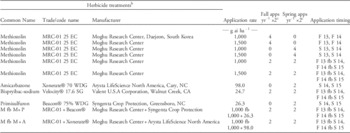
The experiments at each location were arranged in a randomized complete block design with three replications. Plot sizes at PDRC and HCPR were 1.8- by 1.8-m and 1.8- by 6.1-m, respectively. The complete list of herbicide treatments and application regimes is summarized in Table 1. Treatments also included a nontreated check for comparison. All herbicide treatments were applied with a CO2-pressurized backpack sprayer equipped with TTI11004 nozzles (Teejet Technologies, Springfield, IL 62703), which delivered 281 L ha−1 of spray solution at 290 kPa. All herbicide treatments were applied at 2-wk intervals within a given season, and the treatment programs were implemented both spring and fall for two consecutive years. Whenever applicable, methiozolin-only treatments were watered in with 5-mm irrigation before the foliage could dry, because methiozolin activity is dependent on root uptake and acropetal mobility (Koo et al. Reference Koo, Hwang, Jeon, Kim, Lim, Lee and Cho2014). After treatment with primisulfuron or amicarbazone alone or tank-mixed with methiozolin, the trial area was kept irrigation-free for at least 12 hr. When methiozolin and bispyribac-sodium were sprayed at the same application timing, methiozolin-only treatments were applied and watered in first followed by bispyribac-sodium application.
List of herbicide treatments and application programs used in the study to evaluate long-term roughstalk bluegrass control in creeping bentgrass golf fairways at Highland Course of Primland Resort in Meadows of Dan, VA, and Pete Dye River Course of Virginia Tech in Radford, VA.Footnote a

a Abbreviations: 13, year 2013; 14, year 2014; A, amicarbazone; app, application; F, fall; fb, followed by; M, methiozolin; P, primisulfuron; S, spring.
b All treatments were applied with a CO2-pressurized backpack sprayer equipped with TTI11004 nozzles, which delivered 281 L ha−1 of spray solution at 290 kPa. Whenever applicable, methiozolin-only treatments were watered in with 5 mm of irrigation before the foliage could dry, because methiozolin activity is dependent on root uptake and acropetal mobility (Koo et al. Reference Koo, Hwang, Jeon, Kim, Lim, Lee and Cho2014). When tank-mixed with primisulfuron or amicarbazone, the trial area was kept irrigation-free for at least 12 hr. When methiozolin and bispyribac-sodium were sprayed at the same application timing, methiozolin-only treatments were applied and watered in first followed by bispyribac-sodium application.
c The symbol ×2 after fall or spring app yr −1 indicates that the given herbicide application was repeated the following season or application timing for two consecutive years, for a total of eight applications for methiozolin-containing and bispyribac-sodium treatments and four applications for primisulfuron and amicarbazone alone. Within a season, all herbicide treatments were applied at 2 wk intervals.
Data were collected from each site on a biweekly interval in fall and spring for a total of 20 evaluations over the trial duration. Data collected included visually-estimated and line-intersect cover assessments and visually-estimated injury assessments for creeping bentgrass and control assessments for roughstalk bluegrass. Visual estimations of injury and control were made on a 0% to 100% scale based on a reduction in healthy, green tissue compared with nontreated areas, where 0% was no injury, 30% was maximum acceptable injury, and 100% was complete loss of all green tissue and death of plants (Frans et al. Reference Frans, Talbert, Marx and Crowley1986). Because roughstalk bluegrass becomes more conspicuous in spring, both line-intersect and visual estimations were used to assess plant cover. Plant cover was assessed with the line-intersect method on the entire plot at 81 intersections per square meter in each of the three spring seasons during the trial duration.
Overall turf quality data were also assessed at each rating date on a 1 to 9 scale, where 9 was ideal turf quality, 6 was minimally acceptable turf quality, and 1 was a complete loss of green turf. Turf NDVI was collected at all rating dates using a multispectral analyzer (Crop Circle™ Model ACS-210, Holland Scientific Inc., 6001 South 58th Street, Lincoln, NE 68516). In addition to whole-plot assessment, NDVI data were also collected separately for creeping bentgrass and roughstalk bluegrass by collecting spectral reflectance data on separate 4.91-cm2 areas of species of interest. Separate NDVI ratings were collected for different species with a hand-held spectroradiometer (Spectral Evolution PSR-1100, Spectral Evolution, 1 Canal St, Lawrence, MA 01840).
The average response of all 20 evaluation dates over the 2.5-yr trial duration and the final response at 1 yr after last treatment (YALT) were analyzed separately for each response. Data for each response variable were tested for normality using PROC UNIVARIATE and Shapiro-Wilk statistic in SAS software (version 9.2, SAS Institute, 100 SAS Campus Drive, Cary, NC 27513-2414), and homogeneity of variance was confirmed by visually inspecting plotted residuals and other metrics using the DIAGNOSTIC option of PROC PLOT in SAS. Homogeneity of variance was further assessed using Levene’s test where one-way ANOVAs for main effects or all possible combinations of factorial levels were tested using the HOVTEST WELCH option in the MEANS statement of PROC GLM in SAS. When needed, data were log or arcsin square-root transformed to meet the assumptions of ANOVA. In cases where transformation was needed, data were back-transformed for presentation clarity. A similar approach for determining data normality and homogeneity of variance to meet assumptions of ANOVA has also recently been used by other researchers (Brewer et al. Reference Brewer, Willis, Rana and Askew2016; Rana and Askew Reference Rana and Askew2016). All measured responses were subjected to a combined ANOVA using PROC GLM in SAS with the sum of squares partitioned to reflect the effects of the block, and also trial/location, herbicide program, and their interactions. Main effects and interactions were tested using mean square error associated with the random variable interaction (McIntosh Reference McIntosh1983). Appropriate means were separated using Fisher’s protected LSD at 5% level of significance. To test the correlation of visually estimated plant cover with cover evaluated using the line-intersect method, plant cover data were also subjected to PROC CORR in SAS to determine the Pearson’s correlation coefficient among the two plant cover assessment methods used in the study.
Results and Discussion
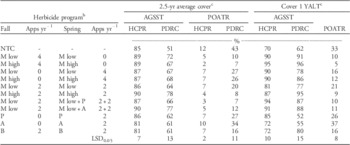
When averaged over all plots, creeping bentgrass initial cover was 93% and 50%, while roughstalk bluegrass initial cover was 7% and 50% at HCPR and PDRC, respectively (data not shown). Creeping bentgrass average cover had a significant trial-by-treatment interaction (P=0.0360); therefore, data were separated by trial (Table 2). At HCPR, methiozolin applied only in fall at either rate, or split between fall and spring at 1,500 g ha−1, yielded an average creeping bentgrass cover of 89% to 90%. This was higher than that of plots treated with amicarbazone and bispyribac-sodium alone (Table 2). At PDRC, all methiozolin-containing treatments produced creeping bentgrass cover of 64% to 78%, which was higher than that of the nontreated check but equivalent to comparison treatments (Table 2). Regardless of trial, none of the spring-only methiozolin treatments produced creeping bentgrass cover greater than non-methiozolin treatments (Table 2).
Average green cover observed in 20 evaluations of creeping bentgrass and roughstalk bluegrass over a 2.5-yr period and at 1 yr after last treatment (YALT), where fall and/or spring herbicide programs were applied for two consecutive years.Footnote a

a Abbreviations: A, amicarbazone at 98 g ai ha−1; AGSST, Agrostis stolonifera L. (creeping bentgrass); B, bispyribac-sodium at 24.7 g ha−1; LSD, Fisher’s protected LSD at 5% level of significance; M low, methiozolin at 1,000 g ha−1; M high, methiozolin at 1,500 g ha−1; Apps yr−1, number of applications per year; HCPR, creeping bentgrass fairway site at Highland Course of Primland Resort in Meadows of Dan, VA; NTC, nontreated check; P, primisulfuron at 26.3 g ha−1; PDRC, creeping bentgrass fairway site at Pete Dye River Course of Virginia Tech in Radford, VA; POATR, Poa trivialis L. (roughstalk bluegrass); YALT, year after last treatment.
b For both studies (HCPR and PDRC), herbicide programs were applied in two consecutive years for a total of eight applications for methiozolin-containing and bispyribac-sodium treatments and four applications for primisulfuron and amicarbazone alone. Within a season, all herbicide treatments were applied at 2 wk intervals.
c Plant cover was visually estimated by species as percent green tissue on a 0% to 100% scale and averaged over 20 evaluations made during a 2.5-yr period. Cover at 1 YALT was based on line-intersect counts where species present at each of 794 and 239 intersects were assessed in 3.34- and 11.1-m2 plots at HCPR and PDRC, respectively, on April 29, 2016. For both creeping bentgrass and roughstalk bluegrass, 2.5-yr average and 1 YALT cover had a significant trial-by-treatment interaction (P<0.05); therefore, cover data were separated by trials.
For each of the three spring assessments, the visual plant cover ratings for creeping bentgrass and roughstalk bluegrass were highly correlated with the quantitative plant cover assessed via the line-intersect method. Regardless of plant species, the Pearson correlation coefficient between visual and quantitative cover assessments was ≥0.93 (data not shown); this is consistent with other peer-reviewed research (Elmore et al. Reference Elmore, Brosnan, Mueller, Horvath, Kopsell and Breeden2013; Gannon et al. Reference Gannon, Jeffries, Brosnan, Breeden, Tucker and Henry2015; Hoyle et al. Reference Hoyle, Yelverton and Gannon2013).
At 1 YALT, creeping bentgrass cover (evaluated with the line-intersect method) had a significant trial-by-treatment interaction (P=0.0043); therefore, data were separated by trials (Table 2). All methiozolin-containing treatments maintained creeping bentgrass cover ≥81% at HCPR and ≥77% at PDRC, higher levels than those of the nontreated checks (Table 2). The inherent high creeping bentgrass cover with little to no injury observed in the majority of the treatments may explain the lack of treatment differences at HCPR and the significant trial-by-treatment interaction for creeping bentgrass average and 1 YALT cover among the two trial locations (Tables 2 and 3).
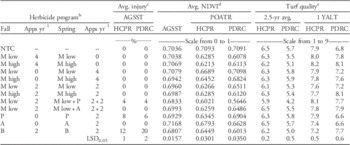
Average creeping bentgrass injury, creeping bentgrass and roughstalk bluegrass normalized difference vegetative index (NDVI), and turf quality following 20 evaluations over a 2.5-yr period and turf quality at 1 yr after last treatment (YALT), where fall and/or spring herbicide programs were applied for two consecutive years.Footnote a

a Abbreviations: A, amicarbazone at 98 g ai ha−1; AGSST, Agrostis stolonifera L. (creeping bentgrass); B, bispyribac-sodium at 24.7 g ha−1; LSD, Fishers protected LSD at 5% level of significance; M low, methiozolin at 1,000 g ha−1; M high, methiozolin at 1,500 g ha−1; Apps yr−1, number of applications per year; HCPR, creeping bentgrass fairway site at Highland Course of Primland Resort in Meadows of Dan, VA; NDVI, normalized difference vegetative index; NTC, nontreated check; P, primisulfuron at 26.3 g ha−1; PDRC, trial at Pete Dye River Course of Virginia Tech in Radford, VA; POATR, Poa trivialis L. (roughstalk bluegrass); YALT, year after last treatment.
b For both studies (HCPR and PDRC), herbicide programs were applied in two consecutive years for a total of eight applications for methiozolin-containing and bispyribac-sodium treatments and four applications for primisulfuron and amicarbazone alone. Within a season, all herbicide treatments were applied at 2 wk intervals.
c Creeping bentgrass injury was visually estimated as percent reduction in green tissue on a 0% to 100% scale, where 0% indicated no reduction in green tissue and 100% indicated no green tissue. The injury estimates were averaged over 20 evaluations made during a 2.5-yr period. Creeping bentgrass average injury had a significant trial-by-treatment effect (P<0.0001); therefore, injury data were separated by trials.
d Creeping bentgrass and roughstalk bluegrass NDVI data were collected using a spectroradiometer (Spectral Evolution PSR-1100) and averaged over 20 evaluations made during a 2.5-yr period. Creeping bentgrass and roughstalk bluegrass average NDVI had a significant trial-by-treatment interaction (P<0.05); therefore, NDVI data were separated by trials. At 1 YALT, the overall plot and species-wise NDVI in treated plots was not different than that of the nontreated checks (data not shown).
e Turf quality was assessed on a 1 to 9 scale, where 9 was ideal turf quality, 6 was minimally acceptable turf quality, and 1 was a complete loss of green turf. The 2.5-yr average quality represents turf quality measurements averaged over 20 evaluations made during a 2.5-yr period and the final evaluation made on April 29, 2016. Both average and 1 YALT turf quality measurements had a significant trial-by-treatment interaction (P<0.05); therefore, turf quality data were separated by trial.
Creeping bentgrass injury had a significant trial-by-treatment interaction (P<0.0001); therefore, injury data were separated by trials (Table 3). Methiozolin-only treatments did not injure creeping bentgrass regardless of application rate and timing (Table 3). Hoisington et al. (Reference Hoisington, Flessner, Schiavon, McElroy and Baird2014) reported that methiozolin rates of 500 to 2,600 g ha−1 reduced creeping bentgrass growth by 50%, and rates of 600 to 4,500 g ha−1 caused 25% turf injury averaged over eight creeping bentgrass cultivars, depending on location and evaluation timing. However, the Hoisington et al. (Reference Hoisington, Flessner, Schiavon, McElroy and Baird2014) study did not include creeping bentgrass cv. ‘L-93’, which was used in the current study. In addition, Hoisington et al. (Reference Hoisington, Flessner, Schiavon, McElroy and Baird2014) made methiozolin applications 7 and 12 wk after seeding creeping bentgrass cultivars in the greenhouse, while in our study, field applications were made on a well-established creeping bentgrass fairway. Other researchers have reported minimal injury to greens-height creeping bentgrass cv. ‘Pencross’ in response to sequential methiozolin applications (Brosnan et al. Reference Brosnan, Henry, Breeden, Cooper and Serensits2013; Xiong et al. Reference Xiong, Moss, Haguewood and Koh2015). Methiozolin has also been reported safe for 110 varieties of Kentucky bluegrass, another preferred cool-season turfgrass for golf fairways and athletic fields, at rates needed to control annual bluegrass and other winter annual weeds (Rana and Askew Reference Rana and Askew2016).
Although only primisulfuron- and bispyribac-sodium-containing treatments injured creeping bentgrass in both trials, the possible source of the trial-by-treatment interaction was the higher injury observed following bispyribac-sodium applications at PDRC (Table 3). Average creeping bentgrass injury following bispyribac-sodium applied at 24.7 g ha−1 was 20% at PDRC, but was only 12% at HCPR (Table 3). Peak creeping bentgrass injury following fall applications of bispyribac-sodium was 78% at PDRC, but was 46% at HCPR (data not shown). Higher creeping bentgrass injury at PDRC than at HCPR cannot be definitively explained, but the inconsistency may be due to differences in turf management between sites. McCullough and Hart (Reference McCullough and Hart2006) reported injury to creeping bentgrass cv. ‘L-93’ in response to bispyribac-sodium when grown in growth chambers. More injury was observed at 10 C than at 20 and 30 C. Average monthly temperatures between HCPR and PDRC did not vary by more than 3 C in any month over the 2.5-yr study duration (data not shown). The differences in creeping bentgrass response to bisypyribac-sodium across trials could be an artifact of overall greater management intensity at HCPR than at PDRC. For example, mowing height was at least 3 mm lower at HCPR than it was at PDRC.
Fall applications of bispyribac-sodium at 24.7 g ha−1 caused creeping bentgrass greater and more persistent injury than did spring applications (data not shown). Spring applications of bispyribac-sodium at 24.7 g ha−1 injured creeping bentgrass ≤15% 2 wk after the second spring application. Higher persistent creeping bentgrass injury in response to fall-applied bispyribac-sodium could be attributed to the fact that the late-fall and winter temperatures during and after treatment were lower than the temperatures in the spring. Higher creeping bentgrass sensitivity to bispyribac-sodium at lower temperatures has been previously reported under growth chamber (McCullough and Hart Reference McCullough and Hart2006) and field (Lycan and Hart Reference Lycan and Hart2006) conditions.
The highest creeping bentgrass injury from primisulfuron at 26.3 g ha−1 alone and tank-mixed with methiozolin applied in spring was 32% 2 wk after the initial spring treatment and 40% 2 wk after the second spring treatment. However, the injury was transient, and creeping bentgrass recovered completely within 4 wk after the second treatment (data not shown). To our knowledge, no peer-reviewed reports have documented primisulfuron injury to creeping bentgrass. Amicarbazone at 98 g ha−1 did not injure creeping bentgrass in the current study; however, amicarbazone can cause significant injury to creeping bentgrass under warmer temperatures (McCullough et al. Reference McCullough, Hart, Weisenberger and Reicher2010). McCullough et al. (Reference McCullough, Hart, Weisenberger and Reicher2010) reported creeping bentgrass cv. ‘L-93’ injury of 4% to 19% at 4 wk and 6% to 44%, depending on location, 6 to 8 wk after sequential fall applications of amicarbazone at 100 g ha−1. However, the same rate of amicarbazone applied in spring injured creeping bentgrass ≤5% 2 to 4 WAT, with complete recovery by 6 to 8 WAT, depending on location (McCullough et al. Reference McCullough, Hart, Weisenberger and Reicher2010).
Roughstalk bluegrass average cover had a significant trial-by-treatment interaction (P<0.0001); therefore, cover data were separated by trials (Table 2). In all treatments except amicarbazone at 98 g ha−1 applied alone at PDRC, roughstalk bluegrass cover was lower than it was in the nontreated check (Table 2). Regardless of trial, treatments containing fall applications of methiozolin reduced roughstalk bluegrass cover more than spring-only applications did, except methiozolin at 1,000 g ha−1 applied twice in fall fb twice in spring (Table 2). Plots treated with bispyribac-sodium at 24.7 g ha−1 had 7% and 16% average roughstalk bluegrass cover at HCPR and PDRC, respectively, which constituted a 63% and 42% cover reduction compared to the nontreated check (Table 2). However, better roughstalk bluegrass cover reduction with bispyribac-sodium at PDRC came at the expense of higher and unacceptable creeping bentgrass injury. This was especially true for fall applications , which injured creeping bentgrass ≥60%, 4 times the injury level caused by the spring applications (data not shown). Bispyribac-sodium efficacy for controlling roughstalk bluegrass in creeping bentgrass has been reported by other researchers, but trends were inconsistent and dependent on creeping bentgrass cultivars, trials, and temperature (McCullough and Hart Reference McCullough and Hart2006; McCullough and Hart Reference McCullough and Hart2011; Morton et al. Reference Morton, Weisenberger, Reicher, Branham, Sharp, Gaussoin, Stier and Koeritz2007; Thompson et al. Reference Thompson, Sousek, Richer, Fry and Kennelly2016).
At 1 YALT, roughstalk bluegrass cover had a significant treatment effect (P=0.0009) but no trial-by-treatment interaction (P=0.1446); therefore, data were pooled over trials (Table 2). Methiozolin at 1,500 g ha−1 applied only in fall yielded roughstalk bluegrass cover of 5%, which was equivalent to all treatments containing fall applications of methiozolin (9% to 11%), except methiozolin at 1,000 g ha−1 applied twice in fall fb twice in spring (Table 2). Methiozolin applied in spring yielded roughstalk bluegrass cover equivalent to fall-only applications of methiozolin at 1,500 g ha−1 only when the higher rate was used (Table 2). No other peer-reviewed research has evaluated roughstalk bluegrass response to methiozolin over a period of 2.5 yr and at 1 YALT. At 1 YALT, spring-only applications of methiozolin at 1,000 g ha−1 and split applications of bispyribac-sodium had 16% roughstalk bluegrass cover, which was greater than fall-only applications of methiozolin at 1,500 g ha−1 but equivalent to the rest of the treatments containing fall applications of methiozolin (Table 2). Over a 3-yr-long study, McCullough and Hart (Reference McCullough and Hart2011) observed significant roughstalk bluegrass suppression with summer applications of bispyribac-sodium; however, roughstalk bluegrass regrew during fall months, thus long-term control was poor.
Creeping bentgrass 2.5-yr average NDVI had a significant treatment effect (P=0.0052), but no trial-by-treatment interaction (P=0.7735), whereas, roughstalk bluegrass average NDVI had a significant trial-by-treatment interaction (P=0.0002). Therefore, creeping bentgrass NDVI was pooled over trials, but roughstalk bluegrass NDVI was separated by trial (Table 3). Plots treated with bispyribac-sodium and primisulfuron tank-mixed with methiozolin had average creeping bentgrass NDVI of 0.6807 and 0.6833, respectively, which was lower than that of the nontreated check. Lower creeping bentgrass NDVI readings in response to bispyribac-sodium and primisulfuron tank-mixed with methiozolin applications were consistent with creeping bentgrass average injury data (Table 3). All treatments in each trial, except amicarbazone alone at HCPR, resulted in roughstalk bluegrass NDVI values significantly lower than those of the nontreated check (Table 2). In addition, the majority of fall-applied methiozolin treatments that reduced roughstalk bluegrass average cover the most also resulted in lower NDVI compared to spring-only applications of methiozolin (Tables 2 and 3).
Average and 1 YALT turf quality had significant trial-by-treatment interactions (P<0.0001); therefore, data were separated by trials (Table 3). Regardless of trials, the nontreated check was equivalent to the highest turf quality. Comparatively better quality of the nontreated plots was attributed to injured or dying roughstalk bluegrass observed in the treated areas. The majority of treatments at HCPR produced turf quality higher than the minimally-acceptable level of 6.0; however, none of the treatments produced turf quality higher than 5.9 at PDRC. These variations may be due to differences between HCPR and PDRC in management intensity and roughstalk bluegrass density within fairways. Moreover, the majority of plant response evaluations were collected during late fall/early winter or early spring, when turf was either undergoing or recovering from winter dormancy or injury, and control from herbicide treatments was greatest. At 1 YALT, regardless of trial, all treatments had a turf quality ≥6.6, which is higher than the minimally acceptable level of 6.0 (Table 3). At HCPR, all treatments, except amicarbazone and bispyribac-sodium alone yielded turf quality ≥7.7 (Table 3). Although the intensity of management practices at HCPR hindered the ability to better separate treatments for turf quality, 7 out of 11 herbicide treatments at PDRC yielded turf quality ≥7.6 and higher than the nontreated check (Table 3).
Results from this study suggest that fall applications of methiozolin generally control roughstalk bluegrass better than spring-only applications. Methiozolin alone, at the rates evaluated, did not injure creeping bentgrass regardless of application rate or timing. For effective and consistent long-term roughstalk bluegrass control with safety to fairway-height creeping bentgrass, methiozolin at 1,500 g ha−1 applied four times in fall or twice in fall fb twice in spring at 2-wk intervals for two consecutive years is effective. When using rate of 1,000 g ha−1, methiozolin should be either applied all in fall or applied twice in fall fb twice in spring with amicarbazone (primisulfuron is not yet registered for use in turf) for two consecutive years. Care should be taken to avoid creeping bentgrass varieties and temperature conditions during and after applications that could result in unacceptable creeping bentgrass injury by amicarbazone. Amicarbazone and primisulfuron alone applied in spring and bispyribac-sodium applied twice in fall fb twice in spring for two consecutive years were either ineffective or inconsistent at selectively and safely controlling roughstalk bluegrass in creeping bentgrass.
Acknowledgments
The authors would like to thank Moghu Research Center for providing technical information and methiozolin (MRC-01 250 EC) for research testing. Gratitude is also extended to golf course superintendents Brian Kearns and Mark Cote and their crew members at the Primland Resort and Pete Dye River Course of Virginia Tech in Meadows of Dan and Radford, Virginia, respectively, for their support, feedback, and help finding appropriate sites for conducting this research.