Lost in translation
The lagged disconnection between science and practice in (behavioral) medicine has a long, unfortunate tradition. Research evidence on dissemination and implementation (D&I) efforts suggests that research reaches clinical practice an average of 17 years after getting published (Morris et al., Reference Morris, Wooding and Grant2011), not to mention the additional years for widespread, sustained adoption. A lapse of 17 years translates to almost an entire generation of individuals aging into older adulthood, meanwhile, generations of older adults with whom the research was conducted may not benefit. Further, given the life course nature of health and wellness, the relevance of implementing 17-year-old results to future aging cohorts is questionable. Researchers across fields have realized that more traditional methods of disseminating science (e.g. peer-reviewed journals) are failing to meet the needs of providers and the public (Brownson et al., Reference Brownson2018). Achieving widespread D&I of evidenced-based geroscience may require embracing other, supplementary, nontraditional methods of promoting geroscience to improve the uptake, effectiveness, and efficiency of aging policy and clinical practice (Kaslow, Reference Kaslow2015). There are other direct-to-consumer approaches that could improve wider dissemination and more efficient implementation, such as advocacy in public policy arenas and public science communication (i.e. SciComm) (Brownson et al., Reference Brownson2018). If geroscience is to thrive and inform everyday living, geroscientists must become savvy in communication methods that most effectively move the dial for not only providers, but policy-makers, older communities, and consumers. This paper provides a rationale for using communication methods that embrace innovative mechanisms and formats (e.g. social media) for translating and implementing geroscience to researchers, providers, communities, and consumers.
Dissemination and implementation science
D&I science has been attempting to close the existing gap between research and widespread use of evidence-based practice, focusing on transferring knowledge and sustaining change in real-world practice and/or behavior in a more efficient manner (Nilsen, Reference Nilsen2015; Shelton et al., Reference Shelton2020). The emphasis of D&I in fields such as public health has been more focused on disseminating to wider audiences (e.g. policy-makers, communities, consumers) and implementation across clinical and community settings (Blachman-Demner et al., Reference Blachman-Demner, Wiley and Chambers2017; Brownson et al., Reference Brownson2018). Recent examples of using a D&I framework to effectively inform the public have included cancer awareness campaigns on Twitter (e.g. Xu et al., Reference Xu, Markson, Costello, Xing, Demissie and Llanos2016). However, studies have also shown low rates of uptake on using avenues such as social media to reach wider audiences with public health education (Harris et al., Reference Harris, Mueller, Snider and Haire-Joshu2013).
Several large research funding agencies have called for a wider translation of research knowledge to entities such as public policy-makers and the general public, yet few actions have been taken to further those goals (Brownson et al., Reference Brownson2018; Green et al., Reference Green, Ottoson, Garcia and Hiatt2009). For researchers in aging, part of the challenge may be fewer funding avenues for D&I projects, with only one D&I project funded through the National Institute of Aging from 2007 to 2014 (vs. 46 at the National Cancer Institute and 40 at the National Institute for Mental Health; Purtle et al., Reference Purtle, Peters and Brownson2015) and less than 5% of newly funded projects in 2015 focused on D&I (Prusaczyk, Reference Prusaczyk2016). Geroscience researchers continue making considerable efforts to understand and use D&I frameworks in hopes of reducing lagged implementation of evidence-based programs in areas such as dementia care (see Gitlin et al., Reference Gitlin2020). However, there is still a long way to go before sustained use of these programs is achieved, to say little of how the information will reach a broader, public audience. Generally, D&I science is a significant improvement over traditional methods of peer-reviewed journals as a primary dissemination mechanism and can make a broader impact by widening the audience of both D&I to include policy-makers and the public (Brownson et al., Reference Brownson2018).
Shooting the messenger: A critique of peer review as a primary dissemination tool
Trends in peer review
Science has several goals, including generating and sharing new knowledge. The current system of dissemination of scientific knowledge is done via accessing peer-reviewed scholarly journal papers. The academic climate, with its “publish or perish neurosis” (Bekoff, Reference Bekoff1989), places a large premium on communicating scientific results to other experts and tethering academic merit to the quality and quantity of one’s publications in high impact peer-reviewed journals (De Rond and Miller, Reference De Rond and Miller2005; Kreiner, Reference Kreiner2016). Some may equate more published output with more discovery, more knowledge, and an improving scientific enterprise (Bauerlein et al., Reference Bauerlein, Gad-el-Hak, Grody, McKelvey and Trimble2010). Rather, it appears that as the volume of published content increases, its overall scientific merit decreases (Evans, Reference Evans2008), at times filling journals with research that is of questionable relevance (Bauerlein et al., Reference Bauerlein, Gad-el-Hak, Grody, McKelvey and Trimble2010). For example, to increase h-index scores as part of a strong publish or perish culture, researchers may “salami slice” papers into their least publishable units (Committee on Publication Ethics, 2005) thereby inflating their number of publications and increasing potential for citation. Several geriatrics and gerontology journals, including Advances in Gerontology and GeroScience, have recently added salami-slicing clauses into their submission guidelines, cautioning against this behavior. The peer-review climate of academia can also incentivize researchers to cite the same small pool of studies, narrowing the range of findings built upon. In fact, an active core of authors appears responsible for 42% of papers and 87% of very highly cited papers (Ioannidis et al., Reference Ioannidis, Boyack and Klavans2014), though these trends within geriatrics and gerontology require more investigation.
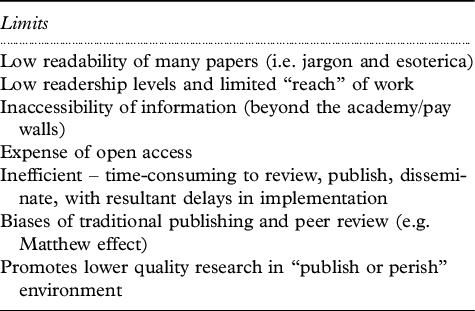
Limits of the current knowledge dissemination model (see Table 1)
Table 1.
Limits of the traditional dissemination model
Neither peer-review nor scholarly journals are inherently a danger to science. It is more often the culture within which these scholarly activities are conducted, that has, over time, lessened the true impact of science, while upholding the impact factor of a publish or perish environment. For instance, readability of scientific text has decreased over time and notoriously contains esoterica, jargon, and abbreviations that lack digestibility (Hales et al., Reference Hales, Williams and Rector2017). Also, cited papers do not necessarily mean read papers (Biswas and Kirchherr, Reference Biswas and Kirchherr2015). According to the 2015 STM report, which provides an illustrative overview of trends in scientific and scholarly publishing (Ware and Mabe, Reference Ware and Mabe2015), 28,100 active, English journals existed in 2014, collectively publishing approximately 2.5 million papers annually. More recently, research on publishing trends in geriatrics and gerontology journals remains limited; however, one study illustrated a similar growth in journals, rising from 31 to 50 during 2007–2014 (Ang and Kwan, Reference Ang and Kwan2017). Citation analyses estimate that as many as 50% of papers have no other readers beyond their authors, referees, and journal editors (Meho, Reference Meho2007). More conservative estimates put this rate at 20%, speculating that an average paper in a peer-reviewed journal has an audience of no more than 10 people (Biswas and Kirchherr, Reference Biswas and Kirchherr2015). Overlap between authors and readers also varies considerably between disciplines; but in narrow fields, such as geroscience, the overlap may look closer to 100% (Ware and Mabe, Reference Ware and Mabe2015).
The resources, time, and budgets involved in publishing have pushed academia to reevaluate its primary dissemination methods, pitting the costs of peer review against the benefits of other methods. Even in the age of the Internet, many journals take more than a year to publish a paper, further delaying D&I efforts (Smith, Reference Smith2006) to providers, communities, and the older adult consumers. Beyond the substantial opportunity cost spent reviewing, revising, and resubmitting (Smith, Reference Smith2006), the largest open-access publishers charge between $1350 and 2250 to publish, although their most selective offerings charge $2700–2900 (Van Noorden, Reference Van Noorden2013). Attempting to access papers and journals beyond the password-protected walls of the ivory tower poses another barrier. The open science movement, which aims to make research processes transparent and collaborative and published scientific literature freely available (Nosek et al., Reference Nosek2015) has gained some traction. However, the emergence of predatory journals, cost of open access, and overall skepticism have limited the uptake and impact of open access (Earnshaw et al., Reference Earnshaw, De Silva and Excell2019) Geroscience still has a considerable way to go to adopt a process of information dissemination that pairs the more traditional publishing paradigm with more innovative and efficient models.
Bias in the peer-review process represents another shortcoming of the current model, with the most famous piece of evidence coming from Peters and Ceci’s seminal 1982 study on the subject (as cited in Smith, Reference Smith2006). The authors illustrated the Matthew effect in publishing – “to those who have, shall be given; to those who have not shall be taken away” – by repurposing published papers with different, fabricated institutional affiliations. In only 3 of the 12 cases did the journals realize that they had already published the paper, and 8 of the remaining 9 got rejected, providing evidence of bias against authors from less prestigious institutions (Smith, Reference Smith2006). This has unique implications for burgeoning, “publication-poor” academics upon whom the advancement of modern geroscience often depends.
So what?
With most geroscience research hidden behind the password-protected walls of the ivory tower, the challenge is for it to reach both academic peers and broader audiences of providers and older adults – the very people our work aims to serve. If not from our research, where will they obtain readily available, evidence-based information on aging and health? The evidence overwhelmingly points to the Internet (Brossard and Scheufele, Reference Brossard and Scheufele2013) – an open source often wrought with misinformation that could endanger consumers and providers. For example, older adults represent a growing Internet base and their use of social media continues increasing (Hunsaker et al., Reference Hunsaker, Hargittai and Piper2020). Over 60% of individuals in the USA reported using the Internet as a primary source of information (Brossard and Scheufele, Reference Brossard and Scheufele2013), and user dynamics on social media sites suggest that most users seek out confirming information from a small number of sources (Schmidt et al., Reference Schmidt2017). Misinformation is a juggernaut on the Internet, with companies like Google working actively against its spread (e.g. pledging 6.5 million to the cause) to help preserve public health integrity (Mantzarlis, Reference Mantzarlis2020). With 84% of adults aged 65–74 having Internet access and smartphone usage quadrupling among older adults from 2010 to 2016, geroscientists face a competitive information environment with real-world implications (Anderson and Perrin, Reference Anderson and Perrin2017). Without an alternative to traditional research D&I methods, knowledge erodes and quality becomes relative in the open information market of the Internet. This effectively limits the consumption, implementation, improvement, and optimization of evidence-based practice and knowledge. As the world ages and changes, how can geroscientists communicate with a wider audience to promote and implement quality geoscience? What alternative, innovative, adjunctive models exist? More importantly, how can we use them and why should we?
The rise and promise of social media in academia
In 2015, Dr. Nadine Kaslow gave her the American Psychological Association (APA) presidential manifesto on public dissemination of psychological science, calling for an increase in the visibility, application, and implementation of behavioral science. Kaslow (Reference Kaslow2015) indicates it is “part of our contract with society” (p. 370), as our science can improve the lives of individuals and societies. This applies readily to geroscience and is the ultimate aim of our research as well. However, this requires a culture shift in academia, moving from the traditional “insider trading” of information to building skills in social media and public communication of science (i.e. SciComm) that will facilitate wider dissemination of research findings, and likely implementation as well. This is necessary, due in part to a shift in the culture of information sharing from an expert-based model of an individual or group sharing pieces of information to specific audiences to everyone with Internet not only having access to but the ability to collaborate in the process.
The current cultural climate also demands greater public engagement from geroscience researchers and practitioners, given the skepticism for science (e.g. older adults having the least confidence in scientists of any other age group; American Academy of Arts and Sciences; AAAS, 2018) and quick availability of mis/information. As most Americans use the Internet as a primary source for science information (Brossard and Scheufele, Reference Brossard and Scheufele2013), it behooves us as scientists to engage with this medium and to transform our information from privileged and specialized to meaningful, accessible, digestible, and actionable (i.e. easy to implement). This is particularly true for geroscientists, as much of the significant growth in mobile news usage was driven by older Americans, with 67% of those aged 65 and older now getting news on a mobile device (24% jump from 2017 to 2016; Bialik and Matsa, Reference Bialik and Matsa2017).
Social media, a group of online applications for the creation and exchange of user-generated information (Kaplan and Haenlein, Reference Kaplan and Haenlein2010), offers a promising conduit for this. It allows for greater dissemination of key research findings via more unidirectional communication strategies (e.g. posting a linked paper, online newsmagazine interview, podcast) and adds a unique bidirectional component (e.g. Twitter, Facebook, blog comments, wikis, likes, reposts). This bidirectionality permits live, ongoing discussions of our research with lay, interdisciplinary, and our own academic communities, co-constructing an understanding of how the information translates and can be implemented (Howell et al., Reference Howell, Nepper, Brossard, Xenos and Scheufele2019). Psychological science, among other fields, has gotten increasingly shared on social media (Kaslow, Reference Kaslow2015) with microblogs (i.e. character-limited writing resulting in brief, discrete postings (e.g. Twitter and Instagram) and blogs (i.e. online journals with entries in reverse chronological order) as more popular formats for dissemination (Kaplan and Haenlein, Reference Kaplan and Haenlein2010). Even these formats of dissemination, however, have low uptake (e.g. ~1/3 with Twitter accounts, 5% with blogs) in the academic community, including psychology (Weinstein and Sumeracki, Reference Weinstein and Sumeracki2017). With limited research, the number of geroscientists active on social media is yet unknown, as are the preferred methods of social media usage for active geroscience users.
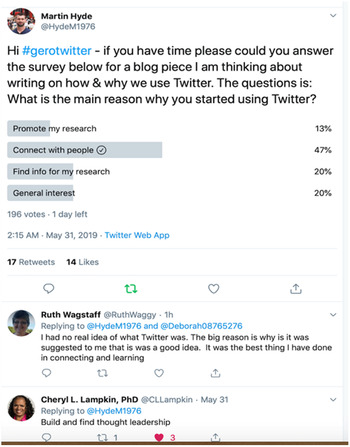
Twitter provides an on-demand social environment where research can be shared and discussed, with hashtags providing a way to aggregate information by topic (e.g. #caregiving) and groups with similar interests (e.g. #AcademicTwitter and #SoMePsychs). A primary example of geroscience is #GeroTwitter (Hyde, Reference Hyde2019). This hashtag emerged in January 2019 from Dr. Martin Hyde (@HydeM1976), a prominent geroscience researcher at Swansea University, as an attempt to create a space for gero researchers to share ideas, ask questions, seek advice, and connect within and across disciplines (see Figure 1). Examples of use have included sharing findings from current studies in plain language and concomitantly using hashtags from other disciplines (e.g. #MedTwitter) and tagging known individuals and groups of interest (e.g. legislators, federal agencies, aging-related think tanks like AARP) to disseminate to a wider audience. Twitter has also been used to discuss and inform projects, proposals, and reports among those in the geroscience research and aging communities, which are examples of implementation. Blogs – such as those available through the National Institute on Aging, Alzheimer’s Association, and AARP – also provide timely updates on relevant geroscience and clinical topics (e.g. COVID-19 and nursing homes, suicide and loneliness among older adults, Older Americans Act funding) more comprehensively, and can be used in tandem with microblogging (i.e. Twitter). For example, blogs such as Eng(aging) on Psychology Today can hyperlink direct access to recently published research and feature real-time commentaries from principal investigators and other researchers. There are several innovators sharing geroscience in the blog and Twittersphere (e.g. @DrSharronH, Living to 100 Club podcast, The World According to Dr. El blog); however, many remain either skeptical, unaware of the potential benefits, or unable to overcome typical challenges of effective social media engagement such as scheduling, timing, branding, and producing consistent content; mastering social media writing, navigating search engine optimization (SEO), and growing a following.
Figure 1.Example of use of #gerotwitter hashtag by creator, Martin Hyde, PhD.
However, the potential for disseminating and implementing geroscience through engagement on social media is promising. It offers an avenue to disseminate and discuss science as it emerges, in real time, and in response to current events (e.g. COVID-19, #MeToo, #OKBoomer, climate change) without many of the limits of traditional dissemination methods. Using social media may also help to attract the newest cohort of prospective geroscientists and clinicians, a group that uses social media often but has been challenging to recruit as demand for a geriatrics workforce increases. Further, the extent to which targeted, concerned social media campaigns can address the overall shortage of geriatrics providers offers another promising avenue for action and inquiry (American Geriatrics Society, n.d.).
The benefits of using social media to translate research findings
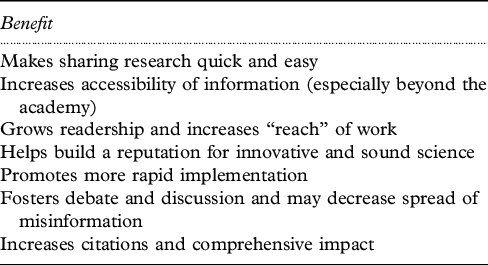
Engaging in research D&I activities via social media has many benefits for geroscientists, providers, and our older adult consumers (see Table 2). Admittedly, disseminating research via social media may not entirely stop the consumption of misinformation as much as it may increase consumption of and access to more reputable information. First, it provides more accessible and democratic access to science, reaching beyond privileged academic circles to cross disciplinary lines and provide public access (Kaslow, Reference Kaslow2015; Weinstein and Sumeracki, Reference Weinstein and Sumeracki2017). A key benefit of disseminating research via social media is the reach factor. Movements such as open science and introducing alternative metrics for published papers are a part of a major shift in the way we perceive the reach and impact of our research. Academics’ use of Twitter and other social media tools has been associated with both greater academic impact (e.g. h-index, JIF, citation count; Eysenbach, Reference Eysenbach2011) and a more “comprehensive impact” which takes into account the way research affects society, economy, culture, public policy, quality of life, and services – all examples of implementation (Ravenscroft et al., Reference Ravenscroft, Liakata, Clare and Duma2017, p. 4). Additionally, planned social media interventions (e.g. health communication messages) may provide a venue for broader implementation and increased uptake of health behavior interventions, though more research is needed to support social media’s utility in intervention work (Bou-Karroum et al., Reference Bou-Karroum2017).
Table 2.
Potential benefits of social media dissemination of research
Making geroscience more accessible has a dual benefit of showcasing its relevance to everyday issues and highlighting the value our work adds to improving the lives of older adults. As mentioned above, social media provides a conduit for on-demand information, allowing efficient dissemination of research knowledge on aging to current social problems, best clinical practices (Kaslow, Reference Kaslow2015), and to promote policies consistent with research that enhance healthspans and lifespans. For example, at the start of COVID-19, an interdisciplinary group of psychologists studying aging widely disseminated information on the diversity and impact of COVID-19 on older adults during a pandemic by publishing an op-ed in USA Today, which was tweeted and shared on Facebook as well as picked up by Rolling Stone magazine for further coverage (see Yuko, Reference Yuko2020). This included the geroscience of diversity in aging, and cautioned people to avoid a homogenous view of older adults, citing the potential damages and implications for clinical practice.
Social media dissemination also promotes more rapid implementation of research in aging, reaching professionals in applied settings who do not have access to peer-reviewed journals and may benefit from a more translational, applied take-home message (Weinstein and Sumeracki, Reference Bou-Karroum2017). We can also use social media tools to reach educators and policy-makers whose work aims to translate scientific research to a wider audience of students, stakeholders, and the general public. Providing digestible messages about aging and aging services via infographics, blog posts, podcasts, and using Twitter and Facebook to disseminate to a wider audience can move geroscience implementation forward in those arenas. Social media further allows geroscientists to build a reputation for innovative yet sound science by facilitating real-time sharing of timely information (i.e. latest and greatest), monitoring misperceptions of aging research, and offering instant commentary and discussion to correct any misunderstandings (Weinstein and Sumeracki, Reference Weinstein and Sumeracki2017).
Practical recommendations for using social media
When used well, social media can enhance academics’ and older adults’ lives and learning, though both risks and opportunities exist (Kind et al., Reference Kind, Patel, Lie and Chretien2014). Professional guidance can support effective social media use and help academics to avoid common pitfalls while upholding their professional values. Existing literature on the matter encourages academic social media newcomers to (1) identify their goals; (2) establish comfort; and (3) foster connections. In their 12-point framework for navigating social media use in the academy, Kind et al. (Reference Kind, Patel, Lie and Chretien2014) specifically emphasize (1) identifying and reflecting upon a digital identity and goals for using social media (i.e. what do you hope to accomplish/learn?); (2) observing and establishing comfort (i.e. “lurking before leaping”); (3) applying existing, “official” social media guidelines and developing individual guiding principles; (4) using social media to disseminate evidence-based health information; (5) engaging, learning, teaching, and mentoring, as well as (6) tapping into the power of community to advance productivity and expanding professional networks. Regarding dissemination, the authors encourage newcomers to actively share credible research (theirs or others), correct misinformation, to respond to inaccuracies, and to only disseminate information based on expert opinion, evidence, and science (Kind et al., Reference Kind, Patel, Lie and Chretien2014).
Potential barriers
Notwithstanding the benefits of using social media, dissemination of scientific results via these platforms has mixed reviews in academia, and uptake remains moderate to poor (Weinstein and Sumeracki, Reference Weinstein and Sumeracki2017). To increase social media use among geroscientists and practitioners, we must address the attitudinal, ethical, and logistical barriers.
Attitudes
Traditional means of dissemination (e.g. peer-reviewed journals) are privileged and afforded prestige, which has partially produced negative perceptions of sharing research on social media. For example, some worry that social media dilutes or “dumbs down” the research and may result in the public devaluation of our work, (Kaslow, Reference Kaslow2015). The unease some may feel in unregulated social media spaces – beneficial but certainly new and uncomfortable for many – may exacerbate this.
This underscores a significant source of social media skepticism for scientists: lack of control and regulation over the science (Weinstein and Sumeracki, Reference Bou-Karroum2017). What happens in the marketplace of ideas can yield high benefits, allowing researchers to shape understanding and be thought leaders via translation of our science. However, it also introduces potential error with the loss of control and the lack of guidelines and training for social media usage as a cause for hesitation among scientists across disciplines (Gholami-Kordkheili et al., Reference Gholami-Kordkheili, Wild and Strech2013; Kaslow, Reference Kaslow2015). This has prompted organizations (e.g. Association for Psychological Science) to develop trainings and ethical communication standards to guide social media use both to the public and among colleagues. These guidelines serve as integral tools for promoting effective science communication and for avoiding falling into common social media traps (i.e. feeding the trolls; bullying).
Guidelines and ethical considerations
Geroscientists and psychologists must understand and embrace this new digital culture while also maintaining their values and ethical principles (Lannin and Scott, Reference Lannin and Scott2013). Guidelines add value in new and changing areas, such as social media use among healthcare researchers and providers, and can help advise and mentor social media users and contemplators alike (Kind, Reference Kind2015). Guidelines can also identify opportunities and challenges that arise in new and evolving online platforms, with organizations such as the American Medical (AMA) and Psychological (APA) associations recognizing the need for such guidelines and increasingly providing them (e.g. APA, 2018). In the meantime, three principles, including beneficence, nonmaleficence, and integrity (APA, 2002; Beauchamp and Childress, Reference Beauchamp and Childress2013) can help guide ethical decision-making in the social media dissemination space. These principles, which comprise APA Ethical Standard 5.04, can advise geropsychologists and scientists how to take appropriate precautions when disseminating knowledge using social and related media (Lannin and Scott, Reference Lannin and Scott2013). First, geroscientists must consider the risks and rewards that dissemination might pose (i.e. beneficence; nonmaleficence) as well as accurately, democratically, and honestly disseminate their findings to preserve trust in the profession (i.e. integrity).
A related attitudinal barrier concerns skepticism of the “popularizers” – those scientists perceived to cherry-pick their most interesting, provocative messages for self-promotion, at the expense of quality and thoroughness (Kaslow, Reference Kaslow2015, p. 367). However, recent studies have shown that faculty, graduate students, and nonacademics have generally positive attitudes toward social media dissemination (Howell et al., Reference Howell, Nepper, Brossard, Xenos and Scheufele2019), and that scientists most active in dissemination activities have positive reputations (Eysenbach, Reference Eysenbach2011).
More specific guidelines will likely continue emerging as social media use evolves and demands for it in academia increase. Updating and modifying existing geropsychological training models such as the Pikes Peak Model for Training in Professional Geropsychology (Knight et al., Reference Knight, Karel, Hinrichsen, Qualls and Duffy2009) or the APA Guidelines for Psychological Practice with Older Adults (APA, 2014) to include guidance on these issues may promote competence in responsible dissemination, implementation, and social media use.
Pikes Peak competencies in geropsychology
Specifically, the Pikes Peak Model for Training in Professional Geropsychology provides an aspirational, competencies-based approach to training professional geropsychologists that outlines the attitudes, knowledge, and skills requisite for work with older adults (Knight et al., Reference Knight, Karel, Hinrichsen, Qualls and Duffy2009). Among other recommendations, its attitudes component encourages psychologists to consider individual diversity in all its manifestations (gender, age, cohort, sexual orientation) as well as to recognize how attitudes and beliefs about aging may influence assessment and treatment. The knowledge component emphasizes (1) general knowledge about adult development, aging, and the older adult population; (2) foundations of clinical practice with older adults; (3) assessment; and (4) foundations of intervention, consultation, and other service provision. Finally, the skill competencies of this model highlight professional geropsychology functioning, assessment, intervention, consultation, and delivery of service in different settings. In its current form, therefore, the Pikes Peak Model excludes research dissemination, implementation, and translation as foundational geropsychological competencies. This paucity highlights an exciting and meaningful opportunity to update and expand sections of this framework (i.e. skills) to include these as competencies for work with older adults in the era of social media.
Logistics
The traditional culture of academia, research dissemination, and implementation incentivizes publishing (or perishing) in peer-reviewed scholarly journals. Few examples of institutions that encourage and/or incentivize public engagement via social media exist. Further, there are few to no standards guiding social media activity in tenure and promotion materials, CVs, or biosketches for granting agencies. Not surprisingly, researchers often cite lack of time and incentive as factors in their hesitancy toward social media engagement (Weinstein and Sumeracki, Reference Weinstein and Sumeracki2017). These warrant both a culture shift within research institutions (Ravenscroft et al., Reference Ravenscroft, Liakata, Clare and Duma2017) toward embracing comprehensive impact and a perceptual one among geroscientists. Studies in social media engagement reveal that the most productive academics use nontraditional dissemination tools, such as social media, and that using these tools does not have a negative effect on meeting or exceeding traditional academic milestones (Eysenbach, Reference Eysenbach2011; Jensen et al., Reference Jensen, Rouquier, Kreimer and Croissant2008).
Another logistical barrier includes lack of knowledge and skills for translating research with social media (Kaslow, Reference Kaslow2015). For geroscientists, only a few avenues for training exist from experienced colleagues and aging organizations (e.g. Gerontological Society of America, APA, British Society of Gerontology), though some have started providing webinars and other trainings. However, this paucity identifies an opportunity for our organizations and leadership to embrace the changing climate of D&I and to provide training resources for both current and emerging scholars in effective science communication and public engagement.
Next steps
What can we do? Shifting the culture will involve more than creating an account and logging on, though there are worse ideas. To start, publishing (and #Tweeting) more papers giving fellow academics permission to explore their options can help to nudge the paradigm and normalize the practice. As mentioned, embracing social media may also help to attract a new generation of geriatrics scholars and clinicians, particularly as demand for geriatrics providers increases but supply only modestly increases (American Geriatrics Society, n.d.). To engage and empower everyone else, those in higher education may consider the steps of progressive scholars and institutions – including the London School of Economics (LSE) – who, as part of their culture, have embraced blogging (i.e. LSE Impact Blog) as well as codified and disseminated social media trainings students and faculty (LSE Impact Blog, n.d.). The rise and promise of social media may warrant integrating such trainings into curricula for healthcare professionals, or at the very least, offering them as continuing education opportunities (e.g. CME credit) at scientific conferences, community outreach events, and online webinars. For example, the AMA has moved to include social media in medical education (i.e. both teaching about social media and using it in curricular delivery) and to trust trainees to use it properly rather than to limit their access (Kind, Reference Kind2015). With competencies in professionalism, ethical conduct, and communication, geroscientists and clinicians may benefit from receiving similar treatment that entrusts them with responsible social media use upon entering the academy. Education in this space will grow in its importance as social media increasingly penetrates quality improvement initiatives, patient engagement efforts, and the measurement of scholarly impact using “altmetrics” (alternative, nontraditional metrics such as online engagements) (Kind, Reference Kind2015). Of course, careful research evaluating the impact of social media on the accessibility, quality, uptake, and implementation of our science must undergird these shifts and be coupled with ethical best practices to secure the public’s trust.





 You have
Access
Lost in translation
The lagged disconnection between science and practice in (behavioral) medicine has a long, unfortunate tradition. Research evidence on dissemination and implementation (D&I) efforts suggests that research reaches clinical practice an average of 17 years after getting published (Morris et al., Reference Morris, Wooding and Grant2011), not to mention the additional years for widespread, sustained adoption. A lapse of 17 years translates to almost an entire generation of individuals aging into older adulthood, meanwhile, generations of older adults with whom the research was conducted may not benefit. Further, given the life course nature of health and wellness, the relevance of implementing 17-year-old results to future aging cohorts is questionable. Researchers across fields have realized that more traditional methods of disseminating science (e.g. peer-reviewed journals) are failing to meet the needs of providers and the public (Brownson et al., Reference Brownson2018). Achieving widespread D&I of evidenced-based geroscience may require embracing other, supplementary, nontraditional methods of promoting geroscience to improve the uptake, effectiveness, and efficiency of aging policy and clinical practice (Kaslow, Reference Kaslow2015). There are other direct-to-consumer approaches that could improve wider dissemination and more efficient implementation, such as advocacy in public policy arenas and public science communication (i.e. SciComm) (Brownson et al., Reference Brownson2018). If geroscience is to thrive and inform everyday living, geroscientists must become savvy in communication methods that most effectively move the dial for not only providers, but policy-makers, older communities, and consumers. This paper provides a rationale for using communication methods that embrace innovative mechanisms and formats (e.g. social media) for translating and implementing geroscience to researchers, providers, communities, and consumers.
Dissemination and implementation science
D&I science has been attempting to close the existing gap between research and widespread use of evidence-based practice, focusing on transferring knowledge and sustaining change in real-world practice and/or behavior in a more efficient manner (Nilsen, Reference Nilsen2015; Shelton et al., Reference Shelton2020). The emphasis of D&I in fields such as public health has been more focused on disseminating to wider audiences (e.g. policy-makers, communities, consumers) and implementation across clinical and community settings (Blachman-Demner et al., Reference Blachman-Demner, Wiley and Chambers2017; Brownson et al., Reference Brownson2018). Recent examples of using a D&I framework to effectively inform the public have included cancer awareness campaigns on Twitter (e.g. Xu et al., Reference Xu, Markson, Costello, Xing, Demissie and Llanos2016). However, studies have also shown low rates of uptake on using avenues such as social media to reach wider audiences with public health education (Harris et al., Reference Harris, Mueller, Snider and Haire-Joshu2013).
Several large research funding agencies have called for a wider translation of research knowledge to entities such as public policy-makers and the general public, yet few actions have been taken to further those goals (Brownson et al., Reference Brownson2018; Green et al., Reference Green, Ottoson, Garcia and Hiatt2009). For researchers in aging, part of the challenge may be fewer funding avenues for D&I projects, with only one D&I project funded through the National Institute of Aging from 2007 to 2014 (vs. 46 at the National Cancer Institute and 40 at the National Institute for Mental Health; Purtle et al., Reference Purtle, Peters and Brownson2015) and less than 5% of newly funded projects in 2015 focused on D&I (Prusaczyk, Reference Prusaczyk2016). Geroscience researchers continue making considerable efforts to understand and use D&I frameworks in hopes of reducing lagged implementation of evidence-based programs in areas such as dementia care (see Gitlin et al., Reference Gitlin2020). However, there is still a long way to go before sustained use of these programs is achieved, to say little of how the information will reach a broader, public audience. Generally, D&I science is a significant improvement over traditional methods of peer-reviewed journals as a primary dissemination mechanism and can make a broader impact by widening the audience of both D&I to include policy-makers and the public (Brownson et al., Reference Brownson2018).
Shooting the messenger: A critique of peer review as a primary dissemination tool
Trends in peer review
Science has several goals, including generating and sharing new knowledge. The current system of dissemination of scientific knowledge is done via accessing peer-reviewed scholarly journal papers. The academic climate, with its “publish or perish neurosis” (Bekoff, Reference Bekoff1989), places a large premium on communicating scientific results to other experts and tethering academic merit to the quality and quantity of one’s publications in high impact peer-reviewed journals (De Rond and Miller, Reference De Rond and Miller2005; Kreiner, Reference Kreiner2016). Some may equate more published output with more discovery, more knowledge, and an improving scientific enterprise (Bauerlein et al., Reference Bauerlein, Gad-el-Hak, Grody, McKelvey and Trimble2010). Rather, it appears that as the volume of published content increases, its overall scientific merit decreases (Evans, Reference Evans2008), at times filling journals with research that is of questionable relevance (Bauerlein et al., Reference Bauerlein, Gad-el-Hak, Grody, McKelvey and Trimble2010). For example, to increase h-index scores as part of a strong publish or perish culture, researchers may “salami slice” papers into their least publishable units (Committee on Publication Ethics, 2005) thereby inflating their number of publications and increasing potential for citation. Several geriatrics and gerontology journals, including Advances in Gerontology and GeroScience, have recently added salami-slicing clauses into their submission guidelines, cautioning against this behavior. The peer-review climate of academia can also incentivize researchers to cite the same small pool of studies, narrowing the range of findings built upon. In fact, an active core of authors appears responsible for 42% of papers and 87% of very highly cited papers (Ioannidis et al., Reference Ioannidis, Boyack and Klavans2014), though these trends within geriatrics and gerontology require more investigation.
Limits of the current knowledge dissemination model (see Table 1)
Limits of the traditional dissemination model
Neither peer-review nor scholarly journals are inherently a danger to science. It is more often the culture within which these scholarly activities are conducted, that has, over time, lessened the true impact of science, while upholding the impact factor of a publish or perish environment. For instance, readability of scientific text has decreased over time and notoriously contains esoterica, jargon, and abbreviations that lack digestibility (Hales et al., Reference Hales, Williams and Rector2017). Also, cited papers do not necessarily mean read papers (Biswas and Kirchherr, Reference Biswas and Kirchherr2015). According to the 2015 STM report, which provides an illustrative overview of trends in scientific and scholarly publishing (Ware and Mabe, Reference Ware and Mabe2015), 28,100 active, English journals existed in 2014, collectively publishing approximately 2.5 million papers annually. More recently, research on publishing trends in geriatrics and gerontology journals remains limited; however, one study illustrated a similar growth in journals, rising from 31 to 50 during 2007–2014 (Ang and Kwan, Reference Ang and Kwan2017). Citation analyses estimate that as many as 50% of papers have no other readers beyond their authors, referees, and journal editors (Meho, Reference Meho2007). More conservative estimates put this rate at 20%, speculating that an average paper in a peer-reviewed journal has an audience of no more than 10 people (Biswas and Kirchherr, Reference Biswas and Kirchherr2015). Overlap between authors and readers also varies considerably between disciplines; but in narrow fields, such as geroscience, the overlap may look closer to 100% (Ware and Mabe, Reference Ware and Mabe2015).
The resources, time, and budgets involved in publishing have pushed academia to reevaluate its primary dissemination methods, pitting the costs of peer review against the benefits of other methods. Even in the age of the Internet, many journals take more than a year to publish a paper, further delaying D&I efforts (Smith, Reference Smith2006) to providers, communities, and the older adult consumers. Beyond the substantial opportunity cost spent reviewing, revising, and resubmitting (Smith, Reference Smith2006), the largest open-access publishers charge between $1350 and 2250 to publish, although their most selective offerings charge $2700–2900 (Van Noorden, Reference Van Noorden2013). Attempting to access papers and journals beyond the password-protected walls of the ivory tower poses another barrier. The open science movement, which aims to make research processes transparent and collaborative and published scientific literature freely available (Nosek et al., Reference Nosek2015) has gained some traction. However, the emergence of predatory journals, cost of open access, and overall skepticism have limited the uptake and impact of open access (Earnshaw et al., Reference Earnshaw, De Silva and Excell2019) Geroscience still has a considerable way to go to adopt a process of information dissemination that pairs the more traditional publishing paradigm with more innovative and efficient models.
Bias in the peer-review process represents another shortcoming of the current model, with the most famous piece of evidence coming from Peters and Ceci’s seminal 1982 study on the subject (as cited in Smith, Reference Smith2006). The authors illustrated the Matthew effect in publishing – “to those who have, shall be given; to those who have not shall be taken away” – by repurposing published papers with different, fabricated institutional affiliations. In only 3 of the 12 cases did the journals realize that they had already published the paper, and 8 of the remaining 9 got rejected, providing evidence of bias against authors from less prestigious institutions (Smith, Reference Smith2006). This has unique implications for burgeoning, “publication-poor” academics upon whom the advancement of modern geroscience often depends.
So what?
With most geroscience research hidden behind the password-protected walls of the ivory tower, the challenge is for it to reach both academic peers and broader audiences of providers and older adults – the very people our work aims to serve. If not from our research, where will they obtain readily available, evidence-based information on aging and health? The evidence overwhelmingly points to the Internet (Brossard and Scheufele, Reference Brossard and Scheufele2013) – an open source often wrought with misinformation that could endanger consumers and providers. For example, older adults represent a growing Internet base and their use of social media continues increasing (Hunsaker et al., Reference Hunsaker, Hargittai and Piper2020). Over 60% of individuals in the USA reported using the Internet as a primary source of information (Brossard and Scheufele, Reference Brossard and Scheufele2013), and user dynamics on social media sites suggest that most users seek out confirming information from a small number of sources (Schmidt et al., Reference Schmidt2017). Misinformation is a juggernaut on the Internet, with companies like Google working actively against its spread (e.g. pledging 6.5 million to the cause) to help preserve public health integrity (Mantzarlis, Reference Mantzarlis2020). With 84% of adults aged 65–74 having Internet access and smartphone usage quadrupling among older adults from 2010 to 2016, geroscientists face a competitive information environment with real-world implications (Anderson and Perrin, Reference Anderson and Perrin2017). Without an alternative to traditional research D&I methods, knowledge erodes and quality becomes relative in the open information market of the Internet. This effectively limits the consumption, implementation, improvement, and optimization of evidence-based practice and knowledge. As the world ages and changes, how can geroscientists communicate with a wider audience to promote and implement quality geoscience? What alternative, innovative, adjunctive models exist? More importantly, how can we use them and why should we?
The rise and promise of social media in academia
In 2015, Dr. Nadine Kaslow gave her the American Psychological Association (APA) presidential manifesto on public dissemination of psychological science, calling for an increase in the visibility, application, and implementation of behavioral science. Kaslow (Reference Kaslow2015) indicates it is “part of our contract with society” (p. 370), as our science can improve the lives of individuals and societies. This applies readily to geroscience and is the ultimate aim of our research as well. However, this requires a culture shift in academia, moving from the traditional “insider trading” of information to building skills in social media and public communication of science (i.e. SciComm) that will facilitate wider dissemination of research findings, and likely implementation as well. This is necessary, due in part to a shift in the culture of information sharing from an expert-based model of an individual or group sharing pieces of information to specific audiences to everyone with Internet not only having access to but the ability to collaborate in the process.
The current cultural climate also demands greater public engagement from geroscience researchers and practitioners, given the skepticism for science (e.g. older adults having the least confidence in scientists of any other age group; American Academy of Arts and Sciences; AAAS, 2018) and quick availability of mis/information. As most Americans use the Internet as a primary source for science information (Brossard and Scheufele, Reference Brossard and Scheufele2013), it behooves us as scientists to engage with this medium and to transform our information from privileged and specialized to meaningful, accessible, digestible, and actionable (i.e. easy to implement). This is particularly true for geroscientists, as much of the significant growth in mobile news usage was driven by older Americans, with 67% of those aged 65 and older now getting news on a mobile device (24% jump from 2017 to 2016; Bialik and Matsa, Reference Bialik and Matsa2017).
Social media, a group of online applications for the creation and exchange of user-generated information (Kaplan and Haenlein, Reference Kaplan and Haenlein2010), offers a promising conduit for this. It allows for greater dissemination of key research findings via more unidirectional communication strategies (e.g. posting a linked paper, online newsmagazine interview, podcast) and adds a unique bidirectional component (e.g. Twitter, Facebook, blog comments, wikis, likes, reposts). This bidirectionality permits live, ongoing discussions of our research with lay, interdisciplinary, and our own academic communities, co-constructing an understanding of how the information translates and can be implemented (Howell et al., Reference Howell, Nepper, Brossard, Xenos and Scheufele2019). Psychological science, among other fields, has gotten increasingly shared on social media (Kaslow, Reference Kaslow2015) with microblogs (i.e. character-limited writing resulting in brief, discrete postings (e.g. Twitter and Instagram) and blogs (i.e. online journals with entries in reverse chronological order) as more popular formats for dissemination (Kaplan and Haenlein, Reference Kaplan and Haenlein2010). Even these formats of dissemination, however, have low uptake (e.g. ~1/3 with Twitter accounts, 5% with blogs) in the academic community, including psychology (Weinstein and Sumeracki, Reference Weinstein and Sumeracki2017). With limited research, the number of geroscientists active on social media is yet unknown, as are the preferred methods of social media usage for active geroscience users.
Twitter provides an on-demand social environment where research can be shared and discussed, with hashtags providing a way to aggregate information by topic (e.g. #caregiving) and groups with similar interests (e.g. #AcademicTwitter and #SoMePsychs). A primary example of geroscience is #GeroTwitter (Hyde, Reference Hyde2019). This hashtag emerged in January 2019 from Dr. Martin Hyde (@HydeM1976), a prominent geroscience researcher at Swansea University, as an attempt to create a space for gero researchers to share ideas, ask questions, seek advice, and connect within and across disciplines (see Figure 1). Examples of use have included sharing findings from current studies in plain language and concomitantly using hashtags from other disciplines (e.g. #MedTwitter) and tagging known individuals and groups of interest (e.g. legislators, federal agencies, aging-related think tanks like AARP) to disseminate to a wider audience. Twitter has also been used to discuss and inform projects, proposals, and reports among those in the geroscience research and aging communities, which are examples of implementation. Blogs – such as those available through the National Institute on Aging, Alzheimer’s Association, and AARP – also provide timely updates on relevant geroscience and clinical topics (e.g. COVID-19 and nursing homes, suicide and loneliness among older adults, Older Americans Act funding) more comprehensively, and can be used in tandem with microblogging (i.e. Twitter). For example, blogs such as Eng(aging) on Psychology Today can hyperlink direct access to recently published research and feature real-time commentaries from principal investigators and other researchers. There are several innovators sharing geroscience in the blog and Twittersphere (e.g. @DrSharronH, Living to 100 Club podcast, The World According to Dr. El blog); however, many remain either skeptical, unaware of the potential benefits, or unable to overcome typical challenges of effective social media engagement such as scheduling, timing, branding, and producing consistent content; mastering social media writing, navigating search engine optimization (SEO), and growing a following.
Example of use of #gerotwitter hashtag by creator, Martin Hyde, PhD.
However, the potential for disseminating and implementing geroscience through engagement on social media is promising. It offers an avenue to disseminate and discuss science as it emerges, in real time, and in response to current events (e.g. COVID-19, #MeToo, #OKBoomer, climate change) without many of the limits of traditional dissemination methods. Using social media may also help to attract the newest cohort of prospective geroscientists and clinicians, a group that uses social media often but has been challenging to recruit as demand for a geriatrics workforce increases. Further, the extent to which targeted, concerned social media campaigns can address the overall shortage of geriatrics providers offers another promising avenue for action and inquiry (American Geriatrics Society, n.d.).
The benefits of using social media to translate research findings
Engaging in research D&I activities via social media has many benefits for geroscientists, providers, and our older adult consumers (see Table 2). Admittedly, disseminating research via social media may not entirely stop the consumption of misinformation as much as it may increase consumption of and access to more reputable information. First, it provides more accessible and democratic access to science, reaching beyond privileged academic circles to cross disciplinary lines and provide public access (Kaslow, Reference Kaslow2015; Weinstein and Sumeracki, Reference Weinstein and Sumeracki2017). A key benefit of disseminating research via social media is the reach factor. Movements such as open science and introducing alternative metrics for published papers are a part of a major shift in the way we perceive the reach and impact of our research. Academics’ use of Twitter and other social media tools has been associated with both greater academic impact (e.g. h-index, JIF, citation count; Eysenbach, Reference Eysenbach2011) and a more “comprehensive impact” which takes into account the way research affects society, economy, culture, public policy, quality of life, and services – all examples of implementation (Ravenscroft et al., Reference Ravenscroft, Liakata, Clare and Duma2017, p. 4). Additionally, planned social media interventions (e.g. health communication messages) may provide a venue for broader implementation and increased uptake of health behavior interventions, though more research is needed to support social media’s utility in intervention work (Bou-Karroum et al., Reference Bou-Karroum2017).
Potential benefits of social media dissemination of research
Making geroscience more accessible has a dual benefit of showcasing its relevance to everyday issues and highlighting the value our work adds to improving the lives of older adults. As mentioned above, social media provides a conduit for on-demand information, allowing efficient dissemination of research knowledge on aging to current social problems, best clinical practices (Kaslow, Reference Kaslow2015), and to promote policies consistent with research that enhance healthspans and lifespans. For example, at the start of COVID-19, an interdisciplinary group of psychologists studying aging widely disseminated information on the diversity and impact of COVID-19 on older adults during a pandemic by publishing an op-ed in USA Today, which was tweeted and shared on Facebook as well as picked up by Rolling Stone magazine for further coverage (see Yuko, Reference Yuko2020). This included the geroscience of diversity in aging, and cautioned people to avoid a homogenous view of older adults, citing the potential damages and implications for clinical practice.
Social media dissemination also promotes more rapid implementation of research in aging, reaching professionals in applied settings who do not have access to peer-reviewed journals and may benefit from a more translational, applied take-home message (Weinstein and Sumeracki, Reference Bou-Karroum2017). We can also use social media tools to reach educators and policy-makers whose work aims to translate scientific research to a wider audience of students, stakeholders, and the general public. Providing digestible messages about aging and aging services via infographics, blog posts, podcasts, and using Twitter and Facebook to disseminate to a wider audience can move geroscience implementation forward in those arenas. Social media further allows geroscientists to build a reputation for innovative yet sound science by facilitating real-time sharing of timely information (i.e. latest and greatest), monitoring misperceptions of aging research, and offering instant commentary and discussion to correct any misunderstandings (Weinstein and Sumeracki, Reference Weinstein and Sumeracki2017).
Practical recommendations for using social media
When used well, social media can enhance academics’ and older adults’ lives and learning, though both risks and opportunities exist (Kind et al., Reference Kind, Patel, Lie and Chretien2014). Professional guidance can support effective social media use and help academics to avoid common pitfalls while upholding their professional values. Existing literature on the matter encourages academic social media newcomers to (1) identify their goals; (2) establish comfort; and (3) foster connections. In their 12-point framework for navigating social media use in the academy, Kind et al. (Reference Kind, Patel, Lie and Chretien2014) specifically emphasize (1) identifying and reflecting upon a digital identity and goals for using social media (i.e. what do you hope to accomplish/learn?); (2) observing and establishing comfort (i.e. “lurking before leaping”); (3) applying existing, “official” social media guidelines and developing individual guiding principles; (4) using social media to disseminate evidence-based health information; (5) engaging, learning, teaching, and mentoring, as well as (6) tapping into the power of community to advance productivity and expanding professional networks. Regarding dissemination, the authors encourage newcomers to actively share credible research (theirs or others), correct misinformation, to respond to inaccuracies, and to only disseminate information based on expert opinion, evidence, and science (Kind et al., Reference Kind, Patel, Lie and Chretien2014).
Potential barriers
Notwithstanding the benefits of using social media, dissemination of scientific results via these platforms has mixed reviews in academia, and uptake remains moderate to poor (Weinstein and Sumeracki, Reference Weinstein and Sumeracki2017). To increase social media use among geroscientists and practitioners, we must address the attitudinal, ethical, and logistical barriers.
Attitudes
Traditional means of dissemination (e.g. peer-reviewed journals) are privileged and afforded prestige, which has partially produced negative perceptions of sharing research on social media. For example, some worry that social media dilutes or “dumbs down” the research and may result in the public devaluation of our work, (Kaslow, Reference Kaslow2015). The unease some may feel in unregulated social media spaces – beneficial but certainly new and uncomfortable for many – may exacerbate this.
This underscores a significant source of social media skepticism for scientists: lack of control and regulation over the science (Weinstein and Sumeracki, Reference Bou-Karroum2017). What happens in the marketplace of ideas can yield high benefits, allowing researchers to shape understanding and be thought leaders via translation of our science. However, it also introduces potential error with the loss of control and the lack of guidelines and training for social media usage as a cause for hesitation among scientists across disciplines (Gholami-Kordkheili et al., Reference Gholami-Kordkheili, Wild and Strech2013; Kaslow, Reference Kaslow2015). This has prompted organizations (e.g. Association for Psychological Science) to develop trainings and ethical communication standards to guide social media use both to the public and among colleagues. These guidelines serve as integral tools for promoting effective science communication and for avoiding falling into common social media traps (i.e. feeding the trolls; bullying).
Guidelines and ethical considerations
Geroscientists and psychologists must understand and embrace this new digital culture while also maintaining their values and ethical principles (Lannin and Scott, Reference Lannin and Scott2013). Guidelines add value in new and changing areas, such as social media use among healthcare researchers and providers, and can help advise and mentor social media users and contemplators alike (Kind, Reference Kind2015). Guidelines can also identify opportunities and challenges that arise in new and evolving online platforms, with organizations such as the American Medical (AMA) and Psychological (APA) associations recognizing the need for such guidelines and increasingly providing them (e.g. APA, 2018). In the meantime, three principles, including beneficence, nonmaleficence, and integrity (APA, 2002; Beauchamp and Childress, Reference Beauchamp and Childress2013) can help guide ethical decision-making in the social media dissemination space. These principles, which comprise APA Ethical Standard 5.04, can advise geropsychologists and scientists how to take appropriate precautions when disseminating knowledge using social and related media (Lannin and Scott, Reference Lannin and Scott2013). First, geroscientists must consider the risks and rewards that dissemination might pose (i.e. beneficence; nonmaleficence) as well as accurately, democratically, and honestly disseminate their findings to preserve trust in the profession (i.e. integrity).
A related attitudinal barrier concerns skepticism of the “popularizers” – those scientists perceived to cherry-pick their most interesting, provocative messages for self-promotion, at the expense of quality and thoroughness (Kaslow, Reference Kaslow2015, p. 367). However, recent studies have shown that faculty, graduate students, and nonacademics have generally positive attitudes toward social media dissemination (Howell et al., Reference Howell, Nepper, Brossard, Xenos and Scheufele2019), and that scientists most active in dissemination activities have positive reputations (Eysenbach, Reference Eysenbach2011).
More specific guidelines will likely continue emerging as social media use evolves and demands for it in academia increase. Updating and modifying existing geropsychological training models such as the Pikes Peak Model for Training in Professional Geropsychology (Knight et al., Reference Knight, Karel, Hinrichsen, Qualls and Duffy2009) or the APA Guidelines for Psychological Practice with Older Adults (APA, 2014) to include guidance on these issues may promote competence in responsible dissemination, implementation, and social media use.
Pikes Peak competencies in geropsychology
Specifically, the Pikes Peak Model for Training in Professional Geropsychology provides an aspirational, competencies-based approach to training professional geropsychologists that outlines the attitudes, knowledge, and skills requisite for work with older adults (Knight et al., Reference Knight, Karel, Hinrichsen, Qualls and Duffy2009). Among other recommendations, its attitudes component encourages psychologists to consider individual diversity in all its manifestations (gender, age, cohort, sexual orientation) as well as to recognize how attitudes and beliefs about aging may influence assessment and treatment. The knowledge component emphasizes (1) general knowledge about adult development, aging, and the older adult population; (2) foundations of clinical practice with older adults; (3) assessment; and (4) foundations of intervention, consultation, and other service provision. Finally, the skill competencies of this model highlight professional geropsychology functioning, assessment, intervention, consultation, and delivery of service in different settings. In its current form, therefore, the Pikes Peak Model excludes research dissemination, implementation, and translation as foundational geropsychological competencies. This paucity highlights an exciting and meaningful opportunity to update and expand sections of this framework (i.e. skills) to include these as competencies for work with older adults in the era of social media.
Logistics
The traditional culture of academia, research dissemination, and implementation incentivizes publishing (or perishing) in peer-reviewed scholarly journals. Few examples of institutions that encourage and/or incentivize public engagement via social media exist. Further, there are few to no standards guiding social media activity in tenure and promotion materials, CVs, or biosketches for granting agencies. Not surprisingly, researchers often cite lack of time and incentive as factors in their hesitancy toward social media engagement (Weinstein and Sumeracki, Reference Weinstein and Sumeracki2017). These warrant both a culture shift within research institutions (Ravenscroft et al., Reference Ravenscroft, Liakata, Clare and Duma2017) toward embracing comprehensive impact and a perceptual one among geroscientists. Studies in social media engagement reveal that the most productive academics use nontraditional dissemination tools, such as social media, and that using these tools does not have a negative effect on meeting or exceeding traditional academic milestones (Eysenbach, Reference Eysenbach2011; Jensen et al., Reference Jensen, Rouquier, Kreimer and Croissant2008).
Another logistical barrier includes lack of knowledge and skills for translating research with social media (Kaslow, Reference Kaslow2015). For geroscientists, only a few avenues for training exist from experienced colleagues and aging organizations (e.g. Gerontological Society of America, APA, British Society of Gerontology), though some have started providing webinars and other trainings. However, this paucity identifies an opportunity for our organizations and leadership to embrace the changing climate of D&I and to provide training resources for both current and emerging scholars in effective science communication and public engagement.
Next steps
What can we do? Shifting the culture will involve more than creating an account and logging on, though there are worse ideas. To start, publishing (and #Tweeting) more papers giving fellow academics permission to explore their options can help to nudge the paradigm and normalize the practice. As mentioned, embracing social media may also help to attract a new generation of geriatrics scholars and clinicians, particularly as demand for geriatrics providers increases but supply only modestly increases (American Geriatrics Society, n.d.). To engage and empower everyone else, those in higher education may consider the steps of progressive scholars and institutions – including the London School of Economics (LSE) – who, as part of their culture, have embraced blogging (i.e. LSE Impact Blog) as well as codified and disseminated social media trainings students and faculty (LSE Impact Blog, n.d.). The rise and promise of social media may warrant integrating such trainings into curricula for healthcare professionals, or at the very least, offering them as continuing education opportunities (e.g. CME credit) at scientific conferences, community outreach events, and online webinars. For example, the AMA has moved to include social media in medical education (i.e. both teaching about social media and using it in curricular delivery) and to trust trainees to use it properly rather than to limit their access (Kind, Reference Kind2015). With competencies in professionalism, ethical conduct, and communication, geroscientists and clinicians may benefit from receiving similar treatment that entrusts them with responsible social media use upon entering the academy. Education in this space will grow in its importance as social media increasingly penetrates quality improvement initiatives, patient engagement efforts, and the measurement of scholarly impact using “altmetrics” (alternative, nontraditional metrics such as online engagements) (Kind, Reference Kind2015). Of course, careful research evaluating the impact of social media on the accessibility, quality, uptake, and implementation of our science must undergird these shifts and be coupled with ethical best practices to secure the public’s trust.