1. Introduction
After the death of any hard-shelled creature, and subsequent to the decay of its soft tissues, its skeletal components become subject to the same sedimentary processes as lithic particles. Among the foraminifera, a proportion of the dead tests may be destroyed by abrasion or dissolution (cf. Kotler, Martin & Liddell, Reference Kotler, Martin and Liddell1992, p. 309), leading to significant changes in the information to be gained from the taphocoenosis as compared to the biocoenosis (Martin & Wright, Reference Martin and Wright1988). The tests of dead foraminifera nevertheless remain useful for studies such as those tracing sediment movement (Chang, Reference Chang1984; Li, Jones & Blanchon, Reference Li, Jones and Blanchon1997; Hohenegger, Reference Hohenegger2000) or the detection of relict sediment on continental shelves (Bandy, Ingle & Resig, Reference Bandy, Ingle and Resig1965; Emery, Reference Emery1968).
Post mortem chemical alteration of calcareous foraminiferal tests has long been noted. Murray (Reference Murray1967) found that acid water renders transparent tests opaque. Seiglie (Reference Seiglie1970) recorded abundant altered tests on the neritic Cabo Rojo Platform off SW Puerto Rico and, although he did not present any chemical analyses, concluded them to comprise glauconite and goethite. He suggested that alteration to glauconite occurs where there is mixing of river- and sea-water, and that the glauconite in altered tests is converted to goethite when washed into agitated, oxic water. Wilson (Reference Wilson2006a) hypothesized that altered tests of the miliolid Archaias angulatus around the West Indian island of Nevis form in sediment with dysoxic pore water.
Maiklem (Reference Maiklem1967) recorded terrigenous, iron-stained sediment grains around the Capricorn Reef Complex, Australia, and on adjacent parts of the inner shelf in a zone where terrigenous and carbonate sediments were being mixed. Many of the associated foraminiferal tests were stained by iron and manganese sulphides, hydroxides and oxides. The iron and manganese, Maiklem wrote, were derived from the terrigenous component, and he showed that sulphate-reducing bacteria are re-precipitating these elements under reducing conditions around nuclei of organic material such as foraminiferal tests. Bioturbation (or erosion) brings the reduced sediment back into the oxidizing zone, where the black sulphides oxidize to brown ferric hydroxides and oxides. Batista, Vilela & Koutsoukos (Reference Batista, Vilela and Koutsoukos2007) appealed to this mechanism to explain the occurrence of iron-stained benthonic foraminifera around the Parrachos de Maracajaú Reef, Brazil, while Butcher & Steinker (Reference Butcher and Steinker1979) invoked a similar mechanism to explain the chemical alteration of A. angulatus.
Since the end of the last glacial maximum at c. 18 ka bp, sea-levels have risen 120–130 m (Poag, Reference Poag1973). Terrigenous sediment is currently being sequestered in marginal marine areas such that, excepting around prograding deltas, the continental shelves are effectively being starved of terrigenous input. Consequently, ~70% of the shelfal area worldwide is coated with partially or entirely relict sediment deposited in the early stages of the Holocene transgression (Kennett, Reference Kennett1982) in which the foraminiferal assemblage may comprise 80–90% relict tests. There have been several records of chemically altered foraminifera from these deposits (Conolly & Von der Borch, Reference Conolly and Von der Borch1967; Andreieff et al. Reference Andreieff, Bouysse, Chateauneuf, Homer and Scolari1971; Douglas et al. Reference Douglas, Liestman, Walch, Blake, Cotton, Michael, Douma, Colburn, Douglas and Ingle1980; Bornhold & Giresse, Reference Bornhold and Giresse1985). Vilela (Reference Vilela2003) recorded dark and abraded tests in two cores from 70 m water depth on the Amazon Shelf off Brazil. She concluded that these tests were relict.
The studies outlined above examined either individual species (especially A. angulatus) or the altered foraminiferal assemblage as a whole. They noted a range of alteration products (iron oxides and sulphides, glauconite and goethite). They did not, however, characterize the components of the altered assemblage in greater detail. During a routine but proprietary examination of live (Rose Bengal-stained) benthonic foraminifera in the Savonette Field area, off SE Trinidad, western Central Atlantic Ocean (Fig. 1; latitude 10°06′N, longitude 60°15′W), many dead foraminiferal tests, both planktonic and benthonic, were found to be stained with either blood-red hematite or yellowish-red limonite, forming an iron-stained calcareous benthonic foraminiferal association (ISCBFA). In association with this iron staining, miliolids showed occasional blackish alteration also, especially along the sutures. This paper examines this ISCBFA in greater detail, compares the proportions of the planktonic and benthonic populations that have been stained with iron, and contrasts the proportions of iron-stained specimens between species within the ISCBFA.
NE South America, showing the locations of the major rivers, the path of the Guyana Current and the Savonette Field.

2. Previous work
The continental shelf around Trinidad and NE Venezuela was surveyed sedimentologically by Koldewijn (Reference Koldewijn1958), who noted the sediment of the Savonette area to comprise calcarenitic sandy pelite to very pelitic calcarenite. Carr-Brown (Reference Carr-Brown1972) examined the continental shelf east of Galoeta Point close to the Savonette Field, using samples collected in water depths of 61–66 m. He concluded that the continental shelf in the area comprises a deltaic Pleistocene succession overlain by a layer of Holocene calacarenitic sandy deposits 0.05–1.6 m thick. On the basis of a radiocarbon date for the Pleistocene deposits, he concluded that the Holocene succession is ‘largely composed of reworked Pleistocene sands, laid down approximately 11500–6000 years ago (relict transgressive facies)’. He assumed that deposition in the area virtually ceased at the end of the early Holocene transgression.
The micropalaeontology of the continental shelf round Trinidad was surveyed by Drooger & Kaasschieter (Reference Drooger and Kaasschieter1958). Their material included samples from two transects (DG and DR) that respectively lie about 30 km SE and NW of the Savonette area. They estimated the total (live + dead) fauna in the Savonette area to comprise 15–20% Cibicidoides pseudoungerianus and vars., ~5% Eponides antillarum, 4–5% Hanzawaia concentrica and 1–2% Amphistegina lessonii (= A. gibbosa of this report), an assemblage that Carr-Brown (Reference Carr-Brown1972, fig. 2) characterized as indicating a Cibicidoides pseudoungerianus vars. biofacies. Drooger & Kaasschieter (Reference Drooger and Kaasschieter1958) also recorded 1–2% Elphidium poeyanum. Given the distance between Drooger & Kaasschieter's (Reference Drooger and Kaasschieter1958) transects and the Savonette region, however, these percentages must be regarded as approximate only.
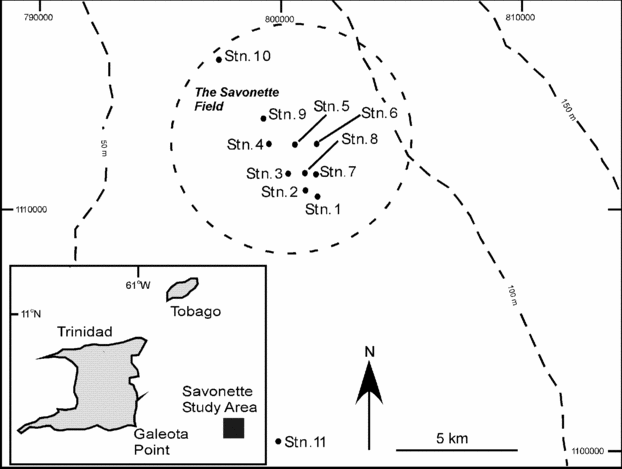
Sample stations within the Savonette Field area. WGS84 Zone 20N Universal Transverse Mercator grid coordinates.

Wilson (Reference Wilson2006b) surveyed the 2005 benthonic foraminiferal fauna from the Ibis Field, about 50 km due west of the Savonette Field. Given that some of Drooger & Kaasschieter's (Reference Drooger and Kaasschieter1958) transects pass within a few kilometres of the Ibis Field, Wilson (Reference Wilson2006b) was confident that the percentage abundances recorded by Drooger & Kaasschieter were in this case an accurate reflection of those in the population. Wilson (Reference Wilson2006b) found the total (live + dead) assemblage there to differ markedly from that reported by Drooger & Kaasschieter (Reference Drooger and Kaasschieter1958), with overall increases in the proportional abundances of Uvigerina subperegrina, Ammonia pauciloculata/Rolhausenia rolhauseni and Pseudononion atlanticum. This change in the Ibis area had killed off Cibicidoides pseudoungerianus and Miliolinella subrotunda and reduced the relative abundance of Hanzawaia concentrica, but had not affected the relative abundance of Cancris sagra. That the benthonic foraminiferal assemblage in the Ibis area comprised <1% altered foraminifera (Wilson, unpub. data) suggests that alteration is limited to sites further west.
Van der Zwaan & Jorissen (Reference Van Der Zwaan, Jorissen, Tyson and Pearson1991) used Drooger & Kaasschieter's (Reference Drooger and Kaasschieter1958) data to recognize six biofacies (Zones) around Trinidad. The Savonette area lies within their Zone VI, which they characterize as occupying a sandy zone little influenced by Orinoco outflow. Wilson (Reference Wilson2007, Reference Wilson2008) found ostracod biofacies off SE Trinidad to be arrayed perpendicular to bathymetric contours and concluded that this reflects the interplay of Amazon- and Orinoco-derived water along an estuarine front within the Orinoco Plume. The Ibis and Savonette Fields lay on opposite sides of this front, the Savonette Field being beneath surface water derived from the River Amazon.
3. Materials and Methods
Ten samples were recovered from Stations 1–10 within the Savonette Field area, and one further south from Station 11 (Fig. 2). All were taken with a van Veen grab. Water depths at the stations ranged from 78 to 90 m (online Appendix 1 at http://journals.cambridge.org/geo). For ease of statistical manipulation, sample locations were recorded as grid references using UTM/WGS84 coordinates.
The material examined from each sample comprised the top 1 cm over an area of 400 cm2. Each was washed over a 63 μm mesh to remove silt and clay, and then air dried. The samples had been stained with Rose Bengal to distinguish live foraminifera from dead, but a total of only 253 Rose Bengal-stained benthonic foraminifera were recovered from the entire sample suite. This live assemblage was dominated by Eponides antillarum (53%) with lesser Marginulinopsis planatus (32%). Removal of these few specimens is thought unlikely to have affected the results from the present exercise, which is based on dead foraminifera only. The residue was weighed, then split using an Otto microsplitter to give an aliquot of ≥350 dead benthonic foraminifera. All specimens (planktonic + benthonic) were picked to a total of 200 benthonic foraminifera, and this figure used to calculate %p, the percentage of the fauna as planktonic individuals (de Rijk, Troelstra & Rohling, Reference de Rijk, Troelstra and Rohling1999; Wilson, Reference Wilson2003). The remaining benthonic foraminifera were then picked. All benthonic specimens were sorted into species using Phleger & Parker (Reference Phleger and Parker1951), Drooger & Kaasschieter (Reference Drooger and Kaasschieter1958), Poag (Reference Poag1981) and Hofker (Reference Hofker1983).
Calcareous specimens (miliolids and rotalids) were characterized as being either fresh or iron-stained, the latter comprising the ISCBFA. As the textularids and the agglutinating miliolids might possibly have accumulated iron-stained particles while alive, no attempt was made to distinguish these as iron-stained or fresh, and, once their presence had been noted, they were excluded from any further analyses. Analyses were thus limited to the calcareous benthonic foraminifera, among which the amount of staining varied markedly from a pale patch to deep staining that pervaded the entire test, the latter being especially the case among miliolids. Although an attempt was made to develop a scale reflecting the degree of staining, this was not found to be consistently workable. Thus, a specimen was deemed to be stained with iron if it showed any staining at all. A proportion of the specimens were broken. These might equate to the eroded specimens of Amphistegina noted by Hofker (Reference Hofker1983). However, Wetmore (Reference Wetmore1987) having noted that a force as low as 1 N can break a specimen, it was concluded that fragile specimens of the smaller benthonic species might have been broken during sample retrieval and preparation. Thus, no attempt was made to distinguish broken from pristine specimens. To facilitate comparisons, the stained and unstained assemblages were treated as separate sub-assemblages. Their diversity within each sample was calculated using the information function H = −Σpi*lnpi. Pearson's product moment correlations between measures were accepted as significant at a level of p<0.05. Although the continental shelf east of Trinidad extends approximately north–south, the shallow depth at the most southerly Station 11 resulted in depth being positively correlated with northings (r = 0.77).
4. Results
The sample residues ranged in mass from 2.1 to 11.0 g (online Appendix 1 at http://journals.cambridge.org/geo; mean 5.8 g) and comprised mostly quartz with lesser foraminifera, ostracods, mollusc debris and rare bryozoans. Many of the quartz grains were stained red-brown with ferruginous matter. No pyrite was noted. Residue masses varied randomly throughout the study area, not being significantly correlated with northings, eastings or water depth.
The percentage of the total (iron-stained + unstained) foraminiferal fauna as planktonic specimens (%p) ranged from 18.5 to 57.5% (mean 32%) and was significantly correlated with eastings (r = 0.68). The planktonic assemblage was co-dominated by Globigerinoides ruber and Globoturborotalita rubescens, the former of which has a capacity to withstand neritic conditions (Bandy, Reference Bandy1956). A mean of 75% of the planktonic foraminifera per sample were iron stained. There was a significant negative correlation between %p and the percentage of the planktonic foraminiferal assemblage stained with iron (r = −0.66), indicating an eastward decrease in the incidence of staining.
4.a. Characteristics of the total benthonic foraminiferal assemblage
A total of 4293 benthonic foraminifera in 96 species were picked from the samples. Of these, nine species possess agglutinated tests: Bigenerina irregularis, Liebussella arenosa, Siphonaperta horrida, Spiroglutina glutinosa, Spiroplectammina floridana, Textularia agglutinans, T. luculenta, T. pseudotrochus and Trochammina sp. These comprised 189 specimens only (4.4% of total recovery) and were excluded from further analyses.
The diversity of the total calcareous benthonic assemblage, as measured using the information function H, was positively correlated with %p (r = 0.71). However, it was negatively correlated with the percentage of the planktonic foraminiferal association that had been stained with iron (r = −0.80). This reflects a tendency towards an eastward increase in benthonic diversity within the study area.
Of the total assemblage, six species are known to harbour algal symbionts: Amphistegina gibbosa, Amphistegina radiata, Elphidium sp., E. advenum, E. translucens, Heterostegina antillarum and Peneroplis proteus. These formed a mean of 8% of the total calcareous assemblage (range 5–19% per sample).
4.b. General characteristics of the fresh calcareous benthonic association
The unaltered association of calcareous benthonic foraminifera comprised 1437 specimens in 65 species (online Appendix 1 at http://journals.cambridge.org/geo), of which 11 formed >5% of the assemblage in any one sample. In rank order of mean percentage abundance per sample these are: Cibicidoides ex gr. pseudoungerianus (35%), C. io (16%), Eponides antillarum (9%), Hanzawaia concentrica (5%), Globocassidulina subglobosa (4%), Amphistegina gibbosa (4%), Cassidulina norcrossi australis (4%), Elphidium translucens (3%), Marginulinopsis planatus (3%), Discorbis floridensis (2%) and Eponides repandus (1%). The per sample information function ranged from H = 1.75–2.52, and was significantly correlated with eastings (r = 0.75).
4.c. General characteristics of the iron-stained calcareous benthonic foraminiferal association (ISCBFA)
Of the calcareous benthonic foraminifera, 2667 specimens were iron stained (66.5% of all calcareous benthonic foraminifera recovered; online Appendix 2 at http://journals.cambridge.org/geo). A mean of 65% of the calcareous benthonic foraminifera in each sample was iron-stained. This was a significantly lower percentage than the mean 75% iron-stained planktonic foraminifera (Student's t-test, t obs = 3.33, t crit = 2.09, df = 20). There was no significant correlation between the percentages of the calcareous benthonic and planktonic foraminiferal assemblages in each sample that were iron-stained. Whereas the percentage of iron-stained planktonic foraminifera increased with eastings, the percentage of the calcareous benthonic assemblage as ISCBFA was correlated with both depth and northings (r = 0.84 and 0.81, respectively).
The ISCBFA comprised 72 species. Ten of these formed >5% of the iron-stained assemblage in any one sample. In rank order of mean percentage abundance these are: Cibicidoides ex gr. pseudoungerianus (33%), C. io (11%), Hanzawaia concentrica (10%), Globocassidulina subglobosa (6%), Eponides antillarum (5%), Quinqueloculina lamarckiana (4%), Elphidium translucens (4%), Amphistegina gibbosa (4%), Cassidulina norcrossi australis (3%) and Eponides repandus (3%). The percentage per sample of the total calcareous benthonic foraminiferal assemblage as ISCBFA ranged from 48% at Station 11 to 73% at Stations 7 and 9. Per sample H for the ISCBFA ranged from 2.07 (Station 11) to 2.68 (Station 1), and was positively correlated with depth (r = 0.61) and northings (r = 0.69). It was also negatively correlated with the percentage of the planktonic assemblages as iron-stained specimens (r = −0.69). The information function showed the ISCBFA (mean H = 2.46) to be significantly more diverse than the unstained assemblage (mean H = 2.23; t obs = 2.31, t crit = 2.09, df = 20).
Fifteen altered species within the ISCBFA comprised porcellaneous-walled miliolids, the remainder being hyaline-walled rotalids. Student's t-test indicated that the mean percentage of 86% iron-stained miliolids per sample was significantly greater than the mean of 64% iron-stained rotalids (t obs = 6.05, t crit = 2.09, df = 20). Four genera (Amphistegina, Elphidium, Heterostegina and Peneroplis) are known to support algal symbionts, and are thus known to be limited to the photic zone. The mean percentage (68%) per sample of symbiont-bearing foraminifera that were altered did not differ significantly from the mean percentage of iron-stained foraminifera that do not utilize symbionts (65%; t obs = 0.51, t crit = 2.09, df = 20).
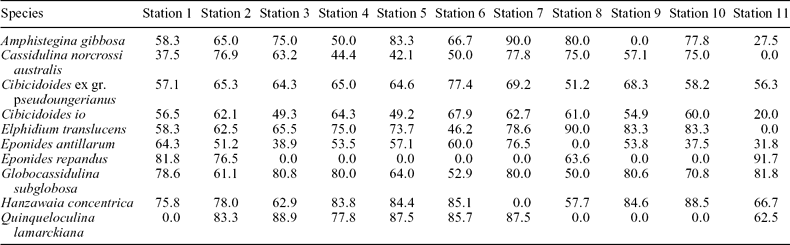
The percentage of each species in each sample stained with iron was calculated. A one-way between-groups analysis of variance was conducted to ascertain if the mean percentage of iron-stained specimens differed among the ten species forming >5% of the iron-stained assemblage in any one sample (Table 1). There was a statistically significant difference at the p<0.05 level (F = 2.59, p = 0.01). The lowest mean percentage iron-stained was for Eponides repandus (28.5%), the highest for Globocassidulina subglobosa (71.0%). Subsequent application of Bonferroni's test for equality of means revealed three groups (a–c) within which the mean percentage stained with iron did not differ (in rank order, highest first): (a) G. subglobosa and H. concentrica; (b) E. translucens, C. ex. gr. pseudoungerianus, A. gibbosa, C. io, C. norcrossi australis and Q. lamarckiana; and (c) E. antillarum and E. repandus.
The percentage of specimens stained with iron among the ten species forming >5% of the iron-stained calcareous benthonic foraminiferal assemblage in any one sample

For sample station locations, see Figure 2.
5. Discussion
At the Savonette Field the total dead (fresh + iron-stained) calcareous benthonic foraminiferal assemblage in its entirety comprised 33% Cibicidoides ex gr. pseudoungerianus, 13% C. io, 8% Hanzawaia concentrica, 7% Eponides antillarum, 4% Amphistegina gibbosa and 3.5% Elphidium translucens. (Section 4.b lists the mean values per sample across the sample suite.) This differed markedly from the live fauna, which was dominated by E. antillarum with lesser Marginulinopsis planatus. It is not known if this difference is due to a change in the overall composition of the fauna over time, or to transient blooms in the two dominant, live species.
Drooger & Kaasschieter (Reference Drooger and Kaasschieter1958) produced a series of maps on which they used relatively widely spaced transects to depict the suggested distributions of selected species in the early 1950s. The percentage abundances that Drooger & Kaasschieter (Reference Drooger and Kaasschieter1958; see Section 2 above) recorded in the Savonette Field area for Cibicidoides pseudoungerianus vars., H. concentrica, E. antillarum, A. gibbosa (as A. lessonii) and Elphidium (as E. poeyanum) differ somewhat from those recorded here, Cibicidoides ex gr. pseudoungerianus in particular being recorded much more abundantly in the present study. Wilson (Reference Wilson2006b) used changes in the percentage abundance of species within the Ibis Field to suggest that organic matter loading in that area had increased markedly over the past 50 years. However, the transects on which Drooger & Kaasschieter (Reference Drooger and Kaasschieter1958) based their figures were far from the Savonette Field, allowing little confidence to be placed in the percentage abundances they suggested for the Savonette area. For this reason, the differences between the percentage abundances recorded here and by Drooger & Kaasschieter (Reference Drooger and Kaasschieter1958) need not reflect the degree of recent environmental change in Savonette Field.
Live Amphistegina are symbiotic with algae that restrict their occurrence to the photic zone (Reiss & Hottinger, Reference Reiss and Hottinger1984; Hallock, Reference Hallock2000). Hofker (Reference Hofker1983) reported from Secchi disc observations off Guyana and Surinam (~500 km SE of Trinidad) that the photic zone, the illuminated surface layer of the ocean (Tett, Reference Tett, Herring, Campbell, Whitfield and Maddock1990), extends down to 25 m only. Recording abundant Amphistegina gibbosa in that area at depths of 80–100 m, he concluded them to be relict. The Savonette Field currently lies in water 78–90 m deep. The water around Trinidad can be expected to be as turbid as that off Surinam, the island lying only ~120 km NW of the Orinoco delta (van Andel, Reference van Andel1967) and within the Orinoco Plume, which affects the optical properties of surface water throughout the whole SE Caribbean region (Del Castillo et al. Reference Del Castillo, Coble, Morell, López and Corredor1999). With a mean freshwater outflow of (3.10±0.38) × 104 m3 s−1, the Orinoco ranks as the fourth largest river in the world (Hu et al. Reference Hu, Montgomery, Schmitt and Muller-Karger2004). The total assemblage of calcareous benthonic foraminifera from the Savonnette area nevertheless comprised 8.4% symbiont-bearing foraminifera. It might be argued that the tests of some of these symbiont-bearing species are modern and allochthonous, the disc-shaped tests of Amphistegina especially being susceptible to transport (Martin & Liddell, Reference Martin, Liddell and Donovan1991). However, the dominant current in the region, the Guyana Current, flows towards the Savonette area from the southeast (Lentz, Reference Lentz1995). Thus, it flows from a turbid region unlikely to support a live population of A. gibbosa (Hofker, Reference Hofker1983). Furthermore, although the Guyana Current carries 20% of the clay and silt discharged from the Amazon NE along the coast of South America as mudbanks (Meade, Reference Meade1994; Eisma, Augustinus & Alexander, Reference Eisma, Augustinus and Alexander1991; Eisma, Reference Eisma1998), such that half the sediment making up the Orinoco Delta comprises mud derived from the River Amazon (Aslan et al. Reference Aslan, White, Warne and Guevara2003), it is unlikely that it is strong enough to transport larger foraminiferal tests also.
Poag (Reference Poag1981) suggested that there are five relict ‘generic dominance facies’ within the Gulf of Mexico: his Elphidium, Elphidium–Hanzawaia, Bigenerina, Planulina and Cibicidoides biofacies. Although he implied that these are of Late Pleistocene age, an early Holocene age cannot be ruled out. The total benthonic foraminiferal assemblage in the Savonette area is dominated by species of Cibicidoides (Carr-Brown, Reference Carr-Brown1972), with lesser Elphidium and Hanzawaia, and thus equates to Poag's (Reference Poag1981) Cibicidoides biofacies. Within the Gulf of Mexico the Cibicidoides biofacies is developed in carbonate-rich areas on the continental shelves off western Florida and around the Yucatan Peninsula. Carbonates accumulate primarily where the terrigenous input is low (Flugel, Reference Flugel2004). The presence of a relict Cibicidoides biofacies off SE Trinidad might indicate that during the early Holocene transgression, sediment was so effectively sequestered in the Orinoco delta and Amazon estuary that carbonate-producing organisms were able to move into the area. (Milliman & Meade, Reference Milliman and Meade1983, suggested that even at present most of the sediment carried by the Orinoco River is deposited in its upper delta.) This hypothesis is supported by Sen Gupta et al.'s (Reference Sen Gupta, Pujos, Pons, Galluzo, Aharon and Parra1991) observation that the source for clayey sediments within the Grenada basin, north of Trinidad, at the Pleistocene/Holocene boundary switched from a South American (southerly) to a Lesser Antillean (easterly) source. The reduction in turbidity engendered was sufficient to allow species with algal symbionts to establish populations off eastern Trinidad. The water need not have been extremely clear, however. Amphistegina gibbosa, which formed 1–15% of the recovery of calcareous benthonic foraminifera from samples from the Savonette area, is in Florida Bay the last of the larger, symbiont-bearing foraminifera to die out as the water at a locality becomes increasingly turbid (P. Hallock, pers. comm. 2008).
The samples from the Savonette area did not present a uniformly iron-stained foraminiferal assemblage. The percentage of iron-stained planktonic foraminifera exceeded that of iron-stained benthonic ones. It has long been noted that benthonic foraminifera differ in their susceptibility to dissolution (Corliss & Honjo, Reference Corliss and Honjo1981), Amphistegina gibbosa and miliolids being particularly susceptible. However, planktonic foraminifera are generally more prone to dissolution than benthonic ones (Berger, Reference Berger, Sliter, Bé and Berger1975). The results presented here suggest that planktonic foraminifera, in addition to being more readily dissolved, are also more disposed to staining with iron.
ANOVA (ANalysis Of VAriance) showed that the percentage of iron-stained specimens differed between calcareous benthonic species, being highest in Globocassidulina subglobosa and lowest in E. antillarum. Several hypotheses may be proposed to account for this:
(1) On the basis of the elevations and ages of drowned Acropora palmata reefs from the Caribbean-Atlantic region, Blanchon & Shaw (Reference Blanchon and Shaw1995) documented that sea-level during the early Holocene rose in at least three catastrophic, decimetre-scale events (see also Yu et al. Reference Yu, Berglund, Sandgren and Lambeck2007), synchronous with episodic collapsing of the Laurentide and Antarctic ice sheets, which released huge volumes of subglacial and proglacial meltwater. Foraminiferal biofacies typically being arrayed by depth (Culver, Reference Culver1988; Buzas, Hayek & Culver, Reference Buzas, Hayek and Culver2007), it might be suggested that each sea-level rise induced a change in the foraminiferal community at the Savonette Field. Symbiont-bearing genera (Amphistegina, Elphidium, Heterostegina, Peneroplis) would be limited to the early stage of the transgression, when the seafloor lay within the photic zone. Should the degree of iron-staining be dependent on the time since the specimens were deposited, one might, therefore, expect these symbiont-bearing species to be more commonly stained than at least some of the remainder of the community. This was not the case; the mean percentage of the ten species forming >5% of the iron-stained assemblage in any one sample that had been altered was 56.8%. Bonferroni's comparison of means, performed subsequent to the ANOVA, showed that the mean percentage abundances of stained A. gibbosa (61.2%) and E. translucens (65.1%) were not significantly different to the percentages of most other species in the association. Only the percentages of stained G. subglobosa and H. concentrica (71% and 70%, respectively) were both significantly greater than those of A. gibbosa and E. translucens, while only the percentages of Eponides antillarum (48%) and E. repandus (28%) were significantly lower. It might be suggested that radiocarbon dating might be used to explore this pattern further; the shallow water species should be significantly older than the deep. However, Anderson et al. (Reference Anderson, Sen Gupta, McBride and Byrnes1997) found that on the northeastern Gulf of Mexico shelf, extensive reworking of the Holocene transgressive package has led to considerable stratigraphic disorder in foraminiferal 14C dates.
(2) Corliss & Chen (Reference Corliss and Chen1988) attempted to distinguish epifaunal and infaunal morphotypes. It might be argued that infaunal species would be preferentially altered, being closer to the reducing zone invoked by Maiklem (Reference Maiklem1967) as harbouring sulphate-reducing bacteria and being more readily incorporated into this zone by either burial or bioturbation. However, de Stigter, Jorissen & van der Zwaan (Reference de Stigter, Jorissen and van der Zwaan1998) found that representatives of morphotypes at one time ascribed to an epifaunal microhabitat can live commonly in subsurface microhabitats, leading Gross (Reference Gross2002) to suggest that the infaunal/epifaunal dichotomy of foraminiferal microhabitats needs to be re-examined and Murray (Reference Murray2006) to write that ‘the distinction between infaunal and epifaunal [foraminifera] is to some extent arbitrary’. Thus, no attempt can be made to discern differing staining susceptibilities on the basis of microhabitat.
(3) The three groups recognized using Bonferroni's test for equality of means may each comprise species with a similar susceptibility to staining. Murray (Reference Murray2006, p. 340) observed that live Hanzawaia occur at primarily inner neritic depths, that is, at depths comparable to Elphidium and Amphistegina. In the Savonette area, however, H. concentrica is significantly more stained than E. translucens and A. gibbosa. This further suggests that the susceptibility to staining is independent of the preferred water depth at which the foraminifera live.
It has long been recognized that much of the seafloor on continental shelves worldwide is the site of relict sediment of Late Pleistocene to early Holocene age (e.g. Lyell, Reference Lyell1850; Stather, Reference Stather1912; Shepard, Reference Shepard1932; Conolly & von der Borch, Reference Conolly and Von der Borch1967) that was deposited during a sea-level low stand. Emery (Reference Emery1968) suggested that much of this relict sediment is iron-stained. Should iron-stained sediment be restricted to the transgressive systems tract, it follows that iron-stained foraminifera might prove a useful sequence stratigraphic tool. Although some of this relict sediment shows a ‘palimpsest effect’ (Prothero & Schwab, Reference Prothero and Schwab1996), having been reworked so that it is in dynamic equilibrium with modern marine processes (Swift, Stanley & Curray, Reference Swift, Stanley and Curray1971), it will nevertheless contain some relict foraminifera specimens (Poag, Reference Poag1981). Despite this incorporation of relict specimens, which at times can dominate the assemblage, total (living + dead) foraminiferal assemblages on shelves have long been accepted as being good indicators of water depth (Norton, Reference Norton1930; Culver, Reference Culver1988; Buzas, Hayek & Culver, Reference Buzas, Hayek and Culver2007). This has led authors to utilize data from relict occurrences on continental shelves when proposing palaeodepths for ancient successions. For example, the New Orleans Paleoecologic Committee (1966) suggested A. gibbosa to be an index for water 20–100 m deep, and Collins (Reference Collins1993) cited Drooger & Kaasschieter (Reference Drooger and Kaasschieter1958) as her authority when using Cassidulina norcorssi australis and Eponides antillarum, respectively, to indicate shelf edge and neritic palaeodepths in the Neogene of the Bocas del Toro Basin, Panama.
Note: To counter any bias in palaeoenvironmental interpretations induced by this relict material, Murray (Reference Murray2006) has recommended that palaeoenvironmental inferences conducted using ecological uniformitarianism should be made using data from observations of live specimens only.
6. Conclusions
Relict sediment of early Holocene age near the continental shelf edge off SE Trinidad yields a rich assemblage of iron-stained foraminifera. Examination of this association suggests that species differ in their susceptibility to iron-staining, and that planktonic foraminifera are generally more susceptible to alteration than are benthonic ones. The fauna was dominated by Cibicidoides spp. A similar biofacies has been found at comparable, outer neritic depths in the Gulf of Mexico in carbonate-rich areas. This indicates that, despite the proximity of the Orinoco delta, terrigenous input to the continental shelf off SE Trinidad was much reduced early in the Holocene transgression. Of the calcareous benthonic specimens, 8.4% comprise species that are currently symbiotic with algae and restricted to the photic zone, which is at present only a few tens of metres deep off northern South America. These species symbiotic with algae date from an interlude early in the Holocene transgression when sediment was so effectively stored within the Orinoco delta that the water on the continental shelf was rendered sufficiently clear to be inhabited by species typical of low-turbidity water.
The foraminifera have a long history of use as a tool in sequence stratigraphy (Armentrout, Reference Armentrout, Howell and Aitken1996; Orndorff & Culver, Reference Orndorff and Culver1998; Pekar & Kominz, Reference Pekar and Kominz2001), but few studies have placed the foraminiferal assemblages on the modern continental shelf in a sequence stratigraphic context. Should iron-stained foraminifera prove to be typical of sediment deposited during transgressions, they would prove a powerful tool for use in sequence stratigraphy.
Acknowledgements
Thanks are due to Mr Tyrone Kalpee of BP Trinidad and Tobago LLC, who arranged the study during which the samples were taken, and Mr Frank Teelucksingh of Coastal Dynamics Limited, who arranged the sample collection. This work was supported in part by the Research and Publications Fund of The University of the West Indies.