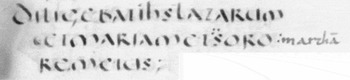
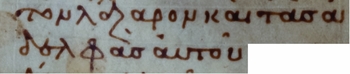
This study examines the text transmission of the figure of Martha of Bethany throughout the Fourth Gospel in over one hundred of our oldest extant Greek and Vetus Latina witnesses. The starting point for this study is instability around Martha in our most ancient witness of John 11–12, Papyrus 66. By looking at P66’s idiosyncrasies and then comparing them to the Fourth Gospel's greater manuscript transmission, I hope to demonstrate that Martha's presence shows significant textual instability throughout the Lazarus episode, and thus that this Lukan figure may not have been present in a predecessor text form of the Fourth Gospel that circulated in the second century. In order to gain the greatest amount of data on the Fourth Gospel's text transmission, I rely on several sources.Footnote 1 Occasionally these sources conflict in their rendering of a variant; I have tried to make note of these discrepancies and look at photographs of witnesses whenever possible. Although this study is primarily focused on Greek and Vetus Latina witnesses, an occasional noteworthy variant (e.g., from a Syriac or Vulgate witness) may be mentioned when relevant to the subject at hand. The work of many established redaction critics, who have already hypothesized that Martha was not present in an earlier form of this Gospel story, will also be addressed.
Papyrus 66: An Important Witness to Late Second-Century Scribal Variants in John
Papyrus Bodmer II (P66), discovered in 1952 near Dishna, Egypt, and held at the Bodmer Library in Cologny, Switzerland, is a codex containing only the Gospel of John and is arguably the oldest extant witness of John 11–12. It is generally dated to approximately 200 CE (P75 and P45 are roughly contemporaneous).Footnote 2 The scribe of this manuscript was notoriously unpredictable, having made about 450 corrections to the Gospel in total.Footnote 3 Although the majority of the corrections throughout P66 are due to scribal error, P66 also reflects dozens of alternate readings of the text attested in important early witnesses such as א, W, Θ, 579, and several church fathers.Footnote 4 It appears that the scribe corrected the Gospel text against another exemplar.Footnote 5
John 11 in P66 contains an intriguing set of variations around the names “Mary” and “Martha.” To date, only a handful of comments have been made on these important discrepancies in P66. Why is this? Is it simply because the scribe of P66 is known to have been sloppy? This cannot be the case, as P66* provides many noteworthy and oft-discussed readings (e.g., ο προφητης, “the prophet,” at John 7:52; προ πεντε ημερων, “Five days before,” at John 12:1; εν τω νομω γεγραμμενος, “written in the law,” at John 15:25). I believe it is more likely that due to the great number of corrections in this manuscript, text critics have perhaps been so focused on cataloguing each individual correction that they have not noticed the themed cluster of variants at the opening of John 11.Footnote 6
Due to sustained uncertainty around Martha's presentation in P66, I believe text critics should no longer overlook these variants in John 11. Thus, in this study P66’s verses containing Martha will be examined on a case-by-case basis, while the greater context of the corrections, including the broader text transmission of the verses in over one hundred Greek and Vetus Latina manuscripts, will be kept in mind. The International Greek New Testament Project's transcription of P66 will be used to report the readings of this manuscript. My goal is to demonstrate that the initial circulating version of the Gospel of John may not have included Martha, and thus that P66 may provide a window into a late scribal interpolation that is now part of our received Gospel text. Using readings found in P66 and other ancient witnesses, I will then make a tentative attempt to reconstruct the opening verses of John 11 without Martha.
John 11:1—An Introduction to Lazarus's Sister(s)? Or to Mary's Sister?
The story of the raising of Lazarus of Bethany as we know it includes two sisters named Mary and Martha. However, according to the IGNTP, P66*’s text of this verse appears as follows:
ην δε τις ασθενων λαζαρος απο βηθανιας
εκ της κωμης μαριας και μαριας της αδελφης αυτου.Footnote 7
I am particularly interested in the words της κωμης μαριας και μαριας της αδελφης αυτου (“the village of Mary and of Mary his sister”) in this reading. Although the words της κωμης μαριας και μαριας likely reflect some sort of scribal error, and the scribe of P66 does make occasional dittographic errors of entire words, at this point it will suffice to note that Martha is not present in the initial reading.Footnote 8 With Martha absent, the words αδελφης αυτου, “his sister,” naturally identify Mary as the sister of Lazarus.
The correction of P66 in 11:1 does include Martha. Changes are in bold:
ην δε τις ασθενων λαζαρος απο βηθανιας
εκ της κωμης μαριας και μαρθας της αδελφης αυτης.Footnote 9
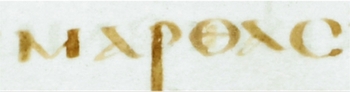
Erroll Rhodes has suggested that της κωμης μαριας και μαριας in 11:1 is dittography, mistakenly written instead of της κωμης μαριας και μαρθας, with P66c returning to correct it somewhat later. James R. Royse believes the mistake was an accidental backward leap to the letters μαρ and was corrected almost immediately.Footnote 10
Figure 1

Rhodes and Royse give simple explanations for this change, if it is taken out of context. However, I believe this correction must also be examined with the surrounding reading of P66*, because immediately afterward the masculine αδελφης αυτου, “his sister,” is corrected to the feminine αδελφης αυτης, “her sister”; furthermore in 11:3 one woman's name will be changed to αι αδελφαι, “the sisters.” We will return to 11:3 shortly.
Using P66 as a (decidedly unclear) starting point, we will now examine John 11:1 over the course of the Fourth Gospel's broader manuscript transmission. In fact, several other of our most important witnesses do not name Martha in their initial reading. Most notably, Codex Alexandrinus (A) makes an extraordinarily similar change to that of P66. According to Swanson and the INTF, A* transcribes:
ην δε τις ασθενων λαζαρος απο βηθανιας
εκ της κωμης μαριας της αδελφης αυτου.Footnote 12
Ac corrects to:
ην δε τις ασθενων λαζαρος απο βηθανιας
εκ της κωμης μαριας και μαρθας της αδελφης αυτου.Footnote 13
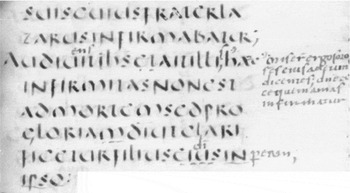
Figure 2

In the corrected text, the word κωμης is squeezed into the right-hand margin; smaller script is then used for μαριας και to compensate for the extra letters. The left-hand vertical line of the μ in μαριας is further to the left of the subsequent margin lines, suggesting that Ac repurposed the κ of A*’s κωμης; the θ in μαρθας is now visibly off-center, revealing the word μαριας hiding underneath.
Figure 3

Like P66*, A's scribe transcribed αδελφης αυτου in this verse, yet in A the masculine pronoun stands uncorrected. Minuscule 32 also transcribes αδελφης αυτου. Minuscule 157 stands uncorrected in omitting και μαρθας (“and Martha”), thus nonsensically applying a feminine pronoun to Lazarus! Vetus Latina witness 9A simply omits Martha's name and is uncorrected. It is striking that four important witnesses (P66, A, 157, and VL 9A) do not include Martha's name in their original text of 11:1. These readings reflect several traditional textual families: Alexandrian (P66), Byzantine (A), Caesarean (157), and Western (VL 9A). Meanwhile, none of the eighty-eight Greek or twenty Vetus Latina witnesses surveyed for this verse ever omit Mary's or Lazarus's names.
The Vetus Latina readings show an even more striking pattern in this verse: eight (40%) of the twenty Vetus Latina witnesses surveyed describe the two women as Lazarus's sisters in either their initial or corrected reading. Both aur c and VL 11Ac actually correct the singular (feminine) identification “her sister” in favor of the plural (masculine) identification “his sisters.” Two Syriac witnesses (the Peshitta and the Sinaitic Syriac) uniquely introduce the Bethany siblings by identifying Lazarus as “the brother of Mary and Martha.”Footnote 16 What I would like to highlight is the wide variation in meaning in these variants—whether the verse's wording introduces us to one sister of Lazarus, two sisters of Lazarus, or one sister of Mary.
Thus the surveyed transmission of 11:1 reflects nine different renderings, which differ significantly on whether Martha is named, how many sisters appear, and whose sister(s) they are:

Analysis
I would like to explore the possibility that some of these discrepancies are due to conflate readings that reflect a scribal dilemma. If a scribe was familiar with two text forms, one with Mary identified as the sister of Lazarus but without Martha present (as in reading [c] above), and the other with Martha present as the sister of Mary (as in reading [b] above), this would have created confusion for the scribe in what to copy. Various solutions to this dilemma might explain our strange variants in the number of women, whether Martha was actually named, and whether a masculine or feminine pronoun was used when describing the sister(s). Thus I posit that the combination of readings [c] + [b] gave rise to scribal conflate readings [a], [d], [f], [g], and [h]:

If a predecessor text form of this Gospel circulated without Martha, perhaps reading [c], A's initial reading ην δε τις ασθενων λαζαρος απο βηθανιας εκ της κωμης μαριας της αδελφης αυτου (“There was a certain sick man, Lazarus of Bethany, the village of Mary his sister”) retains it. In that case, P66*’s nonsense reading της κωμης μαριας και μαριας may actually indicate the scribe's familiarity with a version of the verse where Martha was not present.
John 11:2b—Mary's Brother “Was Also Lazarus”?
John 11:2b has some very curious corrections in Papyrus 66. According to the IGNTP, the first reading was:
ης και αδελφος η¯ λαζαρος ασθενων.Footnote 17
But the scribe then made several changes:
ης ο αδελφος [omission] λαζαρος ησθενει.Footnote 18
Figure 4

Gordon Fee states that “it looks as if the ην [‘was’] has been scraped out, thus making it a part of P66*. If so, then P66* apparently started to read, ‘whose brother was also Lazarus.’ But when the scribe ran into grammatical difficulties in coming to ησθενει, he deleted the ην, and perhaps at the same time changed the και to ο.”Footnote 20
Perhaps the addition of another sister to the story can shed light on this strange scribal behavior. I suggest that since a second woman has been included in 11:1 (described in P66* as αδελφης αυτου, “his sister”), the scribe now felt it necessary to explain that Mary also was Lazarus's sister.Footnote 21 But encountering grammatical difficulties with this idea, perhaps the scribe decided on an alternate approach by going back and changing the αυτου of 11:1 to αυτης. Because this pronoun was changed, the second woman in 11:1 is now instead described as Mary's sister, so the scribe could return to the version of 11:2 with Mary described as Lazarus's sister. This solution successfully ensured that all three Bethany siblings were related.
John 11:3—How Many Women Sent the Message to Jesus? Whose Sister(s) Were They?
The most striking manuscript evidence calling for further study of the figure of Martha is P66’s text of John 11:3. The change from P66* to P66c demonstrates an undisputable change of meaning and cannot be explained by the habits of P66’s scribe; the correction clearly splits one woman into two. According to the IGNTP, P66* transcribes the following:
απεστιλεν ουν μαρ[1]α προς αυτον λεγουσα.Footnote 22
P66c adds a sister to this verse. The corrected letters are in bold:
απεστιλαν ουν αι αδελφαι προς αυτον λεγουσαι.Footnote 23
Figure 5

Not all text critics are agreed on which name is hiding under αι αδελφαι. As reflected above, the IGNTP is undecided on whether the second-to-last letter of the woman's name was an ι or a θ.Footnote 25 Nestle-Aland 26, Nestle-Aland 27, Comfort and Barrett, Fee, Royse, and Elliott and Parker state that the name crossed out is μαρια. But Nestle-Aland 28, Boismard, Swanson, and the INTF state that the name crossed out in 11:3 is μαρθα.Footnote 26 The IGNTP is clearest that either name could have been transcribed here; however, since Martha's name is absent from several crucial initial readings of 11:1 (including P66*), I agree with the majority and suggest it is more likely that the scribe of P66* wrote μαρια in 11:3.
Fee has also taken particular notice of this odd correction. He believes “the original reading of the verb was the singular απεστειλεν and that the original subject was μαρια” and that the change from μαρια to αι αδελφαι is “one of the most interesting readings of P66.”Footnote 27 Royse agrees with Fee that the initial reading was μαρια and calls the change “a striking shift.”Footnote 28 Boismard also states that the change is “one of the most interesting variants of the papyrus” but originally believed that the name crossed out was μαρθα, suggesting a textual tradition where “the role of Mary was blotted out even more than it is now.”Footnote 29 However, Boismard later revised his view to state that P66* named Mary here.Footnote 30 The singular-to-plural change from λεγουσα to λεγουσαι in 11:3 is cited by all but Swanson; the ι is the last letter of the line and the furthest out into the margin. Although the woman's name can only be conjectured here, P66 11:3 is indeed an actual reading where one named woman has been split into two unnamed women; thus this reading is crucial to our examination of Martha's overall presence in the Fourth Gospel.
At this point in the study it is worthwhile to call attention to the work of several established redaction critics who have already hypothesized that Martha was not present in a more ancient version of this Gospel. In her monograph Martha from the Margins, Allie Ernst provides a helpful survey of the source-critical scholarship to date on the subject of Martha in the Fourth Gospel. She names Eugene Stockton, Marie-Émile Boismard and Arnaud Lamouille, Gérard Rochais, and Jacob Kremer as those who believe Martha's presence to be part of a later stratum of textual development.Footnote 31 Furthermore, in his landmark work, A Marginal Jew, John P. Meier states, “The Lucan story of Martha and Mary has no Lazarus, and apparently the early Johannine form of the Lazarus story had no Martha.”Footnote 32 Rudolf Schnackenburg notes, “It is striking that in v. 1 Mary is mentioned first, but that Martha subsequently takes the leading role. . .. It is [the evangelist] who has brought Martha into prominence.”Footnote 33 Robert Tomson Fortna's The Fourth Gospel and Its Predecessor posits that the Fourth Evangelist “has rewritten [verse 1] to bring Lazarus to the fore—and possibly to introduce Martha into the story for the first time (then altering ‘she’ in v. 3 to the sisters). . .. In the Lazarus story of the source, Mary was the principal and possibly the only interlocutor with Jesus.”Footnote 34 Thus Fortna theorizes that the “evangelist” did something strikingly similar to what the scribe has done in P66 11:3. Urban C. von Wahlde acknowledges that a case has been made for Martha's absence but concludes “there was some rudimentary mention of both sisters in the earliest version.”Footnote 35 Boismard and Lamouille were aware of P66*’s, A*’s, and 157’s manuscript variants around Martha in 11:1 and 11:3, and in La vie des Évangiles they conclude, “According to these witnesses, verses 1 and 3, like verse 45, speak only of Mary; Martha is not even mentioned. . .. [The text] would have been significantly modified at a later stage in order to introduce the character of Martha and give her preeminence over her sister.”Footnote 36
Rudolf Bultmann has made special note of the sisters’ duplicate quote at 11:21 and 11:32, and of the more developed Johannine theology of Martha's dialogue with Jesus.Footnote 37 In his analysis of John 11, Morton Smith agrees with Bultmann and states that a second sister was added here by the evangelist: “With Mary's arrival (verse 32) John returned to the story as it lay before him, that is, to the saying κυριε, ει ης ωδε κ.τ.λ. from which he had departed (verse 21) to introduce the intervening sermonette. . .. This indicates that the doubling of the sisters was John's work and not in his source.”Footnote 38 In his classic survey of the Fourth Gospel, Raymond Brown considers Bultmann's conclusion that the original dialogue was with Mary only and asks an important question: “If Mary had the original role, why would an editor feel impelled to give a longer role to the less important Martha?” Brown suggests that in 11:28–33 Mary is merely repeating Martha's actions, and Mary's role thus could have been a compositional “afterthought.”Footnote 39 Brown's argument is reasonable; yet as noted above, Mary and Lazarus are introduced by name in every extant witness of 11:1, while Martha is not always present. Furthermore several patristic quotations will soon be introduced where it is clear that Martha's presence is questionable, not Mary's.
All of the above-mentioned critics knew of manuscript variants in P66, yet only Boismard and Lamouille show awareness of this exact change in 11:3. It is extraordinary that so many respected voices have discussed the possibility that there was only one Bethany sister in a more primitive form of the Lazarus story, independently of P66’s manuscript evidence.
Yet P66 is not the only manuscript to suggest the possibility of Martha's absence in 11:3. As in 11:1, the number of sisters in 11:3 fluctuates throughout the manuscript transmission of the Gospel. Although P66* is the only extant witness that actually transcribes the name of a single sister, several important witnesses reflect possible traces of only one Bethany sister's presence in the verse. Like P66, Minuscule 579 uses the singular verb απεστηλεν in 11:3a when describing a plural feminine subject. Minuscule 579 will again transcribe an unexpected singular verb regarding the Bethany sisters in 12:2. Two Latin witnesses, g 1 and O, mention only one woman in their original reading: the Oxford Vulgate witness O retains the genitive singular “sororis eius” (“of his sister”) while Vetus Latina g 1 corrects “sororis eius” to the nominative plural “sorores eius” (“his sisters”). The word “sororis” in both g 1 and O may well be a nonsense orthographic error;Footnote 40 however, two further Vetus Latina witnesses (b and l) omit the words “sorores eius,” and two others (ff 2 and μ) omit verse 11:3 entirely in their initial reading.Footnote 41 This verse, already shown to be remarkably unstable in P66, has been included only by a later hand in ff 2. Furthermore, in ff 2 the singular pronoun “illi” (“to her”) is corrected to “illis” (“to them”) by the second hand in 11:4, so that Jesus now replies to two sisters instead of only one.
Figure 6

Here, then, are the variants of John 11:3:

Analysis
Again I suggest that many of these variants reflect conflate readings. A scribe confronted with two exemplars, one containing reading [a] and the other containing reading [b], might resolve the dilemma by simply writing “his sister” instead of the woman's name, resulting in conflate reading [g], a natural compromise. This is in fact a very persistent reading: the 1526 Tyndale Bible, the 1591 Bishop's Bible, and the first printing of the 1611 King James Bible all mention only one sister in this verse.
Figures 7 and 8

Tyndale's 1526 translation says, “And his sister sent vnto hym, sayinge, Lorde, behold! he whom thou lovest, is sicke.”Footnote 45
Conflicted scribes could also explain the origin of reading [c] (a singular verb paired with a feminine plural subject), reading [i] (the sister description actually omitted), and reading [j] (the omission of the verse altogether). Reading [g] is the natural predecessor of the widely attested [d] and [e], which identify Mary and Martha as “his sisters.” At first glance these may seem like simple scribal or printing errors, but as we examine the greater picture of John 11’s text transmission, perhaps we should not dismiss this pattern of singular/plural discrepancies around the Bethany sisters.
Thus I suggest the combination of readings [a]+[b], both of which are present in our oldest extant witness of John 11:3, resulted in the conflate readings [c], [g], and [i] (and possibly reading [j], which omits the verse altogether). If [b] became widely accepted, when combined with [g] it could have resulted in readings [d] and [e]. I posit this stemma diagram for 11:3:

The textual transmission of John 11:3 thus shows significant instability on how many sisters sent the message to Jesus and whose sisters they were. Reading [b] (P66c) shows tremendous influence in the overall transmission. However if Martha was not present in a text form of the Fourth Gospel that circulated in the second century, I suggest (along with Fee, Royse, Comfort and Barrett, Boismard in later years, and Elliott and Parker) that P66’s initial reading was απεστιλεν ουν μαρια προς αυτον λεγουσα κυριε ιδε ον φιλεις ασθενει (“Therefore Mary sent to him saying, ‘Lord, behold, the one you love is sick’”).
John 11:4—Was the Word αυτη Originally Intended as a Dative Feminine Singular?
The transmission of John 11:4 also raises questions about the number of women to whom Jesus replied. As mentioned above, in John 11:4 the original reading of the fifth-century manuscript ff 2 specifies that Jesus replied to one woman (“Audiuit ihs et ait illi” [“Jesus heard and said to her”]). This reading is corrected by a later hand to include 11:3, as well as to add an s to the “illi” in 11:4, so that Jesus now replies to two women: “Audiuit ihs et ait illis.” This manuscript is not alone in mentioning only one person in 11:4—the sixth-century Vetus Latina witness Codex Carnotensis/33 also specifies that Jesus replied to one woman, and stands uncorrected (“audiens autem ihs dixit ei”). In fact, the majority of the Latin manuscripts use a pronoun to specify that Jesus is responding to the women here; thirteen (65%) of the twenty Vetus Latina witnesses surveyed include the pronoun, and two of these (10%) originally indicated that Jesus responded to one person. Even Jerome's Vulgate includes the pronoun and states “audiens autem iesus dixit eis.” Yet our Greek manuscripts do not mention an equivalent pronoun to “illi” or “illis,” “ei” or “eis.”
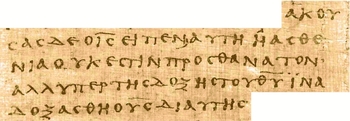
Or do they? If one were to translate the singular Latin pronoun backward into Greek, it would almost certainly say ακουσας δε ο ιησους ειπεν αυτη . . . (“but when Jesus heard he said to her . . .”). And incredibly, this is exactly what the text of John 11:4 says in all printed Greek editions to this day! Since there were generally no accent marks in the earliest manuscripts, the αυτη in this sentence could have originated as the dative feminine singular form αὐτῇ (“to her”), although today it is considered to be a nominative αὕτη (meaning “this sickness” when applied to the word ασθενεια). Since in the majority of our Latin witnesses there is a pronoun specifying the women to whom Jesus replied—and this pronoun is occasionally singular—this strengthens the possibility that our canonical word αυτη could have originally referred to a single woman in the Greek text. Amazingly, the scribe of P66 adds a rare punctuation mark here, which may be deliberately intended to shift the reader's interpretation of the text.
Figure 9

By the addition of the comma after the word ειπεν, the αυτη clearly causes the text to mean “But Jesus said, ‘this sickness’” (as opposed to “Jesus said to her, ‘the sickness’”). P66c’s uncharacteristic comma forces a break in the text immediately before a natural pause in the phrasing, which is clearly seen in P66* after the word αυτη.Footnote 47 P66 is not the only manuscript to show hesitation on a pronoun after the word ειπεν; the scribe of Minuscule 565 originally transcribed a pronoun here but clearly erased it, and the word αυτη appears after the word ασθενεια.Footnote 48 Minuscules 579 and 1071 also transcribe ειπεν η ασθενεια αυτη, and Minuscule 69 omits the word αυτη altogether. Thus these witnesses ensure that the verse cannot be interpreted as meaning that Jesus replied to a single woman.
John 11:5—Who Gets Pride of First Place in the List of Those Whom Jesus Loved? How Many Sisters? Are They Named? Whose Sister(s)?
The text transmission of John 11:5, the verse naming those whom Jesus loved, demonstrates what can only be called extreme instability. Although P66’s initial reading at last includes Martha, according to the IGNTP P66* transcribes it as follows:
ηγαπα δε ο ις την μαρθαν και την αδελφην και τον λαζαρον.Footnote 49
P66c corrects with a marginal note:
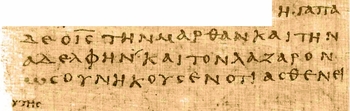
ηγαπα δε ο ις την μαρθαν και την αδελφην αυτης και τον λαζαρον.Footnote 50
Figure 10

Out of context, P66*’s initial lack of identification of Mary as Martha's sister appears to be simply a dropped pronoun, an omission, or an alternate exemplar reading.Footnote 52 These are established tendencies of the scribe of P66. Yet the omission of the word αυτης in 11:3 could also reflect hesitation by the scribe in identifying exactly whose sister Mary is. This pronoun matters a great deal, since if Martha was not present in the initial circulating version of the Fourth Gospel, the words “her sister” would not be found anywhere in the story.
Furthermore, although the absence of this pronoun is not reflected in any other witness, there is a tremendous amount of instability in both the Greek and Latin witnesses on the order of the names of those whom Jesus loved. Rochais notes how strange it is to see Lazarus named last: “The mention of Lazarus in last place is surprising! The most likely solution is that this verse has been added by the author to show that the story's leading role is held not by Lazarus, but by Martha.”Footnote 53 There is also some instability in the number of people whom Jesus loved in this verse, and who exactly is named. These instabilities are also reflected in some patristic quotations. Here are the ten different readings listing the Bethany siblings Jesus loved:

Analysis
Ten (12%) of the eighty-six Greek witnesses surveyed, including Caesarean (f 1 f 13 565) and Byzantine (Θ Λ) witnesses, name Mary first in the list of people Jesus loved. This is important because an elevated place for Mary in this verse might be an echo of an earlier text form where only she and Lazarus were present. The same reading is found in the fourth-century Lycopolitan Coptic manuscript Codex Qau.Footnote 54 Two additional Greek witnesses, including the fourth-century P6, opt to include Mary's name in the verse. Thus a significant 14% of the Greek witnesses surveyed, including some very weighty manuscripts, actually name Mary in 11:5. Meanwhile a striking thirteen (62%) of the twenty-one Vetus Latina witnesses surveyed, as well as most Vulgate witnesses, include Mary's name in the verse.
Several Vetus Latina witnesses demonstrate a wholly different trend. Five (24%) of the twenty-one Vetus Latina witnesses surveyed name Lazarus first in the list of people Jesus loved. (In fact, 86% of the Vetus Latina witnesses disagree with the received text “Jesus loved Martha and her sister and Lazarus”!) Witness ff 2’s reading is again especially interesting for this study in that it states that Jesus loved “lazarum et mariam et sororem eius”—with Martha's name added in the margin by a later hand.
Figure 11

This is the same manuscript that omitted 11:3 entirely in its initial reading and also added a sister by way of correction in 11:4; thus, like P66, the fifth-century ff 2 contains another sustained cluster of verses where Martha's presentation is unstable.
The remaining Vetus Latina variants of 11:5 deserve special attention because they do not include names of women. Witnesses a, e, and aur state that Jesus loved “lazarum et sorores eius.” An eleventh-century manuscript of a Chrysostom homily also lists Lazarus first in Greek when quoting 11:5.
Figure 12

Vetus Latina witness c has similar wording but states there was only one woman whom Jesus loved and stands uncorrected: “Lazarum et sororem eius.”
Figure 13

Perhaps what is most remarkable about the transmission of 11:5 is how much variation appears on which person is named first. As a control, I have studied eighty Greek and twenty Vetus Latina variants of John 19:25: the first woman listed at the foot of the cross is always Jesus's mother (0% variation). In 144 Greek and thirty-five Latin witnesses surveyed on Luke 9:28, the first man listed at the transfiguration is always Peter (0% variation; there is also 0% variation on the first name in the manuscripts surveyed for Matt 17:1 and Mark 9:2). A rare case of comparable instability can be found in Gal 2:9, where five (7%) of seventy-six Greek and eleven (32%) of twenty-eight Latin witnesses surveyed list Peter first instead of James. One Greek witness (A) drops the name κηφας. It is widely accepted that these names are unstable due to early arguments over Petrine primacy.Footnote 58
Thus with groups of people listed in the New Testament, either women or men, whether in the Greek, the Vetus Latina, or in the Vulgate, it is extraordinary to find any variation on the first name listed; certainly it is odd to find a woman listed before a man in the canon. In the other rare case where variation on the first name occurs, there seems to be a tendency to “move up” the preferred person in the list. Yet unlike Gal 2:9 (where only James or Peter are ever named first), in John 11:5 any of the three Bethany inhabitants might be named first, and all are represented in substantial measure in important witnesses of the text transmission.
How can we make sense of this extreme variation on who is to be named first of those Jesus loved? I suggest that the reason for this instability is that several of these manuscripts again reflect conflate readings created by conflicted scribes, and that the order and naming of the Bethany siblings mattered to them very much indeed. If so, one extant variant could explain the origin of all the other variants: reading [h]. Vetus Latina witness c states that Jesus loved “Lazarum et sororem eius.” St. Ambrose seemed to know this reading in his Apologia prophetae David: “In short, Jesus loved Lazarus and Mary: Christ loved his church.”Footnote 59 No extant Greek witness demonstrates this wording, a fact that calls to mind Aland and Aland's basic rules that “the primary authority for a critical textual decision lies with the Greek manuscript tradition” and “the principle that the original reading may be found in any single manuscript or version when it stands alone or nearly alone is only a theoretical possibility.”Footnote 60 Yet Martha's absence is indeed clearly reflected in the Greek manuscript tradition in crucial witnesses of John 11:1 and 11:3 (P66*, A*, and 157), and if the story continued without Martha, is reading [h] not exactly what we would expect to see? Its ordering of the siblings (first Lazarus, then Mary) matches the order in John 11:1, suggesting that reading [h] was indeed composed by the same author who wrote 11:1. Furthermore, reading [h] adheres to many other common text-critical maxims, including the following: a) it is the shortest reading; b) it is the most difficult reading (why would a scribe choose to omit the figure of Martha after already mentioning her in John 11:1 and 11:3?); c) it is the reading that explains the origin of all the others; and d) it accords with the tendency of New Testament Greek writers to list men before women. If not for the readings in P66*, A*, 157, VL 9A, and ff 2*, reading [h] would be negligible; but with the greater context in mind, reading [h] must be taken very seriously. If Martha was not actually present in the initial circulating version of the Gospel, it is curious indeed that she has now been placed at the top of the list of those whom Jesus loved.
Thus I suggest that the combination of readings [h]+[b] naturally leads to conflate readings [a], [g], [i], and [j].Footnote 61 Furthermore, if scribes were aware of a text form of this story without Martha, they might have wished to rectify the prominence given to Mary in the list of Jesus's beloveds; [h]+[b] could explain why Mary is given more prominence in [f]. A scribe influenced by reading [b], encountering reading [f], would likely produce reading [c] or the widely attested [d]. In other words, [h]+[b]=[a], [c], [d], [f], [g], and [j].Footnote 62
[EPS]
If we are to continue exploring the possibility that Martha was not present in a predecessor text form of John 11–12, let us note that reading [h] may retain a Latin translation of that predecessor wording, which in Greek would have been ηγαπα δε ο ιησους τον λαζαρον και την αδελφην αυτου (“Now Jesus loved Lazarus and his sister”).Footnote 63
Thus, I believe we can make a tentative reconstruction of John 11:1–5 without Martha present, using only P66*, A*, and c:
-
1 1 ην δε τις ασθενων λαζαρος απο βηθανιας, εκ της κωμης μαριας της αδελφης αυτου.
-
2 2 ην δε μαριαμ η αλειψασα τον κυριον μυρω και εκμαξασα τους ποδας αυτου ταις θριξιν αυτης, ης ο αδελφος λαζαρος ησθενει.
-
3 3 απεστειλεν ουν μαρια προς αυτον λεγουσα, κυριε ιδε ον φιλεις ασθενει.
-
4 4 ακουσας δε ο ιησους ειπεν αυτη, η ασθενεια ουκ εστιν προς θανατον αλλ’ υπερ της δοξης του θεου ινα δοξασθη ο υιος δι’ αυτης.
-
5 5 ηγαπα δε ο ιησους τον λαζαρον και την αδελφην αυτου.
-
6 1 There was a certain sick man, Lazarus of Bethany, the village of Mary his sister.
-
7 Now this was the Mary who anointed the Lord with ointment and wiped his feet with her hair, whose brother Lazarus was sick.
-
8 Therefore Mary sent to him, saying, “Lord, behold, the one you love is sick.”
-
9 But when Jesus heard he said to her, “The sickness is not unto death, but for the glory of God, so that the Son may be glorified through it.”
-
10 Now Jesus loved Lazarus and his sister.
John 11:19–45—Further Notable Inconsistencies throughout the Martha Episode
After Martha is included in P66* in 11:5, all goes mostly as expected in the readings around this figure. Nevertheless, some instability is still reflected throughout the wider manuscript transmission around Martha in these verses; for the sake of brevity only those that are most outstanding will be addressed.
a) John 11:21–32—Martha's Dialogue with Jesus is Bounded with Duplicate Quotes by Martha and Mary
As Bultmann, Brown, Smith, and others note, Martha and Mary give Jesus an identical greeting in John 11:21 and 11:32 (κυριε, ει ης ωδε ουκ αν απεθανεν ο αδελφος μου, “Lord, if you had been here my brother would not have died”). These critics all consider the possibility that Martha and Mary's duplicate quote indicates something has been changed here.
Although critics like Bultmann and Fortna have suggested that Martha's dialogue with Jesus was added by the evangelist, the christological confession in 11:27 is so important to the theology of the Fourth Gospel that it would be hasty to suggest that it was not present in a circulating text form.Footnote 64 Ernst notes that because 11:27 contains a parallel with the author's conclusion to the Gospel in 20:31, “There is wide agreement among the source critics that Martha appears as the carrier of the evangelist's own theology. . .. This has significant implications. Why is Martha the carrier of the evangelist's theology?”Footnote 65 Ernst's question becomes very serious indeed if we consider that this woman may not have been present in the evangelist's original Gospel.
b) John 11:27—Tertullian Believed Mary Spoke the Christological Confession
In fact, the consensus of the manuscripts of Tertullian's Adversus Praxean (written ca. 208 CE) states that the woman who uttered the christological confession in 11:27 was Mary. Due to this manuscript consensus, commentator Ernest Evans argues that Tertullian himself attributed this quote to Mary.Footnote 66 I am unaware of any biblical or lectionary witness transcribing Mary's name here, but a substantial eight (36%) of twenty-two Vetus Latina witnesses surveyed include Martha's name (she is usually unnamed). The significant variation in the Old Latin, and the witness of Tertullian, thus may reflect traces of a text form where a woman's name was included in this verse. However, conflicted scribes aware of a version identifying Mary might have preferred to omit the name here.
c) John 11:24 and 11:30—Multiple Omissions of Martha in Witnesses VL 9A and c
Martha's name has actually been omitted in Vetus Latina witness 9A's initial text of John 11:24, a manuscript that (as already mentioned) also omits her name completely in John 11:1. Furthermore, witness c, the manuscript containing reading [h] in 11:5 (“Jesus loved Lazarus and his sister”), corrects the name “maria” to “martha” on the same page in 11:30:
Figure 14

The consistent width of the vertical bar of the t makes it clear that the reading was not originally “marta,” since this scribe writes the word “Maria” with a thick vertical bar for the i’s and a narrow-to-thick bar for the t’s:
Figures 15, 16, 17, and 18

Including P66 and ff 2, there thus are at least four important witnesses where Martha's presence is uncertain in multiple verses.
d) John 11:39—Who Was the “Sister of the Dead Man”?
Greek Majuscule Θ and seven of the twenty-two Vetus Latina witnesses surveyed in this verse refrain from naming Martha as the “sister of the dead man.” As in John 11:27, the omission of the name could reflect a hesitation to name the woman at some point in the transmission. Notably, one uncorrected Persian witness from the fourteenth century identifies this woman as Mary.Footnote 69
But more striking is the description of John 11:39 in Chrysostom's Homilia in Joannem 62. Bernard de Montfaucon informs us that in the most reliable manuscripts of this homily, Chrysostom identifies Mary as the “sister of the dead man.” In this homily, the woman who mentions the stench is the same woman who sat at Jesus's feet in Luke 10. Here is the text of Chrysostom's homily that de Montfaucon favors: “Do you see how zealous was the affection? It is she concerning whom he says, ‘Now Mary has chosen the good part.’ How then does she appear more zealous, one might ask? She is not more zealous; it was because she had not yet learned about it, since she was the weaker. For having heard such things, she speaks again, ‘By this time he stinks.’”Footnote 70 De Montfaucon also notes a minority manuscript variant, beginning with the words “How then”: “How then, says one, does Martha appear more zealous? She was not more zealous, but it was because the other had not yet been informed, since Martha was the weaker. For even when she had heard such things, she yet speaks in a groveling manner, ‘By this time he stinks.’”Footnote 71 This minority variant is inevitably how this text is presented in translated editions of the Chrysostom homily, yet the majority and the best manuscripts clearly present a text where Mary is the sister named in John 11:39.
Cyril of Jerusalem seems to have had a similar fourth-century text form of this story as Chrysostom. Although Cyril refrains from providing the women's names in his Catecheses ad Illuminatos 5, he clearly identifies the woman who falls at Jesus's feet in John 11:32 (usually Mary) as the woman who mentions the stench in John 11:39 (usually Martha): “For when the Lord had come, the sister fell down before him, and when he said, ‘Where have you laid him?’. . . ‘Lord, by this time he stinks.’”Footnote 72 Thus, Cyril of Jerusalem and Chrysostom both appear to have had texts where Mary was the woman speaking at the tomb with Jesus.
John 12:2—Was It Mary, or Martha, or Both Who Made the Supper?
Returning to P66, we see that the figure of Martha reveals one final uncertainty in our earliest witness. In John 12:2, P66 transcribes εποιησεν αυτω δειπνον εκει και μαρθα διηκονει (“there she made a dinner for him and Martha served”) and stands uncorrected. Although Martha is given her usual task of serving, an unexpected singular verb εποιησεν appears, which is not a common tendency of P66’s scribe.Footnote 73 Like P66, Minuscule 579 also transcribes the singular εποιεισεν in 12:2—notable because, as mentioned above, 579 also retains a singular απεστηλεν in 11:3. Both singular verbs in 579 stand uncorrected. Meanwhile, at least three Byzantine Greek minuscules (27, 63, and 1194) state that Mary served the dinner, and one manuscript of Origen's Commentarii in evangelium Joannis also states that Mary served in 12:2.Footnote 74
Analysis
The variants naming Mary in John 12:2 are surprising, especially since the figure of Martha is so closely associated with the verb διηκονει (“serving” or “ministering”); however, serving would have been a common task for all female hostesses in antiquity, so it is not inconceivable that Mary could have served the supper before anointing Jesus. Thus five (6%) of eighty-three Greek witnesses surveyed for the verse, including our oldest witness, reflect further uncertainty around the Bethany sisters in John 12. The nineteen Vetus Latina witnesses surveyed for this verse demonstrate 0% variation in the name and number of people who serve the supper. Nevertheless, the Mary variants in this verse confirm possible traces of Martha's absence in witnesses throughout the Fourth Gospel's text transmission, from her entrance in John 11:1 to her exit in John 12:2.
Summative Analysis: The Figure of Martha of Bethany Shows Significant Instability in the Greek and Vetus Latina Text Transmission of the Fourth Gospel
After comparing P66’s discrepancies to the greater Greek and Vetus Latina manuscript transmission, and taking into account established rules of text-critical analysis, I hope to have demonstrated significant instability around the figure of Martha of Bethany throughout the Fourth Gospel. While I am not aware of any witness where Martha is completely absent, there are so many Greek and Latin witnesses with possible traces of her absence that I believe it is worthwhile to question the consensus view that Martha was always present in the circulating Fourth Gospel. Here are the criteria I consider to be possible traces of Martha's absence:
-
A. the unexpected omission of Martha's name
-
B. the initially transcribed name “Mary” altered to “Martha”
-
C. the name “Mary” appearing instead of an expected “Martha”
-
D. an unexpected singular noun, verb, or pronoun to describe the Bethany sisters
-
E. a different person named as the first of those Jesus loved in John 11:5
According to these criteria, of the ninety-two Greek witnesses surveyed for John 11:1–12:2, seventeen (18%) contain traces of Martha's absence. These traces are present in some of our weightiest Greek witnesses (P66, A, Θ, and 579), throughout several textual families, and in additional Greek patristic quotations from Origen, Chrysostom, and Cyril of Jerusalem. Of the twenty-three Vetus Latina witnesses surveyed, seven (30%) contain traces of Martha's absence. Martha is also absent in Latin patristic quotations from Tertullian and Ambrose. The Vulgate witnesses eliminate these traces.
Thus, I conclude that the entire Greek and Vetus Latina text transmission reflects significant instability around the figure of Martha in the Fourth Gospel. Of all the Greek witnesses, our most ancient witness, P66, most clearly suggests Martha's absence, because it contains a cluster of verses (John 11:1–5) where both her presence and presentation are uncertain. In the Vetus Latina witnesses, c (John 11:5 and 11:30), ff 2 (John 11:3–5), and VL 9A (John 11:1 and 11:24) also contain multiple verses where Martha's presence is uncertain. Throughout the transmission, traces of only one sister are most persistent in John 11:3, appearing all the way until the first printed edition of the King James Bible. The verse with the most unstable content is John 11:5.
Graphic Similarity between Mary and Martha
With so much variation around the figures of Mary and Martha in the manuscript transmission of the Fourth Gospel, it is logical to wonder whether this is simply an issue of scribal blunder due to the graphic similarity of the two names. Fortunately for this study, the exact same two names appear in the manuscript transmission of Luke 10:38–42. Yet of 134 Greek and thirty-six Latin witnesses surveyed in these verses, 0% contain an unexpected “Maria” transcribed instead of “Martha,” or vice versa, either corrected or uncorrected.Footnote 75
Furthermore, the opposite trend must be examined in John—that is to say, whether Martha's name is ever changed to “Mary,” whether Martha appears unexpectedly instead of Mary, or whether Mary's name is ever unexpectedly omitted. I am aware of four instances of the opposite trend: in John 11:19, one Greek witness surveyed omits Mary's name (Minuscule 28). In John 11:45, one Greek witness (Minuscule 213) and one Vetus Latina manuscript (μ) transcribe Martha's name instead of Mary's. Curiously, Hippolytus of Rome attributes the Johannine anointing scene to Martha in his In Canticum canticorum.Footnote 76 These are the only occurrences in the Fourth Gospel of which I am aware where the trend goes in the opposite direction; indeed, the last three examples could be seen as further evidence of instability around Martha in the Fourth Gospel. Notably, it is often the same scribes who had no trouble discerning the two names in Luke who produced these variants in John. Thus I believe that the significant uncertainty around the Bethany sisters’ names in the Fourth Gospel is not so much an issue of their graphic similarity, but a phenomenon unique to the text transmission of the Fourth Gospel.
Implications for the Absence of Martha in the Fourth Gospel
Papyrus 66 is indeed an important and curious witness that may hold undiscovered clues to a more ancient text form of the Fourth Gospel. My observation is that P66’s instability around the figure of Martha is substantial and reflected throughout the Gospel's entire manuscript transmission. My intention with this text-critical contribution is to open up further discussion and scholarly study on what Martha means to the Fourth Gospel. Clearly, the next question is: Why would early Christian editors have chosen to add the figure of Martha to the Lazarus story? A few hypotheses are worth considering.
It is clear that an early tradition circulated where Mary, the sister of Lazarus in the Fourth Gospel, was identified with Mary, the sister of Martha in the Third Gospel. Although there is no mention of a brother or a resurrection scene in Luke 10, and the Lukan story suggests a more likely Samaritan or Galilean context, the pair “Mary and Martha” seems to have been accepted into the Fourth Gospel regardless of these contextual inconsistencies. Perhaps the Mary of Luke 10 was somehow confused in second-century oral tradition with the Mary of John 11, and scribes began harmonizing their text of John 11 to Luke 10—possibly even going so far as to expand the actual content of the Lazarus story to include Martha. Boismard and Lamouille, the only source critics to date to address textual variants around Martha, postulate that Martha was added to this story by Christian scribes due to early quarrels in the church. They actually state that the underlying Johannine story structure has been “broken” (“rompue”) by the inclusion of Martha and postulate that Johannine scribes intended a “reversal of values” (“renversement des valeurs”) of the Lukan story—that is, they believe a later generation of Christians wished to elevate Martha's “active” service over Mary's more “contemplative” approach.Footnote 77
However if Martha were not present in the text of John 11, it must be pointed out that there would be no real reason to connect the Lazarus story to Luke 10. In fact, with only Mary present I believe readers would be far more likely to connect John 11 to John 20:11–17, where one woman named Mary also cries and speaks with Jesus at another tomb. Several specific words are emphasized in both chapters: μαριαμ (“Mary,” 11:2, 20:16); κλαυση, κλαιουσαν / κλαιουσα, κλαιεις (“crying,” 11:31, 11:33, 20:11, 20:13, 20:15); που τεθεικατε αυτον / που εθηκας αυτον (“where have you laid him” / “where you have laid him,” 11:34, 20:15); μνημειον (“tomb,” 11:38, 20:11); λιθος / λιθον (“stone,” 11:38, 20:1); σουδαριω / σουδαριον (“handkerchief,” 11:44, 20:7); and ο αδελφος μου / τους αδελφους μου (“my brother” / “my brothers,” 11:21, 20:17). Deirdre Good notes that “both [Marys] weep over a dead man at a tomb; both are consoled (11:31, 33; 20:11, 15); both accrue followers (11:32, 45; 20:18); both experience resurrection (11:43, 45; 20:16).”Footnote 78 Mary of Bethany is also associated with Jesus's burial (12:7), as is Mary Magdalene (20:1). These repeated themes demonstrate an obvious parallelism between the chapters, a parallelism that would certainly be amplified in Martha's absence.
Consequently, this study yields an interesting exegetical result: a Johannine text form without Martha would create a strong textual implication that Mary of Bethany was Mary Magdalene. Mary Ann Beavis and Mark Goodacre have already challenged the relatively recent scholarly tendency to make a clear delineation between Mary Magdalene and Mary of Bethany. Beavis believes that “the boundaries between the two Gospel characters are amenable to blurring, especially in John.”Footnote 79 A forthcoming paper from Goodacre notes that in John 11 and 12,
her name is simply “Mary.” The term “Mary of Bethany” is a scholarly convenience, used to distinguish her from other women of the same name. . .. Mary Magdalene and Mary of Bethany are never seen in the same room at the same time and they share similar traits like weeping at a tomb before a resurrection (John 11, John 20). Although Mary “of Magdala” has become a scholarly commonplace, it is worth remembering that she is never described this way in the Synoptics or John, where she is always “Mary Magdalene” or just “Mary.”Footnote 80
Beavis and Goodacre argue for the two Johannine Marys’ possibly being one woman even with Martha present in the text; yet without Martha, such arguments would certainly be more formidable.
Obviously Mary cannot be from both the Galilean Magdala and the Judean Bethany. And if it were so clear that the word “Magdalene” meant “from Magdala,” then why did so many generations of early Christians (both gnostic and orthodox) believe Mary Magdalene to be from Bethany, centuries before Gregory the Great's famous sermon of 591 CE?Footnote 81 If Mary of Bethany was indeed the same Johannine figure as Mary Magdalene, the word “Magdalene” would need to have been a nickname, or an honorific applied to Mary. Beavis emphasizes that
it is also debatable whether the title μαγδαληνη would have been taken as a gentilic (“Mary of Magdala”), since as the popular Mary Magdalene scholar Margaret Starbird has noted, there is no reference to such a town in sources contemporary with Jesus. . .. Luke's observation that Mary was “the one called Magdalene” (8:2) suggests that μαγδαληνη was a nickname or title from the Aramaic magdala (“Mary the Tower” or “Mary the Great”). . .. It is conceivable that, irrespective of authorial intent, the reader/audience [of John] would have associated the Mary at the cross with the Mary earlier associated with his death (12:7).Footnote 82
As another tentative solution for how a Judean woman could have had the name Magdalene, I would like to suggest that the Aramaic
 (migdāl, “tower”) may have been combined with the Greek woman's name Ελένη (“Helen”), and thus migdāl +Helenē might be another potential etymology.Footnote
83
Interestingly, there are several ancient witnesses where Martha unexpectedly appears beside Mary Magdalene, or instead of Mary Magdalene, in scenes from the Fourth Gospel.Footnote 84 Hippolytus's In Canticum canticorum provides perhaps the clearest examples of this phenomenon. His replacement of Mary with Martha in John 12’s anointing scene has already been noted above. Furthermore, in Hippolytus's description of Easter morning, he states, “The Savior answered and said: ‘Martha, Mary.’ And they said ‘Rabbouni!’ . . . Martha and Mary said this to him. [The bride] showed Martha's secret beforehand through Solomon.”Footnote 85 Hippolytus's pairing of Martha with Mary Magdalene here diffuses the Johannine Mary's most poignant moment; one might wonder why Mary of Bethany and Mary Magdalene were receiving a similar sort of treatment by one of Christianity's most prominent early church fathers. Perhaps Hippolytus's commentary provides the answer to Raymond Brown's question about John 11: “If Mary had the original role, why would an editor feel impelled to give a longer role to the less important Martha?” Could it be that early orthodox Christians specifically wished to deflect attention away from the woman who spoke with Jesus at Lazarus's tomb, and from her similarities with the Mary of John 20? By the simple addition of Martha, the reader of the Lazarus story is instead subtly urged to identify Mary of Bethany with the woman who sat at Jesus's feet in Luke 10.Footnote 86
Of course the Easter morning scene is notorious for the fluctuating women who may or may not appear beside Mary Magdalene. In John 20:1, Mary Magdalene is described as going alone to the tomb, although in John 20:2 she uses the plural οιδαμεν when describing the scene to Simon Peter and the other disciple Jesus loved. Yet this plural use depends on the manuscript; in three Greek witnesses (579, 1243, and S), three Latin witnesses (e r 1 T), Tatian's Diatessaron, and quotations from Augustine, Mary uses the singular verb here, duplicating her words from John 20:13 (ουκ οιδα που εθηκαν αυτον, “I do not know where they have laid him”).Footnote 87 In Matthew 28:1 Mary Magdalene and “the other Mary” appear, and in the second-century Gospel of Peter, Mary Magdalene goes to the tomb with unnamed “women friends.”Footnote 88 In Mark 16:1, the women who visit the tomb are usually “Mary Magdalene, Mary the mother of James, and Salome,” but again these women vary depending on the manuscript. In Codex Bezae and Vetus Latina n, only Mary of James accompanies Mary Magdalene; in Vetus Latina k Mary of Joses accompanies her, and in Vetus Latina c we find “Mary of James and Joseph.” Strikingly, in all of these Markan witnesses Salome is not present at the tomb.
In the second-century Epistula apostolorum, Martha is present on Easter morning—but yet again, the women presented here fluctuate depending upon which manuscript we are examining. A fourth- or fifth-century Coptic manuscript of the Epistula states that “Mary, Martha, and Mary Magdalene” went to anoint Jesus's body, but the later Ethiopic manuscripts of the same story state that it was “Sarah, Martha, and Mary Magdalene” who came.Footnote 89 Furthermore there is specific uncertainty around Martha's and Mary's roles in the Epistula. In the Coptic manuscript, it is Martha who is given the distinctively Johannine commission to be the first to announce to her “brethren” that Jesus has risen from the dead. Yet in the Ethiopic manuscripts, it is Mary Magdalene who is sent first.Footnote 90 François Bovon has suggested that Martha was included in the Epistula apostolorum specifically to undermine the authority of Mary Magdalene: “The polemic here would be even more dramatic: contrary to the gnostics who honored Mary Magdalene, the Epistula apostolorum, using all means available, has called Martha to the rescue.”Footnote 91 Regardless of authorial intentions, the Epistula apostolorum clearly provides a further ancient example of women fluctuating around Mary Magdalene, and Martha and Mary Magdalene changing places, depending on which manuscript of the text is being read.
In conclusion, I suggest that Papyrus 66 may reflect the final stages of a text form of the Fourth Gospel where the figure of Martha was being secondarily added to the resurrection story of Lazarus. I believe there is a strong possibility that this change was made in order to hamper the text's subtle identification of Mary of Bethany with Mary Magdalene, and perhaps in particular to ensure that John 11:27’s crucial christological confession would not be on her lips. David C. Parker has noted that, “based on a period of transmission extending . . . at least a century, [an early witness like P66] will already show signs of what its readers rather than its author thought it should contain.”Footnote 92 I believe the changes around Martha in P66 cannot simply be dismissed as scribal mechanical errors, because there are so many strange variants around Martha throughout the text transmission of the Fourth Gospel, as well as in patristic quotations and ancient extracanonical texts. I believe we can still see a literary prehistory reflected in P66, giving us a window into a predecessor circulating text form with only Mary and Lazarus present, now overlaid with secondary interpolations of the figure of Martha. It seems likely that there was an early harmonization of the Johannine Lazarus story to the Lukan story of Mary and Martha. The larger questions are: Who exactly added Martha to this story, and why? Is it possible that one very important figure in the Fourth Gospel has been deliberately split into three? My hope is that this paper will be a substantial contribution to and invitation for future dialogue on how Martha's presence affects our interpretation of the Lazarus story, especially our perception of Mary of Bethany.
Ongoing work towards the Novum Testamentum Graecum Editio Critica Maior of John has led to the recent online publication of transcriptions of many additional witnesses at www.iohannes.com/XML, even while the edition itself is in progress. These witnesses became newly available over the course of my writing this article, and they have yielded additional data. I provide a list below of many additional witnesses demonstrating textual instability in the presentation of the Bethany sisters. I am grateful to Prof. David C. Parker, Dr. H. A. G. Houghton, and all who were involved in making this resource available. The creation of such transcriptions and their value for research in a variety of fields is a major contribution of the adoption of digital methods for New Testament textual scholarship.
John 11:1
και μαρθας is omitted in Minuscule 1230.
αδελφης αυτου appears in Minuscules 841, 1009, and 1071.
John 11:3–5
Minuscule 2575 omits these verses.
John 11:5
Minuscule 2561 corrects μαριαμ to μαρθαν.
Minuscules 22, 138, 346, 357, 543, 826, 828, 884, and 994 list μαριαν first.
Majuscule 0233 lists μαριαμ first.
Minuscules 1230 and 2615 add μαριαν after αδελφην αυτης.
John 11:19
Minuscule 2680 uses the singular αυτη instead of the plural αυτας.
John 11:20
Minuscules 983, 1344*, and 1689 nonsensically name μαρια as the first woman. (Minuscule 1344 corrects μαρια to μαρθα.)
John 11:21–24
Minuscule 423 omits these verses.Footnote 93
John 11:28
Minuscules 333 and 423 name μαρθα instead of μαρια; Minuscule 397 has no name.
John 11:30
Minuscule 1319 omits η μαρθα.
John 11:45
Minuscule 841 writes μαρθαν και μαριαν.