INTRODUCTION
The TGF-β family is intimately involved in development and homeostasis of both vertebrate and invertebrate organisms (Newfeld et al. Reference Newfeld, Wisotzkey and Kumar1999; Massagué et al. Reference Massagué, Blain and Lo2000). In vertebrates, one branch of the family mediates immunological functions, in particular dampening potential immune pathology (Li et al. Reference Li, Wan, Sanjabi, Robertson and Flavell2006). In Drosophila, the TGF-β family member decapentaplegic (DPP) acts in morphogenesis (Affolter and Basler, Reference Affolter and Basler2007) while in Caenorhabditis elegans, daf-7 regulates entry into the arrested Dauer larval stage (Ren et al. Reference Ren, Lim, Johnsen, Albert, Pilgrim and Riddle1996; Inoue and Thomas, Reference Inoue and Thomas2000) and dbl-1 controls body size (Suzuki et al. Reference Suzuki, Yandell, Roy, Krishna, Savage-Dunn, Ross, Padgett and Wood1999; Morita et al. Reference Morita, Flemming, Sugihara, Mochii, Suzuki, Yoshida, Wood, Kohara, Leroi and Ueno2002). There is considerable interest in TGF-β homologues of parasitic helminths, and in Schistosoma mansoni one member of this family (SmInAct) is required for embryonic development (Freitas et al. Reference Freitas, Jung and Pearce2007). It has been suggested that other homologues may control parasite-arrested development, in particular the hiatus of the infective third-stage nematode larvae (L3) awaiting a mammalian host (Viney et al. Reference Viney, Thompson and Crook2005). Furthermore, parasitic species may have even adapted TGF-β genes to interact with, and suppress, the host immune system (Maizels et al. Reference Maizels, Gomez-Escobar, Gregory, Murray and Zang2001).
To address these possibilities, nematode TGF-β homologues have been studied from Brugia malayi (Gomez-Escobar et al. Reference Gomez-Escobar, Lewis and Maizels1998, Reference Gomez-Escobar, Gregory and Maizels2000), Ancylostoma caninum (Brand et al. Reference Brand, Varghese, Majewski and Hawdon2005; Freitas and Arasu, Reference Freitas and Arasu2005), two Strongyloides species and Parastrongyloides trichosuri (Crook et al. Reference Crook, Thompson, Grant and Viney2005; Massey et al. Reference Massey, Castelletto, Bhopale, Schad and Lok2005). Only the B. malayi TGF-β homologue-2 (Bm-TGH-2) shows binding to mammalian TGF-β receptors (Gomez-Escobar et al. Reference Gomez-Escobar, Gregory and Maizels2000) with all other homologues appearing to fulfill a developmental function in the parasite, as is the case for C. elegans daf-7 and dbl-1. However, the contrasting gene expression patterns suggests a reversal in developmental roles between C. elegans and parasitic species (Viney et al. Reference Viney, Thompson and Crook2005). In the former, daf-7 is expressed in early stages, but down-regulated when entering the arrested Dauer larval form (Ren et al. Reference Ren, Lim, Johnsen, Albert, Pilgrim and Riddle1996). In parasitic species expression is maximal in diapausal stages, including the arrested L3 larvae which may be developmentally analogous to Dauer (Hotez et al. Reference Hotez, Hawdon and Schad1993). As larval arrest is constitutive in parasitic life cycles, but facultative in C. elegans, parasite TGF-β homologues may be required not to control entry into diapause, but rather to maintain arrest until the opportunity for infection arises (Viney et al. Reference Viney, Thompson and Crook2005). This evolutionary switch is made more plausible by the recent discovery that the common molecular pathway controlling Dauer formation in C. elegans and parasite infective larval development is not daf-7-related, but signals through dafachronic acid ligation of the nuclear hormone receptor daf-12 (Ogawa et al. Reference Ogawa, Streit, Antebi and Sommer2009).
The importance of TGF-β homologues in development and immune modulation may be dissected in model organisms such as the mouse intestinal helminth Heligmosomoides polygyrus and the rat parasite Nippostrongylus brasiliensis. Both are closely related to other Trichostrongyloid nematodes of great economic significance as veterinary pathogens, including Haemonchus contortus and Teladorsagia circumcincta. These species offer fascinating and contrasting developmental and immunological features. H. polygyrus, H. contortus and T. circumcincta all share transmission via the faecal/oral route, with L3 larvae entering orally, developing to L4 larvae in the duodenum of mice or the abomasum (4th stomach) of sheep, following which, they emerge into the lumen and deposit eggs which egress in faeces. H. contortus, like many cattle nematodes (Armour and Duncan, Reference Armour and Duncan1987), may enter environmentally-induced arrest and T. circumcincta can undergo immune-induced developmental delay in the mammalian host. In N. brasiliensis infections, larvae penetrate the skin, and migrate through the lungs, trachea and oesophagus to reach the gastrointestinal tract. In the lumen, parasites develop to sexually reproducing adults, depositing eggs that are voided in the faeces. H. polygyrus establishes chronic infections in mice, associated with immune suppression (Elliott et al. Reference Elliott, Setiawan, Metwali, Blum, Urban and Weinstock2004) and regulatory T cell activity (Wilson et al. Reference Wilson, Taylor, Balic, Finney, Lamb and Maizels2005; Finney et al. Reference Finney, Taylor, Wilson and Maizels2007; Rausch et al. Reference Rausch, Huehn, Kirchhoff, Rzepecka, Schnoeller, Pillai, Loddenkemper, Scheffold, Hamann, Lucius and Hartmann2008); however, N. brasiliensis is rapidly expelled from mice by a strong Th2-dependent immune response (Finkelman et al. Reference Finkelman, Shea-Donohue, Morris, Gildea, Strait, Madden, Schopf and Urban2004; Anthony et al. Reference Anthony, Rutitzky, Urban, Stadecker and Gause2007). In both rodent and ovine hosts, a protective memory response can be generated following chemotherapy (Schallig, Reference Schallig2000; Finkelman et al. Reference Finkelman, Shea-Donohue, Morris, Gildea, Strait, Madden, Schopf and Urban2004; Anthony et al. Reference Anthony, Urban, Alem, Hamed, Rozo, Boucher, Van Rooijen and Gause2006), which is also characterized by a dominant Th2 effector mechanism. With the definition of a daf-7 homologue from the dog hookworm A. caninum (Brand et al. Reference Brand, Varghese, Majewski and Hawdon2005; Freitas and Arasu, Reference Freitas and Arasu2005) and with extensive genomic sequence data available for H. contortus, we initiated a project to identify new family members within this extremely important group of parasites, as we now report below.
MATERIALS AND METHODS
Parasites and life cycles
H. polygyrus bakeri was maintained in CBAxC57BL/6 F1 mice by infection with 500 larvae through a gavage tube; adults were recovered at day 14 post-infection. N. brasiliensis was maintained as described (Lawrence et al. Reference Lawrence, Gray, Osborne and Maizels1996), by infecting SD rats with 4000 L3 subcutaneously. L1, L2 and L3 of H. polygyrus and L3 of N. brasiliensis were collected from faecal-charcoal cultures using the Baermann technique. N. brasiliensis L4 larvae were recovered from lungs 42 h post-infection, and adult parasites from the gut 6 days post-infection. Eggs were collected from adults cultured in vitro as described previously (Holland et al. Reference Holland, Harcus, Riches and Maizels2000). H. contortus and T. circumcincta lifecycles were maintained as described (Knox and Jones, Reference Knox and Jones1990). L3 larvae from faecal cultures were exsheathed in 8% sodium hypochlorite solution and washed 4 times in saline at 38°C. Fourth-stage larvae and adult parasites were harvested 8 days and 21 days respectively after infecting worm-free sheep (7–12 months old) with 50 000 L3 of either H. contortus or T. circumcincta.
cDNA preparations
H. polygyrus and N. brasiliensis harvested as above, were washed 5 times in PBS, and then stored in TRIzol reagent (Invitrogen) at –80°C, before use for RNA extraction following the manufacturer's methods. Briefly, around 100 μl packed volume of parasites (equivalent to around 50 adults or 1000 larvae) were first homogenized on ice, and after addition of 200 μl of chloroform, centrifuged at 12 000 g for 15 min at 4°C. The aqueous layer was then precipitated with isopropanol and centrifuged at 12 000 g for 10 min at 4°C. The RNA pellet was then washed in 500 μl of 70% ethanol, air-dried and re-suspended in 20 μl of DEPC water. The DNA-free kit (Ambion) was used to degrade DNA: 2 μl of DNAse with 2·4 μl DNAse buffer was added, and incubated at 37°C for 30 min. Then 5 μl of DNAse inactivation reagent was added, incubated at room temperature for 2 min, spun down at 12 000 g for 2 min, and the supernatant removed. The concentration was determined by spectrophotometry at 260 nm.
For reverse transcription to cDNA, 500 ng of RNA was mixed with 2 μl of 10× reverse transcriptase buffer, 2 μl of 25 mM dNTP mix, 1 μl of 50 U/μl MMLV reverse transcriptase (Stratagene), 0·5 μl of 40 U/μl RNAsin (Promega), 1 μl of 0·4 μg/ml oligo-dT primer (Promega) and DEPC-treated water to 20 μl. The reaction was incubated on a PCR block at 20°C for 10 min, 37°C for 60 min and 99°C for 5 min. cDNA from H. contortus and T. circumcincta was prepared as described previously (Redmond et al. Reference Redmond, Smith, Halliday, Smith, Jackson, Knox and Matthews2006).
PCR amplifications and RACE
Polymerase chain reactions (PCRs) were run on an MJ Research DNA Engine with denaturing at 94°C for 1 min, annealing at 55–65°C for 1 min (depending on primers and product), and extended at 72°C for 0·5–2 min (depending on length of product). Reaction mixes comprised 0·2 μl of 5 U/μl Taq (QIAGEN), 0·2 μl of 25 mM dNTP mix, 2 μl of 10 X PCR buffer (QIAGEN), 1 μl of forward and reverse primers (10 μm each), 1 μl of template (cDNA, colony pick or plasmid miniprep) and water to 20 μl. RACE-ready cDNA was made using the Invitrogen Generacer Core kit from adult parasites of all 4 species.
For 3′ RACE reactions, reverse transcription was carried out with a modified oligo-dT primer containing a sequence insert for subsequent amplification (5′-GCTGTCAACGATACGCTACGTAACGGCATGACAGTG(T)24-3′). The resulting cDNA was RNAse-treated and then used in PCR with the gene-specific forward primers set out in Table 1. For 5′ RACE, an oligonucleotide 5′-CGACUGGAGCACGAGGACACUGACAUGGACUGAAGGAGUAGAAA-3′ was ligated to the 5′ end of the RNA molecule prior to reverse transcription; 5 μg RNA was dephosphorylated with CIP (calf intestinal phosphatase), phenol:chloroform precipitated, and the 5′ cap structure then removed with TAP (tobacco acid pyrophosphatase). Free phosphate groups created at the 5′ end of mRNA were then ligated to the 5′ RACE primer. The resulting cDNA was RNAse-treated and used in PCR with the gene-specific reverse primers shown in Table 1.
Gene-specific primers used in 3′ and 5′ RACE (A) and in RT-PCR (B)
(RACE reactions used a single gene-specific primer with a second primer to a sequence ligated onto all cDNA molecules; products and sizes are shown in Fig. 2. RT-PCR used the indicated primer pairs and yielded products of the sizes indicated. Numerals in parentheses correspond to the nucleotide positions in the full-length cDNA sequences as deposited at GenBank.)


Cloning
PCR products were excised under UV transillumination, purified using the QIAGEN gel extraction kit and ligated into pGEM-T (Promega) at a 3:1 molar ratio. Ligated plasmid preparations were then transformed into E. coli JM109 cells for overnight colony formation. Colonies positive by PCR screening were cultured overnight, and plasmid mini-prep DNA sequenced.
Real-time PCR
Real-time PCR was performed on 1 μl of a 1 in 5 dilution of cDNA, mixed with 5 μl of Platinum SYBR green qPCR supermix (Invitrogen), 0·2 μl of forward and reverse primers (10 μM), and water to 10 μl. Triplicate reactions were set up, with standards of a mixture of all cDNA, with doubling dilutions from neat cDNA mix. The reactions were run on a Chromo4 real-time PCR machine (Alpha Innotech). Reactions were denatured for 20 sec at 94°C, annealed for 20 sec at 65°C and extended for 20 sec at 72°C (for SYBR green fluorescence) for 50 cycles. Primers used for the actin, tubulin and tgh-2 genes of all 4 parasite species are given in Table 1. In all reactions a melting curve analysis was also carried out, in which the fluorescence profile was measured at 0·5°C increments from the annealing temperature until 94°C, to ensure a single peak, indicative of a single amplified product, was detected. Reaction products were also run on agarose gels to confirm that a single product had been amplified.
Bioinformatics
Homology searches of the partially sequenced H. contortus genome were performed using the Wellcome Trust Sanger Institute Blast server (www.sanger.ac.uk/Projects/H_contortus), using the datasets published on 27/01/2006, and more recently on 12/11/2007. Searches of nematode ESTs (including T. circumcincta) were carried out at http://www.ebi.ac.uk/Tools/blast2/nucleotide.html, selecting the ‘nucleic acid’ and ‘EMBL EST Invertebrate’ options. Signal peptide predictions were performed using the SignalP 3.0 server (http://www.cbs.dtu.dk/services/SignalP/). Alignments, translational predictions and sequence analysis were carried out using MacVector 9.5.2 (Symantec). The phylogenetic tree shown was constructed by best tree analysis, using a Poisson distribution.
Nomenclature
Naming of genes and proteins followed standard nomenclature for nematode species (Bird and Riddle, Reference Bird and Riddle1994), with a 2-letter species code followed by a 3-letter gene name and a numeral if required. Gene names for DNA and mRNA are referred to in lower-case italics, while proteins and amino acid sequences are Roman capitals. Names and numerals are conserved between orthologues from different species wherever possible. Hence, the orthologues of B. malayi transforming growth factor homologue-2 (Bm-tgh-2) are each given the gene name tgh-2. In TGF-β superfamily members, proteolytic cleavage at an internal tetrabasic site is required to produce the receptor-binding C-terminal domain, variously termed mature, ligand or active domain; we use the latter term to denote this domain.
RESULTS
Identification of TGH-2 in Haemonchus contortus
Nematode homologues of TGF-β identified in recent years include Ac-tgh-2 (also designated Ac-daf-7) from the dog hookworm A. caninum (Brand et al. Reference Brand, Varghese, Majewski and Hawdon2005; Freitas and Arasu, Reference Freitas and Arasu2005). Because Ancylostoma is within the same taxonomic suborder as H. contortus (Strongyloida), the Ac-TGH-2 protein sequence was selected to search for TGF-β homologues in H. contortus. A closely related sequence was found on a contig in the Wellcome Trust Sanger Institute dataset (http://www.sanger.ac.uk/Projects/H_contortus), covering 3 exons in the active domain, as shown in Fig. 1A. No ESTs from H. contortus (Parkinson et al. Reference Parkinson, Mitreva, Whitton, Thomson, Daub, Martin, Schmid, Hall, Barrell, Waterston, McCarter and Blaxter2004), N. brasiliensis (Harcus et al. Reference Harcus, Parkinson, Fernández, Daub, Selkirk, Blaxter and Maizels2004), or T. circumcincta (Nisbet et al. Reference Nisbet, Redmond, Matthews, Watkins, Yaga, Jones, Nath and Knox2008) were found with similarity to either Ac-tgh-2 or the H. contortus contig. When, as described below, 5′ and 3′ RACE were used to extend the cDNA sequence to the N- and C-termini of the protein, the additional sequences matched two additional contigs containing five 5′ and one 3′ exons. The organization of Hc-tgh-2 into 10 exons closely resembles that of Ac-tgh-2, with all but the first exon being of identical length. There is considerable variation, however, in the intronic tracts, as far as genomic information permits comparison (Freitas and Arasu, Reference Freitas and Arasu2005).
Primer design and amplification of tgh-2 sequences. (A) Schematic of H. contortus tgh-2 genomic organization, in comparison to the corresponding organization of the A. caninum homologue, Ac-tgh-2, according to Freitas and Arasu (Reference Freitas and Arasu2005). Based on cDNA sequence of H. contortus tgh-2 (Accession no. FJ391183), exons were identified on contigs 0077796, 016772 and 001624. Nucleotide lengths of exons (below or above box, bold) and introns (within box, italic) are given. Intron boundaries invariably conformed with the GT....AG consensus. Longer intronic tracts that contain gaps in existing sequence are indicated with broken lines. Note that no genomic sequence yet corresponds with exon VI of Hc-tgh-2. The active domain is encoded within Exons VII-X. The positions of forward and reverse primers used for RT-PCR analysis (see Fig. 5 below) are indicated beneath the H. contortus diagram. (B) Alignment of the active domains (AD) of TGF-β family members from C. elegans (Ce-DAF-7, AAC47389), B. malayi (Bm-TGH-2, AF104016), A. caninum (Ac-TGH-2, AAY79430 and AAX36084, identical depositions), and the newly-identified H. contortus (Hc-TGH-2, Accession number FJ391183). Numbering corresponds to the Ce-DAF-2 sequence. Identical amino acids are shaded, and the amino acid sequences coded by the degenerate primers shown in solid blocks. (C) Degenerate primer sequences used in this study (Y=C/T, R=A/G and N=A/C/G/T). (D) Ethidium bromide gels of degenerate PCR products amplified from H. polygyrus, N. brasiliensis and T. circumcincta. Sizes of marker polynucleotides are given in bp. H. polygyrus and N. brasiliensis products were amplified using F1 and R1 degenerate primers, while the T. circumcincta product was amplified using F2 and R1 degenerate primers as shown in (B).

Isolation of TGH-2 homologues from other species
To isolate cDNAs coding for TGH-2 homologues from other gastrointestinal nematode parasites, an alignment of known human and nematode TGF-β amino acid sequences was made, including the newly defined H. contortus homologue (Fig. 1B). Degenerate primers were designed for regions that were best conserved and offered the lowest degeneracy. Where sequences diverged between homologues, the H. contortus/A. caninum TGH-2 consensus was taken. These primer sequences are shown in Fig. 1C.
Combinations of these degenerate primers were used in PCRs with H. polygyrus, N. brasiliensis and T. circumcincta adult parasite cDNA, and products (Fig. 1D) excised from gels and sequenced. From both H. polygyrus and N. brasiliensis, bands of ~250 bp were amplified which, on sequencing, showed similarity to Ac-tgh-2. Using a different forward primer, a 200-bp product was amplified from T. circumcincta cDNA, with homologous sequence. Non-degenerate primers (Table 1) were then designed to these newly sequenced regions of each homologue, and were used in 5′ and 3′ rapid amplification of cDNA ends (RACE) to identify flanking coding sequences.
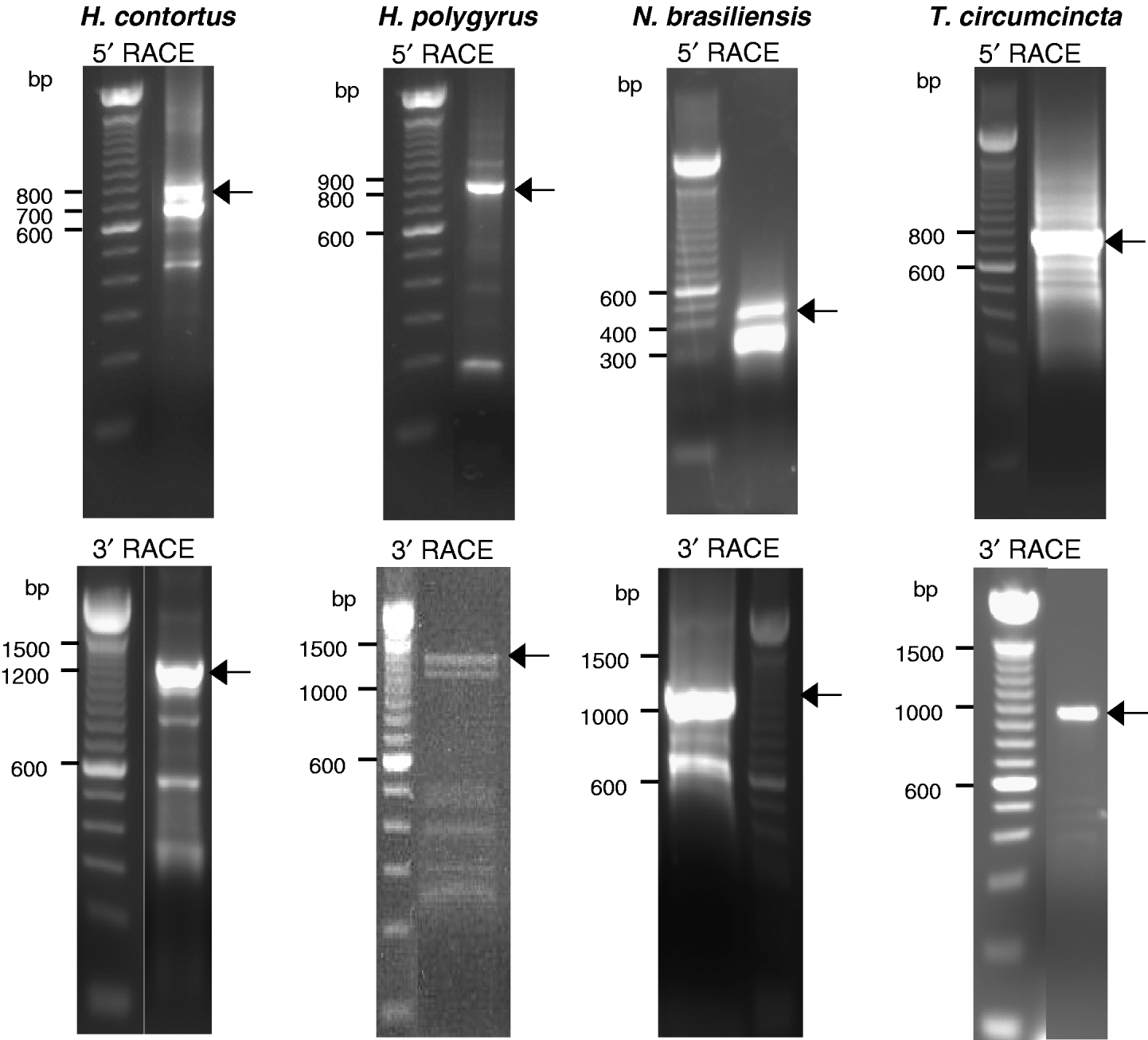
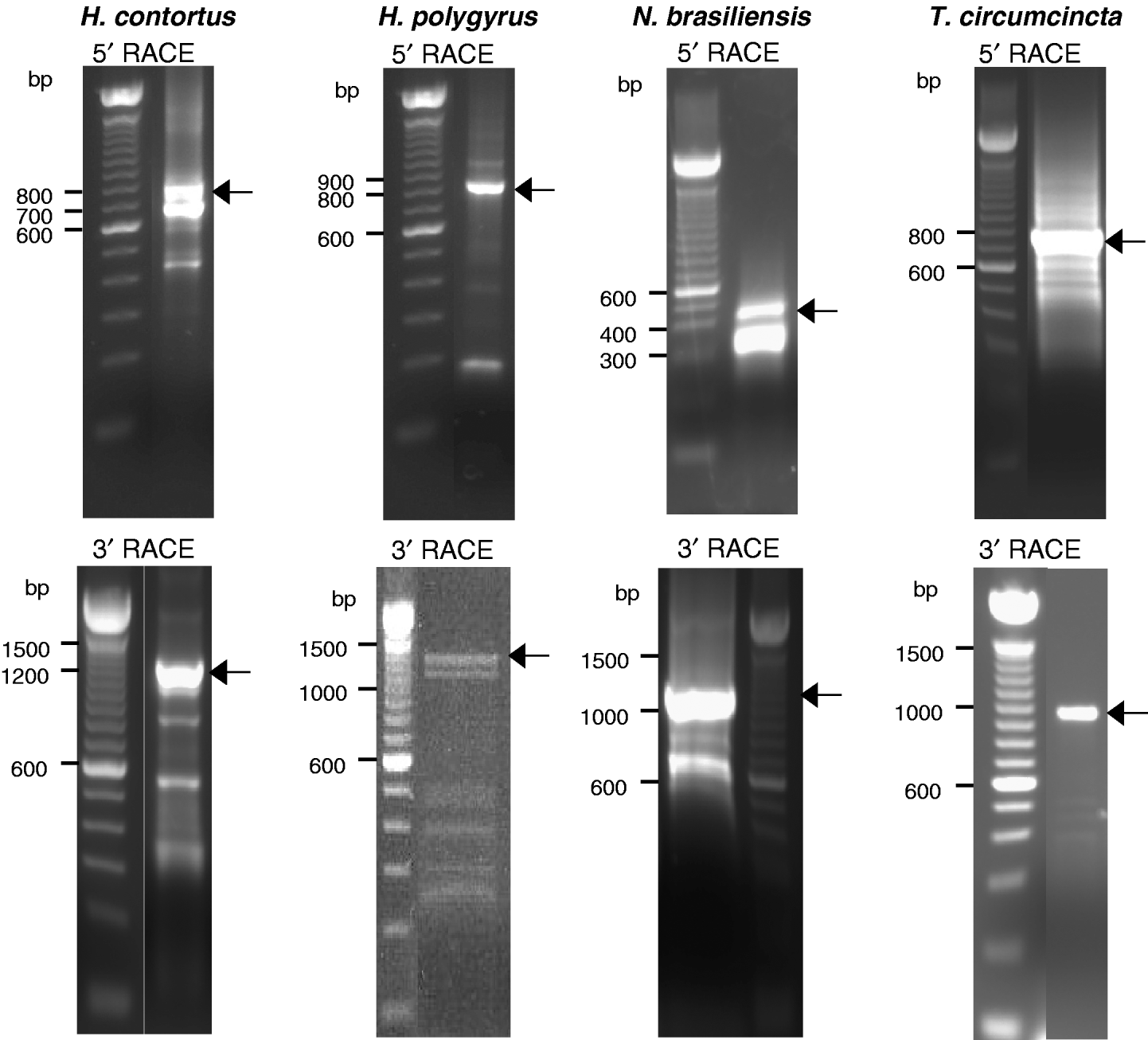
Full sequences of TGF-β homologue genes
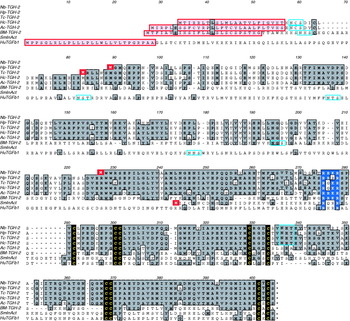
RACE was used to isolate the 5′ and 3′ ends of each gene, in separate reactions with products as shown in Fig. 2. The H. contortus and T. circumcincta 5′ and 3′ RACE products were amplified by single PCR reactions, while the H. polygyrus and N. brasiliensis 5′ and 3′ RACE products required amplification by nested PCR, using a second set of primers. Products were sequenced, and sequences of the newly assigned Hc-TGH-2, Hp-TGH-2, Nb-TGH-2 and Tc-TGH-2 aligned with other TGF-β family members at the amino acid level (Fig. 3). The 4 trichostrongyloid parasite proteins were all identical at 100/117 positions (85·4%) of the C-terminal domain, but only 50 amino acids (42·7%) were identical to Bm-TGH-2 over the same tract.
5′ and 3′ RACE products of TGF-β homologues. Upper panel: 5′ RACE of H. contortus, H. polygyrus, N. brasiliensis and T. circumcincta adult cDNA, amplified and visualized by ethidium bromide staining of agarose gels. Following sequencing, the indicated bands were found to contain tgh-2-like sequences. Lower panel: 3′ RACE from the same cDNA samples as above.
Full amino acid sequences and alignment of TGF-β homologues. Protein alignments of known TGF-β homologues from Homo sapiens, B. malayi, A. caninum, and novel TGF-β homologues from H. contortus, H. polygyrus, N. brasiliensis and T. circumcincta. Numbering corresponds to the human protein sequence. Predicted signal sequences are shown in red boxes, or where no signal sequence is predicted, start methionines are indicated in solid red boxes. Solid blue box indicates tetrabasic protease cleavage site, black boxes indicate conserved cysteines. Open turquoise boxes denote potential N-glycosylation motifs (N-X-S/T). Accession numbers for novel sequences are: Hp-tgh-2 FJ410912, Nb-tgh-2 FJ410913 and Tc-tgh-2 FJ410914.

Particular scrutiny was given to the 5′ termini of these genes, as in 3 cases they were truncated at the 5′ end compared to canonical TGF-βs (Fig. 3). To verify the full-length sequence of Hp-tgh-2 and Nb-tgh-2, 5′ RACE was repeated several times and the 5′ ends of each gene were also amplified from cDNA libraries prepared as described elsewhere (Harcus et al. Reference Harcus, Parkinson, Fernández, Daub, Selkirk, Blaxter and Maizels2004); in no case did we detect a longer transcript. Furthermore, we were able to amplify Hp-tgh-2 with an internal gene-specific reverse primer, and a forward primer for the nematode 22-nt spliced leader sequence, and this product contained the same start codon as present in all other PCR products (data not shown). Significantly, the SmInAct gene is also truncated at the 5′ end (Freitas et al. Reference Freitas, Jung and Pearce2007), so this is not a feature confined to trichostrongyloid TGF-β homologues.
The truncated N-termini of Hp-TGH-2, Nb-TGH-2 and Tc-TGH-2 also result in the absence of a conventional signal peptide; interestingly, the N-terminus of Nb-TGH-2 fulfils the criteria for a predicted signal peptide, although this sequence corresponds to an internal hydrophobic region in the longer homologues (Fig. 3). Notably, a potential N-glycosylation site is present in the active domain of the trichostrongyloid proteins, which is not observed in other family members (Fig. 3). N-glycosylation is known to be important for secretion of mammalian TGF-β (Brunner et al. Reference Brunner, Lioubin, Marquardt, Malacko, Wang, Shapiro, Neubauer, Cook, Madisen and Purchio1992) and it would be interesting to establish if this also pertains to the parasite products.
Phylogenetic analysis
Within the TGF-β superfamily, each of the homologues described here were found by phylogenetic analysis of the conserved C-terminus to group as a closely-spaced set on the same branch as Bm-tgh-2 and C. elegans daf-7 (Fig. 4). Morphological characteristics group H. contortus and T. circumcincta together in the Family Haemonchidae, while H. polygyrus and N. brasiliensis are placed in separate Families, Heligmosomatidae and Heligmonellidae respectively ((Hoberg and Lichtenfels, Reference Hoberg and Lichtenfels1994) and http://beta.uniprot.org/taxonomy/). Our analysis lends support to this classification, but not at the highest level of confidence because of the limited number of variant positions available for comparison.
Phylogenetic tree of TGF-β superfamily members. Neighbour-joining phylogenetic tree of TGF-β superfamily members, generated using Poisson correction on MacVector; numbers indicate bootstrap values (percentage of calculated trees branching at each point, based on 1000 repetitions. Where no numbers are shown, bootstrap values are below 50%.

Real-time PCR analysis
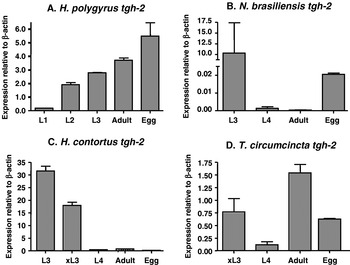
To assess the expression profile of the novel TGF-β homologues in parasites at different developmental points, cDNA was prepared from eggs, larvae and adult worms of each organism. Larval-stage availability varied between species, but it was possible to analyse L1, L2 and L3 larvae of H. polygyrus, L3 and lung L4 larvae of N. brasiliensis, L3 and exsheathed L3 (xL3) and abomasal L4 of H. contortus, and xL3 and abomasal L4 of T. circumcincta. Using real-time PCR, tgh-2 gene transcription was quantified, and normalized by comparison to parasite β-actin gene expression. In H. polygyrus, transcription of Hp-tgh-2 is lowest in the early larval stages, and increases through later stages to reach highest levels in the adults and eggs (Fig. 5A). In contrast, N. brasiliensis tgh-2 expression was maximal in L3 larvae and eggs, with lower expression in L4 larvae and minimal levels in adults (Fig. 5B). RT-PCR analysis of cDNA from H. contortus and T. circumcincta also revealed a different developmental pattern of gene expression, the former species showing a larval maximum (Fig. 5C), as has also been shown for S. ratti (Crook et al. Reference Crook, Thompson, Grant and Viney2005), while in T. circumcincta adult stages contained high levels of tgh-2 transcript (Fig. 5D).
Expression levels of tgh-2 transcript in different life-cycle stages. Levels of tgh-2 and actin transcription were measured by real-time PCR in different developmental stages of H. polygyrus (A), N. brasiliensis (B), H. contortus (C) and T. circumcincta (D). The genomic position of the RT-PCR primers used for H. contortus are shown in Fig. 1 (RT-F and RT-R). The relative transcription levels were calculated by dividing the relative levels of tgh-2 transcription by relative levels of actin transcription. Standard errors shown are calculated from replicate determinations of tgh-2 levels divided by the mean of replicate determinations of actin levels. Relative levels of T. circumcincta tgh-2 were very similar when β-tubulin was used as the reference gene (data not shown). Data are representative of at least 2 independent experiments in each case.

DISCUSSION
Over recent years, it has become established that members of the TGF-β gene superfamily are required in helminth organisms to direct a suite of developmental processes, most clearly observed in the free-living nematode C. elegans (Patterson and Padgett, Reference Patterson and Padgett2000). Strikingly, the complex signalling pathway, with 2 receptor subunits and intracellular kinases, is conserved from mammals to nematodes (Estevez et al. Reference Estevez, Attisano, Wrana, Albert, Massagué and Riddle1993; Gomez-Escobar et al. Reference Gomez-Escobar, van den Biggelaar and Maizels1997; Newfeld et al. Reference Newfeld, Wisotzkey and Kumar1999), trematodes (Beall and Pearce, Reference Beall and Pearce2001; Osman et al. Reference Osman, Niles, Verjovski-Almeida and LoVerde2006; Freitas et al. Reference Freitas, Jung and Pearce2007) and cestodes (Zavala-Gongora et al. Reference Zavala-Gongora, Kroner, Bernthaler, Knaus and Brehm2006), indicating the potential for molecular cross-talk between evolutionarily distant organisms (Luckhart et al. Reference Luckhart, Crampton, Zamora, Lieber, Dos Santos, Peterson, Emmith, Lim, Wink and Vodovotz2003). An important, but unproven, hypothesis is that parasites may have adapted genes first involved in endogenous body organization to interact with the immune system of their host (Gomez-Escobar et al. Reference Gomez-Escobar, Gregory and Maizels2000). TGF-β proteins may exemplify this process, if it is the case that helminth homologues can ligate host TGF-β receptors and thereby diminish immune responsiveness.
A number of TGF-β homologues have been characterized from parasitic nematodes, including the human filarial nematode B. malayi (Gomez-Escobar et al. Reference Gomez-Escobar, Lewis and Maizels1998, Reference Gomez-Escobar, Gregory and Maizels2000), S. stercoralis and S. ratti, and P. trichosuri (Crook et al. Reference Crook, Thompson, Grant and Viney2005; Massey et al. Reference Massey, Castelletto, Bhopale, Schad and Lok2005), as well as the dog hookworm A. caninum (Brand et al. Reference Brand, Varghese, Majewski and Hawdon2005; Freitas and Arasu, Reference Freitas and Arasu2005). Some important groups of parasites, however, have not been examined in this regard. For example, H. polygyrus and N. brasiliensis are species widely used for experimental infections with rodents and known to drive strong regulatory T cell (Wilson et al. Reference Wilson, Taylor, Balic, Finney, Lamb and Maizels2005; Finney et al. Reference Finney, Taylor, Wilson and Maizels2007; Rausch et al. Reference Rausch, Huehn, Kirchhoff, Rzepecka, Schnoeller, Pillai, Loddenkemper, Scheffold, Hamann, Lucius and Hartmann2008) and Th2 differentiation (Lawrence et al. Reference Lawrence, Gray, Osborne and Maizels1996; Voehringer et al. Reference Voehringer, Shinkai and Locksley2004) respectively in laboratory mice. It is possible that parasite-derived TGF-β family members play a role in this very pronounced skewing of immune responsiveness. Two related nematodes, found worldwide in sheep and other ruminants and responsible for very considerable economic damage, are H. contortus and T. circumcincta. Identification of TGF-β homologues in these species could pave the way for new strategies to control infections which are proving recalcitrant to drug clearance (Wolstenholme et al. Reference Wolstenholme, Fairweather, Prichard, von Samson-Himmelstjerna and Sangster2004). These 4 species are closely related taxonomically within the Trichostrongyloidea superfamily of nematodes, and are each found in specialized habitats within the host gastrointestinal tract.
Our identification of new homologues was made possible, firstly, by the release of substantial genomic sequence from H. contortus, and secondly by the availability of sequences from closely related species, most particularly A. caninum (Brand et al. Reference Brand, Varghese, Majewski and Hawdon2005; Freitas and Arasu, Reference Freitas and Arasu2005). While the 4 new homologues were found to be highly similar to each other in the conserved active domain, it was surprising to find that 3 of the 4 contained truncated pro-protein N-terminal domains, without conventional signal sequences. Although in N. brasiliensis it is possible that the truncated product employs an alternative hydrophobic tract as a signal sequence, no alternative is apparent for either H. polygyrus or T. circumcincta. However, it has recently been reported that the S. mansoni homologue SmInAct, which is a functional TGF-β like protein, is also truncated and lacks a conventional signal sequence (Freitas et al. Reference Freitas, Jung and Pearce2007). In the context of signal peptide-independent secretion, it should be noted that in a recent proteomic study of B. malayi secreted proteins, some 33% lacked signal peptides, including one of the most abundant secreted molecules (Hewitson et al. Reference Hewitson, Harcus, Curwen, Dowle, Atmadja, Ashton, Wilson and Maizels2008). Studies are now under way to ascertain whether the trichostrongyloid parasites secrete TGH-2 proteins in a signal peptide-independent manner.
A notable level of diversity between the trichostrongyloid species was seen in the patterns of tgh-2 expression throughout their developmental cycles. Real-time PCR showed that in N. brasiliensis and H. contortus expression is highest in the arrested L3 larvae, which is similar to the profile reported for A. caninum, P. trichosuri, S. ratti and S. stercoralis (Brand et al. Reference Brand, Varghese, Majewski and Hawdon2005; Crook et al. Reference Crook, Thompson, Grant and Viney2005; Freitas and Arasu, Reference Freitas and Arasu2005; Massey et al. Reference Massey, Castelletto, Bhopale, Schad and Lok2005). In contrast, the TGF-β homologue daf-7 is down-regulated in C. elegans Dauer larvae which have entered developmental arrest (Ren et al. Reference Ren, Lim, Johnsen, Albert, Pilgrim and Riddle1996). Thus, in parasitic species in which larval arrest is constitutive, TGF-β homologues may regulate later developmental steps that are exquisitely dependent on the environmental or immunological cues accompanying infection (Freitas and Arasu, Reference Freitas and Arasu2005; Viney et al. Reference Viney, Thompson and Crook2005). Interestingly, among these cues may be host TGF-β (Arasu, Reference Arasu2001). In distinction to N. brasiliensis and H. contortus, 2 other species display continued tgh-2 expression beyond the infective larval stage. Adult worms of H. polygyrus and T. circumcincta show high levels of gene transcription, as do the eggs. Because H. contortus eggs do not express tgh-2, it is difficult to attribute its function in either adult worms or eggs to any fundamental, conserved developmental pathway.
An alternative scenario is that these gene products exert an immunological effect in the host. Thus, expression by infective larvae allows them to release high levels of TGF-β homologue on infection of the host, thereby impairing the host immune response from the very outset. Where, as with H. polygyrus, the expression increases through the duration of mammalian infection, this could explain the dominance of regulatory T-cell activity in mice harbouring adult worms of this parasite (Wilson et al. Reference Wilson, Taylor, Balic, Finney, Lamb and Maizels2005; Finney et al. Reference Finney, Taylor, Wilson and Maizels2007; Rausch et al. Reference Rausch, Huehn, Kirchhoff, Rzepecka, Schnoeller, Pillai, Loddenkemper, Scheffold, Hamann, Lucius and Hartmann2008). It is interesting to speculate whether the failure of N. brasiliensis adult worms to establish beyond 6–8 days in the murine gut is related to the absence of TGF-β homologue expression by this stage of the parasite.
These alternative hypotheses now require experimental investigation. While conventional genetic knockout techniques cannot be used with helminth parasites, RNAi offers a promising route to study individual gene function, and most recently knock-down of the S. mansoni TGF-β family member SmInAct confirmed its role in parasite development (Freitas et al. Reference Freitas, Jung and Pearce2007). Although progress with RNAi on trichostrongyloid nematodes has been limited (Hussein et al. Reference Hussein, Kichenin and Selkirk2002; Geldhof et al. Reference Geldhof, Murray, Couthier, Gilleard, McLauchlan, Knox and Britton2006; Zawadzki et al. Reference Zawadzki, Presidente, Meeusen and De Veer2006; Lendner et al. Reference Lendner, Doligalska, Lucius and Hartmann2008), in some instances this technique has been successful (Kotze and Bagnall, Reference Kotze and Bagnall2006) indicating that it may be possible to knock down TGF-β expression in a species such as H. contortus. Further, heterologous transfection of helminth genes into other organisms such as Leishmania has permitted the immunological function of individual genes to be elucidated (Gomez-Escobar et al. Reference Gomez-Escobar, Bennett, Prieto-Lafuente, Aebischer, Blackburn and Maizels2005; Maizels et al. Reference Maizels, Gomez-Escobar, Prieto-Lafuente, Murray and Aebischer2008). We are pursuing these and other means of establishing the biological role of TGF-β family members in these important helminth parasite species.
H.McS. thanks the Medical Research Council for Studentship support; J.R.G. thanks the Wellcome Trust for a Ph.D. studentship; Y.H., J.M. and R.M.M. thank the Wellcome Trust for Programme Grant support. D.P.K. and A.J.N. gratefully acknowledge funding from the Scottish Government Rural and Environment Research and Analysis Directorate (RERAD).