INTRODUCTION
The survival of temperate ectoparasites depends on their ability to tolerate low seasonal temperatures outside the host (Tinsley, Reference Tinsley1999; Wharton, Reference Wharton1999; Lehane, Reference Lehane2005). Endothermic hosts guarantee constant resources and a safe environment, and some blood-feeding ectoparasites therefore remain reproductively active throughout the year (Haarløv, Reference Haarløv1964; Krasnov et al. Reference Krasnov, Burdelova, Shenbrot and Khokhlova2002). An extended reproductive period means that females will age, and the offspring that are shed from the host will encounter very different seasonal conditions and a risk of freezing. Maternal age often correlates reliably with seasonal environmental changes (Mousseau and Dingle, Reference Mousseau and Dingle1991). Mothers may therefore have good ability to predict the environment that the young will face, and produce offspring with a phenotype that best fits those conditions (McGinley et al. Reference McGinley, Temme and Geber1987; Schultz, Reference Schultz1991; Roff, Reference Roff1992; Plaistow et al. Reference Plaistow, St. Clair, Grant and Benton2007). For example, large offspring are often produced in cold or otherwise poor environments (Fischer et al. Reference Fischer, Brakefield and Zwaan2003). So far there is no empirical evidence as to whether ectoparasites produce offspring whose quality is modified according to predictable seasonal variation in temperature outside the host.
Leaving the warm host during the winter may be risky for ectoparasites. Temperate insects enter diapause in order to escape low temperatures well in advance of severe conditions arising (Tauber et al. Reference Tauber, Tauber and Masaki1986; Danks, Reference Danks1987; Leather et al. Reference Leather, Walters and Bale1993; Bale and Hayward, Reference Bale and Hayward2010). Diapause, per se, increases tolerance to environmental extremes during winter, but diapause-mediated cold-hardening often requires weeks of acclimation: decreasing temperatures stimulate the production of cryoprotectants and thus, tolerance often is at its highest in mid-winter, decreasing towards spring (Tauber et al. Reference Tauber, Tauber and Masaki1986; Bale and Hayward, Reference Bale and Hayward2010). Freeze-intolerant insects reduce the risk of lethal freezing by lowering their freezing point, i.e. by supercooling (Leather et al. Reference Leather, Walters and Bale1993). The period during which an insect can stay in a supercooled state varies with the time and severity of cold exposure (Knight et al. Reference Knight, Bale, Franks, Mathias and Baust1986). Large individuals with larger energy reserves (especially body fat) often have a significant advantage for survival at prolonged low temperatures (Colinet et al. Reference Colinet, Hance and Vernon2006; Matsuo, Reference Matsuo2006). For example, in large individuals the formation of lethal body ice may be slower than in small individuals (Ansart and Vernon, Reference Ansart and Vernon2004). However, the opposite pattern has also been reported: larger individuals may have higher supercooling points and hence they are less tolerant to cold (e.g. Hahn et al. Reference Hahn, Martin and Porter2008).
Resistance to low temperatures varies between life-history stages and according to season (Tauber et al. Reference Tauber, Tauber and Masaki1986; Heinrich, Reference Heinrich1999). This is because preparing for and maintaining high cold tolerance is energetically expensive (Leather et al. Reference Leather, Walters and Bale1993; Colinet et al. Reference Colinet, Hance and Vernon2006). Therefore, low tolerance to frost is often found in active stages (i.e. during growth, development and flight period), when only favourable seasonal temperatures are experienced (Wharton, Reference Wharton1999).
Some blood-feeding ectoparasites feed only on host blood as adults, whereas offspring outside the host depend totally on maternally derived resources (Langley and Clutton-Brock, Reference Langley and Clutton-Brock1998). These energy reserves determine the offspring's resistance to starvation during non-feeding periods but also their resistance to environmental adversities (Roff, Reference Roff1992; Colinet et al. Reference Colinet, Hance and Vernon2006; Piiroinen et al. Reference Piiroinen, Ketola, Lyytinen and Lindström2011). Thus tolerance to low temperatures is likely to decrease with age and decreasing energy reserves as the off-host period progresses (Colinet et al. Reference Colinet, Hance and Vernon2006; Bowler and Terblanche, Reference Bowler and Terblanche2008).
We used the ectoparasitic deer ked (Lipoptena cervi L., Hippoboscidae) to test whether females would produce offspring with higher cold tolerance when they are most likely to experience a high risk of freezing outside the host. The deer ked lives and feeds on temperate cervids, mainly moose (Alces alces), as adults (Kaunisto et al. Reference Kaunisto, Kortet, Härkönen, Härkönen, Ylönen and Laaksonen2009; Välimäki et al. Reference Välimäki, Kaitala, Madslien, Härkönen, Várkonyi, Heikkilä, Jaakola, Ylönen, Kortet and Ytrehus2011). Off-host stages do not feed but rely totally on maternal provisioning. Viviparous females give birth to immediately pupating larvae, one at a time, during their reproductive period extending from autumn until summer. The newborn pupae are shed off the warm host, experiencing frosts of varying degree and duration without cold acclimation. After diapause, developing pupae and adults are not normally exposed to harsh frosts.
This study focuses on factors influencing the cold tolerance (i.e. lack of long cold acclimation, pupal size and birth time) of deer ked pupae at diapause and during active off-host stages. We determine the cold tolerance as cold-hardening capacity (SCP) and as the length and severity of the frost periods that pupae survive, using manipulative short- or long-term frost exposures. We expect cold tolerance to be highest in diapausing pupae that experience harsh frosts soon after birth. We conduct tests to establish whether cold tolerance is higher in newborn pupae produced before or during winter than in spring, and whether it increases with larger size at birth. We also test whether cold tolerance follows seasonal temperatures and decreases with the length of the non-feeding period so that developing pupae and adults have reduced cold-hardening capacity during summer and autumn.
MATERIALS AND METHODS
Study species
Deer keds emerge and fly from late summer to late autumn. After accepting a suitable host, they cut off their wings. The adults stay attached to the same cervid host where they feed and reproduce. The total number of offspring is approximately 20–40 per deer ked female (Popov, Reference Popov1965). Since they are produced one at a time, the birth time and age of offspring differ by several months (Haarløv, Reference Haarløv1964). The hosts may move for tens, or even hundreds of kilometres during the fly's reproductive life span (Heikkinen, Reference Heikkinen2000). Thus, the site for pupal diapause and development is determined by host movements.
The non-feeding, off-host period covers diapause in winter, pupal development (i.e. adult metamorphosis) during summer and the host search period of adults in autumn. The deer ked pupae overwinter in a diapause, which is terminated by high temperature (Härkönen and Kaitala, unpublished observations). They diapause at a stage when adult metamorphosis has not yet begun. Pupae overwinter below or within a snow blanket that creates a microclimate, where temperatures may remain around zero despite low air temperatures (Leather et al. Reference Leather, Walters and Bale1993). Pupal development initiates in late spring when temperatures increase high enough and adults emerge after approximately 3 months of development. Adults may survive more than 2 months without a host (Härkönen et al. unpublished observations).
Material collection and preparation
We had no previous knowledge about the limits of cold tolerance in this species. In order to study the time and severity of frosts that the pupae survive, we needed to gather the largest sample sizes for as many treatments as possible. For this part of the study, we used pupae collected all over the current distribution area in Finland in March. The more detailed collection methods and places are described by Härkönen et al. (Reference Härkönen, Härkönen, Kaitala, Kaunisto, Kortet, Laaksonen and Ylönen2010) and Kaunisto et al. (Reference Kaunisto, Härkönen, Niemelä, Roininen and Ylönen2011).
To study cold tolerance in detail, we collected deer ked pupae from moose bedding sites in the commune of Siikalatva, Central Finland (64°30′20″N, 25°39′00″E; 60 m AMSL). The collection dates were chosen to be during mild weather and several days after periods of harsh frosts, and only pupae from recently used bedding sites (<24 h) were used for experiments. Thus the pupae experienced only mild temperatures (ca. 0–5°C) before the freezing tests were started. In autumn (October) we collected pupae from 3 moose pelts immediately after the moose were killed. This was done because moose bedding sites and the deer ked pupae on them are difficult to find without snow. The moose used in this study originated from the same area and were killed during the moose hunting season. After collection, we measured the pupal mass (used as a measure of offspring size) with a precision balance (Mettler Toledo MT 5, accuracy of 0·001 mg). We kept the pupae in a cold room (+5°C) until the experiments started within a few days after collection.
Cold tolerance of diapausing pupae
We examined ability to tolerate cold in newborn diapausing pupae by determining their cold hardiness in relation to their birth time and size. Cold hardiness is defined as the capacity of a species to survive short- or long-term exposure to low temperatures. The supercooling point is considered to be an indicator of lower lethal temperatures during short-term cold exposure in freeze-avoiding species. By contrast, freeze-tolerant insects can survive in temperatures below their SCP (Salt, Reference Salt1961). Therefore, supercooling capacity should not be considered the only measure of cold-hardiness in a given species; the ability of the species to survive prolonged periods of cold exposure must be evaluated (Sømme, 1996; Bale and Hayward, Reference Bale and Hayward2010).
Supercooling point measurements
We tested the freezing point of the newborn diapausing pupae after dropping off the host. Lethal freezing of body fluids takes place at the supercooling point (SCP) (Wilson et al. Reference Wilson, Heneghan and Haymet2003). The degree of supercooling, i.e. the temperature just before the onset of ice crystal formation and consequent release of heat, can be measured by differential thermal analysis (DTA). The DTA was conducted with a custom-designed device, which consisted of 4 aluminum modules, each module having 3 spaces for the samples (Räisänen et al. Reference Räisänen, Repo and Lehto2006). The differential temperature between the sample and the reference point was measured for 12 samples at a time. The differential temperature was measured using NiCr/Ni thermocouples (diameter 0·25 mm) and the temperature of the aluminum block using a Pt-100 thermistor. The modules were in a programmable freezing chamber (ARC 300/–55/+20, Arctest, Finland). The temperature changes during gradual cooling of each sample were recorded using DASYlab 8.0 software.
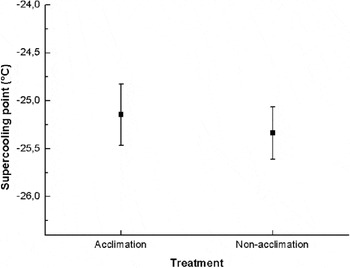
Cold acclimation at subzero temperatures may affect the SCP (e.g. Koštál and Šimek, Reference Koštál and Šimek1995). We collected 72 diapausing pupae (n=36/treatment) in March and tested the effect of cold acclimation on the SCP. The pupae were kept at either +5°C or −5°C for 24 h before DTA. Correspondingly, the DTA was conducted with 2 initial temperatures for the exposure programme (+5°C or −5°C). The acclimation test was also used as a control test for the cooling protocol for further SCP measurements. The SCP of diapausing pupae was not lowered by acclimation at subzero temperature (P>0·05, Fig. 1). Hence, for the later tests, we used an initial temperature of +5°C, a cooling rate of 5°C hour−1 and a target temperature of −40°C. To examine the supercooling capacity of diapausing pupae in relation to their birth time and size, we collected pupae at intervals of approximately 6 weeks from autumn to spring on October 19 (n=40), January 14 (n=37), February 26 (n=30) and April 3 (n=36). We measured their SCPs a few days after collection (the measurements of 1 month's samples taking 4 days altogether).
The supercooling points of acclimated (at −5°C) and non-acclimated (at +5°C) diapausing deer ked pupae.

Tolerance to prolonged frost
We evaluated the cold tolerance of diapausing pupae in nature by testing their ability to survive prolonged cold exposures. For the frost treatments, we placed the pupae individually in Eppendorf tubes and sank them in boxes filled with sand to stabilize possible temperature fluctuations in the freezer rooms. To control natural mortality as compared to frost kills, an additional control group (without frost exposure) was kept in the cold room (at +5°C). Four days after the treatments, we moved all the pupae to a climate chamber (+20°C, 60% RH and a photoperiod of 19 h/5 h for day/night) in order to detect survival (assessed as adult emergence success).
First, we estimated the time and severity of frosts that the pupae survive, using a total of 450 (n=90/treatment) pupae collected from all over Finland. In addition to the control treatment, we exposed them to frosts of −5°C, −15°C, −20°C or −25°C for 4 days (96 h). Second, in order to examine the cold tolerance of newborn pupae in detail, i.e. according to birth time and size, we collected altogether 216 pupae on February 26 and April 3 (n=36/treatment). Hereafter, we will refer to these dates as ‘winter’ and ‘spring’, respectively. We divided the pupae equally into treatments (incl. control) according to size range, so that within either season their mean mass or variance did not vary between the treatments (ANOVAs: Winter F 2,90=0·160, P=0·852; Spring F 2,106=0·031, P=0·970). Since we found that exposure for 4 days killed a large proportion of the pupae if the temperature was below −15°C, we exposed these pupae for 3 days (72 h) to either −15°C or −20°C.
Cold tolerance of free-living stages
Although SCP may not be directly applicable to survival in field conditions, it has been used widely as a comparative measure of cold tolerance between different life-history stages (Leather et al. Reference Leather, Walters and Bale1993). To test possible differences in cold-hardening potential between different free-living life-stages (diapause and non-diapause pupae and adult), we measured freezing points (SCP) also during pupal development (representing the summer stage) and after adult emergence (the autumn stage). The developing stage consisted of pupae (n=31) collected on April 10 and reared in a climate chamber (+20°C, 60% RH and a photoperiod of 19 h/5 h for day/night) for 40 days (i.e. at the halfway point of pupal morphogenesis). To obtain young adults (n=34) we reared pupae without any cold exposure and measured their SCP a week after adult emergence. In addition, we examined tolerance to long frost exposure in developing pupae that we had collected and reared simultaneously with the pupae used for SCP measurements. We exposed 36 pupae for 3 days to +5°C, −15°C or −20°C, while the control treatment was executed at +20°C.
Data analysis
We analysed all the data with SPSS for Windows (version 15.0). We tested the effect of cold acclimation at −5°C on supercooling capacity at diapause by means of a t-test. We analysed the differences in the supercooling points of diapausing pupae according to their birth time by Covariance Analysis: the SCP was set as the dependent factor, pupal mass as a covariate and the birth month as a fixed factor. To test the influence of three-day treatments (no frost, −15 °C or −20°C), the effect of season (winter or spring) and pupal mass on survival, we used a GLM with binomial error distribution and the logit-link function. In the model, survival was set as the dependent factor, pupal mass as a covariate, and the treatment and season as predictors. First, a model with all interactions and main effects was fitted to the data. Then we removed unnecessary parameters according to a principle of hierarchy in order to gain the definitive model. More detailed comparisons for the survival probability within/between seasons and frost treatments we conducted by means of Χ 2-tests. We analysed the seasonal variation in mean pupal mass (i.e. in winter and spring) by a t-test. For the variation in the supercooling points between life-history stages (diapause, developmental and adult stages) we used One-way Analysis of Variance and for the pair-wise comparisons Tukey HSD post-hoc tests.
RESULTS
The short-term cold-hardening capacity of the deer keds (measured as freezing points) was high through 4 seasons and all free-living life-stages, but the ability to survive prolonged frosts was highest in diapausing pupae. The survival of diapausing pupae decreased with the length and severity of frosts above the supercooling point, whereas large size increased the rate of survival.
Cold tolerance of diapausing pupae
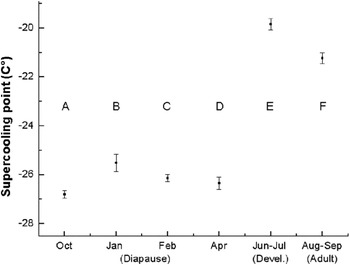
The supercooling points of diapausing pupae (mean±s.e,: 26·1°C±0·13) were not affected by cold acclimation (t=0·187, d.f.=70, P=0·852, Fig. 1) or birth month (F 3,134=1·133, P=0·338, Fig. 2). Neither pupal mass (F 1,134=0·087, P=0·768) nor Month × Mass interaction (F 3,134=0·959, P=0·414) affected the supercooling points of young diapausing pupae.
Mean supercooling points (°C±s.e.) through 4 seasons and all free-living stages of the deer ked. Supercooling points are measured for newborn diapausing pupae produced between Oct. and April (A–D), and for the active stage in summer (E: pupae in the middle of the development) and in autumn (F: 1-week-old adults). P-values for SCP differences according to Tukey post-hoc tests: non-significant within diapause (i.e. between ABCD) but between active stages (EF) P<0·001.

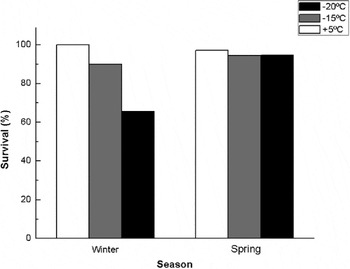
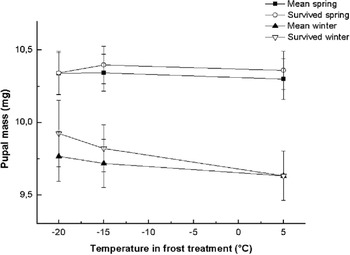
All the diapausing pupae died if the temperature was −20°C or −25°C for 4 days, but 33·3% of the pupae survived at −15°C, and 76·7% survived at −5 °C. During the 3-day exposure, survival probability decreased with severity of frost (Wald X 2=9·517, d.f.=2, P=0·009, Fig. 3). Survival was significantly higher in young spring pupae than in winter, but only at −20°C (X 2=8·172, d.f.=1, P=0·004). However, survival during 3-day frosts was not affected by the season as such (Wald Χ 12=1·922, P=0·166), although it increased with pupal mass (Wald Χ 2=9·205, d.f.=1, P=0·004, Fig. 4). In spring, the pupae were on average larger than in winter (t=5·010, d.f.=197, P<0·001).
Survival of diapausing pupae produced in winter and spring after a 3-day frost periods at −15°C or −20°C compared with survival of pupae without frost experience.

Cold tolerance of free-living stages
The SCPs of the 3 life stages (diapause, development, adult) differed significantly (F 2,207=332·017, P<0·001, Fig. 2). The mean SCP (°C±s.e.) was lower in diapausing pupae (−26·1±0·13) than in active stages, when developing pupae (−19·9±0·23) had higher freezing points than adults (−21·2±0·23) (post-hoc: P=0·001). The developing pupae had the potential to survive prolonged frosts although survival probability is very low during 3-day exposure: temperatures of −20°C killed all the developing pupae, but one adult emerged after exposure of 3 days at −15°C. 63·9% of pupae survived a 3-day period at +5°C, whereas survival in the control treatment (+20°C) was 66·7%.
Mean pupal masses (mg±s.e.) for all pupae tested in winter and spring contrasted with pupae that survived after being exposed to frosts for 3 days.

DISCUSSION
Newborn diapausing pupae were able to cold-harden well without acclimation and they survived harsh frosts lasting from 3–4 days. The freezing points of non-acclimated diapausing pupae (−26°C) did not vary with birth time or size. Tolerance to prolonged frosts was, however, unexpectedly higher in spring than in winter, but the observed seasonal differences were explained by pupal size: in spring the pupae were larger and their tolerance better than in winter. Cold-hardening capacity was highest in the diapausing pupae, yet it was surprisingly high also after diapause in developing pupae (−20°C) and at the adult stage (−21°C). Developing pupae also had the potential to survive prolonged harsh frosts. Thus life-history stages that do not experience very low temperatures in nature were still able to cope with serious frosts.
Diapause-mediated cold-hardening
The freezing points of newborn diapausing pupae were low without long cold acclimation. Our results thus contradict the general assumption that diapause-mediated cold-hardening requires days or weeks before actual severe winter conditions arise (Tauber et al. Reference Tauber, Tauber and Masaki1986). Ectoparasites dropping off the host during unfavourable seasons may be exposed to a high risk of freezing. For example, if an ectoparasitic winter tick (Dermacentor albipictus) leaves the warm cervid host too early in spring, low temperatures are likely to kill it (Samuel et al. Reference Samuel, Mooring and Aalangdong2000). Rapid cold-hardening processes increase survival in species that experience sudden changes in their thermal environment (Chen et al. Reference Chen, Denlinger and Lee1987; Czajka and Lee, Reference Czajka and Lee1990). Low freezing points without cold acclimation may increase the survival probability of newborn deer ked pupae immediately when they drop off the host. However, in Northern Boreal environments, temperatures on the snow surface during midwinter may remain below −20°C for several days, and thus tolerance to long frost periods is crucial for survival.
Cold-hardening capacity measured as supercooling points determines only lethal frost during a short cold exposure and may not be directly translated into long-term survival in the field (Leather et al. Reference Leather, Walters and Bale1993). This is because in freeze-intolerant insects, pre-freeze mortality may occur well above the supercooling point, and the mortality rate increases with time spent in a supercooled state (Knight et al. Reference Knight, Bale, Franks, Mathias and Baust1986). Deer ked pupae seemed to be intolerant to freezing and suffered from higher mortality when severity and duration of frost exposure increased: they survived relatively well for 3 days at −20°C, but died after 4 days of exposure to those temperatures.
The freezing points of diapausing deer ked pupae did not vary with size or according to birth month, whereas tolerance to prolonged frost exposure was higher in spring than in winter. However, differences in the pupal mass of the deer ked fully explained the unexpectedly higher cold tolerance of young pupae in spring than in winter. The mortality of small pupae increased with the severity of 3-day frost, whereas large pupae survived well. This suggests that large pupal size increases resistance to pre-freeze mortality during prolonged frost periods.
Females are expected to invest more in offspring if even a small increase in provisioning increases survival probability (Smith and Fretwell, Reference Smith and Fretwell1974; Parker and Begon, Reference Parker and Begon1986; Plaistow et al. Reference Plaistow, St. Clair, Grant and Benton2007). Pupal size correlated positively with cold tolerance as was expected, but seasonal variation in offspring size did not correlate with the occurrence of harsh frosts. Offspring size increased towards spring and the explanation for this trend is currently under investigation: old females in spring may be able to invest more in one offspring, or the deterioration in host (moose) condition may promote maternal ability to produce larger offspring (Härkönen et al. unpublished observations).
Harsh frosts are presumably a relatively minor factor regulating the deer ked population as new pupae are produced during a 9-month period. The pupae produced in autumn will be covered by snow before the onset of harsh winter frosts: snow significantly buffers both minimum temperatures and cooling rates, thus protecting overwintering insects (Leather et al. Reference Leather, Walters and Bale1993). During winter, it may take days or weeks before an insulating layer of snow provides cover, and thus pupae that are produced during extremely long and harsh frost periods may have reduced survival probability. However, frosts below −20°C in Finland occur only during a few months (Dec–Mar) (Finnish Meteorological Institute Database). In spring the amount of snow diminishes, exposing all pupae to spring frosts, which are not, however, as severe as in winter.
Cold-hardening capacity through the free-living period
Supercooling points of −30°C during diapause are not uncommon among hibernating insects in temperate regions, but only some Arctic and Antarctic species retain a high degree of cold-hardiness all year round (Tauber et al. Reference Tauber, Tauber and Masaki1986; Bale et al. Reference Bale, Worland and Block2001). The freezing points of the deer ked were lowest during diapause as expected, but they remained at −20°C or below even after diapause, although active stages will never experience such temperatures. Even if freezing points could be kept nearly constant throughout the year, susceptibility to lethal cold injury varies seasonally: many insects are sensitive to frosts after diapause termination, and they die mainly from cold shock injuries rather than freezing (Tauber et al. Reference Tauber, Tauber and Masaki1986; Chen et al. Reference Chen, Denlinger and Lee1987). For instance, non-diapausing pupae of Sarcophaga crassipalpis have a supercooling point of −23°C but do not survive to adult emergence when exposed to −17°C for as little as 20 min (Lee and Denlinger, Reference Lee and Denlinger1985). Surprisingly, non-diapausing deer ked pupae have the potential to survive harsh summer frosts: an adult emerged after the 3-day exposure to −15°C, but a slightly milder frost or shorter exposure might have increased their survival rate. Altogether, the mean supercooling points of diapausing and non-diapausing deer ked pupae were a relatively good predictor of cold-hardiness when estimating survival after a 3-day frost exposure: they had potential to survive if the frost was not much harsher than approximately 5°C above their supercooling point.
This study and the study by Nieminen et al. (Reference Nieminen, Paakkonen, Eerilä, Puukka, Riikonen, Lehto and Mustonen2012) both report high cold tolerance in adults, but with partly differing results. Nieminen et al. (Reference Nieminen, Paakkonen, Eerilä, Puukka, Riikonen, Lehto and Mustonen2012) demonstrated that adults might survive at temperatures above −16°C, but they report a significantly higher supercooling point of adults (−7·8°C, n=6) than found in this study (−21·2°C, n=34). Based on the freezing point, they concluded that the deer ked exploits freezing tolerance strategy. Conversely, our data, which also included the other off-host stages, strongly suggest a freeze avoidance strategy to be utilized and high pre-freeze mortality at temperatures approaching the freezing point. However, Nieminen et al. (Reference Nieminen, Paakkonen, Eerilä, Puukka, Riikonen, Lehto and Mustonen2012) used adults collected from the field during several weeks, and thus the body condition and age (i.e. length of starvation) differ from those of our specimens. Moreover, they used significantly older adults for the SCP measurements than for the survival tests, and thus their conclusion may be incorrect.
High cold tolerance all year round and through free-living stages may correlate with other factors increasing off-host survival in ectoparasites. For example, it has been suggested that the high supercooling capacity in the parasitic tick Argas reflexus (Argasidae) is a consequence of its ability to survive prolonged periods of starvation and desiccation when outside the host (Dautel and Knülle, Reference Dautel and Knülle1997). The cold tolerance of the deer ked was reduced during the end of the free-living life-span, which may be related to starvation (Verhoef et al. Reference Verfoef, Nedved and Lavy1997). Nieminen et al. (Reference Nieminen, Paakkonen, Eerilä, Puukka, Riikonen, Lehto and Mustonen2012) reported that the free-living adult stage does not use low molecular weight cryoprotectants (sugars, polyols or amino acids) to increase their cold tolerance, but the characterization of pupal contents (i.e. maternal-derived resources) is a subject for further study. We presume that the high tolerance of all stages could be a side effect of offspring provisioning for their long non-feeding period. For example, body fat is an important energy source during starvation (Colinet et al. Reference Colinet, Hance and Vernon2006), and fatty acid composition has been found to be involved in the cold-hardening of dipterans (Bennett et al. Reference Bennett, Pruitt and Lee1997; Ohtsu et al. Reference Ohtsu, Kimura and Katagiri1998).
The majority of insects enter diapause well in advance in order to withstand decreasing autumnal temperatures. However, the ability to remain active under harsh climatic conditions may be a significant key to fitness (Colinet et al. Reference Colinet, Hance and Vernon2006) and thus increase e.g. range expansion potential (Bale and Hayward, Reference Bale and Hayward2010; Nieminen et al. Reference Nieminen, Paakkonen, Eerilä, Puukka, Riikonen, Lehto and Mustonen2012). In northern environments, nocturnal frosts may occur even in summer. During autumn subzero temperatures may occur nightly, whereas day temperatures still remain favourable for flying: the deer ked adults have been found to survive until December in the field despite frequent nocturnal frosts close to −10°C occurring in late autumn/early winter (Härkönen et al. unpublished observations). For ectoparasites with a long development time (in relation to season length) and late flight time, shorter season length at high latitudes or altitudes may be compensated by extended flight time. For example, high cold-hardening capacity all year around may have facilitated the rapid northward invasion of the deer ked during the past few decades (see Kaitala et al. Reference Kaitala, Kortet, Härkönen, Laaksonen, Härkönen, Kaunisto and Ylönen2009; Härkönen et al. Reference Härkönen, Härkönen, Kaitala, Kaunisto, Kortet, Laaksonen and Ylönen2010).
Conclusions
In the deer ked cold tolerance was highest during diapause and large size increased tolerance to prolonged frosts. However, the deer ked contradicted a few general findings regarding cold tolerance in temperate insects: (i) diapause-mediated cold-hardening did not require a long period of cold acclimation, (ii) tolerance to long cold exposures was highest in spring, not in winter, and (iii) life-history stages experiencing only favourable conditions had high cold-hardening capacity. Our results indicate that in blood-feeding ectoparasites, tolerance to low temperatures through 4 seasons correlates with other survival characteristics, such as the high starvation resistance, of all the free-living stages of ectoparasites.
ACKNOWLEDGEMENTS
We wish to thank all the volunteers who helped us with material collection, especially Juho-Antti Junno, Panu Välimäki, Jani Koskimäki, Mervi Jaakola and the staff at Friendship Park Research Centre. We are indebted to four anonymous reviewers, Eija Hurme, Laura Vesala and the Evolution and Behaviour Research Group at the University of Oulu for their very helpful comments on earlier drafts of the manuscript. We thank Rosemary Mackenzie and Marko Pyhähuhta for checking the English of the earlier drafts and final version of this manuscript. This study complies with the current laws of Finland.
FINANCIAL SUPPORT
This study has been funded by the Academy of Finland (to A.K., L.H.), University of Oulu (L.H.), EnviroNet (L.H.) and several foundations: the Ella and Georg Ehrnrooth Foundation (L.H., S.K.), the Biological Society of Finland Vanamo (L.H., S.K.), Societas Pro Fauna et Flora Fennica (L.H., S.K.), and the Alfred Kordelin Foundation (S.K.).