Prologue
Al‐Ustādh (Le Professeur), a Tunisian film released in 2012, follows an established law professor and member of the ruling party who is chosen to represent the government in a newly formed Tunisian human rights league (Tanit Reference Tanit2012). The opening scene of the film is in the law professor's classroom as he lectures on the Tunisian constitution's history, its guarantee of basic rights, and its promotion of the “rule of law.”Footnote 1 When his student‐mistress is arrested, beaten, and sentenced to four years of imprisonment for assisting two Italian reporters investigating labor union strikes in the mines of Gafsa (Qafṣah, a city in central Tunisia), the law professor finds himself confronting the realities of the authoritarian state he had steadfastly supported.Footnote 2 After declining to withdraw his signature from a petition condemning the government's refusal to pardon his student, he is banished to live under house arrest in a remote part of Tunisia. The movie's events accurately portray some of the real political tensions produced by confrontations between the government and lawyers representing workers in the 1970s. Tensions between pro‐ and anti‐regime legal professionals are strikingly depicted in the film as both sides employ legal rhetoric to advocate for divergent political positions. While the film's script was originally written in 1988, its production was delayed by censorship under the Zine El Abidine Ben Ali (Zayn al‐ʿĀbidīn Bin ʿAlī) regime. This film is a fascinating depiction of an exceptional aspect of Tunisian society: many lawyers understand their professional duties as including the protection of citizens from government repression; and many citizens concur in viewing lawyers as important sociopolitical actors. The film accurately portrays Tunisian political lawyering and popular Tunisian recognition of the importance of the legal profession. This article offers some explanations for how and why this relationship between Tunisian lawyers, citizens, and the state evolved, taking the Tunisian uprising as a key moment in the legal profession's politicization and development of professional autonomy.
Introduction: The Tunisian Uprising and Political Lawyering
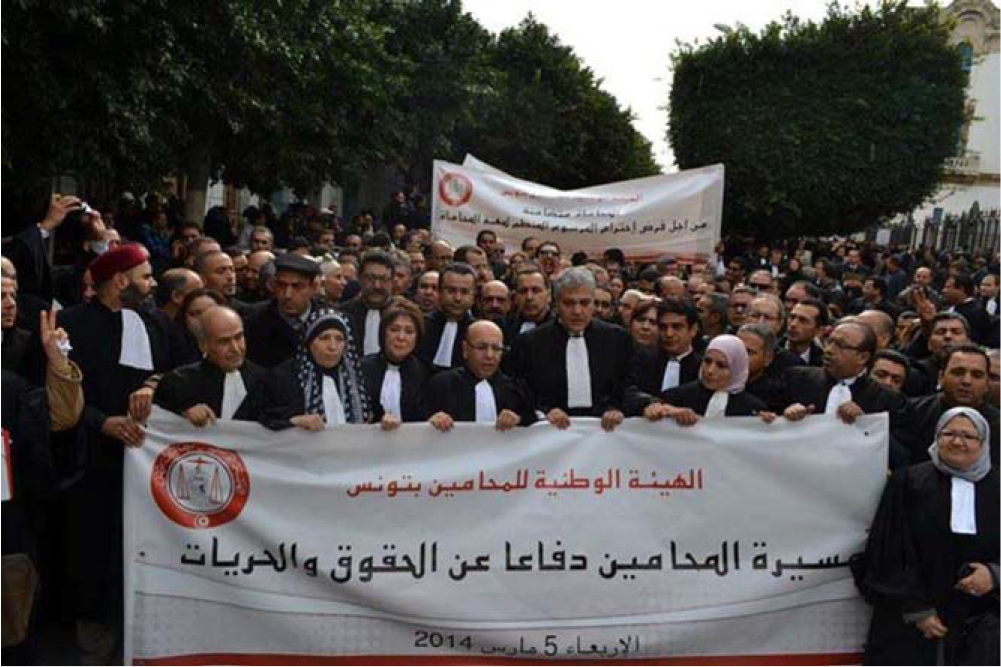
On January 14, 2011, after twenty‐three years in power and one month of popular protest demanding his resignation, President Ben Ali fled Tunisia. Although some characterized it as the “Jasmine Revolution,” many Tunisian activists insist that “it wasn't a revolution, it was an uprising” (al‐Sharīf Reference al‐Sharīf2012).Footnote 3 In the eyes of many Tunisians, whatever changes occurred in the aftermath of Ben Ali's departure constituted a reconfiguring of preexisting power dynamics, rather than a fundamental shift in the sociopolitical, economic, or legal infrastructure of Tunisia. Yet in contrast to this deep‐rooted inertia, the legal profession may be undergoing a more profound transformation. Both during and after the uprising, photos of Tunisian lawyers participating in demonstrations while wearing their professional robes were a source of pride, prominently placed on the cover of an issue of the Tunisian Bar Association's (TBA) newsletter and its Facebook page.Footnote 4 Lawyers’ protests in black robes made them visible symbols in the media and on the Internet; after the fall of Ben Ali, lawyers who became well‐known before and during the uprising (including Abderraouf Ayadi, Choukri Belaïd, Leila Ben Dabba, Fawzi Ben Mrad, and Abdenacer Laouini) were frequently interviewed in Tunisian media to express their views on the uprising and issues related to the purported democratic transition. Many Tunisians identify lawyers as important sociopolitical activists and there is a common and widespread view among Tunisians that the legal profession represents justice. Tunisian lawyers earned their reputation for political dissent prior to the uprising, having long agitated for their independence. Indeed, the TBA constituted an “alternative political field” because its advocacy on behalf of the legal profession often intersected with political protest even before the uprising (Gobe Reference Gobe2010, 334).Footnote 5
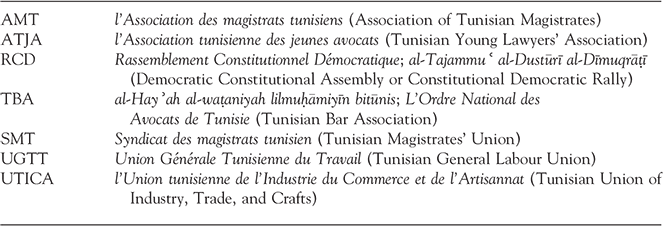
Cited Tunisian Organizations

| AMT | l'Association des magistrats tunisiens (Association of Tunisian Magistrates) |
| ATJA | l'Association tunisienne des jeunes avocats (Tunisian Young Lawyers’ Association) |
| RCD | Rassemblement Constitutionnel Démocratique; al‐Tajammuʿ al‐Dustūrī al‐Dīmuqrāṭī (Democratic Constitutional Assembly or Constitutional Democratic Rally) |
| TBA | al‐Hayʾah al‐waṭaniyah lilmuḥāmiyīn bitūnis; L'Ordre National des Avocats de Tunisie (Tunisian Bar Association) |
| SMT | Syndicat des magistrats tunisien (Tunisian Magistrates’ Union) |
| UGTT | Union Générale Tunisienne du Travail (Tunisian General Labour Union) |
| UTICA | l'Union tunisienne de l'Industrie du Commerce et de l'Artisannat (Tunisian Union of Industry, Trade, and Crafts) |
Undoubtedly, Tunisia's civil legal distinction between avocats (lawyers) and magistrats (magistrates, both judges and prosecutors)—an adoption from the French legal system—places the former in the somewhat natural position of opposing the government. However, the distinctions between these two groups of legal professionals do not adequately explain why Tunisian lawyers and the TBA have come to represent some of the core symbolic values (especially fundamental rights) of the Tunisian uprising.Footnote 6 In this article, we outline the TBA's activism in four historical moments: from Tunisia's independence to the beginning of the third millennium (1956–2000), the first decade of the third millennium (2000–2010), the Tunisian uprising (December 2010–January 2011), and some post‐uprising transformations (2011–2014). These moments parallel a shift in the focus of TBA's activism: from professional objectives, to socioeconomic concerns, to political engagement that divided the membership and leadership, to relatively unified political mobilization of the legal profession. Parallel to these shifts, the TBA's discourse and activities became more symbolic and performative, shifting from courtrooms to public spaces. This symbolic capital of lawyers’ mobilization is evident in other states as well (Munir Reference Munir2009; Halliday, Karpik, and Feeley Reference Halliday, Lucien and Feeley2012). We do not claim an evolutionary progress; instead, responding to its surroundings, the TBA gradually accumulated experience in political protest that intensified during the uprising and was strategically employed in its aftermath. As observed in similar contexts (VonDoepp Reference VonDoepp, Terence C, Lucien and Malcolm M2012), the TBA earned what might be called revolutionary legitimacy by aligning the organization with activists, which endowed the TBA with political influence in post‐uprising Tunisia. This historical process, from Tunisia's independence to uprising, is then a story of transformation in which the bar gained autonomy that resulted in political mobilization, which was intensified by the revolutionary context. We outline these historical moments of the legal profession's escalating participation in civil society in order to investigate political lawyering at the crucial moment of political transition (uprising).
Tunisian political lawyering is similar to political lawyering in a variety of states in that the legal profession mobilized for political liberalism (Halliday and Karpik Reference Halliday, Karpik, Halliday and Karpik1997b; Halliday, Karpik, and Feeley Reference Halliday, Lucien and Feeley2007, 2012). Political liberalism is broadly defined as the pursuit of a moderate state (with an independent judiciary), of independent civil society, and of basic legal freedoms (Halliday and Karpik Reference Halliday, Karpik, Baltes and Smelser2015). Halliday and Karpik (Reference Halliday, Karpik, Baltes and Smelser2015) advanced five propositions on political lawyering and four of them resonate in the Tunisian case: (1) the TBA's relative autonomy was a crucial condition for its collective actions; (2) the TBA advocated for “core civil rights,” rather than broader economic or social rights; (3) the TBA's mobilization was often reactive, rather than proactive, and often involved collaboration with other civil society groups and the public; and (4) the TBA acted as a spokesperson for the Tunisian public during and after the uprising. The uprisings created the conditions for the TBA to adopt a role as representative of the public, reminiscent of Karpik's observation of eighteenth‐century French lawyers (Karpik Reference Karpik1995). In the Tunisian case, however, the fifth proposition—that courts are the key battlegrounds in the fight for political liberalism—does not apply. Because the Tunisian judiciary was co‐opted by the authoritarian regime, the Tunisian legal complex is divided (Halliday, Karpik, and Feeley Reference Halliday, Lucien and Feeley2007), which has implications for political lawyering.
This article contributes to the existing literature by clarifying aspects of political lawyering that have been understudied. We elucidate subtle dynamics of political lawyering through close examination of the TBA's history of activism and its encounter with the revolutionary moment. For example, while the TBA was generally reactive, we identify some explicitly proactive political mobilization that parallels other protests of lawyers in different parts of the world (Halliday, Karpik, and Feeley 2012). Using the rhetoric of justice and claiming to be guardians of revolutionary ideals, the TBA effectively appointed itself as watchdog over the post‐uprising Tunisian government. In addition, the Tunisian case highlights the limits of political lawyering by illustrating the tension within the political liberal notion that core civil rights do not include broad economic and social rights.
Prior to the uprising, the TBA focused on its professional autonomy in order to maintain the boundaries of the legal profession and to improve socioeconomic conditions for its members. Claiming exclusive control of professional territory and marginalizing competing professions (described as parasitic or encroaching on the domain of lawyers) were two issues at the center of the bar's activities since the beginning of the Tunisian legal profession in 1883 (Gobe Reference Gobe2013b). Not surprisingly, lawyers who were less dependent on the state for their livelihood were more likely to resist the authoritarian regime (Perdomo Reference Perdomo, Halliday, Karpik and Feeley2007). Still, a broad range of Tunisian lawyers combined economic and professional concerns in promoting Tunisian political lawyering. We contend that socioeconomic interests and civic professionalism became indistinguishable: because Tunisian lawyers perceived the authoritarian regime's limitation of their autonomy as a direct attack on the profession, monopolistic concerns (Abel Reference Abel1985) merged with civic professionalism (Halliday Reference Halliday1987; Halliday and Karpik Reference Halliday and Karpik1997a) and political resistance. In other words, we recognize that strategies for obtaining clients and interprofessional competition are key modes of professionalization (Abbott Reference Abbott1988), but economic and political objectives can become interlinked with professional goals. Before and after the uprising, Tunisian lawyers were involved in collective actions in which economic, professional, and political objectives were closely intertwined.
Importantly, legal practice does not “naturally” lend itself to liberal politics (Halliday and Karpik Reference Halliday and Karpik1997a). Lawyers profess a wide range of political positions and levels of political engagement, and not all are apostles of fundamental rights (Champy and Israël Reference Champy and Israël2009).Footnote 7 But lawyers benefit from a unique combination of legal resources and professional expertise that facilitates their interventions in politics. Moreover, professional autonomy is both a condition and a consequence of political liberalism (Halliday and Karpik Reference Halliday, Karpik, Halliday, Karpik and Feeley2012, Reference Halliday, Karpik, Baltes and Smelser2015). The legal profession's relative autonomy meant that the TBA operated as a kind of democratic enclave in comparison to other professions prior to the uprising. It was, for example, the only Tunisian professional organization to elect its leaders in a transparent fashion. Consequently, the TBA provided a space in which lawyers could discuss sensitive political issues.Footnote 8 In turn, the TBA's relative autonomy incubated further political activism. In addition to litigation, Tunisian lawyers engaged in a broad array of public acts to pursue justice: strikes, sit‐ins, demonstrations, press conferences, social media, issuing statements, and hunger strikes. In practicing both legal and nonlegal actions, Tunisian lawyers expanded beyond their expertise in law to articulate and to advocate for justice in sociopolitical terms. Most recently, the TBA has politically mobilized to assert itself both as part of the Tunisian system of justice and as representative of the public (Karpik Reference Karpik1988).
While this article focuses on the political lawyering of the TBA and the legal profession at large, it is necessary to note both the important role of cause lawyers and internal divisions within the TBA.Footnote 9 As a subgroup of activist lawyers, Tunisian cause lawyers pursued both defensive and offensive cause lawyering (Sarat and Scheingold Reference Sarat and Scheingold2001, Reference Sarat and Scheingold2005). These high‐profile cause lawyers defended fundamental rights and basic freedoms against the arbitrariness of the authoritarian state;), which is distinct from political lawyering because it is focused on specific demands (such as ending torture, defending human rights, or protecting the rights of laborers). Many Tunisian cause lawyers employed their professional skills in service of challenging the status quo (rather than exclusively serving their clients’ interests) (Hajjar they denounced torture, the courts’ noncompliance with basic procedures, and draconian laws on so‐called terrorism (Gobe Reference Gobe2013a, 250–51).Footnote 10 Although the authoritarian regime marginalized and attacked Tunisian cause lawyers, the lawyers persevered and eventually shaped how other Tunisian lawyers conceptualize the legal profession. Thus, cause lawyers contributed significantly to the political lawyering of the TBA, but they were not the only activist lawyers in the organization.
Internal divisions within the TBA encompass both the organizational structure (leadership vs. membership) and a variety of other partitions. As a simultaneously autonomous and constrained organization, the TBA oscillated between negotiating with and resisting the authoritarian government. The TBA's internal politics shaped its political lawyering. When activist lawyers (i.e., lawyers active in political or cause lawyering) dominated the TBA's leadership, its mobilization changed accordingly, but the general constituency of the bar was also influential. During and after the uprising, the TBA responded to the growing demands of its members by shifting its focus from professional autonomy to political mobilization of the profession. For the purposes of this article, socioeconomic differences are the most significant factor in measuring political lawyering. We identify four basic subgroups of Tunisian lawyers, in the order of their activism: the “lower rung” of struggling, young lawyers; middle‐ and upper‐class lawyers with moderate client bases; specialized corporate lawyers; and members of the authoritarian government party (Gobe Reference Gobe2012). The latter two subgroups were largely uninvolved in political activism. The lower rung of lawyers was the most actively involved group in the Tunisian uprising; it is difficult to measure the activism of the middle‐rung lawyers. It is not, however, our objective to mythologize the activism of Tunisian lawyers, to suggest that there are no client‐centered lawyers, or to imply that Tunisian lawyers form an undifferentiated monolith. In recognition of the problems of mythologizing “civic republicanism” (Spaulding Reference Spaulding2003), we have noted resistance to political lawyering throughout this article.
In Tunisia's pre‐uprising authoritarian regime, civil society was severely stifled. But, alongside the TBA, other Tunisian organizations also have a long history of participation in politics. The Tunisian General Labor Union (UGTT) is one of the most important organizations, and it is relatively more powerful than the TBA. As in the case of the TBA, local and national leaders of the UGTT differed in their approaches to the authoritarian regime, but the circumstances of the uprising consolidated the labor union's advocacy. Most recently, the UGTT assisted in organizing and actively participated in the 2012–2013 framework for national dialogue (Chayes Reference Chayes2014). Yet, while the UGTT wields significant political influence in post‐uprising Tunisia, it does not represent political liberalism in the way that the TBA does. During the uprising, a variety of Tunisian civil society actors viewed lawyers as important leaders and representatives of justice. The TBA's political lawyering is simultaneously representative of broader dynamics and specific to the legal profession; in addition, the TBA's political role is both self‐constructed and widely acknowledged.
Sources, Methods, and Contributions: A Brief Overview
This article draws on our original research (and previous publications) pertaining to the legal profession and law in the contemporary Arab world. Our sources include Tunisian laws regulating the legal profession, quantitative and qualitative surveys and analysis of TBA documents, original interviews with Tunisian lawyers, TBA websites, and news articles. Gobe conducted the first and only comprehensive empirical study of the Tunisian legal profession during and after the Ben Ali regime; he collected quantitative and qualitative data during research trips in Tunisia between 2005 and 2010, as well as during and after the protests of 2010–2011. In 2008, Gobe completed a quantitative survey of 626 lawyers (about 10 percent of all Tunisian lawyers); between 2005 and 2009, he undertook qualitative surveys of eighty‐five lawyers, representing a spectrum of political affiliations and socioeconomic situations. Salaymeh analyzed more than 200 TBA documents issued between 2000 and 2012 and classified them according to the form of political lawyering. The TBA's documents are broadly representative of its organizational structure and membership; in light of the potential limitations of the TBA's self‐presentation, information from TBA sources has been verified for factuality and reliability and has been critically evaluated in conjunction with other sources. As for the bar's history, we relied on several texts that offer first‐hand accounts (biographies and interviews) of the legal profession (Chérif Reference Chérif and Ben1990; ʿUthmān Reference ʿUthmān1990; Mīlādī Reference Mīlādī2000). For the period during and after the uprisings, we relied on information gathered during our research stays in Tunisia. In particular, Gobe interviewed six lawyers (all TBA members).Footnote 11 Salaymeh undertook participant observation in the main Tunis courthouse and the headquarters of the TBA; she also interviewed members of the ATJA and some lawyers in the Tunisian Constituent Assembly. All in‐person interviews were conducted in Tunisia; in some cases, interviewees provided e‐mail responses to specific questions.
Based on extensive research, this article is a unique contribution to the available scholarly literature on both the Tunisian legal profession and political lawyering. There is relatively little scholarship on the legal profession in Tunisia and most of it has been written by Tunisian lawyers. In Arabic, the key history of the Tunisian legal profession primarily reports statistics and facts (Ibn al‐Aṣfar Reference Ibn al‐Aṣfar1998). In French, an unpublished thesis recounts the history of the legal profession from 1883 to 1987 (Hélin Reference Hélin1994). A recently published thesis—authored by a Tunisian lawyer who was president of ATJA, a member of the TBA governing council, and interim TBA president—investigates the relationship between lawyers and the authoritarian government, primarily under Ben Ali (Tabib Reference Tabib2015). There is little scholarship on the Tunisian legal profession available in English (Gobe Reference Gobe2010, Reference Gobe2013b). In contrast to the available scholarly literature, this article relies on diverse and original sources, as well as interdisciplinary methods (both historical and sociolegal).
In addition to contributing to the literature on the Tunisian legal profession, this study furthers scholarship on the political activities of lawyers. Although focused on an authoritarian, postcolonial state, understanding political lawyering in Tunisia contributes to the diversity of case studies in the existing scholarly literature. In other parts of Africa, lawyers have been recognized as important players in democratization efforts (Oko Reference Oko2000). In Tanzania and Kenya, lawyers “have by and large challenged the legitimacy of their country's repressive tendencies” (Kapinga Reference Kapinga1992, 890). In Pakistan, lawyers have mobilized alongside judges against authoritarian government tactics (Ghias Reference Ghias2010). In former British colonies, political lawyering manifests itself distinctly in liberal, authoritarian, and unstable states (Halliday, Karpik, and Feeley 2012). However, the politics of the legal profession in Arab states, or North Africa, or former French colonies is understudied (Reid Reference Reid1981; Agrama Reference Agrama2012). In comparison to other Arab states that followed Tunisia's revolutionary precedent, Tunisia's lawyers stand out as exceptionally involved and influential in resisting authoritarian governance and in politicizing law. Tunisian political lawyering both substantiates the theoretical framework of political lawyering and moves beyond it by demonstrating how and when lawyers can become proactive (rather than reactive) and by stressing the tension within political lawyering's diminishment of economic rights. This Tunisian case study allows us to rethink the role of political lawyering in pivotal moments of sociolegal change.
Autonomy: The Authoritarian Regime in Postcolonial Tunisia (1956–2000)
When Tunisia gained independence from French colonial rule in 1956, most Tunisian politicians were lawyers trained in French law schools and they reproduced the organizational model of the French legal profession by giving its governing bodies (the president and governing council) public powers.Footnote 12 A 1958 law organized lawyers into three separate bars at the courts of appeal in the cities of Tunis, Sousse, and Sfax (JORT 1958). The presidents of each of these three local bar organizations represented the profession before political and administrative authorities. The 1958 law also specified the conditions for access to the legal profession (such as nationality and diploma) and outlined professional conflicts of interest. By establishing rules that enshrined the autonomy of the legal profession and the liberal legacy of the French bar, the postcolonial Tunisian government perpetuated a professional model that challenges the operating logic of authoritarian states. The legal profession's autonomy would prove to be a source of political resistance.
The first authoritarian president of independent Tunisia, Habib Bourguiba (Būrqībah, r. 1957–1987) had studied law in France, practiced as an attorney in Tunisia for a short time, and understood well the potential of lawyers; he attempted to limit the profession's independence because it was dominated by his political opponents.Footnote 13 In August 1961, after detaining the TBA president in Tunis, Bourguiba dissolved the regional bar councils (in Tunis, Sfax, and Sousse), replacing them with an administrative committee charged with managing the affairs of the legal profession (JORT 1961). Although this administrative committee operated for four years, Bourguiba still was not able to control the profession fully. Certain lawyers from the Neo‐Destour party wanted the legal profession to regain normal functions and argued against Bourguiba for the return of legitimate governing bodies, composed of elected representatives from the bar; despite being members of a party aligned with Bourguiba, these lawyers were committed to some degree of autonomy for the legal profession.
Bourguiba negotiated with the bar, resulting in a 1963 law that provided for a return to elected representatives and a modification of the 1958 law organizing the legal profession (Tunisian National Assembly). The 1963 law created the national bar association of Tunisia (the TBA). The creation of a single organization representing lawyers was intended to “strengthen the influence of the president over the bar and the authorities” (Debates 1963, 233). Each side viewed the formation of a dedicated professional organization as an advantage for divergent reasons. The Bourguiba regime, reflecting an authoritarian state's logic of corporatism (Schmitter Reference Schmitter1974), viewed the consolidation of the bar as an opportunity to co‐opt the TBA president, while accepting normal elections for the bar's governing council.Footnote 14 In contrast, the lawyers viewed the institutionalization of a unified bar as allowing the profession to position itself as a unique interlocutor with the government and to represent its interests better. In the long run, the TBA could not be entirely co‐opted and the bar's professional autonomy gave it political leverage.
The legal profession's internal democracy did not generate direct political opposition; the reinstated ability of lawyers to elect their own representatives did not result in the TBA systematically electing government opponents. For the most part, the TBA elected members of the regime's party or individuals aligned with the regime. In 1965, under the provisions of the 1963 law, the TBA elected its first president, Mohamed Chakroun (then a member of the Neo‐Destour party), who had served as Minister of Social Affairs in the first government led by Bourguiba in 1956. The subsequent TBA presidents in the 1970s were also more or less connected to the authoritarian regime or the Neo‐Destour party. In 1971, Taoufik Ben Cheikh, a consensus candidate between the government and the TBA, was elected to a second term as TBA president. His successor, Mohamed Bellalouna, was a member of the Neo‐Destour party. Fethi Zouhir was elected TBA president twice (in 1975 and 1977) and he was also a long‐time member of Bourguiba's party. It was only during the end of the 1970s and the beginning of the 1980s—during a short period of liberalization in the Tunisian government (Chouikha Reference Chouikha, Camau and Geisser2004)—that the TBA elected presidents who were not close to Bourguiba or his political allies. First, Lazhar Karoui Chebbi was the personal secretary of Salah Ben Youssef, Bourguiba's political adversary at the beginning of Tunisia's independence. Second, Mansour Cheffi, who served as TBA president four times in the 1980s and early 1990s, was a leftist with ties to Habib Achour—the General Secretary of the UGTT, which had tense relations with the regime.
The election of TBA presidents who were not aligned with the authoritarian regime resulted in governmental interferences with the legal profession. Ben Ali (r. 1987–2011), Bourguiba's successor, pushed parliament to vote on a bill limiting the autonomy of the profession in 1989, under the tenure of Cheffi (an oppositionist) as TBA president (JORT 1989). The TBA's governing bodies challenged two provisions of the 1989 law. The first provision concerned lawyers’ immunity in the courtroom. Under Article 46, a judge who determined bad faith in an attorney's arguments or statements in court was permitted to prosecute the attorney, after notifying a regional TBA representative (JORT 1989, 1388). The TBA condemned this article for granting a judge the power to adjourn the court in order to send an attorney before other judges without prior notice. In other words, through this 1989 law, Ben Ali's regime gave all courts the power to discipline lawyers. The second disputed provision permitted magistrates who had served on the bench for ten years to become lawyers, even if they had retired. The TBA's governing bodies wanted to add a clause requiring magistrates to pass an exam in order to become members of the bar. The secretary of the TBA council at the time, Abdelwahab el‐Behi, argued that it was inconceivable that someone who spent many years “as a magistrate could be authorized by the provision to join the bar, while young lawyers, recently graduated, cannot even find the money to pay their electricity bills” (Tabib Reference Tabib1988). The TBA was clearly invested in maintaining the autonomy and economic viability of the legal profession, but this objective overlapped with distrust of magistrates, who were perceived as aligned with the authoritarian regime.
Opposition to the 1989 law regulating the legal profession resulted in Cheffi (the acting TBA president) and other activist lawyers becoming targets of government harassment (Abdelkefi Reference Abdelkefi1990). In October 1990, Cheffi and Abderrahmane Hila (a criminal defense lawyer close to Ennahdha) were denied access to a military court. This was followed by the arrest of Islamist lawyer Hedi Zamzemi at the door of the courthouse in Tunis while he was still wearing his lawyer's robe, which provoked strong reactions from the lawyers observing the scene (Abdelkefi Reference Abdelkefi1990). The TBA's governing council convened a general meeting in late October 1990 in response to these incidents. At the meeting, the TBA called on Tunisian lawyers to strike for two hours on November 1, 1990 to protest against the repeated violations of lawyers’ rights (Ben M'barek Reference Ben M'barek and Eberhart2003, 409). This collective action was the first of its kind in post‐independence Tunisia, but it had little effect. The TBA was unable either to amend the 1989 law or to prevent government harassment of its members. Indeed, the 1990s was a dark decade for the TBA. In 1992, thousands of Ennahadha party members, including lawyers, were arrested, tortured, and sentenced for alleged conspiracy against state security or for membership in an illegal organization. In addition, the Ben Ali regime gradually tightened its grip on all autonomous public bodies, including the TBA. During this period, the TBA membership elected two presidents who were close to the Ben Ali regime, hoping that their professional and economic demands would be considered by the regime. While the TBA officially concentrated on professional concerns, the authoritarian government's persecution of activist lawyers was readily apparent to members of the bar.
The French colonial legacy of distinguishing between lawyers and magistrates created the potential for a distinct professional identity. Because the authoritarian state sought to control the independence of lawyers, the legal profession mobilized to protect its professional autonomy. When states impose coercive policies targeting members of their community, then lawyers’ activities can assume a political dimension in which defending individual rights is intertwined with limiting arbitrary power (Karpik Reference Karpik, Bianic and Vion2008). In part, Tunisian lawyers opposed the government because of their own difficult social and economic situations, which gradually worsened during the 1990s—especially for newer members of the bar. From Tunisia's independence to the end of the 1990s, the regime and the TBA were locked in a cycle of government overreach and protest of lawyers over professional autonomy that had serious implications for the economic and civil rights of lawyers. Insofar as the TBA opposed or critiqued the authoritarian government, it did so primarily in defense of professional autonomy and in reaction to government abuse.
Discontent: Tunisia's Oppositional Legal Profession (2000–2010)
In the beginning of the 2000s, the bar's membership became increasingly young, resistant, and insistent on claiming professional autonomy; in response, the government initiated repressive measures in order to control the profession. Consequently, the TBA's governing bodies shifted toward dissent against the government from 2000–2010, chronicling government transgressions against lawyers in their official statements (Salaymeh Reference Salaymeh2014). Throughout the 2000s, lawyers elected members of opposition groups (see Table 2) as TBA presidents: Béchir Essid (an Arab nationalist), Abdessatar Ben Moussa (close to Ettajdid), and Abderrazak Kilani (an Arab nationalist close to Ennahdha). The 2010 bar elections delivered a victory to Kilani over Essid, henceforth supported by the RCD in the race for the post of TBA president. The TBA's governing council had always been politically heterogeneous—including leftists, Arab nationalists, and Islamists, as well as partisans of Ben Ali's RCD.Footnote 15 As compared to earlier periods, in the early 2000s, Tunisian lawyers elected oppositionists as their representatives because they were perceived as more inclined to defend the profession's perceived core values.
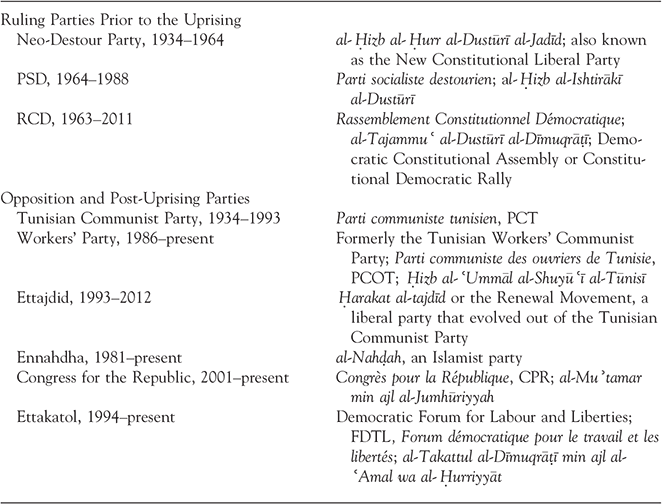
Cited Tunisian Political Parties
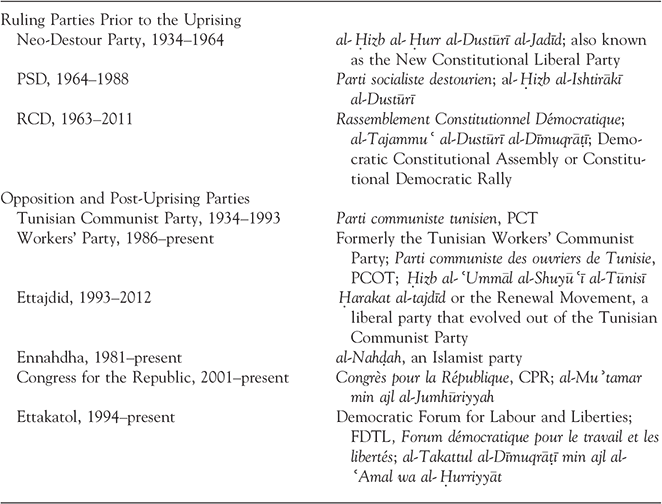
| Ruling Parties Prior to the Uprising | |
| Neo‐Destour Party, 1934–1964 | al‐Ḥizb al‐Ḥurr al‐Dustūrī al‐Jadīd; also known as the New Constitutional Liberal Party |
| PSD, 1964–1988 | Parti socialiste destourien; al‐Ḥizb al‐Ishtirākī al‐Dustūrī |
| RCD, 1963–2011 | Rassemblement Constitutionnel Démocratique; al‐Tajammuʿ al‐Dustūrī al‐Dīmuqrāṭī; Democratic Constitutional Assembly or Constitutional Democratic Rally |
| Opposition and Post‐Uprising Parties | |
| Tunisian Communist Party, 1934–1993 | Parti communiste tunisien, PCT |
| Workers’ Party, 1986–present | Formerly the Tunisian Workers’ Communist Party; Parti communiste des ouvriers de Tunisie, PCOT; Ḥizb al‐ʿUmmāl al‐Shuyūʿī al‐Tūnisī |
| Ettajdid, 1993–2012 | Ḥarakat al‐tajdīd or the Renewal Movement, a liberal party that evolved out of the Tunisian Communist Party |
| Ennahdha, 1981–present | al‐Nahḍah, an Islamist party |
| Congress for the Republic, 2001–present | Congrès pour la République, CPR; al‐Muʾtamar min ajl al‐Jumhūriyyah |
| Ettakatol, 1994–present | Democratic Forum for Labour and Liberties; FDTL, Forum démocratique pour le travail et les libertés; al‐Takattul al‐Dīmuqrāṭī min ajl al‐ʿAmal wa al‐Ḥurriyyāt |
These changes within the TBA's leadership reflected broader dynamics of political dissent among lawyers (Gobe and Ayari Reference Gobe and Ayari2007). A relatively small number of cause lawyers (who were members of political opposition parties) pressed their colleagues. As victims of government authoritarianism, they pressured the legal profession during the 2000s to take collective action on problems particular to lawyers (such as the government's intrusion on attorney‐client confidentiality). The political commitments of these cause lawyers, couched within arguments about the legal profession's autonomy, acted as “a catalyst for the group's principles and functional logic” (Champy and Israël Reference Champy and Israël2009, 14). Cause lawyers joined with other activist lawyers to protest strongly against violations of defendants’ rights and attacks on individual freedoms, as well as infringements on the profession's autonomy. Politically active lawyers pressured the TBA's governing bodies to organize collective actions when a member of the bar had been victimized; by tapping into a sense of professional autonomy, these activist lawyers strategically linked professional concerns to broader political dissent. For example, in 2000, in response to police brutality of attorneys supporting the hunger strike of an opposition journalist (Taoufik Ben Brik), the TBA governing council called for a strike and sit‐in of all Tunisian courts on April 28, 2000. In other instances, cause lawyers inaugurated hunger strikes in order to defend the dignity of lawyers and citizens. Radhia Nasraoui (a radical leftist and wife of Hamma Hammami, long‐time leader of the Tunisian Workers’ Party) was probably the first lawyer to begin a hunger strike as a means of political resistance. In a statement (October 15, 2003) to her colleagues, she explained that “pressure by diverse means” on her clients was intended to frighten them from utilizing her services; she asserted the state's political police had conducted “repeated rampages” on her office and placed her under permanent and extensive surveillance (wiretapping, interception of mail, continuous monitoring of her home, etc.) (Nasraoui Reference Nasraoui2003). In 2005, the arrest of oppositional lawyer Mohammed Abbou provoked his colleagues in the bar to organize a sit‐in protest at the Lawyers’ HouseFootnote 16 that lasted fifty‐two days; the TBA's governing bodies did not support the protest until just before it ended (Gobe Reference Gobe2013a, 290–93). Still, these acts of dissent illustrate that cause and activist lawyers tactically relied on their professional autonomy as an instrument for opposition; the TBA did not fully embrace all this oppositional activity, but did endorse some of it.
It was not, however, only government repression that motivated activist lawyers and the TBA to dissent; the lack of economic opportunities for lawyers (especially younger ones) also generated opposition to the government. During Ben Ali's reign, the legal profession experienced continuous and exponential growth. From 1991 to 2011, the bar's membership increased nearly six times, from approximately 1,400 to 8,000 members.Footnote 17 During the same period, the total labor force only grew 1.6 times (from about 2.3 million people to just over 3.7 million). More specifically, between June 2008 and June 2011, the profession grew with the entry of 1,500 additional lawyers. Nearly 75 percent of lawyers were under the age of forty in 2010 (Gobe Reference Gobe2013a). This bar of young lawyers was registered in the court of appeal and constituted 80 percent of what is identified as the lower rung of the Tunisian bar. These lawyers almost exclusively serve individual (rather than corporate) clients, usually from the working‐class neighborhoods in which they themselves were raised. Their legal work is primarily in the areas of family law (divorce, alimony, etc.), real estate (writing sales contracts for low‐cost properties), petty crimes (primarily misdemeanors), and even neighborhood disputes. In addition, co‐optation and economic inequity caused further resentment within the bar against the government. Lawyers who were active members of the RCD (roughly 500 lawyers) were clients of the Ben Ali regime and enjoyed a quasi‐monopoly over projects with public funding or involvement (Gobe Reference Gobe2013b). In exchange for these economic benefits, these pro‐regime attorneys monitored and challenged the collective actions of their colleagues in the legal profession (Gobe Reference Gobe2013b, 49–53). In the interest of repressing Tunisian civil society, lawyers aligned with the regime litigated against activist lawyers challenging the status quo. Thus, for lawyers, limitations on economic opportunities were both abstractly and concretely caused by the authoritarian regime.
In the late 1990s and early 2000s, with the number of lawyers steadily increasing, the profession's governing bodies repeatedly appealed to the Justice Department to enact reforms allowing them to control access to the bar and to restrict the activities of competing professions accused of encroaching on lawyers’ alleged natural field of expertise. The government, however, refused to accede to their demands, probably out of fear that members of the profession would manipulate their roles as defense advocates in order to challenge the regime's authoritarian behavior. But by refusing to support the professional autonomy of Tunisian lawyers, the regime alienated lawyers loyal to it and drove many lawyers to adopt a critical stance vis‐à‐vis the government. In other words, the widespread impression that the executive was trampling on the profession's prerogatives galvanized the TBA's defense of individual rights and freedoms. The difficult socioeconomic conditions experienced by the lower rung of the bar led a majority of lawyers to be receptive to activist lawyering (opposed to the regime) well before the Tunisian uprising.Footnote 18
The TBA's governing bodies recognized that the rising number of lawyers and their limited professional and economic opportunities was a problem. The TBA president (Abderrazak Kilani) sought, after his election in June 2010, to establish a modus vivendi with the regime. He attempted to negotiate with the regime for a new law regulating the legal profession that would be a compromise between the TBA and the government: it would satisfy at least one of the professional demands of the bar's lower rung in exchange for relinquishing other demands perceived by the government as immediately political (such as defending fundamental rights, respecting the autonomy of the legal order, or protecting public and private liberties). To draft this compromise law, on June 30, 2010, the TBA president convened a regulation committee. Consisting of three former bar presidents and forty‐three other lawyers, this regulation committee was designed to represent the entire spectrum of political and ideological currents in the bar. The committee was divided among four subcommittees that met about twenty times before setting up a higher regulation committee to elaborate the final bill (Ghribi Reference Ghribi2013b). Thus, in the period immediately preceding the Tunisian uprising, the TBA's membership—like many Tunisian citizens—was resentful of government policies constraining their daily livelihood, but the TBA's governing bodies—primarily oppositionists—sought a compromise focused on the profession's autonomy and immediate economic needs. There was then some discontent within the legal profession caused by sometimes conflicting, sometimes overlapping interests: cause lawyers initiated various acts of political resistance; the lower rung of the bar was disgruntled and increasingly activist; the TBA leadership responded to the political and economic concerns of these groups, but was largely accommodationist and focused on professional concerns.
Dissonance: TBA's Membership Versus its Leadership in the Tunisian Uprising (December 2010–January 2011)
The trigger for the Tunisian uprising (leading to the demise of the Ben Ali regime) was the attempted suicide on December 17, 2010 of Muḥammad Būʿazīzī, an unlicensed seller of fruits and vegetables in Sidi Bouzid (Sīdī Būzīd, a town of 40,000 inhabitants located in the center of Tunisia) after authorities confiscated his goods.Footnote 19 Several nights of rioting ensued, with young protestors resisting police. But, despite media portrayals, this was not a spontaneous event, but an “insurrectional moment” (Baduel Reference Baduel2013). The uprisings linked “the actions of political activists and local union members with the collective rioting of neighborhoods, where the young people itching for a fight finally confronted the police” (Hmed Reference Hmed2012, 38). Local members of the UGTT, rights activists, and cause lawyers who had grassroots organizing experience played an important role in the growing politicization of the Sidi Bouzid uprising. When the protests began in December 2010, no particular group of dissidents led them, but by taking responsibility for and placing themselves at the head of demonstrations, long‐time cause lawyers and activist, younger members of the bar (the lower rung) helped encourage and sustain the wave of popular protest. Yet, during much of the protest movement, the TBA's governing bodies were a hindrance to the political engagement of lawyers, rather than a facilitator of their involvement in the uprisings.
The day after Būʿazīzī self‐immolated, some activist lawyers organized a sit‐in in front of the Sidi Bouzid county court. On December 24, 2010, as the protests were beginning to spread throughout the central part of the country, about thirty (or one‐third) of Sidi Bouzid's lawyers marched in their robes from the courts of justice into the streets. This established a pattern (of marching from courthouses to public spaces while wearing the black robes of lawyers) that other Tunisian lawyers would follow in many other cities. On December 27, the police again violently dispersed protestors throughout the region, leading to sit‐ins of lawyers in front of the courts in Sidi Bouzid, Kasserine (Qaṣrayn), and Médenine (Madanīyīn).Footnote 20 These sit‐ins turned into demonstrations, attracting the general public to join protests organized by lawyers. With other protestors, marching lawyers denounced the regime and the predatory behavior of Ben Ali's in‐laws with slogans that mixed political and professional goals: “No to dictatorship; yes to an independent legal system” and “lawyers are the first lines of defense of people's rights.”Footnote 21 As a wave of dissidence spread across Tunisia (and in particular to Sousse and Sfax), lawyers became increasingly engaged in protests. In the capital (Tunis), lawyers continued direct involvement in and even leadership of protests. On December 22, at the instigation of opposition lawyers (primarily leftists and Arab nationalists), a sit‐in of about 100 lawyers was organized outside the Courts of Justice and the Lawyers’ House.Footnote 22 On the morning of December 28, a second sit‐in of about 200 lawyers took place at the Tunis courthouse. Within a matter of a week, lawyers had become part of the fabric of the uprisings and legal rhetoric—as the slogans above indicate—had become integral to the protest discourse.
This political engagement, however, was met with government retaliation, resulting in discord between the TBA's membership and leadership. On December 28, 2010, the regime's security forces arrested and detained for a few hours Abderraouf Ayadi (a human rights lawyer) and Choukri Belaïd (a radical leftist lawyer who was assassinated on February 6, 2013). After a night in detention, Ayadi and Belaïd were released on December 29, and they reported on their experiences at the Lawyers House. Ayadi displayed the clothes he had worn the previous day, which had been tattered by the regime's kidnappers, and denounced the physical abuse he endured during detention. Despite this testimonial of the regime's continued repressive tactics, the TBA president was timid, declaring that “the bar is not a political party” and that it must deal with the pressing, pragmatic concern of “5,000 starving lawyers” (Bouallègue Reference Bouallègue2011). Still, the TBA was obliged to respond to this infringement of professional autonomy. Thus, the TBA's governing council issued a statement denouncing the abduction and arrest of Ayadi and Belaïd “by agents of the security forces in flagrant violation of the law” (TBA 2010a). Concurrently, the TBA officially expressed solidarity with the inhabitants of Sidi Bouzid as citizens who were simply demanding their rights to work and to a decent life. Further, to protest against the police state's handling of the uprising, the TBA's governing bodies called for a day of solidarity with Sidi Bouzid residents: lawyers in black robes would wear a red ribbon in all the Tunisian courts of first instance on December 31, but the TBA asked lawyers to stay within the confines of the courts and not to demonstrate in the streets (TBA 2010a).
The circumstances and wording of the TBA statement and announcement of a demonstration reveal the dissonance between the engaged base of lawyers and the hesitant TBA governing bodies. The TBA president and part of the TBA's governing council sought to slow down the political activities of its members. Within the TBA's governing council, lawyers connected to the RCD did not want the organization to react, while other members were hesitant to take overt political action (Ghribi Reference Ghribi2013b). Those council members with more oppositional politics hesitated to denounce the TBA president's wait‐and‐see approach publicly (Ghribi Reference Ghribi2013b). While the bar's members were actively engaged in the protests, the TBA's official line was cautious. Despite this caution, government authorities reacted to the TBA's call for demonstration by implementing punitive measures outside and inside the courts: they prevented lawyers from exiting the courts by force and they deployed law enforcement agents within the confines of the courts to prohibit lawyers from wearing red ribbons (to express their solidarity with Sidi Bouzid residents). In Tunis, the security forces closed the gates of the main courthouse to prevent lawyers from exiting into the streets.Footnote 23 Lawyers who refused to obey the directives of police officers were mistreated and physically attacked, with their official court robes being torn (Hamida Reference Hamida2011).
This violence inside the sanctified spaces of courthouses provoked the TBA to escalate its dissent and to take a formal position in defense of its colleagues who had been attacked. Denouncing the police's “savage aggression” against lawyers, the TBA governing bodies called for a general strike on January 6, 2011 (TBA 2010b). Even this official statement reflected the TBA president's careful political positioning: in order to avoid a direct attack on the regime, it did not mention the riots and their repression in the central‐western part of the country; instead, the statement denounced the “violence and aggression inflicted upon lawyers by the security forces within the courts … and in front of the courthouse” (TBA 2011b). In other words, the TBA's governing bodies rationalized the organization's political dissent as a matter of professional autonomy—instead of directly aligning the TBA with popular protests, as many of its members were doing through their direct involvement in the protests.
The general strike of lawyers was, of course, part of a spreading wave of unrest. The government's brutal crackdown on protesters in Thala and especially in Kasserine on January 8–9, 2011 elicited wider social and geographic support for the protests, as the uprising spread to other Tunisian towns and cities, including the capital. While they began in largely working‐class neighborhoods, often at the instigation of unemployed graduates, the middle classes (including professionals) soon joined the protests as well. At this point, the split between the TBA governing council and the TBA president became obvious. Instead of simply following as rioters and police produced a “spiral of repression‐exaction‐indignation‐reinforcement of the movement” (Ayari, Geisser, and Krefa Reference Ayari, Vincent and Krefa2011, 370), the TBA governing council's representatives wanted to be at the heart of the protests, but the TBA's president (Kilani) still hesitated to take direct action.
This hesitation was apparent on January 11, 2011, during a meeting of the regulation committee (tasked in 2010 to finalize the draft of a new law regulating the legal profession). Many lawyers refused to proceed with the meeting's normal business; in their perspective, doing so would have been a denial of the human toll of the riots in the center of the country. Mongi Ghribi, a member of the regulation committee, proposed postponing discussions concerning the project in order to focus on the protests taking place in Thala, Kasserine, and Sidi Bouzid (Ghribi Reference Ghribi2013b); this proposal was endorsed by other members of the regulation committee who sought information about lawyers in the regions most affected by the popular uprisings. Kilani claimed that he had intervened in Kasserine to negotiate a deal: the government wanted lawyers in Kasserine to cease direct participation in the street protests in exchange for the release of arrested rioters and for noninterference in the funeral processions for protestors (Ghribi Reference Ghribi2013a). In addition, Kilani reported that lawyers were mediating between protestors and security services in Kasserine and Kairouan (Ghribi Reference Ghribi2013a). Because lawyers were playing pivotal roles in the protests, the regulation committee members created two committees—a monitoring committee and a committee to defend lawyers—in order to supervise the uprising as closely as possible. This was the first official TBA action devoted to the uprising and, considering the extensive involvement of lawyers in the protests, it was a prudent, albeit guarded, move.
Meanwhile, on January 11, 2011, the national leadership of the UGTT decided—under pressure from its members—to allow its regional branches to organize general strikes throughout Tunisia beginning January 12. The labor union's decision encouraged the TBA to express a clearer commitment to the uprising. Consequently, after an emergency meeting on January 12, the TBA governing bodies issued a call for “a lawyers’ general strike across all courts on Friday, 14 January, to show solidarity with victims [of the repression] and in support of the protestors’ claims” (TBA 2011c). The TBA governing council also arranged to send a delegation to Kasserine on January 13 in order to ensure the “safety of [their] fellow lawyers” in the town (TBA 2011c). In Medenine, Kasserine, and Sidi Bouzid, lawyers in their robes marched out of the courts to lead demonstrations. The geographical spread of the protests in Tunisia's major cities and capital, along with the threat of a palace revolution, meant that the regime had its back to the wall. On the morning of January 14, Mohamed Ghannouchi (Ghannūshī, Prime Minister from 1999 to 2011 and acting president from January 14–15, 2011) invited the TBA president to present the lawyers’ complaints and petitions to him. Kilani accepted the invitation to meet with the government, despite being urged by members of the TBA's governing council to march at the head of the demonstrations instead of meeting with Ghannouchi. In Tunis, on the same day, many lawyers had gathered in front of the Court of Justice and were about to join the main march on Bourguiba Avenue (Tabib Reference Tabib2011). Hundreds of lawyers protested in front of the Justice Department, calling for the independence of the judiciary to be respected, before making their way to the State Department on Bourguiba Avenue and joining additional demonstrators (Gherib Reference Gherib2011). Lawyers, encouraged by cause lawyers with protest experience, formed a ring around the State Department, while protestors shouted, “Ben Ali dégage” [Ben Ali out].Footnote 24 This image of lawyers protecting demonstrators would come to have great symbolic power. The protests were successful: by early evening (on January 14, 2011), Ben Ali had fled to Saudi Arabia and the regime had fallen. Unquestionably, lawyers played an important role in the Tunisian uprising. By acting as a line of defense between protestors and the authoritarian regime, lawyers expressed political dissent through the symbols of justice and the rule of law.
During the uprising, the TBA's official representatives initially acted as speed bumps against more active and direct engagement of lawyers in the Tunisian uprising; still, the TBA issued numerous statements criticizing the government's repression of protestors (Salaymeh Reference Salaymeh2014). The hesitations of the TBA's president and governing council support the theory that professional organizations representing lawyers rarely take a stand or deploy their resources to defend human rights or the rule of law (McEvoy and Rebouché Reference McEvoy, Rachel, Morison, McEvoy and Anthony2007). During most of the uprising, the TBA adopted conservative positions in favor of the status quo, appealing to ideas of the profession's neutrality or autonomy. It was the broader context of popular mobilization coupled with the energy of some activist lawyers (especially cause lawyers) that resulted in the TBA developing a “collective legal conscience” (McEvoy and Rebouché Reference McEvoy, Rachel, Morison, McEvoy and Anthony2007). Despite the attempts by the TBA leadership to defuse collective action of the legal profession, lawyers were actively engaged in the uprising. Throughout December 2010 and January 2011, activist lawyers encouraged their colleagues to leave courthouses and to express their solidarity with the protesters by participating in marches, rallies, and other sit‐ins (Bouallègue Reference Bouallègue2013).Footnote 25 These public acts of protest were particularly symbolic because courthouses are located in the centers of urban life in Tunisian cities. In public spaces, the image of lawyers marching together in black robes was a powerful emblem of justice in contrast to the injustice of the authoritarian regime.
Engagement: Politicizing Professional Autonomy in Post‐Uprising Tunisia (2011–2014)
The collapse of the Ben ‘Ali regime swiftly impacted both the ATJA and the TBA. Exclusively members of the RCD, the ATJA's leadership collectively resigned and, in March 2011, Ennahda supporters won the new elections. Furthermore, the Ghannouchi‐led transitional government enacted several measures impacting the political economy of the TBA's members; these measures deprived RCD members of their party's financial resources and of their monopoly on cases involving state institutions. The transitional government authorized managing directors of state companies and establishments to choose whichever lawyers they pleased (Gobe Reference Gobe2013a, 63). In this new situation, the reluctance that the TBA's governing bodies exhibited at the beginning of the uprising evolved into proactive mobilization in the post‐uprising transitional political scene. During the transitional period (from the uprising until the election of the National Constituent Assembly on October 23, 2011), the TBA's public statements demanded accountability (including fair trials) for individuals who benefited under the authoritarian regime and expressed support for other Arab uprisings (Salaymeh Reference Salaymeh2014). The TBA president (Kilani) and governing council capitalized on the considerable symbolic capital generated by activist lawyers participating in the protests in their official dress.Footnote 26 This allowed them to play a major political role under the Ghannouchi‐led transitional government, while considerably enhancing their professional autonomy.Footnote 27 But in the critical, post‐uprising political situations afflicting Tunisia, the TBA's social capital proved less profitable than lawyers expected: the TBA primarily mobilized against the acts of the ruling troika and against hostility from the judiciary.Footnote 28
The TBA has asserted itself as a public overseer of post‐uprising governance. The majority of post‐uprising TBA‐issued statements intervene in domestic politics, rather than advocating for lawyers’ rights, as had been the pre‐uprising norm (Salaymeh Reference Salaymeh2014). For example, the TBA's governing bodies adopted a critical stance toward Ghannouchi, asserting that he was too close to the previous oligarchic regime. In an official announcement released on January 18, 2011, four days after Ben Ali's departure, the TBA governing council criticized the composition of Ghannouchi's interim cabinet because the presence of several high‐ranking members of the previous regime ran counter to the “demands for which the [Tunisian] people had spilled their blood” (TBA 2011d). The TBA governing council further called for “the formation of a national unity government representing the gamut of political affiliations, as well as associations and professional organizations—all without partiality or discrimination” (TBA 2011d). It also demanded that “the government seize forthwith the entirety of Ben Ali's possessions and holdings, along with those of his family, associates, and all those persons who symbolize the corruption [of the previous regime]” (TBA 2011d). The TBA governing council concluded by declaring itself “fundamentally convinced that an independent justice system is the only guarantor of rights and liberties” and demanding “the immediate undertaking of radical measures that will serve as a basis for the reform of the justice system, whose pockets of corruption have caused the country gangrene” (TBA 2011d). This statement reflects the TBA's post‐uprising positioning as a watchdog that (in contrast to magistrates) is presumably not co‐opted by the government.
In addition to criticizing politicians and offering unsolicited advice on legitimate governance, the TBA governing council continued to express its support for demonstrators. New waves of protestors poured in from the central part of the country in late January and set up camp in Kasbah (qaṣbah) Square in front of the Prime Minister's office demanding the resignation of the transitional government. The TBA president visited the Kasbah in person to demonstrate his sympathy for their aims; this act allowed him to assume the informal role of spokesperson for those who had overthrown the dictatorship. When the police broke up the sit‐in, the TBA governing council published an official statement questioning the legitimacy of the transitional government and positioning itself as a stalwart defender of the “advances made since the revolution.” The statement declared:
The unconscionable events that took place [at Kasbah Square] are the work of parallel organizations linked to the former dictatorship, which still wields power behind the scenes, thereby constituting a threat to the advances made since the revolution, as well as to security and civic peace within the country. … The commissions established to investigate political reform … and fight against embezzlement and corruption do not reflect the will of the people, since they were established by the decision of the former president and they lack certain competencies and capacities that could only be provided by an independent legal system. … The TBA governing council hereby confirms that it was neither consulted regarding, nor involved in, the establishment of these committees. It therefore rejects the legitimacy of their composition and calls on lawyers involved to withdraw [their involvement]. (TBA 2011f)
In its conclusion, the profession's governing council reaffirmed its determination “to honor the memory of our martyrs and the heroic struggle of the popular masses to achieve liberty, dignity, and equality” (TBA 2011f). This statement not only declared that the TBA should determine the legitimacy of government acts, but also that the TBA should be involved directly in transitional governance.
The TBA continued to ride the wave of its revolutionary legitimacy in ways that merged political mobilization and professional autonomy. On February 11, 2011, the TBA participated in establishing the National Council for the Preservation of the Revolution. This heterogeneous coalition of twenty‐eight distinct political parties, associations, and professional organizations brought together such disparate actors as the UGTT, Ennahdha, various leftist groups, and associations dedicated to defending human rights and to eliminating torture. Despite their internal divisions, these distinct organizations collectively called for a new government and the establishment of a constitutional convention. During a second sit‐in at Kasbah Square on February 20, the TBA president (Kilani) reinforced the public perception of the TBA as guardian of the revolution and representative of the people. On February 22, Kilani held a press conference, during which he delivered a speech that came across as slightly populist:
All of us here today have in mind the date of January 28, when our youth were abused and mistreated by the police—here in the Kasbah. And I am here to repeat the bar's position: we are on the side of the people. We want what the people want. … We are here because we support the sit‐in. … We are taking part in the sit‐in because it is clear to us that the goals of the revolution have not yet been achieved. (GNet 2011)
By February 27, the TBA appeared to have succeeded in its demands because Ghannouchi resigned and his successor, Béji Caïd Essebsi, agreed to form a constitutional convention. This series of events demonstrates that the TBA positioned itself as the equivalent of a supervisory body over government, one that independently verifies the rule of law and represents the populist demands of the uprising. In line with this mobilization, the TBA president (Kilani) portrayed the engagement of lawyers in the 2010–2011 uprising as (revolutionary) professional service. In the press, Kilani depicted lawyers fighting for fundamental rights and an independent justice system as the “moral guarantor[s] of the reinforcement of rights and freedoms at a time when the ghosts of the ancien régime are all around us and our emerging democracy must struggle against the temptation to try to assimilate and incorporate them” (Le Temps Reference Temps2011a).
Still, Kilani encountered some opposition to his political mobilization of the profession; some lawyers denounced what they described as an “outrageous politicization of the profession and its representative bodies” (Gherib Reference Gherib2011). Although this forced Kilani to refocus his attention on the professional sphere, it did not constrain political lawyering to particularly legal matters. (Kilani managed to return to the political stage in time for the elections to the constitutional convention.Footnote 29 ) With his newfound political capital, Kilani pursued the professional objectives that the TBA's governing council had initiated prior to the uprising. Since lawyers aligned with the previous regime lost their monopoly on public projects after the uprising (Gobe Reference Gobe2013b, 59), some redistribution of economic opportunities occurred, but Tunisian lawyers sought more reforms. An internal TBA plebiscite was held on March 10, 2011 to permit the TBA governing council to draft a new bill on the legal profession without following the normal processes; TBA members overwhelmingly supported the project.Footnote 30 Various provisions in the text were intended to ameliorate the professional autonomy and political role of lawyers. Previously, the bar had been “a liberal and independent profession whose purpose is to help enact justice”; but the first article of the proposed 2011 law made the TBA a participant in “establishing justice and defending human rights and freedoms” (JORT 2011, 1595). In the words of the TBA president (Kilani), the bar became an “equal partner, along with the bench, in the consecration of Justice” (Dermech Reference Dermech2011). This new language reflected the TBA's integration of political engagement into the ethos of the profession.
This political‐professional engagement was promoted as unique. The TBA president exploited the involvement of lawyers in the uprising, declaring “a mere two short months ago [March 2011], it was lawyers and lawyers alone who had the necessary courage to denounce the Ben Ali regime” (Le Temps Reference Temps2011b). The TBA accused competing professions of having received special treatment under the authoritarian former regime, as demonstrated by their failure to participate in the protests, and used this accusation to enlarge the professional jurisdiction of lawyers in Article 2 of the proposed 2011 law (Kilani Reference Kilani2011). This article allowed lawyers to claim some of the responsibilities of competing professions (including notaries, tax specialists, real estate agents, accountants, and certified public accountants). Specifically, the decree stated that “only lawyers are qualified to represent and act as counsel to clients … and to defend them in courts of law, in any other judicial, administrative or disciplinary hearings, and against an investigating officer” (JORT 2011).Footnote 31 Competing professions feared that the wording of this article would prevent them from providing legal, tax, or accounting advice to their clients, as well as from carrying out certain administrative procedures (Gobe and Khlif Reference Gobe and Khlif2015). Professional bodies representing accountants, notaries, and tax specialists viewed the bill as an attempt “by one profession to appropriate for itself the attributes and sphere of professional activity of other professions” (Akkari Reference Akkari2011). Article 2 provocatively endowed lawyers with the exclusive right to “draw up company statutes and administer certain forms of increase and reduction in the company's capital.” The bill also gave lawyers exclusive rights “to draft contracts, real estate deeds of transfer, and certificates of capital investment in a company in the form of real estate, excepting those expressly attributed to notaries and draftsmen from the Land Registry Agency” (JORT 2011).Footnote 32 The ensuing controversies surrounding the bill regulating the legal profession had deleterious effects on the relationship between lawyers and other professions.
In addition to elevating the legal profession's part in pursuing justice and claiming professional territoriality, the proposed 2011 law organizing the legal profession sought to provide lawyers with immunity and with an opportunity to enter the judiciary. Article 47 of the 2011 law specified that “transactions, pleas, and submissions made by a lawyer in the exercise of her duties” could not be used to try her in court, nor could lawyers “be subject to disciplinary measures undertaken by any body other than those instances, authorities, and establishments before which she exercises her practice” (JORT 2011, 1596). This article abrogated and replaced Article 46 of the 1989 law, which allowed judges to try lawyers without due process if they offended them.Footnote 33 Article 46 of the 2011 law (abrogating Article 45 of the previous law) offers lawyers further protection against prosecution, specifying that a lawyer's office cannot be searched unless he has been caught in a criminal act. Furthermore, such a search must be done in the presence of a competent judge, the lawyer himself, and the president of his regional TBA branch.Footnote 34 Finally, Article 48 of the 2011 law renders members of the TBA governing council and its regional branches as administrative authorities, such that any action impugning a member of the profession's representative bodies is to be sanctioned as if it were directed at a prosecuting attorney. The debates surrounding the 2011 law manifested the tensions between the bar's corporatist tendencies and its liberal‐democratic commitments. While for the TBA's leadership there was no contradiction in economic and political objectives, other professions perceived the political commitments of attorneys as a means of pursuing illegitimate professional objectives.
These apparent gains in the proposed 2011 law regulating the legal profession and the TBA's revolutionary capital have not improved confrontational relations in the legal complex (i.e., between lawyers and magistrates). Authoritarian Tunisian regimes historically used judges as vehicles for restriction of dissident political behavior, which contributed to tensions between lawyers and magistrates. In addition, economic competition and professional mobility caused conflicts between lawyers and magistrates.Footnote 35 While successive Tunisian governments ensured that judges could easily join the bar, since the 1960s, the Department of Justice had not allowed lawyers to join the bench (with the exception of Bourguiba's niece, Saida Sassi). In other words, government practice contradicted Article 32 of Law No. 67‐29 (July 14, 1967), which permitted lawyers who practiced their profession for at least ten years to be appointed to any grade of the judicial hierarchy (JORT 1967, 934). Put simply, there is a long history of tension between lawyers and magistrates that intensified as a result of the TBA's post‐uprising political mobilization.
Judges and prosecuting attorneys resented that the proposed 2011 law provided lawyers with new forms of immunity while excluding retired magistrates from the bar. Consequently, the two professional organizations that represent magistrates strongly opposed the proposed bill initially adopted by the government. The SMT (Syndicat des magistrats tunisiens, Tunisian Magistrates’ Union)Footnote 36 denounced the text as opportunist, attributed its drafting to a pro‐lawyer “lobby”Footnote 37 at the heart of government, and called for a three‐day strike from June 28–30, 2011. They also called on the interim president and prime minister to refuse to sign the proposed law. The SMT described the immunity granted under Article 47 as a form of “impunity”Footnote 38 and, more significantly, resented the law's exclusion of former prosecuting attorneys from being admitted to the bar. As for the AMT, it called for the resignation of the Minister of Justice and opposed the promulgation of a law regulating the legal profession in the absence of a comprehensive reform of the legal system (AMT). Prosecuting attorneys demanded that they be allowed to join the bar after retirement, arguing that their pensions were insufficient and their standard of living strained (Turki Reference Turki2011). Some of them also denounced lawyers because Article 38 of the bill (JORT 2011) proposed to legalize contingency fee arrangements, with lawyers authorized to receive up to 20 percent of damages awarded to clients (Ben Saleh Reference Ben Saleh2011b).Footnote 39 Ultimately, the prosecuting attorneys prevailed over the lawyers: the final version of the decree allowed them entry to the bar.Footnote 40 Still, the TBA was successful in obtaining its other professional objectives and the new law was passed in August 2011.
Undoubtedly, these tensions in the legal complex were intensified by lawyers viewing themselves as largely independent and perceiving magistrates as co‐opted by the pre‐uprising, authoritarian government. The preliminary confrontation between the SMT, AMT, and the TBA in 2011 resulted, after the beginning of 2012, in regular clashes between lawyers and magistrates in various courts. On March 19, 2012, forty‐five lawyers from Kasserine published a list of ten magistrates they considered to be corrupt and deserving punishment or removal from the judiciary—an act that sparked reactions from all the magistrates in the Kasserine courts. The magistrates denounced the lawyers for contempt of court, organized a one‐day strike against the actions of the lawyers (on March 22), wore red ribbons for a week, and demanded that the authorities investigate the lawyers involved in this alleged aggression against the judiciary. In May 2013, a lawyer who had been held in contempt appeared before the judge of the Court of First Instance in Beja (Bājah); the hearing that ensued sparked a tit‐for‐tat of strikes held by magistrates and lawyers. On May 21, 2013, magistrates in Beja (supported by SMT) denounced the “assaults by some lawyers on the judiciary” (Hajbi Reference Hajbi2013). In response, the TBA governing council called for a strike on May 23 in all Tunisian courts. Eventually, the lawyer in Beja (who had been held in contempt) was surrendered by the attorney general to the Court of Appeal of Tunis, without the involvement of the regional TBA president, which contravened Article 46 of Law 2011‐79.Footnote 41 This lawyer was detained for four days at the Bouchoucha prison (in Tunis). In response, the TBA governing council called for a general strike on November 11, 2013 (TBA 2013a).
Amid these tensions between lawyers and magistrates, the TBA intervened in debates on the adoption of the final text of the post‐revolution Constitution to ensure that the legal profession and its duties were clearly demarcated. The TBA was supported by the thirty‐three lawyers who were representatives in the Tunisian Constituent Assembly. (Lawyers were the second most represented profession in the Tunisian Constituent Assembly—second only to teachers, with seventy‐seven members.Footnote 42 ) Article 105 of the post‐uprising Tunisian Constitution (January 26, 2014) reflects the renewed commitment of the TBA to position itself as a full partner with magistrates in the pursuit of justice. The relevant article states: “The legal profession is a free and independent profession that participates in establishing justice and defending rights and liberties. Lawyers enjoy legal guarantees that ensure their protection and their ability to exercise their professional duties” (Tunisian National Constituent Assembly 2014).
Mobility between the two professional groups (magistrates and lawyers) continued to be an issue of significant disagreement. On January 18, 2014, the Minister of Justice announced the appointment of 533 judges from among lawyers and academics under Article 32 of Law 67‐29 (JORT 1967, 934). The government's stated objective was to reduce the backlogged caseload burden on magistrates. The TBA approved this decision for reestablishing reciprocal circulation between lawyers and magistrates, for reducing membership of the congested bar, and for filling in judicial vacancies. But the two magistrates’ organizations (AMT and SMT) denounced the decision as infringing on equal opportunities, as being motivated by political expediency, and as challenging the authority of the provisional judicial organization (al‐hayʾah al‐waqtiyyah li al‐qaḍāʾ al‐ʿadlī) to nominate judges. After intense lobbying, the “technocratic government” (led by Mehdi Jomaa) suspended the measure (SMT 2014). This dispute between lawyers and magistrates escalated when a judge from the Court of First Instance issued a warrant for fraud against a lawyer. In response, on February 21, 2014, twenty lawyers prevented this judge from reaching his office and, while being verbally assaulted, he had to be escorted out of the courthouse under police security. A series of protests and counter‐protests ensued, culminating in the SMT calling for a general strike of magistrates on February 24, 2014 (Thebti Reference Thebti2014); the AMT calling for a suspension of hearings from March 2–5, 2014 (AMT 2014b); and the TBA calling on lawyers to participate in a protest in front of the Tunis courthouse on March 5 (see Figure 1). Recounting their role in the uprising and its aftermath, the TBA accused magistrates of “discrediting the pioneering role played by the TBA in the national dialogue and in the conduct of the democratic process” (TBA 2014). While both lawyers and magistrates seek an independent judiciary, they disagree on how to redefine their professional relationships through the institutionalization of a democratic government. Lawyers believe that magistrates should defend lawyers’ rights as essential to establishing the rule of law in Tunisia (TBA 2013b). This position is the outcome of the TBA's post‐uprising mobilization and its insistence on challenging the authority of the judiciary.
The TBA demonstrating “in defense of rights and freedoms” on March 5, 2014, during a period of conflict between lawyers and magistrates
Source: Facebook (Reference Facebook2014b).
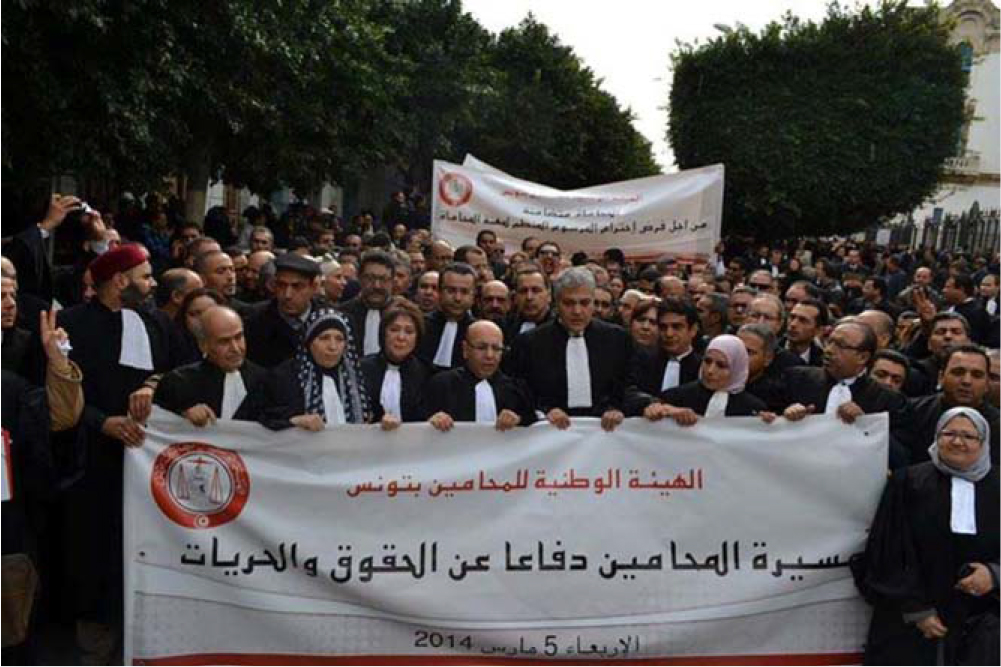
The TBA's mobilization since 2012 indicates that the profession remains deeply involved in Tunisian politics. The current political situation has led representatives of the TBA to view their “professional duties, beyond their proper purposes, as oriented toward or inspired by political objectives” (Lagroye Reference Lagroye2003, 365). The uprising induced a process that has deeply politicized Tunisian civil society, in which lawyers participate more prominently than most other professions. Today, controlling the TBA appears to be a political issue in distinctly post‐uprising terms. The TBA's oppositional political composition continues to broaden: in January 2012, Chawki Tabib became interim TBA president, against the members of the TBA governing council who are aligned with Ennahdha; several leftists won the ATJA elections in April 2013; and an Arab nationalist (anti‐Ennahdha) candidate became TBA president in June 2013.
The new mobilization of the TBA allows it to play an explicitly political role. Since the summer of 2013—in cooperation with the UGTT, UTICA, and the Tunisian Human Rights League (mostly dominated by secularists)—the TBA has mediated between Tunisian political factions within a so‐called national dialogue. The stated objective of this national dialogue is ending the process of political transition in order to establish a stable democratic political system with transparent parliamentary and presidential elections. However, it is unclear how long the TBA leadership will continue to define professional autonomy as a form of political mobilization. Ultimately, many (though not all) Tunisian lawyers seem to perceive their profession as an overseer of government, responsible, alongside the judiciary, for safeguarding the rule of law in Tunisia's post‐uprising transformations. Tunisian political lawyering has expanded beyond professional concerns or political liberalism and into fundamental political matters.
Conclusion
Since Tunisia's independence, the legal profession has sought to establish its own form of independence—first in the form of professional autonomy and more recently as a government watchdog. The historical trajectory presented in this article has tracked the varied ways in which economic concerns, professional objectives, and political resistance overlapped and galvanized Tunisian lawyers to undertake political engagement. In the 2000s, lawyers protested exclusively about political matters or for professional objectives, often without official TBA sponsorship. In contrast, during the 2010–2011 uprising, the political mobilization of lawyers was part of the popular revolt in “open spaces of confrontation” (Dobry Reference Dobry2009). The bar's internal composition, divisions, and leadership explain the TBA's alternating resistance and activism; these factors affected the degree or intensity of political lawyering, but did not dissipate it. The legal profession's autonomy made some degree of political lawyering endemic and that autonomy was a necessary condition for effective mobilization of the legal profession, but it was the energy of the Tunisian uprising that led representatives of the TBA to align themselves with political lawyering.
We argued that economic, political, and civic motivations interacted and were not easily distinguishable. To be effective against the authoritarian state, Tunisian lawyers implemented a variety of legal and nonlegal strategies. In addition to the cause lawyering of small groups of lawyers, Tunisian lawyers generally participated in and organized demonstrations, strikes, sit‐ins, press conferences, and a wide array of public activities. These lawyers strategically analyzed their situations and chose when and how to act by balancing the TBA's internal dynamics and the sociopolitical space for dissent. In particular, Tunisian lawyers performed symbolic acts that both reflected and intensified their social capital as defenders of justice. We identified an explicitly proactive political mobilization of Tunisian lawyers (such as wearing official black robes, demonstrations, sit‐ins, and proclamations in front of courts) that parallels the acts of lawyers in other parts of the world (Halliday, Karpik, and Feeley 2012). Responding to the tensions within the Tunisian legal complex, lawyers defined themselves against magistrates, further articulating political lawyering as a key characteristic of the legal profession. In Tunisia, “proceduralist” lawyering merged with “grassroots” lawyering to culminate in the involvement of lawyers in the uprising against the authoritarian government (Hilbink Reference Hilbink, Sarat and Scheingold2006). In so doing, Tunisian lawyers moved beyond legal rhetoric and became spokespersons for broad social justice values as they claimed to be necessary participants in democratic processes. Since these broad social values are shared across political factions of Tunisian society, the TBA's overtly post‐uprising political role has not significantly divided membership of the bar.
Epilogue: The Limits of Political Lawyering in Post‐Uprising Tunisia
This article began by referencing a recent Tunisian film that accurately portrayed both the tension between lawyers and the authoritarian regime and the not uncommon Tunisian perspective that lawyers are crucial members of civil society. The Tunisian uprising, however, has changed the dynamics of the relationship between lawyers, the government, and the general public; consequently, there are new scenes being played out in Tunisia's courthouses and streets. We want to offer an example of a post‐revolutionary scene of political lawyering.
Addressing reporters and colleagues gathered in the Tunisian Bar Association's conference room, a young lawyer informed his audience that more than fifty attorneys had volunteered to represent nearly 100 Tunisians arrested during the prior week's demonstration in front of the US Embassy.Footnote 43 It was September 20, 2012 and the protestors had gathered the previous week to express their opposition to a film (produced in the United States) that insulted the Prophet. With a palpable energy of activism, a discussion ensued about the absence of formal accusations against the demonstrators, the possibility of excessive use of police force, and the prisoners’ rights to legal representation. Eventually, questions arose as to how the pro bono attorneys would differentiate between political protestors and looters. The spokesperson for the pro bono attorneys, a leading member of the ATJA, assured his audience that a procedure for making this determination was in place.Footnote 44 The press conference appeared to be a message to the Tunisian government that these lawyers would relentlessly pursue the defense of demonstrators. After the reporters left, a group of young Tunisian attorneys engaged in a vibrant discussion on the perils of defending opportunists lacking any commitment to political dissent; in their eyes, the possibility of looters escaping punishment would devalue the political message of the peaceful protestors. For these young lawyers, the right to political protest is crucial because it is the primary means of mobilizing against an authoritarian (or potentially authoritarian) government and that is the key to building a democratic society.
But in their pursuit of demonstrators’ civil rights, these lawyers neglected a significant gray area: perhaps the looters who intermingled with the demonstrators were not opportunistic thieves, but victims of the same dire economic circumstances that provoked the uprisings? After all, Būʿazīzī self‐immolated out of frustration with his financial situation. As Massad has elaborated, demonstrators in Tunisia and in other Arab countries demanded not only the kinds of rights recognized by neoliberal norms (such as the freedom of expression), but also the kind of rights recognized by Soviet ideology (such as a minimum wage) (Massad Reference Massad2012). Many Arabs protested in the streets to demand redistribution of economic wealth because their livelihoods are seriously encumbered by the neoliberal economic policies imposed by authoritarian regimes and perpetuated by post‐revolutionary governments (Kaboub Reference Kaboub2013a).
This disconnect between democratic institutions and economic reform represents a significant gap in Tunisia's political lawyering: the boundaries of political liberalism. As previously noted, political liberalism entails a moderate state, independent civil society, and basic freedoms. But how do Tunisian lawyers reconcile these objectives with the uprising's aims? The overpowering nature of political liberalism is exemplified by the same pro bono attorney representative. In a recorded interview, he explained that Islamic law should be a source of law in Tunisia's Constitution in order to incorporate the Muslim identity of Tunisians after a long period of Tunisian social isolation from the postcolonial state (Awlād ʿAlī Reference Awlād ʿAlī2012).Footnote 45 To clarify the flexibility of Islamic law, he cited to a well‐known narrative in Islamic history: the second Caliph, ʿUmar ibn al‐Khaṭṭāb (d. 644), suspended the Qurʾānic punishment for thieves during a famine.Footnote 46 Although the Qurʾānic verse does not include any exceptions, Caliph ʿUmar saw nothing illegitimate in stopping punishment due to difficult social circumstances (Kamali Reference Kamali1991, 331). The attorney spokesperson argued that this precedent is evidence of how Islamic law's tradition of flexibility and leniency can benefit Tunisian society. Yet, ironically, in his role as a pro bono attorney, he did not apply the precedent: he did not consider that those who looted during the demonstration had much in common with the thief exonerated by exigent circumstances during the era of Caliph ʿUmar; he did not recognize the possibility that the looters of the US Embassy were also destitute, political protestors. Tunisian lawyers—even those affiliated with Islamist political groups—continue to protect the very economic inequality that contributed to the revolution because they accept neoliberal economics (Kaboub Reference Kaboub2013b). Just as Tunisian political lawyering is limited to legal liberalism, Islamist politics in Tunisia is limited to political liberalism.
Political lawyering will likely continue to play an important role in Tunisian civil society. The same pro bono attorney spokesperson—the one who announced the pro bono efforts on behalf of demonstrators—would, only two months later, during another press conference, criticize the (post‐uprising) Tunisian government for the deaths of two prisoners (Rayman Reference Rayman2012; Gaigi Reference Gaigi2012). Many other prisoners arrested during the demonstration in front of the US Embassy maintained long hunger strikes. The police brutality and poor prison conditions that were commonplace under Tunisia's authoritarian regime did not magically disappear after the uprisings and the ensuing political shifts. If Tunisian political lawyering achieves the institutional objectives of political liberalism (i.e., a moderate state, robust civil society, etc.), will the TBA and its members shift to a different kind of politics? If lawyers establish their professional autonomy on the basis of being separate from party politics, then their encroachment into substantive politics (and away from broad political lawyering) will be a source of tension. Can the political mobilization of the TBA move beyond professional autonomy or fundamental rights to include the revolutionary critique of liberalism?