





Introduction
Soybean is the most widely grown crop in the midsouthern United States, with more hectares grown in Arkansas, Louisiana, Mississippi, Missouri, and Tennessee than the combined hectares of corn (Zea mays L.), cotton (Gossypium hirsutum L.), and rice (Oryza sativa L.). These states of the Midsouth—excluding Missouri—produce 8% of the total U.S. soybean crop (USDA-FSA 2026), and the crop is one of the main drivers of on-farm cash receipts in the United States, accounting for US$46.3 billion in 2024 (USDA-ERS 2026). Weed management is a pivotal factor in any crop, and soybean is no exception. Weeds are estimated to cause up to 37% soybean grain yield losses if left unmanaged, posing a greater yield threat than any other pest (Oerke Reference Oerke2006). Understanding emergent weed management patterns and shifting weed spectra is fundamental to protecting soybean cropping systems from weed infestations.
Weed control is in constant flux, driven by the challenges of maintaining profitable crop production. Weed spectra and species dominance changes as weed management practices evolve to meet emergent challenges and market demands. The release of glyphosate-resistant (Roundup Ready Xtend; Bayer CropScience, St. Louis, MO) soybean cultivars in the late 1990s and the exponential increase in their adoption through the 2000s (Dill Reference Dill2005) has resulted in drastic shifts in the soybean weed spectrum. In 1995, the most troublesome weeds in soybean in the southern United States, in order of rank, were sicklepod [Senna obtusifolia (L.) H. S. Irwin & Barneby], morningglories, johnsongrass [Sorghum halepense (L.) Pers.], and common cocklebur (Xanthium strumarium L.) (Webster and Coble Reference Webster and Coble1997). However, by 2009, the four most troubling weeds in soybean production in southern states in order of rank were morningglories, Palmer amaranth, nutsedges (Cyperus spp.), and horseweed (Erigeron canadensis L.), all species that have natural tolerance to or have evolved resistance to glyphosate (Culpepper et al. Reference Culpepper, Grey, Vencill, Kichler, Webster, Brown, York, Davis and Hanna2006; VanGessel Reference VanGessel2001; Webster and Nichols Reference Webster and Nichols2012). With the proliferation of glyphosate-resistant Palmer amaranth, farmers largely relied on herbicides that inhibit protoporphyrinogen oxidase (PPO) to manage the weed. PPO resistance in Palmer amaranth was first reported in Arkansas in 2011, and resistance was widely disseminated throughout the soybean-producing region of the state by 2018 (Heap Reference Heap2026; Varanasi et al. Reference Varanasi, Brabham, Norsworthy, Nie, Young, Houston, Barber and Scott2018). This contributed to the weed being ranked the most troublesome and common weed of soybean by respondents from southern states and the second most troublesome weed of soybean throughout the United States in the most recent survey of weeds in broadleaf crops carried out by the Weed Science Society of America (WSSA) (Van Wychen Reference Van Wychen2025). Altering weed management practices can modify weed spectra, and these practices continue to evolve, leading to shifts in dominant weed species.
Surveying has been commonplace in U.S. research settings for more than 100 yr, and surveys provide estimates of a farming population’s beliefs, needs, and experiences (Converse Reference Converse2017). Conducting surveys in an agricultural setting allows researchers to remain cognizant of changes that can inform research and educational outputs, ensuring these outputs remain relevant and timely. The results of agricultural surveys can inform research priorities and identify knowledge gaps. Surveying weed management practitioners, such as farmers and consultants, provides a better comprehension of on-farm weed control problems, enabling researchers to anticipate how best to serve farmers.
Two previous surveys were conducted in 2011 and 2016 to evaluate soybean weed management in the Midsouth (Riar et al. Reference Riar, Norsworthy, Steckel, Stephenson, Eubank and Scott2013; Schwartz-Lazaro et al. Reference Schwartz-Lazaro, Norsworthy, Steckel, Stephenson, Bish, Bradley and Bond2018). These surveys provided insight into the scope of Palmer amaranth resistance to glyphosate and PPO inhibitors, prevailing weed management practices and herbicide technologies, areas of needed research, and problematic weeds. In previous surveys, Palmer amaranth was reported as the most problematic weed in soybean production in the Midsouth. Palmer amaranth is a highly adaptable and tenacious weed species, capable of rapidly evolving herbicide resistance due to its dioecious nature (Sauer Reference Sauer1957). The species is currently resistant to nine herbicide sites of action (SOAs) in the Midsouth (Carvalho-Moore et al. Reference Carvalho-Moore, Norsworthy, Souza, Barber, Piveta, Meiners and Porri2025; Heap Reference Heap2026). In the absence of effective alternatives, farmers may over-rely on using a herbicide with a single SOA, thereby exerting strong selection pressure for resistant weed biotypes (Beckie and Reboud Reference Beckie and Reboud2009). Given the widespread resistance to other common postemergence herbicides used in soybean, such as glyphosate and PPO inhibitors, farmers have turned to auxin-resistant and glufosinate-resistant soybean cultivars to manage problematic weeds, placing strong evolutionary pressure for auxin- and glufosinate-resistant biotypes (Heap Reference Heap2026; USDA-NASS 2024).
Since the 2016 survey, significant changes have occurred in Midsouth soybean production, including the commercialization of stacked herbicide-resistance trait cultivars, such as the introduction glyphosate-, glufosinate-, and dicamba-resistant soybean (XtendFlex; Bayer Crop Science) in 2021 (Anonymous 2020), and the confirmation of dicamba- and glufosinate-resistant Palmer amaranth (Foster and Steckel Reference Foster and Steckel2022; Priess et al. Reference Priess, Norsworthy, Godara, Mauromoustakos, Butts, Roberts and Barber2022). Additionally, regulatory changes affecting dicamba use and evolving resistance management recommendations necessitate an updated assessment of current practices and emerging challenges. A survey of farmers and consultants in the Midsouth on their soybean weed management practices was conducted from fall 2024 through spring 2025 to identify common weed-control practices and catalysts driving adoption, emerging herbicide-resistance threats, problematic weed species, and research priorities.
Materials and Methods
A survey was designed using the Qualtrics Experience Management software (Qualtrics International Inc., Provo, UT) and was divided into four sections: 1) general weed management, 2) suspected herbicide resistance and resistance management, 3) problematic weed species, and 4) desired weed management research. Respondents were presented with 36 questions regarding the four categories previously mentioned (Supplementary Appendix S1). The survey was distributed to farmers and crop consultants at more than 20 regional conferences and county production meetings via a quick response (QR) code and was made available online through a weblink (https://uaex.co.1qualtrics.com/jfe/form). The survey was available from late October 2024 through early March 2025.
The first section of the survey asked about respondent demographics and general weed management practices, such as the states and counties where they consult or farm, and herbicides they most often used. The section provided respondents with a list of herbicide trait packages and asked them to report the percentage of soybean hectares devoted to each trait, followed by questions identifying the driving factors for adoption. Respondents were also asked to rank common soybean herbicide SOAs by importance on a 0 to 100 scale, with 0 = not important and 100 = most important. The second survey section asked farmers and consultants whether they suspected the presence of auxin- or glufosinate-resistant Palmer amaranth on their farms, and what their most widely adopted herbicide resistance management practices were. In the third section, respondents were provided with a list of 36 weed species and asked to rank their importance on a five-point scale: not important, rarely important, occasionally important, important, or very important. Points were assigned follows: 1 = not important; 2 = rarely important; 3 = occasionally important; 4 = important; and 5 = very important (Riar et al. Reference Riar, Norsworthy, Steckel, Stephenson, Eubank and Scott2013; Schwartz-Lazaro et al. Reference Schwartz-Lazaro, Norsworthy, Steckel, Stephenson, Bish, Bradley and Bond2018). The respondents were also asked to rank their three most problematic weed species. The problematic ranking was calculated by assigning points based on the respondent’s placement of the weed. The first-ranked weed was assigned 3 points, the second-ranked was assigned 2 points, and the third-ranked was assigned 1 point. Higher points indicate a weed is more problematic or important. Sample standard errors were calculated for importance and problematic rankings. Rankings were unweighted to protect against bias toward respondents reporting large soybean hectarage. In the final section, respondents were asked to identify their two most crucial soybean weed management research needs. Responses were divided into seven overarching research categories that encompassed specific needs reported by farmers and consultants.
Data were exported to Microsoft (Redmond, WA) Excel for initial summarization of descriptive statistics and data cleaning, with subsequent analysis performed in JMP software (v. 19.0.5; SAS Institute, Cary, NC). Sample standard errors were calculated for importance and problematic rankings. Numeric responses were subjected to ANOVA with means separated using a Fisher protected LSD test at α = 0.05. Outliers, defined as values 1.5 times the interquartile range above the third quartile or below the first quartile, were excluded from analysis. Residuals were subjected to Shapiro-Wilk and Brown-Forsythe testing to assess normality and homoscedasticity before performing ANOVA. The cost of weed control data met the assumptions of ANOVA and was analyzed using standard least squares, with cost in dollars per hectare as the response variable and herbicide technology as the explanatory variable. Three outliers were removed from data on weed control costs, values that were removed were at least three times greater than the average reported cost for a technology. The rationale for excluding these results from analysis is due to the likelihood that these values were mistyped and are unlikely to represent the actual weed management cost per hectare. Herbicide importance and efficacy controlling Palmer amaranth were analyzed using a generalized linear model fit to a negative binomial distribution with a log link function, with means separated using a Fisher protected LSD test at α = 0.05. The negative binomial distribution was selected for these data based on goodness-of-fit using the normalized chi-square statistic. Herbicide importance score was the response variable, and state was the explanatory variable.
Results and Discussion
Demographics and Soybean Area
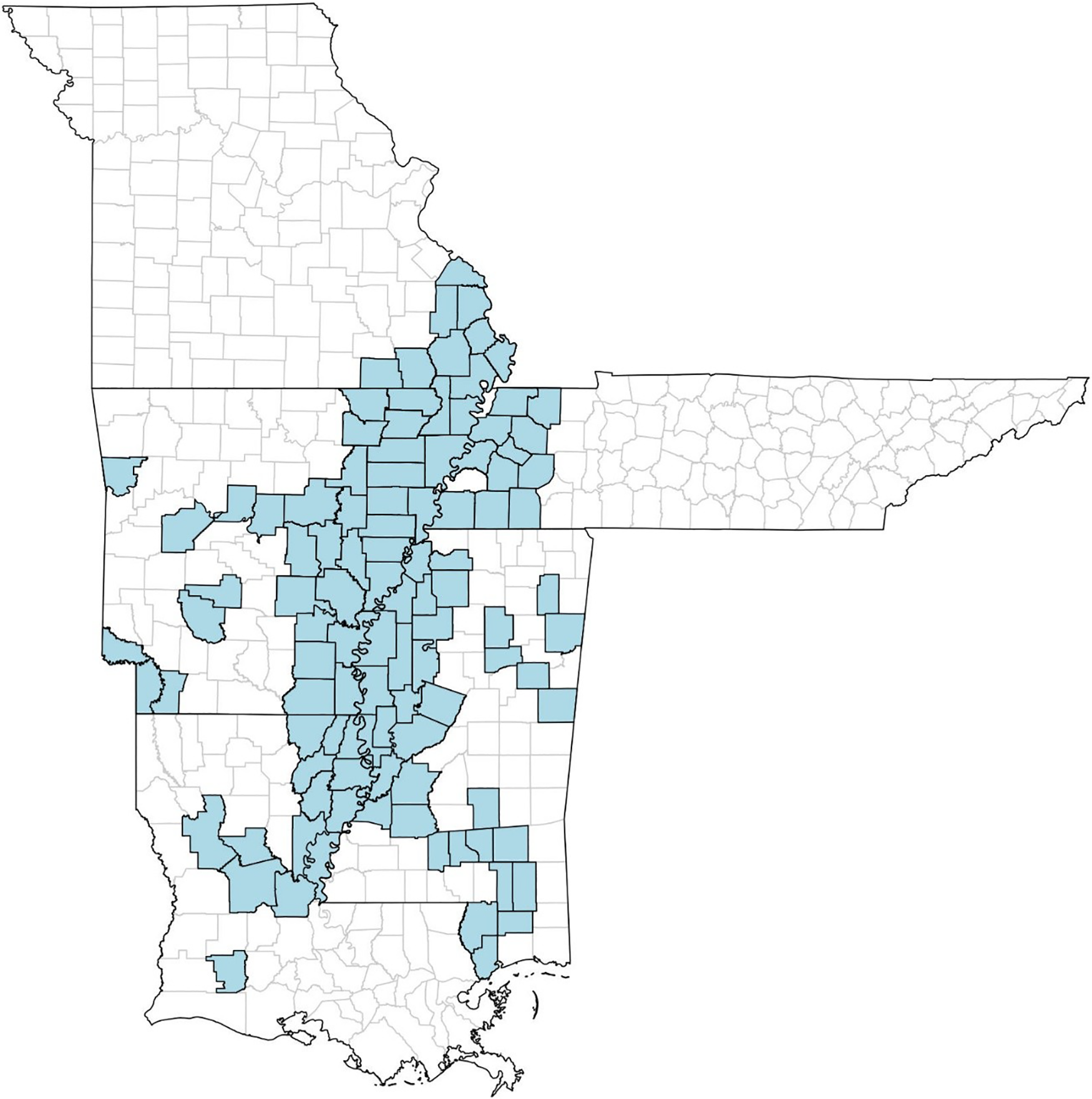
A total of 196 respondents (n = 196) completed the survey, though not all answered every question. There were 120 respondents from Arkansas, 15 from Louisiana, 28 from Mississippi, 14 from Missouri, and 14 from Tennessee (Supplementary Table S1). Additionally, five respondents reported hectarage in two states: four who farmed in both Arkansas and Missouri, and one who farmed in Arkansas and Mississippi. Responses were recorded from 105 soybean-producing counties and parishes across the five states (Figure 1). Respondents represented 19% (908,757 ha) of the total hectarage planted with soybean in 2024 in the five states (4,906,893 ha). Survey respondents represented, in 2024, 44% (459,961 ha) of the soybean-farmed hectares in Arkansas (1,039,514 ha), 42% (132,214 ha) in Louisiana (318,164 ha), 27% (194,306 ha) in Mississippi (722,760 ha), 2% (50,931 ha) in Missouri (2,224,024 ha), and 6% (34,478 ha) in Tennessee (602,431 ha) (USDA-FSA 2024). The survey respondents farmed or consulted an average of 4,886 ha of soybean.
County and parish map of the midsouthern United States. Counties or parishes highlighted in gray represent a respondent to this survey.

Herbicide Usage and Application Practices
The first set of survey questions asked respondents about the factors that drove their weed control decisions. Respondents said their main sources of weed control information came from university sources, including county Extension agents, specialists, and publications. In total, 53% (n = 195) of respondents reported that university sources were their primary source of information on weed control, nearly twice as many as the next most common source, peers, cited by 28% of respondents (Supplementary Table S2). Most respondents noted relying on university programming and Extension outreach to guide their weed control decisions. The advent of electronic means to disseminate educational information now allows Extension personnel to simultaneously and expeditiously reach a broad audience (Norton and Alwang Reference Norton and Alwang2020). The accessibility of university Extension information likely explains why it is the main source of weed control information for many.
The primary consideration in herbicide selection was weed resistance, with 56% (n = 195) of respondents citing it as the driver behind implementing recommendations for using herbicides on soybean (Supplementary Table S3). Nonbiased data (16%) and price (11%) were also frequently identified by farmers and consultants as drivers of their herbicide selection. Nine percent of respondents identified other factors, including 41% who cited a combination of these factors, 24% who cited herbicide efficacy, and 12% who cited weed spectrum (the remaining responses did not indicate a driver of recommendations).
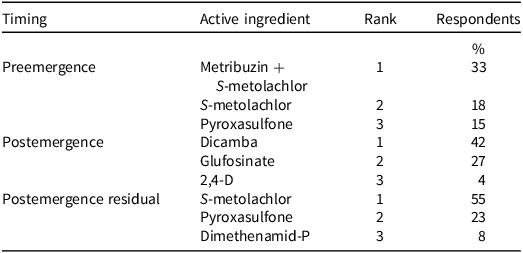
Respondents (n =139) reported using an average of 2.9 herbicide applications for soybean weed control, including burndown applications (2.9 applications reported by farmers and producers in Arkansas, 3.5 in Louisiana, 2.8 in Mississippi, 2.6 in Missouri, and 3.1 in Tennessee). Preemergence herbicides were applied to 87% (n = 131) of soybean-planted hectares. Metribuzin + S-metolachlor was most often used in Arkansas and Mississippi (Table 1). In Louisiana and Missouri, the most commonly used herbicides were S-metolachlor and pyroxasulfone, respectively, whereas respondents in Tennessee used seven distinct combinations equally. The five most widely used preemergence active ingredients across the Midsouth were S-metolachlor (included in 59% of applications), metribuzin (49%), pyroxasulfone (23%), flumioxazin (9%), and sulfentrazone (4%) (data not shown). Fifty-three percent of all respondents reported preemergence applications that included multiple herbicides. Using multiple effective SOAs can delay the evolution of herbicide resistance and improve weed control in soybean (Beckie and Reboud Reference Beckie and Reboud2009; Werle et al. Reference Werle, DeWerff, Arneson, Smith and Mobli2026). While a majority of respondents reported having adopted this practice, there is substantial potential to expand the use of multiple SOAs, thereby improving residual weed control and delaying the evolution of herbicide resistance.
The top three most-used preemergence and postemergence herbicides applied to soybean in 2024 in Midsouth states.

Table 1. Long description
A table showing the top three most-used preemergence and postemergence herbicides applied to soybean in 2024 in Midsouth states. The table has four rows and three columns. The columns are labeled Timing, Active ingredient, Rank, and Respondents. The row labels are Preemergence, Postemergence, and Postemergence residual. The table lists the active ingredients and their ranks along with the percentage of respondents for each. Row 1: Timing, Preemergence; Active ingredient, Metribuzin S-metolachlor; Rank, 1; Respondents, 33 percent. Row 2: Timing, Preemergence; Active ingredient, S-metolachlor; Rank, 2; Respondents, 18 percent. Row 3: Timing, Preemergence; Active ingredient, Pyroxasulfone; Rank, 3; Respondents, 15 percent. Row 4: Timing, Postemergence; Active ingredient, Dicamba; Rank, 1; Respondents, 42 percent. Row 5: Timing, Postemergence; Active ingredient, Glufosinate; Rank, 2; Respondents, 27 percent. Row 6: Timing, Postemergence; Active ingredient, 2,4-D; Rank, 3; Respondents, 4 percent. Row 7: Timing, Postemergence residual; Active ingredient, S-metolachlor; Rank, 1; Respondents, 55 percent. Row 8: Timing, Postemergence residual; Active ingredient, Pyroxasulfone; Rank, 2; Respondents, 23 percent. Row 9: Timing, Postemergence residual; Active ingredient, Dimethenamid-P; Rank, 3; Respondents, 8 percent.
Postemergence-applied residual herbicides were reportedly used on 78% of soybean hectares. S-metolachlor was the most widely used postemergence residual, used by 55% of respondents (n = 121) (Table 1), followed by pyroxasulfone (23%) and dimethenamid-P (8%). In Missouri and Tennessee, pyroxasulfone was the most commonly used postemergence residual herbicide, whereas S-metolachlor was most used by respondents in all the other states. Weeds can germinate and emerge over an extended period and may be missed by postemergence applications (Bagavathiannan et al. Reference Bagavathiannan, Norsworthy, Smith and Burgos2011). Incorporating overlapping postemergence residuals that target weed emergence peaks can improve weed control and reduce late-season weed density (Brown et al. Reference Brown, Gallandt, DiTommaso, Salon, Smith, Ryan and Cordeau2022; Chahal et al. Reference Chahal, Ganie and Jhala2018).
Respondents were asked which postemergence herbicide they most applied during the 2024 growing season, excluding glyphosate. A total of 42% of respondents (n = 139) reported using dicamba alone in 2024 (Table 1). Dicamba was the most common in every state except Missouri and Tennessee, where glufosinate was the most used. Unsurprisingly, respondents in Tennessee did not use dicamba as frequently as respondents in the other states, because Palmer amaranth populations in Tennessee were confirmed in 2022 to have evolved resistance to dicamba, which now limits the herbicide’s utility in soybean production (Foster and Steckel Reference Foster and Steckel2022). Glufosinate alone was the only other herbicide to reach double digits, with 27% of respondents reporting it as their most common postemergence herbicide. Respondents in Mississippi used glufosinate less frequently (11%) than those in other states (25% on average). Dicamba was included in 48% of all postemergence programs, and glufosinate in 35% of programs.
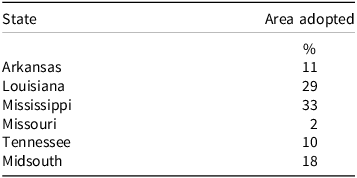
Forty-seven percent of respondents (n = 129) reported using a fall residual herbicide, with 18% of all soybean-planted hectares receiving an application (Table 2). Mississippi had the highest proportion of treated hectares (33%), while Missouri reported the lowest (2%). Italian ryegrass management was cited as the main reason for using fall residuals by 87% of respondents who apply a fall residual herbicide. Another 6.5% cited Palmer amaranth management, and the remaining 6.5% cited winter annual weed management or earlier planting as their reasons for applying a fall residual herbicide. The preeminence of fall residuals targeting Italian ryegrass is due to its ability to germinate over a wide window under suitable environmental conditions (Ghersa et al. Reference Ghersa, Martínez-Ghersa, Brewer and Roush1994) and to the enhanced weed control achieved with fall herbicide treatments in multiple-pass herbicide programs (Bond et al. Reference Bond, Allen, Seale and Edwards2022).
Percent of hectares on which a fall residual herbicide was applied in 2024.

Table 2. Long description
A table showing the percentage of hectares where a fall residual herbicide was applied in 2024 across different states. The table has two columns: State and Area adopted (%). It contains six rows, each representing a different state or region. Row 1: Arkansas, 11 percent. Row 2: Louisiana, 29 percent. Row 3: Mississippi, 33 percent. Row 4: Missouri, 2 percent. Row 5: Tennessee, 10 percent. Row 6: Midsouth, 18 percent.
Herbicide-Resistant Soybean Technology Adoption
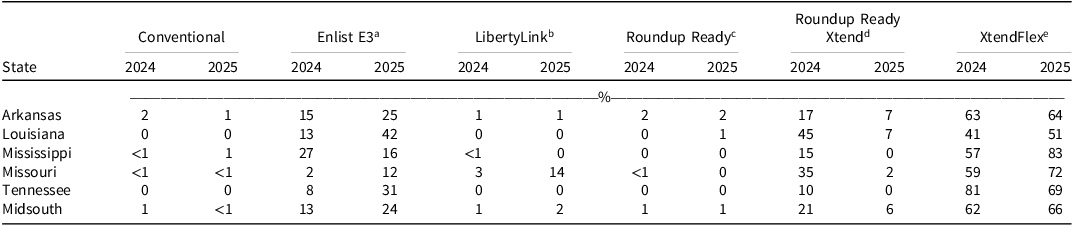
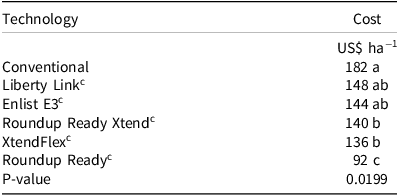
According to responses (n = 182), more than 98% of Midsouth soybean hectares were planted with a herbicide-resistant (HR) soybean cultivar in the 2024 growing season (Table 3). XtendFlex soybean was most widely grown in the Midsouth, accounting for more than 50% of soybean hectares in every state except Louisiana, and 62% of overall soybean hectares. In Louisiana, glyphosate- and dicamba-resistant soybean (Roundup Ready Xtend; Bayer CropScience) accounted for the largest portion of the hectarage at 45% compared with 41% planted with XtendFlex cultivars. Roundup Ready Xtend was the second most widely planted herbicide-resistant soybean and second overall (21%), with glyphosate-, glufosinate-, and 2,4-D-resistant soybean (Enlist E3; Corteva Agriscience, Indianapolis, IN) following at third and third overall in the Midsouth (13%) in all states except Mississippi. In Mississippi, Enlist E3 soybean cultivars were the second-most adopted technology, at 27% of hectares, with Roundup Ready Xtend in third place. Reported Roundup Ready soybean and glufosinate-resistant soybean (LibertyLink; BASF Agricultural Solutions, Research Triangle Park, NC) usage declined from 78% and 18%, respectively, in 2016 to 1% of hectares devoted to each technology in 2024 (Schwartz-Lazaro et al. Reference Schwartz-Lazaro, Norsworthy, Steckel, Stephenson, Bish, Bradley and Bond2018). The decline in hectares dedicated to Roundup Ready Xtend and LibertyLink soybean is likely due to the rise of stacked resistance technologies, which offer additional herbicide SOAs for postemergence herbicide applications, and to the concurrent growth in the prevalence of glyphosate-resistant weeds (Heap and Duke Reference Heap and Duke2018). Respondents (n = 120) projected that XtendFlex cultivars would again account for the largest share of soybean hectares in 2025 (Table 3) but would remain relatively unchanged from 2024. However, the number of hectares planted with Roundup Ready Xtend crops was expected to decline, and the number planted with Enlist E3 crops was expected to increase in 2025. The percentage of soybean hectarage devoted to the remaining herbicide-resistant and conventional soybean crops in the 2025 growing season was relatively unchanged from that in 2024. Respondents reported that conventional, Enlist E3, and LibertyLink soybean crops incurred similar weed control costs ($144–182 ha−1). The costs of all the traited herbicide resistance technologies were similar ($136–148 ha−1), except for Roundup Ready Xtend, with the lowest reported cost at $92 ha−1 (Table 4).
Reported average percent of soybean hectares by herbicide technology for 2024, with the anticipated 2025 percentage of herbicide technology.

Table 3. Long description
A table comparing the percentage of soybean hectares by herbicide technology for 2024 and 2025 across different states. The table has six columns and six rows, including headers. The columns are labeled as follows: Conventional, Enlist E3, LibertyLink, Roundup Ready, Roundup Ready Xtend, and XtendFlex. The rows are labeled with the names of the states: Arkansas, Louisiana, Mississippi, Missouri, Tennessee, and Midsouth. Each cell in the table contains the percentage values for the respective herbicide technology and year. Row 1: Arkansas, Conventional 2024: 2, Conventional 2025: 1, Enlist E3 2024: 15, Enlist E3 2025: 25, LibertyLink 2024: 1, LibertyLink 2025: 1, Roundup Ready 2024: 2, Roundup Ready 2025: 2, Roundup Ready Xtend 2024: 17, Roundup Ready Xtend 2025: 7, XtendFlex 2024: 63, XtendFlex 2025: 64. Row 2: Louisiana, Conventional 2024: 0, Conventional 2025: 0, Enlist E3 2024: 13, Enlist E3 2025: 42, LibertyLink 2024: 0, LibertyLink 2025: 0, Roundup Ready 2024: 1, Roundup Ready 2025: 1, Roundup Ready Xtend 2024: 45, Roundup Ready Xtend 2025: 7, XtendFlex 2024: 41, XtendFlex 2025: 51. Row 3: Mississippi, Conventional 2024: <1, Conventional 2025: 1, Enlist E3 2024: 27, Enlist E3 2025: 16, LibertyLink 2024: <1, LibertyLink 2025: 0, Roundup Ready 2024: 0, Roundup Ready 2025: 0, Roundup Ready Xtend 2024: 15, Roundup Ready Xtend 2025: 0, XtendFlex 2024: 57, XtendFlex 2025: 83. Row 4: Missouri, Conventional 2024: <1, Conventional 2025: <1, Enlist E3 2024: 2, Enlist E3 2025: 12, LibertyLink 2024: 3, LibertyLink 2025: 14, Roundup Ready 2024: <1, Roundup Ready 2025: 0, Roundup Ready Xtend 2024: 35, Roundup Ready Xtend 2025: 2, XtendFlex 2024: 59, XtendFlex 2025: 72. Row 5: Tennessee, Conventional 2024: 0, Conventional 2025: 0, Enlist E3 2024: 8, Enlist E3 2025: 31, LibertyLink 2024: 0, LibertyLink 2025: 0, Roundup Ready 2024: 0, Roundup Ready 2025: 0, Roundup Ready Xtend 2024: 10, Roundup Ready Xtend 2025: 0, XtendFlex 2024: 81, XtendFlex 2025: 69. Row 6: Midsouth, Conventional 2024: 1, Conventional 2025: <1, Enlist E3 2024: 13, Enlist E3 2025: 24, LibertyLink 2024: 1, LibertyLink 2025: 2, Roundup Ready 2024: 2, Roundup Ready 2025: 1, Roundup Ready Xtend 2024: 21, Roundup Ready Xtend 2025: 6, XtendFlex 2024: 62, XtendFlex 2025: 66.
a Corteva Agriscience, Indianapolis, IN. Enables in-crop use of glyphosate, glufosinate, and 2,4-D.
b BASF Agricultural Solutions, Research Triangle Park, NC. Enables in-crop use of glufosinate.
c Bayer CropScience, St. Louis, MO. Enables in-crop use of glyphosate.
d Bayer CropScience. Enables in-crop use of glyphosate and dicamba.
e Bayer CropScience. Enables in-crop use of glyphosate, glufosinate, and dicamba.
Comparison of estimated herbicide costs across soybean herbicide resistance technologies.a,b

Table 4. Long description
A table comparing the costs of different herbicide-resistant soybean technologies. The table has two columns: Technology and Cost. The Technology column lists various herbicide-resistant soybean technologies, and the Cost column lists the corresponding costs in US dollars per hectare. The table includes the following rows: Conventional with a cost of US$ 182 ha-1, Liberty Link with a cost of US$ 148 ha-1, Enlist E3 with a cost of US$ 144 ha-1, Roundup Ready Xtend with a cost of US$ 140 ha-1, XtendFlex with a cost of US$ 136 ha-1, and Roundup Ready with a cost of US$ 92 ha-1. The P-value is listed as 0.0199.
a Means followed by different letters within a column indicate a significant difference according to a Fisher protected LSD test at α = 0.05.
b P-values were calculated using standard least squares.
c See Table 3 footnotes for additional herbicide information.
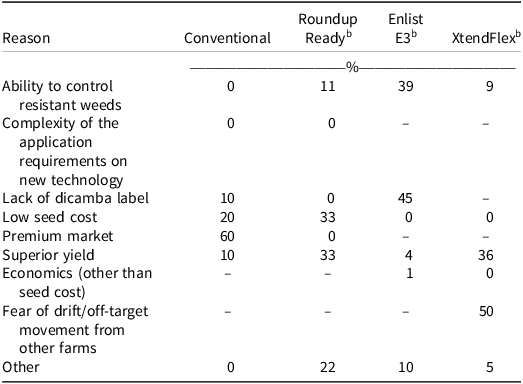
A plurality (45%) of respondents (n = 67) who expected to grow Enlist E3 soybean in 2025 noted that the lack of a dicamba product labeled for over-the-top (OTT) use was their primary reason for growing Enlist E3 cultivars (Table 5). Farmers were prohibited from applying dicamba postemergence to soybean in the 2025 growing season following the decision by the U.S. District Court in Arizona to vacate the registrations of such products (Center for Biological Diversity et al. v. United States Environmental Protection Agency et al. 2024). Without the option to use dicamba in-crop, farmers were likely to shift away from Roundup Ready Xtend technology, which confers only resistance to dicamba and glyphosate, in favor of Enlist E3 and XtendFlex cultivars, which provide glufosinate resistance in addition to glyphosate and auxin resistance. The availability of glufosinate as a postemergence option allows for an additional effective SOA to be incorporated in herbicide programs, providing a marked advantage over Roundup Ready Xtend cultivars in reducing the risk of herbicide resistance evolution (Evans et al. Reference Evans, Tranel, Hager, Schutte, Wu, Chatham and Davis2016). Half of the respondents (n = 22) who expected to grow XtendFlex soybean in 2025 cited fear of drift/off-target movement from other farms as the reason for growing XtendFlex cultivars, while another 36% cited superior yields. Off-target movement of dicamba has been a major concern since the launch of the Roundup Ready Xtend technology (Jones et al. Reference Jones, Norsworthy and Barber2019; Oseland et al. Reference Oseland, Bish, Lerch and Bradley2024; Soltani et al. Reference Soltani, Oliveira, Alves, Werle, Norsworthy, Sprague, Young, Reynolds, Brown and Sikkema2020; Zaccaro-Gruener et al. Reference Zaccaro-Gruener, Norsworthy, Brabham, Barber, Roberts, Mauromoustakos and Mueller2023). Non-dicamba–resistant cultivars are highly sensitive to this herbicide, with reported yield reductions ranging from 14% to 68% at dicamba drift rates (McCown et al. Reference McCown, Barber and Norsworthy2018; Meyeres et al. Reference Meyeres, Lancaster, Kumar, Roozeboom and Peterson2023). Even though no dicamba-containing product was registered for OTT use on soybean in 2025, respondents’ concerns about off-target movement insinuate a belief that dicamba would be used off-label. Arkansas received 963 complaints alleging misuse of dicamba products during the 2017 growing season, prior to the registration of any OTT dicamba product in soybean production (Arkansas Department of Agriculture 2017). There have also been frequent detections of atmospheric dicamba in high-use areas after legally mandated cutoff dates, suggesting that the herbicide was applied after those dates (Zaccaro-Gruener et al. Reference Zaccaro-Gruener, Norsworthy, Brabham, Barber, Roberts, Mauromoustakos and Mueller2023). The widespread allegations of dicamba misuse in 2017 and applications after mandated dicamba application cutoff dates likely contribute to the perception that off-target movement of dicamba could be problematic in 2025. Without the availability of OTT dicamba for soybean in 2025, 66% of farmers and consultants (n = 127) using XtendFlex crops indicated they would use more glufosinate (data not shown), while 18% indicated they would switch to the Enlist E3crops, and 3% reported they would change cultural practices. Furthermore, 13% of respondents indicated they did not know what they would do without dicamba.
Reasons given by growers and consultants for selecting a herbicide-resistant soybean trait for the 2025 season. a

Table 5. Long description
The table presents reasons given by growers and consultants for selecting a herbicide-resistant soybean trait for the 2025 season. It includes five columns: Reason, Conventional, Roundup Ready, Enlist E3, and XtendFlex. The table has ten rows, each representing a different reason for selection. Row 1: Ability to control resistant weeds, Conventional 0 percent, Roundup Ready 11 percent, Enlist E3 39 percent, XtendFlex 9 percent. Row 2: Complexity of the application requirements on new technology, Conventional 0 percent, Roundup Ready 0 percent, Enlist E3 not applicable, XtendFlex not applicable. Row 3: Lack of dicamba label, Conventional 10 percent, Roundup Ready 0 percent, Enlist E3 45 percent, XtendFlex not applicable. Row 4: Low seed cost, Conventional 20 percent, Roundup Ready 33 percent, Enlist E3 0 percent, XtendFlex 0 percent. Row 5: Premium market, Conventional 60 percent, Roundup Ready 0 percent, Enlist E3 0 percent, XtendFlex 0 percent. Row 6: Superior yield, Conventional 10 percent, Roundup Ready 33 percent, Enlist E3 4 percent, XtendFlex 36 percent. Row 7: Economics other than seed cost, Conventional not applicable, Roundup Ready not applicable, Enlist E3 1 percent, XtendFlex 0 percent. Row 8: Fear of drift/off-target movement from other farms, Conventional not applicable, Roundup Ready not applicable, Enlist E3 not applicable, XtendFlex 50 percent. Row 9: Other, Conventional 0 percent, Roundup Ready 22 percent, Enlist E3 10 percent, XtendFlex 5 percent.
a Dashes (–) indicate the response was not included as an option for the particular soybean trait.
b See Table 3 footnotes for additional herbicide information.
Farmers and consultants were also asked about their perceptions of single traits and upcoming technologies. The Vyconic trait, announced by Bayer CropScience in 2025, will confer stacked resistance to 2,4-D, dicamba, glyphosate, glufosinate, and mesotrione in soybean (Anonymous 2025). Eighty-six percent of respondents (n = 131) believe the stacked 2,4-D and dicamba resistance would be very valuable or somewhat valuable, compared with only 8% who believe it would offer no value (data not shown). Nearly all (91%) respondents (n =129) believed that a 4-hydroxyphenylpyruvate dioxygenase resistance trait would be very valuable or somewhat valuable in soybean, compared with 5% who believed it would not be valuable.
Respondents were also asked about the value of the existing glufosinate- and sulfonylurea-resistant traits in soybean. Glufosinate resistance was highly valued, with 96% (n = 129) rating it as very or somewhat valuable. Responses (n = 130) about sulfonylurea-resistant soybean were mixed: 54% stated it was somewhat valuable, and equal numbers (22% each) stated it was very valuable or that it provided no difference in value. The perceived value of the sulfonylurea resistance trait was split between weed control (45%) and drift protection (51%). The Midsouth is the main rice-producing region in the United States, and acetolactate synthase (ALS) inhibitors, including sulfonylurea herbicides, are widely used in rice production (Norsworthy et al. Reference Norsworthy, Bond and Scott2013; USDA-FSA 2026). There is a high likelihood of soybean exposure to ALS-inhibiting herbicides in the Midsouth, given the volume of soybean and rice production in the region. It stands to reason that farmers and consultants would value sulfonylurea-resistant soybean cultivars for their ability to withstand off-target movement in high-use locations such as the Midsouth.
Perceived Herbicide Value and Efficacy
Farmers and consultants (n = 129) were asked to rank the importance of common soybean herbicide SOAs for weed control on the previously mentioned zero-to-100 scale. Very-long-chain fatty acid zelongase (VLCFA) inhibitors (categorized by the Herbicide Resistance Action Committee [HRAC] and the WSSA as a Group 15 herbicide according to its SOA) were rated the most important SOA (90) for soybean weed control in the Midsouth (Table 6). VLCFA inhibitors also received the highest rating in every state where the survey was conducted. The inhibitors of 5-enolpyruvylshikimate-3-phosphate synthase (EPSPS) (HRAC/WSSA Group 9) were ranked second in importance (81), followed by synthetic auxins (78; HRAC/WSSA Group 4), photosystem II inhibitors (77; HRAC/WSSA Group 5), glutamine synthetase inhibitors (73; HRAC/WSSA Group 10), PPO inhibitors (55; HRAC/WSSA Group 14), and ALS inhibitors (37; HRAC/WSSA Group 2). Unsurprisingly, ALS inhibitors were rated as the least important SOA, probably because resistance to the SOA has been reported to occur in more than 10 weed species in the Midsouth (Heap Reference Heap2026). Importance ratings were statistically similar among states for all SOAs except PPO inhibitors (Table 6). Respondents in Louisiana and Mississippi considered PPO inhibitors to be more important than those in Arkansas. A significant proportion of Palmer amaranth populations in Arkansas are resistant to PPO inhibitors, likely contributing to the SOA’s lower importance rating (Varanasi et al. Reference Varanasi, Brabham, Norsworthy, Nie, Young, Houston, Barber and Scott2018).
Importance of herbicide sites of action in soybean weed management on a zero-to-100 scale (0 = not important, 100 = most important).a–c

Table 6. Long description
A table comparing the importance of various herbicide sites of action in soybean weed management across different states. The table has 7 columns and 7 rows, including a header row. The columns are labeled as follows: State, ALS inhibitors, Synthetic auxins, PS II inhibitors, EPSPS inhibitors, Glutamine synthetase inhibitors, PPO inhibitors, and VLCFA inhibitors. The rows list the states and the corresponding importance ratings for each herbicide site of action on a zero-to-100 scale. Row 1: Arkansas, ALS inhibitors: 38, Synthetic auxins: 76, PS II inhibitors: 77, EPSPS inhibitors: 79, Glutamine synthetase inhibitors: 74, PPO inhibitors: 49 b, VLCFA inhibitors: 88. Row 2: Louisiana, ALS inhibitors: 46, Synthetic auxins: 84, PS II inhibitors: 74, EPSPS inhibitors: 95, Glutamine synthetase inhibitors: 71, PPO inhibitors: 74 a, VLCFA inhibitors: 95. Row 3: Mississippi, ALS inhibitors: 30, Synthetic auxins: 76, PS II inhibitors: 75, EPSPS inhibitors: 79, Glutamine synthetase inhibitors: 55, PPO inhibitors: 71 a, VLCFA inhibitors: 91. Row 4: Missouri, ALS inhibitors: 51, Synthetic auxins: 78, PS II inhibitors: 81, EPSPS inhibitors: 83, Glutamine synthetase inhibitors: 86, PPO inhibitors: 48 ab, VLCFA inhibitors: 90. Row 5: Tennessee, ALS inhibitors: 35, Synthetic auxins: 90, PS II inhibitors: 80, EPSPS inhibitors: 78, Glutamine synthetase inhibitors: 97, PPO inhibitors: 62 ab, VLCFA inhibitors: 98. Row 6: Midsouth, ALS inhibitors: 37, Synthetic auxins: 78, PS II inhibitors: 77, EPSPS inhibitors: 81, Glutamine synthetase inhibitors: 73, PPO inhibitors: 55, VLCFA inhibitors: 90. Row 7: P-value, ALS inhibitors: 0.7955, Synthetic auxins: 0.8753, PS II inhibitors: 0.7877, EPSPS inhibitors: 0.3921, Glutamine synthetase inhibitors: 0.0914, PPO inhibitors: 0.0259, VLCFA inhibitors: 0.6045.
a Abbreviations: ALS, acetolactate synthase; EPSPS, 5-enolpyruvyl shikimate-3-phosphate synthase; PPO, protoporphyrinogen oxidase; PS II, photosystem II; VLCFA, very long-chain fatty acid elongase.
b Means followed by different letters within a column indicate a significant difference according to a Fisher protected LSD test at α = 0.05.
c P-values were calculated using a generalized linear model using a negative binomial distribution.
d Midsouth values represent the pooled regional average and were not included in the statistical analysis.
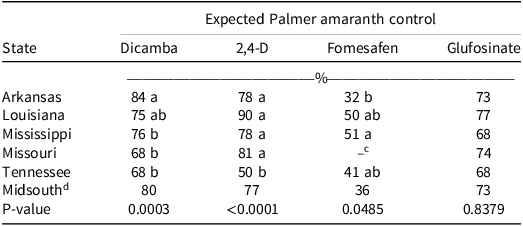
Respondents (n = 127) were provided with a list of four common soybean postemergence herbicides (dicamba, 2,4-D, fomesafen, and glufosinate) and asked to rate their efficacy on 10-cm Palmer amaranth. Dicamba was expected to provide the greatest control of Palmer amaranth (80%), followed by 2,4-D (77%), glufosinate (73%), and fomesafen (36%) (Table 7). Respondents differed significantly in their expected efficacy of dicamba, 2,4-D, and fomesafen depending on where they farmed. Arkansas respondents expected greater control with dicamba (84%) than respondents in every state except Louisiana (Table 7). Tennessee respondents anticipated the least control with 2,4-D (50%) of all surveyed states, while all other states expected similar efficacy with 2,4-D. Mississippi, Louisiana, and Tennessee respondents expected similar control with fomesafen, but those in Mississippi reported statistically greater control with fomesafen than respondents in Arkansas. There were no differences in expected glufosinate efficacy across states, with state-level efficacy ranging from 68% to 77%. Glufosinate is effective on susceptible Palmer amaranth but must be applied at the proper time and performs better with sequential applications, which may affect perceptions of its efficacy (Coetzer et al. Reference Coetzer, Al-Khatib and Peterson2002; Meyer and Norsworthy Reference Meyer and Norsworthy2020).
Expected percent control of 10-cm Palmer amaranth with common soybean postemergence herbicides.a,b

Table 7. Long description
A table titled Expected percent control of 10-cm Palmer amaranth with common soybean postemergence herbicides. The table has six rows and five columns. The columns are labeled State, Dicamba, 2,4-D, Fomesafen, and Glufosinate. The row labels are Arkansas, Louisiana, Mississippi, Missouri, Tennessee, Midsouth, and P-value. The values in the table are as follows: Row 1: Arkansas, 84 a, 78 a, 32 b, 73. Row 2: Louisiana, 75 ab, 90 a, 50 ab, 77. Row 3: Mississippi, 76 b, 78 a, 51 a, 68. Row 4: Missouri, 68 b, 81 a, -, 74. Row 5: Tennessee, 68 b, 50 b, 41 ab, 68. Row 6: Midsouth, 80, 77, 36, 73. Row 7: P-value, 0.0003, <0.0001, 0.0485, 0.8379. The table shows the expected efficacy of different herbicides in controlling Palmer amaranth across various states, with dicamba and 2,4-D generally showing higher efficacy compared to fomesafen and glufosinate.
a Means followed by different letters within a column indicate a significant difference according to a Fisher protected LSD test at α = 0.05.
b P-values were calculated using a generalized linear model.
c Fomesafen results from Missouri are not presented due to insufficient sample size.
d Midsouth values indicate a pooled regional average and were not included in the statistical analysis.
Suspected Herbicide Resistance and Mitigation Practices
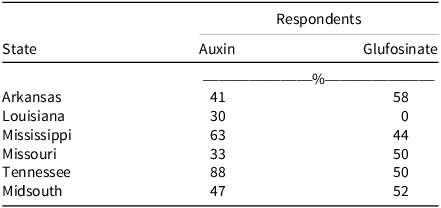
A total of 47% of respondents (n = 127) suspected that auxin-resistant Palmer amaranth was infesting the fields they farm or consult on (Table 8). Tennessee had the highest proportion of respondents suspecting auxin resistance (88%), and Louisiana had the lowest (30%). Overall, 52% of respondents (n = 125) suspected that Palmer amaranth was resistant to glufosinate. Arkansas had the highest percentage of respondents suspecting resistance (58%), whereas no respondents in Louisiana believed glufosinate-resistant Palmer amaranth infested their soybean fields. These results are similar to previous Midsouth surveys, where fewer Louisiana consultants suspected the presence of glyphosate- and PPO-inhibitor–resistant Palmer amaranth on their scouted hectarage (Riar et al. Reference Riar, Norsworthy, Steckel, Stephenson, Eubank and Scott2013; Schwartz-Lazaro et al. Reference Schwartz-Lazaro, Norsworthy, Steckel, Stephenson, Bish, Bradley and Bond2018). This survey also found that Louisiana had the lowest proportion of responses of suspected resistant Palmer amaranth. Heavy use of auxin-resistant cultivars (XtendFlex, E3, and Roundup Ready Xtend) has resulted in Palmer amaranth in the Midsouth evolving resistance to dicamba and 2,4-D, two of the three auxinic herbicides applied postemergence to soybean fields. Dicamba failures on Palmer amaranth were first reported during the 2019 growing season in Tennessee, and populations were subsequently confirmed to be 1.85 to 14.25 times as resistant as a susceptible control (Foster and Steckel Reference Foster and Steckel2022). Resistance to 2,4-D has also been confirmed, with Palmer amaranth accessions from Arkansas reported to be 5.7 to 7.1 times more resistant to 2,4-D than a susceptible control (Hwang et al. Reference Hwang, Norsworthy, Piveta, Souza, Barber and Butts2023).
Percentage of respondents who suspect the presence of auxin- or glufosinate-resistant Palmer amaranth.

Table 8. Long description
A table comparing the percentage of respondents suspecting auxin- or glufosinate-resistant Palmer amaranth across different states. The table has six rows and three columns. The columns are labeled State, Auxin, and Glufosinate. The row labels are Arkansas, Louisiana, Mississippi, Missouri, Tennessee, and Midsouth. Row 1: Arkansas, Auxin 41 percent, Glufosinate 58 percent. Row 2: Louisiana, Auxin 30 percent, Glufosinate 0 percent. Row 3: Mississippi, Auxin 63 percent, Glufosinate 44 percent. Row 4: Missouri, Auxin 33 percent, Glufosinate 50 percent. Row 5: Tennessee, Auxin 88 percent, Glufosinate 50 percent. Row 6: Midsouth, Auxin 47 percent, Glufosinate 52 percent.
Glufosinate has been widely incorporated into weed control programs because of the availability of resistant soybean cultivars (XtendFlex, Enlist E3, and LibertyLink) and the herbicide’s high efficacy against resistant Palmer amaranth (Schwartz-Lazaro et al. Reference Schwartz-Lazaro, Norsworthy, Scott and Barber2017; USDA-NASS 2024). Multiple Palmer amaranth populations in Arkansas were confirmed in 2022 to be resistant to glufosinate, following commercial failures of the herbicide in 2019 and 2020 (Priess et al. Reference Priess, Norsworthy, Godara, Mauromoustakos, Butts, Roberts and Barber2022). Unsurprisingly, Tennessee and Arkansas had the highest percentages of respondents suspecting auxin- and glufosinate-resistant Palmer amaranth, as these states were the first to confirm the existence of auxin and glufosinate resistance, respectively.
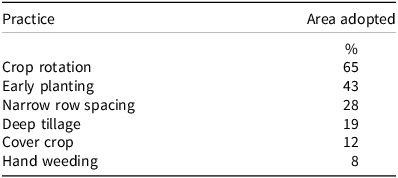
Herbicidal control options are increasingly limited due to the widespread evolution of herbicide resistance in many weed species, necessitating the adoption of practices that mitigate this evolution (Norsworthy et al. Reference Norsworthy, Ward, Shaw, Llewellyn, Nichols, Webster, Bradley, Frisvold, Powles, Burgos, Witt and Barrett2012). Farmers and consultants (n = 137) were asked to identify their three most widely adopted herbicide resistance management practices in soybean. The most widely adopted were the use of multiple effective SOAs (69% of respondents), crop rotation (63%), and proper herbicide timing (53%) (Supplementary Table S4). Notably, no respondent identified equipment sanitation as one of their most used practices. Two respondents indicated they used practices other than those listed, with no-till mentioned as another practice adopted for resistance management. Compared with the most recent survey, starting clean went from the most common practice (73%) to the fourth most common (51%) in the current survey, while the use of multiple SOAs and crop rotation increased by 5 and 11 percentage points, respectively (Schwartz-Lazaro et al. Reference Schwartz-Lazaro, Norsworthy, Steckel, Stephenson, Bish, Bradley and Bond2018). Respondents (n = 122) were also asked about the hectarage managed under select cultural and mechanical weed management practices. Crop rotation was adopted on the largest share of soybean hectares (65%), followed by early planting (43%), and narrow row spacing (28%) (Table 9). Hand-weeding was used on 8% of hectares, compared with 15% of Midsouth soybean hectares in 2011, possibly declining due to higher labor costs relative to other practices (Riar et al. Reference Riar, Norsworthy, Steckel, Stephenson, Eubank and Scott2013; Swinton and Van Deynze Reference Swinton and Van Deynze2017)
Adoption of cultural and mechanical weed management practices by survey respondents.

Table 9. Long description
A table titled ‘Adoption of cultural and mechanical weed management practices by survey respondents’ presents data on the percentage of area adopted for different practices. The table has two columns: ‘Practice’ and ‘Area adopted’. The ‘Practice’ column lists six practices: Crop rotation, Early planting, Narrow row spacing, Deep tillage, Cover crop, and Hand weeding. The ‘Area adopted’ column shows the percentage of area adopted for each practice. Row 1: Crop rotation, 65 percent. Row 2: Early planting, 43 percent. Row 3: Narrow row spacing, 28 percent. Row 4: Deep tillage, 19 percent. Row 5: Cover crop, 12 percent. Row 6: Hand weeding, 8 percent. The table indicates that crop rotation is the most widely adopted practice, followed by early planting and narrow row spacing. Hand weeding is the least adopted practice.
Economically Important Weed Species
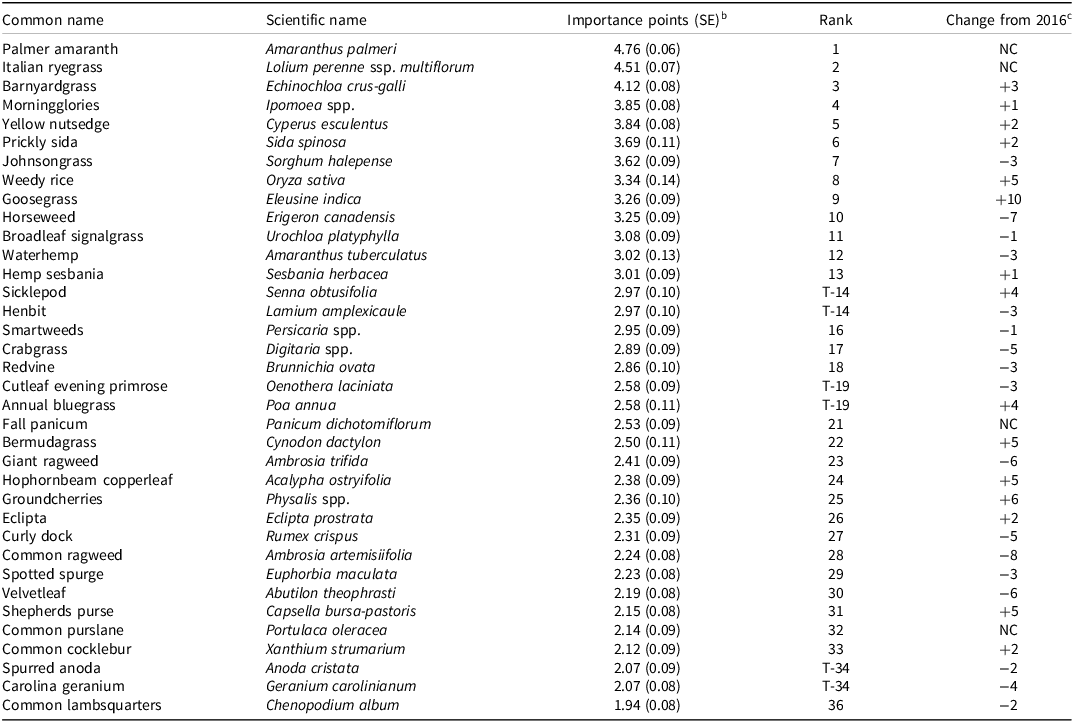
Farmers and consultants (n = 120) were asked to rank weeds on a scale from one to five, with five indicating the most important. Importance rankings were based on the weed’s economic impact. The five are Palmer amaranth, Italian ryegrass, barnyardgrass, morningglories, and yellow nutsedge (Cyperus esculentus L.) (Table 10). In the most recent survey, consultants ranked Palmer amaranth, Italian ryegrass, horseweed, johnsongrass, and morningglories as the most important weeds (Schwartz-Lazaro et al. Reference Schwartz-Lazaro, Norsworthy, Steckel, Stephenson, Bish, Bradley and Bond2018). Compared with the previous survey, barnyardgrass, morningglories, and yellow nutsedge were among the top 10 weeds that increased in rank, while horseweed and johnsongrass decreased (Table 10). Goosegrass [Eleusine indica (L.) Gaertn.] had the largest increase compared with the 2016 survey, rising 10 places. Palmer amaranth remained the most important weed species in the Midsouth. The weed is near-ubiquitous in soybean fields and can cause yield losses exceeding 65% under full-season competition (Bensch et al. Reference Bensch, Horak and Peterson2003; Klingaman and Oliver Reference Klingaman and Oliver1994). Similarly, Italian ryegrass can drastically reduce soybean yield. A study evaluating Italian ryegrass control reported soybean grain yield losses of 27% in unmanaged infestations (Bond et al. Reference Bond, Allen, Seale and Edwards2022). Barnyardgrass at high densities can also cause substantial soybean yield loss (>50%) if left unmanaged (Vail and Oliver Reference Vail and Oliver1993). Each of these weeds can cause severe yield reductions if left unmanaged, which is likely why these species are considered the most important weed species in the Midsouth.
The most important weeds of soybean in the midsouthern United States according to survey respondents. a

Table 10. Long description
The table presents a ranking of weeds based on their importance points, scientific names, and changes from a 2016 survey. It includes 36 rows and 5 columns. The columns are labeled Common name, Scientific name, Importance points (SE), Rank, and Change from 2016. The table lists various weeds along with their scientific names, importance points with standard errors, their current rank, and how their rank has changed since 2016. Notable trends include Palmer amaranth remaining the top-ranked weed, with Italian ryegrass and barnyardgrass following closely. Some weeds like goosegrass have seen significant increases in rank, while others like horseweed have decreased. The table provides a comprehensive view of the most economically impactful weeds in the Midsouth region.
a Abbreviations: NC, no change; NR, not ranked; T, tied.
b Importance points were calculated on the following rating scale: 1 = not important, 2 = rarely important, 3 = occasionally important, 4 = important, and 5 = very important. The standard error for each species is provided in parentheses.
c Change in weed importance ranking from the 2016 Midsouth soybean survey (Schwartz-Lazaro et al. Reference Schwartz-Lazaro, Norsworthy, Steckel, Stephenson, Bish, Bradley and Bond2018).
Difficult-to-Manage Weed Species
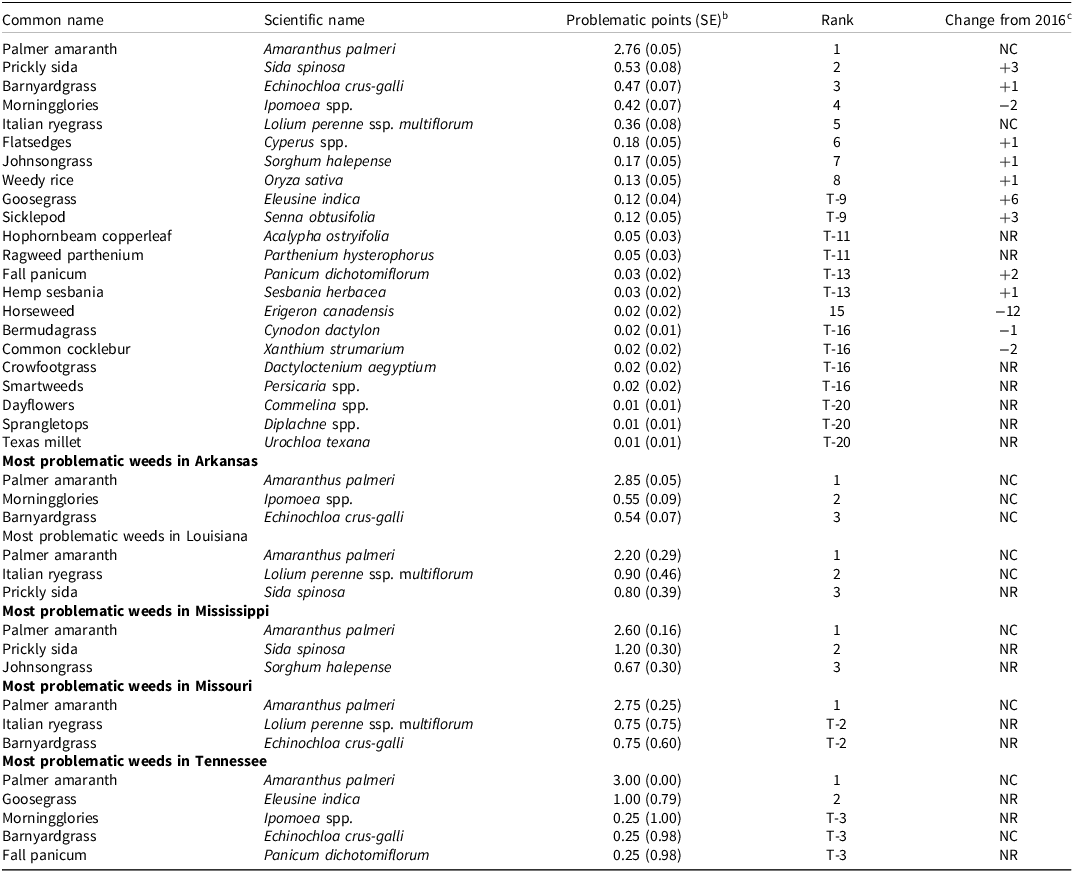
The most problematic weeds in Midsouth soybean fields as reported by respondents (n = 121) are Palmer amaranth, prickly sida, barnyardgrass, morningglories, and Italian ryegrass (Table 1). Notably, three of these (Palmer amaranth, barnyardgrass, and Italian ryegrass) have multiple-herbicide–resistant biotypes, limiting the ability to control them with postemergence herbicides (Heap Reference Heap2026). Although prickly sida and morningglories have no known herbicide resistance to date, these species are difficult to control in current soybean programs given the reliance on glyphosate and synthetic auxins, as these species are not effectively controlled with one or both of these chemistries (Bararpour et al. Reference Bararpour, Korres, Miller, Segbefia, Singh and Tseng2023; Kalina et al. Reference Kalina, Corkern, Shilling, Basinger and Grey2022; Lanie et al. Reference Lanie, Griffin, Vidrine and Reynolds1994; Norsworthy and Oliver Reference Norsworthy and Oliver2002; USDA-NASS 2024).
Problematic species were further delineated by state. Palmer amaranth was the most problematic weed in every surveyed state, underscoring the species’ significance to soybean production in multiple locations (Table 11). Prickly sida was ranked the third most problematic weed in Louisiana and second in Mississippi, while barnyardgrass was ranked third in Arkansas, Missouri, and Tennessee. Morningglories were the second-most problematic weed in Arkansas and tied for third-most in Tennessee. Italian ryegrass was ranked second in Louisiana and Missouri. Tennessee respondents ranked goosegrass second and fall panicum (Panicum dichotomiflorum Michx.) and morningglories tied for third; this was the only state where these species ranked in the top three.
The most problematic weeds of midsouthern soybean (data pooled), with the most problematic weeds of each surveyed state. a

Table 11. Long description
The table compares the most problematic weeds in midsouthern soybean regions and individual states, detailing their common names, scientific names, problematic points, ranks, and changes from 2016. The table is divided into sections for overall midsouthern soybean regions and specific states: Arkansas, Louisiana, Mississippi, Missouri, and Tennessee. Each section lists weeds with their respective data. For example, Palmer amaranth is consistently ranked as the most problematic weed across all regions and states. The table includes 20 rows and 5 columns, with headers: Common name, Scientific name, Problematic points (SE), Rank, and Change from 2016. Each row provides specific data for different weeds, such as Palmer amaranth with a problematic point of 2.76 and rank 1 in the midsouthern soybean region. The table highlights the significance of Palmer amaranth and other weeds like Prickly sida, Barnyardgrass, and Morningglories in various states.
a Abbreviations: NC, no change; NR, not ranked; T, tied.
b Problematic points were calculated by assigning 3 points for a rank of first, 2 points for second, and 1 point for third. The standard error for each species is included in parentheses.
c Change in weed problematic ranking from the 2016 Midsouth soybean survey (Schwartz-Lazaro et al. Reference Schwartz-Lazaro, Norsworthy, Steckel, Stephenson, Bish, Bradley and Bond2018).
The most recent Midsouth soybean weed management survey also included similar problematic rankings (Schwartz-Lazaro et al. Reference Schwartz-Lazaro, Norsworthy, Steckel, Stephenson, Bish, Bradley and Bond2018). The top five, most problematic species were the same in this survey as in the 2016 survey, except for horseweed (Table 11). Palmer amaranth remained unchanged as being the most problematic species in the Midsouth. Of the top five–ranked weeds, prickly sida and barnyardgrass increased in ranking, while Italian ryegrass was unchanged and morningglories decreased. For the individual rankings, Arkansas was the only state where this remain unchanged.
Weed Management Research Priorities According to Survey Respondents
Farmers and consultants were asked to identify the two most-needed areas of research in weed management. Not every respondent provided two research needs; therefore, only 117 responses were recorded. Twenty-six percent of respondents requested research on problematic weed species; specific species mentioned include Palmer amaranth (70% of these responses), prickly sida (27%), johnsongrass (23%), and Italian ryegrass (10%). The aforementioned species are notable because all but prickly sida have been confirmed to demonstrate resistance to multiple herbicide modes of action in the surveyed states (Heap Reference Heap2026). Prickly sida has become a greater concern, likely due to the prevalence of the auxin-resistant soybean technologies. The auxin herbicides dicamba and 2,4-D are not highly effective on prickly sida in the Midsouth, prompting farmers and consultants to call for research on this species (Bararpour et al. Reference Bararpour, Korres, Miller, Segbefia, Singh and Tseng2023).
Survey respondents also identified a need for research on herbicide efficacy. A total of 23% of those surveyed reported that their greatest research need was to improve the efficacy of herbicide applications. Of those responders, 43% considered optimizing residual herbicide use, such as refining timing and rates, to be a major research need. An additional 39% identified a need for research on sprayer technology, including nozzle selection, spray water quality, and new sprayer technologies such as unmanned aerial sprayers or targeted sprayers. University researchers are currently evaluating novel sprayer technologies such as the John Deere (Moline, IL) See & Spray and unmanned aerial sprayers for their fit and efficacy in soybean production systems (Avent et al. Reference Avent, Norsworthy, Patzoldt, Schwartz-Lazaro, Houston, Butts and Vazquez2024; Thompson et al. Reference Thompson, Spaunhorst and Bradley2026). Other responses focused on improving herbicide efficacy mentioned a need for research to optimize applications based on time of day and weed size.
Ten percent of farmers and consultants identified herbicide resistance management as their greatest research need. The evolution of herbicide resistance complicates weed management, rendering once-effective chemistries as now untenable control options. Herbicide resistance is a major problem in the Midsouth, with seven way–resistant Palmer amaranth in Arkansas, glyphosate-resistant junglerice [Echinochloa colona (L.) Link] in Tennessee and Mississippi, and clethodim-resistant Italian ryegrass in Mississippi, out of the >100 confirmed cases of herbicide resistance in the surveyed states (Carvalho-Moore et al. Reference Carvalho-Moore, Norsworthy, Souza, Barber, Piveta, Meiners and Porri2025; Heap Reference Heap2026; Nandula et al. Reference Nandula, Montgomery, Vennapusa, Jugulam, Giacomini, Ray, Bond, Steckel and Tranel2018, Reference Nandula, Giacomini, Lawrence, Molin and Bond2020). A significant portion of responses (21%) requested new herbicide active ingredients or modes of action, with an additional 6% desiring new herbicide technologies. Given the prevalence of herbicide resistance, it is unsurprising that weed management practitioners desire new chemical management tools. However, university researchers have limited capacity to facilitate herbicide discovery and development. There is, however, promise of a new soybean herbicide technology in the near future with the announcement by Bayer CropScience of the Vyconic trait, which will be the first five-way resistance trait in soybean, providing resistance to glyphosate, glufosinate, dicamba, 2,4-D, and mesotrione (Anonymous 2025). In addition to a desire for new chemistry, 7% of respondents expressed interest in cultural practices such as cover cropping and deep tillage for weed control. Farmers and consultants recognize the need for nonchemical weed management given the prevalence of herbicide-resistant species. A diversified weed management approach that incorporates cultural practices such as cover cropping is crucial for reducing the evolution of herbicide resistance (Norsworthy et al. Reference Norsworthy, Ward, Shaw, Llewellyn, Nichols, Webster, Bradley, Frisvold, Powles, Burgos, Witt and Barrett2012).
Additionally, two respondents requested updated Extension publications: one requested information on tank-mix compatibility, and another requested conversion charts for products with different active ingredient concentrations. Two additional respondents requested research on how to meet the mitigation requirements under the U.S. Environmental Protection Agency’s Herbicide Strategy and the Endangered Species Act (US EPA 2024). Another respondent expressed interest in using seed safeners to mitigate herbicide injury. Overall, there is a mandate from farmers and consultants to direct research toward holistic weed management, given the rise of herbicide-resistant and difficult-to-control weed species, with marked interest in mitigating herbicide resistance, cultural weed management, and optimizing herbicide applications.
Respondents were self-selected from conference attendees and Extension meeting participants, potentially biasing results toward farmers and consultants who are actively involved in Extension programming, as well as introducing self-selection bias. The authors also recognize that the states were unequally represented by respondents, with Arkansas-based farmers and consultants accounting for the majority of responses. There is also potential for overlapping reporting by individuals who manage the same soybean hectarage, as well as bias arising from differences between farmers’ and consultants’ perspectives. Despite these limitations, the substantial hectarage represented and the broad geographic distribution across the Midsouth provide valuable insight into the regional weed management trends and impending challenges in soybean systems.
Practical Implications
A significant portion of farmers and consultants in the Midsouth have adopted practices that mitigate the evolution of herbicide resistance, with more than three-quarters of respondents to this survey indicating they apply preemergence and postemergence residual herbicides, thereby reducing selection pressure on postemergence herbicides. However, ample potential still exists for growth in the adoption of herbicide resistance management practices, which are urgently needed given the prevalence of herbicide resistance. Approximately half of the farmers and consultants putatively suspected Palmer amaranth resistance to auxinic herbicides and glufosinate. The current chemical control options are becoming less viable as resistance continues to evolve. Farmers and consultants recognize this and have requested research on herbicide resistance management and difficult-to-control weed species, which many researchers are actively studying. Palmer amaranth remains the most important and problematic species infesting soybean in the Midsouth. This species should be the driver behind weed management decisions given its high adaptability and prolific seed production (Sauer Reference Sauer1957; Ward et al. Reference Ward, Webster and Steckel2013). However, other species, such as prickly sida and barnyardgrass, are an increasing problem affecting soybean production in the Midsouth.
Supplementary Material
To view supplementary material for this article, please visit https://doi.org/10.1017/wet.2026.10126.
Acknowledgments
The authors thank the University of Arkansas System Division of Agriculture for its support of this research. This research would not have been possible without the numerous soybean farmers and consultants who graciously completed the survey.
Funding
The Arkansas Soybean Promotion Board provided funding for this survey.
Competing Interests
The authors declare they have no competing interests.



 Open access

