INTRODUCTION
Down syndrome (DS) is most commonly caused by an extra copy of chromosome 21 (Trisomy 21) and has a prevalence rate of 1·08 in every 1000 live births (Morris & Alberman, Reference Morris and Alberman2009). Down syndrome results in a learning disorder, that can range from mild to severe but is generally associated with an IQ of approximately 50 (Chapman & Hesketh, Reference Chapman and Hesketh2000; Määttä, Tervo-Määttä, Taanila, Kaski & Livanainen, Reference Määttä, Tervo-Määttä, Taanila, Kaski and Livanainen2006). Children with Down syndrome typically show relative strengths in social skills, word reading, and visual short-term memory (Boudreau, Reference Boudreau2002; Buckley, Reference Buckley, Nadel and Rosenthal1995; Fidler, Hepburn & Rogers, Reference Fidler, Hepburn and Rogers2006; Jarrold, Baddeley & Hewes, Reference Jarrold, Baddeley and Hewes1999) and relative weaknesses in oral language and verbal short-term memory (Abbeduto, Warren & Conners, Reference Abbeduto, Warren and Conners2007; Jarrold et al., Reference Jarrold, Baddeley and Hewes1999). Within literacy skills, individuals with Down syndrome have difficulties in nonword reading and reading comprehension in comparison to their strength in word reading (Nash & Heath, Reference Nash and Heath2011; Roch & Jarrold, Reference Roch and Jarrold2008) Within the oral language domain, expressive language tends to be weaker than receptive language (Laws & Bishop, Reference Laws and Bishop2003), and expressive vocabulary has been found to be below the level expected given nonverbal ability (Næss, Lyster, Hulme & Melby-Lervåg, Reference Næss, Lyster, Hulme and Melby-Lervåg2011).
Buckley (Reference Buckley, Nadel and Rosenthal1995) suggested that the relatively intact word reading skills of children with DS may serve to promote their oral language development. So far, however, experimental evidence for this suggestion is lacking. There is also an outstanding question concerning different aspects of vocabulary learning in individuals with Down syndrome. Vocabulary knowledge incorporates both phonological and semantic knowledge and there is some evidence that it is the learning of the phonological form that is particularly impaired in Down syndrome (Jarrold, Thorn & Stephens, Reference Jarrold, Thorn and Stephens2009; cf. Mosse & Jarrold, Reference Mosse and Jarrold2011). The present study investigated vocabulary learning in children with Down syndrome and, more specifically, the extent to which phonological learning can be aided by orthographic support from a written word.
The fast-mapping paradigm has been used with individuals with Down syndrome to investigate vocabulary learning. Fast-mapping is a form of incidental learning where a label for a novel object is introduced in the context of another task, often a game (Carey & Bartlett, Reference Carey and Bartlett1978). The first of these studies (Chapman, Kay-Raining Bird & Schwartz, Reference Chapman, Kay-Raining Bird and Schwartz1990) found that children with Down syndrome, who had a mean age of 12;06, comprehended and produced new words as well as typically developing children, who had a mean age of 4;01. The two groups were explicitly matched for non-verbal ability and also performed similarly on receptive and expressive vocabulary tasks. Chapman et al.'s findings have been replicated (Kay-Raining Bird, Chapman & Schwartz, Reference Kay-Raining Bird, Chapman and Schwartz2004), but advantages for typically developing children have been found earlier in development or when matched for receptive syntax, which is a weakness compared to non-verbal ability for children with Down syndrome (Kay-Raining Bird, Gaskell, Dallaire & MacDonald, Reference Kay-Raining Bird, Gaskell, Dallaire and MacDonald2000; McDuffie, Sindberg, Hesketh & Chapman, Reference McDuffie, Sindberg, Hesketh and Chapman2007). Therefore the results of these studies appear to depend on the characteristics of the comparison group.
In their fast-mapping study, Chapman et al. (Reference Chapman, Kay-Raining Bird and Schwartz1990) also administered a recognition task which required children to choose between the target name (koob) and two distracters, one which had the same rime unit as the target (soob) and one which had a stop consonant as the initial phoneme like the target (tid). This task was only administered to children who did not correctly produce the target name, i.e. those children with poor learning. This was evidenced by pass rates varying between 29% and 58% across groups and on immediate and delayed post-tests. When children chose an incorrect answer, it tended to be the distracter with the phonetically similar initial phoneme to the target, which the authors argued suggests children had some phonological knowledge about the onset of the word, but not the rime.
The production tasks used in the fast-mapping studies above used lenient criteria to determine what was accepted as a correct answer; a response was still considered correct if there was an error on one phoneme in the target word, or if a phoneme was added. Therefore, with the exception of Chapman et al.'s (Reference Chapman, Kay-Raining Bird and Schwartz1990) recognition task, which was only administered to a small number of children, these tasks could be successfully completed even if the child had a relatively poor phonological representation of the novel word.
Problems with articulation are common in children with Down syndrome (Kumin, Councill & Goodman, Reference Kumin, Councill and Goodman1994; Roberts et al., Reference Roberts, Steven, Malkin, Barnes, Skinner, Hennon and Anderson2005), thus making it difficult to assess production of new words. To circumvent this whilst stringently assessing the quality of the phonological representation, Jarrold et al. (Reference Jarrold, Thorn and Stephens2009) tested phonological learning using a receptive multiple-choice task rather than a production task. This required children to choose the word they had learnt and ignore two distracters which were phonetically similar to the target nonword. Individuals with Down syndrome aged fourteen to twenty-nine years and typically developing children aged five to eight years took part. The individuals with Down syndrome were found to be impaired on this task compared to typically developing children matched for non-verbal ability, receptive vocabulary, and expressive vocabulary.
Mosse and Jarrold (Reference Mosse and Jarrold2011) extended this work using a similar training methodology but requiring a spoken response in a series of three experiments with individuals with Down syndrome aged nine to thirty years and typically developing children aged four to six years. In contrast to Jarrold et al. (Reference Jarrold, Thorn and Stephens2009), there were no differences in phonological learning between the two groups of children. This finding remained when the same receptive multiple-choice task as Jarrold et al. was used as the outcome measure. It was argued that this conflicting result may be because the target item appeared more frequently than the distracters in the original study, and the typically developing children benefited more from this. In summary, it is currently unclear as to whether children with Down syndrome have difficulties learning the phonological forms of words relative to their general developmental level.
As children with Down syndrome have oral language and verbal short-term memory difficulties, the use of visual support has often been encouraged in their education, particularly in language instruction. Buckley (Reference Buckley, Nadel and Rosenthal1995) proposed that seeing orthography, or the written form of words, helps the oral language development of children with Down syndrome. There are, at least, two ways in which seeing the written form of a word may help children learn its spoken form. Buckley argued that ‘reading practice improves phonology and articulation, possibly because the letters in words provide the cues the child needs to sound all the phonemes’ (p. 161). If children can identify the individual phonemes in a new spoken word then this may result in their phonological output, and therefore representation, being more accurate. Additionally the orthography may provide children with another representation of the new word form, which strengthens the overall representation in the lexicon and therefore aids retrieval at a later date (Perfetti & Hart, Reference Perfetti, Hart, Verhoeven, Elbro and Reitsma2002).
Some case studies suggest that teaching young children with Down syndrome to read promotes oral language development, particularly in the production of words or sentences which are first introduced in their written form (de Graaf, Reference de Graaf1993; Duffen, Reference Duffen1976). In a longitudinal study with a group of fourteen children with Down syndrome, Laws, Buckley, Bird, MacDonald and Broadley (Reference Buckley, Nadel and Rosenthal1995) found that those who could read made more progress on oral language measures than those who could not read. However the group of children who could read had more advanced oral language skills at the first time-point. Furthermore, all the children who could not read were in special education and those who could read were mostly in mainstream education, which has been found to lead to greater progress in oral language (Buckley, Bird, Sacks & Archer, Reference Buckley, Bird, Sacks and Archer2006). In a different longitudinal study with individuals with Down syndrome, Laws and Gunn (Reference Laws and Gunn2002) found that initial reading skills correlated with mean length of utterance five years later, but not receptive language. Therefore there is some evidence to suggest a positive relationship between reading and oral language. If reading does promote oral language development, as suggested by evidence from case studies, we need to determine whether this is a special or unique relationship or whether it reflects what we see in typically developing children of the same mental age or reading ability.
Studies with typically developing children aged seven to eleven years have directly examined whether seeing the written form of a new word helps to learn its meaning and spoken form. Rosenthal and Ehri (Reference Rosenthal and Ehri2008) taught typically developing children aged seven to eight years and ten to eleven years novel words paired with definitions, half of which were taught with their written form present. When the written form was present, children were quicker to learn the pronunciations and meanings during training and were more accurate when recalling the spelling and pronunciation after a delay of three days. Similarly Ricketts, Bishop and Nation (Reference Ricketts, Bishop and Nation2009) taught typically developing children aged eight to nine years the nonword names for pictures of novel objects. The written form was present for half of the nonwords and for these there was an advantage in producing the names of the pictures during training, spelling the nonwords and matching the nonwords to pictures. It is argued that the written form of a new word is less transient and variable than its spoken form and creates an orthographic image to represent and reinforce the phonological representation (Ricketts et al., Reference Ricketts, Bishop and Nation2009; Rosenthal & Ehri, Reference Rosenthal and Ehri2008). In summary, when learning new vocabulary items, typically developing children benefit from having the written form present. Specifically, it helps them learn the spoken form, meaning, and spelling of the new word.
The aim of the current study was to examine oral vocabulary learning in children with Down syndrome, focusing on the phonological aspect of learning, and to see if this benefits from the support of a written word to a greater degree than in typically developing children. Children were taught spoken nonwords paired with a picture of a novel object. Half of the nonwords were taught with the written form of the word present. To ensure any improvement was due to the specific effect of orthography, a control condition which provided a non-orthographic visual cue was included.
A group of children with Down syndrome and a group of typically developing children matched for single (real) word reading ability participated in the experiment. The children were matched for single word reading ability to ensure that the two groups would have equal opportunity to benefit from the written form of the taught nonwords. It was expected that children with Down syndrome would have poorer existing vocabulary knowledge than the typically developing group and show slower learning of new spoken words than typically developing children. We expected that having the written form of the word present would benefit learning in both groups. The relative benefit that orthography may have on oral vocabulary learning for children with Down syndrome compared to typically developing children has not yet been investigated. It was possible that both groups would benefit from orthography to the same extent because they were of the same reading ability. Conversely it was also feasible that children with Down syndrome would benefit more from orthography than the typically developing children because this would capitalize on their relatively strong visual short-term memory skills.
METHOD
Participants
Seventeen children with Down syndrome (five males) were recruited from local support groups and families who had previously taken part in research projects. The children ranged in age from seven to sixteen years, and had a mean age of 12;09 (standard deviation of 2;10). Parental consent was obtained for all children to participate in the study. Seven children attended mainstream primary schools, seven children attended mainstream secondary schools, and three children attended special secondary schools.
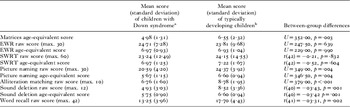
Twenty-seven typically developing children (11 males) were recruited from three primary schools. The children were aged five to seven years, with a mean age of 6;04 (standard deviation of 0;08). The typically developing children were matched to the children with Down syndrome on single word reading ability. As can be seen from Table 1, there were no significant differences between the two groups on two word reading tasks. Consent for the typically developing children to participate was obtained from the headteachers of the schools and from the children's parents. Children who had been identified with special educational needs were excluded and all participants in both groups were monolingual English speakers.
Mean scores (and standard deviations) for the children with Down syndrome and typically developing children on all background measures

notes: EWR = early word reading test; SWRT = single word reading test.
a n = 17, except for sound deletion where n = 15 and word recall where n = 16.
b n = 27 for all measures.
Assessment battery
Non-verbal reasoning
The Matrices subtest from the Wechsler Pre-School and Primary Scale of Intelligence IIIUK (WPPSI-IIIUK; Wechsler, Reference Wechsler2003) or the Wechsler Abbreviated Scale of Intelligence (WASI; Wechsler, Reference Wechsler1999) was administered to measure non-verbal reasoning skills. In these tests, children were asked to look at an incomplete matrix and choose the missing section from four or five options. Testing was discontinued after four incorrect answers on either four or five consecutive items.
The matrices subtest from the WPPSI-IIIUK is normed for children aged up to 7;03; typically developing children older than this were administered the WASI. Most of the children with Down syndrome were administered the WPPSI-IIIUK, as previous research has suggested that individuals with Down syndrome of similar chronological ages to the participants in this study tend to obtain non-verbal age-equivalent scores of four to five years (Boudreau, Reference Boudreau2002; Chapman, Seung, Schwartz & Kay-Raining Bird, Reference Chapman, Seung, Schwartz and Kay-Raining Bird1998; Price, Roberts, Vandergrift & Martin, Reference Price, Roberts, Vandergrift and Martin2007). Indeed, none of the participants in the present study performed at ceiling on the WPPSI-IIIUK matrices subtest. Two of the individuals had taken part in previous research projects, and were known to be of a higher non-verbal IQ and therefore the WASI was administered.
Word reading
Two tasks of word reading were administered to all children from the York Assessment of Reading for Comprehension (YARC), which contains two test batteries: Early Reading (Hulme et al., Reference Hulme, Stothard, Clarke, Bowyer-Crane, Harrington, Truelove and Snowling2009) and Passage Reading (Snowling et al., Reference Snowling, Stothard, Clarke, Bowyer-Crane, Harrington, Truelove, Nation and Hulme2009).
The Early Word Reading (EWR) test from the YARC–Early Reading battery was used to assess children's knowledge of thirty common high-frequency words ranging from cat to giant. The test was discontinued if the child answered ten consecutive items incorrectly. This task is particularly sensitive for children at the beginning stages of reading development.
To ensure children's full range of word reading ability was captured, the Single Word Reading Test (SWRT) from the YARC–Passage Reading battery was also used. The test consists of sixty words that increase in complexity from simple words such as see to more complex words such as pseudonym. Children were shown all words and asked to read as many as they could.
Expressive vocabulary
The WPPSI-IIIUK Picture Naming subtest was administered to test children's expressive vocabulary ability. Children had to name a series of thirty pictures ranging from car to thermometer, and the test was discontinued if five consecutive incorrect responses were made.
Phonological awareness
To assess phoneme awareness, children were given a test of alliteration matching, adapted from Carroll (Reference Carroll2004). All stimuli were presented to children as spoken words and colour pictures. Children were asked which word out of a choice of two started with the same sound as a target word. The distracters were matched to the correct answer for global similarity to the target word. There were two practice items and ten test items, and children completed all items.
The Sound Deletion subtest from the YARC–Early Reading battery was also administered to test phonological awareness. Children were presented with spoken words and corresponding colour pictures, asked to repeat the word and then asked to delete a sound. Some of the items resulted in nonwords, e.g. say sheep without the /ʃ/, whereas some items resulted in real words, e.g. say boat without the /t/. There were twelve items, which tap deletion of syllables and phonemes in initial, medial, and final positions, and children completed all items.
Verbal short-term memory
The Word Recall subtest from the Working Memory Test Battery for Children (WMTB-C; Pickering & Gathercole, Reference Pickering and Gathercole2001) was used to measure verbal short-term memory skills. The children heard a sequence of words and had to repeat them in the same order. The sequence of words increased in length across trials. The test was discontinued when children scored less than four out of six items correct at a given list length. The number of correct trials, rather than span score, was calculated and used in analyses.
Training materials
Ten nonwords were taught and all had three letters with a consonant–vowel–consonant structure. Only phonemes which are typically acquired by four years of age were used (Dodd, Holm, Hua & Crosbie, Reference Dodd, Holm, Hua and Crosbie2003), as children with Down syndrome often have phonological problems and exhibit more difficulties with later acquired sounds (Roberts et al., Reference Roberts, Steven, Malkin, Barnes, Skinner, Hennon and Anderson2005).
There were two conditions in the vocabulary learning procedure: orthography present and orthography absent. Flashcards of the nonword's spelling were created for the orthography present condition. For the orthography absent condition, flashcards were created with the ‘alien spelling’ of the nonword, which consisted of three randomly selected Greek or Cyrillic letters.
Ten colour pictures were selected to fit with the theme of ‘things found on an alien planet’ and represented a number of semantic categories including food, animals, tools, transport, plants, and housing. The pictures and the nonwords were randomly paired and split into two groups: word group A and word group B (see the ‘Appendix’ for a list of nonwords, phonetic transcriptions, ‘alien’ spellings, pictures and their pairings).
Training procedure
The children were introduced to the training procedure by being told they were going to learn about an alien planet. They were told they would see pictures of things from the alien planet and learn what they were called. Each child was taught one group of five nonwords with orthography present and the other five nonwords with orthography absent. The group of nonwords allocated to each condition was counterbalanced across participants and the two training conditions took place on different days, the order of which was also counterbalanced.
When the nonwords were taught with the orthography present, flashcards of the spelling were shown and children were told “This is how we spell it”. When the nonwords were taught with the orthography absent, they saw flashcards of the alien spelling and were told “This is how they spell it on the alien planet”. The children in this study were all able to read, therefore it was possible that they would be able to read the flashcards of the nonwords' spellings. To attempt to equate stimulus exposure, the word was spoken by the experimenter one extra time in each trial in the orthography absent condition.
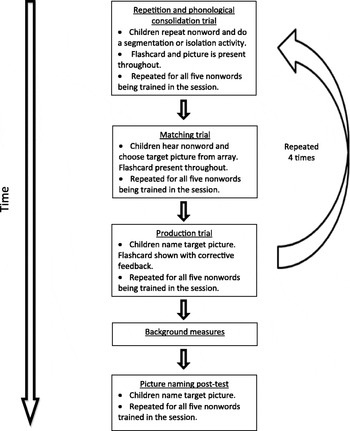
There were three different training trials: repetition and phonological consolidation, matching, and production. This training cycle was repeated four times, and increased in difficulty. The nonwords were presented during training in a fixed random order which differed on each trial. Figure 1 shows the structure of the experimental procedure.
Procedure of the training sessions.

For the repetition aspect of the first trial, children heard the nonword, saw the picture, repeated the nonword, and received corrective feedback. One point was awarded for each nonword repeated correctly. There was then a phonological consolidation activity, which differed slightly in each cycle. In the first training cycle, children heard the word sounded out, repeated it, and heard the initial sound isolated. In the second training cycle, children had to produce the initial sound independently; they were then given corrective feedback and heard the word sounded out. The third and fourth training cycles followed the same format, except the focus was on the final sound. The real spelling or alien spelling flashcard was present throughout.
The second trial was a matching game presented on a laptop computer using a Microsoft Office PowerPoint presentation. The children heard the nonword and had to identify the corresponding picture shown on the computer screen, and the cycles increased in difficulty by including one, two, three, or four distracters, which were the other pictures being trained in that session. Children then received corrective feedback in which they heard the word again. The real or alien spelling was present on the computer screen throughout. Children received one point for each picture identified correctly.
In the production trials, children were shown the same picture of the item as used in the repetition and matching trials (without the real or alien spelling) and asked if they could remember its name. They were given corrective feedback consisting of the spoken nonword and the appropriate flashcard. One point was awarded for each nonword correctly produced.
The production trials were used as the primary learning outcome measure. Consistent speech errors were taken into account when scoring the repetition and production trials. If children repeated a nonword incorrectly but with a consistent realization then this pronunciation was accepted as correct; for example, one child with Down syndrome repeated /zɒt/as /sɒt/consistently and so this was scored as correct. Furthermore some children were unable to produce certain sounds across all words; for example, one child with Down syndrome produced /f/ as /v/. Consistent errors were made by eight children with Down syndrome but none of the typically developing children.
Picture naming post-test
A picture naming post-test took place approximately 10–15 minutes after the training procedure. Children were shown the pictures they had learned in that session and asked if they could remember their names. The pictures were presented individually in a fixed random order. Again, consistent speech errors were taken into account when scoring this test.
Procedure
Typically developing children
There were two training sessions, which lasted 30–40 minutes each. Where possible the first session included, in order: vocabulary training, matrices, picture naming, early word reading, single word reading, alliteration matching, and the alien picture naming post-test. Where possible the second session included, in order: vocabulary training, word recall, sound deletion, and the alien picture naming post-test. Testing took place in a quiet space within the school and children were seen individually.
Children with Down syndrome
Sixteen of the children with Down syndrome were also taking part in a longitudinal study, and the test battery for this included matrices, picture naming, early word reading, single word reading, and alliteration matching. For twelve of these children the vocabulary training study took place at the same time as testing for the longitudinal study. Where possible the tasks were administered in the same order as the typically developing group. For the remaining four children, the measures above were administered two to four months previously. There was still a similar lapse between training and post-test as the typically developing children by including other ‘filler’ activities, such as playing a computerized game. For the child who was not taking part in the longitudinal study, the training sessions followed the same format as for the typically developing group.
RESULTS
Raw scores for all measures except the matrices task were used in all analyses. For the matrices task, different participants completed different versions according to their age or ability, and therefore only age-equivalent scores are presented for this task. One of the children with Down syndrome refused to complete the picture naming post-test and sound deletion task and another refused to complete the word span and sound deletion tasks.
Performance on background measures
If the distribution of scores for a task deviated from normal for either or both groups then a Mann–Whitney U test was used to test the differences between the groups. If the distributions were normal in both groups, then an independent t-test was used. The mean scores, standard deviations, and between-group test results are reported in Table 1. Where possible, age-equivalent scores are also reported so the developmental level of the two groups can be seen. As would be expected from previous studies, there were no differences between the groups on the two reading measures but the typically developing group performed significantly better on all other measures.
Vocabulary learning
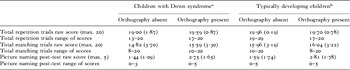
Table 2 shows the scores of the two groups of children during the repetition and matching trials in both conditions. It can be seen that both groups scored well, particularly on the repetition trials, where accuracy was very high. Furthermore the scores were similar in the two conditions.
Mean scores (and standard deviations) for the children with Down syndrome and the typically developing children during vocabulary training and the picture naming post-test

notes:a n = 17, except for the picture naming post-test where n = 16.
b n = 27 for all measures.
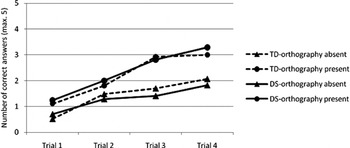
The primary outcome measure during training was the production trials, and the score on each of the four trials can be seen in Figure 2. Overall accuracy was high, but there does appear to be an advantage of orthography. Learning is evident across the production trials in both conditions but there is some indication of an increasing advantage for orthography. The two groups performed very similarly throughout the learning procedure. It must be noted, however, that not all items were accurately identified in either group by the last trial.
The mean scores for the production trials during learning for the typically developing children and children with Down syndrome (n = 17 for the children with Down syndrome and n = 27 for the typically developing children).

A 4 × 2×2 analysis of variance (ANOVA) was conducted for the production trials, with trial (1–4) and condition (orthography absent vs. orthography present) as within-participants variables, and group (Down syndrome vs. typically developing) as a between-participants variable. The main effect of orthography was significant (F(1, 42) = 23·52, p < ·001, ηp2 = 0·36), reflecting the higher scores in the orthography present condition. There was also a main effect of trial (F(2·45,104·76) = 60·80, p < ·001, ηp2 = 0·59), due to the scores increasing across the learning procedure. There was no main effect of group (F(1, 42) = 0·00, p = ·989, ηp2 = ·00), and no significant interactions between trial and group (F(2·45,102·76) = 0·61, p = ·576, ηp2 = ·01), condition and group (F(1, 42) = 0·50, p = ·486, ηp2 = ·01), or condition, trial, and group (F(2·58,108·40) = 0·75, p = ·505, ηp2 = ·02). There was a significant interaction between orthography and trial (F(3, 126) = 7·74, p < .001, ηp2 = ·16).
The interaction between orthography and trial was followed up with a Tukey's (HSD) test, with means collapsed across groups. An HSD value of 0·45 was obtained and this was used to test for significant differences across the new means. This confirmed that on each trial there were significantly more correct responses in the orthography present condition compared to the orthography absent condition. Focusing on the improvement during the learning procedure in the two conditions, there was a significant difference between Trial 1 and Trial 2 scores in both conditions and a significant difference between Trial 2 and Trial 3 scores in the orthography present condition only. There was no significant difference between Trial 3 and Trial 4 scores in either condition. Therefore the interaction between orthography and trial lies specifically in the greater improvement in the orthography present condition between Trial 2 and Trial 3.
In summary, spoken word learning was aided by providing the orthography of the target word. The children with Down syndrome and typically developing children showed similar levels of learning and benefited from orthography to the same extent. In both conditions, accuracy increased throughout the learning procedure, but this was greater in the orthography present condition.
Picture naming post-test
The mean scores for the picture naming post-test are shown in Table 2. The scores were not particularly high but both groups scored more highly in the orthography present condition.
A 2 × 2 ANOVA, with condition (orthography absent vs. orthography present) as a within-participants variable and group (Down syndrome vs. typically developing) as a between-participants variable, was conducted. There was a main effect of orthography (F(1, 41) = 36·70, p < ·001, ηp2 = ·47), due to better performance in the orthography present condition. The main effect of group (F(1, 41) = 0·05, p = ·817, ηp2 = ·00), and the interaction between group and orthography (F(1, 41) = 0·05, p = ·839, ηp2 = ·00), were not significant.
In summary, children with Down syndrome performed equivalently to typically developing children when producing the trained names of novel pictures at a post-test, and orthography benefited both groups equally.
Correlations between background measures and learning
We examined the correlations between the number of correct responses summed across all production trials in each condition and measures of cognitive skills in the two groups of children. Due to the aim of the experiment it was considered theoretically interesting to report correlations separately for the orthography absent and orthography present condition. The different measures of word reading, single word reading, and early word reading were highly correlated in both groups (r = ·84, p < ·001 in each case). Therefore the z-scores from these two measures were averaged to form a word reading composite.
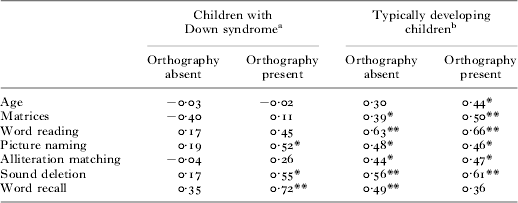
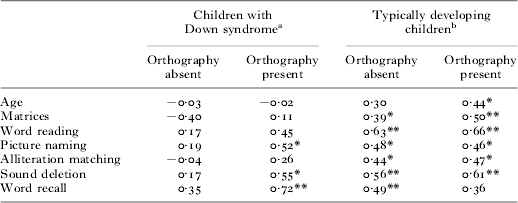
The simple correlations between the background measures and the learning tasks are shown in Table 3. In the typically developing group, the background measures were correlated similarly with both conditions of learning, and the correlations were generally moderate in strength. Word reading and sound deletion had the strongest relationships with learning. For the children with Down syndrome, none of the background tasks were significantly correlated with learning in the orthography absent condition, although the correlation with word recall was moderate in size. In comparison, learning in the orthography present condition was significantly correlated with word recall, picture naming, and sound deletion, and although not significant, the correlation with word reading was moderate.
Simple correlations between the background measures and production trials for the children with Down syndrome and typically developing children
notes: a n = 17, except for sound deletion where n = 15 and word recall where n = 16.
b n = 27 for all measures.
*p < ·05, ** p < ·01.
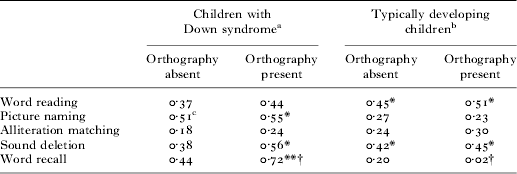
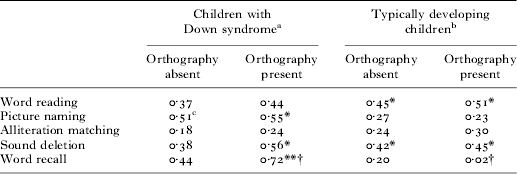
Partial correlations controlling for age and non-verbal ability are shown in Table 4. Only word reading and sound deletion remained moderately and significantly correlated with learning in both conditions in the typically developing group. For the children with Down syndrome, picture naming was significantly correlated with learning in the orthography present condition and marginally in the orthography absent condition, while word recall and sound deletion were significantly correlated with learning in the orthography present condition. However, given the relatively small sample size for the children with Down syndrome, moderate correlations with word reading in both conditions, and with word recall and sound deletion in the orthography absent condition, should also be noted. The correlation between word recall and orthography present learning was particularly strong for the children with Down syndrome, and this was significantly greater than for the typically developing children.
Partial correlations controlling for age and matrices between the background measures and production trials for the children with Down syndrome and typically developing children
notes: a n = 17, except for sound deletion where n = 15 and word recall where n = 16.
b n = 27 for all measures.
c p = ·054.
† significant difference between the correlations in the two groups.
*p < ·05, ** p < ·01.
DISCUSSION
The aim of this experiment was to examine oral vocabulary learning in children with Down syndrome and, more specifically, whether the presence of the written form benefits phonological learning. We found that overall levels of spoken word learning did not differ between the groups and the addition of orthography benefited typically developing children and children with Down syndrome to a similar degree.
The findings from this study suggest that children with Down syndrome do not have a relative impairment in phonological learning compared to typically developing children of the same reading level on tasks that require accurate production of the novel word, in support of Mosse and Jarrold (Reference Mosse and Jarrold2011). However, it should be emphasized that learning here was only assessed immediately after training and not in the longer term. The performance of the children with Down syndrome was significantly poorer than the typically developing group on a measure of existing expressive vocabulary. There is, therefore, a disparity between children with Down syndrome's ability to acquire, store and retrieve a word on the same day and the storage and retrieval of words over prolonged periods of time.
Both groups of children benefited from having the written form of the nonword present during learning and on the picture naming post-test. Similar results have been found with typically developing children aged seven to eleven years (Ricketts et al., Reference Ricketts, Bishop and Nation2009; Rosenthal & Ehri, Reference Rosenthal and Ehri2008), and the present study extends these findings to children with Down syndrome and slightly younger typically developing children.
This experiment was well controlled in that non-orthographic symbols were included in the orthography absent condition. As a result, these findings demonstrate that orthography must provide phonological information about the new word and not just an additional visual cue. It is argued that orthography provides children with a means of confirming the phonology of the new word using grapheme–phoneme correspondences, and provides another representation of the new word form in memory that aids retrieval. Treiman and Bourassa (Reference Treiman and Bourassa2000) found that children's spellings were more accurate when they spelt words or nonwords on paper rather than aloud. The authors argued that if children do not have a complete representation of a spelling then they need to break the word down, and this is done most easily when it is in a visible and permanent form. Similarly, it could be argued that the provision of orthography in this study allows the phonology of the word to be accessed more easily and reduces errors.
This is the first study to test whether the reported effect of orthography on oral language learning is greater in children with Down syndrome than typically developing children. Due to strengths in visual short-term memory and word reading, and weaknesses in expressive language and verbal short-term memory, it might be expected that children with Down syndrome would benefit more from orthography. However, the two groups were facilitated equally by the provision of orthography, presumably because they have similar reading skills and therefore were able to access the orthography to the same extent. However, it should be noted that although the groups were matched on word reading, they were not matched on decoding skills. A test of nonword reading was not administered but it is likely that the children with Down syndrome would have performed significantly worse on such a task than the typically developing children (Roch & Jarrold, Reference Roch and Jarrold2008). Therefore it is possible that the children with Down syndrome benefited more from orthographic support than expected based on their decoding skills. To test this, a typically developing control group matched on nonword reading would need to be included in a future study.
The relationships between the measures of oral language and literacy and vocabulary learning were examined, controlling for age and non-verbal ability. For the typically developing children, reading and sound deletion were the measures most highly correlated with learning. This supports previous research in typically developing children, which has also found that reading and phonological awareness correlated with vocabulary learning (Ehri & Wilce, 1979; Rosenthal & Ehri, Reference Rosenthal and Ehri2008). The pattern of correlations for the children with Down syndrome was similar to that for the typically developing children, in that learning was moderately correlated with word reading and sound deletion in both conditions. However, vocabulary and verbal short-term memory also emerged as correlates. The correlation with verbal short-term memory was particularly strong and significantly different to that found in the typically developing children. It may be that a minimum capacity of verbal short-term memory is necessary to support word learning, and therefore low levels of verbal short-term memory, as in the children with Down syndrome, are highly influential. Further advancement in memory capacity above this ‘minimum level’, as in the typically developing children, would have a weaker effect on new word learning. However, although Jarrold et al. (Reference Jarrold, Thorn and Stephens2009) also found that phonological learning was best predicted by verbal short-term memory in children with Down syndrome, this was not to a greater extent than for typically developing children. Therefore, the present finding requires replication, and the role of verbal short-term memory in spoken word learning warrants further investigation.
There are a number of ways that this study could be extended, for example by adapting the methodology to train sentences rather than single words. Buckley (Reference Buckley1993) found that children with Down syndrome were more accurate at learning spoken sentences when they had previously seen the written form of the sentence. As both morphology and syntax are particular weaknesses for children with Down syndrome (Laws & Bishop, Reference Laws and Bishop2003), it is possible that orthography may benefit the grammatical learning of children with Down syndrome more than typically developing children. Furthermore, this study could be carried out with children with Down syndrome with lower levels of reading. The children who participated in this study had an average age-equivalent score for reading of seven years and were therefore of a relatively high ability, and it may be that these results are only applicable to this subgroup of children with Down syndrome.
In summary, this study has shown that children with Down syndrome are able to learn the phonological form of new words to the same level as typically developing children matched for reading, and that they benefit from orthography to the same degree as typically developing children. A practical application of this work is that children would benefit from being shown a flashcard of the written form of a word when learning its spoken form. This lends empirical support to current practice recommended for children with Down syndrome (Bird, Alton & Mackinnon, Reference Bird, Alton and Mackinnon2000), but also highlights a similar potential benefit for typically developing children. Further research should investigate consolidation of new spoken words in Down syndrome and whether this orthographic advantage extends to other domains of oral language.
APPENDIX: Stimuli used in the Vocabulary Training and Post-Tests