Excessive executive compensation has taken center stage since the government bailout of banks that began in September 2008. Americans have expressed outrage as CEOs and other executives responsible for the financial crisis have pocketed millions of dollars from bonuses and golden parachutes. (AFL-CIO, 2009: 1)
CEO pay fairness has drawn tremendous public attention for a while. Consider the following observations: a 2004 issue of Business Week focused on compensation issues and addressed the fact that the average CEO of a major US company received a 15% increase in pay while the average worker's pay increased by only 2.9% (Lavelle, Reference Lavelle2005). A 2005 issue of Forbes noted that CEO compensation packages do not seem to correspond to firm performance (DeCarlo, Reference DeCarlo2005). A 2006 issue of Fortune highlighted the topic of the very real CEO pay problem that defies economic logic (Kirkland, Reference Kirkland2006). A 2010 issue of Forbes considered why executive pay is high (Weinberg, Reference Weinberg2010).
These observations in the popular press raise an important characteristic of corporate governance, CEO compensation, which should be linked to firm performance as far as sound corporate governance is concerned. The alignment of CEO compensation with firm performance has been widely discussed (Sanders, Reference Sanders2001; Harris & Bromiley, Reference Harris and Bromiley2007). From an agency theory perspective, CEO compensation should have a significant relationship with firm performance because monitoring and reward structures should align incentives for top managers, who are considered self-serving with regard to shareholders’ interests (Fama & Jensen, Reference Fama and Jensen1983; Fosberg, Reference Fosberg2001).
However, many academic researchers find weak or negligible associations between CEO compensation and firm performance (Jensen & Murphy, Reference Jensen and Murphy1990; Frye, Nelling, & Webb, Reference Frye, Nelling and Webb2006), which is in line with observations in the press (e.g., DeCarlo, Reference DeCarlo2005; Lavelle, Reference Lavelle2005) – but is contrary to the perspective of agency theory.
Agency theory aims at ‘control issues resulting from conflicts of interest between top executives and stockholders’ (Tosi, Werner, Katz, & Gomez-Mejia, Reference Tosi, Werner, Katz and Gomez-Mejia2000: 304). Within the context of agency theory, responsibilities of agents (management) should be delegated by the principals (owners) to align the interests of owners and management through compensation schemes to generate returns for the owners (Rhoades, Rechner, & Sundaramurthy, Reference Rhoades, Rechner and Sundaramurthy2000). Hence, management and owners are regarded as having conflicting goals, and the monitoring and control mechanisms provided by boards of directors are to protect shareholders’ interests by governing issues such as CEO entrenchment. Thus, the power of CEOs characterizes corporate governance. CEO power is important to the ability of CEOs to maintain control over a firm (Ocasio, Reference Ocasio1994). ‘Executives can only impact firm outcomes if they have influence over crucial decisions’ (Adams, Almeida, & Ferreira, Reference Adams, Almeida and Ferreira2005: 1403); such decisions may include the CEO's own pay. Prior studies have mainly focused on the association between CEO power and firm performance (Adams, Almeida, & Ferreira, Reference Adams, Almeida and Ferreira2005; Voordeckers, Gils, & Heuvel, Reference Voordeckers, Gils and Heuvel2007), but the evidence regarding the impact of CEO power on his or her own pay is insufficient and requires further evidence to determine whether a CEO influences the pay-setting process for his or her compensation package as well as aligns with the interests of owners and management for better returns. Since corporate governance systems are mechanisms to establish the nature of ownership and control in organizations, CEO power and compensation are all a part of corporate governance (Abor, Reference Abor2007). Hence, the current study included CEO power, pay, and firm performance that characterize corporate governance; it proposed that CEO power should be associated with firm performance and CEO compensation, and that CEO compensation expects to play a role in mediating the association between CEO power and firm performance. In other words, the main research objective of the present study was to find empirical evidence to discover the relationships among CEO power, pay, and firm performance.
This study has focused on the following three research questions:
1. How does CEO power affect firm performance?
2. How does CEO power affect CEO compensation?
3. How does CEO power affect firm performance through CEO compensation?
This study has made three main contributions to the research literature as well as to knowledge available to business practitioners: First, through step-wise examinations, this study extended the debate regarding the impact of CEO power on firm performance and CEO compensation from multiple perspectives, providing evidence to further comprehend how CEO power affects firm performance through CEO compensation. Second, this study extended agency theory to fill the knowledge gap on the mediating impact of CEO compensation from different schemes – short-term pay, long-term pay, total pay, and pay leverage – and whether the relationship between CEO power and firm performance exists, and further the critics of agency perspectives with stewardship perspectives. Third, the evidence-based findings have provided boards of directors with practical information and knowledge for sound governance characterized by CEO power, CEO compensation, and firm performance.
This current study contains five sections for further discussion: the first section reviews related literature and arguments mostly in relation to corporate governance, agency theory, and managerial power theory. The second section addresses the method and data. The third section explains the results from the models. The fourth section concludes the findings and discusses the implications of these findings. The final section addresses limitations and suggests directions for future research.
THEORIES AND HYPOTHESES
CEO power and firm performance
The position of CEOs is always regarded as one of the most powerful positions in a firm (Hamori & Kakarika, Reference Hamori and Kakarika2009). Their power may come from the importance of this position due to the fact that CEOs are expected to be capable of positioning their firms to create wealth (Papadakis, Reference Papadakis2006) and maximize future opportunities for stakeholders (Kanter, Reference Kanter1982; Quinn, Reference Quinn1985). That is, CEO power should impact firm performance. CEO power may vary with a CEO's involvement with the board as a director or even as the chair of the board (Finkelstein & d'Aveni, Reference Finkelstein and d'Aveni1994; Voordeckers, Gils, & Heuvel, Reference Voordeckers, Gils and Heuvel2007). Moreover, CEO tenure can be an indication of CEO power (Shen, Reference Shen2003; Voordeckers, Gils, & Heuvel, Reference Voordeckers, Gils and Heuvel2007). Therefore, this study analyzed CEO power from the perspectives of duality, directorship, and tenure, as well as their composite influence.
CEO duality
CEO duality represents a combined role of CEO and chairman (Laing & Weir, Reference Laing and Weir1999). Some have argued that duality leads to increased effectiveness and productivity that will affect firm performance (Chiang & Lin, Reference Chiang and Lin2007); others argued that duality leads to a compromising situation for the governing role of the board of directors (Fox & Walker, Reference Fox and Walker1998). Since duality should not be regarded as ‘a random phenomenon,’ organizational practice under appropriate conditions (i.e., reward for a CEO's good performance) may positively impact performance, while its practice under inappropriate conditions (i.e., a result of social exchange reciprocity or imposed by a powerful CEO) may have a negative effect on performance (Kang & Zardkoohi, Reference Kang and Zardkoohi2005: 786). Prior research has shown mixed results: CEO duality can affect firm performance negatively (Rechner & Dalton, Reference Rechner and Dalton1991) or positively (Kota & Tomar, Reference Kota and Tomar2010), or it does not significantly affect firm performance (Baliga, Moyer, & Rao, Reference Baliga, Moyer and Rao1996). The mixed results have their theoretical bases in either agency theory – which argues that separating the roles of CEO and board chair reduces the opportunity for the CEO to exhibit self-serving behaviors that are costly to firm owners (Daily & Dalton, Reference Daily and Dalton1994) and can ‘maintain appropriate checks and balances for the firm's shareholders’ (Braun & Latham, Reference Braun and Latham2009: 707) – or in organization and stewardship theories, which argue that a joint board leadership structure can promote strong, unambiguous leadership and enhance internal efficiencies through the unity of command (Daily & Dalton, Reference Daily and Dalton1997; Dalton, Daily, Ellstrand, & Johnson, Reference Dalton, Daily, Ellstrand and Johnson1998). Since prior research on the duality-performance association reveals conflicting results, a meta-analysis was used by Boyd (Reference Boyd1995). Boyd's (Reference Boyd1995) results indicated that CEO duality should have a weak and negative relationship with firm performance. This is consistent with later meta-analyses on board leadership structure and firm performance that revealed duality is not associated with firm performance (Dalton et al., Reference Dalton, Daily, Ellstrand and Johnson1998) and even that duality fails to positively affect firm performance (Rhoades, Rechner, & Sundaramurthy, Reference Rhoades, Rechner and Sundaramurthy2001). This current study followed the results of Boyd (Reference Boyd1995), who proposed that the ‘combination of CEO and chairman positions would weaken board control and negatively affect firm performance’ (p. 303). That is, according to O'Sullivan (Reference O'Sullivan2009), ‘CEOs who also serve as chairman have the freedom to pursue their own interests free from active board monitoring’ (p. 774).
Based on agency theory, the board of directors should be regarded as a key corporate governing body, and more independent monitoring should benefit firm performance (Rhoades, Rechner, & Sundaramurthy, Reference Rhoades, Rechner and Sundaramurthy2000). Hence, CEO duality that could reduce a board's independent monitoring should have negative impacts on firm performance.
CEO directorship
Good governance aims to reduce agency problems and deliver better firm performance. Most attention regarding reducing agency problems has been paid to the separation of the positions of CEO and chair of the board. However, a corporate board comprises a group of individuals serving as directors, and the CEO can serve as an executive director rather than as chair. Similar to a joint position of CEO–chair, the joint role of CEO–director may also create agency problems. One of the main functions of a board is to monitor and control top management (Bonn & Pettigrew, Reference Bonn and Pettigrew2009); joint CEO–director roles can enhance CEO power and weaken board control. Hence, in line with agency theory, proposing that joint CEO and chairman positions can weaken board control, so can joint CEO and director positions – thus, negatively affecting firm performance.
CEO tenure
Previous study attributes the relationship between CEO tenure and firm performance to the level of CEO power (Fredrickson, Hambrick, & Baumrin, Reference Fredrickson, Hambrick and Baumrin1988). That is, CEO tenure – which indicates a CEO's knowledge of the policies and processes in his or her firm (Fisher & Dowling, Reference Fisher and Dowling1999) – can affect a CEO's power (Shen, Reference Shen2003), because once becoming CEO, he or she is in a position to enhance his or her own power (Pfeffer, Reference Pfeffer1981). Hence, CEO power increases with tenure (Hambrick & Fukutomi, Reference Hambrick and Fukutomi1991; Miller, Reference Miller1991), and the longer CEOs stay in that executive position, the more power they accumulate and the more influence they have on the board's decision-making process. CEOs can manipulate the power distribution of the board of directors in favor of their own advancements and rewards: social network theory describes the mechanisms CEOs use to ‘accumulate power in order to reduce the relative monitoring power of the board’ (Plian & Lee, Reference Plian and Lee1995: 37). Hence, based on agency theory and social network theory perspectives, the length of service in a CEO position should be negatively related to firm performance because CEOs may use their power to reduce the monitoring power of the boards, socially or politically pressuring and weakening the boards of directors’ ability to fire the CEO for poor performance (Plian & Lee, Reference Plian and Lee1995). Therefore, the first set of hypotheses (Hypothesis 1) was established as follows, testing whether CEO power can negatively impact firm performance from various perspectives:
Hypothesis 1: CEO power can negatively impact firm performance.
Hypothesis 1a: CEO duality can negatively impact firm performance.
Hypothesis 1b: CEO directorship can negatively impact firm performance.
Hypothesis 1c: CEO tenure can negatively impact firm performance.
Hypothesis 1d: Composite power can negatively impact firm performance.
CEO power and CEO pay
CEOs can position their firms to maximize future opportunities (Kanter, Reference Kanter1982; Quinn, Reference Quinn1985). However, CEOs can affect firm performance only if they have influence on firms’ important decisions (Adams, Almeida, & Ferreira, Reference Adams, Almeida and Ferreira2005). Thus, CEO power apparently indicates their ability to influence such decisions. CEO power can determine board composition (Fiegener, Brown, Druex, & Dennis, Reference Fiegener, Brown, Druex and Dennis2000) and influence decisions, including CEOs’ pay because CEOs have potentially manipulated the selection of board members who make compensation decisions (Lippert & Porter, Reference Lippert and Porter1997). According to managerial power theory, ‘CEOs often have power over board members because of specific structural and social–psychological mechanisms that have an important influence over board-level decision-making processes about executive compensation’ (Van Essen, Otten, & Carberry, Reference Van Essen, Otten and Carberry2012: 2). Hence, CEO power plays a key role in shaping a CEO's pay arrangements (Bebchuk & Fried, Reference Bebchuk and Fried2006), and the present study has analyzed the power from the perspectives of duality, directorship, tenure, and composite influences.
CEO duality
‘The CEO is in a very strong position where he/she has had time to influence the composition of the BOD’ (O'Shannassy, Reference O'Shannassy2010: 295) and CEO power is strengthened when a CEO is highly regarded by the chairman. Thus, a CEO can further be empowered when he or she also owns board power. Since CEO duality is where ‘the CEO and board Chair roles are held by the same person’ (Bennington, Reference Bennington2010: 321), CEO duality enhances CEO power that would positively affect his or her own compensation.
CEO directorship
CEOs should have some degree of influence over their boards, which depends on a firm's governance structures (Bebchuk & Fried, Reference Bebchuk and Fried2006). Corporate governance concerns the duties and responsibilities of a company's board of directors, and board leadership structure has received a lot of attention – considerable attention goes to CEO duality (Dalton et al., Reference Dalton, Daily, Ellstrand and Johnson1998; Rhoades, Rechner, & Sundaramurthy, Reference Rhoades, Rechner and Sundaramurthy2001). Executive directors who have typically acquired substantial power on behalf of the shareholders might not always have had ‘the best interests of the shareholders in mind when performing their executive duties’ (Pass, Reference Pass2004: 52). They may also be subject to power politics between their own executive and director statuses (Ingley & Van der Walt, Reference Ingley and Van der Walt2005). However, the roles and responsibilities of executive directors on boards have attracted little research attention (O'Toole, Reference O'Toole2006). Since the process of determining CEO compensation might be better explained by CEO power due to the social psychology of the board (O'Reilly & Main, Reference O'Reilly and Main2010) and the social network between a CEO and the board (Plian & Lee, Reference Plian and Lee1995), a joint position of CEO and board member should even further increase CEO power (Ocasio, Reference Ocasio1994). Thus, the current study has tested not only CEO duality but also CEO directorship for the degree of power a CEO has to affect CEO pay – that is, CEO directorship enhances CEO power that should positively impact CEO compensation.
CEO tenure
CEO tenure can be regarded as the length of time a CEO has occupied the position since appointment (Navarro & Ansón, Reference Navarro and Ansón2009). CEO tenure can affect a CEO's power (Shen, Reference Shen2003). Once becoming a CEO, he or she is in a position to enhance his or her power (Pfeffer, Reference Pfeffer1981). Hence, CEO power increases with tenure (Hambrick & Fukutomi, Reference Hambrick and Fukutomi1991; Miller, Reference Miller1991). The longer a CEO stays in the executive position, the more power he or she accumulates. CEOs with a longer tenure should be able to exercise more influence on the board's decision-making process. Since CEOs tend to maximize their own pay, the more power CEOs have, the more pay they would receive (Bebchuk & Fried, Reference Bebchuk and Fried2006).
Based on the aforementioned arguments, CEO power should be related to CEO pay. However, CEO pay often is comprised of short-term pay (e.g., base salaries and short-term bonuses) and long-term pay (e.g., stock options, performance plans, restricted stock, and other long-term incentives plans) (Lambert, Larcker, & Weigelt, Reference Lambert, Larcker and Weigelt1993; Henderson & Fredrickson, Reference Henderson and Fredrickson1996). Since, from an agency perspective, CEOs are considered self-serving and concerned with maximizing their own wealth, CEOs will aim at maximizing their compensation packages – regardless of short-term or long-term pay. Hence, CEO short-term, long-term, and total pay should increase with CEO power. Therefore, this study has constructed three sets of hypotheses (Hypotheses 2–4), as follows, to test the impact of CEO power on CEO pay from various perspectives:
Hypothesis 2: CEO power can positively impact CEO short-term pay.
Hypothesis 2a: CEO duality can positively impact CEO short-term pay.
Hypothesis 2b: CEO directorship can positively impact CEO short-term pay.
Hypothesis 2c: CEO tenure can positively impact CEO short-term pay.
Hypothesis 2d: Composite power can positively impact CEO short-term pay.
Hypothesis 3: CEO power can positively impact CEO long-term pay.
Hypothesis 3a: CEO duality can positively impact CEO long-term pay.
Hypothesis 3b: CEO directorship can positively impact CEO long-term pay.
Hypothesis 3c: CEO tenure can positively impact CEO long-term pay.
Hypothesis 3d: Composite power can positively impact CEO long-term pay.
Hypothesis 4: CEO power can positively impact CEO total pay.
Hypothesis 4a: CEO duality can positively impact CEO total pay.
Hypothesis 4b: CEO directorship can positively impact CEO total pay.
Hypothesis 4c: CEO tenure can positively impact CEO total pay.
Hypothesis 4d: Composite power can positively impact CEO total pay.
Other than short-term pay, long-term pay, and total pay, from the above, the allocation of pay between fixed and variable pay structures is another major issue in designing CEO compensation (Rouzies, Coughlan, Anderson, & Iacobucci, Reference Rouzies, Coughlan, Anderson and Iacobucci2009) because equity ownership can generally provide incentives to achieve an appropriate level of monitoring control (Bennington, Reference Bennington2010). A low equity stake – such as a fixed-based pay scheme – is ‘a primary contributor to CEO opportunistic behaviors’ (e.g., income maximization) (Finkelstein & Boyd, Reference Finkelstein and Boyd1998: 187). In contrast, a high equity stake – such as a performance-based pay scheme that links a portion of pay to firm performance – reduces a manager's risk-averse tendency to avoid any change (Larcker, Reference Larcker1983). Hence, the current study also considered the impact of CEO power on the degree of pay leverage (i.e., the ratio of long-term to short-term pay) (Bjorkman & Furu, Reference Bjorkman and Furu2000) and constructs the following set of hypotheses (Hypothesis 5) as an addition to the study of CEO power-pay sensitivity:
Hypothesis 5: CEO power can negatively impact CEO pay leverage.
Hypothesis 5a: CEO duality can negatively impact CEO pay leverage.
Hypothesis 5b: CEO directorship can negatively impact CEO pay leverage.
Hypothesis 5c: CEO tenure can negatively impact CEO pay leverage.
Hypothesis 5d: Composite power can negatively impact CEO pay leverage.
CEO pay: Mediator between CEO power and firm performance
Effective compensation policies are important in creating competitive advantage for firms (Lam & White, Reference Lam and White1998). A tremendous amount of research on executive compensation focuses on the association between CEO pay and firm performance (Carpenter & Sanders, Reference Carpenter and Sanders2002). According to agency theory, CEOs should be motivated to improve and guard their own wealth. When their wealth has a strong tie to the wealth of firms’ owners, CEOs will share similar risk references with the principals by strategically selecting riskier options (Coffee, Reference Coffee1988; Mehran, Reference Mehran1995) and accepting uncertain investment projects (e.g., product innovation). The findings of Schuler and Jackson (Reference Schuler and Jackson1988) have supported these arguments. On the other hand, when CEO compensation has no relationship with firm performance, there is no need to accept risk; CEOs might prefer risk aversion (Bulmash & Maherz, Reference Bulmash and Maherz1985) and avoid complex investments (e.g., international expansion). The findings of Larcker (Reference Larcker1983) and Henderson and Fredrickson (Reference Henderson and Fredrickson1996) have supported these arguments. In fact, according to agency theory, the relationship between CEO compensation and firm performance should be significantly related because managers are self-serving, so monitoring and reward structures should align the incentives for executives with the interests of shareholders for better firm performance (Fama & Jensen, Reference Fama and Jensen1983). A multilevel meta-analysis conducted by Van Essen, Heugens, Otten, and Van Oosterhout (Reference Van Essen, Heugens, Otten and Van Oosterhout2012) modestly supported this expectation that compensation is positively related to performance; however, their findings contained considerable cross-country variability. Nonetheless, other researchers found weak or even insignificant relationships between CEO compensation and the accounting performance of a firm (Jensen & Murphy, Reference Jensen and Murphy1990). A meta-analysis by Tosi et al. (Reference Tosi, Werner, Katz and Gomez-Mejia2000) supported theses researchers and showed that CEO pay is weakly related to firm performance.
Still, these findings might require further analysis because CEO pay often consists of short-term compensation and long-term compensation (Lambert, Larcker, & Weigelt, Reference Lambert, Larcker and Weigelt1993; Henderson & Fredrickson, Reference Henderson and Fredrickson1996). According to agency theory, the objective of CEO pay on a short-term or fixed basis is to keep the CEO's compensation distant from firm performance or from key activities (Henderson & Fredrickson, Reference Henderson and Fredrickson1996), while the objective of CEO pay on a long-term or variable basis is to persuade the agent to act according to the principal's criteria and goals (Bjorkman & Furu, Reference Bjorkman and Furu2000). Short-term pay can be interchangeably described as fixed pay, cash pay, or behavior-based pay because of the shorter realization time; in contrast, long-term pay can be interchangeably described as variable pay, contingent pay, or outcome-based pay because of the longer realization time. The present study has used short-term and long-term pay to describe the respective pay terminology.
Since executive pay schemes serve to ‘orient executives toward different aspects of their organizations and environments … affect risk preferences … and act as agency control devices’ (as cited in Sanders & Carpenter, Reference Sanders and Carpenter1998: 161), firms should align agents’ incentives with the principals’ interests to improve firm performance through CEO pay schemes. However, because CEO power can determine board composition and functions (Fiegener et al., Reference Fiegener, Brown, Druex and Dennis2000) and influence decisions including CEOs’ own pay – that is, how CEOs influence pay schemes should influence their motivations and their decisions on important and complex activities to improve firm performance. Based on managerial power theory advocated by Bebchuk, Fried, and Walker (Reference Bebchuk, Fried and Walker2002), CEOs may overpower board members and influence board-level decisions including CEO compensation (Van Essen, Otten, & Carberry, Reference Van Essen, Otten and Carberry2012). Hence, the agency-based assumptions of optimal contracting is doubted, and CEO power over pay-setting processes should result in CEO compensation practices, which do not always solve agency problems (Van Essen, Otten, & Carberry, Reference Van Essen, Otten and Carberry2012).
Pay schemes involve multiple levels, and CEO pay on a short-term or fixed basis keeps the CEO's compensation distant from firm performance (Henderson & Fredrickson, Reference Henderson and Fredrickson1996), while pay schemes on a long-term or variable basis persuade the agent to act according to the principal's criteria and goals (Bjorkman & Furu, Reference Bjorkman and Furu2000); therefore, CEO pay on a short-term basis should not mediate the relationship between CEO power and firm performance. However, other CEO pay schemes – such as long-term pay, total pay, and pay leverage – should matter to firm performance, with power controlled to maximize CEOs’ overall wealth. Hence, the present study constructs the final four sets of hypotheses (Hypotheses 6–9), as follows:
Hypothesis 6 : With CEO power controlled, CEO short-term pay should not be related to firm performance.
Hypothesis 6a: With CEO duality controlled, CEO short-term pay should not be related to firm performance.
Hypothesis 6b: With CEO directorship controlled, CEO short-term pay should not be related to firm performance.
Hypothesis 6c: With CEO tenure controlled, CEO short-term pay should not be related to firm performance.
Hypothesis 6d: With composite power controlled, CEO short-term pay should not be related to firm performance.
Hypothesis 7: With CEO power controlled, CEO long-term pay should be positively related to firm performance.
Hypothesis 7a: With CEO duality controlled, CEO long-term pay should be positively related to firm performance.
Hypothesis 7b: With CEO directorship controlled, CEO long-term pay should be positively related to firm performance.
Hypothesis 7c: With CEO tenure controlled, CEO long-term pay should be positively related to firm performance.
Hypothesis 7d: With composite power controlled, CEO long-term pay should be positively related to firm performance.
Hypothesis 8: With CEO power controlled, CEO total pay should be positively related to firm performance.
Hypothesis 8a: With CEO duality controlled, CEO total pay should be positively related to firm performance.
Hypothesis 8b: With CEO directorship controlled, CEO total pay should be positively related to firm performance.
Hypothesis 8c: With CEO tenure controlled, CEO total pay should be positively related to firm performance.
Hypothesis 8d: With composite power controlled, CEO total pay should be positively related to firm performance.
Hypothesis 9: With CEO power controlled, CEO pay leverage should be positively related to firm performance.
Hypothesis 9a: With CEO duality controlled, CEO pay leverage should be positively related to firm performance.
Hypothesis 9b: With CEO directorship controlled, CEO pay leverage should be positively related to firm performance.
Hypothesis 9c: With CEO tenure controlled, CEO pay leverage should be positively related to firm performance.
Hypothesis 9d: With composite power controlled, CEO pay leverage should be positively related to firm performance.
METHODOLOGY
Data and sample
Data for the present study were taken from the Compustat, Yahoo Finance, and Hoover databases. The study collected data on CEOs and financial information on companies in computer-related industry groups (SIC codes 7370–7379 and 3570–3579, representing business services and equipment in computer-related industries, respectively). The groups were chosen because focusing on technology-oriented sectors reduces or eliminates any possible impact of variations across industries. The final sample is a panel of 112 unique companies across a five-year span from 2001 to 2005.
Measures
Firm performance
To measure firm performance from various perspectives, this study examined accounting performance and international performance. The return on assets (ROA), the return on equity (ROE), and Tobin's q were measured for a firm's accounting performance. Tobin's q is calculated from the sum of total debt, preferred stock, and market value of equity, divided by total assets (Chung & Pruitt, Reference Chung and Pruitt1994). The income sensitivity between foreign income and domestic income was measured for a firm's international performance.
CEO power (duality, directorship, tenure, and composite power)
This study extended previous measures of CEO power (Voordeckers, Gils, & Heuvel, Reference Voordeckers, Gils and Heuvel2007) to encompass CEO duality, directorship, and tenure, and then measured a composite index of CEO power based on duality, directorship, and tenure. The rationale behind this extension is that a CEO's role on the board may involve positions other than chair, and this recognition is scarce in studies of executive influence. This study used dummy variables to indicate CEO duality and directorship. The code of CEO duality is ‘1’ if the CEO serves as the board chair and ‘0’ otherwise. The code of CEO directorship is ‘1’ if the CEO serves as a board member but not as chair and ‘0’ otherwise. CEO tenure is equal to the number of the years that the CEO has held his or her executive position. To measure a composite index of CEO power, we further used dummy variables on CEO tenure with the code of CEO power ‘1’ if the observation is above the sample median and ‘0’ otherwise. We then added all the three dummy variables (CEO duality, directorship, and tenure) to measure CEO composite power.
Short-term pay
The allocation of a compensation package is typically, in some fashion, between variable (i.e., long-term) and fixed (i.e., short-term) payments (Rouzies et al., Reference Rouzies, Coughlan, Anderson and Iacobucci2009). The analysis of compensation is along three major dimensions: the ‘pay level’ (i.e., the total amount of pay received by an executive), the ‘long-term orientation’ (i.e., the extent to which a compensation package contains a high proportion of equity-based compensation), and the ‘strength of the connection between CEO pay and performance’ (Barkema & Gomez-Mejia, Reference Barkema and Gomez-Mejia1998: 140). In practice, a compensation package usually includes base pay, bonuses, and stock options, plus benefits such as retirement accounts, insurance, and pensions. This study defined short-term pay as base pay plus bonuses (Henderson & Fredrickson, Reference Henderson and Fredrickson1996) because base pay and bonuses are usually on fixed-based contracts and require a shorter time to realize value (e.g., a year). To reduce heteroskedasticity, this study used the natural logarithm of short-term pay.
Long-term pay
Following the above line of reasoning, this study defined long-term pay as stocks, options, and all other contingent pay (Henderson & Fredrickson, Reference Henderson and Fredrickson1996) because stocks, options, and all other contingent pay are usually on variable-based contracts and require a longer time to realize value. To reduce heteroskedasticity, this study used the natural logarithm of long-term pay.
Total compensation
The definition of total compensation is the sum of short-term pay and long-term pay (Henderson & Fredrickson, Reference Henderson and Fredrickson1996). To reduce heteroskedasticity, this study used the natural logarithm of total compensation.
Pay leverage
The ratio of incentive to base pay measures the degree of pay leverage (Boyd & Salamin, Reference Boyd and Salamin2001). Hence, this study used long-term pay divided by short-term pay to measure the degree of pay leverage.
Firm size
To measure firm size, this study used the total number of employees. This number is available in the Compustat database. To control for a potentially diminishing effect, this study used the natural logarithm of firm size.
Firm age
Data for firm age are available in the Hoover and Yahoo finance databases. This study also used the natural logarithm of firm age to control for a potentially diminishing effect.
Sales growth
To calculate sales growth, this study took the change in annual sales between years. Sales figures are available in the Compustat database.
Data analysis
This study pooled data across firms, using SIC codes 7370–7379 and 3570–3579. The final sample is a panel of 112 unique companies across a five-year span. Statistical analysis was conducted using cross-sectional time series regressions while controlling for firm-level characteristics such as firm size, age, and growth. Before conducting the cross-sectional time series regression, this study conducted a Hausman test to determine an appropriate test between random effects and fixed effects in the regression. The results supported the use of random effects for Model 6 (Hypothesis 6a: international performance; Hypothesis 6b: ROE and international performance; Hypothesis 6c: international performance; and Hypothesis 6d: international performance), Model 7 (Hypothesis 7b: ROE), Model 8 (Hypothesis 8b: ROE), and Model 9 (Hypothesis 9b: ROE). For the rest of the models with results that supported the use of fixed effects or did not indicate differences on significance between the use of fixed effects and use of random effects, these models used cross-sectional time series regressions with fixed effects.
RESULTS
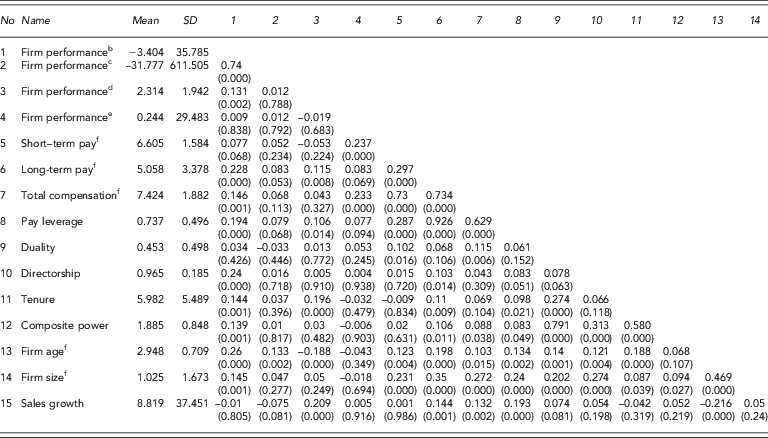
Table 1 presents descriptive statistics and the correlation matrix for variables in Models 1–9. The correlation matrix did not indicate significant multicollinearity among variables in each tested model. Hence, this study relaxed concerns about multicollinearity.
Combined descriptive statistics and Pearson correlationsFootnote a
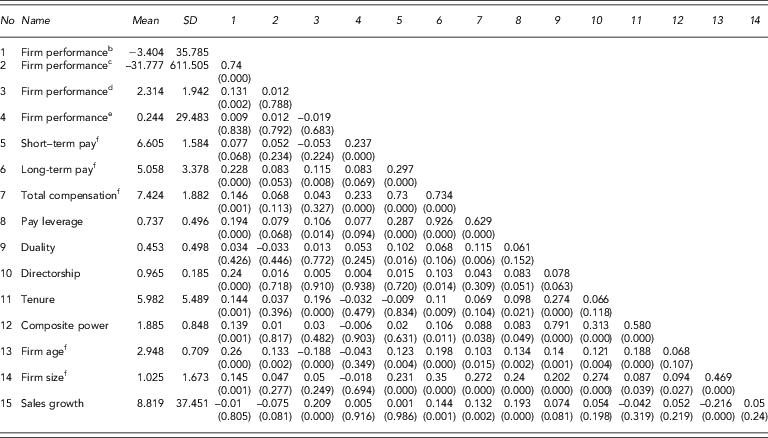
Notes. a n = 112 companies; numbers in the parenthesesmean significance (two-tailed).
b Return on assets.
c Return on equity.
d Tobin's q.
e International performance.
f Natural logs.
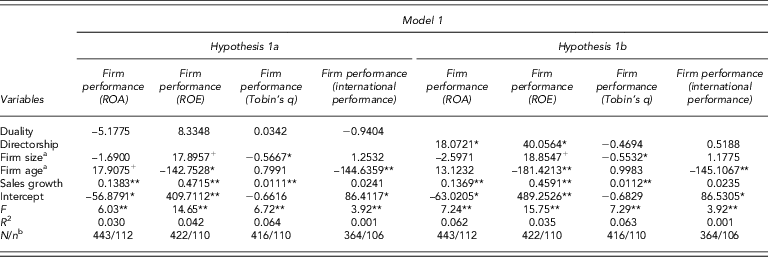
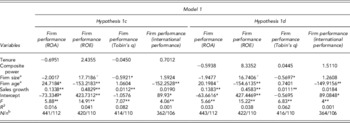
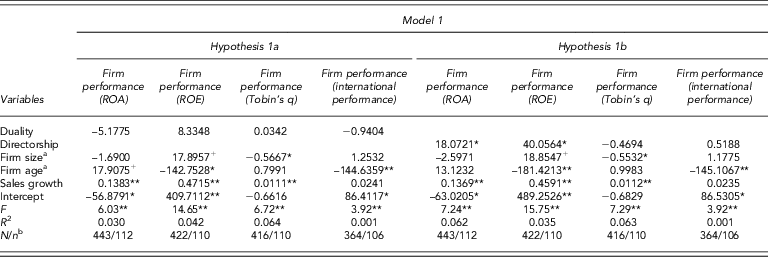
Model 1 was tested for the relationship between CEO power and firm performance. Tables 2 and 3 present the results for Model 1 (Hypotheses 1a–1d). From the perspective of CEO duality, the results failed to support Hypothesis 1a; this finding revealed that CEO duality fails to significantly affect firm performance. From the perspective of CEO directorship, the results partially supported Hypothesis 1b; this finding revealed that CEO directorship can positively affect firm performance on ROA and ROE (ROA: β = 18.0721, p < .05; ROE: β = 40.0564, p < .05). From the perspective of CEO tenure, the results failed to support Hypothesis 1c; this finding revealed no significant relationship between CEO tenure and firm performance. From the perspective of composite power, the results failed to support Hypothesis 1d; this finding revealed that CEO composite power is not significantly associated with firm performance.
Cross-sectional time series regression estimates for Model 1
Notes. aNatural logarithm.
bN/n = observations/number of companies.
ROA = return on assets; ROE = return on equity.
+p < .1, *p < .05, **p < .01.
Cross-sectional time series regression estimates for Model 1 (continued)

Notes. aNatural logarithm.
bN/n = observations/number of companies.
ROA = return on assets; ROE = return on equity.
+p < .1, *p < .05, **p < .01.
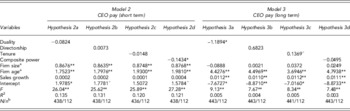
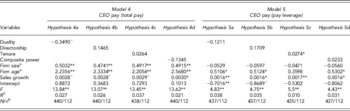
Models 2–5 tested for the relationship between CEO power and CEO pay. Table 4 presents the results from the cross-sectional time series analyses for Model 2 (Hypotheses 2a–2d) and Model 3 (Hypotheses 3a–3d). For Model 2, the results partially supported Hypothesis 2d; this finding revealed that CEO composite power can significantly affect CEO short-term pay but in a negative direction (β = −0.1434, p < .05). As far as Hypotheses 2a–2c are concerned, CEO duality, directorship, and tenure fail to significantly affect CEO short-term pay; thus, Hypotheses 2a–2c are not supported by the present research. For Model 3, CEO duality is found to be associated with CEO long-term pay but in a negative direction (β = −1.1894, p < .05); thus, Hypothesis 3a was partially supported. The results failed to support Hypothesis 3b; this finding revealed that CEO directorship is not significantly associated with CEO long-term pay. However, CEO tenure can marginally positively affect CEO long-term pay, which supported Hypothesis 3c (β = 0.1369, p < .1). The results failed to support Hypothesis 3d; this finding revealed that CEO composite power is not associated with CEO long-term pay. Table 5 presents the results for Model 4 (Hypotheses 4a–4d) and Model 5 (Hypotheses 5a–5d). The results revealed that CEO duality can marginally affect CEO total pay but in a negative direction (β = −0.3490, p < .1); thus, Hypothesis 4a was partially supported. The results failed to support Hypotheses 4b and 4c; these findings revealed that there is no significant relationship between CEO directorship and CEO total pay, or between CEO tenure and CEO total pay. The results also failed to support Hypothesis 4d and revealed that CEO composite power is not related to CEO total pay. As for Model 5, the current research found no evidence in terms of a significant relationship between CEO duality and CEO pay leverage, between CEO directorship and CEO pay leverage, or between CEO composite power and CEO pay leverage; thus, Hypotheses 5a, 5b, and 5d were not supported. However, CEO tenure can significantly affect CEO pay leverage (β = 0.0274, p < .05) but in a positive direction; this finding partially supported Hypothesis 5c.
Cross-sectional time series regression estimates for Models 2 and 3

Notes. aNatural logarithm.
bN/n = observations/number of companies.
+p < .1, *p < .05, **p < .01.
Cross-sectional time series regression estimates for Models 4 and 5

Notes. aNatural logarithm.
bN/n = observations/number of companies.
+p < .1, *p < .05, **p < .01.
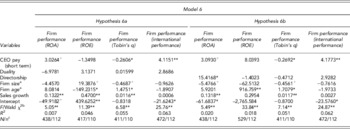
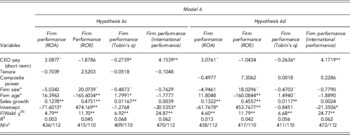
Models 6–9 tested for the relationship between CEO pay and firm performance, with CEO power controlled. Tables 6 and 7 present the results for Model 6 (Hypotheses 6a–6d). As far as Hypothesis 6a is concerned, with CEO duality controlled, CEO short-term pay is marginally positively related to ROA (β = 3.0264, p < .1), negatively related to Tobin's q (β = −0.2606, p < .05), and positively related to a firm's international performance (β = 4.1151, p < .01), while CEO short-term pay is not related to ROE. These findings partially supported Hypothesis 6a. The tests for Hypotheses 6b–6d reached results similar to Hypothesis 6a, with the following findings: with CEO directorship controlled (Hypothesis 6b), CEO short-term pay is marginally positively related to ROA (β = 3.0930, p < .1), negatively related to Tobin's q (β = −0.2692, p < .05), and positively related to a firm's international performance (β = 4.1773, p < .01), while CEO short-term pay is not related to ROE; with CEO tenure controlled (Hypothesis 6c), CEO short-term pay is marginally positively related to ROA (β = 3.0877, p < .1), negatively related to Tobin's q (β = −0.2739, p < .05), and positively related to a firm's international performance (β = 4.1539, p < .01), while CEO short-term pay is not related to ROE. For Hypothesis 6d with CEO composite power controlled, CEO short-term pay is not significantly associated with ROE but is positively associated with ROA at a marginal level (β = 3.0761, p < .1), negatively associated with Tobin's q (β = −0.2636, p < .05), and positively related to a firm's international performance (β = 4.1719, p < .01). Hence, Hypotheses 6b–6d are partially supported as well.
Cross-sectional time series regression estimates for Model 6

Notes. aNatural logarithm.
bWald χ2 for Hypothesis 6a: international performance; Hypothesis 6b: ROE and international performance; F-value otherwise.
cN/n = observations/number of companies.
ROA = return on assets; ROE = return on equity.
+p < .1, *p < .05, **p < .01.
Cross-sectional time series regression estimates for Model 6 (continued)

Notes. aNatural logarithm.
bWald χ2 for Hypothesis 6c: international performance; Hypothesis 6d: international performance; F-value otherwise.
cN/n = observations/number of companies.
ROA = return on assets; ROE = return on equity.
+p < .1, *p < .05, **p < .01.
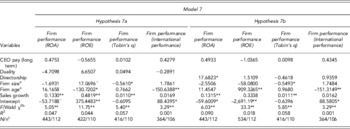
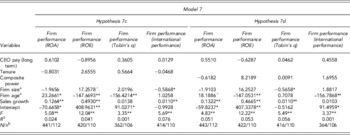
Tables 8 and 9 present the results for Model 7 (Hypotheses 7a–7d). The results failed to support all the tested hypotheses of Model 7, which revealed that no matter which dimension of CEO power – duality, directorship, tenure, or composite power – was being controlled, CEO long-term pay is not significantly related to firm performance.
Cross-sectional time series regression estimates for Model 7

Notes. aNatural logarithm.
bWald χ2 for Hypothesis 7b: ROE; F-value otherwise.
cN/n = observations/number of companies.
ROA = return on assets; ROE = return on equity.
+p < .1, *p < .05, **p < .01.
Cross-sectional time series regression estimates for Model 7 (continued)

Notes. aNatural logarithm.
bN/n = observations/number of companies.
ROA = return on assets; ROE = return on equity.
+p < .1, *p < .05, **p < .01.
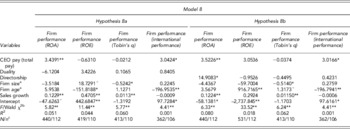
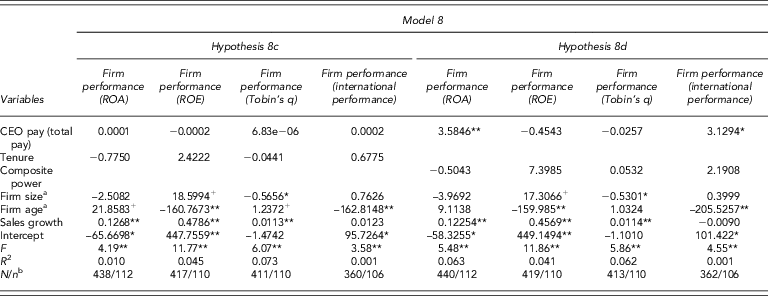
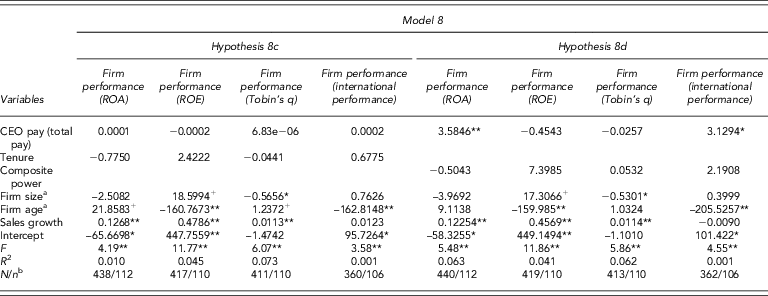
Tables 10 and 11 present the results for Model 8 (Hypotheses 8a–8d). Hypotheses 8a and 8b have the following similar findings: CEO total pay has positive relationships with ROA (β = 3.4391, p < .01) and firms’ international performance (β = 3.0424, p < .05) but has no significant relationships with ROE and Tobin's q when CEO duality is controlled for (Hypothesis 8a). When CEO directorship is controlled for, CEO total pay is positively related to ROA (β = 3.5226, p < .01) and firms’ international performance (β = 3.0166, p < .05) but has no significant impacts on ROE and Tobin's q (Hypothesis 8b). Hence, these findings partially supported Hypotheses 8a and 8b. As far as Hypothesis 8c is concerned, CEO total pay is not significantly related to firm performance with CEO tenure controlled for; the findings did not support Hypothesis 8c. The results partially supported Hypothesis 8d; these findings revealed that CEO total pay can positively affect ROA (β = 3.5846, p < .01) and firms’ international performance (β = 3.1294, p < .05) but has no significant relationships with ROE and Tobin's q when composite power is controlled for.
Cross-sectional time series regression estimates for Model 8

Notes. aNatural logarithm.
bWald χ2 for Hypothesis 8b: ROE; F-value otherwise.
cN/n = observations/number of companies.
ROA = return on assets; ROE = return on equity.
+p < .1, *p < .05, **p < .01.
Cross-sectional time series regression estimates for Model 8 (continued)
Notes. aNatural logarithm.
bN/n = observations/number of companies.
ROA = return on assets; ROE = return on equity.
+p < .1, *p < .05, **p < .01.
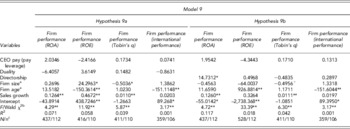
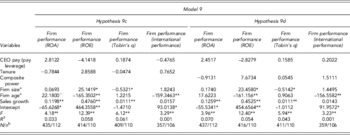
Tables 12 and 13 present the results for Model 9 (Hypotheses 9a–9d). The results failed to support all the tested hypotheses of Model 9, which revealed that no matter which dimension of CEO power – duality, directorship, tenure, or composite power – was being controlled, CEO pay leverage does not significantly impact firm performance.
Cross-sectional time series regression estimates for Model 9

Notes. aNatural logarithm.
bWald χ2 for Hypothesis 9b: ROE; F-value otherwise.
cN/n = observations/number of companies.
ROA = return on assets; ROE = return on equity.
+p < .1, *p < .05, **p < .01.
Cross-sectional time series regression estimates for Model 9 (continued)

Notes. aNatural logarithm.
bN/n = observations/number of companies.
ROA = return on assets; ROE = return on equity.
+p < .1, *p < .05, **p < .01.
The empirical findings revealed mixed evidence in terms of the three main tested relationships: between CEO power and firm performance, CEO power and CEO pay, and CEO pay and firm performance when CEO power is controlled for. Contrary to conventional wisdom, CEO power from duality, tenure, and composite power fails to significantly affect firm performance, but CEO power from a directorship can positively impact firm accounting performance (ROA and ROE). Evidence from the impact of CEO power on CEO pay is also contrary to conventional wisdom, which shows that power from duality can negatively affect CEO long-term pay, while CEO power from tenure can positively affect CEO pay leverage. Power from CEO tenure can also positively affect CEO long-term pay, and power from CEO duality can negatively affect CEO total pay, but both only on a marginal level. CEO power from the composite power can negatively affect CEO short-term pay. With each tested aspect of CEO power controlled, CEO short-term pay is marginally related to ROA and significantly related to Tobin's q and a firm's international performance; however, CEO long-term pay and pay leverage are not associated with any tested perspectives on firm performance. With CEO power from the duality, directorship, and composite power controlled for, CEO total pay is related to ROA and a firm's international performance. Based on the present findings, mixed relationships exist among CEO power, pay schemes, and firm performance; further, the pay schemes fail to significantly mediate the relationship between CEO power and firm performance.
CONCLUSIONS AND IMPLICATIONS
How does CEO power affect firm performance? Based on agency theory and social network theory, CEO power should matter to firm performance. The present study examined the CEO power–firm performance relationship from multiple perspectives, but the findings are contrary to theoretical perspectives and conventional wisdom: CEO duality, tenure, and composite power fail to significantly affect firm performance, and only CEO directorship can positively affect a firm's accounting performance on ROA and ROE. That is, CEO involvement in the function of a board – not as the chair – can positively affect a firm's ROA and ROE but fails to affect a firm's market value and foreign performance. Hence, the impact of CEO power on firm performance is limited.
How does CEO power affect a CEO's own compensation? Prior literature suggested that the more power CEOs have, the more pay they should receive, and a meta-analysis finds that when CEOs have more power, they should receive more cash and total pay (Van Essen, Otten, & Carberry, Reference Van Essen, Otten and Carberry2012). However, this study finds that only a CEO who is also the chair of the company's board of directors can negatively affect his or her own long-term pay as well as total pay, and the longer a CEO is in the position, the higher the long-term pay and pay leverage will be. Furthermore, from the perspective of composite power, the more composite power a CEO has, the less short-term pay a CEO is likely to receive; composite power has no indication of any significant impact on long-term pay, total pay, or on pay leverage. Hence, contrary to conventional wisdom and the findings of Van Essen, Otten, and Carberry (Reference Van Essen, Otten and Carberry2012), power does not always tend to significantly affect pay, supported by Van der Laan's (Reference Van der Laan2010) findings.
How does CEO compensation affect firm performance, with CEO power controlled? With CEO power from various perspectives controlled, the evidence-based findings provide limited support for the hypotheses and conclude that only CEO short-term pay can positively affect a firm's ROA and international performance but negatively affect its market value – regardless of which tested perspective of CEO power is being controlled – and that CEO total pay can positively affect a firm's ROA as well as international performance, with each respective CEO power from CEO duality, directorship, and composite power being controlled. Hence, these mixed results from the present study are consistent with prior critics over a weak link between CEO pay and firm performance, and they support managerial power theory that critiques the existence of optimal contracts in agency theory (Van Essen, Otten, & Carberry, Reference Van Essen, Otten and Carberry2012). Furthermore, based on the present evidence-based findings, CEO pay does not significantly mediate the relationship between CEO power and firm performance from various tested perspectives for the present study.
In conclusion, CEO directorship does not necessarily increase a CEO's power to significantly affect his or her own pay, while CEO duality, tenure, and composite power can increase the power of a CEO to affect his or her own pay – but only under limited circumstances. Hence, although CEO power is considered to play an important role in shaping CEO pay arrangements, from the perspectives of duality, directorship, tenure, and composite power, the relationship between CEO power and CEO pay is weakly associated. Although CEO directorship fails to significantly affect CEO pay, it can positively affect a firm's accounting performance on ROA and ROE; however, CEO duality, tenure, and composite power fail to affect firm performance. Hence, the CEO power–firm performance relationship is also weakly associated.
Consistent with prior research, this study finds mixed support for the relationship between CEO compensation and firm performance, with CEO power controlled. That is, long-term pay and pay leverage are insignificantly associated with firm performance from all tested perspectives, but short-term pay and total pay are significantly associated with firm performance under some circumstances. Through the aforementioned step-wise analyses, the present research not only finds a weak link between each of the relationship between three major concepts – CEO power, CEO pay, and firm performance – in corporate governance research, but also examines any mediating role of CEO pay that might play in the power–performance relationship. Based on the above findings, the mediating effect of CEO pay on the power–performance relationship does not significantly exist.
The implications of the findings are multiple-fold: first, separating the roles of CEO and board chair is not necessarily beneficial to the firm, while the joint position of CEO and board director (rather than board chair) may enhance efficiencies in a firm for better performance. The findings imply that joint positions may not necessarily lead to dictatorship but may enhance firm efficiency due to a closer relationship between agents and principals. The findings may contribute to theoretical debates between agency theory and stewardship theory, suggesting that ‘as a result of unified leadership, the joint structure will facilitate superior firm performance’ (Dalton et al., Reference Dalton, Daily, Ellstrand and Johnson1998: 272). Second, powerful CEOs (with longer tenure and more influences on the boards) may not necessarily generate significantly negative impacts on firm performance. Third, when CEOs have more power through duality, they may show their preferences against a high equity stake. However, CEOs are not necessarily self-serving and concerned only with maximizing their own wealth: this study finds that the longer they stay in the chief executive position, the more they show their preferences for a high-equity pay scheme, which implies that longer CEO tenures may better align CEOs’ interests with the firm's interests; thus, CEOs with longer tenures are more likely to regard the success of the firm as their own personal success. This study also finds that powerful CEOs (with longer tenure and more influences on the boards) tend to reduce their dependence on fixed or short-term based pay. Fourth, CEOs may not always have the motivation to pursue firm internationalization. However, the degree to which a firm's foreign performance outweighs its domestic performance can actually improve CEO short-term pay as well as total pay, which may further increase the awareness and interests of CEOs regarding the importance of a firm's foreign performance. Fifth, CEO power may increase with CEO duality, directorship, and tenure – but to a different extent. The degree of influence from CEO duality, directorship, and tenure should not be treated equally; some executive power from the appropriate source or authorization may be even better for firm performance.
Overall, the evidence-based findings from this study provide mixed support for theory-driven and conventional wisdom-based hypotheses, regarding the relationships between CEO power, CEO pay, and firm performance. Furthermore, the results provide boards of directors with advanced knowledge about CEO compensation schemes and about the impact and accrual of CEO power on firm performance.
LIMITATIONS AND DIRECTIONS FOR FUTURE RESEARCH
This study, like any other study, suffers from limitations. First, to reduce or avoid any possible impact of variances across industries, this article focused on computer-related firms and did not include other firms from relatively different industries. The choice of a particular industry may constrain the explanatory power and the generalizability of the findings. For example, some scholars consider health science firms as high-technology firms (Balkin, Markman, & Gomez-Mejia, Reference Balkin, Markman and Gomez-Mejia2000), but this study did not include these types of firms due to the variances from the norm of the product cycle time. This study also did not include non-high technology or traditional companies because firms with different technology intensity should use different compensation approaches, such as technology-intensive firms versus traditional firms (Tremblay & Chenevert, Reference Tremblay and Chenevert2005), and the rationales seem to vary significantly between innovative and non-innovative companies (Bart, Reference Bart1998).
Second, the samples originate from a restricted geographical boundary under a single national culture, which may undermine the headquarter–subsidiary relationship and overlook different discretions. For example, the practice of stocks and options as the basis for CEO compensation is not popular in Japan or Germany (Bradley, Schipani, Sundaram, & Walsh, Reference Bradley, Schipani, Sundaram and Walsh1999); CEO duality is not prevalent in the United Kingdom and Australia (O'Shannassy, Reference O'Shannassy2010). Furthermore, even for US public companies, there may be some impact from the revised Financial Accounting Standards Board Statement No. 123 on expensing stock-based compensation when strategizing executive compensation on a contingent basis. Although the findings – based on firms in the United States – may provide new research avenues for the modern role of CEOs in a new era of globalization, for future research, this study should extend to include firms from other industries and countries (e.g., developed countries vs. developing countries) or should include the impacts of the headquarter–subsidiary relationship and multiple stages of internationalization to further validate the explanatory power of the current findings.
Third, the past financial crisis triggered public attention and discussion on the topic of chief executive compensation. To avoid the possibility of the study being complicated by macroeconomic fluctuations due to the financial crisis and to mitigate concerns over statistical errors by such an event, the current study used data prior to 2006. Future research can be extended to cover the periods under the influence of the global economic crisis and to conduct studies on a comparative basis.
Finally, some may argue whether or not CEO power uniformly increases with CEO tenure. Hambrick and Fukutomi (Reference Hambrick and Fukutomi1991) suggested that CEOs have distinct phases, which could include a new CEO seeking an immediate impact on an organization in response to a command or commission. The present study, with an average CEO tenure of about six years, may mitigate such a concern, but future studies should address this constraint if applicable.
Acknowledgment
The authors would like to thank editors and reviewers for their comments and suggestions.