





1. Introduction
As a system for communicating information, human language should ideally be efficient in its ratio of utterance length to conveyed information. For example, frequently used meanings such as we are more efficiently represented by shorter words because shorter words are less effortful to produce. Indeed, shorter words tend to be more frequent than longer words (Zipf, Reference Zipf1935, Reference Zipf1949), suggesting that language is shaped by pressures for information efficiency. However, are people also efficient with their utterance lengths in language production, and do readers use this expectation to optimize comprehension? The current study examines whether information efficiency affects preferences for word forms in metalinguistic choice (Experiment 1), language production (Experiment 2), and language comprehension (Experiment 3).
Language is a complex system that has evolved to facilitate efficient communication. This efficiency can be understood through information theory, which provides a framework for how information is encoded, transmitted, and decoded (Shannon, Reference Shannon1948). Within this framework, the Uniform Information Density (UID) hypothesis proposes that language users prefer to distribute information uniformly across utterances, avoiding both information peaks that are difficult to process and information troughs that are inefficient for communication (Jaeger, Reference Jaeger2010; Levy & Jaeger, Reference Levy, Jaeger, Schlokopf, Platt and Hoffman2007). This leads to a balance between brevity and clarity, with speakers modulating linguistic choices based on the predictability of the message content (Jaeger & Buz, Reference Jaeger, Buz, Fernández and Cairns2017).
One manifestation of UID is that shorter and more frequent utterances should convey less information than longer ones (Piantadosi et al., Reference Piantadosi, Tily and Gibson2011). This principle reflects the idea that language users minimize the effort required to transmit and process information while maximizing the information conveyed (Jaeger & Levy, Reference Jaeger and Levy2006; Zipf, Reference Zipf1949). Zipf (Reference Zipf1935, Reference Zipf1949) observed that shorter words tend to be more frequent than longer words, a pattern consistently observed across languages and interpreted as evidence for language efficiency (Ferrer Cancho & Solé Vicente, Reference Ferrer Cancho and Solé Vicente2003; Piantadosi, Reference Piantadosi2014). In this view, shorter words are preferred for frequently communicated concepts because they reduce production and processing effort (Kanwal et al., Reference Kanwal, Smith, Culbertson and Kirby2017).
Likewise, in a large-scale corpus analysis of the relationship between word length and information content across languages including English, Dutch, and German, Piantadosi et al. (Reference Piantadosi, Tily and Gibson2011) found that shorter words tend to convey less information than longer words, as measured by predictability in context. For example, store is highly predictable in a sentence such as he ran out of food so he went to the grocery store. This finding supports the idea that language optimizes the trade-off between production and processing effort and information conveyed. Seyfarth (Reference Seyfarth2014) extended this idea by showing that reduction patterns may become encoded in lexical representations: words that frequently appear in predictable contexts tend to be phonologically reduced even when they appear in less predictable contexts. This UID principle is not limited to word length, and it also extends to utterance structure and complexity. Futrell et al. (Reference Futrell, Mahowald and Gibson2015) found that languages tend to use simpler syntactic structures in contexts where words are more predictable, suggesting that language users adapt utterances to minimize processing and production effort.
The sensitivity of language users to UID has also been demonstrated experimentally. Mahowald et al. (Reference Mahowald, Fedorenko, Piantadosi and Gibson2013) tested whether people prefer shorter or longer word variants depending on contextual predictability. Participants completed predictable or unpredictable sentence fragments such as For commuting to work, John got a 10-speed … or Last week John finally bought himself a new …, by choosing between shorter and longer word variants (shown as written words to the participants) such as bike and bicycle. Participants chose shorter variants more often in predictive contexts than in non-predictive contexts, suggesting that people maintain UID in metalinguistic lexical choice. This finding has been corroborated cross-linguistically: Li et al. (Reference Li, van Deemter, Paperno and Fan2019) found similar patterns in Mandarin Chinese, and Zarcone and Demberg (Reference Zarcone and Demberg2021) showed that German speakers prefer shorter compound forms in predictive contexts. These patterns suggest that UID may be a broad principle of communicative efficiency across languages (Gibson et al., Reference Gibson, Futrell, Piantadosi, Dautriche, Mahowald, Bergen and Levy2019).
However, do people really adhere to UID in language production and comprehension? While the tasks used in past studies suggest that people adhere to UID in forced-choice tasks (with little research examining comprehension), these tasks have limitations in terms of generalizability to natural language production. For example, the tasks in Mahowald et al. (Reference Mahowald, Fedorenko, Piantadosi and Gibson2013) and Li et al. (Reference Li, van Deemter, Paperno and Fan2019) merely had participants choose a word, with both word variants being shown. This explicit choice, due to the metalinguistic nature of the task, may differ from more natural lexical retrieval processes in language production, where the choice of both the shorter and longer word variant may not be as apparent. While producing language may seem like a straightforward and effortless task, even making a single-word utterance involves a range of mental operations (e.g., Bock, Reference Bock1982; Caramazza, Reference Caramazza1997; Fromkin, Reference Fromkin1971; Levelt, Reference Levelt1989; Levelt et al., Reference Levelt, Roelofs and Meyer1999). First, speakers need to formulate the semantic information of the utterance that can be denoted by a word (known as conceptual processing). Second, speakers need to select a word that adequately conveys the required semantic information of the utterance (known as lexical retrieval). With thousands of words to choose from in the mental lexicon, lexical retrieval is no trivial task. In addition to the sheer size of the mental lexicon, choosing a word additionally requires suppressing other words with similar meanings to the intended semantic information (e.g., Kroll & Stewart, Reference Kroll and Stewart1994; Rayner & Springer, Reference Rayner and Springer1986; Schriefers et al., Reference Schriefers, Meyer and Levelt1990). For example, when in the process of selecting the word bicycle/bike, other semantically similar words such as car, train, and wheel will compete to be selected. Therefore, a forced-choice task to a large extent sidesteps both of these processes, with conceptual processing not completely needed as the semantic information is predetermined by the task (e.g., the semantic information of bicycle is already set by way of seeing the two choices of bicycle and bike). This task also largely bypasses the lexical retrieval process by presenting two word choices and merely having participants choose one of them, making searching through thousands of potential word choices unnecessary. In addition, the framing of this task requires thinking explicitly about word preference, which may differ greatly from word production processes that are conducted more implicitly, further masking how language UID may play out in actual language production.
A key theoretical question emerges here: does communicative efficiency in the form of UID shape lexical choice during language production tasks that involve conceptual processing and lexical retrieval, or is it merely an artifact of forced choice tasks that bypass these processes? Jacobs and MacDonald (Reference Jacobs and MacDonald2023) recently examined this question, comparing information-theoretic approaches to lexical selection with other psycholinguistic measures that may affect long/short word variant preference in a task very similar to Mahowald et al. (Reference Mahowald, Fedorenko, Piantadosi and Gibson2013) and Li et al. (Reference Li, van Deemter, Paperno and Fan2019), whereby participants had to give a rating to the relative goodness of the long/short word variants provided (i.e., instead of a forced choice task like in Mahowald et al., participants saw the long/short word variants at opposite ends of a continuous slider and had to indicate with the slider how much they preferred one variant over the other in a particular sentence context). While this design provided a more nuanced measure of preference for a specific word variant, the task was still as metalinguistic as that in Mahowald et al., in that it bypassed the production processes of conceptualization and lexical retrieval and had participants explicitly consider their preference for a specific word variant. Regardless, they found that factors such as the average word frequencies in the sentence contexts and other high-level properties had a stronger influence on word choice than information-theoretic considerations such as predictivity, suggesting that the relationship between UID and lexical selection may be more complex than previously thought. This highlights the importance of examining UID effects in production tasks that engage conceptual processing and lexical retrieval more fully.
Currently, the only study testing language UID in production without using a forced-choice task comes from Zarcone and Demberg (Reference Zarcone and Demberg2021). They conducted a study that used a cloze task instead of a forced-choice task in order to test for language UID in a setting involving more conceptual processing and lexical retrieval. In this task, participants viewed short vignettes with either a predictive introduction (e.g., Sandra came home after a long workday and drew herself a bubble bath) or a non-predictive introduction (e.g., Sandra came home after a long work day) and then saw a second sentence with a blank (e.g., She happily got into the _____ and closed her eyes. Only when the water had become cold did she get up and dry herself off); their task was to produce a word (e.g., bath/bathtub) to fill in the blank. This task paradigm, however, presents a problem with determining how participants interpreted these contexts in terms of predictivity, as both the predictive and non-predictive conditions included the same semantically biasing context (e.g., Only when the water had become cold …) after the target word. This entails that, especially for the non-predictive condition, participants needed to read the semantically biasing context after the target word in order to supply the correct word, making it unclear whether or not participants treated the whole vignette as being a predictive context or not.
Thus, the current study tested for language UID in a setting involving conceptual processing and lexical retrieval. In Experiment 1, we first directly replicated Mahowald et al. using an explicit choice paradigm. Then in Experiment 2 (pre-registered), we had participants read sentences where the last word was presented with the initial two letters, together with a definition of the word (e.g., For commuting to work, John got a 10-speed bi__. (a form of transportation with 2 wheels)) and then had them supply the last word according to the given letters and definition (e.g., bike or bicycle). This paradigm allows for a language production task with more involvement from the conceptual processing and lexical retrieval stages, and thereby does not explicitly make the shorter or longer word variant known (and also without a highly semantically biasing context after the target word that can be construed as being part of the overall context, as in the Zarcone and Demberg study). In particular, Experiment 2 requires participants to formulate the semantic information of the word (with the help of the provided short definition), then will need to select a word that conveys this semantic information (with the help of the provided two-letter word fragment). Although the provision of the initial letters and the definition makes the task somewhat artificial, these constraints were the minimal metalinguistic intervention necessary to elicit the target words at a sufficient rate in non-predictive contexts. Without them, the target words would rarely occur except in an impractically large sample of responses. Nevertheless, the task remains closely related to natural language production, because participants still had to retrieve and produce a lexical item that satisfied the relevant semantic and orthographic constraints.
Overall, these linguistic processes of conceptual processing and lexical retrieval are almost absent in Mahowald et al. (Reference Mahowald, Fedorenko, Piantadosi and Gibson2013) and Li et al. (Reference Li, van Deemter, Paperno and Fan2019), with the sentence contexts in Zarcone and Demberg (Reference Zarcone and Demberg2021) being confounded by always having a core predictive sentence in the vignette appear after the target word. For language UID, lexical retrieval may play an especially important role in (dis)attenuating its effects, as lexical items that are used more frequently in general are easier to access and choose for subsequent production. This entails that preferences for long/short word variants to convey more/less information may be masked by the preference for choosing words that are more frequent, and hence easier to select in lexical retrieval. For example, in contemporary American English, the word porn is used much more frequently than its longer variant pornography (Davies, Reference Davies2008). Therefore, even in non-predictive contexts where an upcoming word would convey more information, the shorter variant porn may still be predominantly used in that context due to it being much more frequently used than pornography, which would mask any language UID effects if they are present. In Experiment 2 we also examine word features such as frequency in order to test whether these features affect language UID.
Furthermore, forced choice tasks may encourage participants to make an explicit metalinguistic comparison between two visible word forms. Because both alternatives are presented simultaneously, participants can base their response partly on surface-level properties of the options, such as character length. This does not mean that the findings from the forced choice tasks are invalid, but it leaves open the possibility that the language UID effects could be amplified by the forced choice format, whereby when participants see a short and a long word variant side by side, this experimental contrast may make word length especially salient and may boost UID effects that would otherwise be absent in paradigms that do not present the whole written word forms. Therefore, the paradigm in Experiment 2 sidesteps this issue by presenting the same amount of written character information for both the long and short word variants, as well as providing a task involving conceptual processing and lexical retrieval to test for language UID at these stages of linguistic processing.
Besides language production, language UID in terms of utterance length and information content also has important implications for language comprehension. Studies have shown that readers and listeners are sensitive to the predictability of words in context and use this information to facilitate language processing (Brothers et al., Reference Brothers, Swaab and Traxler2017; Smith & Levy, Reference Smith and Levy2013). This is supported by studies showing that when a word (e.g., bike) is predictable based on the prior context (e.g., for commuting to work, John got a 10-speed …), the word is fixated on less and more quickly read (Ehrlich & Rayner, Reference Ehrlich and Rayner1981; Smith & Levy, Reference Smith and Levy2013), more quickly identified (Fischler & Bloom, Reference Fischler and Bloom1979), and generates a smaller N400 electrophysiological response suggesting that the word is indeed expected (Kutas & Hillyard, Reference Kutas and Hillyard1984). Likewise, prediction can benefit language comprehension by aiding in understanding incomplete or distorted utterances (e.g., Norris et al., Reference Norris, McQueen and Cutler2016) and increasing efficiency of language processing (e.g., Clark, Reference Clark2013). These results suggest that readers use the predictability of words to optimize their reading efficiency.
However, linguistic predictions may also bring downsides to comprehension. From the outset, making predictions may require additional cognitive resources (Kuperberg & Jaeger, Reference Kuperberg and Jaeger2016), and furthermore, making wrong predictions may impede comprehension (entailing that wrong predictions are worse than making no predictions; e.g., Van Petten & Luka, Reference Van Petten and Luka2012). Therefore, prediction may only arise when the upcoming content is highly predictable and when listeners have the necessary cognitive resources and time (e.g., Ito et al., Reference Ito, Corley, Pickering, Martin and Nieuwland2016, Reference Ito, Corley and Pickering2018). Furthermore, an important consideration for understanding comprehension processes is whether readers have internalized the statistical patterns of language use, such as the tendency for shorter word variants to appear in predictive contexts. If such patterns are encoded in readers’ expectations, this could influence how they process words of different lengths in different contexts. Levshina and Lorenz (Reference Levshina and Lorenz2022) suggest that formally distinct variants (like bike and bicycle) should also be functionally different, raising questions about how comprehenders might use these functional distinctions during processing. Do readers expect shorter variants in predictive contexts because they have internalized the patterns of efficient communication in terms of UID, or are other factors at play?
Thus, in Experiment 3 we examine whether readers apply expectations of UID in utterance length when processing short and long word variants. We hypothesize that in language comprehension (and in particular reading comprehension for this study), readers expect (and therefore predict) shorter versions of words (e.g., bike) to appear more so in predictive contexts than non-predictive contexts (and vice-versa for longer versions of words, e.g., bicycle). If speakers do use this UID prediction, then comprehension of a shorter word in its expected context (i.e., a predictive context) should occur more quickly due to it being predicted, whereas shorter word comprehension in its unexpected context (i.e., a non-predictive context) should be hindered. Likewise, comprehension of a longer word in its predicted context (i.e., a non-predictive context) should occur more quickly, whereas longer word comprehension should be slower in its non-predicted context (i.e., a predictive context). Alternatively, contexts in which short and long word variants are found may not constrain the choice of word variant to an extent to which prediction would occur. Due to this, people may not make any predictions of short versus long word variants. To test these hypotheses, Experiment 3 uses a self-paced reading paradigm to examine if readers predict short word variants to be more likely to be found in predictive contexts, and if this prediction (if any) leads to faster reading times for short and long word variants in predictive and non-predictive contexts respectively (and if this prediction leads to slower reading times for short and long word variants in non-predictive and predictive contexts respectively).
2. Experiment 1
2.1. Methods
2.1.1. Participants
A total of 97 native English-speaking participants from the U.S. (mean age = 34.41, 40 male, 57 female) were recruited from the online recruitment platform Prolific (https://app.prolific.co/). All participants gave their informed consent to take part in the study, and ethical approval was received from the Survey and Behavioural Research Ethics Committee at the Chinese University of Hong Kong (ethics code SBRE-22-0464).
2.1.2. Materials
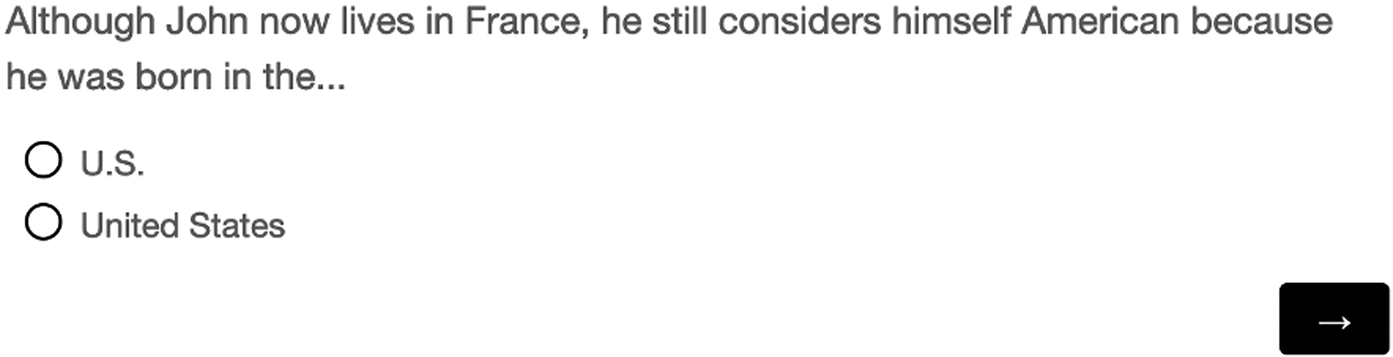
These were the same as those in the behavioral study of Mahowald et al. (Reference Mahowald, Fedorenko, Piantadosi and Gibson2013). A total of 40 target long/short word pairs were used in sentence fragments that either had a predictive context (e.g., For commuting to work, John got a 10-speed … 1. bicycle 2. bike) or a non-predictive context (e.g., Last week John finally bought himself a new… 1. bicycle 2. bike; see Figure 1). Forty filler sentence fragments were also used which included word pairs which were two different words (e.g., Denver, a city in Colorado, is known for its… 1. mountains 2. lakes). Four experimental lists were created crossing context and answer choice order in a Latin square design so that participants encountered each word pair only once and so that across the participants and items there was a balance of answer choice order.
An example of a target trial.

Predictability of the target words in the sentence fragments was measured in Mahowald et al. (Reference Mahowald, Fedorenko, Piantadosi and Gibson2013). In a pretest (n = 80), they had participants pick a word to complete a sentence stem (e.g., Susan was very bad at algebra, so she hated …). For the predictable context sentences, 52.4% of the responses picked the target short/long word, while for the nonpredictable context sentences only 1.6% of the responses picked the target word. This effect was found to be highly significant and indicates that the predictive sentences are indeed much more predictable than the nonpredictive sentences. As we do not have the exact cloze data for each sentence, predictability was operationalized in a binary fashion following Mahowald et al., that being sentences grouped into predictable and nonpredictable categories.
2.1.3. Procedure
The experiment took place online using the online survey platform Qualtrics (https://www.qualtrics.com/). Participants gave their consent and were then instructed that they would be reading sentence fragments, with their task being to choose the word out of two given words that sounds the most natural to them when finishing the sentence. The main trials then commenced, where they were presented with a sentence fragment with two word choices that could finish the sentence. Participants then clicked on the word that they felt was most natural to finish the sentence, and then pressed a continue button to start the next trial. There were 80 trials in total (40 targets, 40 fillers), with the target and filler trials randomized per participant. The experiment took about 10 min to finish, and participants were paid one pound after finishing the experiment.
2.1.4. Data coding
The word choice responses were coded for whether a participant chose a long or short word variant. For example, a choice of bicycle was coded as long, and a choice of bike was coded as short.
2.2. Results
We built a binomial logit mixed-effects model (LME) on the long and short responses (with long responses as the reference level) with the predictor of context (predictive versus non-predictive). This model (as well as all subsequent models) determined the data-justified maximal random-effects structure via forward model comparison with a 0.2 alpha level (e.g., Bates et al., Reference Bates, Kliegl, Vasishth and Baayen2015; Matuschek et al., Reference Matuschek, Kliegl, Vasishth, Baayen and Bates2017). In our report below (for Experiments 1 and 2), we will use proportions of the word choices (short versus long) calculated from the raw data; note that these proportions may not be fully translatable from the log probabilities estimated from the model, which were adjusted for random subject and item effects.
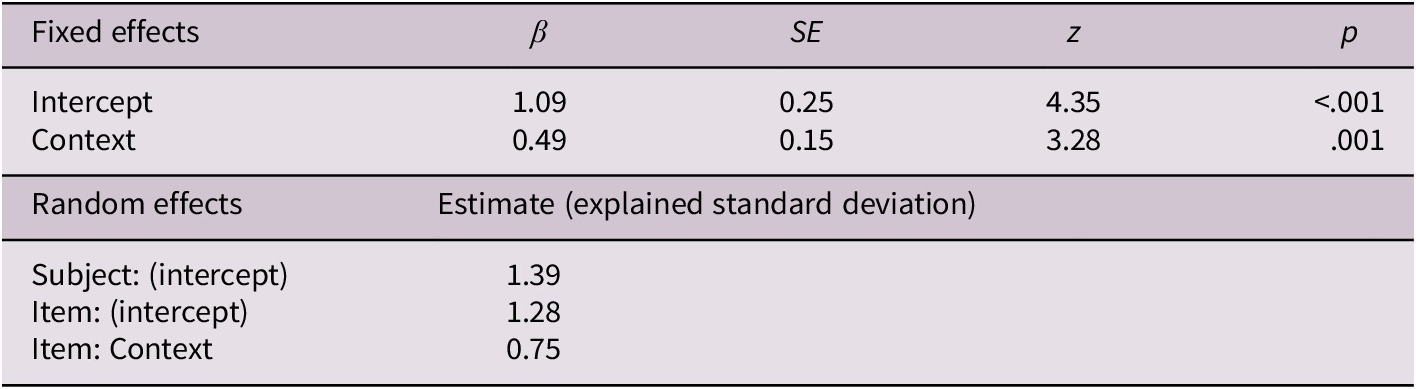
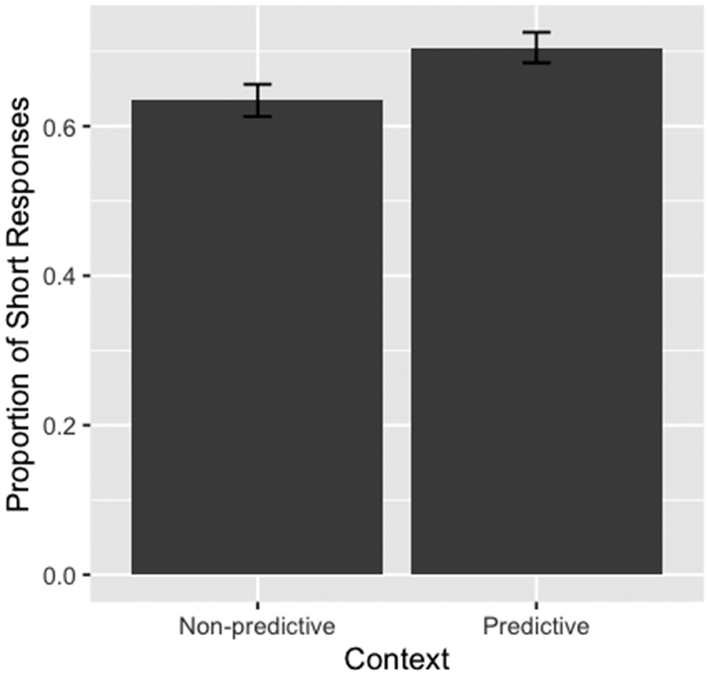
As in Mahowald et al. (Reference Mahowald, Fedorenko, Piantadosi and Gibson2013), there were more short (67.0%) than long (33.0%) word choices, which concurs with the significant intercept (see Table 1). There was a significant main effect of context, suggesting that participants were more likely to choose short words for predictive (70.5%) than non-predictive (63.5%) contexts (see Figure 2).
LME results of Experiment 1
Response ~ Context + (1 | Subject) + (1 + Context | Item)
Context coded as non-predictive = −0.5 and predictive = 0.5

Table 1. Long description
The table is divided into two main sections: Fixed effects and Random effects.
Fixed effects section:
* Intercept: beta 1.09, S E 0.25, z 4.35, p less than .001.
* Context: beta 0.49, S E 0.15, z 3.28, p .001.
Random effects section (Estimate/explained standard deviation):
* Subject (intercept): 1.39.
* Item (intercept): 1.28.
* Item Context: 0.75.
The caption notes the model formula as Response tilde Context plus (1 vertical bar Subject) plus (1 plus Context vertical bar Item), with context coded as non-predictive equals minus 0.5 and predictive equals 0.5.
Observed proportion of choosing the short word variant by context (error bars show 95% CIs).

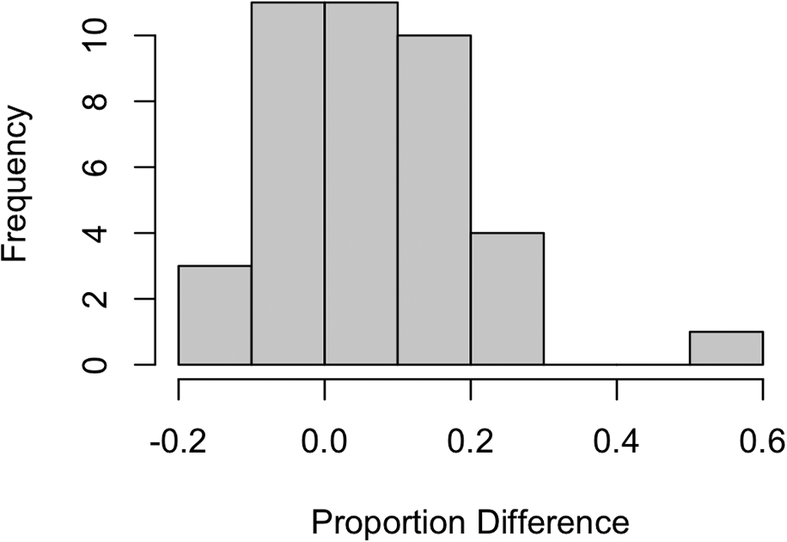
Additional exploratory analyses were conducted to examine the extent to which these results may be driven by particular items. First, we looked to see if there were any outliers in the set of items of the target long/short word pairs. An outlier here was defined as an item that was above or below two standard deviations of the mean in terms of the overall difference in the proportion of participants picking the short variant of the item in predictive compared to non-predictive contexts. For example, if participants chose the short variant of the item 60% of the time in predictive contexts and 40% of the time in non-predictive contexts, then the item mean difference would be 20% (see Figure 3).
Histogram of the proportion differences per item of choosing the long/short word variant responses.

From a visual inspection of Figure 3, as well as applying the above or below two standard deviations of the mean criterion, one item (item 34: veterinarian/vet) was a noticeable outlier in terms of its short variant being picked much more frequently in predictive compared to non-predictive contexts (50.3% difference, with the next highest difference being 29.5%). This item was then dropped from the data, and an additional LME was built, mirroring the LME detailed in Table 1 but without item 34. This new LME produced the same results, with a significant main effect of context (β = 0.42, SE = 0.14, t = 3.08, p = .002). Note though, that dropping the item outlier caused the effect size of context to decrease (as based on the beta coefficient values of context).
To further examine whether specific linguistic properties the items effected these results, exploratory analyses where conducted (again without item 34), whereby nine LMEs were built each with context and one additional interacting predictor, those additional predictors being: 1) the character length difference between the long and short word variant of each item; 2) the length of the long word variant; 3) the length of the short word variant; 4) the logged frequency difference of the long and short word variants (frequencies from the Corpus of Contemporary American English; Davies, Reference Davies2008-); 5) the logged frequency of the long word variant; 6) the logged frequency of the short word variant; 7) the predictability of the target word (measured as the surprisal of the target word given all of the preceding words in the sentence using the GPT-2 language model from OpenAI; Sathe, Reference Sathe2025); 8) the predictability of all of the words in the sentence (measured as the surprisal of each word given the preceding words in the sentence; Sathe, Reference Sathe2025) and 9) the mean frequency of all of the words preceding the target word (following Jacobs & MacDonald, Reference Jacobs and MacDonald2023; frequencies obtained from Davies, Reference Davies2008-). None of the main effects of these additional predictors nor the interaction between context and these predictors were significant in any of the models, suggesting that differences in word length and frequencies between the long and short word variants and frequencies of the preceding words, as well as the predictability of the target words or sentences as a whole, do not drive the effect of the tendency for choosing short/long word variants in predictive/non-predictive contexts, respectively.
2.3. Discussion
Experiment 1 replicated the behavioral experiment in Mahowald et al. (Reference Mahowald, Fedorenko, Piantadosi and Gibson2013), where participants read predictive or non-predictive sentence fragments and then chose a long or short word to complete the sentence fragment. Short words were more likely to be chosen for predictive than non-predictive contexts, concurring with the results from Mahowald et al. In addition, these results held up even when taking out items that were noticeable outliers in terms of long and short word variant response patterns. Finally, these results also do not seem to be driven by specific linguistic properties or predictability as measured by surprisal of the different long/short word pairings.
3. Experiment 2
Experiment 2 expands upon the findings of Experiment 1 by using a similar sentence completion paradigm whereby participants read sentence fragments with the last word consisting of only two letters, and then needed to type in a word to finish the sentence. As this task involves conceptual processing and lexical retrieval, we predict a similar UID effect as in Experiment 1; that is, we expect participants to come up with a short word as a completion more often in the predictive than nonpredictive context. The following methods and analyses for Experiment 2 have been preregistered (https://osf.io/q25bx).
3.1. Methods
3.1.1. Participants
A total of 101 native English-speaking participants from the U.S. (mean age = 31.72, 53 male, 48 female) were recruited from the online recruitment platform Prolific (https://app.prolific.co/).
3.1.2. Materials
The materials for Experiment 2 were drawn from the materials used in Experiment 1. Of the 40 target sentences from Experiment 1, 27 met the criteria for the Experiment 2 paradigm: the two possible target words were longer than two letters and shared the same first two letters (e.g., bicycle/bike). These items were used to create new sentence fragments that included the first two letters of the target word, followed by a definition of the target word (e.g., For commuting to work, John got a 10-speed bi_ (a form of transportation with 2 wheels)). The definition appeared at the same time as the sentence fragment and was displayed immediately to its right, continuing below the fragment when necessary. We also used the same 40 filler sentences in Experiment 1 (adapted to have the same format as the target sentences). Two experimental lists were created using a Latin square design to counterbalance context condition, ensuring that each participant saw each sentence fragment only once.
3.1.3. Procedure
The procedure of Experiment 2 was the same as Experiment 1 with the following exceptions. Participants were instructed that they would be reading sentence fragments with the final word consisting of the first two letters, with the task being to type the word that sounds the most natural to finish the sentence. Experiment 2 took about 12 min for the participants to complete on average.
3.1.4. Data coding
The typed word responses were manually coded for whether a participant chose a long or short word variant. For example, a response of bicycle was coded as long, and a choice of bike was coded as short. Leniency was given for words spelled incorrectly but were clearly the long or short version of the target word (e.g., the response bicicle would be coded as long). A response that was not one of the word variants (e.g., bin) was coded as other.
3.2. Results
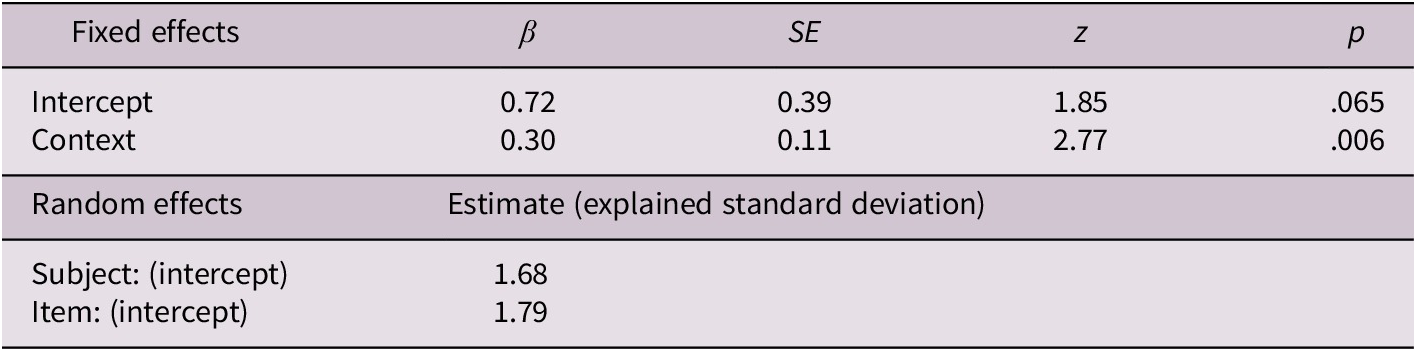
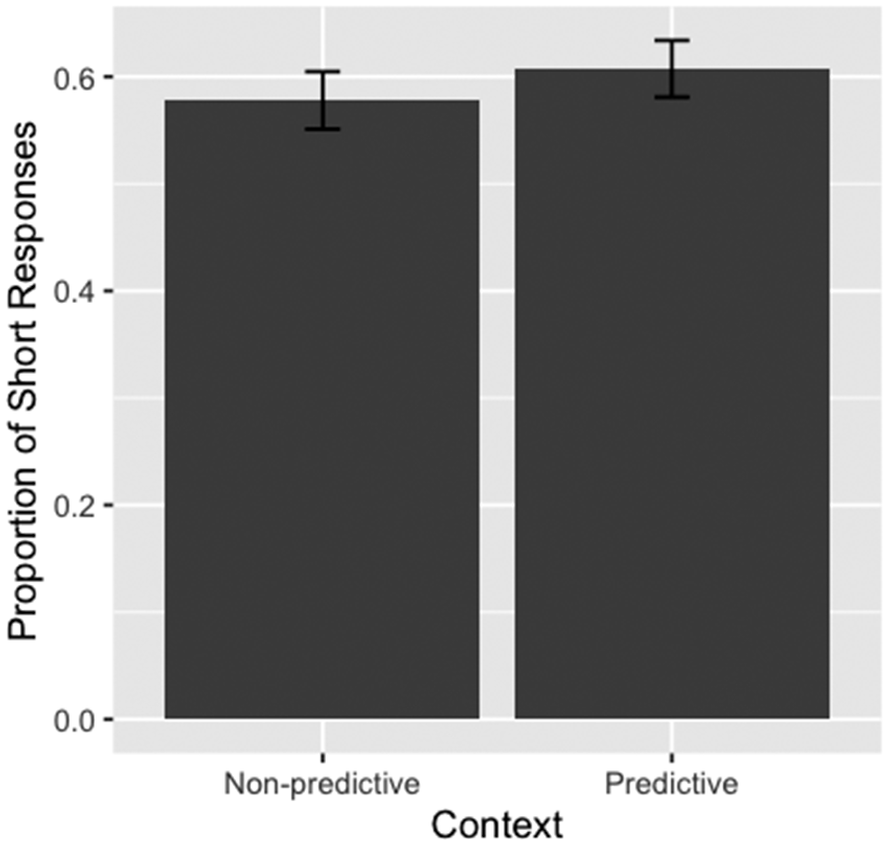
One participant was excluded for having over 15% of their responses categorized as other responses, leaving the data of 100 participants usable for the main analyses. We built a binomial logit mixed-effects model (LME) on the long and short responses (with long responses as the reference level) with the predictor of context (predictive versus non-predictive). There were more short (59.3%) than long (40.7%) word choices, as indicated by the marginally significant intercept (see Table 2). There was a significant main effect of context, suggesting that participants were more likely to choose short words for predictive (60.7%) than non-predictive (57.8%) contexts (see Figure 4).
LME results of Experiment 2
Response ~ Context + (1 | Subject) + (1 | Item)
Context coded as non-predictive = −0.5 and predictive = 0.5

Table 2. Long description
The table is divided into two main sections: Fixed effects and Random effects.
Fixed effects section:
* Intercept: beta = 0.72, S E = 0.39, z = 1.85, p = .065.
* Context: beta = 0.30, S E = 0.11, z = 2.77, p = .006.
Random effects section (Estimate of explained standard deviation):
* Subject (intercept): 1.68.
* Item (intercept): 1.79.
The header row includes columns for Fixed effects, beta, S E, z, and p. Context is coded as non-predictive = minus 0.5 and predictive = 0.5.
Observed proportion of short responses by context (error bars show 95% CIs).

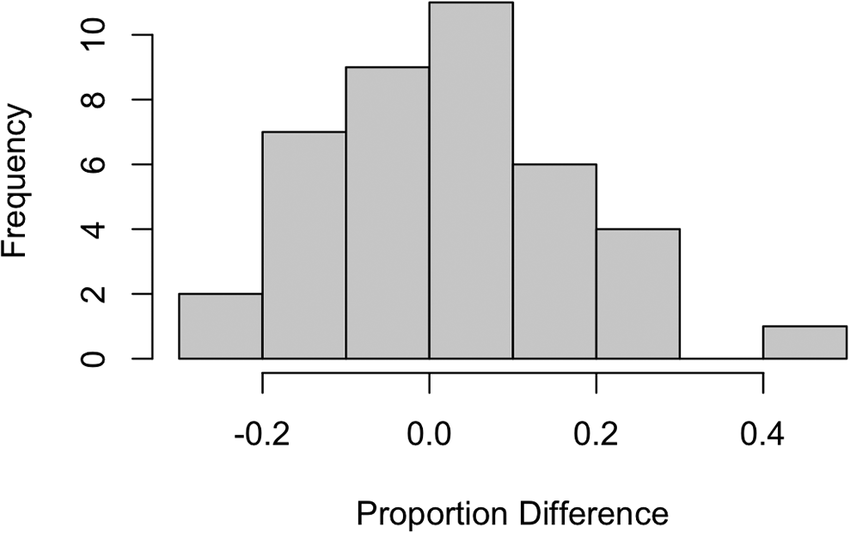
Similar to Experiment 1, a few additional analyses were conducted to examine the extent to which these results may be driven by particular items. First, we looked to see if there were any outliers in the set of items of the target long/short word pairs (defined the same as in Experiment 1; see Figure 5).
Histogram of the proportion differences per item of the long/short word variant responses.

Figure 5. Long description
The horizontal X axis is labeled Proportion Difference and ranges from minus 0.2 to 0.4 with major tick marks at minus 0.2, 0.0, 0.2, and 0.4. The vertical Y axis is labeled Frequency and ranges from 0 to 10 with tick marks at intervals of 2. The data is represented by eight gray bars.
Starting from the left
* The first bar at minus 0.3 to minus 0.2 has a frequency of 2.
* The second bar at minus 0.2 to minus 0.1 has a frequency of 7.
* The third bar at minus 0.1 to 0.0 has a frequency of 9.
* The fourth bar at 0.0 to 0.1 is the peak with a frequency of 11.
* The fifth bar at 0.1 to 0.2 has a frequency of 6.
* The sixth bar at 0.2 to 0.3 has a frequency of 4.
* There is a gap between 0.3 and 0.4.
* The final bar at 0.4 to 0.5 has a frequency of 1.
The distribution is roughly bell-shaped and centered slightly to the right of 0.0, indicating a positive skew.
From a visual inspection of Figure 5, as well as applying the above or below two standard deviations of the mean criterion, one item (item 25: gasoline) was a noticeable outlier in terms of its short variant being picked much more frequently in predictive compared to non-predictive contexts (46.0% difference, with the next highest difference being 27.8%). This item was then dropped from the data, and an additional LME was built, mirroring the LME detailed in Table 2 but without item 25. This new LME produced similar results, but with a marginally significant main effect of context (β = 0.21, SE = 0.11, t = 2.84, p = .066). Note, though, that dropping the item outlier caused the effect size of context to decrease (as based on the beta coefficient values of context).
To further examine whether specific linguistic properties of the items affected these results, exploratory analyses were conducted similar to Experiment 1, whereby nine LMEs were built, each with context and one additional interacting predictor, those additional predictors being the same as the exploratory analyses in Experiment 1. None of the main effects of these additional predictors nor the interaction between context and these predictors were significant in any of the models, suggesting that differences in word length and frequencies between the long and short word variants and frequencies of the preceding words, as well as the predictability of the target words or sentences as a whole, do not drive the effect of the tendency for choosing short/long word variants in predictive/non-predictive contexts respectively.
3.3. Discussion
Experiment 2 used a similar sentence completion task as Experiment 1, with participants typing the last word of the sentence instead of merely choosing the last word from two options. The results of Experiment 2 loosely align with those of Experiment 1 and of Mahowald et al. (Reference Mahowald, Fedorenko, Piantadosi and Gibson2013), in that shorter words are used more in predictive compared to non-predictive contexts even in a language production task requiring conceptual processing and lexical selection rather than a forced choice task that skips these linguistic production steps. However, the marginal results of Experiment 2 (when taking out item outliers), along with its smaller effect sizes, suggest that this effect is smaller and less robust in linguistic tasks that involve conceptual processing and lexical retrieval, and may be sensitive to certain long/short word variants. In contrast, these results also do not seem to be driven by specific linguistic properties of the different long/short word pairings. Nonetheless, these results provide further support for the notion that people adhere to UID across a range of linguistic production contexts and processes.
4. Experiment 3
While Experiments 1 and 2 found evidence that speakers follow the principle of UID in their productions, would expectations of UID also aid in language comprehension? Experiment 3 examines this via a self-paced reading task, whereby participants read sentences featuring short and long word variants placed in predictable and unpredictable contexts. The following methods and analyses for Experiment 3 have been preregistered (https://osf.io/6ncvw).
4.1. Methods
4.1.1. Participants
A total of 391 native English-speaking participants from the U.S. (mean age = 35.93, 155 male, 236 female) were recruited from the online recruitment platform Prolific (https://app.prolific.co/).
4.1.2. Materials
These were similar to the materials used in Experiment 1. Self-paced reading sentences were created from the 40 target items in Mahowald et al. (Reference Mahowald, Fedorenko, Piantadosi and Gibson2013), where each target item consisted of four sentence variants with either the predictive or non-predictive context with the long or short word variant, with three words added after the target word (e.g., predictive: Susan was very bad at algebra, so she hated mathematics/math more than science; non-predictive: Susan introduced herself to me as someone who loved math/mathematics more than science; target word italicized). Four experimental lists were created crossing context and word variant length in a Latin square design so that participants encountered each target word only once.
4.1.3. Procedure
The experiment took place online using the online experiment builder platform Gorilla (https://www.app.gorilla.sc/). The procedure of Experiment 3 was similar to Experiments 1 and 2, with the major change of participants conducting a self-paced reading task. Participants read sentences one word at a time, with participants pressing the space bar to read each subsequent word that would replace the previous word in the middle of the screen. Participants then answered a yes/no comprehension question after reading each sentence to ensure that they were attentive when reading the sentences. There were 80 trials in total (40 targets, 40 fillers; randomized).
4.1.4. Data coding
The reading times for the target word and the three subsequent words were recorded separately. These reading times were log-transformed in order to decrease right-tail skewness (Baayen et al., Reference Baayen, Davidson and Bates2008). Trials with reading times less than 100 ms or greater than three standard deviations above the mean for each experimental condition were removed from the analyses (526 trials removed; 3.55%). The accuracy of the comprehension questions was recorded for every trial, with participants responding correctly on 91.10% of trials. Trials where participants responded incorrectly on the comprehension question were removed from the analyses (1153 trials removed; 7.78%). Likewise, all of the data from 11 participants were removed from the analyses for incorrectly answering more than one third of the comprehension questions.
4.2. Results
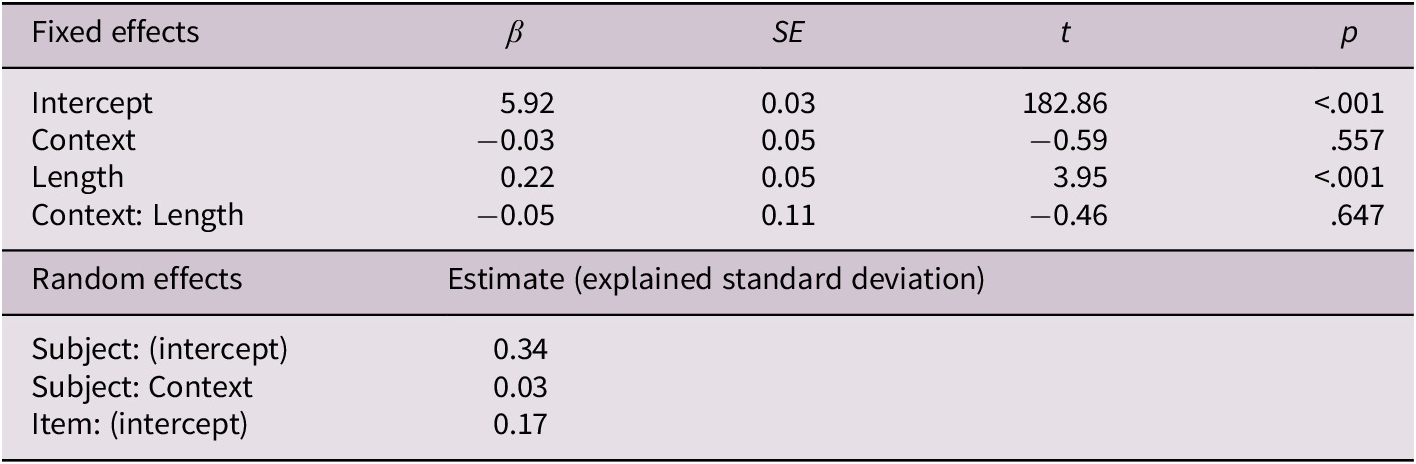
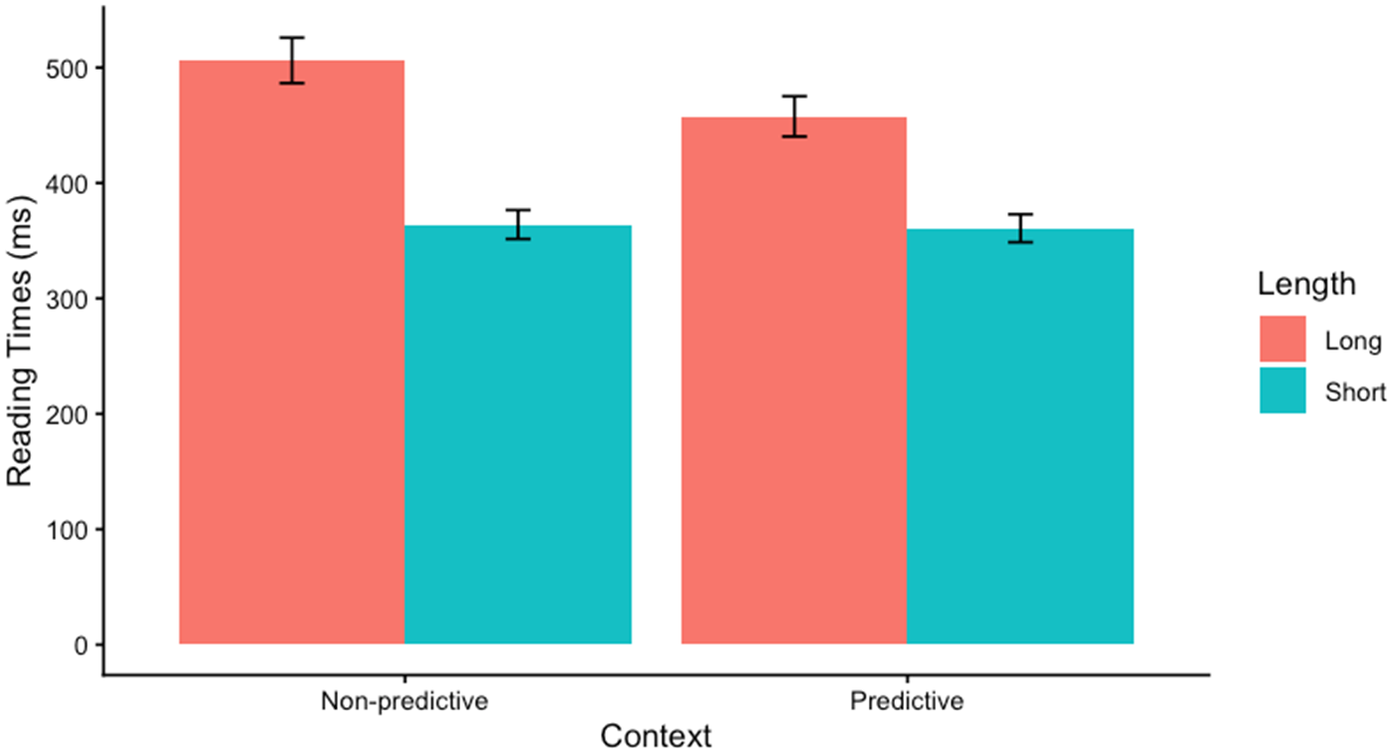
We built a linear mixed-effects model (LME; see Table 3) with the target word reading time (logged milliseconds) as the dependent variable, with context (predictive versus non-predictive) and length (long versus short) as interacting predictors. The main effect of length was significant (see Figure 6), indicating that longer word variants took longer to read (480.61 ms) than shorter word variants (362.41 ms) (these reported reading times are the raw observed means). There were no significant effects involving predictivity, suggesting that people did not read the target words faster in predictive than non-predictive contexts (although the direction of the effect concurs with past research showing that people read words faster in predictive than non-predictive contexts; e.g., Calvo, Reference Calvo2000; Keefe & McDaniel, Reference Keefe and McDaniel1993). The interaction between context and length was non-significant as well, and to further test this non-significant interaction, a Bayes factor with the BIC approximation was used to compare this model to an identical model but without the interaction between context and length (Reaction Time ~ Context + Length + (1 + Context | Subject) + (1 | Item)). This Bayes factor returned a value of BF10 = 0.0026, indicating a decisive preference for the model without the interaction. This suggests that expectations of UID in language do not affect the reading comprehension of short and long word variants in predictive and non-predictive contexts.
LME results of Experiment 3
Reaction Time ~ Context * Length + (1 + Context | Subject) + (1 | Item)
Context coded as non-predictive = −0.5 and predictive = 0.5
Length coded as short = −0.5 and long = 0.5

Table 3. Long description
The table is divided into two main sections: Fixed effects and Random effects.
Fixed effects section columns include beta, S E, t, and p values:
* Intercept: beta 5.92, S E 0.03, t 182.86, p less than .001.
* Context: beta minus 0.03, S E 0.05, t minus 0.59, p .557.
* Length: beta 0.22, S E 0.05, t 3.95, p less than .001.
* Context by Length interaction: beta minus 0.05, S E 0.11, t minus 0.46, p .647.
Random effects section lists estimates for explained standard deviation:
* Subject (intercept): 0.34.
* Subject Context: 0.03.
* Item (intercept): 0.17.
Reading time of target words by context and length (error bars show 95% CIs for the dataset grouped by subject).

Figure 6. Long description
The Y-axis is labeled Reading Times in m s, ranging from 0 to 500 in increments of 100. The X-axis is labeled Context with two categories: Non-predictive and Predictive. A legend to the right indicates that salmon-colored bars represent Long words and teal-colored bars represent Short words.
In the Non-predictive context group on the left:
* The Long word bar reaches approximately 505 m s with an error bar extending from roughly 485 to 525.
* The Short word bar reaches approximately 365 m s with an error bar from roughly 350 to 380.
In the Predictive context group on the right:
* The Long word bar reaches approximately 460 m s with an error bar from roughly 440 to 480.
* The Short word bar reaches approximately 360 m s with an error bar from roughly 345 to 375.
Overall, reading times are higher for long words than short words, and the difference between long and short words is more pronounced in the non-predictive context.
Three additional LMEs using the same predictors as the above analysis were built separately using the first, second, and third word following the target word as the dependent variable. In these models, only the main effect of length was significant for the first word following the target word (see Table 4 and Figure 7), suggesting that reading times were faster following a short target word than a long target word for the first word following the target word.
LME results of Experiment 3 for the words following the target word
Reaction Time Word 1 ~ Context * Length + (1 + Length | Subject) + (1 | Item)
Reaction Time Word 2 ~ Context * Length + (1 | Subject) + (1 | Item)
Reaction Time Word 3 ~ Context * Length + (1 + Predictivity | Subject) + (1 | Item)
Context coded as non-predictive = −0.5 and predictive = 0.5
Length coded as short = −0.5 and long = 0.5

Table 4. Long description
The table is divided into three main sections for Word 1, Word 2, and Word 3. Each section includes columns for beta, S E, t, and p values.
Fixed effects for Word 1:
* Intercept: beta 5.90, S E 0.02, t 351.65, p less than .001.
* Context: beta 0.01, S E 0.01, t 0.43, p .671.
* Length: beta 0.07, S E 0.01, t 5.07, p less than .001.
* Context and Length interaction: beta 0.01, S E 0.03, t 0.20, p .840.
Random effects for Word 1: Subject intercept 0.30, Subject Length 0.02, Item intercept 0.04.
Fixed effects for Word 2:
* Intercept: beta 5.80, S E 0.02, t 371.08, p less than .001.
* Context: beta 0.00, S E 0.01, t minus 0.19, p .852.
* Length: beta 0.00, S E 0.01, t 0.89, p .381.
* Context and Length interaction: beta 0.00, S E 0.01, t minus 0.51, p .615.
Random effects for Word 2: Subject intercept 0.29, Item intercept 0.03.
Fixed effects for Word 3:
* Intercept: beta 5.83, S E 0.02, t 353.64, p less than .001.
* Context: beta minus 0.01, S E 0.01, t minus 1.45, p .155.
* Length: beta 0.01, S E 0.00, t minus 1.86, p .071.
* Context and Length interaction: beta 0.00, S E 0.00, t 0.01, p .995.
Random effects for Word 3: Subject intercept 0.31, Subject Context 0.02, Item intercept 0.03.
Reading times of 1st, 2nd and 3rd spillover words by context and length (error bars show 95% CIs for the dataset grouped by subject).

Figure 7. Long description
The figure consists of three side-by-side bar charts labeled 1st Word, 2nd Word, and 3rd Word. All charts share a Y-axis for Reading Times in m s ranging from 0 to 400 and an X-axis for Context with categories Non-predictive and Predictive. A legend on the right identifies salmon-colored bars as Long and teal-colored bars as Short. Each bar includes a vertical error bar representing 95 percent C I s.
* 1st Word panel: For both Non-predictive and Predictive contexts, Long words have higher reading times (approximately 405 m s) compared to Short words (approximately 380 m s).
* 2nd Word panel: Reading times are nearly identical across all conditions, hovering around 350 m s for both Long and Short words in both contexts.
* 3rd Word panel: A slight reversal or equalization occurs. In the Non-predictive context, Short words (approximately 365 m s) are slightly higher than Long words (approximately 350 m s). In the Predictive context, Short words (approximately 380 m s) are notably higher than Long words (approximately 360 m s).
4.3. Discussion
Experiment 3 used the self-paced reading paradigm to assess whether the expectation of UID affects comprehension. In contrast to the findings of this expectation having an effect in language production (Experiments 1 and 2), expectations of UID do not seem to lead people to make predictions about the distribution of shorter and longer word variants, and therefore do not affect reading comprehension (in the form of reading times).
However, no significant general boost of reading times from predictive contexts was found either, suggesting that Experiment 3 may have lacked power to also detect any effect of expectations of word length (if this effect does exist). However, the number of participants taking part in this experiment is considerably larger (i.e., hundreds more participants) than past studies examining self-paced reading (e.g., Hintz et al., Reference Hintz, Meyer and Huettig2016; Ito, Reference Ito2026; Lyu et al., Reference Lyu, Tu and Lin2020; Ng et al., Reference Ng, Payne, Steen, Stine-Morrow and Federmeier2017), suggesting that this experiment has sufficient experimental power. Furthermore, from these comparisons, the Ito (Reference Ito2026) study is the most similar to Experiment 3, in that both consisted of web-based self-paced reading tasks comparing predictable and non-predictable target words. Ito (Reference Ito2026) found a significant effect of predictability in a task without additional working memory loads (13 ms decrease in reading times for predictable versus non-predictable words) with 125 participants and 44 items total (compared to 391 participants and 40 items for Experiment 3), suggesting that Experiment 3 has an adequate sample size and number of items for this type of study. From these comparisons, another explanation for a lack of this effect is that the contexts may not have been predictable enough to have an effect on reading times. The Ito (Reference Ito2026) study items had a cloze probability of the predictable words of 94.5%, whereas the predictable items in this study had a cloze probability of only 52.4%. This discrepancy is due to the limited item options available for picking target words that have semantically equivalent short/long word variants, whereas Ito (Reference Ito2026) did not have this constraint when making sentences with highly predictable contexts. Therefore, stimuli with higher predictability than those used in Experiment 3 may have shown significant differences in reading times compared with non-predictable stimuli. Regardless, effects of predictability were found for both of the production experiments, suggesting that these contexts were predictable enough to have an effect in production. Overall, this suggests that, while there might exist effects of UID in more highly predictable contexts, these effects seem larger and more robust in production than comprehension.
Furthermore, examining the raw results shows that the direction of the general effect of context is consistent with the notion that reading is faster for predictable words (with a 22.44 ms facilitation effect found here, which is comparable and also larger than the equivalent effect found in Ito (Reference Ito2026) of a 13 ms facilitation effect). In contrast, the direction of effects involving the interaction between context and length do not align with the presence of UID effects in language comprehension. Here, if people did use knowledge of short/long word patterning in predictive and non-predictive contexts, then the expectation should be for short words to be more likely found in predictive contexts (representing a facilitation effect) and less likely to be found in non-predictive contexts (overall increasing the difference between reading times between predictive/non-predictive contexts for short words), with the opposite patterning for long words (i.e., overall decreasing reading time differences between predictive/non-predictive contexts). However, the difference in reading times for short words in predictive/non-predictive contexts is 3.25 ms, while this difference for long words is numerically (not statistically) larger at 48.50 ms, which is the opposite direction of what is expected under a UID effect. Overall, while the non-significance of the interaction effect here may indicate a lack of power, analyzing the raw trends give a preliminary indication for the lack of a UID effect in comprehension, or at least that expectations of information and word length are more robust in language production than comprehension.
5. General Discussion
Across three experiments (one direct replication and two preregistered), we found that people tend to choose short words for predictive compared to non-predictive contexts in a metalinguistic task (replicating the results of Mahowald et al. (Reference Mahowald, Fedorenko, Piantadosi and Gibson2013) in Experiment 1). In Experiment 2, we further showed that people also prefer to produce short words in predictive compared to non-predictive contexts in language production. However, in Experiment 3, we did not observe evidence that people predict short words following a predictive context in language comprehension. Below, we discuss the theoretical implications of these findings.
5.1. UID effects in language production via lexical selection
Experiments 1 and 2 provide evidence that people are communicatively efficient by way of adhering to UID and the principle of shorter units containing less information compared to longer units. This UID effect was found both in a metalinguistic task requiring people to choose between a shorter or longer word variant to complete a sentence (Experiment 1), and also in a different paradigm requiring people to lexically retrieve and complete a word (with both shorter and longer word variants being acceptable completions; Experiment 2). People in these two experiments tended to choose/produce shorter word variants in predictive contexts and longer word variants in non-predictive contexts. These results concur with past research showing the tendency for shorter words to transmit less information compared to longer words (Piantadosi et al., Reference Piantadosi, Tily and Gibson2011), that shorter words are found more often in predictable contexts in a corpus analysis, and that people tend to select shorter words for predictive contexts compared to non-predictive contexts (Mahowald et al., Reference Mahowald, Fedorenko, Piantadosi and Gibson2013).
Thus, our findings provide strong support for the UID hypothesis, which proposes that speakers distribute information uniformly across their utterances, avoiding both information peaks and troughs (Jaeger, Reference Jaeger2010; Levy & Jaeger, Reference Levy, Jaeger, Schlokopf, Platt and Hoffman2007). According to this hypothesis, speakers modulate the linguistic signal – including word choice – to maintain a relatively constant information rate. The tendency to use shorter word variants in predictive contexts aligns with this principle, as it allows speakers to compress the signal when the semantic content is highly predictable from context, thus maintaining a more uniform information distribution (Jaeger & Buz, Reference Jaeger, Buz, Fernández and Cairns2017). The results from our production experiments also align with recent cross-linguistic evidence showing similar patterns. For instance, studies on Mandarin Chinese have demonstrated that speakers prefer abbreviated forms of compound words in predictive contexts (Li et al., Reference Li, van Deemter, Paperno and Fan2019, Reference Li, Scontras and Futrell2023). Similarly, Zarcone and Demberg (Reference Zarcone and Demberg2021) found that German speakers prefer to use the shorter base forms of compounds in predictive contexts, providing further evidence that this UID-driven pattern is not just a peculiarity of English, but transcends specific languages and may reflect a universal principle of human communication. Finally, our findings also relate to other work suggesting that UID effects operate at multiple levels of linguistic representation, from phonology to syntax, reflecting a general cognitive bias toward efficient information transfer. In particular, Futrell et al. (Reference Futrell, Mahowald and Gibson2015) showed that people use simpler syntactic structures when the words in the utterance are more predictable and Seyfarth (Reference Seyfarth2014) found that words that frequently appear in predictable contexts may develop reduced phonological forms that become part of their lexical representation.
The persistence of this effect in our word completion task (Experiment 2) is particularly noteworthy, as it demonstrates that UID-driven lexical selection occurs even when the production process more fully engages conceptual processing and lexical retrieval mechanisms. This addresses a key limitation of previous research that relied primarily on forced choice tasks, which may not fully capture the full range of steps in the language production process (Jacobs & MacDonald, Reference Jacobs and MacDonald2023). Our findings suggest that communicative efficiency in the form of UID is not merely an artifact of explicit metalinguistic judgments but is integrated into the core mechanisms of language production. However, it is possible that the predictivity effect on word form choice may be robust only in certain contexts; for instance, by analyzing corpus data, Levshina and Lorenz (Reference Levshina and Lorenz2022) reveal limited predictivity-induced UID effects (in the use of want-to and wanna): the preference for wanna over want-to in predictive context is only observed in fast speech. Future research should examine predictivity effects across a wide range of linguistic phenomena and contexts in order to gauge how prevalent this effect is.
But what specific mechanisms bring about this patterning of word length in language production? Under standard Uniform Information Density (UID) accounts, speakers actively modulate their message online to avoid information spikes which smooths the transmission rate (Jaeger, Reference Jaeger2010; Levy & Jaeger, Reference Levy, Jaeger, Schlokopf, Platt and Hoffman2007). However, our results are also compatible with producer-internal mechanisms rooted in lexical accessibility and production planning, whereby predictive contexts modulate the accessibility of competing variants (i.e., short and long variants of the same concept). When an upcoming concept is strongly supported by the preceding context, strong prior pre-activation facilitates rapid retrieval, allowing speakers to readily select and produce shorter variants that require less phonological and articulatory planning. In contrast, in less predictive contexts, weaker contextual pre-activation results in slower retrieval. In such cases, speakers produce the longer variant not because additional phonological material aids retrieval, but perhaps because articulating a longer form provides valuable time to buffer and plan downstream speech. Alternatively, rather than computing UID principles online, speakers may have internalized the statistical regularities linking contextual predictability with form length through cumulative linguistic experience, allowing them to retrieve appropriate variants automatically. Distinguishing whether these length alternations reflect emergent production constraints and/or internalized distributional learning remains an important question for future research.
A compatible explanation comes from audience design. Rather than standing in contrast to UID, audience design can be viewed as one communicative mechanism through which UID-consistent patterns may arise. UID predicts that speakers should avoid both under-informative and over-informative encodings by distributing information relatively uniformly across an utterance. Audience design similarly assumes that speakers adapt their utterances to support successful comprehension by the listener while avoiding unnecessary communicative effort (e.g., Cai et al., Reference Cai, Sun and Zhao2021; Tal et al., Reference Tal, Grossman, Rohde and Arnon2023). Under this view, shorter variants are more appropriate in predictive contexts because the context already supports comprehension of the intended referent, allowing speakers to be efficient without substantially increasing the risk of misunderstanding. In contrast, in non-predictive contexts, speakers may favor longer variants because the additional phonological material provides a more robust cue to the intended referent when contextual support is weak.
This audience-oriented behavior may also be shaped by learning from communicative experience. Speakers may learn over time that using shorter forms in weakly constraining contexts is more likely to result in misunderstanding or communicative difficulty. Such failures could generate a cognitive error signal when the expected outcome, successful comprehension, does not match the actual outcome, that being comprehension difficulty or communicative breakdown (for a review, see Ferreira, Reference Ferreira2019). This error signal could then tune future production choices, increasing the likelihood of longer variants in less predictive contexts. Conversely, because predictive contexts provide stronger support for the intended referent, shorter variants are less likely to cause comprehension difficulty in those contexts, and therefore speakers have less pressure to use longer variants. With this account, UID and audience design are not competing explanations, in that UID characterizes the information-density pattern, whereas audience design and learning from communicative feedback provide possible mechanisms by which speakers come to produce that pattern. And to clarify, this account is not intended to imply a strict separation between production and comprehension. On the contrary, the proposed mechanism could be compatible with more integrated accounts of language processing, in which comprehension-based error monitoring and prediction can inform future production choices (e.g., Pickering & Garrod, Reference Pickering and Garrod2013). The key claim here is simply that comprehension failure, or the anticipation of such failure, may provide a learning signal that differentially affects future production depending on contextual predictability.
In addition, these UID effects in production were not affected by a range of other linguistic factors, such as the word length and word frequency differences between the short and long word variants, the frequencies of the preceding words in the sentences, and the surprisal of the target words given the preceding words in the sentences. This suggests that predictable target words are predictable due to inherent human judgments of predictability as found in the cloze task, rather than other factors such as a sentence having more high- or low-frequency words. It is worth noting the discrepancy that word surprisal did not modulate UID effects. This may stem from differences between cloze task and surprisal measures. Cloze tasks are human-based, usually untimed, and offline assessments that can involve deliberative decision-making, whereas surprisal (using language models) provides very fine-grained distinctions based on access to massive corpora of text, which allow them to make different predictions about the most likely following word compared to humans (Oh & Linzen, Reference Oh and Linzen2025; Oh & Schuler, Reference Oh and Schuler2023). Indeed, cloze and suprasegmental measures may differ in the conclusions they draw from reading time data (Shain et al., Reference Shain, Meister, Pimentel, Cotterell and Levy2024). Therefore, cloze measures may have better modeled the results of the production experiments, as these experiments were relatively similar to cloze tasks, in that participants needed to choose the following word in a conscious and untimed manner.
5.2. UID effects in language comprehension via prediction
The apparent dissociation between production and comprehension in our study raises important theoretical questions. While UID principles clearly influence language production, they do not appear to generate expectations that affect reading times during comprehension. If comprehenders were generating predictions about whether a shorter or longer word variant would appear based on contextual predictability, we would expect an interaction between context and word length in reading times. The absence of such an interaction suggests that comprehenders may not generate predictions at this level of specificity. This aligns with more conservative accounts of prediction in language comprehension, which propose that prediction may be limited to semantic or conceptual information rather than extending to specific lexical forms (e.g., Nieuwland et al., Reference Nieuwland, Politzer-Ahles, Heyselaar, Segaert, Darley, Kazanina and Huettig2018).
Our findings may support a fundamental asymmetry between language production and comprehension processes, going against the Production-Distribution-Comprehension (PDC) account as proposed by MacDonald (Reference MacDonald2013). According to this framework, production constraints shape language distributions, which in turn influence comprehension. The absence of UID effects in comprehension may indicate that while production processes actively implement UID principles by constraining long and short word variants into specific distributions, comprehension processes do not seem to be attuned to the resulting distributional patterns, or at least not using this distributional knowledge to aid in comprehension. Thus, this asymmetry between production and comprehension may be explained by different processing priorities in production versus comprehension. While speakers must actively select among competing lexical alternatives (Levelt et al., Reference Levelt, Roelofs and Meyer1999), comprehenders may prioritize rapid access to meaning over predictions about specific word forms. As Ferreira and Chantavarin (Reference Ferreira and Chantavarin2018) argue, ‘good-enough’ processing in comprehension may focus on extracting meaning efficiently rather than predicting specific lexical forms. Thus, while the production to distribution to comprehension chain may apply in some cases as detailed by PDC, these links may be limited to linguistic patterns more salient than the distributions that arise from language UID.
Another possible explanation for this asymmetry comes from Kanwal et al.’s (Reference Kanwal, Smith, Culbertson and Kirby2017) experimental work with artificial languages. They found that participants chose short forms in predictive contexts only when they were tasked with communicating both efficiently and accurately. In natural reading, the pressure for efficiency may be less pronounced than in production, as readers can generally process information at their own pace. Without strong pressure for efficiency in comprehension, readers may not develop or utilize expectations about word length based on contextual predictability and UID.
Likewise, even if people have internalized in their comprehension systems the principle that short words are more likely to be found in predictive contexts (and vice-versa for long words), this patterning across predictive and non-predictive contexts may not constrain the use of short and long word variants to the extent to which people would actively expect short and long words in predictive and non-predictive contexts respectively. As making wrong predictions possibly worsens comprehension (e.g., Van Petten & Luka, Reference Van Petten and Luka2012), people may avoid making predictions about short and long words given that these predictions would often be wrong given the non-highly constrained nature of short and long words. Likewise, prediction is heavily context-dependent and, in general, may use more cognitive resources (see Huettig & Mani, Reference Huettig and Mani2015 for a review), further reducing any positive effects that predicting short and long words would have and thus reducing the likelihood of these predictions from occurring. Overall, these results concur with the notion of prediction happening only with highly predictable content in conjunction with having ample cognitive resources and time (e.g., Ito et al., Reference Ito, Corley, Pickering, Martin and Nieuwland2016, Reference Ito, Corley and Pickering2018).
Thus, a general implication from our results is that UID may be better understood as an outcome of production-oriented optimization rather than as a general property of language processing across modalities. Speakers must select among alternative word forms in real time, and these forms often differ in their phonological or orthographic length while having similar if not identical meanings. In such cases, production pressures may favor forms that distribute information more evenly across the utterance, for example by choosing shorter variants in predictive contexts and reserving longer forms for contexts where additional comprehension support is useful. Comprehenders, however, are not faced with the same selection tradeoff: they must process the input they receive, and their predictive processing may therefore prioritize upcoming semantic content rather than the precise lexical realization of that content (e.g., Nieuwland et al., Reference Nieuwland, Politzer-Ahles, Heyselaar, Segaert, Darley, Kazanina and Huettig2018). If alternative word forms are near-synonymous, differences in length may have relatively little bearing on a comprehender’s prediction of meaning. This asymmetry helps explain why UID effects may emerge in production while being absent (or at least weaker) in comprehension.
Nonetheless, while Experiment 3 gives initial evidence for the lack of UID effects in comprehension, this experiment does not directly test for the mechanism behind this production-comprehension asymmetry. Future research should examine this in more depth to assess whether the PDC account, efficiency pressure, and/or cognitive resource concerns contribute to this pattern of results.
6. Conclusion
Language in general seems to adhere to principles of communication efficiency in the form of uniform information density, in that shorter units tend to convey less information than longer units. Furthermore, people tend to adhere to this principle as well in language production, while not utilizing this information in language comprehension, or at least utilizing this information less in comprehension compared to production. Our results contribute to a growing body of research on communicative efficiency and UID in language, supporting the view that UID considerations shape both language structure and language use. The findings from our production experiments align with the UID hypothesis and other information-theoretic approaches to language, demonstrating that speakers actively modulate their linguistic choices based on contextual predictability. However, our comprehension experiment reveals an important asymmetry, suggesting that UID-based expectations about word length may not play a significant role in reading comprehension. This production-comprehension asymmetry has important implications for theories of language processing and evolution. It suggests that communicative efficiency in terms of UID may be primarily driven by production pressures rather than comprehension needs, potentially explaining why certain UID-based patterns emerge in language over time despite not being actively utilized during comprehension. Further research should explore this asymmetry across different linguistic phenomena and in more naturalistic settings to better understand the complex interplay between UID, production, and comprehension in human language.
Data availability statement
The data and analytical scripts can be found on the Open Science Framework (https://osf.io/mcuvd/?view_only=eb29a7ebb98747e385e7d0d10073a3a0 and https://osf.io/jvb4w/?view_only=4233f48baaf64c16a8ea8634bde1440c).
Funding statement
This work was supported by a General Research Fund grant (Project Number: 14600220).
Competing interests
The authors have no declarations of interest.
Appendix
The items of Experiment 1

Table A1. Long description
A four-column table titled Table A 1, The items of Experiment 1. The columns are labeled Item, Predictivity, Preamble, and Choices.
Items 1 through 40 are paired as Nonpredictive and Predictive versions of the same scenario. Examples include:
* Item 1: Predictive preamble ‘Susan was very bad at algebra, so she hated...’ with choices 1. mathematics 2. math.
* Item 8: Predictive preamble ‘Mary got some chocolate milk out of the...’ with choices 1. refrigerator 2. fridge.
* Item 16: Predictive preamble ‘When John’s mother calls, he does not pick up the...’ with choices 1. telephone 2. phone.
* Item 24: Predictive preamble ‘When it got really hot, Eric wished his house in Florida had...’ with choices 1. air conditioning 2. A / C.
* Item 30: Predictive preamble ‘Mary looks young, so the bartender asked her for...’ with choices 1. identification 2. I D.
* Item 39: Predictive preamble ‘Although John now lives in France, he still considers himself American because he was born in the...’ with choices 1. United States 2. U S.
Items 41 through 80 are categorized as Filler. Examples include:
* Item 41: Preamble ‘John walked outside to talk to his...’ with choices 1. neighbor 2. friend.
* Item 54: Preamble ‘Someone broke in and stole Mary’s...’ with choices 1. computer 2. P C.
* Item 68: Preamble ‘Ken does not know how to use a computer so has never been on the...’ with choices 1. web 2. Internet.
* Item 80: Preamble ‘Astronauts have been to the moon but never...’ with choices 1. Mars 2. Jupiter.
The items of Experiment 2

Table A2. Long description
The table consists of three columns: Item, Predictivity, and Sentence.
Items 1 through 27 are paired as Nonpredictive and Predictive versions of the same context. Examples include:
* Item 1: Susan introduced herself as someone who loved ma_ (Nonpredictive) vs. Susan was bad at algebra, so she hated ma_ (Predictive).
* Item 8: John loves his picture book, especially the page with the hi_ (Nonpredictive) vs. At the zoo, John took a picture of a fat hi_ (Predictive).
* Item 17: Lionel had to undergo ch_ (Nonpredictive) vs. After being diagnosed with cancer, Lionel had to undergo a course of ch_ (Predictive).
* Item 25: Karen is training to be a ve_ (Nonpredictive) vs. When her dog got sick, Karen took it to the ve_ (Predictive).
Items 28 through 67 are labeled as Filler and consist of single sentences such as:
* Item 28: John walked outside to talk to his ne_.
* Item 39: Next week, Susan will vacation in Me_.
* Item 50: As an Italian, Kevin enjoys eating pi_.
* Item 67: Astronauts have been to the moon but never Ma_.
Each sentence ends with a two-letter word fragment followed by an underscore and a parenthetical definition of the intended word.
The items of Experiment 3

Table A3. Long description
The table consists of six columns: Item, Predictivity, Length, Sentence, Answer, and Question.
* The first three rows are Practice items. The sentences are segmented by vertical bars, such as + | Tim | went | to | the | store | to | buy | some | milk’. Answers are ‘Yes’ or ‘No’ based on the corresponding question.
* Items 1 through 40 are experimental trials categorized by Predictivity (Predictive or Nonpredictive) and Length (Short or Long).
* Item 1 (Short) contrasts a nonpredictive sentence about Susan loving mathematics with a predictive sentence about her hating math because she was bad at algebra.
* Item 2 (Long) features John buying a new bicycle.
* Item 12 (Long) involves Mark and pornography, with questions about his approval of smoking.
* Item 20 (Long) describes Lionel undergoing chemotherapy after a cancer diagnosis.
* Item 26 (Long) discusses Kevin’s love for British culture and the United Kingdom.
* Items 41 through 80 are labeled as ‘Filler’ for both Predictivity and Length. These rows repeat the same sentence and question pair twice for each item number. For example, Item 41 features ‘John walked outside to talk to his neighbor’ with the question ‘Did John talk to someone?’ and a ‘Yes’ answer. Item 80 concludes the table with ‘Astronauts have been to the moon but never Mars’ and the question ‘Have astronauts never been to the moon?’ with a ‘No’ answer.


 Open access

