Implications
Different pig breeds show obvious differences in meat quality traits, but little is known about the molecular mechanisms responsible for the differences. Based on the results obtained from such studies, meat quality could be manipulated in order to produce high-quality pork.
Introduction
It is well-known that different pig breeds show obvious differences in meat quality traits (Hu et al., Reference Hu, Wang, Zhu, Guo and Wu2008; Miao et al., Reference Miao, Wang, Xu, Huang and Wang2009; Guo et al., Reference Guo, Shan, Wu, Zhu, Ren, An and Wang2011; Ruusunen et al., Reference Ruusunen, Puolanne, Sevon-Aimonen, Partanen, Voutila and Niemi2012; Shen et al., Reference Shen, Lei, Zhang, Li, Li, Jiang, Zhu and Zhu2014); however, up to now, little is known about the molecular mechanisms responsible for the differences. Usually, the differences in meat quality traits are smaller between pig breeds that are commonly used for commercial production, because the goals of pig breeding, such as fast growth and leanness of the carcass, have been similar for a long time (Ruusunen et al., Reference Ruusunen, Puolanne, Sevon-Aimonen, Partanen, Voutila and Niemi2012). However, the Chinese local and Western pig breeds do not have similar breeding processes, and they have many different characteristics. The Rongchang pigs, one of the most important local fatty pig breeds of the southwest area of China, exhibit earlier sexual maturity, higher fat deposits, poorer feed efficiency and lower growth rate and lean meat content compared with Western pig breeds, but the sensory quality of its meat is superior. The Landrace pigs, one of the Western lean pig breeds, have been intensively selected for a thin subcutaneous fat layer and high muscularity in the carcass, which has led to deterioration in meat quality (Lefaucheur et al., Reference Lefaucheur, Ecolan, Plantard and Gueguen2002; Shan et al., Reference Shan, Wu, Reng and Wang2009). Therefore, the underlying molecular mechanisms responsible for the differences in meat quality traits between pig breeds can be investigated using these two pig breeds as the ideal comparison model.
Intramuscular fat (IMF) content is an important determinant factor for meat quality traits (Fernandez et al., Reference Fernandez, Monin, Talmant, Mourot and Lebret1999a). In general, the Chinese local fatty pigs have higher IMF content than Western lean pigs (Young, Reference Young1992; Hu et al., Reference Hu, Wang, Zhu, Guo and Wu2008; Miao et al., Reference Miao, Wang, Xu, Huang and Wang2009; Zhao et al., Reference Zhao, Ren, Chen, Zhang, Cheng, Li, Zhang and Gao2009; Guo et al., Reference Guo, Shan, Wu, Zhu, Ren, An and Wang2011), but the knowledge about the molecular mechanisms is limited. The extent of fat deposition in skeletal muscles depends on the balance between synthesis and degradation of triglycerides (TG), which includes TG synthesis, fat mobilization, fatty acid transport as well as fatty acid oxidation (Zhao et al., Reference Zhao, Ren, Chen, Zhang, Cheng, Li, Zhang and Gao2009). Therefore, the expression levels of lipid metabolism-related genes in muscle tissue could theoretically contribute to the difference in IMF content, which lead to different meat quality between pig breeds. Moreover, skeletal muscle comprises four types of myofibers, which are encoded by four different myosin heavy chain (MyHC) isoform genes (MyHCI, MyHCIIa, MyHCIIx and MyHCIIb) and have different biochemical and biophysical characteristics such as oxidative and glycolytic capacities, contraction speed, cross-sectional area, glycogen content and TG content (Schiaffino and Reggiani, Reference Schiaffino and Reggiani1996; Lefaucheur et al., Reference Lefaucheur, Ecolan, Plantard and Gueguen2002; Lefaucheur, Reference Lefaucheur2010). Thus, the compositions of myofiber types are considered as important influencing factors for meat quality (Franck et al., Reference Franck, Figwer, Godfraind, Poirel, Khazzaha and Ruchoux2007). However, to the best of our knowledge, there are no published articles that have investigated the variations in myofiber-type compositions between Rongchang and Landrace pigs. Therefore, the objective of the present study was to compare the differences in meat quality traits and the relative mRNA expression levels of lipid metabolism-related genes and MyHC isoform genes in the Longissimus dorsi muscle (LM) of Landrace and Rongchang pigs, and consequently provide some valuable information for understanding the possible molecular mechanisms responsible for meat quality trait differences between fatty and lean pig breeds.
Material and methods
The study was approved by the Animal Care Advisory Committee of Sichuan Agricultural University.
Animals and sample collection
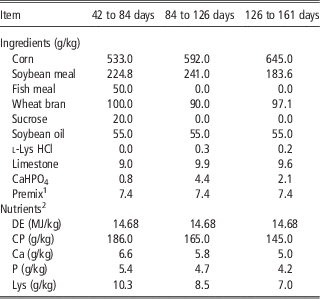
Six Rongchang (originating from six litters) and six Landrace (originating from six litters) young boars of 42 days of age were chosen for the experiment. The feeding experiment lasted for 112 days after 7 days of adaptation period. The pigs were housed in separate pens according to breed and were reared in the same environmental conditions. In order to eliminate the possible influence of different diets on the test results, the Rongchang pigs and Landrace pigs were provided ad libitum access to the same basal diet and water before being slaughtered. The basal diets were formulated mainly based on corn, soybean meal and wheat bran, and were formulated to meet or exceed the NRC (2012) recommendations for the nutrient requirements of the different growth phases. The ingredients and nutrient levels of the basal experimental diets are shown in Table 1. At the end of the feeding experiment, all pigs (161 days of age) were electrically stunned and exsanguinated after fasting for 12 h. Within 10 min postmortem, LM samples from the 6th to the 10th rib and from the 10th to the 11th rib of the left-side carcass were collected for meat quality measurements (samples were stored at 4°C for further analysis) and RNA isolation (samples were snap-frozen in liquid nitrogen and then stored at −80°C until further analysis), respectively.
Ingredients and nutrients of the experimental diets (as-fed basis)

DE=digestible energy.
1 Provided the following (per kilogram of complete diet): 100 mg of Fe (as ferrous sulfate); 15 mg of Cu (as copper sulfate); 120 mg of Zn (as zinc sulfate); 40 mg of Mn (as manganese sulfate); 0.3 mg of Se (as Na2SeO3); 0.25 mg of I (as KI); 13 500 IU of vitamin A; 2250 IU of vitamin D3; 24 IU of vitamin E; 6.2 mg of riboflavin; 25 mg of nicotinic acid; 15 mg of pantothenic acid; 1.2 mg of vitamin B12; 0.15 mg of biotin; 1 g of choline chloride; 3 g of salt.
2 All data were calculated values.
Carcass traits and meat quality
Hot carcass weight was recorded and then divided by slaughter weight to obtain dressing percentage. Backfat thickness at the first rib, last rib and last lumbar vertebrae of the left-side carcass was measured and subsequently the average backfat thickness was calculated. The longissimus dorsi muscle area (LA) at the 10th rib of the right-side carcass was measured according to the unified standard. Meat color was measured in triplicate using a Minolta Chromameter CR-300 (CR-300, Minolta Camera Co., Tokyo, Japan) on a freshly cut surface of the LM sample between the 9th and 10th rib at 45 min and 24 h postmortem. The pH-value was measured in triplicate, using a handheld pH meter (pH-STAR, SFK-Technology, Copenhagen, Denmark) equipped with a glass electrode, at the center of the LM sample between the eighth and ninth rib at 45 min and 24 h postmortem. IMF content was determined on a sample of LM between the seventh and eighth rib by petroleum ether extraction as previously described (Fortin et al., Reference Fortin, Robertson and Tong2005). Shearing force was determined on a sample of LM between the sixth and seventh rib, as previously described (Zeng et al., Reference Zeng, Yu, Mao and Chen2012), using a Tensipresser (TTP-50BXII, Taketomo Electric Corp., Tokyo, Japan).
RNA isolation and reverse transcription
Total RNA was isolated from LM using Trizol reagent (TaKaRa, Dalian, China) according to the manufacturer’s instructions. The purity and concentration of total RNA were measured by a spectrophotometer (Beckman Coulter, DU800, Fullerton, CA, USA) at 260 and 280 nm. Ratios of absorption (260/280 nm) of all samples were between 1.8 and 2.0. The integrity of RNA was detected by electrophoresis in 1.3% agarose-formaldehyde gel. For each sample, 2 µg of total RNA was used to synthesize the cDNA using a PrimeScript RT reagent Kit with gDNA Eraser (TaKaRa) according to the instructions of the manufacturer.
Real-time PCR
The primers were synthesized by TaKaRa Biotechnology (TaKaRa) and are presented in Supplementary Table S1. Real-time PCR was performed using SYBR® Premix Ex Taq ll (Tli RNaseH Plus) reagents (TaKaRa) and a CFX-96 Real-Time PCR detection system (Bio-Rad, Hercules, CA, USA). Each 25 μl PCR mixture contained 12.5 μl SYBR® Premix Ex Taq ll (Tli RNaseH Plus), 1 μl forward primers (10 μM), 1 μl reverse primers (10 μM), 8.5 μl double-distilled water and 2 μl cDNA (the concentration of cDNA was adjusted to the same by ddH2O). Cycling conditions were as follows: 95°C for 10 s, followed by 40 cycles at 95°C for 5 s and 60°C for 25 s and a 72°C extension step for 15 s. A melting curve was generated following each real-time quantitative PCR assay to check and verify the specificity and purity of the PCR product. The standard curve of each gene was run in triplicate to obtain reliable amplification efficiency (E). The correlation coefficients (R 2) of all standard curves were >0.99, and the amplification efficiency (E) was between 90% and 110%.The β-actin gene was used as the reference gene to normalize the mRNA expression amount of target genes according to a previous report by Zhao et al. (Reference Zhao, Ren, Chen, Zhang, Cheng, Li, Zhang and Gao2009) and our unpublished data, which showed that the mRNA synthesis of this gene is stable and secure in muscles of various pig breeds. The relative amount of mRNA of a gene was calculated as previously described (Pfaffl, Reference Pfaffl2001). In brief, the relative expression ratio (R) of a target gene was calculated based on the following equation: R=(E target)∆C t target/(E reference)∆C t reference. The ∆C ttarget value was the C t deviation of C tLandrace−C tRongchang of the target gene transcript. The ∆C treference value was the C t deviation of C tLandrace−C tRongchang of the reference gene transcript. The final data of each sample used for statistical analysis were calculated as the fold change relative to the mean R-value of the Landrace group, which was arbitrarily defined as 1. All experimental sample analyses were repeated in triplicate.
Statistical analysis
Each pig was considered as an experimental unit. Results for gene mRNA level in figures are presented as mean and s.d., and other results in the table are presented as mean and r.s.d.
Comparisons between breed groups were made by a simple t-test using SPSS 18.0 for Windows statistical software package (SPSS, Chicago, IL, USA). The level of statistical significance was set at P<0.05.
Results
Carcass traits and meat quality traits between breeds
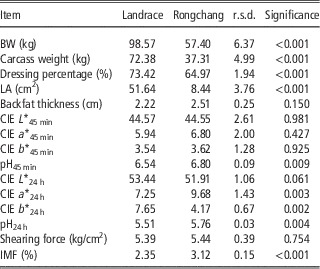
Carcass traits and meat quality traits in the Landrace and Rongchang pigs are shown in Table 2. Compared with Landrace pigs, the Rongchang pigs not only exhibited greater pH, CIE a*24 h and IMF but also exhibited lower BW, carcass weight, dressing percentage, LA and CIE b*24 h (P<0.05). In addition, Rongchang pigs tended to exhibit lower CIE L*24 h compared with Landrace pigs (P=0.061). Other meat quality traits had no significant differences between the two pig breeds (P>0.05).
Characteristics of carcass traits and meat quality traits in the Landrace and Rongchang pigsFootnote 1

LA=longissimus dorsi muscle area; IMF=intramuscular fat content.
1 n=6.
Relative mRNA expression levels of lipid metabolism-related genes in LM between breeds
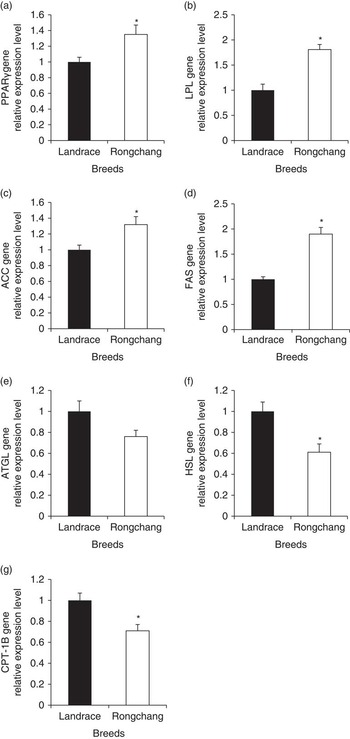
The relative mRNA expression levels of lipid metabolism-related genes in LM of the Landrace and Rongchang pigs are shown in Figure 1. Compared with Landrace pigs, the relative mRNA expression levels of the lipogenesis (PPARγ, FAS and ACC) and fatty acid uptake-related genes (LPL) in LM were greater in Rongchang pigs, whereas the relative mRNA expression levels of the lipolysis (HSL) and fatty acid oxidation (CPT-1B)-related genes were lower in Rongchang pigs (P<0.05). In addition, Rongchang pigs tended to exhibit lower relative mRNA expression levels of adipose triglyceride lipase (ATGL) compared with Landrace pigs (P=0.053).
Relative mRNA expression levels of lipid metabolism related genes in longissimus dorsi muscle (LM) of the Landrace and Rongchang pigs. Each column represents the mean of six pigs±s.d. *P<0.05.

Relative mRNA expression levels of MyHC isoform genes in LM between breeds
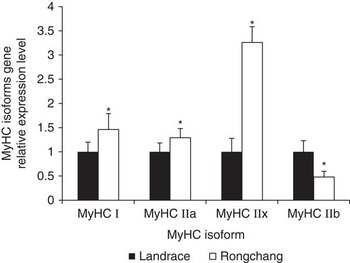
The relative mRNA expression levels of MyHC isoform genes in LM of the Landrace and Rongchang pigs are shown in Figure 2. Compared with Landrace pigs, the relative mRNA expression levels of oxidative fiber type (MyHCI and MyHCIIa) and intermediate fiber type (MyHCIIx) were greater in Rongchang pigs (P<0.05), whereas the relative mRNA expression levels of glycolytic fiber type (MyHCIIb) were lower in Rongchang pigs (P<0.05).
Relative mRNA expression levels of myosin heavy chain (MyHC) isoform genes in longissimus dorsi muscle (LM) of the Landrace and Rongchang pigs. Each column represents the mean of six pigs±s.d. *P<0.05.

Relative mRNA expression levels of peroxisome proliferator-activated receptor gamma coactivator-1α (PGC-1α) in LM between breeds
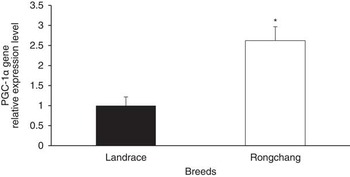
The relative mRNA expression levels of PGC-1α in LM of the Landrace and Rongchang pigs are shown in Figure 3. Compared with Landrace pigs, the relative mRNA expression levels of PGC-1α were greater in Rongchang pigs (P<0.05).
Relative mRNA expression levels of peroxisome proliferator-activated receptor gamma coactivator-1α (PGC-1α) in longissimus dorsi muscle (LM) of the Landrace and Rongchang pigs. Each column represents the mean of six pigs±s.d. *P<0.05.

Discussion
It is well-known that different pig breeds show obvious differences in meat quality traits (Hu et al., Reference Hu, Wang, Zhu, Guo and Wu2008; Miao et al., Reference Miao, Wang, Xu, Huang and Wang2009; Guo et al., Reference Guo, Shan, Wu, Zhu, Ren, An and Wang2011; Ruusunen et al., Reference Ruusunen, Puolanne, Sevon-Aimonen, Partanen, Voutila and Niemi2012; Shen et al., Reference Shen, Lei, Zhang, Li, Li, Jiang, Zhu and Zhu2014); however, up to now, little is known about the molecular mechanisms responsible for the differences. Usually, the differences in meat quality traits are smaller between Western modern pig breeds because of the long-time similar breeding aims such as fast growth and leanness of the carcass (Ruusunen et al., Reference Ruusunen, Puolanne, Sevon-Aimonen, Partanen, Voutila and Niemi2012).The Rongchang pig is one of the local fatty-type pig breeds of the southwest area of China with a white coat color phenotype (Lai et al., Reference Lai, Ren, Ai, Ding, Ma, Zeng, Chen, Guo and Huang2007), and is especially noted for its early sexual maturity, increased IMF content and high meat quality as other Chinese local pigs. Landrace pigs, a Western pig breed, have been intensively selected for their thin subcutaneous fat layer and high muscularity in the carcass, which has led to deterioration in meat quality (Lefaucheur et al., Reference Lefaucheur, Ecolan, Plantard and Gueguen2002; Shan et al., Reference Shan, Wu, Reng and Wang2009). Therefore, these two pig breeds can be used as an ideal comparison study model to investigate the possible mechanisms responsible for the differences in meat quality traits between pig breeds.
Carcass characteristics and meat quality
In the present study, Rongchang pigs had lower carcass weight, LA and dressing percentage compared with the Landrace. These results are in accordance with previous reports, which have compared those traits of the Jinhua pigs, a Chinese local fatty-type pig breed, with the Landrace at same age (Miao et al., Reference Miao, Wang, Xu, Huang and Wang2009; Guo et al., Reference Guo, Shan, Wu, Zhu, Ren, An and Wang2011), and may be attributed to the lower muscle growth potential of Rongchang pigs compared with the Landrace.
It is well-known that pork meat quality traits are affected by the genotype of the pig. For example, the Jinhua pigs (Miao et al., Reference Miao, Wang, Xu, Huang and Wang2009; Guo et al., Reference Guo, Shan, Wu, Zhu, Ren, An and Wang2011) and Laiwu pigs (Hu et al., Reference Hu, Wang, Zhu, Guo and Wu2008) exhibited better meat quality traits when compared with the Landrace and Duroc pigs, respectively. Moreover, Ruusunen et al. (Reference Ruusunen, Puolanne, Sevon-Aimonen, Partanen, Voutila and Niemi2012) and Shen et al. (Reference Shen, Lei, Zhang, Li, Li, Jiang, Zhu and Zhu2014) also found differences in meat quality traits between different genotype pigs. In the present study, we have compared meat quality traits in the Rongchang with the Landrace at 161 days of age. Consistent with previous results on different genotype pigs (Miao et al., Reference Miao, Wang, Xu, Huang and Wang2009; Guo et al., Reference Guo, Shan, Wu, Zhu, Ren, An and Wang2011; Shen et al., Reference Shen, Lei, Zhang, Li, Li, Jiang, Zhu and Zhu2014), our results showed that Rongchang pigs exhibited better meat quality compared with the Landrace at the same age.
Lipid metabolism-related gene expressions in LM
IMF content is an important determinant of many aspects of meat quality characteristics (Fernandez et al., Reference Fernandez, Monin, Talmant, Mourot and Lebret1999a and Reference Fernandez, Monin, Talmant, Mourot and Lebret1999b) – for example, meat color, shearing force, etc. Generally, an increase in IMF content is mainly due to an increase in TG content, which has been demonstrated by previous research in pigs (Bergeron et al., Reference Bergeron, Julien, Davis, Myre and Thivierge2007). It has been reported that the content of IMF depends on the balance between lipogenesis and lipolysis metabolic pathways, which include fatty acid uptake from circulating lipids, de novo lipogenesis and lipid mobilization, as well as fatty acid oxidation (Zhao et al., Reference Zhao, Ren, Chen, Zhang, Cheng, Li, Zhang and Gao2009). Therefore, although there are many determinants for IMF content, the expression levels of those lipid metabolic pathways-related genes in muscle tissue could partly explain the difference in IMF contents between pig breeds. In the present study, Rongchang pigs had higher IMF content compared with the Landrace, which is in accordance with previous reports that have compared the IMF content between other Chinese local fatty pigs and western commercial pigs (Young, Reference Young1992; Miao et al., Reference Miao, Wang, Xu, Huang and Wang2009; Zhao et al., Reference Zhao, Ren, Chen, Zhang, Cheng, Li, Zhang and Gao2009; Guo et al., Reference Guo, Shan, Wu, Zhu, Ren, An and Wang2011). Therefore, as stated above, one could assume that, compared with the Landrace, Rongchang pigs have higher fatty acid uptake and/or de novo lipogenesis capacity, whereas they have lower lipid mobilization and/or fatty acid oxidation capacity in LM. Therefore, in the present study, in order to shed light onto the reasons that can, at least in part, explain why Rongchang pigs exhibit higher IMF than the Landrace, the relative mRNA expression levels of those key lipid metabolism pathways-related genes were assessed. In order to assess the fatty acid uptake capacity of muscle tissues from circulating TG, the mRNA expression levels of LPL were measured. LPL functions as a ‘metabolic gatekeeper’ and is considered as a key lipase impacting the partitioning of circulating lipids among tissues (Greenwood, Reference Greenwood1985; Zechner, Reference Zechner1997). Indeed, previous studies have reported that LPL can hydrolyze circulating lipoproteins for skeletal muscle lipid biosynthesis (Tan et al., Reference Tan, Yin, Liu, Tang, Xu, Kong, Li, Yao, Gu, Smith and Wu2011), and LPL correlates well with the uptake of fatty acids derived from circulating TG in skeletal muscles (Ellis et al., Reference Ellis, Lanza-Jacoby, Gow and Kendrick1994; Levak-Frank et al., Reference Levak-Frank, Radner, Walsh, Stollberger, Knipping, Hoefler, Sattler, Weinstock, Breslow and Zechner1995). Our present results showed that Rongchang pigs had higher LPL expression levels compared with the Landrace. These data indicated that the higher IMF content in LM of Rongchang pigs compared with the Landrace could be partly mediated by a higher fatty acid uptake capacity. Concerning lipid synthesis, we have assessed the relative mRNA expression levels of PPARγ, FAS and ACC. PPARs consisting of three isotypes – namely, PPARα, PPARβ and PPARγ – belong to the nuclear receptor family of ligand-activated transcriptional factors, and play an important role in fatty acid metabolism (Schoonjans et al., Reference Schoonjans, Staels and Auwerx1996). In particular, PPARγ plays an important role in fat accumulation by inducing the expressions of lipid metabolism-related genes such as LPL (Tontonoz and Spiegelman, Reference Tontonoz and Spiegelman2008) and FAS (Schadinger et al., Reference Schadinger, Bucher, Schreiber and Farmer2005). It is well-known that FAS and ACC play a central role in the de novo lipogenesis in mammals. ACC catalyses the carboxylation of acetyl-CoA to malonyl-CoA, and is considered to be a rate-limiting enzyme of lipogenesis in animals (Numa et al., Reference Numa, Nakanishi, Hashimoto, Iritani and Okazaki1970; Munday, Reference Munday2002). FAS catalyses all the reaction steps in the synthesis of palmitate from acetyl-CoA and malonyl-CoA in the presence of NADPH (Munoz et al., Reference Munoz, Ovilo, Noguera, Sanchez, Rodriguez and Silio2003). Our present results showed that the relative mRNA expression levels of PPARγ, FAS and ACC were greater in Rongchang pigs than in the Landrace. Therefore, we can speculate that Rongchang pigs have a higher capacity of lipogenesis, and therefore they exhibit higher IMF content compared with the Landrace breed. With regard to lipid mobilization and fatty acid oxidation, we have assessed the relative mRNA expression levels of ATGL, HSL and CPT-1B, respectively. ATGL and HSL are known to be the major enzymes for TG catabolism in adipose tissue. ATGL, a newly identified lipase, is the rate-limiting enzyme in hormone-induced lipolysis, and hydrolyses the first ester bond of the stored TG into non-esterified free fatty acids and diacylglycerol (Zimmermann et al., Reference Zimmermann, Strauss, Haemmerle, Schoiswohl, Birner-Gruenberger, Riederer, Lass, Neuberger, Eisenhaber, Hermetter and Zechner2004). Further, diacylglycerol is hydrolyzed by activated HSL, which cleaves the fatty acid from diacylglycerol for exportation and oxidation (Mersmann, Reference Mersmann1998; Carmen and Victor, Reference Carmen and Victor2006) and has a greater substrate affinity for diacylglycerol than TG (Haemmerle et al., Reference Haemmerle, Zimmermann, Strauss, Kratky, Riederer, Knipping and Zechner2002). CPT-1B is highly expressed in muscles and is involved in regulating mitochondrial fatty acid oxidation, which facilitates lipid mobilization (Lee et al., Reference Lee, Kim, Park, Kim, Jeon, Oh, Koh, Won, Kim, Oh, Yoon, Lee and Park2006). Our results showed that the relative mRNA expression levels of ATGL, HSL and CPT-1B in LM were lower in Rongchang pigs than in the Landrace. These data indicated that the higher IMF content in LM of Rongchang pigs than the Landrace could be, at least in part, mediated by the lower lipid mobilization and fatty acid oxidation capacity.
MyHC isoform genes and PGC-1α expression in LM
Eight isoforms of MyHC encoded by a separate gene are found in the skeletal muscles of mammals (Weiss et al., Reference Weiss, McDonough, Wertman, Acakpo-Satchivi, Montgomery, Kucherlapati, Leinwand and Krauter1999; Shrager et al., Reference Shrager, Desjardins, Burkman, Konig, Stewart, Su, Shah, Bricklin, Tewari, Hoffman, Rickels, Jullian, Rubinstein and Stedman2000). In postnatal pigs, skeletal muscle consists of four MyHC isoforms: MyHCI, MyHCIIa, MyHCIIx and MyHCIIb, with different biochemical and biophysical characteristics such as oxidative and glycolytic capacities, contraction speed, cross-sectional area and TG content (Schiaffino and Reggiani, Reference Schiaffino and Reggiani1996; Lefaucheur et al., Reference Lefaucheur, Ecolan, Plantard and Gueguen2002; Lefaucheur, Reference Lefaucheur2010). Muscle fibers are dynamic structures and exhibit high plasticity, and under normal physiological conditions transition among four MyHC isoforms follows an obligatory pathway: MyHCI↔ MyHCIIa↔MyHCIIx↔MyHCIIb (Schiaffino and Reggiani, Reference Schiaffino and Reggiani1994; Pette and Staron, Reference Pette and Staron2000). In general, oxidative metabolism decreases in the rank order MyHCI→MyHCIIa→MyHCIIx→MyHCIIb (Lefaucheur et al., Reference Lefaucheur, Ecolan, Plantard and Gueguen2002), and these metabolic changes are consistent with the transition of MyHC profile toward a faster type (Lefaucheur et al., Reference Lefaucheur, Milan, Ecolan and Le Callennec2004). It is well-known that intensive selection for faster muscle growth in Western modern pigs has resulted in a shift in muscle fiber toward a higher glycolytic and lower oxidative metabolism (Lefaucheur et al., Reference Lefaucheur, Milan, Ecolan and Le Callennec2004; Hu et al., Reference Hu, Wang, Zhu, Guo and Wu2008; Guo et al., Reference Guo, Shan, Wu, Zhu, Ren, An and Wang2011), which is associated with leaner pigs, better feed efficiency and higher growth rate, but gives rise to a deterioration in meat quality (Lefaucheur et al., Reference Lefaucheur, Ecolan, Plantard and Gueguen2002; Shan et al., Reference Shan, Wu, Reng and Wang2009). Previous studies have reported that, compared with the Landrace (Guo et al., Reference Guo, Shan, Wu, Zhu, Ren, An and Wang2011), Duroc (Hu et al., Reference Hu, Wang, Zhu, Guo and Wu2008) and Large White (Lefaucheur et al., Reference Lefaucheur, Milan, Ecolan and Le Callennec2004), respectively, the mRNA expression levels of MyHCIIa and MyHCIIx were greater in Jinhua, Laiwu and Meishan pigs, whereas the mRNA expression levels of MyHCIIb were lower. Those results may be related to the variation of meat quality between pig breeds (Hu et al., Reference Hu, Wang, Zhu, Guo and Wu2008; Guo et al., Reference Guo, Shan, Wu, Zhu, Ren, An and Wang2011), because the composition of skeletal muscle fibers is one of the important factors in determining meat quality (Chang et al., Reference Chang, da Costa, Blackley, Southwood, Evans, Plastow, Wood and Richardson2003). As mentioned above, one can assume that Rongchang pigs have better meat quality traits compared with Landrace pigs due to differences in the type and composition of myofibers. As we expected, compared with the Landrace, the mRNA expression levels of MyHCI, MyHCIIa and MyHCIIx were greater, whereas the mRNA expression levels of MyHCIIb were lower in Rongchang pigs. Moreover, these results were further confirmed by the higher mRNA expression levels of PGC-1α in Rongchang pigs, because it is widely known that PGC-1α can induce myofiber-type transitions from fast to slow (Lin et al., Reference Lin, Wu, Tarr, Zhang, Wu, Boss, Michael, Puigserver, Isotani, Olson, Lowell, Bassel-Duby and Spiegelman2002; Ueda et al., Reference Ueda, Watanabe, Sato, Akiba and Toyomizu2005; Yamaguchi et al., Reference Yamaguchi, Suzuki, Arai, Tanabe and Atomi2010). It is reported that MyHCIIb exhibits higher glycolytic metabolism capacity and glycogen content than other MyHC isoforms (Lefaucheur, Reference Lefaucheur2010), and mainly uses glycogen and glucose as fuel through the glycolytic pathway. It is also reported that pigs carrying the mutated halothane gene, which is harmful to meat quality, exhibit greater proportions of MyHCIIb (Depreux et al., Reference Depreux, Okamura, Swartz, Grant, Brandstetter and Gerrard2000). Therefore, it is not difficult to understand that greater MyHCIIb expression will lead to faster postmortem pH decrease and lower ultimate pH as presented in our results. Moreover, Ruusunen et al. (Reference Ruusunen, Puolanne, Sevon-Aimonen, Partanen, Voutila and Niemi2012) reported that the rate and the extent of the postmortem pH decrease and the ultimate pH affect meat color, and a fast postmortem pH decrease usually increases the lightness on the meat surface. Therefore, the greater CIE L*24 h in the Landrace than in Rongchang pigs may be due to the lower ultimate pH value. Myoglobin is the principle protein responsible for meat color, especially for CIE a* values. Lefaucheur (Reference Lefaucheur2010) reported that MyHCIIb has lower myoglobin content than other MyHC isoforms. Moreover, type I muscle fibers are positively correlated with CIE a* value (r=0.44; Mancini and Hunt, Reference Mancini and Hunt2005). Therefore, the greater CIE a* value in Rongchang pigs compared with Landrace pigs could be attributed to a lower MyHCIIb expression as well as greater MyHCI, MyHCIIa and MyHCIIx expressions, as presented in this study.
Conclusion
The findings of this study indicated that the mRNA expression patterns of muscle lipid metabolism-related genes and MyHC isoform genes were different between the Rongchang and Landrance pigs. The possible reason of the higher meat quality in Rongchang pigs than the Landrace appeared to be that Rongchang pigs possessed a higher capacity of lipogenesis and fatty acid uptake, along with greater mRNA expression levels of type I, type IIa, type IIx myofibers, although they possessed a lower capacity of fat mobilization and fatty acid oxidation, along with lower mRNA expression levels of typeIIb myofibers. These results may provide valuable information for understanding the possible molecular mechanisms responsible for the differences in meat quality traits between different pig breeds. Therefore, based on this information, it could be possible to manipulate meat quality forming process to produce high-quality pork. However, the sample used in the present study is too small and does not allow to obtain a definitive conclusion; therefore, further research needs to be carried out on a larger sample.
Acknowledgments
This study was financially supported by the National Basic Research Program of China (2012CB124701). The authors are grateful to the ongoing support from Quyuan Wang, Jiangong Li and Bei Pu during the animal experiment.
Supplementary material
To view supplementary material for this article, please visit http://dx.doi.org/10.1017/S1751731115000324