Introduction
Once subsumed under the general category of neurosis, in 1980 generalized anxiety disorder (GAD) and dysthymic disorder (DD) were separated into two different disorders in the Diagnostic and Statistical Manual of Mental Disorders, third edition (DSM-III). It was decided that GAD belonged to the anxiety disorders, whereas DD was part of the depressive disorders. Ever since, the nosological status of both GAD and DD has been a topic of debate (Kendler, Reference Kendler1996; Kessler, Reference Kessler2000; Andrews et al. Reference Andrews, Slade and Issakidis2002; Beesdo et al. Reference Beesdo, Pine, Lieb and Wittchen2010). Andrews et al. (Reference Andrews, Slade and Issakidis2002) found that the associations between GAD and DD [odds ratio (OR) 12.6] were similar in magnitude to the ORs within diagnostic groupings, such as between panic and social phobia (OR 8.6). In addition, transdiagnostic therapies have demonstrated recently that both GAD and depressive disorders may be treated with a common cognitive behavioral therapy protocol (Titov et al. Reference Titov, Dear, Schwencke, Andrews, Johnston, Craske and McEvoy2011).
Given the strong relationship between the two disorders and the observation that these two disorders co-occur more often than not (Judd et al. Reference Judd, Kessler, Paulus, Zeller, Wittchen and Kunovac1998; Kessler et al. Reference Kessler, Chiu, Demler, Merikangas and Walters2005; Simon, Reference Simon2009; Lamers et al. Reference Lamers, van Oppen, Comijs, Smit, Spinhoven, van Balkom, Nolen, Zitman, Beekman and Penninx2011; Hidalgo & Sheehan, Reference Hidalgo, Sheehan, Aminoff, Boller and Swaab2012), it is imperative that researchers and clinicians gain a greater understanding of how these two disorders occur and present in the general population. The polythetic nature of the DSM symptom criteria enables individuals within the population who present with symptoms of both GAD and DD to experience a variety of GAD and DD co-morbidity. For example, it is possible that a group of people experiences predominately GAD symptoms with some DD symptoms, another group experiences predominately DD symptoms with some GAD symptoms, another group experiences GAD and DD symptoms equally, while other groups could experience another combination of the two disorders symptoms.
To examine the presence of various subtypes of GAD and DD co-morbidity, the present study aims to use latent class analysis (LCA) on a group of people at higher risk of experiencing GAD and DD symptoms using three general population-based surveys from three different countries. We attempt to further support and expand on the findings from the general population surveys using a more clinical-based survey, the Netherlands Study of Depression and Anxiety (NESDA). In this NESDA sample not only can co-morbidity profiles be tested, but inclusion of pure cases also enables examination of symptom profiles at the two ends of the GAD–DD spectrum, e.g. pure GAD and pure DD symptomatology. Finally, we examine sociodemographics, co-morbidity and clinical characteristics of the identified classes to see whether the identified classes differ. The main goal of our study was to examine whether LCA can identify qualitative differences in GAD and DD symptomatology.
Method
Study sample
Data were derived from three general population studies, namely (i) the 2007 Australian National Survey of Mental Health and Wellbeing (NSMHWB-2007), Australia, (ii) the National Comorbidity Survey Replication (NCS-R), USA and (iii) the Netherlands Mental Health Survey and Incidence Study-2 (NEMESIS-2), hereafter called the ‘Triple study’. Analyses were repeated and extended with data from NESDA, a study among the general population, general practices and mental health organizations.
The NSMHWB-2007 is a nationwide household survey of adults (aged 16 to 85 years). The survey was conducted in 2007 by the Australian Bureau of Statistics, under the Census and Statistics Act, 1905. Respondents were selected at random from a stratified, multistage area probability sample of private dwellings. The total sample consisted of 8841 respondents (response rate: 60%). Written informed consent was obtained. The method of recruitment and data collection was described extensively elsewhere (Slade et al. Reference Slade, Johnston, Oakley Browne, Andrews and Whiteford2009). The NCS-R is a nationally representative household survey of adults (aged 18 years and older) in the USA. The respondents were selected from a multistage clustered area probability sample of households. The total sample consisted of 9282 persons for diagnostics assessment (response rate: 71%). Verbal informed consent was obtained. Procedures were approved by the Human Subjects Committees of both Harvard Medical School (Boston, MA, USA) and the University of Michigan. The method of recruitment and data collection was described extensively elsewhere (Kessler et al. Reference Kessler, Berglund, Chiu, Demler, Heeringa, Hiripi, Jin, Pennell, Walters, Zaslavsky and Zheng2004). With the courtesy of the NCS-R, we downloaded the public use version of NCS-R data-part 1 (http://www.icpsr.umich.edu/CPES). NEMESIS-2 is a naturalistic, prospective, epidemiological cohort survey among the general adult population (aged 18 to 64 years). The sampling procedure consisted of a multistage, stratified, random sample. Procedures were approved by an ethics committee and written informed consent was obtained. The total sample consisted of 6646 persons (response rate: 65%). The method of recruitment and data collection was described extensively elsewhere (de Graaf et al. Reference de Graaf, ten Have and van Dorsselaer2010). Finally, NESDA is a multi-site naturalistic cohort study of adults (aged 18 to 65 years) recruited from the general population, general practices and mental health organizations. The total sample consisted of 2981 persons. The study protocol was approved by the Ethical Review Board of the VU University Medical Center and written informed consent was obtained. The method of recruitment was described extensively elsewhere (Penninx et al. Reference Penninx, Beekman, Smit, Zitman, Nolen, Spinhoven, Cuijpers, De Jong, Van Marwijk, Assendelft, Van Der Meer, Verhaak, Wensing, De Graaf, Hoogendijk, Ormel and Van Dyck2008).
The surveys of the Triple study employed the Composite International Diagnostic Interview (CIDI), version 3.0, which was developed by the World Health Organization (WHO)-World Mental Health Survey Initiative (Kessler & Ustün, Reference Kessler and Ustün2004), generating diagnoses according to DSM, fourth edition (DSM-IV; APA, 2001) criteria. NESDA employed CIDI version 2.1, also generating DSM-IV diagnoses. Clinical calibration studies conducted in various countries have found that CIDI 3.0 (Haro et al. Reference Haro, Arbabzadeh-Bouchez, Brugha, De Girolamo, Guyer, Jin, Lepine, Mazzi, Reneses, Vilagut, Sampson and Kessler2006) and earlier versions (Wittchen, Reference Wittchen1994; Andrews & Peters, Reference Andrews and Peters1998) assess anxiety and mood disorders with generally good validity compared with blinded clinical reappraisal interviews (Wittchen, Reference Wittchen1994; Andrews & Peters, Reference Andrews and Peters1998; Haro et al. Reference Haro, Arbabzadeh-Bouchez, Brugha, De Girolamo, Guyer, Jin, Lepine, Mazzi, Reneses, Vilagut, Sampson and Kessler2006).
CIDI 3.0 starts with a screening section with key questions for most disorders. Participants responding affirmatively to a key question were administered the CIDI section of the disorder involved. For the Triple study, we selected and combined adults (aged 18 years and older) from the three surveys who answered positively on the CIDI 3.0 screening questions for both GAD and DD (NSMHWB-2007: n = 207, NCS-R: n = 264, NEMESIS-2: n = 125), irrespective of whether they fulfilled the criteria for CIDI diagnoses of GAD and/or DD or not. In NESDA, measures of anxiety, worry and depression, other than CIDI-derived items, were available for all respondents. Hence, LCA did not necessarily rely on CIDI-derived items, thus enabling inclusion of pure GAD and DD. For the NESDA study, we selected adults (aged 18 years and older) with a CIDI 6-month GAD (n = 464) and/or a 6-month DD (n = 305) (total n = 630) from the baseline measurement. Organic exclusion rules were used in making diagnoses, but hierarchical exclusion criteria, as applied by the CIDI, were ignored, thus allowing for the examination of co-morbidity.
Symptoms of depression and anxiety
For the Triple study, a total of 12 CIDI lifetime symptoms were used in the LCA, consisting of six symptoms of GAD and six symptoms of DD. The screening items for GAD and DD were not included in the LCA because, due to our selection strategy, all respondents endorsed the lifetime screening questions of GAD and DD. The final items consisted of depressive symptoms of changes in weight or appetite, sleep disturbance, low energy, low self-esteem, poor concentration, hopelessness, and anxiety symptoms of feeling restless/keyed up, fatigue, irritable, poor concentration, feeling tense and sleep disturbance (for detailed information on how the questions were phrased, see also http://www.hcp.med.harvard.edu/ncs/ftpdir/Baseline%20NCS.pdf).
For the NESDA study, we used symptoms of anxiety and/or worry and/or depression as indicator variables in the LCA. Anxiety was assessed by the 21-item Beck Anxiety Inventory (BAI; Beck et al. Reference Beck, Epstein, Brown and Steer1988). Worrying was assessed by the 11-item Penn State Worry Index (PSWQ; Meyer et al. Reference Meyer, Miller, Metzger and Borkovec1990). Depression was assessed by the 16-item Quick Inventory of Depressive Symptomatology – Self Report version (QIDS-SR, www.ids-qids-org; Rush et al. Reference Rush, Giles, Schlesser, Fulton, Weissenburger and Burns1986, Reference Rush, Gullion, Basco, Jarrett and Trivedi1996). The BAI was designed to measure general anxiety during the last week prior to assessment. Its reliability and validity have previously been demonstrated (Beck et al. Reference Beck, Epstein, Brown and Steer1988). The 11-item PSWQ was designed to measure the extent to which persons worry frequently and extensively (Meyer et al. Reference Meyer, Miller, Metzger and Borkovec1990). No particular time-frame was applied. It was found not to correlate with other measures of anxiety or depression, indicating that it is tapping an independent construct (Meyer et al. Reference Meyer, Miller, Metzger and Borkovec1990; Chelminski & Zimmerman, Reference Chelminski and Zimmerman2003). Its reliability and validity have previously been demonstrated (Meyer et al. Reference Meyer, Miller, Metzger and Borkovec1990). The QIDS-SR was designed to assess the severity of depressive symptoms during the last week prior to assessment and proved to be a valid and reliable instrument for the self-report of depressive symptoms (Rush et al. Reference Rush, Giles, Schlesser, Fulton, Weissenburger and Burns1986). In order to reduce the total number of items involved, we reduced the 21-item BAI to four previously identified factors (Beck & Steer, Reference Beck and Steer1990; Osman et al. Reference Osman, Kopper, Barrios, Osman and Wade1997), namely neurophysiological symptoms, panic symptoms, subjective anxiety symptoms and autonomous symptoms. Likewise, we reduced the 16-item QIDS-SR to nine items, according to the scoring guidelines (see www.ids-qids-org) by combining several items. The final (aggregated) items of the QIDS-SR consisted of sleep, depressed mood, weight, concentration, negative self-view, suicidal ideation, anhedonia, fatigue, and psychomotor changes. All items derived from the BAI, PSWQ and QIDS-SR were dichotomized into 0 = absence of symptoms versus 1 = presence of a symptom. A total of 11 persons had missing values on all three instruments (BAI, PSWQ and QIDS-SR) and were excluded from the LCA.
Characteristics
We examined the distribution of various characteristics across the identified classes. Due to differences in methodology and design in the three national surveys, only a limited number of characteristics could be examined in the Triple study, consisting of gender, age and variables derived from the CIDI diagnostic interview [12-month diagnosis of GAD and/or DD and/or major depressive disorder (MDD), co-morbid 12-month anxiety disorders, number of depressive, dysthymic and GAD symptoms and age at onset of depression or anxiety]. Age was included as a continuous variable. Co-morbid anxiety disorders included a 12-month diagnosis of panic disorder (with or without agoraphobia); agoraphobia without history of panic disorder; and social phobia. For age at onset, earliest age was used for those with co-morbid disorders.
In NESDA, we were able to examine the distribution of some additional characteristics across the identified classes. Characteristics included gender, age, level of education, 12-month diagnosis of GAD and/or DD and/or MDD, co-morbid anxiety disorders, severity of anxiety, worry and depression, age at onset, presence of a family member with depression, number of somatic illnesses, level of functioning and level of neuroticism and extraversion. Age was included as a continuous variable. Level of education was measured by years of education. In accordance with the Triple study, 12-month diagnoses of GAD and/or DD and/or MDD, co-morbid 12-month anxiety disorder, number of depressive, dysthymic and GAD symptoms and age at onset were assessed by the CIDI. As a measure of severity of anxiety, worry and depression, we computed the total scores of the 21-item BAI (Beck et al. Reference Beck, Epstein, Brown and Steer1988), the 11-item PSWQ (Meyer et al. Reference Meyer, Miller, Metzger and Borkovec1990) and the nine-item QIDS-SR (http://www.ids.qids.org) (Rush et al. Reference Rush, Giles, Schlesser, Fulton, Weissenburger and Burns1986, Reference Rush, Gullion, Basco, Jarrett and Trivedi1996), respectively. The presence of a depressive disorder in first-degree family members was assessed using the family tree method (Fyer & Weissman, Reference Fyer and Weissman1999). The presence of somatic conditions was examined by counting the number of somatic diseases (including cardiovascular disease, diabetes, lung disease, osteoarthritis, cancer, gastrointestinal disease, liver disease, epilepsy, thyroid disease) for which one receives medical treatment, at the moment of the interview. The level of functioning was measured by total scores on the 36-item WHO Disability Assessment Schedule II (WHO-DAS II; Chwastiak & Von Korff, Reference Chwastiak and Von Korff2003). The WHO-DAS II queries difficulties in various domains of life during the last 30 days. We computed total scores based on five domains of the WHO-DAS II (cognition, mobility, self-care, interpersonal interactions, and participation in society). Neuroticism and extraversion were assessed by means of the neuroticism and extraversion dimensions of the NEO personality questionnaire, a 60-item questionnaire measuring five personality domains (Costa & McCrae, Reference Costa and McCrae1995).
Statistical analyses
We performed LCA to investigate the presence or absence of distinct classes among persons with anxious and depressive symptomatology. LCA, often described as a ‘categorical equivalent’ of factor analysis, assumes that an unobserved, latent categorical variable explains the association among a set of observed symptoms. It starts with one class, suggesting one classification fitting for all persons. Then successively more classes are added to determine the best-fitting model. Since LCAs and other mixture models are susceptible to converging on local, rather than global, solutions (Nylund et al. Reference Nylund, Asparouhov and Muthén2007), we increased the number of random starting values when necessary to avoid local solutions. The LCAs were conducted using M-plus version 5 (Muthén & Muthén, Reference Muthén and Muthén2007).
To determine which model best fitted the data, we examined the Bayesian information criterion (BIC), sample size-adjusted BIC (ssaBIC), entropy, the Lo–Mendell–Rubin likelihood ratio test (LMR), the proportion of respondents in each class, and the interpretability and clinical relevance of the latent classes. Lower BIC and ssaBIC values indicate better model fit. The LMR provides a p value, which indicates whether the k-1 class model is rejected in favor of the k class model. Entropy, as a measure of the quality of classification, is presented for models with more than one class. Values for entropy can range between 0 and 1, with values closer to 1 indicating greater classification accuracy. Finally, the proportions of individuals in each class are presented. In order to identify clinically relevant classes, we aim to identify classes greater than 5% of the sample. Currently there is no consensus on which criterion best identifies the best-fitting number of classes.
After the identification of the classes, persons were assigned to their most likely class based on model probabilities. Then, we examined the identified classes by testing the distribution of characteristics across the identified classes using two-tailed χ 2 statistics for categorical variables and one-way analysis of variance statistics for continuous variables. Additional pairwise comparisons were performed to test for differences between pairs of classes. All comparisons were conducted using SPSS for Windows, version 15 (SPSS Inc., USA).
Results
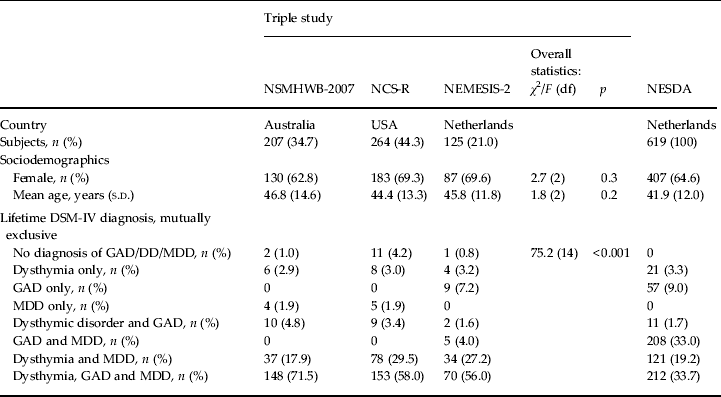
Table 1 displays the characteristics of the four surveys that contributed to the current study. The surveys that contributed to the Triple study were similar in age and gender distribution, while persons in the NESDA study were slightly older. Diagnostic differences between the Triple study and NESDA reflect differences in selection strategies. Whereas in the Triple study a small number of persons did not have a lifetime diagnosis of GAD, DD or MDD, in the NESDA study all persons had at least one lifetime diagnosis, reflecting the inclusion criteria of a 6-month diagnosis of GAD and/or DD. Likewise, persons with MDD only were absent in NESDA. Furthermore, it is noteworthy that in all surveys about 85% of the persons had a (co-morbid) MDD, illustrating the high co-morbidity rates between GAD and/or DD and MDD.
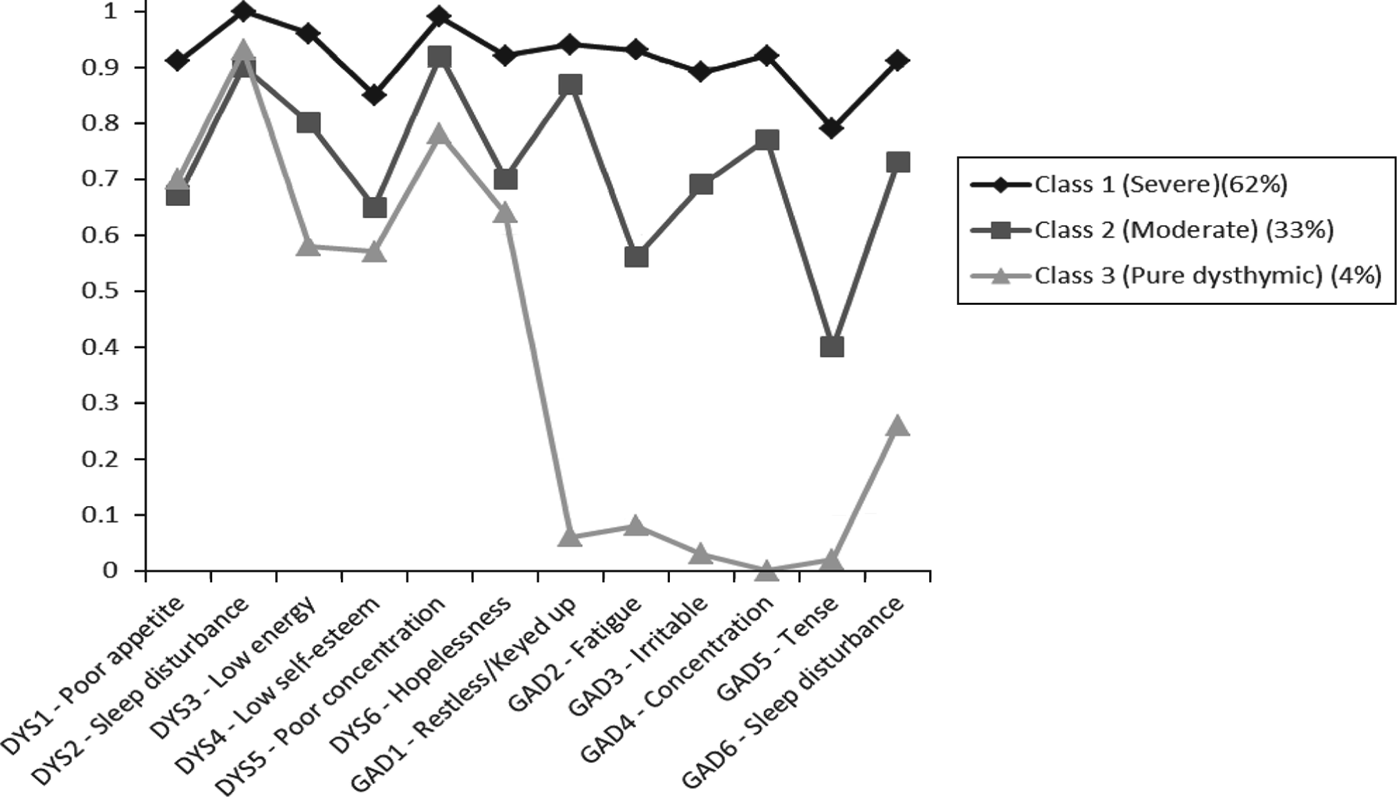
Probability of symptom endorsement by class from three population-based studies (2007 Australian National Survey of Mental Health and Wellbeing; National Comorbidity Survey Replication; and Netherlands Mental Health Survey and Incidence Study-2; together known as the Triple study).

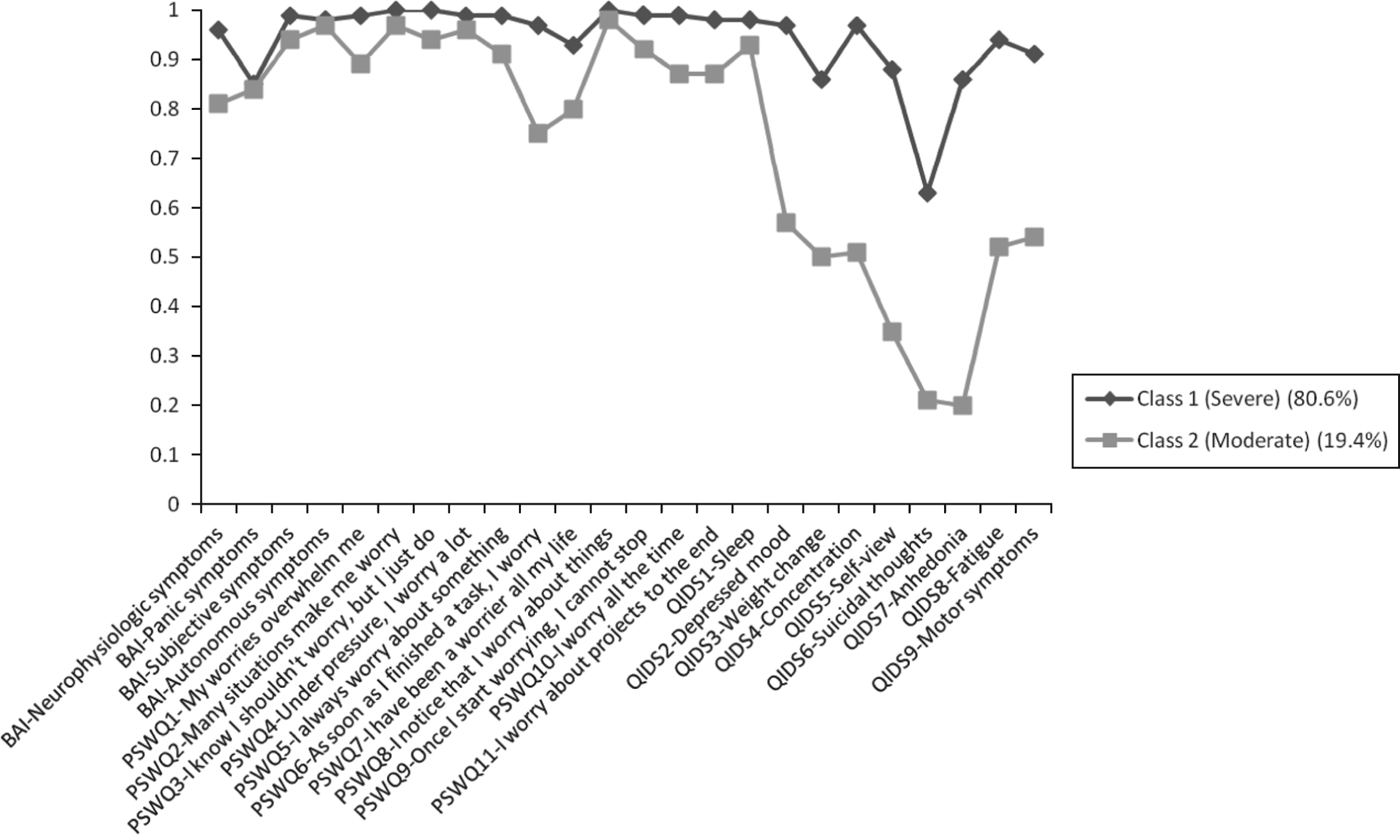
Probability of symptom endorsement by class – Netherlands Study of Depression and Anxiety (NESDA). BAI, Beck Anxiety Inventory; PSWQ, Penn State Worry Index; QIDS, Quick Inventory of Depressive Symptomatology.

Characteristics of the study populations of the Triple study (n = 596) and NESDA (n = 619)

NESDA, Netherlands Study of Depression and Anxiety; NSMHWB-2007, 2007 Australian National Survey of Mental Health and Wellbeing; NCS-R, National Comorbidity Survey Replication; NEMESIS-2, Netherlands Mental Health Survey and Incidence Study-2; df, degrees of freedom; s.d., standard deviation; DSM-IV, Diagnostic and Statistical Manual of Mental Disorders, fourth edition; GAD, generalized anxiety disorder; DD, dysthymic disorder; MDD, major depressive disorder.
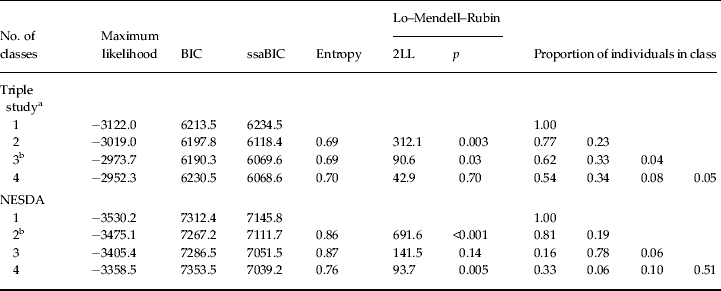
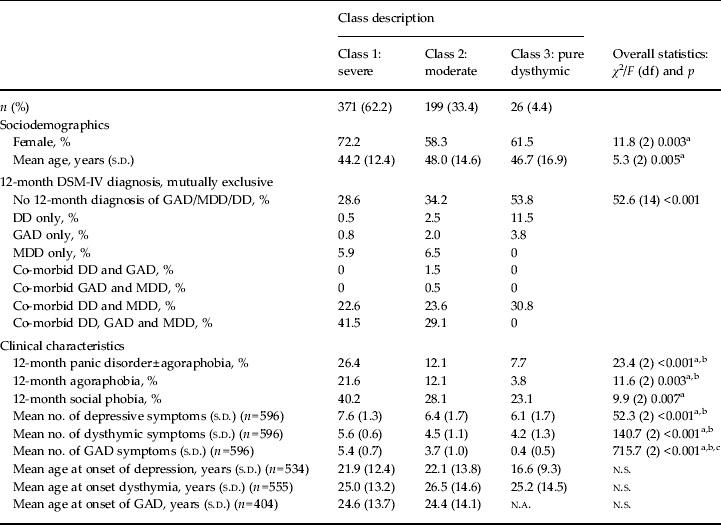
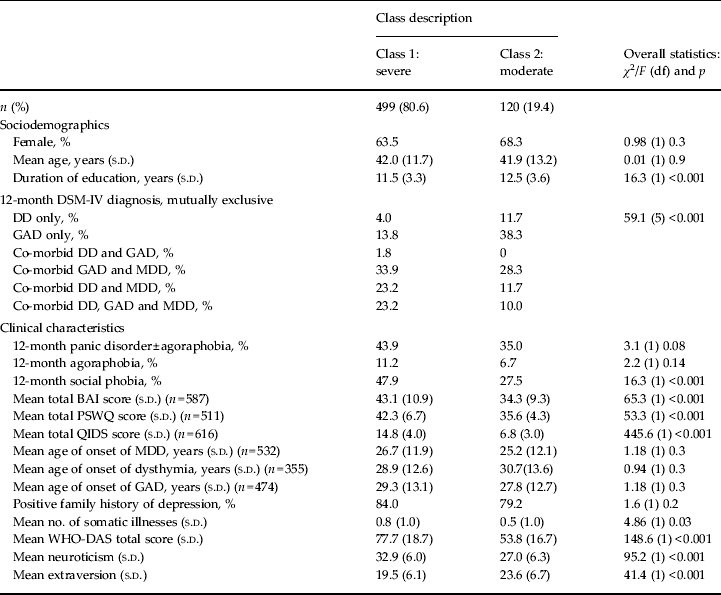
In Table 2 the parameters of fit and the proportion of individuals in each class are presented. In the Triple study, the three-class model provided the best fit for the observed data. However, class 3 consisted of only 4.4% of the respondents. Previously, it was noted that small classes (prevalence less than 5% of the sample) are considered spurious classes, a condition often associated with extracting too many classes (Hipp & Bauer, Reference Hipp and Bauer2006). However, since all parameters for fit consistently pointed at the three-class model, we decided that this model best fitted the data. Fig. 1 shows the probability of endorsement per item of the three identified latent classes in the Triple study. The first class was labeled ‘severe’ (prevalence 62.2%) and was characterized by high endorsement of both depressive and anxiety items. The second class was labeled ‘moderate’ (prevalence 33.4%) and showed a high endorsement of both depressive and anxiety items, albeit of lesser magnitude than class 1. The third class was labeled ‘pure dysthymic’ (prevalence 4.4%) and showed a low endorsement of GAD symptoms with moderate endorsement of depressive symptoms, indicating a ‘pure’ dysthymic profile. In the NESDA study, the parameters were best for the two-class model (BIC, LMR test), although ssaBIC continued to decrease across higher class models. The probabilities of endorsement per item are displayed in Fig. 2. The first class was labeled ‘severe’ (prevalence 80.6%) and was characterized by high endorsement of both depressive and anxiety items. The second class was labeled ‘moderate’ (prevalence 19.4%) and also showed a high endorsement of anxiety and worry items, albeit of a slightly lower magnitude, and a lower endorsement of depressive symptoms than class 1.
Parameters of fit of latent class analysis

BIC, Bayesian information criterion; ssaBIC, sample size adjusted Bayesian information criterion; 2LL, 2 log likelihood value; NESDA, Netherlands Study of Depression and Anxiety.
a The Triple study data are derived from three general population studies, namely (i) the 2007 Australian National Survey of Mental Health and Wellbeing, Australia, (ii) the National Comorbidity Survey Replication, USA and (iii) the Netherlands Mental Health Survey and Incidence Study-2.
b Best-fitting model.
Next, we examined the distribution of sociodemographics, DSM-IV diagnoses and clinical characteristics across the three identified latent classes (n = 596) in the Triple study (Table 3). The severe class was characterized by a younger age and a preponderance of females. Considering DSM-IV diagnoses, the classes were not characterized by a clear GAD or dysthymic profile; rather, classes were characterized by level of co-morbidity rates. There was a preponderance of pure disorders in the moderate and ‘pure dysthymic’ class, whereas the prevalence of co-morbid disorders was highest in the severe class. Triple co-morbidity (GAD, DD and MDD) was highest in the severe class, as compared with the other classes. Next, there was a gradual decrease of co-morbid anxiety disorders and number of depressive, dysthymic and GAD symptoms across the classes, with highest prevalence rates and highest symptom endorsement in the severe class (class 1) and lowest in the ‘pure dysthymic’ class (class 3). In particular, the ‘pure dysthymic’ class distinguished itself by the low endorsement of GAD symptoms (mean = 0.4, s.d. = 0.5), as compared with the two other classes.
Distribution of characteristics across the identified latent classes in the Triple study d (n = 596)

df, Degrees of freedom; s.d., standard deviation; DSM-IV, Diagnostic and Statistical Manual of Mental Disorders, fourth edition; GAD, generalized anxiety disorder; MDD, major depressive disorder; DD, dysthymic disorder; n.s., non-significant; n.a., not applicable.
Significant differences by class (p < 0.05): a class 1 versus class 2, b class 1 versus class 3, c class 2 versus class 3.
d The Triple study data are derived from three general population studies, namely (i) the 2007 Australian National Survey of Mental Health and Wellbeing, Australia, (ii) the National Comorbidity Survey Replication, USA and (iii) the Netherlands Mental Health Survey and Incidence Study-2.
Table 4 shows the distribution of characteristics across the two identified latent classes (n = 619) in the NESDA study. The classes did not differ on gender and age. Level of education was slightly lower in the severe class as compared with the moderate class. Again, we did not find classes with either greater endorsement of anxiety or depressive symptoms. An equal percentage of persons with pure GAD and persons with pure DD were allocated to the severe class (60.0% and 58.8%, respectively) (data not shown). As in the Triple study, the prevalence of pure disorders was highest in the moderate class, whereas co-morbidity rates were highest in the severe class. The severe class was further characterized by a higher number of co-morbid anxiety disorders, a higher number of anxiety, worry and depressive symptoms, a higher number of somatic illnesses, more functional impairment and a higher level of neuroticism and lower levels of extraversion. Comparisons of age at onset did not yield significantly different results.
Distribution of characteristics across the identified latent classes in NESDA (n = 619)

NESDA, Netherlands Study of Depression and Anxiety; df, degrees of freedom; s.d., standard deviation; DSM-IV, Diagnostic and Statistical Manual of Mental Disorders, fourth edition; DD, dysthymic disorder; GAD, generalized anxiety disorder; MDD, major depressive disorder; BAI, Beck Anxiety Inventory; PSWQ, Penn State Worry Index; QIDS, Quick Inventory of Depressive Symptomatology; WHO-DAS, World Health Organization Disability Assessment Schedule.
Discussion
The aim of this study was to examine whether LCA would identify subtypes characterized by varying levels of anxiety versus depressive symptomatology in persons with GAD and/or DD symptomatology. We hypothesized that different subtypes could be identified: (1) a group of people experiencing predominately GAD symptoms with some DD symptoms; (2) a group experiencing predominately DD symptoms with some GAD symptoms; (3) a group experiencing GAD and DD symptoms equally; and (4) other groups with another combination of symptoms of the two disorders. On the other hand, if GAD and DD reflect a rather homogeneous group of mildly depressed worriers, no distinct profiles should emerge from LCA. Our findings support the latter. In the Triple study three classes were identified, a severe (62.2%), moderate (33.4%) and a small class, representing ‘pure dysthymic’ cases (4.4%) with low endorsement of GAD symptoms. The clinical relevance of the latter class may be questioned due to the small percentage of the population included within this class. The other two classes merely differed in levels of severity, with equal endorsement of GAD and DD symptoms, albeit of a different magnitude. In particular, no tendency towards endorsing an anxiety or depressive symptom profile was noted.
Since the Triple study did not allow us to include pure cases, we are at risk of tautological reasoning: we excluded pure anxiety and pure depressive states and, then, accordingly, LCA did not identify specific anxiety or depressive profiles. However, our aims were modest: we only hypothesized that in persons – who positively answered both screening questions – different profiles of GAD/DD symptomatology would be encountered (if GAD and DD represent truly different disorders). This was not the case. Symptomatology only differed in level of severity. To be able to explore how both pure disorders would behave, we used the NESDA sample, enabling us to include pure cases and hence avoiding tautological reasoning.
NESDA involved measurements of anxiety, worry and depression with instruments other than the CIDI, allowing for the inclusion of pure GAD and pure DD cases. However, even in this sample with pure diagnoses, no predominantly anxiety versus depression profile could be found. A two-class model best fitted the data, reflecting similar endorsement of anxiety and worry, but different levels of severity of depressive symptoms. Besides differences in the presence of a co-morbid MDD and other severity-related indicators, such as number of symptoms and co-morbid anxiety disorders, and levels of neuroticism and extraversion, no profound differences could be found between the identified classes. Thus, results from the NESDA study underlined and extended our findings that GAD and DD do not represent truly distinct symptomatology profiles.
Comparison of the identified classes across the Triple and NESDA studies is hampered due to differences in inclusion criteria and methods. However, it is noteworthy that the severe classes in both samples appear to have similar symptom profiles. On the other hand, the moderate class in NESDA had a more anxious profile as compared with either the moderate (class 2) or pure dysthymic (class 3) class in the Triple study, possibly reflecting differences between a general population sample versus a combined population and clinical cohort.
Our results fuel debates on the nosology of DSM-IV categories of GAD and DD. Instead of distinct clinical entities, they seem to represent a group of depressed worriers. However, as Wittchen et al. (Reference Wittchen, Höfler and Merikangas1999) noted, at a subthreshold level, symptoms are shared to a substantial degree by anxiety and depressive disorders. Hence, the lack of distinct classes in the Triple study might be an artifact of assessment, i.e. that persons were derived from population-based studies with inclusion of subthreshold cases and milder, and probably more overlapping, symptomatology. However, the results of the multi-site NESDA study, in which persons fulfilled the criteria of a DSM diagnosis of GAD and/or DD, supported results from the Triple study.
Previously, the discriminant validity of GAD versus depression has already been questioned. It has been recognized that GAD and DD frequently co-occur, both in clinical and general population samples (Tyrer et al. Reference Tyrer, Seivewright and Johnson2003). In the previous 1997 NSMHWB 17.7% of persons with 1-month diagnosis of GAD also had a 1-month diagnosis of DD (OR 6.8, 95% confidence interval 2.0–23.4) (Hunt et al. Reference Hunt, Issakidis and Andrews2002). In NCS data almost 40% of persons with lifetime GAD had also DD (Wittchen et al. Reference Wittchen, Zhao, Kessler and Eaton1994). In an Australian adult twin sample 58% of persons with lifetime GAD had a co-occurring DD (Andrews, Reference Andrews1996). In addition, it has been argued that GAD has a greater affinity for DD than for anxiety disorders (Krueger, Reference Krueger1999; Vollebergh et al. Reference Vollebergh, Iedema, Bijl, De Graaf, Smit and Ormel2001). Others (Clark et al. Reference Clark, Beck and Beck1994) had difficulties differentiating between GAD and DD by symptomatology.
However, results are inconsistent. Kessler (Reference Kessler2000) noted that family studies show distinct aggregation of GAD and depression, and environmental determinants of GAD and MDD differ, all supporting the view that GAD and depression are distinct diagnostic entities. To what extent this accounts for GAD and DD remains to be settled. Likewise, Beesdo et al. (Reference Beesdo, Pine, Lieb and Wittchen2010) demonstrated that temporal longitudinal patterns of GAD are more closely related to anxiety disorders than to depressive disorders, suggesting the grouping of GAD with anxiety disorders.
To date, several studies on the structure of psychopathology have been conducted. Two main models elaborate on the position of both GAD and DD. First, in the Nottingham Study of Neurotic Disorder, Tyrer et al. (Reference Tyrer, Seivewright and Johnson2004) demonstrated the poor temporal stability of GAD, panic disorder, MDD and DD conditions, once collectively described as neurotic disorders. They concluded that the outcomes give some support to the notion of the general neurotic syndrome – a coaxial diagnosis of mixed anxiety and depression and personality pathology (Tyrer et al. Reference Tyrer, Seivewright and Johnson2003, Reference Tyrer, Seivewright and Johnson2004). Second, a two-dimensional structure of internalizing and externalizing disorders has been demonstrated (Krueger, Reference Krueger1999; Vollebergh et al. Reference Vollebergh, Iedema, Bijl, De Graaf, Smit and Ormel2001; Olino et al. Reference Olino, Klein, Farmer, Seeley and Lewinsohn2012). In addition, some argued that internalizing spectrum disorders can be further divided into the subdimensions of ‘anxious–misery’, consisting of MDD, DD and GAD, and ‘fear’, consisting of more specific anxiety disorders (phobic disorders, agoraphobia and panic disorder) (Krueger, Reference Krueger1999; Vollebergh et al. Reference Vollebergh, Iedema, Bijl, De Graaf, Smit and Ormel2001; Olino et al. Reference Olino, Klein, Farmer, Seeley and Lewinsohn2012), although the distinction between the ‘anxious–misery’ and ‘fear’ dimensions could not be fully replicated by others (Vaidyanathan et al. Reference Vaidyanathan, Patrick and Iacono2011). A striking feature of all these data-driven models is the suggestion to aggregate GAD and DD.
Strengths and limitations
To our knowledge, this is the first study to empirically examine the nosological status of GAD versus DD. Despite the high co-occurrence of GAD and DD, and irrespective of their shared historical roots in the concept of neurosis, the majority of studies have focused on the nosological status of GAD versus MDD. The aggregation of three major general population samples from three different continents enabled us to perform LCA on a sufficient number of participants. Furthermore, NESDA provided more severe cases and a higher number of pure diagnoses. The combination of both the Triple study and NESDA enabled us to examine the full range of subthreshold to severe cases.
Despite these main advantages, the results of our study should be interpreted in the context of the following limitations. First, in the Triple study we were not able to include pure cases of GAD and DD. Pure GAD or pure DD cases did not endorse both CIDI entry questions, resulting in automatic partition of the respondents into either the GAD or DD section and, consequently, missing values for LCA. This selection bias may have prevented the detection of predominantly anxiety or depressive subtypes in the Triple study. In addition, lifetime symptoms were included in the Triple study and, thus, temporal occurrence of symptoms may have influenced the results. As previously demonstrated (Lamers et al. Reference Lamers, van Oppen, Comijs, Smit, Spinhoven, van Balkom, Nolen, Zitman, Beekman and Penninx2011), anxiety disorders tend to occur prior to depressive disorder. Hence, if respondents had symptoms mainly of anxiety at one point, and then shifted to depression, these two distinct symptom patterns would be detected by LCA – based on lifetime symptomatology – as an anxious/depressed symptom profile. However, the NESDA study was based on 6-month diagnoses, assuming current symptomatology. In addition, both the BAI and QIDS-SR assessed anxiety and depression during the last week prior to assessment. Hence, insight into current symptomatology was provided. Next, LCA assumes the independence of items. Considering the CIDI items of GAD and DD, the high degree of similarity in diagnostic criteria might result in interdependence of items. However, previously, it was demonstrated that the endorsement of CIDI symptoms of MDD were not significantly influenced by the presence of co-morbid GAD (Sunderland et al. Reference Sunderland, Mewton, Slade and Baillie2010). Hence, we assumed sufficient discriminative power to detect possible class differences between GAD and DD. Next, the aggregation of data from three different national cohorts contains the risk of introducing bias due to differences in survey design and methods. This resulted in the availability of only a limited number of putative validators of the identified classes, mainly derived from the CIDI interview. We cannot exclude the possibility that qualitative differences between the identified classes would emerge under consideration of more or other factors. However, the benefit of aggregation of three community-based samples, resulting in sufficient numbers for LCA, outweighs the negatives. Finally, previously the BAI has been disputed for its bias towards measurement of symptoms linked to panic (Cox et al. Reference Cox, Cohen, Direnfeld and Swinson1996) and lack of power to discriminate between anxiety and depression (Muntingh et al. Reference Muntingh, Van der Feltz-Cornelis, Van Marwijk, Spinhoven, Penninx and Van Balkom2011), although inconsistent results exist (Beck et al. Reference Beck, Epstein, Brown and Steer1988). To what extent this might have obscured differences between GAD and DD remains unclear. However, the ability of the PSWQ to discriminate between GAD and depression has previously been demonstrated (Meyer et al. Reference Meyer, Miller, Metzger and Borkovec1990; Chelminsiki & Zimmerman, Reference Chelminski and Zimmerman2003), suggesting that the absence of distinct profiles in LCA is not due to insufficient discriminative power of the instruments used.
To conclude, utilizing data from three general populations and an independent cohort study, LCA was able to determine that the majority of persons within the population can be classified as cases that experience prolonged feelings of mildly depressed worry. Any new classification system that does not accommodate an anxiety/depression syndrome, so prevalent in primary care, is unhelpful and unrealistic. This finding is of great clinical significance. Prevention and intervention programs should be targeting both depressive and worry symptoms to optimize treatment for persons currently categorized as GAD or DD.
Acknowledgements
We greatly acknowledge the National Comorbidity Survey Replication for releasing a public use version of their dataset. The 2007 Australian National Survey of Mental Health and Wellbeing was funded by the Australian Department of Health and Ageing and conducted by the Australian Bureau of Statistics. NEMESIS-2 is conducted by the Netherlands Institute of Mental Health and Addiction (Trimbos Institute) in Utrecht with financial support from the Ministry of Health, Welfare and Sport. The infrastructure for the NESDA study (www.nesda.nl) is funded through the Geestkracht program of the Netherlands Organization for Health Research and Development (ZonMw, grant no. 10–000–1002) and is supported by participating universities and mental health care organizations [VU University Medical Center, GGZ inGeest, Arkin, Leiden University Medical Center, GGZ Rivierduinen, University Medical Center Groningen, Lentis, GGZ Friesland, GGZ Drenthe, IQ Healthcare, Netherlands Institute for Health Services Research (NIVEL) and Netherlands Institute of Mental Health and Addiction]. D.R. was supported by a grant from the Dr Catharine van Tussenbroek Fonds. M.S. was supported by a National Health and Medical Research Council (NHMRC) Capacity Building Grant (no.568 940). F.L. was supported by a Rubicon Fellowship from the Netherlands Organization for Scientific Research (NWO).
Declaration of Interest
None.