Introduction
Persons suffering from chronic illnesses or other medical conditions,Reference Davis, Wilson and Brock-Martin 1 - Reference Ford, Mokdad and Link 5 the elderly,Reference Fernandez, Bayard and Lin 6 , Reference Aldrich and Benson 7 poor, and medically underservedReference Davis, Wilson and Brock-Martin 1 , Reference Mack, Brantley and Bell 8 - Reference Kleinpeter 10 are more susceptible to the negative impacts a disaster may have on the health care system. Access to routine health care, a healthy supply of prescription medications, and functioning medical equipment can be particularly challenging for these at-risk populations during a major disaster.Reference Mokdad, Mensah and Posner 11 - Reference Morrow 13 Compared to their healthy counterparts, members of these populations stand to suffer more from losing access to food and clean water and being exposed to extreme temperatures. They are also at greater risk for postdisaster injuries.Reference Fernandez, Bayard and Lin 6 These populations merit special consideration when health care facilities and organizations prepare for and respond to disasters.
The US Veterans Health Administration (VHA) is the largest health care system in the US, with more than eight million veteran enrollees and 153 medical centers located throughout the United States and in Puerto Rico. Compared to the general US population, veterans tend to be older.Reference Koepsell, Reiber and Simmons 14 Veterans Health Administration users are more likely to suffer from multiple health conditions; 15 - Reference Agha, Lofgren, Van Ruiswyk and Layde 17 hence, a disaster, such as an earthquake, might have a more pronounced impact for this population.
The Northridge earthquake took place on January 17, 1994 and was classified as a 6.7 magnitude event affecting over 2,100 square miles. It caused extensive damage to buildings, utilities, and roadways,Reference Peek-Asa, Kraus and Bourque 18 with an approximate cost of $25 billion.Reference Eguchi, Goltz and Taylor 19 Even though the Northridge earthquake has been classified as a low-impact disaster,Reference Norris, Friedman and Watson 20 with 75 deaths and roughly 11,846 injured persons with minimal effects on mental health,Reference Knight, Gatz, Heller and Bengtsoon 21 - Reference Ullman and Newbomb 24 serious injury did occur among some Californians. The risk of serious injury was also higher among patients aged 60 or older,Reference Mahue-Giangreco, Mak, Seligson and Bourque 25 after controlling for demographic factors. These findings highlight the vulnerability of the elderly during an earthquake. With the exception of two studies that used the same data as this study,Reference Dobalian, Stein and Heslin 26 , Reference Heslin, Stein and Dobalian 27 prior work on the Northridge earthquake has looked at a geographically diverse sample rather than one located close to the epicenter of the earthquake. These studies also used data collected more than six months post earthquake, a potentially significant period of time after the actual event.Reference Knight, Gatz, Heller and Bengtsoon 21 , Reference Siegel, Shoaf and Bourque 23 , Reference Ullman and Newbomb 24 This study focuses on the Sepulveda Veterans Affairs Medical Center (VAMC) located in Los Angeles, California USA, which was in close proximity to the epicenter of the Northridge earthquake and experienced significant physical damage. The center was evacuated quickly with no injuries or deaths.Reference Chavez and Binder 28 However, the facility's ability to deliver health services was disrupted for months after the earthquake. This study is based on a pre-post design utilizing data collected from a male veteran patient cohort from the Sepulveda VAMC who were interviewed up to one year prior to the earthquake, and were contacted again three months post earthquake to complete a follow-up questionnaire. The objective of this study was to investigate pre-earthquake characteristics by self-reported burden of illness, and to examine the relationship between pre-earthquake burden of illness and postearthquake health-related and personal preparedness factors among veterans: the elderly, chronically ill, and medically underserved.
Methods
Setting and Sample
As part of the evaluation, which took place prior to the earthquake, the Primary Ambulatory Care and Education (PACE) program provided integrated care to more than 19,000 veterans from a catchment area around the Sepulveda VAMC. The VAMC was located two miles from the epicenter of the earthquake. Immediately after the earthquake, PACE program evaluators developed a survey to assess the impact of the earthquake on veterans who received care at the Sepulveda location, and to disseminate information on how to obtain assistance from the VAMC or other agencies. Data for this study were collected from the same respondents prior to (March - June 1992) and one to three months following (February - April 1994) the January 1994 Northridge earthquake.
As part of this evaluation, patients were approached consecutively at the check-in desks of the PACE program clinics at randomly selected days and times. Eligible individuals participated in a structured, face-to-face interview about their service utilization, sociodemographic characteristics, and health status. The 1,800 individuals who participated in the program evaluation were a subgroup of approximately 11,000 patients who participated in the PACE program during 1992. Male, English-speaking, continuing clinic patients who had at least one prior Sepulveda VAMC clinic visit in the previous 12 monthsReference Lee, Yano and Wang 29 were recruited for the survey, excluding those who were hearing-impaired, in acute distress, showing signs of memory loss, or homeless. Starting approximately four weeks after the earthquake, trained interviewers made up to six attempts to contact VA PACE program participants for whom there was pre-earthquake data available in order to administer the Post Earthquake Health and Needs Assessment Survey by telephone. The study was approved by the VA Greater Los Angeles Healthcare System Institutional Review Board.
The Northridge earthquake data set includes 1,482 pre-earthquake respondents and 1,144 postearthquake survey respondents. For the purposes of this paper, the analytic sample includes 1103 pre- and postearthquake survey participants (ie, those who had both pre- and postearthquake data) with nonmissing pre-earthquake burden of illness data. Respondents with both pre- and postsurvey data were compared to respondents who did not have postearthquake data to assess nonresponse bias. There were no statistically significant differences between these two groups in terms of race, education, whether they had paying jobs, and whether they received veteran's disability payments. The only statistically significant differences were between marital status (P < .001) and annual household income (P < .01). Respondents with both pre- and postearthquake data were more likely to be married (51% vs 32%), and to report annual household income of $15,000 (in 1994 US dollars; $23,634 in 2013 US dollars) or higher (40% vs 30%), compared to respondents who did not have postearthquake data.
Measures
In this study, survey variables collected pre-earthquake included: socioeconomic and demographic characteristics (race, age, marital status, education, household income, employment status, and receiving veteran's disability payment), burden of illness, and functional status. All sociodemographic variables were dichotomized (eg, white vs non white; 60 years or older vs younger than 60 years; married vs not married; 12 years of education or less vs some college or more; annual household income <$15,000 vs ⩾ $15,000; employed vs not employed; receiving Veteran's disability payment vs not). The burden of illness variable was constructed by summing the number of illnesses reported from a list consisting of cancer, diabetes, arthritis, depression, stroke, and heart attack, and then dividing the range into three categories: none, one illness, and two or more illnesses. Functional status was assessed using the Functional Status Questionnaire (FSQ) basic activities of daily living (ADL) subscale which includes three physical function items: (1) taking care of yourself, (eg, eating, dressing or bathing); (2) moving in and out of a bed or chair; and (3) walking indoors such as around your home. Functional Status Questionnaire scores range from 0-100, with higher scores indicating better functioning.Reference Jette, Davies and Cleary 30 Mental health status was assessed using the 5-item Mental Health Inventory (MHI-5) screening test which includes the following five questions: [how much of the time during the past four weeks] (1) have you been a very nervous person; (2) have you felt calm or peaceful; (3) have you felt down hearted and blue; (4) were you a happy person; and (5) have you felt so down in the dumps that nothing could cheer you up. The response categories varied from “all of the time” to “none of the time.” Two scale items were reverse coded and all five items were summed to create the MHI-5 scale where high scores indicate good mental health (scale range: 5-30).Reference Ware and Gandek 31
Postearthquake variables consisted of: minor physical injury (“As a result of the earthquake, did you have any of these problems: a minor injury such as small cut or bruise?”); pain (“As a result of the earthquake, did you have any of these problems: pain present for at least two days?”); emotional stress (“As a result of the earthquake, did you have any of these problems: severe mental and emotional stress for two weeks or more?”); loss of medical equipment (“Do you have medical equipment that was broken or lost during the earthquake, for example, a wheelchair, a hearing aid or eyeglasses?”); problems with prescription refills (“Because of the earthquake, did you have any difficulty refilling your medications or didn't you need any refills?”); access to medical care (“Since the earthquake, did you try to get medical help for yourself but were unable to?”); and not having enough food (“Because of earthquake, were you without enough food to eat for a period of 24 hours or more?”); or not having enough water (“Because of earthquake, were you without enough water to drink for a period of 24 hours or more?”).
Statistical Analysis
The relationship between pre-earthquake burden of illness and postearthquake variables was assessed using chi-square and F tests. For unadjusted significant findings, multivariate logistic regressions were conducted adjusting for age and FSQ basic ADL. Multivariate logistic regression was used to calculate the predicted probability of specific postearthquake health-related variable (ie, pain, emotional stress, difficulty refilling medications, loss of medical equipment, and unable to get medical help) for the three burden of illness groups, adjusting for age and FSQ functional status basic ADL. Additional multivariate logistic regression analyses controlling for the effects of other demographic variables (such as race and marital status), socioeconomic indicator (education, household income, and employment status), and other health indicators (VA disability status) also were conducted. The results from these additional analyses were very similar to the original model that included age and FSQ basic ADL; as such, the results from the age and FSQ model are presented in this paper. Statistical significance was set at P < .05. Stata version 12 (StataCorp LP, College Station, Texas USA) was used for all statistical analyses.
Results
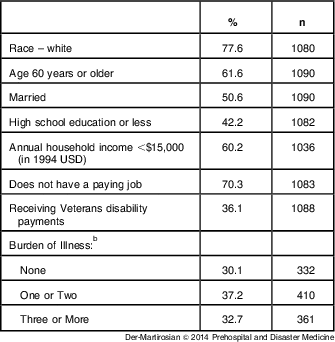
The analytic sample of male veterans (N = 1103) was predominately white (78%). More than half (62%) were 60 years or older, and approximately half were married (51%). Less than two-thirds (60%) reported an annual household income of <$15,000 (in 1994 U.S. dollars); about three-fourths (70%) were not employed; and less than half (42%) had a high school education or less. As for burden of illness, 30% reported having none of the specified illnesses, 37% had one, and 33% had two or more illnesses (see Table 1).
Sociodemographic Characteristics of the Analytic SampleFootnote a of Male Veterans in the US Department of Veterans Affairs Primary Ambulatory Care and Education (PACE) Program

a Analytic sample consisted of pre- and post-Northridge earthquake respondents with nonmissing pre-earthquake burden of illness data; N = 1103.
b Includes: cancer, diabetes, arthritis, depression, stroke, and heart attack.
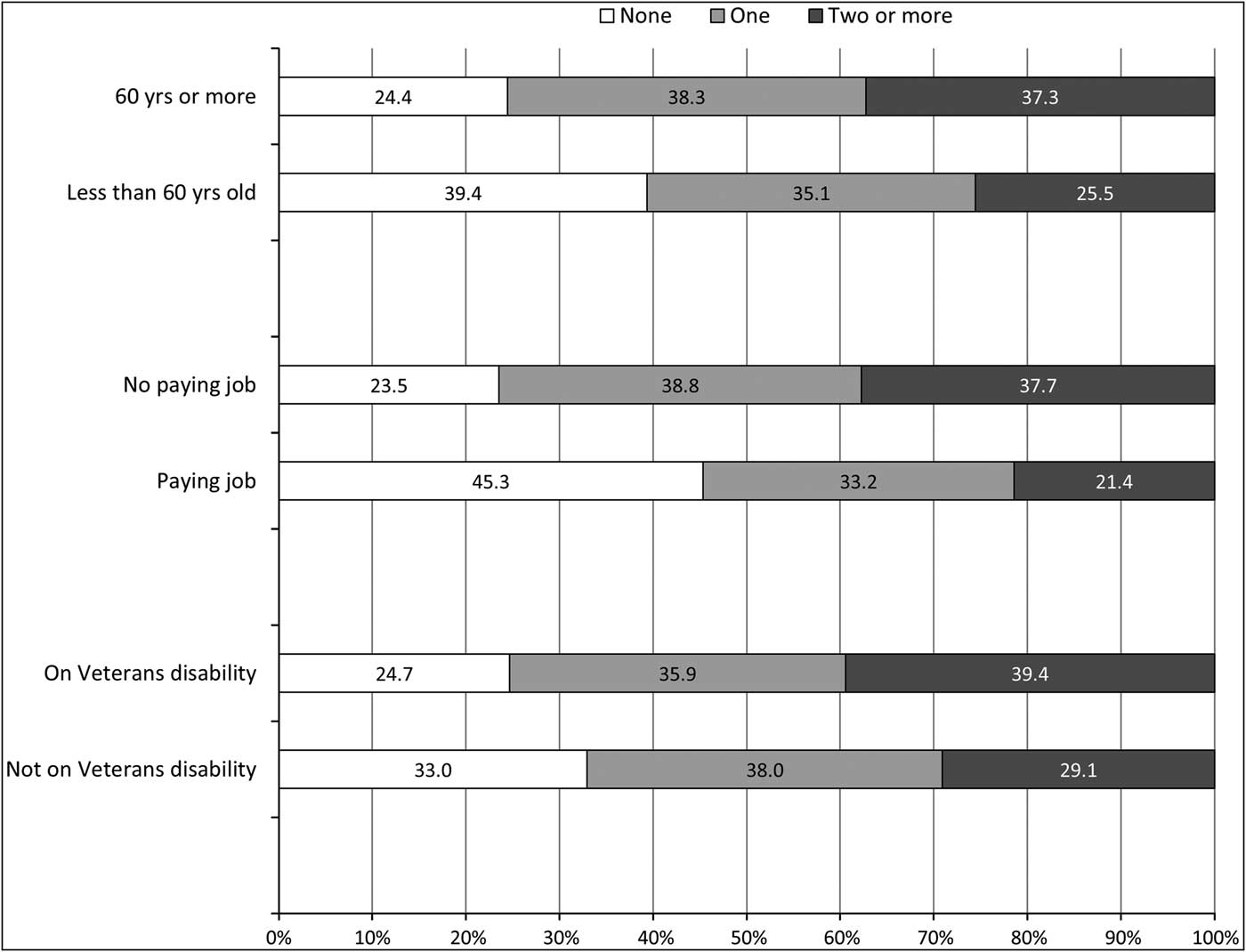
Figure 1 displays statistically significant sociodemographic characteristics by pre-earthquake burden of illness (age, employment status, and veteran's disability payment). Among male veterans 60 years or older, 37% had two or more illnesses, whereas among younger male veterans (under 60 years of age), 26% had two or more illnesses. The association between age and burden of illness for male veterans before the Northridge earthquake was statistically significant (P < .0001). Among unemployed male veterans, 38% had two or more illnesses, whereas among employed male veterans, 21% had two or more illnesses. The association between employment status and burden of illness was also significant (P < .0001). Among male veterans receiving VA disability, 39% had two or more illnesses compared to 29% of male veterans not receiving VA disability. The association between veteran's receipt of disability payment and burden of illness was significant (P = .001).
Select Demographic Characteristics by Number of Illnessesa,b
aIncludes: cancer, diabetes, arthritis, depression, stroke, and heart attack.
bN = 1098, P = .0001.

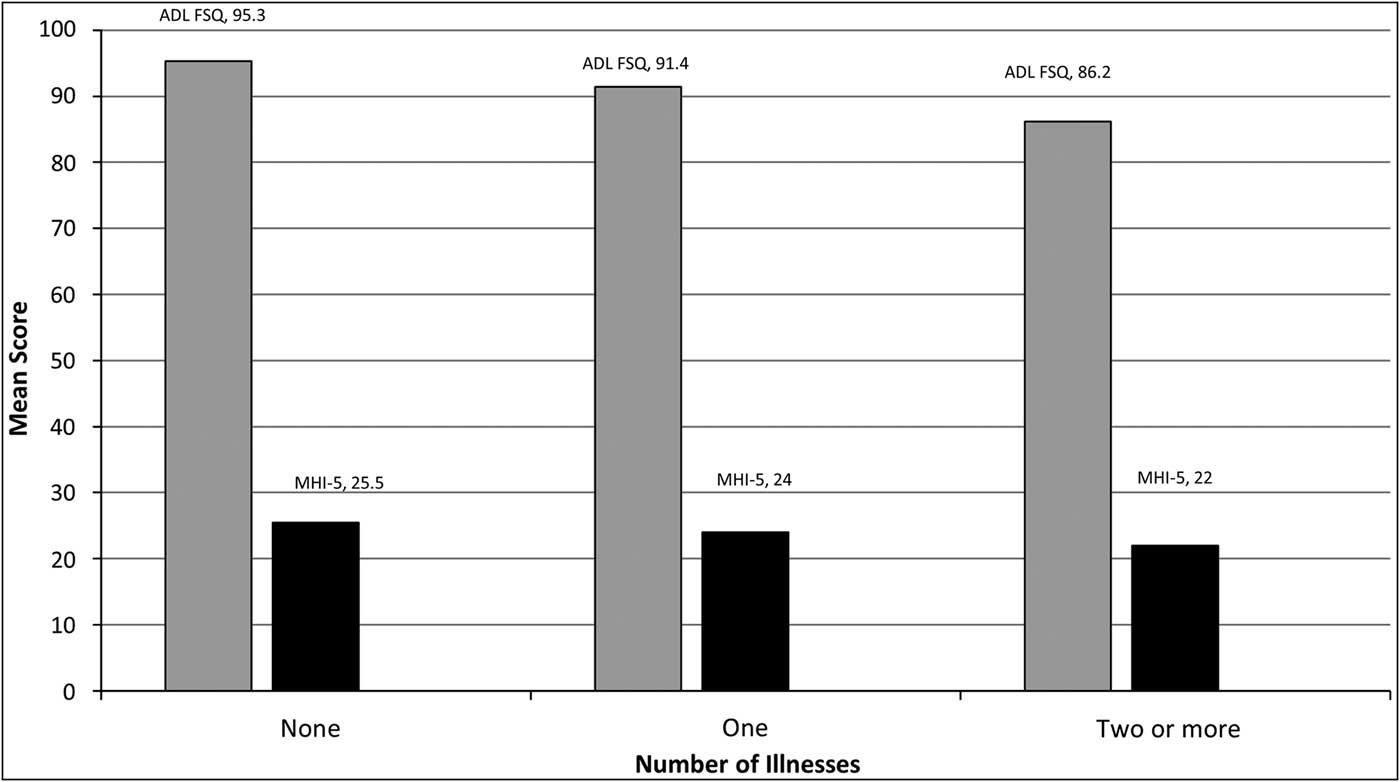
As shown in Figure 2, pre-earthquake mean scores on the FSQ basic ADL scale and Mental Health Index score (MHI-5) were significantly associated with pre-earthquake burden of illness. Veterans with no burden of illness had higher functional status (mean = 95.3, SD = 13.4) and higher MHI-5 (mean = 25.5, SD = 3.8) compared to those who had one illness (mean score (SD); FSQ: 91.4 (14.8); MHI-5: 24.0 (4.9)) versus the group with two or more illnesses (mean score (SD); FSQ: 86.2 (17.3); MHI-5: 22.0 (5.9)) (Ps < .0001).
Mean Activities of Daily Living (ADL) Functional Status Questionnaire (FSQ) and Mental Health Index Score (MHI-5) by Number of Illnessesa
aIncludes: cancer, diabetes, arthritis, depression, stroke, and heart attack.
bN = 1083, P < .0001.

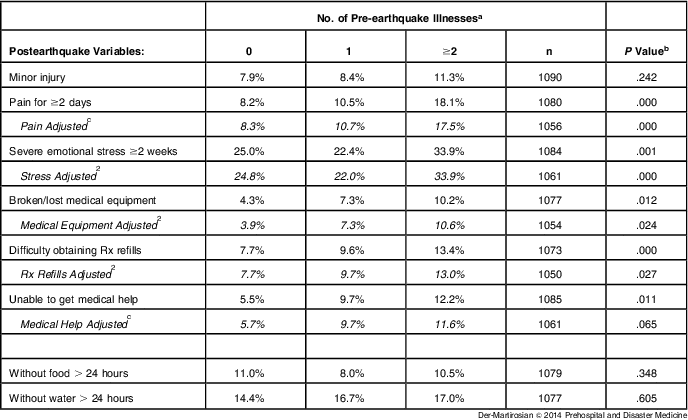
Table 2 displays bivariate associations between veterans’ burden of illness by postearthquake health-related and preparedness variables. Among male veterans with two or more pre-earthquake illnesses, 18% reported having pain for at least two days post earthquake compared to 11% for male veterans with one illness and 8% with no illness. For emotional stress (at least two weeks post earthquake), the respective figures for two or more illnesses, one illness, and no illness were 34%, 22% and 25%. The association between burden of illness and postearthquake problems with pain was statistically significant (P < .0001), as was the association between pre-earthquake illness and severe mental/emotional stress as a result of the earthquake (P = .001). In both cases, more illness before the earthquake was associated with experiencing pain and stress following the quake.
Analyses of Pre-earthquake Burden of Illness by Postearthquake Health-related and Preparedness Variables

aIncludes: cancer, diabetes, arthritis, depression, stroke, and heart attack.
bFor unadjusted percents, the P values are based on chi-square analyses. For adjusted percents, the P values are based on logistic regression analyses.
cAdjusted for: age, Functional Status Questionnaire (FSQ), and basic activities of daily living (ADL). Adjusted percents are reported for unadjusted bivariate significant findings only.
Among male veterans with two or more illnesses, 12% were unable to obtain medical help. The percentages of veterans unable to obtain medical help for one illness and no illness were 10% and 6%, respectively (see Table 2). Similarly, among male veterans with two or more illnesses, 13% had difficulty refilling medications compared to 10% (one illness) and 8% (no illness). As for loss of medical equipment post earthquake, the respective figures for the three groups were 10%, 7%, and 4%. Greater burden of illness was significantly associated with being unable to obtain medical help (P = .011), having difficulty refilling medications (P < .0001), and loss of medical equipment post earthquake (P = .012).
The percentages of specific postearthquake health-related variables for the three burden of illness groups after adjusting for age and FSQ functional status basic ADL were statistically significant for pain (P < .0001), stress (P < .0001), loss of medical equipment (P < .05) and difficulty refilling medications (P < .05) (Table 2). As for the preparedness measures, approximately 10% of respondents said they were without enough food for 24 hours or more, and 16% reported being without drinking water for the same period of time; however, this did not vary significantly by burden of illness (see Table 2).
Discussion
The number of major injuries and deaths associated with earthquakes varies greatly across events and locations. In Southern California, these numbers are relatively low compared to similar events in developing nations, even when considering the 75 deaths attributed to the Northridge earthquake of 1994. Nevertheless, earthquakes and other disasters impact the health of community members in a variety of other ways, some of which can result in serious and long-term deleterious effects.Reference Bartels and VanRooyen 32 The elderly, poor, and people with disabilities and chronic illnesses are especially vulnerable to disaster-induced morbidity. Even before a disaster occurs, these individuals often comprise the communities with greatest health-related needs and often have fewer resources with which to prepare for a disaster or emergency.
According to this study, male veterans burdened with chronic illnesses were more likely to have lower physical functional status as well as poorer mental health. Compared to younger, employed, and nondisabled veterans, this study found that older, unemployed, and disabled male veterans were more likely to be burdened by chronic conditions prior to the 1994 Northridge earthquake. With regard to the associations between pre-earthquake and postearthquake personal health-related preparedness, male veterans with chronic conditions were more likely to report having broken or lost medical equipment, difficulty refilling prescriptions, and being unable to obtain medical help following the earthquake. They also reported neglected physical pain that lasted for two or more days, and severe mental/emotional stress that lasted two or more weeks. As such, male veterans who were burdened with one or more chronic conditions were more vulnerable to the impacts of a disaster.
These findings mirror those of previous studies; having an adequate supply of medications and access to routine health care and functioning medical equipment can be challenging for these high- risk populations following any major disaster.Reference Davis, Wilson and Brock-Martin 1 - Reference Dobalian, Tsao, Putzer and Menendez 3 , Reference Fernandez, Bayard and Lin 6 , Reference Mokdad, Mensah and Posner 11 , Reference Morrow 13 There was no association between burden of illness and having enough food or water for at least 24 hours for this sample of male veterans. Regardless of their health status, this group of veteran men seemed to be somewhat prepared, in that they reported having a 24-hour supply of food or water post event. These findings suggest a need to improve personal preparedness around health conditions, but a less-pronounced need for educational efforts aimed at simply having an adequate supply of food and water.
In a recent study, Claver et al applied the biopsychosocial model to assessing the impact of hurricanes Katrina and Rita on the evacuation of elderly veterans in VA nursing homes. Claver et al connect “behavioral and social support needs to the overall greater burden of chronic diseases and age-related physical, psychological and social changes associated with nursing home residents” by arguing that assessment of the vulnerability of any population during disasters should include an examination of the physical, psychological, and social aspects of individuals.Reference Claver, Dobalian and Fickel 33 This idea is illustrated by the postearthquake experiences of older male veterans burdened with chronic conditions affected by age-related physical and psychological changes associated with the Northridge earthquake. Accordingly, future disaster plans should attempt to meet the comprehensive needs of vulnerable populations such as veterans burdened with chronic diseases.
Over the intervening years since the Northridge earthquake, there also have been significant changes in care the VHA provides, both at the Sepulveda site and on a broader level. Due to damage caused by the earthquake, as well as the health care industry's move toward providing more care on an outpatient basis, the Sepulveda VAMC was rebuilt and became the Sepulveda Ambulatory Care Center (ACC). As of July 2013, the Sepulveda ACC had 15,135 active primary care patients. 34 Changes in the larger VHA health care system have included the addition of many features to the electronic medical record system to better track patients and their health care needs. There also has been a growing need to treat chronic health conditions and to address conditions such as posttraumatic stress disorder, traumatic brain injury, and rehabilitation for patients with prosthetics. All of these conditions contribute to the medical, physical, and emotional vulnerability of patients following a disaster.
To avoid or minimize medical complications following a disaster, efforts to ensure that vulnerable groups burdened with chronic illnesses receive the medical equipment and medications they require are paramount. The negative consequences that result from a disruption of access to simple, everyday use items is often underestimated. Prescription eye glasses rendered unusable because they are either broken or lost may leave a person vulnerable to injury. Similarly, a disruption in medication could lead to the manifestation of otherwise controlled conditions such as seizures and heart attacks. Health care providers, including both individual providers and large organizations like the VHA, are aware of their patients’ special health care needs and have ongoing relationships with many of these patients. These relationships provide opportunities to strengthen preparedness through education and to improve access to medical supplies. These relationships also potentially provide opportunities for health care providers to proactively plan for ways to assist these individuals with their health care needs following a disaster. Focusing education and outreach efforts on ensuring an adequate supply of medications and the availability of functioning medical equipment, as well as developing and strengthening systems to provide both on an as-needed basis following a disaster, should lessen the burden that these vulnerable groups confront during times of national emergencies and disasters.
Limitations
There are strengths and limitations to this study. Even though the data used in this study were 18 years old, the study design is fairly unique in disaster research. The opportunity to conduct this type of research is limited due to the unpredictable nature and relatively rare occurrence of large, damaging earthquakes in densely-populated areas of the United States. The primary strength of the study design is that it used pre- and postearthquake data collected shortly after the event on the same cohort of Sepulveda VAMC male veterans; this was an improvement over the majority of other studies on the Northridge earthquake most often conducted six or more months post earthquake.Reference Knight, Gatz, Heller and Bengtsoon 21 , Reference Siegel, Shoaf and Bourque 23 , Reference Ullman and Newbomb 24 This study also benefited from having postearthquake data from a location close to the epicenter, in contrast to many prior studies.
There were several limitations to this study. The study sample may not be representative of the Sepulveda VAMC patient population in 1994 since a consecutive visit-based sampling strategy was used to select the study cohort. As Lee at al state, “sampling of consecutive visitors will typically under-represent low users of care,” and in the case of this study, the sample is representative of the Sepulveda VAMC male patient population visiting four or more times a year. Another limitation of this study is that this data set was over 18 years old; however, since Southern California has not experienced a large earthquake since then, there have been limited incidences to investigate. Moreover, it is likely that the identified gaps can still be applied today. Future studies should also include the experiences of women veterans since more women serve in the military and become veterans now than they did 18 years ago; women veterans may differ from male veterans in their postdisaster needs.
Conclusion
The relationship that exists between health care providers, including both individual providers and organizations like the VA, and their vulnerable, chronically-ill patients affords providers the unique opportunity to deliver critical assistance that could make this vulnerable population better prepared to meet their postdisaster health-related needs. This can be accomplished through education about preparedness and the provision of easier access to medical supplies. Disaster plans for those who are burdened with chronic conditions should meet their social needs in addition to their psychological and physical needs.
Acknowledgments
This material is based upon work supported by the Department of Veterans Affairs, Veterans Health Administration, Office of Public Health, and the Department of Veterans Affairs, Western Region. The views expressed in this article are those of the authors and do not necessarily reflect the position or policy of the Department of Veterans Affairs or the US government. The data for this paper was prepared by Michael Mitchell, PhD, the lead statistician at VEMEC.