Introduction
Based upon estimates of the rise in numbers of people living with dementia (Comas-Herrera et al., Reference Comas-Herrera, Wittenberg, Pickard and Knapp2007), growing numbers of the population and thus members of caring or human services’ professions will have personal family experience of a person with dementia and will possibly be providing care for them. Using the accounts of a range of dementia care practitioners in England, this paper investigates reported interactions of personal and professional experiences. The accounts were collected as part of an investigation into the implementation and operations of the Mental Capacity Act (MCA) 2005 in England, and elements of the Act formed the focus of the interviews. There is a tendency to see professional and personal experiences of caregiving as separate, and practitioners are sometimes depicted as not always being aware of family carers’ needs or wishes. This paper provides new evidence that some practitioners reflect on their dual identities and make connections between their personal and professional lives. This may be relevant to training and education, to practice and supervision, and to research.
There is long-standing evidence that decisions to join the caring or human services’ professions may be influenced by personal or family experiences of adversity or caring (Parker and Merrylees, Reference Parker and Merrylees2002). For example, social work student motivations are influenced by personal, professional, or political considerations (Christie and Kruk, Reference Christie and Kruk1998; Wilson and McCrystal, Reference Wilson and McCrystal2007). Stevens et al. (Reference Stevens2012) found that altruistic motivations to join the social work profession, often influenced by personal experiences, were the most important motivations among social work students in England.
While prior caregiving experiences may influence career considerations and decisions, becoming a family carer is more likely to occur while a person is part of the labor force. Taking dementia care work specifically, working family carers of both genders are clustered in lower level jobs such as practitioners in care homes and home care rather than being clinical professionals. Yeandle et al. (Reference Yeandle, Bennett, Buckner, Shipton and Suokas2006) noted that among men and women aged under 45 years in the UK, rates of family caring are highest among those in personal service occupations, and lowest among professional workers. Taking on caring roles and responsibilities may be so stressful that carers leave the labor force (Arksey, Reference Arksey2003; Arksey et al., Reference Arksey, Kemp, Glendinning, Kotchetkova and Tozer2005). An estimated one in five UK carers give up work to care for family members, with many more reducing their hours or foregoing promotion (Stiell et al., Reference Stiell, Shipton and Yeandle2006; Yeandle et al., Reference Yeandle, Bennett, Buckner, Fry and Price2007). Public policy is becoming more supportive of carers maintaining their employment or resuming it (Yeandle et al., Reference Yeandle, Bennett, Buckner, Shipton and Suokas2006), in line with positive evaluations of the value of paid work to well-being (Waddell and Burton, Reference Waddell and Burton2006), and professionals may be required to pay more attention to these outcomes.
The salience of having recently provided care to a relative or friend underpinned decisions to work in Canadian home support i.e. home care; Sims-Gould et al., Reference Sims-Gould, Byrne, Craven, Martin-Matthews and Keefe2010). While not all carers are willing or able to work in home care services, Sims-Gould et al. (Reference Sims-Gould, Byrne, Craven, Martin-Matthews and Keefe2010) concluded that people with prior caring experiences could be attracted by the interpersonal rewards and intrinsic value that they have already associated with this activity. More specifically, there are a small number of accounts from human services practitioners reporting their experiences after they have become the carers or relatives of people with dementia. For example, in the context of decision-making around dementia care, DiBartolo (Reference DiBartolo2002) reflects on nursing care and Anon. (2009) writes of her distress about the situation of her aunt with dementia in a care home.
Nonetheless, while practitioners may have caregiving experiences and are able to act as advocates for stressed family carers (Sullivan, Reference Sullivan2009), some literature portrays professionals as lacking empathy with carers or as not sufficiently able to recognize and respond to their possible emotional distress. The UK government has urged more consistent and informed support with timely encouragement and referral to appropriate services (HM Government, 2008).
It is in these contexts that this paper is set. The findings reported below are from a set of interviews undertaken (2007–2011) to investigate the implementation of the MCA 2005 in England. As part of this study, interviews (n = 123) were undertaken in different dementia care contexts and with different practitioners. These covered expectations of the new legal framework, followed by initial and later experiences of (possibly) using it in practice. In addition to these practice perspectives, at the end of each interview participants were asked whether they had formulated any formal plans on their own account or that of a family member, or whether they had engaged in any informal discussions of this kind. Follow-up questions asked if they had been or were family carers themselves. The findings from these sections of the interviews have been analyzed separately to develop what, to the best of our knowledge, is a first consideration of links between practice and personal perspectives in this area.
Methods
Recruitment and data collection
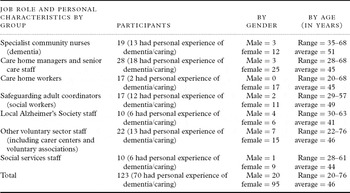
A purposive sampling frame of potential organizations from which to recruit participants was drawn up to reflect the many roles of dementia care practitioners (Table 1) in primary and social care (excluding medical practitioners). Data collection took place in the south-east of England, including London, and organizations providing dementia services in community health and social care were contacted. Participants were recruited following permission from senior managers. Following this permission an introductory email or letter was sent to all staff with these organizations, introducing the study and encouraging participation. Staff were asked to contact the research team themselves if they were interested in participating and no further input from senior management was sought.
Demographic and personal characteristics of all participants

Interviews were arranged at a time and place convenient to participants. After informed consent had been obtained, face-to-face interviews were conducted with participants in each organization; 11 interviews were conducted over the telephone – at the request of participants who said that face-to-face interviews were not convenient owing to pressure of work. Most interviews lasted on average around 40 minutes; all were recorded with permission and transcribed. Towards the end of each interview, participants were asked whether they had made their own plans in anticipation of the future or with others, reflecting a key principle of the MCA that everyone has rights to express their views and wishes in advance of possible loss of capacity and to appoint proxy decision-makers should they so wish. They were further asked if they had family members with dementia or had caring experiences outside their professional roles. If the reply to these latter questions was in the affirmative, the interviewers followed up this section of the interview by asking about family decision-making in the context of the MCA and whether such personal experiences had subjectively made a difference to the participants’ work with family carers. This section of the interview was categorized as “personal perspectives.”
Data analysis
From 123 interviews conducted (see Table 1), responses to the “personal perspectives” questions were delineated for separate analysis. Seventy participants confirmed personal experience of caring for a relative or having a family member with dementia, but not all had talked about their future care with them, nor had they used the provisions of the MCA. Transcripts of these 70 participants were analyzed for mentions of the impact of their personal caregiving experience on their professional practice. Experiences of the remaining 53 participants were referred to for comparisons, where relevant.
A coding framework was developed through the application of thematic analysis to the data (Strauss and Corbin, Reference Strauss and Corbin1990). Identified concepts, themes, and consistencies in the text were added iteratively to the coding framework, and analysis continued until no new themes emerged from the data. The lead author was blind to the job role and other participant characteristics; this reduced risk of stereotypes of gender or occupation to influence categorization.
Ethical considerations
As this part of the study was an audit, ethical permissions were not required from the National Health Service, UK, but some local government bodies required research governance approvals. Ethical permissions were received for contacts with patients, carers, and service users (reported elsewhere; see Manthorpe et al., Reference Manthorpe, Samsi, Heath and Charles2011).
In view of the potential sensitivity of the material, participants were reassured that their anonymity would be maintained and, therefore, all identifying personal details have been changed or replaced with ellipses and “their” is used to replace his/her in order to avoid identification of individuals. Participants who requested information about the MCA following the interview were provided with sources of information and specific material relevant to their role or interest.
Results
Informing the professional role
Participants with experience of a family member with dementia, with or without direct hands-on involvement with everyday caring, talked of this experience informing their professional caregiving role. If close members of their family were carers, this too informed the professional role. In such instances, participants reported feeling greater empathy with carers, in which the potential to share some of their own experiences of distress or feelings of helplessness, at times bewilderment and uncertainty, emerged as illustrations of this. Several remarked that their ability to empathize with carers appeared to benefit clients who could, as a consequence, talk “more openly” (Carers support worker). Two nurses (Specialist Nurses 1 and 2) and a social worker explained that they would cross professional boundaries to share some of their personal experiences with carers if this helped to explain a specific MCA provision (such as benefits of making financial arrangements in advance of loss of decision-making capacity). Admission of a sense of powerlessness, feelings of loss when the person with dementia “does not recognize you” (Specialist Nurse 3), and the potential for family conflict deepened understanding of carers’ potential stress. A sense of unrelenting burden of dementia care combined with family tensions was described by one care home manager:
Here [at work] I can go home . . . when you are on your own with somebody how could you walk away? You can't. . . .My granddad was saying “I can't cope” and my grandma was saying “but I'm not going into a home. Don't you put me into a home.” So you can see it from both sides. (Care Home Manager 1)
In two examples below, participants confessed bewilderment when arranging care for their relative with dementia. They commented that if this were their experience then lay people would be even more likely to find the system baffling. This had influenced their practice and views about their duties under the MCA and other legislation to provide carers with information and sources of help:
It definitely made me realize what it's like to be on the other side of the fence, because I couldn't fathom my way around the services and I worked in them! I don't know what it's like for carers who don't know the system . . . it was a nightmare. (Specialist Nurse 4)
Own experiences? This morning I've spent hours dealing with family . . . I'm right in the middle of it . . . an emphatic “yes” and mental capacity is all part of it. The MCA has affected both myself and my partner . . . it's been an enormous help . . .. The whole information is about capacity and we scratch our heads and say “what do we do next?” It's about those issues – empowerment and risk, and establishing some degree of clarity. Unless you have that you are powerless. Yes, I know how it is to be a carer. (Safeguarding Adults Coordinator 1)
Insight into services
Several participants reflected how professional knowledge and experiences had made them critical of the services provided to their relatives and others. In general they considered themselves more focused, with better understanding of services, and to be more confident. Two nurses and a social worker described incidents that had occurred during their relatives’ dementia. Reflecting on the provisions of the MCA, they felt that they would have been more assertive about their relatives’ care if the Act had been in place at that time:
[I] have got a lot of personal experience, but not since the MCA, oh yes, I mean I can see everything was being done wrong, my father-in-law was living in [different part of England] and he was in a home and he was coming to the very end of his life and he got to the stage where he had to be rushed into hospital and he said, “I don't want to be in hospital and I would rather just pass away here,” and that was disregarded by the home who had said they would keep him, and the ambulance was called and he was transferred that afternoon and died. (Specialist Nurse 5)
I think it's probably sometimes I look back on the case in my family as a scenario and the lessons I've learned from that I might use to advise other people. (Specialist Nurse 2)
Oh, absolutely yes, both my parents had advanced dementia, my mother was in residential care, and looking back, if I knew what I know now and there had been an Act in place, then I would certainly have dealt with some issues that she encountered in residential care differently, very much so. (Safeguarding Adults Coordinator 2)
The poignancy of these regrets was in contrast to one nurse's account of their parent's care outside the UK. The nurse's feelings of powerlessness to effect change had sharpened their practice in supporting family carers:
The problem I had was being so far away, I feel helpless, can't help my family, and plus the fact that dementia or care is not heard of where I come from . . . and although the last few years of my parent's life I saw changes in them, but it really blew my head that people had no understanding of the illness . . . because of my experience of my parent, therefore, I now feel more focused . . . having personal experience to have an idea of how to help people. (Specialist Nurse 6).
Several participants had observed first-hand the complexity of family dynamics around a relative who was losing, or had fluctuating, capacity and the potential for family disagreements about the person's best interests and the risks attached to independent living. A few thought, as a result of their experiences, that they now possessed better understanding of how to help people lacking capacity:
Yes . . . affected work . . . how you deal with people who lack capacity, best interest decisions, how things are done for them. (Safeguarding Adult Coordinator 4)
In the way that trying to bring about a change has . . . or doing anything to possibly bring about a change in the care of people with dementia, it is not always great, but it . . . I think . . . it is getting better. (Local Alzheimer's Society 1)
Some examples emerged of professionals having chosen to work in dementia care expressly because of their personal experiences, including three care home staff, a day care worker, and a nurse. The last said that in a “funny” post-bereavement period, they had been beguiled into thinking that a job offer at the time had been a special “sign” to apply (Care Home Nurse 4). A care home team manager described coming into the job partly to fill a vacuum left after a grandparent's death and partly because of appalling experiences of their grandparent's care. They were thus motivated to try to create changes for other people with dementia:
And it wasn't until my [relative] passed away that we realized how bad my [grandparent] was . . . and that was one of the reasons I came into this . . . I came into a home because my [relative] was looked after in her own home . . . and my grandparent lived there and my [other relative] used to go in and look after them [but] all that went. . . . It took me a long time to visit [grandparent] in a home because I didn't like the idea of homes and I went into one and I said, “I can't do this. I need to work to change it.” I know I can't change the whole thing but I'd like to make someone have a better quality of life than they had in a home. [Grandparent] was strapped to a chair . . . covered in mess . . . sat in a room. Told to sit there and stay there. (Care Home Manager 5)
Professional influences on caring
With the benefit of hindsight, several participants viewed the MCA as something they would have wanted to be in place when they were carers negotiating or communicating with other professionals involved in their relative's care. One reflected:
In my particular situation I certainly think it [MCA] would have been helpful, but again I think I was lucky enough because of my professional background and the relationship with the professionals as a family carer, for example, my Mum's GP, the consultant psychiatrist. I think I had an advantage, I think if I had not had the educational background that I had already and wasn't able to express myself, I think having something like this is a great fallback to have. I think it would have given me confidence and enabled me to achieve things that perhaps otherwise I could not have done. (Local Alzheimer's Society 2)
In contrast, a social worker reported more recent experience:
It [MCA] certainly informed my job and my job informed how I coped with it, it's circular really. I'm sure because I was a social worker I was in a good position to argue to get him [relative] some personal care that took into account his background and personal choices to stay at home for as long as possible until he became a bit muddled and he went into a home. He was an artist and to allow him to paint and draw when he was in a care home, it was quite difficult because they didn't want him to have an easel and paints in his room – health and safety things. (Safeguarding Adult Coordinator 5)
A sprinkling of participants across all professions were noticing possible early signs of dementia in some close relatives; the occasional “out of character” forgetfulness and repetitive speech patterns being seen as worrying. However, three day care staff complained that they had tried to raise their concerns but other members of their families were refusing to acknowledge the situation. In one case, this was attributed to cultural differences regarding dementia (Local Alzheimer's Society 3).
Bridging the personal and professional worlds
In contrast to the apparent denial by the family of the participant's expertise in the above comment, some participants reported often being consulted by anxious family members, being used as a bridge across the family and outside professionals, and respected for their knowledge about dementia and how best to respond. One nurse indicated that as a result of their family advice role, they now kept up to date with financial and legal matters (Specialist Nurse 8). Various examples were provided of the MCA's actual or potential influence to assertively persuade relatives and friends to respect the seemingly “unwise” wishes of a person near the end of life and to challenge medical opinion on the same grounds. One example was provided by a care home manager about their relative:
The doctors go on at him to stop drinking (alcohol) but he said, “I'm 77 years old, I've drunk all my life. If it's going to kill me it's going to kill me.” . . . He smokes about ten cigarettes a day . . . at the end of the day he's 77. Why should he stop because they tell him to stop? (Care Home Manager 5)
Planning
In general terms, there was no difference across professions in respect of making arrangements or plans in anticipation of loss of decision-making capacity, such as Lasting Powers of Attorney (LPAs), advance decisions, or statements of wishes. Few had actually done this, but most were thinking of doing so, either for older relatives and/or themselves as a result of their combined professional and personal experiences and, for some, their MCA training. Not surprisingly, this seemed to be more common among older practitioners, whose parents were facing late old age or declining health. Several were in the throes of discussing MCA issues with their families, with variable success, either in anticipation of likely problems ahead or because they could already see the warning signs (described above). As fairly typical examples of, firstly, gradual accommodation, secondly, rather stalemate positions, and, thirdly, expressions of disinterest, the following practitioners (social worker, nurse, and care home manager) reported:
I did think of it with my mother, she is 80, we had a family discussion and I have given her leaflets to read through, but she was not too happy about it, but we as a family, my sisters and brothers, we have sort of discussed it among ourselves, she hasn't reached that stage but sort of not to do anything, but we just thought she should have that information available to her. (Safeguarding Adult Coordinator 6)
Yes, I'm thinking I will probably move next year. . . . And my mother has no intention whatsoever of giving any of us Lasting Power of Attorney . . . it's impossible . . . it's going nowhere. (Specialist Nurse 10)
Because my [grandmother] is on her own and she doesn't have any of that and she's quite capable to say that she wants these things, but if we get to that point what do we do? I'm trying to get her to do these things because I've seen it here [care home]. I try to pass on what I know. But she says “I'm too old for all that now. If I die, I die. I've got nothing anyway so it doesn't matter, does it?” It's not understanding what it's all about. (Care Home Manager 5)
However, the dangers of doing nothing were sharply etched on the mind of one social worker participant who had, on the morning of the interview, spent hours trying to sort out a relative's care:
Own plans? Yes, as a result of this [difficulty], myself and my partner, we will make plans. There's nothing like personal experience to sharpen the focus. We're in the process of the LPA and Court of Protection [for a relative]. (Safeguarding Adult Coordinator 1)
Family recognition of early signs of dementia was considered to be crucial and efforts to explain the benefits of advance planning were reported fruitless where families had no concept of dementia or were denying that anything was wrong. Several comments were made by care workers that families often did not know the intimate details of each other's lives because they lived apart thereby making proxy decision appointments difficult. Changes in role and family dynamics, resulting from a relative's fading capacity, could also add to confusion. It was therefore felt essential that wishes were recorded in writing to avoid future conflict and reduce the burden on carer relatives who might eventually have to take responsibility for their parents’ lives and ensure that their wishes were carried out. Several care home staff mentioned that a prime objective of their own plans was (or would be) to avoid being a burden on their children, if and when dementia or something similar struck; these concerns did not feature elsewhere. A home manager, deputy home manager, and nurse described their respective positions:
Yes, as a matter of fact I said to my kids I am going to do my own care plan . . . and then one day if ever they need it they can have it, but I would like to write my own care plan because if you put me in a skirt, I would be one of your worst residents ever, so don't put me in a skirt please! . . . because they don't live with you . . . they don't know your likes and dislikes, they know you as Mum, but they forget because they are getting on with their own life and so they forget you don't like two sugars in your tea anymore, do you know what I mean? (Care Home Manager 2)
The only thing I have is my Dad is becoming quite forgetful at the moment, but he hasn't got a diagnosis, I mean he is very much able to function but I can see you know, he is getting quite repetitive in some things, so it may be coming . . . the LPA yes . . .. Mostly welfare [decisions around care] more than anything because I'd like to make sure we know how he . . . I mean he is quite a private person and he is quite a religious person so I do need, the family needs to know what his wishes are, what should happen to him, that is very important. (Specialist Nurse 11)
Lasting Power of Attorney, looking at their assets, what they want to do with them, if they've thought about what would happen if they became ill, even funeral arrangements and things. And I think I've got them starting to think about such things. It's not comfortable, is it? Nobody wants to think about. But I would definitely think about it. I'm saying, “you ought to write down things that I ought to know as well.” Because I haven't lived with them for a long while . . . so even if I live round the corner I don't know what their routines are. (Care Home Manager 1)
Several participants had relatives who had drawn up LPAs. However, family resistance due to emotional and possibly also cultural issues had hampered progress (the registration of the LPA) in respect of one very elderly relative for whom excuses were being inappropriately made, in the view of the participant, on grounds of poor hearing (Local Alzheimer's Society 3).
No apparent effect of MCA
Across the board, there were a few individual examples where, in spite of personal experiences, participants claimed that the Act had made no impact on their professional role or decision-making, or giving advice on, planning, or stating personal wishes. A social worker, who thought they were probably “becoming one” (a carer) when reflecting on the possibility of a LPA for their mother, proposed that the Act had not had any real impact on their work because it was based on the good practice which she had been endeavoring to build on throughout their career (Safeguarding Adult Coordinator 7).
In three other instances, participants had not yet thought about the MCA in the context of their own family circumstances. However, following the thread of the interview discussion about decision-making, some were seemingly prompted to consider this.
Discussion
Experiences of family caring and of relatives with dementia were not uncommon and this may be widely applicable to dementia practitioners. The focus on family decision-making and planning, which were viewed as easier under the MCA, threw up examples not only of tensions that could arise when acknowledging the potential for loss of decision-making capacity or family dispute but also of thoughtful reflections on care and professional relationships with carers. Research on empathy in the professional encounter has predominately explored empathy with the patient rather than empathy for the carer and emotional connectedness (Hughes, Reference Hughes2005). Expressions of empathy need not rely on personal experience but they may be enhanced by this. By showing empathy, professionals may reduce carers’ emotional and psychological burdens (Emanuel et al., Reference Emanuel, Fairclough, Slutsman and Emanuel2000). Our findings suggest that there is scope to explore the emotional elements among dementia professionals and the interactions of personal and professional lives, and also to investigate the potential for role conflict and how this may negatively affect work roles, drawing on theories of “double stress” (Zuba and Schneider, Reference Zuba and Schneider2011). While dementia care practice has moved to focus on the person with dementia, there is little about the emotional impact on practitioners’ worlds. Morrison (Reference Morrison2007) has suggested that care work generally should “refresh and re-engage with emotion.”
Personal experiences influence motivations to become a social worker (Stevens et al., Reference Stevens2012) and possibly to work in dementia services. Working with students or in professional development to identify the role of personal experience in their ability or otherwise to undertake different tasks may help assimilate personal experiences with theoretical and practical learning (Christie and Weeks, Reference Christie and Weeks1998). Such integration may help resolve the apparent dilemmas that carers report receiving too little information or too much or that it is the “wrong sort” (Wald et al., Reference Wald, Fahy, Walker and Livingston2003). It may also assist health and care professionals’ new imperatives to take active roles in supporting carers who wish to stay in or return to employment (Vickerstaff et al., Reference Vickerstaff, Loretto, Milne, Alden, Billings and White2009) by addressing the emotional aspects of this as well as practicalities.
There are limitations to this study in that the accounts are subjective experiences and this study did not include any scrutiny of practice or input from carers receiving support about the impact of engaging with a practitioner who spoke of their own personal experiences. The practitioners interviewed may be not representative. Setting accounts in the context of the MCA 2005 focused discussion on decision-making which misses, of course, other aspects of caring. However, the findings of this study explored less well-covered ground. They provide new evidence that some practitioners, if asked specifically, reflect on their dual identities and may connect their personal and professional lives.
Conclusion
Having caring experiences may help dementia care practitioners to have more empathy with carers. Some of those interviewed in this study reported that their experiences had made them more focused and more confident in their practice with carers. Not all professionals will have been carers or relatives of someone with dementia and the nature of this very individual experience means that generalizations should be avoided. Observational research would help understand if care experiences are translated into practice and outcomes for carers. Such is the growth of caring experiences, however, that it will be rare for teams and agencies not to include current and former carers or relatives of people with dementia, whatever their work or service settings (George, Reference George2001; Mooney et al., Reference Mooney, Statham and Simon2002). This study has identified that research could be alert to the overlap between professional support for carers and being on the receiving end of support. It was noticeable that many participants did not talk about their family or own experiences until specifically requested. This suggests the potential for educational and professional development to build on care experiences. For trainers there are points to consider about managing and optimizing personal experiences in learning events and professional development, such as when covering new legislation. For supervisory staff there are opportunities to discuss how practice can acknowledge and accommodate personal concerns, and for human services professionals who are carers there are questions about how to make the most of personal experiences without transgressing professional boundaries inappropriately.
Conflict of interest
None.
Description of authors' roles
J. Manthorpe conducted the analysis and co-wrote major sections of the paper. K. Samsi conducted some of the data collection and part of the analysis, and co-wrote some of the other sections of the paper. J. Rapaport conducted a majority of the data collection and some of the analysis, and assisted in the writing up of the paper.
Acknowledgments
We are grateful to all those who agreed to be interviewed and to the interviewers who assisted in this study: Jess Harris, Hazel Heath, and Tayanie Nagendran.
This paper presents ongoing independent research of the Mental Capacity Act 2005 commissioned by the National Institute for Health Research (NIHR) under its Programme Grants for Applied Research scheme (RP-PG-0606-1005). The views expressed in this publication are those of the author(s) and not necessarily those of the NHS, the NIHR, or the Department of Health. The study forms part of the EVIDEM Research Programme (www.evidem.org.uk) involving the Central and North West London (CNWL) Foundation NHS Trust together with Claire Goodman (University of Hertfordshire); Greta Rait, Jane Wilcock, and Steve Iliffe (University College London); Vari Drennan (St George's University of London and Kingston University); and Martin Knapp (London School of Economic and Political Sciences).