1. Introduction
This paper has two goals: First, we test introspective claims on the intonation of information-seeking questions experimentally in Icelandic (henceforth ISQs), as in 1 (polar questions) and 2 (wh-questions). Second, we investigate the intonational differences between neutral ISQs and rhetorical questions (henceforth RQs) in Icelandic. In Icelandic, polar questions are verb-initial (V1). Unlike in English, finite main verbs occur in initial position (see 1, from Thráinsson Reference Thráinsson2007:147).
(1)


Wh-questions (constituent questions) are formed with wh-interrogative pronouns (Icelandic hv-pronouns), which relate to a constituent in the answer. In 2, adapted from Thráinsson Reference Thráinsson2005:72, hv-pronouns appear in italics. As can be seen in 2, the canonical position of the hv-pronoun, or hv-phrase, is sentence-initial, that is, preceding the finite verb.
(2)

The structure of the paper is as follows: In section 2, we discuss the intonation patterns of Icelandic questions and formulate the hypotheses. Section 3 reports on the production experiment testing the hypotheses. Section 4 presents the experimental results, which are discussed in section 5. Section 6 concludes the paper.
2. Icelandic Question Intonation
Icelandic intonation has not yet been the focus of much experimental research, and most previous research is based on introspective data. The tonal inventory of Icelandic comprises at least two bitonal pitch accents (L+H*, early rise, peak aligns with stressed syllable; and L*+H, late rise, peak aligns after stressed syllable) and two monotonal pitch accents (peak accent H*, low accent L*), as well as two boundary tones terminating the intonational phrase (high H% and low L%; see Árnason Reference Árnason and Werner1998, Reference Árnason2005, Reference Árnason2011 and Dehé 2006, Reference Dehé2009, Reference Dehé2010). Pitch accents are associated with the lexically stressed syllable of the relevant word. Note that Icelandic has word-initial primary stress throughout with very few exceptions in non-native words, irrespective of the length or morphological structure of the word (for example, Árnason Reference Árnason2011). Icelandic neutral declaratives are typically realized with a nuclear L+H* pitch accent, followed by a final fall to a low boundary tone (L%), thus the nuclear tune is a rising-falling one with the pitch peak aligned in the nuclear syllable. If the nuclear tune is preceded by prenuclear prominence, the typical accent is a late rise (L*+H), that is, a low accented syllable followed by a rise. The Intonational Phrase is the domain of downstep; thus, later peaks are typically lower compared to earlier ones. An example of an Icelandic neutral declarative is provided in 3 (from Dehé’s Reference Dehé2010 data set).
(3)

As in declaratives, the default intonational contour of both polar questions and wh-questions is a fall to a low boundary tone (L%) (see Árnason Reference Árnason and Werner1998, Reference Árnason2005, Reference Árnason2011; Dehé Reference Dehé2018a). According to Árnason (Reference Árnason2011:323), questions with rising intonation “have special connotations.” To illustrate this contrast, in polar questions, L*+H combines with L% in “matter of fact” questions, which function “as simple requests for information” (Árnason Reference Árnason and Werner1998:56) while H% may, for example, be used in a polar question that functions more like a “friendly suggestion […], which calls for an immediate reply” (Árnason Reference Árnason and Werner1998:56). In wh-questions, a final rise to H% may be used to mark, for example, impatience or surprise (Árnason Reference Árnason2005:477). While the default boundary tone is L% across utterance types, declaratives, polar questions, and wh-questions do differ in pitch accent types and thus in the shape of the overall tonal contour that spans the utterance.
2.1. Polar Questions Versus Wh-Questions
Árnason (Reference Árnason2011) assumes that the typical nuclear pitch accent in Icelandic polar questions is a rise from a low target on the accented syllable (late rise; L*+H), the peak being reached after the end of the nuclear syllable. Combined with the low boundary tone, the typical nuclear contour is thus a rising-falling one (L*+H L%). An example adapted from Árnason Reference Árnason2011:323 is given in 4, complemented by a stylized intonation contour; dashed lines mark the beginning and the end of the nuclear syllable.
(4)

Árnason’s (Reference Árnason2011) assumption was only partly confirmed by a recent instrumental intonational analysis of polar questions in Modern Icelandic versus North American (heritage) Icelandic (Dehé Reference Dehé2018a). As in Árnason’s (introspective) work, Dehé (Reference Dehé2018a) finds in her study a rising-falling nuclear contour (L+H L%) in map task data from Modern Icelandic. Unlike the data in Árnason Reference Árnason2011, the data in Dehé Reference Dehé2018a show that the early rise (L+H*) rather than the late rise (L*+H) was typical (N=85 out of 99, that is, 86% of rising nuclear accents). Compare 5 below with 4 above for the alignment of the intonational contour in L+H* versus L*+H, respectively.
(5)

However, while the map task tested 100 speakers overall, the data from only 12 speakers (5 male, 7 female), all aged 64+, entered the analysis in Dehé Reference Dehé2018a. The results therefore have to be corroborated by results from the speakers of the remaining age groups and/or different elicitation paradigms.
In any case, the intonation of Icelandic polar questions differs crucially from the one in polar questions in related languages, which often end in a rise to H%, as in English (Schubiger Reference Schubiger1958, Pierrehumbert & Hirschberg 1990, Bartels Reference Bartels1999, Hedberg & Sosa 2002, Hedberg et al. Reference Hedberg, Juan, Görgülü, Plinio, Madureira and Reis2008) and German (von Essen Reference Essen1964, Féry Reference Féry1993, Braun et al. Reference Braun, Dehé, Neitsch, Wochner and Zahner2018). For example, in a corpus study on American English, Hedberg et al. (Reference Hedberg, Juan, Görgülü, Plinio, Madureira and Reis2008) find that almost 90% of the polar questions (N=372 of total N=419) have a rising intonation (N=333, or 79.5%, low rise and N=39, or 9.3%, high rise). Polar question intonation also differs from the intonation of declaratives in Icelandic, which, like polar questions, are terminated by L%, but whose default nuclear pitch accent is rising to a high target (early rise; L+H*; see Dehé Reference Dehé2010, Árnason Reference Árnason2011).
We now turn to wh-questions. Árnason (Reference Árnason2005:476–477) discusses three intonational contours for wh-questions in Icelandic (see 6; all examples and stylized contours are from Árnason Reference Árnason2005:476–477). According to Árnason, the typical contour is the one given in 6a. It starts high, although it is not entirely clear whether the initial high target has to be a prenuclear peak accent (H*) associated with the wh-word. The initial H is then followed by a H* nuclear accent associated with the first syllable of the noun kartöflurnar ‘the potatoes’ and is then falling toward L%. The difference between 6a and 6b is that the wh-question in 6b starts at a lower level and then rises to H*, although it is not entirely clear whether there may be prenuclear prominence (for example, a low accent L*). Notice also that Árnason (Reference Árnason2005) does not analyze the nuclear accent in 6b as a rising (L+H*) one, even though the contour toward H* starts from a lower position than in 6a. Árnason assumes that 6b is used if prominence on the wh-word is unnecessary—for example, because it is being repeated. Imagine, for example, a situation in which the speaker is trying to locate different objects, one after the other, repeating questions of the type Where is X?, X being unique for each question, the wh-word being the same for each question. Finally, the contour in 6c starts low, and the pitch accent is L*+H, followed by a high boundary tone (H%), that is, a rising pattern (note that Árnason represents this contour as a sequence of L* and H). Árnason (Reference Árnason2005:477) argues that a wh-question realized with this contour has a special connotation, for example, impatience or perhaps surprise: It can be used in a situation in which the speaker has been looking for the potatoes for a while and cannot find them. The examples in 6 are adapted to an autosegmental-metrical representation system.
(6)

Taking declaratives, polar questions, and wh-questions together, one arrives at the following generalization about the distribution of typical nuclear pitch accents in Icelandic: i) the early rise (L+H*) in declaratives (Dehé Reference Dehé2010, Árnason Reference Árnason2011), ii) the late rise (L*+H) in polar questions (Árnason Reference Árnason2011:322; but see Dehé Reference Dehé2018a), and iii) the high peak accent (H*) in wh-questions (Árnason Reference Árnason2005). Nuclear accents are followed by a fall to L% in all utterance types unless special connotations demand otherwise. Therefore, in Icelandic nuclear pitch accent types help to distinguish between illocution types (questions versus statements), while boundary tones do not seem to contribute to this distinction.
2.2. ISQs Versus RQs
Neutral questions (ISQs) perform the directive speech act of requesting information. Polar questions “request an answer that specifies whether the proposition expressed by their sentence radical holds or does not hold” (Krifka 2011:1747), that is, the expected answer may be yes or no. Wh-questions “create an open proposition by leaving parts of the description of the proposition unspecified” (Krifka 2011:1744). The expected answer is one that provides information about the open parameter.
RQs are formally (that is, surface-syntactically) interrogatives, but they differ from ISQs in their discourse function. Based on much previous literature, Biezma & Rawlins (2017:302) summarize their characteristics as follows: i) RQs do not expect an answer (Hudson Reference Hudson1975, Quirk et al. 1985, Wilson & Sperber 1988, Ilie 1995, Banuazizi & Creswell 1999), ii) RQs have the feel of an assertion (Sadock Reference Sadock1971, Quirk et al. 1985, Gutiérrez-Rexach Reference Gutiérrez-Rexach1998, Han 2002, Rohde Reference Rohde2006), and iii) RQs do not have to but can optionally be answered (Rohde Reference Rohde2006, Caponigro & Sprouse Reference Caponigro, Sprouse and Puig-Waldmüller2007). Moreover, while for ISQs there is a high degree of uncertainty on the part of the speaker as to the answer, for RQs there is no uncertainty. Instead, the answer is part of the common ground and obvious to all the interlocutors (Rohde Reference Rohde2006, Caponigro & Sprouse Reference Caponigro, Sprouse and Puig-Waldmüller2007, Biezma & Rawlins 2017) or is intended to be added to the common ground (Biezma & Rawlins 2017). Biezma & Rawlins (2017:307) further argue that for a question to be interpreted as an RQ, “the utterance needs to include a conventional marking of a certain kind of speaker attitude—that the question they are asking is non-inquisitive in context.”
With respect to the prosody of ISQs and RQs, it is a common assumption in the semantic and prosodic literature that ISQs and RQs are prosodically distinct (for instance, Gutiérrez-Rexach Reference Gutiérrez-Rexach1998, Han 2002, Biezma & Rawlins 2017). However, actual studies on the prosody of RQs are rare and they deal almost exclusively with English. Typically, existing studies do not directly compare string-identical ISQs and RQs (Quirk et al. 1985, Banuazizi & Creswell 1999, Bartels Reference Bartels1999, among others). A recent experimental study identified phonological and phonetic differences between string-identical ISQs and RQs in German (Braun et al. Reference Braun, Dehé, Neitsch, Wochner and Zahner2018). Specifically, phonological (intonational) differences relate to the distribution of boundary tones and nuclear pitch accent types. In particular, polar ISQs typically ended in a high rise to H-∧H%, while mid-level H-% was more frequent in polar RQs. Wh-RQs typically ended in a final fall to L-%, while there was more variation in wh-ISQs (L-L%, H-∧H%, L-H%).Footnote 1 For nuclear pitch accents it was found that in polar questions, L* was more frequently produced on the sentence-final noun in ISQs than in RQs, while L*+H was more frequent in RQs than in ISQs. For wh-questions, the difference in the timing of the rise in bitonal rising pitch accents was most striking. Specifically, the late rise (L*+H) was more frequent in RQs than in ISQs, and the early rise (L+H*) was more frequent in ISQs than in RQs. Taken together, these data show that L*+H was the most frequent accent type in RQs across question types. No notable phonological differences between ISQs and RQs were found in the prenuclear region.
Dehé & Braun (Reference Dehé and Braun2019) found similar results for English. In particular, they show that edge tones distinguish between ISQs and RQs only in polar questions. English wh-questions ended in L-L% throughout. Within polar questions, significantly more ISQs ended in steep rises (H-H%), while RQs were comparatively more often realized with a final mid-high plateau H-L%. Moreover, the type and—in polar questions—the position of the nuclear accent was important. Specifically, in polar questions, the object noun was more often unaccented in RQs than in ISQs, and instead the nuclear accent was realized on the subject. In wh-questions, ISQs had comparatively more monotonal (mostly !H*) nuclear accents, while RQs had comparatively more bitonal rising L+!H* nuclear accents. For English, differences were also found in the prenuclear region. Most strikingly, there was a difference in prenuclear accent type in wh-questions. If accented, the wh-word was more often accented with an L*+H accent in RQs than in ISQs, and there were significantly more H* accents on the wh-word in ISQs compared to RQs.
Note that unlike the work on English and German, the present study on Icelandic first investigates and compares the intonation of ISQs (polar and wh-; see hypothesis H1 in 7), which has not previously been done by means of a systematically controlled experiment. We then move on to the comparison between ISQs and RQs (see hypothesis H2 in 7).
(7)

The hypotheses in 7 are based on the literature review provided in the preceding sections. There is no previous literature on the prosody of RQs in Icelandic. Therefore, one aim of this study is to fill this gap.
3. Production Experiment
The production experiment reported on in this section was designed to test the hypotheses in 7 above.
3.1. Methodology: Materials, Procedure, Participants
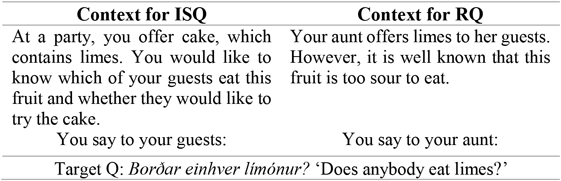
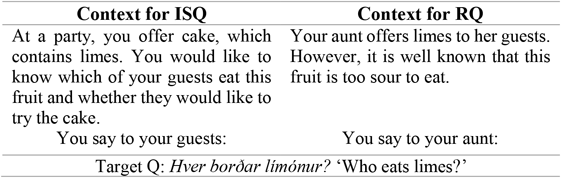
Twenty-one pairs of wh- and polar interrogatives were constructed, as well as accompanying contexts (one context triggering an information-seeking, one a rhetorical interpretation, for each question pair). Target inter-rogatives and contexts were translated from English (Dehé & Braun Reference Dehé and Braun2019) as closely as possible by a native speaker of Icelandic. Each question was felicitous in both an information-seeking context and a rhetorical one, resulting in 21 quadruples (see tables 1 and 2 below; the contexts are translated from Icelandic). Contexts were created such that in contexts triggering an ISQ reading of the target interrogative, the answer was obviously not known to the speaker and would instead have been highly informative. The description of the context situation was therefore followed by a sentence starting Þú vilt gjarnan vita ‘You would like to know’ or similar (see left-hand columns in tables 1 and 2). In contexts triggering an RQ reading of the target interrogative, there was no uncertainty about the answer. On the contrary, the answer to the RQ was obvious from the given context, that is, it was part of the common ground in the imaginary situation. This was achieved by the string Það er hinsvegar alþekkt að ‘It is well known that’ or similar (see right-hand columns in tables 1 and 2). The full list of experimental items is provided in the appendix.Footnote 2
Contexts and target polar interrogatives. Contexts translated from Icelandic.

Contexts and target wh-interrogatives. Contexts translated from Icelandic.

In addition, 34 fillers were created, each along with a context establishing a situation (parallel to the experimental items). They included 19 verb-second (V2) exclamatives (for example, Rosalega les Nína vel! ‘How well Nina can read!’), seven exclamatives starting with enn hve (for example, Enn hve Lena þarf að læra mikið! ‘How much Lena has to learn!’), six neutral verb-first (V1) polar questions (for example, Er hann með doktorsgráðu? ‘Does he have a doctorate?’), and two V1 sentences functioning as requests for help (Geturðu hjálpað mér við …? ‘Can you help me with …’). Finally, there were three practice items of parallel make-up (one wh-question, one polar question, and one V2 exclamative).
For the experiment, two basic lists were constructed. Each list contained both polar and wh-questions and both illocution types. The members of the quadruplets were distributed across the two lists such that one list contained 11 polar and 10 wh-questions, the other one 10 polar and 11 wh-questions. Illocution type was thus manipulated within-subjects. The same polar or wh-question occurred twice in each list, one in an ISQ context, the other in an RQ context. For example, the items in table 1 were members of list 1, the items in table 2 appeared in list 2. The 34 filler items were added to each list. Participants were randomly assigned to one of the two experimental lists. The experimental lists were randomized for each participant separately with the constraint that two readings of a question were separated by at least four other trials to avoid effects of direct contrast between string-identical ISQs and RQs on the part of the participant.
Each experiment started with three familiarization trials. Each trial started with the visual display of the context description, which the participant had to read silently. The participants were instructed to press a button when they had finished reading. After the button press, the target interrogative appeared on the same screen. Participants were instructed to read the description of each context situation carefully and to utter the target and filler sentences as naturally as possible. The recording started simultaneously with the appearance of the target interrogative on screen. Participants pressed a button to proceed to the next trial. The recording was stopped at this point. Participants were allowed to repeat the target in case of mistakes. After the trials, there was a short break, which participants were allowed to use for questions, if anything was unclear.
The whole experiment lasted 25 to 30 minutes. The contexts were presented in black Calibri 40 font and the target sentences in blue Calibri 40 font, all on white background. The participants were instructed to produce their utterances in such a way that they were suitable in the given context. No feedback was provided during the actual experiment. Productions were recorded using a headset-microphone (Shure SM10A) and digitized directly onto a PC (44.1 kHz, 16Bit, stereo). The experiment was controlled using the experimental software Presentation (Neurobehavioral-Systems 2000).
Thirty-two native speakers of Icelandic (aged 20–65, 20 female and 12 male) participated in the experiment. They were tested in a sound-attenuated room at the University of Iceland in Reykjavík in June 2017. All participants were unaware of the purpose of the study and were compensated for their participation with a gift from Konstanz. Of the 32 participants, the data from all participants aged 20–32 (N=21) entered the analysis. This was done to keep the age range of participants comparable to parallel studies on English (Dehé & Braun Reference Dehé and Braun2019) and German (Braun et al. Reference Braun, Dehé, Neitsch, Wochner and Zahner2018). The data from four participants were removed from the analysis due to missing files or because they changed the wording of more than one target interrogative. Accordingly, the data from 17 participants (aged 22–32; average 26.9; 6 male) entered the present analysis.
3.2. Data Treatment and Analysis
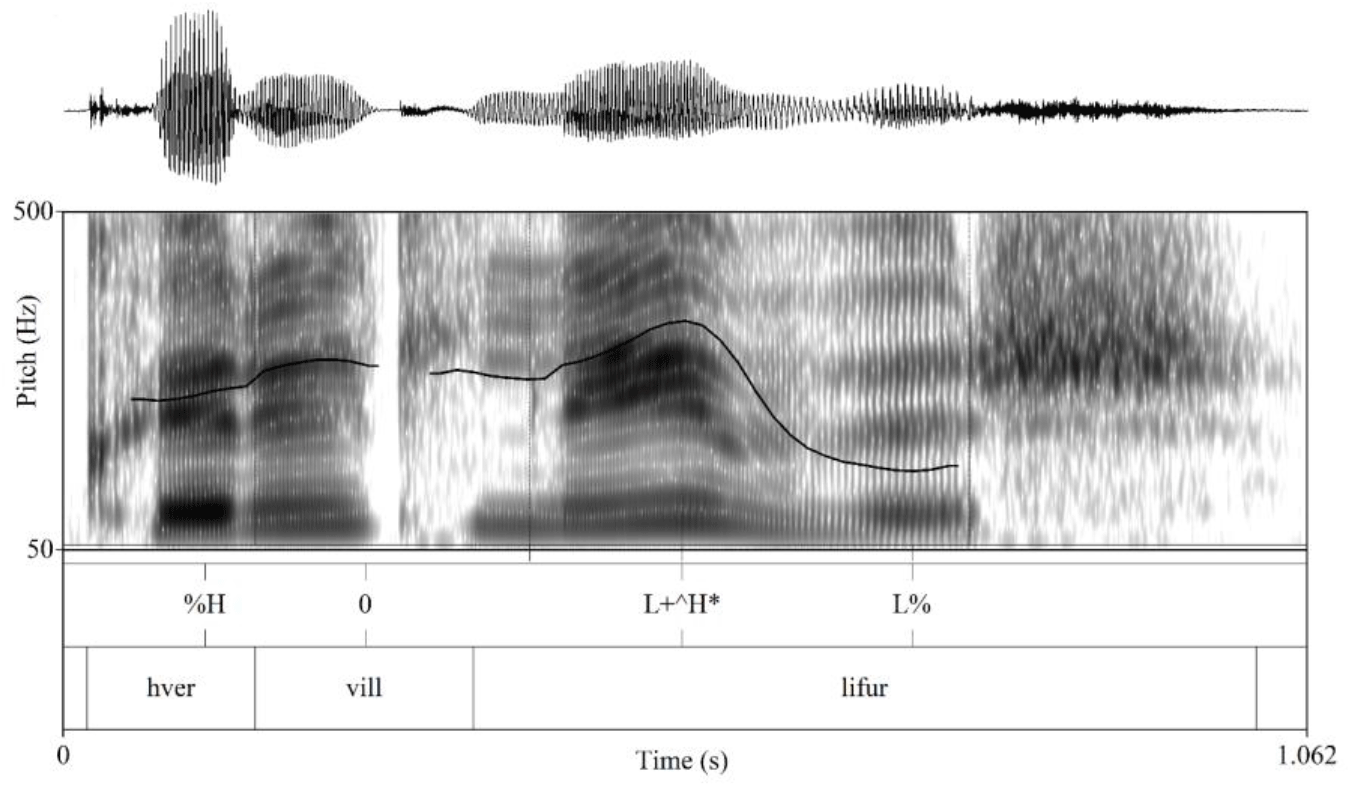
Two quadruples (N=68) contained non-native object nouns (Lambada, Bolognese). They were removed from the analysis due to varying placement of word stress, which was often non-native. Accordingly, 646 target interrogatives entered the analysis. They were 313 polar (156 ISQs, 157 RQs) and 333 wh-questions (167 ISQs, 166 RQs). All target interrogatives were annotated in Praat (Boersma Reference Boersma2001, Boersma & Weenink Reference Boersma and Weenink2017; see figure 1 for an example).
Example target interrogative and annotation (popular question, RQ, vp28, female).

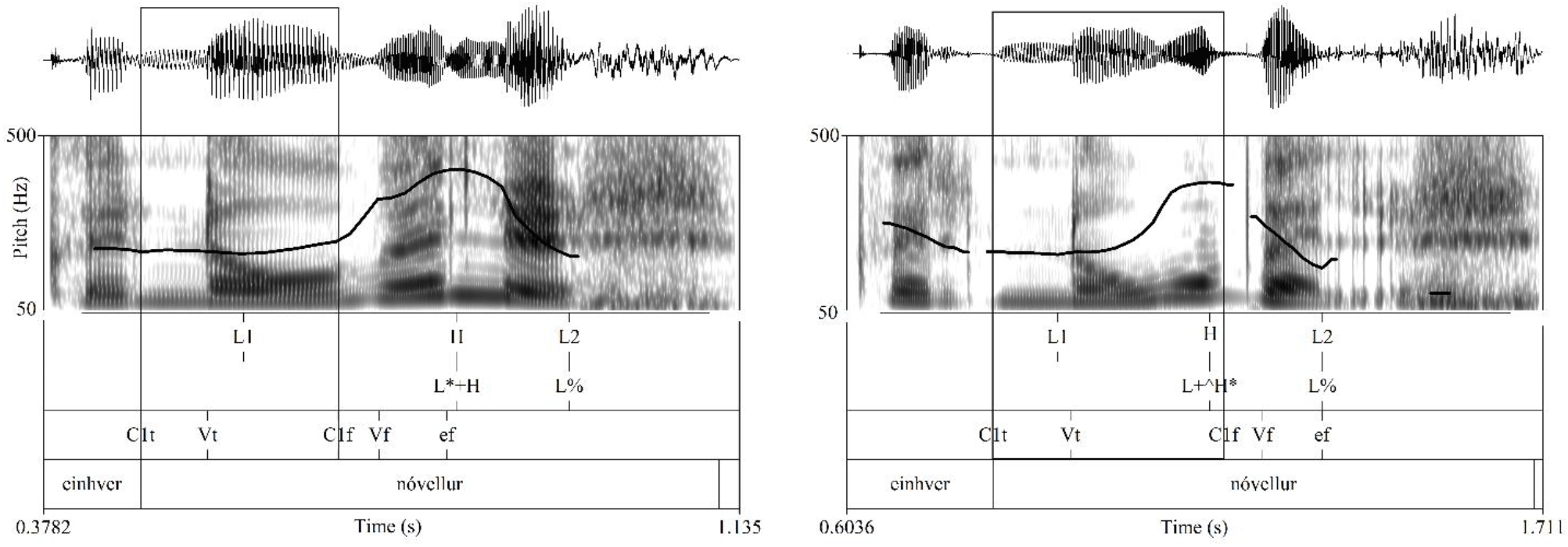
For the phonological analysis, local peaks (H) and lows (L) were annotated on the top tier. On the second tier from top, prenuclear and nuclear pitch accents, as well as boundary tones were annotated following previous intonational analyses of Icelandic in the autosegmental-metrical framework (for example, Dehé Reference Dehé2010, Reference Dehé2018a). In particular, L*+H was annotated when the stressed syllable sounded low-pitched and the peak was located in the post-tonic syllable; L+H* when the stressed syllable sounded high-pitched and the peak was located in the stressed syllable. This difference is illustrated in figure 2. The rectangle marks the nuclear syllable. In the early rise (L+H*; right-hand panel in figure 2), both L and H are aligned in the nuclear syllable; H is reached within the vowel of the nuclear syllable (Vt). In the late rise, in contrast (L*+H; left-hand panel), L is aligned in the nuclear syllable, but the subsequent peak is reached outside the nuclear syllable, here within the geminate consonant /l.l/ at the boundary of the second and third syllables. Figure 2 shows the same item and speaker as figure 1, zooming in to the nuclear area; the nuclear syllable is marked by a rectangle; C1t: beginning of the onset consonant of the target (stressed) syllable (σt); Vt: beginning of the vowel of σt; C1f: beginning of the onset consonant of the syllable following the σt (σf); Vf: beginning of the vowel of σf; ef: end of σf.
Late rise (ISQ; left) versus early rise (RQ; right) in polar questions.

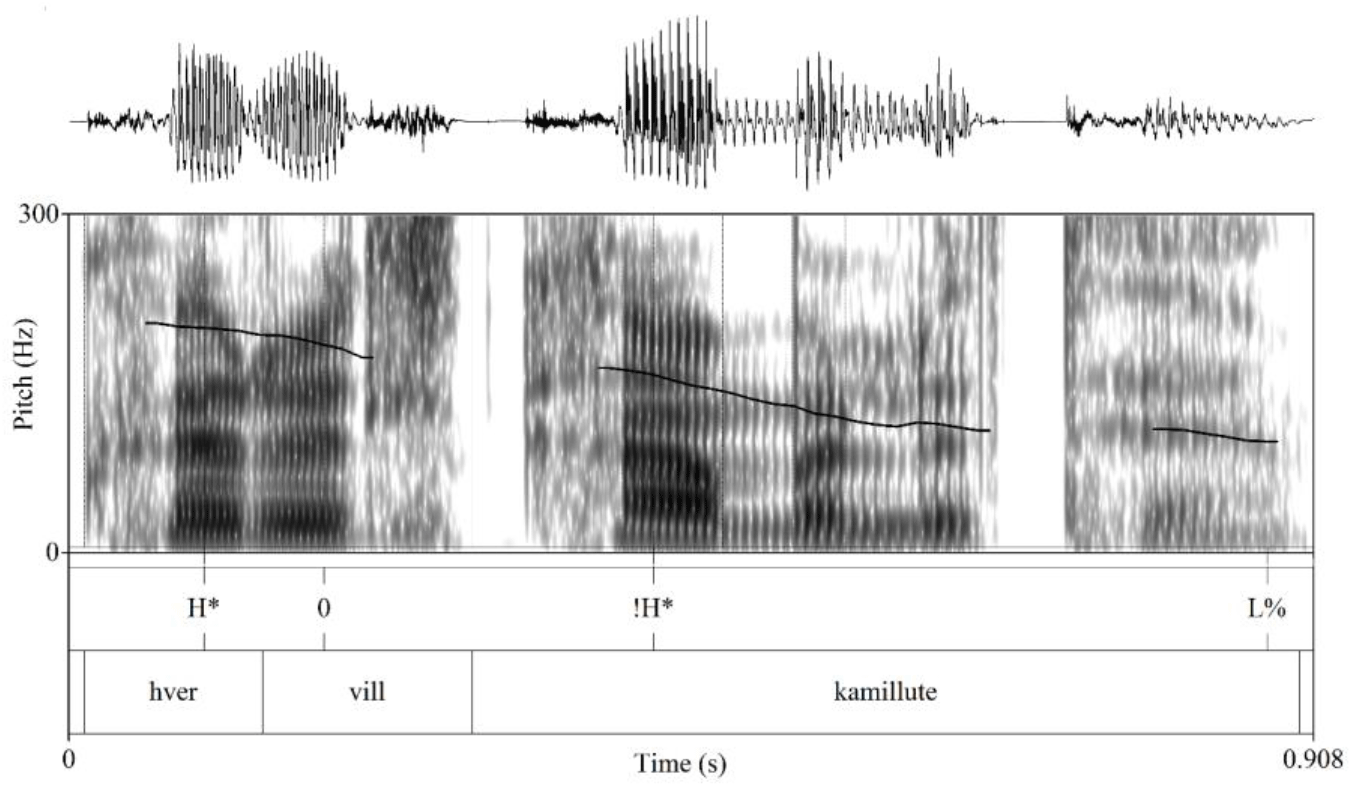
L* and H* were annotated when there was no strong pitch movement, that is, no preceding H or L leading tones, respectively. Upstep (∧H) was annotated when an H-tone was higher than a preceding H target; downstep (!H) was annotated when an H-tone was considerably lower than a preceding H target. Regarding initial boundary tones, %L (that is, the utterance starting low) was not annotated. When the speaker started with high initial pitch, this was annotated as %H (high initial boundary tone), unless the high tone was due to prenuclear prominence, in which case it was annotated as H*. %H was notably higher than following low tones in the utterance. Downstep !H* is illustrated in figure 3, and %H and upstep (in L+∧H*) are illustrated in figure 4.
Example target interrogative with a H* prenuclear accent and a !H* nuclear accent (wh-question, ISQ, vp31, male).

Example target interrogative with a %H boundary tone and L+∧H* nuclear accent (wh-question, ISQ, vp13, female).

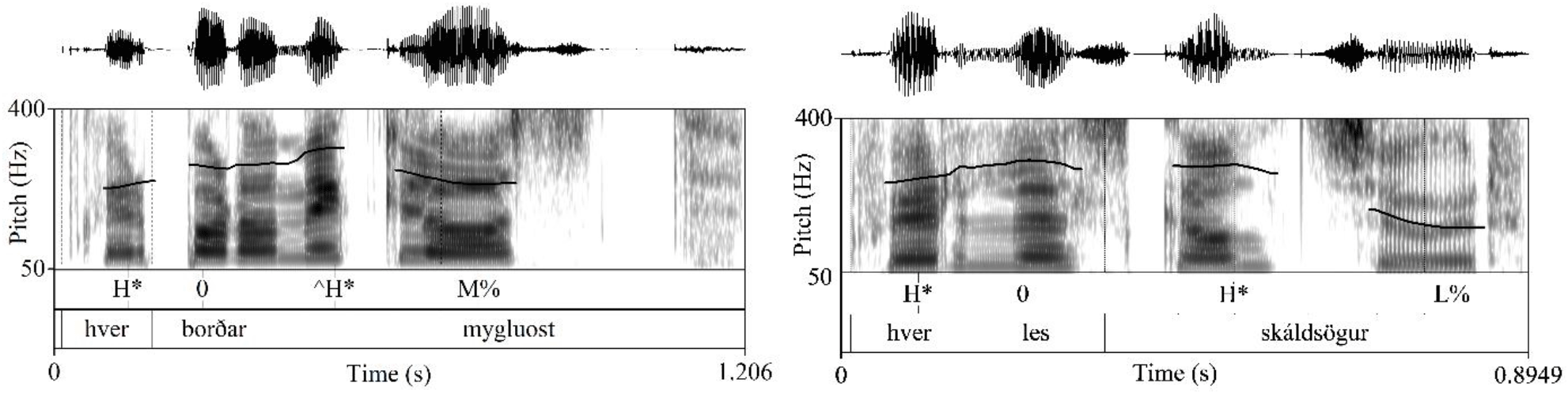
The utterance-final boundary tone was labeled as L% when it reached the bottom of the speaker’s pitch range. It was annotated as H% when it was high, and as M% when a final fall from a nuclear peak did not reach the bottom of the speaker’s pitch range, but ended at mid-level instead. This pattern is comparable to the calling contour, which has been analyzed as a downstepped H phrase accent (!H-; that is, H* !H- in Grice et al. Reference Grice, Robert Ladd and Arvaniti2000). Since the category of phrase accent has yet to be established for Icelandic, the observed fall to mid (instead of low) is analyzed as a fall to the auxiliary category M% here. The difference between a fall to L% and a fall to M% is illustrated in figure 5. It is striking that a fall to M% (see left-hand panel) is to a pitch level not much lower than the level at the beginning of the utterance, while the fall to L% (see right-hand panel) is to a considerably lower level.
Comparison of final boundary tones M% (left; Who eats mold cheese?) and L% (right; Who reads novels?); speaker vp11, female; ISQ.

The data were first annotated by the first author. A selection of 15% of the data (randomly sampled from all speakers, both question types and both illocution types) were independently annotated by the second author. Overall, agreement for all intonational events (pitch accents and boundary tones) was 84.4%, kappa 0.81 (Cohen Reference Cohen1960), which indicates substantial agreement. All of the disagreements were resolved. The remaining 85% of the data were then annotated again by both authors to resolve other potential disagreements. Fourteen items (2% of the overall data; 4 polar questions, 10 wh-questions) were excluded from the analysis because agreement could not be reached.
To establish whether certain boundary tones or pitch accents occurred significantly more frequently in certain question types (wh- or polar) or illocution types (ISQs versus RQs), we coded that boundary tone or accent as 1 and all other boundary tones or accents as 0. We then calculated logistic mixed effects regression models with illocution type as fixed factor, and participants and items as crossed random factors (Agresti Reference Agresti2002, Baayen Reference Baayen2008, Baayen et al. Reference Baayen, Debra and Douglas2008), using the lme4 package (Bates et al. Reference Bates, Maechler, Bolker and Walker2014). The initial model included participants and items as random intercepts (in case this initial model did not converge, we removed random intercepts for items; this was then explicitly reported in the text). Then more complex models with random slopes were estimated. If this improved the fit of the model (significantly increased log-Likelihood as determined by a direct comparison of the initial and the more complex model using the R-function anova()), the more complex model was reported. The p-values in the paper are corrected for multiple tests for question type (section 4.1) and illocution type (section 4.2), using the Benjamini-Hochberg correction (Benjamini & Hochberg Reference Benjamini and Hochberg1995).
4. Results
We report the results according to illocution types, beginning with ISQs in section 4.1 followed by a comparison between ISQs and RQs in section 4.2.
4.1. ISQs
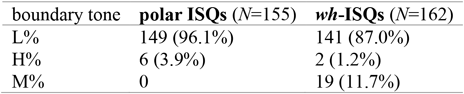
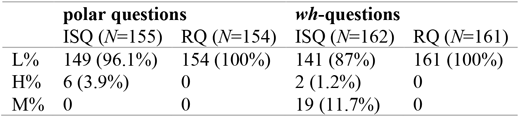
All numbers and percentages within ISQs relate to 155 polar ISQs and 162 wh-ISQs (see section 3.2). The distribution of boundary tones in the two question types is shown in table 3.
Distribution of final boundary tones within ISQs.

The default boundary tone in both polar ISQs and wh-ISQs is L%. The results of the logistic mixed-effects regression model with question type as fixed factor showed no effect of question type on the frequency of occurrence of L% (β=7.9, SE=5.1, z=1.5, p=0.12). The relatively high number of M% in wh-questions was unexpected. However, there was considerable variation across subjects, in particular, five out of the 19 occurrences were produced by one participant. Table 3 shows the distribution of final boundary tones within ISQs across question types in absolute numbers and relative to the overall N in each question type.Footnote 3
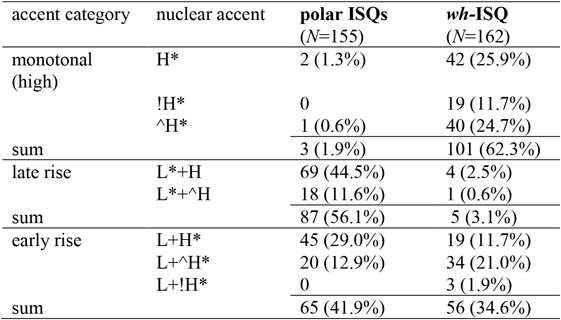
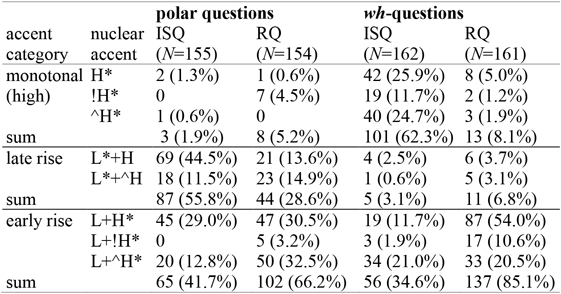
The distribution of nuclear pitch accent types in the two question types is shown in table 4. The most frequent nuclear pitch accent in polar ISQs is the late rise (L*+H and L*+∧H). This is followed in frequency by the early rise (L+H* and L+∧H*). In total, 98% (N=152) of the polar ISQs exhibited bitonal nuclear accents. The most frequent nuclear pitch accent in wh-ISQs is the monotonal peak accent (H*, !H*, and ∧H*). This is followed in frequency by the early rise, that is, the rise to H* (L+H*, L+!H*, and L+∧H*). Together, these two accent types make up 96.9% of nuclear accents in wh-questions. In table 4, percentages relate to the total number of tokens in a question-type.
Distribution of nuclear pitch accents across question types in absolute numbers and percentages.

The statistical analysis shows a significant effect of question type on the frequency of occurrence of monotonal high accents (H*, ∧H*, !H*). On the one hand, there were more monotonal accents in wh-questions than in polar questions (ß=6.5, SE=0.9, z=6.9, p<0.0001). On the other hand, there were more late rises (L*+H, L*+∧H, L*+!H) in polar questions than in wh-questions (ß=5.5, SE=0.8, z=6.8, p<0.0001). Polar questions were produced with a late rise in the majority of the cases (56.1%), and monotonal accents were clearly avoided in polar questions (<2% of the cases). It emerges that bitonal accents are typical for polar questions (98%). Wh-questions were realized with monotonal H* (and upstepped and downstepped variants) in the majority of cases.
For both polar and wh-questions, the early rise is a strong competitor for the most typical accent type (late rise in polar questions and monotonal accents in wh-questions).
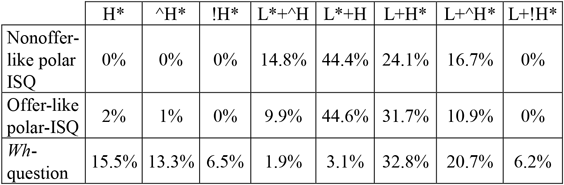
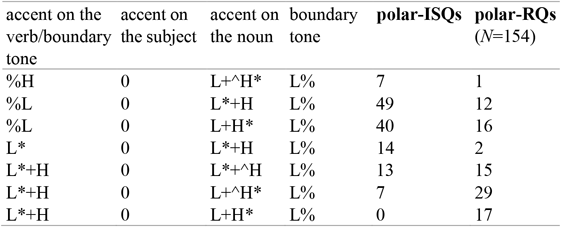
We add to the discussion of nuclear accents the comparison between offer-like and nonoffer-like polar ISQs (see note 2 above). The distribution of nuclear accents and boundary tones was the same for offer-like and nonoffer-like polar ISQs. It follows that offer-like ISQs are different from wh-questions. The distribution of nuclear accents is shown in table 5. The results of a logistic mixed-effects regression model with item type (offer-like versus nonoffer-like ISQs) showed no effect of item type on the distribution of the bitonal nuclear accent categories (late rises: p=0.7, early rises: p=0.8). There were too few items to calculate a statistical model for monotonal high accents. Offer-like polar-ISQs differed significantly from wh-questions (late rises: ß=5.4, SE=0.9, z=5.7, p<0.00010, early rises: ß=0.9, SE=0.3, z=2.5, p=0.01). Again, there were too few items to test monotonal high accents. This analysis does not support the assumption that offer-like and nonoffer-like ISQs differ in prosodic realization and that offer-like ISQs are closer to wh-questions than to polar questions.
Nuclear accents in offer-like versus nonoffer-like polar ISQs.

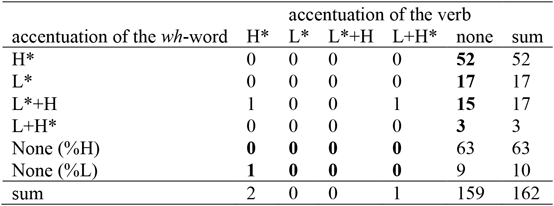
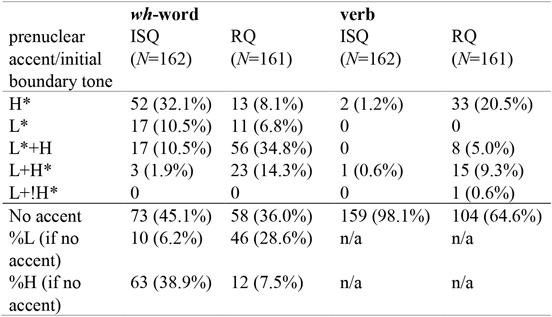
The distribution of prenuclear accents in wh-questions is shown in table 6. Based on Árnason (Reference Árnason2005), it was predicted that the default contour on wh-questions would start high and could have a prenuclear H* accent associated with the wh-word. The results show that if there is a prenuclear accent in wh-questions, it does indeed fall on the wh-word. Of the 88 cases with one prenuclear accent (bold face in table 6), 87 had the prenuclear accent on the wh-word (98.9%). Among accented wh-words, the H* accent was the most frequent one (52 out of 89 cases; 58.4%). Another frequent prenuclear pattern was no prenuclear accent at all (N=72, 44.4%). Prenuclear accents on both the wh-word and the verb were very rare (N=2, 1.2%). Of the 73 cases that had no prenuclear accent on the wh-word, 63 (38.9% of the overall wh-set) had a %H boundary tone. Including the wh-questions with the H* prenuclear accent, 115 of 162 wh-questions (71%) thus started high, confirming Árnason’s (Reference Árnason2005) intuition about the default pattern for wh-questions being one that starts high with an optional H* prenuclear accent. In table 6, bold face indicates the cases with only one prenuclear accent.
Cross-tabulation of type of prenuclear pitch accents in wh-questions; rows: wh-word, columns: verb.

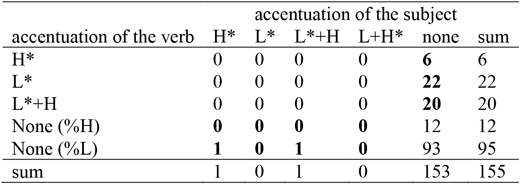
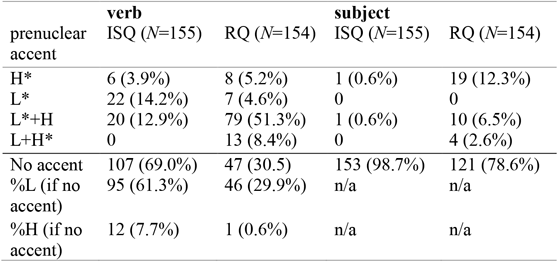
The distribution of prenuclear accents in polar questions is given in table 7; again, bold face indicates the cases with only one prenuclear accent.
Cross-tabulation of type of prenuclear pitch accents in polar questions; rows: verb, columns: subject.

In wh-questions, there were significantly more productions that started with high initial pitch (H*, %H) than in polar questions (ß=3.7, SE=0.4, z=8.7, p<0.0001).
4.2. ISQs Versus RQs
All numbers and percentages within RQs relate to 154 polar RQs and 161 wh-RQs (see section 3.2). The distribution of boundary tones in the two illocution types is shown in table 8, adding RQs to table 3. All RQs in both question types are falling to a low boundary tone L%, while there is more variation in boundary tones in ISQs in both question types. The distribution of L% boundary tones could not be compared statistically across illocution types because of 100% L% occurrence in RQs.
Distribution of final boundary tones across question and illocution types.

The distribution of nuclear accents in the two illocution types is shown in table 9, adding RQs to table 4. Percentages in table 9 relate to the total number of instances in a given question and illocution type.
Distribution of nuclear pitch accents across question and illocution types.

In polar questions, the most frequent accent types in RQs were early rises (L+H*, L+!H*, and L+H*), accounting for 66.2% of the polar-RQ realizations. They were followed in frequency by late rises (L*+H, L*+!H, and L*+∧H, 28.6%), while monotonal accents (H*, !H*, ∧H*) were very infrequent (5.2%). In wh-questions, early rises (L+H*, L+!H*, L+∧H*) were predominant (85.1% of the wh-RQs), while late rises (L*+H, L*+!H and L*+H) and monotonal accents were rare (6.8% and 8.1%, respectively).
For polar questions, there was no effect of illocution type on monotonal accents (p=0.8). Late rises were significantly more frequent in ISQs than in RQs (β=1.9, SE=0.3, z=5.6, p<0.00001). At the same time, early rises were significantly more frequent in RQs than in ISQs (β=1.6, SE=0.3, z=5.0, p<0.00001). For wh-questions, there were more monotonal accents in ISQs than in RQs (β=4.3, SE=0.8, z=5.3, p<0.00001), more early rises in RQs than in ISQs (β=2.9, SE=0.4, z=8.3, p<0.00001), and no difference in late rises (p=0.9).
The distribution of prenuclear accents is shown in table 10 for polar questions and in table 11 for wh-questions. In polar questions, the sentence-initial verb was mostly unaccented in ISQs (69.0%), but mostly accented in RQs (69.5%), a difference that was significant (β=2.9, SE=0.6, z=4.7, p<0.00001). In RQs, the most frequent accent type on verbs was L*+H (51.3%), which occurred significantly more frequently in RQs than in ISQs (β=2.9, SE=0.7, z=4.3, p=0.00001). The subject was mostly unaccented in both illocution types (153 versus 121). However, they were more often unaccented in ISQs than in RQs (β=3.9, SE=0.9, z=4.4, p<0.00001). Considering accented subjects in RQs, the most frequent pitch accent was H* (12.3% of accented subjects).
Distribution of prenuclear pitch accents and initial boundary tones in polar questions across illocution types.

Distribution of prenuclear pitch accents and initial boundary tones in wh-questions across illocution type.

Wh-words in RQs were most often accented with L*+H (34.8%), significantly more often than in ISQs (ß=1.8, SE=0.3, z=5.2, p<0.00001). They were also frequently unaccented, following a low initial boundary tone %L. This pattern was also more frequent in RQs than in ISQs (ß=2.4, SE=0.5, z=5.3, p<0.00001). Conversely, ISQs more often started with a high initial boundary tone (%H) than RQs (ß=2.4, SE=0.4, z=6.3, p<0.00001, without random intercept for item). The verb was more often accented in RQs than in ISQs (ß=3.7, SE=0.7, z=5.8, p<0.00001). If it was accented, the most frequent accent type was H* (20.5%), followed in frequency by L+H* (9.3%).
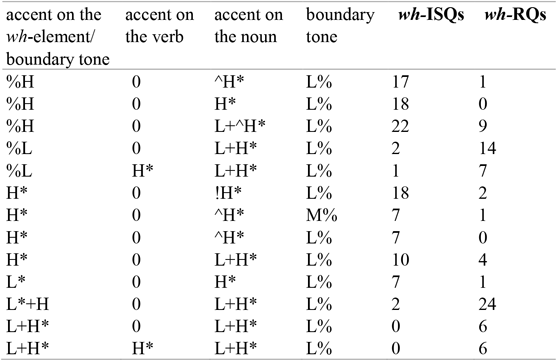
Finally, we report the combinations of prenuclear accents, nuclear accents, and boundary tones that occurred more than 5 times in any of the illocution types, first for polar questions (table 12), then for wh-questions. In polar questions, the most frequent combinations of accents and boundary tones for ISQs were a low-pitched start, no prenuclear accents, and either an L*+H or L+H* accent on the object, followed by a low boundary tone L% (N=49, 31.6% for L*+H, and N=40, 25.8% for L+H*, accounting for 57.4% of the polar ISQs). For polar RQs, the most frequent contour consisted of a prenuclear L*+H accent on the verb and an L+∧H* L% nuclear contour associated with the object (N=29, 18.8% of the polar RQs). All other contours were clearly less frequent (less than 12% of the polar RQs). Tables 12 and 13 show the distribution of frequent combinations of prenuclear accents, nuclear accents, and boundary tones across illocution types for polar questions (>5 instances in one of the illocution types) and wh-questions (>5 instances in one of the illocution types), respectively.
Frequent combinations of prenuclear accents, nuclear accents, and boundary tones for polar questions.

Frequent combinations of prenuclear accents, nuclear accents and boundary tones for wh-questions.

For wh-questions, the most frequent contour for ISQs was a high initial boundary tone (%H) followed by an L+∧H* L% nuclear contour on the object (N=22), which accounts for 13.6% of the cases. For RQs, the most frequent contour was a prenuclear L*+H accent associated with the wh-pronoun followed by L+H* L% on the object (N=24, 14.9%). Taken together, except for polar ISQs, the most frequent overall contours were rather infrequent, with a frequency of occurrence of less than 15% of the cases.
5. Discussion
We begin by addressing the hypotheses regarding the prosodic realization of experimentally elicited ISQs in Icelandic (see 7 H1, repeated in 8), and then move on to the comparison between ISQs and RQs (see 7 H2, repeated in 9). We end the discussion with a comparison between Icelandic and its linguistic relatives English and German, and some general remarks about the relationship between prosody and question and illocution type, and finally the Icelandic tonal inventory.
(8)

First, the results for ISQs (testing H1) largely confirm observations made in previous literature based mostly on introspective data (for example, Árnason Reference Árnason and Werner1998, Reference Árnason2005, Reference Árnason2011). Both polar and wh-questions typically end in L% (at least 88% of questions in each question type), confirming L% as the typical boundary tone for both question types, and thus confirming H1a. Deviances from L% were mostly M% (in 11.7% of wh-ISQs), which was found in contours with a final fall in which the fall did not reach the speaker’s baseline. However, their occurrence was very speaker-specific and is therefore hard to generalize.
As hypothesized in H1b, the two question types differ in nuclear accent type, although there is some overlap, as well. While the typical nuclear pitch accent in wh-ISQs is a peak accent, that is, monotonal H*/!H*/∧H* (62.3%), polar ISQs typically have bitonal (L+H) nuclear pitch accents. Polar ISQs were predicted to be realized with a late rise (L*+H), which was indeed produced in the majority of the cases (56.1%). However, the early-rise (L+H*) is a strong competitor (occurring in 41.9% of the cases), while monotonal accents hardly occur. In wh-questions, the monotonal nuclear accent is most frequent (62.3%), as predicted, but here again, the early-rise is a considerable competitor (34.6%). For wh-questions, there is no prior work stating the presence of early rises. However, looking at Árnason’s contour in 6a (as well as the less frequent one in 6b), one does see a dip in the intonational contour before the peak annotated as nuclear peak. In our data, if the rise from this dip was local (that is, on the stressed syllable, see section 3.2), it was annotated as L+H* (including L+∧H*, L+!H*), while Árnason in his work did not employ leading tones at all. The occurrence of L+H* in wh-questions is thus not totally unexpected. In future research we plan to establish whether (and under which phonetic conditions) listeners of Icelandic perceive a difference between these kinds of nuclear accents (in particular, monotonal H* and bitonal L+H*).
In both question types, the early rise (L+H*) is the second most frequent nuclear pitch accent (polar ISQs: 41.9%; wh-ISQs: 34.6%). Remember that for polar questions, previous research observed both the late rise (Árnason Reference Árnason2011) and the early rise (Dehé Reference Dehé2018a), but using different methods. Our results show that both rises are frequent, but that there is a larger proportion of late rises than early rises overall. The relatively frequent occurrence of the early rise in both polar and wh-questions is noteworthy, especially because it is also the accent typical of declaratives. If used, it does thus not necessarily distinguish between utterance types, although in terms of frequency it is assumed typical of declaratives and less frequent in questions. Future research will have to show i) whether there are timing differences between early rises in questions versus statements (that is, alignment of L and H relative to segments in the nuclear syllable), ii) whether along with intonation, there are phonetic features in the utterance that distinguish between questions and statements (for instance, duration; see Petrone & Niebuhr Reference Petrone and Niebuhr2014, van Heuven & Zanten Reference Heuven and van Zanten2005), iii) whether these differences are then identified in perception, as well as iv) more generally, which cues (accent type, timing, phonetic features) are most distinctive to listeners. If the timing of rises turns out to be the same and is judged natural across utterance types, L+H* might perhaps be seen as some neutral accent type for Icelandic despite varying frequencies between utterance types. One may also speculate that speakers do not always mark the contrast between question types by different pitch accents because the contrast is also marked syntactically (see Keller & Alexopoulou Reference Keller and Alexopoulou2001 for a discussion on the trade-off between syntactic and intonational marking). In absence of the need to signal the contrast prosodically, the accent that is already the most frequent one (or perhaps default, namely, the early rise also typical in declaratives; see Árnason Reference Árnason and Werner1998, Reference Árnason2011; Dehé Reference Dehé2010) is also produced in the question contexts tested here.
For the prenuclear area, Árnason (Reference Árnason2005) assumes that the typical intonational contour for wh-questions starts high (see our hypothesis H1c), although it is not entirely clear from his work whether the high beginning has to be interpreted as a H* accent associated with the wh-pronoun. Our results are compatible with Árnason’s assumption of a high start. Of the 162 wh-ISQs, 115 (71%) started high, either with %H or with H* associated with the wh-pronoun. We thus also show that the high beginning is not necessarily due to early prominence (that is, a nuclear accent associated with the wh-pronoun). Note that high initial pitch also contributes to the difference between polar and wh-questions. Only 18 of 155 (11.6%) polar ISQs started high (12 %H, 6 H*), while only 29% of wh-ISQs did not start high. Remember the contour that Árnason (Reference Árnason2005:476–477) describes for the example in 6b above: It starts low, then rises toward the peak associated with the nuclear syllable. Although Árnason (Reference Árnason2005:477) argues that this contour is used when the wh-word does not need to be accented due to discourse givenness, the low start of the contour may perhaps be interpreted as a L* prenuclear accent (17 cases in our data), rise from L* (L*+H, 15 cases in our data), or no accent at all. All of these patterns are found in the data.
We now turn to the hypotheses given in 7 H2, repeated here as 9, concerning the intonational contrast between ISQs and RQs.
(9)

ISQs and RQs are clearly realized with different intonational patterns, confirming H2a. As predicted, this difference is not expressed by the boundary tone, which is L% throughout, with 100% L% in RQs. Although in wh-ISQs we find 11.7% (N=19) mid-level boundary tones (M%), compared with 0% in RQs, we do not interpret this result as an important difference between the illocution types. M%, like L%, terminates a fall from a high target in the nuclear accent, although this is a fall to mid instead of low. Of the 19 cases of M% within wh-ISQs, five were produced by the same speaker, suggesting an idiosyncratic usage of M% to signal illocution type. The results for boundary tone in polar questions are unlike those in English, where boundary tones distinguish illocution types in polar questions (Dehé & Braun Reference Dehé and Braun2019), and unlike those in German (Braun et al. Reference Braun, Dehé, Neitsch, Wochner and Zahner2018), where boundary tones are different between ISQs and RQs in both polar and wh-questions.
In Icelandic, the crucial differences between ISQs and RQs are differences in pitch accent type, which confirms hypothesis H2a. Despite some overlap in nuclear accent distribution (see table 9 above), clear differences emerge between ISQs and RQs. In polar questions, it is the timing of the nuclear rise that distinguishes between polar ISQs and polar RQs. Specifically, there are more late rises (L*+H) in ISQs, and more early rises (L+H*) in RQs. Within wh-questions, we typically find monotonal H*/!H*/∧H* in wh-ISQs (see also Árnason Reference Árnason2005, Reference Árnason2011), but bitonal L+H*/L+!H*/L+∧H* in wh-RQs. Our results concerning the relevance of nuclear pitch accents are compatible with Árnason’s (Reference Árnason2011) observation that the nuclear pitch accent type used in Icelandic utterances reflects illocution type. Árnason (Reference Árnason2011) maintains that the early rise (L+H*) is typical of statements (see also Dehé Reference Dehé2010), while the late rise (L*+H) is typical of polar questions. The present study confirms the late rise as most frequent accent for polar ISQs, while polar RQs more often have an early rise (L+H*), similar to declarative statements. Based on our results, this difference in accent type distribution across illocution types can be extended to wh-questions, such that the early rise is the most frequent accent type in RQs across question types (polar RQs: 66.2%, wh-RQs: 85.1%). We conclude from this that the early rise is particularly suitable to mark nonquestionhood more generally. While RQs are interrogatives in syntactic form, their most frequent nuclear accent is the same as in declaratives, reflecting the “feel of an assertion” (Biezma & Rawlins 2017:302), which has been attributed to RQs in the literature (see section 2.2 above).
The use of L*+H to mark questionhood versus L+H* to mark nonquestionhood may in fact be a recent development, given that Dehé (Reference Dehé2018a) finds more early rises (L+H*) in polar ISQs in speakers aged 64+. To verify this suggestion, we analyzed the productions of the three speakers aged 60+ who participated in the present experiment.Footnote 4 The results showed a higher proportion of early rises in polar ISQs (52.6%) than what was produced by the younger speakers in this study (41.7%), supporting Dehe’s (2018a) results from a map task study. However, given the sample size, these results can only be taken as a tendency and will have to be addressed in a separate experimental study manipulating age in order to arrive at results that are more conclusive.Footnote 5 In any case, all nuclear pitch accents are typically followed by L%, that is, all nuclear contours, across question types and illocution types, are typically falling.
Another intonational difference between ISQs and RQs in Icelandic, confirming hypothesis H2b, is found in the prenuclear region, specifically with respect to type and frequency of the prenuclear accent. In polar questions, the typical position of a prenuclear accent, if present, was the verb; in wh-questions it was the wh-word. However, in both question types, more prenuclear accents were generally produced in RQs than in ISQs, and bitonal prenuclear pitch accents (mostly L*+H) were more frequent in RQs than in ISQs across question types, while ISQs had more monotonal pitch accents. When no prenuclear prominence was present, more %H boundary tones were observed in wh-ISQs than in wh-RQs. Not only is this finding consistent with Árnason’s (Reference Árnason2005) assumption that the default wh-contour starts high, but it also suggests that in wh-questions, the high beginning may be a genuine question marker. It disappears in RQs, which are generally assumed to have the feel of an assertion.
Note that the prenuclear region also plays a role in the disambiguation of illocution types in other languages (see, for example, van Heuven & Haan 2002 for Dutch, Petrone & Niebuhr Reference Petrone and Niebuhr2014 for German). We assume that in Icelandic, as well, listeners may use prenuclear cues to identify questions early on as being either information seeking or rhetorical, especially because in phonological terms, most nuclear accents occur in both RQs and ISQs, albeit with different frequencies (see table 9), and the boundary tone is generally L%. Note also that our results suggest that the role of prenuclear accents is more important in polar questions than in wh-questions. This may be directly related to the fact that the difference in nuclear accents is larger in wh-questions than in polar questions. Considering the most frequent accentual realization, the most frequent nuclear accent in wh-questions is the monotonal high accent in ISQs, 62.3%, versus the early rise in RQs, 85.1%. In contrast, in polar questions, the difference in percentages of occurrence is smaller: 55.8% late rises for ISQs versus 66.2% early rises in RQs (see table 9). In comparison, in the prenuclear area (tables 10 and 11)—which is the verb in polar questions and the wh-word in wh-questions—there are larger differences in accent distribution within polar questions (69% no accent on the verb in ISQs versus 51.3% L*+H in RQs) than within wh-questions. As shown in table 10, in polar questions, the verb was unaccented in 69% of the ISQs compared to 30.5% of the RQs. In contrast, in wh-questions, the wh-word was unaccented in 45.1% of the ISQs compared to 36.0% of the RQs. It thus seems as if in polar questions, an intonational difference in the prenuclear area makes up for a weaker intonational difference in the nuclear area. The role of the prenuclear area (both phonologically and phonetically) is a question for future research, along with questions about phonetic differences between phonologically identical contours (timing, duration, etc).
Given that RQs and ISQs differ in prenuclear and nuclear pitch accents, the difference in whole contours as shown in tables 12 and 13 follows straightforwardly. It is striking that there seems to be more clustering of intonation contours in ISQs (for example, only two contours accounting for 57.4% of polar ISQs), and more balanced occurrences of various contours in RQs (for example, no contour associated with wh-RQs occurring in more than 15% of the cases). This suggest that individual elements of the intonation contour contribute to marking a question as information seeking or rhetorical and that there is no single overall contour (or a single nuclear tune) that is specific to one illocution type. This finding deviates from Prieto & Borràs-Comes’ (Reference Prieto and Borràs-Comes2018) findings for Catalan, in which the nuclear contour altered according to how a polar question was interpreted with respect to different levels of agreement or commitment.
The lack of a clear pattern in RQs may suggest that other, non-intonational cues also contribute to the rhetorical interpretation, specifically phonetic cues such as longer durations (Braun et al. Reference Braun, Dehé, Neitsch, Wochner and Zahner2018 for German, Dehé et al. Reference Dehé, Braun, Wochner, Klessa, Bachan, Wagner, Karpiński and Śledziński2018 for Icelandic, Dehé & Braun Reference Dehé and Braun2019 for English) and differences in voice quality (for instance, Braun et al. Reference Braun, Dehé, Neitsch, Wochner and Zahner2018 for German, Dehé & Braun Reference Dehé and Braun2019 for English). Phonetic cues have also been shown to signal illocution type elsewhere. Regarding duration, for example, questions are produced with a faster speaking rate (that is, shorter durations) than statements in German, Manado Malay, Orkney English, and Dutch (see, among others, van Heuven & Zanten Reference Heuven and van Zanten2005, Niebuhr et al. Reference Niebuhr, Bergherr, Huth, Lill and Neuschulz2010, Niebuhr 2013). Regarding voice quality, Niebuhr et al. (Reference Niebuhr, Bergherr, Huth, Lill and Neuschulz2010) report breathier voice quality for declarative questions than for declarative statements in German. Breathiness has also been associated with questionhood in a number of African languages (Rialland Reference Rialland2009). As for the contrast between RQs and ISQs, breathier voice quality in RQs than in ISQs has been found in German (Braun et al. Reference Braun, Dehé, Neitsch, Wochner and Zahner2018) and English (Dehé & Braun Reference Dehé and Braun2019). It is therefore conceivable that voice quality plays a role in Icelandic, too. We leave the analysis of phonetic parameters for Icelandic to future research.
Comparing the present results for the intonational marking of illocution types in Icelandic with recent results for English (Dehé & Braun Reference Dehé and Braun2019) and German (Braun et al. Reference Braun, Dehé, Neitsch, Wochner and Zahner2018), the following picture emerges with respect to meaning signaled by intonation. All three languages use intonation to cue illocution type, but not all intonational parameters are used in all three languages (for example, boundary tone). The parameters that are used in all three languages (nuclear and prenuclear pitch accents) are not always used in the same way (see also Dehé 2018b). First, unlike both English and German, Icelandic does not make use of the final boundary tone to mark illocution type. Instead, Icelandic sticks to the default L% in both ISQs and RQs, reserving H% for special connotations (as well as continuation rises; see Árnason Reference Árnason and Werner1998 and Dehé Reference Dehé2009). By contrast, in English, the final boundary tone distinguishes between polar ISQs and polar RQs (rise versus mid-level plateau), but not between wh-ISQs and wh-RQs (typically L-L% in both illocution types). German makes use of the final boundary tone in both question types.
Second, like English and German, Icelandic employs pitch accent types to mark illocution type. In particular, the timing of the nuclear rise plays a role in both German and Icelandic, although it goes in different directions (late rises, L*+H, are more frequent in RQs in German, but in ISQs in Icelandic). Moreover, in both English and Icelandic the difference between monotonal and bitonal nuclear accents contributes to the distinction between wh-ISQs and wh-RQs. In both languages, monotonal nuclear peaks are more frequent in wh-ISQs, while bitonal pitch accents (early rises) are more frequent in wh-RQs. Unlike English polar RQs, Icelandic polar RQs do not make use of the position of the nuclear accent. Finally, for the prenuclear region, we find similarities between Icelandic and English such that stronger (that is, bitonal) accents are more frequently produced in wh-RQs than in wh-ISQs.
In theoretical (semantic) work on question intonation, the boundary tone is often assumed to constitute a crucial difference between RQs and ISQs. This work focuses almost exclusively on English and typically assumes a distinction between a high terminus (H%) for ISQs and a fall to L% for RQs, reflecting assertiveness (see, among others, Bartels Reference Bartels1999, Han 2002). For several reasons the simple contrast between rise and fall is insufficient to distinguish between ISQs and RQs in any of the languages that have so far been studied experimentally. In Icelandic, the boundary tone is not distinctive at all, because a final fall is the default across question and illocution types. In English, the terminus is contrastive between ISQs and RQs in polar questions only, and only if taking into account the edge tone, that is, the combination between phrase accent and boundary tone, instead of the boundary tone alone (Dehé & Braun Reference Dehé and Braun2019). Moreover, both English and German show that along with rise and fall, a plateau contour is crucial in the distinction between illocution types (Dehé & Braun Reference Dehé and Braun2019, Braun et al. Reference Braun, Dehé, Neitsch, Wochner and Zahner2018). We conclude that i) generally speaking, the relationship between illocution type and intonational realization is much more complex than just a matter of final fall or rise, and ii) this reationship may be language-specific. In particular, we do find similarities across languages in that intonational parameters used to signal illocution type may be the same (for example, pitch accents reflect the difference between illocution types), but the ways they are employed are language-specific (see also Dehé 2018b).
Finally, a word is due on the tonal inventory of Icelandic. As described in section 2 above, two bitonal and two monotonal pitch accents (L*+H, L+H*, L*, H*), as well as two final boundary tones (L%, H%) have previously been identified in the literature. The current study adds two initial boundary tones to this inventory (default %L, %H) to account for the fact that certain utterance types—most notably wh-ISQs—may start with high initial pitch but not with prenuclear prominence. The current study also adds a diacritic for upstep (borrowing the ∧H annotation from GToBI), used to indicate that later high tonal targets in the utterance are higher than earlier ones. For example, if a wh-question starts with %H or prenuclear H*, the nuclear peak may be upstepped in comparison. Therefore, the present experimental study of Icelandic question intonation also contributes to a better and fuller picture of the Icelandic tonal inventory. However, future studies on the intonation of Icelandic, including utterance types other than interrogatives, will have to i) show whether all categories are contrastive (for example, H* versus ∧H*) and thus necessary, and ii) elaborate on the exact relationship between intonational categories and meaning.
6. Conclusion
This paper used a controlled question-elicitation task to investigate the prosodic realization of Icelandic information-seeking and rhetorical questions. The results showed that polar ISQs were mostly realized with L*+H nuclear accents, and wh-ISQs with H* accents (often with a high start, that is, %H or H*). Both polar and wh-ISQs ended in a low boundary tone (L%). RQs also ended in L%, but differed from ISQs in nuclear pitch accent types (more early rises in RQs), and in the type and frequency of prenuclear accents (more accented verbs in polar RQs than in polar ISQs, and more accented wh-words in wh-RQs than wh-ISQs, typically L*+H). Most importantly, the results show that the boundary tone in Icelandic is not used to distinguish between question types (polar versus wh-) or between illocution types (ISQ versus RQ). Instead, pitch accent types and their distribution, both in the nuclear and the prenuclear region, serve as intonational keys to these distinctions.
APPENDIX
The table below shows target polar and wh-interrogatives. The two items containing non-natives words (Bolognese, Lambada) are not included because they were excluded from the analysis.