INTRODUCTION
Calcareous tube worms (family Serpulidae) are taxonomically and biologically relatively well studied, especially compared to other families of Polychaeta. Among the many alien species reported world-wide, 18 serpulid species (excluding spirorbins) were reported as invasive or cryptogenic (Nishi & Kato, Reference Nishi and Kato2004). Comprising 89 described species world-wide (see ten Hove & Kupriyanova, 2009 for a review) and particularly speciose in the tropics, the largest serpulid genus Hydroides has 16 species recorded from temperate Japan: H. fusicola Mörch, 1863, H. diramphus Mörch, 1863, H. albiceps (Grube, 1870), H. minax (Grube, 1878), H. elegans (Haswell, 1883), H. exaltatus (Marenzeller, 1884), H. multispinosus Marenzeller, 1884, H. novaepommeraniae Augener, 1925, H. ezoensis Okuda, Reference Okuda1934, H. brachyacanthus Rioja, 1941, H. tambalagamensis Pillai, 1961, H. externispina Straughan, 1967, H. fuscus Imajima, 1976a, H. tuberculatus Imajima, 1976a, H. longispinosus Imajima, 1976b and H. bisectus Imajima & ten Hove, 1989 (Imajima, Reference Imajima1996). Most species of this list were originally described from the Indian Ocean and western Pacific; however, H. brachyacanthus is either an alien species (Zibrowius, Reference Zibrowius1971) or a member of a complex of species (Bastida-Zavala & ten Hove, Reference Bastida-Zavala and ten Hove2003b). Also at least two species, H. diramphus and H. elegans are considered cryptogenic sensu Carlton (Reference Carlton1996), that is, are neither clearly native nor introduced. These two species of uncertain origin have been well known as fouling organisms on ships' hulls world-wide since the late 19th Century (Zibrowius, Reference Zibrowius1971). More recently, H. ezoensis was transported to Europe, likely associated with oysters (Zibrowius, Reference Zibrowius1978; Thorp et al., Reference Thorp, Pyne and West1987; Breton & Vincent, Reference Breton and Vincent1999) and introduced by ship-transport to Australia, where it became well-established (Hayes & Sliwa, Reference Hayes and Sliwa2003). Although H. ezoensis was originally described by Okuda (Reference Okuda1934) from Hokkaido (formerly Ezo), Japan, some specimens of this species were studied by Fauvel in 1927 at Seto, Wakayama, near Osaka, and deposited in the Seto Marine Biological Laboratory, Kyoto University (Iwasaki et al., Reference Iwasaki, Kimura, Kinoshita, Yamaguchi, Nishikawa, Nishi, Yamanishi, Hayashi, Okoshi, Kosuge, Suzuki, Henmi, Furota and Mukai2004; Nishi & Tanaka, Reference Nishi and Tanaka2008). Being quite common in Japan and East Asia, H. ezoensis is, however, found predominantly as fouling organisms on mariculture as well as ships and piers in harbours and ports, which is characteristic for invasive species. Consequently, Nishi & Tanaka (Reference Nishi and Tanaka2008) tentatively considered it a cryptogenic species whose occurrence in natural habitats outside harbours and ports needs to be confirmed.
Many Japanese and Asian species are found to have been introduced into European waters, often developing into harmful pests (e.g. Eno et al., Reference Eno, Clark and Sanderson1997). Japanese coasts also sometimes receive invasive species from Europe and America (Iwasaki et al., Reference Iwasaki, Kimura, Kinoshita, Yamaguchi, Nishikawa, Nishi, Yamanishi, Hayashi, Okoshi, Kosuge, Suzuki, Henmi, Furota and Mukai2004; Nabeshima, Reference Nabeshima2007). Here we report a characteristic example of another common Hydroides species recently introduced into Tokyo Bay, central Japan, imported from either temperate European or American waters.
MATERIALS AND METHODS
Polyvinylchloride (PVC) panels (15 × 15 cm) were immersed at 80 cm depth in Shinhama Lagoon, inner part of Tokyo Bay (35°66.519′N 139°91.764′E), from May until November 2006. The lagoon is an 83 ha wetland park connected to Ichikawa Port by one open and one underground channel. In summer, salinity ranges from 20 to 24‰ (Tanaka et al., Reference Tanaka, Isobe, Koibuchi, Gomyo and Ohno2005) and the water temperature can exceed 25°C. The average water depth here is less than 3 m, and the sea-floor consists of sandy silt with clay. Hard substrata found in the muddy tidal flat are oyster reefs and the concrete wall, which surrounds about two-thirds of the lagoon. Material was sorted under the stereomicroscope and polychaete species were identified and counted. Although more serpulid species were found (Link, Reference Link2007), we only studied the relatively newly recorded Hydroides dianthus in detail. Specimens were fixed using 4% neutralized formaldehyde and preserved in 70% ethanol. An anterior part of one specimen was observed with a JEOL scanning electron microscope. Five specimens were stored in the Universidad del Mar Polychaete Reference Collection (UMAR Poly, Oaxaca, México), and nine more specimens were deposited in the Natural History Museum and Institute of Chiba, Japan (CBM), Coastal Branch of Natural History Museum and Institute, Chiba, Katsuura, Chiba, Japan (CMNH), the South Australian Museum, Adelaide, Australia (SAM), the National Museum of Natural History, Smithsonian Institution, Washington DC, USA (USNM), the Senckenberg Museum, Frankfurt, Germany (SMF), the Zoological Museum, University of Copenhagen, Copenhagen, Denmark (ZMUC) and the Natural History Museum, London (NHM).
In the diagnosis the notation between parentheses corresponds to the minimum measurement in ‘juveniles’, following Bastida-Zavala & ten Hove (Reference Bastida-Zavala and ten Hove2003a).
(A, B) Scanning electron micrographs of Hydroides dianthus operculum; a characteristic basal funnel is crowned with a verticil made of chitinous spines without external spinules; (C) operculum of H. sanctaecrusis; the verticil bears typical external spinules, sp; (D, E) H. dianthus, SEM of collar chaetae; (F) H. dianthus, anterior abdominal uncini; (G) H. dianthus, thoracic uncini from 4th chaetiger. Scale bars: A, B, 200 µm; D, 20 µm; E, 50 µm; F, G, 10 µm.

MATERIAL EXAMINED
Twelve adult specimens and one juvenile specimen. CBM-ZW-1010 (2 specimens), CMNH-ZW-1696 (1 specimen), NHM-ANEA 2009.1 (1 specimen), USNM 1122383 (1 specimen), SAMA-E3716 (1 specimen), UMAR Poly-107 (5 specimens), SMF 17915 (1 specimen), ZMUC-POL-2010 (1 specimen). Ichikawa area, Tokyo Bay, 22 August 2006, collected by H. Link, from PVC panels in 80 cm depth. Specimens with gametes have not been found.
DESCRIPTION
Tube white, internal diameter 1.3 mm (N = 10, r: 0.1–1.3, μ = 0.8 ± 0.4), external diameter 1.5 mm (N = 10, r: 0.1–1.5, μ = 1.0 ± 0.4); one tube covered by epibionts, all tubes have transversal ridges and lack peristomes; one specimen shows three longitudinal ridges and three none. Body colourless in preserved specimens; total length 10.7 mm (N = 11, r: (3.0) 4.6–15.7, μ = 11.3 ± 3.1). Branchial crown with 12 radioles (N = 10, r: (8) 9.0–20.0, μ = 11.6 ± 3.0) on each lobe. Peduncle length 3.2 mm (N = 8, r: 2.1–3.6, μ = 3.0 ± 0.4), all specimens show insertion of the peduncle left; constriction ill-defined or lacking (Figure 1G). Pseudoperculum present in all specimens. Operculum length 0.7 mm (N = 11, r: (0.2) 0.5–1.0, μ = 0.8 ± 0.2), diameter 0.7 mm (N = 5, r: 0.5–0.8, μ = 0.7 ± 0.1). Funnel with 26 radii (N = 11, r: (10) 17–33, μ = 25.8 ± 4.7) with pointed tip (Figure 1A, B&G). Inter-radial grooves half of funnel length in all opercula. Verticil with nine yellowish spines (N = 11, r: 8–10, μ = 9.4 ± 0.7), all curving more or less in ventral direction (Figure 1A, B&G). Dorsal spines larger than ventral ones, in ‘juvenile’ specimens the dorsal verticil spines are less developed. Tip of spines pointed. Spines with one basal internal spinule, one specimen lacks internal spinule; without external and lateral spinules and/or wings. Verticil without central tooth. Collar chaetae bayonet type, with two blunt-rounded teeth, distal blade smooth (Figure 1C, D). Length of thorax 2.5 mm (N = 11, r: (0.7) 1.0–3.4, μ = 2.3 ± 0.7), width 1.0 mm (N = 11, r: (0.3) 0.6–1.0, μ = 0.8 ± 0.1). Thoracic membranes forming well-developed ventral apron. Six chaetigers with hooded (limbate) chaetae of two sizes, saw-shaped uncini with seven teeth (Figure 1E). Abdomen with 45 (N = 10, r: (30) 35–48, μ = 40.9 ± 4.7) chaetigers. Anterior and middle abdominal chaetigers with flat-trumpet chaetae. Posterior chaetigers with ‘capillary’ chaetae. Anterior uncini saw-shaped, with eight teeth (Figure 1F).
HABITAT
The species is found in fouling communities on buoys and piers in embayments, and particularly on artificial substrates such as concrete walls, ropes and PVC plates. The serpulid fouling community at the collection site consisted of four species of Hydroides: H. ezoensis, H. fusicola, H. exaltatus and H. dianthus, with addition of some polydorid species.
DISTRIBUTION
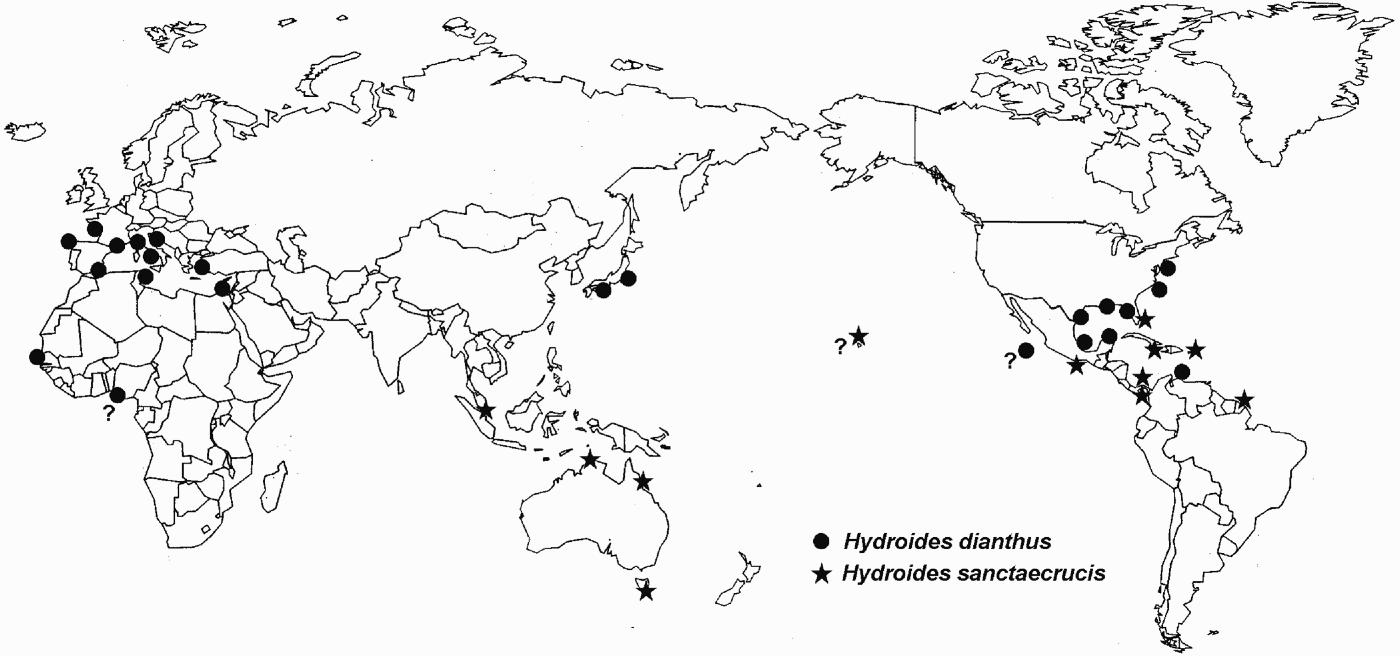
Amphi-Atlantic. East coast of the United States, New Jersey to Massachusetts, Gulf of Mexico, Atlantic coasts of France and Spain, Mediterranean Sea, West Africa (Senegal), Japan (Figure 2).
Updated distribution of Hydroides dianthus and H. sanctaecrucis according to Zibrowius (Reference Zibrowius1971), Bastida-Zavala & ten Hove (Reference Bastida-Zavala and ten Hove2003a, Reference Bastida-Zavala and ten Hoveb) and Lewis et al. (Reference Lewis, Watson and ten Hove2006). Question mark on the map indicates the records that have not been confirmed.

DISCUSSION
The morphological characters of the specimens described here fit well the description of Bastida-Zavala & ten Hove (Reference Bastida-Zavala and ten Hove2003a), although the specimens found in Japan are relatively small compared with those recorded from the western Atlantic. However, the important diagnostic characters, such as the number of opercular radii or spines, fit in the short range (radii: 24–37, spines: 8–13) recorded from the western Atlantic.
Hydroides dianthus was originally described (as Serpula dianthus) by Verill (1878) from the coast of New England. It appears to be native at the east coast of North America where it is widely distributed in a variety of ‘natural’ habitats including open coasts as well as in partly brackish waters of bays, lagoons, and ports. In Europe and western Africa, however, its distribution is sporadic; it occurs only in ports and lagoons, leaving out ‘natural’ habitats of full marine salinity, except in areas immediately adjacent to harbours (Zibrowius, Reference Zibrowius1971; Bastida-Zavala & ten Hove, Reference Bastida-Zavala and ten Hove2003a).
Specimens of Hydroides dianthus have been abundant (along with H. diramphus and H. elegans) as fouling organisms at Naples' harbours as early as 1888. But the occurrence of H. dianthus can be traced back to an even earlier date at Izmir (year of publication 1865) and at Trieste (year of collecting 1874) (Zibrowius, Reference Zibrowius1971, Reference Zibrowius1973, Reference Zibrowius1978). Possibly the arrival of H. dianthus via ship hull-fouling in the Mediterranean considerably antedates their first records. The species was discovered at Humble Spit in Southampton Water, England, in 1970 (Zibrowius, Reference Zibrowius1978) but has apparently not spread further (Zibrowius, Reference Zibrowius1992). It has also been recorded from the Atlantic coast of France and Spain (Zibrowius, 1983, 1991, Reference Zibrowius and Boudouresque1994; Zibrowius & Thorp, 1989).
This study is the first well documented record of H. dianthus for Japan and the Asian region in general, although its occurrence has independently been mentioned at a local conference (Otani & Yamanishi, Reference Otani and Yamanishi2007). This was based on the material collected in Osaka by Otani and referred to by Nabeshima (Reference Nabeshima2007). We revised the material and the identification was confirmed by R.B.-Z. Whereas the record from the Osaka Bay is the first for Japan, our record from Tokyo Bay is a range extension to the eastern part of Honshu, central Japan.
Serpulid polychaetes, especially of the genus Hydroides, are important fouling organisms on ships and in mariculture and therefore their taxonomy and biology have been well studied in Japan (e.g. Kajihara, Reference Kajihara1964; Imajima, Reference Imajima1976, Reference Imajima1996). Morphologically, H. dianthus is hard to confuse with local congeners, thus the lack of previous records of this species in Japan most likely is not a result of misidentification, but rather is an indication of its recent introduction.
Hydroides dianthus has been partly confused with and sometimes misidentified as a morphologically similar congener H. sanctaecrucis Krøyer [in] Mörch, 1863 (Lewis et al., Reference Lewis, Watson and ten Hove2006). Both species have partly sympatric distribution in the western Atlantic region (Bastida-Zavala & ten Hove, Reference Bastida-Zavala and ten Hove2003a). Hydroides sanctaecrucis is commonly found along the Caribbean Sea, Suriname and Gulf of Mexico (Bastida-Zavala & ten Hove, Reference Bastida-Zavala and ten Hove2003a). It also recently invaded the Pacific coast of Panama and some localities along the Pacific coast of Mexico (Bastida-Zavala & ten Hove, Reference Bastida-Zavala and ten Hove2003b), as well as Australia and Singapore (Lewis et al., Reference Lewis, Watson and ten Hove2006) (Figure 2). Hydroides sanctaecrucis and H. dianthus are distinguished by the presence of external spinules on the main spines of the verticil: the spinules are present in H. sanctaecrucis and are absent in H. dianthus (Figure 1C, sp). The Japanese specimens reported here are clearly without external or lateral spinules (Figure 1A&G) and thus belong to H. dianthus.
The possible sources of invasion of Hydroides dianthus reported here may include both the American or European coasts. Notably, this species has not been previously reported from the Asian region or the Pacific Ocean; the only record from Socorro Island, Pacific coast of Mexico by Holguín-Qiñones (Reference Holguín-Quiñones, Ortega-Rubio and Castellanos-Vera1994; as Eupomatus dianthus) is questionable and has not yet been confirmed. Therefore, it most likely has been introduced to Japan from an Atlantic or Mediterranean population. Hydroides dianthus is most likely to be introduced via ship hull-fouling, but its planktonic larvae might also be transported in ballast-water.
Non-indigenous species can have serious ecological and environmental impacts on the recipient area where they establish. For example, H. elegans is a notorious pest of fisheries and mariculture in Japan, where it competes with oysters for food and oxygen. An outbreak of this serpulid polychaete in Hiroshima Bay has caused heavy economic loss to cultured oyster crops through fouling on their shells, estimated at ¥3 billion in 1969 (equivalent to ~¥10 billion today) (Arakawa, Reference Arakawa1971). Hydroides dianthus occurs in both temperate and subtropical estuaries and does not appear to have the temperature restrictions of other species of the genus Hydroides (Zibrowius & Thorp, 1989). Its close congeneric H. elegans has a reasonably wide salinity tolerance: although freshwater caused 100% mortality of the tubeless worms in two minutes, 5‰ caused 100% mortality after 9.5 hours only (Mak & Huang, Reference Mak, Huang, Morton and Tseng1982). Similarly, maturation of H. dianthus is satisfactory in the salinity range of 25‰ to 35‰ (Leone, Reference Leone1970). Larvae of Hydroides dianthus are planktonic for up to two weeks (Toonen & Pawlik, Reference Toonen and Pawlik1994) and show a tolerance for low dissolved oxygen (Sagasti et al., Reference Sagasti, Schaffner and Duffy2000). Although H. dianthus larvae preferentially settle on bare space (Dean, Reference Dean1981) and its recruitment is inhibited by most other sessile species (Dean & Hurd, Reference Dean and Hurd1980), their settlement is also markedly gregarious, among conspecific adults (Scheltema et al., Reference Scheltema, Williams, Shaw and Loudon1981; Toonen & Pawlik, Reference Toonen and Pawlik1994). As a result, Hydroides dianthus occurs in tube clusters that provide microhabitats to diverse assemblages of other invertebrates (Haines & Maurer, Reference Haines and Maurer1980). In the Mediterranean H. dianthus even builds small (less than 1 m) reefs in the western part of the lagoon of Orbetello, Italy (Bianchi & Morri, Reference Bianchi and Morri2001). The species has also been known to smother juvenile oysters by overgrowing them in its native range of North America (Eno et al., Reference Eno, Clark and Sanderson1997).
The fact that new settlement of H. dianthus was recorded in Tokyo Bay suggests that the species has already established in the habitats studied here. According to its biological traits as discussed above, its introduction into the ecosystems along Japanese coasts may have serious negative effects, such as intensive fouling not only on harbour structures but also on mariculture. Therefore, expansion of this species in Japan has to be carefully monitored and the possibilities of preventing its spread to other areas need to be assessed.
ACKNOWLEDGEMENTS
The first author thanks Dr Masahiro Nakaoka and his laboratory staff, now at Akkeshi Marine Station, Hokkaido University, Japan, for their assistance in collecting in the field. The field work has been conducted in the frame of the GAME (Global Approach by Modular Experiments) project coordinated by Martin Wahl and Mark Lenz, IFM-GEOMAR, Kiel, Germany. This work is partly funded by the Kanagawa Academy of Science and Technology (KAST), Kurita Water and Environment Research Fund (KWEF) and Fujiwara Natural History Foundation to E.N. This work was supported by the Grant-in-Aid for Scientific Research (KAKENHI 20008766).