Demographers, like other social scientists, offered intellectual support to National Socialism. As in every other discipline, both people and theories were selected according to new ideological criteria (Heim et al. Reference Heim, Sachse and Walker2010; Klingemann Reference Klingemann1996; Lehmann and Oexle Reference Lehmann and Oexle2004; Pringle Reference Pringle2006; Steinweis Reference Steinweis2006). Under Nazism, the quantitative study of human population movement, migration, was shaped by the racist assumptions shared among academics and government. Migration researchers contributed to the justification of genocide. But the history of demography as social science in modern Germany offers more than the addition of a few names and another discipline to the list of scientists and sciences helping the Nazis wage war on European society.
A close examination of the reigning assumptions, the empirical methods, and the professional careers of successive generations of German migration researchers provides an expansive window through which to view the long-term interplay of social science and politics over 150 years, across very different political regimes. Because excellent internal migration data were collected across every German state since 1871, theoretical arguments can also be continuously juxtaposed with the accumulation of quantitative evidence. I will show that until very recently, biologically inflected sociological theory successfully resisted the influence of incompatible data. The resulting science was based on politically acceptable but empirically flawed analysis.
The history of internal mobility in Germany and the history of those who have observed, measured, and analyzed migration are inseparable. For two centuries human migration in Germany has been studied by professional demographers, mainly urban statisticians. Well before the creation of the German empire in 1871, they produced both descriptions and analyses of uniquely revealing data on migration at the regional and national level.Footnote 1 In the late nineteenth century, another group of more politically motivated writers invented forms of population data to support their very different understanding of migration. This latter ideological construction came to dominate public discourse on migration from the late Imperial Germany through the Weimar Republic, became the foundation of public policy under the Nazis, and continued its hegemony for decades in postwar West German academia. I argue that the intellectual dominance of these ultimately racist formulations, which fundamentally misunderstood and misrepresented how Germans migrated, exemplifies the subjectivity of social science, the resilience of theory against data, and the influence of politics on knowledge.
This national study is embedded in Western cultural history. How did the misunderstanding of migration as an expanding and quintessentially modern phenomenon of permanent rural-to-urban movement come to be a Western intellectual consensus? The story of German conceptions of migration offers a national answer to this global question. This essay is a contribution to what Stefan Goch called the “social history of the development of science,” more specifically the sociopolitical history of migration research (Goch Reference Goch2001: 140).
Migration in Germany 1824–1988
To measure how well researchers understood and portrayed German migratory behavior, we must begin with data. Thinking about migration rates at the community level across many, and eventually all, German communities provides the broadest and most inclusive grasp of the key features of German migration over the past two centuries. The significant features of migration are its changing volume, direction, and net impact.
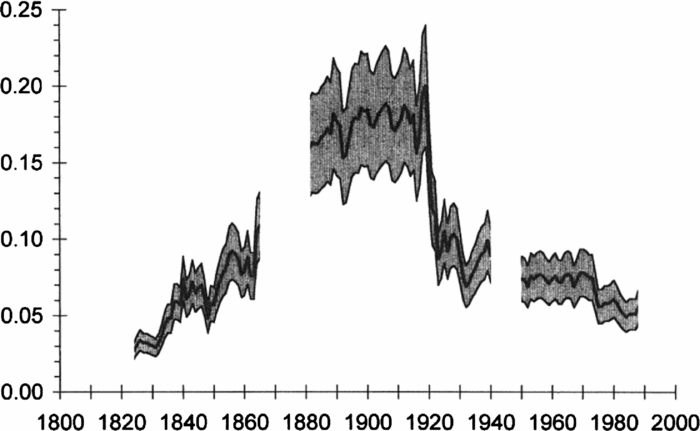
Figure 1 displays trends in migration volume in Germany from 1824 through 1988, based on rates of inmigration at the community level from three different sets of data (Hochstadt Reference Hochstadt1999).
Migration Rates in Germany 1824–1988.

These data come from various attempts to measure all migrations through the system of registration, the Meldewesen, instituted by Prussian officials in the District Düsseldorf, then generalized to other Prussian regions after 1857, and later expanded to large cities across Imperial Germany.Footnote 2 For brief periods before 1945, these data cover entire regions of Germany. After 1950, the system became national. Few data are available between 1866 and 1880, and during the chaotic 1940s. All the data displayed in figure 1 for thousands of separate communities were collected at the time and made public within a year or two.
The trends are clear. As Germany industrialized throughout the nineteenth century, mobility grew rapidly, reaching a plateau that stretched from about 1890 through World War I. By 1920, mobility started falling sharply, reaching a new equilibrium by 1923 at about half of the previous level. Migration rates in German cities and rural regions did not then change substantially from the early 1920s through 1940: The Great Depression caused a decline of about 20 percent to 30 percent from 1928 to 1932, which was then gradually reversed by the beginning of the war. After World War II, mobility fell again, and stabilized for 25 years at levels comparable to 1850, until the oil shock of the early 1970s led to another drop. Throughout these two centuries, smaller temporary oscillations in mobility corresponded to economic cycles, some very brief, and some more serious, such as in the late 1840s and early 1930s.
The data charted in figure 1 are among the most reliable historical migration statistics at the national level for any region in the world. Even allowing for considerable error has little impact on the clarity of this changing volume of migration. The gray area in figure 1 represents a range of 20 percent above and below the black data line: The long-term trends remain recognizable. Mobility in Germany increased during the particular socioeconomic circumstances of the nineteenth century, peaked as early as the 1890s, remained stable until about 1920, and declined since then.
The dark line in figure 1 charts an average inmigration rate for German communities. A chart of community outmigration rates would look very similar, because at all times, for all sizes of community, in- and outmigration moved up and down in tandem. That is, the flow between urban and rural communities had no dominant direction. Most migration was temporary. The excellent migration data allow us to calculate that for every 100 people who arrived in Germany's large cities from smaller communities throughout the Imperial Germany, between 90 and 95 people left those cities for smaller destinations (Hochstadt Reference Hochstadt1999: 137–39, 172–75). German migration was overwhelmingly circulatory exchange, not a one-way transfer.
At every point over the past two centuries when urban and rural migration rates can be compared, they were very close. Within the District Düsseldorf in the early nineteenth century (ibid.: 70–76), the city and District of Essen in 1920–21 (Statistisches Jahrbuch der Stadt Essen 8 1922: 7, 29), the province of East Prussia in 1932 (Statischer Jahresbericht der Provinzialverwaltung Ostpreussen 5 1932: 48–64), and the District of Oppeln in Silesia in 1937 (Laxy Reference Laxy1938: 47), community size had little influence on in- or outmigration rates. The difference between mobility in the late 1920s in rural East Prussia and in large German cities was small, and both lines follow the same curve. The most inclusive comparison available, the data for all Prussian communities for 1920–23 and 1937–38, shows very similar mobility for small rural communities and big cities (Statistisches Jahrbuch 1940: 75; 1942: 98).
There was no dominant regional direction in the movements of Germans. These characteristics of German migration structure were shared across the nation. At the peak of mobility before World War I, big city rates were virtually the same across all German regions, ranging from 0.17 to 0.20, except in Bavaria, where they were 0.11 (Hochstadt Reference Hochstadt1999: 122).
The migration data discussed in the preceding text present the most salient characteristics of mobility in Germany. These basic properties of German mobility are now assumed by scholars and fit into broader European patterns (Baines Reference Baines and Mokyr2003: 118; Lenger Reference Lenger2012: 68, 73; Lucassen and Lucassen Reference Lucassen and Lucassen2009: 347–77; Moch Reference Moch1993: 19). As far as we know, these characteristics of the German migration structure were true as mobility rose during the nineteenth century, at the high point of mobility around 1900, after the significant drop in the 1920s through 1940, and at an even lower overall level in the Federal Republic. These quantitative facts appear to turn on its head much common wisdom about migration, a set of assumptions that developed in tandem with political ideology.
Arguments About Migration
Scientific and public interest in demographic subjects, especially migration, was excited by the unprecedented population developments of the late nineteenth century. The expansion of both industrial capacity and urban population at unprecedented speeds focused attention on migration as the creator of a new social order. The work of E. G. Ravenstein (Reference Ravenstein1885, Reference Ravenstein1889) in England is often cited as the initiator of international research on migration, but by the time he outlined his “Laws of Migration” in the late 1880s, some German-speaking researchers had already published (Brämer Reference Brämer1873; Mayr Reference Mayr1876; von Randow Reference von Randow1884). German municipal statistical bureaus had implemented their own version of the police registration of migrants, and professional demographers were trying to systematically describe migratory movements (Bücher Reference Bücher1886; Lackner Reference Lackner1888; Markov Reference Markov1889). Already in 1867, the official Prussian statistical yearbook published migration data collected in 20 Kreise (counties) across northern and central Germany showing urban rates just slightly higher than rural rates and a close balance between in- and outmigration in all communities (Jahrbuch für die amtliche Statistik des preussischen Staates 1867: 288–343).
Mass emigration to the United States, the explosive growth of industrial cities, and the new assertiveness of urban labor unions and their Marxist political allies, the SPD (Sozialdemokratische Partei Deutschlands), frightened conservatives, who developed a set of ideas about population change that complemented their antimodern politics (Mosse Reference Mosse1964; Stern Reference Stern1961). At the dawn of the systematic study of migration, public discussion narrowed to a few related assumptions: extensive mobility was a modern development caused by industrialization; migration and urbanization were mirror images of the same process, a permanent rural-urban migration; the rural population was naturally firmly rooted in place while urban populations were highly mobile; and high levels of mobility were dangerous for the biological and political health of urban communities.
The public debate about migration was touched off by Georg Hansen's book, Die drei Bevölkerungsstufen (The Three Stages of Population), in 1889. Hansen (1852–1901), a Bavarian Imperial archivist, used numbers that he derived from birth and mortality data to claim that cities could maintain their population only by immigration from the countryside. Without this influx of the healthiest elements of the German population, the toxic urban environment would cause urban populations to die out within two generations. Hansen assumed, as many did, that migration in the Imperial Germany was mainly permanent rural-to-urban movement, and that this so-called flight from the land was unhealthy. A few years later, the conservative publicist Otto Ammon (1842–1916) tried to make such arguments accessible to a public audience. Ammon's works (1891, 1893) were imbued with the newly developing racial science, in which biological characteristics, like body and head measurements, were linked with social and intellectual superiority.
The urban statistician Heinrich Bleicher answered almost immediately in 1893 with a careful analysis of the migration registration statistics of Frankfurt am Main.Footnote 3 Never mentioning Hansen or Ammon, he showed that migration is mainly “a coming and going of the population seeking work in the city. . . . It seems that the actual state of the population is changed only in relatively small measure by migration” (Bleicher Reference Bleicher1893: 59–61). In the same year, Karl Bücher, a professor at the University in Leipzig and one of the best-informed migration researchers in Germany, claimed against most of his contemporaries that migration viewed historically was declining as civilization advanced (Bücher 1920: 429–64).
More pointed was the criticism of the developing conservative consensus about migration by Robert René Kuczynski in his 1897 dissertation about migration, Der Zug nach der Stadt (The Movement to the City), written under the direction of Lujo Brentano, one of Germany's leading left-wing academics. Kuczynski opened his book with a reference to Hansen's “brilliant theory,” and then examined Hansen's and Ammon's works in great detail. Kuczynski's summary of their errors focused on their reliance on the so-called Bevölkerungsstand, the composition of urban populations as measured in census snapshots, to come to false conclusions about the dynamic process of migration, the Bevölkerungsbewegung. Because most migration in Germany was temporary and circular, census snapshots showing people of rural origin in cities are easily misinterpreted to mean that these migrants have permanently changed residence. In fact, most of the inmigrants to German cities in the nineteenth century were no longer there the next year (Kuczynski Reference Kuczynski1897: 156–58).
After his dissertation, Kuczynski worked for the Statistical Office in Berlin as a volunteer, then for the US Census Office in Washington, D.C. When he returned to Germany, he became head of the Statistical Office in Elberfeld, and then later in Berlin-Schöneberg, from 1906 to 1921. His politics stood at the opposite end of the spectrum from the conservatives he criticized. Kuczynski's demographic and statistical studies led him to campaign for improvement of working-class overcrowding in Berlin with radicals like Käthe Kollwitz and Karl Liebknecht, as well as liberal writers like Friedrich Naumann (Brockmann Reference Brockmann2011: 18–20). During Weimar, he voted for the Communist Party and in 1926 he led the organization of a referendum to confiscate the estates of the German princely families (Beveridge and Carr-Saunders Reference Beveridge and Carr-Saunders1948).
Already by 1900, two strands of demographic research and writing about migration had developed key features that lasted nearly another century. Politically conservative critics of modernity, especially of urban life, asserted that migration, assumed to be permanent rural-to-urban movements as measured by static census data, weakened the biological nation (Bergmann Reference Bergmann1970; Heberle Reference Heberle and Swaine Thomas1938; Lees Reference Lees1979). More liberal and professional urban statisticians, by studying annual migration registration statistics, described much greater movement, but much less effect (Brückner Reference Brückner1890; Wirminghaus Reference Wirminghaus1895).Footnote 4
The most extensive sociological investigation of migrants was carried out by the Verein für Sozialpolitik (Society for Social Politics), an academic organization founded in 1872 by left liberal intellectuals who sought to take a position between laissez-faire economics and revolutionary socialism: They produced a five-volume study of the ubiquitous itinerant peddlers, who crossed Germany selling small goods (Untersuchungen 1898–99). The liberal Ernst Engel, director of the Royal Prussian Statistical Office after 1860, was one of the few founders who was not a university professor (Philippovich Reference Philippovich1891). The Verein’s members heavily influenced the liberal-empirical strand of migration research. Karl Bücher in Frankfurt and Lujo Brentano, Kuczynski's dissertation advisor, were members. So were Gottlieb Schnapper-Arndt (Reference Schnapper-Arndt1883) and Karl Kärger (Reference Kärger1890), whose studies of migratory smallholders were based on extensive personal observation.Footnote 5 Another significant early work on circulatory migrants was by Paul Kollmann (Reference Kollmann1898), head of the Statistical Office of the Grand Duchy of Oldenburg. Within the Verein, a tug-of-war between socially committed liberals and advocates for a social science above political involvement pulled the organization back and forth before World War I, but its place left of center and right of the Social Democrats was never in doubt (Gorges Reference Gorges, Bulmer, Bates and Kish Sklar1991).
The argument about migration developed further during the final decades of Imperial Germany. Among the conservative critics of modern city life and democratic politics, biological metaphors and racial categorization increasingly permeated demographic study. The belief that groups of people were ultimately defined by their biology, expressed not as genes but as blood, naturally affected ideas about population movement, which brought different groups of people into contact (Knetsch Reference Knetsch1904). Embodying the conservative biological understanding of migration and its results was the concept of the Volkskörper (literally, body of the people). Envisioning society as a biological organism was a fundamental belief in German anthropology and sociology of the late nineteenth century. Populations were understood metaphorically as singular bodies, whose characteristics represented some blend of the inherent racial character of the peoples who composed them (Schmitz-Berning Reference Schmitz-Berning and Nationalsozialismus2007: 667–70).
This racial science was predicated on a particular view of how migration in Germany proceeded. Migrations were seen as permanent changes in residence, thus migrants joined a new Volkskörper in their places of destination. Racially superior people added useful traits to the Volkskörper. Inferior peoples, especially Polish Catholics and Jews fleeing the Russian Empire, the two major categories of migrants from the East, added unhealthy blood. Migrations proceeded mainly from rural to urban communities, or more generally, from less economically developed to more developed regions. All of these assumptions led conservative thinkers about migration to focus on the single migration stream that upset them the most: The large movement of ethnic Poles from the predominantly Polish regions of the German, Austro-Hungarian, and Russian empires into the expanding industrial region around the Rhine and Ruhr rivers and into East Prussian agriculture became the paradigm for all of German mobility, the substitution of one piece for the whole (Degen Reference Degen1915; Oltmer Reference Oltmer2010: 27, 32).
These racial thinkers were doubly alarmed. They believed that more intelligent, thus racially superior, people in the countryside tended to move to cities, thus sapping the rural basis of the Germanic race (Heberle 1938: 292–96). By contrast, biologically inferior peoples from the East were pouring into German industrial centers. Mobility came to represent all the features of modernity that alarmed conservative Germans: the development of big urban business, like department stores; the growing Polish-speaking minority across northern Germany; the explosive expansion of popular support for the SPD; increasing calls for democratic reforms and egalitarian economic policies; and the apparent connection of Jews with each of these developments. Population studies became linked with romantic antiurban mythology, militarism, claims of Aryan biological superiority, and the search for racial scapegoats. Josef Ehmer calls this a “paradigm shift” in the study of German population (Ehmer Reference Ehmer2004: 68).
Alongside conservative intellectuals, an opposing group of demographers focused on the understanding of the vast population data collected by local governments. Newly self-conscious municipal governments created more elaborate data-gathering mechanisms, culminating in the establishment of statistical offices and publication series (von Mayr Reference von Mayr1903). Beginning in 1890, urban statistical offices organized their work on a national scale, collectively producing the Statistisches Jahrbuch deutscher Städte (Statistical Yearbook of German Cities), allowing easy comparison of the migration statistics of the largest cities. Urban statisticians, driven to defend their cities by vocal antiurban critics, continued to produce detailed monographic studies, heavily based on the study of geographical population movements (Allendorf Reference Allendorf1901; Dieterle Reference Dieterle1913; Dullo Reference Dullo1906; Most Reference Most1908; Schott Reference Schott1906). Using the very accurate registration data, German migration researchers were able to go well beyond the work of other Western scholars, who analyzed only census data.Footnote 6
They were accompanied by other social scientists who were interested in studying migration, rather than complaining about it. Faced with the daunting task of tracing all of the family histories of the town of Durlach from parish registers, the archivist Otto Konrad Roller (1871–1936) invented what he called the “genealogical method” in 1907, the first known family reconstitution study (Roller Reference Roller1907).Footnote 7 Interest in migration went beyond city statistics to the increasingly temporary movements of the rural population, which gave regional and sociological detail to the balance of in- and outmigration in communities at both ends of these seasonal movements (Lezius Reference Lezius1913; Tack Reference Tack1902). Hellmuth Wolff, who wrote for Soziale Praxis, a liberal social reformist weekly newspaper, did such a study (1905) of the Spessart region.
After the German Revolution of 1918–19 and the establishment of the Weimar Republic, these two strands of demographic research continued. Although politics at the national level became much more liberal, academic work appears to have become further infused with biological racism and proto-fascist ideology. Intellectuals focused more on “population questions” as an explanation for political problems (Ehmer Reference Ehmer2004: 69). Organized genealogical research against a racially motivated background proliferated in the Weimar Republic, with the founding of such journals as Archiv für Sippenforschung und alle verwandten Gebiete (Archive for Genealogical Research and All Related Areas) and Archiv für Bevölkerungswissenschaft und Bevölkerungspolitik (Archive for Population Science and Population Politics), both in 1930. Parish registers became tools for doing racial research, as in the work of Walter Scheidt (Reference Scheidt1932), who called his work “historical-genealogical population biology.” The much feared Geburtenrückgang (decline of births), meaning specifically fewer births to racially pure Germans, was the 1926 dissertation topic of Richard Korherr. The next year he collaborated with Oswald Spengler to write a further article on the birth rate (1927). Friedrich Burgdörfer (1890–1967) published many demographic works during Weimar, increasingly focused on the racial dangers of the falling birth rate. His article “Stadt oder Land?” (1933), written just before the Nazi seizure of power in January 1933, urged that the goal of Germany should be to defend the peasant class, end urbanization, and protect against Slavs. As one of the leading demographers of the Weimar and Nazi periods, Burgdörfer represents the transition from conservative interpretations of population trends to participation in the open racism of National Socialist population biology (Ehmer Reference Ehmer2004: 69).
At the same time that the ideology of migration as growing and permanent rural-urban migration, with the associated dangers of racial mixing and degeneration, was hardening into certainty among German demographers, more and more data became available that demonstrated this to be false. By the 1920s, not only large municipal governments collected migration statistics, but also the state of Prussia, covering nearly two-thirds of the German population, was developing a quasinational registration system. The data displayed in figure 1 for the 1920s came out of these broad data-gathering projects.
Migration Research under National Socialism
The roots of the Nazi belief system, and especially the Nazis’ ideas about population, have been thoroughly investigated (Schafft Reference Schafft2007; Weiss Reference Weiss2010). Here it is useful to examine the work of two major figures in migration research in the late 1930s, Rudolf Heberle (1896–1991) and Wilhelm Brepohl (1893–1975), to see how the field of migration studies was affected by the political triumph of racial social science.
Heberle studied political science in Kiel and finished his dissertation in 1923. The next year he married Franziska Tönnies, the daughter of one of his teachers, the great sociologist Ferdinand Tönnies, a member of the Verein für Sozialpolitik. In the late 1920s, Heberle was a fellow of the Rockefeller Foundation, and, like Kuczynski, he spent a couple of years doing research in the United States. He focused on migration, eventually publishing his results upon returning to Kiel to join the faculty in 1929 (Heberle Reference Heberle1929). A new project supported by the Rockefeller Foundation was to investigate the Nazi Party in Schleswig-Holstein, where they were unusually successful. By the time his manuscript was completed in 1934, he could find no German publisher (Urwin Heberle Reference Urwin1983).Footnote 8
The Heberles shared a house in Kiel with Tönnies, whose pension was cut as soon as the Nazis took power. By 1934, the sociology faculty at Kiel was gone, except for Heberle, who was also considered politically unacceptable by the university administration, but hung on for a few more years (Käsler Reference Käsler1991: 55–59). The Verein für Sozialpolitik disbanded itself in 1936 to avoid the required Nazi Gleichschaltung (coordination).
Heberle, with his younger collaborator Fritz Meyer (1907–80), used further support from the Rockefeller Foundation (Jackson Reference Jackson1997: 33) to study migration in Germany, publishing a major historical study in 1937, Die Großstädte im Strome der Binnenwanderung (Large Cities in the Stream of Internal Migration).Footnote 9 Heberle and Meyer departed from their contemporaries’ concern with the net effects of migration to focus on mobility: that is, away from census snapshots to population movements. They argued that turnover (Wanderungsumschlag) was the key to mobility, which to that point had been virtually ignored (“ein kaum beachteter Gesichtspunkt”): “As long as scientific interest concentrates. . . on the net migration balances, exact analysis of the movements of individuals can be renounced. . . research into the causes of migration on the basis of quantitative analysis can only begin with total mobility.” They claimed that the registration statistics were “superior to all other methods of understanding migration,” allowing one to calculate a migration rate, by dividing the number of migrants per year by the population. They resurrected the turn-of-the-century studies of urban mobility based on registration data by Bleicher, Dullo, and others, as well as the urban migration statistics in the Statistische Jahrbücher deutscher Städte and in individual urban statistical yearbooks (Heberle and Meyer Reference Heberle and Meyer1937: 36, 73, 76–77).
Their book was the fullest treatment of migration data in Germany yet written. They demonstrated the virtual equivalence of in- and outmigration rates in large cities. They showed there was no clear relationship between gross migration into and out of cities and the net balances. They created useful migration differentials, showing how rates varied by gender and age. Heberle and Meyer discovered that mobility had fallen significantly after World War I, and pinpointed the moment of decline in 1919–22, as shown in figure 1. This unexpected decline affected all the cities for which they had data: The fall in level characterized the entire German migration structure. They also attempted to relate differences in migration rates among cities to their other structural characteristics, but with little success. In particular the type of economy had no discernable influence on migration rates. Industrial, commercial, and “mixed” cities all showed similar average rates and trends. Neither net migration nor urban growth were successful predictors of migration rate (ibid.: 11, 103–58).Footnote 10
Heberle and Meyer contradicted Hansen and his many followers, including the Nazis’ most honored racial thinker, H. F. K. Günther. They took up their arguments one by one and showed through migration statistics that they were false; they made the heretical claim that “no sharp differentiation can be made between city population and rural population,” because of the constant fluctuation of migrants (ibid.: 42, 57, 60–66).
This analysis of recent German migration trends was supported by the work of other contemporary demographers. Konrad Steyer (Reference Steyer1935) published and analyzed the detailed registration data from East Prussia since 1929 to show the equivalence of levels of urban and rural mobility and of in- and outmigration from all types of communities. Oskar Büchner (Reference Büchner1936) showed how the flow of migrants into and out of communities was reduced by economic depression, stressing the importance of using gross migration data from registrations to understand mobility trends.
In 1937 the University of Kiel took away Heberle's salary while he was attending a conference of the American Social Science Research Council Committee on Migration Differentials, organized by Dorothy Swaine Thomas, an American sociologist, whose own work stood at the radical end of American sociology.Footnote 11 So he left for the United States in 1938, where he spent the rest of his life. Helped by Thomas, he was able to settle in Baton Rouge at Louisiana State University, where he remained until retirement in 1963. One of his first American publications was a brief study of the history of German work on migration, published in the conference report by Thomas, in which he noted the preoccupation of German demographers with urbanization and rural exodus (Heberle Reference Heberle and Swaine Thomas1938: 269–70).Footnote 12
Just as Heberle was leaving Germany, Wilhelm Brepohl was embarking on a career as a major German voice in migration studies. Brepohl started as a journalist. He became an editor at the Gelsenkirchener Allgemeine Zeitung in 1923, and was promoted to chief editor in 1933. The newspaper greeted the new Nazi government with great hopes and immediately Brepohl joined the party. Brepohl continued working primarily as a journalist until he became a full-time soldier in various propaganda units from 1939 to the end of the war (Goch Reference Goch2001, Reference Goch, Haar and Fahlbusch2008b).
During Weimar, Brepohl had developed an interest in the local history of his native Ruhr region, which he elaborated into a project about the creation of a new kind of person through migration, the so-called Ruhrmensch (Ruhr person). Through a series of brief articles in local journals, he won a place on the Ethnological Commission of the newly founded Provincial Institute for Westfalian Regional and Ethnological Research in 1928. In this body of work, race was a crucial category for Brepohl, with Aryans always the leading human race. Arguing that the new understanding of Volk after 1933 allowed for the proper study of the first Industrievolk (industrial people), Brepohl successfully proposed the creation of the Forschungsstelle für das Volkstum im Ruhrgebiet (Research Station for the People of the Ruhr) in 1935. Now Weimar's “gospel of the proletariat” could be replaced by a better conception of the people of the Ruhr: “The object of the scientific work of the Forschungsstelle is the human being of the Ruhrgebiet in his uniqueness, determined by race, ethnic identity and occupation” (Goch 2008a; Weyer Reference Weyer1984).
Brepohl's Forschungsstelle expanded from a room in his apartment to an office in a brewery in Gelsenkirchen. In 1936, Eberhard Franke joined the Forschungsstelle, as his dissertation on migration from East Prussia into the Ruhr Valley was accepted (Franke Reference Franke1936). The biggest project of the Forschungsstelle was a study of the geographical, occupational, and racial origins of the population of Ruhr cities, as reported in tens of thousands of survey forms distributed to school children. But Brepohl's scholarly demographic ambitions could not be fulfilled, as he was called up for full military service in 1939, before the survey materials could be evaluated.
The survey evidence was also put aside so that Brepohl could write some unpublished essays requested by various government agencies. The Nazi labor organization, the Deutsche Arbeitsfront (DAF), was very interested in Brepohl's analysis of the new type of industrial worker; in early 1939, Brepohl wrote a report for the DAF entitled, “Der Typus Polack im Ruhrgebiet, Herkunft und Bedeutung der Minderwertigen” (“The Type Polack in the Ruhr Region, Origin and Significance of People of Lesser Worth”). Brepohl's publications since the early 1920s had contained his judgments about the “Typus Polack,” which were further elaborated in this report. The Polack combined a variety of negative qualities, contrasted with the superiority of the Aryan master race. “In working life, the people of Type P are a heavy burden. They are essential for crude work to support others, but they disturb the labor force in that they create mistrust and discord.” Brepohl's understanding of the sociological and biological consequences of migratory mixing recommended him to the Office for Racial Politics, for whom he wrote a report on the “Problem der Eindeutschung und Unterbringung der Polen” (“Problem of Germanization and Assimilation of the Poles”) in conjunction with the invasion of Poland (Goch Reference Goch2001: 159–60).
A key concept throughout Brepohl's work was the Volkskörper of the people of the Ruhr, whose investigation was the first point of the work plan of the Forschungsstelle (ibid.: 155).Footnote 13 For him a Volkskörper represented a new sociological and biological creation through migration, not a temporary juxtaposition of people of different origins, but their incorporation into an unprecedented organism. Because Brepohl simplified his discussion of the people of the Ruhrgebiet into two opposing groups, the German master race and the Typus Polack, this integration was labeled assimilation, or more precisely Germanization.
Out of a nation whose people had been moving in every direction, from every community to every other one, Brepohl (Reference Brepohl1939) isolated the most politically charged stream, the flow of non-German speakers into west German cities. Other flows did not interest him, as they had not interested anyone but a few urban demographers: the flow of these migrants back home; the flow of other Germans into cities and out again; and the intensive and often seasonal exchanges among rural regions, often at great distances. As regional origin and cultural heritage became racialized, the anxious attention of national chauvinists, antimodernists, and Aryan supremacists separated out a tiny minority of all the migrations that were registered in Germany as symbolic of the entire internal migration.
Similarly, Eberhard Franke's study of Polish migration into the Ruhr recommended him to the Deutsche Arbeitsfront, for whom he wrote a report in 1940. Franke characterized the Polish migrants as “presumptuous and impudent,” criminal minded, and “proverbially unclean,” leading to a “pronounced decline in morals,” the spread of infectious diseases, and the contamination of the German language (Franke Reference Franke1940–41).
The careers of Rudolf Heberle and Wilhelm Brepohl in the Third Reich exemplify the way that the demographic research community was sieved by Nazi cultural and racial policies: The broader group for whom demographic evidence was employed to promote a nationalist, increasingly racist ideology stayed, prospered, and renewed itself, while the smaller circle of demographic practitioners was silenced or expelled. Kuczynski and Heberle left Germany for good.
A notable group of sociologists who promoted racial science made new careers in demography, especially in studies of migration. Their careers were intertwined with the development of Nazi racial persecution. Gerhard Mackenroth (1903–55) joined the Nazi Party in 1933 and the Sturmabteiling (SA) in 1934, and was among the organizers of the 1933 “Bekenntnis der Professoren an den deutschen Universitäten und Hochschulen zu Adolf Hitler und dem nationalsozialistischen Staat” (“Affirmation of the Professors of German Universities to Adolf Hitler and the National Socialist State”). As Tönnies and Heberle were being pushed out of Kiel, Mackenroth became professor of theoretical national economy, economic politics, and statistics there (Gutberger Reference Gutberger2006). Gunther Ipsen (1899–1984), an outspoken defender of the German peasantry, published Blut und Boden (Blood and Soil) just in time for the 1933 seizure of power. Ipsen received a chair at Königsberg, and immediately joined the SA; later, after he joined the Nazi Party, he took a chair at the University of Vienna. He argued that the idea of protection for minorities was invented by Jews as part of their “war against the will to live of the German Volk” (Haar Reference Haar, Haar and Fahlbusch2005). Egon Freiherr von Eickstedt (1892–1965) was author of Rassenkunde und Rassengeschichte der Menschheit (Racial Science and Racial History of the Human Race), which appeared right at the moment of the 1933 Nazi takeover, when he applied for membership in the Nazi Party. Von Eickstedt taught at Breslau, and founded a new journal there, the Zeitschrift für Rassenkunde (Journal for Racial Science). In 1941 he gathered most of Germany's leading demographers together in a study of urban populations (von Eickstedt Reference von Eickstedt1941). He and his assistant, Ilse Schwidetzky, produced official “certificates of descent” for the Reich Office of Genealogy of “half-Jews” and “full Jews” based on their appearance, which after 1941 could mean life or death (Preuss Reference Preuss2009; Przyrembel Reference Przyrembel2003: 120–23). Karl Valentin Müller (1896–1963) wrote his second dissertation in 1936 on sociology and demography. In 1939 he became professor for sociology at the Technische Hochschule in Dresden. After the war began, he became Special Commissioner for Racial Questions in Bohemia. From 1941 to the end of the war he was specialist at the University of Prague for racial science, where he advocated the assimilation of Czechs into Germans (Ferdinand Reference Ferdinand2006).
Although he did not mainly work on migration, the career of Richard Korherr was a key part of the development of a peculiarly Nazi demography. His 1926 dissertation concerned the birth decline, which he turned into a book the next year: Geburtenrückgang—Mahnruf an das deutsche Volk (Birth Decline—Warning to the German People). Later he published Europäische Wanderungsströme (European Migration Streams) (1941). In 1940 he became director of the Statistical Office in the SS Main Office, where he wrote his most famous work in 1943 on the “Final Solution of the Jewish Question” (Korherr 1943), which estimated that four million Jews had died since the beginning of the war (Friedman Reference Friedman2005).Footnote 14 Like Korherr, Friedrich Burgdörfer graduated from demographic research, including work on the censuses of 1933 and 1939, to explicitly racial work. He joined the board of directors of the Research Section on the Jewish Question in the Reich Institute for the History of the New Germany.
Heberle and Meyer produced the last challenge to the racist interpretation of migration in Nazi Germany. In one way or another, the liberals disappeared from universities and statistical offices. It is not surprising that the analytical claims of leftists, like Kuczynski and Heberle, were disbelieved, while the views of enthusiastic supporters of fascism, like Ipsen, Brepohl, and Müller, were promoted. Claims that migration is a modern process of exhausting the countryside to feed the voracious and dangerous cities, that migrations are one-way, permanent decisions, do not necessarily imply biological racism, social Darwinism, or genocide. There was nothing in Heberle's and Meyer's charts that could not have been absorbed into Nazi doctrine. But the political genealogy of the conservative demographers allowed them to act persuasively as enthusiasts of a new order. Brepohl's survey in the Ruhr was much less significant to the success of his career at the Forschungsstelle than his willingness to write about the Typus Polack.
These scholars all made their careers by consistently propagating a demographic ideology of German racial superiority, under a regime that openly used that ideology to murder those who did not belong to the Germanic community. As occupants of the seats of intellectual power, they were called upon to participate in the state's mission of ethnic cleansing. Some, like Brepohl and Franke, helped the regime think about how to deal with these inferior races; others, like Korherr and Von Eickstedt, got very close to the genocide, which was one of that ideology's logical conclusions. They all lent a semblance of intellectual rigor and academic respectability to Nazi policies, while they used their professorial positions to teach the next generation of intellectuals (Aly and Heim 1991).
Yet the Nazi government pursued two separate, but parallel paths concerning migration and its analysis. While their preferred intellectual spokesmen propagated ideologically convenient interpretations of mobility based only on census data, the Nazis continued the drive to collect migration registration data that had motivated the Prussians at the beginning of the nineteenth century, and had been elaborated and expanded ever since. Older legal principles and statistical systems provided the basis for perhaps the most determined effort ever created to control populations at home and in conquered territories through sophisticated data collection.
The use of the census to locate and distinguish undesirable population groups, in collaboration with foreign companies like IBM, has been described in detail (Aly and Roth Reference Aly and Roth2004). Less attention has been paid to the expansion of the registration of migrations. As discussed earlier, the state of Prussia had tried to extend the registration system beyond large cities to all communities right after World War I, but that effort fell victim to the inflation and ended in 1923. Beginning in 1937, it was revived in Prussia. In July 1938, Bavaria began collecting statewide migration statistics (Laxy Reference Laxy1938: 38–39; Trampler Reference Trampler1940: 321–24). The war presumably interfered with any further effort to follow the nation's residential movements, as there is no record of data collected after 1938, although publication of registration data continued into the 1940s. These data were analyzed and discussed in a couple of obscure official statistical publications, which emphasized the as-yet-incomplete processing of the records of millions of migrations, while these registration systems were still being developed (Laxy Reference Laxy1938: 36–77; Trampler Reference Trampler1940: 321–28). A similarly ambitious plan to organize 30,000 local community genealogies based on parish registers, because they could serve both genealogical and racial political purposes, also fell victim to the more violent goals of Nazi megalomania (Knodel Reference Knodel1975: 293–95).
Demographic History in the Bundesrepublik Deutschland
The military collapse of Hitler's armies and the Nazi government was often characterized as a zero hour (Stunde Null), a new beginning for Germans and Germany. The usefulness of this formulation can be seen in the organization of academic sociology after 1945. In the postwar Bundesrepublik, leading sociologists claimed that 1945 represented a clean break with the past for their discipline. Leopold von Wiese, the first postwar president of the German Sociological Society, claimed that there had been no real sociology under the Nazis. Johannes Weyer (Reference Weyer1984: 124) called this posture a “systematic exclusion” of Nazi sociology, and especially its dangerously racist demography, in the postwar years. It was easier simply to ignore any work done before 1945, by beginning a new history of the discipline after 1945 (Bommes 2010; Haller Reference Haller2010: 9; Lepsius Reference Lepsius and Lüschen1979: 28).
But the ideological migration system, which became ruling orthodoxy under the Nazis, not only did not die, it and its propagators managed to remain in control of German research for another 30 years. The postwar development of German historical demography, as in other intellectual fields, shows considerable continuities of ideas and personnel (Gutberger Reference Gutberger2006: 12).
The generation of demographers who had made careers under the Nazis continued to dominate research after 1945. K. V. Müller, former racial science specialist in Prague, received the chair for sociology and social anthropology at the University for Economics and Social Science at Nürnberg in 1955. He became a director of the German Society for Population Sciences. After 1945, Müller used the concept of stratum to replace that of race, but he still argued that a person's worth was anchored in their biology (ibid.: 77, 85). Müller was able to invite Richard Korherr to teach methods of empirical sociology and demography at Nürnberg from 1959 to 1962. Von Eickstedt and Schwidetsky joined the Anthropological Institute in Mainz, where von Eickstedt was professor until 1961, and Schwidetsky succeeded him until her retirement in 1975. Mackenroth returned to Kiel as professor for sociology and social science, and in 1952 joined the Senate of the German Research Society. He continued work begun during the Nazi period, using his synthetic volume, the Bevölkerungslehre of 1953, to explain demographic differences and changes in terms of the “generative structures” of different populations, interpreted as social-racial groups with biologically determined spiritual and intellectual characteristics (Mackenroth Reference Mackenroth1953: 109–11, 242–45, 267, 327–28).
The postwar career of Wilhelm Brepohl is useful as an example of how the sociological ideas and demographic research that were encouraged in the Third Reich prospered in the Federal Republic. After 1945, Brepohl became even more of a sociological success story, the most significant migration researcher in West Germany. Just before the so-called de-Nazification process categorized him as a sympathizer in 1947, he joined the newly created Sozialforschungsstelle Dortmund (Social Research Station Dortmund), which absorbed the Forschungsstelle für das Volkstum im Ruhrgebiet. Brepohl at first directed the publication department. He was surrounded by familiar faces in Dortmund. Ipsen became department head in 1951. The Sozialforschungsstelle acted as a pipeline for former Nazi writers into postwar academia (Goch Reference Goch2001: 165–66; Weyer Reference Weyer1984: 142). Many of those who had made demographic careers before 1945 published in a new journal created by the Springer Verlag, Studium Generale.
Brepohl was able at last to complete the writing of his study of the Ruhrmenschen: in 1948 Der Aufbau des Ruhrvolkes im Zuge der Ost-West-Wanderung (The Development of the Ruhr People in the Process of East-West Migration) was published. Der Aufbau des Ruhrvolkes demonstrates the smooth acceptance in the Federal Republic of the concepts that had been dominant during the Third Reich, as long as they were lightly whitewashed. Brepohl dropped the offensive “Polack” terminology, in favor of the more contemporary “proletariat.” But migration was still characterized as the unhealthy one-way movement from countryside to cities, and the only significant migration stream in the nineteenth century was from East to West (Brepohl 1948: 11–26).
Stefan Goch (Reference Goch, Haar and Fahlbusch2008b: 81) demonstrates that Brepohl never gave up the ideas that he had propagated at the Forschungsstelle. In the Ruhr two biological types were brought together by migration, where the intellectually, culturally, and morally superior native German master race caused the absorption of the Polish immigrants. A new biological organism, the industrial Volkskörper, had been created by the paradigmatic form of German internal migration, the East-West migration (Goch Reference Goch2001: 167–69; Weyer Reference Weyer1984: 139–41).
Der Aufbau des Ruhrvolkes, as a description of German migration history, brought its author remarkable attention. In 1950 Brepohl was brought into the exclusive scholarly German Sociological Society, and with Müller represented Germany at the first world congress of the International Sociological Association. In 1951 the Sozialforschungsstelle Dortmund made him director of the Department for Population research in the Ruhr Region. In the 1960s, Brepohl began to be labeled publicly as “Father of the Ruhr.” On his 75th birthday in 1968, the recently founded Ruhr University Bochum awarded Brepohl an honorary doctorate in social science. In 1974, the Press Association Ruhr gave him its annual prize, the “Eiserner Reinoldus.”Footnote 15
The influence of demographers who had made careers during the Third Reich was extended by a new generation of researchers, most notably by Wolfgang Köllmann (1925–97), who became the unparalleled German authority on migration history in the 1960s and 1970s.Footnote 16 Köllmann began his academic career as an assistant at the Sozialforschungsstelle, and in 1964 became professor of social and economic history and demography at Bochum. There he wrote the eulogy in connection with Brepohl's honorary degree in 1968.
The fundamentals of Köllmann's demographic history can be read in one of his early publications in Studium Generale tracing German population history over the past 200 years. Leaning heavily on work by Ipsen and others from 1933 to 1945, as well as on Mackenroth's Bevölkerungslehre, Köllmann argued that the German Volkskörper had been changed by industrialization. Migration was described as a necessary rural-to-urban permanent movement: the “emptying of the countryside. . . covered the size of the urban need for people.” The largest and most significant migratory movement was the “East-West migration,” which can stand for the whole of German internal migration. Following Brepohl and Franke closely, Köllmann says that this migration led to assimilation: “a new German race, the ‘Rhenish-Westfalian’, was created, in which biologically the eastern German element, culturally the western German proved itself superior” (Köllmann Reference Köllmann1959: 386–88).Footnote 17
Later publications specified Köllmann's view of the Volkskörper as an organic population structure composed of various elements. Köllmann concentrated on urban populations around 1900, using the 1907 census, considering their composition in terms of geographical origin. Natives, near migrants, and far migrants mingle to create new demographic Volkskörper with particular generative structures, especially fertility rates. Fundamental to this notion is the permanence of migration (Köllmann 1974: 35–46; 125–39). Köllmann's data always came from censuses; he never referred to the migration registration data nor to the Statistische Jahrbücher deutscher Städte as sources.Footnote 18 In the 1972 collection Bevölkerungsgeschichte (History of Population), Köllmann and his coeditor Peter Marschalck included essays from Burgdörfer, Ipsen, Mackenroth, as well as Heberle (Köllmann and Marschalck 1972).
Köllmann's explanation of migration was adopted by virtually all students of German social and demographic history into the 1980s (Bergmann Reference Bergmann1970: 12–19; Hoerder Reference Hoerder and Hoerder1985: 6–7; Imhof 1981: 35–36; Knodel Reference Knodel1974: 192, 257, ch. 5; Lee Reference Lee and Lee1979: 161–63; Marschalck Reference Marschalck1973; Pohl Reference Pohl and Pohl1979: 32–33). Köllmann's leadership within the German demographic community indicates the continuing acceptance of ideas about migration based on inadequate sources, motivated by nineteenth-century fears of industrialization, and infused with the biological determinism at the heart of Nazi racial policies.
In Germany and elsewhere, the modern history of migration continued to be written through the 1980s with the concepts that had first come into prominence in the late nineteenth century: permanent rural-urban movement, unprecedented and growing mobility, and migration as prototypically modern behavior (Albrecht Reference Albrecht1972: 47; Aschenbrenner and Kappe Reference Aschenbrenner and Kappe1965: 36–38, 60; Bleek Reference Bleek1989: 31; Borscheid Reference Borscheid1978: 190; Liang Reference Liang1970: 111; Schaffner Reference Schaffner1972: 26–27, 56–57). A 1980 publication by Klaus Bade, who succeeded Köllmann as the foremost exponent of historical migration studies, shows both the hegemony of these ideas and their genealogy. Familiar assumptions are outlined as social scientific facts: The German Northeast was the main source of internal migrants; the reliable literature on internal migration comes overwhelmingly from the 1930s; Brepohl and Franke are authorities on the East-West migration; and the concepts of flight from the land or rural-urban migration are key to understanding internal migration as a whole (Bade Reference Bade1980: 265–80). The idea that city populations needed inmigration to survive also had a long life: Allan Sharlin (Reference Sharlin1978: 126) noted, “The thesis that early modern cities would have declined in population without in-migration has become conventional wisdom.”
This ideological system had lasted nearly a century. Occasional doubts went unheard. For example, Karl Schwarz (Reference Schwarz1969: 82), who had noticed the decline in German mobility already in 1952, complained: “One is constantly confronted with the assertion that people are more mobile today than in the past. This conviction appears to have so established itself, that its defenders barely take the trouble to put forward the evidence for it. In fact, the trend in general has run in the other direction.” A pioneering challenge was made by Dieter Langewiesche in two articles (1977, 1979), the first postwar scholar to study the voluminous registration data that had formed the basis of the work of Heberle and Meyer 40 years earlier.
Even while Brepohl was still being referred to as an authority on migration (Pierenkamper and Tilly Reference Pierenkamper and Tilly2004: 101, 153), his work was finally being examined closely and found to be wanting (Tenfelde Reference Tenfelde1977). Brepohl's Nazi colleagues were no longer cited as authorities by a new generation of researchers, who rediscovered the data and the analyses of the pioneers of German migration research. Two Americans, relying on other intellectual traditions, used archives in the Ruhrgebiet to write very different treatments of nineteenth-century migration in the 1970s (Crew Reference Crew1979; Jackson Reference Jackson and Heinz Schröder1979). In an article from 1987, Langewiesche and Friedrich Lenger called the pre-1933 work on migration by Kuczynski and others “immensely valuable,” cited East German scholars rather than Brepohl as having written significant postwar work, and were somewhat critical of Köllmann (Langewiesche and Lenger Reference Langewiesche, Lenger and Bade1987: 87–100). Migration registers and the study of the geographical movement were beginning to replace reliance on censuses for migration data (Hahn Reference Hahn2000; Redmund Reference Redmund2010).
Just as national politics had played a major role in the development and acceptance of one perspective on migration, the immense political shifts in Germany encouraged a changing understanding of migration. Klaus Bade has been the strongest voice within demographic research for replacing the conception of Germany as a land of emigration by recognizing that since 1945 it has been a land of immigration. That belated acceptance of demographic fact has brought a welcome political repositioning in the treatment of migrants, both in research and in daily life (Bommes Reference Bommes2003; Motte and Ohliger Reference Motte and Ohliger2004).
The shift in migration research from focusing on census data to migration data, from Volkskörper and the biological metaphors of nationalism to an explicitly liberal embrace of immigration, was not an isolated development. Criticism of leading intellectuals in the Federal Republic who had made their careers serving the Nazi regime, and of the ideas they had generated at that time, was connected to the more public recognition in the 1960s of the extent of German responsibility for the Holocaust. Korherr lost his academic post following the publication in 1961 of Gerald Reitlinger's book The Final Solution, in which the Korherr-Report featured prominently. Increasingly after the 1970s, perhaps originating in the broader intellectual and political upheaval of the late 1960s, German intellectuals questioned the ideas and people that had dominated the BRD.
Social scientific consensus is constructed out of available data, collective professional careers, and dominant political contexts, with data, perhaps surprisingly, being the weakest element. The history of German migration research demonstrates how political assumptions divided social scientists into two camps: liberal professional demographers, sociologists, and anthropologists prioritized quantitative and qualitative empirical research, while conservative nationalists used demographic arguments to support political conclusions grounded in emotional racism. Although it was convenient for some German intellectuals to claim that the Nazi period was a brief and exceptional interlude, a poorly supported set of claims dominated public demographic discourse for a century. These ideas prepared the ground for the political triumph of Nazism and then extended the careers and influence of Nazi intellectuals for decades after 1945. In migration studies, the recent rejection of a dominant strand of theorizing has allowed a more accurate recovery of the German past.
The history of German migration research reveals a uniquely clear separation of social scientists into two incompatible camps, divided by theoretical assumptions, preferred data sources, and quantitative methodologies. Membership in these camps was remarkably congruent with political ideology between the beginning of migration research in the mid-nineteenth century through the end of World War II. After 1945, when the radically conservative politics that had come to dominate German social science was no longer tenable, ideology appears to have played a less distinct role in influencing migration research. Not until a generation of researchers who had been born after the end of the war came to maturity in the 1980s, however, were the conservative orthodoxies overthrown.
To the professional statistical demographers in Germany over two centuries we owe the collection of an extraordinary database, which still offers opportunities to refine, and even recast, migration theory. We can applaud their precise analyses of these data, a unique library of publications using innovative methods to advance empirical generalizations that continue to be useful. We should respect their willingness to criticize those who used shoddy social science to advance theories based on the assumptions of a racist biological determinism.
Acknowledgments
This essay began as five pages, written in the 1970s, of the introduction to my dissertation on migration in Germany. That section was rewritten and expanded when the revised manuscript was published as Mobility and Modernity in 1999. I returned to this subject in a paper at the conference Nationalsozialistisches Migrationsregime und Volksgemeinschaft in Berlin in 2010. My thanks to Jochen Oltmer for inviting me, and to all the members of the SSHA migration network, who have contributed to the continuing inspiration to think about historical demography and the history of demography.