Introduction
Hoarding in late life is a growing community health problem. Hoarding disorder (HD) is present in approximately 2% of the general population (Postlethwaite et al., Reference Postlethwaite, Kellett and Mataix-Cols2019) and increases in severity (Dozier et al., Reference Dozier, Porter and Ayers2016) and prevalence across the life span (Cath et al., Reference Cath, Nizar, Boomsma and Mathews2017). The prevalence of HD in older adults is triple that found in the general population (Cath et al., Reference Cath, Nizar, Boomsma and Mathews2017; Roane et al., Reference Roane, Landers, Sherratt and Wilson2017). Some reports suggest as many as 25% of older adults experience hoarding symptoms (Marx and Cohen-Mansfield, Reference Marx and Cohen-Mansfield2003). Nearly two-thirds of individuals with HD report one or more chronic and severe medical conditions (Tolin et al., Reference Tolin, Frost, Steketee, Gray and Fitch2008) and at least one psychiatric comorbidity (American Psychiatric Association, 2013). The most common psychiatric comorbidities include major depressive disorder (MDD), social anxiety disorder, and generalized anxiety disorder (American Psychiatric Association, 2013). Those with HD are more likely to be overweight or obese (Tolin et al., Reference Tolin, Frost, Steketee, Gray and Fitch2008), socially isolated (Roane et al., Reference Roane, Landers, Sherratt and Wilson2017), to have never married (Ayers et al., Reference Ayers, Schiehser, Liu and Wetherell2012b; Steketee and Frost, Reference Steketee and Frost2003), and to have difficulty with daily activities, such as moving around the home, locating necessary items, using the kitchen sink, preparing food, eating at a table, and sleeping in their beds (Ayers et al., Reference Ayers, Schiehser, Liu and Wetherell2012b).
Beyond functional limitations in the home, geriatric hoarding is associated with numerous public health risks and safety problems such as falls, food contamination, medication mismanagement, infestations, exposure to toxic mold, and fires (Ayers et al., Reference Ayers, Saxena, Golshan and Wetherell2010; Tolin et al., Reference Tolin, Frost, Steketee, Gray and Fitch2008). Twenty-five percent of older adults with HD report having an insect infestation in their homes and 58% report that their home is a fire hazard (Ayers and Dozier, Reference Ayers and Dozier2015). Although cohabitating with significant others may ameliorate some of the dangers caused by excessive clutter, most older adults with HD are unmarried and live alone (Ayers and Dozier, Reference Ayers and Dozier2015).
Hoarding symptoms are pervasive, impacting nearly every aspect of individuals’ functioning. The most critical consequence of HD may be eviction and homelessness. A quarter of individuals seeking help from an eviction intervention service in New York City were found to meet criteria for HD, yet fewer than half of them reported seeking any type of mental health treatment (Rodriguez et al., Reference Rodriguez2012). Research suggests that HD is associated with deficits in problem-solving, visuospatial ability, attention, and organization (Woody et al., Reference Woody, Kellman-Mcfarlane and Welsted2014). Executive functioning deficits evident in HD may be more pronounced among older adults (Ayers et al., Reference Ayers, Dozier, Wetherell, Twamley and Schiehser2016), as well as impede response to behavioral treatments (Ayers et al., Reference Ayers, Schiehser, Liu and Wetherell2012b).
Although treatment studies for HD show promising results (Tolin et al., Reference Tolin, Frost, Steketee and Muroff2015), including for older adults (Ayers et al., Reference Ayers2018), there has been little focus on the implementation and dissemination of evidence-based treatment for hoarding in community settings. Community interventions, where available, have largely relied on hoarding task forces composed of individuals from relevant agencies, including the fire department and adult protective services, and are typically targeted at individuals who are not treatment-seeking (Bratiotis, Reference Bratiotis2013). These interventions tend to use a case management approach to link individuals with HD to appropriate services in the community, including clutter removal agencies and disability services (Bratiotis et al., Reference Bratiotis, Woody and Lauster2019). Although case management for geriatric HD can be helpful (Ayers et al., Reference Ayers2018), current community-based case management interventions are typically general interventions with only limited modifications for hoarding-specific needs (Bratiotis et al., Reference Bratiotis, Woody and Lauster2019).
Cognitive Rehabilitation and Exposure/Sorting Therapy (CREST) is the most efficacious intervention for older adults with HD (Ayers et al., Reference Ayers, Saxena, Espejo, Twamley, Granholm and Wetherell2014; Ayers et al., Reference Ayers2018). The CREST protocol is comprised of compensatory cognitive training (CCT) modules designed to target cognitive impairments common in people with HD (i.e. prospective memory, prioritizing, problem-solving, planning, and cognitive flexibility). As habit learning is also highly resistant to forgetting (Bayley et al., Reference Bayley, Frascino and Squire2005), CREST aims to help clients form new habits and automate tasks, thereby reducing the active cognitive effort required for effective performance. CCT strategies are designed to help clients get organized for treatment, develop skills to support treatment attendance and homework completion, and plan strategies to prevent relapse.
Symptoms of acquiring and saving are themselves avoidance behaviors that are performed to avoid internal distress related to negative thoughts and emotions (Steketee and Frost, Reference Steketee and Frost2003). Avoidance serves to reduce distress related to beliefs about the necessity and utility of possessions (Steketee and Frost, Reference Steketee and Frost2003; Frost and Hartl, Reference Frost and Hartl1996). The second phase, and the majority of CREST, is dedicated to exposure therapy (ET) for discarding and not acquiring. The ET utilizes in vivo exposure exercises taking place in the home to enhance generalization of a client’s new skill sets (Ayers et al., Reference Ayers, Bratiotis, Saxena and Wetherell2012a).
In ET for HD, clients develop a hierarchy or list of spaces that evoke progressively greater distress when discarding. These discarding scenarios may range from those that are relatively easy to others that are incredibly difficult for the individual. For clients with HD, fear hierarchies typically start with a space that has low clutter volume or where there is less of an urge to save a particular type of item. The client and therapist collaborate to create this list and select a mild to moderately difficult space where the client will begin exposure exercises. Optimally, clients with HD receive 20 to 40 sessions based on individual needs such as symptom severity ratings.
Implementation of CREST
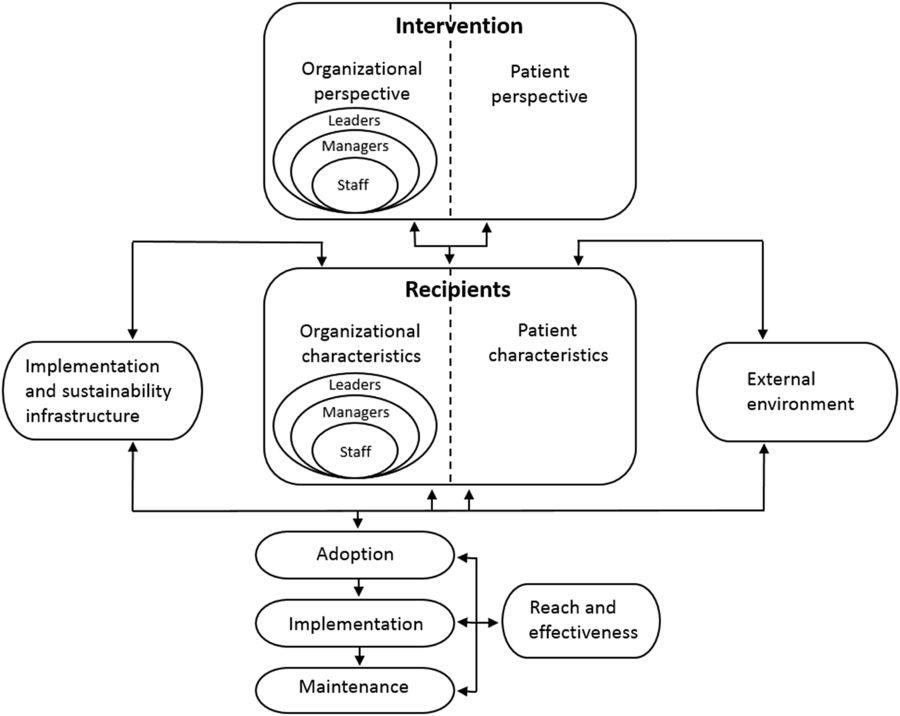
The Practical, Robust Implementation and Sustainability Model (PRISM; Feldstein and Glasgow, Reference Feldstein and Glasgow2008) was designed to provide a framework for organizations to identify factors important for implementation. PRISM is a contextually extended version of the more broadly known RE-AIM (Reach, Effectiveness, Adoption, Implementation, and Maintenance) framework (Glasgow et al., Reference Glasgow2019). PRISM integrates contextual factors with the RE-AIM outcomes in a single model designed to be a practical and actionable guide for implementation (McCreight et al., Reference McCreight2019).
PRISM (Feldstein and Glasgow, Reference Feldstein and Glasgow2008) focuses on the intervention characteristics, recipient characteristics, external environment, and implementation and sustainability infrastructure that influence RE-AIM outcomes (see Fig. 1). Intervention elements include variables such as the strength of the supporting evidence, person centeredness, and burden of an intervention. Recipient elements regarding organizational characteristics include systems and training and management support and communication. Recipient elements pertaining to individual characteristics may include demographics and the knowledge and beliefs of consumers. The external environment may involve community resources, the regulatory environment, and competition with other programs. Implementation and sustainability infrastructure may include plans for sustainability, adopter training and support, and the adaptability of protocols and procedures. Together, these interrelated contextual components influence the RE-AIM outcomes, making PRISM a comprehensive tool for informing and evaluating the implementation of an intervention as it is translated from research to community settings. PRISM has been used successfully to guide the implementation and evaluation of extant programs (Leonard et al., Reference Leonard2019).
The Practical, Robust Implementation and Sustainability Model (PRISM).

Supported by California Mental Health Services Act Innovations funding, the County of San Diego contracted the University of California, San Diego (UCSD) to implement and evaluate a comprehensive, community-based CREST program. The primary objective of the CREST Community Program (CCP) was to reduce hoarding symptoms and clutter volume through the provision of comprehensive, evidence-based services to low-income (i.e. Medi-Cal eligible) older adults with HD. The CCP was designed to test the effectiveness of CREST in the community. To ensure the best possible outcomes, contextual elements of the PRISM model were used to inform implementation of the CREST intervention.
The overall goal of this study was to implement and evaluate the CREST intervention using a multidisciplinary team approach that included individual therapy, care management, peer support, family psychoeducation, and after-care groups. Specifically, we aimed to: 1) describe how implementation of the CREST intervention was informed by the contextual PRISM elements: organization and consumer perspective of the intervention, external environment, implementation and sustainability infrastructure, and consumer characteristics (Fig. 1); 2) evaluate the program using the RE-AIM elements of PRISM: reach, effectiveness, implementation, and sustainability.
Method
This was a mixed-method, pre-post quasi-experimental study of the implementation and effectiveness of CREST during the first 2 years (2/2016-12/2017) of the CCP in San Diego County. This project was approved by the UCSD Human Research Protections Program (project identifier 181688S).
Implementation
Program (intervention) organizational perspective
Based upon a needs assessment of community stakeholders, the San Diego County Health and Human Services Agency (HHSA) procured funding and solicited a request for proposals for a mobile hoarding intervention program, which was subsequently awarded to UCSD as the CCP. We used a multidisciplinary approach to staff the CCP with three psychologists (combined 1.0 full-time equivalent [FTE] employee), two social workers (combined 1.5 FTE), one marriage and family therapist (1.0) FTE, and one peer support specialist (.25 FTE). All staff were supported by the contract. Of the FTE, one was dedicated for program administration, including clinical and administrative supervision and regulatory oversight. The other FTE were dedicated to direct clinical care, recruitment, and outreach.
The team participated in a day-long training on the CREST protocol that included a review of the evidence base. The training was followed by ongoing group and individual supervision. To address potential barriers for frontline clinical staff, we utilized weekly team meetings to discuss program challenges and an annual anonymous qualitative survey that was conducted by a separate evaluation group. Clinical caseloads were capped at 15 individual clients per FTE to provide time for travel time, individual therapy, care management, and family psychoeducation. The goal set by the contract was to serve 30 individuals per year. These strategies allowed for a high level of adaptability and usability from the outset, with group supervision and team meetings serving as forums for sharing implementation challenges and solutions.
Program (intervention) consumer perspective
In order to ensure the CCP was implemented with consumer input and person-centered, we included a program advisory group made up of over 50% consumers to provide guidance and suggestions for the CCP. We designed the program to ensure that individual treatment was tailored to the needs and preferences of each consumer and integrated into a collaborative treatment plan. The CCP was designed to be free and mobile to mitigate financial, transportation, and physical barriers to care. The program was also developed to include care management to address and coordinate services for other aspects of consumers’ health, spiritual, and social needs. Consumer input was collected at the end of treatment and through the quarterly program advisory group. Feedback from consumers informed recruitment strategies, such as flyering at strategic locations (e.g. libraries, laundromats, discount stores, and senior centers), posting to Craigslist and print sources (e.g. locally published senior resource booklets and newsletters), and outreach to other older adult service organizations (e.g. Meals On Wheels, Seniors Helping Seniors, and volunteer law enforcement programs).
External environment
Throughout implementation of the CCP, we collaborated with the San Diego County Program Officer and Quality Improvement department to ensure the program met regulatory expectations, including monthly status updates and annual site visits and records reviews. For any identified areas of improvement, the program leadership worked closely with program staff and regulatory officials to implement changes. This collaboration led to enriched clinical training for staff in older adult documentation, cultural competency, and dual diagnosis so the program could become part of the Comprehensive, Continuous, Integrated System of Care network in the County. Collaboration with the County also led to the development of several policies and procedures (e.g. policy on transportation of health assessment data, internal quality control activities, and safety guidelines for staff home visits).
To integrate the CCP into the larger community of resources in San Diego, we developed a strong relationship with the San Diego Hoarding Collaborative, consisting of multiple agencies working to improve outcomes for individuals with HD in the County. Program staff provided ongoing targeted community outreach and education to other organizations.
Implementation and sustainability infrastructure
Planning for sustainability was a goal from the start of the program. We developed a policies and procedures manual that was reviewed and adapted regularly based on feedback from the County program officer and CCP program requirements. The plan for sustainability included incremental goals toward establishing billable services in coordination with San Diego County such as use of the County electronic health record and engagement in County quality improvement audits, treatment outcome measures, and collection and analysis of performance data to create annual reports for the program. Ongoing training and information relevant to the evidence base of CREST and hoarding treatment generally were provided to clinical staff and community partners.
Recipients: service user characteristics
Eligible individuals were low-income adults, aged 60 years and older, with HD and residing in designated areas of San Diego County. The CCP was designed to serve those with a high disease burden, with significant health and community consequences, low insight, ambivalence, fear of treatment, and conflicting priorities given the length and intensity of treatment. To address these potential barriers, we engaged clients in the community and focused treatment planning on their personal goals as they related to excess clutter. We also incorporated motivational interviewing techniques throughout treatment and engaged in substantial outreach.
Recruitment
We targeted outreach to service organizations, healthcare providers, emergency services, senior centers, and low-income senior housing providers in our geographic region. Outreach efforts included educational presentations, posting flyers, contacting community and faith-based organizations, and print, email, and web media. All staff participated in outreach. In order to address potential recruitment barriers, outreach was performed with the intention of de-stigmatizing individuals with hoarding behaviors, clarifying the goal of the program to help clients achieve their goals, and providing education about available resources and effective approaches to assist clients. Referrals sources included healthcare providers, senior housing property management and staff, adult protective services, the local law enforcement psychiatric emergency response team, friends/family, and self-referral.
Data collection
The CCP treatment effectiveness data were collected at pre- and posttreatment assessments. Qualitative data were collected through an annual staff survey. All CCP staff members (i.e. psychologists, social workers, marriage and family therapists, and peer support specialist) were invited via email to participate in confidential online surveys requesting feedback to document key implementation experiences and generate recommendations for ongoing program adaptations. For this study, we are utilizing survey results from the end of year two (N = 8; 100% response rate from all affiliated staff).
Measures
Clinically significant hoarding
Clinically significant hoarding was assessed via the Structured Interview for Hoarding Disorder (SIHD; Nordsletten et al., Reference Nordsletten, de la Cruz, Pertusa, Reichenberg, Hatch and Mataix-Cols2013). The SIHD was developed in conjunction with Diagnostic and Statistical Manual of Mental Disorders, Fifth Edition (DSM-5; American Psychiatric Association, 2013) and assesses for the core criteria of HD, HD specifiers, and assists with differential diagnosis, including with medical and other psychiatric conditions such as obsessive-compulsive disorder. The SIHD has demonstrated excellent interrater reliability and convergent and discriminant validity (Nordsletten et al., Reference Nordsletten, de la Cruz, Pertusa, Reichenberg, Hatch and Mataix-Cols2013).
Clutter volume
Clutter volume was assessed with the Clutter Image Rating (CIR; Frost et al., Reference Frost, Renaud, Steketee and Tolin2008), which consists of nine photographs of increasing severity of clutter in the living room, kitchen, and bedroom, with a higher score indicating a larger volume of clutter. The CIR is both a client- and clinician-rated measure and has good test–retest reliability (r = 0.82) and good client/clinician correlation (r = 0.78).
Hoarding symptom severity
Hoarding symptom severity was assessed with the Hoarding Rating Scale (HRS; Tolin et al., Reference Tolin, Frost and Steketee2010), a 5-item questionnaire administered as a self-report or clinician interview. The HRS has good test–retest reliability (r = 0.96 for total HRS score), good internal consistency (α = 0.97), and good convergent validity (Tolin et al., Reference Tolin, Frost and Steketee2010).
Homelessness risk
Homelessness risk was assessed during the pretreatment evaluation. The assessment includes nine items that assess overall risk, for example, “have you been under threat of eviction in the past six months?” or “In the past 12 months have you missed a rent/mortgage payment or had to borrow money to cover it?” and 9 items that assess current risk, for example, “Were you unable to pay rent/mortgage this month or anticipate being unable to pay next month or have to borrow money to do so?” or “If for any reason you were to lose your current housing situation, are you without somewhere you know you could stay, or without a plan for obtaining housing?” Clients respond “yes” or “no” to each item. A total score was calculated by summing all items.
Comorbidity
Psychiatric comorbidities were assessed via the Mini-International Neuropsychiatric Interview (MINI; Sheehan et al., Reference Sheehan1998). The MINI has demonstrated good validity, reliability, and concordance with expert ratings (Sheehan et al., Reference Sheehan1998).
Staff survey
Guided by the PRISM organizational perspective contextual component, the staff survey consisted of a series of open-ended questions regarding barriers and facilitators to implementation and operational factors (i.e. “what factors helped achieve CCP goals,” “what factors inhibited achievement of CCP goals,” “what factors helped with successful recruitment and/or retention of CCP clients,” etc.). The survey was designed to contribute essential qualitative “process” data to create better understanding of CCP implementation activities and help refine CCP and guide future dissemination efforts.
Data analysis
We used a “complementary” mixed-method approach (Palinkas et al., Reference Palinkas, Aarons, Horwitz, Chamberlain, Hurlburt and Landsverk2010) where qualitative and quantitative data were used to answer different, but related, questions regarding the initial implementation and operation of CREST (i.e. quantitative data address Reach and Effectiveness and the qualitative data address CREST Implementation). Qualitative data from the CCP annual staff survey were examined by two investigators. One investigator used open-coding techniques to develop a set of thematic codes for the textual responses for each open-ended staff survey item (Corbin and Strauss, Reference Corbin and Strauss2008). A second investigator independently coded each response using the initial set of thematic codes (expanding and refining the initial codes as needed). The coding between the two investigators was then compared, and a final set of codes and coding frequencies was derived by review and consensus determination. For this paper, we only included analyses related to questions pertaining to staff perception of program goals (PRISM organizational perspective) and the perceived factors facilitating and inhibiting achievement of program goals. For quantitative data, descriptive statistics were obtained for all variables and examined for normal distribution, missing values, and outliers. Paired t-tests were used to examine change in hoarding severity ratings (HRS and CIR). The t-tests were two-tailed with a significance level of 0.05.
Results
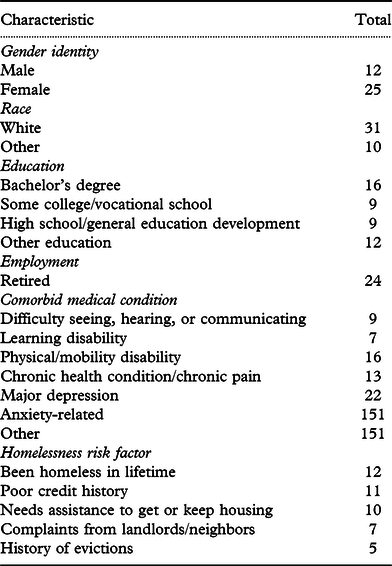
Demographics (Table 1)
Sample Characteristics

CCP clients included 37 older adults aged 60–93 years (M = 68.73, SD = 7.46). The sample was predominantly Caucasian (84%) and female (68%). Approximately 43% percent of CCP clients had earned a bachelor’s degree, 24% had attended some college or vocational school, and 24% had earned a high school diploma or equivalent. Most clients (65%) were retired.
Symptom severity (Fig. 2)
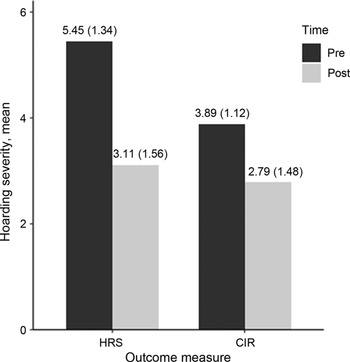
Change in hoarding severity and functional impairment from pre- to posttreatment.

Prior to treatment, scores on the HRS (M = 5.45, SD = 1.34) and CIR (M = 3.89, SD = 1.12) indicated clinically significant hoarding severity.
Comorbid medical conditions (Table 1)
Seventy-three percent of clients reported having at least one comorbid medical disability. The most commonly reported disabilities involved physical or mobility difficulties (reported by 43%); followed by chronic health/chronic pain problems (35%); vision, hearing, or other communication difficulties (24%); and learning difficulties (19%). In addition, 84% met diagnostic criteria for at least one comorbid DSM-5 diagnosis. The most common psychiatric comorbidities were MDD (59%) followed by anxiety disorders (41%).
Homelessness risk (Table 1)
Homelessness risk factors were prevalent among CCP clients. These factors included history of prior homelessness (32%), having a poor credit history (30%), requiring assistance in order to obtain and/or retain housing (27%), receiving complaints from landlords and/or neighbors (19%), and having a history of evictions (14%).
Reach
A total of 191 individuals were referred and screened for the program. Of those, 147 (77%) met criteria for HD based on administration of the SIHD by a staff clinician. Among those who met HD criteria, 43 (29%) met other program eligibility requirements (zip code, age, and Medi-Cal insurance or uninsured). Finally, 37 (86%) were successfully enrolled in the program, 62% of the program target. Of those, 15 (41%) completed during the study period, 14 (38%) were still in treatment, and 8 (22%) dropped out. Four clients dropped out because they were no longer interested in receiving services, one had health problems that precluded continued engagement, and three were unable to be contacted.
Effectiveness (completer analysis) (Fig. 2)
At posttreatment, clients who completed both pre- and posttreatment assessments (i.e. “completers,” n = 15, one completer was missing HRS scores) reported decreased hoarding severity (HRS: M = 3.11, SD = 1.56; CIR: M = 2.79, SD = 1.48), such that average scores fell below what is typically reported for populations with clinically significant hoarding (Tolin et al., 2008, Reference Tolin, Frost and Steketee2010). Average reduction in hoarding severity was high (HRS: 42.9%; CIR: 28.3%) and statistically significant (HRS: t(13) = 4.4, p = 0.0007; CIR: t(14) = 3.3, p = 0.005). Effect sizes from pre- to posttreatment for hoarding severity were large (HRS: d = 1.18; CIR: d = 0.86).
Implementation
The CCP staff identified the primary program goal as reducing HD symptoms. The foremost factor they cited in achieving this goal was using a comprehensive evidence-based practice (i.e. the CREST protocol). The CCP staff identified several facilitators and barriers to delivering the intervention. Facilitators included ability to provide services “in patients’ homes;” funding to address physical and financial limitations for removal of items (help moving large objects; dumpster rental); ongoing training and supervision in CREST; and leadership support. Barriers to program implementation were age, insurance, and County region exclusionary criteria, significant comorbidities making recruitment and retention difficult, and urgent eviction processes requiring expediting the intervention.
Maintenance
Based on the program evaluation from the first 2 years of the CCP and stakeholder and community feedback, San Diego County funded an expansion and extension of the CCP to triple the size of the program, expand its reach to the entire County, and to provide services in Spanish. The program successfully transitioned to the County electronic health record and engaged in two medical record audits
Discussion
We used contextual elements of PRISM to inform implementation of the evidence-based CREST treatment in a community setting and conducted a mixed-method evaluation of the implementation using the RE-AIM elements of PRISM. Overall, CCP outcomes demonstrated significant improvements in hoarding severity and clutter volume among low-income, older adults with multiple risk factors for eviction and medical disabilities. These results are particularly promising as this is a difficult to treat population (Tolin et al., Reference Tolin, Frost, Steketee and Muroff2015), with limited resources. Minimal eligibility requirements, that is, being over the age 60 years with an annual income that qualifies for Medi-Cal, make this a more pragmatic clinical demonstration relative to restrictive randomized controlled trials. Importantly, these results suggest that those with lower socioeconomic status can benefit meaningfully when provided access to efficacious treatment despite the additional systemic barriers and individual challenges faced by older adults with limited resources.
Reach is defined as the proportion of eligible consumers who engage in the intervention (RE-AIM, 2020). The program enrolled 86% of the eligible individuals during the evaluation period, but 8 dropped out and 14 were still engaged in treatment at the end of the evaluation period. However, the CCP reached nearly 50% of the 60 consumer target since 29 had completed or were still engaged. This rate is higher than the typically cited 30% target for reach (Brownson et al., Reference Brownson, Colditz and Proctor2018) and the typical reach rate seen in other studies (Santos et al., Reference Santos2017). This evaluation was focused on the initial startup, which included hiring staff and building referral and recruitment relationships that may have contributed to the reach.
Effectiveness results for the CCP are promising. As with many evidence-based treatments, CREST was developed in a controlled research setting. An initial pilot trial for CREST evidenced significant decreases in hoarding symptoms, with large effect sizes from pre- to posttreatment (24 weeks later). Hoarding symptoms and clutter decreased by approximately 38% and 26%, respectively (Ayers et al., Reference Ayers, Saxena, Espejo, Twamley, Granholm and Wetherell2014). Importantly, these reductions were double those observed in a prior trial of cognitive-behavioral therapy for older adults with HD (Ayers et al., Reference Ayers, Wetherell, Golshan and Saxena2011). A subsequent feasibility trial of CREST found that relative to a case management control condition, individuals who received CREST demonstrated significantly greater improvements in hoarding symptoms (decreasing by 38%) as well as functional impairments related to hoarding (decreasing by 35%). Moreover, these improvements were maintained over a 6-month follow-up period (Ayers et al., Reference Ayers2018). Likewise, in the CCP, we observed a 43% reduction in hoarding symptoms and a 28% reduction in clutter. CCP outcomes replicated those from prior research trials, supporting CREST’s effectiveness in the broader community.
Consistent with the nature of HD involving excess clutter in the home, the qualitative data from clinicians on implementation facilitators and barriers suggest that services delivered in home settings are beneficial. The qualitative results that providing funding to assist with services such as dumpster rental or help moving heavy items to address physical limitations of older adults with HD are consistent with the significant challenges seen in prior studies (Ayers and Dozier, Reference Ayers and Dozier2015; Tolin et al., Reference Tolin, Frost, Steketee, Gray and Fitch2008). Our finding that staff identified limitations on service area, age, and insurance status as barriers to treatment may help explain why the program did not reach the target number of consumers, but it also underscores a significant need for HD services in the community.
After less than 2 years of funding, the CCP evidenced enough meaningful improvements for those served by the program that the County contract was expanded and funded for an additional 1.5 years. Consequently, new staff were hired and trained, and the CREST protocol was translated and delivered in Spanish during year three. This project provides an example of a strong public sector–academic relationship in that a community need was identified, stakeholders were engaged, and a partnership was formed to provide evidence-based services for an underserved population.
These results highlight how the PRISM contextual elements can be used to inform implementation of an evidence-based intervention from a randomized control trial to a community-based setting; they also demonstrate the use of the RE-AIM elements of PRISM. The CCP was successful in creating relationships with other professionals in the community that made the implementation of the CREST protocol possible in an underserved population. Additionally, the CCP demonstrated the ability to adapt and implement the CREST intervention in a community-based setting, supporting its effectiveness, and provided preliminary evidence regarding the sustainability of the program.
Ours is among the first implementation and evaluation of an evidence-based practice for HD treatment in a community setting. Nonetheless, there were several limitations to this study. The restrictions on age (≥60), initial geographic location (only within certain zip codes), and financial status make these results difficult to generalize to younger, more diverse populations. In particular, the lack of diversity in the sample (84% identified as Caucasian) suggests that the project is not fully reaching a representative sample of the surrounding community. The effects of adding Spanish-speaking staff members in year three on outreach and services will be evaluated. A substantial portion of the posttreatment data was not yet available for analyses, which limits the conclusions that can be drawn from the results. In addition, homelessness risk was assessed via a screening tool created by the program, thus the reliability and validity of this measure have not been established. Furthermore, although our results suggest that implementation of the CCP has resulted in significant reduction in hoarding severity in clients, the observed outcomes could be the result of ancillary factors not evaluated (e.g. social engagement, readiness for change). Finally, although program staff were asked about facilitators and barriers to intervention, no systematic qualitative analysis of staff members’ or clients’ reported experiences has been undertaken. As the program continues to evolve, we anticipate continuing to elicit and integrate feedback from stakeholders in the community and plan to report a more systematic analysis of the feedback in future program evaluations.
A more robust evaluation of the PRISM constructs would help to better support other community-based settings in developing a CCP, including systematic evaluation of the contextual PRISM elements, cost analysis for program delivery, adoption by staff in other organizations, fidelity to treatment and adaptation data, and individual-level maintenance of treatment gains. Future research should address these limitations and explore approaches to integrating CREST treatment into existing community mental health settings.
Conflict of interest
None.
Description of authors’ roles
JOEP contributed to the project design, data interpretation, drafting and revising the manuscript. EJD participated in the data analysis and contributed to drafting/revising the manuscript. BHB contributed to the project design and drafting of the manuscript. MED contributed to drafting the introduction and discussion sections and the manuscript revisions. KAB participated in the data analysis and contributed to drafting/revising the manuscript. EWT contributed to the project design, data interpretation, drafting and revising the manuscript. TLM contributed to drafting and revising the manuscript. DHS was involved with development of interview guide, data collection, and the data analysis section of the methods. TL assisted with the data management and organization. CRA was the senior contributing author, participated in the design and coordination, and helped with data interpretation and drafting/revising the manuscript. All authors read and approved the final manuscript.
Acknowledgments
This program evaluation was supported by the San Diego County Health and Human Services Agency—Behavioral Health Services (Contract 552936) awarded to the University of California, San Diego (UCSD).