Introduction
Due to their abundance and vital roles, microphytoplankton communities are fundamental to the functioning and evolution of marine ecosystems. They are the primary producers in the pelagic marine food web, representing the main pathway for transferring matter and energy to the higher trophic levels (Ben Salem et al., Reference Ben Salem, Drira and Ayadi2015). Hence the diversity and fluctuations of microphytoplankton can affect the food web and the ecological functions and thus explicit knowledge of the structure of this component is major for identifying trophic regimes and investigating the general functioning of the marine ecosystems (Lagaria et al., Reference Lagaria, Mandalakis, Mara, Frangoulis, Karatsolis, Pitta, Triantaphyllou, Tsiola and Psarra2016). Moreover, the analysis of the composition, abundance and changes in the frequency of microphytoplankton are informative of the actual and future changes in water quality (Belén Sathicq et al., Reference Belén Sathicq, Gómez, Bauer and Donadelli2016). Simultaneously of the most important components of plankton, ciliates are trophic link between the traditional food chain and microbial food web (Elloumi et al., Reference Elloumi, Drira, Guermazi, Hamza and Ayadi2015). Marine planktonic ciliates are a major, ubiquitous and varied group of protozooplankton (Ying et al., Reference Ying, Wuchang, Shiwei and Tian2013). Their dynamics are closely related to variations in environmental parameters (Küppers and Claps, Reference Küppers and Claps2012), particularly in coastal ecosystems due to the combination of marine and land influences, making ciliates useful as indicators of ecosystem health status (Kchaou et al., Reference Kchaou, Elloumi, Drira, Hamza, Ayadi, Bouaïn and Aleya2009; Elloumi et al., Reference Elloumi, Drira, Guermazi, Hamza and Ayadi2015). With their fast growth, ciliates react more rapidly to environmental variations than most other microorganisms (Gong et al., Reference Gong, Song and Warren2005).
Several studies have been undertaken in the southern coast of Sfax regarding the spatial distribution of plankton assemblages (Rekik et al., Reference Rekik, Denis, Aleya, Maalej and Ayadi2013a, Reference Rekik, Elloumi, Chaari and Ayadi2015a, Reference Rekik, Ben Salem, Ayadi and Elloumi2016a, Reference Rekik, Ben Salem, Ayadi and Elloumi2016b; Ben Salem et al., Reference Ben Salem, Drira and Ayadi2015, Reference Ben Salem, Drira and Ayadi2016; Drira et al., Reference Drira, Kmiha-Megdiche, Sahnoun, Hammami, Allouche, Tedetti and Ayadi2016) to compare the spatial and seasonal distribution of dinoflagellates and diatoms along Sfax northern and southern coasts (Rekik et al., Reference Rekik, Ayadi and Elloumi2017a, Reference Rekik, Ayadi and Elloumi2017b). The present study is the first examining the distribution of microphytoplankton and ciliates assemblage through sampling these communities simultaneously at high spatial resolution sampling in the shallow coastal waters south of Sfax during four seasons. It is therefore of interest to assess to the high impact of human pressure, chiefly by phosphogypsum, on plankton assemblages in a stressed ecosystem (Rekik et al., Reference Rekik, Elloumi, Chaari and Ayadi2015a). Our objectives are (1) to study the spatial and seasonal distribution of ciliates in relation to microphytoplankton, that constitute one of their potential prey, in the shallow coastal waters of Sfax, (2) to determine their potential relationship with environmental factors by using statistical analyses and (3) to determine marine water quality based on biological parameters as a bioindicator.
Material and methods
Study site
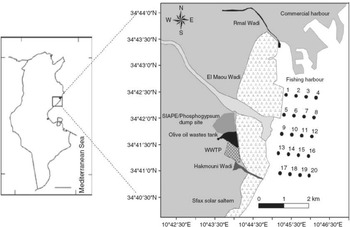
The southern coast of Sfax, the second largest city in Tunisia (Figure 1) is marked by salt extraction ponds from solar salter located over an area of about 1500 ha (COTUSAL) (Kobbi-Rebai et al., Reference Kobbi-Rebai, Annabi-Trabelsi, Khemakhem, Ayadi and Aleya2013). In addition, phosphogypsum, the residue of phosphate treatment, has been stored along the coastline at an uncontrolled dumpsite from the manufacture which produces phosphoric acid (SIAPE) (Rekik et al., Reference Rekik, Drira, Guermazi, Elloumi, Maalej, Aleya and Ayadi2012). This coast is subject to degradation of water quality (Drira et al., Reference Drira, Kmiha-Megdiche, Sahnoun, Hammami, Allouche, Tedetti and Ayadi2016), increasing eutrophication (Kobbi-Rebai et al., Reference Kobbi-Rebai, Annabi-Trabelsi, Khemakhem, Ayadi and Aleya2013), green tides caused by coastal Ulva rigida replacing the Posidonia oceanica seagrass beds (Ben Brahim et al., Reference Ben Brahim, Hamza, Ben Ismail, Mabrouk, Bouain and Aleya2013) and thus degrading benthic habitats (Turki et al., Reference Turki, Harzallah and Sammari2006). It also suffered over the last two decades from an important decrease in fish resources that might have resulted from industrial and urban activities, menacing Tunisia's socio-economic resources (Abdennadher et al., Reference Abdennadher, Hamza, Fekih, Hannachi, Zouari-Belaaj, Bradai and Aleya2012). Many studies have reported the high level of atmospheric pollution (Azri et al., Reference Azri, Abida and Medhioub2010), marine pollution such as hydrocarbon (Zaghden et al., Reference Zaghden, Kallel and Elleuch2014), and heavy metal contamination (Serbaji et al., Reference Serbaji, Azri and Medhioub2012; Naifar et al., Reference Naifar, Pereira, Zmemla, Bouaziz, Elleuch and Garcia2018).
Location of sampling stations (1–20) in the south coast of Sfax.

Field sampling
Samples for nutrients, microphytoplankton and ciliates were taken during four one-day campaigns in winter (16 February), spring (22 May), autumn (11 October), and summer (15 July) 2011 along the southern coast of Sfax. During each campaign, water samples were collected in 20 stations, divided in to five transects from coast to open water (Figure 1). The stations were located at different depths due to different distances off the coast: S1, S5, S9, S13, and S17 with depth < 0.5 m; S2, S6, S10, S14, and S18 with depth varying between 0.5 and 3 m; S3, S7, S11, S15, and S19 with depth varying between 3 and 5 m; S4, S8, S12, S16, and S20 with depth > 5 m. A total of 80 samples were collected with a Van Dorn-type closing bottle that was deployed horizontally and at a depth ranging from 0.5 to 7 m. Nutriment samples (120 ml) were kept immediately upon collection at −20°C in the dark. Samples for microphytoplankton were preserved with acid Lugol solution (at 3%; Parsons et al., Reference Parsons, Maita and Lalli1984) and alkaline Lugol solution was used for fixation of ciliate samples (at 5%; Sherr and Sherr, Reference Sherr, Sherr, Kemp, Sherr, Sherr and Cole1993). Samples for microphytoplankton and ciliates were placed at 4°C in the dark for enumeration. Water samples for Chlorophyll-a (1 l) and suspended matter (0.5 l) analyses were filtered by vacuum filtration onto Whatman GF/F and Whatman GF/C glass fibre filters, respectively, which were then immediately stored at −20°C.
Physico-chemical variables
Physical parameters (temperature, salinity, and pH) were measured using a multi-parameter kit (Multi 340 i/SET) immediately after sampling. Subsamples for the nutrients (nitrite, nitrate, ammonium, orthophosphate, silicate, total nitrogen, and total phosphate) were collected in plastic containers of 4.5 ml previously washed with distilled water. They were analysed with a Bran and Luebbe type 3 autoanalyzer and concentrations were determined colourimetrically using a UV-visible (6400/6405) spectrophotometer (Grasshof, Reference Grasshof, Ehradt, Grasshof and Kremling1983). Analyses were independent. The automatic analysis system provides fast and accurate analysis of these nutrients. Although each nutrient is determined in a different way, but the method remains similar. It is used colourimetry to determine the dosage of each nutrient. Percentages of dissolved inorganic nitrogen were calculated from [(NO3− + NO2− + NH4+)/T-N] × 100. Percentages of dissolved inorganic phosphate were calculated from [PO43−/T-P] × 100. Suspended matter concentrations were measured using the dry weight of the residue after filtration of 0.5 l of seawater onto Whatman GF/C membrane filters and drying at 60°C during 24 h.
Ciliates and microphytoplankton enumeration
Sub-samples (50 ml) for microphytoplankton and ciliates counting to estimate the abundance were analysed under an inverted microscope (Leica) using the Utermöhl method (Reference Utermöhl1958) after 24 h settling. Microphytoplankton and ciliates species counts were carried out on the entire sedimentation chamber with 40× magnified. Identification of microphytoplankton species was made according to various keys (Balech, Reference Balech1959; Tomas et al., Reference Tomas, Hasle, Steidinger, Syvertsen and Tangen1996). Ciliates were identified to genus or species level after the works of Alder (Reference Alder and Boltovsky1999), Petz (Reference Petz and Boltovsky1999) and Strüder-Kypke and Montagnes (Reference Strüder-Kypke and Montagnes2002). The importance value for the different species was determined by their relative frequency.
Chlorophyll-a
Chlorophyll-a was estimated by spectrometry, after extraction of the pigments in acetone (90%). The concentrations were then estimated using the equations of SCOR-UNESCO (SCOR-UNESCO, 1966). This method consists of filtering 1 l of sea water by vacuum filtration onto Whatman GF/F glass fibre filters, without exceeding 400 mmHg to prevent cell breakdown. A pinch of carbonate magnesium is added to avoid the degradation of pigments in pheopigments at the end of filtration. Filters are kept in aluminium paper and are dried under vacuum on silica gel during 24 h and were then conserved at −20°C until the time of extraction. The pigments extraction is carried out in 90% acetone in the dark and cold for 5 h. After 10 min of centrifugation at 3500g, the absorbance is measured using a Jenway spectrophotometer at 630, 645 and 663 nm.
Data analyses
Means and standard deviations (SD) were reported when appropriate. The potential relationships between variables were tested with Pearson's coefficient correlation. One-way ANOVA followed by a post hoc comparison using Tukey's test was applied to identify significant differences between seasons.
The variations of phytoplankton and ciliate communities were investigated using multivariate analysis, specifically Nonmetric Multidimensional Scaling (NMDS). The mean percentage abundance of the taxa per transect and per seasonal period were square root transformed before estimation of resemblance using the Bray Curtis metric. The similarity matrix was then ordinated using NMDS. A SIMPER (percentage of similarity) analysis was performed to identify the species contributing most to similarity within and dissimilarity between clusters.
The physico-chemical and biological parameters assessed at 20 stations during four seasons were submitted to a normalized principal component analysis (PCA) (Dolédec and Chessel, Reference Dolédec and Chessel1989). Simple log (x + 1) transformation was applied to data in order to correctly stabilize variance (Frontier, Reference Frontier1973). These statistical analyses were performed using Primer 7 software.
Results
Hydrological features
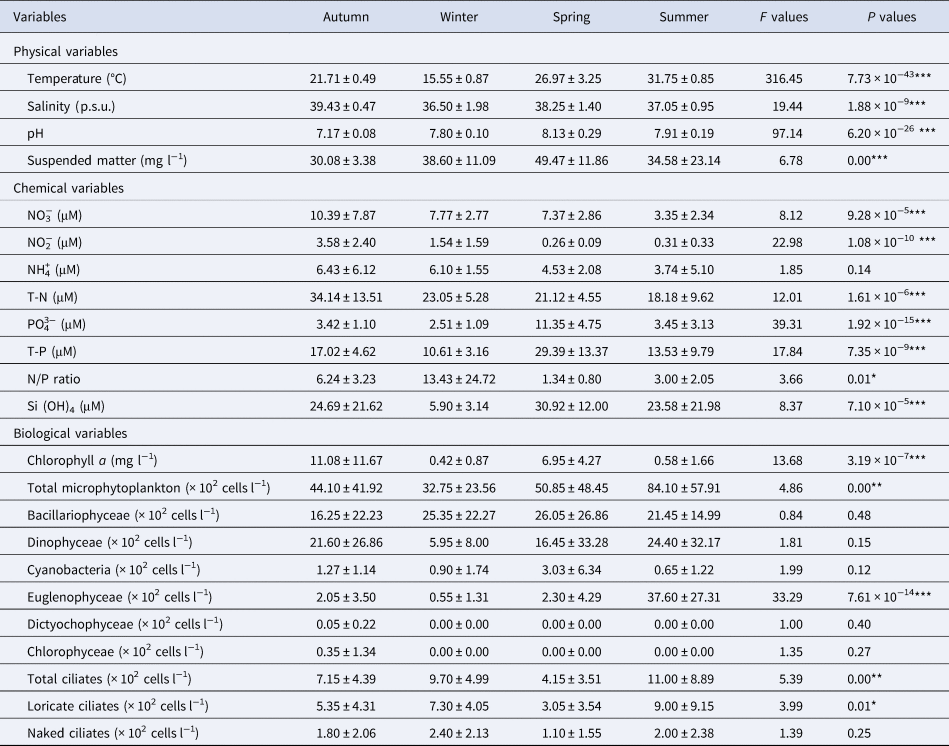
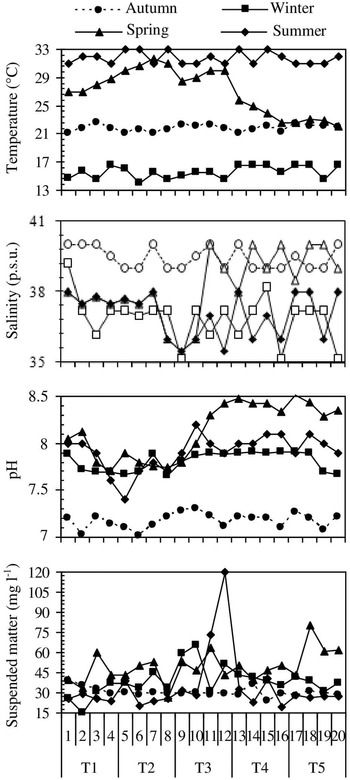
The mean values of physical variables recorded at the 20 sampled stations are summarized in Table 1. Temperature varied among stations and seasons (Figure 2 and Table 1). The temperature was in the range 14–33°C, the lowest values being observed at stations 6 in winter and the highest at stations 5, 6, 8, and 13 in summer. At each station, temperature exhibited increasing values from winter to summer and a slight decline in spring compared to summer. In winter, the observed temperatures were at their lowest (Figure 2 and Table 1). Thermal stratification did not develop because of the shallowness at the sampled stations (<7 m). Salinity varied from 35.2 in winter (stations 9, 16, and 20) to 40 in autumn (stations 1, 2, 3, 7, 11, 13, and 20) and spring (stations 11, 14, 16, 18, and 19). The pH values ranged from 7.01 (autumn, station 6) to 8.51 (spring, station 17). Concentrations of suspended matter varied between 30.08 ± 3.38 mg l−1 during autumn and 49.47 ± 11.86 mg l−1 during spring (Table 1).
Seasonal variation of physical-chemical and biological parameters in the south coast of Sfax (Mean + SD; n = 20)

In the last column, results of one-way ANOVA analysis. *P < 0.05, **P < 0.01, ***P < 0.001, show significant differences among sampled levels.
Spatial and seasonal variations of physical variables. Stations (1–20) and transects (1–5).

Nutrients
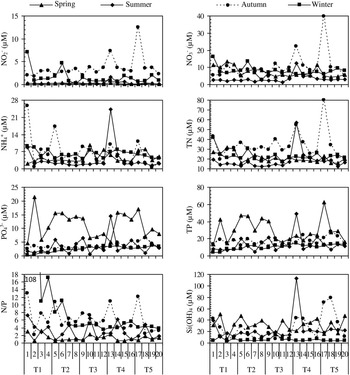
NO3− concentration varied between 1.31 and 39.66 μM in the study area, with the lowest concentration observed in summer at station 11 and the highest in autumn at station 17 (Figure 3). Mean values were also higher in autumn (10.39 ± 7.87 μM) than in summer (3.35 ± 2.34 μM), whereas winter and spring were intermediate (7.77 ± 2.77 and 7.37 ± 2.86 μM respectively; Table 1). NO2−, NH4+ and total nitrogen (T-N) concentrations were higher in autumn and winter than that in spring and summer. Nitrogen appeared mainly in its dissolved inorganic form (DIN, NO3− + NO2− + NH4+) representing 57.35% of the total nitrogen. Orthophosphate and total phosphate concentrations had almost the same distribution pattern (Figure 3), with low concentrations during winter and maximum values during spring (Table 1). The N/P ratio (dissolved inorganic nitrogen (NO2− + NO3− + NH4+) to dissolved inorganic phosphate (PO34−) ratio), ranged from 1.34 in spring to 13.43 in winter (Figure 3). These values were less than the Redfield ratio (16), suggesting a potential N limitation. Silicate concentrations ranged from 5.90 ± 3.14 μM (winter) to 30.92 ± 12.00 μM (spring) (Table 1).
Spatial and seasonal variations of chemical parameters. Stations (1–20) and transects (1–5).

Chlorophyll-a
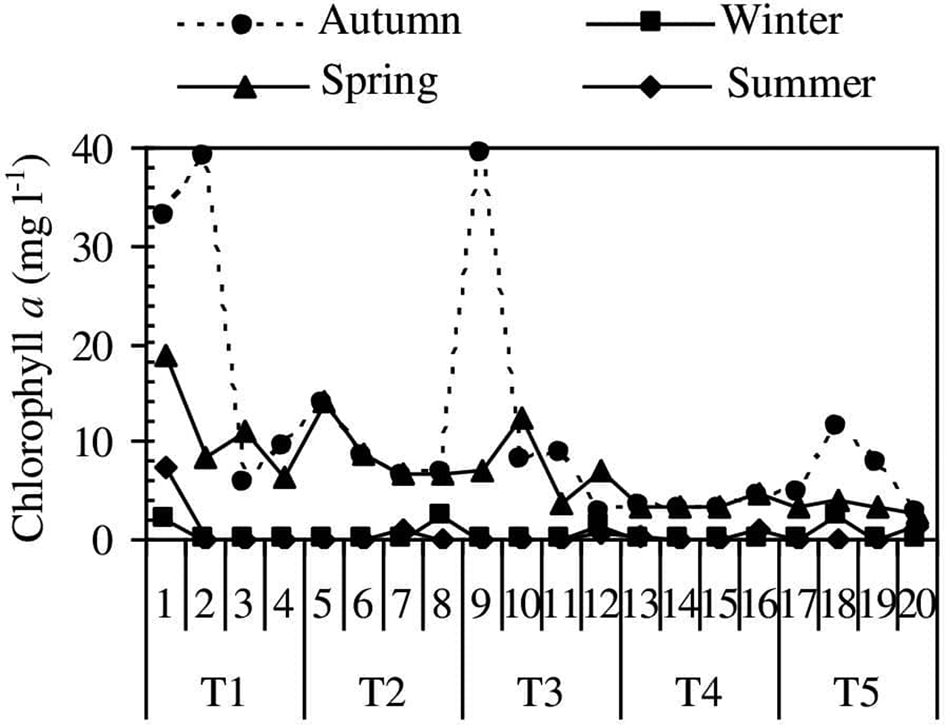
Average Chl a concentrations remained <12 mg l−1 (Table 1), but exhibited higher values like the maximum (39.40 mg l−1) observed at station 9 in autumn. Meanwhile, Chl a was very low and sometimes undetected in some samples during winter and summer (Figure 4).
Spatial and seasonal variations of chlorophyll-a concentration. Stations (1–20) and transects (1–5).

Microphytoplankton
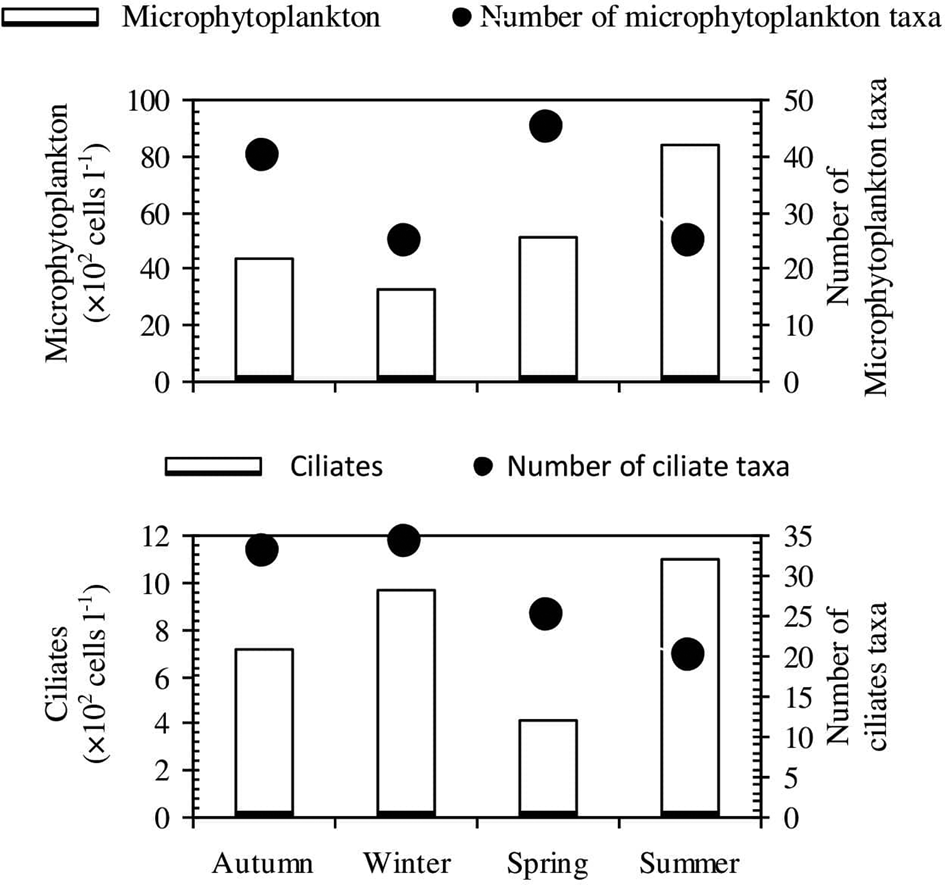
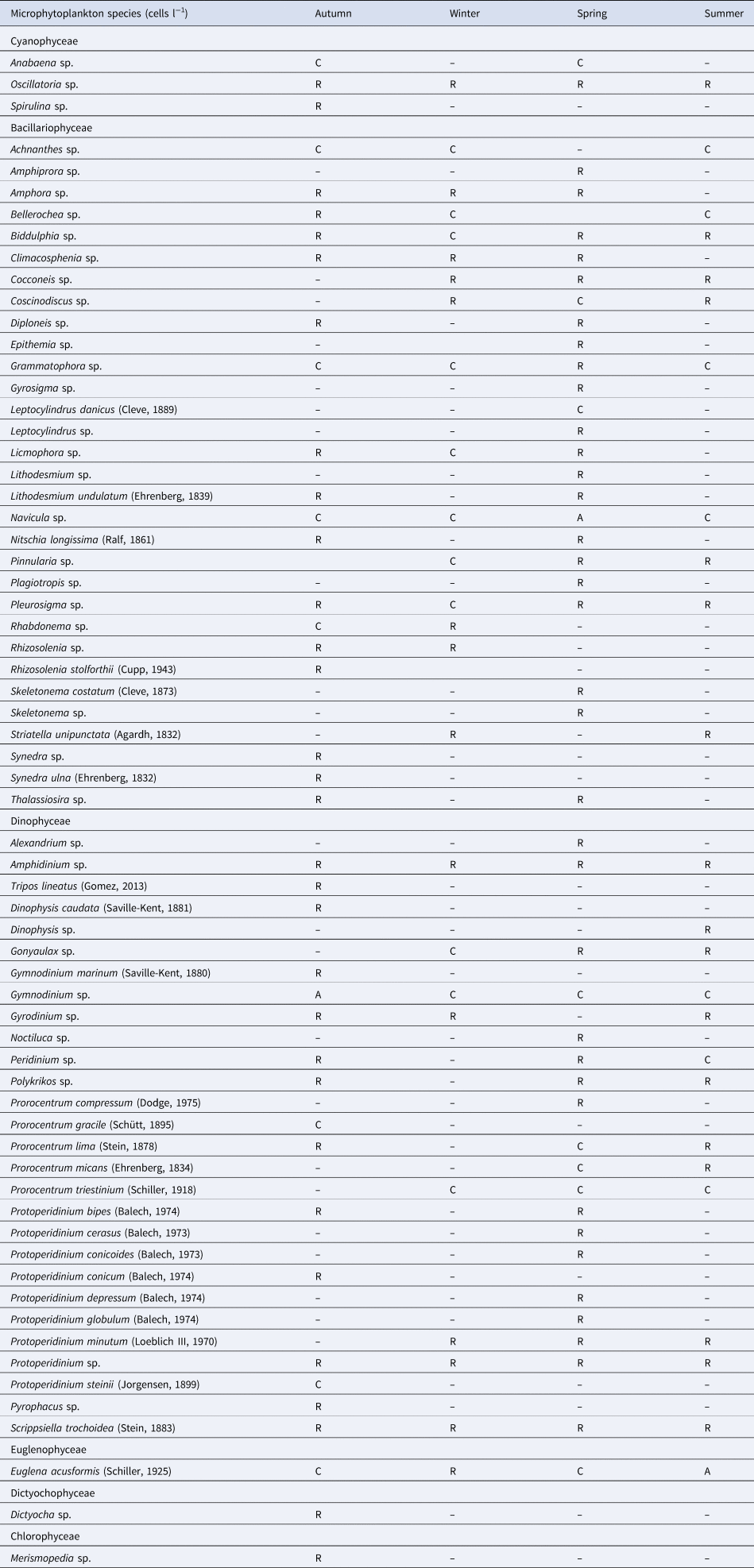
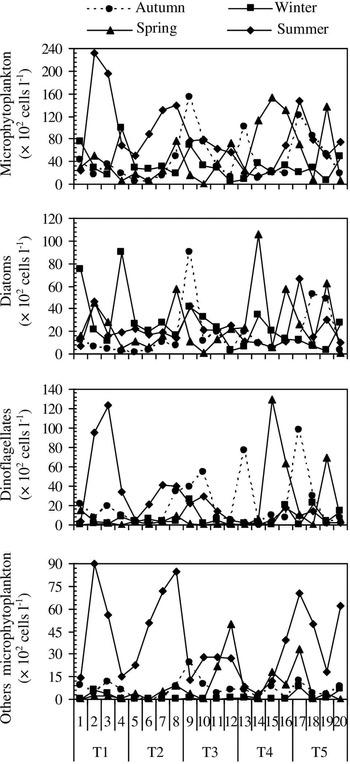
Mean microphytoplankton abundance was the highest in summer (84.10 ± 57.91 × 10² cells l−1) and the lowest in winter (32.75 ± 23.56 × 10² cells l−1) (Figure 5 and Table 1), and displayed significant differences from season to season (F = 4.86; df = 80; P < 0.01). In the present study, 65 microphytoplankton taxa were observed, 25 among them were identified to the species level (Table 2). Diatoms were the most species-rich group with 30 taxa, followed by dinoflagellates with 29 taxa and Cyanobacteria with 3 taxa. Other groups such as Dictyochophyceae (Dictyocha sp.), Euglenophyceae (Euglena acusformis) and Chlorophyceae (Merismopedia sp.) were represented by only one species each. The genus Protoperidinium (9 taxa) was the most diverse among dinoflagellates and the genera Lithodesmium, Skeletonema and Synedra (2 taxa) among diatoms (Table 2). Diatoms were, on average, the most abundant group throughout the survey period (Table 1), but dinoflagellates and Euglenophyceae were punctually more abundant in autumn and summer respectively (Figure 6). Microphytoplankton diversity changed significantly throughout our study, shifting from the predominance of diatoms, particularly Grammatophora sp., Navicula sp., Coscinodiscus sp., Pinnularia sp., and Bellarochea sp. during the winter and spring, to that of dinoflagellates represented by Gymnodinium sp., Prorocentrum gracile, and Protoperidinium steinii in autumn (Table 2). The highest microphytoplankton abundance observed in summer (84.10 ± 57.91 × 10² cells l−1, Table 1), was associated with an important proliferation of Euglenophyceae (37.60 ± 27.31 × 10² cells l−1, Table 1), with Euglena acusformis accounting for 44.71% of total microphytoplankton abundance. The dominance of E. acusformis was coupled with a low number of microphytoplankton taxa (only 25 taxa, Figure 5), but no significant correlation was found between this species and physico-chemical variables.
Seasonal variations of average values of microphytoplankton abundance, number of microphytoplankton taxa, ciliates abundance, and number of ciliates taxa.

List and frequency of microphytoplankton species found in the southern coast of Sfax during the study conducted at four successive seasons

(–) en dash means not detected.
(R) Rare means 0–100 cells l−1.
(C) Common means 100–300 cells l−1.
(A) Abundant means > 300 cells l−1.
Spatial and seasonal variations of the abundance of microphytoplankton, diatoms (diat), dinoflagellates (dino), and other microphytoplankton (other micro).

Ciliates
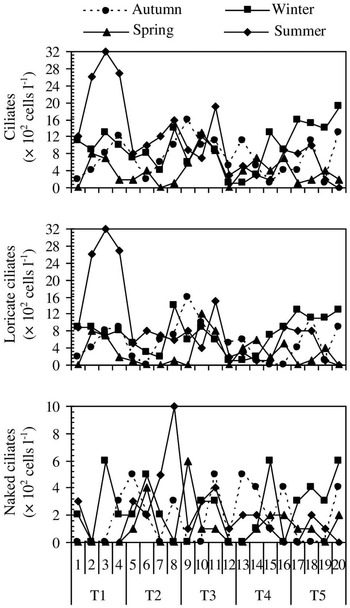
Ciliate abundance ranged from 0 (stations 1, 7, 12 (spring), and 20 (summer)) to 32 × 102 cells l−1 (station 3, summer) (mean = 8.00 × 10² ± 3.02 × 10² cells l−1). The highest ciliate abundance was recorded in summer and the highest number of ciliate taxa was observed in winter (34 taxa) (Figure 5). The ciliate community consisted of 64 taxa (33 taxa in autumn, 34 taxa in winter, 25 taxa in spring, and 20 taxa in summer) belonging to 32 genera and 2 groups: loricate ciliates and naked ciliates (Table 3). Loricate ciliates were the most diversified with 43 taxa and representing 73–82% of total ciliates abundance. The genus Tintinnopsis was dominant among loricate ciliates (13 taxa), followed by Codonellopsis and Undella (4 taxa) (Table 3). Loricate ciliates and total ciliate abundance showed the same temporal and spatial distribution patterns (Figure 7). Loricate ciliate abundance varied from 0 to 32 × 102 cells l−1, with the highest abundance at station 3 in summer, associated with an important reproduction of Poroecus apiculatus and Tintinnopsis beroidea. High abundances were also recorded at the same season at station 2 (26 × 102 cells l−1, Tintinnopsis aperta) and station 4 (27 × 102 cells l−1, Tintinnopsis parvula and Tintinnopsis complex) (Figure 7). Some loricate ciliates species (among which Tintinnidium balechi, Tintinnopsis beroidea, and Tintinnopsis nana) were omnipresent at all seasons (Table 3). Naked ciliates abundance varied from 0 to 10. 102 cells l−1 (maximum in summer at station 9), and showed its highest mean value (2.40 ± 2.13 × 10² cells l−1) in winter and its lowest 1.10 ± 1.55 × 10² cells l−1 in spring (Figure 7; Table 1).
List and frequency of ciliate species found in the southern coast of Sfax during the study conducted at four successive seasons

(–) en dash means not detected.
(R) Rare means 0–100 cells l−1.
(C) Common means 100–300 cells l−1.
Spatial and seasonal variations of the abundance of ciliate (cil), loricate ciliate (loricate cil) and naked ciliates (naked cil).

Statistical analysis
Non-metric dimensional scaling (NMDS) and similarity (SIMPER) analyses on microphytoplankton and ciliate species
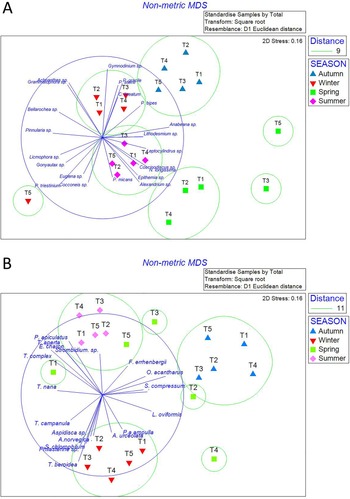
The NMDS ordination of relative abundances of the microphytoplankton species (stress value of 0.16 indicating a strong ordination) roughly identified four clusters corresponding to the four seasons (Figure 8A). However, in winter one transect (T5) clearly distinguished from the four other clusters, mainly due to some species (Gonyaulax sp., Grammatophora sp., Licmophora sp., Bellarochea sp., Gymnodinium sp., and Prorocentrum triestinium) that explained 62% of the dissimilarity with the four other transects (T1–T4). Also, in spring two transects differentiate from the three others: T3 due to Anabeana sp., Coscinodiscus sp., Nitschia longissimi, Prorocentrum micans, Prorocentrum triestinium, Navicula sp., and Polykrikos sp. (50% cumulated dissimilarity) and T5 due to Prorocentrum lima, Navicula sp., Anabeana sp., Coscinodiscus sp., P. micans, and Prorocentrum triestinium (42% cumulated dissimilarity). The autumn group (60.45 average similarity) was mainly explained by Gymnodinium sp., Grammatophora sp., Navicula sp., Achnanthes sp., and Anabeana sp. that explained 72% cumulative similarity. The main winter group (70.73 similarity, without T5) was explained by Navicula sp., Grammatophora sp., Bellarochea sp., Gymnodinium sp., and Pinnularia sp. (72% cumulated), the main spring group (46.78 similarity, without T3 and T5) by Navicula sp., Coscinodiscus sp., Euglena sp., and Prorocentrum Triestinium (62% cumulated), and the summer group (69.23 similarity) by Euglena sp., Navicula sp., Grammatophora sp., Gymnodinium sp., and Prorocentrum triestinium (75% cumulated).
Non-metric dimensional scaling analyses (NBMDS) on mean values per sampling transects (T1–T5) and per season of abundance percentages of phytoplankton species (A) and ciliate species (B).

The NMDS ordination of the relative abundances of ciliate species (stress value of 0.16 indicating a strong ordination) clearly identified three clusters corresponding to autumn, winter and summer transects, showing a relative spatial homogeneity of the ciliate communities at these three periods, whereas the five transects of spring were scattered (low similarity: 17.99), suggesting high spatial variability at this period (Figure 8B). The summer group had the highest similarity (60.87) mostly explained by Tintinnopsis aperta, Tintinnopsis beroidea, Poroecus apiculatus, and Euplotes Charon (72% cumulative). Winter and autumn groups were less homogeneous (38.52 and 35.07 similarity, respectively) and both highly explained by Tintinnopsis beroidea (>50%).
Relationships between biological and environmental variables
Simple correlation analyses between biological and environmental variables and between microphytoplankton and ciliate variables are detailed in Tables S1 and S2, respectively.
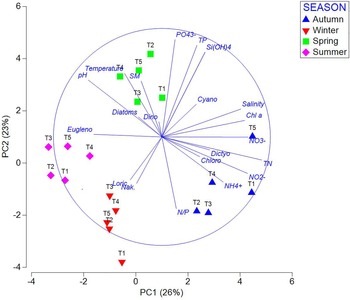
The PCA on the mean values per transect of the four seasonal sets of hydrological (temperature, salinity, pH, suspended matter, nutrients) and biological (Chlorophyll a, microphytoplankton groups' abundance and ciliates groups' abundance) variables (Figure 9) allowed clear discrimination of the four seasonal sampling groups around the F1 and F2 components. The F1 component axis (26% of the variance) opposed the autumn sampling points to the summer sampling points. The formers were characterized by high concentrations of N-nutrients and Chlorophyll a and by the presence of Dictyochophyceae and Chlorophyceaea, and the latter by high temperature and pH and by high Euglenophyceae, diatoms and ciliate densities. The F2 component axis (23% of the variance) opposed spring points correlated with pH, temperature, P and Si nutrients to winter points correlated with loricate and naked ciliates.
Principal component analysis (PCA) (axis I and II) of mean values per sampling transects (T1–T5) and per season abundance and selected environmental variables.

Discussion
The current study is the first report concerning the distribution of microphytoplankton and ciliates assemblage through high spatial resolution sampling in the shallow coastal waters south of Sfax during four seasons.
The south coast of Sfax, a typical stressed Mediterranean coastal zone
Our results allow characterizing the environmental context of a typical stressed area of the southeastern Mediterranean coast. The high values of temperature and salinity are in agreement with other studies performed in arid to semi-arid Mediterranean areas (Elloumi et al., Reference Elloumi, Drira, Guermazi, Hamza and Ayadi2015). A strong acidification of seawater was observed in autumn with pH values down to 7 (mean = 7.17 ± 0.08), contrasting with the highest pH levels in spring (8.13 ± 0.29). Such low pH values could reasonably be attributed to the industrial activity still in operation along the south coast (Rekik et al., Reference Rekik, Denis, Aleya, Maalej and Ayadi2013a). In particular, the phosphate processing industries (SIAPE-Sfax) generate very acidic residues (phosphogypsum) that can result in very low pH values of coastal marine water: in the Ghannouch-Gabes zone, values lower than 3.5 have been recorded close to the discharge (Ben Amor and Gueddari, Reference Ben Amor and Gueddari2016), and values close to or even lower than 7 can be observed at several kilometres off the coastline (El Kateb et al., Reference El Kateb, Stalder, Rüggeberg, Neururer, Spangenberg and Spezzaferri2018). The high concentration of suspended matter may be the result of the shallow depth of the sampled area and the intensity of the dominant winds (southwest and north-east), which usually provoke not only sediment mixing but also remobilization from the surface deposits (Ben Salem et al., Reference Ben Salem, Drira and Ayadi2015). The high concentrations of orthophosphate and total phosphate are associated with an important release of phosphate due to residue from the phosphate processing industries (SIAPE-Sfax) (Ben Brahim et al., Reference Ben Brahim, Hamza, Hannachi, Rebai, Jarboui, Bouain and Aleya2010). Additionally, the N/P–DIN to DIP ratio was highly variable and in average lower than the Redfield ratio (16) during the four periods. Strong variability in the N/P ratio characterizes coastal ecosystems, particularly under eutrophication conditions, where the high terrestrial inputs of nutrients, tide and turbulence-driven resuspension cause situations far from the relative equilibrium found in the open ocean (Ryther and Dunstan, Reference Ryther and Dunstan1971). Low N/P ratio during our study agrees with the results in the north Sfax coast before the restoration process (Rekik et al., Reference Rekik, Drira, Guermazi, Elloumi, Maalej, Aleya and Ayadi2012), also suggesting an overall nitrogen limitation in this stressed coastal zone.
Microphytoplankton community of the south coast of Sfax and its environmental drivers
Withis the oligotrophic Eastern Mediterranean Sea, the southern coast of Sfax stands out as a highly productive ecosystem (Rekik et al., Reference Rekik, Elloumi, Chaari and Ayadi2015a). The high productivity has been further confirmed by compiling satellite observations and biogeochemical data, which reinforce the contrast with the Eastern Mediterranean Sea (D'Ortenzio and Riberad'Alcalà, Reference D'Ortenzio and Riberad'Alcalà2009; Ayata et al., Reference Ayata, Irisson, Aubert, Berline, Dutay, Mayot, Nieblas, D'Ortenzio, Palmiéri and Reygondeau2017). Microphytoplankton assemblages recorded in our study in the southern coast of Sfax showed some similarities compared to other coastal environments (Rekik et al., Reference Rekik, Maalej, Ayadi and Aleya2013b). A high number of microphytoplankton taxa (65 species), with a prevalence of diatoms species was observed in agreement with previous studies conducted in the north Sfax coast, during the 2009–2010 period, showing a comparable number of taxa (70 taxa/90 taxa) at the surface and the water-sediment interface, respectively (Rekik et al., Reference Rekik, Maalej, Ayadi and Aleya2013b, Reference Rekik, Denis, Maalej and Ayadi2015b, Reference Rekik, Ben Salem, Ayadi and Elloumi2016a). Microphytoplankton abundance shifted from dinoflagellates dominance in autumn to diatoms dominance in winter and spring and dominance of Euglenophyceae in summer in the southern coast. On the north coast of Sfax, the microphytoplankton community consisted mainly of diatoms in autumn and winter, dinoflagellates in spring and Cyanobacteriae in summer (Rekik et al., Reference Rekik, Maalej, Ayadi and Aleya2013b). The variations of microphytoplankton community were mainly related to nutrient and environmental parameters. Dinoflagellates were positively correlated to pH, TN and N/P ratio in autumn. The important abundance of dinoflagellates in autumn may be explained by their cell motility allowing them to explore different depths (Rekik et al., Reference Rekik, Ayadi and Elloumi2017a). The abundance of dinoflagellates in such polluted situation (low pH, high nutrients) agrees with their cosmopolitan and less demanding character in terms of environmental conditions compared with other groups (Ben Salem et al., Reference Ben Salem, Drira and Ayadi2015). In our study, dinoflagellates species composition showed similarity between the southern coast of Sfax and the Gulf of Gabes. Some dinoflagellates, such as Gymnodinium, Gonyaulax, Protoperidinium, and Prorocentrum attained high abundance in stressed areas like in the northern coast of Sfax (Rekik et al., Reference Rekik, Drira, Guermazi, Elloumi, Maalej, Aleya and Ayadi2012), the southern coast of the Kerkennah islands (Rekik et al., Reference Rekik, Ayadi and Elloumi2018), the Kneiss island (Rekik et al., Reference Rekik, Ayadi and Elloumi2017b), and the Gulf of Gabès (Drira et al., Reference Drira, Hamza, Belhassen, Ayadi, Bouïn and Aleya2008), indicating their tolerance to local environmental conditions. In fact, they can overcome the lack of nutrients by diversifying their trophic modes (autotrophic, mixotrophic, and heterotrophic; Jeong et al., Reference Jeong, Yoo, Kim, Seong, Kang and Kim2010). About half of dinoflagellate species in marine plankton lack chloroplasts (Sherr and Sherr, Reference Sherr and Sherr2007). Dinoflagellates comprise a large variety of toxic species, which can produce many different toxic compounds (Smayda, Reference Smayda1997) that can interfere with recruitment, growth and viability of an important range of marine organisms including their competitors (Plumley, Reference Plumley1997). In this study, potential toxic species such as Protoperidinium depressum (spring), Protoperidinium steinii (autumn), Dinophysis caudata (autumn), and Prorocentrum lima (autumn, spring, and summer) were recorded (Hallegraeff, Reference Hallegraeff1993). The dinoflagellates assemblages also included high numbers of Gymnodinium, a genus that was reported to occur under high phosphate loading (Daly-Yahia Kéfi et al., Reference Daly-Yahia Kéfi, Souissi, Gomez and Daly Yahia2005). However, in this study high Gymnodinium abundance occurred under low phosphate and high nitrogen concentrations, suggesting that the reproduction of dinoflagellates was mainly nitrogen-driven (Rekik et al., Reference Rekik, Elloumi, Chaari and Ayadi2015a). High density of diatoms in winter and spring may be due to their quick growth capacity under turbulent and high nutrient conditions (Maranon et al., Reference Maranon, Cermeno, Latasa and Tadonleke2012). Diatoms are known to be opportunistic organisms (Fogg, Reference Fogg1991) having fast growth due to rapid nitrogen uptake (Lomas and Glibert, Reference Lomas and Glibert2000). These large species (Navicula (95 μm), Coscinodiscus (160 μm) and Leptocylindrus (150 μM)) are characterized by a high tolerance to various environmental parameters and physical stress characteristic of shallow coastal ecosystems, especially during spring blooms (Lomas and Glibert, Reference Lomas and Glibert2000). During our survey the south coast of Sfax, Euglenophyceae, represented by one species, Euglena acusformis, displayed their highest abundance in summer (45% of the total microphytoplankton abundance) but in previous surveys, high abundance of this species was also recorded in winter in the same area (Ben Salem et al., Reference Ben Salem, Drira and Ayadi2015). Euglena acusformis has been recognized as the most opportunistic and saprobiontic species which assimilate lots of organic matter and might be an indicator of pollution (Barrera et al., Reference Barrera, Vasquez, Barcelo and Bussy2008). Because of their high surface to volume ratio, small cells like Euglena acusformis incorporate nutrients at low energy cost (Agawin et al., Reference Agawin, Duarte and Agusti2000) and thus outperform large cells (Sin and Wetzel, Reference Sin and Wetzel2000). In our study Cyanobacteria were not well represented in the microphytoplankton community but reached their maximal density in Spring mainly due to the nitrogen-fixing Anabaena sp., consistently with the lowest N/P ratio, indicating N limitation at this period (Table 1). On the north coast of Sfax, the main period for Cyanobacteriae growth was in summer with the dominant opportunistic and nitrogen-fixing species Trichodesmium erythraeum (Rekik et al., Reference Rekik, Maalej, Ayadi and Aleya2013b) which can form important blooms in the gulf of Gabès during warm periods (Hamza et al., Reference Hamza, Wafa, Asma and Malika2016) and which is known to dominate the microphytoplankton community in the oligotrophic Sea (Nausch et al., Reference Nausch, Nausch, Wasmund and Nagel2008).
Ciliate community of the south coast of Sfax and its environmental drivers
A total of 64 ciliates taxa representing 46 different genera were identified during this study, few species of which could be characterized as rare, found at only one or two stations. The species number reported here is lower than the one reported by Rekik et al. (Reference Rekik, Denis, Maalej and Ayadi2015c) in the northern coast of Sfax (Tunisia), over four seasons (40 planktonic species at the surface and 53 at the bottom). The divergence in terms of species number between the north and the south coast of Sfax is probably partly due to difference in terms of sampling efforts applied to each study. Another reason may be the mixing of planktonic and benthic ciliates (thus increasing the number of sampled species) due to the shallow water depth of the south coast of Sfax. Ciliates community demonstrated a clear temporal pattern: high abundance values in winter and summer with an obvious peak at station 3 in summer, low abundance values in spring and autumn. Ciliates are dominant in southern coast of Sfax during summer as shown by the maximal abundance recorded for a wide range of ciliates (20 taxa) belonging to different size classes with different feeding strategies (autotrophic, heterotrophic, and mixotrophic ciliates). The ciliates community was dominated by loricate ciliates while aloricate ciliates were relatively rare, as also reported in the north coast of Sfax (Rekik et al., Reference Rekik, Denis, Maalej and Ayadi2015c), the Gulf of Gabès (Hannachi et al., Reference Hannachi, Drira, Belhassen, Hamza, Ayadi, Bouain and Aleya2009; Kchaou et al., Reference Kchaou, Elloumi, Drira, Hamza, Ayadi, Bouaïn and Aleya2009), the Adriatic Sea (Bojanić et al., Reference Bojanić, Šolić, Krstulović, Šestanović, Marasović and Ninčević2005), and the Yellow Sea (Jiang et al., Reference Jiang, Xu, Al-Rasheid, Warren, Hu and Song2011). The high abundance of loricate species is probably due to the eutrophic conditions in these marine areas, since these species might possess a higher adaptability to eutrophic environments than other ciliates (Bojanić et al., Reference Bojanić, Šolić, Krstulović, Šestanović, Marasović and Ninčević2005). Some loricate ciliates species, such as Favella ehrenbergii, Helicostomella subulata, Tintinnopsis beroidea, Tintinnopsis campanula, and T. lobiancoi, reach high abundances in highly anthropized marine coastal areas, showing their tolerance to environmental stress (Rekik et al., Reference Rekik, Elloumi, Chaari and Ayadi2015a). However, there are some exceptions to this composition pattern in some marine regions where aloricate species dominate the ciliate community; this is typical for many coastal and oceanic waters, such as the Irish Sea (Edward and Burkill, Reference Edward and Burkill1995), the Irminger Sea (Montagnes et al., Reference Montagnes, Allen, Brown, Bulit, Davidson, Fielding, Heath, Holliday, Rasmussen, Sanders, Waniek and Wilson2010), the Baltic Sea (Mironova et al., Reference Mironova, Telesh and Skarlato2009), and the North Sea (Stelfox-Widdicombe et al., Reference Stelfox-Widdicombe, Archer, Burkill and Stefels2004).
In this study, we found no significant correlations between environmental factors and the abundance of the ciliates community. The same results were reported by Gong et al. (Reference Gong, Song and Warren2005). The water temperature and various inorganic nutrients might not directly control the structure and dynamics of the ciliates community but indirectly influence it via food availability. For instance, the dominance of the agglutinated species Tintinnopsis beroidea was shown to be related to the availability of particles to construct the lorica in addition to the presence of its preferred food (Cyanobacteria) (Rakshit et al., Reference Rakshit, Ganesh and Sarkar2015).
Relationships between ciliate and microphytoplankton communities in the south coast of Sfax
Loricate ciliates are known to have significant relationships with microphytoplankton groups suggesting a close ecological link to this type of food and revealing further insights into the ecological role of ciliates as grazers on microphytoplankton, especially in autumn and summer when microphytoplankton is very abundant (Yang et al., Reference Yang, Löder, Gerdts and Wiltshire2015). The seasonal distribution of microphytoplankton and ciliates (dominated by the genus Tintinnopsis) suggests that ciliates community consume nanophytoplankton but also microphytoplankton, as shown in the north coast of Sfax (Rekik et al., Reference Rekik, Drira, Guermazi, Elloumi, Maalej, Aleya and Ayadi2012). Significant relationships between loricate ciliates and microphytoplankton community abundance have been found in previous studies in Tunisian coastal areas such as the Gulf of Gabes (Hannachi et al., Reference Hannachi, Drira, Belhassen, Hamza, Ayadi, Bouain and Aleya2009). In our study, there were significant correlations between loricate ciliates and Cyanobacteria (r = 0.85, n = 20, P < 0.05) in autumn and between loricate ciliates and dinoflagellates (r = 0.56, n = 20, P < 0.05) in summer. On the other hand, dinoflagellates may also be in direct feeding competition with ciliates for food. Indeed, Protoperidinium is a heterotrophic genus known to feed exclusively on diatoms (Sherr and Sherr, Reference Sherr and Sherr2007) and several other dinoflagellates (including the genera Gymnodinium, Gyrodinium, Gonyaulax, Tripos, and Alexandrium) are considered as grazers, since most of them were previously shown to be mixotrophic (Stoecker, Reference Stoecker1999). This competition for food between ciliates and dinoflagellates may constitute another hypothesis explaining their simultaneous presence and the correlations recorded between them. However, loricate ciliates rarely control the abundance or composition of their prey, as their aggregate feeding activity usually equates to clearing a maximum of 1–2% per day of the surface layer waters they occupy (Dolan et al., Reference Dolan, Landry and Ritchie2013).
Conclusion
The present study indicates that the environmental properties of the southern coast of Sfax have typical characteristics of a stressed area. The microphytoplankton community is highly tolerant and dependant on environmental variables in particular pH and nutrient availability. Diatoms are dominant in winter and spring taking advantage of their high growth capacity. Dinoflagellates dominate in autumn in low pH condition showing their high tolerance to environmental stress. Euglenophyceae are the most numerous in summer in the lowest nutrient condition, may be due to their high surface to volume ratio favouring nutrient assimilation at low energy cost. In contrast with current observations in the open Mediterranean Sea the ciliate community of the southern coast of Sfax is dominated by loricate ciliates (mostly the genera Tintinnopsis, Codonellopsis, and Undella) which are more abundant than naked ciliates. Ciliate abundance and community structure is highly variable between seasons but this variability seems not directly driven by environmental variables but indirectly through dependence on prey availability, resulting in a tight coupling with microphytoplankton community. Ciliates should exert a top-down control on microphytoplankton but the importance of mixotrophic and heterotrophic dinoflagellates (known to feed on diatoms) also suggests a feeding competition with this group.
At present, the phosphogypsum restoration had been acutely necessary allowing microphytoplankton and ciliate species to take optimal advantage of niche opportunities, which, in turn, improve water quality along the southern coast.
Supplementary material
The supplementary material for this article can be found at https://doi.org/10.1017/S0025315423000462.
Acknowledgements
This work was supported by the Taparura Project conducted in the Laboratory LR/18ES30 Marine biodiversity and environment at the University of Sfax. We have obtained permits for sampling and observation field studies from the Taparura Project.