Diversifying crop rotations is expected to contribute to increased agricultural sustainability (Wezel et al. Reference Wezel, Casagrande, Celette, Vian, Ferrer and Peigné2014). Introducing new crops into rotations may result in shifts in dominant insect communities (Vankosky et al. Reference Vankosky, Cárcamo, Catton, Costamagna and De Clerck-Floate2017), potentially impacting crop production. Novel crops may be recipients or reservoirs of pests moving between them and important cash crops. For example, brassicaceous oilseeds being developed as bioenergy crops may share pests with canola, Brassica napus Linnaeus (Brassicaceae), an important food crop in our study region in the northern Great Plains of North America (Soroka et al. Reference Soroka, Olivier, Grenkow and Séguin-Swartz2015, Reference Soroka, Olivier, Wist and Grenkow2017; Seepaul et al. Reference Seepaul, Small, Mulvaney, George, Leon and Paula-Moraes2019). Similarly, cover crop mixes can harbour insects that are pests of cash crops (Bugg Reference Bugg1991; Sarrantonio and Gallandt Reference Sarrantonio and Gallandt2003; Lee-Mader et al. Reference Lee-Mader, Stine, Fowler, Hopwood and Vaughan2015). Thus, identifying the dominant pests associated with new crops is important for forecasting impacts on their production and determining their potential suitability as rotational crops.
We carried out preliminary pest surveys as part of an integrative study designed to assess the feasibility of diversifying traditional wheat–fallow cropping systems by replacing the fallow phase of the rotation with either bioenergy crops or a 10-species cover crop mix. The two bioenergy crops, carinata (Brassica carinata Alexander Braun (Brassicaceae)) and camelina (Camelina sativa (Linnaeus) Crantz (Brassicaceae)), are industrial-grade oilseed feedstocks that have shown production potential in semi-arid environments (Gesch et al. Reference Gesch, Isbell, Oblath, Allen, Archer and Brown2015). Cover crop mixes, in addition to having many documented conservation benefits (Lee-Mader et al. Reference Lee-Mader, Stine, Fowler, Hopwood and Vaughan2015; Bergtold et al. Reference Bergtold, Ramsey, Maddy and Williams2019), also have potential as forage resources (Davis et al. Reference Davis, Presley, Farney and Sassenrath2015). Little research has been done on the pest groups associated with these promising fallow replacement crops in the northern Great Plains. In the present study, we surveyed the vegetation-associated insect pest communities via sweep netting in each of the three crops over two years. Our specific objectives were (1) to inventory the dominant pests associated with each crop and (2) to compare insect abundance among crops to gauge their potential to serve as reservoirs of the most damaging insect pests of canola.
We made four predictions regarding pest composition and abundances in these different crops. Plants in the family Brassicaceae contain defensive compounds that can be detrimental to generalist herbivores but serve as aggregation, oviposition, or feeding stimulants for specialists (Hopkins et al. Reference Hopkins, van Dam and van Loon2009). Therefore, our first prediction was that specialists would dominate the pest complex associated with the brassicaceous oilseeds, whereas the cover crop mix, made up of multiple plant families, would contain a greater percentage of generalists and opportunists. Although surveys of pests associated with carinata are lacking in the region, aphids (Hemiptera: Aphididae) and diamondback moths (Plutella xylostella (Linnaeus) (Lepidoptera: Plutellidae)) are important pests in the southeastern United States of America (Baldwin et al. Reference Baldwin, Paula-Moraes, Mulvaney and Meagher2021). Therefore, our second prediction was that these pests would be similarly important in carinata in our study region. In addition, previous studies have found that camelina is relatively resistant to pests in the region (Pachagounder et al. Reference Pachagounder, Lamb and Bodnaryk1998; Cárcamo et al. Reference Cárcamo, Olfert, Dosdall, Herle, Beres and Soroka2007; Lenssen et al. Reference Lenssen, Iversen, Sainju, Caesar-TonThat, Blodgett, Allen and Evans2012; Soroka et al. Reference Soroka, Olivier, Wist and Grenkow2017), potentially reflecting either the absence of stimulatory or the presence of inhibitory secondary compounds (Soroka et al. Reference Soroka, Olivier, Wist and Grenkow2017). Therefore, our third prediction was that the abundance of specialist pests on camelina would be low. Finally, increasing crop diversity is known to reduce pest population densities, particularly for specialist feeders (Root Reference Root1973; Risch et al. Reference Risch, Andow and Altieri1983; Altieri et al. Reference Altieri, Letourneau and Risch1984; Letourneau et al. Reference Letourneau, Armbrecht, Rivera, Lerma, Carmona and Daza2011). Therefore, our fourth prediction was that the cover crop mix would have lower pest abundances relative to monocultures of brassicaceous crops, especially those that are potentially attractive to specialists, that is, carinata.
The study was conducted at the United States Department of Agriculture experimental farm in northeastern Montana, United States of America (see Jabro et al. Reference Jabro, Allen, Rand, Dangi and Campbell2021 and the present study’s Supplementary materials, Methods for details). Briefly, the study included four treatments: durum wheat, Triticum durum Desfontaines (Poaceae), planted in a two-year rotation either with fallow or with one of three replacement crops – camelina “Suneson”, carinata “A110”, or a 10-species cover crop mix. The cover crop included a diverse mix of warm- and cool-season broadleafed crops and grasses (Supplementary material, Tables and Figures, Table S1). Crops were planted in individual, 6-m-wide by 15-m-long, plots that were arranged in a randomised complete block design, with three blocks each containing a single replicate plot of each treatment (Supplementary material, Tables and Figures, Fig. S1). Due to time and cost constraints, insects were sampled in plots planted to replacement crops in only two years, 2016 and 2018 (n = 9 plots per year; Supplementary material, Tables and Figures, Fig. S1). Climatic conditions were similar in 2016 and 2018 (growing season (May–August), precipitation: 220 and 209 mm, and average temperature: 17.9 °C and 18.3 °C, respectively). A sweep sample, consisting of 15 180°-arc sweeps with a 38-cm diameter sweep net, was taken through the centre of each plot weekly from the late bud/early flowering stage (mid- to late-June) to the ripening stage (mid-August) of the oilseed crops (Supplementary material, Tables and Figures, Table S2), following the approach of Lenssen et al. (Reference Lenssen, Iversen, Sainju, Caesar-TonThat, Blodgett, Allen and Evans2012). Insect sampling was carried out between 10:00 and 16:00 hours on clear to partly cloudy days, when temperatures were at least 15 °C and wind speeds were less than 24 km/hour (Kieckhefer et al. Reference Kieckhefer, Elliott and Beck1992). Samples were emptied into 7.57-L plastic bags, kept cool for transport, and stored in a laboratory freezer until processed.
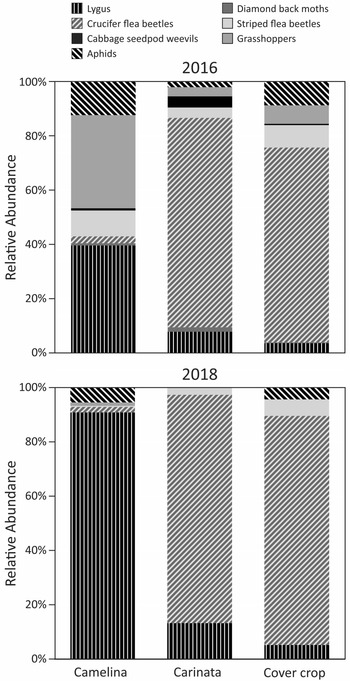
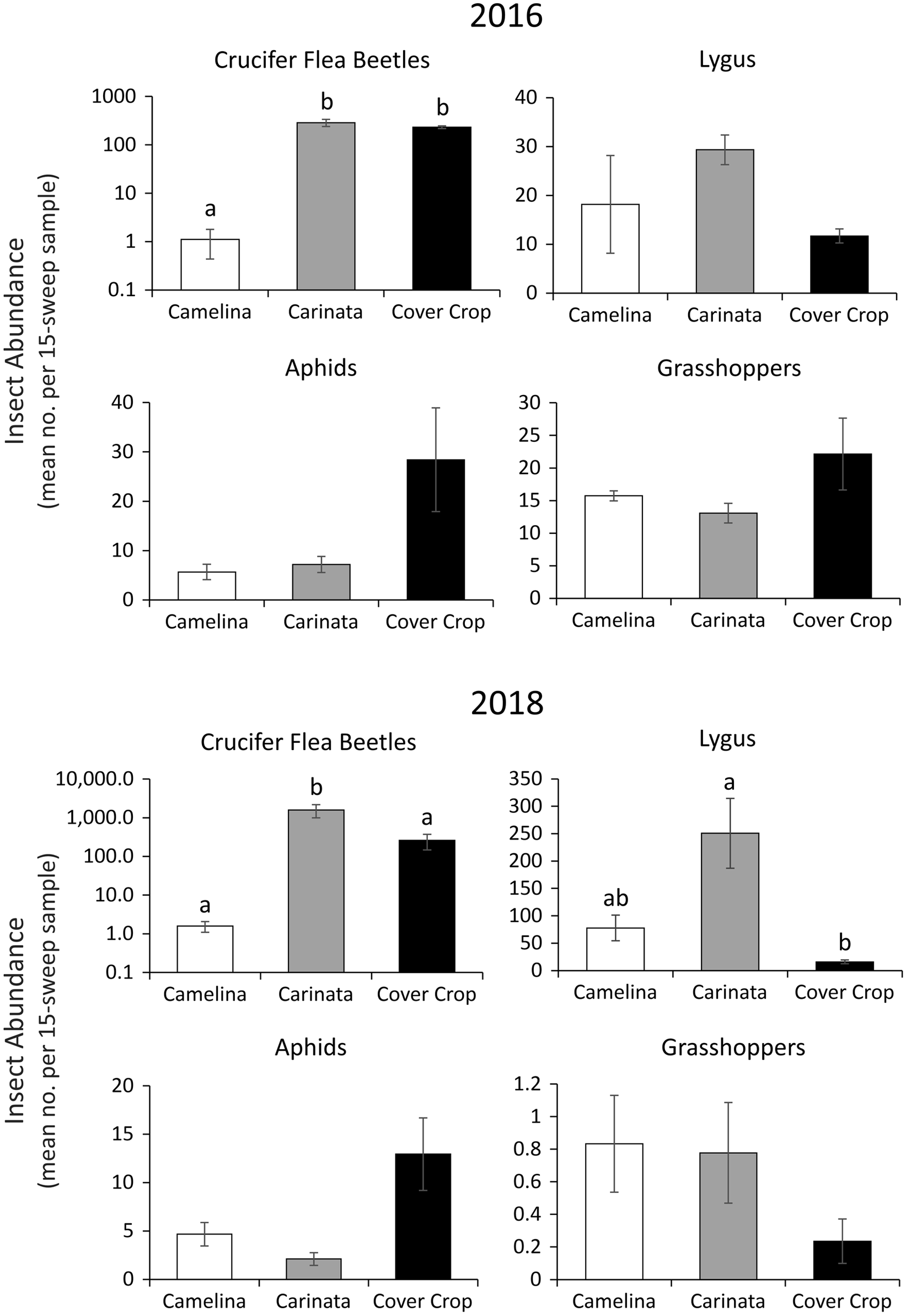
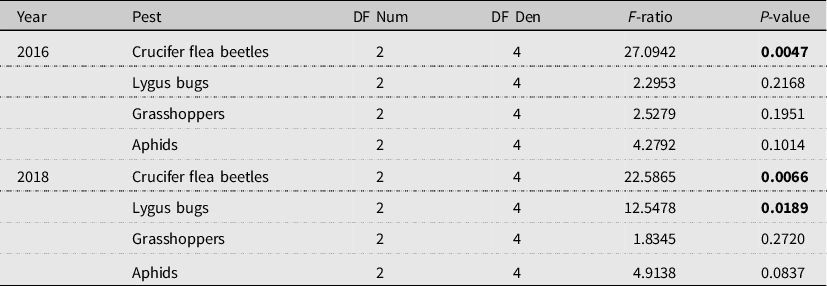
For each sample, we quantified the abundance of insects considered to be major pests of canola (Brassica napus) in the United States of America (Lamb Reference Lamb1984; Weiss et al. Reference Weiss, Knodel and Olson2013; Reddy Reference Reddy2017) using the following resources: Burgess (Reference Burgess1977); Schwartz and Foottit (Reference Schwartz and Foottit1992); Weiss et al. (Reference Weiss, Knodel and Olson2013); Gilligan and Passoa (Reference Gilligan and Passoa2014); and Kandel et al. (Reference Kandel, Lubenow, Keen and Knodel2019). The major pest groups quantified included four Brassicaceae specialists: crucifer flea beetle (Phyllotreta cruciferae Goeze (Coleoptera: Chrysomelidae)), striped flea beetle (Phyllotreta striolata (Fabricius) (Coleoptera: Chrysomelidae)), cabbage seedpod weevil (Ceutorhynchus obstrictus (Marsham) (Coleoptera: Curculionidae)), and diamondback moth, as well as generalist lygus bugs (Lygus spp.) (Heteroptera: Miridae). Lygus bugs were not identified to species in this study, but previous work (Ritter et al. Reference Ritter, Lenssen, Blodgett and Taper2010) found that L. elisus is the dominant species on canola in Montana. Additionally, we quantified the abundances of two generalist pest groups, aphids and grasshoppers (Orthoptera: Acrididae), considered occasional pests of brassicaceous crops (Weiss et al. Reference Weiss, Knodel and Olson2013; Knodel et al. Reference Knodel, Beauzay, Boetel, Prochaska and Lubenow2017a; Reddy Reference Reddy2017). All stages (larvae, adults, and/or nymphs) of pest insects present in the samples were included in abundance totals. Voucher specimens were deposited in the rangeland insect collection at the United States Department of Agriculture, Agricultural Research Service in Sidney, Montana. We calculated the relative abundance (percent of total) of each pest group for each crop in each year (Fig. 1). The mean number of individuals per 15-sweep sample across sampling dates was calculated and compared amongst crops for the four most common pest groups (Fig. 2). General linear models, with crop type as a fixed effect and block as a random effect, were run in JMP v 15.2.0 (JMP®15 1989–2019). Tukey’s honestly significant difference tests were run to assess differences among crops following a significant main effect (α = 0.05) for each of these groups (Table 1; Fig. 2).
Relative abundance (% of total) of insect pests sampled in each of three fallow replacement crops, camelina (Camelina sativa), carinata (Brassica carinata), and a cover crop mix, in each of two study years.

Abundances of the four most common pest insect groups sampled in each of three fallow replacement crops, camelina (Camelina sativa), carinata (Brassica carinata), and a cover crop mix, in each of two study years. Bars represent mean abundance (± standard errors) per 15-sweep sample across the summer sampling interval in each year. Different letters above bars indicate means that differed significantly (P ≤ 0.05).

Summary of results of general linear mixed models examining the effects of crop type (three levels: camelina, carinata, or cover crop) on the abundances of the four most common pest groups observed over two years. Significant models (in bold type) were followed by Tukey’s honestly significant difference tests to assess signficant differences among the three treatments (results summarised in Fig. 2).

We predicted that the composition of the pest complex associated with the two brassicaceous crops would be dominated by Brassicaceae specialists, whereas generalists were expected to be relatively more common in the cover crop with a more diverse resource base (prediction 1). Consistent with these expectations, we found that specialist crucifer flea beetles dominated the pest complex of carinata (Fig. 1). However, counter to expectations, crucifer flea beetles were also the dominant insect in the cover crop mix, comprising more than 70% of insects sampled. Furthermore, the pest complex on camelina was co-dominated by generalist grasshoppers and lygus bugs in 2016 (34% and 40% of total individuals, respectively) and by lygus bugs (91%) in 2018 (Fig. 1). Thus, the composition of the insect pest community associated with carinata was more similar to that of the cover crop mix than to that of camelina, another brassicaceous oilseed (Fig. 1).
Surveys of pest insects in carinata are lacking in our study region. However, a recent two-year field study from Florida, in the southeastern United States of America, found that turnip aphids (Lipaphis pseudobrassicae Davis (Hemiptera: Aphididae)) and diamondback moths were the most abundant insects (Baldwin et al. Reference Baldwin, Paula-Moraes, Mulvaney and Meagher2021), and they were therefore expected to be potentially important pests in our system (prediction 2). In contrast to this expectation, crucifer flea beetles dominated the complex in carinata, whereas diamondback moths comprised fewer than 2% of the insects sampled and aphids were similarly scarce (Fig. 1). Lygus bugs were the second most abundant pests, reaching high numbers of up to 17 individuals per sweep, but they have not been listed as important pests in previous studies on this crop (Medhin and Mulatu Reference Medhin and Mulatu1992; Baldwin et al. Reference Baldwin, Paula-Moraes, Mulvaney and Meagher2021).
Abundances of crucifer flea beetles and lygus bugs differed significantly among the three crops in at least one year, with consistently higher abundances observed in carinata, whereas grasshopper and aphid abundances did not differ significantly (Table 1, Fig. 2). Camelina has previously been found to be resistant to pest problems in the region (Pachagounder et al. Reference Pachagounder, Lamb and Bodnaryk1998; Soroka et al. Reference Soroka, Olivier, Wist and Grenkow2017). The results of our two-year study support the expectation of low pest abundance in camelina (prediction 3). The abundance of crucifer flea beetles in camelina was extremely low (averaging fewer than two individuals per sample). Their abundance was significantly greater (> 200-fold) in both carinata and the cover crop mix in 2016 (Fig. 2). In 2018, crucifer flea beetles were more than a thousand times more abundant in carinata than in camelina. A previous study by Lenssen et al. (Reference Lenssen, Iversen, Sainju, Caesar-TonThat, Blodgett, Allen and Evans2012) found similarly low abundances of pests in camelina at this site, with no flea beetles observed over the four-year study. Although generalist lygus bugs were the dominant pest in camelina, their abundance there was still substantially lower than in carinata.
Lower pest abundance was predicted in the diverse cover crop mix relative to brassicaceous oilseed monocultures, especially carinata (prediction 4). Counter to that expectation, crucifer flea beetle abundance in the cover crop was similar to that in monocultures of carinata (Fig. 2). This result was surprising because brassicaceous species averaged only 28% of the cover crop biomass. High abundance could reflect a strong preference for one of the brassicaceous crops seeded in the cover crop mix (turnip, radish, or winter canola), all of which are in the host range of the beetles (Knodel et al. Reference Knodel, Lubenow and Olson2017b). Aphids were the only group with consistently higher abundance in the cover crop mix relative to the oilseed crops, although these differences were not significant. It is likely that our cover crop harboured aphids that are pests of other crops in the region (e.g., pea aphid in pulse crops), as well as other pests that were not quantified.
Although inferences from our study are limited by aspects of the design, including sampling small plots, at a single site, in only two years, we found strong and consistent preliminary patterns that highlight directions for future work. Our results confirm findings from previous work that camelina supports relatively low pest populations, especially of crucifer flea beetles, suggesting that it is less likely to be attacked by or serve as a source of pests of canola. In contrast, the high abundances of both flea beetles and lygus bugs in carinata could potentially impact yield, making it a poor fallow replacement choice in areas where these pests are common. The cover crop mix also supported relatively high abundances of flea beetles, suggesting that eliminating brassicaceous species from cover crop mixes may be important in reducing their potential as canola pest reservoirs.
Generally, the results suggest that additional work quantifying damage and impact of flea beetles in carinata and of lygus bugs in both carinata and camelina is warranted. Such efforts would require expanding pest and damage surveys to include all relevant crop and insect phenological stages, increasing the number of site-years to assess the generality of results, and quantifying impacts on yield. Larger, field- to landscape-scale studies would be needed to assess whether differences in insect abundances across crops reflect short-term concentration due to insect attraction to particular plants or population-level responses that may be important in driving source–sink dynamics across broader spatio-temporal scales (e.g., spillover effects and concentration–dilution effects). Agronomic practices, such as planting density (Root Reference Root1977), and varietal differences (Soroka et al. Reference Soroka, Olivier, Grenkow and Séguin-Swartz2015) may also affect pest responses and should be considered in future work. Finally, insect pests are only one of many important considerations in designing and implementing rotational systems. Their impacts should be considered in conjunction with other biotic (e.g., weeds, disease, and soil microbes), abiotic (e.g., water and nutrient management), and economic factors.
Supplementary material
To view supplementary material for this article, please visit https://doi.org/10.4039/tce.2022.14.
Acknowledgements
Rene France and Michelle Lair sampled and maintained experimental plots. Deb Waters, Ellen Titus, Alison Berka, and Rylie Olson processed samples. AGRISOMA Biosciences contributed partial funding.