A well-dressed lady asked me [a butcher] if the piece of bacon she had chosen was Danish. I answered: ‘no, it is Canadian’. After that answer the lady immediately turned around and left the shop saying that under no circumstances would she buy foreign bacon.Footnote 1
What! You don’t know how to spell BACON? Why, D.A.N.I.S.H!Footnote 2
During the nineteenth century, Britain was the world’s biggest importer of foodstuffs. By the turn of the twentieth century, Britain depended heavily on Australasia and South America for beef and lamb, Denmark for bacon and butter, and Canada and the United States for bacon and pork. This dependency evolved with the rapid growth of free trade, a robust international financial framework based on fixed exchange rates, and a multilateral payments system, all of which encouraged specialization. However, the dislocation in trading patterns caused by World War I, along with the need to increase national self-sufficiency in foodstuffs, prompted the British government, via the Ministry of Agriculture (MAF), to introduce a series of initiatives—largely concerned with standardization, branding, and marketing—to encourage British agriculture to increase its output in order to secure a larger share of the domestic market.
This article focuses on one such initiative: the attempt to overcome Danish dominance of the British bacon market during the interwar years. The central argument of this article is that Danish supremacy over the British bacon market during the interwar years was based on a deeply embedded institutional and industrial structure that generated a number of competitive advantages, including the selection and breeding of pigs best suited to produce “Wiltshire” sides for the British market and rigorous coordination of quality control between pig farming and bacon curing, and between distribution and export. All these strengths were signaled by the national brand “Danish” applied to Danish bacon. Conversely, we argue that state-sponsored attempts to improve the competitiveness of the British bacon industry between 1919 and 1938 were only partially successful, precisely because the British industry could not secure the maximum benefits from high levels of cooperation and coordination. Consequently, attempts by the British government and MAF to reinvigorate the domestic bacon industry using a national mark to advertise “British” bacon were constrained.
A number of reasons justify such an examination. Our study examines the different performance outcomes of two types of agricultural systems to explain how the benefits of cooperation and coordination can improve and sustain the competitiveness of an industry. Although comparable data on the structure of the Danish and British bacon industries is not available for the entire interwar period, the evidence suggests there were clear similarities. Both industries possessed a large number of pig producers. In the 1930s, Denmark had approximately 180,000 of them registered with cooperative bacon factories, whereas in Britain, between 1935 and 1937, about 145,000 farmers contracted with the Bacon Market Board (BMB).Footnote 3 Additionally, both countries had broadly comparable numbers of bacon factories: On average, during the 1920s, forty-seven were operating in Denmark (and sixty in the 1930s). The comparable figure for England and Wales in the 1920s was seventy-five.Footnote 4
However, these common structural characteristics generated substantially different performance outcomes for the British and Danish bacon industries. We argue that the principal explanation for this divergence is located in the different levels of cooperation and coordination in each industry. Unlike simple industrial economics models in which there is unidirectional causation from structure through conduct to performance, the British and Danish bacon industries exhibited different “conduct.” Denmark’s bacon factories were cooperatives dealing with thousands of pig farmers who were compulsory members; membership meant that pig farmers became contractually obliged to have their pigs slaughtered at these factories. Effectively, cooperation was synonymous with coordination, and market-based relationships between pig farmers and bacon factories largely disappeared.
In England, by contrast, only six cooperative bacon factories existed in the mid-1920s, located at Hitchin, Lenham (Kent), Kidlington (Oxford), Ruskington (Lincolnshire), Eastleigh (Hampshire), and Elmswell (Norfolk). Although these cooperatives dealt with fewer pig farmers than their Danish counterparts—the biggest cooperative bacon factory, based at Elmswell, had 1773 members—their biggest weakness was the absence of contractual relationships with pig farmers. Only two of these six factories required that their members guarantee supplies of pigs. Consequently, many cooperative bacon factories rarely operated in excess of 50 percent of their capacity.Footnote 5
The relative absence of cooperation and coordination in the British bacon industry was also manifest in marketing. In Britain, only a small proportion of home-produced bacon was handled by agents and wholesalers. Much of the output of the largest bacon factories was sold to local curer-retailers; the strength of this relationship depended much more on individual curers’ brand reputations than on a preference for home-produced bacon as a whole. In Denmark, the reverse was the case.Footnote 6 Moreover, the marketing arrangements of the English bacon cooperatives were not much better. The advantages of establishing a cooperative central selling agency included reduction of competition between the constituent factories, attainment of higher levels of uniform quality, and the facility with which the products of these factories could be popularized by the brand “English Farmers’ Bacon.” However, adequate support for such an agency never materialized during the period under discussion. The contrast with the Danish experience—which is examined later—was startling: the Danish Bacon Company (DBC), for example, acted on behalf of eighteen Danish factories and handled approximately one-third of Danish bacon exported to Britain, embossed with the national Lur Brand.Footnote 7
This article also discusses the benefits that can arise from government involvement in the development of trademarks and brands. The advantages derived by individual firms using these intangibles is well documented and include, for example, product differentiation and higher price-cost margins.Footnote 8 In theory, these advantages could extend to groups of firms selling products under the same mark, as would be the case with a collective or national mark. With the latter, however, it is imperative that high levels of quality are imposed and enforced: Whereas an individual producer has a strong incentive to protect its goodwill, it is not certain that it will take the same interest in a collective/national mark because private incentives to cheat by secretly lowering quality may arise. Similarly, when the scale of agricultural production assumes national importance, and the problems of maintaining quality along the supply chain increase, it becomes more important to coordinate quality at each stage of the chain, because otherwise, national economic well-being can be undermined.
Establishing and maintaining a national mark to be used by all bacon producers as a guarantee of origin and quality was fundamentally important to the Danish government, given agriculture’s importance in the Danish economy during the interwar years. In 1914, for example, agriculture accounted for 32 percent of Danish gross domestic product (GDP), whereas the combined share of manufacturing and public utilities was 19 percent. By 1929, these shares were 23 and 21 percent, respectively.Footnote 9 Of particular relevance to our argument, Danish exports were ruled by agriculture, which accounted for 90 percent of exports in 1914, and 80 percent in 1929.Footnote 10 Within these broad aggregates, bacon and butter exports dominated: Together, they averaged more than 60 percent of exports between 1918 and 1939, most destined for Britain. In fact, the British market absorbed 99 percent of Danish bacon exports by value during the interwar period—more than double the value of exported Danish industrial products.Footnote 11 Because the bacon industry was of paramount importance to the Danish economy, official and national economic interests inevitably coincided: By authorizing use of the Lur Brand, the Danish government was simultaneously guaranteeing the quality of Danish bacon and underwriting the economic fortunes of Denmark.
This article discusses the coordination problems that confronted MAF in its attempts to increase domestic supplies of bacon and explains why these efforts were not entirely successful. Research on these coordination problems—especially in a British context—has been heavily slanted toward the manufacturing industries, including cotton textiles, iron and steel, shipbuilding, and motorcars.Footnote 12 We argue that similar coordination problems had pronounced effects on agriculture, especially bacon, which was both vertically specialized (pork farmers supplied pigs to bacon curers) and sectionally organized (the bacon curing industry comprised the “Wiltshire” and the “Midland” trade). To achieve maximum scale economies, bacon curers needed to secure high levels of capacity utilization, which required regular supplies—ideally over short distances—of suitable “bacon pigs.” The supply of such pigs was erratic, however, and quality issues proved almost intractable. It seemed that pig producers were more concerned with developing prize breeds than with helping to foster a competitive bacon industry. A variety of initiatives, such as the Pigs and Bacon Marketing Schemes and the Bacon Development Board, were established in the 1930s to remedy these problems, but they met with limited success. This was in sharp contrast to Denmark, where close collaboration between government and agriculture solved these coordination and quality problems before 1914.
Alongside debates on reorganization was recognition of the dietary importance of bacon—an important component of the British food system, especially for the working class—and arguably the most important constituent of the classic British breakfast. Consequently, there was a social angle to bacon consumption that complements the broader political-economic issues sketched out earlier. Bacon was the most important source of meat for the working classes and, compared to beef and fish, it had better keeping qualities.Footnote 13 In 1910, Bristol grocers complained that “as bacon entered so largely into the daily rations of the country any undue raising of price must act in a detrimental way to the body politic.” In the same year, the Federation of Grocers accepted the need to petition the Board of Agriculture because of “retailers’ inability to cater at reasonable prices for the working classes … on account of the dearness of bacon.”Footnote 14 Complaints about high bacon prices reached a crescendo in the aftermath of World War I, following various food control orders. During the 1930s, imposition of a quota on imports to stimulate British bacon production generated immediate opprobrium because of its socially divisive effects. Critics argued that if MAF had not imposed restrictions on bacon imports, “the poorer people would be able to see bacon on the breakfast table instead of it being a luxury.”Footnote 15 Even worse, “By purely artificial means the national bacon supply has been reduced to a point which makes the commodity a luxury … for only the well-to-do can afford the best bacon, and they want Danish.”Footnote 16
Finally, this article complements the considerable work that has already been done on Anglo-Danish agricultural trade.Footnote 17 The importance of butter and bacon to this trade dates back to the late nineteenth and early twentieth centuries and provides a classic example of mutual gains from specialization: Denmark established a world-leading dairy industry and the British population enjoyed a ready supply of high-quality bacon and butter at prices that its own farmers could not match. During the interwar years, however, this trading relationship became strained. Tim Rooth, for example, examined the leverage that Britain was able to exert on Scandinavia, and especially Denmark, following the Ottawa Conference (1932), and the operation of most-favored nation clauses.Footnote 18 This article accepts Rooth’s general interpretation, but investigates the micro-level factors that explain the limited response of the British bacon industry during the interwar years.
In the second section we next set out the major trends in Britain’s bacon imports during the interwar years and explain how, from the late nineteenth century, Denmark attained its position as Britain’s preeminent supplier of bacon. In the third section, the factors driving Denmark’s continued supremacy during the interwar years are examined. Weaknesses in the British bacon industry, and official attempts to overcome them, are discussed in the fourth section. The penultimate section argues that official intervention was transient, with a largely superficial impact on the competitiveness of the British bacon industry. Particular emphasis is placed on the introduction of a quota, which succeeded in restricting total imports of bacon but reinforced British preference for Danish bacon. Conclusions, presented in the sixth section, suggest that Denmark benefited from “first mover” advantages that locked it into the British market and reinforced entrenched weaknesses within the British bacon industry.
The Beginnings of Danish Supremacy
Concerns about the failure of the British bacon industry to respond to the rapid growth of imports were well established by 1914. In 1912, Britain produced 832,000 hundredweight of bacon—less than 20 percent of its total requirements.Footnote 19 This dependency persisted throughout the interwar period, when official inquiries established that Britain was almost totally reliant on foreign supplies of bacon. Two reports indicated that “[t]he UK is, immeasurably, the largest market” and “[t]here is virtually no export market for bacon outside the UK.”Footnote 20 These reports suggested that domestic supplies of bacon as a proportion of total consumption ranged between 15 and 25 percent during the 1920s and early 1930s. MAF initiatives to increase domestic production of bacon (discussed later) had some success. Comparing 1934–1938 with 1930–1931, British bacon production increased by 81 percent, but imports remained high, averaging 71 percent of total bacon consumption between 1934 and 1938.Footnote 21
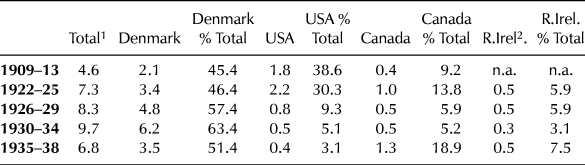
Aggregate import data conceals significant variation in the relative importance of exporting countries, shown in Table 1, from which a number of observations can be made. First, between 1909 and 1913, Britain was almost totally reliant on Denmark and the United States, which together accounted for 84 percent of British bacon imports. During the interwar years, their positions diverged significantly: Denmark’s share of British imports almost doubled between 1922 and 1934, whereas the United States’ share declined rapidly, becoming negligible by 1934.Footnote 22 A second observation is that during the interwar years, the fortunes of the Republic of Ireland and Canada fluctuated substantially: between 1922 and 1925, and between 1935 and 1938, they jointly accounted for slightly under 20 percent and slightly over 25 percent, respectively, of British bacon imports, whereas in the intervening period, 1926–1934, the level was just around 10 percent. A further observation, not fully revealed in Table 1, is that this massive importing was reciprocated: The British market was of considerable importance to foreign bacon producers. Thus, for example, for the early 1920s, it has been estimated that Britain purchased more than 66 percent of Danish bacon production. The comparable figures for bacon sold by Canada and the Republic of Ireland have been estimated at 80 and 60 percent, respectively. Although the ratio of exports to production was much smaller in the United States, at about 10 percent, nonetheless, Britain was a crucial export market accounting for more than 40 percent of U.S. bacon exports in the early 1920s.Footnote 23 We have already indicated that, taking the interwar period as a whole, the British market was of paramount importance to Denmark. Consequently, fluctuations in the British bacon market had potentially severe consequences for the Danish bacon industry and the Danish economy.
British imports of bacon during the interwar years

Notes: 1. Total figures expressed in million hundredweights, rounded up.
2. R.Irel. refers to the Republic of Ireland.
Sources: Row 1 calculated from Ministry of Agriculture and Fisheries, Report on the Pork and Bacon Trades in England and Wales (London: HMSO, 1928: Table 1, p.178). Additional data obtained from Report of the Reorganization Commission for Pigs and Pig Products (London: HMSO, 1932: Table V, pp. 78–79), and Annual Statement of the Trade of the United Kingdom (various issues).
The success of Danish exports during this period has been attributed to a variety of factors, many of which can be traced to the later nineteenth century. Most commentators focus on cooperative organization within the bacon industry and the fact that the world’s first cooperative bacon slaughterhouse was established in Horsens, Jutland, in 1887.Footnote 24 The cooperative structure was an effective way to attract the required investment capital for establishing slaughterhouses, which spread quickly. At the beginning of World War I, forty-four cooperative slaughterhouses had emerged, increasing to sixty-two by 1931, covering most of Denmark and all exporting bacon to Britain.Footnote 25 Although independent, the cooperative slaughterhouses shared a common aim: the creation of a profitable bacon export trade that would guarantee their future. To achieve this, they formed the Union of Danish Co-operative Bacon Factories, which, from its inception in 1897, was a powerful collective. Private slaughterhouses complemented the cooperatives, among which the two most important were the Danish Slaughterhouses, owned by the influential entrepreneur P. Heyman (who controlled five),Footnote 26 and Koopman (owning nine).Footnote 27 Nonetheless, the cooperatives dominated, being responsible for the slaughter of 83 percent of pigs by 1914.Footnote 28 Despite enduring ideological conflicts between cooporative and private slaughterhouses, they often collaborated on marketing.
The boom in cooperative slaughterhouses was but one element in the success of the Danish bacon-export trade. From the late nineteenth century, Danish agriculture made a rapid transition from grain production toward livestock.Footnote 29 This shift focused on milk used to produce butter destined for export to the British market. A by-product was skimmed milk and buttermilk, excellent pig fodder that could be used to fatten lean pig breeds suitable for bacon production. This combination of butter and bacon generated synergies at all stages in the production chain. For example, it was possible to use the same infrastructure, transport system, and information and distribution channels for both butter and bacon. Similar synergies were also apparent in the branding and marketing of Danish bacon and butter for sale in the British market.
Important developments also occurred with the grading and branding of bacon for export.Footnote 30 In the late 1880s, the Danish pig population suffered swine plague and pig fever, which resulted in the closure of the German market, the most important outlet for Danish pig exports. This blockade provided the impetus for a reorientation toward the British market and stricter prevention of disease. Part of the solution originated from the Landhusholdningdselskabet, a private but state-funded society that stipulated that from March 1888, all pigs shipped to Britain had to be inspected and monitored by a veterinarian during their transport. In 1897, the Danish government enacted legislation preventing the export of bacon and pork that was unfit for human consumption.Footnote 31
Despite the good intentions behind this statute, it was not sufficient: Several cases of diseased Danish pork and bacon were discarded in London in 1905, and the City of London Council issued warnings about the poor quality of Danish bacon. These threats had a salient effect—the Danish government responded with an executive order declaring that all pig meat had to be certified by a veterinary surgeon. This order simultaneously reassured the London authorities and prevented an incipient crisis from developing.Footnote 32 This episode highlighted the bacon export industry’s vulnerability to health scares. Hence, the Danish government recognized that, rather than ad hoc legislation, a more permanent solution was needed. This was achieved by extending application of the Lur Brand to bacon.Footnote 33 In doing so, the Danish government anticipated that this brand would be recognized as a national mark of origin and quality.
However, use of this brand was opposed by private slaughterhouses, which feared that it would undermine the reputation of their own marks. A further objection was that such marking would antagonize British curers that wished to apply their own indicia. Doubts were also entertained about the Lur Brand as a quality mark and whether all slaughterhouses would reach the required standard.Footnote 34 The Danish government, aware of the bacon industry’s national importance, dismissed these fears. In 1906, it introduced legislation that imposed the mandatory requirement that all bacon destined for export be inspected by a state-appointed veterinarian and marked with the Lur Brand. In fact, healthy pigs were first stamped with a blue oval containing the legend I.Kl., Danmark, Statskontrol, indicating they were disease-free; the resultant pig meat was then imprinted with the red Lur Brand bearing the legend “Danmark” and other indicia showing the factory number of the slaughterhouse and the Lurs (see Figure 1).Footnote 35 The Lur Brand was thus, simultaneously, a mark of health, quality, and national origin, because the factory number of the slaughterhouse helped protect the bacon from adulteration. Also, it could be used to control bacon quality throughout the supply chain.
Example of the Lur Brand. By the law of 27 May, 1908, animals slaughtered for export had to be registered with an identifying number. This number would be inserted where 00 appears in the above Figure.
Source: H. Faber, Cooperation in Danish Agriculture: 69.
The 1906 statute was consolidated in 1908 with the further requirement that apart from smoking and salting, no other preservatives were permitted in bacon production. This last initiative helped differentiate Danish from Canadian and American bacon: Because of their greater distance from the British market, the latter needed to use chemical preservatives. Simultaneously, the Lur Brand was introduced to the export of eggs. The net result was that this brand on bacon, butter, and eggs became synonymous with the British breakfast.
As indicated, heavy state involvement was a central feature of Danish export success. Put bluntly, the bacon industry was simply too important to Danish agriculture—and, therefore, to the well-being of the Danish economy—to be entrusted entirely to private enterprise. The state was integral to the development of Danish agriculture in a number of ways. These included the foundation in 1856 of the Royal Veterinary and Agricultural High School (Landbohøjskolen), which researched animal disease and pig-breeding and fodder programs to improve the quality of Danish bacon and its customization for the British market. In addition, the Danish government appointed Harald Faber as Danish Agricultural Commissioner to London in 1888. Subsequently, Faber secured registration of the Lur Brand in Britain in 1901, when Danish butter exports began to accelerate.Footnote 36
In 1901, after ten years studying agriculture in Britain and Denmark, the Danish agricultural consultant and veterinarian P. A. Mørkeberg published The Management of Pig-Breeding in Denmark. This book contained detailed market research, including analyses of sales channels and consumer preferences. Mørkeberg concluded that although British bacon importers appreciated the quality of Danish bacon, there was still scope for improvement: British consumers still found Danish bacon too fatty, and the need for greater standardization and regular delivery was emphasized. To overcome these problems, Mørkeberg proposed the establishment of institutions to oversee pig-breeding and feeding programs. His plan could not be effected without close cooperation among government, the slaughterhouses, and the farmers. The state needed to provide a legal and institutional framework that balanced the decentralized structure of the farms and bacon factories. Furthermore, the state had to supply knowledge, consultants, and financial support. The bacon factories recognized this and were receptive to state involvement, which resulted in the 1902 Livestock Act (Husdyrloven af 23.maj 1902).
The state established research stations to collect data and to refine breeding and feeding methods used in the development of a homogeneous pig breed particularly suited for bacon production. A cross between the Danish white land pig and Yorkshire pig was chosen. Other breeds practically vanished in Denmark. Locally, farmers participated in pig-breeding communities, which included representatives from the Federation of Farmers, local slaughterhouses, and government-appointed veterinarians. The result of these initiatives was the large-scale production of uniformly high-quality bacon: It was estimated that 75 percent of Danish pigs were classified as “good” for curing purposes, compared with less than 50 percent in England. Moreover, the bacon produced from Danish pigs was ideally suited to British tastes. An official British report summarized these developments as follows:
Danish producers have made a careful study of the requirements of the British market. … By combining together, and with the encouragement of their Government, they have set themselves successfully to supply the article required. ...The Danish conquest of the British market is not least attributable to the way the farmers’ associations in that country have induced their members to abandon their personal prepossessions as to the type of pig to raise. The prime bacon imported into this country is the product of cooperation; it would seem that similar cooperation must afford the most effective reply.Footnote 37
These developments would have been nullified unless Danish bacon was sold as “Danish” on the British market. The custom in the Danish bacon industry was for slaughterhouses to process pigs into “Wiltshire”Footnote 38 sides and export them in the “green” state, with further processing undertaken in Britain.Footnote 39 After export, the bacon was classified according to quality and sold at fixed prices on the London Provision Exchange, where it was quoted as “Continental,” not “Danish.” Consequently, it was impossible to develop brand value in “Danish” bacon. Exacerbating matters, Danish slaughterhouses made individual agreements with British agents who sold the bacon to wholesalers.Footnote 40 These agents belonged to the Produce Agents Association (PAA), whose members agreed to sell only to members of the Wholesale Merchants’ Association. In practice, this arrangement worked as a cartel.
Circumventing this “bacon ring” became a central objective of major British retailers and the Danish bacon industry. The Cooperative Wholesale Society (CWS), for example, had forged direct links with Danish butter producers as early as 1882;Footnote 41 this provided a template when it developed its Danish bacon supply chain. The CWS established three green-field buying depots in Aarhus, Odense, and Esbjerg between 1891 and 1905, and a bacon factory in Herning, in 1900—all of which enabled it to circumvent the “bacon ring.”Footnote 42 In 1902, the Danish Bacon Agency—from 1906, renamed the Danish Bacon Company (DBC)—was established.Footnote 43 Initially, only three slaughterhouses participated as owners. Despite this unpromising start, the DBC lobbied the remaining slaughterhouses and placed advertisements in the Andelsbladet—the main journal for Danish farmers. The PAA retaliated and tried, unsuccessfully, to dissuade British curing and smoking firms from processing DBC bacon.Footnote 44 Gradually, the DBC gained market share; it succeeded in creating a robust alternative to the PAA and, from November 1909, Danish bacon was quoted as such on the London Provision Exchange.Footnote 45
During the interwar years, the DBC became a center for marketing Danish bacon in Britain. By 1914, the industry had established a dual institutional setup, in which operations within Denmark focused on improving bacon quality while British operations concentrated on sales and marketing. This framework stemmed from significant investments by farmers, slaughterhouses, and government and generated path dependency. The early concentration on the bacon preferences of British consumers affected Danish exports to other markets. For example, continental European consumers preferred pork to bacon. Consequently, Danish exports of pork to Germany—which had been important in 1900—declined.Footnote 46 Increasingly, therefore, the Danish bacon industry became “locked in” to the British market. This lock-in arose in a historical period characterized by a rapidly expanding British market for bacon and in an economic environment of free trade and international competition. The advantages obtained by Danish bacon producers prior to 1914 made them better equipped to respond to the completely different conditions post-1919. In contrast, Britain’s reliance on Danish bacon placed the British bacon industry at a significant—and also path-dependent—disadvantage when it tried to claw back a bigger share of the domestic market during the interwar period.
Consolidation of Danish Supremacy
The Danish bacon industry was not immune from the dislocation caused by World War I. Blockades meant that its exports declined from 148,000 tons in 1915 to less than one ton in 1919.Footnote 47 Simultaneously, Canada and the United States replaced Denmark as Britain’s principal bacon suppliers. This prompted the following question: Would Denmark regain its position in Britain or be forced to diversify into other markets?Footnote 48 Fortunately, for Denmark, anxieties about its long-term position in the British market were unfounded. Although Canadian and U.S. bacon exports to Britain increased during the war, the reputation of this produce was undermined because it was stored for far too long and reached consumers in a degraded state. In April 1921, a delegation of the Institute of American Meat Packers visited Britain and expressed deep concern at the stocks of old bacon still held by the British government, which had “caused almost irreparable injury to the reputation of American bacon on this market.” Indeed, because substantial quantities of overkept bacon remained to be sold off, the delegation suggested that the individual names of packers should be obliterated.Footnote 49
The sullied reputation of Canadian and U.S. bacon further improved the standing of Danish bacon. Some alleged that price differentials among Canadian, Danish, and U.S. bacon did not reflect their relative merits because retailers were fanning the flames of prejudice by stocking only Danish bacon.Footnote 50 Consequently, even as late as May 1924—almost five years after the armistice—it was said of Canadian bacon: “The butchering and selection is the best of any bacon coming to England, not excluding Danish or Irish bacon. Despite this, the wholesale trade, the retail trade and the consuming public are all deliberately boycotting Canadian bacon and paying money to the foreigners, particularly the Danes.”Footnote 51 In fact, the 1920s and early 1930s were the heyday for Danish bacon exports, which increased from 187,000 tons in 1921 to 807,000 tons by 1931. In 1932, Denmark’s share of British bacon imports peaked at 67.4 percent. The principal explanation was the sustained effort to enhance its reputation on the British market.
The short-term advantages enjoyed by Denmark after World War I were underpinned by fundamental institutional changes, which generated long-run gains. For example, in 1919, the DBC restructured, increasing its capital from £5,000 to £150,000. This move was part of a general transition in the marketing strategy of Danish bacon that occurred in the 1920s, with more efforts made to extend the geographic distribution of bacon in the British market. Prior to 1914, the bulk of Danish bacon was exported to, and distributed from, the London market,Footnote 52 but between 1920 and 1931, eleven new branches were launched throughout Britain, and more than two hundred salesmen were hired. Before 1914, the Danish bacon export trade was principally based on “business to business” transactions in which the DBC sold bacon to agents, who, in turn, sold it to retailers. In the interwar period, more emphasis was placed on “business to consumer” transactions, in which the DBC targeted retailers and consumers directly. The two hundred salesmen who worked for the expanded DBC were not just salesmen, but rather bacon experts who were sent to Denmark for training. A dedicated monthly magazine, The Mustard Post, commenced in 1925, communicating to these salesmen the latest developments in the Danish bacon industry. Additionally, exporting bacon directly to London, instead of Harwich, improved quality control along the supply chain. After landing, samples were taken from each slaughterhouse, cooked, and blind tasted, and a report detailing flavor, color, fat content, and texture was cabled to each factory.Footnote 53
The need to boost the promotion of Danish bacon received further impetus with the formation of the Imperial Economic Committee in 1925 and subsequent efforts by the Empire Marketing Board (EMB) to foster intra-Empire trade.Footnote 54 As we show later, the Danes could be justifiably unconcerned about British attempts to restructure its bacon industry because its weaknesses were too intractable to be solved in the short term.Footnote 55 Nonetheless, by encouraging British consumers to buy Empire bacon, principally from Canada, EMB campaigns posed a threat to Danish sales promotions,Footnote 56 and the Danish bacon industry responded by intensifying its marketing efforts. The Danish Agricultural Commissioner to London, Harald Faber, stated:
We must remember that Denmark is a small state [which] compete [s] [in a] world market, with products from many other countries. The more [that] Danish agricultural products can appear [under] one uniform trademark, the more the entire export can appear as if it was one united business, ‘Denmark & Co’, the stronger we stand. That is why we work on maximizing the homogeneity in the quality, appearance, branding and so on. A tool to this is the ‘Lure-brand’ on bacon and butter.Footnote 57
To facilitate the DBC’s promotional campaigns, Danish slaughterhouses imprinted the Lur Brand on all parts of the carcass; irrespective of the cuts purchased, all consumers could be certain they were buying Danish bacon. British retailers were required to deploy posters advertising Danish bacon in their shops, and all Danish bacon was wrapped in paper labeled “Made in Denmark.”Footnote 58 This mark simultaneously announced origin and quality: It guaranteed that the bacon was free from disease and that only salt was used as a preservative.Footnote 59 It is estimated that each British household received literature advertising Danish bacon several times a week (see Figure 2);Footnote 60 in 1926, the Danish press reported the following letter published in the Hornsey Journal:
Dear Editor: Could it be that any of your readers or advertisers could do me the favor to give me the name of a grocery store where I would always be sure to get English Wiltshire Bacon and English Cheddar Cheese? ... I can only admire that organization that has resulted in shop after shop [offering] ‘Danish’, ‘Danish’, ‘Danish.’ I just wish that [this] was [the] case with ‘English.’Footnote 61
British advertisement for Danish bacon, 1926. Source: Reginald Spink, DBC-The Story of the Danish Bacon Company, 1902–1907, p. 39.
In the same year, the appeal of Danish bacon to the British working class was increased when the DBC donated 10 tons of bacon to Arthur Cook,Footnote 62 for distribution to the national mining community.Footnote 63
As the brand value of Danish bacon increased, its protection from passing off became imperative; this was the key task for Harald Faber. In 1925, for example, Nevin Limited of St. Helens in Lancashire was prosecuted on behalf of the Danish government for selling American ham as “Danish.” This and similar actions were important for two reasons: First, they ensured that only Danish bacon was properly marked as such. In addition, because U.S. bacon and hams were preserved with boric acid—which was forbidden in Denmark—passing off American bacon as Danish undermined the reputation of the genuine Danish product, which was preserved with salt. Nevin Ltd. was fined £40.Footnote 64 For some time after this verdict, flyers were distributed and advertisements published that condemned such practices as “unscrupulous,” and reassured consumers that they could be certain of buying Danish bacon in DBC shops. In addition, the severity of the fine ensured that all retailers in the region advertised genuine Danish bacon in their shop windows.Footnote 65 Whenever misleading information about the quality of Danish bacon was published by the British media, Harald Faber successfully demanded a disclaimer and/or that his response be published in the relevant newspaper.Footnote 66
A final observation concerns the Danish response to the imposition of quotas in the 1930s. The fundamental problem confronting the Danish bacon industry following the Ottawa Conference of 1932 and the Anglo-Danish Commercial Treaty of 1933 was how to respond to the problem of too much capacity while maintaining quality. As Table 1 indicates, British bacon imports from Canada and the Republic of Ireland grew rapidly during the 1930s, and imports from Denmark from mid-decade slid by about 10 percentage points. Denmark clearly required an effective, national solution. The Kanslergade Agreement was the cornerstone of the Danish response. Among other provisions, it contained an agreement for government regulation of the entire bacon industry. The Agricultural Ministry established a Bacon Committee to regulate the quantity of pigs that each slaughterhouse was permitted to breed and kill.Footnote 67 This was later extended by law and determined the quantity of pigs that farmers were permitted to deliver to the slaughterhouses.Footnote 68 The key feature of this regulation was that each pig farmer was allocated a limited number of “pig-cards,” each of which allowed the farmer to have one pig slaughtered. This system was mandatory: Home slaughtering was prohibited and punishable by fines.Footnote 69 The administration of this law was transferred to the Union of Danish Co-operative Bacon Factories, which bacon producers were compelled to join, and coordination of slaughterhouse output became centralized. Effectively, the relationship between the bacon industry and the state evolved in a corporatist direction: The Danish government no longer simply supported the bacon industry, but rather became actively involved in its regulation to maintain the highest possible level of exports and social stability in Denmark. The close connection between the bacon industry and the state that had developed and institutionalized from the late nineteenth century facilitated the Danish response to British quotas in the 1930s.
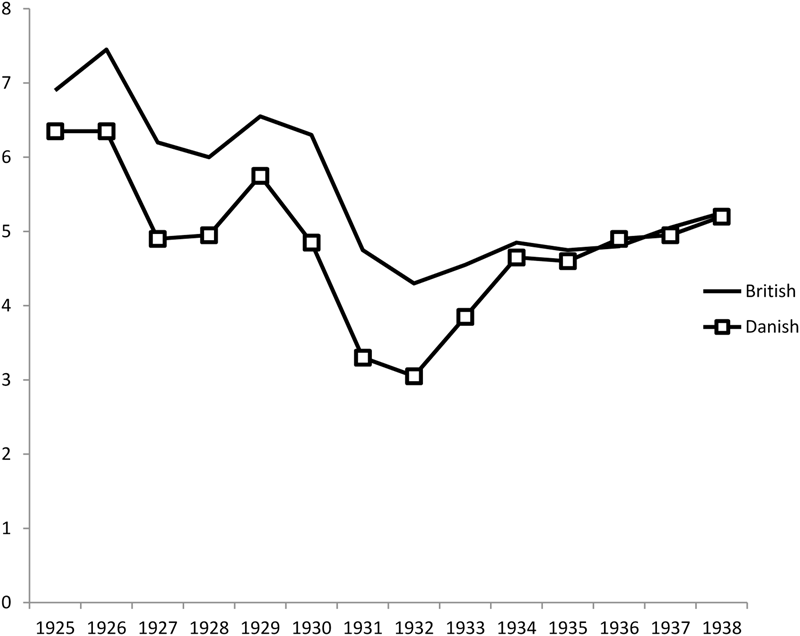
These institutional changes reduced bacon production but improved quality. During the 1920s, increased production had threatened quality by disturbing the equilibrium between milk input and bacon output.Footnote 70 By refocusing on quality, Denmark continued to export high-value bacon, which was reinforced by extensive advertising in the British market. These changes were crucial: Although the quota caused Danish exports to Britain to decline by half between 1932 and 1938, the average price of Danish bacon exports almost doubled during the same period (Figure 3), so that export revenues were largely maintained.Footnote 71
British and Danish bacon prices, 1925–1938. Note: Figures indicate wholesale prices for first-quality British and Danish bacon, respectively, and refer to annual average prices from wholesaler to retailer. Source: Agricultural Statistics, various issues.
Defects in the British Bacon Industry
We have indicated that Britain’s reliance on imported bacon was well established by 1914. Clearly, if Britain could not satisfy its domestic requirements, there was no surplus available for export. This point is important because it helps explain why discussion of national branding of British bacon is nonsensical for the pre-1914 period.Footnote 72 Heavy reliance on imports generated two adverse consequences. First, before 1914, there was no incentive for the British government to support its bacon industry. Contemporaries contrasted this lack of support with that lavished by the Danish authorities, who devoted “much attention to the practical side of every branch of agriculture, thereby securing a regular supply and a more even price.” The shortage of pigs in Britain was directly attributed to a lack of government support, again in marked contrast to Denmark, which provided regular funds to encourage pig breeding. In some country regions, there was reportedly only one hog to service the entire locality. Such was the stranglehold that Denmark had on Britain—indeed, some argued that the Danes were driving Irish bacon completely off the British market and believed that the only solution was to impose a quota.Footnote 73 This neglect by the British government was also in stark contrast to the efforts of the Canadian and U.S. governments to relay to their bacon producers information about British consumers’ preferences.Footnote 74
Second, heavy reliance on imports meant that there was no need to compete in international produce markets; consequently, prior to 1914, there was little incentive to develop national branding, again in marked contrast to Denmark. In fact, use of national marks to promote British produce in the domestic market was entirely absent until the 1920s.Footnote 75 After all, the private marks of individual bacon curers—for example, C. T. Harris & Co. (Calne) in Wiltshire, and Cole & Lewis in Gloucestershire—had considerable repute.Footnote 76 For the former company, the U.S. Department of Agriculture (USDA), stated, “Wiltshire bacon is all through Europe recognized as the standard brand, and the house of Charles & Thomas Harris is known as the largest and best Wiltshire packing concern.”Footnote 77 The marks of these companies were on a par with famous Irish, Canadian, and U.S. marks such as Denny’s, Shaw & Matterson, O’Mara, Davies, Mathews, Beaver, Boyd-Lunham, Cudahy Bros, and Morris’ Supreme. The private marks of firms in Denmark that did not belong to the cooperative system—for example, Royal Dane, Fink, Varde, and Tip Top—were also highly regarded.Footnote 78 However, these brands were used in conjunction with the Lur Brand—which was mandatory on all exported bacon. Perhaps some private slaughterhouses thought it desirable to use their own marks alongside the Lur Brand because this provided an additional guarantee and generated a firm-specific premium, as well as helping them monitor quality control along their own supply chains?Footnote 79
After World War I, British government “neglect” of agriculture diminished. Contemporaries, such as Arthur Lucas, recognized that the postwar period brought greater government intervention to accelerate restructuring. In general terms, official intervention in the agricultural and manufacturing sectors was motivated by the same criteria, which included rejection of the neoclassical concept of a self-equilibrating economy, and the need for effective organization to remove intense competition and to supplant economic forces with “artificial control.” Lucas argued that government policy toward industrial control in both sectors was based on the fundamental assumption that “it is impossible for industry to continue to function in the national interests within the simple pattern of a laissez-faire economy.”Footnote 80
In the post-1919 period, the earliest official inquiry into agriculture was conducted by the Linlithgow Committee, appointed in 1922 to investigate the methods and costs of selling and distributing agricultural products.Footnote 81 This committee reported that the spread between producers’ and consumers’ prices was “unjustifiably wide.” and that “[p]ublic interest demands a far more determined effort on the part of all concerned … to increase the efficiency of the marketing and distributive machinery as a whole.”Footnote 82 The committee highlighted three principal means by which the objective of greater efficiency could be achieved. First, it was necessary to develop a greater “marketing sense” among farmers, which would enable them to closely align their methods of production and the goods they produced to consumer demand. Second, it was imperative that higher levels of standardization in produce were achieved, because this would increase domestic demand. The British bacon industry was identified as particularly culpable on this count: “Grocers foster the Danish trade because they know that Danish bacon varies little in quality and gives satisfaction to their customer and themselves.” Finally, greater cooperation was also necessary; otherwise, efforts to achieve higher levels of standardization would be undermined. Again, the British bacon industry was targeted by the Linlithgow Committee: “By cooperative action it should be possible to establish a ‘hall mark’ for British bacon which reaches a standard of excellence comparable to the Danish.”Footnote 83
During the 1920s, however, agriculturalists identified a number of entrenched structural weaknesses in the British bacon industry that had to be eliminated if a national marketing campaign extolling British bacon was to be successful. For example, the maladjustment of pig supplies to curers’ requirements undermined the vertical coordination of quality. Butchers and meat processors recognized that it was straightforward to build bacon-curing factories to handle any quantity of pigs, “but regularity in supply is essential in order that there shall be as little broken time as possible.” Concerns were also raised about the generally low quality of pigs supplied to the curing industry: “Farmers hold different views concerning the various breeds and crosses … which is decidedly inconvenient where the production of pig products of uniform quality is important, as it is where bacon and hams are the staple commodities of the industry.” Small farmers were singled out as being the most difficult to deal with because they paid little or no regard to the requirements of the curing factory, their only concern being to buy animals cheaply and feed them at little expense. Clearly, if curing factories used low-grade pigs, their bacon products would inevitably suffer in value and reputation.Footnote 84
There was also the problem of determining the optimal location for curing factories. Continental experience indicated that their establishment in a particular area led to a concomitant increase in nearby pig rearing, which also helped to stabilize prices. In Britain, however, a frequent complaint was that in many markets unfair prices were paid for pigs—especially of the bacon type—if there was no local outlet for them in bacon factories. Consequently, pig breeders were left dissatisfied and disappointed. This was hardly a model of efficiency, especially as to avoid losses, pig farmers had to ship their pigs large distances to curing factories, which increased cost. Conversely, a trade report on the establishment of a bacon curing factory in Spalding (Lincolnshire) reported that local butchers feared that if the bacon factory absorbed all the pigs for bacon, there would be no pigs available for pork.Footnote 85
Professionals in the bacon-curing trade remonstrated that use of unsuitable pigs imposed hard financial penalties. For example, there was considerable wastage in curing operations on account of the variable quality pigs supplied. It was estimated that British domestic pigs supplied only 20 percent grade A bacon, compared to the 80 percent that could be obtained from pigs in other countries.Footnote 86 Examination of studies published in Canada indicated that “Wiltshire” sides from fat pigs were visually less appealing than similar sides from “bacon” pigs and financial returns from the former were much lower than from the latter.Footnote 87 Moreover, use of unsuitable pigs meant that the final selling price of bacon was higher than it needed to be: It was wrong that curers and the public were paying for a pig with three inches of fat—which the public did not want—compared with a pig with just 1.5 inches of fat.Footnote 88
The formation of cooperative bacon factories along Danish lines would have solved many of these problems, but a survey commissioned by the National Farmers’ Union (NFU) in 1926 revealed that only limited attempts had been made to develop this organization. Whereas Denmark had forty-five bacon cooperatives in 1914, only six existed in England by 1923.Footnote 89 Even this unflattering comparison failed to convey the scale and severity of the problems confronting the British bacon industry in its attempts to claw back a bigger share of the domestic market. Two fundamental issues stood out. The first was contractual and centered on the desirability of introducing binding agreements between pig farmers and bacon curers. Contracts were necessary to ensure that curers operated at viable levels of capacity utilization. The NFU reported that levels of utilization in British bacon cooperatives was between 66 and 70 percent. Comparable data from Denmark are not available, but the evidence suggests that it was higher than in Britain: In Denmark, the volume of pigs processed by the same number of cooperative slaughterhouses increased from 1.8 million to 4.2 million between 1922 and 1929. Consequently, during the same period, operating cost per processed pig declined by almost 40 percent.Footnote 90 The NFU accepted that adoption of the cooperative organization per se was not sufficient to guarantee high levels of utilization because “[s]hortage of supplies is the common lot of English bacon manufacturers generally; so is their irregularity. … [T]hese difficulties are inherent in the present position of the bacon curing industry, as a whole, in this country, and are not peculiar to the farmer-owned concerns.”Footnote 91
A 1928 MAF investigation acknowledged these structural problems and identified other weaknesses in the British bacon industry. First, the relative sizes of the pork and bacon markets and their different characteristics presented further obstacles to improving the competitiveness of the bacon industry. MAF estimated that about 50 percent of total British supplies of pig meat was converted into bacon and hams, whereas the other half was consumed as fresh pork. However, the pork industry was highly seasonal, with sales heavily concentrated around the Christmas period, whereas bacon had no defined seasonality—supplies in the winter months could be as high as those in August. Consequently, pig farmers were free to vary their supplies of pigs to the pork and bacon industries according to differences in relative prices, which undermined the uniform supply of bacon. A second weakness existed within the structure of the domestic bacon industry. In broad terms, the “Midland” industry was able to use much heavier pigs than those required for “Wiltshire” bacon. This sectional difference hindered specialization in the production of pigs for the Wiltshire trade, in which foreign competition was most severe. In contrast, producers of Midland cut bacon were in direct competition only with the very best boxed bacon exported from the United States, and even here it appears that domestic firms in this trade could command a higher price.Footnote 92
A further weakness that MAF identified concerned the most efficient way of curing bacon—with direct implications for sales policy.Footnote 93 As previously indicated, Danish success was heavily reliant on identifying British consumer bacon preferences and satisfying these at lowest cost. As far as we can ascertain, all Danish bacon exports to Britain were tank-cured. This was by far the cheaper method of curing compared to the alternative of dry-curing. In 1932, though, most of the bacon in Britain was dry cured, and even by 1938, approximately 40 percent was still so cured.Footnote 94 This discrepancy highlighted a fundamental British weakness: There was little alignment between the technical objectives of the factory—to produce at lowest cost—and the choice of cure that was best able to satisfy market requirements. The Danish industry was fully committed to supplying Britain’s bacon needs, but the British industry was divided.Footnote 95
In concluding its analysis of weaknesses in the British bacon industry, the MAF report especially scored the absence of a relationship between quality (as opposed to weight), grading, and national marks. In this respect, a stark contrast between Denmark and Britain was noted: In Denmark, all bacon exports were uniformly graded, but in Britain, “each factory grades according to its own ideas, and … there is no approach to national uniformity. Much of the miscellaneous bacon produced in this country cannot … be graded at all ... and is on that account at a commercial disadvantage compared with imported supplies.” Without rigorous grading, the British bacon industry was unable to obtain the benefits of a national mark, further weakening its competitive position:
These national marks have…acquired a wider significance as indicating definite standards of quality, especially when, as in the Danish trade, supplies possess a high degree of uniformity. The goodwill, as it were, of the Danish national mark has considerable sales significance … which enables Danish bacon, in the face of severe competition, to increase its hold on the English market. … It is a question for English curers to consider whether, following the adoption of a standard grading system, some kind of overriding national mark should not be applied … to certain of the standard qualities of English bacon.Footnote 96
A national trademark had been registered by MAF in 1927 to serve the triple purpose of introducing standardization, identifying the produce as domestically produced, and providing a basis for effective advertisement, (Figure 4). This mark was designated in trademark class 48, which included, inter alia, bacon and other pig products. Its registration was based on the premise that a mark applied to produce graded to national standards would “give confidence to buyers by reason of the implied legal guarantee as to quality.”Footnote 97 Subsequently, the Agricultural Produce (Grading and Marking) Act of 1928 installed a national scheme for the grading and marking of agricultural produce, which empowered the minister for agriculture to prescribe “grade designation marks” indicating the quality of agricultural produce.Footnote 98 The national mark and the provisions of the 1928 act were combined when the minister for agriculture established a National Mark Committee to authorize use of the national mark as a “grade designation mark.”Footnote 99
Advertisement from 1929, urging consumers to buy produce bearing the National Mark. Source: advert appearing in MAF, Report of the Reorganisation Commission for Pigs and Pig Products, 1932.
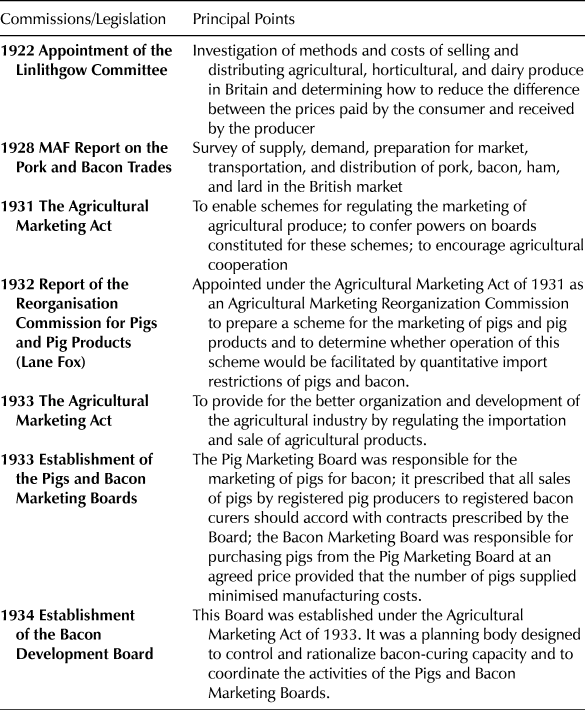
However, not until the early 1930s did official intervention seem to restructure the bacon industry to ensure that use of a national mark was feasible. MAF recognized that until suitable reorganization was achieved, advertisement of a national mark would be detrimental to British bacon.Footnote 100 The need for official intervention in agriculture became more acute with the onset of the Depression, because Britain’s reliance on imported foodstuffs was relatively inelastic compared with world demand for British exports of manufactures. Between 1929 and 1932, British imports and exports of all products declined by 43 and 50 percent, respectively. Over the same period, British imports of meat and animals declined by 29 percent,Footnote 101 but imports of bacon peaked at 11 million hundredweight. If Britain were to avoid a severe deterioration in its balance of payments, greater efforts would be needed to achieve higher levels of self-sufficiency, especially in bacon (see Table 2 for a list of official British inquiries and legislation).
Official inquiries and legislation by the British government in the bacon industry, 1922–1935
Source: MAF, Report of the Committee Appointed to review the Working of the Agricultural Marketing Acts, 3–8; 24–27.
The Agricultural Marketing Act of 1931 empowered MAF to authorize schemes for producers to regulate the marketing of their produce. Its principal features included that each scheme had to be administered by a board composed of representatives of registered producers; there was a broad definition of marketing, which included grading, packing, and advertising; and the minister for agriculture could establish an Agricultural Marketing Reorganization Commission that would investigate “any matter affecting the operation of a scheme.” The act of 1931 was supplemented by the Agricultural Marketing Act of 1933, which authorized the Board of Trade, after consultation with MAF, to regulate the import of produce, provided that reorganization schemes under the 1931 Act were being effected and that, without a restriction on imports, reorganization could not be maintained.Footnote 102
In 1932, an Agricultural Marketing Reorganization Commission (the Lane Fox Commission) commenced preparing a scheme for regulating the marketing of pigs and pig products and to consider the extent to which this reorganization would be facilitated by the quantitative restriction of imports. Because bacon imports peaked in 1931, the commission acknowledged the urgency with which it had to make its recommendations.Footnote 103 To overcome the myriad problems existing in the British bacon industry, the commission recommended the following principal measures: First, bacon supplies would be stabilized at a target volume of 10.67 million hundredweight (the annual average supply between 1925 and 1931). This was to be achieved by a variable quota system by which imports would be restricted to offsetting the difference between domestic production of bacon and the target volume. Secondly, the pork-pig and the bacon-pig markets were to be segregated in an attempt to isolate the latter from fluctuations in the former. To facilitate the coordination of production between the two industries, and to smooth out fluctuations in the supply of pigs to bacon curers, bacon pigs would be sold on annual contracts at a national price pegged to feeding costs. For example, if the price of pork exceeded that of bacon, pig farmers had an incentive to sell their pigs for pork, thereby reducing the supply of domestic pigs for bacon. The operation of this scheme was to be overseen by the Pigs Marketing Board (representing pig producers) and the Bacon Marketing Board (representing curers), both of which were established in 1933, under the Agricultural Marketing Act of 1931.Footnote 104 To ensure the highest levels of coordination, the Pigs Marketing Board was required, at the joint request of the farmer and curer, to buy pigs on contract from the former and sell them on contract to the latter at the prices set by the national agreement. To secure an adequate supply of bacon pigs—only 40 percent of the pigs killed in British bacon factories were suitable for the production of first-quality bacon—contracts would “specify the standard carcass grades and weights for bacon pigs, and … discriminate in price against carcasses of indifferent quality and weight … payment for quality … supported by intelligent propaganda, would, in time, standardize the type of pig produced for bacon.”Footnote 105 In common with previous investigations by MAF, the relationship between cooperation, standardization and national marking was emphasized:
The consolidation of the curing industry…and its cooperation with the feeding industry…make it possible for valuable work to be undertaken in connection with the marketing of bacon. … We have referred … to the need for standardization as an instrument to secure uniformity of quality at a high level … the advertising of home produced bacon should be undertaken … on an extensive scale, as … it will be necessary to break down fairly strongly fixed tastes for foreign products; in this campaign, the National mark and the use of standardized grades should be invaluable.Footnote 106
Explaining the Failed British Response
A committee appointed to investigate the working of the Agricultural Marketing Acts during the interwar years reported in 1947 that many of the schemes “succeeded in doing comparatively little” and that “standardised grading and packing was still the exception rather than rule in the marketing of home produce before the war.”Footnote 107 For the bacon industry, the committee noted, “The Pigs Marketing Board seems to have had its hands full in trying to overcome difficulties inherent in the scheme which it operated, the major difficulty being the absence of control over pork which, in fact, doomed the scheme to failure from the start. The Bacon Board was simply a piece of negotiating machinery; it neither sold bacon nor controlled its sales.”Footnote 108 Reviewing the 1930s as a whole, the committee noted that, at best, the effects of the pork and bacon schemes were transient.
The broad trends in the response of the British bacon industry to the Agricultural Marketing Acts of 1931 and 1933 can be summarized as follows. On the positive side, the quota was partially successful: Imports declined by approximately 40 percent over the period 1932–1935, and thereafter remained practically static. Additionally, “import penetration” also declined. Comparing the period 1925–1926 with 1934–1938, home production of bacon as a percentage of imports increased from 21 to 42 percent.Footnote 109 However, on the debit side, the pig population increased by 22 percent between 1932 and 1935, but thereafter declined so that the population in 1938 and 1939 was less than it was in 1935. Bacon production increased by 36 percent between 1934 and 1936, but output in 1938 and 1939 was below the 1936 level.Footnote 110 In any case, Table 1 also indicates that imports from Canada and the Republic of Ireland increased markedly, even though during the 1930s, per capita consumption of bacon in Britain declined from 30.6 pounds to 25.7 pounds between 1930–1931 and 1934–1938, respectively.Footnote 111Figure 3 indicates that, with the exception of 1936, Danish prices were always lower than British prices, and the convergence in prices during the 1930s was largely driven by an increase in the former. These data permit two principal observations to be made on the performance of the British bacon industry during the 1930s. First, although the ratio of British bacon production to bacon imports increased, this was largely a function of the collapse in total imports. In other words, British bacon producers were unable to fill the void the quota created. Second, from the early 1930s, British bacon prices show no pronounced trend. This indicates that it was not only the quota that prevented increased consumption of British bacon (by artificially raising Danish prices), but also the inability of British producers to increase supply, thereby lowering the price of domestically produced bacon.
One explanation for the limited British response is that efforts to secure standardization were attempted too late in the day: Official action concerning the introduction of uniform standards for bacon did not occur until 1935 and was quickly rebuffed by a number of eminent bacon curers because sectional differences in the industry—between Midland and Wiltshire—had not been removed. In general terms, the Wiltshire side trade had more demanding specifications on the ratio of fat to meat in a pig compared with the Midland side trade.Footnote 112 Hollingsworths, for example, a long-established Midland firm, replied to a MAF inquiry, “The bacon has to be selected not in classes or grades, but to meet the requirements of each customers [sic] particular fancy. I cannot see that grading would be of any use, where customers requirements are so varied.”Footnote 113 Moreover, even within each of these sections, important differences remained. In the Midland trade, price variation did not provide accurate indications of quality because some customers were willing to pay different prices according to weight. Consequently, “it would be undesirable to force the trade into unaccustomed weight ranges by means of standardisation.” Other disadvantages identified in the 1935 initiative included the danger that efforts to increase standardization would upset well-established trading customs; that it would only partially satisfy demand, thereby annoying a proportion of existing customers whose particular requirements were no longer being satisfied; and there would be no change in the costs of distribution or any increase in the prices offered to farmers and curers.Footnote 114 The practice of curers mixing “best” with “second” quality bellies further undermined the problem of relying on a national mark—and there was the opposition of the large curer-retail firms in the Midlands to be overcome. These large firms did not require a national system of quality grading because they did all their grading internally and would reject bellies they considered unsuitable.Footnote 115
Turning to the specific problem of meeting greater foreign competition in the Wiltshire trade, a MAF report in 1935 emphasized the urgent necessity of improving the quality of Wiltshire bacon if Britain was to reduce its dependence on imports.Footnote 116 This report noted that some of the problems affecting the Wiltshire trade were outside the control of this section of the industry. For example, the general quality of pigs supplied for curing was seriously deficient: More than 50 percent of retailers complained of excessive fatness; issues relating to conformationFootnote 117 were still pronounced; and failure to achieve “ideal” conformation was attributed to the large number of breeds. All these weaknesses were particularly pronounced when compared to Danish “Wiltshire” sides.Footnote 118 Most importantly, a crucial weakness within this trade was the haphazard nature of grading. For example, whereas imported bacon was classified according to three selections of fatness, many factories used the customary “Wiltshire” classification, which was based on four selections. Of greater concern, the report commented, “No definition of these selections exist: and there is no uniformity in grading or nomenclature. Even the factories that are trying to grade bacon on the continental system … are with a few exceptions unreliable in their grading.”Footnote 119
Under the pig and bacon marketing schemes, the BMB was entrusted with the task of allocating pigs supplied “on contract” among licensed bacon curing factories. However, an “efficient” allocation—one permitting the greatest number of factories to operate at full capacity—proved impossible. Soon after its establishment, members of the BMB complained that the proposed contract prices governing the supply of pigs were misleading: “[A]n unfair and incorrect inference has been drawn in comparison between Factories in this country which have rarely, if ever, had the experience of working to 100% capacity and Factories in Denmark which have steadily averaged from week to week the use of their full capacity.”Footnote 120 One solution to this problem was for the board to encourage curers that had secured at least 80 percent of their requirements to reallocate some of their quota to those who had much less.Footnote 121 This recommendation was commendable because it acknowledged that the distribution of pigs was inequitable, but it was also a policy that undermined attempts to improve the competitiveness of British bacon, because it hindered attainment of maximum capacity utilization.
The Bacon Development Board (BDB) faced the same difficulties later in the 1930s. This board permitted unlicensed bacon-curing factories to participate in the marketing schemes, but only after limiting the scale of their operation.Footnote 122 Similarly, when curers sought to transfer their licenses from old to new premises, they were allowed do so only if the capacity of the latter did not exceed the former.Footnote 123 The Yorkshire Farmers’ Bacon Factory provides a particularly damning example of the board’s policy. This factory had secured more pigs than it could process at its existing factory, and sought permission to develop new premises. The BDB acceded to this request, provided that the combined capacity of the old and new factories did not exceed the volume of pigs already contracted for.Footnote 124 The CWS encountered similar difficulties obtaining suitable licenses. For example, between 1934 and 1936, the society experienced declining bacon sales, and senior members of its board protested against a situation in which “an organization of consumers ready to produce in the United Kingdom was denied additional licenses for further production in England.”Footnote 125 Unsurprisingly, these licensing issues attracted severe criticism. Bauer, for example, stated:
There is no mention of the mutually contradictory measures for ‘rationalising’ the bacon-curing industry by imposing quotas on individual curers to prevent some from working at a higher rate of capacity than others, while at the same time refusing to permit the erection of new curing premises to ensure that existing establishments would work to full capacity.Footnote 126
The mechanism to ensure higher and more stable supplies of pigs to curers was not always successful. Between 1933 and 1936, four contract periods were specified, and the ratio of pigs supplied to pigs contracted for averaged 89.3 percent.Footnote 127 However, during the first and fourth contract periods, there were wide discrepancies in the supply of pigs to curers. For example, in the last period, some curers were adequately supplied, whereas others received nothing.Footnote 128 Gradual changes were made to contracts to ensure that curers were not penalized if the market price of bacon declined between contract and delivery; even so, the 1937 contract was a complete failure. This contact guaranteed minimum prices provided there was a minimum supply of 2,200,000 pigs, but by December 1936, only 87 percent was guaranteed and the curers declared the contract void because this volume was insufficient to provide a profitable basis for bacon production. A further criticism of the contracts was that they were vulnerable to evasion by pig farmers: When the price of pigs for pork exceeded the “bacon price” of pigs, there was a strong and immediate incentive to renege on contracts.Footnote 129
A quota on bacon imports was introduced following the recommendations of the Agricultural Marketing Reorganization Commission in 1932. This quota was intended to stabilize total UK supplies of bacon (from all sources) at 10.67 million hundredweight per annum. It was believed that this stabilization would stimulate domestic production.Footnote 130 However, this scheme soon attracted severe criticism. One problem was that quotas would only foster consumption of home-cured bacon if the domestic product were both relatively cheap and of acceptable quality. Retailers doubted that this was the case.Footnote 131 Similarly, unless the response of domestic producers was sufficient to offset the reduction in imports, domestic prices would rise to a level at which the volume of demand would decrease substantially, thereby reducing the available market for domestic producers and further upsetting domestic consumers.Footnote 132 In fact, at no time between 1934 and 1939 did total domestic supplies reach the target figure, and in 1936 and 1937, total domestic supply fell short by approximately 690,000 hundredweight.Footnote 133
Moreover, at the end of the bacon supply chain, retail grocers had to bear the brunt of consumer criticism directed to scarce and expensive supplies, even though they were expressly excluded from participating in the bacon marketing schemes until 1936.Footnote 134 Unsurprisingly, therefore, grocers lost no opportunity to criticize the bacon industry: “What is the use of relying on the British farmer for adequate supplies [of bacon] which they cannot, or ever will give us, as long as it is left to individuality and no standard breeds?” and “Irish and Danish bacon can never be surpassed. The English bacon curer has a long way to go to perfect English bacon to suit the British people.”Footnote 135 Grocers advocated that, in fairness to consumers, there should be no restriction on importsFootnote 136 and they highlighted inconsistencies within the scheme: If MAF wished to compel the public to buy English bacon, why not prohibit importation altogether?Footnote 137 It was claimed that the operation of the quota simply generated an artificial scarcity: “The quota was introduced by the Ministry of Agriculture as a means to restrict bacon imports, and thereby increase home production. This has not succeeded, for today, although imports are at their lowest, home producers are dissatisfied with the present conditions and bacon is very expensive.”Footnote 138 Inevitably, in these circumstances, British grocers retained a desire to stock “Danish” bacon.
The price differences between English and Danish bacon (Figure 3) cast further doubt on the efficacy of the quota scheme. One observation is that the decline in British bacon prices occurred in 1930 and was largely exhausted when the Lane Fox Commission published its recommendations in 1932.Footnote 139 A further observation is that after 1932, British prices showed no marked change. Clearly, if the quota had succeeded in encouraging an effective response, we might have anticipated a decline in British prices, but this was not the case.Footnote 140 Finally, convergence in Anglo-Danish prices after 1932 is credited entirely to the rise in Danish prices. The obvious explanation for this is that by artificially restricting Danish supplies, the quota forced Danish prices upward. Closer examination suggests that this is not a complete account, however. It could be argued that weaknesses in the schemes operated by the Pigs and Bacon Marketing Boards undermined the scale of response by British farmers. Had these schemes been enthusiastically received, British bacon supplies would have increased—possibly offsetting the decline in Danish imports—and the general price of bacon would have declined. For this conclusion to hold, however, it is necessary to assume that British and Danish bacon were perfect or close substitutes.
A confidential 1935 MAF investigation of British consumers’ bacon preferences should have warned them that they had an uphill task. This committee stated that Danish bacon was “Very strongly entrenched in the favour of all classes of consumer. … It is regarded by all consumers except those of the highest class as the finest quality of all, and, I was told, would be preferred to English at level prices.” The committee further indicated that, with the exception of the highest-quality dry-cured bacon, the majority of English bacon received complaints about lack of uniformity and regularity, unsatisfactory cure, and excessive saltiness and fat.Footnote 141
Concerns about the relative merits of British bacon were reiterated later in the 1930s by the Retailers Advisory Committee, charged in 1936 to review the retailing of domestically produced bacon.Footnote 142 This committee reaffirmed the general observations made by the confidential MAF investigation and identified two further weaknesses in the industry. First, retailers were prejudiced against British bacon because greater profits could be obtained by selling Danish bacon—even though its price increased substantially during the 1930s.Footnote 143 Second, the committee recognized that persistent failings in the British bacon industry nullified any attempt to launch a national marketing scheme with a national bacon mark and concluded that “no advertising in respect of bacon should be undertaken until the quality and regularity of supply of the British product had been improved. … [A]n assurance of quality was essential before an advertising campaign for English bacon could be usefully launched.”Footnote 144
A final observation on the wisdom of promoting a national mark for British bacon is that it may have conflicted with the marketing efforts of the EMB. Much of the Empire’s advertising campaign involved agricultural produce of little or no concern to British farmers. Production of citrus fruits such as lemons, limes and oranges, as well as tea, coffee, and tobacco were not commercially viable in Britain. However, because the EMB’s remit was to promote intra-empire trade as a whole, including trade in Canadian bacon, some degree of conflict between domestic and imperial objectives was inevitable. For example, it has been claimed that the EMB’s prime objective was the enhancement of imperial trade at the expense of British farmers.Footnote 145 Indeed, MAF recognized that the marketing of Danish bacon bearing the legend “Danish” signaled a guarantee of quality; and that if reorganization of the British bacon industry failed to provide rigorous quality control, any advertisement for British bacon using the national mark would benefit dominion and foreign bacon producers more than British producers.Footnote 146
Discussions between MAF and the EMB also revealed further inconsistencies about the purpose of the British national mark. The EMB was keen that the design should suit all empire purposes and be capable of distinguishing British produce. MAF, however, believed that the imperial conception of the mark had to figure in, irrespective of whether “Produce of England and Wales”or “Produce of Canada,” were used on the mark. Consequently, although the national mark was originally designed to indicate “home” produce, its subsequent use encompassed all Empire products.Footnote 147
Conclusions
In this article, we argue that Danish dominance of the British bacon market was established by 1914 and persisted throughout the interwar years. This supremacy, built on cooperative foundations laid in the nineteenth century, was maintained in the interwar period because of increasing path dependency in the British market, which culminated in 1932 when Denmark accounted for 67 percent of Britain’s bacon imports. Denmark’s dependence on the British market was inevitable and fully justified: From the late nineteenth century, the Danish bacon industry had specialized in the production of “Wiltshire” sides, which best satisfied the preferences of British bacon consumers. In contrast, we have shown that British attempts to claw back a greater share of the domestic market during the interwar period were only partially successful. A number of conclusions are suggested from our study.
It could be argued that the British focus on Denmark was totally mistaken. After all, the Danish bacon industry developed and matured during the late nineteenth and early twentieth centuries. In contrast, a national bacon industry on any comparable scale was not attempted in Britain until the 1930s—almost a quarter of a century after Denmark became Britain’s premier bacon supplier (Table 1). Moreover, the conditions in which the Danish industry operated were totally alien to Britain. The Danish system of dairy farming was simply not transferable to Britain: The best way to use separated milk arising from large-scale butter making in Denmark was to employ it as a foodstuff for bacon pigs. In other words, Danish supremacy was built on the dual and reciprocal success of its butter and bacon industries.Footnote 148 There were no such surplus supplies in Britain, however, which was not renowned for its butter exports and was, in fact, heavily dependent on Australasian, Danish, and Irish supplies. By 1914, approximately 75 percent of butter consumption in Britain represented imports—which more than doubled between 1913 and 1932.Footnote 149 MAF recognized that a large percentage of the milk produced in Britain was sold as whole milk and that whey (skim) and buttermilk were not fully utilized in pig-feeding. In fact, most of the milk that was surplus to the requirements of the liquid milk market was converted into cheese, not butter.Footnote 150
The absence of national marking in British agriculture during our period is consonant with the rapid decline of this sector. Thus, between 1871 and 1937, agriculture’s share of total employment in Britain declined from 22.2 to 6.2 percent.Footnote 151 When demands were made that produce should be origin marked, the focus was on imports, not domestic supplies. One explanation for this conflict is that the marking of foreign produce still enabled British consumers to exercise a voluntary preference in favor of unmarked British produce. But an alternative—and less flattering—explanation is that it would have appeared bizarre for agriculturalists to have campaigned for national marking when Britain was so heavily dependent on lower-cost imports.
By focusing on the British market in the late nineteenth century, Denmark had established a first-mover advantage. However, unlike standard models in which this yields technologically suboptimal outcomes,Footnote 152 this advantage was based on specialization, which “locked in” Denmark to the British market. As we have shown, this specialization, in turn, created hysteresis effects: British consumers had developed such an ingrained preference for Danish bacon that their own industry, even with government support, was unable to compete. Our analysis of the Danish bacon industry suggests that its competitive advantage was based on satisfying the conditions that underpin first-mover modelsFootnote 153: interrelatedness (the by-products from butter production were used as pig feed); the cooperative system generated economies of scale, which de facto led to standardization (Denmark was renowned for supplying consistently high-quality bacon), and irreversibility (as Denmark concentrated increasingly on the British market it became more difficult to diversify into other markets; the corollary of this was that British consumers’ preference for Danish bacon became entrenched). According to MAF:
It is certainly not difficult to understand why, given a preference for Wiltshire-cut sides, the bulk of the import trade should go to Denmark, whose highly standardized bacon, closely adapted to consumers’ requirements, comes into this country in relatively level and adequate quantities all the year round.Footnote 154
Of course, the integration of the Danish bacon industry into the British market was not without costs. For example, specialization in the rearing of pigs best suited to produce Wiltshire sides necessarily restricted the diversity of pig breeds in Denmark. In addition, Danish “lock-in” to the British market made it difficult for British bacon producers to respond to market opportunities after World War II. Indeed, British consumers’ preference for Danish bacon has proved irreversible in the post-1945 period: Between 1960 and 1985, Denmark accounted for 69.2 percent of total British imports of bacon and ham, whereas over the same period, domestic production as a percentage of supply was just 39 percent.Footnote 155 In other words, taking a longer-run perspective, encompassing the period from 1913 to 1985, it is clear that Britain remained heavily reliant on “Danish bacon.” It is probably no exaggeration to state that British preference for “Danish” bacon had matured from short-run addiction to complete dependency.