Introduction
It is widely accepted that the intrauterine environment not only plays a pivotal role in fetal development but has the potential to cause lasting health effects in offspring.Reference Barker and Clark 1 , Reference Schlotz and Phillips 2 Maternal nutrition has a substantial influence on offspring neurodevelopment during early life due to increased fetal metabolic requirements and neurologic vulnerabilities.Reference Bale, Baram and Brown 3 Specifically, prenatal omega-3 fatty acid deficiencies have been linked to adverse impacts on brain development with potential effects evident throughout many life stages.Reference Weiser, Butt and Mohajeri 4 , Reference Karr, Alexander and Winningham 5
Long-chain omega-3 polyunsaturated fatty acids (n-3 PUFAs) are essential lipids involved in neurologic functions including maintaining membrane fluidity,Reference Lauritzen, Hansen, Jørgensen and Michaelsen 6 myelination,Reference Yehuda, Rabinovitz and Mostofsky 7 gene expression, signal transduction and neural growth.Reference Weiser, Butt and Mohajeri 4 Docosahexaenoic acid (DHA) and eicosapentaenoic acid (EPA), the two most biologically active n-3 PUFAs,Reference Coletta, Bell and Roman 8 are nutrients vital for optimal growth and development during the fetal and early postnatal stages of life.Reference Gow and Hibbeln 9 Perinatal brain maturation reaches its peak growth rate during the third trimester of gestation,Reference Lauritzen, Hansen, Jørgensen and Michaelsen 6 requiring rapid DHA accretion into retinal and neural tissues.Reference Uauy, Mena, Wegher, Nieto and Salem 10 , Reference Bobiński and Mikulska 11 In response to increased fetal demands, maternal adipose deposits release stored fatty acids into the bloodstream at an enhanced rate during the final trimester, suggesting that adequate n-3 PUFA intake is important in the time preceding conception as well as during pregnancy.Reference Hadders-Algra 12 DHA and EPA enter fetal circulation through simple diffusion across the placenta driven by a concentration gradient.Reference Gould, Smithers and Makrides 13 In the adult liver, DHA is metabolically converted from α-linolenic acid (ALA); however, de novo synthesis is inefficient in humansReference Arterburn, Hall and Oken 14 and elevated perinatal requirements cannot be met solely via endogenous formation.Reference Koletzko, Larqué and Demmelmair 15 Preformed n-3 PUFA, directly obtained through diet, accumulates more readily than those derived from precursor acids due to enhanced bioavailability.Reference Koletzko, Larqué and Demmelmair 15 Therefore, fetal intake is largely dependent on maternal nutrition,Reference Muldoon, Ryan, Yao, Conklin and Manuck 16 with the richest sources of DHA and EPA naturally present in seafood and fish.Reference Coletta, Bell and Roman 8 Due to maternal dietary limitations and environmental health concerns, fish oil supplementation may be consumed as a substantial source of n-3 PUFA during pregnancy.Reference Dunstan, Simmer, Dixon and Prescott 17
The body of evidence supporting the beneficial fetal impacts of maternal fish oil supplementation is mounting.Reference Hibbeln, Davis and Steer 18 Observational studies have found that cord blood n-3 PUFA concentrations are associated with improved language, cognitive, visual motorReference Jacobson, Jacobson and Muckle 19 and memory skillsReference Boucher, Burden and Muckle 20 among children aged 11 months through 12 years suggesting that prenatal n-3 PUFA intake is of importance with effects potentially spanning many years.Reference Lauritzen, Brambilla and Mazzocchi 21 Animal models suggest that maternal n-3 PUFA supplementation may be neuroprotective in regards to neonatal hypoxic-ischemic brain injury,Reference Suganuma, Arai and Kitamura 22 hyperoxic injury,Reference Tuzun, Kumral and Ozbal 23 and prenatal stress-induced learning and memory deficits.Reference Feng, Zou and Jia 24 Several randomized-controlled trials of fish oil during pregnancy have described beneficial associations among maternal supplementation and child outcomes such as hand and eye coordination,Reference Dunstan, Simmer, Dixon and Prescott 17 problem-solving skillsReference Judge, Cong, Harel, Courville and Lammi-Keefe 25 and neurologic development.Reference Escolano-Margarit, Ramos and Beyer 26 , Reference Helland, Smith, Saarem, Saugstad and Drevon 27 In addition, research indicates that the effects of DHA on the developing brain may be impacted by gender and genotype.Reference Lauritzen, Brambilla and Mazzocchi 21 However, a consensus regarding n-3 PUFA supplementation and aforementioned benefits has not been reached. The literature as a whole is lacking consistent epidemiological evidence with numerous studies failing to observe child impacts stemming from in utero n-3 PUFA exposure.Reference Campoy, Escolano-Margarit and Ramos 28 – Reference Meldrum, Dunstan, Foster, Simmer and Prescott 30 The mixed results may be attributed, in part, to high attrition rates, lack of statistical power, diverse study designs and varying time points for outcome assessment. Controversial studies have warranted further prospective research to investigate the potential long-term effects of prenatal fish oil intake and child development.Reference Makrides, Gibson and McPhee 29 To our knowledge, no studies have examined the impact of prenatal n-3 PUFA supplementation on the neurodevelopment of twins. It has been demonstrated that although singleton newborns have higher mean erythrocyte DHA concentrations than their mothers at the time of birth, twins have lower levels suggesting fetal insufficiencies.Reference McFadyen, Farquharson and Cockburn 31 In addition, multiples are known to be at increased risk of neurodevelopmental delays due to the elevated likelihood of adverse health outcomes such as low birth weight.Reference Wadhawan, Oh and Vohr 32
This study aims to examine the association between maternal fish oil supplementation and subsequent child developmental capabilities up to 3 years of age. In addition, we investigate any divergences in these impacts among singletons and twins.
Methods
Study setting and participants
The Upstate KIDS Study is a population-based birth cohort in New York State (excluding the five New York City boroughs), originally designed to examine the impact of infertility treatment on child growth and development.Reference Buck Louis, Hediger and Bell 33 Participants were recruited from New York State livebirth registry and included mothers who gave birth between July 2008 and May 2010. All infants with birth certificates indicating conception by way of infertility treatment were recruited to participate in the study. Regardless of the means of conception, all multiple births were recruited. Singletons who were not conceived through infertility treatments were frequency matched on geographic residence and recruited at a ratio of 3:1 to those infants who were exposed to infertility treatment. In total, 5034 mothers were recruited, including mothers of singletons, twins and higher-order births. All mothers provided written informed consent. The Institutional Review Boards (IRB) at the New York State Department of Health and the University at Albany approved the study and under a reliance agreement served as the IRBs designated by the National Institutes of Health.
Mother–child pairs were excluded from this analysis if the maternal questionnaire, which captured self-reported exposure information, was not completed. In addition, due to limited numbers, triplets and quadruplets were excluded (n=128 children and n=42 mothers). When conducting primary analyses, one child was randomly selected from each twin pair and included with the eligible singletons (n=4843). When examining plurality, both twin siblings were included in analyses (n=2038) independent from the singleton children (n=3807).
Exposure: fish oil supplementation
At 4 months postpartum, mothers completed a self-administered questionnaire which inquired about their earlier pregnancy with the participating child. Mothers were asked (yes/no) whether they took fish oil (n-3 PUFA) more than once per week in the 12 months preceding pregnancy. A separate question queried whether fish oil supplementation was taken more than once per week during pregnancy.
Child development: Ages and Stages Questionnaire (ASQ) and parental report
Recommended for use from infancy through early childhood, the ASQ is a validated parent-completed screening tool designed for early assessment of developmental delays.Reference Squires and Bricker 34 , Reference Gollenberg, Lynch, Jackson, McGuinness and Msall 35 In the Upstate KIDS Study, children were evaluated at 4–6, 8, 12, 18, 24, 30 and 36 months of age utilizing the ASQ. The parents engaged in different activities with their children and then responded to questions on the ASQ rating their child’s skills. Five developmental domains were assessed: fine motor, gross motor, communication, personal–social functioning and problem solving.
The ASQ-2nd edition was used to screen the children at 4–6, 8 and 12 months of age. Released in 2009, the ASQ-3rd edition was used for screening from 18 through 36 months of age. The elements of each questionnaire were scored as follows: ‘yes’=10 points, ‘sometimes’=5 points, ‘not yet’=0 points.Reference Squires and Bricker 34 , Reference Squires and Bricker 36 The items from each domain were then summed with total scores ranging from 0 to 300 (60 points for each domain). Fails for each domain are defined as scores 2 s.d. below the average score for the child’s age which was derived from a U.S. normative sample.Reference Squires and Bricker 34 , Reference Squires and Bricker 36
Covariates
Vital records in combination with self-reported information (where missing) provided demographic data on maternal age, race/ethnicity, educational achievement, marital status and health insurance status. Health information including parental body mass index (BMI), parity and maternal smoking history was obtained from the baseline questionnaire. Infant characteristics such as plurality and gender were collected from birth records and an infant questionnaire at 4 months.
In addition, nutritional data were captured on self-reported questionnaires. At 4 months postpartum, mothers indicated (yes/no) whether they had regularly consumed (>1 time/week) numerous vitamins and dietary supplements (e.g. multivitamins, iron) throughout pregnancy. The baseline questionnaire also collected information on how many days per week the mothers took prenatal vitamins. In our analyses, regular prenatal vitamin consumption was defined as having taken the vitamins 7 days/week due to the high frequency of adherence, 75% of mothers reported taking the vitamins every day.
The 12-month questionnaire inquired about how many servings of fish were consumed per week during pregnancy. For the analyses, fish consumption was treated as a dichotomous covariate (0 servings of fish eaten/week or >0 servings of fish eaten/week) due to few mothers eating multiple servings per week.
Statistical methods
The socio-demographic, nutritional and infant characteristics of mother–child pairs relative to fish oil supplementation status were compared using the χ2 test and independent sample t-tests. The frequencies and percentages of ASQ domain failures by supplementation group were obtained and presented for each of the seven specific stages of screening. The outcomes were treated as binary variables (pass/fail) due to the original design of the tool which intends the ASQ to be used as an initial screening test accompanied by follow-up assessment in situations where a child fails any domain or there is parental concern.Reference Squires and Bricker 36
To evaluate the associations between fish oil supplementation (before and during pregnancy) and any fail on the ASQ domains, generalized linear mixed models with a logit link function were used to estimate 95% confidence intervals (CI) and odds ratios (OR). Domain-specific fails were estimated in the same manner. In all of the models, the mother–child pairs who did not consume supplementation were the reference group. The study’s design of oversampling based on infertility treatment and multiples was accounted for by the use of sampling weights, which were derived from New York State birth certificate data, in the analyses. To account for repeated ASQ measures of development, an infant-level random intercept was included in all models.Reference Buck Louis, Hediger and Bell 33 In addition, to further investigate temporal relationships, an interaction term between the time of the ASQ and fish oil supplementation status was tested in all models. When including both siblings in a set of twins a second random intercept was added to the models. The five domains were viewed as independent hypotheses, as in clinical practice they are informative of distinct and tailored interventions and no corrections for multiple comparisons were made; therefore, P<0.05 was considered significant.
Sensitivity analyses included several independent models. Due to the potential differences in neurodevelopment, stratified analyses were conducted by gender and plurality. Interaction terms were tested between fish oil supplementation during pregnancy and gender as well as supplementation and plurality. To examine the impact of exposure duration, we separated the mothers who consumed fish oil supplementation exclusively before pregnancy from the mothers who supplemented solely during pregnancy. We also assessed the relationship among the mothers who indicated supplementing throughout both time points and ASQ fails.
Baseline data on maternal usage (yes/no) of rare supplements during pregnancy (echinacea, ginkgo biloba, kava kava and St. John’s wort) were combined due to rarity when we evaluated their association with the ASQ outcomes. Maternal pre-pregnancy BMI was included in separate models both as the World Health Organization’s (WHO) classifications 37 and as a continuous variable.
Confounders were selected a priori based on previously described associations with the exposure and child developmental deficits (e.g. educational achievement,Reference Hauser 38 incomeReference Chin-Lun Hung, Hahn and Alamiri 39 and maternal smoking during pregnancyReference Yolton, Khoury and Xu 40 ). Models were adjusted for maternal educational level, race/ethnicity, age, insurance, marital status, plurality, BMI, smoking during pregnancy and the child’s gender. Nutritional factors such as prenatal vitamin usage and fish consumption were adjusted for in a third model. Multiple imputations were used to generate 10 independent data sets when there were missing covariate values for 10 or more mother–child pairs. Each of the 10 imputed data sets were analyzed and the resultant data were then pooled to achieve complete analyses. In situations where <10 pairs were missing specific covariate information, the data were imputed using the mean observed response from the existing data set (e.g. insurance and smoking).Reference Rubin 41
All analyses were performed using SAS version 9.4 (SAS Institute Inc., Cary, NC, USA).
Results
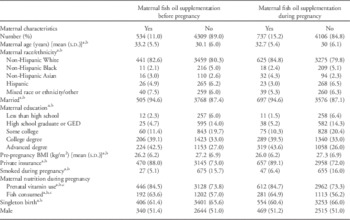
In total, the analyses encompassed 4843 mother–child pairs with baseline characteristics displayed in Table 1. Mothers who took fish oil supplementation were more likely to be older, non-Hispanic White, married, possess an advanced degree, have lower pre-pregnancy BMIs, use fertility treatment and have private insurance. The same mothers were less likely to smoke during pregnancy when compared with those who did not consume fish oil supplements. With regards to nutrition, taking fish oil supplementation was also associated with taking prenatal vitamins and consuming fish during pregnancy. No differences were observed for child gender.
Maternal baseline characteristics by fish oil supplementation status

GED, General Equivalency Diploma; BMI, body mass index.
a P<0.05 for comparison between fish oil supplementation during pregnancy and no supplementation during pregnancy.
b P<0.05 for comparison between fish oil supplementation before pregnancy and no supplementation before pregnancy.
c Data are missing for the following before multiple imputation: prenatal vitamin (n=78), fish consumption (n=2431).
The frequencies of domain failures by supplementation group are presented in the Supplementary Table 1. On average, 2–3% of children failed each domain. A higher percentage of children in the no fish oil group tended to fail than the fish oil group.
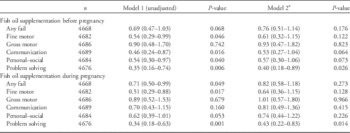
In the unadjusted analyses (Model 1), supplementation at both time points was significantly associated with a lower risk of failing multiple ASQ domains (Table 2). After adjustment for socio-demographic and maternal lifestyle factors (Model 2), the risk of failing the problem-solving domain remained significantly lower among those who supplemented with fish oil before pregnancy (OR 0.40, 95% CI 0.18–0.89) and during pregnancy (OR 0.43, 95% CI 0.22–0.83). In Model 2, fish oil supplementation before pregnancy was additionally related to a decreased risk of failing the communication and personal–social domains although the associations were borderline significant (P<0.10). A lower risk of failing the problem-solving domain persisted in a third model which was further adjusted for prenatal vitamin usage and fish consumption (supplementation before pregnancy OR 0.40, 95% CI 0.18–0.90 and during pregnancy OR 0.43, 95% CI 0.22–0.84).
Odds ratio for risk of developmental delays by maternal fish oil supplementation status

a Model 2 adjusts for maternal race/ethnicity, age, education, insurance, married, plurality, smoking during pregnancy, body mass index and infant gender.
We were unable to detect a significant statistical interaction for supplementation during pregnancy and gender. Neither did an interaction between supplementation and plurality reach statistical significance. However, in gender-stratified analyses, the risk of failing both the problem-solving (OR 0.17, 95% CI 0.03–0.95) and the personal–social (OR 0.33, 95% CI 0.12–0.95) domains were significantly lower among girls whose mothers used fish oil supplementation but not in boys (OR 0.64, 95% CI 0.30–1.36), when adjusted for socio-demographic factors. Moreover, a significant protective association with the problem-solving domain was observed for singletons (OR 0.39, 95% CI 0.19–0.82) but not twins (OR 0.77, 95% CI 0.33–1.78).
When testing an interaction term between the time of the ASQ and supplementation status, some evidence suggested an interaction with the problem-solving domain when the children were older (30 and 36 months); however, sporadic interactions were also observed at the 30-month time point with the fine motor domain and overall fails (data not shown). No interactions were observed at other time points.
When trying to separate the effects of supplementation before pregnancy from during pregnancy, we still observed a protective association between supplementation and the risk of failing the problem-solving domain (problem solving OR: 0.68 before only and 0.80 during only). However, because many of the mothers were likely to supplement during both timeframes, precision was reduced and the findings did not reach statistical significance in models among mothers who only supplemented before pregnancy (4%) or only during pregnancy (8%), after excluding those who supplemented both before and during (7%).
The number of mothers who took rare supplements (e.g. St. John’s wort, echinacea) during pregnancy was very low (n=31); therefore, we were unable to detect any association with ASQ scores. Due to many missing values, we ran analyses, adjusted for both socio-demographic and nutritional factors, for only those mother–child pairs with prenatal fish consumption data (n=2412) to compare with the analyses of the entire data set which included imputed values. No notable differences in results were detected (i.e. problem solving OR adjusted for fish consumption: 0.57, 95% CI 0.27–1.20). The use of WHO BMI categories in place of the continuous BMI value did not have an impact on results (data not shown).
Discussion
The results suggest that maternal prenatal fish oil supplementation may be beneficial to child neurodevelopment, specifically with regards to problem solving. Secondary analyses were suggestive of a positive relationship between fish oil supplementation and personal–social and problem-solving skills among female children only. Similar effects on problem solving were apparent in singleton, but not twin, children.
The hippocampus, frontal lobes and basal ganglia of the brain, areas that are fundamental in higher-order cognition,Reference Diau, Hsieh and Sarkadi-Nagy 42 , Reference Cheatham, Colombo and Carlson 43 are all very receptive to DHA.Reference Stonehouse 44 Although the underlying mechanisms between n-3 PUFA and cognition remain unknown, several postulations exist. First, the accumulation of n-3 PUFA within the cell membranes may result in enhanced information processing speed which would thus lead to improved problem solving.Reference Drover, Hoffman, Castañeda, Morale and Birch 45 Supplementation of n-3 PUFA has also been associated with heightened attention which in turn is linked with improved cognition.Reference Cowan 46 , Reference Colombo, Kannass and Shaddy 47 Nonetheless, these findings are contested.Reference Kelly, Grehan and Chiesa 56 A recent randomized-controlled trial did not find any evidence supporting the long-term beneficial impacts of prenatal fish oil supplementation on child attention.Reference Catena, Muñoz-Machicao and Torres-Espínola 48 Although the evidence is inconsistent,Reference Makrides, Gibson and McPhee 29 prenatal fish oil supplementation has been associated with modest improvements in gross motor function.Reference Bakker, Hornstra, Blanco and Vles 49 Previous research demonstrates that motor development may be indicative of later in life cognitive skills;Reference Ghassabian, Sundaram and Bell 50 therefore, it is possible that problem-solving enhancements may be mediated by heightened gross motor abilities. Although our study did not detect an effect on gross motor function, the ASQ may not be sensitive enough to capture these subtle variations. Another potential explanation is that DHA promotes neurite growth within the hippocampus and accumulates rapidly in the fetal brain at the same time as critical myelination and synaptogenesis.Reference Weiser, Butt and Mohajeri 4 , Reference McNamara and Carlson 51 n-3 PUFA deficiency has been related to the suppression of the biosynthesis of catecholamines, neurotransmitters that are essential for learning and memory function,Reference Kobayashi 52 in the offspring of rats.Reference Takeuchi, Fukumoto and Harada 53 The role of n-3 PUFA on cognitive function in the developing as well as the aged brain has been previously demonstrated.Reference Luchtman and Song 54 Models in geriatric animals suggest that fish oil supplementation may play a neuroprotective role in aging by increasing neurogenesis in the hippocampus and reversing changes in retinoid receptors.Reference Dyall, Michael and Michael-Titus 55 n-3 PUFA supplementation has been shown to improve synaptic plasticity, learning and memory in matured rats.Reference Kelly, Grehan and Chiesa 56 Aged rats fed a diet supplemented with n-3 PUFA had decreased hippocampal levels of lipid peroxide and improved learning abilities.Reference Gamoh, Hashimoto, Hossain and Masumura 57 In humans, increased fish consumption and n-3 PUFA intake has been associated with a decreased risk of developing Alzheimer’s disease,Reference Morris, Evans and Bienias 58 although this association is not unanimously supported.Reference Phillips, Childs, Calder and Rogers 59 Both infants and the elderly are vulnerable populations with regard to many exposures. It is likely that the observed positive cognitive impacts of n-3 PUFA supplementation in aged populations occur through the same pathways as during the early stages of life.Reference Weiser, Butt and Mohajeri 4 Although many studies have focused on the impact of n-3 PUFA on the development of brain regions such as the frontal lobe in school-aged children, our study shows that the beneficial association is present early in life, specifically in children 3 years and younger.
The potential for fetal insufficiencies of n-3 PUFA during critical windows of development is of concern due to the transition of many to Westernized diets high in saturated fats and low in PUFAs, specifically n-3 PUFA.Reference Gould, Makrides, Colombo and Smithers 60 , Reference Morse 61 The American food industry has become much more reliant on processed foods which are often void of n-3 due to the desire for increased shelf life.Reference Holman 62 With the transition of corn- and grain-based livestock feeds, animals have become n-3 deficient and thus, our meat sources lack n-3 PUFA as well.Reference Holman 62 In developing countries, access to food sources rich in n-3 PUFA is limited due to geographic as well as economic challenges.Reference Huffman, Harika, Eilander and Osendarp 63 Moreover, pregnant women have been advised to limit seafood consumption to reduce fetal exposure to chemical pollutants commonly present such as polychlorinated biphenyls and methylmercury,Reference Hibbeln, Davis and Steer 18 , Reference Gil and Gil 64 both of which are known neurotoxicants that cross the placenta.Reference Grandjean and Landrigan 65 Therefore, fish oil supplementation, typically free from contaminants found in fish and seafood, may be a valuable alternative source of n-3 PUFA.Reference Coletta, Bell and Roman 8 , Reference Arterburn, Hall and Oken 14
Associations between maternal supplementation and lower risks of failing the personal–social and problem-solving domains of the ASQ were significant among female, but not male, children, suggesting potential gender modification. Independent of dietary intake, females typically have greater blood lipid concentrations of DHA than males.Reference Childs, Romeu-Nadal, Burdge and Calder 66 In early life, females begin storing DHA in adipose deposits in order to support the growth and development of future offspring;Reference Luchtman and Song 54 , Reference Lassek and Gaulin 67 therefore, higher quantities of the nutrient are required. In addition, females have a greater capacity to convert ALA into EPA and DHA than males.Reference Arterburn, Hall and Oken 14 Suggested mechanisms include differences among rates of β-oxidation, adipose tissue composition and sex hormone function between the genders.Reference Childs, Romeu-Nadal, Burdge and Calder 66 A study of the human placental transcriptome discovered that maternal n-3 PUFA supplementation during pregnancy is associated with more pronounced placental gene expression in females compared with males.Reference Sedlmeier, Brunner and Much 68 A randomized, double-blind controlled trial described a correlation between postnatal DHA supplementation in preterm infants and Bayley Mental Development Index scores at 18 months’ corrected age among females only.Reference Makrides, Gibson and McPhee 69 Using National Health and Nutritional Examination Survey data, a study found the positive relationship between n-3 fatty acid intake and cognition to be twice as strong for school-aged females when compared with males.Reference Lassek and Gaulin 67 Similarly, animal research has suggested that fish oil supplementation during pregnancy results in improved social behavior; however, this finding did not take gender into account.Reference Clouard, Souza and Gerrits 70
Compared with singletons, twins typically have a higher rate of neurodevelopmental deficits mainly due in part to factors such as low birth weight, smaller gestational age, higher maternal age and socio-economic status.Reference Lorenz 71 , Reference Ronalds, De Stavola and Leon 72 When stratifying by plurality in our study, the beneficial association on problem solving was significant for singletons but not twins. Similarly, a randomized clinical trial examining maternal fish oil supplementation and pregnancy outcomes failed to detect effects in twin pregnancies.Reference Olsen, Secher and Tabor 73 Due to the inclusion of the aforementioned covariates in our analyses, it is possible that the positive effect of fish oil supplementation was not apparent. In addition, the sample size of twins was smaller than that of singletons.
The permanence of the potential impacts of in utero exposures is one of the critical facets regarding ‘fetal programming.’Reference Barker, Eriksson, Forsén and Osmond 74 A recent prospective cohort identified a temporary increase in child neurodevelopment followed by an accelerated decline in these skills among children born to obese mothers, suggesting a dynamic temporal association.Reference Torres-Espinola, Berglund and García-Valdés 75 Our study identified significant interactions with problem solving at 30 and 36 months and in utero supplementation status; however, this relationship may be attributed to more appreciable problem-solving skills at older ages. Furthermore, while intermittent interactions were also observed at 30 months with fine motor and overall fails, no other interactions were detected at additional time points. Due to the inconsistencies of the interactions, our study does not present strong evidence regarding the temporality of the neurologic associations.
Supporting the criticality of the in utero exposure time point, prenatal n-3 PUFA deficiencies have been strongly linked with decrements in cognitive function and neurodevelopment.Reference Takeuchi, Fukumoto and Harada 53 , Reference Luchtman and Song 54 An autopsy study found that term infants had appreciably higher DHA contents in the frontal cortex than those infants who were in the second trimester,Reference Clandinin, Chappell and Leong 76 demonstrating the elevated requirement of n-3 PUFA during the final trimester of gestation. Animal models show that the learning deficits associated with shortages of n-3 PUFA during this critical prenatal period are challenging to reverseReference Ikemoto, Ohishi and Sato 77 and reduce brain plasticity and performance in adulthood.Reference Bhatia, Agrawal and Sharma 78 With a half-life in the human brain of ~2.5 years, DHA content remains for a substantial amount of time.Reference Umhau, Zhou and Carson 79 Although we cannot rule out postnatal n-3 PUFA exposures in our current study (e.g. infant formulas supplemented with DHAReference Willatts, Forsyth, DiModugno, Varma and Colvin 80 ), research suggests that the positive impacts of this prenatal exposure may be long-lasting, even after continuous supplementation has ceased.Reference Clouard, Souza and Gerrits 70 , Reference Willatts, Forsyth, DiModugno, Varma and Colvin 80
This study faced some limitations. First, exposure data on maternal fish oil consumption was captured on the maternal baseline questionnaire as a dichotomous variable (once or more per week), limiting our ability to distinguish specific dose or the exact frequency of supplementation. However, information on prenatal vitamins suggests the majority took them every day. Second, the ASQ is a validated screening instrument but not a diagnostic tool; therefore, results may not be appropriate for direct comparison with outcomes from diagnostic developmental assessment tools. Lastly, both fish oil supplementation and child performance on the ASQ were assessed using maternal report which could potentially introduce bias. However, our analyses were strengthened by the notable sample size of >4800 mother–child pairs. The longitudinal approach with multiple collected ASQ data points employed by the Upstate KIDS Study is a valuable design aspect. Previous research warranted future studies including children of multiple gestations.Reference Saccone, Saccone and Berghella 81 Our analyses examined twins in addition to singletons and independently.
Despite limitations from the observational nature of our study design, we found that reported maternal fish oil supplementation, both before and during pregnancy, was protective against failing the problem-solving domain of the ASQ with the association persisting until 3 years of age. Furthermore, our findings suggest that female children experienced the greatest benefit from maternal supplementation with lower risks of personal–social and problem-solving deficits significantly correlated to prenatal fish oil exposure. Given that pregnant women are advised to increase n-3 PUFA intake to aid fetal brain development while concurrently restricting fish and seafood consumption, our findings demonstrate the potential value of fish oil supplementation as an alternate source of n-3 PUFA during pregnancy. Future research needs to focus on clearing up discrepancies in the literature, establishing optimal dosages, identifying the ideal timing and duration of supplementation, the persistence of subsequent health outcomes, gender interactions and impacts on children of multiple births.
Acknowledgments
The authors thank all the Upstate KIDS Study participants and staff for their important contributions.
Financial Support
This study was supported by the Intramural Research Program of the Eunice Kennedy Shriver National Institute of Child Health and Human Development (NICHD; contract nos HHSN275201200005C, HHSN267200700019C).
Conflicts of Interest
None.
Ethical Standards
The authors assert that all procedures contributing to this work comply with the ethical standards approved by the New York State Department of Health and the University of Albany Institutional Review Board (NYSDOH IRB no. 07-097; UAlbany no. 08-179) serving as the IRB designated by the National Institutes of Health for this study under a reliance agreement.
Supplementary materials
To view supplementary material for this article, please visit https://doi.org/10.1017/S2040174417000253