Introduction
Red palm weevil Rhynchophorus ferrugineus Olivier (Coleoptera: Curculionidae) has a wide host range of 26 palm species worldwide (Malumphy and Moran, Reference Malumphy and Moran2009). In date palm, Phoenix dactylifera L. (Arecaceae), R. ferrugineus is a key pest where young date palms less than 20 years of age are mostly infested by feeding grubs that bore into the palm tissue (Abraham et al., Reference Abraham, Mahmood, Faleiro, Abozuhairah and Vidyasagar1998). Palms in the early stages of attack, where tunnelling by feeding grubs is not extensive, respond to curative insecticide treatments by stem injection. However, where internal tissue damage is severe, curative treatments do not help and such palms have to be eradicated. It is, therefore, important to detect infested palms at the earliest opportunity, which is often not possible due to the concealed nature of the pest (Faleiro, Reference Faleiro2006).
In the Gulf region of the Middle East, the annual loss due to eradication of severely infested palms at 1–5% infestation was estimated to range from 5.18 to US$25.92 million, respectively, at a fixed eradication level of 20% infested palms. In Saudi Arabia, this loss was estimated to be US$1.74–8.69 million (El-Sabea et al., Reference El-Sabea, Faleiro and Abo El Saad2009). Pheromone (4-methyl-5-nonanol)-based area-wide integrated pest management (IPM) programmes comprising mainly detecting infested palms, mass trapping of adult weevils, preventive and curative chemical treatments and eradication of severely infested palms as proposed by Abraham et al. (Reference Abraham, Mahmood, Faleiro, Abozuhairah and Vidyasagar1998) have been implemented in Saudi Arabia for nearly two decades with varying levels of success. Area-wide R. ferrugineus IPM programmes have to be periodically validated so that the often-limited resources of men and material can be utilized where most required (Faleiro et al., Reference Faleiro, Ben Abdallah, Ashok Kumar, Shagagh and Al Abdan2010). In this context, geographic information system (GIS)-based techniques are increasingly used to enhance and support decision-making capabilities in R. ferrugineus IPM (Barranco et al., Reference Barranco, Lorente-Moreno, Alcazar-Alba and Pena-Mendez2006; Brun, Reference Brun2006; Massoud et al., Reference Massoud, Faleiro, El-Saad and Sultan2011).
In this study, we used GIS-based techniques (ESRI, 2006; Arctur and Zeiler, Reference Arctur and Zeiler2004) to study the spatial and temporal spread of R. ferrugineus in Al-Sohemia-1 in Al-Ahsa (25°19′60″N latitude and 49°37′60″E longitude), Saudi Arabia's premier date palm oasis.
Materials and methods
This study was carried out in Al-Sohemia-1 located in the north of the Al-Ahsa oasis where a pheromone (ferrugineol)-based area-wide R. ferrugineus IPM strategy has been implemented since 1994 by the Directorate of Agriculture, Ministry of Agriculture, Kingdom of Saudi Arabia. Rhynchophorus ferrugineus is mass trapped in the Al-Ahsa oasis using a 5 L-four window bucket trap (Faleiro, Reference Faleiro2006). All the food (200 g dates in 1 L water)-baited pheromone (Ferrolure™, 700 mg) traps are placed on top of the date palm trunk logs (0.5 m high) set every 100 m along the irrigation canals. Each trap is allowed to sit partially inside a hollow (20 cm wide; 10 cm deep) on top of the date palm trunk log. The distance between two consecutive canals is 160 m, thereby allowing each trap to service 1.5 ha.
In March 2011, all the 156 pheromone (Ferrolure™) traps in Al-Sohemia-1 (234 ha) were logged using the Trimble global positioning system (GPS) to determine the east longitude and north latitude of each pheromone trap and transformed to the GIS as a shape file.
The Trimble GPS used to log the co-ordinates for each pheromone trap comprised an eight-channel GPS/MSK (minimum shift keying) Beacon Pro XR receiver, TDC1 (Trimble data collector 1) data logger, integrated GPS/Beacon antenna, and camcorder batteries. TDC1 Asset Surveyor software (version 3.30) was used to navigate and collect GPS field data, while Pathfinder Office software was used to view, edit, and plot and export data to GIS. ArcGIS (version 9.3) and ERDAS Imagine (version 9.1) as image processing software were used as the GIS software in this investigation. The shape file of Al-Sohemia-1 pheromone traps was integrated with the geo-database layers of the irrigation canals (Massoud, Reference Massoud2008) in Al-Ahsa oasis and is presented in Fig. 1.
Geographic position of Rhynchophorus ferrugineus pheromone traps (RPWT) in Al-Sohemia-1, Al-Ahsa, Saudi Arabia

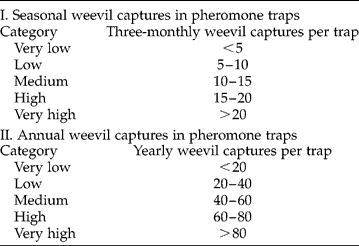
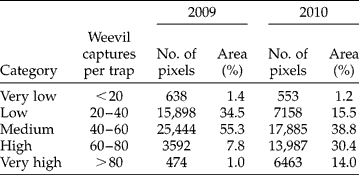
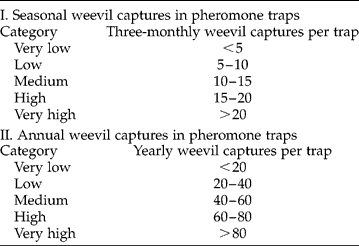
The territorial spread of R. ferrugineus based on captures in pheromone traps was assessed for five categories (Table 1) for the four seasons of the year, viz., spring (March–May), summer (June–August), autumn (September–November) and winter (December–February) and also year-wise during 2009 and 2010. The categories for weevil activity in this study were selected based on previous work to predict the relationship between R. ferrugineus activity and related infestation of date palm in the Al-Ahsa region (Massoud et al., Reference Massoud, Faleiro, El-Saad and Sultan2011).
Intensity of Rhynchophorus ferrugineus activity at different levels in Al-Sohemia-1
The purpose of this study is to build a geo-database for R. ferrugineus pertaining to weevil captures in pheromone traps during 2009 and 2010 and ascertain the spatial and temporal spread of R. ferrugineus in Al-Sohemia-1 in relation to the four seasons of the year.
Results and Discussion
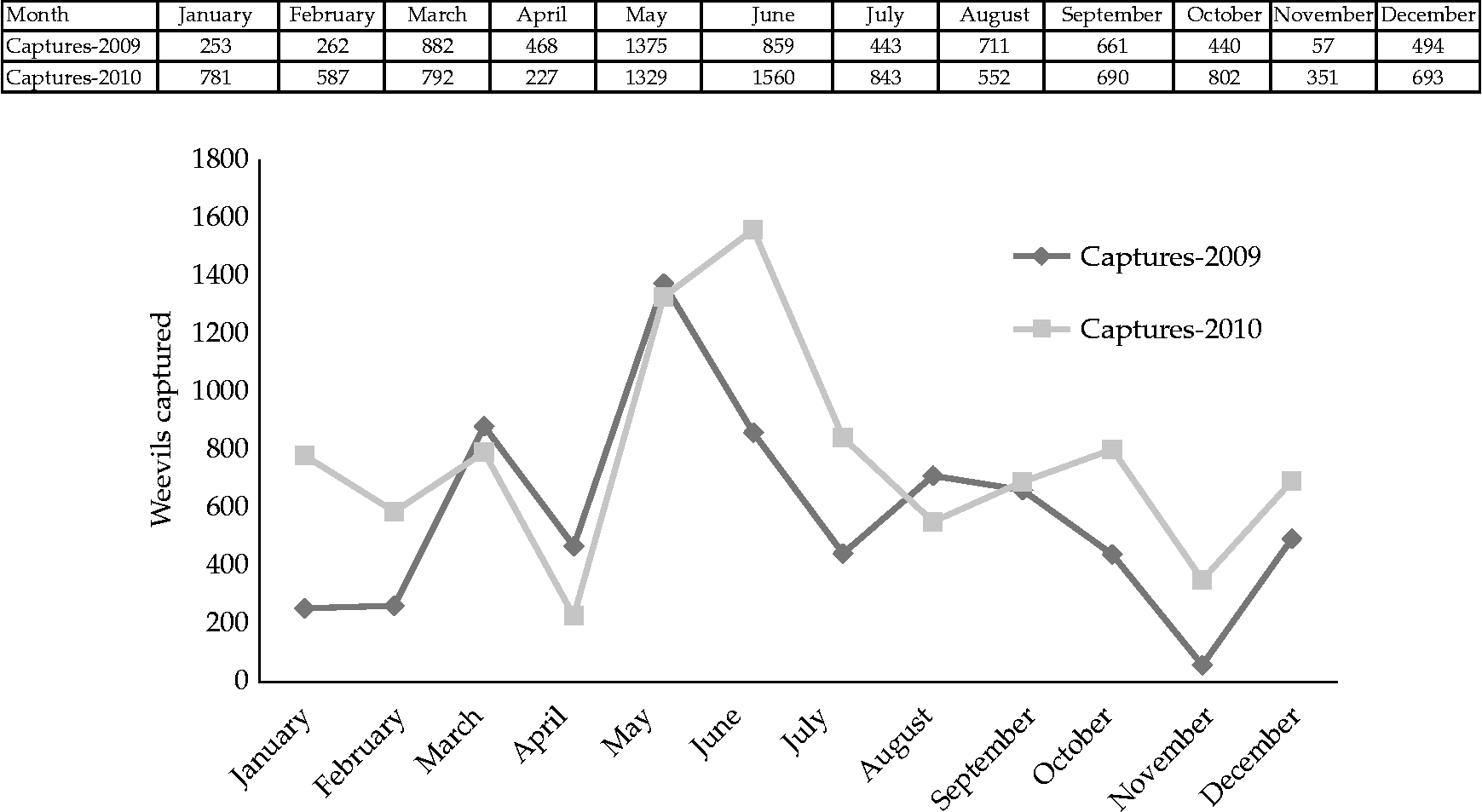
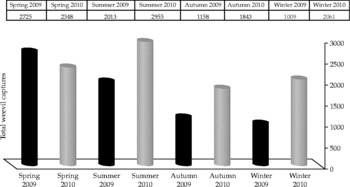
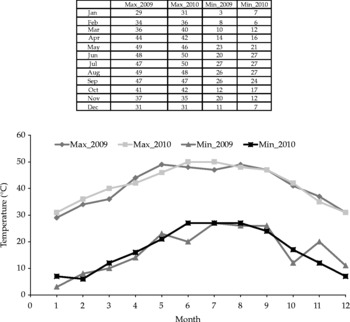
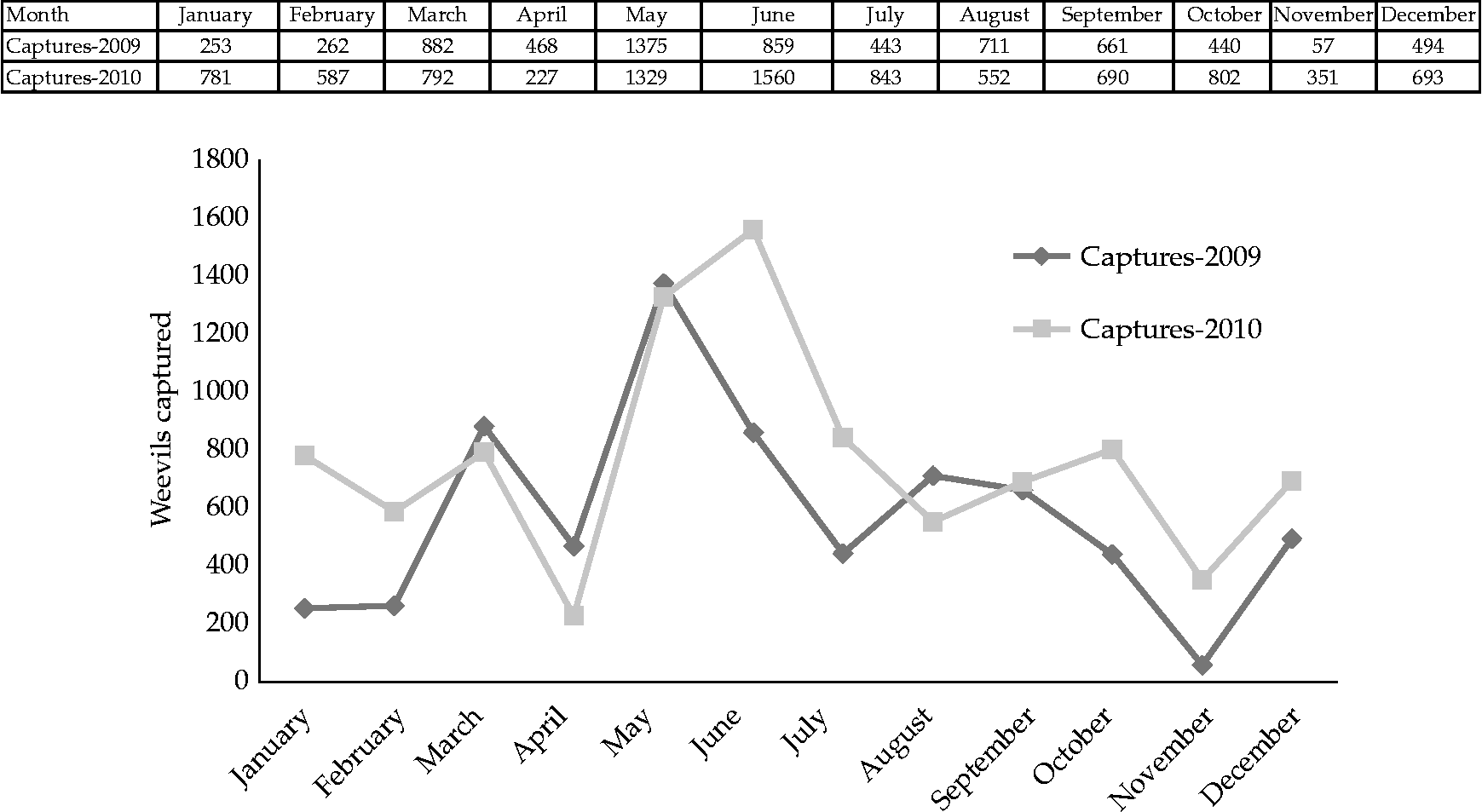
With regard to temporal variation in the activity of R. ferrugineus, results presented in Fig. 2 reveal that during both 2009 and 2010, maximum weevil activity was recorded during the months of May and June when environmental conditions of late spring and early summer months favour weevil activity (Fig. 3). Weevil captures declined during autumn and winter. Previous reports suggest that besides peak weevil activity during April–May; a smaller peak occurs during October–November (Anonymous, 1998) in the region. However, during both 2009 and 2010, the second peak is not conspicuous, probably due to the early onset of winter, when low winter temperatures are known to decrease weevil activity and also adversely impact oviposition and egg hatch. El-Garhy (Reference El-Garhy1996) reported high weevil activity during April, May and June which slowed down during the cold winter months, while studying the seasonal variations in the abundance of R. ferrugineus using pheromone traps in date plantations of Egypt. Reports from Israel also suggest a similar trend (Soroker et al., Reference Soroker, Blumberg, Haberman, Hamburger-Rishad, Reneh, Talebaev, Anshelevich and Harari2005) and are in agreement with the temporal variations in the activity of R. ferrugineus recorded in this study. Dembilio et al. (Reference Dembilio, Tapia, Téllez and Jacas2012) determined the lower temperature threshold for oviposition and egg hatching as 15.45 and 13.95 °C, respectively, while Martin and Cabello (Reference Martin and Cabello2005), determined the minimum temperature threshold for R. ferrugineus pupa to be 13 °C. These temperatures occur in Al-Ahsa during late autumn and continue until the end of winter, resulting in low weevil activity in the Al-Ahsa oasis during this period. Recently, Massoud et al. (Reference Massoud, Faleiro, El-Saad and Sultan2011) used regression analysis to explain pest-infestation relationship in Al-Ahsa and reported that R. ferrugineus activity of up to 12 weevils/ha/year would not result in any new infestation. In Egypt, Brun (Reference Brun2006) used GIS to determine the monthly progression of R. ferrugineus in an oasis eco-system and suggested that the waves of infestation lasted for about 4 months. Our study, which corresponds to the major seasons of the year, was carried out every 3 months and adequately determines the temporal and spatial changes of R. ferrugineus occurring in the field.
Temporal variations in monthly weevil captures of Rhynchophorus ferrugineus in Al-Sohemia-1 during 2009 and 2010
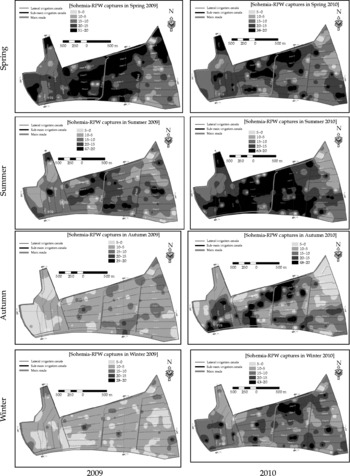
Temporal variations in captures of Rhynchophorus ferrugineus in Al-Sohemia-1 during different seasons of 2009 and 2010

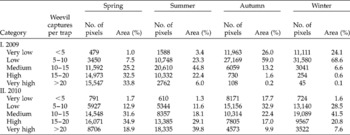
Besides temporal variations in weevil activity, we also studied the spatial spread of the weevil in Al-Sohemia-1. From Table 2, it is evident that 91.5 and 73.2% of the area exhibited medium to very high weevil activity in spring and summer 2009, respectively, while 85.4 and 87% of the area recorded medium to very high weevil activity in 2010 during the spring and summer seasons, respectively. During autumn and winter of 2009, only 15 and 7.3% of the area registered medium to very high weevil activity, respectively. However, 49.3 and 69.9% of the area recorded medium to very high weevil activity during the autumn and winter of 2010, respectively. Dembilio et al. (Reference Dembilio, Tapia, Téllez and Jacas2012) found that the winter temperatures of 15.45 and 13.95 °C were the lower thresholds that adversely affect oviposition and hatching of R. ferrugineus, respectively. Our findings suggest that better management of the pest coupled with low winter temperatures curtailed weevil activity in 2009 compared with 2010. In general, 2009 registered lower weevil activity compared with 2010. From Tables 2 and 3, it is evident that the more the number of pixels, the greater the percentage area in a given threshold category.
Seasonal geostatistical analysis of Rhynchophorus ferrugineus captures in Al-Sohemia-1 during 2009 and 2010

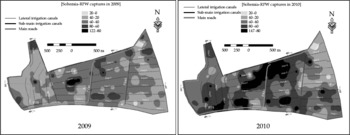
Annual geostatistical analysis of Rhynchophorus ferrugineus captures in Al-Sohemia-1 during 2009 and 2010
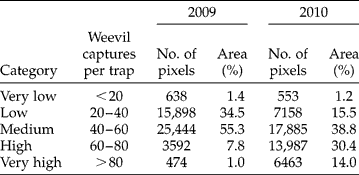
The seasonal and annual variations in the spatial spread of the weevil are depicted in Figs 4 and 5, respectively, which also suggests low weevil activity in 2009 compared with 2010. Weevil captures in pheromone traps are known to be directly influenced by temperature (El-Garhy, Reference El-Garhy1996; Oehlschlager, Reference Oehlschlager2005).
Seasonal spatial variations in captures of Rhynchophorus ferrugineus in Al-Sohemia-1 during 2009 and 2010. RPW, red palm weevil.

Annual spatial variations in captures of Rhynchophorus ferrugineus in Al-Sohemia-1 during 2009 and 2010. RPW, red palm weevil.

Although the mean monthly maximum and minimum temperatures for 2009 and 2010 were similar (Fig. 6), the spatial spread of R. ferrugineus was found to be different, which can be attributed to the efficiency of the R. ferrugineus IPM programme implemented especially with regard to early detection of infested palms. It can be inferred from this study that the IPM strategy had the desired impact during 2009 while it needed to be strengthened in 2010. GIS can serve as an excellent tool to study periodic changes in the temporal and spatial spread of R. ferrugineus in area-wide control programmes and divert valuable resources of men and material where most required. In Spain, GIS was used to ascertain the spread of R. ferrugineus in vast stretches of the Almunecar region by recording the number of palms eradicated (Barranco et al., Reference Barranco, Lorente-Moreno, Alcazar-Alba and Pena-Mendez2006).
Mean monthly maximum and minimum temperatures during 2009 and 2010 in Al-Ahsa, Saudi Arabia (source: www.wunderground.com/global/SD.html)

In Al-Ahsa, R. ferrugineus is currently being mass trapped at a trapping density of one trap for 1.5 ha. Recent reports from Al-Ahsa suggest that this uniform trapping grid may be inadequate to effectively trap adults where R. ferrugineus activity is high and recommended to increase the trap density to 4–7 traps/ha in such hot spots (Faleiro et al., Reference Faleiro, El-Saad and Abdul Hadi2011). In this context, it is pertinent to mention that in a 2000 ha of spruce (Picea mongolica) forest reserve of Baiyinaobao surrounded by grassland, only 80 traps used to mass trap the bark beetle Ips duplicatus (Coleoptera: Scolytidae) captured 0.5–1.7 million beetles/year over a period of 3 years using synthetic pheromones (ipsdienol and E-myrcenol). During this period, tree mortality due to the bark beetle attack also significantly reduced from 600 to just 88 per year (Schlyter et al., Reference Schlyter, Zhang, Liu and Ji2003).
Based on our findings, we propose that in all areas exhibiting high to very high weevil activity, the mass trapping grid may be increased (4–7 traps/ha), as recommended above, besides implementing other R. ferrugineus IPM tactics, viz., early detection, preventive and curative insecticide treatments, eradication of severely infested palms, inspecting closed plantations etc. as suggested by Abraham et al. (Reference Abraham, Mahmood, Faleiro, Abozuhairah and Vidyasagar1998).
Faleiro et al. (Reference Faleiro, Ben Abdallah, Ashok Kumar, Shagagh and Al Abdan2010) used the concept of sequential sampling to validate area-wide R. ferrugineus IPM programmes in date plantations where on a 100 ha scale (10,000 palms), 0–39, 40–55 and >55 infestations would imply low, medium and high infestation levels. Using the same rationale, we propose that in areas of Al-Sohemia-1 with low to very low weevil activity the IPM strategy is working well, in areas with medium weevil activity the IPM strategy needs to be strengthened, while in areas with high to very high weevil activity the IPM strategy is not having the desired impact and needs urgent reinforcement.
A geo-database for R. ferrugineus pertaining to weevil captures in pheromone traps using GIS techniques needs to be developed for the entire Al-Ahsa oasis so as to periodically review the impact of the IPM strategy being implemented and use scarce human resources where most required.
Acknowledgements
The authors express their sincere thanks to Dr Salah Al-Eid, Director, Date Palm Research Centre (Centre of Excellence), King Faisal University (KFU), Al-Ahsa; Dr Ahmed A. Alnaeem, Director, Water Studies Centre, KFU, Al-Ahsa; and Mr Salah Nasser Al Homaidi, Director, Directorate of Agriculture, Ministry of Agriculture, Al-Ahsa, for providing the necessary support to take up this study. The authors also thank Saudi Aramco for funding this research through the Saudi Aramco–KFU project on red palm weevil.