1. Introduction
The German language has a long history in the state of Texas. The first large wave of German settlers arrived in the early 1840s, and large-scale immigration continued for a number of decades thereafter. For many years, German was well established in Texas; there were German-language schools, newspapers, and church services, as well as a lively social circle for Texas Germans, and one can trace the emergence of a new variety of German, namely Texas German, through time.Footnote 1 The current situation is radically different; although there are still approxi-mately 8,000–10,000 speakers of Texas German, many of these German-language social organizations have either been dissolved or have abandoned German in favor of English, and Texas German is clearly an endangered dialect.
There is a correspondingly long history of research into Texas German, ranging from the pioneering studies of Eikel 1954 and Gilbert 1972 to more recent works like Fuller & Gilbert 2003, Nicolini 2004, and Salmons & Lucht 2006. This paper introduces the most recent large-scale study of Texas German, the Texas German Dialect Project (TGDP), and one of its results, the Texas German Dialect Archive (TGDA), an on-line multimedia archive containing recordings of interviews (including tran-scriptions and translations) with more than 350 speakers of present-day Texas German. We first give a brief historical overview of the development of the Texas German community, starting with the settle-ment of the first German immigrants in Texas in the 1830s and continuing to the present day. Next, we describe the workflow of the TGDP and the TGDA, and discuss how the TGDA is currently used for linguistic research. Since the open-ended sociolinguistic interviews contain a wealth of information on the history and cultural practices of the Texas German community, the archive is also of interest to historians and anthropologists. Finally, we show how the archive has been used for community outreach programs throughout central Texas.
2. The Socio-Historical Context.Footnote 2
As noted above, large-scale German immigration to Texas began in the 1840s.Footnote 3 Promises of land grants and transportation to Texas attracted a significant number of immigrants, mainly from northern and central Germany; by 1860, there were nearly 20,000 German-born immigrants living in Texas, and approximately 30,000 Texas Germans, including the American-born children of immigrants (Jordan 1975:54). German immi-gration to Texas eventually slackened, but the number of Texas Germans continued to increase: At the beginning of the twentieth century, approxi-mately one third of all Texans were of German ancestry (Nicolini 2004:42), and Eichhoff (1986) estimates that there were approximately 75,000–100,000 Texas Germans in 1907. In 1940, there were approxi-mately 159,000 Texas Germans (Kloss 1977).Footnote 4
For the first several decades of German settlement in Texas, the Texas Germans were relatively isolated. A number of social and political factors contributed to this isolation, ranging from deliberate attempts at self-sufficiency by German settlers (Benjamin 1910) to the anti-slavery views held by most German settlers, which would certainly be isolating in a slave state like Texas (Salmons 1983:187). This isolation, coupled with serious attempts at language maintenance, allowed for the retention of Texas German. Signs of this language maintenance and retention include the following: There were 145 church congregations offering German-language church services as of 1917 (Arndt & Olson 1961:615, Salmons & Lucht 2006:168); there were numerous German-language newspapers and periodicals, some with very healthy circulation numbers (Texas Vorwärts, published in Austin, had a circulation of approximately 6,100 in 1900, according to Salmons & Lucht 2006:174); there was a wide range of German literature written in Texas; there were German-language schools and numerous social organizations, including choirs (such as the San Antonio Maennergesang Verein, founded in July 1847), social groups like the Hermanns-Söhne, shooting clubs, and so on.Footnote 5
This situation eventually changed dramatically, starting with the passing of an English-only law for public schools in 1909 (Salmons 1983:188). World War I, especially following America's entry into the war in 1917 and the resulting increase in anti-German sentiment, dealt a major blow to Texas German, leading to the stigmatization of German and the beginning of its decline. Although some of the resulting develop-ments seem relatively innocuous or even ludicrous in hindsight (such as the replacement of sauerkraut with liberty cabbage), they did severely damage the position of German in Texas, and interviews with various informants recorded in the TGDA testify to the stigmas felt by many Texas Germans at this time and afterwards.Footnote 6
World War II reinforced the stigma attached to Germany, Texas Germans, and the German language. Institutional support for the wide-spread maintenance and use of German was largely abandoned, with devastating consequences for the Texas German language. German-language newspapers and periodicals stopped publishing (Das Wochen-blatt, published in Austin, stopped publishing in 1940) or switched to English as the language of publication (the Neu-Braunfelser Zeitung was the last to switch to English, in December 1957).Footnote 7 Some German-language schools closed, while German instruction was dropped in others; and German-speaking churches replaced German-language services with English-language ones.Footnote 8
The end of World War II brought additional challenges to the maintenance of German language and culture in Texas. Speakers of English moved to the traditional German enclaves in increasing numbers and generally refused to assimilate linguistically to their new neighbors by learning German, leading to the large-scale abandonment of German in the public sphere. At the same time, younger Texas Germans left the traditional German-speaking areas for employment in larger cities such as Austin, San Antonio, and Houston, or to enroll in college or enlist in the military (Jordan 1977, Wilson 1977). Consequently, this group began to speak primarily English, which weakened their command of Texas German. Also, Texas Germans increasingly married partners who could not speak German, and English typically became the language of the household in such linguistically mixed marriages. Children raised in such households are typically monolingual in English or have only a very limited command of Texas German, typically a few stock phrases like prayers or profanities (Nicolini 2004, Boas 2005). Finally, the develop-ment of the American interstate highway system under President Dwight Eisenhower (himself of German descent) in the 1950s (construction started in 1956) made the once-isolated Texas German communities much more accessible. This new accessibility cut both ways, as it was now easier for non-German speakers to visit or live in originally German-speaking communities, and for German-speakers to accept employment in more urban areas. Both of these possibilities led to the spread of English at the expense of German.
Despite these factors, in the 1960s approximately 70,000 speakers of Texas German remained in the German belt. Today only an estimated 8,000–10,000 Texas Germans, primarily in their sixties or older, still speak the language of their ancestors fluently (Boas 2009a). English has become the primary language for most Texas Germans in both private and public domains. With no signs of this shift to English being halted or reversed and fluent speakers almost exclusively above the age of 60, we cannot accept the claim of Nicolini (2004:165) that “Interviews mit alten Texanern lassen den Schluss zu, dass die deutsche Sprache am Ende des 20. Jahrhunderts lebendiger ist, als es in der germanistischen Forschung gemeinhin gesehen wird.”Footnote 9 Instead, Texas German is expected to die out within the next 30 years (Boas 2009a).Footnote 10
3. The Texas German Dialect Project
While there are earlier in-depth surveys and recordings of Texas German speech (see, for instance, Eikel 1954, based on fieldwork done in the 1940s, and Gilbert 1972, based on fieldwork done in the 1960s), there are no large-scale and detailed studies of more current developments in Texas German.Footnote 11 As of 2001, there was no data on the current state of Texas German available for linguistic, historical, and anthropological research, or for heritage preservation efforts by the Texas German community. In response to this situation, Hans C. Boas founded the TGDP, with the goal of recording, documenting, and analyzing the remnants of Texas German; preserving Texas German is seen as a less crucial (and probably impossible) task. We describe below the workflow of the TGDP and then reviews the architecture of the TGDA.
Over the past nine years, members of the TGDP have recorded three different types of data.Footnote 12 The first type of data consists of English word lists and sentences taken from the Linguistic Atlas of Texas German (Gilbert 1972) and from Eikel 1954. Before interviews begin, informants sign a consent form giving permission to use the recordings for educational purposes and for heritage documentation efforts, including digitization and delivery over the web. An interview begins by eliciting personal information (date and place of birth, level of education, language spoken at home when growing up, and so on) from the interviewee. Interviewers read the English words and sentences to the informants, who are then asked to translate these words and sentences from English into Texas German. The interviews last about 20–60 minutes; are recorded on MiniDisc, DAT, or solid state digital recorders; and normally take place at the informants’ homes, nursing homes, museums, or local churches. The use of word lists and sentences enables the comparison of the current recordings with data collected over four decades ago, and it also provides well-focused and well-controlled data sets giving information about the distribution of specific phonological, morphological, and syntactic features in present-day Texas German.
The second type of data seeks to capture the informants’ daily use of Texas German. An eight-page questionnaire serves as the basis for sociolinguistic interviews conducted in German. At the beginning of an interview, interviewers speak (standard) German to the informants to begin eliciting personal information about the informants in Texas German. During this first phase of the interview, informants are typically aware of the recording device and pay attention to their speech, but they soon become more comfortable and therefore produce more natural speech in Texas German. The second section of the interview consists of about 140 questions in German about topics ranging from childhood activities, the community, religion, education, tourism, and language, to current activities. These questions are designed to produce casual, relaxed conversation in which informants respond freely in Texas German without being asked to produce specific linguistic structures, as is the case with the word and sentence list translation task. Allowing informants to speak freely also makes it possible to examine linguistic features of Texas German that were not noticed by previous studies, because such elicitation methods were not included in the research methodology. These interviews typically last from 40 to 60 minutes.
The third type of data seeks to capture the informants’ use of Texas German when participating in activities with other native Texas Germans. In order to record this type of data, we chose card-playing activities, dinner preparation, and farm chores. After filling out the con-sent forms, informants are given wireless microphones, which are linked to a recorder. The informants then interact with each other, speaking Texas German. Interviewers leave the area and do not get involved in the 60–100 minute long recording activities, in order to facilitate relaxed interaction among the informants. The three scenarios enable the collection of data in a variety of environments that involve different usages of Texas German.
The three types of spoken data are augmented by a written bio-graphical questionnaire. This questionnaire elicits information about issues like age, date of birth, level of education, domains of language use (Texas German and English), and language attitudes, among others. The biographical data are used to create metadata records for each informant and each interview to be included in the digital on-line archive. Since the beginning of the project, members of the TGDP have interviewed more than 350 speakers, totaling more than 750 hours of data. The recordings are stored on MiniDiscs, whose average lifespan is estimated to be around ten years. In order to preserve the recordings for a longer period of time and to make them available to as wide an audience as possible, they are stored in a digital archive. More recently, we have started using solid state digital recorders, as they provide a higher quality of recording and are easier to use. The following section discusses the various processing steps that the recordings undergo before they are deposited in the on-line Texas German Dialect Archive (TGDA).Footnote 13
4. Processing of Recordings
The recordings are transferred from MiniDisc to our main workstation and saved in WAV format (48,000 Hz, 16-bit Stereo). To protect the anonymity of informants, no recordings accessible to the public contain any personal identifying information. We remove the names of infor-mants and edit out sections of interviews in which informants refer to specific things that could be used to identify them. Each audio master file is assigned a unique combination of numbers referring to the interviewer, the informant, and the number of the interview conducted with that informant. Further information includes a number identifying the file as a master file and a letter showing whether the file is audio or combined audio/video. For example, the file name 8-154-3-0-a.wav indicates that interviewer No. 8 conducted this interview with informant No. 154, and that this is the third interview with that informant. The “0” indicates that this file is a master file. When a copy of the master file is later edited for transcription and translation, each subsection is identified by a series of consecutive numbers replacing the “0”. Finally, the “a” in the file name stands for “audio,” indicating that this is an audio master file. Sub-sequently, a copy of each master file is uploaded to the project's Linux-based file server.
After making the recordings anonymous, they are segmented into smaller sections, or “media sessions” that vary in length between about thirty seconds and six minutes. (This segmentation allows users with low bandwidth to access the recordings more easily.) Each media session is a segment of an interview that deals with a specific topic, such as the founding of Fredericksburg or how to make sausage, and may consist of a monologue, a dialogue, a song, or a poem. Each media session is assigned a unique file name that identifies it as belonging to a specific master file and numbered consecutively. The edited media sessions are subsequently labeled with a descriptive name identifying their contents (for example, “Brewing beer during prohibition”) and then saved in a separate folder on the file server. Field notes are included with each interview to provide supplemental information about special circum-stances surrounding the recording of the interview (number of speakers involved, location, and so on).
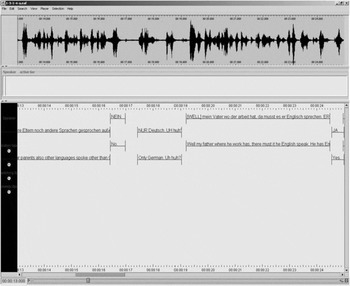
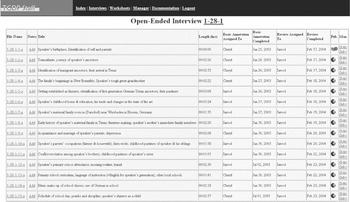
Once the recordings are segmented, they are transcribed and translated with ELAN (EUDICO Linguistic Annotator), which allows for the definition of a multitude of so-called parent tiers (for each speaker in an interview) with associated subtiers in combination with synchronized playing of video and audio data (both for annotation and for subsequent re-playing) (see figure 1). ELAN has a number of advantages: First, it is freely available; second, it supports open formats such as XML, WAV, MPEG1/2, and UNICODE; and third, it produces time-aligned transcriptions, which facilitate verification in combination with the recording. Using a specific web interface designed for the TGDP (see figure 2), annotators check out the media sessions in WAV format from the file server, open them, and transcribe and translate them with ELAN. Annotators then upload the XML-compatible EAF transcription file produced by ELAN to the file server. Next, the files are checked for consistency; a reviewer examines a media session's WAV and EAF files and conducts quality control. Finally, the EAF transcription file is returned to the file server.
ELAN (EUDICO Linguistic Annotator).

Web-based interface supporting the workflow of the TGDP.

To publish a media session, a project member with manager privi-leges uses the internal staff web pages to access the MySQL database in order to check on the status of a media session. Files that have undergone both annotation and quality control are marked with a special icon indicating that they are “ready to be published.” A click on the file link automatically converts a media session's WAV and EAF files into MP3 and HTML files, respectively, which are then stored on the file server.Footnote 14
The final step before publishing a media session involves the inclusion of metadata. The MySQL database includes a separate database table for metadata information, based on the informants’ biographical questionnaires. Each media session is thus associated with a specific set of metadata information values: the place and date of the recording, the place and date of the informant's birth, the gender, the childhood residence, the current residence, the level of education, the language(s) spoken in the parents’ home before elementary school, and the lan-guage(s) of instruction in elementary school. Moreover, each file is associated with an additional 38 metadata values based on the IMDI metadata schema for endangered languages (see Johnson & Dwyer 2002 or Boas 2006 for further discussion).
Once the metadata and the different file formats of a media session are in place, a project member with manager privileges accesses the web-based interface to publish the media session. The only step necessary for publication is to check the box “publish media session” in a web form, and to hit return. With this step the “publication” value of that media session is marked as positive in the MySQL database, and a public-facing website can access the audio and transcription files on the file server in combination with the metadata in the database. The following section describes how the public web pages of the TGDP can be used to access the media sessions.
5. The Texas German Dialect Archive (TGDA)
From the home page of the TGDP (http://www.tgdp.org) users can access the TGDA by clicking on “Dialect Archive.” After obtaining a username and a password, users log on to the archive pages by agreeing to the terms and conditions of the archive. The log-in protocol requires users to agree to the terms and conditions of use of the archive before they access any data, provides an inventory of users accessing the archive, and allows TGDP workers both to exclude a user from the archive if the conditions of use are not met and to ascertain what types of data are accessed by individual users.Footnote 15
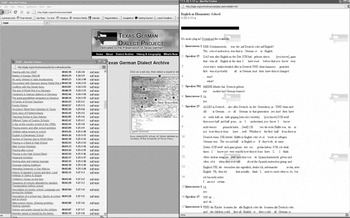
To access the archived data as easily as possible, users can choose between two options. The first option for accessing files in the TGDA is via a number of digitized maps from the Linguistic Atlas of Texas German (Gilbert 1972). Users start by viewing a map of Texas outlining the areas in which Texas German is spoken. By clicking on this area of central Texas, users are presented with a new window detailing the counties with individual locations for which Texas German recordings are available. Clicking on a specific location displays a pop-up window containing a list of media session names with their length and formats in combination with their unique ID numbers. The media sessions, which are available for download in different formats, are labeled with short titles summarizing their content (for example, “Growing up on a farm”). Users interested in time-aligned transcriptions and audio files with low compression rates may download WAV formats in combination with their EAF annotation files. To view and listen to these files, users need to employ ELAN. While this option for downloading allows for viewing time-aligned transcriptions in combination with uncompressed sound files, the size of WAV files may be 10 MB and more. The TGDA also offers versions of media sessions in MP3 and HTML formats. With this option, users may click on a file name, which opens a new window with an MP3 player and plays the audio portion of the media session. The same window contains a transcription and translation of the media session in HTML (see figure 3). Users can read the transcript and its corresponding translation while the audio file is playing to understand the contents of the recording better.
Media sessions of the translation tasks (“Gilbert” and “Eikel” data) can also be accessed through the public archive web pages. By clicking on a specific location for which the archive contains recordings, users may choose among the 148 words, phrases, and sentences from Gilbert 1972, or the 191 sentences from Eikel 1954, whose resampled versions are also stored in the archive. A new window lists the full set of TGDP informants who have provided a translation of a particular word, phrase, or sentence. Clicking on that word, phrase, or sentence downloads the audio file of the Texas German translation. This access option allows users to compare a controlled data set in order to figure out how different informants perform the same translation task.
The remainder of this section (based on Boas 2006) gives a brief overview of how the resources contained in the TGDA have been used over the past several years, beginning with the usefulness of the archive for research purposes. The various types of data contained in the archive support linguistic research in a variety of ways. In particular, the archive offers several types of data important for cross-linguistic research on language contact, language change, and language death. First, re-sampling Eikel's (1954) and Gilbert's (1972) word and sentence lists has resulted in a rich pool of real-time data.Footnote 16 A comparison of the Texas German data with data from other languages will help to shed light on the mechanisms underlying language change and is therefore useful for those interested in historical linguistics. To take one specific example, Boas 2009b discusses case loss in Texas German. Re-recording the word and sentence lists of Eikel (1954) and Gilbert (1972) allowed Boas (2009b) to trace changes in the Texas German case system that have occurred since the data was originally recorded.
Reading a media session's HTML transcript while listening to its MP3 sound file.

Second, the TGDA also provides apparent time data, as it contains recordings with members from two different generations, thus providing material that will further our understanding of language change.Footnote 17 The apparent time data can be coupled with the real time data, which will increase the reliability of diachronic studies of Texas German and also further our understanding of language change. In this respect, the TGDA provides the same type of opportunities for the analysis of Texas German that works like the Linguistic Atlas of New England (LANE) provided for studies such as Labov 1963.Footnote 18 Finally, the TGDA contains data reflecting different levels of spontaneity. Data that vary according to Himmelmann's (1998) spontaneity hierarchy (translation data, open-ended sociolinguistic interviews, and conversations among informants) were collected for each informant; these data, taken in conjunction with biographical data, allow linguists to examine a wide range of linguistic performances.
To date, the TGDA has been used for extensive research on Texas German, as well as for comparative studies with other rapidly eroding dialects. Boas (2009a), for instance, offers a major in-depth study of Texas German, based on data collected for the TGDA. This study treats a number of phonological and morphosyntactic issues, such as the development of front rounded vowels and the distribution of [s] and [∫], changes in the case system, and word order. Lexical developments in Texas German have recently been treated by Boas & Pierce (in press), a study that draws the bulk of its data from the TGDA. Similarly, Nicolini (2004) also draws on TGDA data for his research. Various student projects rely on data from the TGDA, including Moran 2004 and Rybarski 2006, both undergraduate honors theses on Texas German phonology; Weilbacher 2008, a master's thesis on discourse markers in Texas German, focusing on anyway, which has been borrowed from English; and Roesch 2009, a doctoral dissertation on Texas Alsatian, which treats the history and structure of this variety. Because of their scope, format, and accessibility, the data provided by the TGDA will also be of use to researchers working on other languages.
The dialect archive has also been used to develop and teach linguistics courses. One of the main problems typically encountered by instructors is that students are asked to apply their knowledge of theo-retical concepts by solving printed exercises in textbooks or provided by the instructor. These traditional exercises do enable students to practice solving linguistic problems, but their lack of relevancy and immediacy generally results in pedagogical problems on two levels. First, traditional exercises can fail to demonstrate the pervasiveness of linguistic problems in speech communities that students are exposed to and thereby create the false picture of linguistics as the study of exotic and remote languages. Second, traditional exercises can fail to excite and motivate students to conduct further research on their own. Even when readings, class lectures, and exercises are augmented by recordings of interviews in class, students are usually left with no chance of using these recordings outside of class to work on homework assignments or conduct research.
The web-based multimedia archive of Texas German seeks to overcome these problems by giving students the opportunity to gain access to interview data to conduct independent research on Texas German both in and outside the classroom. The TGDA's combination of audio clips with transcribed and translated textual data enables students to approximate sitting directly across from the Texas German informants as they talk. This high level of engagement has resulted in an array of original student research projects on Texas German language, history, and culture (including those noted above). Courses on linguistic and cultural aspects of Texas German are regularly offered at the University of Texas at Austin on the undergraduate and graduate levels, and various other linguistics courses (for instance, on the history and structure of German or on German sociolinguistics) at the same institution also draw on the data collected in the TGDA. Various other institutions have also used TGDA materials in their own pedagogical efforts; Schneller (2008) describes an exercise based on TGDA data, for example.
Finally, the TGDA has played an essential role in community outreach and heritage preservation efforts. The staff of the TGDP is regularly invited to give guest lectures to local genealogical societies on the status of Texas German. These lectures raise awareness in the com-munity about the current status of Texas German and enable the TGDP to connect with local schools and preservation societies eager to use TGDA materials for educational programs about Texas language, history, and culture. One of the ways in which the dialect archive will be used in the future is by setting up computer terminals in local museums to enable access to the archive. Museum visitors will then have immediate access to the archive and can listen to the stories and learn more about the history, culture, and language of the Texas German com-munity.
Although the TGDP is in the process of documenting Texas German, there does not appear to be much interest in the community to maintain the dialect.Footnote 19 This attitude is unfortunately reflected in the failure of some recent maintenance efforts; Roesch (2009) reports that a recent com-munity education class on Texas Alsatian collapsed when the teachers could not agree on what form of Alsatian should be taught in the class. Despite these views toward language maintenance, feedback has been consistently positive regarding TGDP outreach activities with genealogi-cal and preservation societies, schools, and museums.
6. Conclusions
This paper described the organization of the Texas German Dialect Project, which is in the process of documenting and archiving the remnants of the rapidly eroding dialect of Texas German. First, we gave an overview of the socio-historical background of the Texas German community from its founding in the early 1830s until the beginning of the 21st century. At present, there are fewer than 10,000 fluent speakers of Texas German, most of whom are over 60 years of age. Because the dialect is not being passed on to younger generations it will most likely be extinct by the middle of the 21st century. The mission of the TGDP is, as stated, (a) to document Texas German as it reflects the rich cultural and linguistic traditions of its residents; (b) to gather basic research infor-mation about linguistic diversity in order to understand the nature of language variation, contact, and change; (c) to provide information about language differences and language change for public and educational interests, and (d) to use the collected materials for the improvement of educational programs about language and culture.
The project's workflow consists of the following steps: recording interviews, editing the recordings, transcribing and translating the recordings, and finally storing the recordings together with their transcriptions and translations in the on-line multimedia Texas German Dialect Archive. Finally, we showed how the archived materials can be used for research, teaching, and community outreach. We hope that these applications of the Texas German Dialect Archive will prove to be the most useful and rewarding aspects of the project as a whole and will contribute to continued understanding and sharing of ideas and information about this community and their language in accordance with the principal missions of the TGDP.