

Cecil Woodham-Smith was an unlikely historian. Even after writing two best-selling books, the acclaimed popular author remained surprised by her own success.1 The daughter of a prominent Anglo-Irish military family, Mrs. Woodham-Smith was a well-dressed housewife and erstwhile romance writer turned purveyor of Victorian history. Inspired by a dinner party conversation, she burst onto the scene in 1950 with a successful biography of Florence Nightingale. No one-hit wonder, she followed up three years later with The Reason Why, an account of the Charge of the Light Brigade, the tragic culmination of the Battle of Balaklava.2 The best-seller solidified Woodham-Smith’s standing as a historian of national renown. Widely reviewed and broadly acclaimed, The Reason Why became required reading across a broad swath of British society. It was even named the Daily Mail’s Book of the Month in November 1953.3
The through line linking these two works by Woodham-Smith is the mid-nineteenth century’s Crimean War, fought between 1853 and 1856, primarily on a Black Sea peninsula now occupied by the Russian Federation. This conflict of recondite and complex causes is best known in Britain for the mismanagement by the Army’s hidebound leadership and for the innovations of the moment’s resourceful new luminaries. The Army’s blunder is exemplified in the Charge of the Light Brigade, a near-suicidal maneuver involving more than 600 cavalry soldiers. The occasion came to characterize a British affection for disaster and even failure, met resolutely and dutifully.4 The leading light of the war, on the other hand, was Florence Nightingale. Called “The Lady with the Lamp,” Nightingale offered a resourceful response to deaths by wartime illness, her can-do spirit coated in an angelic veneer.5 As she wrote about the Victorian past, Mrs. Woodham-Smith played her part in lodging a tragic blunder and a beloved heroine at the heart of national myth and national understanding. Together, Florence Nightingale and the Charge of the Light Brigade represent the antinomies of the Crimean War. They also capture two poles of British, and particularly English, self-conception.
I imagined, when I began researching the Crimean conflict some years ago, that Mrs. Woodham-Smith would appear as a footnote in my study, her texts providing a well-regarded foundation in their archival research and lucid prose. But as I dove into military archives, I found myself pulled between letters sent from survivors in the wake of the Charge and plans for auctions of its regalia one hundred years on. And when I surveyed medical papers, my perusals of nineteenth-century newspapers lionizing Nightingale opened up into discoveries of transcripts for BBC radio shows produced a century later. My experience researching other aspects and other protagonists was very much the same. Database searches and archival meanderings had me shuttling between the Crimean War and its legacies, from the nineteenth century to the twentieth century and even to the twenty-first.6 Time and again, my research revealed, countless Britons have found themselves absorbed by the mid-nineteenth century’s war.7 As I came to apprehend this dynamic, Mrs. Woodham-Smith moved from note to text and from background to foreground.
It is a commonplace to dismiss the Crimean War as an embarrassment, an event better forgotten, and a conflict that has lingered in “semi-obscurity.”8 However, the Crimean War has repeatedly absorbed public attention since its waging. Woodham-Smith and her contemporaries provide a case in point. Cecil Woodham-Smith had a rare and singular talent for bringing Victorian heroes and blunders to life. But she was not alone in her fascination with them. Her knack for narrative and her passion for the archives allowed her to capture the attention of her public of common readers.9 Her subject matter proved compelling at a moment of modernizing change, with Nightingale offering an exemplar of British ingenuity and the Charge an indictment of dyed-in-the-wool tradition. More generally, the Crimean moment struck a chord – several, in fact – at the moment of its centenary. This anniversary dovetailed with the rise of the Cold War and with the advent of decolonization; it occurred alongside the coming of postwar modernization and the making of the welfare state. For many, the pomp of Victoriana provided surety as the nineteenth century receded into the deep past.10 The certainties of the nineteenth century offered consolation as Britain lurched toward the end of empire. As they reckoned with their futures in a New Elizabethan Era, many looked back on the past, some critically and others longingly. In the Crimean War, with its blunders and its heroes, they found their ground for launching critique and for navigating change.
This is not, however, a book about Woodham-Smith and her contemporaries. It is, instead, a study of the Crimean conflict and the role played by its ongoing legacies in the making of modern Britain. Florence Nightingale and the Charge of the Light Brigade have long served as enduring touchstones for the production of national histories and national myths. Some years ago, historian Raphael Samuel noted that Florence Nightingale, in her incarnation as the Lady with the Lamp, was a set piece in what he called Britain’s “Island Story.”11 An embodiment of the qualities of ingenuity, sacrifice, and humility, Nightingale informed understandings of exceptionalism that bound countrymen and countrywomen together. In a similar vein, historian Stephanie Barczewski later identified the Charge of the Light Brigade as an epitome of heroic failure, the particularly British penchant for glorifying loss and turning it into victory.12 Journalist Fintan O’Toole took up this understanding as he illuminated 2016’s Brexit referendum and aftermath as the quintessence of the “English capacity to embrace disaster” with “character” and with “pluck.”13 As these examples suggest, the Crimea’s set pieces are no static emblems of Victoriana. They are portals to history and memory across the ages; they are bellwethers of nostalgia;14 they are flashpoints for discussions about belonging in Britain today. Yet, they are only the best-known legacies of the Crimean War, which bequeathed to later generations a set of ideals, practices, and innovations with enduring effects.
Just as this book transcends Woodham-Smith’s moment, it reaches beyond her encapsulation of the Crimean War in its two best-known legends to provide a broader assessment of the conflict and its legacies. The Chargers dashed into Balaklava’s Valley of Death; Nightingale became a heroic first responder. But there were other responses to the war’s demands and mismanagement. From the Crimean moment through to our own time, gallant soldiers who performed acts of bravery have received the Victoria Cross, an award for valor in battle. Woodham-Smith did not write about the Cross, but it was likely on her horizon. The Order was well known at its centenary in 1956, when living recipients from across Britain and the Commonwealth came to London for a recognition ceremony. She would have heard but fleetingly of Mary Seacole, now herself a national institution, though for a time forgotten. This nineteenth-century Jamaican healer made her way to the Crimea despite institutional racism, becoming a heroine in her own day and once again for a post-Windrush Britain. As these examples suggest, the Crimean War provided an opening for now-heralded institutions to develop and for trailblazing figures to enter the breach. Their legacies are evident on the landscape of twenty-first-century London. A gallery of Victoria Crosses has occupied the top floor of the Imperial War Museum since 2010, and a statue playing tribute to Mary Seacole has stood less than a mile away, on the South Bank of the Thames, since 2016.
Other Crimean touchstones elude characterization through names and accolades; they defy materialization in collections and statues. For instance, the Crimean War gave rise to shared experiences of travel and loss that have had continuing reverberations. Long fundamental to wartime, these prospects took particular shape on the Crimean Peninsula and in the mid-Victorian moment. Encounters on the way to war and on the battlefront provided experiences of alterity at a European periphery; in the process, they nourished senses of adventure and senses of home-feeling among the combatants and their fellow travelers. These poles may seem in conflict; yet both are part of British national understanding and English self-conception, historically and today. Ultimately, war is a tragedy involving the deaths of many and the grief of even more. In the case of the Crimea, the ravages of disease and battle led to loss of life and limbs for over 40,000 of the more than 100,000 British soldiers deployed.15 The numbers pale in relation to the casualties wrought by the wars of Mrs. Woodham-Smith’s own century. Yet their consequences were deep and long. Casualties in the East produced heart-rending loss for friends and families; they also bequeathed long-standing challenges for armies and nations. These are most evident in the recurring concerns for the upkeep of the Crimea’s graves, which served, time and again, as a focus for collective feeling around the war. Difficult to reach beyond the Iron Curtain in Woodham-Smith’s time, they are once again inaccessible in our own.
Statues and collections. Best-selling books and notions of nationhood. Grief and graveyards. The Crimean War has left many legacies, material and immaterial, near and far. To capture their variety and vitality, I employ the notion of afterlife. Those who have sought to understand the lasting effects of wars on home fronts, and particularly their losses and traumas, have long focused upon memory, commemoration, and memorialization as frameworks for study.16 These rubrics informed understandings of World War I, or the Great War, on the occasion of its centenary. Yet, memorials and ceremonies are but aspects of the Crimea’s afterlife. Afterlife is a notion that apprehends the reverberations of the conflict over the ages – its unfinished business and its unanticipated effects, its literary inheritances and its material residues, its structures of feeling and its unanswered questions. It captures the robust persistence of the Crimea’s legacies and the reinterpretation of its meanings across both time and space.
In my use of the notion of afterlife, I take my lead from scholars working across disciplines who have sought to understand the ongoing impacts of diverse historical phenomena: the 1856–1857 Xhosa Cattle Killings in South Africa, the events of May 1968 in France, and decolonization as an everyday experience in Great Britain’s welfare state, to name some.17 Afterlife allows an apprehension of how the past resonates and accumulates in consensual and conflicting ways.18 It captures how events and their meanings are used and reworked in their long, indeterminate aftermaths. It encompasses representational practices, collective feeling, and shared morals. It signals how things forgotten are expressed, how matters cherished are critiqued, and how the past persists and recurs – for Cecil Woodham-Smith and her readers, for the Victorians and for ourselves.
The persistence of the Crimean War is evident in the texture of everyday life.19 Through the ages, a cast of ordinary Britons20 has engaged with the legacies of the Crimea – as veterans and descendants, as acolytes and critics, as first-rate writers and “second-hand dealers in the past.”21 Their venues have been many: the primary school classroom and the dusty attic; the local museum and the national arena; the city square and the country graveyard. As they have stewarded the war’s legacies, they have shaped communal fellowship and produced associational life.22 Veterans’ organizations, history societies, and book clubs; nurses’ unions, touring groups, and immigrant associations – all have taken up the legacies of the Crimea.23 The war has provided a set of stories that produce a shared, yet pliable heritage.24 Its afterlife has enabled the tightening of claims to belonging, the rending of ties of community, and the upending of national pieties.
By charting the Crimean War’s robust afterlife, this book participates in a reframing of the narratives of British modernity. In ages of peace and in epochs of wartime, in moments of hope and on occasions of loss, ordinary Britons have made meanings out of the Crimean War. Like Woodham-Smith and her readers, they looked to the Crimean conflict not only as a gateway to the Victorian past, but also as a vehicle for negotiating their own presents. A useable past and an occasion replete with meanings, the war is an anvil on which historical understandings are created and national ideals are forged.25 The Crimean War’s afterlife thus charts, tracks, and engages the major narratives of the modern British past. It recurs with the ebbs and flows of empire and with the waging of wars and the coming of peace. It accompanies the rise and fall of the welfare state and the making of the liberal self. It emerges alongside the remaking of populations and the redrawing of borders. In sum, it indexes the tides and tensions in British history writ large. At the same time, the war’s afterlife illuminates how everyday life was lived and how cultural life was rendered, both intimately and expansively. By telling a new story about the Crimean War, this book offers a new perspective on the making of modern Britain, its invented traditions and its cherished heroes, its cultural values and its social life.26
***
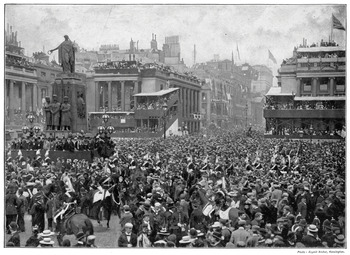
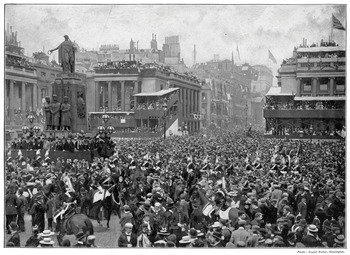
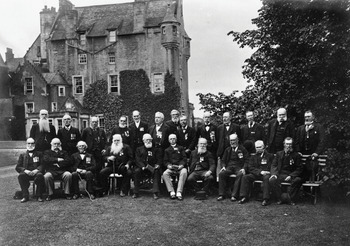
In national narratives and in the public mind, the Crimean War sits in the shadows of the larger and longer wars that flank the long nineteenth century: the Napoleonic Wars and the Great War.27 Fittingly, these two conflicts assume commanding spaces on the memorial landscape of London; Nelson’s Column occupies a dominant place in London’s Trafalgar Square, while the Cenotaph stands conspicuously in London’s Whitehall.28 Taking its place among these monuments is the Guards’ Memorial in St. James’s Place (Figure 0.1). It pays tribute to the Crimean War, the one truly major conflict involving European powers between the two better-known conflagrations. The Crimean War shattered the so-called Pax Britannica, the hundred years of putative peace within Europe, when Great Britain was the globe’s foremost power. This notion was, of course, a fiction during a century when insurgency and battle marred the European continent and when Britain, along with other European nations, was involved in imperial conquest and imperial war.29 The so-called “little wars” of empire were nearly continuous across a century that witnessed the large-scale traumas of the Indian Rebellion (1857-1858) and the South African War (1899-1902), to name two of the most significant conflicts.30
Veterans at the Guards’ Crimea Memorial. c. 1899.
On the surface, the Crimean War was a contest with obscure causes. Its immediate spark came from tensions over the holy places in Palestine and over territories within the Ottoman Empire.31 Territorial ambitions in continental Europe and in an imperializing world also propelled Europe to war. These conflicts pitted Britain against a onetime ally, the Russian Empire. They tied Britain to a former enemy: France. Together, and aided by the island nation of Sardinia, they fought on behalf of an ally often deemed unworthy, the Ottoman Turks. The balance sheets of destruction may have paled in comparison to those for the Napoleonic Wars and World War I.32 However, like the Napoleonic Wars33 and the Great War,34 the Crimean conflict was, itself, global in scale,35 with fighting taking place in far-flung regions, involving both the Army and the Navy.36 And, like these larger wars on either side of the long nineteenth century, the Crimean War enmeshed the British, perennially reluctant Europeans, in affairs on the Continent, as it led to the redrawing of geopolitics. Negotiated in 1856, the Treaty of Paris ended the war, hastening a French ascent in Europe, a Russian retreat to insularity, an Ottoman decline in power, and a British reorientation of interests – away from Europe and towards its growing empire and its domestic front.37
The global dimensions of the conflict notwithstanding, the central and decisive drama – or, at least, the occasions that figure into the war’s afterlife – took place largely on the Crimean Peninsula.38 There, a saga of heroism, sacrifice, and suffering unfolded between 1854 and 1856. In 1854, British troops made the 2,000-mile journey to the East, with some coming directly from stations in the mother country and others arriving from service in the empire. That autumn witnessed a trio of dramatic battles at the Alma, Balaklava, and Inkerman, all allied victories. Fought in quick succession, these occasions tested the mettle of the Army and elevated the status of the British soldier.39 They linger today as street names in England’s inner suburbs, built in the Victorian era, and on placards at pubs and taverns, located across the country. At the time of their waging, these battles broke any hope of a speedy Russian victory, leading instead to the yearlong Siege of Sebastopol, which included the Battles of the Tchernaya and the Redan.40 This long assault, which provided a dress rehearsal for the trench warfare used in later conflicts, was a slow attrition in advance of the decisive allied triumph in the autumn of 1855. Through it all, the Russians were not the most formidable enemy. Even greater foes were the cold of the Crimean winter, the pangs of hunger, and the depredations resulting from the cholera epidemic: each and every one a failed test of military management.41
The overarching story to come out of the battlefront saga thus involves the glory of soldierly sacrifice and the failures of national leadership.42 The course of the Crimean War witnessed the rise in stature of the rank-and-file soldier. Construed as the “scum of the earth” in Napoleonic times, this figure took hold of the nation’s hearts during the Crimean conflict.43 The soldier was not only an object of admiration for his bravery; he was also an object of sympathy for his suffering.44 While faith in the soldier grew, confidence in the Army’s officers and in the Government diminished. For its part, the Government had embarked on a dubitable war fought by an outdated army. With an officer class left over from the Napoleonic Wars, and with an administrative apparatus not truly tested since, the armed forces showed themselves to be unprepared for full-scale conflict at mid-century. There were failures of military intelligence, as the Charge of the Light Brigade so well demonstrated. There was fumbling by the Commissary when it came to provisioning the troops with warm clothes and sufficient food. And there was a dismal collapse of the medical services in treating the cholera epidemic, taking far more lives than battlefront injury over the course of the war.45
There were several well-known and robust responses to this situation, both during and after the conflict itself. The Crimean War has long been understood as an impetus to state modernization and Army reform.46 Traditionally, Florence Nightingale has assumed a role as the avatar of reforming efforts, credited – erroneously it turns out – with staving off the cholera in the East before embarking on a career of pioneering nursing education and public health initiatives in Britain, India, and beyond.47 Responses, too, came in the form of a series of Parliamentary interventions. Most notable here are the Cardwell Reforms (1868–1874), devoted to bringing measures of merit and humanity to the antiquated and aristocratic Army.48 But the war was not only an occasion for engendering modernizing reform; it was, as well, an opportunity for providing succoring care.49 Concerned citizens on the home front offered monies and goods to the Patriotic Fund, in amounts large and small. They provided outpourings of support in Thanksgiving prayers and at peace celebrations. The battlefront did not lack, either, for quotidian acts of care, in life and in death. The Caribbean healer Mary Seacole, recently anointed as a heroine of the war, looked after British soldiers, offering succor and sustenance in her British Hotel. Officers exhibited paternalistic concern for their men; battlefield compatriots attended to the burials of deceased friends. If the war gave way to a culture of reform, it gave way as well to a culture of care.50
These acts, in all of their variety, were made possible within a media ecology that produced shared knowledge and shared feeling. The nation that went to war in the Crimea was a literate society with many forms of written and visual expression.51 There were, of course, the daily newspapers, most notably the Times, in whose pages William Howard Russell, touted as the first battlefront journalist, kindled outrage at the blunders of the war and stoked sympathy for the sufferings of the soldiers.52 Provincial newspapers amplified these concerns. So did the illustrated press, with its capacities for visual reproduction. Photography became a means for bringing wartime experience and imagery home, with the innovations of Roger Fenton.53 The field of expression was varied, extending beyond national organs and well-known trailblazers.54 Homespun tributes abounded in poetry and in homily. Finally, military men, auxiliary supporters, and traveling ladies wrote letters, diaries, and journals at the front.55 Taken together, these texts helped to produce shared senses of suffering and sympathy, and of concern and outrage. They inspired a diverse set of representational practices that blossomed in the course of the war. These included forward-looking forms like the realist novel as well as more traditional genres.56 There was no shortage of sentimental literature published in the war’s wake. A conflict with religion at its heart,57 the Crimean War facilitated an engagement with Christian texts and with medieval chivalry.58 In the end, the war was a pivotal moment in the production of new forms of expression. It was also a landmark moment in the making of a reading, writing, and viewing public59 that could think, act, and feel.60
These representational practices and the wartime experiences from which they derived worked, together, to forge new men and new women.61 They consolidated and redefined gender ideals for the Crimean moment and beyond. The rich media landscape of the moment played a decisive role in making Florence Nightingale into the exemplar of mid-Victorian womanhood.62 Newspapers, images, and poems cloaked Nightingale, a paragon of bureaucratic efficiency and an advocate of scientific inquiry, in sentiment and feeling. A heroine for her own time, Nightingale also became a role model for later years: she offered up an avatar of white, middle-class womanhood associated with an idealized figure of the nurse. As the contours of the Crimean War and its afterlife lay bare, this was an ideal to which only some could aspire, and from which many were summarily barred. Mary Seacole, in contrast, made it to the Crimea despite her own experiences of exclusion, where she greeted the troops with boisterous warmth. Models of the female self thus crystallized in the personae of the War’s leading ladies. These ideals developed alongside a variety of masculinities that solidified during wartime. Deeds of battlefield heroics and episodes in soldierly valor consolidated a heroic manhood. This ideal found textual expression in the pages of novels promoting muscular Christianity; it found official recognition in the institution of the Victoria Cross.63 Wartime writing and wartime experience also allowed for the rise of the military man of feeling, who could offer affection and receive care.64
A crucible for the making of gender ideals, the conflict was equally a laboratory for the production of nationhood. The War, of course, made the Charge of the Light Brigade and the Lady with the Lamp into set pieces of Englishness. Mary Seacole provided an opportunity to expand the boundaries of Britishness, at least later on. But it was not just the war’s icons that enabled understandings of nation and belonging. The process of going to battle at a periphery of Europe amongst new allies and new foes allowed for experiences of difference. In the popular mind, the Crimean War did not stir the terror and trauma that emerged in response to the Indian Rebellion, which gripped the subcontinent in 1857.65 Draped in English sentiment, the Crimean conflict stands apart from the so-called “savage wars” of empire waged in Africa and Asia across the later nineteenth century, both imaginatively and geographically.66 Yet, the British understood themselves as the defenders of civilization against Russian despotism in their Crimean undertaking; they did so even while aligned with an Ottoman Empire that many Victorians considered backward. In the end, the wartime experience, like its best-known legends, worked to shore up senses of British nationhood and English home feeling. The Crimea’s warriors were reluctant cosmopolitans, needful of home, as evident in their longing for domestic comforts and Christmas dinners while at the front. Britain’s Island Story was made, in manifold ways, on the Crimean Peninsula, with its myths ready for reworking, adapting, and exploiting over the conflict’s long afterlife.67
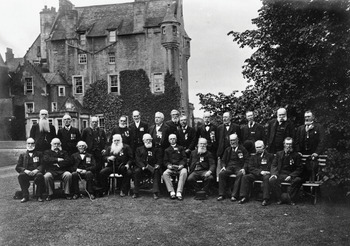
The afterlife of the Crimean War is, ultimately, a palimpsest for British history as it unfolded within the nation’s borders and beyond.68 It opened out across the life cycles of the Crimean generation and its descendants (Figure 0.2).69 The Crimean conflict attained resonance at notable anniversaries, such as the centenary that captivated Woodham-Smith and her contemporaries. More broadly, it came to the fore across Great Britain’s long, subsequent line of wars, from the nineteenth century onward. Its veterans fought in the Indian Rebellion, the Anglo-Zulu Wars, and the South African War.70 Its lessons served, alternatively, as calls to duty and as touchstones for rebuke in the era of the world wars.71 Updated for a modern age, its tales of heroism and blunder reemerged during the Korean War, 72 the Vietnam War, and the Falklands War.73 Even the twenty-first century conflicts in Afghanistan and Iraq bear traces of the Crimean War’s institutions and ideals. The War’s afterlife has enjoyed equal longevity on the home front. Given its developments in caretaking, the Crimea became germane alongside innovations for the public good, including the rise of the new liberalism and the establishment of the welfare state. Full of its own disappointments and consolations, it proved resonant at moments of loss and change that took their toll on the national psyche: among them, the end of empire, decolonization,74 and, most recently, Brexit.75
Crimean War veterans from the 42nd Highlanders. 1900.
It is revealing to catalogue the historical junctures of the Crimea’s afterlife. It is more important, however, to consider the purposes of its recurrence. In some regards, the Crimean War embraced the new, its mismanagement opening the way for a set of modernizing reformers. With Nightingale providing a model for professionalism and Seacole a paragon of entrepreneurialism, the Crimean War held purchase at moments when Britons embraced modernity. Yet, in its afterlife, the Crimean War has not only served as a link to history; it has also provided ground for reinvention. Across the ages, a range of Britons have looked to the Crimean conflict to reinvent a romanticized past for uncertain futures. As the nation hurtled toward the changes wrought by mechanized warfare and decolonization, Britons clung to the Crimean War and its legacies. Relics and lore offered links to tradition and continuity. There were times when cleaving to the Crimean conflict, with its heroes, its artifacts, and its legends, may have been folly. Time and again, however, the war was a prosthetic to a past that offered succor as later generations of Britons faced individual displacement and collective change. A bellwether of tradition and duty, it provided an incarnation of the mid-Victorian age, its logics, and its states of mind.
Ultimately, the Crimea’s robust afterlife invites a reconsideration of the imprint of the Victorian age on the making of modern Britain.76 Why should Victorian Britain matter in the twenty-first century?77 The epoch fades evermore into the past. Even in 1953, a review of The Reason Why declared that the “ever-receding nineteenth century” seemed “as remote as the Pharaohs.”78 Yet, in the 1950s and well beyond, historians and literary critics often looked to the century as foundational for Anglo-American modernity, whether economic, political, or sociocultural. Now, in the twenty-first century, in late capitalism and the later days of the Anthropocene, the glory of industrial and imperial Britain is not just long faded, but also ethically questionable.79 The period does remain a locus of uncritical nostalgia for Conservative Brexiteers like Jacob Rees-Mogg.80 Yet, younger generations are toppling its statues and its pieties. The Victorian era has become a site for generating critical understandings of the contemporary world and its racial logics, as the work of a new generation of BIPOC-led scholars to undiscipline the field has indicated.81
The Crimea’s continued afterlife demonstrates that the Victorian era reverberates still. The war provided an occasion to express, generate, and legitimate a set of Victorian values.82 Its afterlife has allowed for occasions to transmit, revisit, and transform them. Such Victorian mainstays as duty, sacrifice, and heroism took their shape in the Crimean War.83 If wartime played its part in developing and institutionalizing these ideals, the Crimea’s afterlife provided occasions to sustain and rework them. The mid-Victorian moment thus bequeathed a set of vocabularies, traditions, and ideals to later epochs.84 These ideas have distinctly Crimean roots; they were the outgrowths of wartime encounters and wartime mediations. They are at once exclusive and malleable; they are simultaneously adaptable and limiting. They inform public practice and govern private hopes; they shape everyday life and inflect landmark events. They produce social cohesion and encourage care; they underwrite violence and allow exclusion.85
The Crimean War and its Afterlife places the mid-Victorians’ war at the center of our narratives of the making of modern Britain. To do as much, it relies upon a variety of interpretive and archival practices. While attuned to literary and cultural criticism, this book is insistently archival. It draws upon repositories holding materials from the nineteenth, twentieth, and twenty-first centuries. The source base is equally expansive, encompassing military collections and medical papers, as well as national archives and local records. These run the gamut to include schoolboys’ notebooks and soldiers’ letters, military memoranda and auction accounts, and travelers’ diaries and film publicity. Taken together, this range of sources substantiates received narratives even as it offers up hidden histories; it conveys time-honored voices even as it introduces forgotten figures. The pages that follow reveal traces of the Crimea in grand narratives and in small stories; they find it in national traditions and in local examples.86 They locate the Crimea’s afterlife at the levels of the quotidian and the everyday, the ideal and the abstract, and the concrete and the monumental.87 In many places and on many scales, the Crimean War shaped British history and informed everyday life.
***
The six chapters of this book address different facets of the wartime experience and its legacies across a long historical arc of the modern era, from the nineteenth century through the twenty-first.88 Each chapter takes as its focus a figure, institution, or practice that emerged from the Crimean War’s torsions. The cases are associated, additionally, with a national ideal, a Victorian value, or a character trait. A central contention of this book is that the Crimea’s afterlife is not an afterthought or an epiphenomenon. Instead, the seeds of remembrance and reinterpretation reside in the war itself. Each chapter begins therefore in the wartime moment, to show that the event and its mediation provided the conditions for the Crimea’s afterlife. All six chapters trace the fate of wartime ideals and institutions from the Crimean moment to the near present. They employ overlapping narratives and recursive trajectories as they demonstrate how values, sociability, and experience were made and remade at flashpoints across history.
The first two chapters address the theme of “Persistence.” They underscore the longevity and capaciousness of the Crimea’s afterlife as they trouble notions of peripheries and centers. Chapter 1, “The Adventurers,” brings the Crimean Peninsula, distant from Britain, into focus. It demonstrates that wartime travel and encounter shaped subsequent experiences of the peninsula, even to our own century. As they made the journey eastward, the Crimea’s combatants sought to understand the peninsula and the many peoples they encountered there, both friends and foes. The end of the war was an occasion for mass retreat, but it did not mark the end of British engagement with the peninsula. Rather, wartime writing and wartime experience generated vocabularies and understandings that shaped later engagements with the Crimea as a place of memory and self-discovery, and of tourism and diplomacy. Here and throughout, I refer to the land mass where the Victorians fought as the Crimea. It is today called Crimea. My choice of the earlier nomenclature invokes the nineteenth-century experience of the land and its continuing association among Britons with a Victorian war. Similarly, I refer to Sebastopol, now Sevastopol, by its Victorian spelling.
Although the Crimean War was fought at a distance, on a peninsula at the edge of Europe, it gave rise to one of the most feted events in British military history. The second chapter, “The Dutiful,” thus moves from the peripheral locales of Eurasia to the central myths of British history to consider the Charge of the Light Brigade. The Charge occurred over only fifteen minutes of action-packed drama, but it is unusually long lived in the British imagination. It was a highly mediated event, in soldiers’ letters, in newspaper reports, and, not least, in Alfred, Lord Tennyson’s eponymous poem. Together, these productions worked to criticize the incident while redeeming its protagonists: the 600 or so Chargers who rode resolutely into battle. In its wake, the Chargers became embodiments of patriotic duty, social responsibility, and heroic failure. They remained so across their life cycles. Even after their passing, the ideal of duty stayed fused to the Charge. It proved useful at moments of military pressure and it proved redemptive at times of imperial loss. It could stir men to service in wartime and it could comfort the nation in the wake of disappointment. Its malleability notwithstanding, the ideal of duty did find its own limits, as twentieth-century wars and big screen films lay bare. Yet, the affinity for heroic failure has lingered, as the Brexit moment suggests.
The second coupling of chapters, “Avatars,” addresses two different ideals of masculinity that were produced out of the crucible of military mismanagement.89 They examine bravery and valor, on the one hand, and vulnerability and care, on the other. Chapter 3, “The Brave,” traces the institutionalization of a Victorian value and a military ideal in the form of the Victoria Cross. Established at the end of the Crimean War by Royal Warrant, this award recognized acts of valor in battle. It continues to do so today. The Victoria Cross has created a fellowship of bravery that includes Victorian warriors and twenty-first century servicemen; aristocrats and common soldiers; and Britons and imperial subjects. A coveted award with Crimean origins, the Cross is an object of desire. Servicemen have pursued the award; collectors have chased after Crosses. Museums have showcased these treasures, with the largest single collection residing in the attic of London’s Imperial War Museum, where it opened in 2010.90 Its transcendent promises notwithstanding, the Cross itself has not protected its winners from misfortune or hardship. Yet it has functioned all the same as a compensation for loss and a vehicle for consensus at moments of transition across the ages.
Chapter 4, “The Custodians,” takes us back to the grounds of the Crimea and the East to consider the vulnerabilities of military masculinity. It foregrounds the challenges wrought by death in wartime, whether on the field of battle or through sickness in hospital. Combatants responded with acts of care – ministering to the sick, acting as brokers with the living, and managing last rites for comrades. Collectively, I refer to these acts as custodianship. In the case of the Crimea, the problem of death in wartime and after crystallized in the challenge of maintaining burial grounds at a distance. Across the centuries, Crimean graves and their upkeep served as a focus for shared emotion and collective mourning. Distance posed a challenge to their maintenance over time, with the world wars, the Cold War, and the Russian invasion of the Crimea making care all but impossible for those good Samaritans, civil servants, and twenty-first century crusaders who took up the task across the years. Like the war itself, their efforts often proved an exercise in futility. The state of the Crimea’s graves has served repeatedly as an emotion-laded referendum on the management of the war and its aftermath. Like many episodes in the war itself, the endeavor has proved, time and again, to be an exercise in futility, at no point more so than at the present, with the Peninsula inaccessible to Britain’s twenty-first-century custodians.
Under the rubric of “Angels,” the final two chapters focus on the lives, mythologies, and legacies surrounding two women who emerged in Victorian times and after as heroines of the Crimean War: Florence Nightingale and Mary Seacole.91 Chapter 5, “The Heroine,” examines the life and legacies of the war’s best-known protagonist. Nightingale proved appealing in her own time for the combination of care and organization that she manifested in the crusade against mismanagement. A trailblazing and unorthodox figure, Nightingale was cast as a paragon of white English womanhood. Beloved as the Lady with the Lamp, she was a nursing pioneer and a beacon of reform. She was, in her lifetime and after, a lodestar, a woman who shaped the contours of the nation through her deeds and touched the hearts of the people through her character. Across the years, many sought to burst the myths surrounding this Victorian worthy: the leadership of the Army medical services, pioneers of literary and cultural modernity, and, ultimately, members of the nursing profession itself. To track the ebbs and flows of Nightingale’s public fortunes is to track the making and dismantling of an idealized, if constrained, womanhood associated with a variety of Englishness: one connoted by the term Middle England and embodied in the values of rurality, modesty, and practicality.
The final chapter, “The Foremother,” traces the emergence of the newest addition to the pantheon of Crimean worthies: the Caribbean healer and hotelier Mary Seacole. Beloved during the Crimean War, Seacole published her 1857 autobiography, the Wonderful Adventures of Mrs. Seacole in Many Lands, to claim her place in the War’s annals and to secure her livelihood Largely forgotten for more than a century, Seacole enjoyed a renaissance in the last quarter of the twentieth century with the rediscovery and reprinting of her autobiography. Seacole’s life provided evidence of the long-standing impact of Black Britons well before the 1948 arrival of the Empire Windrush, which announced the settling of a generation of Caribbean migrants in the mother country; her story provided inspiration for minority communities, especially Black women and health care providers, often overlapping constituencies.92 On the occasion of her rediscovery, Seacole was, at first, a community heroine, brought to light through labors of love and grassroots efforts. During the first two decades of the twenty-first century, she became a national icon, claiming a place in the National Curriculum and the National Portrait Gallery. A commanding statute of Mary Seacole now stands on the South Bank of the Thames, at St. Thomas’ Hospital, where Florence Nightingale once spearheaded efforts in nursing education. The complicated relationship between the two leading ladies of the Crimea has often been cast as a rivalry, with Seacole a foil to Nightingale: a warm hotelier and not a steely angel; a clever entrepreneur instead of a bureaucratic reformer; a subaltern, Black protagonist in place of a white, English heroine. However, like Nightingale, Seacole was an unconventional woman with a long legacy. She became a standard bearer in her own right: an embodiment of distinctive virtues for our own time and a Crimean role model for a twenty-first-century Britain.
***
Born a Victorian, in 1896, Cecil Woodham-Smith passed away in 1977, just a few years after the Lignum Vitae Club, a fellowship of Jamaican nurses, restored Mary Seacole’s grave, located in London’s Kensal Green cemetery. Although she wrote against the backdrop of a changing Britain, with immigration from the Caribbean on the rise, with decolonization gaining momentum, and with filiations with Europe gaining new steam, Cecil Woodham-Smith could likely not have imagined a moment when Mary Seacole would join the pantheon of Crimean heroes. To be fair, Woodham-Smith was no little Englander. She may have made her name with her rendering of such icons and emblems as Florence Nightingale and the Charge of the Light Brigade. But her consciousness, and her work, extended beyond the island of Great Britain itself. She was a proud descendant of Lord Edward Fitzgerald, a military leader of the Irish Rebellion of 1798. She was, as well, the author of The Great Hunger, a book on the Irish Famine of 1848.93 Her interest in Ireland notwithstanding, it is difficult to imagine Woodham-Smith finding a Victorian worthy in the person of Mary Seacole. As this book shows, the valences of the Crimean War, and its messages, shift across history.
The following pages bring the Crimean War, its heroes, and its traditions to life. This book traces the changing engagements with this mid-Victorian conflict as it charts the making of British pasts and presents. It hones in on a range of actors across the ages. Among them were Mary Seacole, Cecil Woodham-Smith, and the Lignum Vitae Club. All engaged with the legacies of the Crimean War as a way of producing histories and of imagining futures. Each advanced their own understanding of the event in order to create meaning and forge community. With its generative capacities and its shifting resonances, the Crimean War engaged publics of ordinary Britons again and again, shaping their understandings of self and of nationhood. These pages tell the story of that engagement, from Victorian times to Woodham-Smith’s time to our time.