Introduction
Clay minerals are important sorbents in soils and sediments, acting as a major reservoir of various transition metals. The rare earth elements (REEs) are among those being typically sorbed and accumulated in soils (Gwenzi et al., Reference Gwenzi, Mangori, Danha, Chaukura, Dunjana and Sanganyado2018; Laveuf & Cornu, Reference Laveuf and Cornu2009; Li & Zhou, Reference Li and Zhou2020; Li et al., Reference Li, Zhao and Zhou2017). The accumulation of REEs in the regolith forms economically valuable regolith-hosted REE deposits that are the most important heavy (H)REE resource in China (Xie et al., Reference Xie, Hou, Goldfarb, Guo and Wang2016), contributing to > 95% of the global HREE supply (Riesgo García et al., Reference Riesgo García, Krzemień, Manzanedo del Campo, Menéndez Álvarez and Gent2017). In these deposits, > 70% of the REEs exist in an exchangeable state sorbed on the clay minerals (Li et al., Reference Li, Zhao and Zhou2017; Sanematsu & Watanabe, Reference Sanematsu and Watanabe2016). Clay minerals are a key component in the formation of these deposits by controlling the mobilization, fractionation, and accumulation in the regolith during weathering (Borst et al., Reference Borst, Smith, Finch, Estrade, Villanova-de-Benavent, Nason, Marquis, Horsburgh, Goodenough and Xu2020; Li & Zhou, Reference Li and Zhou2020).
Experiments have demonstrated that clay minerals sorb REEs through outer- and inner-sphere complexation, depending on the nature of the minerals and on the pH and ionic strength of the soil solution (Bradbury & Baeyens, Reference Bradbury and Baeyens2002; Coppin et al., Reference Coppin, Berger, Bauer, Castet and Loubet2002; Stumpf et al., Reference Stumpf, Bauer, Coppin, Fanghänel and Kim2002; Yang et al., Reference Yang, Liang, Ma, Huang, He and Zhu2019). Overall, 2:1 clay minerals with permanent negative layer charge, such as vermiculite and smectite, show stronger sorption capacity. For example, Alshameri et al. (Reference Alshameri, He, Xin, Zhu, Xinghu, Zhu and Wang2019) determined that the order of adsorption efficiency for La3+ and Yb3+ from the greatest to least is montmorillonite, illite, and kaolinite. Stronger inner-sphere complexation of REEs is also more plausible for these permanently negatively charged clay minerals (Coppin et al., Reference Coppin, Berger, Bauer, Castet and Loubet2002; Tertre et al., Reference Tertre, Castet, Berger, Loubet and Giffaut2006). The sorption ability of neutrally charged 1:1 kaolinite and halloysite is controlled mainly by broken bonds on basal surfaces and along edges. Sorption is dominated commonly by outer-sphere complexation (Borst et al., Reference Borst, Smith, Finch, Estrade, Villanova-de-Benavent, Nason, Marquis, Horsburgh, Goodenough and Xu2020; Yamaguchi et al., Reference Yamaguchi, Honda, Tanaka, Tanaka and Takahashi2018). In many well characterized regolith-hosted REE deposits, kaolinite and halloysite are the main REE sorbents in the regolith (Estrade et al., Reference Estrade, Marquis, Smith, Goodenough and Nason2019; Li et al., Reference Li, Zhou and Williams-Jones2019, Reference Li, Zhou and Williams-Jones2020); the role of other coexisting clay minerals, e.g. illite, smectite, and vermiculite, has not been evaluated comprehensively, however. Although these minerals are often much less abundant than kaolinite and halloysite, the stronger sorption ability implies a potential role for these clay minerals in REE sorption and enrichment in the regolith. Indeed, illite has been suggested as potentially the main REE sorbent in saprolite through inner-sphere complexation (Mukai et al., Reference Mukai, Kon, Sanematsu, Takahashi and Ito2020). Nonetheless, a detailed investigation at the scale of weathering profile is lacking. Understanding the potential of various common clay minerals to act as REE sorbents in tropical and sub-tropical regolith is important for evaluating the enrichment process during weathering to form world-class regolith-hosted REE deposits. This understanding is especially important as REEs are in significant demand for use in advanced technologies for the green economy. Exploration for new regolith-hosted REE resources is being undertaken worldwide and recognition of the connection between clay minerals and REE behavior in regolith is essential for further exploration.
Clay minerals are important sorbents of REEs in regolith-hosted deposits; how variations in the physicochemical properties of clay minerals during weathering affect REE sorption and desorption is not yet well understood, however. In the present study, variations in the physicochemical properties of clay minerals in well characterized profiles from the Bankeng regolith-hosted REE deposit in Jiangxi Province, South China were analyzed to investigate further how the variations of different physicochemical properties of clay minerals, including species, abundances, surface areas, porosities, and cation exchange capacities (CEC), affect the mobilization and sorption of REE during weathering.
Site Geology
The studied site is located at the footslope of a granitic catchment in South China. The region has a subtropical monsoon climate, with distinct wet and dry seasons. Convex-concave slopes are well developed in the region. Erosion has been intense at the ridgetop and less intense toward the downslope, where deposition became more dominant so that a thickened weathering crust developed (Li et al., Reference Li, Zhou and Williams-Jones2020). Detailed characterization of the bulk mineralogical and geochemical compositions of the weathering crust, on which this study is based, is available (Li et al., Reference Li, Zhou and Williams-Jones2020, Reference Li, Teng and Zhou2021). The weathering profile shows a clear vertical zonation, from bottom to top, of bedrock, saprock, saprolite, and pedolith zones (Fig. 1). The bedrock is a medium- to coarse-grained granite containing quartz, K-feldspar, albite, biotite, and chlorite. The REEs are hosted in a variety of accessory minerals: mainly synchysite-(Y), and to a lesser extent, gadolinite-(Y), hingganite-(Y), yttrialite-(Y), zircon, with a minor amount found in xenotime-(Y), and in REE niobates. Synchysite-(Y), gadolinite-(Y), and hingganite-(Y) are largely absent from the regolith; presumably these minerals decomposed completely during weathering. The weathering susceptibilities of these minerals are also indicated from thermodynamic evaluation (Li et al., Reference Li, Kwong, Williams-Jones and Zhou2022). In the saprock and saprolite, K-feldspar, biotite, and chlorite are weathered partially and replaced by kaolinite, halloysite, illite, vermiculite, and smectite. In the pedolith, feldspars, biotite, and chlorite are largely decomposed to form secondary minerals, such as kaolinite, halloysite, vermiculite, Fe and Mn oxyhydroxides, and gibbsite with relict rounded quartz. The soil pH displays a systematic trend, decreasing gradually from ~ 8 at the bottom to ~ 4.5 at the top of the profile, with abrupt increases at the pedological interfaces.
A schematic column of the weathering profile of the Bankeng deposit (after Li et al., Reference Li, Zhou and Williams-Jones2020)

Methods
Clay-size Separation
Samples examined in the present study were described by Li et al., (Reference Li, Zhou and Williams-Jones2020, Reference Li, Teng and Zhou2021). The clay-size fraction was obtained through dispersion of ~20 g of soil samples in de-ionized water. The dispersion was aided by vigorous agitation of the suspension for 30 s and supersonic bathing for 5 min. The clay-containing supernatant solution was then pipetted after the amount of time required for settlement of the clay-size fraction (according to the Stoke's law) had elapsed. The excess water was then removed from the clay-size fraction by centrifugation at 6000 rpm (3220 × g) for 15 min.
Scanning Electron Microscopy (SEM)
Micro- to nano-scale observations were carried out using an Hitachi S-4800 FEG scanning electron microscope (Hitachi Ltd., Tokyo, Japan) at the Electron Microscopy Unit (EMU) at the University of Hong Kong. The SEM was operated at 15 kV and samples were coated with carbon before examination. The SEM used is equipped with an Oxford energy-dispersive spectrometer (Oxford Instruments, Abingdon, UK) for rapid semi-quantitative elemental analysis.
Fourier-transform Infrared Spectroscopy (FTIR)
FTIR spectra were obtained on a Nicolet iS10 FTIR spectrometer (Thermo Scientific, Waltham, Massachusetts, USA) at ZKBC Analytical Laboratory in Beijing using the KBr pressed-disk technique. Samples were mixed with KBr at a ratio of ~1:100 and ground in an agate mortar and then pressed to make disks. The disks were then heated under a lamp for 3 min at 50°C to minimize water adsorption. The scanning resolution of the spectra was 4 cm–1 with 64 scans over the range 4000–400 cm–1.
Specific Surface Area (SSA), Porosity, and Pore-Size Distribution Analysis
Specific surface areas (SSA) were determined by the BET method using an SA3100 analyzer (Beckman Coulter, Brea, California, USA) at ZKBC Analytical Laboratory in Beijing. All samples were outgassed for 6–12 h and heated to 50°C to remove the surface moisture. The porosity and pore-size distribution of these samples were measured through nitrogen adsorption and desorption, with the isotherm obtained analyzed by the BET method and the Barrett–Joyner–Halenda (BJH) method (Barrett et al., Reference Barrett, Joyner and Halenda1951).
CEC Characterization
The CEC was determined following Deng et al. (Reference Deng, White and Dixon2014). Any carbonates or soluble components in the samples were removed by treatment with dilute acetic acid. The samples were washed three times (six washes in total) for 15 min using 20 mL 0.5 M and 0.005 M CaCl2 (Reagent grade, Acros Organics, Waltham, Massachusetts, USA). The suspensions were centrifuged at 2000 rpm for 10 min (358 × g) and the supernatant solutions were pipetted and discarded. Repeated washing was used to saturate the cation exchangeable sites completely with Ca. Afterward, the samples were washed four times with 15 mL of 0.5 M MgCl2 (Reagent grade, Acros Organics, Waltham, Massachusetts, USA) for 15 min to leach all the previously adsorbed Ca. The supernatant solutions were collected after centrifugation at 2000 rpm (358 × g) for 10 min. The calcium concentrations of the supernatant solutions were analyzed with a PE Optima 8300 inductively coupled plasma-optical emission spectrometer (Perkin Elmer, Waltham, Massachusetts, USA) at the University of Hong Kong. Excess MgCl2 in the sample was removed through vortexing the samples in 15 mL of distilled water and centrifuging at 1500 rpm (201 × g) for 10 min. The weights of the samples were measured: (1) before the experiment, to determine the dry sample weights; (2) before the MgCl2 wash to determine the weights of the interstitial CaCl2 solution that remained in the samples after the CaCl2 washes; and (3) after drying at 60°C for 12 h after the experiment for another dry sample weight to determine the sample weight loss during the experimental procedure, for the calculation of the CEC.
Clay-sorbed REE Concentration
Chemical extraction was conducted to quantify the amounts of REEs sorbed on the clay minerals. Before the experiment, all utensils were soaked in reagent-grade 1 M HNO3 (Sigma-Aldrich, St. Louis, Missouri, USA) for > 24 h and rinsed repeatedly with Milli-Q double de-ionized water (resistivity = 18.2 MΩ cm). The sorbed REEs were extracted through mechanical shaking of 50 mg clay mineral separates with 10 mL of 0.5 M ammonium sulfate (Reagent grade, Acros Organics, Waltham, Massachusetts, USA) for 16 h at room temperature. The leachates were then separated from the clay-size fraction through centrifugation at 10,000 rpm (6708 × g) for 30 min and filtration using a cellulose acetate-type membrane filter (φ = 0.22 µm). Acidified and diluted solutions were analyzed with an Agilent 7900 inductively coupled plasma-mass spectrometer (Agilent Scientific Instruments, Santa Clara, California, USA) at the University of Hong Kong. Both the accuracy and precision are at <10% for all analyzed elements.
Results
Transformation of Clay Minerals during Weathering
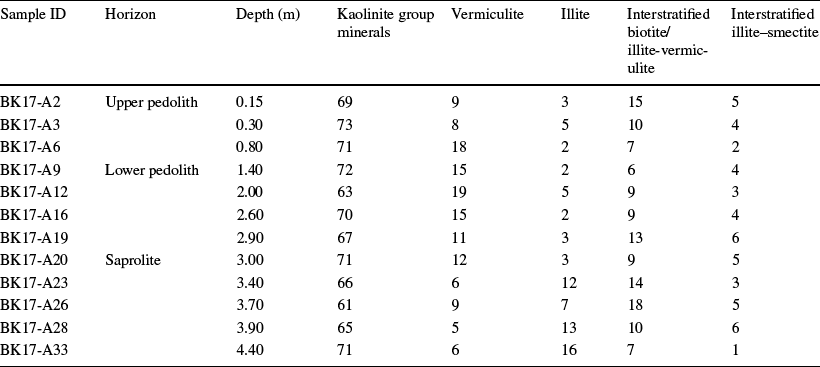
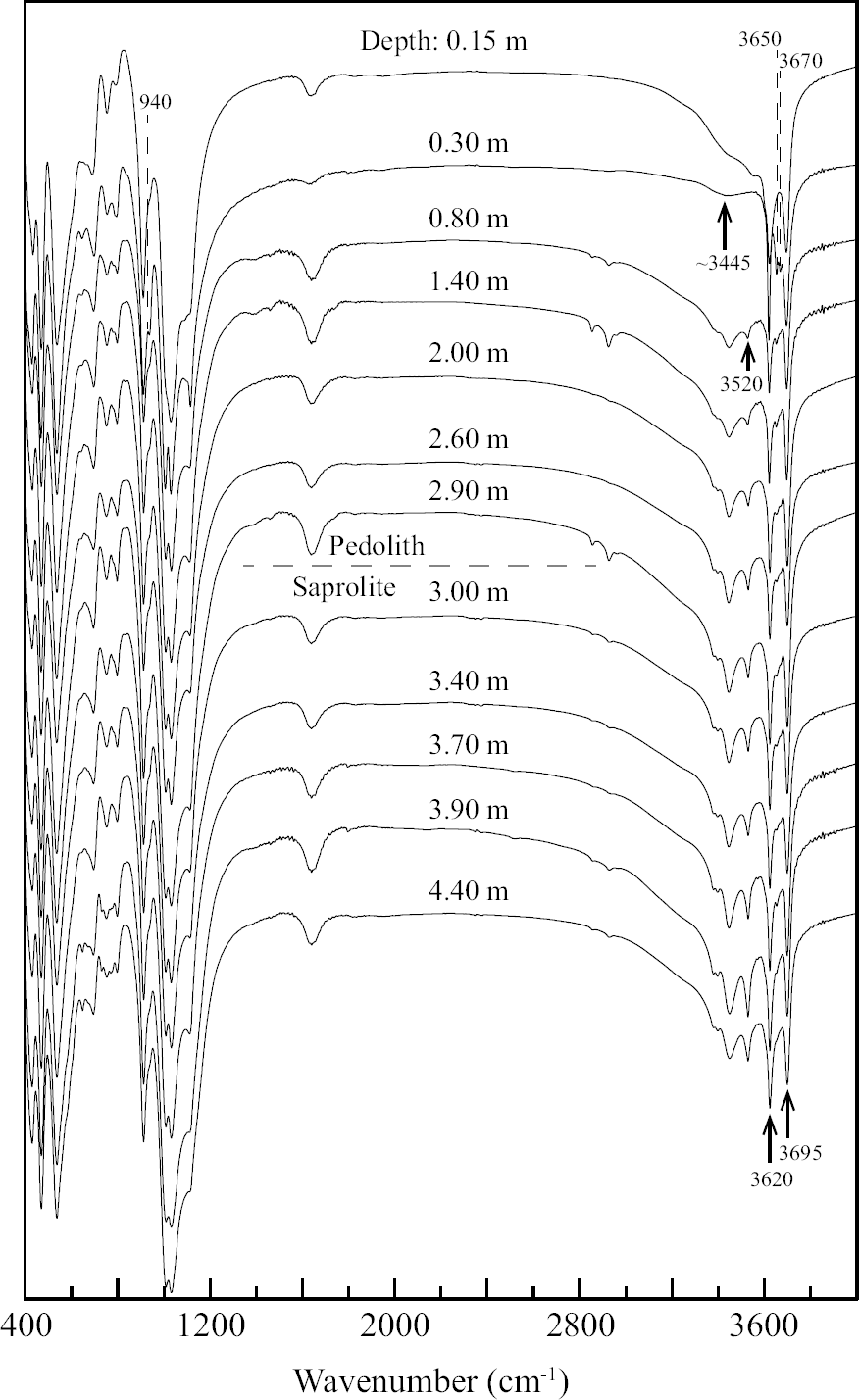
Kaolinite group minerals are the most abundant clay minerals throughout the entire weathering profile, comprising ~70% of the clay mineral assemblages; illite and interstratified biotite/illite-vermiculite are the second most abundant clay minerals in the saprolite both at ~15% each but their abundance decreases in the pedolith (Table 1) (Li et al., Reference Li, Teng and Zhou2021). The pedolith contains vermiculite at up to ~20% (Fig. 2a; Table 1). In the present study, mineralogical characterization was done using FTIR and SEM. From the IR spectra, halloysite is the dominant kaolinite group mineral in the saprolite and at the saprolite-pedolith interface, exhibiting only two Al2OH-stretching bands at ~3695 and 3620 cm−1 and a sharp single Al2OH-bending band at 920 cm–1 without shoulders (Fig. 3). The upper pedolith has more abundant kaolinite with well developed Al2OH-stretching bands at ~3695, 3670, 3650, and 3620 cm–1 and a broad shoulder associated with the Al2OH-bending band at 940 cm–1 (Fig. 3). In the pedolith, the small peak at ~3520 cm–1 indicates a minor proportion of chlorite and probably interstratified chlorite-vermiculite (Sample No. BK17-A12; depth of 2.0 m). Another small peak at ~3445 cm–1 suggests the existence of gibbsite. In the uppermost soil (Sample No. BK17-A2; depth of 0.15 m), halloysite is more common than kaolinite, as indicated by the relatively well developed peaks characterizing halloysite (Fig. 3).
Summary of relative proportions of clay minerals from various regolith horizons (data from Li et al., Reference Li, Teng and Zhou2021)

Remark: All proportions in %
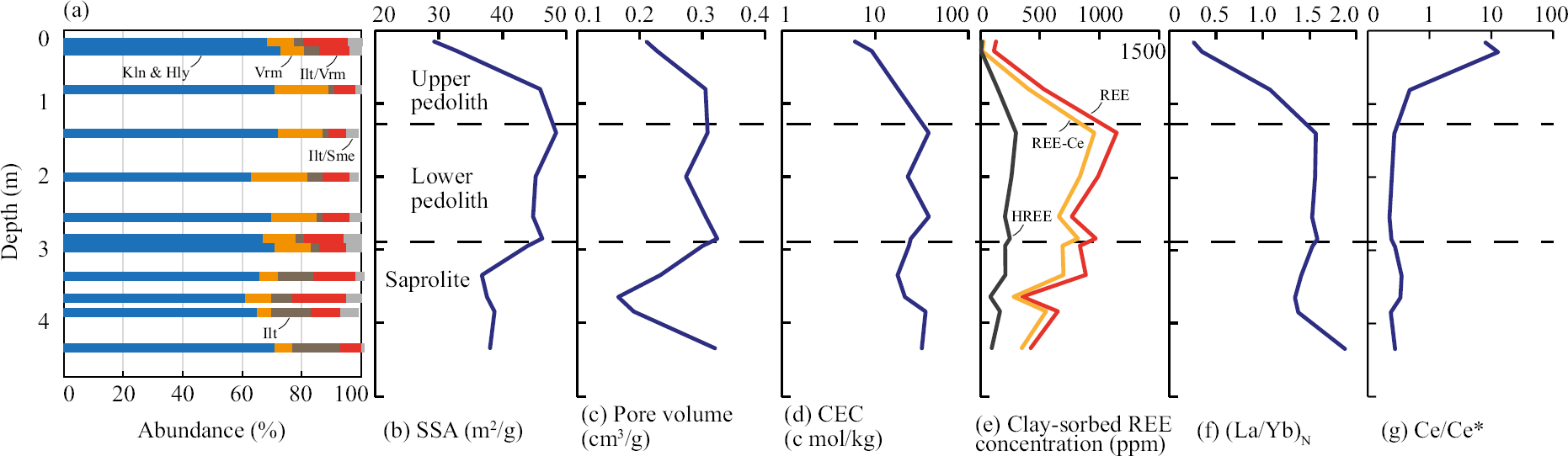
Variations in a proportion of clay minerals, b SSA, c pore volume, d CEC, e clay-sorbed REE concentrations, f (La/Yb)N of the clay-sorbed REE concentrations, and g Ce anomaly of the clay-sorbed REE concentrations of the clay mineral assemblages from various depths of the weathering profile. Abbreviations: Hly: halloysite; Ilt: illite; Ilt/Sme: interstratified illite–smectite; Ilt/Vrm: interstratified biotite/illite-vermiculite; Kln: kaolinite; Vrm: vermiculite

FTIR spectra of the clay mineral assemblages from various depths of the weathering profile

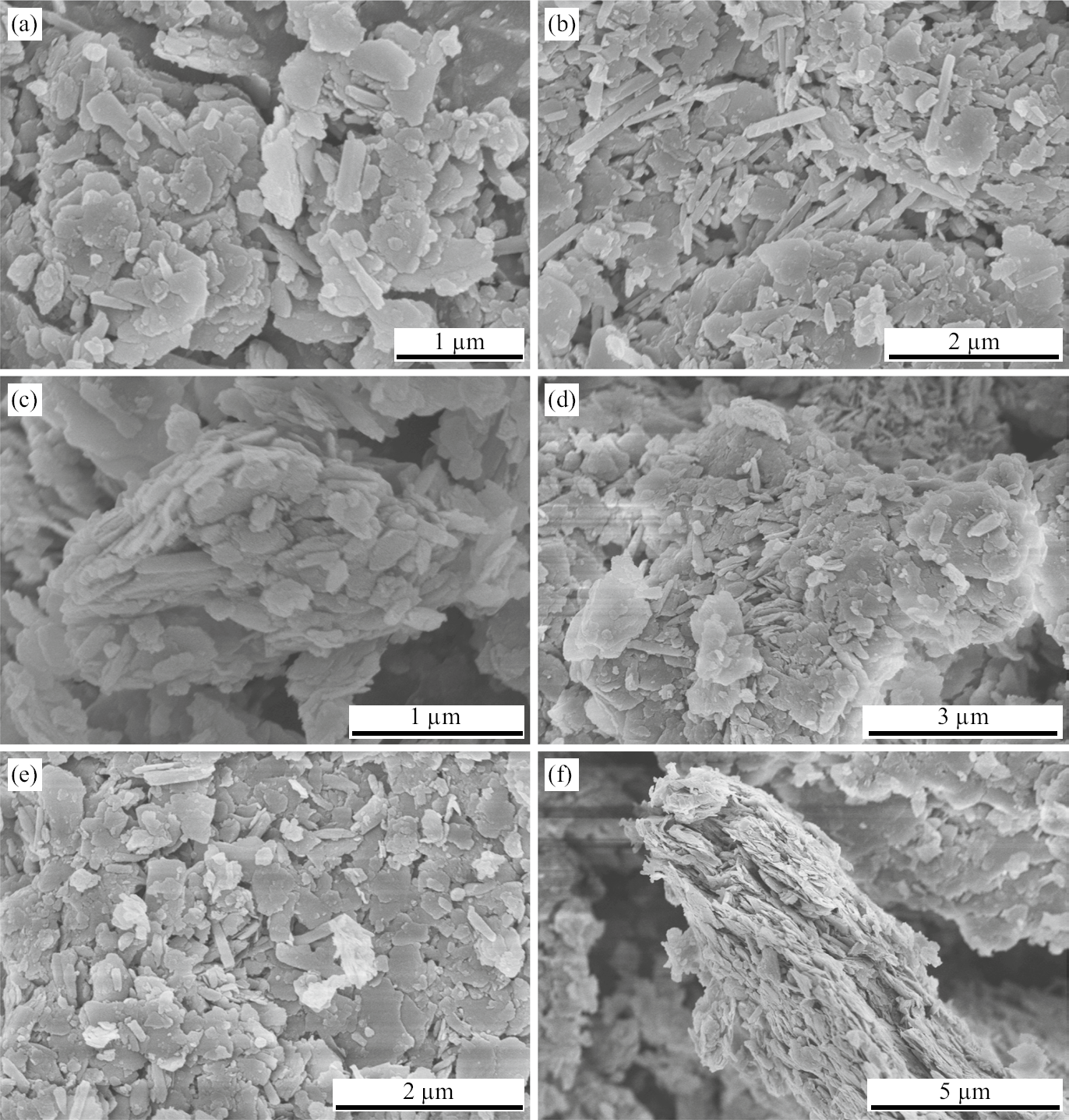
Morphologically, kaolinite and halloysite occur as aggregates of sub-µm to nm-sized polygonal flakes (Fig. 4a) and stubby tubes (Fig. 4b), respectively, whereas illite occurs as either fine-grained platy or wavy particles in the saprolite. In the lower pedolith, vermicular kaolinite booklets become more common, but generally only a few µm across and in poorly-stacked arrangements (Fig. 4c), suggesting an interim stage of the ‘booklet’ development. Abundant irregularly shaped kaolinite also appears in sub-µm-sized flakes in this horizon. Coalescence of halloysite tubes, especially along the edges of these kaolinite booklets, is commonly observed (Fig. 4c,d), indicating a gradual transformation of meta-stable halloysite to kaolinite during weathering (Li & Zhou, Reference Li and Zhou2020). In the upper pedolith, kaolinite booklets are much better developed and show larger sizes and a more euhedral hexagonal crystal form (Fig. 4e). Halloysite which is less abundant than kaolinite appears mostly as µm-long tubes with a large length-to-width ratio (Fig. 4e). Vermiculite appears as µm-sized flakes with wavy edges (Fig. 4f).
SEM images of a kaolinite and b halloysite in saprolite; c and d progressive development of vermicular kaolinite with coalescence of halloysite along edges and basal surfaces; e kaolinite and halloysite; and f vermiculite in pedolith

Variation of Physicochemical Properties
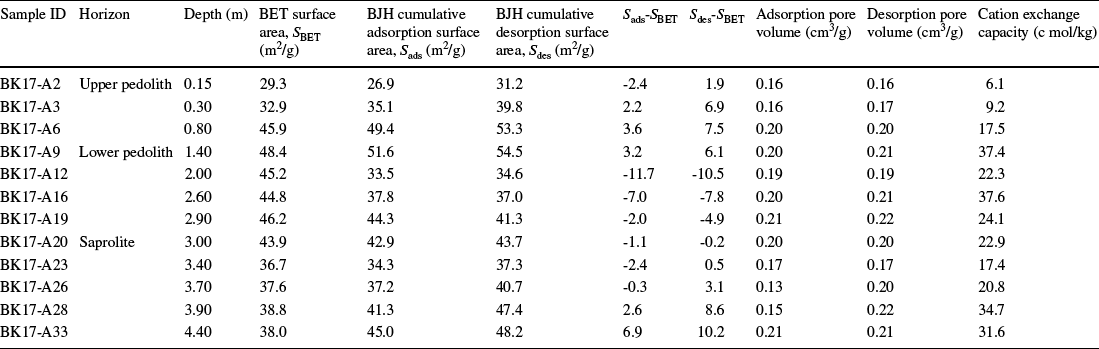
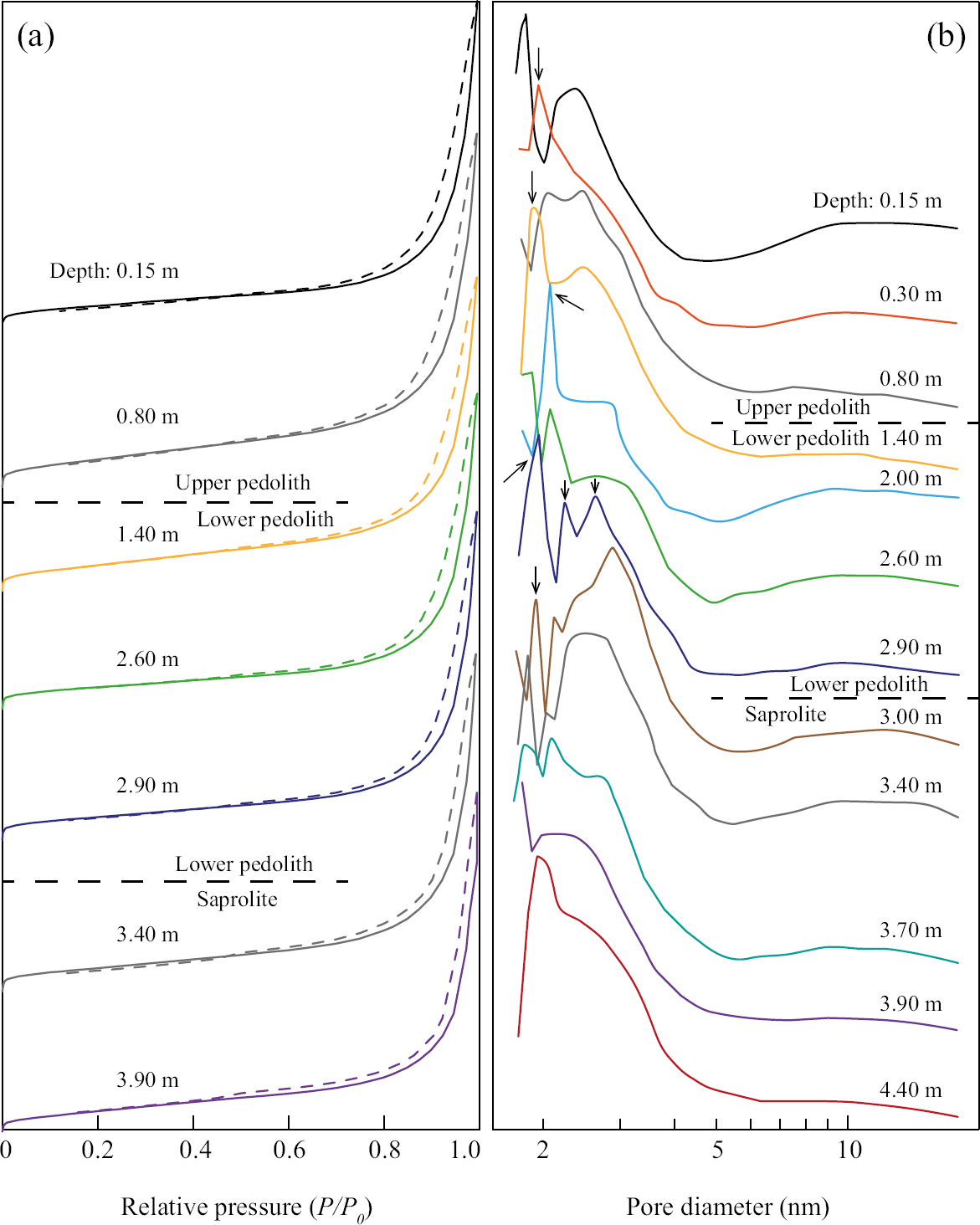
The specific surface area (SSA) of the clay-size separates is ~38 m2/g in the saprolite but increases sharply to ~45 m2/g at the saprolite–pedolith interface (Fig. 2b; Table 2). The specific surface area is also broadly similar in the pedolith but decreases abruptly to ~30 m2/g in the uppermost soil. From the adsorption and desorption isotherms (Fig. 5a), only a little hysteresis is noted for all samples, and moreover, generally small values exist for the differences between the cumulative SSA from either the adsorption (S ads) or desorption (S des) isotherms and the S BET. This suggested that the dominant pore shape in all samples is cylindrical (Churchman et al., Reference Churchman, Davy, Aylmore, Gilkes and Self1995; Pasbakhsh et al., Reference Pasbakhsh, Churchman and Keeling2013).
Summary of physical and chemical properties of the clay mineral assemblages from various regolith horizons

a Adsorption (represented by the solid line) and desorption (represented by the dashed line) isotherms and b pore-size distribution of the clay mineral assemblages from various depths of the weathering profile with arrows pointing to the characteristic peaks of pore size observed

The pore volumes range from 0.13 to 0.21 cm3/g, decrease toward the middle of the saprolite zone, and then increase to the maximum at the pedolith-saprolite interface (Fig. 2c; Table 2). The pore volumes are generally consistent at ~ 0.2 cm3/g in the pedolith and decrease to 0.16 cm3/g in the uppermost soils (Table 2).
Micropores to fine mesopores of 1.8–3 nm predominate for all samples (Fig. 5b). However, the pore-size distribution with this range can be manifested as multiple peaks, a single peak with a broad shoulder, or a broad band. In samples obtained from the saprolite, the pore-size distribution often appears as a broad band within the range of ~ 2–3 nm with or without minor peaks. Toward the saprolite–pedolith interface (e.g. sample BK17-A19; depth of 2.9 m), narrow peaks develop at ~ 1.8, 2.4, and 2.8 nm (Fig. 5b). In the lower pedolith, the pore-size distribution is characterized by a narrow peak at ~2 nm with a broad shoulder extending to 3–3.5 nm. In the upper part of the lower pedolith (sample BK17-A9; depth of 1.4 m), pores of sizes ~1.8–2.5 nm are well developed as indicated by two peaks at the corresponding diameter in the spectrum (Fig. 5b), whereas in the upper pedolith, the appearance of the pore-size distribution changes to a single peak at ~2 nm with a broad shoulder except for the uppermost regolith sample. Apart from the micro- and fine mesopores, small amounts of mesopores of ~10 nm diameter, as indicated by the small and broad peaks at ~10 nm in the spectra, are detected for all samples.
The CEC is relatively consistent, between ~20 and ~ 40 meq/100 g, in the saprolite and the lower pedolith. In the upper pedolith, the CEC decreases gradually to 6 meq/100 g in the uppermost soil (Fig. 2d; Table 2).
Variation of the Sorbed REE Concentrations
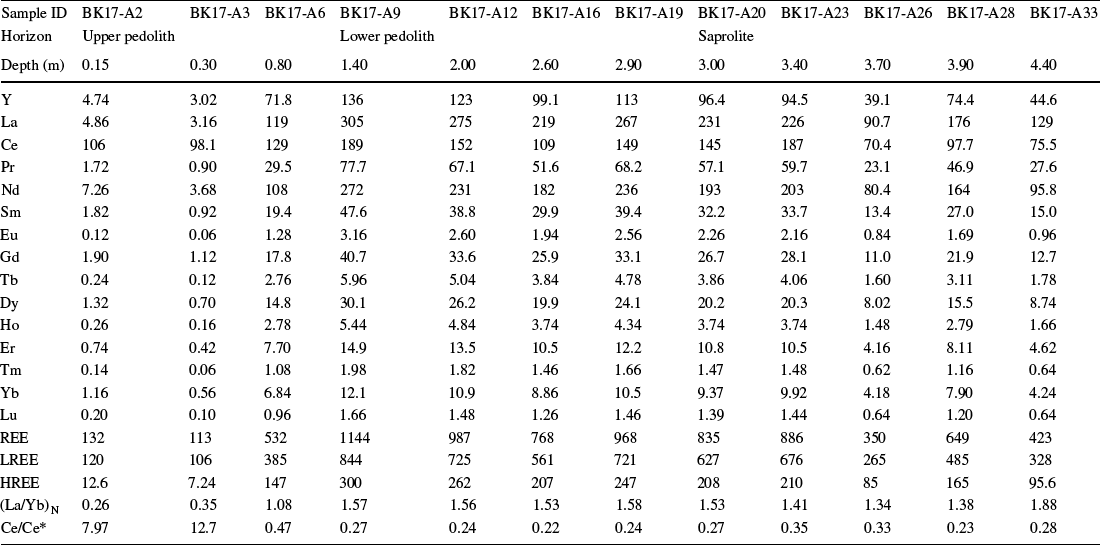
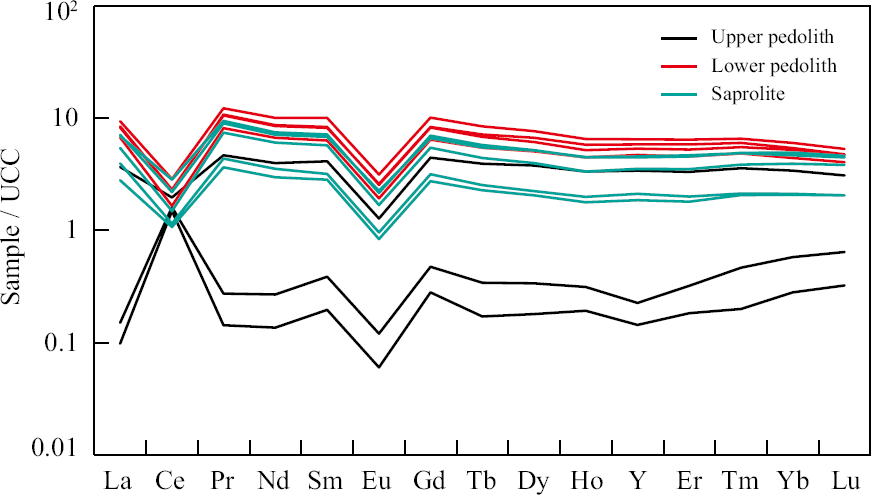
The concentrations of REE sorbed on the clay minerals varies from ~100 to ~1150 ppm and shows systematic variation along the weathering profile. In general, the concentrations increase from ~400 to a maximum of ~950 ppm at the saprolite-pedolith interface (Fig. 2e; Table 3). Another concentration peak of ~1150 ppm occurrs between the upper and lower pedoliths, and the concentration decreases gradually to ~100 ppm in the uppermost soil. All the samples have UCC-normalized patterns enriched in LREEs (Fig. 6). The (La/Yb)N ratios of the clay-sorbed REEs decrease from ~1.9 at the bottom of the profile to ~1.5 in the saprolite and most of the pedolith zone, except in the two uppermost soil samples, where the ratio decreases significantly to 0.3 (Fig. 2f). Cerium anomalies in the clay minerals are consistently negative with a magnitude of ~0.3 in the saprolite and lower pedolith, but are found to have increased significantly to positive values of 8–13 in the uppermost soils (Fig. 2g).
Extraction results of the clay mineral assemblages (ppm) from various regolith horizons

Remark: All concentrations in ppm
Upper continental crust (UCC)-normalized REE patterns of the clay mineral assemblages from various depths of the weathering profile

Discussion
Physicochemical Variation of Clay Minerals
Transformations of the phyllosilicate minerals due to weathering of the studied profile at the Bankeng site were as follows (Li et al., Reference Li, Teng and Zhou2021 and the present study): (1) biotite → interstratified biotite/illite-vermiculite → vermiculite → kaolinite; (2) biotite → smectite → interstratified illite–smectite → illite → kaolinite; (3) chlorite → interstratified chlorite-vermiculite → vermiculite → kaolinite; and (4) illite → interstratified illite-vermiculite → vermiculite. The associated physicochemical properties of the clay mineral assemblages vary because of changes in the proportions of various clay minerals and their genesis; clay minerals formed through different processes and conditions could have different size and crystallinity and show different physicochemical properties (e.g. Churchman et al., Reference Churchman, Davy, Aylmore, Gilkes and Self1995; Darunsontaya et al., Reference Darunsontaya, Suddhiprakarn, Kheoruenromne and Gilkes2010; Jozefaciuk, Reference Jozefaciuk2009; Li & Zhou, Reference Li and Zhou2020; Murray & Lyons, 1960; Raman & Mortland, Reference Raman and Mortland1966). Kaolinite, halloysite, vermiculite, and illite were identified as the major clay minerals of the Bankeng site. Kaolinite and halloysite formed throughout the entire weathering profile along with vermiculite in the pedolith and illite in the saprolite (Fig. 2a).
Associated with progressive weathering, illite transformed gradually to vermiculite via interstratified illite-vermiculite, and thus the abundance of illite decreased gradually at shallower depths in the saprolite while that of vermiculite increased gradually to a persistent abundance in the pedolith (Fig. 2a). A general range of SSA values have been found for vermiculite, from a smaller value of 350 m2/g (Carter et al., Reference Carter, Heilman and Gonzales1965) to a larger value of up to ~750 m2/g (Greenland & Mott, Reference Greenland, Mott, Greenland and Hayes1978). Illite usually shows a smaller total SSA (e.g. 86 m2/g; Nadeau et al., Reference Nadeau, Wilson, McHardy and Tait1985) and even smaller values are found for halloysite (57–64 m2/g; Levis & Deasy, Reference Levis and Deasy2002; Mellouk et al., Reference Mellouk, Cherifi, Sassi, Marouf-Khelifa, Bengueddach, Schott and Khelifa2009) and kaolinite (16–26 m2/g for poorly crystallized kaolinite; Murray & Lyons, 1960). Thus, greater abundances of vermiculite and illite in the clay mineral assemblages would contribute to larger SSA values. Considering the relatively large abundance of vermiculite (up to ~20%) and illite (up to ~15%) in the pedolith and saprolite, respectively (Table 1), these two minerals, probably as well as the transitional interstratified illite-vermiculite (of which the SSA is assumed to be between that of vermiculite and illite), essentially control the SSA of the clay mineral assemblages. The increase from the saprolite to lower pedolith indicates the transformation of illite (of relatively low SSA) to vermiculite (of relatively large SSA). In the uppermost pedolith, the SSA decreases significantly. This may be partially due to the lower abundances of vermiculite and partially due to the low SSA, in general, of the more crystalline kaolinite and halloysite in this horizon.
Similarly, the pore volume of the clay mineral assemblages is affected significantly by the existence of illite and vermiculite in the regolith. A recent study by Zhang et al. (Reference Zhang, Chen, Li, Shi, Wang and Ling2020) reported a pore volume of 0.14 cm3/g for exfoliated vermiculite, which is comparable to the samples in the present study. Moreover, the resemblance in the variation of pore volume of the clay mineral assemblage along the weathering profile (Fig. 2c) to that of the SSA (Fig. 2b) and abundance of vermiculite (Fig. 2a) suggests that vermiculite may contribute significantly to the pore volume of the clay assemblages. In the saprolite, illite probably affects the pore volume, particularly when the pore volume of the samples in this study are compared to the previously detected pore volumes of illite (0.13–0.19 cm3/g; Aylmore et al., Reference Aylmore, Sills and Quirk1970).
For the pore size, the predominant size range is 1.8–3 nm and it varies slightly throughout the entire weathering profile (Fig. 5b). Similar to the SSA and pore volume, the pore size of the clay minerals varies significantly among the samples. However, like the SSA and pore volume, the contribution of the clay minerals can be correlated to the variation of the pore-size distribution. Previous investigations showed that internal and/or surface pores of non-hysteretic halloysite are 2.4–2.8 nm in size (Churchman et al., Reference Churchman, Davy, Aylmore, Gilkes and Self1995; Pasbakhsh et al., Reference Pasbakhsh, Churchman and Keeling2013), whereas the predominant pore size of illite is often 3–3.5 nm (Aylmore et al., Reference Aylmore, Sills and Quirk1970). Thus, the broad distribution of pore size of 2–3 nm in the saprolite should represent a mixture of illite and halloysite, and with progressive weathering, transformation of illite to vermiculite unmasks the peaks (~ 2.4–2.8 nm) indicative of the micropores of halloysite in the pedolith. Meanwhile, pores of ~ 1.8 nm may be attributed to the presence of vermiculite. This could explain the absence of pore-size distribution peaks in the range of 2–3 nm in upper pedolith samples where kaolinite dominates over halloysite (Figs. 2a, 3). The broad distribution at ~ 10 nm mesopores is attributed to the central lumen pores of the halloysite tubes (Pasbakhsh et al., Reference Pasbakhsh, Churchman and Keeling2013).
The CEC of the clay mineral assemblages is probably affected mainly by 2:1 vermiculite and illite, due to the permanent negative charge in their structures (Joussein et al., Reference Joussein, Petit, Churchman, Theng, Righi and Delvaux2005; Wilson, 2013). Hence, decreases in the abundance of vermiculite in the uppermost pedolith account for the gradual decrease in the CEC of the clay mineral assemblages (Fig. 2d).
Effect of Physicochemical Properties of Clay Minerals on REE Sorption and Enrichment
In the Bankeng deposit, clay minerals, in general, host 70–90% of the REEs in the regolith, except the lower saprolite (Li et al., Reference Li, Zhou and Williams-Jones2020). The variation of physicochemical properties, such as SSA, porosity, and CEC, of the clay mineral assemblages along the weathering profile imposes a first-order control on the REE sorption and enrichment to form regolith-hosted deposits (Li & Zhou, Reference Li and Zhou2020). In the current study, the role of kaolinite, halloysite, vermiculite, and illite in the physicochemical properties at various depths of the weathering profile, corresponding to different degrees of weathering, is delineated.
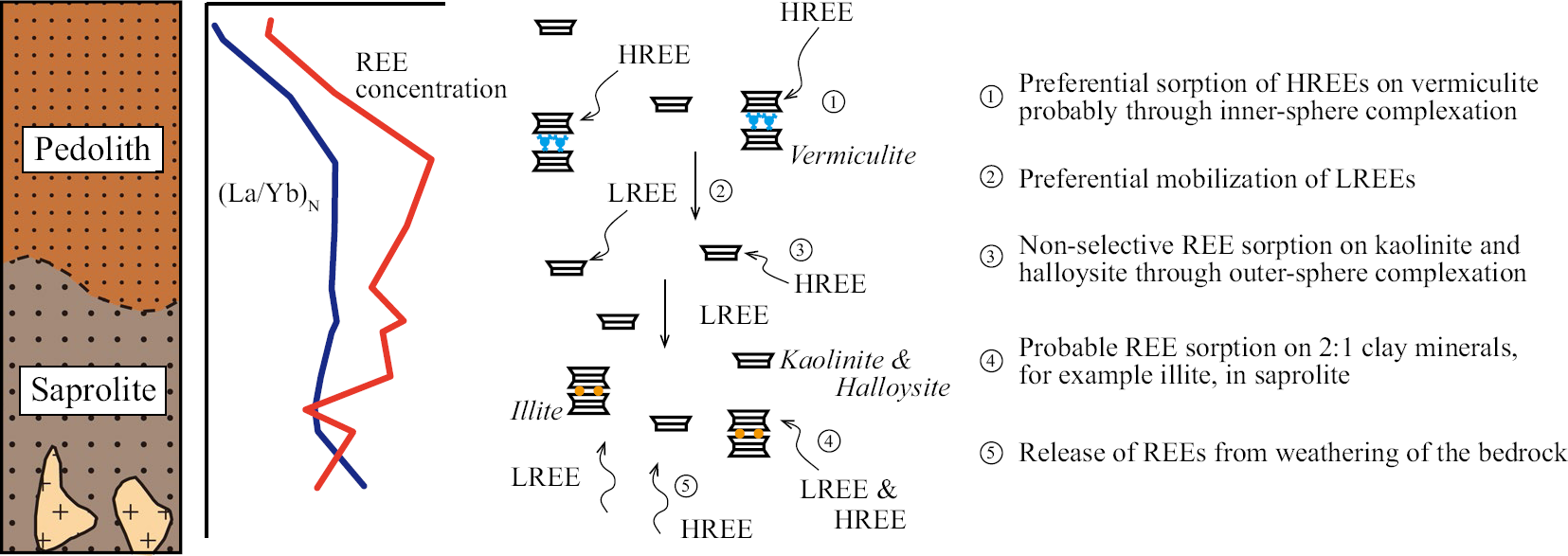
In general, the concentrations of all REEs, except Ce, vary sympathetically throughout the entire profile (Fig. 2e). Cerium, which can be oxidized to a tetravalent state in the supergene environment, often fractionates from its counterpart among the other REEs (e.g. Berger et al., Reference Berger, Janots, Gnos, Frei and Bernier2014; Braun et al., Reference Braun, Pagel, Muller, Bilong, Michard and Guillet1990; Li et al., Reference Li, Zhou and Williams-Jones2019, Reference Li, Zhou and Williams-Jones2020). Oxidation of Ce in the uppermost soil precipitates Ce as cerianite [CeO2] while other trivalent REEs would be mobilized preferentially to greater depth, and thus Ce is decoupled from the other REEs (Fig. 2g). On the other hand, high concentrations of sorbed REE are associated with clay mineral assemblages with large SSA and pore volume values and, less importantly, with a higher CEC value (Fig. 2). In the pedolith, the sorbed REE concentration indicated the role of vermiculite, apart from kaolinite group minerals, in providing the large SSA and CEC for REE sorption and enrichment in the middle of this horizon (Fig. 2b, d). The REEs are believed to be largely adsorbed, on kaolinite group minerals, mainly through outer-sphere complexation on basal surfaces and/or along edges as 8- to 9-coordinated hydrated complexes (Borst et al., Reference Borst, Smith, Finch, Estrade, Villanova-de-Benavent, Nason, Marquis, Horsburgh, Goodenough and Xu2020; Yamaguchi et al., Reference Yamaguchi, Honda, Tanaka, Tanaka and Takahashi2018). In addition to the outer-sphere complexation, the permanent negative charge in 2:1 clay minerals, such as vermiculite, favors inner-sphere complexation (Alshameri et al., Reference Alshameri, He, Xin, Zhu, Xinghu, Zhu and Wang2019; Bradbury & Baeyens, Reference Bradbury and Baeyens2002; Coppin et al., Reference Coppin, Berger, Bauer, Castet and Loubet2002; Stumpf et al., Reference Stumpf, Bauer, Coppin, Fanghänel and Kim2002; Tertre et al., Reference Tertre, Castet, Berger, Loubet and Giffaut2006), especially for the HREEs of smaller ionic radii (Shannon, Reference Shannon1976). Hence, the occurrence of vermiculite in the pedolith could fractionate REEs through preferential sorption of the HREEs, while vertical mobilization of the LREEs would drive the (La/Yb)N ratios of the sorbed REEs to higher values at greater depths (Figs. 2f, 7; Table 3). At the saprolite–pedolith interface (2.9 m), there is a peak in REE concentration (~970 ppm), at which the abundance of vermiculite becomes smaller. On the other hand, halloysite, with its abundance indicated by the IR spectrum, contributes to the large SSA and pore volume of the clay assemblages for REE sorption. This is further supported by the predominance of the ~2.5 nm sized pores that characterize the internal and/or surface pores of halloysite (Churchman et al., Reference Churchman, Davy, Aylmore, Gilkes and Self1995) in the clay assemblages. Halloysite is regarded as a major REE sorbent in the ore-bearing lower pedolith and upper saprolite in many regolith-hosted REE deposits (Li & Zhou, Reference Li and Zhou2020). Nonetheless, the ability of halloysite to fractionate the REEs may not be as strong as vermiculite, as it is postulated that non-selective to slightly selective outer-sphere complexation takes place over halloysite (Yang et al., Reference Yang, Liang, Ma, Huang, He and Zhu2019). Thus, no obvious REE fractionation was observed from the lower pedolith and saprolite (Figs. 2f, 7).
Schematic diagram of the variation of clay minerals and the control on REE enrichment in the Bankeng deposit

Transformation of clay minerals during progressive weathering causes significant changes in the physicochemical properties of the clay assemblages (Li & Zhou, Reference Li and Zhou2020). The transformation of illite to interstratified illite-vermiculite and further to vermiculite would increase the SSA and CEC of the clay minerals for REE sorption. Although the SSA and CEC values of interstratified illite-vermiculite are rarely investigated in the literature and are, thus, unknown, the values are likely to be between those of vermiculite and illite, suggesting the possible additional contribution of the interstratified illite-vermiculite to the SSA and CEC of the clay assemblages for REE sorption. Noted also is the fact that the peak REE concentration at the saprolite–pedolith interface coincided with the predominance of the 2.4 and 2.8 nm pores in the clay-size fraction (sample BK17-A19; depth of 2.9 m) (Fig. 5b). It is speculated that the internal and/or surface pores in this size are favorable for REE sorption whereas the collapse of these pores would cause the desorption of the REEs. Such desorption is made apparent by the concurrent low sorbed REE concentration and absence of the 2.4 and 2.8 nm peaks in the pore-size distribution of the clay-size fraction located at shallower depths than the samples showing the REE concentration peaks (Fig. 5b). Coalescence and transformation of halloysite to well crystallized kaolinite in the pedolith, as suggested by Li and Zhou (Reference Li and Zhou2020), are plausible causes for the collapse of the 2.4- and 2.8-nm pores. The case here illustrates further the control of clay minerals over REE sorption and desorption in weathering profiles (Fig. 7).
Comparison with other Regolith-hosted REE Deposits
The Bankeng deposit is a regolith-hosted LREE deposit developed from weathering of a biotite-chlorite granite (Li et al., Reference Li, Zhou and Williams-Jones2020). Geochemical analyses revealed multiple peaks of REE concentrations along the weathering profiles, especially in the pedolith horizon, both in bulk samples (Li et al., Reference Li, Zhou and Williams-Jones2020) and in the clay-size fractions (present study). Such REE concentrations are not widely observed in regolith-hosted REE deposits reported in the literature (e.g. Berger et al., Reference Berger, Janots, Gnos, Frei and Bernier2014; Fu et al., Reference Fu, Li, Feng, Feng, Peng, Yu and Lin2019a, Reference Fu, Luo, Hu, Feng, Liu, Yang, Feng, Yu and Zhou2019b; Li et al., Reference Li, Zhou and Williams-Jones2019; Sanematsu et al., Reference Sanematsu, Kon, Imai, Watanabe and Watanabe2013) but have been observed in other cases (e.g. Huang et al., Reference Huang, Tan, Liang, He, Ma, Bao and Zhu2021). The REE enrichment in the pedolith may be caused by the formation of 2:1 clay minerals, e.g. vermiculite in this case, with a relatively large SSA, porosity, and CEC for REE sorption. At Bankeng, vermiculite in the pedolith sorbs efficiently the REEs being leached from the shallower regolith and retards the downward migration of the REEs to develop an enrichment zone in the upper part of the lower pedolith (Fig. 7), whereas the magnitude of REE enrichment at the saprolite–pedolith interface is not as intense as observed in other deposits of this type, such as the Zudong deposit in the same region (Li et al., Reference Li, Zhou and Williams-Jones2019). Sorption on vermiculite is more influential on HREEs as the mobility of HREEs during weathering is postulated to be enhanced by strong aqueous HREE-carbonate complex action in the soil waters (Johannesson et al., Reference Johannesson, Stetzenbach, Hodge and Lyons1996; Li et al., Reference Li, Kwong, Williams-Jones and Zhou2022). The appearance of 2:1 clay minerals in the pedolith with greater ability to sorb HREEs would hinder the migration of HREEs preferentially over LREEs; thus the sorbed REEs are characterized by a gradual increase in the (La/Yb)N ratios from the upper to the lower pedolith (Figs. 2f, 7).
This study also illustrates the potential roles of clay minerals, other than those in the kaolinite group, in the enrichment of REEs in the regolith. Although there has been a study indicating the possible role of illite in accumulating REEs in saprolite (Mukai et al., Reference Mukai, Kon, Sanematsu, Takahashi and Ito2020), few studies have evaluated comprehensively the role of other 2:1 clay minerals in regolith-hosted ore formations. Nonetheless, other 2:1 clay minerals may play a role in enhancing the REE enrichment, particularly considering the relatively strong sorption ability of these minerals. The present study has demonstrated that vermiculite could facilitate REE enrichment, especially in the pedolith where metastable halloysite has largely been transformed to more crystalline kaolinite with less sorption capacity (Li & Zhou, Reference Li and Zhou2020).
Conclusions
In the Bankeng deposit, progressive transformation of clay minerals occurred during weathering, i.e. the transformation from halloysite and illite, minerals which dominate in the saprolite and lower pedolith, to kaolinite and vermiculite in the upper pedolith. Associated with changes in the clay mineral assemblage, the physicochemical properties vary significantly along the weathering profile. Vermiculite apparently shows strong control over the SSA, pore volume, and CEC of the clay mineral assemblage while pore sizes characterizing halloysite are reflected in the pore-size distribution. Large SSA and pore volume values contributed by vermiculite probably lead to REE sorption and enrichment in the upper part of the lower pedolith, while halloysite is associated with the REE enrichment at the saprolite–pedolith interface. Progressive transformation of halloysite to kaolinite led to the destruction of the halloysite pores, thus causing desorption to deplete the REEs from the shallower regolith. This study highlights the potential role of clay minerals in REE sorption and enrichment in regolith, especially the 2:1 clay minerals in other regolith horizons apart from the saprolite–pedolith interface, to form economic regolith-hosted deposits.
Acknowledgements
This study was supported financially by grants from the National Natural Science Foundation of China (92162323, 91962216). Constructive comments by the Editor-in-Chief Dr. Joseph W. Stucki, Associate Editor Dr. W. Crawford Elliott, Dr. Jim Hower, and two anonymous reviewers helped to improve the manuscript.
Data Availability
All data used in this paper are given in the figures and tables.
Declarations
Conflicts of Interest
There are no conflicts of interest.