

Hip fractures are a major global health care issue, especially for the increasing population of older people (Beaupre et al., Reference Beaupre, Binder, Cameron, Jones, Orwig, Sherrington and Magaziner2013). Approximately 30,000 hip fractures are reported in Canada each year and are projected to increase to 88,124 in 2041 (Health Quality Ontario & Ministry of Health and Long-Term Care, 2013; Papadimitropoulos, Coyte, Josse, & Greenwood, Reference Papadimitropoulos, Coyte, Josse and Greenwood1997). Post-surgical hip fracture rehabilitation is important to minimize negative sequelae such as decreased mobility and quality of life, permanent disability, loss of independence, and increased morbidity, mortality, and burden of care for patients’ families and informal caregivers (Health Quality Ontario & Ministry of Health and Long-Term Care, 2013). Baycrest Health Sciences (Toronto, Canada) has two post-acute care inpatient rehabilitation programs: high tolerance short duration rehabilitation (HTSD), usually provided in designated rehabilitation beds, and low tolerance long duration rehabilitation (LTLD, or slow stream rehabilitation), a provincial-specific designation that is commonly provided to patients in complex continuing care (CCC) beds. CCC provides medically complex care, sometimes over an extended period. Patients who are medically stable but cannot tolerate a higher intensity of rehabilitation, or who may need a longer length of stay (LOS) to maximize function and facilitate safe return to the community, are admitted to LTLD rehabilitation (GTA Rehab Network, 2009; O’Neill, McCarthy, & Newton, Reference O’Neill, McCarthy and Newton1987; Rehabilitative Care Alliance, 2015).
Using a patient-centred, goal-directed approach, care and therapy within each stream of rehabilitation are provided by an inter-professional team whose expertise includes helping patients improve their strength, mobility, balance, and walking; optimizing the activities of daily living; providing equipment recommendations and strategies for managing in the home environment; addressing memory and thinking problems; and managing chronic pain. The inter-professional teams also support patients in enhancing and restoring their functional independence in preparation for discharge, assisting patients and caregivers in returning to their previous living environment to continue with supports or services, and referring the patient for ongoing rehabilitation on an outpatient basis as needed. Patients in HTSD receive physiotherapy 6 days per week, whereas those in LTLD are offered physiotherapy up to 6 days. As there is no standardized method of triaging patients, the allocation of patients with hip fracture into LTLD and HTSD streams is determined on the basis of a set of criteria including the patient’s premorbid status, and cognitive and functional status, that utilizes clinical judgement and experience.
The Ministry of Health and Long-Term Care in Ontario has implemented Quality-Based Procedures (QBP) to inform clinical redesign and funding allocation, and to improve quality of care and patient outcomes for high-cost conditions (Health Quality Ontario & Ministry of Health and Long-Term Care, 2013). The QBP for patients with hip fracture indicates a target LOS of 28 days, and general clinical guidelines for LOS in LTLD range up to 90 days (Beaupre, Reference Beaupre2011; Health Quality Ontario & Ministry of Health and Long-Term Care, 2013). Studies have identified two primary discharge destinations post-hospital admission: (1) home which involves living in the community or a retirement home, and (2) long-term care facility or another institution (Health Quality Ontario & Ministry of Health and Long-Term Care, 2013). Post-fracture repair, the QBP considers discharge home a better outcome because patients prefer to return home and doing so is associated with improved quality of life (Health Quality Ontario & Ministry of Health and Long-Term Care, 2013). Furthermore, when a patient is discharged to an institution following admission from home for surgical hip fracture repair (i.e., a change in residence), they are at an increased risk of mortality (Ariza-Vega, Kristensen, Martin-Martin, & Jimenez-Moleon, Reference Ariza-Vega, Kristensen, Martin-Martin and Jimenez-Moleon2015).
Currently, there is a lack of consensus and literature regarding which factors are associated with increased LOS and discharge home, especially for patients with hip fracture in LTLD. Existing literature does support that a longer time from surgery to beginning rehabilitation (specifically > 6 days post-repair), worse cognition, older age, low prefracture level of function, preoperative ambulation assistance level and gait aid use, living alone, vision or hearing impairment, and pain are associated with worse functional outcomes following a hip fracture (Blackman-Weinberg, Crook, Roberts, & Weir, Reference Blackman-Weinberg, Crook, Roberts and Weir2005; Canadian Institute for Health Information, 2015; Cheng et al., Reference Cheng, Lau, Hui, Chow, Pun, Ng and Leong1989; Health Quality Ontario & Ministry of Health and Long-Term Care, 2013; Hershkovitz, Kalandariov, Hermush, Weiss, & Brill, Reference Hershkovitz, Kalandariov, Hermush, Weiss and Brill2007; Heruti, Lusky, Barell, Ohry, & Adunsky, Reference Heruti, Lusky, Barell, Ohry and Adunsky1999; Hulsbaek, Larsen, & Troelsen, Reference Hulsbaek, Larsen and Troelsen2015; Kristensen, Foss, & Kehlet, Reference Kristensen, Foss and Kehlet2009; Kristensen, Reference Kristensen2013; Landi et al., Reference Landi, Bernabei, Russo, Zuccala, Onder, Carosella and Cocchi2002; Lee, Jo, Jung, & Kim, Reference Lee, Jo, Jung and Kim2014; Semel, Gray, Ahn, Nasr, & Chen, Reference Semel, Gray, Ahn, Nasr and Chen2010).
Additionally, females are five times more likely to be successful in rehabilitation, while males achieve less gain in Functional Independence Measure (FIM) scores during the rehabilitative stay (Lieberman et al., Reference Lieberman, Fried, Castel, Weitzmann, Lowenthal and Galinsky1996; Semel et al., Reference Semel, Gray, Ahn, Nasr and Chen2010). The presence of informal support at home and sufficient support prefracture, younger age, absence of delirium, better cognition, higher FIM motor score, vision in at least one eye, and independence with ADLs on admission to rehabilitation are associated with discharge home or to the community (Blackman-Weinberg et al., Reference Blackman-Weinberg, Crook, Roberts and Weir2005; Canadian Institute for Health Information, 2015; Gialanella, Ferlucci, Monguzzi, & Prometti, Reference Gialanella, Ferlucci, Monguzzi and Prometti2015; Health Quality Ontario & Ministry of Health and Long-Term Care, 2013; Marcantonio, Flacker, Michaels, & Resnick, Reference Marcantonio, Flacker, Michaels and Resnick2000; Wang et al., Reference Wang, Graham, Karmarkar, Reistetter, Protas and Ottenbacher2014).
Factors associated with a longer rehabilitation LOS include older age, male sex, lower physical and cognitive function on admission, diabetes, and higher number of co-morbidities (Arinzon, Fidelman, Zuta, Peisakh, & Berner, Reference Arinzon, Fidelman, Zuta, Peisakh and Berner2005; Castelli, Daidone, Jacobs, Kasteridis, & Street, Reference Castelli, Daidone, Jacobs, Kasteridis and Street2015; Health Quality Ontario & Ministry of Health and Long-Term Care, 2013; Hershkovitz et al., Reference Hershkovitz, Kalandariov, Hermush, Weiss and Brill2007; Hershkovitz, Beloosesky, & Brill, Reference Hershkovitz, Beloosesky and Brill2012; Semel et al., Reference Semel, Gray, Ahn, Nasr and Chen2010). Being married is associated with better discharge outcomes as well as decreased LOS (Semel et al., Reference Semel, Gray, Ahn, Nasr and Chen2010). Additionally, the literature supports that cognitive impairment, such as delirium and dementia, is predictive of longer LOS and less successful functional recovery (Hershkovitz et al., Reference Hershkovitz, Kalandariov, Hermush, Weiss and Brill2007; Landi et al., Reference Landi, Bernabei, Russo, Zuccala, Onder, Carosella and Cocchi2002; Lee et al., Reference Lee, Jo, Jung and Kim2014; Marcantonio et al., Reference Marcantonio, Flacker, Michaels and Resnick2000). None of the previous studies examined different types of inpatient rehabilitation settings.
The study objective was to describe the patient characteristics and outcomes in LTLD and HTSD that are associated with LOS and discharge destination in order to inform decision-making.
Methods
Study Design and Data Collection
At the outset of our study, we conducted a retrospective chart review to collect data on patients with hip fracture admitted to LTLD and HTSD inpatient rehabilitation units at Baycrest Health Sciences in Toronto from January 1 until December 31, 2015. Approval for this study was granted by the University of Toronto and Baycrest Health Sciences research ethics boards.
We collected data from electronic medical records, the Resource Matching and Referral system (RM&R), and the National Rehabilitation Reporting System (NRS). The RM&R is an application used in parts of Ontario which electronically matches patient referrals with appropriate clinical programs and services (Toronto Central Local Health Integration Network, 2015). Hospital facilities in Ontario are mandated to submit data, including the FIM through the NRS, on all patients admitted to a designated rehabilitation bed to the Canadian Institute for Health Information. The FIM, which is validated in geriatric populations, contains 18 items composed of 13 motor tasks and 5 cognitive tasks rated on a 7-point ordinal scale that ranges from complete dependence to complete independence (Uniform Data System for Medical Rehabilitation, 2016). Scores range from 18 (lowest functioning) to 126 (highest functioning), and assess dimensions including eating, bathing, grooming, upper and lower body dressing, toileting, bladder and bowel management, bed to chair transfer, toilet and shower transfer, stairs ability, and locomotion. Cognitive dimensions include comprehension, expression, social interaction, problem solving, and memory.
A data abstraction form with standardized coding that we created collected variables of interest. There were five data abstractors, and inter-rater reliability was achieved by reviewing the first 10 charts to ensure there was agreement of data sources and coding. We collected sociodemographic, functional, and clinical variables for each patient. Sociodemographic variables included age on admission to rehabilitation, sex, and prefracture living situation (e.g., living alone, with spouse, with family, as per NRS coding). Functional characteristics included premorbid gait aid use, independence with bathing, and independence with instrumental activities of daily living (IADLs) as reported by health care practitioners in the electronic chart, existing home-care Community Care Access Centre support, FIM scores (motor, cognition, and total) at admission to rehabilitation, and change in FIM total score from admission to discharge. Clinical variables included the presence of diabetes, number of co-morbidities, and days from surgery to rehabilitation. Outcome variables were discharge destination and LOS in rehabilitation at Baycrest Health Sciences. Discharge destination was defined as either a return to prefracture residence (“home”) or alternative discharge location (“not home”), such as a more supportive living environment or long-term care facility. For example, if a patient resided in their own home prefracture and was discharged to a more supportive environment such as a retirement home or relative’s home, they were grouped into the not home category. LOS was calculated by using the admission and discharge dates from inpatient rehabilitation.
Study Sample and Data Analysis
The inclusion criteria were patients aged 55 years or older admitted and discharged from inpatient rehabilitation between January 1 and December 31, 2015 with femoral neck, pertrochanteric, or subtrochanteric fracture. The exclusion criteria were patients with multi-fracture sites other than the hip and patients who transferred between HTSD and LTLD during their rehabilitation stay.
We analysed the data with IBM SPSS Version 23 software. Any given patient characteristic or outcome variable missing in greater than 20 per cent of sampled patients was excluded from analysis due to insufficient data. An alpha level of 0.05 was used to determine statistical significance.
Descriptive statistics were calculated to describe sociodemographic, functional, and clinical characteristics for each as a function of stream of rehabilitation and discharge destination (home and not home) within each stream of rehabilitation. Following categorization into home and not home, some patients were not included due to missing pre-to-post living environment data or an unexpected discharge to acute care. However, these patients were still included in analyses describing the total HTSD and LTLD populations. We used t-tests and chi-square tests to compare differences between rehabilitation streams (HTSD vs. LTLD) and conducted an equivalent nonparametric test, the Mann-Whitney, if the sample was not normally distributed. Within rehabilitation streams, the same tests let us compare the difference between characteristics in those discharged home and not home (e.g., home HTSD vs. not home HTSD).
Multiple linear and simple linear regression analyses were conducted in HTSD and LTLD respectively to describe the relationship between key variables of interest and the outcome variable, LOS in rehabilitation. We identified outliers and eliminated them if they were three standard deviations above or below the mean (Howell, Reference Howell1998). All variables were entered simultaneously into the initial regression model for each stream of rehabilitation if variables had a significant relationship (p ≤ .05) with LOS in rehabilitation on bivariate analysis.
Results
Study Sample
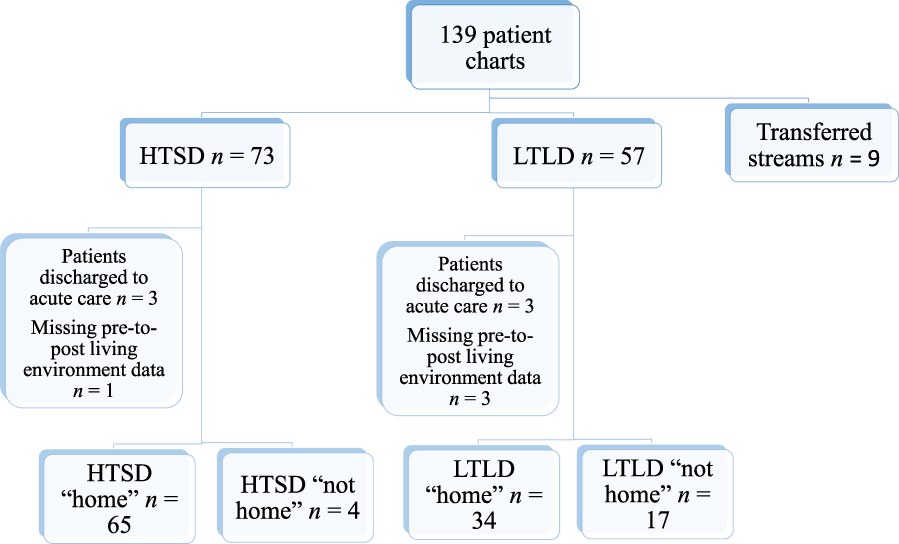
We reviewed a total of 139 patient charts and excluded nine patients for transferring between HTSD and LTLD, leaving 130 eligible patients for inclusion in this study (HTSD n = 73 and LTLD n = 57). For the descriptive analyses, when subdividing patients into home and not home, we excluded four patients due to missing pre-to-post living environment data, and six patients due to being discharged to acute care (see Figure 1).
Flowchart depicting study sample and outcome variables by rehabilitation stream

Patient Characteristics by Type of Rehabilitation (HTSD vs. LTLD)
Demographic Characteristics
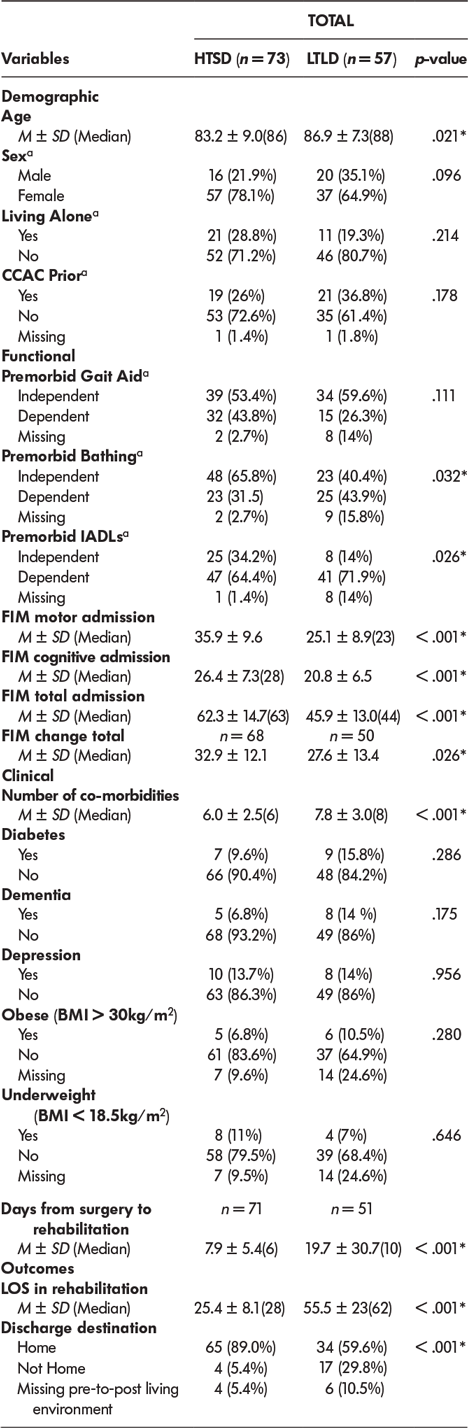
Among patients in HTSD, the mean age was 83.2 ± 9.0 years and 78.1 per cent (n = 57) of patients were female (see Table 1). Premorbidly, 47.9 per cent (n = 35) of patients lived in an apartment or condominium, 39.7 per cent (n = 29) lived in a house, 11.0 per cent (n = 8) resided in a retirement home, and 1.4 per cent (n = 1) of patients resided in convalescent care. For patients in LTLD, the mean age was 86.9 ± 7.3 years and 64.9 per cent (n = 37) of patients were female. Premorbidly, 43.9 per cent (n = 25) of patients lived in a house, 28.1 per cent (n = 16) lived in an apartment or condominium, 24.6 per cent (n = 14) lived in a retirement home, and 1.8 per cent (n = 1) lived in a facility or assisted living. Data was missing on 1.8 per cent (n = 1) of patients for this variable.
Demographic, functional, and clinical characteristics of patients with hip fracture in high tolerance short duration (HTSD) and low tolerance long duration (LTLD) rehabilitation

Note. a n(%). CCAC = Community Care Access Centre; FIM = Functional Independence Measure; LOS = length of stay; M = mean, SD = standard deviation; median presented if data were not normally distributed.
* Significant; p ≤ .05.
Clinical Characteristics
Compared to HTSD, patients in LTLD were statistically significantly less likely to be independent with bathing (40.4% LTLD vs. 65.8% HTSD, p = .032) and IADLs (14.0% LTLD vs. 34.2% HTSD, p = .026) premorbidly. Patients in LTLD also had lower FIM scores at admission (motor FIM: 25.1 LTLD vs. 35.9 HTSD, p ≤ .001; cognitive FIM: 20.8 LTLD vs. 26.4 HTSD, p ≤ .001; total FIM: 45.9 LTLD vs. 62.3 HTSD, p ≤ .001). They also demonstrated less change in total FIM score during their rehabilitation period (27.6 LTLD vs. 32.9 HTSD, p = .026). Lastly, patients in LTLD were older (86.9 LTLD vs. 83.2 HTSD, p = .021), had a higher number of co-morbidities (7.8 LTLD vs. 6.0 HTSD, p ≤ .001) and more days from surgery to rehabilitation (19.7 LTLD vs. 7.9 HTSD, p ≤ .001) than those in HTSD (see Table 1).
Discharge Destination and Length of Stay
Patients who were missing pre-to-post living environment data or transferred to acute care (n = 4 HTSD, n = 6 LTLD) were removed from the discharge statistical analysis. Post-discharge from HTSD, 46.4 per cent (n = 32) of patients lived in an apartment or condominium, 39.1 per cent (n = 27) lived in a house, 11.6 per cent (n = 8) resided in a retirement home, 1.4 per cent (n = 1) lived in a relative’s house, and 1.4 per cent (n = 1) were transferred to Baycrest Health Sciences’ Alternative Level of Care floor. In HTSD, patients had an average rehabilitation LOS of 25.4 days, 94.2 per cent of patients (n = 65) returned to premorbid living environment and were categorized as discharged home, and 60.9 per cent (n = 42) were discharged in ≤ 28 days (QBP LOS guidelines).
Post-discharge from LTLD, 37.3 per cent (n = 19) of patients lived in a house, 27.5 per cent (n = 14) resided in a retirement home, 19.6 per cent (n = 10) lived in an apartment or condominium, 9.8 per cent (n = 5) were transferred to Baycrest Health Sciences’ Alternative Level of Care floor, 2 per cent (n = 1) were discharged to a nursing home, 2 per cent (n = 1) lived in supportive housing, and 2 per cent (n = 1) were sent to palliative care. In LTLD, patients had an average rehabilitation LOS of 55.5 days, 66.7 per cent of patients (n = 34) returned to their premorbid living environment and were categorized as discharged home, and 9.8 per cent (n = 5) were discharged in ≤ 28 days (QBP LOS guidelines). Compared to patients in HTSD, patients in LTLD were significantly less likely to return home (p < .001), meet LOS guidelines (p < .001), and had significantly longer LOS in rehabilitation (p < .001).
Characteristics Associated with Outcome Variables by Rehabilitation Stream
Characteristics Associated with Returning “Home”
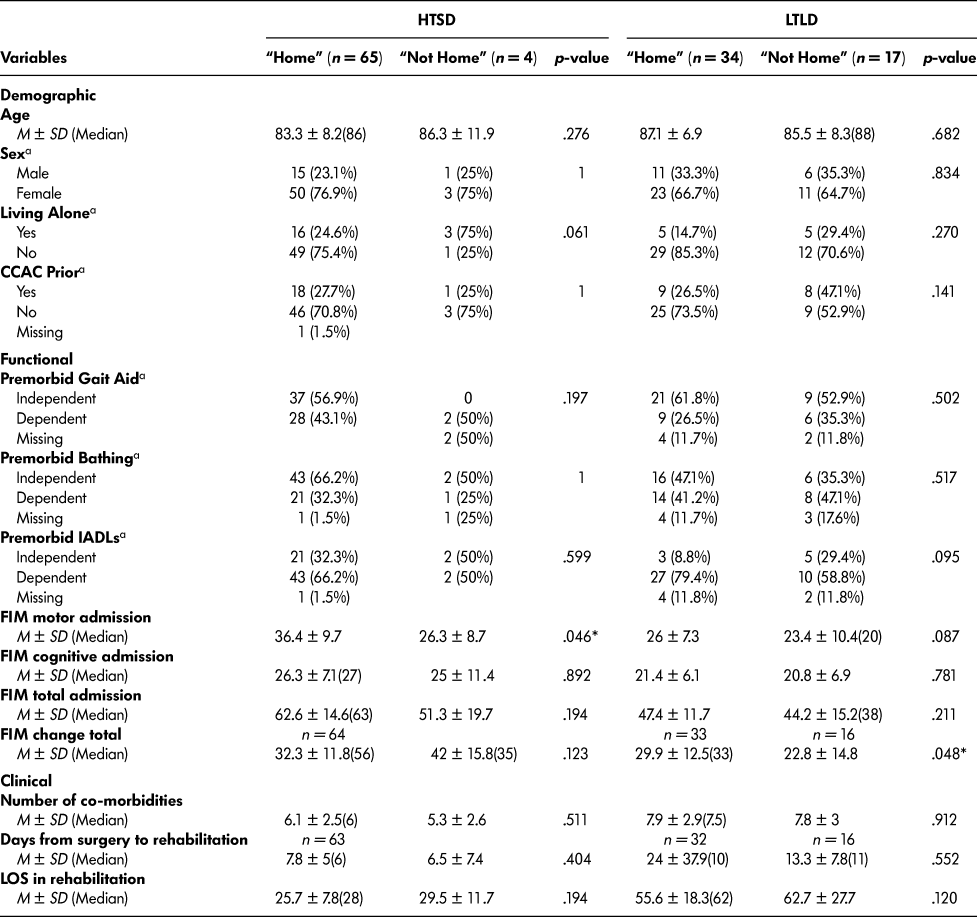
Within HTSD, those who returned home (94.2%) had a statistically significant higher FIM motor score (36.4 ± 9.7) on admission compared to those who were discharged not home (26.3 ± 8.7). Within LTLD, those who returned home (66.7%) had a statistically significant larger FIM change score (29.9 ± 12.5) compared to those who were discharged not home (22.8 ± 14.8) (see Table 2).
Characteristics of patients with hip fracture discharged “home” and “not home” in high tolerance short duration (HTSD) and low tolerance long duration (LTLD) rehabilitation

Note. a n(%). CCAC = Community Care Access Centre; FIM = Functional Independence Measure; LOS = length of stay; M = mean, SD = standard deviation; median presented if data were not normally distributed.
* Significant; p ≤ .05.
Factors Associated with Length of Stay
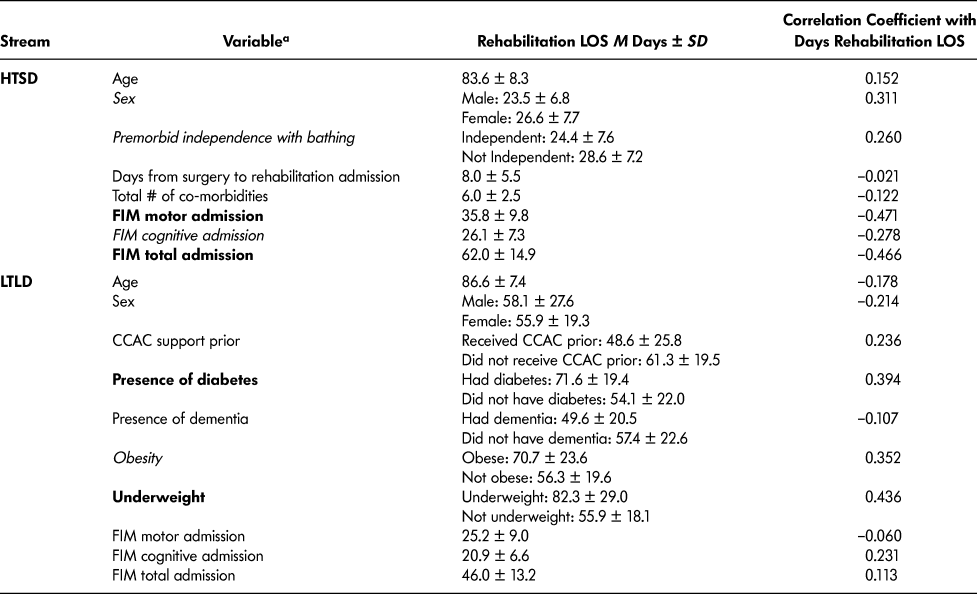
Factors that were individually associated with rehabilitation LOS within LTLD and HTSD are reported in Table 3. We performed a multiple linear regression analysis for HTSD and a simple linear regression analysis for LTLD to examine factors associated with rehabilitation LOS (see Tables 4 and 5 respectively). All assumptions of multiple and simple linear regression were met. Sex, premorbid independence with bathing, FIM motor score on admission, FIM cognitive score on admission, and total FIM score on admission were chosen for HTSD based on bivariate correlation with LOS in rehabilitation. FIM motor score on admission and FIM cognitive score on admission were excluded from the final models due to collinearity with the included factors. The presence of diabetes, being overweight, and being underweight were entered into the model for LTLD based on bivariate correlation with LOS. Using enter analysis with p = .05, only one variable remained predictive for LOS in rehabilitation for each stream.
Bivariate analyses of factors associated with rehabilitation LOS in HTSD and LTLD

Note. a Italic variables: p < .05, bold variables: p < .01. CCAC = Community Care Access Centre; FIM = Functional Independence Measure; HTSD = high tolerance short duration; LTLD = low tolerance long duration; LOS = length of stay; M = mean; SD = standard deviation.
HTSD Multiple regression results for rehabilitation LOS

Note. (Italics: p < .05, bold: p < .01). FIM = Functional Independence Measure; HTSD = high tolerance short duration; LOS = length of stay.
LTLD Linear regression results for rehabilitation LOS

Note. (Italics: p < .05, bold: p < .01). LOS = length of stay; LTLD = low tolerance long duration.
Results of the regression for variables in HTSD that predict length of stay indicated that only total FIM admission scores were significantly related to LOS once one outlier was removed (p < .01). These results were confirmed using backwards, forwards, and stepwise regression. We attempted a multiple linear regression analysis for LTLD using the presence of diabetes, obesity, and underweight as predictive factors; however, multiple linear regression analysis could not be conducted with obesity and underweight included in the model as there was too much missing data (24%). Missing variables were not randomly distributed as patients with high co-morbidities and males were more likely to be missing. As a result, we conducted a simple linear regression using the presence of diabetes as a predictive factor for LOS in rehabilitation for LTLD. In LTLD, the model showed that only diabetes was significantly related to LOS (p = .039).
Discussion
Comparison of HTSD and LTLD Populations
The results of this study indicate that patients in HTSD and LTLD differ significantly with regard to age, premorbid independence with bathing and IADLs, number of co-morbidities, admission FIM (motor, cognitive, and total), FIM change (total), days from surgery to rehabilitation, LOS in rehabilitation, and discharge destination. These results confirm that patients in these two streams of rehabilitation are indeed different populations and help support the admission triage criteria and the need for rehabilitation programs of different lengths, intensities, and resources. As there is limited literature defining the LTLD population, describing these patient characteristics may help inform clinical decision-making and encourage research evaluating the effectiveness of the LTLD program or the development of a standardized triaging tool. Furthermore, since individuals who transferred from HTSD to LTLD were excluded from this study, further research should quantify their characteristics. Examination of this subpopulation with a larger sample size may shed light on key characteristics that may not be clinically recognized on admission as indicators of appropriate rehabilitation stream, LOS, and discharge destination.
Functional Characteristics Associated with Discharge Destination
Among LTLD patients with pre-to-post living environment data, 66.7 per cent (n = 34) of patients returned to their premorbid living environment, which is similar to research in previous literature that found 61.5 per cent of patients returned home (Leung et al., Reference Leung, Katz, Karuza, Arling, Chan, Berall and Naglie2016). Patients in LTLD who did not return home had fewer functional gains, as measured by change in FIM total score. In our study, patients in LTLD who were classified as not home had a mean increase in total FIM of 23 points whereas those in LTLD who returned home had a mean change in total FIM of 30 points which is similar to previous literature (Wang et al., Reference Wang, Graham, Karmarkar, Reistetter, Protas and Ottenbacher2014). Our results did not find a significant difference in change in total FIM in an HTSD population between those who went home and those who did not. However, few individuals in HTSD were classified as being discharged not home (n = 4). In practice, change in total FIM has limited use as a predictive factor for returning home as it is available only at discharge. FIM motor score on admission may be more clinically useful as this was significantly different between streams.
Functional Characteristics Associated with Length of Stay
Patients in HTSD with a lower FIM total on admission had a longer LOS. This is consistent with a previous study that indicated that patients with lower overall function on admission had longer LOS (Hershkovitz et al., Reference Hershkovitz, Kalandariov, Hermush, Weiss and Brill2007). The FIM is used as a standardized practice to estimate LOS in stroke rehabilitation in Ontario; Baycrest Health Sciences also uses admission FIM scores in the HTSD rehabilitation stream (but not in LTLD) to estimate a target rehabilitation LOS for patients after a hip fracture (Health Quality Ontario and Ministry of Health and Long-Term Care, 2016). The findings in this study support the emerging practice of using FIM scores to estimate LOS in HTSD rehabilitation for patients with hip fracture. For example, FIM total score explained a moderate amount of LOS variability in this study, with LOS and FIM score being inversely correlated in HTSD. These results can assist health care teams upon admission to estimate LOS and to inform discharge planning in an HTSD population.
Other Characteristics Associated with Length of Stay and Discharge Destination
Previous literature has shown that diabetes, dementia, depression, hypertension, weight-bearing status, and Braden score (pressure sore risk) are associated with LOS or discharge destination (Castelli et al., Reference Castelli, Daidone, Jacobs, Kasteridis and Street2015; Hershkovitz et al., Reference Hershkovitz, Kalandariov, Hermush, Weiss and Brill2007; Huusko, Karppi, Avikainen, Kautiainen, & Sulkava, Reference Huusko, Karppi, Avikainen, Kautiainen and Sulkava2000; Morghen et al., Reference Morghen, Bellelli, Manuele, Guerini, Frisoni and Trabucchi2011; Semel et al., Reference Semel, Gray, Ahn, Nasr and Chen2010). Factors such as dementia and depression may have had an impact on LOS and, thus, on the variance in the regression analysis; however, as this study was a retrospective review, cognitive impairment and depression were not consistently measured in a standardized way and therefore were not included in the data abstraction and analysis. It is not likely that weight-bearing status, pressure sore risk, and hypertension would be associated with LOS in this study as all patients had limited variability for these characteristics. This study found that only diabetes was associated with a longer LOS for patients in LTLD, although the effect size was small in the simple linear regression. With only one variable entered into the regression analysis for LTLD, limited variance could be explained with our model so interpreting these results should be done with caution. The small sample size in this study likely limited the ability to detect other factors that may have contributed to LOS, so these results require confirmation in larger studies.
Study Limitations
Small sample size and the single-site study design are the main limitations of this study. Patients who were discharged to acute care (n = 6) were included in analyses of total HTSD and LTLD so we could achieve a better understanding of the characteristics of each patient population as the number of patient charts we examined was small (n = 139). However, we excluded them from LOS regression analysis to prevent distortion of data (i.e., shorter LOS was due to acute illness) and when subdividing the HTSD and LTLD populations by discharge destination for analysis. Because the sample size of those who did not return home in HTSD was small (n = 4), we were unable to determine factors associated with discharge destination from this unit. In addition, the sample size of those who did not return home in LTLD was also small (n = 17), and therefore it is difficult to draw meaningful conclusions regarding the LTLD population; the findings cannot be generalized.
Sample size may also account for the insignificance of other factors in this study that the literature showed to be related to LOS, such as age and sex (Arinzon et al., Reference Arinzon, Fidelman, Zuta, Peisakh and Berner2005; Health Quality Ontario & Ministry of Health and Long-Term Care, 2013b). A larger sample size would allow for greater power and better detection in the regression of factors associated with LOS. Future research would benefit from a greater sample size (more years of data or data from multiple sites) to have a better understanding of the LTLD population. Socioeconomic status and geographical differences could not be accounted for in this single-site study.
Conclusion
This study adds to the literature by further exploring the characteristics of patients following a hip fracture in both HTSD and LTLD rehabilitation streams and highlights that differences exist between these populations. Patients in LTLD were significantly less likely to meet QBP LOS guidelines of ≤ 28 days, less likely to return home, were older, less independent with bathing and IADLs premorbidly, had lower FIM admission scores, more co-morbidities, and more days from surgery to rehabilitation than those in HTSD rehabilitation. A higher FIM motor admission score was significantly associated with discharge home in HTSD, and a greater change in total FIM score was significantly associated with discharge home in LTLD although there was a very small sample size in each stream of those who did not return home. Finally, higher FIM total score on admission was associated with decreased LOS in HTSD, and the presence of diabetes was associated with an increased LOS in LTLD in regression analyses.
The results of this study demonstrate the need for future research to include larger sample sizes in order to further explore the characteristics of LTLD populations, and to identify which factors are most significantly associated with LOS and discharge destination within this stream of rehabilitation. Further research should include prospective studies wherein factors such as duration, type, and frequency of therapy are considered. Information gleaned from further research could then be used to ensure that patients are admitted to a rehabilitation stream with the appropriate level of care, and that they are allowed sufficient time and resources to maximize patient outcomes.