In the wake of Teresa A. Goddu's Gothic America,Footnote 1 the US strain of gothic fiction is increasingly being understood not as escapist fantasy – fanciful tales of darkness and terror detached from history and politics – but as commentary on the very society that produced it. As such “the gothic … needs to be historicized.”Footnote 2 This particular genre, Goddu argues, deals in themes that are “abject”: they constitute “historical horrors” displaced into the fantastic to render them expressible.Footnote 3 And the list of these “historical horrors” is indeed long, especially in the early days of the American republic: from unequal representation, poverty, and the repression of women and (ethnic or religious) minorities, to slavery and the genocide against the various Native peoples. That the gothic made its leap across the ocean at this turbulent time is certainly no coincidence, Goddu rightfully reminds us – and like many, she turns to Charles Brockden Brown's Wieland to prove her point.
Although it is clear by now that Brown's famous 1789 novel is by no means the first gothic novel to come out of the “New World” (that honor likely belongs to the anonymous St. Herbert of 1796), it certainly figures as one of the most influential in American literary history. It also remains one of the very pieces that struggle quite fervently against letting us glimpse into their “abject” interior. Quite often, even historical criticism of the novel is mainly preoccupied with issues of the psyche, or reads Wieland's convoluted plot about ventriloquism, hauntings and murder as an abstract allegory of republicanism of sorts.Footnote 4 (Even Goddu herself discusses the story as the latter.Footnote 5 ) Are we, then, to believe that Wieland has nothing to say about arguably more pressing horrors such as slavery or genocide? Especially striking – considering Brown's other novels (and scholarly commentary on them) – is how rarely the fate of Native peoples figure in analyses of this peculiar tale. At first glance, this absence seems reasonable, given that Brown's readers are treated to a mere two sentences that even mention “Indians” directly. Still, there is a certain aura of indigenous anxiety that lingers behind Wieland's strangely allegorical plot, its oddly alien characters and its truly remarkable, Euro-American setting. “The American Indian presence in Wieland,” Sarah Rivett rightly proposes, “is highly visible at the same time that it recedes into a haunted backdrop that can be easily missed by the reader.”Footnote 6 The following pages will trace such a claim into the historical context of Brown's Philadelphia to discover what Rivett terms a “spectral Indian presence,”Footnote 7 and lay out how Brown carefully inscribes this subtext into his narrative. Reading this Native presence, I will argue, is crucial to understanding the full depth of its gothic denunciation of fathers' guilt, ownership of stolen lands and troubled self-image of European settlers.
The Native inhabitants of Pennsylvania have, indeed, become uncanny shadows in the young author's rendering, but in their bodily absence they disclose unspeakable crimes from the colonial past – and at the center of this history stand the tale's main protagonists: the Wieland family. Still, I will argue, this “presence” would have been much less “invisible” for a contemporary audience than Rivett seems to suggest. It appears, then, that these Native specters are not a marker of repression on the part of the author – a psychological hiccup of sorts – but rather an authorial and political strategy of Brown aimed at fundamentally unsettling the colonial mindset of his protagonists (as well as his contemporaries). In reassessing the indigenous subtext of Wieland we find Brown, in the end, negotiating the very limits and possibilities of white authorship in occupied, Native lands.
ALIEN VOICES
The first thing one might notice when reading Wieland is how strangely foreign this self-termed “American Tale” is. Going out of his way to Germanize his protagonists, Brown treats his readers not only to an all-German cast of main protagonists living on a farm named for a Prussian town but also to numerous, rather detailed, spotlights on German history, literature and theology that appear to have no direct relation to the story's main plot. Given its prominent role in the novel, it is striking how comparatively little research exists on Wieland's Prusso-German affinities. Indeed, Sydney J. Krause's reading of Brown's oeuvre as a commentary on German American culture in late eighteenth-century Philadelphia appears to be the only thorough investigation into this topic to date.Footnote 8 While the majority of scholarship on this aspect of the novel focusses on a theological, epistemological or republican discourse that might be contained in the juxtaposition of German Protestant sects in Wieland,Footnote 9 no real attempt has been made to connect the presence of “these foreign-speaking people”Footnote 10 in the novel to its main plot device: ventriloquism.
Ventriloquism in Wieland is neither the popular “form of rational entertainment” that it had become in the late 1700s for enlightened Americans,Footnote 11 nor merely a simple hoax performed by a mischievous trickster (in this case a figure named Carwin). Instead, it is a distortion of space. In his elaborate footnote on the practice, Brown describes it as follows (italics mine):
BILOQUIUM, or ventrilocution. Sound is varied according to the variations of direction and distance. The art of the ventriloquist consists in modifying his voice according to all these variations, without changing his place.
… This power is difficult to explain, but the fact is undeniable. Experience shows that the human voice can imitate the voice of all men and of all inferior animals. The sound of musical instruments, and even noises from the contact of inanimate substances, have been accurately imitated …
[Ventriloquizing] may, possibly, consist in an unusual flexibility or exertion of the bottom of the tongue and the uvula. That speech is producible by these alone must be granted, since anatomists mention two instances of persons speaking without a tongue. In one case, the organ was originally wanting, [in] the other, the tongue was destroyed by disease.Footnote 12
This aspect of “throwing the voice”Footnote 13 – an auditory trick that is believed to obscure the origin of the ventriloquist's words – is a quite troublesome notion in Wieland. Introduced through examples of speaking without a tongue, the reader is led to approach ventriloquism as voice without direct origin, utterance without locus. For Brown, who would soon draft a poem titled “Inchanting Tongue!” that would poeticize the tongue as the very source of speech and meaning, this is certainly a fascinating proposition.Footnote 14 Ventriloquism, hence, becomes ghostly, distancing speech from the body that has produced it. In Brown's story, a bystander (and, indeed, many of his characters) can hardly tell who or what is speaking. This particularly eerie piece of stagecraft creates a narrative gap between speaker and voice, open to being possessed by an Other – a notion that is rooted deep in the history of ventriloquism and its alleged connections to necromancy and magic.Footnote 15 Invoking the possibility of an intersecting presence, ventriloquism literally turns into “biloquium” (Wieland 148): double-speech. It is not mere “belly speaking,” but a stretching of the act of speech that calls into question who produced its meaning and who uttered it. Wieland's ventriloquisms are a distortion of intermediate space that relies on bodies to constitute itself – bodies that are absent or mediated through other bodies in this space clearly marked as German. Here, as Chad Luck has argued in his discussion of Humeian theories of sensation in Brown's work, “space cannot be experienced or understood apart from the other bodies that call it, relationally, into being.”Footnote 16 Ventriloquism, then, reveals an ontological mismapping behind the existence of the Wieland homestead of Mettingen. It is a space constituted against the same (the German) instead of the other – an incestuous space that leads to a breakdown in sensory perception. In such a non-place, the relationship between bodies and voices folds in on itself – epitomized by the acts of biloquium that haunt and, ultimately, bring down the German enclave of the Wielands.
Looking at ventriloquism in Wieland as expressions transplanted from their points of origin, Mettingen already appears to be the site of numerous ‘ventriloquizations’ even before the character of Carwin, the villain, arrives: a Prussian town transplanted to Pennsylvania, German spoken in the British colonies, Moravian pietism and Roman logic imposed on the North American woods, Italian architecture overlooking the Schuylkill river, etc.Footnote 17 Going out of his way to make these cultural imports feel alien, almost an imposition, Brown creates a setting that exists in constant contradiction to its surroundings. It is a purely German voice “thrown” onto an American body – an alien element that, given local sentiment against the Germans' notorious unwillingness to assimilate,Footnote 18 would certainly have spoken to Brown's audience. There is something unsettling summoned up in the text through the presence of these deeply foreign “expressions,” dislodged from their place of origin. Their cultural ventriloquism opens up a gap, and in this non-space uncertainties arise. Suddenly, there are voices of impossible origin in Mettingen: flashes of light begin to speak, hills seem to utter warning cries and a rock chasm talks of murder. In a very physical sense, nature in Pennsylvania appears to conspire against the Wieland family: it employs voices where there should be none.
But why would it? In short, because these ghostly acts of speech represent the rooted expression of the stretch of land now christened “Mettingen.” While the instances of Germanness here are a mere ventriloquizing of a cultural body that lies beyond the Atlantic, traces of voices native to the land seem all the more present, lurking behind the more unsettling parts of the story. It is the voice of the Lenape (or Delaware) peoples,Footnote 19 who inhabited the coastal area between Long Island and the Delaware Bay with hinterlands stretching to the Appalachian Mountains. Having long struggled against the colonizers,Footnote 20 many of whom were German,Footnote 21 the Lenape become the most noticeable absence during the happenings at Mettingen. And indeed, the so-called “French and Indian War” (1754–1763) that Brown uses to frame the beginning of his novel marks a split between the German settlers – who at times intermarried with Natives and were often involved in religious reform projects aimed at local “Indians”Footnote 22 – and the Natives of the region, with the latter allied with the French and the former loyal to the British. In Wieland, this colonial echo of the Seven Years War effectively marks the violent end point of the fraught ambitions of the Wieland family's own history – a history beginning a generation before Clara and her brother.
In the beginning of the narrative, we learn that Clara's father transplanted himself to the colonies to live the “life of a missionary” (Wieland 11) with the declared goal of christianizing the Natives of Pennsylvania:
The North-American Indians naturally presented themselves as the first objects for this species of benevolence. As soon as his servitude expired, he converted his little fortune into money, and embarked for Philadelphia. Here his fears were revived, and a nearer survey of savage manners … shook his resolution. (Wieland 11)
With this endeavour, the elder Wieland is a typical example for a large number of ethnic Germans coming to America to “reform” its Natives, inspired by the teachings of, most noticeably, Pietist and Moravian theologians from the dukedom of Württemberg and the kingdom of Prussia. With a wife at his side who worshiped in the “manner of the disciples of Zinzendorf” (Wieland 13), one of the most prominent of these reformers (who travelled to Philadelphia in 1741),Footnote 23 Wieland senior originally sets out for a way of living that would have earned him Brown's approval. Besides writing numerous essays praising Prussia,Footnote 24 Brown also authored at least two eulogies to German missionaries amongst the Lenape. His 1808 piece in the American Register on the late Rev. David Zeisberger, for example, describes the follower of Zinzendorf as a “senior missionary of the united brethren among the Indians” and then goes on to briefly sketch his life:
He was a native of Moravia, in Germany, from whence he emigrated with his parents at an early age, to Herrnhuth, in Upper Lusatia, for the sake of obtaining religious liberty … In 1738 he came to this country, landed in Georgia … From thence he removed to Pennsylvania, and assisted at the commencement of the settlements of Bethlehem and Nazareth … Having once devoted himself to the service of God among the Indians, he … with the purest motives, pursued his object, namely, the glory of his Redeemer, in the salvation of his fellow men, whom he found sunk in heathenish darkness, and error … In the course of a long life, thus spent among savages, he was, of course, exposed to innumerable hardships and privations. In addition to these, he had at times to suffer much persecution from the enemies of the truth, and was frequently in imminent danger of his life.Footnote 25
It is certainly no coincidence that Brown has Clara's brother inherit large tracts of land in Upper Lusatia, the very origin of their family's colonial and theological ambitions. The same force that had unsettled the Wielands in Pennsylvania (the Seven Years War) has apparently granted them a safe retreat to their home country – but the refusal of Clara's brother to invert his father's transatlantic journey effectively brings about his end.
While Brown himself seemingly supported conversion and assimilation of the Lenape and other Native peoples, he did voice – if not in direct opposition – at least regret for the removal of the Pennsylvania Natives. These moments in Brown's journalistic writings are numerous and often triggered by observing aboriginal traces in nature. Ventriloquizing what he assumes to be “Indian” expressions, Brown, in an 1804 essay, muses upon looking at a large elm believed to have been of religious significance to the Lenape:
Where are now those venerable and veteran chieftains and warriors … who received here with open arms the first white man who came helpless and forlorn among them? Surely they were unconscious that, in a few very few [sic] revolving moons, the stranger whom they here cherished and warmed by the council fire; to whom they here presented the wampum of consecrated friendship, and with whom they here smoked the sacred calumet of peace, had come to supplant them in their native possessions, to root out their posterity from the country, and to trample down the graves of their fathers. These ancient inheritors of the soil reluctantly submit to the discipline and shackles of civilized life, and in general have shown contempt for our customs and manners; but as their hunting grounds become destroyed, necessity may force them to resort to other means of subsistence.Footnote 26
A rooting out must have taken place at Mettingen, as well. After his short sojourn with the Lenape (and just a sentence after its description), father Wieland finds the land on the outskirts of Philadelphia empty and for his taking: “The cheapness of land, and the service of African slaves, which were then in general use, gave him who was poor in Europe all the advantages of wealth” (Wieland 11). From a Zinzendorfian pietist perspective (present, we have learned, at least in the narrator's mother), this was highly problematic. While at times respecting physical bondage as a part of the natural order,Footnote 27 the sect often spoke out against the corrupting influence that they believed slavery to produce, calling the practice “a moral wreckage” and even sending out white missionaries to become slaves themselves.Footnote 28 Zinzendorf is also thought to have preached in Creole at times.Footnote 29 By evoking Zinzendorfianism, a force that must have been perceived as quasi-abolitionist by its contemporaries, Brown inserts into the text a perspective quite similar to his own. Still significantly shaped by his Quaker upbringing,Footnote 30 Brown's position appears much in line with the radical pacifism and abolitionism of the Society of Friends. In his “Sketches in America, in the Year 1740,” for instance, Brown echoes a fellow author's strong disavowal of slavery: the piece calls the practice “monstrous and shocking” and describes the selling of slaves as akin to what “butchers do [to] beasts in Smithfield.”Footnote 31
After these telling revelations in the first few pages of Wieland, we hear no more of African slaves and are treated only to a passing glance at what happened to the Natives in the region. Being informed of the outcome of the so-called French and Indian War by the narrator, Clara, we learn that the “Indians were repulsed on the one side, and Canada was conquered on the other” (Wieland 23). Instead of witnessing Clara reflect on the tragedy of the “repulsion” of these “ancient inheritors of the soil,” we are treated to a very different picture: to the young folks of Mettingen, this news “contributed in some sort to [their] happiness” (Wieland 23). Ultimately, the crime that was committed by their father – his complicity in the theft of land and the “moral wreckage” of slavery – is indirectly celebrated by the inheritors of his estate.Footnote 32 While they are oblivious to the crime, they nonetheless share their father's guilt that now comes to haunt and ultimately “repulse” them.
GHOSTLY VOICES
The idea of ventriloquism as a vessel for justified revenge would not have been a new notion to many readers of Brown's writings. Indeed, the author himself hinted at it in a prior publication, probably employed as a marketing tool for Wieland. In a short piece called “An Instance of Ventriloquism” that Brown printed less than three months prior to the publication of Wieland in Philadelphia's Weekly Magazine (of which he was the editor), he retells the story of Petrus Brabantius.Footnote 33 A ventriloquist by trade, Brabantius tricks the son of “a merchant of Lyons, lately dead, who had acquired a great estate by unjust dealing,” into believing that his father talked to him from purgatory urging his son to hand over large amounts of money to pay ransom for “Christians who were taken by the Turks” in order to redeem his soul. In the end, said inheritor pays but ends up dying from “mere grief and vexation” after being informed of Brabantius's ploy.Footnote 34 Here we have the same logic as in Wieland: a father gains property through an unjust act and his son is coaxed by a ventriloquist into paying (ultimately with his life) the inherited debt, which, in turn, might result in some form of restitution of a disenfranchised group from foreign bondage.
As the Brabantius of Wieland, the character of Carwin – truly “a baffling nexus of geography, voice, and project”Footnote 35 – at first appears an unlikely vessel for indigenous justice. Like the Mettingen crowd, he is the son of an immigrant to Pennsylvania and seems to have no direct connection to the Lenape.Footnote 36 Still, upon closer scrutiny, one can notice various elements in this figure's backstory that complicate his relationship with the “savage” element in Wieland. From remarks over his childhood in the colonies, we learn (in the follow-up book to Wieland) that Carwin started acquiring his peculiar talent by mimicking the “shrill tones of a Mohock savage” (Memoirs 185) that he then used to communicate with the animals on his father's farm. In general, Carwin's relationship with nature is of a much higher intensity than that of his friends/foes at Mettingen. He is frequently outside to enjoy “the luxuriances of nature” (Memoirs 185) and his voice becomes “naturally forcible” (Wieland 151) when terrorizing the Wielands from hillsides, hidden in bushes or creeping in crevices. As a result of these instances of voices seemingly emerging from the land itself, Clara feels “in a community of savages” (Wieland 142) and compares her brother's killings to that of “savages trained to murder” (Wieland 131). Evoking imagery from popular captivity narratives, her words suggest armed “Indians” surrounding Mettingen to enact their justified revenge.
The fact that Carwin is also loosely connected to Irishness (he spend time in an Irish prison before arriving in Mettingen, and flirted with Catholicism), also underlines his “savagery.” As Peter Kafer points out, in the “Quaker cultural world in which [Brown] spent his first seventeen years, only one group qualified, at times, as ‘savages,’ and that was the Scots-Irish or ‘Irish.’”Footnote 37 Complexly interconnected with “Indian” politics in the early history of Pennsylvania, the Scots Irish could easily be perceived as a threat to a Quaker writer like Brown. With the murderous campaign of the Paxton Boys still in recent memory – a group consisting mostly of Scots Irish and “a few Germans” that massacred local Susquehannock in the aftermath of the French and Indian War and “announced their intention to kill any pacifist Friend who stood in their way”Footnote 38 – Irish and Indians acquire a somewhat shared identity in Brown's fictions. Both victims and perpetrators of violence at the same time, they frequently appear in tandem and blur into each other – often becoming indistinguishably “savage” to Brown's narrators.Footnote 39 Indeed, the Scots Irish have famously been labeled as the “people with no name” of colonial Pennsylvania.Footnote 40 Without a clear claim to white, Protestant Britishness, the Scots Irish were often seen as lacking a stable racial identity and became increasingly associated with blacks and Native peoples – groups that often lived in close proximity to the Scots Irish, either in the poor districts of early American cities or on the Western frontier.Footnote 41 Indeed, the association of Scots Irish with Native American “savages” was so popular it even spawned its own brand of captivity narratives.Footnote 42
And indeed, judging from his garb, Carwin does appear distinctly uncivilized. In a highly uncharacteristic move for Wieland (we never really know, for example, what Clara is wearing), we are treated to a very detailed description of Carwin's weather-beaten and ill-fitting clothes:
His gait was rustic and aukward [sic]. His form was ungainly and disproportioned. Shoulders broad and square, breast sunken, his head drooping, his body of uniform breadth, supported by long and lank legs, were the ingredients of his frame. His garb was not ill adapted to such a figure. A slouched hat, tarnished by the weather, a coat of thick grey cloth, cut and wrought, as it seemed, by a country tailor, blue worsted stockings, and shoes fastened by thongs, and deeply discoloured by dust, which brush had never disturbed, constituted his dress. (Wieland 41–42)
Where could Carwin be coming from in this rugged outfit? His garments betray extended exposure to weather, and his dusty and torn shoes show signs of having been subjected to long marches across the country. Keeping in mind that the French and Indian War had just recently come to a close, we could indeed be looking at “his body [in] uniform,” returning from combat with a blank stare in his “lustrously black” eyes (Wieland 44). In contemporary newspaper announcements of desertions, for example, we find numerous sketches like the following that seem to echo Clara's chain of descriptors:
Samuel Saunders, born in Maryland, 22 Years of Age, five Feet eight Inches high, well set, of a fair Complexion, light brown Hair, had on, when he deserted, a blue gray Jacket, Leather Breeches, blue Worsted Stockings, and a Pair of Shoes.Footnote 43
In this sense, Clara's gaze at Carwin turns into a kind of military muster. Unlike other characters in the story, Carwin is presented to us primarily through his clothing and, especially, through the condition of it: he looks soldier-like, appearing right after the end of a war that engulfed the western third of Pennsylvania – but merely served to give more relish to the safety and pleasures of Mettingen.
In a side note, we are also informed that Carwin stayed for a while with “a brother whose farm is situated in the bosom of a fertile desert, near the sources of the Leheigh [sic]” (Wieland 159). Given the tale's historical context, this certainly reads like a reference to one of the four Gnadenhütten villages (“Mercy Huts”) that Zeisberger, whom Brown would later eulogize, had built in the Lehigh Valley as missionary settlements.Footnote 44 There, whites and christianized Lenape lived together,Footnote 45 often portrayed in expressions such as “a flourishing community of Christian Indians – an oasis in the desert.”Footnote 46 These villages were built on land that had been dispossessed from the Lenape people as a result of the fraudulent “Walking Purchase” of 1837 and were to become the site of numerous violent conflicts, including the killing of around a dozen Christian Lenape in 1755 and the “Gnadenhutten massacre” of 1782 perpetrated by colonial militia from Pennsylvania. With Lenape villages soon to burn again only a few miles north of Mettingen, ghostly hints at “Indian” life on the soil of the Wieland estate seem all the more striking.
NATIVE VOICES
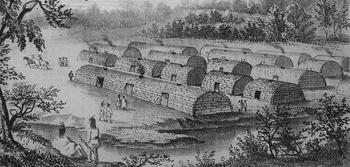
Another odd detail in the story that might point us to traces of a Native presence is the somewhat strange structure situated on the outskirts of Mettingen: a “HUT” that Brown introduces to us in capital letters,Footnote 47 inhabited by “honest creatures” (Wieland 143) and “rustics” (Wieland 177). Elsewhere in Brown's diction, huts are very clearly associated with either “Indians” or,Footnote 48 occasionally, slaves.Footnote 49 Indeed, the Lenape lived in huts: flexible dome structures as summer hunting settlements, constructed of tree branches, as well as massive longhouses (often surrounded by a stockade) as winter quarters (Figure 1).Footnote 50 The hut in Mettingen is, then, a visible marker of the theft committed by the elder Wieland against the people he hoped to “save” – a crime that his children inherited and Carwin, ultimately, revenged. It is the only expression of culture in the novel that is not ventriloquized: unlike the Wieland siblings' homes, it belongs. If Mettingen is a German voice “thrown” onto an American body, the “hut” has been deprived of a voice but remains as a body. It is the physical object that a social and linguistic mapping of space has to constitute itself against. And indeed it seems – through Carwin – to invite the voice of the “rustics,” who originally lived by the side of what they called “Ganshohawanee” (meaning “rushing water”), which the Dutch West India Company later renamed “Schuylkill.”Footnote 51 In the end, with all the German occupants of Mettingen either dead or departed for Europe and the stately house of Clara finally burned to the ground, only the HUT survives.
Mid-nineteenth-century rendering of a historic Lenape settlement, showing both longhouses and wigwams. D. T. Valentine (illustrator), in George Hayward, An Indian Village of the Manhattans, Prior to the Occupation by the Dutch (New York: Chas. W Baker, 1858), 590.

Indeed, we will meet a HUT like this again in Brown's literary oeuvre: Deb's Hut in Edgar Huntly. Published less than a year after Wieland, this gothic tale of frontier violence treats the reader to a very similar sketch of colonial terror. Here, too, a mysterious act of crime – perpetrated “beneath the shade of [an] elm,”Footnote 52 the spilled blood turning it into a “sacred spot” (Edgar Huntly 13) – leads the narrator to directly address the specter that is also haunting Wieland. He now confirms that there truly are “Indians” roaming the caverns below the villages of the Walking Purchase area,Footnote 53 trying to kidnap white women and burning down houses. Throughout his hunt for a murder (an identity always oscillating between the twin-like savagery of Irish and Indian), the notion of original ownership is addressed,Footnote 54 ultimately leading to Edgar loosing claim to the land. Still, when Elizabeth Wall Hinds argues that “what never belonged to Edgar in the first place … returns to its various rightful owners,”Footnote 55 she overlooks a central character of the story: Old Deb.Footnote 56 As Sivils points out, a “representative for dispossessed Indian nations and their fight to retain sovereignty over the land that defines their existence,”Footnote 57 this Lenape matriarch refuses to abandon her “hut” to white settlers (Edgar Huntly 185). Though rendered through the dismissive “majority voice” of Edgar Huntly's “colonizing narrative,”Footnote 58 Brown nonetheless provides a clear picture of colonial violence and indigenous resistance to it:
I knew that, at this time, some hostilities had been committed on the frontier; that a long course of injuries and encroachments had lately exasperated the Indian tribes; that an implacable and exterminating war was generally expected. (Edgar Huntly 157)
[Old Deb] originally belonged to the tribe of Delawares, or Lennilennapee. All these districts were once comprised within the dominions of that nation. About thirty years ago, in consequence of perpetual encroachments of the English colonists, they abandoned their ancient seats and retired to the banks of the Wabash and Muskingum. This emigration was concerted in a general council of the tribe, and obtained the concurrence of all but one female. Her birth, talents, and age, gave her much consideration and authority among her countrymen; and all her zeal and eloquence were exerted to induce them to lay aside their scheme. In this, however, she could not succeed. Finding them refractory, she declared her resolution to remain behind and maintain possession of the land which her countrymen should impiously abandon … The English were aliens and sojourners, who occupied the land merely by her connivance and permission, and whom she allowed to remain on no terms but those of supplying her wants. (Edgar Huntly 185–87)
With Old Deb's former village “built upon ground which now constitutes [the narrator's] uncle's barnyard and orchard” (Edgar Huntly 186) – and likely destroyed by said uncle – Edgar Huntly is, like Clara Wieland, inheritor to a crime of dispossession that he appears oblivious to.
Still, as a whole, Edgar Huntly is not only, as Rivett argues, more “conventionally” scripted than Wieland,Footnote 59 but also more conventional in its outlook. While Wieland could imagine a colonizing force, alienized as a German Other, being driven back across the Atlantic, resistance in Edgar Huntly has no such hope to offer. Here, half a dozen Lenape (and two savage panthers) are killed, Old Deb has to endure colonial “justice” as the leader of an armed revolt (likely resulting in a death sentence), and the estate is to be handed over to a Huntly relative of ill repute.
Ultimately, as Rivett rightly points out, Chares Brockden Brown inaugurates “the American gothic with [his] own attempt to grapple with the spectral presence of American Indians within the American landscape.”Footnote 60 Upon closer scrutiny, we can discover throughout Wieland strong themes of cultural domination and subjugation interwoven into the novel's German–Indian subtext. We are presented with a family that is reclusive, chauvinist Prusso-German, and that inhabits a land that they acquired through an act of crime. The Wielands rechristen their surroundings, mapping it into an expression of European identity in a place that is decidedly non-European. Prototypically German, their ventriloquism is obvious to us – and probably was to most contemporary readers of Brown. In dreams or on nighttime walks in nature, this family is haunted by visions and voices of knife-wielding “savages” that seek to exterminate them and their ill-gotten possessions. While we learn that the reason for these occurrences is a person named Carwin, who exerts an influence over the Wielands through his ability to ventriloquize, we are left to wonder whose voice Carwin summons up. Tracing the numerous references and allusions surrounding this psychologically incoherent and seemingly haphazardly constructed figure, we again and again find him bringing the French and Indian War, as well as the dispossession of the Lenape and other Native peoples, back to the surface of a text that seems to struggle to suppress every notion of “Indianness.” In the end, Carwin follows the precedent that Brown had established for him in Brabantius and redeems the land to its state of natural order: the elder Wieland dies, Catharine dies, her brother and his children die and Clara flees to Europe with her future husband after her mansion goes up in flames. Through Carwin's body, a native voice has (however briefly) reclaimed Ganshohawanee/Mettingen – the demonic gap that biloquium had opened between speech and tongue, voice and body, residence and home has been closed.
While some criticism of Brown's novels has found the highly mediated Native peoples that populate the backdrop of these gothic stories (and are never being granted direct speech) extremely problematicFootnote 61 – even a sign of “Indian-Hating”Footnote 62 – the role of ventriloquism in Wieland opens up another perspective. Brown, throughout this “American tale,” rightly points us to the act of mimicry (assuming the voice of another) as an act of violence and subjugation. Only by speaking as the Wielands can Carwin ensure their demise – by taking over the identity of others and, temporarily, stripping their bodies of autonomy. While Brown himself could ventriloquize some forms of otherness (the Pennsylvania Dutch, the Irish, a German woman), a voicing of Lenape tongue would have equaled his direct participation in the colonial violence that his novels are so careful to unearth.Footnote 63 As David Goldblatt reminds us of the ventriloquizing nature of literature,
When the ventriloquist effaces himself, which he must do by the logic of his act, it is effacement as a speaker of words, a silencing of his words at their point of origin that nevertheless are heard and known to come from him. His object is the creation of an illusion within the context of his work that gives his dummy, as a voice-at-a-distance, independence of character. Thus, the ventriloquist effaces himself as speaker when he is also speaking and while he is pretending to listen and then to respond as if he were replying to the remarks of another. These independent words are, at the same time, only his own.Footnote 64
Placing the Native American element in his novels clearly outside his literary voice as well as his protagonists' comprehension, Brown creates the only real autonomy of Native American expression available to him as a member of the white elite of Pennsylvania. Whereas most literature of his times strives to establish “a sense of European purpose and then of Anglo-American belonging … through the figure of the Indian,”Footnote 65 Brown's novels seem to refuse to fall in line. While voicing the predominant disregard and hatred of “Indians,” ironized through the use of notoriously “unreliable” and self-contradictory first-person narrators,Footnote 66 he never directly takes over the voice of the already disenfranchised Natives. In Brown, only a true outside to his “majority voice”Footnote 67 can keep the shadowy figures of the Lenape in Wieland from becoming like a ventriloquist's dummies – pretend “voices-at-a-distance” that are really “only his own.” “As colonized indigenous figures, these characters are spoken for,” Janie Hinds argues.Footnote 68 Still, they are never spoken for by Brown – only by his white protagonists, whose ignorant complicity in genocide, repulsion and dispossession Brown carefully deconstructs and expels throughout his various narratives.
The Native American element in Wieland is truly not a mere backdrop to Brown's inaugural gothic tale for the young republic but key to understanding the dynamics of native and alien voices at the very heart of the story. Wieland gives an account of two forcible removals: of the Native Lenape and of their European dispossessors. In repulsing a colonial group, cast as racial Other – a rich, German clan that tried to create a miniature Europe abroad – Brown's tale leaves its readers with a quite pronounced blank space where legitimate ownership of land ought to be: There is no Quaker gentleman to take over the estate, no Republican hero to americanize Mettingen and no English voice to bring order to the chaos. As such, Wieland is truly a tale about abjection in a very literal sense: it is a “casting off” of the colonial surface of Mettingen to reveal the crimes of a not-too-distant past buried underneath – a past that Brown felt gnawing at the very foundations of the American project.