INTRODUCTION
Social entrepreneurship has emerged as a phenomenon deeply rooted in its social mission, with its drive for sustainability influenced and shaped by environmental dynamics (Mair & Marti, Reference Mair and Marti2006; Peredo & McLean, Reference Peredo and McLean2006; Short, Moss, & Lumpkin, Reference Short, Moss and Lumpkin2009). Effective resource management assists social enterprises (SEs) to achieve their dual mission of social value creation and financial sustainability (Austin, Stevenson, & Wei-Skillern, Reference Austin, Stevenson and Wei-Skillern2006; Meyskens, Robb-Post, Stamp, Carsrud, & Reynolds, Reference Meyskens, Robb-Post, Stamp, Carsrud and Reynolds2010). Although SEs require similar resources as any other enterprise (Meyskens et al., Reference Meyskens, Robb-Post, Stamp, Carsrud and Reynolds2010), they must deal with a tradeoff between the achievement of their social mission and efficiency of their resource utilization. SEs operate under severe resource constraints and must rely on obtaining resources at below market rates or by using non-economic forms of exchange, such as sponsorship, volunteers, and grants (Haugh, Reference Haugh2007). Social entrepreneurship scholars have identified bricolage as an important mechanism for resource mobilization by SEs. Bricolage, defined as ‘making do with existing resources at hand’ (Baker & Nelson, Reference Baker and Nelson2005), serves as a means of overcoming the hindrances to economic and social development in an environment where resources and supporting institutions are scarce (Desa & Basu, Reference Desa and Basu2013; Di Domenico, Haugh, & Tracey, Reference Di Domenico, Haugh and Tracey2010; Mair & Marti, Reference Mair and Marti2007).
However, in the past, bricolage has been predominantly studied in developed market contexts and little is known more specifically about how bricolage is uniquely undertaken under the multiple resource constraints found in emerging economies. High-quality resources are typically scarce and hence expensive in emerging economies (Desa, Reference Desa2012; Mair & Marti, Reference Mair and Marti2009). In such economies there is great demand for SE activities owing to a large economically and socially disadvantaged population. So, SEs in these economies face pressures to scale up rapidly even before stabilizing, creating a resource stretch for the organization (Mair & Schoen, Reference Mair and Schoen2007; Mair & Marti, Reference Mair and Marti2009; Urban, Reference Urban2013). In particular, rural areas in emerging economies have unique social norms, beliefs, power structures, and hierarchy that accentuates resource challenges for SEs due to a non-munificent institutional environment (Bhatt, Qureshi, & Riaz, Reference Bhatt, Qureshi and Riaz2017; Mair & Marti, Reference Mair and Marti2009). Therefore, such emerging economies pose greater challenges of resource mobilization to SEs.
Given the resource challenges faced by SEs and lack of understanding of bricolage mechanism in non-munificent institutional environment of emerging economies, it is critical to understand how SEs operating in such an environment develop bricolage solutions to overcome resource challenges. This article seeks to address this gap.
An inductive multiple case-study approach was adopted to study two SEs engaged with rural communities in India. We sought to understand how the two SE organizations in our study ‘seek innovation processes that are socially inclusive toward local communities…’ (Smith, Fressoli, & Thomas, Reference Smith, Fressoli and Thomas2014: 1). Our findings suggest that identifying locally embedded village level entrepreneurs is a bricolage activity that social entrepreneurs leverage in resource constrained environment of emerging economies, especially for the social enterprises that are active in the villages but were founded by social entrepreneurs who are not from these villages. For SEs created and resourced in urban areas but operating in remote rural areas, this bricoleur solution of identifying and mobilizing village level entrepreneur helps them overcome complex structural and institutional challenges such as a lack of openness to outsiders arising out of unique social norms, beliefs, power structures, and hierarchy of these remote rural areas.
We contribute to the existing literature in two ways. First, we examine how social entrepreneurial bricolage may manifest in the institutionally non-munificent context of emerging economies. Second, by identifying how a unique bricolage activity helps SEs to overcome resource constraints, we add to the understanding of social entrepreneurial bricolage. Our work has important implications for practice, as it can guide the founder or manager of an SE in mobilizing required resources when operating in an institutionally non-munificent context.
THEORETICAL BACKGROUND
Bricolage and SEs
Bricolage is defined as ‘making do by applying combinations of resources already at hand to new problems and opportunities’ (Baker & Nelson, Reference Baker and Nelson2005: 33). The bricolage perspective builds on the idea that an organization can extract multiple services from the same resources, such that recombined resources address new problems, given the scarcity of resources in the context (Baker & Nelson, Reference Baker and Nelson2005; Desa & Basu, Reference Desa and Basu2013). It is significant when an institutional environment may be ‘non-munificent’ or non-supportive of social enterprises, due to unavailability of tangible resources, high business costs, labor shortages, and intense competition for resources that characterize emerging economies (Bhatt et al., Reference Bhatt, Qureshi and Riaz2017; Cai & Young, Reference Cai and Cheng2014; Sunduramurthy, Zheng, Musteen, Francis, & Rhyne, Reference Sunduramurthy, Zheng, Musteen, Francis and Rhyne2016).
Apart from bricolage being an entrepreneurial process in a resource-poor environment (Garud & Karnøe, Reference Garud and Karnøe2003), it is an entrepreneurial ‘refusal to enact or be constrained by resource limitations imposed by institutional and/or political settings’ (Linna, Reference Linna2013: 4), as well as a shortage of materials, practices, and standards in environmentally non-munificent emerging economies (Di Domenico et al., Reference Di Domenico, Haugh and Tracey2010; Goll & Rasheed, Reference Goll and Rasheed2004; Staw & Szwajkowski, Reference Staw and Szwajkowski1975). Here, bricolage may result in the social construction of a path-dependent trajectory that is dominated not by a clear vision and careful a priori planning, but by a ‘serendipitous combination of existing programs, pasted-up solutions, and failed components put to unexpected uses’ (Baker & Nelson, Reference Baker and Nelson2005: 35).
As a consequence, to what use resources may be put in the future, once they are accumulated, is unknown; the nature of the resource use is influenced by the types of resources available in the context. This is the nature and characteristics of bricolage. Studies on entrepreneurship have demonstrated a multiplicity of views on bricolage; it has been regarded as (a) an approach to overcoming the resource-constraint problems of new ventures (Desa, Reference Desa2012); and (b) an experiential learning (Ferneley & Bell, Reference Ferneley and Bell2006), such that knowledge generated through bricolage not only changes resource investment patterns (Burgers, Stuetzer, & Senyard, Reference Burgers, Stuetzer and Senyard2014) but also fosters creativity and innovation (Andersen, Reference Andersen2008). Both these views identify bricolage as a specific behavior to create individualized and tacit experiential knowledge (Foss, Klein, Kor, & Mahoney, Reference Foss, Klein, Kor and Mahoney2008).
SEs are businesses that are market driven but aim to create social and community benefits (Di Domenico et al., Reference Di Domenico, Haugh and Tracey2010). They resort to ‘making do’ and improvisation to prioritize social value creation, as espoused more formally in their articles of association, policies, and procedures (Di Domenico et al., Reference Di Domenico, Haugh and Tracey2010), compared with the exposition of bricolage of individual entrepreneurs and private enterprises (Baker & Nelson, Reference Baker and Nelson2005). This assists SEs in creating legitimacy through close relationship with stakeholders, controlling local agendas through a dynamic process of negotiating and renegotiating access to resources, including expertise (Di Domenico et al., Reference Di Domenico, Haugh and Tracey2010). In emerging economies, informal practices can fill the voids in the formal institutional structure (Desa, Reference Desa2012) at the base of the pyramid (BoP) where the pervasiveness of constraining informal institutions impede full market participation. Such a process was evident in Bangladesh, in the establishment of remote village organizations, where members were asked to stand for local government elections to create social capital for women (Mair & Marti, Reference Mair and Marti2007). At the root of this was the efficacy of the stakeholder-based governance structure of the SE (Di Domenico et al., Reference Di Domenico, Haugh and Tracey2010; Sunduramurthy et al., Reference Sunduramurthy, Zheng, Musteen, Francis and Rhyne2016).
SEs and Resource Constraints in the Rural Contexts of Emerging Economies
A particularly vibrant subtheme has been the application of bricolage to social entrepreneurship in emerging markets (Gundry, Kickul, Griffiths, & Bacq, Reference Gundry, Kickul, Griffiths, Bacq, Lumpkin and Katz2011). Although a non-munificent environment for an SE may hinder unilateral support for its social mission, the literature has identified that, in emerging economies, a non-munificent environment was the motivator for SEs, as the inability to secure external resources increased the reliance on leveraging available resources for maximum benefit (Mair & Marti, Reference Mair and Marti2009; Mair, Martí, & Ventresca, Reference Mair, Martí and Ventresca2012). Although this results from a higher degree of structural embeddedness fostering trust, the outcome would largely be conditioned on the prior experience in a specific geographical location.
Context-specific prior experience, whether relating to nongovernment organization support for disaster rebuilding in China (Qureshi, Kistruck, & Bhat, Reference Qureshi, Kistruck and Bhatt2016) or to BoP markets in the widely varying formal and informal institutional environments of other emerging economies (Karnani, Reference Karnani2007), can lead to different expectations of SEs in urban versus rural areas, for various reasons (Bhatt et al., Reference Bhatt, Qureshi and Riaz2017). One observed pattern of distinction within BoP markets concerns whether they are in rural or urban areas. Rural BoP markets in Kenya, India, and Guatemala are characterized by informal institutions and a lack of openness to outsiders (Sutter, Webb, Kistruck, & Bailey, Reference Sutter, Webb, Kistruck and Bailey2013). In contrast, BoP markets in urban areas within these countries appeared to be characterized by greater openness to outsiders, perhaps facilitated by relatively improved levels of education and literacy, and more formal institutions (Kistruck, Webb, Sutter, & Ireland, Reference Kistruck, Webb, Sutter and Ireland2011). The BoP populations in rural areas can be engaged as producers and customers, but there is limited understanding of how rural SEs function (Steinerowski & Steinerowski-Streb, Reference Steinerowski and Steinerowska-Streb2012). One characteristic of rural and poor communities is that they have to conduct transactions in a subsistence marketplace (Kistruck, Beamish, Qureshi, & Sutter, Reference Kistruck, Beamish, Qureshi and Sutter2013). This marketplace is scattered, but fairly large, with over 4 billion people living on less than $2 per day (Prahalad, Reference Prahalad2006; Viswanathan & Sridharan, Reference Viswanathan and Sridharan2009). Poor rural consumers have low literacy levels. They view brand names and prices as images instead of symbols (Viswanathan, Sridharan, Ritchie, Venugopal, & Jung, Reference Viswanathan, Sridharan, Ritchie, Venugopal and Jung2012). Therefore, fair and transparent exchanges are essential for businesses in subsistence marketplaces (Viswanathan, Gajendiran, & Venkatesan, Reference Viswanathan, Gajendiran and Venkatesan2008).
In the absence of formal institutions, such as developed property rights, in rural areas, it is difficult to obtain loans or financial resources because property cannot be used as collateral (Kostova & Zaheer, Reference Kostova and Zaheer1999). Other institutional gaps, such as a lack of paved transportation linkages and safe passage, together with a propensity for opportunistic behavior and a lack of access to information (Qureshi, Sutter, & Bhatt, Reference Qureshi, Sutter and Bhatt2018), make on-site monitoring extremely costly. Poorly developed transportation infrastructure hinders word-of-mouth marketing, as rural communities remain largely disconnected. These challenges are further aggravated by norms, values, beliefs, and other sources of identity that vary across BoP markets even within one country, especially within the rural markets (Bhatt et al., Reference Bhatt, Qureshi and Riaz2017). Such fragmentation, combined with the high incidence of violence that often permeates BoP markets (Karnani, Reference Karnani2007), creates a strong sense of distrust toward individuals and organizations that are not native to the local community.
We build on the prior work to address an important gap in understanding the bricolage process in an SE. This pertains to the context of extreme resource scarcity in the rural areas of emerging economies, which is a reason for SE activity, given the non-munificent environment and multitude of socioeconomic issues (Mair & Marti, Reference Mair and Marti2009). Rural India provides an ideal setting to conduct such research, and an interesting context within which to explore the challenges of regional variations in institutions (both formal and informal), including belief systems, values, and culture, and their effect on the bricolage activities. In this article, we examine two SEs not only operating in different domains but also concentrating on diverse geographical locations. Interactions with entrepreneurs as well as customers in these predominantly subsistence markets reveal businesses with weak property rights, low education levels, and poor information technology connectivity and usage, which highlights the role of word-of-mouth in these remote dispersed geographies that exercise bricolage resource use. Therefore, as suggested by Kistruck et al. (Reference Kistruck, Webb, Sutter and Ireland2011), greater benefits may arise from adapting to the needs of the highly fragmented local contexts, rather than attempting to ‘cookie cut’ the physical designs and operating procedures across diverse locations and institutional environments.
METHODS
Multiple Case-Study Methodology
Our approach involved understanding the bricolage process by adopting an inductive multiple case-study approach (Eisenhardt, Reference Eisenhardt1989). In this study, we are trying to answer a ‘how’ research question to understand the resource mobilization of SEs, and hence case-study approach is a suitable one (Eisenhardt & Graebner, Reference Eisenhardt and Graebner2007; Yin, Reference Yin2003). As little is known about the process underlying bricolage in SEs operating in emerging economies, we undertook an exploratory case study (Welch, Piekkari, Plakoyiannaki, & Paavilainen-Mäntymäki, Reference Welch, Piekkari, Plakoyiannaki and Paavilainen-Mäntymäki2011). We adopted a multiple case-study design because multiple cases typically yield a better grounded, more robust, generalizable, and testable theory than do single case studies (Eisenhardt & Graebner, Reference Eisenhardt and Graebner2007). The multiple case-study design also allowed us for replication logic, which enhances the validity of the findings by confirming them in two cases (Eisenhardt, Reference Eisenhardt1989). Replication of the phenomenon is a key to establishing reality (Mir & Watson, Reference Mir and Watson2001). Further, the multiple case studies enabled us to conduct cross-case comparisons, which provides a strong foundation for theory building because it allowed us to corroborate, qualify, or extend the findings between cases (Eisenhardt & Graebner, Reference Eisenhardt and Graebner2007; Yin, Reference Yin2003).
Empirical Settings
A multiple case-study research strategy involves the deliberate selection of cases that are able to provide important information about the phenomenon being studied (Eisenhardt, Reference Eisenhardt1989). With a goal to select cases that helps us in maximizing what we learn (Stake, Reference Stake1995), we adopted a theoretical sampling approach (Glaser & Strauss, Reference Glaser, Strauss and Denzin2017) to select the first organization, Alpha, pseudonym. In our selection, we were guided by our theory development needs (Charmaz, Reference Charmaz2006; Strauss & Corbin, Reference Strauss and Corbin1994), which required that our case study was located in a remote rural area, serving poor and marginalized communities in an extremely resource constrained environment (Poulis, Poulis, & Plakoyiannaki, Reference Poulis, Poulis and Plakoyiannaki2013). When analyzing the data from Alpha, we realized that the nature of its business – which focused on agriculture, sanitation, and market linkages – was such that government policy had a limited effect. Hence, we selected another organization, Beta (a pseudonym), which focused on the business of financial inclusion, which was strongly affected by government policy, to determine whether these types of organizations also engage in bricolage activities. We selected these two organizations operating in India from the list of SEs affiliated with the global social venture network Ashoka Foundation (Meyskens et al., Reference Meyskens, Robb-Post, Stamp, Carsrud and Reynolds2010; Sunduramurthy et al., Reference Sunduramurthy, Zheng, Musteen, Francis and Rhyne2016), to study their resource mobilization practices. To control for extraneous variation, we selected organizations operating in the economic development sector only (Eisenhardt, Reference Eisenhardt1989).
Alpha is a for-profit SE that was founded in 2009 to provide economically sustainable solutions for poor farmers in remote rural villages in the Indian state of Odisha. Over time, Alpha identified the need for interventions in other areas and ventured into providing market linkages and sanitation solutions for farm producers. Alpha adopted a bricolage approach in the form of an innovative entrepreneur-driven model, in which they identified people from the local community as entrepreneurs to be used as a substitute for market resources to deliver services. SE Alpha supports the farming community by building appropriate partnerships with different groups, including suppliers, agro scientists, technology providers, and nongovernment organizations that leverage technology.
Beta is a for-profit SE that aims to make banking services accessible to poor people in remote villages in different states of India in line with government plans for financial inclusion and credit facilitation. By building partnerships with multiple banks as business correspondents, Beta provides banking solutions through a local entrepreneur-based model. The various services provided by Beta include banking services, savings and other government payments, money transfers, utility payments, and prepaid mobile top-ups. Access to the services is enabled through a network of basic convenience outlets operated by the local entrepreneur. At the core is Beta’s strong technological platform that provides seamless delivery of services and social value and assists entrepreneurs to earn sufficient incomes while staying in their own villages.
Non-Munificent Context of Rural India
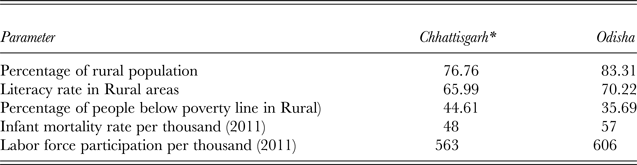
The case-study organizations Alpha and Beta operate in rural areas of India with higher levels of poverty, including Odisha, Chhattisgarh, and Jharkhand (RBI, 2015). In addition to acute poverty, the rural population of India has a lower score on the human development index (a measure of life expectancy, education and per capita income indicators), and a lower literacy rate than urban areas (Census Data, 2011). Table 1 provides details regarding the states in which Alpha and Beta operate. These rural areas in India are dominated by small and marginal farming communities, which constitute 80% of the rural population but own only 36% of the land (Behera, Sharma, & Mahapatra, Reference Behera, Sharma and Mahapatra2007). The high poverty rates are linked to the small per capita land ownings, which pose a serious threat to the sustainability and profitability of farming. In addition, rural India lacks access to formal banking and financial services, requiring it to resort to informal sources of finance that are expensive as well as risky (Mehta & Bhattacharya, Reference Mehta and Bhattacharya2016).
Context of rural India

Note: *Beta works in multiple states, Chhattisgarh is one of them
Along with the economic difficulties, there are cultural belief systems that strongly influence how people in rural areas live. One example is that there is a strong belief among rural communities that it is a sin to have a toilet inside one's house, where the idols of gods and goddesses reside (Routray, Schmidt, Boisson, Clasen, & Jenkins, Reference Routray, Schmidt, Boisson, Clasen and Jenkins2015), which results in the unhygienic practice of defecating in the open. The high infant mortality rate in rural India (Niti Aayog India Report, 2017; Venkatesh, Rai, Sykes, & Aljafari, Reference Venkatesh, Rai, Sykes and Aljafari2016) points to the prevalence of such superstitions and ill-informed traditional healthcare practices in rural India (Sinha, Kaur, Gupta, Dalpath, Goyal, & Murhekar, Reference Sinha, Kaur, Gupta, Dalpath, Goyal and Murhekar2014).
Data Collection
Semi-structured interviews were the main data collection method for our study. We prepared an interview protocol, containing an outline of topics to be covered, with suggested questions (Yin, Reference Yin2003). The interview protocol served as a conversational guide and directed the conversation during an interview (Rubin & Rubin, Reference Rubin and Rubin2005). The initial protocol was presented to an expert panel of three academicians, who reviewed the protocol and gave their suggestions, which are the incorporated into the interview protocol. Further, the interview protocol was discussed with the strategic resource consultant at Ashoka to get his views and based on his input, the protocol was further modified suitably. We followed established guidelines by Rubin and Rubin (Reference Rubin and Rubin2005), while administering the interview protocol. First, we jotted down any follow-up questions that came to our mind while an interviewee is answering any questions and asked the follow-up questions only after the interviewee finished answering. We did this to avoid disturbing the interviewee when they are in flow. Second, we carefully paid attention to what the interviewee is answering and based on that asked subsequent questions that were not necessarily the next one in the interview protocol. Also, wherever required, we adjusted questions from replies given in earlier questioning. The idea behind this was to guide the conversation rather than giving the impression that we have a rehearsed list of questions which we are asking in a particular sequence. Finally, wherever the interviewee faced any difficulty in understanding a question, we gave suitable example to explain the same. On all occasions, the interview was conducted with a single person at a time. This was done to ensure that participants can comfortably answer the questions posed to them. Interviews were scheduled based on the date and time suggested by each participant. Prior to the start of the interview, we briefly introduced the research in terms of its objectives, expectations from participants, and possible contributions (Kvale, Reference Kvale1996; Rubin & Rubin, Reference Rubin and Rubin2005). We provided them with an information sheet for the interview and requested them to go through it. This document also clearly specifies that at any point of time the interviewee may decide not to participate in the interview and he/she can take out any information given at any point of time (Kvale, Reference Kvale1996). Subsequently, we presented them with informed consent form to fill out (Cresswell & Creswell, Reference Creswell and Creswell2017). The form has an option which asks permission for recording the interview for further analysis.
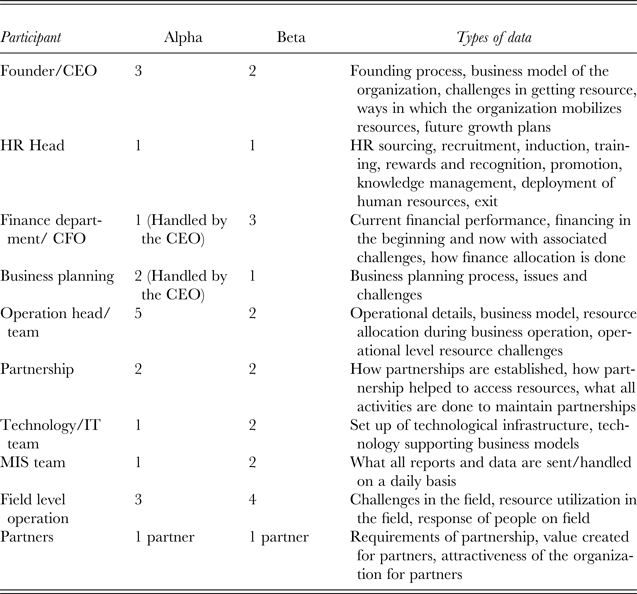
The first author of this article spent approximately six weeks at each of the organizations to collect a rich set of data. In the case of Alpha, data was collected over three visits. On the first visit, the author interviewed the founders and spent a few days visiting the area of operation of the organization and meeting different organizational members. On the second visit, the author conducted interviews with other organizational members from the operations team, the management information systems team and the field-level team. On the final visit, the author spent four days visiting the area of operation and collected other data relevant to the organization. The same process was followed for the visits and interviews at Beta, with the first visit including attendance at Beta’s annual celebration day. An overview of the interviews can be found in Table 2. Further, to ensure triangulation of the results (Yin, Reference Yin2003), we collected data from other sources, including field observations (e.g., the first author's notes from attending organizational meetings), the internal documents of the organizations (annual reports, project reports, and process documents), and published secondary sources (newspaper articles, published cases, and research articles on the organizations). These also helped to enhance the validity of the study through cross checking (Fletcher & Prashantham, Reference Fletcher and Prashantham2011).
Overview of the interviews

Data Analysis
The first step in the data analysis involved compiling and organizing the interview transcripts, field notes, and other secondary data (Yin, Reference Yin2003). Our overall analysis followed an established process of inductive theory building research (Eisenhardt, Reference Eisenhardt1989; Miles, Huberman, & Saldana, Reference Miles, Huberman and Saldana2014; Strauss & Corbin, Reference Strauss and Corbin1994), involving moving back and forth between the data and emerging theoretical categories (Locke, Reference Locke2001). We used the computer-aided qualitative data analysis software (CAQDAS) Atlas.ti for data management and coding following established guidelines (Friese, Reference Friese2014; Miles et al., Reference Miles, Huberman and Saldana2014; Saldana, Reference Saldana2013). While iterative in nature, our analysis was conducted by following two coding cycles (Miles et al., Reference Miles, Huberman and Saldana2014), as explained below.
Step 1: First-cycle coding
We employed first-order coding techniques to identify a set of primary-closer to observation-codes for further analysis (Miles et al., Reference Miles, Huberman and Saldana2014). Codes emerged as we began comparing and categorizing texts, and assigning levels to them. We used the concept of the meaning unit (Campbell, Quincy, Osserman, & Pedersen, Reference Campbell, Quincy, Osserman and Pedersen2013; Garrison, Cleveland-Innes, Koole, & Kappelman, Reference Garrison, Cleveland-Innes, Koole and Kappelman2006) to select a segment of data for coding. During the coding process, we kept an open mind, allowing the data to ‘speak to us’ (Suddaby, Reference Suddaby2006). For instance, in Alpha, we found instances in the data, in which the interviewees have discussed the challenges faced by the organization because farmers do not want to adopt modern techniques due of their old belief system. This was captured as the first cycle code ‘Farmers and rural poor illiteracy hampering business model implementation’. As the analysis progressed in this phase, we began to notice concepts that were repeatedly present or significantly absent from our data. We read and reread the data and recoded them in a recursive manner based on our evolving understanding (Strauss & Corbin, Reference Strauss and Corbin1994). Thus, the coding process was iterative in nature, with each iteration leading to refinement of the coding system. Our first-order codes represented the integration of the raw data and our initial interpretation.
Step 2: Second-cycle coding
In this stage, we employed axial coding to move from first-order codes and categories to more abstract theoretical sub-categories (Miles et al., Reference Miles, Huberman and Saldana2014; Saldana, Reference Saldana2013; Strauss & Corbin, Reference Strauss and Corbin1994). As this phase progressed, we sought for similarities and differences among the different categories identified in the previous stage, which resulted in a set of relevant categories. Then, we gave a category level or phrasal descriptor to each of the relevant categories and examined the categories to identify deeper relationships. For instance, one of the second-cycle codes that we identified was ‘sociocultural challenges’, which emerged from a range of first-cycle codes, such as ‘mindset of freebees arising from philanthropy’, ‘Farmers and rural poor illiteracy hampering business model implementation’, ‘Long-held practices and belief system hampering modernization’, and ‘Lack of trust in alien people’. As with the previous stage, this stage was iterative, as we moved constantly between the existing literature and data, using established concepts and theories to interpret the data, and then between the emerging theoretical themes and data to arrive at a set of second-order themes.
Once the coding process was completed, we examined our second-order codes to identify possible relationships. We first observed each case separately and then compared and contrasted multiple second-order themes across the two cases to identify patterns and boundary conditions (Eisenhardt, Reference Eisenhardt1989). The final objective was to understand relationship between the contextual dimensions and the process of bricolage (Langley, Smallman, Tsoukas, & Van de Ven, Reference Langley, Smallman, Tsoukas and Van de Ven2013).
Quality Consideration
A qualitative research must address quality issues in research findings and demonstrate rigor in conducting case studies (Cuervo-Cazzura, Andersson, Brannen, Nielsen, & Reuber, Reference Cuervo-Cazurra, Andersson, Brannen, Nielsen and Reuber2016; Eisenhardt & Graebner, Reference Eisenhardt and Graebner2007; Welch & Piekkari, Reference Welch and Piekkari2017). In order to establish rigor of this study, we adhered to the established data collection, analysis and reporting processes to achieve credibility, transferability, dependability, and confirmability (Lincoln & Guba, Reference Lincoln, Guba, Lincoln and Guba1985; Miles et al., Reference Miles, Huberman and Saldana2014).
RESULTS
Contextual Challenges
Our findings suggest that the multiple context-related challenges faced by both SEs, Alpha and Beta, can be classified broadly into three different categories, namely sociocultural challenges, policy challenges, and market challenges. We discuss each of these in turn below.
Sociocultural challenges among BoP populations in rural areas primarily arise from the belief that voluntary organizations provide ‘freebees’ as philanthropy, which ignores the need for sustainability of the SE. These challenges persisted owing to the long-held beliefs of the largely illiterate populations, often located in remote areas, which deeply mistrusted the SEs as alien organizations. In India, the concept of social business is yet to be understood by the people, as highlighted by an interviewee from Alpha:
The difficulties are largely in the first mile wherein whether it is the government whether it is corporate or whether it is [corporate social responsibilities]. The main concept of social business as such is very alien to the Indian mindset still. So still we are in the era of you know providing free money, providing free services, focusing on philanthropy. Government and the private sector still thinking that you know we will give so much money and toilets will be made and the job is done. So when you have to operate in that kind of an ecosystem and that kind of mindset at the first mile it is very difficult to explain them that what do you mean by social business, why social business is making sense and that the main purpose of having the concept of social business is sustained provision of product and services that any philanthropy cannot provide [Interviewee 1, Alpha]
Policy challenges for SEs arose from strong ex ante influence of government policy, which was frequently changing and often poorly planned and executed in emerging economies. As another Alpha interviewee commented:
Very frankly speaking to do business in India is painful whether social or commercial. And commercial they are earning a lot of money, they can pay back whatever they are incurring in complying with the system and processes of Indian business system. But for a [SE] it is very difficult to comply with so much … undefined requirement[s]. [Interviewee 2, Alpha]
In explaining rise of resource cost from inefficient rural territory allocation by government policy for financial inclusion by Beta one report said
‘The factor that increases marketing costs is the distributed geography of agents, due to the mandate-driven approach to expanding the network’ [Internal report on Operational Challenges of Beta]
Market challenges in the case-study context arose from the fragmented rural supply chains, with low value additions and high transaction costs in geographically dispersed and disorganized rural markets. As one interviewee commented
Our transaction cost is comparatively higher, so at times it is an issue, because working with small farmers, in rural areas, in remote location like in Odisha, transaction cost increases. [Interviewee 13, Alpha]
These indicate resource limitations imposed by institutional setting (Baker & Nelson, Reference Baker and Nelson2005; Kistruck et al., Reference Kistruck, Beamish, Qureshi and Sutter2013) and limits of social enterprise organization relationships between individuals, their interactions and networks as ‘social dimensions’ (Johannisson, Reference Johannisson, Sexton and Landstrom2000).
Bricolage Activity
Analysis of the data from both Alpha and Beta suggested that a unique bricolage activity occurred, involving the use of village-level entrepreneurs for service delivery. We discuss that activity for both the organizations in turn.
Case study: Alpha
The geographical areas in which Alpha operates, a remote district in the state of Odisha, posed multiple challenges for the organization because of the non-munificent environment. From a physiographical perspective, the entire district lies in a high-altitude zone, with inaccessible terrain of hilly ranges and narrow valley tracts. With more than half the population of tribal (indigenous) origin, practices remain traditional, handed down over generations. Insurgency (Loiwal, Reference Loiwal2017) and multiple cases of communal violence (Karat, Reference Karat2016) resulted in a near complete absence of progressive institutions, including formal lending institutions such as rural or cooperative banks. The literacy rate for the whole district is only 64% (NIC, 2018).
Traditionally, in a non-munificent environment, local farmers depend on local moneylenders during the harvest season, to whom they pay high interest rates, which often leads to the farmers falling into a debt trap (Alpha organizational video, also corroborated in the field). This situation has been further aggravated in Alpha’s region of operation by the farmers’ lack of access to markets for quality seeds and fertilizers at competitive prices, with small local shops selling low quality items at exploitative high prices. Lack of information, aggravated by illiteracy, mean that farmers were unaware of which farm inputs were best for their fields, their availability and appropriate price. Similarly, because farmers in rural areas lack market linkages, they sell their produce to local traders and intermediaries at unprofitable prices.
The persistence of these factors over a long period of time has resulted in the people in Alpha’s region possessing a deep distrust of strangers and people from outside their villages. Although there was ample scope for Alpha, as an SE, to intervene to solve these problems, it was found that the usual model of establishing an employee at the field-level was not appropriate in this non-munificent environment. As one of the Alpha interviewees observed:
If I choose an employee who has been living in the capital city of the state of Odisha [urban center] and has been hired, then my rural location is say a remote backward location in Odisha, and I post him there, do you think that he will be able to adjust? He may not even know the local language, he may not know local people. He may not be aware of their culture, it will take him a few months to adjust to the system, to create rapport with the community, which is another cost. It will be difficult for local farmers to trust that employee. [Interviewee 9, Alpha].
Initially, the people of this remote region were suspicious about the operation of SEs and avoided using Alpha’s services. As one of the interviewees commented:
Convincing farmers to apply technology to farming practices is difficult. They are not willing to make an investment, as there's a lack of trust. [Interviewee 3, Alpha]
The cultural norms and entrenched social beliefs and practices in the remote areas made it even more difficult for Alpha to overcome this suspicion. For instance, because the farmers believed that the souls of their ancestors resided in the farmlands, it was feared that the introduction of modern farming techniques would anger these souls and, therefore, it was regarded as a sin. As one of the interviewees mentioned:
Sometimes we face difficulties in convincing people to adopt better farming methods because people have a very strong belief system… say for example they do not want to use [new methods] just because they think their forefather's soul is there in the field and that protects their produce…any attempts to use things like [new methods] may make the forefather's soul angry and they have to face negative consequences. [Interviewee 7, Alpha]
To improve sanitation in the villages, Alpha wanted to build toilets to stop open defecation. It found that the rural sanitation market was fragmented, with private players selling inferior quality toilet materials at high prices from local shops (Alpha organizational video). Moreover, there was insufficient knowledge regarding the need to maintaining the hygiene and cleanliness of these toilet, which discouraged people from using them or made them unusable, such that people reverted back to open defecation. Therefore, a strong challenge for Alpha was to convince the villagers to make use of toilets and to overcome their strong beliefs that toilets in or nearby their houses would desecrate the holy abodes of the gods. Another issue was that because of the social hierarchy and power differences in rural areas, having a toilet was considered a privilege reserved for the upper class.
As in most remote rural areas of emerging economies, illiteracy was a significant problem among rural people, so Alpha faced the challenge of designing communications that did not rely on written communication. For instance, Alpha could not provide information to the farmers through text messages, and had to communicate through voice only. As one interviewee commented, this slowed down the process of implementation and placed demand on resources:
Literacy among farmers was low and that slowed down the implementation and effectiveness of our business model…our business model basically depends on leveraging the potential of ICT [information and communications technology] to empower the farmers to take appropriate decisions and hence literacy levels mattered quite a lot. Although the majority of the farmers had mobiles, information could be only transferred through voice as many of them cannot read text messages. [Interviewee 9, Alpha]
Thus, in summary, in the remote areas, there needs to be local intervention that uses the local dialect and expressions and leverages on trust to convince farmers to adopt modern farming or sanitation practices. This situation created challenges for Alpha and hampered the operation of its usual delivery mechanisms. For the organization to succeed, there was a need for local knowledge, networks, and community embeddedness.
As a solution to this issue, Alpha decided to select suitable local villagers as micro-entrepreneurs (MEs) to address its resource related problems. To overcome the idiosyncratic challenges of a remote location, Alpha developed the locally embedded entrepreneur-based model, which employed educated village youths as intermediaries between Alpha and the rural people, to provide agriculture, market linkage, and sanitation services to rural farmers. As one of the Alpha interviewees explained:
At grass root level, what we do is we create entrepreneurs and these entrepreneurs help us to reach the farmers, [the] entrepreneur is our main channel actually. These entrepreneurs will be chosen from a particular village or combining two or three villages together. So, this person, local person, he will be selling our tools like going and collecting information from the farmers and as well as he will be giving recommendation to the farmer. He will be our key sales person. [Interviewee 8, Alpha]
The MEs, who were literate, received digital training by Alpha and were provided with the necessary technologies to help farmers in their area. By virtue of being embedded locally, the MEs could help translate farming information into the language of the farmers, and devise ways of overcoming the obstacles arising out of their social, belief, and value systems. Being local members of the village, MEs were transparent and legitimately gained the trust of villagers.
In the case of farming solutions, a particular type of ME, the ‘veggie-entrepreneur’, collected farm produce from the farmers at a fair price; then sold it to Alpha, which would sell it at a higher price in the urban markets. In the sanitation business, Alpha supplied high quality toilet building materials and other supporting services at affordable prices to the village-level ME known as the ‘sani-entrepreneur’, who in turn sold these products to the local villagers at a profit. Alpha negotiated with large corporates to provide bulk supplies under their corporate social responsibility commitments and other social development schemes, which also gave corporations access to the rural markets.
In changing the villagers’ traditional beliefs and value systems, the ME leveraged his/her trust and used his/her local skills and tacit knowledge of appropriate farmers to target as role models to deliver services. For example, the MEs working in sanitation discussed sanitation supplies with groups of villagers, not only to highlight the benefits of having toilets, but also to demonstrate to them the resource benefits of choosing Alpha’s products, in terms of both paying lower prices and securing better quality products than those supplied by the existing local vendors. Owing to their community embeddedness, these entrepreneurs assisted in scaling up Alpha's SE model by helping more and more local villagers to challenge their old belief systems. In one case, the ME showed the villagers multiple videos on the dangers of open defecation and the advantages of toilets, explaining the details in local language that the audience could understand, thus adopting constant persuasion, as identified by Di Domenico et al. (Reference Di Domenico, Haugh and Tracey2010).
The MEs succeeded in creating farmer interest groups (FIGs) that met on a regular basis and shared information with each other. Over time, this assisted Alpha to embed itself in the local community with the help of the MEs. As an Alpha organizational document stated:
The micro-entrepreneur facilitates FIG meetings at regular intervals. These meetings provide an opportunity for the farmers to get together, discuss and/or solve problems, and plan the procurement and marketing activities for the upcoming season. In other words, it facilitates peer interactions, learning, and strategic planning.
In a unique bricoleur innovative role, Alpha used the ME generated critical farmer data to build a credit score for the farmers that would help the farmers obtain credit from financial institutions to overcome their financial resource crunch in the absence of banks in such remote locations. MEs leverage their intimate knowledge of farmers – their habits, trustworthiness, past behavior, which is vital in developing a credit score. Once developed these credit scores help overcome institutional barriers to securing financial resources in remote rural areas.
The social mission of Alpha and its promise to accelerate the sustainable growth of farming communities helped it to build the required legitimacy and to obtain support from the MEs. One ME explained why he became part of Alpha:
I got to know about Alpha and how they are helping so many poor farmers come out of poverty. I thought it is a good opportunity god has given me and then I decided to work with them. Now, I am able to help so many poor farmers. I know them since my birth, they were suffering a lot because of the lack of guidance on proper farming process. Through Alpha, I am able to help them all. It is great to see their lives improving. [Interviewee 13, Alpha]
Another ME added, ‘I feel proud of the goodwill I have been able to generate amongst the local population through my activities’. [Interviewee 14, Alpha]
To obtain the support of prospective MEs, in the case of sanitation, Alpha created a video, discussing how, by being part of Alpha, MEs could be agents for change and improve the lives of many people. Thus, Alpha used constant persuasion to garner the support of the village-level MEs in working for the villagers. Alpha’s hybrid SE model combined a nominal profit-based model of selling goods and services to villagers, which provides financial sustainability, with social bricolage, which it leveraged to meet the particular needs of the villager by countering the limitations arising from the existing institutional arrangements and resource-deficient environment. The introduction of the locally embedded MEs and the trust that the members of a subsistence economy had in them helped to implement the business model introduced by Alpha, which is a clear case of social bricolage (Di Domenico et al., Reference Di Domenico, Haugh and Tracey2010).
Case study: Beta
Beta works in rural India to provide financial inclusion (FI) services, including no-frills bank accounts, saving products to suit the cash flow needs of poor villagers, and credit services to village women. Beta uses an internally developed robust technology platform to connect to the bank server for delivery of services and to reduce transaction costs. However, in dealing with unbanked villages, Beta faced obstacles including high illiteracy rates, both general and financial literacy, which presented it with a challenge as villagers resisted entrusting Beta with their life savings. Traditionally, villagers kept cash in their household, as a field-level employee of Beta explained:
People still have got the long-held practice of keeping cash with them… so whatever money they earn, they spend some and whatever is remaining they keep with them in the form of cash… this thing needs to be changed. If this is changed, it will be good for people and also for our business. [Interviewee 16, Beta]
As they never held formal bank accounts, and because many lacked financial and general literacy, the villagers hesitated to conduct banking transactions. Hence, although the FI mandate was originally directed at commercial/ rural banks, these banks found that it was unviable to establish bank branches in rural areas because of the high setup costs and the low volume of business from the dispersed rural poor (often BoP populations), with the problems aggravated by illiteracy challenges that prevented villagers following banking instructions. Thus, the government permitted banks to contract business correspondents (BC) such as Beta to deliver banking services to rural people. As the manager of one banking partner explained:
Actually, as part of RBI [Reserve Bank of India] guidelines, they give us mandate to provide banking services in rural areas. This is part of the government's financial inclusion mission. Now, to open a bank branch there is huge investment required from our side, then there is the cost of operations. Understanding this problem, banks came up with a BC [business correspondent] model, wherein they allowed companies like [Beta] to partner with us and provide our services to people in rural areas. [Interviewee 14, Beta]
Beta already had a presence in rural India through developmental organization partners. However, illiteracy remained a challenge, as mentioned in one of Beta's organization documents:
[Beta] faced a challenge in providing an economical and reliable medium for banks to connect with customers via local banking agents, given low levels of literacy [Organization Report 5, Beta]
Other challenges were presented because the government randomly allocated geographical areas to banks for the provision of FI services, with the result that business correspondents like Beta were assigned operating outlets in scattered locations. This geographic spread increased operational costs for Beta, and did not allow for efficient utilization of resources, often preventing the use of synergies with partner organizations. As one of the interviewees mentioned:
Since government assigns geographically scattered location to the banks and banks then assign them to us, the cost of operation becomes high for us… we have 1350 outlets of Syndicate Bank but we have [them] from Jammu Kashmir to Kanyakumari, Gujrat to Tripura. With this kind of a vast geography, managing the business is a very difficult thing. [Interviewee 6, Beta]
Thus, as another interviewee commented, the viability of the BC business for Beta was questionable from the very beginning:
The customers who we are trying to link to the banking systems are not necessarily seen as the business opportunity by the banks, they are always ignored, neglected, because the business that these people bring is not really remunerative enough … So in our effort to bring these low income population into the banking stream, the opportunity to generate revenue is very limited. [Interviewee 1, Beta]
As well as working in FI services, Beta worked with banks to create self- help groups (SHG) for women in these villages, providing the SHGs with funds to start small businesses. To ensure these businesses survived and loan repayments were made, Beta needed to closely assess and monitor SHGs. Therefore, it required village-level information and skills to understanding the local socioeconomic conditions and language to provide training to SHG members and to collect payments and monitor progress.
Conducting FI services and providing credit to businesses spread over vast geographical areas, involving BoP members in a non-munificent rural environment, presented a significant challenge to Beta. Executives and employees of Beta who were not local faced a lack of trust from villagers, which increased transaction costs. To overcome this challenge, Beta adopted a bricoleur solution and operated a business model in which they appointed select village-level people as business correspondent subagents (BCSAs), who were authorized as Beta agents to deliver banking and nonbanking services to local villagers. These village-level agents were trained by Beta and provided with mobile device-based technology to carry out banking transactions. In other words, Beta’s indigenously developed robust technology platform was provided to the BCSAs, which helped to connect customers to the bank's core banking server. As explained in a formal Beta document:
Beta operates, manages, and controls inclusive transactions on end-to-end basis through recruiting, training and equipping local entrepreneurs as business correspondent agents who serve as human ATMs at the last mile of connectivity between the bank and the end consumer, through mobile/kiosk-based technology. [Beta organization document]
Beta adopted a unique approach of choosing village entrepreneurs who met specific criteria as BCSAs; they were required to have a stable location, assured availability, a constant cash balance in the cash box, and high credibility in the village. These BCSAs made initial deposits to a bank account called a virtual wallet, which they used for transactions. The villagers chosen as BCSAs were generally small shop owners, who represented a ‘hub’ of economic activity in the village. The FI services provided an additional source of income for the BCSAs because they possessed the required embeddedness and trust, being well known to the villagers. As one customer observed in relation to depositing his money with a BCSA:
He is from here only. I know him since his childhood. I have full faith on him. Moreover, where will he go. His house, land, father, mother, everything are here. I am thankful to him that he is doing this thing for us. [Interviewee 19, Beta]
Thus, Beta leveraged on the BCSAs to convince villagers to use banking services. In addition, when determining whether to make loans to SHG members, Beta leveraged on the BCSAs’ knowledge of the villagers, their past FI record, and conduct. BCSAs also took responsibility for providing training and guidance to SHGs in the local language. An innovative model of a notional deposit available with the BCSA based on his actual deposit with the bank helped BCSA receive and disburse cash to villagers instantly as the bank debited or credited BCSA account accordingly up to the limit of BCSA deposit. This created lock-in with Beta and helped instant disbursement in an emergency in turn enhancing customer trust. As one of the BCSA explained:
I personally approach people and encourage them to open [an] account, save money, etc. Initially, it was a little difficult because people did not know the benefits of savings and all. In fact, many people did not know the bank or [Beta], but they knew me, they had a trust in me. I used to tell them, you deposit money in the bank account and I will give you the guarantee. In case of any problem I will pay you. I also showed them my account just to build confidence. But nowadays, it is not a problem, people understand this and they are more open. Sometimes, I have paid people from my pocket also for 1–2 days in case they need something urgent. This helps to build confidence. [Interviewee 18, Beta]
The social mission of Beta, which pertained to improving the livelihoods of rural poor in India by providing them with access to banking services, assisted the organization to gain support from the village-level BCSAs. When asked about why he chose to work with Beta, one of the BCSAs replied:
[Beta] helps people by providing banking services which were earlier not accessible for them. For making one transaction earlier these people had to make a lot of effort, hence many of them were not using banking things only. They used to keep money with them and spend whenever required. So, saving money was very difficult. These are poor people who need money for things like marriage, health issue and all. By providing them banking service next door and educating them about importance of savings, Beta has really made their life better. [Interviewee 19, Beta]
Through the introduction of the locally embedded BCSAs, Beta addressed existing issues of illiteracy among villagers, broke old practices of using cash instead of banking services and saving, and overcame the lack of trust of an outside enterprise. Thus, using BCSAs as a bricoleur solution assisted Beta to meet its FI policy goal of delivering a social entrepreneurial solution to the rural poor (BoP populations) facing a financial institution void in a non-munificent environment. BCSAs, as villagers themselves, constantly persuaded local villagers to use banking services and to save, which also helped Beta achieve financial viability; growth in the number of transactions led to higher incomes for both BCSAs and Beta, resulting in financial sustainability. Hence, this solution can be considered as a case of social bricolage (Di Domenico et al., Reference Di Domenico, Haugh and Tracey2010).
EMPIRICALLY GROUNDED MODEL OF SOCIAL ENTREPRNEURIAL BRICOLAGE
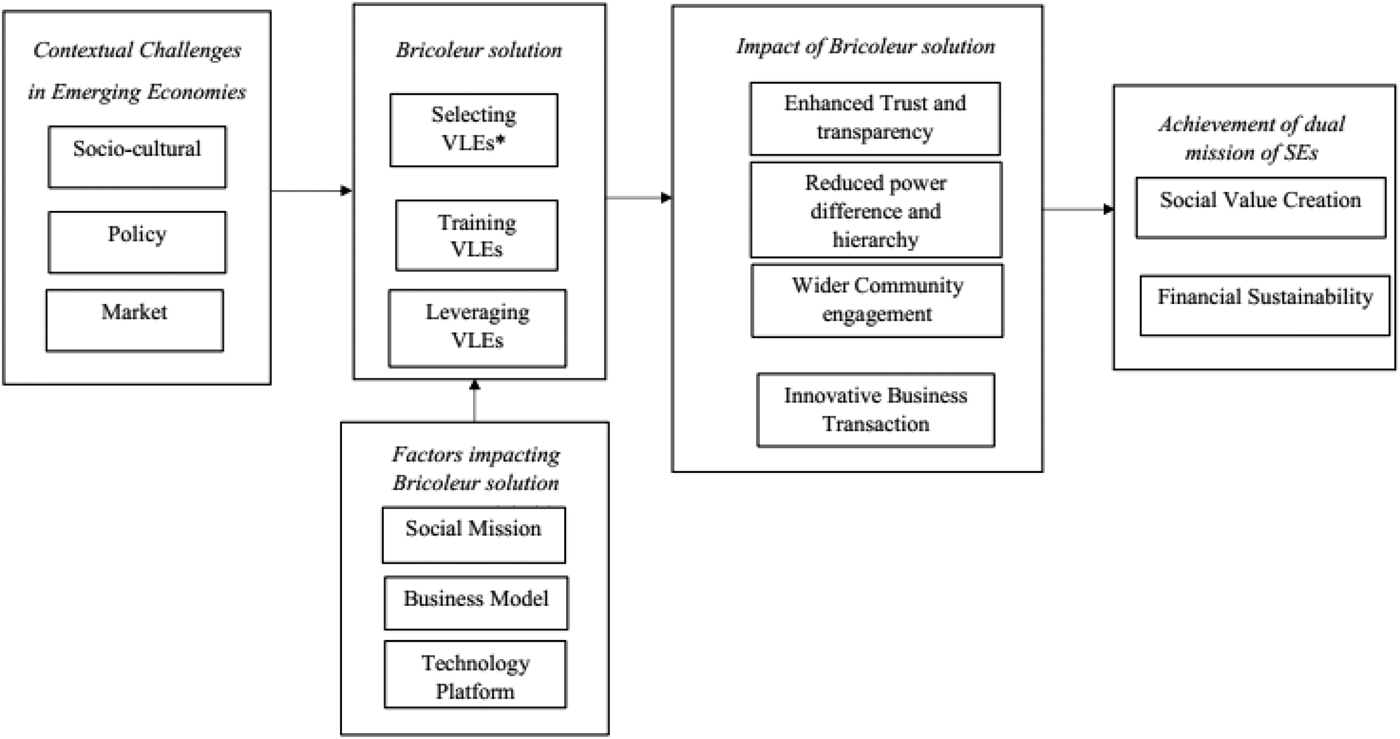
The model that emerged from our analysis of two cases has been summarized in Figure 1. The core elements of Figure 1 summarize the empirically grounded concepts, and the relationships between them, that we have described so far (Miles et al., Reference Miles, Huberman and Saldana2014). The model begins by highlighting unique contextual challenges existing in remote rural areas of India (Farmer, Steinerowski, & Jack, Reference Farmer, Steinerowski and Jack2008; Munoz, Steiner, & Farmer, Reference Munoz, Steiner and Farmer2014). These socio-cultural, policy and market challenges together with details of non-munificence of rural India, both discussed previously in this article, gives the advantage of studying bricolage, especially its form and processes in an extreme resource scarcity context. Insights from such extreme context may help in better understanding any resource scarce context, particularly those in other emerging economies (Mair & Marti, Reference Mair and Marti2009). The contextual challenges identified in both the case studies arose from the non-munificent remote rural environment (Bhatt et al., Reference Bhatt, Qureshi and Riaz2017), which was characterized by an absence of supporting institutions, including banks and markets for inputs and sale of outputs. This lack of institutions was further aggravated by sociocultural factors, such as strong traditional beliefs and practices, low literacy levels, and a lack of access to information. The high poverty levels and the lack of other economic opportunities resulted in many depending on the subsistence agricultural economy. This context was further aggravated by insurgency and violence. Tackling such institutional voids in the rural areas of emerging economies requires more resources and a wider engagement of actors (Saebi, Foss, & Linder, Reference Saebi, Foss and Linder2019), as also seen in the case of both Alpha and Beta.
Grounded model of bricolage in social enterprises operating in non-munificent rural context of emerging economies

The cumulative effect of this context was that local farmers and villagers were distrustful of outsiders, including the SEs that are the subject of our case studies. Consequently, as discussed in literature, they co-opted local intermediaries and moneylenders- a power structure of community elites defined dependent relationship (Mair & Marti, Reference Mair and Marti2007; Platteau & Gaspart, Reference Platteau and Gaspart2003; Riaz & Qureshi, Reference Riaz, Qureshi, Seidel and Greve2017). The power structure leveraged the sociocultural traditions of the villagers, their belief structures, and their mistrust of outsiders to survive (Qureshi et al., Reference Qureshi, Sutter and Bhatt2018). While overcoming environmental non-munificence and socio-cultural challenges was essential, its success depended on acceptability and trust to address issues of power structure.
In order to overcome these challenges, SEs adopt a bricoleur approach (Baker & Nelson, Reference Baker and Nelson2005; Di Domenico et al., Reference Di Domenico, Haugh and Tracey2010) by identifying locally embedded village-level entrepreneurs (VLEs). Such a social bricolage solution (Collier, Reference Collier2007; Di Domenico et al., Reference Di Domenico, Haugh and Tracey2010) helps SEs to overcome challenges related to the remoteness of the locations, local social practices, and lack of trust on outsiders. Alpha appointed local educated youth MEs and Beta appointed local villagers as BCSA are commonly identified as SE appointed VLEs, fulfilling bricoleur process of ‘making do’ with the skills available within the village (Jha, Pinsonneault, & Dube, Reference Jha, Pinsonneault and Dubé2016). These VLEs through their tacit knowledge from social embedding, trust and transparency help achieve this by legitimizing the SE and ensuring their rapid adoption through innovation and improvisation (Shaw & Carter, Reference Shaw and Carter2007). VLEs as resources were lying idle as in case of Alpha and/ or had other sources of income as for BCSAs in Beta. This allowed VLEs to agree to the limited margins as provided by SEs given the opportunity to improve social impact with their effort. This is borne out by the fact that VLEs felt pride in attaching with the social mission of the enterprises (both Alpha and Beta) and value the goodwill thus generated among their immediate society. Although VLEs are strongly influenced by SE mission, their opportunity for wider engagement with community assures better income, in turn helping SEs attain financial sustainability as they scale up.
Such a bricoleur solution using locally embedded VLEs is impacted by the social mission, business model and technology platform of the organization. The social mission of the organization, acting as a source of legitimacy (Dart, Reference Dart2004; Doherty, Haugh, & Lyon, Reference Doherty, Haugh and Lyon2014; Yunus, Moingeon, & Lehmann-Ortega, Reference Yunus, Moingeon and Lehmann-Ortega2010), is the key to engage the locally embedded VLEs. The feel of doing something good for their local people acts as a prominent motivator for the VLEs to work with the SEs. The business models of the SEs, assuring regular incomes for the VLEs, helped to attract the villagers who wanted to stay in their village and earn their income (cf Yunus et al., Reference Yunus, Moingeon and Lehmann-Ortega2010). The technology platform developed by both Alpha and Beta helps the VLEs to deliver services in remote areas, and hence act as a facilitator for the bricoleur solution.
By employing this bricoleur solution, SEs can overcome contextual challenges and achieve their dual mission. Since the VLEs already have trust prebuilt because of his/her embeddedness, it becomes easy for SEs to build trusts. Any outsider representing the SEs was not only a stranger but also carried the mistrust of the SE itself on his shoulder. Those obstacles arising from idiosyncratic mistrust could only be overcome with the local embeddedness (Shaw & Carter, Reference Shaw and Carter2007) of the VLE, as in case of villagers trusting the local shopkeeper with all their savings only because he was ‘son of the soil’, a neighbor, as in case Beta.
VLEs also can help to change existing belief system in the villages and that can lead to increase acceptance of services of SEs and finally result in higher engagement of community members (Di Domenico, Tracey, & Haugh, Reference Di Domenico, Tracey and Haugh2009). For instance, only the local VLEs, explaining in local dialect (language skills) with video support made an impact where outside trained employees of SE would have failed as quoted in case of Alpha. In overcoming deeply entrenched beliefs and practices, contextual familiarity of VLEs helped understand and devise ways to align the villagers to the goals of the SE, identify villagers who were opinion makers and convert them into early adopters. This tacit knowledge from local embeddedness was necessary to find workable and sustainable solutions leveraging local resources.
The personalized interactions locally between VLEs and villagers also led to wider community engagements (Desa & Koch, Reference Desa and Koch2014; Haugh, Reference Haugh2005). This provided an opportunity for greater stakeholder participation in decisions (Teasdale, Reference Teasdale2010), besides persuasion using peer pressure for more villagers to fall in line with the objectives of the SE (Di Domenico et al., Reference Di Domenico, Haugh and Tracey2010). This helped move away from traditional business transactions arising from socio-cultural practices and beliefs besides prevailing institutional voids. As an improvisation (Baker, Reference Baker2007), a unique initiative of VLEs leveraging local, personalized data of villagers like trustworthiness, past loan repayment records, personal integrity, habits, helped draw up rudimentary credit score for villagers useful for securing future financial loans when endorsed by SE. Without training, such improvisation by VLEs was not only useful contextual skill otherwise unavailable at remote locations for SEs, but was also one that prioritized social value creation over profits.
The use of VLEs as a bricoleur solution also helps the SEs to reduce the power difference and hierarchy prevalent in rural areas (Mair & Marti, Reference Mair and Marti2007, Reference Mair and Marti2009; Riaz & Qureshi, Reference Riaz, Qureshi, Seidel and Greve2017). For instance, in the case of Alpha, creation of FIGs through VLEs helped knowledge sharing and interaction among farmers and reducing the power differences. Similarly, the continuous efforts by VLEs helped to break the existing beliefs that toilets are to be used only by elites and not by others, hence reducing the power difference.
DISCUSSION
We sought to extend previous research on bricolage and resource mobilization in social enterprises operating in rural contexts of emerging economies by examining contextual challenges and a unique bricolage activity that helps SEs to overcome these contextual challenges (Gras & Lumpkin, Reference Gras and Lumpkin2012; Martin & Osberg, Reference Martin and Osberg2007). To do so, we explored two social enterprises operating in India through in-depth case study approach. In answering our research question, we identified how social entrepreneurial bricolage may manifest in the institutionally non-munificent context of emerging economies in response to the contextual challenges. Further we explore how a unique bricoleur approach of identifying village level entrepreneurs helps SEs to overcome contextual challenges and address their dual objectives.
Contributions
This article extends the understanding of social entrepreneurial bricolage in the unique context of institutionally challenging environment of emerging economies where, unlike developed economies, voids result from conflict and contradiction among institutional ‘bits and pieces’ from local political, community, and religious spheres. These insights extend perspective that view the ‘property rights’ and ‘autonomy’ as fundamental pillars of modern societies and economies and sharpen the focus on the inadequacy of existing ‘rules of the game’ associated with the local community (Mair et al., Reference Mair, Martí and Ventresca2012). In absence of formal institutional, existing informal institutions of trust, group power reflecting local socio-economic and belief systems tend to dominate (Kostova & Zaheer, Reference Kostova and Zaheer1999; Scott, Reference Scott2008). This is in contrast to developed economy context with limited or no challenges of institutional voids and therefore a less dominant role for informal institutions, local power structures and beliefs as compared to emerging economies. One of the outcomes of the bricolage activity include deconstruction and revamping current institutional structures (DiMaggio & Powell, Reference DiMaggio and Powell1983; Fligstein, Reference Fligstein1997) so as to create required social change (Mair et al., Reference Mair, Martí and Ventresca2012). In the acute resource constraint of rural context in emerging economies, a bricolage approach to achieve this is demonstrated through the identification of village level entrepreneurs.
Although in tracing bricolage's conceptual underpinnings, Di Domenico et al. (Reference Di Domenico, Haugh and Tracey2010) identified ‘social value creation’, ‘stakeholder participation’ and ‘persuasion’ as additional key resources over and above ‘making do’, ‘refusal to be constrained by limitations’ and ‘improvisation’ (Baker & Nelson, Reference Baker and Nelson2005) in case of SEs, they typically focus on non-availability of facilities and challenges to a community in need of a product or service. For this Di Domenico et al. (Reference Di Domenico, Haugh and Tracey2010) looked at early stage SEs in UK in need of resources for their creation. Largely centered around identification of unused resources or rallying resources where required, formal institutions such as town councils were used for legitimization and public relationships. SEs however went as far as to respond to changes occurring in the macro, regulatory environment and a refusal to be irrevocably constrained by these limitations, mostly using tangible resources-physical, financial and skills assets with aim of prioritizing social value creation over revenue generation. All these were captured through the dimensions of ‘social value creation’, ‘stakeholder participation’ and ‘persuasion’ mentioned before (Di Domenico et al., Reference Di Domenico, Haugh and Tracey2010). The research acknowledges that dynamic use and exchange of resources by SE bricoleurs within their environment reflects recognition of institutional pressures (Douglas, Reference Douglas1986).
The present study builds on and extend this work by contributing an empirically grounded model that explains how SEs facing non-munificent institutional environment can adopt bricoleur solutions using locally embedded entrepreneurs to overcome the challenges imposed by the operating environment. Since our article investigates the persuasive practices used by SEs to acquire resource portfolios in a different setting from UK, embedded in a distinct socio-political context, this study using grounded method is a contribution beyond that of Di Domenico et al. (Reference Di Domenico, Haugh and Tracey2010). The present article looks at resource challenges of SE, but contextually unique as in acute resource challenges in virtually non-existant formal institutions of remote rural areas in emerging economy. Characterized by the lack of formal institutions including banks and markets for inputs and sale of outputs, besides property rights, and fair and transparent transactions, (Viswanathan et al., Reference Viswanathan, Gajendiran and Venkatesan2008) this context is of fragmented rural supply chains, with low value additions and high transaction costs in geographically dispersed and unorganized rural markets. Such spatially bound contextual challenges need creation of bricoleur recombination of resources also bound to the same space (Korsgaard, Müller, & Tanvig, Reference Korsgaard, Müller and Tanvig2015), creating what Foss et al. (Reference Foss, Klein, Kor and Mahoney2008) called experiential subjective knowledge or Smith et al. (Reference Smith, Fressoli and Thomas2014) identified as new knowledge. This knowledge pertained to ways of weakening power hierarchies, traditional belief systems as also traditional business systems.
The optimal use of local resources (Kitchen & Marsden, Reference Kitchen and Marsden2009) assisted in maintaining a local equilibrium in resource use, thus making localities more resilient (Bristow, Reference Bristow2010; Christopherson, Michie, & Tyler, Reference Christopherson, Michie and Tyler2010) in the face of resource scarcity, making it more likely for SEs to not only succeed but scale up rapidly. VLEs as bricoleurs learn through personal encounters with the elements in their repertoires, so sharing them may be relatively easy when they belong to a close-knit community or have undergone similar kinds of socialization. Bricoleurs need to gain legitimacy and thereby position the outcome of bricolage in a wider organizational (here social) context (Duymedjian & Rüling, Reference Duymedjian and Rüling2010). With their individualized and tacit local knowledge, trust and transparency, such entrepreneurs arrive at localized heterogeneous solutions to problems. These entrepreneurs show considerable ‘resourcefulness and improvisation’ (Garud & Karnøe, Reference Garud and Karnøe2003) in their innovative social bricolage to overcome context specific socio-cultural constraints like ‘dependent security’ power structure (Mair & Marti, Reference Mair and Marti2007).
Social entrepreneurs confronted with institutional constraints engage in bricolage to reconfigure existing resources at hand (Desa, Reference Desa2012). Such bricolage activities challenge rules and norms in existence (Mair & Marti, Reference Mair and Marti2009) by recombining legitimacy of fragmentary resources into a normatively legitimated whole (Desa, Reference Desa2012). In doing so, social entrepreneurs survive against odds of lack of viable opportunity, legitimacy (West, Bamford, & Marsden, Reference West, Bamford and Marsden2008). While stating role of bricolage in the process of legitimization, Desa (Reference Desa2012) however did not go into the details of ‘how’ this was achieved except indicating role of informal practices in compensating for institutional voids. Our article highlights where and how this legitimization of SE come from. Engaging VLEs, as a bricolage activity, for local level resource mobilization in a non-munificent environment of institutional voids and idiosyncratic local beliefs and practices of emerging economies achieve legitimization. It reinforces role of entrepreneur without siding with institutional rationality of agency or structural determinism (Battilana, Lee, & Boxenbaum, Reference Battilana, Leca and Boxenbaum2009). Our findings suggest that a bricoleur solution using local village youth as entrepreneurs with required trust, skills and technology created legitimacy for the SE. Besides identifying beneficiaries, the explicit social mission was also useful in identifying such local entrepreneurs. Unlike the route of political legitimization to create alternative institutions (Mair & Marti, Reference Mair and Marti2007), the skills, information, material and technology (as provided by SE) together with tacit knowledge, trust, and transparency from embeddedness of the local entrepreneurs helped weaken the power structure and hierarchy. In breaking the isolated village economy, bricolage not only helped SE serve its mission but also scale up with the help of incremental revenue that provided financial sustainability.
Further, in order to understand, social entrepreneurial bricolage Sunduramurthy et al. (Reference Sunduramurthy, Zheng, Musteen, Francis and Rhyne2016) conducted a study on a set of Ashoka fellows based on secondary data. Although this study was useful in highlighting the pattern of bricolage and ingenieur-type of approaches in the operational process of SEs, Sunduramurthy et al. (Reference Sunduramurthy, Zheng, Musteen, Francis and Rhyne2016) acknowledged that there is a need to understand the ‘micro bricolage process’ (866), which our study addressed by exploring one bricolage activity in depth. Moreover, our study considered the suggestion by Sunduramurthy et al. (Reference Sunduramurthy, Zheng, Musteen, Francis and Rhyne2016) that ‘there is a need to develop a comprehensive process model of social value creation which is only possible using primary data’ (866).
Our study acknowledges the usefulness of uncovering micro-processes of social entrepreneurship using a qualitative research method that is of exploratory, inductive nature drawing on empirical data from cases (Di Domenico et al., Reference Di Domenico, Haugh and Tracey2010). In addition, longitudinal data collection provided us several insights and nuances around doing qualitative research in emerging economies. In such economies, respondents are not well literate and hence they cannot read and understand consent forms. Hence, taking informed consent becomes difficult and complex. Hence, as a researcher, the onus is on us to make them understand their rights. Moreover, a question we ask might be misunderstood or answers communicated to us might only be partially understood due to variation in dialects and social contexts. Therefore, saturation of information and convergence of themes takes long time and needs a greater number of interviews. This also highlights the need for multiple field visits to make sense of emerging themes. Further, in emerging economies, especially in rural areas, respondents are sparsely spread, with poor infrastructure and connectivity, as compared to developed economies, and as a researcher one has to reach them personally as calling them over phone may not be feasible. This adds to the number of days required to be spent in the field for data collection.[Footnote 1 ]
Limitations and Future Research Directions
This research, being exploratory, was limited in the number of SEs studied and their nationality. Future research should build on our findings and explore several SEs in different national contexts of emerging economies. Such contextual challenges of extreme resource scarcity in non-munificent environment is also faced by other organization types, such as foundations and non-profits. Such different organizations have degrees of benevolence and altruism that may differ from SE, which have dual mission, and might approach contextual challenges differently. The policy context of economies may vary in terms of extent of socio-economic development impact expected from SE, thus creating interesting deviations to study. Further, it needs to be seen to what extent understanding of role of social bricolage in overcoming contextual challenges of emerging economies can be generalized to better understand impact of bricolage in these economies on entrepreneurship in general. Given the early stage of research on social entrepreneurship and bricolage activities in the rural context of emerging economies, we used a descriptive qualitative study, which is found to be suitable at an early stage of studying a phenomenon (Creswell, Reference Creswell1998; Patton, Reference Patton2015). However, as phenomenon mature, future research may be conducted using a large number of case studies, where cases may be selected on a priori thematic dimensions.
Managerial Implications
The findings of this paper have important implications for the managers of SEs. The bricoleur approach of using local resources for service delivery provides a way for the managers to overcome contextual challenges when operating in the extreme non-munificent context of rural areas in emerging economies. The challenge lies in the selection of right bricoleur resources, providing them appropriate training such that they ultimately assist SEs to achieve their dual mission of financial sustainability and social value creation. Over time this challenge broadens to offering appropriate challenges for local resources to scale up SE operations by undertaking additional activities as demanded by local beneficiaries for continued viability of the business model. Managers need to manage all this in a dynamic environment where all the discussed contextual challenges of policy, market and socio-cultural nature change with time raising different and changing bricoleur challenges.
CONCLUSION
In conclusion, social enterprises in rural context of emerging economies see institutional voids manifest primarily as socio-cultural, policy and market challenges. These challenges make resource mobilization vital yet difficult for SEs who are alien to such contexts. This article finds that such SEs can employ a unique bricoleur mechanism of selecting locally embedded village level entrepreneurs for service delivery. The local embeddedness of the entrepreneurs help SEs overcome contextual challenges through their trust and transparency-based transactions leading to weakening of power and hierarchy as also traditional belief systems. Such bricolage effort increases engagement of local community as stakeholder to weaken entrenched traditional business transactions such that SEs achieve their mission while maintaining financial viability. This way spatially bound contextual challenges create bricoleur solutions bound to the same space. The experiential subjective knowledge makes optimal use of local resources to help maintain a local equilibrium in resource use, thus making localities more resilient.