In 1487, Master William Chaunt, notary public and proctor general of the Court of Canterbury, held that it was “the custom [consuetudinem] of the kingdom of England [that] a married woman, first having obtained license [licencia] from her husband, can make a testament concerning her own property [bonis paraphonalibus et distinctis].”Footnote 1 In 1497, Chief Justice Fineux argued in the King's Bench that, “by ecclesiastical law she [a wife] can appoint an executor of her paraphernalia [son apparel de son corps] though they belong to the husband at common law, and she requires his consent at common law.”Footnote 2 Both these legal disputes—one in a church court, one in a common law court—had their origins in a married woman making a will at the end of the fifteenth century and there being some disagreement about whether such a will was valid. In both cases, those who believed that a married woman could make a will did so by setting out clear parameters for such an act: she must secure her husband's permission (the King's Bench case discussed if this needed to be explicit or could be implied) and only bequeath her own personal property (and here the lawyers argued about what might be said to be the wife's own).
In the King's Bench case, the chief justice referred back to an earlier case (1426) in which a Justice had argued that it did not matter if canon law allowed a married woman to make a will, in this court “our law” prevailed, and under this law she had no possessions.Footnote 3 Although this view was not the majority one in this particular courtroom, it sets up well the clash between the canon and common law positions on married women's wills. The scholarly consensus, cemented by Richard Helmholz's essay of 1993, is that the common law position prevailed, at least to the extent that the church did not succeed in convincing people that married women did not need their husbands’ consent to make a will, but perhaps also to the extent that married women largely ceased to make wills from 1440 or 1450 or thereabouts.Footnote 4 I will summarize the debate about the common law and canon positions subsequently, adding in the position of customary law. I will then review the studies of married women's will making in practice, adding some of my own statistical findings in order to argue that there was regional variation in the late fifteenth century. The article will then focus on the deanery of Wisbech 1465–77, its linked diocese of Ely 1449–1505, and the Archdeaconry of Buckingham 1483–97, where married women made wills in significant proportions and had them proved. In particular, a focus on court books (for Wisbech and Buckingham) which included visitation material, enrolled wills, and probate acta, enables more to be said about the kinds of married women who made wills and their possible motivations for so doing. The article argues that, in these areas, as well as a continued tendency for wives who had some land or buildings to make wills, wives who were married to, or had other close connections with, men who acted as churchwardens or jurors in church courts might also have their wills proved, even when they had little to bequeath. It will thus add another dimension to the debate about the impact of different legal jurisdictions on the property rights and legal abilities of married women: one that allows for more fluid practices.
Married Women's Wills: The Legal Position
In late medieval England, church courts had primary probate jurisdiction and, according to canon law (following Roman law), married women were fully capable of making a testament of their separate property.Footnote 5 English ecclesiastical legislation in the thirteenth and fourteenth centuries set out that husbands must not prevent their wives making wills, under pain of excommunication.Footnote 6 However, the matter of probate jurisdiction was one of customary practice in England, not a canonical principle.Footnote 7 This is one of the reasons Helmholz offers for why there was room for development in the legal position concerning married women making wills.Footnote 8
Although some people in this period made a “last will” for land and a “testament” for chattels, this separation was not always made.Footnote 9 The lack of a clear distinction between a will and a testament is also evident in some contemporary discussions about whether married woman could bequeath property, which is significant because, under common law, a married woman owned no chattels.Footnote 10 Under common law, with its doctrine of coverture, upon marriage, a husband became guardian of his wife's lands, whether they were part of her dowry or whether she inherited them, but she retained ownership and, therefore, when the marriage ended she should be able to recover them. With chattels, including those she received after marriage, the husband became the owner, with the possible exception of her clothes and jewelry.Footnote 11
The earliest treatises on English common law indicate that the initial common law position was that a married woman could not make a will without her husband's consent. The late twelfth-century treatise known as Glanvill stated that because “she is in the power of her husband” (“in potestate viri”), any chattels are his. However, it did go on to suggest that it would be “kind and creditable” for a husband to allow his wife to dispose of that third part of his goods that she would have obtained had he died first.Footnote 12 The division of a man's movables into thirds, if he had children (halves if he did not), originated in England as a customary rule and was widespread by the end of the reign of Henry I.Footnote 13 The husband should leave a third of his goods to his widow and a third to his children, and his testament would then concern the final third, which he could freely bequeath.
The treatise known as Bracton, largely composed in the late 1220s and early 1230s, was in agreement with Glanvill that allowing a wife to bequeath her third was “only proper” (“propter honestatem”), and added “especially things given and granted her for personal adornment, as robes and jewels, which may be said to be her own.”Footnote 14 Although the term “paraphernalia” was not used as yet, this is what came to be understood in common law by that term. Neither of the statements in Glanvill and Bracton about what wives might have been able to bequeath had the force of common law, but they are allusions to contemporary practice in the late twelfth and early thirteenth centuries.Footnote 15 Glanvill stated with reference to husbands allowing their wives to bequeath a third share: “many husbands in fact do this, which is much to their credit.”Footnote 16
The question of whether a married woman needed her husband's consent to make a will or not was publicly contested in 1344. The Archbishop of Canterbury John Stratford had issued a provincial constitution in 1343 stating that anyone who hindered married women from making a will, including their husbands, should be excommunicated from the church.Footnote 17 This led to a Commons petition to the king in 1344, which seemed to object to the very idea that married women could make wills: “the commons pray: that whereas an ordinance was made by the prelates … that bondsmen and married women [femmes] might make a will, which is unreasonable, may it please him and his good council to ordain remedy.”Footnote 18
As Charles Donahue reminded us, we should be wary of assuming that the canon legal position had been “overwhelmed by the force of the common law” by the middle of the fifteenth century, even if it was in the sixteenth century.Footnote 19 He demonstrated how William Lyndwood's gloss “propriarum uxorum,” part of his canonical commentary Provinciale (completed by 1430), deliberately adopted a broad understanding of “paraphernalia”—all that is hers except the dowry, and those acquests attributable to it—in order to argue that a married woman did not need permission to dispose of something that she was considered to own.Footnote 20 The year book evidence suggests that at approximately the same date common lawyers had a much narrower definition of paraphernalia; given the small number of legal treatises written in late medieval England, the year books are our principal source for the development of common law doctrines and concepts.Footnote 21 A debate in the Court of Common Pleas in 1454, recorded in a year book, about whether a widow effectively took on liability for her deceased husband's estate when she accepted delivery of certain goods, speaks to what the justices considered a woman's own property as opposed to her husband's. The justices argued about whether she even had a right to her own clothing; two justices argued that the widow should not receive her apparel or any other goods until the question of administration had been settled, another argued that she could have what apparel canon law stipulated, and two others maintained that she could have suitable (“convenient”) but not excessive (“excesse”) apparel.Footnote 22
We also need to consider the status of married women's property under customary law. Bracton and Glanvill both referred to what was common practice in England and, as we was mentioned earlier, in 1487, an ecclesiastical official referred to “the custom” of England. However, there were also regional customs. Bracton mentioned that in the city of London it was the custom that a wife would not get a third share if she had a specified dower from her husband; a Cambridge custom of 1299 specified that the wife should be allowed a half share.Footnote 23 There are a number of boroughs that recorded their stance on married women's ability to make wills; civic governments required wills that affected their jurisdiction—in that they, for example, concerned burgage tenure or the protection of orphans—be enrolled before them too.Footnote 24 In some of these, the custom was little more than a reminder that a husband must consent to his wife's will (for example, Bristol c.1240, Lincoln 1480–81) but in others it set out restrictions on what real estate a married woman could bequeath even with her husband's consent (for example, Ipswich 1291, Godmanchester 1324, London 1419).Footnote 25 In terms of movable goods, there were also specific customs about what constituted “principalia” (heirlooms), which were reserved to the heir, usually the equipment needed for the household and its work.Footnote 26 In Leicester, according to a custom recorded in 1293, after the death of a father the heir should get “the best boiler, the best brass pot, the best basin with the laver, the best mazer, …the best table, with the best table-cloth.”Footnote 27 In Godmanchester 1312–13, it was decided that if the wife received some of the “principalia” she should pay a deposit to the heir in case she damaged them.Footnote 28
Janet Loengard has demonstrated that what was viewed as the wife's “paraphernalia” also varied regionally. For example, in the province of York and the City of London (perhaps the southern province in general) it included her bed and a chest; in London she might keep “her chamber,” that is, all cloths belonging to it such as linen and wool for the beds.Footnote 29 Helmholz has also argued that the custom of giving a third to one's children, legitim, was only preserved in parts of England by the end of the fourteenth century, again primarily the province of York and a few places in the south such as the City of London.Footnote 30 These findings lead into the realm of practice. Did married women make wills and, if so, what kind of property was involved and were there regional variations?
Married Women's Will Making in Practice
The first foray into the area of married women's wills was by Michael Sheehan in 1963. He cautioned that it was hard to deduce how frequently wives made wills, as most early extant wills survived because they concerned land, which was less likely to be a feature of married women's wills. However, he examined a printed consistory court register for the diocese of Rochester pertaining to the years 1347–48 and found that of 186 notes of probate (also known as probate acta), 57 pertained to women's wills (30.6%) and 26 certainly belonged to those of married women (and probably at least 5 others; 14.0–16.7%). Sheehan concluded that, despite the common law position, married women “very often managed to distribute property at death.”Footnote 31 Donahue's 1982 essay also argued that we need to examine practice, suggesting that such wills “seem to get less common as the middle ages wear on.”Footnote 32
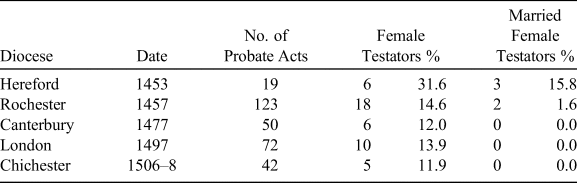
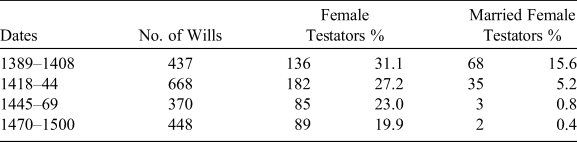
It was Helmholz, in an essay dedicated to Sheehan, who took up the mantle to see if Sheehan's impression—that, by the time of Elizabeth I, the ecclesiastical courts had lost their attempt to influence common law as regards married women's rights to chattels—was correct.Footnote 33 Helmholz focused on whether married women continued to make wills in the fifteenth century and found that, although there were examples, they were very few in number “by 1450, at the latest.”Footnote 34 Like Sheehan, he examined notes of probate, choosing to do so because, whereas not all wills were recorded, “acta record all the wills proved by specific ecclesiastical courts and normally all cases of intestacy as well.”Footnote 35 Helmholz sampled unpublished records in five ecclesiastical jurisdictions to prove this decline (see Table 1). He also cited, as supporting evidence, P. J. P. Goldberg's work on the Exchequer Court in the diocese of York.Footnote 36 Goldberg counted enrolled wills rather than notes of probate, but his findings do fit the chronological pattern that Helmholz was suggesting for England as a whole (see Table 2).Footnote 37
Helmholz's Data Pertaining to Married Women's Will Making in Later Medieval England.

Source: Richard H. Helmholz, “Married Women's Wills in Later Medieval England,” in Wife and Widow in Medieval England, ed. Sue Sheridan Walker (Ann Arbor: University of Michigan Press, 1993).
Married Women's Wills in the Exchequer Court of York, 1389–1500.

Source: P. J. P. Goldberg, Women, Work, and Life Cycle in a Medieval Economy: Women in York and Yorkshire c.1300–1520 (Oxford: Clarendon Press, 1992).
Helmholz argued that this decline in married women's will making was not about increasing pressure from common lawyers on the church courts, which only happened at the very close of the fifteenth century, but was perhaps driven by “a growing social acceptance of the view that married women had no separate property and that what personal property they did have would normally have been held in trust for them.”Footnote 38 Helmholz refers back to his earlier argument that the custom of a man having to think of his chattels in thirds was dying out at the time, and that therefore married women could no longer assume that they had a third of the household's goods to bequeath.Footnote 39 He also points out that it was the fifteenth century that saw a growth in trusts, known as the “use,” by which a married woman assigned legal ownership of land or chattels to a trusted party; what happened to this property in the event of her death would be covered by the terms of the use, thus negating the need for a will.Footnote 40
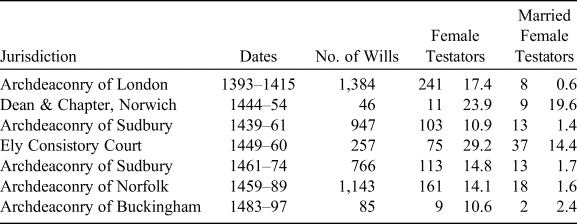
Mary Prior, who was most interested in what happened to married women's will making in the period 1558–1700, suggested 1440 as the point at which the decline set in. She also mentioned “pockets of resistance” to the national trend, such as in the archdeaconries of Buckingham and Sudbury.Footnote 41 In general, archdeaconry courts dealt with the wills of testators who did not have property in another archdeaconry (commissary courts with wills concerning property in more than one archdeaconry, and the Prerogative Court of Canterbury for those with property in more than one diocese).Footnote 42 The register for the Archdeaconry of Sudbury, 1439–74, does contain some married women's wills, but not enough to be considered a pocket of resistance (see Table 3). Prior cited an index as her source, which perhaps accounts for the claim. The index identifies 121 testators as wives for the period 1354–1530, and 86 post-1440. However, a number of these women were widows who began their wills describing themselves as former wives. An examination of the Baldwyn Register (which covers the period 1439–74) reveals that of the thirty-three women described in the index as wives, twenty-six were actually widows. Also, of the twenty-nine married female testators in this register (twenty-six wills and three additional notes of probate, one for a married couple), only seven were described as wives in the index.Footnote 43 However, the Archdeaconry of Buckingham, 1483–97, does seem to be a possible “pocket of resistance.” Although there are only two married women's wills recorded in the court material for this period, there are thirty-five probate acta that pertain to married women in the same period (out of 195; 17.9%).Footnote 44 This suggests that, although married women continued to make wills in significant numbers and this court continued to prove them right up to the end of the fifteenth century, very few of these wills were thought to merit the expense of recording, perhaps because they did not concern immovable property.Footnote 45 The two married women's wills that were recorded both mention a tenement that they had acquired from a previous marriage; one left it to her current husband for life, one left it to her son, although her husband was joint executor of the will.Footnote 46
Married Women's Wills in Select Ecclesiastical Jurisdictions in Later Medieval England.

Source: Robert A. Wood, “Life and Death: A Study of the Wills and Testaments of Men and Women in London and Bury St. Edmunds in the late Fourteenth and early Fifteenth Centuries” (PhD diss., Royal Holloway, University of London, 2012), 12, 44; Norfolk Record Office (NRO), Records of the Dean and Chapter of Norwich Cathedral (DCN), 69/1; Peter Northeast, ed., Wills of the Archdeaconry of Sudbury, 1439–1474, 2 vols. (Woodbridge: Boydell Press, 2001–10), 1; Cambridgeshire Archives, VC 1; Northeast, Wills of the Archdeaconry of Sudbury, 2; NRO, Archdeaconry of Norfolk (ANF), will register Liber 4 (Grey); and E. M. Elvey, ed., The Courts of the Archdeaconry of Buckingham, 1483–1523, Buckinghamshire Record Society, vol. 19 (Aylesbury: Buckinghamshire Record Society, 1975), 1–189.
In terms of the chronological pattern identified by past scholarship, it is also worth noting that the numbers of married women's wills recorded in London were low at the start of the fifteenth century (see Table 3), as well as at the end, although here we have to compare Robert Wood's work on the archdeaconry court with Helmholz's sampling of the consistory court, as the probate materials for both do not survive for the whole period. Wood found only eight married women's wills enrolled in the Archdeacon of London's register in the period 1393–1415, out of 1,384 wills (0.6%).Footnote 47 If we turn to the city's court of Husting, which proved wills pertaining to citizens with property in the city, we find that two married women's wills were annulled in 1291 and 1307 respectively, because the testators were “under the rod” (sub virga; echoing the language Bracton used for married women's legal coverture) or “feme covert.”Footnote 48 The custom in London from 1256 was that married women could not devise tenements, even with the permission of their husbands.Footnote 49
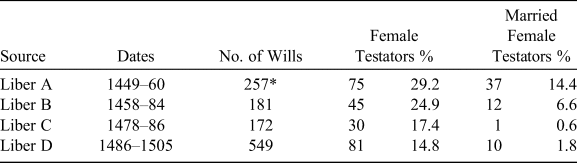
For Helmholz, his outlier finding from the diocese of Hereford that three of nineteen testaments (15.8%) proved in autumn 1453 were by certainly married woman was “quite unusual,” but also his smallest sample.Footnote 50 However, there are similar if not higher proportions of married women's wills for the middle of the fifteenth century from larger samples in other dioceses, albeit in registers that largely recorded wills rather than notes of probate (see Table 3). A register of wills proved before the Dean and Chapter of Norwich in the period 1444–54 contains forty-six wills, of which eleven were by female testators and nine were by certainly married women (19.6%).Footnote 51 A probate register for the diocese of Ely, 1449–60, contains 257 wills of which 75 were by women and 37 were by certainly married women (14.4%).Footnote 52 It is the latter area that I shall focus on, in part because we have a full series of probate registers from 1449, stretching into the sixteenth century. These are registered in bound manuscript volumes, which are labeled Liber A, B, C, and D, with the titles being contemporary or near contemporary with the volumes’ compilation.Footnote 53
Another reason for the focus on the Diocese of Ely is that the second register in this series, Liber B, is actually a court book for the Deanery of Wisbech, a rural deanery within the Diocese of Ely, as well as a will register. In the fifteenth century, a diocese was still divided into a number of deaneries, with deans appointed to administer these smaller units, on behalf of the bishop.Footnote 54 The Deanery of Wisbech included the small town of Wisbech plus four small, largely adjacent rural parishes (Elm, Leverington, Newton, and Tydd St. Giles).Footnote 55 The bishop empowered one of his officials, sometimes the dean, to convene a court that dealt with a range of matters such as breach of faith cases, defamation suits, some sexual and marital offences, and granting probate for testaments in this deanery, as well as Whittlesey, which was technically outside the deanery.Footnote 56 The surviving court book includes 181 wills from the deanery (including Whittlesey).Footnote 57 Of these wills, twelve are certainly by married women (6.6%). Although this represents a substantial drop from the previous register (see Table 4), it is still high compared with the figures cited by Helmholz and Goldberg for this period (Tables 1–2), and these wills have sparked comment for that reason.Footnote 58 The advantage of having surviving court material for the Deanery of Wisbech means that sometimes more can be said about the married female testators and their families than is revealed by a study of their wills alone. In a classic essay, Clive Burgess demonstrated the problems of using wills alone to assess how pious a testator was and how much property that person owned. Using supplementary material, he demonstrated that a will might only be part of a testator's plans for his or her property and soul.Footnote 59 Liber B, which I will focus on first, can be used to find out more about the social status of the testators.
Married Women's Wills in the Diocese of Ely, 1449–1505.

*One joint will from a husband and wife; not counted as a woman's or wife's will.
Source: CA, VC 1-4.
Although Prior's study is much later in date, her qualitative approach to samples of married women's wills meant that she did find some noticeable trends in the kinds of women who made them. Her study was based on sampling in the Prerogative Court of Canterbury (PCC) 1558–1700 and in two courts in Oxfordshire to give her some women below the ranks of the elite.Footnote 60 First, she found that a substantial proportion of her PCC samples were women who had been married more than once.Footnote 61 Second, she found that a significant number of the husbands in these samples were lawyers or had connections with the Inns of Court.Footnote 62 Third, she found that married women's wills tended to fall into pairs or clusters; for example, of women who shared kinship ties. She also found a few examples in which the successive wives of a particular man both made wills.Footnote 63 Fourth, Prior found that women whose families had been persecuted because of their religious beliefs formed another significant cluster.Footnote 64 Fifth, a key cluster that she identified in the Oxfordshire sample was that three married women's wills dealt with land in the ancient demesne manor of Long Handborough. Prior's thesis here was these wills were concerned with oversetting the custom of the manor in which the land would have gone to the youngest son; she also suggested a similar concern in some wills from Combe.Footnote 65 These are patterns to which I will return.
The intention of my case study is not just to make the case for the Diocese of Ely, particularly the Deanery of Wisbech, as another “pocket of resistance” in terms of married women making wills. It will also appraise the evidence for why some married women made wills, something that is not explicitly stated in the documents themselves, and evaluate what this reveals about the women, their families, and their communities. Further, it will consider what this might suggest about the impact of the law—be it, ecclesiastical, common, or customary—on marital property and married women's will making.
Married Women's Wills in the Court of the Deanery of Wisbech, 1465–77
The twelve married women's wills in Liber B (or VC 2 as it is now known) all date from the period 1465–77.Footnote 66 Seven of the wills identify the testators as wife (“uxor”) in the opening line, but in the other five it is only a later reference to a living husband (“maritus meus” or “sponsus meus”) that identifies them as married women.Footnote 67 None of the twelve wills specifically stated that they had been made with the husband's permission, but he was named as an executor in ten of the wills. Margaret Freman, who made William Satewyn from Bishop's Lynn (now King's Lynn) in Norfolk, her executor, had her husband, John Freman, witness the will.Footnote 68 The court when granting probate, then, would have been satisfied that the husbands in these eleven cases had consented to the making of the wills.Footnote 69 In the twelfth, Matilda Clerk's will, her husband (Thomas Clerk) was assigned no formal role but was left various household items, alongside her son, William Godfrey, who was one of the executors.Footnote 70 Perhaps William was a son from a previous marriage, as he does not share her surname. Although a previous marriage was a feature in a large number of the wills in Prior's samples, only one of the twelve women, Cicely Freman, explicitly referred to a former husband in her will. Indeed, part of the intention of her will was to ensure that her late husband's will was honored. The will requested that 40s. be distributed according to the will of Geoffrey Mobbe, Cicely's late husband, which Thomas Mobbe (an unspecified relation) would have distributed if he had been alive.Footnote 71 Even when the husband was given a formal role, we cannot assume that he always performed it. We learn from the court entries that, c.1467–69, the husband of Elizabeth Tailor, Richard, was presented for hindering the execution of her will by withholding 6s. 8d. from her other named executor, Guy Alcok; her will had been proved on November 6, 1466.Footnote 72 It is noted in 1466 that Robert Galyarde of Wisbech withheld 40d. from the legacy of his wife, which should have been paid to the church of St Andrew in Whittlesey.Footnote 73 The will of Alice wife of Robert Galyarde was not proved until 1472, so this seems to be an example of a man whose successive wives made a will.Footnote 74
If we turn to the detailed content of the wills, four in part concerned real estate, such as buildings and land, and this ownership of property was probably a significant factor in why these married women made wills and why they were preserved.Footnote 75 One was the woman who was concerned with the will of her late husband: Cicely Freman of Wisbech. In her short will, she made her current husband, John, the executor and asked him to sell a dwelling (“messuagium meum”) in March, a nearby village, and spend the money on good works including celebrating the anniversaries of the burials of herself and her former husband in their parish church. John was to get 40s for his efforts. This will, although relatively brief, gives a clear sense that Cicely Freman saw herself as the owner of the property that she brought to the marriage, and perhaps they had made a marriage settlement to that effect.Footnote 76
In the second of the two wills not to name the husband as executor, that of Margaret Freman, also of Wisbech, her house (“mansio mea”) was to be sold by her executor, a William Satewyn of Bishop's Lynn. Her husband was to get 10s. from the sale but also to have a home within this house for the rest of his life, at the discretion of her executor. The husband was additionally left “all my necessaries pertaining to the hall and chamber” and all her apparel pertaining to her body except her best clothing, which was to serve as a mortuary payment.Footnote 77 There are no indications as to how she came by this property, whether it was from her natal family or a previous marriage. The church that was to get 20s. from the sale of her property was in Sutton St. James in Lincolnshire, which, like Bishop's Lynn, was not far from Wisbech despite being in another county.
The will of Alice Galyarde was largely concerned with real estate, leaving a dwelling house with its adjacent buildings in Wisbech to her husband for life and then to her sons and their heirs. She also requested that her properties and lands in the neighboring county of Norfolk be sold and the money go to her sons. The only material objects mentioned in the will were her best tunic, which was her mortuary payment, and a set of rosary beads that she was gifted by her mother, which she passed onto her husband.Footnote 78 This will suggests that Alice Galyarde held property in her own name, perhaps from her natal family (as the beads came from her mother) or it might have been from a former marriage. As discussed, it seems likely that her husband Robert had been married before. The fourth will, that of Elizabeth Tailor of Wisbech, is also largely concerned with real estate and does not even begin with any religious bequests. Her husband was left a house and various lands for life, as well as a fishery called Blakdike.Footnote 79 The reference to her debts, which he should pay, suggests that she perhaps ran this as an independent business while married.
Whereas the four wills just discussed dealt with real estate, the wills recorded in this book do not only concern such property. As L. R. Poos commented, “the Wisbech court book is especially noteworthy for the large number of early wills of obviously fairly humble people that it contains.”Footnote 80 This applies to some of the married women's wills. The eight other married women's wills were concerned only with movable goods and, of these, six were largely concerned with clothing. However, perhaps only three of the wills pertained to a strict, common law understanding of “paraphernalia”; that is, clothing and personal jewelry. I will discuss these three first (the wills of Alice Qwyght, Joan Elliott, and Alice Gilbert), before considering the three that bequeath a little more (Margaret Kellsull, Katherine Haukyn, and Alice Dowdynett), and then will turn to the two that have more substantial goods to give away (Joan Powdych and Matilda Clerk). An appreciation of what married women's wills contain, something that cannot be ascertained from a study of probate acta, is important to an understanding of why these women had these documents made and what property they considered to be at their disposal.Footnote 81
The will of Alice Qwyght of Leverington was relatively brief. After stating where she was to be buried, she left her best animal as a mortuary payment, and then bequeathed five specific items of clothing to four women, two of whom were her daughters. These items were referred to as “my gown” (“togam meam”), “my hood” (“caputium meum”), “my tunic” (“tunicam meam”), and “my overtunic and shirt” (“supertunicam meam et camisiam meam”).Footnote 82 This appears to be a basic wardrobe, not excessive apparel.Footnote 83 The will then ends by saying that she left the residue to her husband, Thomas Qwyght, whom she made executor (a formulaic statement).Footnote 84 The majority of the will is thus concerned with leaving clothing to a few named women and in this does not stray too far from the “robes… which may be said to be her own.”Footnote 85 The other two wills, which generally concern a few bequests of clothing to family and friends, also made a number of donations to their local churches. The will of Joan Elliott left a cow as a mortuary payment but also 7d. to the high altar of Tydd St. Giles, where she wanted to be buried, and 12d. to the fabric of the church, followed by payments to all the lights in that church, some named and given a higher amount than others.Footnote 86 She also bequeathed a tunic of rose russet, another tunic made from woolen cloth (“blanket”), one black hood, and a shirt to a woman called Katherine Bryde. Again this was not excessive apparel but a basic set of clothes.Footnote 87 In this will, the religious bequests dominate the short text.Footnote 88 The will of Alice Gilbert, also of Tydd St. Giles, is analogous, but she bequeathed Alice daughter of Roger Aylwarde a jet rosary (“j par precularum de gett”).Footnote 89 Although Loengard was ambivalent as to whether all jewelry was seen as paraphernalia in the late medieval period, she did think rosary beads were included.Footnote 90
The will of Margaret Kellsull left a little more, although largely in cloth rather than money. In terms of religious bequests, she left 12d. to the high altar, presumably of her parish church in Whittlesey, and some cloth to be used as vestments.Footnote 91 She gave all of her godchildren (unspecified number) 2d. each. Then eleven named individuals (ten women, one man) were given various items of clothing or cloth; the one man, Robert Kelsull (possibly a brother-in-law), was to get a yard of woolen cloth and a pair of shoes.Footnote 92 This will seems to stretch the common law understanding of “paraphernalia.” Whereas the custom in London might have been for widows to get the cloth pertaining to their chambers, the fact that other married women in this area do not bequeath cloth suggests that this was not a local custom.Footnote 93
Two other wills are similar in that they also stretch the definition of “paraphernalia” by including the odd household item. The will of Katherine Haukyn, of Tydd St. Giles, allocated some money to the church and items to seven individuals (six female, one male). Each person got an item of clothing, described by color or material or with adjectives such as “best” and “old.”Footnote 94 However, two women—her daughter, Matilda Pocok, and Katherine daughter of Geoffrey Godfrey—were also to get a household item. She left a gallon pot to her daughter (“j ollam eneam mensure unius lagene”).Footnote 95 Women tended to do the domestic brewing, as ale was a staple of the late medieval diet, and so this perhaps explains why Katherine Haukyn felt that she could lay specific claim to it.Footnote 96 We might see it as akin to “principale,” discussed previously, in that she was passing it on so that her daughter could continue to do the household brewing. She bequeathed a large chest to Katherine Godfrey but noted that she was only to have it after the death of her husband (“j magnam cistam post decessum Willelmi Haukyn’ sponsi mei”).Footnote 97 Perhaps this was a chest that she brought to the marriage as part of her trousseau, or akin to the chests that widows could take after their husbands' deaths in places such as York and London.Footnote 98 The will of Alice Dowdynett left, in addition to a kerchief each to three women, a “focer,” which was a chest or coffer, to one of them, Agnes Perch.Footnote 99 There is an argument for seeing such chests as part of a woman's paraphernalia; a married woman in York left her daughter all her jewelry but also a coffer to put them in (“pro ornamentis meis conservand[um]”).Footnote 100
The final two wills concerned more goods. That of Joan Powdyche of Wisbech, refers to more items of high value than have been mentioned so far, but they are largely items that could be considered as “personal adornments,” with the exception of two crucifixes.Footnote 101 Joan left her two female servants some items of clothing, but she also left her brother the silvered blue girdle that she wore on her wedding day, her mother a big crucifix of silver gilt, and her father a small ring of gold.Footnote 102 She also bequeathed a necklace containing a large amount of silver to a chaplain, a round crucifix of silver to another chaplain, and a silver ring called a “crampryng” to a rector (this was an amuletic ring for cramps, recommended for ailments such as epilepsy).Footnote 103 That the majority of Joan Powdyche's bequests were to her natal family suggests that this was the original source of the items, and the jewelry and devotional items probably had personal as well as economic significance, which might explain why she thought of them as her own possessions. Her husband was her executor, so he presumably agreed.
The eighth will, that of Matilda Clerk of Wisbech, starts in a similar way to most of the wills discussed so far, in terms of its religious bequests. In addition to bequests of clothing to her son, William Godfrey, and two women (one was probably William's wife), Matilda Clerk specified that her gown and best hood, rosary beads, and a ring of silver were to be sold by her executors. This could all be classed as paraphernalia.Footnote 104 However, she then went on to apportion various household equipment and furniture among her male kin, including her husband. For example, her husband was to have his choice of her best pots and pans and her son William was to get the rest of them (“Thomas sponsus meus habeat electionem optime olle mee et patelle et Willelmus filius meus habeat alteram partem”); her son was to get her best table and one of her grandsons was to have the other.Footnote 105 This sense of ownership of household property is perhaps the result of an earlier marriage.Footnote 106 Her son is referred to as William Godfrey and although it is possible that he is her son-in-law, this seems unlikely, as Alice Godfrey is not described by a familial relationship; this is also the one married woman's will in which the husband was allocated no formal role.
Matilda Clerk, like Joan Powdyche and the women who owned real estate, had enough property to dispose of to account for her will's existence. Her sense of ownership of household chattels is interesting given the common law position. But if we return to the six other married women who left very little, we might particularly ponder why they made a will. There are the obvious reasons for making a will, such as piety or looking after one's soul, although the will of Alice Qwyght barely touched on those elements.Footnote 107 But given that married women's wills seem to have largely disappeared from probate registers and court books in some parts of England by this date, the question remains: why did these wives make wills and why did their executors, usually their husbands, have them registered in court?
When looking into the family, particularly the husbands, of the married, female testators, I found another connection that might explain why some made wills. Four of the six women whose wills left very little had husbands who had official roles that gave them direct access to the court that proved their wills. The women's husbands were named either as a churchwarden (“iconomus”) or a juror (“inquisitor”) during their lifetimes. John Dowdynet, husband of Alice, is listed as a churchwarden in the early 1460s (she died in 1467).Footnote 108 John Elliott, husband of Joan, is listed four times as a juror in Tydd St. Giles,Footnote 109 as is Henry Gilbert, husband of Alice,Footnote 110 and their relationship is attested by Henry Gilbert witnessing the will of John Elliott in 1469.Footnote 111 Thomas Qwyght, husband of Alice, was listed as a juror for Leverington twice (but on one of those occasions it is noted that he did not appear).Footnote 112 The identification of Margaret Kellsull's husband as a churchwarden is more problematic. There is a William Kellsull named in that role in Whittlesey, her parish, but not until 1479–80, and Margaret Kellsull's will was proved in 1467 or 1468.Footnote 113 Allegations of immorality had been leveled against both of them in the 1460s.Footnote 114 Such allegations, even if true, might not have been enough to stop William becoming a churchwarden 10 years later, but the gap in time makes the identification less secure.Footnote 115 However, we should also note that the brother of Joan Powdych, whose will largely dealt with jewelry and devotional objects that she wanted to pass to her natal family, was twice named as a juror for Wisbech.Footnote 116
The sixth woman was Katherine Haukyn, she of the gallon pot; although I did not find Katherine Haukyn's husband, William, recorded as an office holder in this court book, he can be found listed as a juror in the manor court of Tydd throughout the 1460s.Footnote 117 It is not impossible that William Haukyn was also a church court juror at some point too. Poos compared some of the names of jurors and churchwardens in this court book with the jury lists from the same communities’ manorial court records, another category of local office-holding, and his findings are revealing: almost one third (29%; twenty-five of eighty-seven) of churchwardens and jurors in the 1460s and 1470s were serving as manorial court jurors at almost exactly the same time.Footnote 118 Joan Elliott's husband was a juror in the manor court of Tydd in 1465 (he is presumably one of the overlapping jurors to whom Poos refers).Footnote 119 This suggests both that certain parishioners were especially likely to be selected for the maintenance of order and that there was some clear overlap between the personnel of secular and ecclesiastical courts here.Footnote 120
The overlap in families who made wills and those who were officials with a role at this ecclesiastical court is doubtless because local office holders tended to be drawn from the heads of established families of middling status.Footnote 121 But, in terms of what this tells us about married women making wills, one interpretation would be to argue that strong connections with the local court that dealt with probate might have been a factor in these women knowing that canon law allowed married women to make wills and having their husbands’ support to do so. Prior's early modern study had found a connection between husbands with legal knowledge and married women making wills.Footnote 122
As the Buckinghamshire probate material, discussed previously as demonstrating a possible “pocket of resistance,” is also included in court material, I conducted a similar exercise. Here I found indications of a similar pattern to that identified in Wisbech. For example, Alice Picot—a married woman from Upper Winchendon who had her will proved in 1490—was married to a man named Richard; a Richard Pigot was listed as a churchwarden in the same place c.1483–85.Footnote 123 The (unnamed) wife of Thomas Hawkyns, from Whaddon, made a nuncupative will in 1492 with her husband as executor, and he could well have been a churchwarden in Wotton c.1483–85.Footnote 124 In the entries for Quainton 1485, Isabelle Maister's note of probate named a John Maister as executor and Alice Elys's note named a Thomas Elys.Footnote 125 Although we do not have enough evidence from the acta to assert the women's marital status (hence the risk of undercounting in the studies by Sheehan and Helmholz and in my own figures for Buckinghamshire, which do not include these women), the matching surnames suggest that these were also married women. In both cases, the men can be found as churchwardens for the same parish c.1483–85.Footnote 126
Returning to the Wisbech material, it seems that twelve married women made wills and that their husbands had them enrolled in the court book c.1465–77 for one of two reasons: either because they had specific property of value to bequeath or, when they did not have much to leave, because they had the support of men (usually their husbands) who were well connected to the court. I will now turn to the other will registers for the Diocese of Ely to assess the content of the married women's wills and whether these changed over the course of the late fifteenth century.
Married Women's Wills in the Probate Registers for the Diocese of Ely, 1449–1505
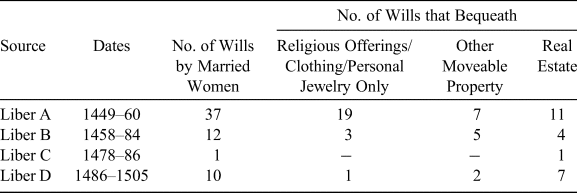
In the Diocese of Ely, as well as a decline over the course of the late fifteenth century in the number of married women making wills and them being recorded, there was also a shift away from the recording of married women's wills when they had little to bequeath toward married women generally only having their wills registered when they had real estate to bequeath (see Table 5). Liber C generally overlaps in time with Liber B, which explains why in its earliest sections it contains virtually no wills from the Deanery of Wisbech and, perhaps as a consequence, only one married woman's will.Footnote 127 For the purpose of chronological trends, then, we can count Liber B and Liber C together. The key registers to be discussed here are, therefore, Liber A and Liber D.
The Types of Bequests in Married Women's Wills in the Diocese of Ely, 1449–1505.

Source: CA, VC 1-4.
In Liber A (1449–60), there are thirty-seven married women's wills, possibly forty. In thirty-six of these the husband was named as the executor;Footnote 128 in another, the will of Joan wife of Robert Green, the husband was not the executor, but he was left 5 acres of land for life.Footnote 129 In three other wills, the woman is identified in the opening line of the will as “uxor,” but does not mention a husband again; therefore, I have not counted these in my statistics.Footnote 130 More than half of the married women's wills in this register were concerned with small religious offerings and perhaps the odd gift of clothing (nineteen of thirty-seven). For example, the will of Katherine wife of William Howlet, made in 1456, consisted of small monetary payments (from 2d. to 12d.) to the high altar and the fabric of her parish church in Wisbech, and to various lights (two specifically named) in the same church, and then a payment to a church in Leverington, perhaps where she had lived previously. There were no other bequests, and her husband and another man, as executors, were to dispose of any residue.Footnote 131 The will of Marion Pococke made in 1455 made a bequest to the high altar (6d.) and to the fabric (12d.) of the parish church in Sutton, but the only other bequests were items of clothing to two married women. Marion Pococke's husband, Robert, was named as executor.Footnote 132 A further six wills referred to some other movable assets. For example, Katherine wife of John Towt made her will in 1456 and left one Agnes Hope some clothes but also a large chest (“magnam cistam”), the latter only after the death of her husband, as we saw in the will of Katherine Haukyn.Footnote 133 Joan wife of Richard Bolle, in her will of 1454, left to five of her children two sheep and a lamb each.Footnote 134 Only eleven of the thirty-seven wills dealt with real estate such as land or a dwelling. For example, the will of Alice wife of John Mas, made in 1454, left her husband a house (“mansionem meam”) in Wisbech in which one Thomas Sorham currently stayed, until her husband's death when it was to go to the Gild of Holy Trinity. Her son, Walter, was to get 7 acres of land in Tyrington; this land seems to have come from her mother's side of the family, as her mother's will was mentioned here.Footnote 135
In terms of similarities with Liber B, it should be noted that of the thirty-seven married women's wills in Liber A, only seven were from areas outside the Deanery of Wisbech, if we include Whittlesey in the deanery's jurisdiction.Footnote 136 This suggests that married women making wills might have been more common in the latter jurisdiction, rather than in the diocese as a whole. The will of Joan wife of Adam Stevenson of Elm, made in 1452, left three items of clothing to one Agnes Perche.Footnote 137 Agnes Perche was perhaps the same woman left a kerchief and a chest by Alice Dowdynett, whose will was recorded in Liber B in 1467; Agnes seems linked (perhaps married) to William Perch of Elm, who is named just above her in Dowdynett's will and was a juror in Elm, where Joan Stevenson resided, c.1467–72 and in 1479.Footnote 138 The will of Margaret wife of John Derby from Newton, made in 1454, only included religious bequests ranging from 3d. to named lights to 3s. 4d. to the fabric of her parish church (and she left money to a chaplain in Tydd St. Giles, which was within the Deanery of Wisbech).Footnote 139 There is a John Derby junior recorded as a juror for the manor court of Newton in 1461.Footnote 140 This again suggests that, as well as being a localized practice, women married or closely connected to jurors were more likely to make wills and have them enrolled, even when they had little to bequeath.
By the time of Liber D (1486–1505), the balance had shifted substantially toward recorded married women's wills—of which there are fewer—being concerned with real estate (seven of ten), primarily land. For example, Matilda Cokke of Ickleton, in her will of 1494, left her husband a property and all her lands for the term of his life on condition that he commemorate her parents’ deaths, presumably from whom she had acquired the land, as well as her own.Footnote 141 A further two bequeathed some movable property. The will of Isabel Pecherde of Little Shelford left her children some household objects, such as a large brass pot and a round pan to her son William.Footnote 142 The will of Joan Balderton of Whittlesey was more extensive. It set out the religious bequests in Latin and then switched to Middle English for the bequests to family and friends. Her husband, also her executor, was to get two silver spoons, but her son, John Edward, was to get her mash vat (for making wort from malt), a guile vat (for fermenting the wort), a lead brewing vessel, a cheese vat (for straining curds), three brass pans, two brass pots, six pewter pans, a candle holder, a salt cellar, two silver rings, two coverlets, a blanket, a pair of sheets, and a gown for his wife.Footnote 143 This reads very much like the core elements of the household and perhaps also of a brewing business, and might be akin to principalia. In Torkesy, Lincolnshire, the custom recorded c.1345 set out that the heir on the death of his ancestors (“antecessorum suorum”) would get, in addition to the tenement, the following utensils: “the best bed with counterpane and sheets, a hutch, the whole cupboard, a tun with the best cup if it be of silver or of mazer, a silver spoon, the best table-cloth, towel and napkin, the best table with tressels, the best laver and basin, the best pot, gridiron, pan and trivet, the best mash-vat and guile-vat and trough, and a tub and a [bowl], the best boiler and hand-mills.”Footnote 144 The tenth married woman's will in this register, that of Agnes Manne of Hardwick, largely concerned bequests of clothing and one pair of beads (a rosary).Footnote 145 In this it is similar to the majority of the married women's wills in Liber A and a quarter of those in Liber B, but it is unusual in the context of Liber D.Footnote 146
On the whole, there was clearly a trend away from recording married women's wills that did not deal with real estate. There appear to be no notes of probate for married women, apart from those that follow their wills, in Liber B (or Liber A). There are some in Liber D, although not on the scale found in Buckinghamshire, which might indicate that there was also a trend toward married women either not making wills or their husbands not bringing them to court.Footnote 147 However, in all of the Ely registers there are notes of administration relating to married women who died intestate. For example, in Liber B—between the enrolled wills of Margaret Kellsull and Matilda Clerk (both married women)—there are eight notes of administration for people who died intestate, one dated 1470, and three are married women. For example, Margaret Rede died intestate and her husband, John, was dismissed from paying a fee on account of poverty.Footnote 148 In Liber A, there are two such notes pertaining to married women below the will of Emma wife of William Belman.Footnote 149 This is significant, as Sheehan expressed some doubt about whether church courts would treat marrying women without wills as dying intestate given the common law position about property.Footnote 150
Conclusions
The case study of married women's wills in the probate registers for the Diocese of Ely 1449–1505 has shown that, although a decline set in of married women making wills, it was later than Goldberg found in York and later than has been suggested for England as a whole by Helmholz and Prior. The registers do signal that there was a particular concentration of married women making wills in the Deanery of Wisbech (including Whittlesey) which further suggests regional variation in practice, as Prior suggested for parts of early modern Oxfordshire. The registers also reveal a shift away from recording married women's wills if no real estate was being bequeathed, so that by 1486 (Liber D) any wills that did not include such bequests were rare. The Buckingham court book, which only includes two married women's wills for the period 1483–97, suggests that this might have been about the cost of registration, as the probate acta included indicate that married women continued to make wills and have them proved in not insignificant numbers (17.9% of probate acta).
In terms of which married women made wills and had them proved, the Wisbech and Buckingham court books also suggest that another cluster was women who were closely related to male officials whose roles provided direct access to the courts (there are also indications of this in Liber A). This is not exactly the same as Prior's finding that women related to lawyers were more likely to make wills in early modern England, but the women whose wills were proved before archdeaconry courts were generally of lower social status than those whose wills went to the PCC. We might conclude, however, that knowledge of how courts worked might have been a factor in the drawing up and proving of these legal documents. Other, smaller clusters (pairs) include connections between married women who made wills, whether that is the two wives of Robert Galyarde or the wives of Henry Gilbert and John Elliott, whose husbands knew each other, or Joan Stevenson and Alice Dowdynett, who both knew an Agnes Perch. Some of the married women who made wills in Ely were certainly remarried but this was not as noticeable as in Prior's PCC sample.
The social status point is also worth reflecting on. Helmholz commented, “by the middle of the fifteenth century, wills of married women had become rarities in England. There were always some, perhaps more so among the wealthy or the powerful than among the middling sort most diocesan courts dealt with.”Footnote 151 However, this study suggests that it is precisely among the records of archdeaconry courts that we find married women's wills in late fifteenth-century England. In Prior's study of the PCC 1558–1700, her highest proportion of married women's wills, in 1694–1700, was fewer than 9 out of 1,000 wills (less than 1%); for 1558–83 she estimated it was fewer than 4 out of 1,000 wills.Footnote 152 Prior also commented that her “Oxfordshire sample goes further down the social scale than might be expected… two labourers’ wives, the wife of a husbandman, and three other country wives in quite humble circumstance.”Footnote 153 This is again congruent with the Ely material.
Helmholz suggested that one possible reason for the decline in married women's wills was that families found other ways to pass on property such as trusts.Footnote 154 Although that might have been the case, many of the married women's wills discussed in this study were not concerned with real estate, and some bequeathed little in the way of movable goods. The latter point also suggests that there was no custom of shared marital property in these areas, although Donahue had pointed to hints of its survival.Footnote 155 The married women's wills considered in this study did not attempt to bequeath a third share, as was suggested as a reasonable practice in Glanvill and Bracton. The value of the wills, beyond the fact of their continued existence in spite of the position of the common law, therefore lies in their communicating a sense of what items married women could claim as their own, something that we cannot access from probate acta. For Alice Qwyght it was just five items of clothing, for Katherine Haukyn it was a gallon pot, and for Joan Balderton it was a much more extensive list of household goods. As Prior articulated, “Wills are amongst the most useful sources for the study of ordinary people… For married women, … they are almost our only source.”Footnote 156
In terms of what married women's wills reveal about the law, they suggest that we need to be cautious in assuming that, just because common lawyers set out a particular position, medieval people followed it. Further, the matter of probate jurisdiction in late medieval England was one of customary practice, rather than canonical principle, which allowed for regional variation, as Helmholz found for the custom of legitim. Just as some areas continued the practice of reserving a third of the parent's goods for his or her heirs for longer than others, some areas continued to allow (if not encourage) married women to make wills. The references to married women dying intestate in the diocese of Ely c.1449–1505 suggest an expectation that married women would make wills, and some wives did just that.