Nomenclature
-
 $ \Delta$
-
change
- fnew
-
new objective function value
- fold
-
old objective function value
- P (accept)
-
probability of acceptance
- T
-
temperature
- TFH
-
total flight hours
- TC
-
total cost

1.0 Introduction
As well as systems used in areas such as transportation, and energy, etc., weapon systems in the military have a long lifetime, and, because of national security and essential training concerns, failure of these systems is not acceptable. Therefore, it is not only very important, but also extremely challenging to keep these systems operational and improve system availability. Governments, academia and industry are seeking new logistics support strategies or improving existing ones to overcome this problem. This accounts for why so many strategies have emerged in the last two decades. Performance Based Logistics (PBL) is one of these strategies and has started to be used in very large projects such as Joint Strike Fighter (JSF). PBL was also used for some other military systems and subsystems and have provided a significant improvement on availability. For example, F/A-18 tires availability improved from 81% to 98%, Auxiliary Power Unit availability improved from 70% to 90%, and F-14 LANTIRN system availability improved from 73% to 90% [Reference Kirk and Depalma1].
PBL does not actually add new parameters to logistics analysis methods; however, the existing methods are handled differently. In the PBL approach, the supplier is responsible for the entire logistic support of the product while providing pre-determined performance metrics. When a supplier provides better performance, it will be awarded incentives that are pre-defined in the contract. This new idea shifted the cost minimisation centric approach towards a profit-centric approach.
Although there are many factors that can affect the system’s availability, the SPA problem has received significant attention in order to deal with the availability issue. Most of those studies use simplifying assumptions to build easily solvable models; however, real-life problems include many different variables which are rarely included in the current models. Also, the decision about where to repair the failed part is important and Level of Repair Analysis (LORA) provides the answer. There are two common questions when a failure occurs in a system. These are:
-
Do we need to repair or discard the component?
-
Where should the desired action of question one take place?
Each question can be regarded as an option and the goal is to find the option with the lowest total cost of ownership.
There are a limited number of studies in the literature regarding LORA, while studies on the SPA problem are abundant. However, studies on joint optimisation of SPA and LORA are very limited. To the best of our knowledge, there is no research in the literature in which variables such as repair times, system usage schedule, availability of maintenance personnel, and replenishment time of parts are considered simultaneously in multi-echelon, multi-indenture, and a multi-objective environment for PBL analysis.
The queuing models are usually used for the analytical solution of service-constrained problems. However, the problem defined in this study is very complex and it is extremely hard to solve this problem in a reasonable time. For this reason, a simulation optimisation approach is adopted in this study. Firstly, a multi-objective simulation-optimisation model is proposed for the two-echelon, two-indenture system. This model is then used to solve the SPA problem. Finally, joint optimisation of the SPA and LORA problem is accomplished. All these models are considered as pioneering studies in the related literature with their comprehensive approach to the problem. Moreover, the Technique for Order of Preference by Similarity to Ideal Solution (TOPSIS) method is used to select among the design points for the simulation optimisation parameters, which is also a new contribution to the literature.
The rest of the paper is organised as follows: Section 2 gives a brief literature review of the problem. We then introduce the simulation model and optimisation algorithm in Section 3. The computational experiment is given in Section 4, conclusions and future research directions are given in Section 5.
2.0 A brief literature review on PBL and joint optimisation of SPA and LORA
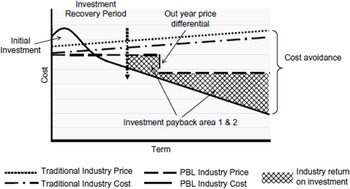
PBL is a new strategy which is based on buying performance instead of parts. Different approaches similar to PBL have already found various applications in the public and private sectors, however, no comprehensive approach, such as PBL, has yet been developed. The starting point of the applications in this field first appeared in the United States. In the US, particularly in the late 1990s, public-private sector cooperation in the military area began to be developed, but PBL first came to the fore in the US in the 2001 Quadrennial Defense Review (QDR) report [2]. In PBL, long-term contracts are defined with clear delineation of the responsibilities between the customer and the supplier. The differences between PBL and the traditional approach are shown in Fig. 1. In traditional logistics support, profit is limited for a supplier and the total cost of a system is higher for a customer. In the PBL approach, the supplier makes some initial investments to make the system more reliable and sustainable and gain more profit after the investment recovery period by assuring desired performance metrics. In this manner, the supplier makes more profit while the customer has lower total lifecycle cost. This new profit-centric approach requires a reassessment of existing logistics analysis methods. Logistics services range from organic to full PBL, and the model in this research can be regarded as full PBL.
Traditional approach vs. PBL [Reference Randall, Nowicki and Hawkins3].

Sols et al. [Reference Sols, Nowicki and Verma4] conduct a general literature review and attempted to reveal the lessons learned from PBL applications through interviews with PBL practitioners. As a result of this work, they propose a new methodology for better implementation of PBL. Nowicki [Reference Nowicki5] develops different optimisation models for the PBL approach in his dissertation. Hypko et al. [Reference Hypko, Tilebein and Gleich6] create a new conceptual model for PBL by examining 39 academic publications. Randall et al. [Reference Randall, Pohlen and Hanna7] propose a theoretical model for supply chains implementing PBL. It is stated that with the PBL approach, instead of acting independently, it would be more appropriate for all units in the supply chain to act together and in harmony in a way to achieve the required system performance. Mirzahosseinian and Piplani [Reference Mirzahosseinian and Piplani8] develop a new stock model in the PBL environment by loosening the impractical assumptions of METRIC-based algorithms such as constant failure rate, constant repair rate, and unlimited repair capacity. Sols et al. [Reference Sols, Romero and Cloutier9] create a model that evaluates the PBL together with technology renewal programs to close the capability gaps that occur in the long lifecycle of the systems and implement an application on Spanish F-100 frigates. Selviaridis and Wynstra [Reference Selviaridis and Wynstra10] conduct a detailed literature review on PBL contracts and reveal areas for study in the future. Glas and Kleemann [Reference Glas and Kleemann11] examine the conceptual aspects of PDL contracts and the integration between the customer and the service provider. Hur et al. [Reference Hur, Keskin and Schmidt12] study spare parts inventory optimisation of near end-of-life aircraft systems.
Although there are many studies that cover both SPA and LORA, only those that dealt with the joint optimisation of these problems are discussed here. SPA and LORA problems are usually solved sequentially, and there is limited research on solving both problems simultaneously. The parts of the system and the repair structure of these parts are two main factors of the problem. The repair concept of a military aircraft is based on at least two-level echelon, such as operational bases and a depot serving those bases. The number of parts in a system and repair structure make the problem more complex.
Alfredsson [Reference Alfredsson13] develops a joint optimisation model which solves the SPA, LORA, and test equipment allocation problems simultaneously. He uses two-echelon repair centres but just one indenture for the items. Also, LORA decisions are the same for all items assigned to the same type of tester. Kusters [Reference Kusters14] solves the problem in two blocks: block-1 is for Line Replaceable Unit (LRU) definition and LORA, and block-2 is for the SPA problem by the VARI-METRIC method. After solving the SPA problem, he uses the final results as feedback for block-1. This procedure continues until the stopping criteria are met.
Basten et al. [Reference Basten, Van der heijden and Schutten15] develop a joint optimisation model for LORA and SPA problems. To reduce the complexity of the problem, they use a single indenture and two-echelon model. In their case study, they show that the joint optimisation approach provides an average cost reduction of 5.07% over the sequential approach which is more common in literature. Basten et al. [Reference Basten, Van der heijden, Schutten and Kutanoglu16] develop a new iterative algorithm for multi-echelon, multi-indenture problems. Their algorithm provides an average of 3% more cost reductions compared to the sequential approach and 0.6% more than the Basten et al. [Reference Basten, Van der heijden and Schutten15] algorithm, and also has better computation time.
Bouachera [Reference Bouachera17] solves the joint optimisation of LORA and SPA problems using the M/G/K queueing theory. He solved sequential, iterative, and integrated methods. The integrated one has an average of 13% improvement over the best iterative one. However, the iterative algorithm can still be satisfactory with its low computational time. Fan et al. [Reference Fan, Guo, Yang and Kang18] develop a convex programming algorithm to solve a single-echelon multi-indenture problem. Their objective is to minimise the Expected Number of Backorder (EBO), and they use cost as a constraint.
Triki et al. [Reference Triki, Alalawin and Ghiani19] solve single-echelon, multi-indenture problem using optimisation via simulation outputs. Alalawin et al. [Reference Alalawin, Ghiani, Manni and Triki20] use integer programming with a nonlinear probabilistic constraint to solve spare parts stock and the LORA problem simultaneously. Their approach is very similar of Triki et al. [Reference Triki, Alalawin and Ghiani19] except for the multi-echelon environment and some extensions. As we noted earlier, there is no study that considers variables such as repair times, system usage schedule, availability of maintenance personnel, and replenishment time of parts simultaneously in multi-echelon, multi-indenture, and a multi-objective environment that can be used in PBL.
The approach developed by Ghaddar et al. [Reference Ghaddar, Sakr and Asiedu21] to solve the SPA and LORA problems together can be considered as the closest study to the scope of this article. In the aforementioned study, first of all, a genetic algorithm-based optimisation model was created for SPA. It has been shown that this model produces similar results to the marginal analysis used by METRIC-based algorithms, but it is stated that with the proposed model, an easier transition can be made to the SPA and LORA solution, which is the second stage. The integrated problem is solved with the mixed integer nonlinear optimisation approach. It is stated that the approach towards the integrated solution of SPA and LORA can be combined with a realistic simulation model in future research.
Liu et al. [Reference Liu, Feng, Xue and Lu22] develop a joint optimisation model for the LORA and inventory system, with the system total cost serving as the objective function and fleet availability serving as the constraint. The Partical Swarm Optimisation (PSO) model is used to solve the non-linear optimisation problem. Their research also shows that the joint optimisation approach provides better results with a lower total cost. Liu et al. [Reference Liu, Liu and Deng23] formulate the combined LORA and inventory optimisation problem as a mixed integer nonlinear optimisation problem. They use the chance constrained approach to deal with demand uncertainty, and propose to extend the model for multi-indenture structures. Wang et al. [Reference Wang, Chen, Wu, Zhou and Huang24] solve the joint optimisation model of LORA and spare parts inventory for a two-echelon, two-indenture fleet system by taking into account the multiple failure modes. Their study demonstrates the practical importance of joint optimisation in regard to the cost of the system.
3.0 Problem definition and solution approach
The model has two sub-problems, SPA optimisation and joint optimisation of SPA and the LORA problem. In the first model, LORA decision is generated randomly for each part, then it is taken as a decision variable in the second one. The simulation optimisation approach is used for solving the model. Simulation approach and optimisation algorithm will be explained in the following sub-chapters.
3.1 Simulation model
Because of the PBL implementation in the JSF program, aircraft procedures were taken into account while building the simulation model. Additionally, repair times, systems usage schedule (mission plan), availability of maintenance personnel, and replenishment time of parts were included to build a more holistic model.
At first, a commercial simulation program was tried for modeling because it was ready to use and had visual functions. However, it was hard to build a complex model, as required for this research, with these kinds of programs, as specific details, functions and relationships needed to be defined. Therefore, the R programming language, which is generally used for data mining and statistics, has been chosen as provided a better user interface, huge user network, a lot of libraries, and free use on anyplatform.
The assumptions of the model are given as follows:
-
There is a two-level repair structure (base and depot). There are two bases and one depot, and the depot serves both bases.
-
The first base has 24 aircraft and the second base has 16 aircraft.
-
The system has two indentures. Each part in the first layer has two subordinate parts in the second layer, and there is a father-son relationship between them.
-
To evaluate the availability of the system in the desired time interval, mission plans are generated randomly according to the total number of aircraft in each base. There are two kinds of missions: two-wing, and four-wing. There is a requirement to have two available aircrafts in two-wing missions and four available aircrafts in four-wing missions.
-
The system is simulated for a year. But after excluding holidays and weather cancellations, the simulation time is assumed as 200 days.
-
In addition, to take into account the effects of daily activities on the results, each day is divided into two blocks. Therefore, instead of simulation time, these 400 separate intervals are used in the simulation model. Each interval is considered discrete, and the parameters are updated with the change of interval.
-
The simulation parameter values are determined by the subject matter of experts, using the Delphi method. The expert group consists of three pilots and three maintenance personnel. The parameters are given below.
Holding cost: The cost of stocking part in a base or depot. The cost is generated according to the Uniform Costing (10,30) euro/year.
Order cost: If there is not any desired part in a base or depot then this cost is incurred. The procurement time is disregarded and assumed as included in the cost which is fixed as 100 euro.
Part changing cost: The failed part has to be changed with a new one by maintenance personnel. The labor cost of changing a part is fixed, 5 euro for the bases and 10 euro for the depot.
LORA decision: Is the decision about a failed part. The alternatives are:
-
1. Repair at the base
-
2. Discard at the base
-
3. Repair at the depot
-
4. Discard at the depot
Cost of LORA decision: The cost of each decision is generated according to the Uniform (5,20) euro for each part.
Failure matrix: This matrix is constructed by an exponential distribution with a mean of 50 (Expo (50)) for the first layer parts, Expo (20) and Expo (10) for the second layer parts, respectively. According to those values, a part will be failed after a specified time of operation in the matrix.
Mission plan: The missions are generated for each time interval in the simulation model. Uniform (4,7) two-wing mission, and Uniform (1,2) four-wing mission are for the first base; Uniform (2,6) two-wing mission, and Uniform (0,2) four-wing mission are for the second base.
Mission time: Normal distribution (2,0.5) hours for each mission. These values are subtracted from the failure matrix after the operation.
Repair time: Is the time to repair the failed part. If it is done at the base, a part will be added to the inventory after one simulation interval. If it is repaired in the depot, then a part will be added to the inventory after four consecutive simulation intervals.
Maintenance personnel availability: To represent the availability of maintenance personnel, a random number is generated according to Uniform (0,1). If this value is less than or equal to 0.2, that means maintenance personnel is available; otherwise, maintenance personnel is available in the following simulation cycle.
Minimum and maximum stock levels: To shrink the solution space reasonably, the minimum stock level is assumed to be zero and the maximum stock level is determined with the Design of Experiment (DOE) approach.
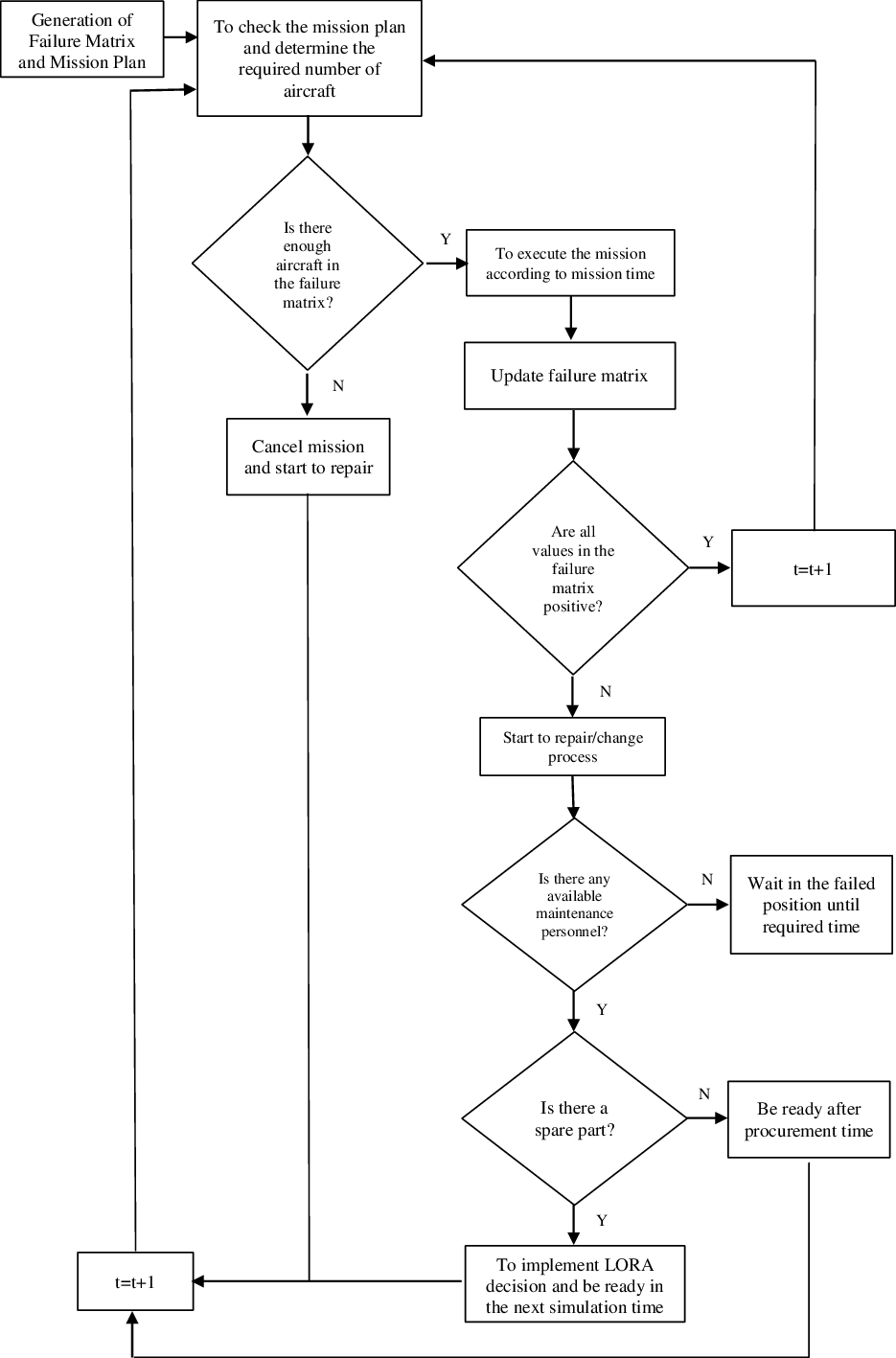
The steps of the simulation model used in this study are given in Fig. 2. The described simulation model is coded in the R programming language.
Steps of the simulation model.

3.2 Optimisation algorithm
The decision variable of the simulation-optimisation model is the number of parts in each stock. In the joint optimisation stage, the LORA decision will be added as a new decision variable and the model will be solved jointly.
The objectives of the optimisation model are minimising the total cost and maximising the total flight hours. Availability is used as the main driver of SPA or general logistics support activities in many studies. Yet it is very hard to find a linkage between availability and the desired operational time of the system. Thus, total flight hours are used instead of availability as one of the objectives in this research. There is no closed form formulation for the calculation of flight hours. Therefore, simulation optimisation is used for the model. Because of the complexity of the problem a heuristic optimisation approach is selected for the optimisation phase. The decision variable in the optimisation algorithm is the number of parts in each location. The variability of the decision variable is limited from a realistic point of view. Therefore, local search is considered as a suitable approach and a single solution-based algorithm, Simulated Annealing (SA) is used in the optimisation process. The determination of SA parameters will be discussed in Section 4.
The Gaussian perturbation method is used for creating new neighbors in SA. In the Gaussian perturbation method, the new neighbor solution is created by taking into account the maximum and minimum stock levels in this problem. There is an enormous difference between objective function values, the cost and the total flight hours. Therefore, the difference between objective function values of design points is calculated by the percentage difference approach as used in Cakir et al. [Reference Cakir, Altiparmak and Dengiz25] to accept or reject probability in the SA algorithm. The calculation of Δ value and the probability of acceptance of the new solution are shown in Equations (1) and (2), respectively.
 \begin{align}\Delta\% = \left[ {\frac{{{f_{new}} - {f_{old}}}}{{{f_{old}}}}} \right] \times\, 100\end{align}
 \begin{align}P(accept) = {e^{ - \Delta \% /T}}\end{align}
4.0 Analysis and results
Since the information about the parts in the system and their parameters, such as mean time between failure and cost, are a commercial secret, they are not mentioned here. Also, there is no data set in the literature which includes all the parameters used in this study. Therefore, the data in the model has been generated according to distributions as explained in the previous section. Thus, we provide a generic model of the problem that can be used by anyone who has the real data for a system.
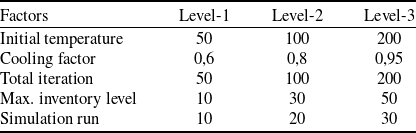
A simulation model is a tool that is used in the optimisation algorithm. The objective values of any design point in the optimisation algorithm are taken from simulation results. DOE is used for determining the parameter values of the SA algorithm. Three levels are used for each parameter and the Design Expert 10 [26] program is used for creating the design points. A number of simulation runs and maximum inventory level are also considered as a parameter. Three levels of these parameters are shown in Table 1.
SA and simulation parameters.

The decision about the number of parts in the model is also important. In practice, there may be thousands of parts in an aircraft system. However, it is not necessary to deal with all parts, as most of them are analysed via non-economical methods. In implementation of the Delphi method, the number of parts that have to be taken into consideration was decided as 300 parts. But, for getting more robust results in both design experiment analysis and simulation optimisation, different numbers of parts such as 30, 60, 150 and 300 were also examined for the sake of sensitivity.
Design Expert 10 [26] has created 56 design points using two-factor interaction. The average of total simulation runs is taken as a result of the objective function values. Also, the parameters are fixed for each simulation run to make a fair comparison between design points. The TOPSIS method is used to select the best levels of SA algorithm parameters and the number of simulation runs. Objective function values of each design point are compared by the TOPSIS method, and each value is assumed as having equal weight. The ranking of design points is calculated for 30, 60, 150 and 300 parts, and the design point with the minimum of total ranking was taken as model parameters as shown in Table 2. To the best of our knowledge, the TOPSIS method is used for the first time for this purpose.
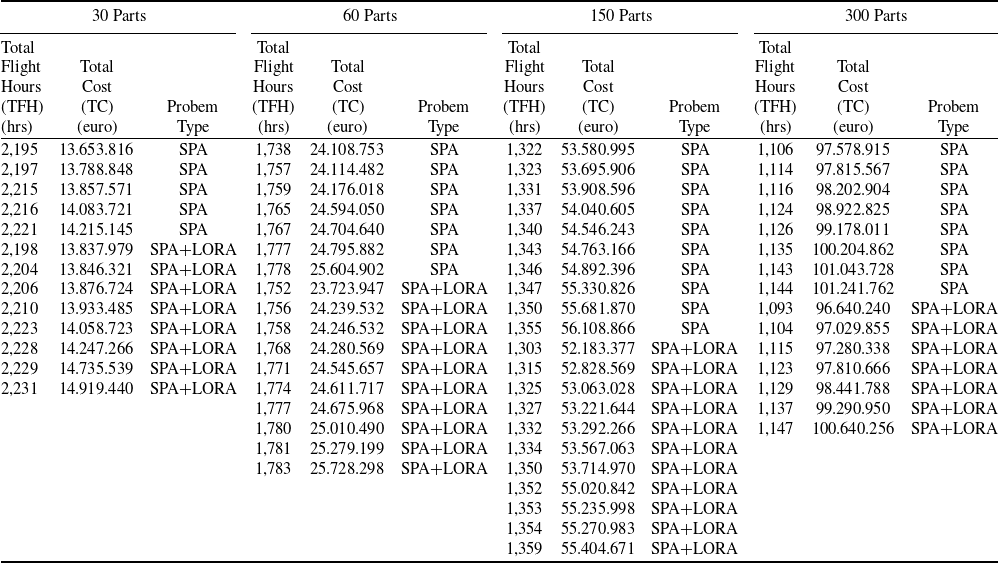
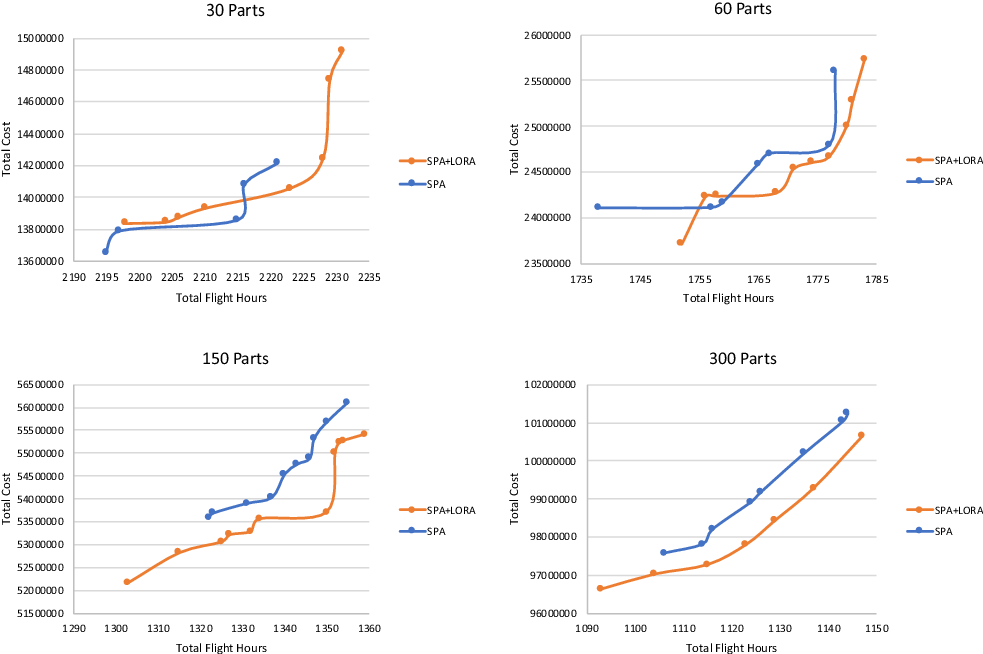
By using the parameters in Table 2, SPA and joint optimisation of SPA and LORA (SPA+LORA) are solved for each number of parts. Each setup was run 10 times and non-dominated solutions were collected. Then pure non-dominated solutions were selected within these solutions. The results are shown in Table 3 and the graphical representation of these results are shown in Fig. 2 for each batch of parts
When the pareto optimal solutions are examined in detail, it can be concluded that:
-
Although there is a small difference in total flight hours between SPA and SPA+LORA, the total cost of providing this difference is very significant. For example, for 300 parts in SPA, 1,116 flight hours costs 98.202.904 euros while it costs 97.280.338 euros to generate 1,115 flight hours in SPA+LORA, which is almost a million euros cheaper.
-
The difference in total flight hours is very important in military operations. Sortie generation is critical for planners and cost can be seen as a non-important constraint. However, in peacetime and in daily missions, the difference in total flight hours can be tolerated and the lower cost alternative can be preferred.
Simulation-optimisation model parameters.

The non-dominated solutions of model.

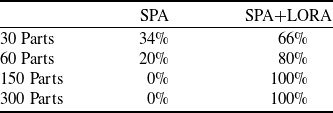
In Fig. 3, the bottom right of the graphic is the desired solution area. When we examine the lines for 30 and 60 parts in Fig. 3, it is hard to come up with an explicit conclusion due to the crossing lines. Although this situation is not the same for 150 and 300 parts visually, to make a sound comparison between the two approaches, and to check if any improvements exist with the joint optimisation model, the ratio of pareto optimal solutions for each batch is calculated. First of all, the non-dominated solutions produced by the SPA and SPA+LORA approaches for each batch are brought together. Then, dominated solutions in the new set are excluded to reach a pure non-dominated solution set. Finally, the ratios are calculated based on which approach the non-dominated solution come from. For example, within the final non-dominated solution set for 30 parts, 34% of solutions come from SPA and 66% of solutions come from SPA+LORA approach. The whole results are shown in Table 4.
Graphical representation of the non-dominated solutions.

Overall non-dominated solutions’ ratios.

As seen in Table 4, the joint optimisation approach produces better results as the number of parts in the model increase. It is better to solve SPA and LORA problems jointly for practical implementation for 300 parts in this study.
5.0 Conclusion and future research directions
SPA and LORA, as the most commonly used problems within PBL, are considered with multiple objectives in this study. For providing a more comprehensive approach, many variables such as repair times, systems usage schedule, availability of maintenance personnel, and replenishment time of parts are considered simultaneously in multi-echelon, multi-indenture structure, which is very common in PBL.
SPA and LORA problems are modeled and solved via the simulation-optimisation approach. The main flight characteristics at an air force base are used for the model. Repair times, system usage schedule (mission plan), availability of maintenance personnel, replenishment time of parts in the two-echelon, two-indenture, multi-objective environment is modeled so that they can be used in PBL requirements. The simulation parameters are determined via the TOPSIS method among design points. The objectives of the optimisation model are minimising total cost and maximising total flight hours. The Simulated Annealing algorithm is used for the optimisation phase.
Firstly, the SPA problem is solved preliminary and then the two problems are solved jointly by adding the LORA decision as a new dimension to the model. The results show that the joint optimisation of SPA and LORA problems produces better values in terms of total flight hours and total cost than the singular approach. This model can be used by both customers and suppliers to understand the relations and results of performance metrics that can be considered in a PBL contract. The consideration of many real-life facts in daily operations makes the model in this research more practical.
For future research:
-
The problem can be modeled in a different simulation program or programming language.
-
New heuristics for the optimisation phase can be researched.
-
SPA and LORA problems can be combined with other logistics analysis methods.
-
The SA algorithm in the model can be improved.
-
Other objectives that may be used in the PBL contract can be researched.
6.0 Disclaimer
The views expressed are those of the authors, and do not reflect the position or policy of the Turkish Air Force, Turkish Ministry of National Defense, or Turkish Government.