Introduction
Complex carbohydrates and, in particular, those from the plant cell wall are important contributors to fermentable substrate in the hind gut (Guillon et al., Reference Guillon, Auffert, Robertson, Thibault and Barry1998). Dried sugar-beet pulp (SBP) contains a large quantity of non-starch polysaccharide, of which 15% to 30% is pectin (Pilnik and Voragen, Reference Pilnik and Voragen1992). Sugar-beet pectin has been shown to be extensively degraded in the caecum (Robertson et al., Reference Robertson, Muirson and Chesson1987). Therefore if sugar-beet pectin is available for fermentation in the caecum, it may replace protein fermentation and associated harmful by-products will be reduced. Canh et al. (Reference Canh, Aarnink, Verstegen and Schrama1998a) achieved reductions in ammonia emissions through the partitioning of nitrogen (N) to faecal N excretion while reducing urinary N excretion when pigs were offered 300 g/kg SBP. However, odour concentration was not measured and there is limited information about the effects of SBP on odour concentration.
Sulphurous, indolic and phenolic compounds and volatile fatty acids (VFAs) are some of the major constituents of odour from pig manure (Curtis, Reference Curtis1993; Hobbs et al., Reference Hobbs, Misslebrook and Pain1997). The proportion of VFAs produced from hindgut fermentation depends on the composition of anaerobic flora, available substrate and gut pH (Le et al., Reference Le, Aarnink, Ogink, Becker and Verstegen2005). Acetic acid, propionic acid and butyric acid are formed both from carbohydrates (Rasmussen et al., Reference Rasmussen, Holtug and Mortensen1988; Sutton et al., Reference Sutton, Kephart, Verstegen, Cahn and Hobbs1999). However, isovaleric acid and isobutyric acid are produced exclusively from the deamination and decarboxylation of leucine and valine, respectively (Mackie et al., Reference Mackie, Stroot and Varel1998), and contribute to malodour (Mackie et al., Reference Mackie, Stroot and Varel1998). It is generally accepted that the reduction of dietary crude protein (CP) can significantly reduce excess N excretion and ammonia emissions (Hayes et al., Reference Hayes, Leek, Curran, Dodd, Carton, Beattie and O’Doherty2004; Leek et al., Reference Leek, Callan, Henry and O’Doherty2005; O’Connell et al., Reference O’Connell, Callan and O’Doherty2006; Lynch et al., 2007). Recent data have shown that fermentable carbohydrates can have similar effects in reducing ammonia emissions (O’Connell et al., Reference O’Connell, Callan, Byrne, Sweeney and O’Doherty2005; Garry et al., Reference Garry, Fogarty, Curran, O’Connell and O’Doherty2007).
Therefore, feeding to the ideal protein concept by formulating low-CP diets supplemented with synthetic amino acids and/or increasing the concentration of fermentable carbohydrates in the hindgut of pigs offered high-CP diets may reduce ammonia emissions, odour concentration and odourous compounds from pig production. The hypothesis of the current experiment was that SBP as a fermentable carbohydrate source in high-CP diets may reduce manure ammonia and odour emissions and odourous compounds from finisher boars.
Material and methods
All procedures described in this experiment were conducted under experimental licence from the Irish Department of Health in accordance with the Cruelty to Animals Act 1876 and the European Communities (Amendments of the Cruelty to Animals Act 1976) Regulations, 1994.
Experimental diets
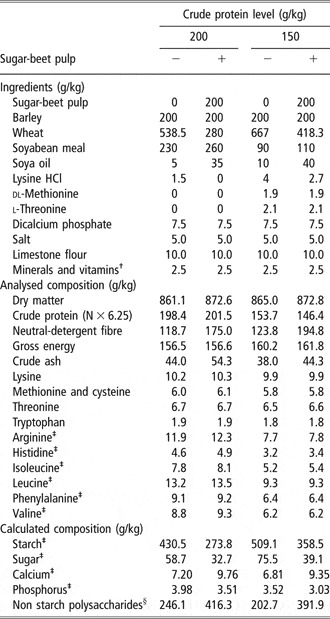
The experiment was designed as a 2 × 2 factorial comprising four dietary treatments. All diets were formulated to have similar concentration of digestible energy (DE; 13.6 MJ/kg) (Sauvant et al., Reference Sauvant, Perez and Tran2004) and total lysine (10.0 g/kg). The amino acid requirements were met relative to lysine according to the ideal protein concept (Close, Reference Close1994). The dietary composition and analysis is presented in Table 1. The experimental treatments were as follows: (1) 200 g/kg CP, (2) 200 g/kg CP plus 200 g/kg SBP, (3) 150 g/kg CP and (4) 150 g/kg CP plus 200 g/kg SBP. All diets were fed in meal form.
Composition and analysis of experimental diets (as fed basis, g/kg)

†Provided per kg of complete diet: 3 mg retinol, 0.05 mg cholecalciferol, 40 mg α-tocopherol, 90 mg copper as copper II sulphate, 100 mg iron as iron II sulphate, 100 mg zinc as zinc oxide, 0.3 mg selenium as sodium selenite, 25 mg manganese as manganese oxide and 0.2 mg iodine as calcium iodate on a calcium sulphate/ calcium carbonate carrier.
‡Sauvant et al. (Reference Sauvant, Perez and Tran2004).
§NSP calculated as (organic matter – (crude fat + crude protein + starch + sugar) (Canh et al., Reference Canh, Aarnink, Schutte, Sutton, Langhout and Verstegen1998b).
Animals and management
Twenty-four finishing boars (progeny of Meat line boars × (Large White × Landrace sow)) with an initial live weight of 74 kg (s.d. 2.6) were used in this experiment. The pigs were blocked on the basis of live weight and within each block were randomly allocated to one of four (n = 6) dietary treatments. The pigs were allowed a 14-day dietary adaptation period after which they were weighed. Sixteen (four from each treatment) pigs were selected to a uniform weight and transferred to individual metabolism crates. The pigs were given a further 5 days to adapt to the metabolism crates before collections begun. The collection period was subdivided into three parts to facilitate studies on ammonia emission (days 1 to 2), odour emission (days 3 to 5) and apparent digestibility and N balance (days 6 to 10). The daily feed allowance (DE intake (MJ/day) = 3.44 × (live weight)0.54 (Close, Reference Close1994) was divided over two meals. Water was provided with meals in a 1 : 1 ratio. Between meals, fresh water was provided ad libitum from a designated container in the meal trough. The metabolism crates were located in a temperature-controlled room, maintained at a constant temperature of 22°C (± 1.5°C).
Ammonia emissions
Four separate collections of total faeces and urine were performed at 12-h intervals during collection days 1 to 2. Urine was collected in a plastic container, via a funnel below the crate. Faeces were collected in a tray directly underneath the metabolism crate. Following collection, the excreta were stored separately in sealed containers at 4°C. After the last collection, the four collections of urine and faeces were mixed together (w/w) according to the original excretion ratio. Two-kilogram samples of the manure homogenate from each pig were subdivided into two 1-kg subsamples and both placed in containers within a climate-controlled room. Ammonia emission from the manure was measured over 240 h from the first container, in a laboratory scale set-up according to the method of Derikx and Aarnink (Reference Derikx and Aarnink1993). The equipment consisted of a sealed vessel containing 2 kg slurry, vacuum pump and three impingers in series per sample. The first two impingers contained 1 mol/l nitric acid and the third impinger contained water. The ventilation rate in the container was 4.2 l/min. The first impinger was replaced at 48, 96 and 144 h and the second impinger was replaced at 96 h. Samples were collected from all three impingers at 240 h. The concentration of ammonia-nitrogen (NH3-N) in the impingers was determined by the micro diffusion technique of Conway (Reference Conway1957). Ammonia production from manure is compared between the different dietary treatments using the quantity volatilised from 0 to 240 h. The sample in the second ventilated container was used to conduct pH analysis of the slurry whenever the first impinger was replaced.
Air sample collection and measurement of odour concentration
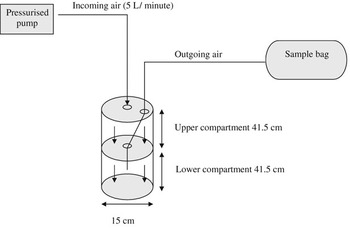
Total faeces and urine were taken at 12-h intervals during collection days 3 to 5 and stored in a container below the crate until sampling on day 5. Air samples were used to measure odour concentration. Air samples were collected directly above the storage container. The surface area of the storage container was 176.6 cm2 and the diameter was 15 cm. The air-sampling vessel was divided into two compartments by a lid. The net height of the lower compartment (storage container) was 41.5 cm and the net height of the upper compartment was 41.5 cm. A schematic view of the odour sample collection system, which was adapted from Le et al. (Reference Le, Aarnink, Jongbloed, Van der Peet-Schwering, Ogink and Verstegen2007), is illustrated in Figure 1.
Schematic view of the odour sample collection adapted from Le et al. (Reference Le, Aarnink, Jongbloed, Van der Peet-Schwering, Ogink and Verstegen2007).

Air entering the upper compartment of the vessel from a pressurised pump (flow rate 5 l/min) was odour-free air. Air entering the lower compartment via 24 holes of 1 mm diameter each was exhausted from the vessel by a hole of 5-mm diameter in the middle of the lid. The outgoing air from the vessel was connected to a 20-l Nalophan sampling bag and analysed for odour concentration using an Ecoma T07 dynamic olfactometer (ECOMA, Honigsee, Germany) as described by Hayes et al. (Reference Hayes, Leek, Curran, Dodd, Carton, Beattie and O’Doherty2004).
Apparent digestibility and nitrogen balance study
During collections, urine was collected in a plastic container, via a funnel below the crate, containing 20 ml of sulphuric acid (25% H2SO4). To avoid N volatilisation, the funnel was sprayed four times daily with weak sulphuric acid (2% H2SO4) solution. The urine volume was recorded daily and a 50-ml sample was collected and frozen for laboratory analysis. Total faeces weight was recorded daily and all faeces were oven dried at 100°C. A sample of freshly voided faeces was collected twice daily and frozen for N analysis. At the end of the collection period, the faeces samples were pooled and a subsample retained for laboratory analysis. Feed samples were collected each day and retained for chemical analysis. Digestibility values and N balance data were calculated as follows:
Total tract nutrient digestibility = ((nutrient in feed g/kg × feed intake kg/day) − (nutrient in faeces g/kg × faecal output kg/day)/(nutrient in feed g/kg × feed intake kg/day));
Total N excretion (g/day) = (faecal N excretion (g/day) + urinary N excretion (g/day));
N retention (g/day) = (total N excretion – N intake);
N retention as % intake = (N retention/N intake).
Microbiology
All 24 pigs remained on their respective dietary treatments until slaughter. Digesta samples (approximately 10 ± 1 g) were aseptically removed in aerobic conditions from the proximal colon (second loop) of each animal immediately after slaughter, stored in sterile containers (Sarstedt, Wexford, Ireland) on ice and transported to the laboratory within 7 h. Lactobacillus spp. and Enterobacteriaceae spp. were isolated and counted according to the method described by O’Connell et al. (Reference O’Connell, Callan, Byrne, Sweeney and O’Doherty2005). Typical colonies of each bacterium were counted and the numbers of bacteria were log transformed and expressed per gram of digesta. Lactobacillus spp. were selected for enumeration because of their putative health (Gibson and Roberfroid, Reference Gibson and Roberfroid1995), while Enterobacteriaceae spp. were selected for enumeration because of harmful effects of some species in the gastrointestinal tract (Gibson and Roberfroid, Reference Gibson and Roberfroid1995).
pH measurements
Samples of digesta from the caecum and proximal colon were taken and placed in containers. The pH of the digesta was recorded, immediately after collection. All pH measurements were made on a Mettler Toledo MP 220 pH meter, which was calibrated with certified pH 4 and pH 7 buffer solutions. Distilled water was added to some very viscous samples in a ratio of 1 : 1 to enable their pH to be read.
Volatile fatty acid analysis and sampling
Samples of digesta from the caecum and the colon of individual pigs (n = 24) were taken for VFA analysis. VFA concentrations in the digesta were determined using a modified method of Porter and Murray (Reference Porter and Murray2001). A sample of 1 g was diluted with distilled water (2.5 × weight of sample) and centrifuged at 1400 × g for 4 min (Sorvall GLC – 2B laboratory centrifuge). One ml of the subsequent supernatant and 1 ml of internal standard (0.5 g 3-methyl-n-valeric acid in 1 l of 0.15 mol/l oxalic acid) were mixed with 3 ml of distilled water. Following centrifugation to remove the precipitate the sample was filtered through Whatman 0.45 μm polyethersulphone membrane filters into a chromatographic sample vial. A sample of 1 μl was injected into a model 3800 Varian gas chromatograph with a 25 m × 0.53 mm i.d. megabore column (coating CP-Wax 58 (FFAP) – CB (no. CP7614)) (Varian, Middelburg, The Netherlands).
Laboratory analysis
Proximate analysis of diets for dry matter (DM) and ash was carried out according to Association of Official Analytical Chemists (AOAC, 1995). The DM of the food and faeces was determined after drying for 24 h at 103°C. Ash was determined after ignition of a known weight of concentrates or faeces in a muffle furnace (Nabertherm, Bremen, Germany) at 500°C for 4 h. The neutral-detergent fibre (NDF) content of feed and faeces was determined using a Fibertec extraction unit (Tecator, Hoganas, Sweden) according to the method of Van Soest et al. (Reference Van Soest, Robertson and Lewis1991). The N content of feed was determined as Kjedahl N × 6.25 using the LECO FP 528 instrument (Leco Instruments, UK Ltd, Stockport, Cheshire, UK). The dietary concentrations of lysine, threonine, tryptophan, methionine and cysteine were determined by high-performance liquid chromatography (HPLC) (Iwaki et al., Reference Iwaki, Nimura, Hiraga, Kinoshita, Takeda and Ogura1987). The N content of fresh faeces was analysed by the macro-Kjeldahl technique using a Buchi distillation apparatus.
Statistical analysis
The data were analysed as a 2 × 2 factorial using the general linear model procedure of the Statistical Analysis Systems Institute (1985). The model used included the effect of protein level and SBP and the associated two-way interactions. Metabolic live weight (live weight0.75) was included as a covariate in the model. The individual pig served as the experimental unit. The probability value that denotes significance is P < 0.05. The data in the tables are presented as least-square means (LSM) ± standard error of the mean.
Results
Coefficient of total tract apparent digestibility (CTTAD) and nitrogen balance study
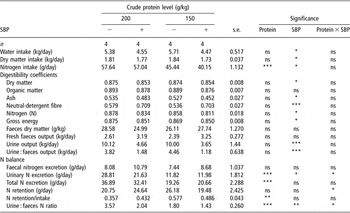
Pigs offered SBP-containing diets had a reduced water intake (4.51 v. 5.54 kg/day; P < 0.05), N intake (48.60 v. 51.54 g/day; P < 0.05) and DM intake (1.75 v. 1.83 kg/day; P < 0.05) compared with pigs offered the diets containing no SBP. Also, pigs offered SBP-containing diets had reduced digestibility of DM (0.854 v. 0.874; P < 0.05), ash (0.468 v. 0.531; P < 0.05), gross energy (GE) (0.851 v. 0.872; P < 0.05), N (0.822 v. 0.868; P < 0.05) and increased digestibility of NDF (0.706 v. 0.558; P < 0.001) compared with pigs offered diets containing no SBP. Pigs offered high-CP diets had a higher N intake (57.34 v. 42.79 g/day; P < 0.001) compared with those pigs offered low-CP diets (Table 2).
Effect of dietary crude protein and sugar beet pulp (SBP) inclusion on apparent nutrient digestibility and nitrogen balance (LSM ± s.e.)

*P < 0.05; **P < 0.01; ***P < 0.001; ns = not significant (P > 0.05).
There was an interaction between CP and SBP on urinary N excretion (P < 0.05), N retention (P < 0.05) and the urine : faeces N ratio (P < 0.05). Pigs offered the 200 g/kg CP diet containing SBP had reduced urine : faeces N ratio and urinary N excretion compared with those offered the 200 g/kg CP diet containing no SBP. However, there was no effect of SBP in pigs offered the 150 g/kg CP diets. Pigs offered the 150 g/kg CP diet containing SBP had decreased (P < 0.05) N retention compared with those offered the 150 g/kg CP diet containing no SBP. However, there was no effect of SBP in pigs offered the high-CP diets on N retention.
Pigs offered SBP-containing diets had reduced urine output (4.15 v. 10.06 kg/day; P < 0.001), reduced urine : faeces output ratio (1.33 v. 4.14; P < 0.001) and increased faecal N excretion (9.73 v. 7.76 g/day; P < 0.1) compared with pigs offered diets containing no SBP. Pigs offered low-CP diets had reduced total N excretion (19.96 v. 34.65 g/day; P < 0.001) compared with those offered high-CP diets.
Microbiology study
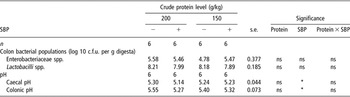
There was no dietary treatment effect (P > 0.05) on the population of colonic Enterobacteriaceae spp. or Lactobacilli spp. (Table 3). Pigs offered diets containing SBP had reduced caecal pH (5.19 v. 5.27; P < 0.05) and colonic pH (5.29 v. 5.47; P < 0.05) compared with pigs offered diets containing no SBP.
Effect of dietary crude protein and sugar-beet pulp (SBP) inclusion on microbial ecology and pH in the caecum and colon (LSM=±s.e.)

Abbreviation is: c.f.u. = colony-forming unit.
*P < 0.05; ns = not significant (P > 0.05).
Volatile fatty acid study
Caecum volatile fatty acids
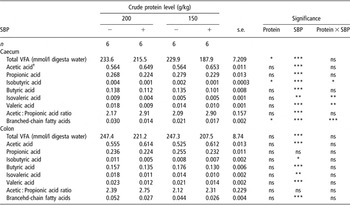
There was an interaction between dietary CP and SBP on the molar proportions of isobutyric acid, isovaleric acid, valeric acid and branched-chain fatty acids in caecal digesta (Table 4). Pigs offered 200 g/kg CP increased the production of isobutyric acid and valeric acid compared with pigs offered 150 g/kg CP in diets containing no SBP. However, there was no effect of dietary CP concentration in the SBP-containing diets. Pigs offered the 200 g/kg CP diet containing SBP had reduced isovaleric acid and branched-chain fatty acids compared with the 200 g/kg CP diet containing no SBP. However, there was no effect of SBP in the 150 g/kg CP diets.
Effect of dietary crude protein and sugar-beet pulp (SBP) inclusion on total volatile fatty acids (VFA) concentration on digesta, molar proportions of VFAs and pH in the caecum and colon (LSM ± s.e.)

*P < 0.05; **P < 0.01; ***P < 0.001; ns = not significant (P > 0.05).
†Individual acids are expressed as a proportion of total volatile fatty acid.
Pigs offered SBP-containing diets had increased production of acetic acid (0.651 v. 0.564; P < 0.001), acetic : propionic acid ratio (2.90 v. 2.13; P < 0.001) and reduced production of propionic acid (0.226 v. 0.274; P < 0.001) and butyric acid (0.107 v. 0.136; P < 0.001) compared with pigs offered diets containing no SBP.
Colon volatile fatty acids
Pigs offered SBP-containing diets decreased total VFA concentration (214.4 v. 247.3 mmol/l; P < 0.001), molar proportions of isobutyric acid (0.006 v. 0.009; P < 0.05), butyric acid (0.133 v. 0.167; P < 0.001), isovaleric acid (0.010 v. 0.016; P < 0.01), valeric acid (0.013 v. 0.022; P < 0.001), branced-chain fatty acids (0.027 v. 0.048; P < 0.001) and increased the production of acetic acid (0.613 v. 0.540; P < 0.001) compared with pigs offered diets containing no SBP (Table 4). There was no effect of dietary CP concentration on VFA profile in the colon.
Slurry volatile fatty acids
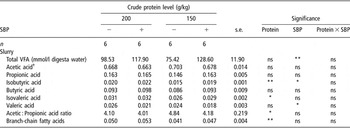
Pigs offered SBP-containing diets had increased total VFAs concentration (123.25 v. 86.97 mmol/l; P < 0.01), increased proportions of isobutyric acid (0.020 v. 0.018; P < 0.05) and branched-chain fatty acids (0.050 v. 0.046; P < 0.1) and decreased concentrations of valeric acid (0.019 v. 0.024; P < 0.002) compared with pigs offered diets containing no SBP (Table 5). Pigs offered 200 g/kg CP increased isobutyric acid (0.021 v. 0.017; P < 0.01), isovaleric acid (0.031 v. 0.027; P < 0.05) and branched-chain fatty acids (0.052 v. 0.044; P < 0.01) and decreased the acetic : propionic acid ratio (4.06 v. 4.51; P < 0.05) compared with pigs offered 150 g/kg CP.
Effect of dietary crude protein and sugar-beet pulp (SBP) inclusion on total volatile fatty acids (VFA) concentration and molar proportions of VFAs in slurry (LSM ± s.e.)

*P < 0.05; **P < 0.01; ns = not significant (P > 0.05)
†Individual acids are expressed as a proportion of total volatile fatty acid.
Ammonia and odour emissions study
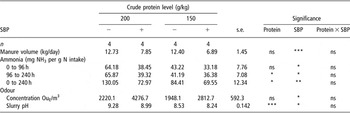
Pigs offered diets containing SBP had reduced manure ammonia emissions from 0 to 96 h (35.82 v. 53.70 g NH3 per g N intake; P < 0.05), 96 to 240 h (37.85 v. 53.53 g NH3 per g N intake; P < 0.05) and 0 to 240 h (71.26 v. 107.23 g NH3 per g N intake; P < 0.01) and volume of manure (3.09 v. 4.49 kg/day; P < 0.01) compared with pigs offered diets containing no SBP (Table 6). However, pigs offered SBP-containing diet had increased odour emissions (3544.7 v. 2084.1 OuE/m3; P < 0.05) compared with pigs offered diets containing no SBP.
Effect of dietary crude protein and sugar-beet pulp (SBP) inclusion on ammonia and odour emissions and slurry pH (LSM ± s.e.)

*P < 0.05; **P < 0.01; ***P < 0.001; ns = not significant (P > 0.05).
Pigs offered diets containing 150 g/kg CP had lower ammonia emissions from 96 to 240 h (38.78 v. 52.60 g NH3 per g N intake; P < 0.05) and 0 to 240 h (76.98 v. 101.51 g NH3 per g N intake; P < 0.05) compared with those offered 200 g/kg CP diets. Pigs offered diets containing 150 g/kg CP had a lower slurry pH (8.39 v. 9.14; P < 0.001) compared with pigs offered 200 g/kg CP. Pigs offered SBP-containing diets had a lower slurry pH (8.90 v. 8.62; P < 0.05) compared with pigs offered diets containing no SBP.
Discussion
The hypothesis of the current experiment was that SBP as a fermentable carbohydrate source in high-CP diets could reduce manure ammonia and odour emissions and odourous compounds from finisher boars. The results show that there was an interaction between SBP and dietary CP on urinary N excretion and the urine-to-faeces N ratio where pigs offered the 200 g/kg CP SBP-based diet had significantly reduced urinary N excretion and urine-to-faeces N ratio compared with those offered the non-SBP-based 200 g/kg CP diet. Additionally, SBP significantly reduced ammonia emissions during 10 days of storage compared with non-SBP diets.
The results of the current study indicate a 42% reduction in total daily N excretion as dietary CP was reduced from 200 to 150 g/kg. The reductions found in the current study in total N excretion may be in agreement with those reported in previous studies (Canh et al., Reference Canh, Aarnink, Schutte, Sutton, Langhout and Verstegen1998b; Carpenter et al., Reference Carpenter, O’Mara and O’Doherty2004). Lynch et al. (2007) reported a 6% reduction in total daily N excretion for each one-percentage unit reduction in dietary CP to 148 g/kg.
Ammonia losses during storage (0 to 240 h) were reduced by 24% by lowering the dietary concentration of CP to 150 g/kg. This equals a 5% reduction in ammonia emission per day per 10 g/kg reduction in CP. Lynch et al. (2007) reported a 6.6% reduction in ammonia emissions per 10 g/kg reduction in dietary CP in vitro while Hayes et al. (Reference Hayes, Leek, Curran, Dodd, Carton, Beattie and O’Doherty2004) achieved an 8.1% reduction per 10 g/kg CP in vivo. The 42% reduction in N excretion as dietary CP was reduced to 150 g/kg means that there may be less ammonical N available for volatilisation in the low-CP diet. Ammonical N together with other factors such as manure pH, the dietary electrolyte balance (dEB) and temperature regulate ammonia emission from manure (Canh et al., Reference Canh, Aarnink, Verstegen and Schrama1998a). The quantity of manure from pigs offered low-CP diets was greatly reduced, which may have been sufficient to prevent any remaining ammonical N in the manure from being volatilised to the atmosphere.
The interaction between dietary CP and SBP on urinary N excretion and the urine : faeces N ratio and the increase in faecal N excretion of pigs offered diets containing SBP is in agreement with the hypothesis that SBP as a fermentable carbohydrate source may alter N excretion in high-CP diets by reducing urinary N excretion in favour of faecal N excretion. N excreted in faeces is predominantly present in the form of dietary or endogenous originating protein, which is less susceptible to rapid decomposition. However, N excreted as urine is mainly in the form of urea, which is converted into ammonia and carbonate by the urease enzyme present in faeces (Van der Peet-Schwering et al., Reference Van der Peet-Schwering, Aarnink, Rom and Dourmad1999). Canh et al. (Reference Canh, Verstegen, Aarnink and Schrama1997) also achieved reductions in urinary N excretion and an increase in faecal N excretion when pigs were offered 300 g/kg SBP. As a result of the alteration in N excretion, a reduction in ammonia emissions with the inclusion of SBP would be expected.
In this experiment, NH3 losses during storage (0 to 240 h) were reduced by 33% with an inclusion level of SBP at 200 g/kg, which is comparable with that of Canh et al. (Reference Canh, Aarnink, Verstegen and Schrama1998a) who achieved a 45% reduction in in vitro ammonia emissions with an inclusion rate of 300 g/kg SBP. Pigs offered SBP-based diets in the current study also had reduced urine output, urine : faeces output and manure volume. For producers this could have significant implications in complying with the European Communities (Good Agricultural Practice for Protection of Waters) Regulations 2006, especially with regard to the compulsory storage of organic fertilisers during the prohibited land application periods. Additionally, faecal N excretion was increased when pigs were offered SBP-based diets. Urinary urea and the pH of slurry are the most important factors influencing the ammonia emission from manure (Aarnink et al., Reference Aarnink, Hoeksma and van Ouwerkerk1993). Therefore the reduction in slurry pH of pigs that were offered SBP-based diets and the reduction in urinary N excretion from pigs offered 200 g/kg CP SBP-based diets may have contributed to the 33% reduction in manure ammonia emissions.
The high water-holding capacity of this source of fibre (Decuypere et al., 1994; Lizardo et al., Reference Lizardo, Peiniau and Aumaitre1997) may explain the reduction in DM intake, water intake and, as a consequence, manure volume of pigs offered SBP-based diets, though it must be remembered that this is a metabolism experiment and such effects may not be as pronounced in group housing. The high water-holding capacity of SBP within the digestive tract may cause a full feeling, which is a common satiety strategy, when adult sows are fed high-fibre diets (Zonderland et al., Reference Zonderland, De Leeuw, Nolten and Spoolder2004). The interaction between dietary CP and SBP on N retention may be associated with the reduction in N and DM intake in pigs offered SBP-based diets, which was more pronounced at the lower protein concentration.
To this point, our hypothesis that SBP as a fermentable carbohydrate source could manipulate N excretion to reduce urinary N and reduce manure ammonia emissions can be accepted. Additionally, SBP reduced isovaleric acid and branched-chain VFAs in the caecum of pigs offered high-CP diets compared with those offered high CP alone. In the colon, SBP-based diets significantly reduced branched-chain VFAs, which are thought to contribute to malodour (Mackie et al., Reference Mackie, Stroot and Varel1998).
It is therefore surprising that pigs offered SBP-based diets caused an increase in odour concentration. This may have occurred due to two reasons. Firstly, there was an increase in isobutyric acid and branched-chain fatty acids in the manure of pigs offered SBP-based diets. The VFAs with higher carbon numbers such as isobutyric acid and isovaleric acid have a lower odour-detection threshold and as a result are more offensive (Mackie, Reference Mackie1994). In the current study, the pattern of VFA production in the digesta does not reflect what is happening in the manure. This may be due to protein fermentation in the manure with pigs offered SBP-based diets excreting more faecal N than those offered non-SBP-based diets. The most pungent and offensive-smelling compounds originate from the decomposition of proteins (Zhu, Reference Zhu2000), with isovaleric acid and isobutyric acid being produced exclusively from the deamination and decarboxylation of leucine and valine, respectively (Mackie et al., Reference Mackie, Stroot and Varel1998). There are various bacterial genera that can produce these compounds since swine manure contains sufficient nutrients for bacterial growth; however, pH and temperature are limiting factors (Zhu, Reference Zhu2000).
Secondly, there was a reduction in manure pH with the addition of SBP to the diet. Although this is hugely beneficial in maintaining ammonia as a stable ammonium in the manure (Aarnink et al., Reference Aarnink, Hoeksma and van Ouwerkerk1993), it renders conditions ideal for hydrogen sulphide release (Howe and Lawler, Reference Howe and Lawler1989) and other volatile sulphide compounds that have been identified as important odourous compounds from livestock manure (O’Neill and Phillips, Reference O’Neill and Phillips1992).
The reduction in odour concentration of pigs offered low-CP diets can be supported by the significant reduction in isobutyric acid and isovaleric acid in the slurry of pigs offered low-protein diets. Leek et al. (Reference Leek, Hayes, Curran, Callan, Dodd, Beattie and O’Doherty2007) reported that pigs offered 210 g/kg CP had a higher odour emission rate compared with pigs offered 130 and 160 g/kg CP.
There is a low correlation between swine manure ammonia and odour emissions (Liu and Hoff, 1993; Verdoes and Ogink, 1997; Leek et al., Reference Leek, Hayes, Curran, Callan, Dodd, Beattie and O’Doherty2007). Manure odour originates from the decomposition of proteins; however, ammonia production is not a result of the same degradation kinetics as the major part of ammonia in the manure originates from urea hydrolysis (Zhu, Reference Zhu2000). In the current study, pigs offered 200 g/kg CP SBP-based diets had significantly lower urinary N and as a result manure ammonia emissions were reduced. Faecal N excretion was increased in pigs offered SBP-based diets and perhaps as a result of the bacterial degradation of this excess protein during storage a higher odour concentration was produced.
NDF digestibility was significantly increased in pigs offered SBP-based diets and is in agreement with previous studies (Lizardo et al., Reference Lizardo, Peiniau and Aumaitre1997; Freire et al., Reference Freire, Guerreiro, Cunha and Aumaitre2000). Pectins are a highly soluble non-starch polysaccharide (Bertin et al., Reference Bertin, Rouau, Barry, Thibault and De Baynast1988) and have been shown to be extensively degraded (Robertson et al., Reference Robertson, Muirson and Chesson1987). The reduction in the digestibility of DM, ash, GE and N in pigs offered SBP-based diets is in contrast to the increase in the digestibility of NDF. The reduction in digestibility is likely due to the greater fibre concentration in the SBP-containing diets. The reduction in N digestibility may also be related to the increase in faecal N excretion and an increase in endogenous losses of N of pigs offered SBP. Higher faecal N excretion is indicative of increased microbial protein synthesis or augmented endogenous protein loss (Rideout et al., Reference Rideout, Fan, Cant, Wanger-Riddle and Stonehouse2004; Pierce et al., Reference Pierce, Sweeney, Callan, Byrne, McCarthy and O’Doherty2006).
In conclusion, pigs offered SBP-based diets had reduced manure volume, manure ammonia emissions and urinary N excretion, which suggest that SBP could have played a role in reducing the impact of pig production on the environment. However, SBP-based diets increased odour emissions from manure, possibly due to the fermentation of excess protein resulting in the production of isobutyric acid and branched-chain fatty acids in the manure. The VFA profile changed considerably from the colon to the manure during the first few days of storage, indicating that significant fermentation takes place in the manure. Lowering dietary CP from 150 g/kg to 200 g/kg resulted in a 42% reduction in N excretion and 24% reduction in manure ammonia emissions.