Introduction
Most countries have some institutional arrangements for transferring income or wealth from rich to poor individuals or families. The most important arrangements are controlled by governments, including taxation of wealthier individuals and social expenditures benefiting poorer individuals and families. These policies are the subject of considerable political controversy, however, as they reflect two conflicting principles: that people should be allowed to live according to prevailing social standards (Marshall, Reference Marshall1964) versus that they should do what they can to be economically self-sufficient (Feldman and Zaller, Reference Feldman and Zaller1992). Knowing in what kind of situations the public wants more redistribution is important because with no public demand policy makers are unlikely to enter the controversial issue of economic redistribution.
Much empirical research has investigated what kind of individuals tend to support or not support economic redistribution (Taylor-Gooby, Reference Taylor-Gooby1985), or in what kind of countries public opinion is more or less supportive toward redistribution (Svallfors, Reference Svallfors1997). This paper introduces economic strain as a new explanation of public support toward redistribution. I hypothesise that economic strain affects public preferences for redistribution at the level of both individuals and countries. The individual-level effect means that individuals reporting economic strain are more likely to support redistribution than those not reporting economic strain. The country-level effect means that as more people experience economic strain in a country, even individuals not reporting economic strain tend to support redistribution.
Compared to conventional explanations, economic strain is first of all an alternative to studying the effects of the economic situation of individuals and countries using objective economic measures such as household income and the income dispersal of the country (i.e. the Gini coefficient). I argue that economic strain is a theoretically simpler explanation of why people support redistribution than most objective measures of economic well-being. Empirically, I will show it is also a stronger predictor of public support toward redistribution than conventional economic explanations.
These effects are investigated in twenty-eight countries in the fourth round of the European Social Survey (ESS) 2008–09 using multi-level (random intercept) linear regression models. The analysis also investigates how far income levels and the income dispersal of the country can help explain why economic strain is associated with preferences for redistribution. I first present a review of conventional explanations of public support toward redistribution, before presenting the new perspective on how economic strain might affect public preferences for redistribution of income.
Individual-level characteristics
Who tends to support redistribution of income from rich to poor individuals? Much empirical research has investigated individual characteristics seen as indicators of the self-interest individuals have in relation to economic redistribution (Sears et al., Reference Sears, Lau, Tyler and Allen1980; Hasenfeld and Rafferty, Reference Hasenfeld and Rafferty1989). The self-interest argument claims that those who are likely to gain from redistribution are more likely to support it, whereas those who are likely to contribute to the redistribution to others are more likely to oppose such policies. Empirical findings are consistent with this argument. For example, economically vulnerable individuals, as defined by low income and ethnic minority status (Hasenfeld and Rafferty, Reference Hasenfeld and Rafferty1989) or by low occupational class and non-employment (Svallfors, Reference Svallfors1997; Edlund, Reference Edlund1999), are more likely to support welfare provision associated with redistribution than less vulnerable groups. This is also the case when comparing public attitudes toward welfare policies in several countries (Svallfors, Reference Svallfors1997; Edlund, Reference Edlund1999; Blekesaune and Quadagno, Reference Blekesaune and Quadagno2003).
Correlations between income and support for redistribution are not very strong, however. Consequently, there is some debate over how far individual self-interest can explain variation in support for redistribution. One alternative explanation is that people may support redistribution if economic strain is supposedly caused by circumstances beyond individual control (Fong, Reference Fong2001). This hypothesis is supported by psychological research finding a strong link between attributions of personal responsibility for people's economic situation and support for redistribution (Appelbaum, Reference Appelbaum2001; Mitchell et al., Reference Mitchel, Tetlock and Lerner2003).
Country-level characteristics
Research has also investigated how far individuals living in different countries hold different preferences for economic redistribution (Svallfors, Reference Svallfors1997; Dallinger, Reference Dallinger2010) or social expenditure (Blekesaune and Quadagno, Reference Blekesaune and Quadagno2003). In these studies, country-level characteristics are often investigated as institutional characteristics of welfare policies (Svallfors, Reference Svallfors1997; Larsen, Reference Larsen2008) or as economic factors typically related to economic cycles (Blekesaune, Reference Blekesaune2007; Dallinger, Reference Dallinger2010) or the income dispersal of the country (Lübcker, Reference Lübcker2007; Finseraas, Reference Finseraas2009).
The institutional argument claims that institutional characteristics of welfare programmes shape public opinion (Svallfors, Reference Svallfors1997; Larsen, Reference Larsen2008). Most research has investigated institutional characteristics rather crudely by grouping countries into a few types of welfare regimes (Svallfors, Reference Svallfors1997; Edlund, Reference Edlund1999) à la Esping-Andersen (Reference Esping-Andersen1990). More recent research has also utilised more direct policy measures, including social expenditures (Jæger, Reference Jæger2006; Jakobsen, Reference Jakobsen2010) or more continuous scales measuring welfare regimes (Jæger, Reference Jæger2009). Comparative findings on welfare opinions only partially support the hypothesised consistency between public opinion and welfare policies (Jæger, Reference Jæger2009; Dallinger, Reference Dallinger2010). Continuous variables could perhaps prove more promising than categorical classifications of welfare regimes (Jæger, Reference Jæger2009; Jakobsen, Reference Jakobsen2010) but might also create a risk that the large number of policy indicators made available by organisations such as Eurostat and OECD make it possible to construct measures supporting any hypothesis. Much of this research is based on strong theoretical assumptions: correlation between welfare regimes and public opinion reflects that policies affect public opinion, disregarding either the possibility that public opinion also affects welfare policies or the presence of a third variable (e.g. historical experience) affecting both policy makers and public opinion.
Economic factors
At least two types of economic factor have been investigated for how they affect public attitudes toward redistribution. One is economic cycles, typically measured as employment or unemployment rates (Blekesaune, Reference Blekesaune2007; Kim, Reference Kim2007); the other is income dispersal, typically measured by the Gini coefficient (Finseraas, Reference Finseraas2009; Lupu and Pontusson, Reference Lupu and Pontusson2011). The economic cycle argument was popular in the 1960s and 1970s when several authors claimed that public support for leftist policies (Leggett, Reference Leggett1964) or welfare provision and redistribution (Cutright, Reference Cutright1965; Wilensky, Reference Wilensky1975) tends to rise in ‘bad’ periods of low employment or high unemployment rates. More recent empirical research is consistent with this argument, looking at temporal variation in employment rates (Blekesaune, Reference Blekesaune2007) or unemployment rates (Kim, Reference Kim2007) in several countries.
The issue of income dispersal and public support for redistribution has attracted interest over recent years. Theoretically, much research has made use of the median voter theorem, stimulated by the Meltzer and Richard (Reference Meltzer and Richard1981) model. When median income is lower than average income – the situation in most countries – more income dispersal should lead to more public support for redistribution, certainly among middle-income citizens (Lübker, Reference Lübcker2007; Finseraas, Reference Finseraas2009). In democratic societies, it should also lead to more redistribution but this is of less interest here; this analysis focuses on the first part of the model.
Empirical findings are not always consistent with this hypothesis. In aggregate data analyses, Kenworthy and McCall (Reference Kenworthy and McCall2008) do not find this income dispersal effect when looking at trends in public support for redistribution in eight countries. Nor does Lübker (Reference Lübcker2007) find an income dispersal effect when comparing public support for redistribution in twenty-six countries in the International Social Survey Program (ISSP) data. The latter study finds that public support for redistribution is correlated with popular assessments of the income dispersal of their country as being too large or not too small. Finseraas (Reference Finseraas2009) finds, on the other hand, a positive correlation between income dispersal and public support for redistribution in the first round of the European Social Survey (ESS). Also, Lupu and Pontusson (Reference Lupu and Pontusson2011) find a correlation between income dispersal and public support for redistribution among middle-income citizens (r = 0.45) when comparing ninety country-level observations from various (ISSP and ESS) surveys.
Economic strain
The current analysis uses economic strain in place of other economic factors for predicting preferences for redistribution. Economic strain is measured subjectively, reflecting the extent to which people find it hard to live on their current income (Whelan et al., Reference Whelan, Layte, Maitre and Nolan2001; Berthoud et al., Reference Berthoud, Blekesaune and Hancock2009). The terminology used in analyses of economic strain is not very consistent. Existing research uses all combinations of financial/economic and strain/stress/hardship. Various measures of economic strain are also used. Some authors use single items, typically indicated by living comfortably versus finding it hard to live on current income (Whelan et al., Reference Whelan, Layte, Maitre and Nolan2001); others use indices that may include additional items (Berthoud and Bryan, Reference Berthoud and Bryan2011).
I hypothesise that economic strain makes individuals more supportive toward redistribution for two reasons: (1) such policies would improve their economic situation, and (2) individuals experiencing economic strain are more aware of economic problems than those not having such problems. Further, individuals living in countries where many people experience economic strain are also more likely to support redistribution, for similar reasons: (1) high incidence of economic strain makes individuals aware of the risk of economic strain, including those currently not experiencing such problems, and (2) this situation makes people aware of the problems of economic strain since there are more individuals around them experiencing such problems. At the country level, there is also a third reason: (3) when more people experience economic strain, public opinion is more likely to see economic strain as an outcome of factors beyond individual control. In these situations, people tend to be more supportive toward redistribution, as indicated by empirical research (Appelbaum, Reference Appelbaum2001; Fong, Reference Fong2001; Mitchell et al., Reference Mitchel, Tetlock and Lerner2003) and normative theory (Rawls, Reference Rawls1972).
Research on public opinion toward redistribution has largely investigated economic factors by objective characteristics (i.e. household income and income dispersal), and not as subjective assessments such as economic strain. Theoretical arguments, however, seemingly assume that low-income or high degree of income dispersal measured objectively affects people's preferences for economic redistribution via some changes in people's subjective assessment of their economic situation or the situation of their country. This follows from a standard self-interest or rational choice model (Elster, Reference Elster1989; Lübker, Reference Lübcker2007). Economic strain can be seen as a more direct measure of how people assess their economic situation, and would relate more directly to the underlying theoretical model compared to objective income measures.
Economic strain does not necessarily correspond to situations of low income or where people are excluded from enjoying prevailing standards of living. Whelan and colleagues (Reference Whelan, Layte, Maitre and Nolan2001) find that income, standards of living and subjective assessment – including economic strain – are not highly correlated. The research literature provides various arguments in favour of investigating some but not all of these factors. For example, people experiencing low income over short periods of a few years do not necessarily experience economic strain or reduce their standards of living (Berthoud and Bryan, Reference Berthoud and Bryan2011). Ringen (Reference Ringen1988) argues that low standards of living, and low assessments of these standards, are more direct measures of poverty than (current) income.
Somewhat contrarily, economic strain does not only reflect low income but is also affected by how ambitious people are regarding consumption and abilities to convert income to goods and services. For example, older people tend to do better on low income than younger adults (Berthoud et al., Reference Berthoud, Blekesaune and Hancock2009), and rising income levels in a society (economic growth) are not necessarily associated with less economic strain (Berthoud and Bryan, Reference Berthoud and Bryan2011).
For these reasons, economic strain is controversial when used as an indicator of poverty. Social philosophers have argued that society should not support ambitious individuals with expensive tastes at the expense of others whose tastes are more modest (Rawls, Reference Rawls1972; Sen, Reference Sen1992). The political implications might be different, however. For example, historians have argued that economic strain, rather than low income, fuelled the revolutions of Russia and Cuba (Carr, Reference Carr1953; Zeitlin, Reference Zeitlin1966). Income poverty may not lead to demand for more redistribution or welfare provision, whereas economic strain might.
Method
The data analysed in this paper are from the fourth round of the European Social Survey 2008–09. All twenty-eight countries are investigated: Belgium, Bulgaria, Cyprus, Czech Republic, Denmark, Estonia, Finland, France, Germany, Great Britain, Greece, Croatia, Hungary, Israel, Latvia, Netherlands, Norway, Poland, Portugal, Romania, Russia, Slovakia, Slovenia, Spain, Sweden, Switzerland, Turkey and Ukraine. Sample sizes vary from 1,159 (Cyprus) to 2,673 (Germany), with a mean of 1,898.
The dependent variable, preferences for redistribution, is measured by a single item: ‘Using this card, please say to what extent you agree or disagree with each of the following statements [starting with]: The government should take measures to reduce differences in income levels.’ The card has five responses varying from ‘Agree strongly’ [value 5] to ‘Disagree strongly’ [value 1] plus ‘Don't know’ [set to missing].
The main explanatory variable, economic strain, is also measured by a single item: ‘Which of the descriptions on this card comes closest to how you feel about your household's income nowadays?’ The card has five responses varying from ‘Living comfortably on present income’ [value 1] to ‘Finding it very difficult on present income’ [value 4] plus ‘Don't know’ [set to missing].
The data are investigated using linear regression models with random intercepts for the twenty-eight countries. The statistical analysis controls for gender (female dummy), age, being partnered (married or cohabiting dummy) or not and the number of children living in the household. Age is controlled for by three linear slopes (splines), and is divided by ten in order to make the coefficients larger in the tables, with the result that decimals reflect individual years. It is centred on forty years (values in parentheses): fifteen to forty years (−2.5–0), forty to sixty years (0–2), and sixty to ninety-nine years (0–3.9). All regression analyses are non-weighted.
Sensitivity analysis is carried out by reclassifying the dependent variable: first, by making it symmetrical, next by identifying two groups supporting economic redistribution (strongly or any kind of support) using binary logit models, and finally by limiting the analysis to the lower seven income deciles or the mid four income deciles, to test the median voter hypothesis.
A further analysis investigates how far the (individual- and country-level) effects of economic strain on public support for redistribution are explained by the income level of the household and the country (using mean household income of the country). Household income is measured by ten income levels pre-classified in the survey questionnaire corresponding broadly to the deciles of the actual household income range of each country. This income variable is after tax income from all sources. Respondents can provide the answer in terms of weekly, monthly or annual income. Unfortunately, the household income variable is only available for twenty-five of the twenty-eight countries (not Bulgaria, Cyprus or Slovakia), and only 81 per cent of the respondents of these twenty-five countries answer this question (lower in Southern Europe, only 42 per cent in Portugal), corresponding to 73 per cent of the full sample.
A final analysis investigates whether the income dispersal of the country can help explain the correlation between economic strain and support for redistribution. Income dispersal is measured by the Gini coefficient taken from Eurostat's EU-SILC database from 2008 (2009 for some countries). Unfortunately, these data include only twenty-three of the twenty-eight countries investigated (not Cyprus, Israel, Russia, Turkey or Ukraine). When combining household income and Gini coefficients in the same analysis, the number of countries drops to twenty-one and the number of individuals drops to 31,450 (59 per cent of the full sample).
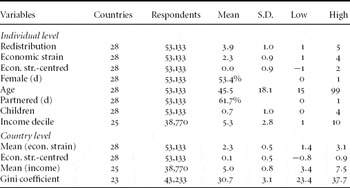
Descriptive statistics (Table 1) show that a majority of the respondents support redistribution, with a mean of 3.9 along the 1–5 scale. A minority report economic strain, with a (weighted) mean of 2.3 along the 1–4 scale. In the first analyses (Table 2), this variable is centred on its arithmetic (non-weighted) mean of 2.2, varying from −1.2 to 1.8 between respondents, and somewhat less between countries (−0.8–0.9), because of a cross-level interaction term of economic strain at the levels of individuals and countries.
Descriptive statistics of the variables (European Social Survey 2008/2009 using design and population weights

Note: (d) = dummy variable, coded 1 and 0.
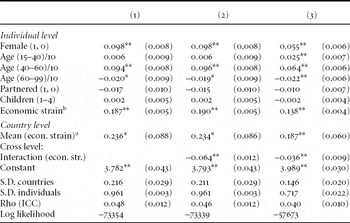
Two-level linear regression analysis of public support for redistributiona as a result of individual-level (53,133) characteristics and mean economic strain of the country (28) (coefficients with standard errors in parentheses)

Notes: * significant at 5 per cent and ** significant at 1 per cent in two-sided tests, a 1–5 in models 1 and 2, 3–5 in model 3, b 1–4 variable minus (mean of) 2.2. Age centred at 40 years.
Respondents are evenly distributed over the ten income deciles, with slightly fewer on the lowest two income levels (mean 5.3). The number of children in the household is delimited to four because of the small number of households with more than four children. Fifty-three per cent of the respondents are women and 62 per cent are partnered (using weighted data). Mean economic strain and mean household income of the countries, at the lower end of the table, are simple (non-adjusted, non-weighted) mean values calculated for each country in the sample.
Results
Regression results are presented in Table 2. Model 1 shows that individuals reporting economic strain are more likely to support redistribution than individuals not reporting economic strain. The predicted support for redistribution (1–5) increases with an average of 0.187 for each unit increase in economic strain (roughly from −1 to 2). Further, individuals living in countries where many people report economic strain are also more likely to support redistribution than individuals living in countries where few people report economic strain. This is also the case when controlling for economic strain of the household. The predicted support for redistribution (1–5) increases with an average of 0.236 for each country-level mean increase in economic strain. Economic strain does vary more between individuals (or household) than between countries; standard deviation (S.D.) statistics are twice as large when comparing individuals (S.D. = 0.91) as they are in country comparisons (S.D. = 0.46) (not shown in tables). Still, an increase in the mean economic strain of the country affects people's preferences for redistribution as much or even more than a similar increase in economic strain of the household.
Model 2 includes a cross-level interaction term between economic strain at the levels of individuals and countries. Figure 1 presents predictions for four combinations of this result as indicated by low and high economic strain at the levels of individuals and countries. The predictions are calculated at plus/minus 1.2 standard deviations (of the empirical distribution) of the two centred variables (from Table 1): plus/minus 1.09 (0.91*1.2) at the level of individuals and plus/minus 0.56 (0.46*1.2) at the level of countries.Footnote 1 The graph shows that in countries of widespread economic strain, both individuals experiencing and not experiencing economic strain tend to support redistribution. In countries of less economic strain, only those experiencing economic strain tend to support redistribution.
Combinations of individual and country-level economic strain in support for redistribution
Note: Predictions from model 2, Table 2.

Further results show that women are more supportive of redistribution than men, and people in their sixties are more supportive than those below forty. There are no differences between partnered and non-partnered individuals, or between those with and those without children in the household.
The lower part of Tables 2 and 3 splits the unexplained variation between individuals and countries. By comparing statistical models with and without various explanatory variables, it can be shown that only economic strain explains country-level variation in public support for redistribution; standard deviation statistics (S.D.) are reduced from 0.292 in a model with no explanatory variables to 0.211 in a model including only economic strain (not shown in tables). Further, the mean economic strain of the country explains more country-level variation in public support for redistribution (down to 0.211) than the individual (compositional) effect in economic strain (down to 0.237) (not shown in tables). Taken together, both regression slopes and random variation indicate that economic strain at country level is important in shaping public attitudes toward redistribution, and it appears to be important for understanding country-level variation in public support for redistribution.
Sensitivity
It is a potential problem with these cross-level interaction effects that they could result from a so-called ceiling effect. The dependent variable varies from 1 to 5 with a mean of nearly 4, meaning that very few people are against redistribution. Hence, the low variation in public support for redistribution in countries of widespread economic strain could simply reflect that the instrument measuring this support does not pick up much variation in public support for redistribution in poor countries. Model 3 (in Table 2) corrects for this potential bias by merging the three lowest values in public support for redistribution (1–3) into a single value (3), meaning that the dependent variable is symmetrical (similar numbers of 3 and 5). This model provides results nearly identical to those of model 2 when considering the smaller variation in the dependent variable (public support for redistribution) in model 3 compared to that in model 2. Hence, we can conclude that in countries where many people feel poor, even those who do not feel poor tend to support redistribution from rich to poor individuals. In wealthier countries, redistribution is subject to more controversy when comparing rich and poor individuals.
The ESS questionnaire identifies two groups supporting redistribution of income: those agreeing strongly with redistribution and those reporting any kind of agreement with redistribution. The two outcomes can be investigated separately using binary logit models. Such analyses show largely similar results as those reported in Table 2 (results not shown in tables). The individual-level effect of economic strain is slightly stronger in the model of any kind of agreement with redistribution than when analysing those agreeing strongly with redistribution. The country-level effect of economic strain is, on the other hand, much stronger when analysing those agreeing strongly than when analysing those merely agreeing with redistribution, when this effect becomes marginally non-significant. The interaction effect between economic strain at the levels of individuals and countries is of similar magnitude in the two logit models.
The median voter theorem suggests that the results presented here should hold for people with low and medium income but perhaps not for people with higher incomes. This hypothesis can be investigated by restricting the analysis to mid- and low-income earners. Results remain similar, however, for the economic strain variables when restricting the analyses to the lower seven income deciles or to the mid four income deciles (analysis not shown here). The sole exception is that the individual-level (but not country-level) effect of economic strain is reduced slightly when omitting the highest two income deciles. Hence, these results cannot be interpreted into a simple rational choice model where support for redistribution occurs only where this is gainful to the individual respondent.
Adding household income and income dispersal
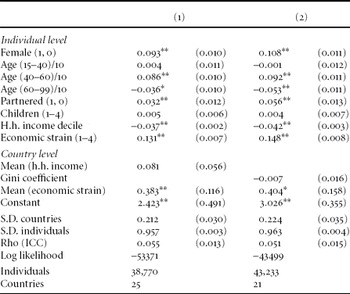
Table 3 investigates similar correlations (to Table 2) by including household income and country-level (mean household) income (model 1) or country-level income dispersal measured by the Gini coefficient (model 2) as explanatory variables. Since these analyses include fewer individuals (model 1 and 2) and countries (model 2), the correlations between economic strain and support for redistribution may also change (increase) as compared to the results in Table 2.
Two-level linear regression analysis of public support for redistribution (1–5) as a result of individual-level characteristics and (mean) income level, income dispersal (Gini coefficients) and (mean) economic strain of the country (coefficients with standard errors in parentheses)

Notes: * significant at 5 per cent and ** significant at 1 per cent in two-sided tests; † significant at 5 per cent in one-sided tests. Age centred at 40 years.
With no statistical control for economic strain, household income (1–10) predicts support for redistribution (1–5) which decreases with an average of 0.057 for each unit (decile) increase in income (not shown in tables). The similar (mean household) country-level income variable is similarly correlated (0.050) with public preferences for redistribution when disregarding the smaller variance in the country-level compared to the household-level income variable. This country-level correlation is far from statistically significant, however.
When using both income and economic strain in the same model (1), we find that both household income and household-level economic strain strongly predict public support for redistribution. The two effects are of similar magnitude when considering the actual variation in the two explanatory variables or the test statistics associated with the two slopes. Still, there is a considerable amount of overlap (collinearity) between these effects; they are both lower than in models where only one of these effects is specified. At the country level, there is no correlation between (mean household) income and public support for redistribution when also controlling for economic strain (the income coefficient switches sign in model 1). The slope between country-level economic strain and public support for redistribution gets even steeper (and more significant) when also controlling for the (mean household) income of the country.
Model 2 is similar to model 1 but now the country-level mean household income variable is replaced by country-level income dispersal measured by the Gini coefficient. The number of countries is also smaller, now reduced to twenty-one, and the number of respondents drops to a mere 59 per cent of the full sample. The country-level Gini coefficient is correlated with public support for redistribution (not shown in tables), but this relationship is not strong and it is only statistically significant when using a one-sided test (which is appropriate in this case).
When using both economic strain and the Gini coefficient in the same model (2), there is no correlation between the Gini coefficient and public support for redistribution when also controlling for (country-level) economic strain (the Gini coefficient switches sign in model 2). The slope between country-level economic strain and public support for redistribution gets even steeper when also controlling for the country's income dispersal measured by the Gini coefficient.
Most other results are similar when comparing Tables 2 and 3. The main exception is that partnered individuals are more supportive toward redistribution than non-partnered individuals when also controlling for household income.
Summary and discussion
I have hypothesised that economic strain leads to stronger public support for redistribution, both among people experiencing economic strain and among people living in countries where many other people report economic strain. Data from the twenty-eight countries of the European Social Survey round four are consistent with this hypothesis. These results are robust across various income levels and various classifications of the dependent variable. The country-level effect is largely driven by a tendency to strongly agree with redistribution in countries of widespread economic strain.
Survey data on public attitudes may reflect tendencies people have to select certain response categories (response style) or to present themselves in ways that do not represent their true attitudes (response set) (O'Neill, Reference O'Neill1967). These tendencies are likely to become more important when comparing data from various countries because of different languages and cultures (Singh, Reference Singh1995). There is thus a possibility that single items are correlated because of how respondents from different countries interpret their exact wordings. The wordings of the response categories for economic strain and support for redistribution are different, however, and the ordering of these categories in the questionnaire is such that any tendency to choose the first or the last category would lead to a negative correlation between economic strain and support for redistribution, the opposite of what is found here.
The fact that individuals experiencing economic strain tend to support redistribution could be seen as self-evident since many of them would gain from such policies. This follows from a standard self-interest argument. It is more interesting that people not experiencing economic strain also tend to support redistribution from the rich to the poor when living in countries where many other people experience economic strain. This country-level effect of economic strain is as strong, or even stronger, than the individual/household-level effect of economic strain when disregarding the larger individual-level variation in the economic strain variable. This finding can be given various interpretations. The risk of running into economic problems is larger when many people are experiencing such problems. Further, the awareness of the problem of economic strain is larger when many people experience economic problems in a country, even among those without such problems. Finally, public opinion is more likely to see economic strain as an outcome of factors beyond individual control when more people experience economic strain.
The link between economic strain and public support for redistribution is likely to be important for policy makers. Popular theory suggests that people's preferences for redistributive policies are rooted in more general value systems regarding the proper relationship between the individual and the state (Feldman and Zaller, Reference Feldman and Zaller1992). The path dependency thesis could indicate that any policy change affecting economic distribution will generate more negative than positive feedback from the electorate (Pierson, Reference Pierson2000). This research indicates that the scope for redistributive policies is better in periods of economic strain than in periods of economic growth when regarding public support.
Both low income and economic strain are important for understanding who is supporting redistribution at the level of individuals and households. People with low incomes are more likely to experience economic strain than higher-income individuals and families. Hence, the two explanations, low income and economic strain, overlap to some extent in explaining who is supporting redistribution of income. These findings make sense if we assume that low income leads to more economic strain and eventually to more support for redistribution. At the level of individuals and households, it appears that economic strain to some extent mediates the effect of low income in explaining who is supporting redistribution, and to some extent explains individual-level support for redistribution beyond what is explained by their current income.
At the country level, both mean household income and income dispersal could perhaps help explain why some countries are more supportive toward redistribution than other countries. But neither of these effects is strong, and both disappear when controlling for mean economic strain of the country. Clearly, this subjective measure of economic problems is much more important for understanding country-level variation in public support for redistribution than the mean (household) income of the country, or the income dispersal of the country. At the level of countries, it is unlikely that economic strain merely mediates the effects of objective economic conditions. It is more likely that economic strain drives public demand for redistribution, apparently across various levels of economic prosperity and income dispersal.
Economic strain is important for understanding why some countries are more supportive toward redistribution than others. Previous research has largely explained country-level variation in public support for redistribution by institutional factors (e.g. welfare regimes) or economic factors measured objectively (economic cycles, income dispersal). Economic strain has some advantages regarding simplicity of explanation (compared to income dispersal), simplicity of interpretation (compared to institutional arrangements) and empirical support (compared to other economic factors). Still the relationship between economic strain and other factors affecting public support for redistribution should be investigated more thoroughly. For example, future research should include actual redistribution when investigating public preferences for redistribution. It should also look into more dynamic (longitudinal) aspects of the relationships between income, standards of living, economic strain and public support for redistribution.