Party systems in new democracies differ dramatically in their capacity to structure citizen preferences and represent them in the political process, which is one of the most central goals of popular rule according to democratic theory. In this article, I argue that in the long run, party systems that experienced prolonged periods of ideological conflict differ starkly from those in which elites avoided polarization. Contrasting party platforms allow voters to make sense of what politics is about and create strong links between social groups and political parties. If parties retain their spatial positions, ongoing conflict is capable of reproducing alignments over generations, instilling long-term mechanisms of programmatic accountability.
The stark differences in the quality of representation in Latin America provide an excellent context in which to verify this claim. What is more, a coherent theoretical framework to explain how party systems rooted in ideology emerged in some Latin American countries, but failed to crystallize in others, is still lacking. I argue that the paths between representative and unrepresentative party systems bifurcate when – at different points in the first half of the twentieth century, depending on the country – the left makes its appearance on the political scene. At this point, party systems either became polarized or elites restrict competition. Parties started offering distinctive platforms along the economic policy dimension early in the twentieth century in Chile and Uruguay, and with the advent of Peronism in Argentina. As I will show, these party systems still exhibited high representational quality in the 1990s. The balance of power between left and right is crucial to explaining whether party systems became polarized: where the established social and political elites felt threatened by leftist parties, they banned challengers, resorted to the military to intervene or employed clientelistic benefits to demobilize newly emerging social groups. Peru employed all of these strategies in combination. Likewise, pacted transitions back to democracy, such as those in Colombia and Venezuela in 1958, proved damaging to political representation. These countries, along with others that I study in less detail – Brazil, Ecuador, Bolivia and Mexico – represent instances of what I call ‘aborted polarization’. As a consequence, responsive party systems either never formed, or parties progressively lost touch with society as they cartelized.
My central claim is thus that the quality of representation – a term I define below – in the 1980s and 1990s, after many countries in Latin America had re-democratized after years of military dictatorships, displayed patterns stemming from a long-term, path-dependent evolutionary process. Considerable research has addressed changes in Latin American party systems since the 1980s.Footnote 1 But with the exception of Kitschelt et al.’s recent book,Footnote 2 we lack a comparative account based on a limited set of variables that explain where the initial configuration in the 1980s came from, and what mechanisms underpinned its continuity for much of the early twentieth century. What is more, if the focus is on the impact of historical polarization, continuities actually remain stronger than discontinuities. Of the eleven countries I study, only Argentina may have jumped off track by the 2000s. The breakdown of the Venezuelan party system, by contrast, can be explained by the long-term consequences of the collusive behavior of the major parties.
By demonstrating the merits of polarization, I contradict modernization theorists, proponents of pacted transitions and other scholars who have championed political moderation as key for democracy.Footnote 3 In theory, of course, party positions need not be polarized, but only sufficiently distinct for programmatic alignments and congruent representation to emerge. Yet in the Latin American historical context, challenging parties tended to be highly polarizing. There were no cases in which party systems were not polarized, yet provided voters with identifiable, distinctive policy options – Uruguay is a partial exception. Given the choice between polarization and the absence of policy-based representation, many students and observers of Latin American politics have endorsed polarization-aborting pacts that I show are detrimental to representation. Paradoxically, even the party systems literature, which is strongly shaped by Lipset and Rokkan’s conflict-based explanation of party system formation, has developed a pro-moderation bias at least since Sartori’s influential work on polarized pluralism.Footnote 4 At the same time, recent research from advanced democracies supports my claim that polarization creates (while de-polarization dilutes) the links between social groups and parties that have stabilized party systems since the formation of the historical cleavages.Footnote 5 Party differentiation also fosters another normative desirable goal: Franklin shows that individuals’ propensity to vote is rooted in the degree of polarization they experienced in the first rounds of elections they participated in, which is one of the most important factors shaping aggregate levels of turnout.Footnote 6 Evidence from outside Latin America likewise suggests that if conflict does not surpass a certain threshold, polarization has beneficial effects. Le Bas argues in the context of Africa that polarization results in more cohesive and socially rooted party organizations.Footnote 7 Parties of this kind are necessary for democracy to function.
The remainder of this study is structured as follows. The first section advocates the need to move beyond party system institutionalization in order to meaningfully capture differences between party systems. Although the empirical analysis will be situated at the country level, I substantiate my claim that polarization is good for representation by presenting an individual-level theory of how this process allows voters to develop partisan attachments, and argue that these attachments force parties to remain responsive to voter preferences even as alignments are reproduced over generations. In the second section, I develop a specific theory for the Latin American context, identifying the conditions under which polarization lasted long enough for this individual-level process to occur and for party systems to become anchored in the populace. The bulk of the article is then dedicated to a comparative historical analysis of six cases, which are chosen based on a briefer analysis of eleven South American countries. The predictions derived from this analysis are then used to explain voter–party congruence in the 1990s, employing existing quantitative evidence. In the final section, I discuss rival accounts.
BEYOND INSTITUTIONALIZATION: HOW CONGRUENT REPRESENTATION EMERGES AND PERPETUATES ITSELF
Parties link citizens and the political system, and thus play a central role in democratic governance. Indeed, their representative function makes them a key element of democracy itself.Footnote 8 A first wave of comparative research that sought to explain the differences between Latin American party systems and elsewhere was based on the party institutionalization approach, pioneered by Mainwaring and Scully’s seminal book.Footnote 9 Dix, Coppedge, and Roberts and Wibbels all sought to explain differences in the degree to which party systems are institutionalized.Footnote 10 This perspective makes the problematic assumption, however, that stable party systems tend to offer clearly identifiable policy options, or what Kitschelt terms ‘programmatic linkages’.Footnote 11 Where programmatic linkages prevail, goods are distributed according to universalistic, publicized criteria – irrespective of whether an individual supported the party that distributes the benefits.Footnote 12 But parties can also build a loyal following – resulting in aggregate stability and hence an institutionalized party system – by distributing particularistic benefits, that is, by building clientelistic linkages. Looking only at institutionalization, then, makes the Chilean, Uruguayan, Colombian and Venezuelan party systems appear similar for much of the twentieth century. But these party systems could hardly look more different in the degree to which they offered divergent policy options and in their capacity to respond to popular demands.
If the quality of representation is the dependent variable, then the lack of sustained party differentiation – or polarization – goes a long way towards explaining why many countries score so low. I define the quality of representation as the degree to which parties represent the programmatic preferences of their voters, resulting in congruence between parties and voters. Polarization is used in accordance with standard language in this article to describe a state of affairs in which left and right parties advocate clearly contrasting policies. These policies need not be radical or extreme – not least because what is considered radical is very time specific – but sufficiently distinct, allowing even voters with limited political knowledge to distinguish between party platforms. Using Conover and Feldman’s terms, voters can then form ideological schemas for understanding politics.Footnote 13 These schemas are the individual-level reflection of conflicts that have shaped a society and its party system. Stated this way, it is clear that institutionalization is a necessary, but not sufficient, condition of good representation: for strong programmatic linkages to emerge, the options not only have to be stable, but also represent contrasting policy options. Empirical analyses support this supposition. For instance, Lachat shows that party polarization increases ideological voting.Footnote 14 At the system level, the clarity of party positions is a significant predictor of the quality of representation.Footnote 15 In an individual-level study of new democracies, Dalton and Weldon find that citizens have the capacity to ‘learn’ partisanship, but only where party systems provide them with the opportunity to do so.Footnote 16 Likewise, a thread that runs through the recent volume on voting behavior in Latin America edited by Carlin, Singer and Zechmeister is that polarization is an asset to voters because it allows them to base their vote on group interests, issues and policy output.Footnote 17
If sustained and institutionalized, conflict based on policy-related polarization results in the crystallization of stable political cleavages. Less polarization is probably necessary to maintain cleavages than to forge them in the first place, but some degree of periodic conflict is necessary to reinforce the political group identities that underlie cleavages, and to stabilize alignments over time.Footnote 18 In a classical essay, Converse estimated that, if we ‘simulate an electorate launched de novo in a party system’, it would take three generations for partisan identification to ‘mature’.Footnote 19 More recently, Dinas has shown that psychological attachments to partisan groups strengthen as voters vote for the same party in several elections.Footnote 20 It is easy to see that this micro-level process can result in the macro phenomenon that Lipset and Rokkan have famously referred to as the ‘freezing’ of the major party alternatives.Footnote 21 The recent literature on the established democracies underscores that political conflict constitutes the reproductive mechanism underlying cleavages, even as they adapt to reflect new issues and concerns.Footnote 22 This is particularly true with respect to the socialization of new voters, who become acquainted with the prevailing structure of conflict in the first set of elections in which they participate.Footnote 23 At the same time, as the Latin American cases testify, because ideological schemas are social constructs, the structure of conflict can be reproduced in the minds of voters even during phases in which democracy is interrupted by political discussion and parental socialization. The length of the interruption of the electoral calendar affects the survivability of links between specific social groups and political parties, as does the initial strength of the cleavage, because strong political sub-cultures are more likely to persist. Drawing on Lupu and Stokes, an important transmitting factor is that the grassroots networks characteristics of ideology-based parties tend to survive authoritarian interludes, and then give established parties an advantage in perpetuating the structure of conflict from the prior democratic regime once elections are re-established.Footnote 24
From a cleavage perspective, then, it is clear that polarization plays an important role in forming party systems that are anchored in society. For the most part, however, scholars working on party systems in the developing world have discounted the conflict-ridden path of party system formation that established democracies have followed as inappropriate due to the weakness of religious and class identities.Footnote 25 At the same time, fears of political instability due to excessive polarization have promoted the idea that successful party system development implies ideological moderation.Footnote 26 Thus although I follow Collier and Collier’s analytical approach, and extensively draw on their historical material, we differ in terms of the outcome to be explained.Footnote 27 While they are concerned with the viability of formally democratic regimes in the turbulent 1960s and 1970s, I seek to explain the quality of representation after the latest wave of democratization in the 1980s. When the focus is on the quality of representation, it becomes clear that ideological moderation comes at the price of fostering party systems that are out of touch with voter preferences. Yet the record of several decades of polarized conflict helps explain why Chile, Uruguay and Argentina are different from most other Latin American countries.
APPLYING THE THEORY TO LATIN AMERICA
Under which conditions did ideological conflict persist long enough to foster and then perpetuate congruence in Latin America? Put simply, prolonged polarization requires the prior presence of a strong and unified conservative pole, which subsequently allows for the entry of actors advocating redistributive interests. For the sake of simplicity, I refer to the latter as left-wing parties, although in the Latin American context this group also comprises cases in which an established party moved to the left to mobilize new social groups (Uruguay), or parties that meshed socialist and fascist ideas (Bolivia’s Nationalist Revolutionary Movement). In Western Europe, the church–state conflict delivered a first blow to the localized type of clientelistic politics that was prevalent before programmatic mass politics.Footnote 28 In most of Latin America, a similar conflict between liberals and conservatives emerged in the nineteenth century, but except for in Chile, this tension was largely pacified when mass suffrage was achieved.Footnote 29 For this reason, polarization capable of forming mass alignments occurred only as a result of the mobilization of the left, which in many countries coincided with, or indeed was the cause of, the process of suffrage expansion.Footnote 30
Given the costs of repression and the risk of radicalizing the politically excluded,Footnote 31 conservative elites are likely to tolerate the mobilization of new social segments by parties of the left (or transformed elite parties) if they are confident of defending their own vital interests in parliament. Thus, in line with Rueschemeyer, Huber and Stephens’ argument, the presence or absence of unified, nationwide conservative or liberal parties to protect such interests was crucial in Latin America.Footnote 32 This condition is itself the outcome of the degree of institutionalization of the earlier nineteenth century conflict between conservatives and liberals.Footnote 33 It is beyond the scope of this article, however, to fully explore this ‘critical antecedent’, a term introduced by Slater and Simmons.Footnote 34 Where strong parties defending the interests of political and economic elites allowed for a toleration of the left, this should result in ideological polarization.
But polarization also requires that the major parties of the left and right refrain from forming pacts that limit the scope of policy alternatives that voters are presented with. Pacted transitions to democracy after authoritarian interludes or civil war often exclude or marginalize certain actors, which is damaging for representation. In the short run, pacts may result in certain interests losing representation due to the narrowing of the policy spectrum. Far more important still are the long-term effects of restricting competition: the marginalization of competitors limits the inducements established parties have to maintain distinctive policy platforms. Without open contestation, the dynamic of competition changes: a mainstream (center-) left party challenged by a more leftist competitor is likely to lose to this competitor if it moves to the center. If contestation is restricted, however, left-leaning voters have nowhere else to go. Consequently, center-left parties do not face immediate losses when they collude with their mainstream center-right counterparts and eliminate programmatic distinctiveness. Curtailing competition also destroys parties’ incentives to adapt to new social demands. I illustrate these mechanisms in a comparison of the Uruguayan and Colombian cases, but they also help to explain the breakdown of the Venezuelan party system in the 1990s.
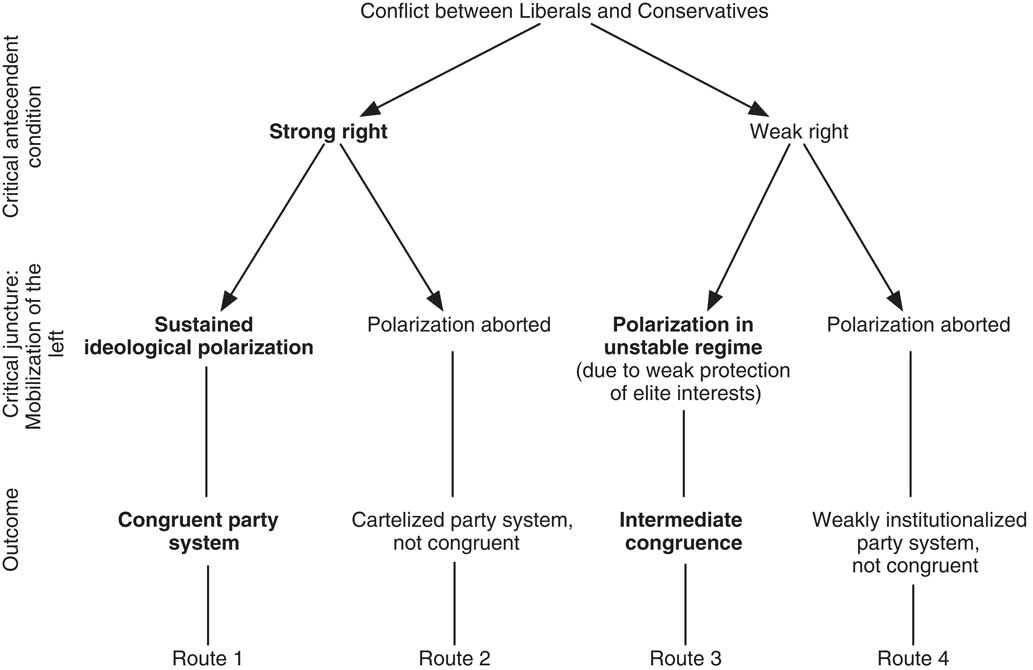
Figure 1 shows the four combinations that result from the critical antecedent condition, the strength of the right (first bifurcation), and the critical juncture of polarization vs. aborted polarization triggered by the mobilization of the left (the second bifurcation). The most propitious route to good representation (Route 1) is open only to countries in which a balance of power between left and right developed. Extensive phases of open competition and polarization set in motion the process theorized in the previous section, in which ideologically based partisan attachments develop. Pacted transitions to democracy, however, can abort polarization even where the right is strong, especially in the Cold War context (Route 2). The second-most successful is Route 3, where polarization in the absence of the strong protection of elite interests makes democracy fragile, but where partisan identities are sufficiently strong to resurface whenever open elections are held. This path is unlikely to be very common, but we will see that it was followed by one important case, Argentina. Most widespread in Latin America is Route 4, where the weakness of the right induces established actors to pursue strategies to de-politicize social conflict or to resort to the military to defend conservative interests. Indeed, the parliamentary right was weak in most countries, as emphasized by students of democratic regime stability and party system formation alike.Footnote 35 The difference between Routes 3 and 4 is that in the former, the strategy of de-politicization fails, while in the latter it succeeds.
Theoretical map of party system trajectories in Latin America

A final note is in order concerning the relationship between ideology and clientelism. For various reasons, the emergence of programmatic party–voter linkages does not imply the absence of clientelism, as is borne out by recent evidence.Footnote 36 Indeed, in the Latin American context, parties on both the left and right are likely to pursue ‘mixed’ mobilization strategies for two reasons. First, since the core constituency of conservative parties is smaller than that of the left, they often use more than just religious and conservative values to mobilize beyond the narrow strata of the upper classes. Second, because left-leaning parties in Chile, Argentina and Uruguay had access to state resources early on, they do not conform to Shefter’s model of externally mobilized parties, and were able to pursue mixed mobilization strategies as well.Footnote 37 But from a normative point of view, mixed mobilization strategies are clearly superior to purely clientelistic ones. Building on Stokes et al.’s idea of a ‘diversity of harms’ of clientelism to democracy, particularistic exchanges most severely undermine democracy when they take on a coercive character and impede voters from expressing their policy preferences.Footnote 38
RESEARCH DESIGN
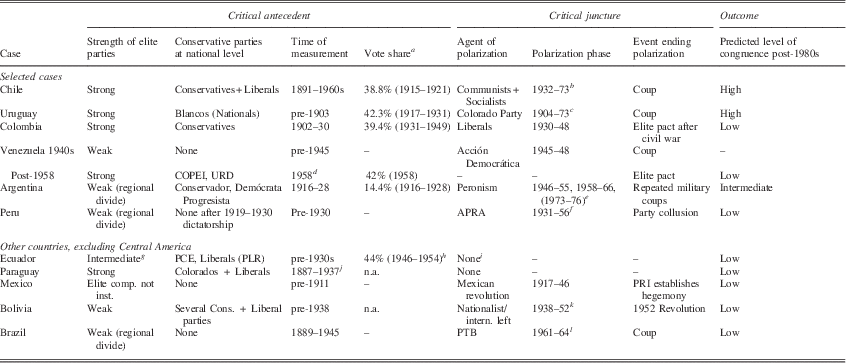
A test of the argument put forward in the preceding sections requires a set of countries that exhibit variation in terms of my key independent variables – the strength of the right, the ability of the left to openly compete and the resulting duration of polarization. Excluding the Central American and Caribbean countries due to their differing socioeconomic structure and their more limited experience with democracy,Footnote 39 we are left with eleven potential cases. These cases are listed in Table 1, together with summary information on the key variables in my model and their measurement. The antecedent condition is constituted by the strength of the right prior to the emergence of the left, which strongly determines the establishment’s response to the left. Building on Gibson, the key criterion with which to assess the strength of the right is whether or not a nationalized conservative party predated mass politics, or whether conservative parties were regionally fragmented.Footnote 40 Only where the right was united in one or two nationalized parties were they able to effectively defend conservative interests and counter the mobilization of the left. Because Gibson does not extensively document his classification of countries based on this criterion, I draw on further sources to do so in the next section.
Summary of Independent Variables, Expected Outcomes and Case Selection

a Based on earliest data available from Nohlen (Reference Nohlen2005). I have included all parties that reach vote shares of at least 10 per cent and defend economic elite interests.
b Polarization begins after the 1924–32 authoritarian interlude; vote share of the left very restricted before. See text and online appendix.
c José Batlle y Ordóñez moved the Colorado Party to the left a year after winning the presidency in 1903 (Collier and Collier Reference Collier and Collier2002, 127, 273). The authoritarian backlash in 1933 was an explicit reaction against the social reforms inaugurated by the Colorados (Rueschemeyer, Huber Stephens, and Stephens Reference Rueschemeyer, Huber Stephens and Stephens1992, 209–10), and since parties were not prohibited during authoritarian rule, partisan conflict arguably persisted even during the 1933–42 authoritarian interlude (Collier and Collier Reference Collier and Collier2002, 444–56).
d No competitive elections were held between 1948 and 1958. The vote share of the right in 1958 shows that conservative parties nonetheless deepened their roots in society during this period. Furthermore, the right was an important actor in the negotiated transition back to democracy (Bejarano Reference Bejarano2011, Ch. 3).
e The period after Perón’s return to power in 1973 was not characterized by strong interparty polarization (see main text and online appendix).
f Polarization phase stretches from the first elections after the founding of the APRA until the party’s first alliance with the right.
g Conservative Party strength classified as intermediate due to relatively high pre-1930 vote share, but manifest inability to compete with populist challengers.
h Partido Conservador Ecuatoriano (PCE) and Partido Liberal Radical (PLR) combined.
i José María Velasco Ibarra’s repeated challenge to the political establishment from the 1930s onwards was largely devoid of ideology, and none of his elections resulted in a major policy shift, as documented in the online appendix.
j Refers to the period between the founding of the Colorado and Liberal parties until the first of a series of military coups that led up to Alfredo Stroessner’s dictatorship (1954–89). See the online appendix for a discussion of the challenges to the established parties in the 1930s.
k Polarization phase begins after the constitution of 1938 and ends when the Nationalist Revolutionary Movement established hegemony after the revolution of 1952 (see online appendix).
l President João Goulart moved the Brazilian Labor Party to the left. See online appendix for a detailed assessment.
I also complement the assessment by drawing on the vote share of parties defending conservative interests in the lower legislative chamber immediately prior to the critical juncture for the cases for which this information is available from Nohlen.Footnote 41 The strength of the right in parliament is crucial because it determines whether conservative forces will be able to block legislation (or at least constitutional changes) that threaten their interests. Next, Table 1 provides detailed information on the timing of the critical juncture – the emergence of a left-wing actor capable of polarizing redistributive conflicts. The most crucial variable is the length of the ensuing polarization period. Some countries experienced protracted polarization over decades of elections, while in others these episodes were either nonexistent or too short and temporally remote to structure party alternatives in the 1990s, when the dependent variable is measured. Note that polarization does not necessarily arise as an immediate consequence of the extension of the franchise: while it more or less did so in Chile (1918), in Argentina, the polarization phase began several decades after the introduction of universal suffrage in 1912 because the growth of the Radicals that occurred after the extension of the franchise did not strongly polarize the economic dimension of conflict.Footnote 42 Finally, Table 1 indicates the predicted outcome of the critical juncture: the level of congruence between voter preferences and party positions in the 1980s and 1990s. While the next section tracks the evolution of six party systems along the routes of polarization and aborted polarization using comparative history, Appendix A discusses the classification of all eleven countries and the timing of the antecedent and polarization phases in more detail than is possible here.
In selecting cases for the comparative historical analysis, I start by choosing four cases featuring a strong right in order to flesh out the importance of the interaction between the strength of the right and the role of the left. By the standards set out in Table 1, Chile, Uruguay, Colombia and Venezuela clearly featured strong conservative parties or coalitions prior to the emergence of the left. Two of these, Chile and Uruguay, experienced prolonged party system polarization. I include both because Chile is the classical case of a party system polarized along the economic left-right divide, while this claim is more controversial in the Uruguayan case. My analysis will show, however, that despite the differences in the make-up of their party systems, these cases share important commonalities in terms of my independent variables that result in a similar outcome. The selection of Uruguay is also important because it allows me to include a most-similar-systems comparison, which is nested within the most-different-systems design: the origins of the Uruguayan and Colombian party systems are remarkably similar, but the paths these countries followed bifurcated when it comes to the persistence of polarization. However, Colombia shares the important commonality with Venezuela that polarization was aborted as a result of its pacted transitions back to democracy in 1958. The inclusion of both cases with pacted regime transitions highlights that such agreements may result in deviations from the polarization path despite the existence of a strong right-wing conservative party with a nationwide organization (the critical antecedent). Furthermore, the rather sudden breakdown of the Venezuelan party system has proven difficult to account for by scholarship within the party system institutionalization approach, while it is easily explained using my framework.
I then select two cases with a weak right, one of which – Argentina – nonetheless saw prolonged periods of polarization. I focus on the Peronist phase, rather than the challenge to the traditional political and landowning elite launched by the Radicals from the 1880s onwards, because the Peronists polarized the party system much more strongly along the economic dimension of conflict, as noted above.Footnote 43 Yet in Peru, polarization was aborted, as was the case in Brazil, Bolivia and Mexico, which also followed Route 4 in Figure 1. As indicated in Table 1, the predicted outcome in all these cases except Argentina is a low level of congruence in the 1980s and 1990s. Among the countries that never experienced significant polarization or saw it aborted, Peru is particularly interesting to single out because of the similarities it shares with Argentina. Certainly, Argentina and Peru always differed fundamentally in their economic structure and level of modernization, yet the nature and scope of left-wing mobilization they experienced in the 1940s was comparable. Collier and Collier extensively highlight these commonalities, and analyze the two countries using paired comparison.Footnote 44 My analysis highlights a crucial difference between Argentina and Peru: the degree to which they experienced prolonged polarization. While this contrast may be partly due to the Argentine labor movement’s capacity to resist repression (which is related to the more industrialized nature of the Argentine economy), this does not suggest an alternative causal mechanism to explain long-term differences in the quality of representation. Indeed, the structural factors along which Argentina and Peru differ played out exactly through the political variables I focus on. The causal relationships between political and structural variables are discussed in more detail toward the end of this article.
None of the countries excluded from the more in-depth analysis presents a problem for my theory. The phases of polarization in Mexico, Bolivia and Brazil were far too short and historically remote to anchor the party system in the populace and shape voters’ interpretation of politics toward the end of the twentieth century. Aided by the weakness of the right, revolutionary movements became hegemonic in Mexico and for a briefer period in Bolivia, underscoring that a balance of power between left and right is necessary to keep polarization alive. Ecuador and Paraguay, finally, did not witness significant ideological party system polarization until very recently, which was to a large degree the consequence of the weakness of the left.
COMPARATIVE HISTORICAL ANALYSIS
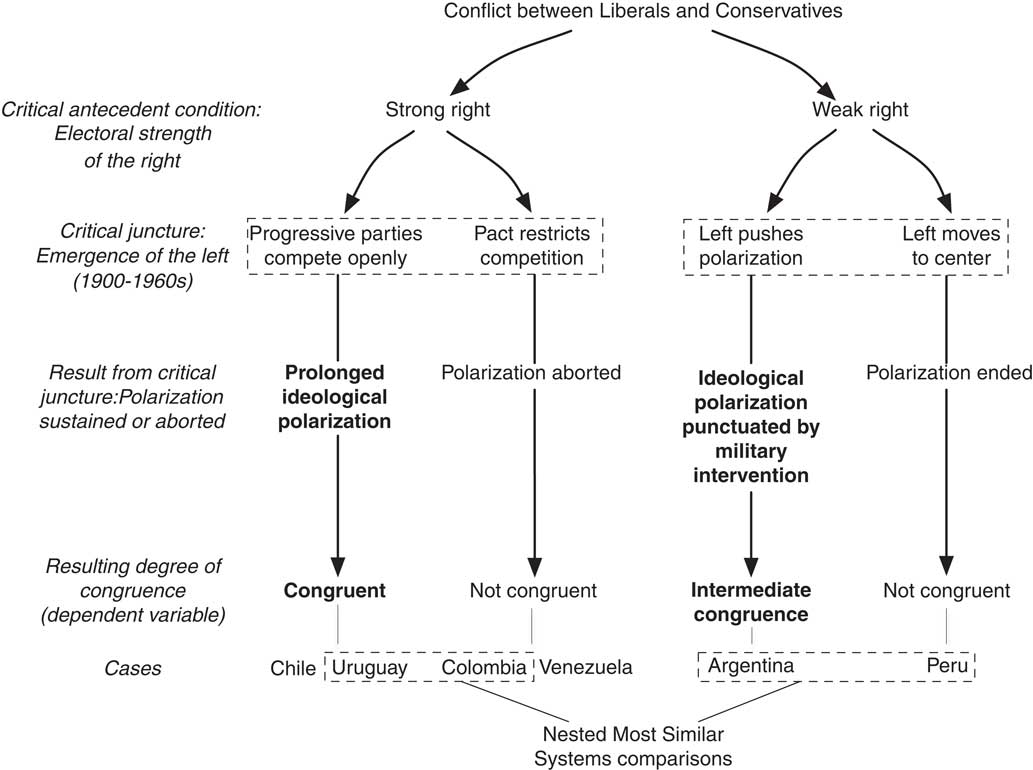
To guide the comparative analysis of the six cases singled out for detailed examination, Figure 2 presents a summary of the research design and the results of the analysis. The explanatory variables are the presence or absence of a strong party of the right (the critical antecedent condition), and whether prolonged party differentiation occurred following the critical juncture. The outcome to be explained is the congruence between party positions and voter preferences in the 1980s, after the most recent wave of democratization. Figure 2 thus differs from Figure 1, which describes the general theory, in that it presents a more detailed summary of the actors and strategies involved in the processes of polarization and aborted polarization.
Summary of country trajectories resulting from the strength of the right and the mobilization of the left

Left-wing Polarization in Chile and Uruguay, and Aborted Polarization in Colombia
The Chilean and Uruguayan trajectories show the ideal-typical case of a strong right and a strong left that offered voters clear alternatives; the resulting balance of power allowed both open competition and polarization to be sustained for several decades until the military coups of the 1970s. Polarization occurred in two steps in Chile, and the strong protection of elite interests during the first phase was propitious for the formation of partisan alignments. In Chile’s ‘Parliamentary Republic’ of 1891, a competitive party system and a nationwide religious cleavage emerged. This history of early institutionalized conflict endowed Chile with strong Conservative and Liberal parties that until the early 1970s were able to secure the interests of the upper classes.Footnote 45 From the 1920s onwards, the mobilization of the communist and socialist left fundamentally transformed the party system.Footnote 46 While left-wing participation in coalition governments between 1938 and 1948 produced rather disappointing results for the working class, the left moderated somewhat in terms of its rhetoric, but not substantially.Footnote 47 The oligarchy remained in a strong electoral position until the 1950s due to its clientelistic control of the vote of the rural population.Footnote 48 The second phase of polarization was inaugurated when the Christian Democrats started mobilizing rural laborers in the late 1950s, socializing larger segments of the population into ideological party politics. As continued mobilization in the countryside and urban shantytowns eroded vertical patron–client relationships, the Conservative and Liberal parties first responded by fusing into the National Party in defense of conservative interests.Footnote 49 When the left won the presidency and the legislative majorities resulted in stalemate, non-electoral cycles of mobilization and counter-mobilization intensified.Footnote 50 In the end, the right abandoned its support for the democratic regime: in 1973, a military coup ended Chile’s impressive record of uninterrupted elections that had begun in 1932. When the military regime stepped back from power, the balance of power between the left and right had not changed. I thus expect high levels of congruence in Chile in the post-Pinochet phase.
Uruguay and Colombia represent critical cases for my argument since they share strikingly similar features in terms of their pre-democratic order and the make-up of their two-party systems until the 1960s. At the elite level, a pluralistic order was facilitated by two factors. First, the two camps were of similar strength, and thus unable to defeat one another in the days of civil war. Secondly, the oligarchy was divided and represented in both of the traditional parties.Footnote 51 Most importantly, in both Uruguay and Colombia, one of the traditional parties moved to the left to attract working-class and other left-leaning voters. But while the Liberals in Colombia moved back to the center after the Civil War, the Colorados in Uruguay maintained a left-wing profile until the growth of the Frente Amplio in the 1960s. While Collier and Collier’s comparison emphasizes these similarities between Uruguay and Colombia,Footnote 52 the two countries diverge at the critical juncture postulated by my model, explaining patterns of representation from the 1960s to the present. As a consequence, these two party systems could hardly look more different today.
In Colombia, the progressive turn of the Liberal Party destabilized the traditional arrangement between liberals and conservatives, involving shared patronage resources to rally support, and ultimately ushered in the 1948–58 civil war known as ‘La Violencia’.Footnote 53 To end the fighting, the ‘National Front’ was established in 1958, a constitutional provision in which the liberals and conservatives agreed to refrain from polarization, to alternate in the presidency, to distribute bureaucratic posts outside the civil service equitably and to exclude all other parties from competing.Footnote 54 While the left itself was too weak to forcefully demand its inclusion, the Cold War political climate produced powerful pressures from within and outside the country to outlaw the communists, marginalizing the left.Footnote 55 In the resulting façade democracy, local political bosses obtained a vital role in distributing patronage and securing the loyal vote for the regime.Footnote 56 Consequently, Colombia represents an instance of cartelization, in which the established parties jointly exclude challengers, either by an outright ban (as was the case until 1978) or by their privileged access to state resources, the strategy they continued to pursue thereafter. Only in recent years have the established parties experienced a gradual erosion of their dominant position. For the post-1980s period, I expect the Colombian party system to be institutionalized due to a history of cartelization, but to display low levels of congruence.
In Uruguay, however, polarization was sustained, and there was never a pact or an agreement to limit the choice of policy options, as Collier and Collier themselves highlight.Footnote 57 Crucially, the established parties did not outlaw the communists, which they did in Colombia. The adoption of legislation in favor of the working class by the Colorados provoked a strong conservative counter-reaction, and an authoritarian interlude between 1933 and 1942. But unlike the pro-labor parties in Colombia, Venezuela, Peru and Mexico, the Colorado Party in Uruguay did not move back to the center, as Collier and Collier’s comparative case studies impressively show. While progressive elements were expulsed from the parties that had incorporated the working class in all the other cases studied by Collier and Collier, the Colorados in Uruguay tellingly chose not to do so for fear that they would join the left-wing opposition.Footnote 58 Thus the presence of the communists was crucial, although the Colorados retained the overwhelming share of the left-wing vote until the 1960s. Indeed, Coppedge’s expert survey reports contrasting positions for the Colorados and Blancos until 1966.Footnote 59
Certainly, clientelism played a major role in Uruguayan politics until the 1960s, but González argues convincingly that politics in Uruguay cannot have been only a matter of clientelism, as some assert.Footnote 60 Rather, the cases of Uruguay and Chile defy the notion of a direct and linear trade-off between clientelistic and programmatic linkages.Footnote 61 When the Colorados moved to the center in the mid-1960s, the Frente Amplio – which united the communists, the Christian Democrats and progressive lists from within the traditional parties – polarized the party system anew.Footnote 62 While non-electoral mobilization and polarization in public spaces – but less within the party system, as Bermeo demonstratesFootnote 63 – ultimately resulted in a military coup, the degree to which partisan alignments survived the harsh military dictatorship that lasted from 1973 to 1984 is striking. In the first elections after re-democratization, the party system re-surfaced virtually unchanged: the volatility between the 1971 and 1984 elections was limited to 5.2 per cent.Footnote 64 This is strong evidence of robust links between social groups and political parties that keep parties responsive to voter preferences.
Venezuela’s Pacted Democracy and the End of Polarization
While the early trajectories of the Venezuelan and Colombian party systems were markedly different, both had pacts between the left and right that aborted polarization. The Pact of Punto Fijo that Acción Democrática (AD), the Comité Político Electoral Independiente (COPEI) and a third party agreed on in 1958 to re-establish democracy in Venezuela was less rigid than the National Front in Colombia, as it did not outlaw all opposition parties.Footnote 65 Nonetheless, the outcome was similar: programmatic distinctiveness was lost, and politics centered almost exclusively on distributing clientelistic benefits. After AD was ousted from power at the end of its three-year rule between 1945 and 1948, its main goal in 1958 was to make stable democracy possible by avoiding the polarization that had led to the 1948 coup. Indeed, Venezuela’s ‘pacted democracy’ that extended from 1958 to the 1990s is often considered a success story and a model for the viability of democracy in the unstable 1960s and 1970s.Footnote 66
The result of the Pact of Punto Fijo was an effective de-politicization of economic policy issues, aided by the wealth created by oil. The agreement codified a number of policy principles, and shared power and patronage resources such as ‘… access to state jobs and contracts, a partitioning of ministries, and a complicated spoils system which would ensure the political survival of all signatories’.Footnote 67 Although the communists had been part of the coalition demanding a return to democracy, they were excluded from the agreement and banned in 1962 due to their armed resistance against the regime. AD and COPEI came to dominate the electoral arena as well as civil society, co-opting all independent organizations. Clientelism became rampant, and parties no longer exhibited contrasting policy profiles.Footnote 68 Although open contestation was re-established in 1968 and left-wing opposition parties re-emerged, AD and COPEI’s capacity to deliver particularistic benefits allowed the duopoly to govern the country for another three decades. This situation was similar to the one in Colombia immediately after the end of the National Front in 1978, although the Colombian party system de-institutionalized more rapidly. After the resources that fuelled AD and COPEI’s clientelistic networks in the 1980s dried up, and their ever more collusive behavior in the 1990s, both traditional parties in Venezuela broke down in the election that brought Hugo Chávez to power.Footnote 69 The data from the 1990s, shortly before Chávez’ first presidential bid, will allow me to verify the hypothesis that the Venezuelan party system lacked programmatic responsiveness, thereby enabling an outsider to win the presidency.
Polarization that Persists and Polarization that Ends: Peru and Argentina
Peru and Argentina had left-wing or progressive movements that were capable of winning popular majorities. Because pre-democratic elites had not succeeded in overcoming their divisions, conservative parties were regionally based prior to the appearance of the left.Footnote 70 Due to the military’s capacity and will to prevent progressive movements from gaining power, the outcome was a long history of military involvement in politics. The crucial difference between the two cases, as can be seen in Figure 2, is that Peru’s Popular Revolutionary American Alliance (APRA) moved to the center in an elusive quest to gain acceptance from the military establishment, while the Argentine Peronists stubbornly pushed polarization. Thus despite the structural differences in the economies of these two countries, in political terms, Argentina and Peru constitute a most-similar-systems comparison, as they differ in terms of the durability of the polarization triggered by the left.
Peru’s APRA was founded in 1924. The party forged close ties to the union movement and became the dominant force on the left, outflanking the Communist Party. With no party to defend conservative interests in the electoral arena, however, the military intervened continuously whenever it saw the vital interests of the oligarchy as threatened.Footnote 71 Although APRA’s programmatic stance was less radical than that of its counterparts in Mexico, Venezuela and Bolivia from the start, according to Collier and Collier, the only way for APRA to have a chance at governing was to moderate its profile even more, and to form alliances with right-wing parties to ensure civilian rule.Footnote 72 Ultimately, this resulted in the adoption of rather conservative positions and the watering down of the party’s ideological profile. APRA’s move away from the left and the coming to power of a reformist military government in 1968 then created ample space for revolutionary parties that flourished in the 1970s. After uniting in the Izquierda Unida in the early 1980s, the coalition collapsed a few years later, however, due to internal contradictions related to the left’s difficulty in defining its stance with respect to the Shining Path’s strategy of armed political struggle against the state.Footnote 73 In the poor urban neighborhoods, neither APRA nor the new parties of the left had succeeded in supplanting the dominant clientelistic networks.Footnote 74 Re-democratization did not reverse Peru’s historical legacy of aborted polarization: the 1980s were marked by high levels of volatility, as successive center-right and APRA administrations suffered devastating setbacks after their terms in office.Footnote 75 Although APRA had moved back to the left under Toledo, and won the 1985 presidential elections, the party was unable to consolidate its success due to Toledo’s failure to resolve the economic crisis. The fact that Alberto Fujimori was able to win the presidency in 1990 without being backed by an established party demonstrates that there were no stable links between social groups and parties in Peru.Footnote 76 In the 1990s, I therefore expect low levels of congruence between parties and voters.
Despite the threat that democracy may be overturned, the Peronist party in Argentina never moderated its programmatic position after its sudden rise in the 1940s, nor did it form alliances with political opponents. While some would claim that Peronism did not have a left-wing ideology, the Peronist/anti-Peronist antagonism in fact represents a sectoral divide: Peronism pulled protectionist segments of the rural elites into an alliance with the urban working class and other social groups.Footnote 77 Peron’s early redistributive economic policies and the attainment of full employment helped his party attract urban working-class voters who exhibited a clear ideological profile.Footnote 78 According to Collier and Collier, Perón’s first presidency constituted a ‘dramatic shift away from earlier patterns of state–labor relations to one in which, in symbolic and ideological terms, the government dramatically sided with the working class’.Footnote 79
In Argentina, Peronist and anti-Peronist identities were reinforced by political conflict during the entire period between 1946 and 1966, the advent of the first bureaucratic-authoritarian regime.Footnote 80 In Peru, the phases of polarization were considerably shorter: the polarized election of 1931 was immediately followed by the repression of APRA. Due to Peronism’s penetration of the militant labor movement, polarization was also maintained during phases in which the party was banned, such as between 1955 and 1966.Footnote 81 Consequently, the Peronist party kept its distinctive programmatic profile and retained a loyal constituency even during periods of dictatorship, as Lupu and Stokes show.Footnote 82
Another key difference between Argentina and Peru is the presence of the Radicals, a strongly institutionalized middle-class party that united the anti-Peronist opposition. Thus, Lupu and Stokes present evidence that despite the weakness of conservative interests in the party system, the Argentine party system was polarized along class lines from 1946 onwards.Footnote 83 While democratic competition remained fragile and was punctuated by military interventions, ideological conflict nonetheless became institutionalized and created strong and enduring political identities. When the military regime was toppled in the early 1980s, not only did the pre-coup party system re-emerge; party support continued to be clearly structured by social class in the 1983 elections.Footnote 84 Due to the limited periods of open contestation, but high levels of polarization, I expect at least intermediate levels of voter–party congruence for Argentina in the 1990s.
TESTING THE PREDICTIONS: PATTERNS OF PARTY SYSTEM INSTITUTIONALIZATION AND THE QUALITY OF REPRESENTATION IN THE 1990s
The quantitative evidence in this section confirms the impact of the critical juncture in my model on party systems after the wave of re-democratization in the 1980s. I started out by arguing that party system institutionalization is a necessary, but not sufficient, condition for responsiveness. To substantiate this argument, I locate countries along the dimensions of party system institutionalization and party–voter congruence. To measure party system institutionalization, I use Mainwaring and Scully’s overall measure for the period from the early 1980s to the early 1990s.Footnote 85 The assessment of party system congruence after re-democratization, my key dependent variable, would ideally rely on data from the 1980s. While we lack suitable data from this period, Luna and Zechmeister’s seminal article offers a measure of congruence for the late 1990s that is based on the correspondence between voter preferences and party positions across a number of issue bundles, including economic and religious issues, preferences for a democratic regime, law and order, and good governance.Footnote 86 Because Luna and Zechmeister’s measurement does not include Peru and Venezuela, I impute values for these two countries using Kitschelt et al.’s index of ‘programmatic partisan structuration’, which combines Luna and Zechmeister’s original measure with several additional components measuring the clarity of partisan alternatives.Footnote 87 Appendix B documents the high correlation between the two indices and the computation of the imputed values.Footnote 88
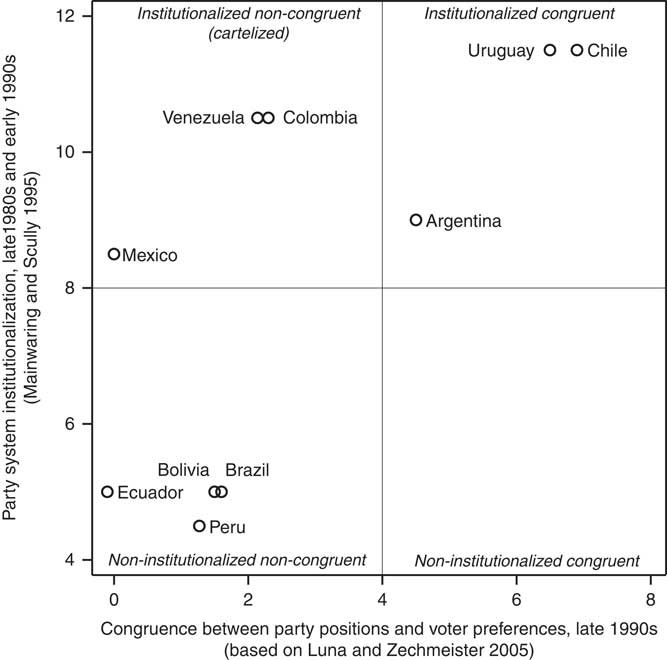
Figure 3 plots party system institutionalization and programmatic partisan structuration against each other. This results in four possible combinations, three of which are likely to be empirically populated: institutionalized congruent party systems, institutionalized non-congruent systems (based on stable patron–client relationships) and non-institutionalized systems (which may reflect competitive or personalistic patron–client relationships). Because institutionalization is a prerequisite for congruence, a non-institutionalized congruent party system is unlikely to exist.
Party system institutionalization and voter–party congruence in the 1980s–1990s

In line with expectations, Chile and Uruguay exhibit highly institutionalized party systems that closely mirror voter preferences. Both countries are situated close to the conceptual maximum on both scales. Argentina is also located in the upper-right quadrant, but takes a more intermediate position with respect to both measures. This is the expected outcome of the strong political identities resulting from the long-term conflict between Peronists and Radicals, but the more limited experience of open democratic elections. Peru, by contrast, a case of aborted polarization, is characterized by similarly low performance both in terms of institutionalization and congruence (lower-left quadrant). As predicted, three other cases of aborted polarization from Table 1 – Ecuador, Bolivia and Brazil – are also located in this quadrant.
Finally, the presence of cases in the upper-left quadrant underscores that party system institutionalization cannot be equated with congruence. Both Venezuela and Colombia had been governed by party cartels since the late 1950s that distorted the ‘playing field’Footnote 89 between the traditional parties that enjoyed access to clientelistic resources and a fragmented opposition that did not. Similarly to Mexico, they exhibit high stability, but score far lower in the quality of representation than the polarization cases. Despite all the similarities between the Colombian and Uruguayan party systems up to the 1940s, these two countries differ in terms of the polarization they have experienced since the late 1950s.
RIVAL EXPLANATIONS
The preceding section has shown that my historical model explains the quality of representation in the 1990s well. How does my account (and the evidence presented here) compare to alternative explanations? I discuss three related arguments. The first states that historical factors no longer matter after a so-called neo-liberal critical juncture, and that more proximate factors than those analyzed in this article in fact explain differences between party systems in Latin America. The second argument focuses on the role of the welfare state, while the third emphasizes the role of modernization. Starting with the first argument, Kenneth Roberts distinguishes between labor-mobilizing party systems that feature strong working-class parties with links to organized labor, on the one hand, and party systems in which elite parties remain largely unchallenged, on the other hand.Footnote 90 He argues that these historical imprints have been erased by the advent of neo-liberalism in the 1980s.Footnote 91
I suggest that the historical imprint must be conceived differently. What matters for the socialization process that forges strong programmatic linkages between parties and voters is not simply the presence of a strong left, but polarization within the party system – which was by no means the logical consequence of the presence of strong labor parties. Chile and Argentina experienced protracted polarization, but Peru did not. The same applies to Brazil, Bolivia and Mexico, which also form part of Roberts’ category of ‘labor-mobilizing party systems’. In the absence of a strong right, the left was unable to polarize the political space in the latter cases. And finally, Uruguay’s party system is strongly representative of voter preferences despite the historical weakness of the left, because polarization occurred between the established Colorado and Blanco parties.
My argument is not that the betrayal of voters that occurs when a left-wing party promises leftist policies in its campaign, but then pursues market liberalization once in office – what Stokes refers to as ‘policy switching’ and Roberts as a ‘dealigning critical juncture’ – does not have the capacity to disrupt voter–party linkages.Footnote 92 But a look at Roberts’ systematic assessment of this phenomenon in Latin America shows that voter betrayal occurs chiefly in cases that had experienced aborted polarization earlier on, and already exhibited low levels of congruence between party positions and voter preferences.Footnote 93 In fact, where there are strong ideological ties between parties and social constituencies, parties know that policy switching has devastating electoral consequences. With respect to my polarization cases, Roberts shows that both the left and the right remained true to their ideological credentials during the period of neoliberal reform in Chile and Uruguay. Indeed, the left’s opposition to the neo-liberal reforms pursued by the military regimes in Chile and Uruguay reinforced the older antagonism between the left and right in these party systems. However, the neo-liberal critical juncture model does not explain the de-institutionalization of the Colombian party system, where market reform was pursued by the right, and thus should not have disrupted partisan alignments.Footnote 94
This leaves us with Argentina as the only case that may have partially deviated from its historical path (keeping in mind that I predicted only intermediate levels of congruence for this case). But even here the evidence supports my argument. The Peronists’ move to the right in pursuit of market reform under Menem in the 1990s is a prime example of what Stokes calls policy switches.Footnote 95 Interestingly, as the results for congruence in Figure 3 show, this did not exceedingly damage representation in the short run. A more detailed analysis reveals that the Peronists succeeded in pulling their electorate to the right, to follow the party’s shift.Footnote 96 This is evidence of the kind of reciprocal voter–party linkages theorized in this article. At the same time, the further trajectory of the Argentine case shows that if political actors do not help to reproduce historical legacies, their imprint may fade. There is widespread consensus that the Peronists’ (increasing) reliance on clientelistic mobilization strategies has hampered representation in the longer run.Footnote 97 However, the Peronists have moved back to the left under Néstor and Cristina Kirchner. In light of the 2015 elections, it may even have been premature to lament the vanishing of the right after the ‘breakdown’ of the Radicals in 2003.Footnote 98 The further trajectory of representation in the Argentine party system thus remains open.
Together with Venezuela, the Argentine case is among those that Lupu seeks to explain in a framework emphasizing mechanisms that are similar to my own, but operate in the short term.Footnote 99 According to Lupu, when ‘brand dilution’ – meaning that parties abandon the positions they are known for and lose their distinctive policy profiles – coincides with economic crises, parties risk devastating defeats from which they are unlikely to recover. In the case of Venezuela, I concur with Lupu’s emphasis on the lack of representativeness of the party system to explain the collapse of both traditional parties (similarly to other authors, who have also emphasized the ebbing of the clientelistic or patronage resources).Footnote 100 While Lupu’s approach sheds light on the proximate causes of party breakdown, the cases of breakdown he identifies are clustered in my category of aborted polarization, with the partial exception of the Argentine Radicals.Footnote 101 Our approaches are thus complementary, in that I analyze the forces underlying the gradual erosion of a party system’s roots in society, which represents the crucial precondition for party system breakdown during a crisis. In line with classical realignment theory, the forces of dealignment work gradually, while change tends to manifest itself abruptly in a number of ‘critical elections’.Footnote 102 More generally, while Lupu focuses on how parties’ brands are diluted, my emphasis is on the process by which the brand identities are created. My model thus helps to explain why Chile, Uruguay and Argentina are so different from other Latin American party systems. While this difference is well known, no coherent framework has as yet been put forward to explain it – with the exception of Kitschelt et al.’s recent study, to which I now turn.
The second way in which my argument compares with alternative explanations is that it relates to Kitschelt et al.’s explanation of the differences in programmatic structuring in Latin American party systems.Footnote 103 The authors convincingly show that early modernization (measured in terms of 1928 GDP) is a much better predictor of programmatic representation in the 1990s – the same period I am looking at – than later levels of GDP, and that contemporary levels of GDP are highly endogenous to historical welfare state formation.Footnote 104 According to the authors, early developing countries established inclusive welfare states, which then created the ‘stakes’ of political conflict necessary for parties to develop contrasting policy profiles. But Kitschelt et al.’s argument does not address why welfare states were established in early modernizing countries, and which actors helped bring them about. In line with Roberts (discussed above), Kitschelt et al. find that the strength of the left or the labor movement is a poor predictor of programmatic party competition.Footnote 105 Therefore, they argue that the party system does not have an autonomous role in triggering welfare state development and good representation.
Both Roberts and Kitschelt et al. thus fail to find that the organization of the left has an impact on representation or the development of welfare states because they neglect the important role of the right. For instance, while the labor movement was relatively strong in Peru and Bolivia, these countries did not experience protracted polarization in the party system; nor was the instability of democracy propitious for the development of encompassing welfare states. Where conservative forces relied on the military to defend their interests, the right was less pressed to pre-empt the growth of the left by making concessions in terms of welfare provisions.Footnote 106 Consequently, the left was able to push for the establishment of welfare states only where there was a balance of power between left and right. In these contexts, ideological conflict was channeled into party competition, resulting in both strong partisan alignments and encompassing welfare states. My findings and those of Kitschelt et al. are thus not contradictory, because I emphasize factors that are antecedent to theirs. Our explanations complement one another because Kitschelt et al. highlight an important mechanism of how polarized conflict is sustained: by ongoing contention over the welfare state.
Kitschelt et al.’s analysis has the further merit of showing that economic modernization is a less powerful predictor of good representation than the historical institutionalist explanations we both offer. If modernization plays a key role, then it did so in the first half of the twentieth century. Of course, there is still a significant positive correlation between modernization in the 1990s and the quality of representation in the same period. But the correlation between early modernization and later representation (in the 1990s) is much stronger. Thus an explanation based on modernization must focus on the early period. Looking at the GDP figures for 1928 that Kitschelt et al. have assembled,Footnote 107 early modernization is closely correlated with historical polarization: my three polarization cases – Argentina, Uruguay and Chile – display above-average levels of GDP in 1928. Early polarization is less intimately related to GDP in 1980 or 1998, because Venezuela, Brazil and Mexico have caught up in terms of modernization, but not with respect to the quality of representation.
There is no obvious link between early modernization and representation in the 1990s other than a connection provided by features of the party system that derive from the historical period. The differences between the Uruguayan, Chilean and Argentine party systems also suggest that polarization, and not some other party system feature, matters for representation. What is it, then, about early modernization that is conductive to both polarization and the establishment of encompassing welfare states? Exploring possible explanations is well beyond the scope of this article, but I suggest several avenues for further research. First, the presence of a comparatively strong right (such as the Conservatives in Chile, the Blancos in Uruguay and the Radicals in Argentina) may be the result of a specific pattern of economic development in the nineteenth century that resulted in early industrialization and modernization later on. Thus the effect of early modernization on the party system would run through the strength of the right. Inversely, institutionalized elite conflict – and, as a by-product, a strong right – may have facilitated early development.
Thirdly, to explain the reaction of the establishment against the left, it may matter at which point in time polarization occurred. During the Great Depression in the 1930s, authoritarian backlashes occurred even in Uruguay and Argentina, but with the onset of import-substituting industrialization, the relationship between the left and right grew less antagonistic. Because the left appeared less threatening, party system polarization became compatible with democratic regime survival. Countries that only saw significant development after the onset of the Cold War, however, were at an obvious disadvantage, as the international climate favored restricted competition. This is most clearly demonstrated by the pacted transitions of the 1950s in Colombia and Venezuela, where external pressure (or at least the international climate) played an important role.Footnote 108 Yet where the left was already firmly institutionalized in the Cold War period, it was more difficult to repress; this is why the timing of its mobilization, which in turn is related to economic development, may have mattered.
As a final possibility, the early developers may have been at an advantage because higher levels of literacy, education and associationalism fostered political interest, involvement and programmatic polarization. Although it cannot be ruled out on theoretical grounds that these factors can contribute to good representation independently of polarization, in none of the cases studied in this article did they translate into congruent representation in its absence. In sum, the available evidence suggests that polarization is the main factor translating early modernization into good representation.
CONCLUSION
In summary, the only party systems in Latin America that exhibited congruence in the 1990s were those in which a challenging party had started polarizing the party system several decades earlier. Uruguay, Chile and Argentina followed a trajectory of inclusion and sustained polarization. Conflict along the state–market dimension was channeled into party competition in these countries, and became embedded in lasting political identities and partisan loyalties. Undeniably, high levels of polarization are problematic not only for the stability of democracy, but also for reaching a compromise, as exemplified by contemporary US politics. At the same time, Hetherington finds that polarization in the United States ‘has clarified public perceptions of party ideology, which has produced a more partisan electorate’.Footnote 109 A key problem in the US context is that parties occupy more extreme positions than their voters.Footnote 110 In Latin America, the reverse was true for much of the twentieth century: cartels formed by pre-democratic elite parties – sustained by bans on left-wing parties, combined with the de-mobilizing effect of clientelism – narrowed the political spectrum. Partially as a consequence, political movements often used extra-parliamentary strategies to achieve their ends, with disastrous consequences for democracy. The results of this article suggest, in line with Bermeo’s supposition, that at least in the long run, the destabilizing effects of extremism are best mitigated by inclusion.Footnote 111
Of course, too much polarization can be problematic for both regime stability and governability. In Latin America, the weakness of the right in conjunction with widespread inequality in the twentieth century certainly made ideological moderation appear appealing. According to Collier and Collier, the political moderation of the left, and a labor movement tied to the political center, have been key in making more inclusive political regimes viable in Colombia, Venezuela and Mexico.Footnote 112 Likewise, classical modernization theory and its contemporary variants assume that the moderating effects of rising affluence or declining inequality make democracy sustainable.Footnote 113 However, in light of the persistent differences in the quality of Latin American democracies, privileging the goal of stability is problematic. In terms of the quality of representation and the long-term viability of these democracies, the collusion of the major parties in Colombia and Venezuela (cases that represent success stories from Collier and Collier’s point of view) was not propitious. Without meaningful choice, which generally implies that segments of society lack representation, democracy carries little normative weight. The relationship between polarization and democracy is therefore probably best understood as curvilinear, in which too little ideological differentiation is as harmful as too much polarization.
The irony is that some of the countries that have been considered success cases for having avoided polarization in the twentieth century are today confronted with much more polarized politics than those they experienced early on. For example, radical left parties have gained power in Venezuela and subsequently in other cartelized party systems. Whether this development will be beneficial for representation is unclear, as the party system lacks institutionalization, the playing field has become severely distorted in favor of incumbents and democracy as a whole is under threat.Footnote 114 Yet the appearance or growth of even moderate ideological alternatives where they were historically absent may be able to exert positive effects on representation. Indeed, the Brazilian Workers’ Party’s ability to claim credit for its social policy innovations may establish programmatic linkages between the party and certain social constituencies, thereby anchoring the party system more strongly in the country’s social structure and pushing it in a more programmatic direction. Together with what is happening as a consequence of the Partido Acción Nacional’s challenge to the Partido Revolutionario Institucional in Mexico, this suggests an alternative route to programmatic party competition, which is open even to countries that lack favorable historical experiences with polarization.