Antibiotic allergy labels (AALs) are frequently documented in health records and are used to inform safe prescribing practices. These allergies are usually self-reported and represent a heterogeneous group of adverse drug reactions, both immune mediated and non–immune mediated in origin. Notably, most patients with a penicillin AAL do not have a true immunological adverse drug reaction when formally stratified for risk, tested, and rechallenged.Reference Blumenthal, Peter, Trubiano and Phillips1,Reference Trubiano, Thursky and Stewardson2
Antibiotic allergy labels are frequently reported, with a prevalence estimated between 14.3% and 35.1%.Reference Huang, Cluzet, Hamilton and Fadugba3–Reference Moran, Devchand, Churilov, Warrillow and Trubiano9 In a large study (411,543 outpatients), 15% of San Diego Kaiser Permanente health plan members reported at least 1 AAL. The most commonly reported AALs were penicillins (37,059 of 411,543, 9.0%,) and sulphonamides (22,321 of 411,543, 5.4%).Reference Macy and Poon6
Antibiotic allergy labels in hospitalized patients have been associated with inappropriate prescribing, suboptimal clinical outcomes, and increased cost. Multiple reports have found that these labels increase the median number of antibiotics prescribedReference Huang, Cluzet, Hamilton and Fadugba3,Reference Charneski, Deshpande and Smith10,Reference Trubiano, Leung, Chu, Worth, Slavin and Thursky11 as well as duration of antibiotic therapy.Reference Huang, Cluzet, Hamilton and Fadugba3,Reference Trubiano, Leung, Chu, Worth, Slavin and Thursky11,Reference Trubiano, Cairns, Evans, Ding, Nguyen, Dooley and Cheng12 Broader-spectrum or second-line agents are commonly prescribed for patients with penicillin AALs.Reference Huang, Cluzet, Hamilton and Fadugba3,Reference Trubiano, Pai Mangalore and Baey8,Reference Trubiano, Cairns, Evans, Ding, Nguyen, Dooley and Cheng12–Reference Moran, Devchand, Smibert and Trubiano14 The impact on clinical outcomes varies,Reference Moran, Devchand, Smibert and Trubiano14,Reference Wu Hui-Chih, Langford and Schwartz15 but some studies have demonstrated longer hospital length of stays,Reference Huang, Cluzet, Hamilton and Fadugba3,Reference Charneski, Deshpande and Smith10,Reference Macy and Contreras16 higher readmission rates, higher intensive care admission rates,Reference Huang, Cluzet, Hamilton and Fadugba3,Reference Knezevic, Sprigg and Seet5,Reference Charneski, Deshpande and Smith10,Reference Trubiano, Leung, Chu, Worth, Slavin and Thursky11,Reference van Dijk, Gardarsdottir, Wassenberg, Oosterheert, de Groot and Rockmann17 and higher mortality.Reference Huang, Cluzet, Hamilton and Fadugba3,Reference Charneski, Deshpande and Smith10 Increased costs are probably due to the use of restricted antibioticsReference Sade, Holtzer, Levo and Kivity18,Reference Picard, Begin and Bouchard19 and extended hospital lengths of stay.Reference Macy and Contreras16
Although an understanding of the prevalence and impact of AALs on hospitalized patients is increasing, little is known about other vulnerable populations such as residents in aged care facilities. Australia has 2,695 residential aged care facilities, and ~242,000 people received permanent care at some point during the 2017–2018 year.20 An annual point- prevalence survey, the Aged Care National Antimicrobial Prescribing Survey (AC NAPS), is utilized in Australian residential aged care facilities to monitor infections and antimicrobial use.21 The objectives of this study were (1) to determine the prevalence of AALs in Australian aged care residents and (2) to describe the impact of AALs on antibiotic use.
Methods
Participants
All Australian aged care homes and multipurpose services were encouraged to participate in the 2018 AC NAPS.
Data collection
The AC NAPS data were collected by staff at participating facilities on a single day between June 1 and August 31, 2018. For residents prescribed an antimicrobial, standardized collection forms included demographic variables, the prescribed antibacterial agent, indication, and antibiotic allergies (ie, presence and type). Data were submitted via a web-based interface to a central database. Support in the form of training manuals, webinars, and an enquiry line was provided to all staff completing the survey.
Definitions
An AAL was reported if documented in the ‘allergies and adverse drug reaction’ section of a resident’s health record. A resident could have >1 AAL. The impact of an AAL was defined as the effect an AAL had on the number of antibiotics prescribed and prescribing patterns.
Data analysis
Data were grouped at resident-level and included demographics and antibiotic allergies: presence, type, class(es), number of AALs, number of AALs (classes). Data were also grouped at the antibiotic level and included prescribed antibacterial agent, indication, and antibiotic allergies. Antiviral, antifungal, and antiparasitic agents were excluded. All AALs were standardized to generic drug names and were mapped to a relevant antibiotic class. Penicillins, cephalosporins, and carbapenems were classified as β-lactams.
Continuous variables were summarized using median and interquartile range, and the Mann-Whitney U test was used to compare groups. Categorical variables were summarized as proportions, and the χ2 test was used to compare groups. To evaluate factors associated with prescribing specific classes of antibiotics, multivariable logistic regression was used (ie, covariates of age, gender, and use of agent for prophylaxis). All analyses were performed using Stata version 15.1 software (StataCorp, College Station, TX) and P < .05 was considered statistically significant.
Results
Overall, 407 residential aged care facilities (15%) participated in the 2018 AC NAPS. In total, 1,619 antibiotics were prescribed for 1,489 residents (989 female and 500 male). Of these 1,619 antibiotics, 1,299 (80.2%) were prescribed for oral administration and 296 (18.3%) were prescribed for topical administration.
Prevalence of antibiotic allergy labels
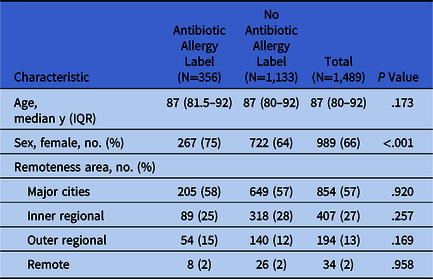
Of the 1,489 residents prescribed an antibiotic, 356 (24%; 95% CI, 19.8–28.9) had 1 or more AALs. Characteristics of surveyed residents are summarized in Table 1. The AAL group had a higher predominance of females than those without an AAL (75% vs 64%; P < .001).
Baseline Demographics

Note. IQR, interquartile range.
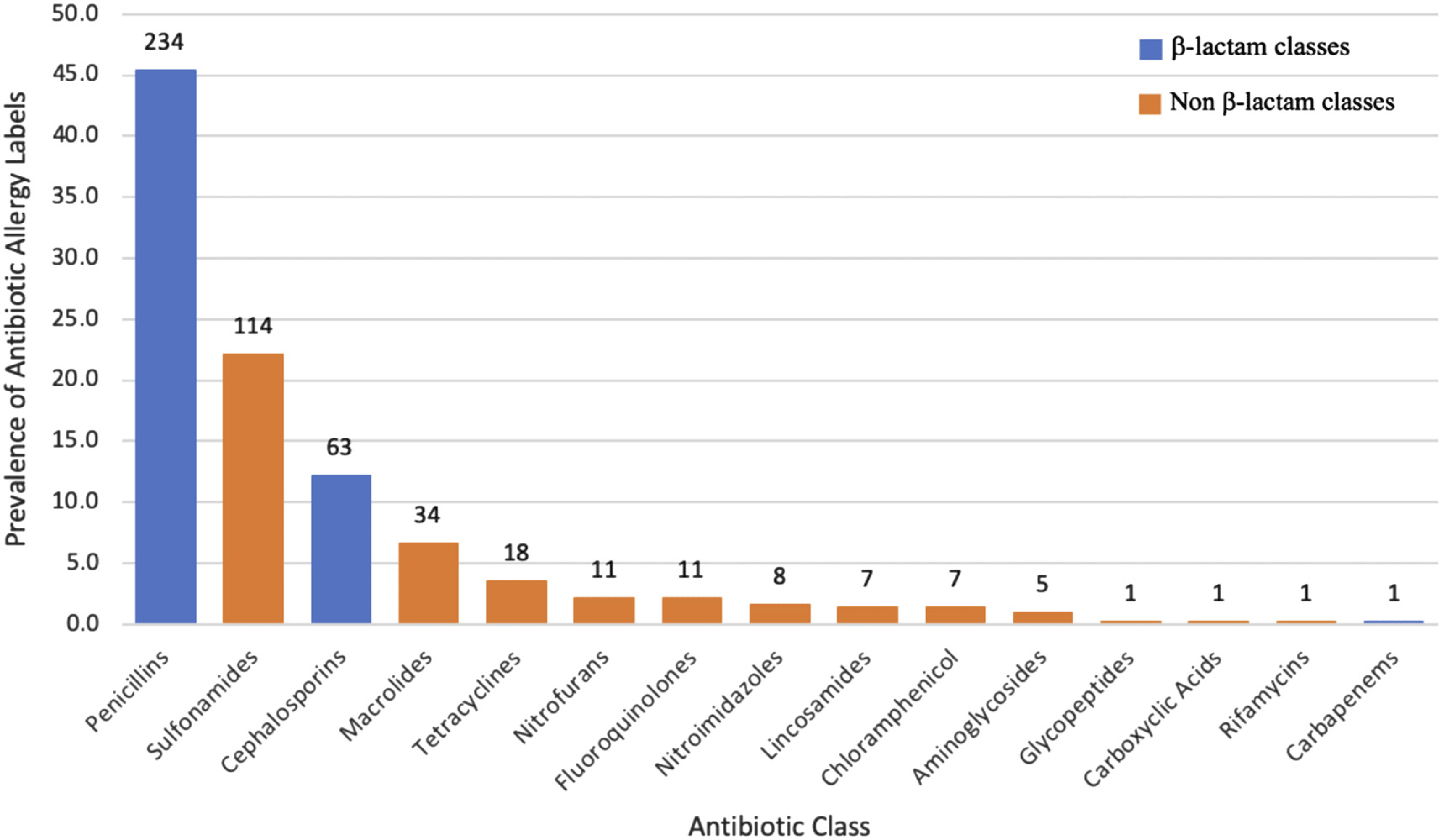
In total, 516 AALs were reported for the 356 residents prescribed an antibiotic (Fig. 1). Most were β-lactam AALs (298 of 516, 57.7%). AALs were most commonly ascribed to the penicillin (45.3%), sulfonamide (22.1%), and cephalosporin (12.2%) classes. AALs for penicillin (28.3%), amoxicillin or amoxicillin/clavulanic acid (10.5%), cefalexin (7.2%), and trimethoprim (7.0%) were most commonly reported.
Breakdown of antibiotic allergy label (AAL) prevalence by antibiotic class. Total number of AALs = 516. Individual bars are labelled with absolute numbers of reported allergies.

Impact of antibiotic allergy labels
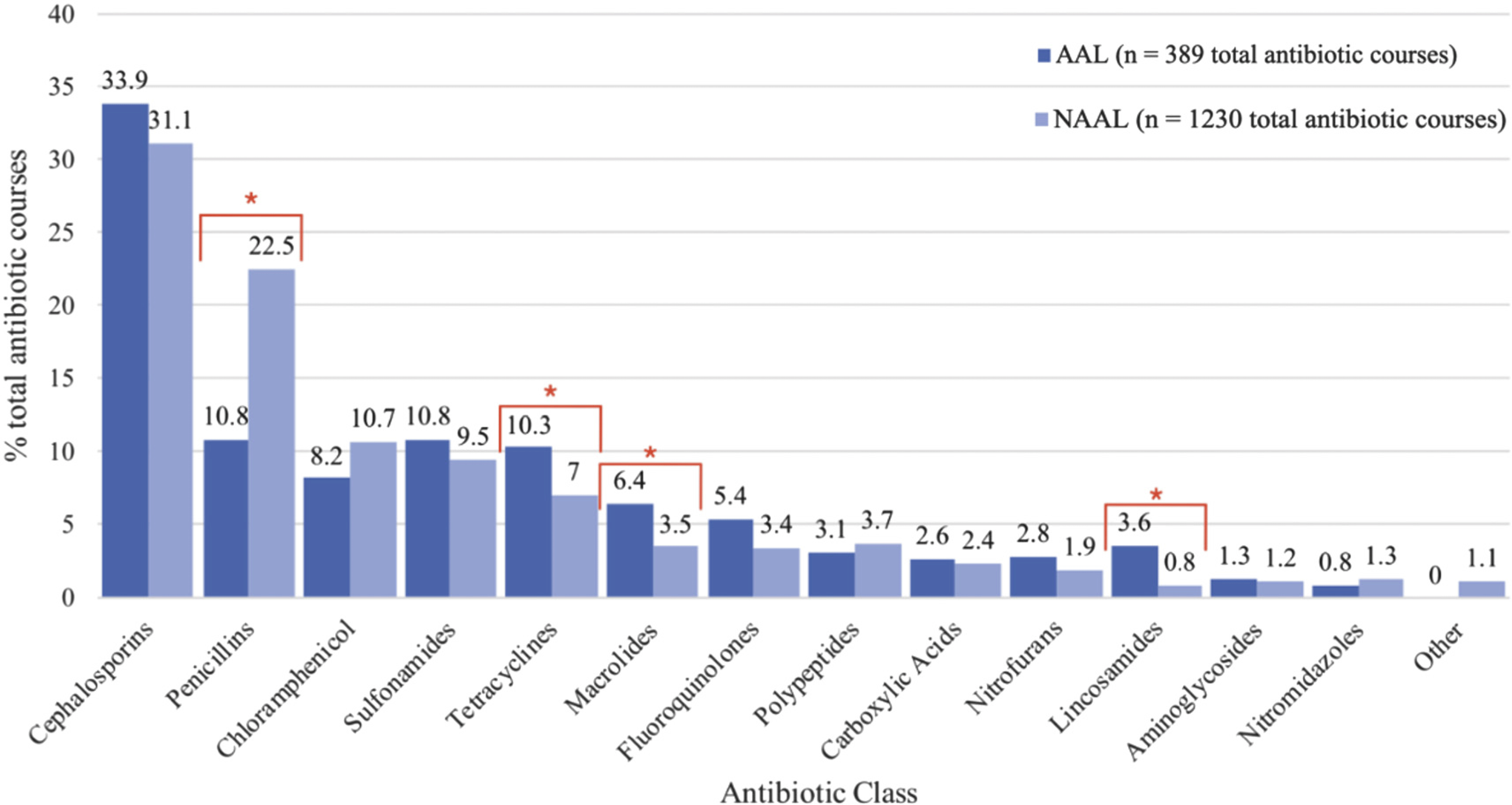
The mean number of prescribed antibiotics was comparable for residents with and without an AAL (1.1 per resident for both groups). The presence of an AAL was associated with significantly different prescribing patterns (Fig. 2). Those with AALs received significantly fewer penicillins (OR, 0.43; 95% CI, 0.31–0.62; P < .001) and significantly more lincosamides (OR, 4.81; 95% CI, 2.10–11.01; P < .001), macrolides (OR, 2.03; 95% CI, 1.22–3.39; P = .007), and tetracyclines (OR, 1.54; 95% CI, 1.03–2.29; P = .033) than those without an AAL after adjusting for age, gender, and prophylaxis.
Antibiotic usage (classes) for residents that reported antibiotic allergy labels (AALs) compared to those that reported no antibiotic allergy label (NAAL). Other includes rifampicin, glycopeptides, phosponic acid, and fusidane antibiotic classes. * denotes statistical significance.

Of the 356 residents with AALs, 7 residents (1.9%) were prescribed an antibiotic to which they had a listed allergy: 5 residents with unspecified sulfonamide AALs were prescribed sulfonamide antibiotics; 1 resident with a chloramphenicol AAL was prescribed chloramphenicol eye drops; and 1 resident with an augmentin AAL was prescribed amoxicillin.
Discussion
Our study is the first in Australia to evaluate the prevalence and impact of AALs on aged care residents. These findings have established a platform for future quality and safety programs and interventional studies examining the impact of delabelling on aged care residents reporting an AAL.
We observed that the prevalence of 1 or more AALs for our aged care residents (24%) was high when compared with similar reports for Australian hospitalized patients (14%–24%).Reference Khumra, Chan and Urbancic4,Reference Knezevic, Sprigg and Seet5,Reference Torda and Chan7–Reference Moran, Devchand, Churilov, Warrillow and Trubiano9 This finding may be related to the fact that the study cohort was aged and predominately female. Increasing age contributes to more AALs due to extensive antibiotic use over time and infrequent removal of AALs from health records.Reference Knezevic, Sprigg and Seet5,Reference Macy and Poon6,Reference Trubiano, Pai Mangalore and Baey8 Female predominance has been consistently reported in those with AALs.Reference Khumra, Chan and Urbancic4–Reference Macy and Poon6,Reference Trubiano, Pai Mangalore and Baey8,Reference Moran, Devchand, Churilov, Warrillow and Trubiano9
Not surprisingly, we observed a significant impact of AALs on prescribing practices. In particular, penicillin prescribing was reduced, together with increased use of lincosamides, macrolides, and tetracyclines. This finding is consistent with penicillin AALs being the most frequently reported in our cohort and with the subsequent need for prescribing second-line agents for common infections (eg, respiratory and skin or soft-tissue infections). These antibiotics are broad-spectrum agents that contribute to the risk of Clostridium difficile infections and infections due to antimicrobial-resistant pathogens in aged care settings.Reference Blumenthal, Lu, Zhang, Li, Walensky and Choi22
Standardized multidisciplinary antibiotic allergy assessment and delabelling programs have demonstrated benefit in hospital settings,Reference Trubiano, Thursky and Stewardson2,Reference Du Plessis and Jordan23–Reference Blumenthal, Li and Hsu25 and they are likely to strengthen antimicrobial stewardship initiatives in our aged care sector. Educational campaigns for primary care clinicians regarding the diagnosis and management of allergies would also support appropriate prescribing. Current barriers to the implementation of these services in Australia include a lack of awareness or availability of specialists who can provide the required assessment services. Updated comprehensive undergraduate and continuing education for clinicians regarding antibiotic allergies is not widely available.Reference Trubiano, Worth and Urbancic26
Our study has several limitations. The standardized collection regarding reaction type was not mandated. The impact of AALs may differ between those AALs with immune-mediated or non–immune-mediated reaction types. The AC NAPS was not developed to longitudinally capture and compare data related to clinical outcomes (eg, relapse of infections) of residents with or without an AAL. Finally, participation in the AC NAPS is mostly voluntary, and these findings may not represent the aged care sector overall. Notwithstanding these limitations, this multisite study provides valuable estimates of the national prevalence of AALs and the impact of AALs with antibiotic prescribing practices in aged care residents.
In conclusion, a high prevalence of AALs was identified in residents of Australian residential aged care facilities, and this prevalence was comparable to that in high-risk hospitalized patients. Significant increases in prescribing lincosamide, macrolide, and tetracycline agents in residents with AALs poses a potential risk to aged populations. Future studies must evaluate the impact of prescribing second-line agents and the benefits of developing and implementing AAL delabelling programs tailored to aged care settings.
Acknowledgments
The authors gratefully acknowledge the staff employed in the Australian residential aged care facilities that collected and submitted AC NAPS data.
Financial support
No financial support was provided relevant to this article.
Conflicts of interest
All authors report no conflicts of interest relevant to this article.