Major media play a key role in transmitting information about labor unions to the public. In US media coverage of labor conflicts over the past decade, a specific type of anti-union message persists that makes invidious class-based comparisons between union and non-union workers. The Chicago Teachers Union (CTU), for example, went on strike in 2012 for a variety of reasons,Footnote 1 but had to overcome the ‘popular idea’ – often communicated in media transmissions – that the teachers were substantially overpaid.Footnote 2 Similarly, as unionized workers of the Long Island Rail Road (LIRR) – a subsidiary of the Metropolitan Transit Authority (MTA) – contemplated going on strike in 2014, various media outlets communicated that such a strike was unjustified given the employees’ compensation. Popular headlines read: ‘Millionaires on Strike’Footnote 3 and ‘Over 10,000 MTA Employees Earned Six-Figure Salaries in 2013’.Footnote 4 Turning to private-sector unions, in 2008 as members of Congress debated whether to give financial assistance to the foundering auto industry, a frequently cited statistic by opponents of the auto bailout was that members of the United Auto Workers (UAW) union made, on average, $70 per hour – a figure exorbitantly above the national averageFootnote 5 and ‘two to three times what similar workers earn elsewhere’.Footnote 6 In each of these cases, labor unions had the difficult challenge of obtaining public support as various media outlets contended that union workers were overpaid and, thus, undeserving of public support.
Do such anti-union messages represent a distinct type of anti-union rhetoric? If so, what effects may exposure to this type of anti-union rhetoric have on public support for organized labor? Moreover, and most critically, could this rhetoric alter the relationship between working-class identity and solidarity between union and non-union workers? In this article, we argue that this type of class-based anti-union rhetoric (CAR) represents a distinct and previously unexplored anti-union frame that can erode public support for organized labor and alter class identity-based solidarity between non-union and union workers. We contend that such rhetoric echoes the structure of rhetoric concerning the ‘undeserving rich’,Footnote 7 which constitutes a specific instance of more general ‘ingroup–outgroup’,Footnote 8 ‘us–them’Footnote 9 or ‘insider–outsider’Footnote 10 intergroup rhetoric. Anti-union media messages containing CAR portray members of organized labor – an institution historically recognized as acting on behalf of the interests of working-class AmericansFootnote 11 – as distinct from and better-off than ‘normal’ or ‘average’ workers, and as possessing characteristics analogous to the increasingly vilified ‘undeserving rich’: overpaid for their labor, selfish and greedy, and undeserving of greater compensation, power or public support.
We draw on research on rhetoric and political speech, as well as on social identity and persuasion, to explicate several hypotheses concerning the effects of exposure to CAR on citizens’ solidarity with union workers and support of pro-union government policies. To test these hypotheses, we conducted a series of survey experiments on national samples of adult Americans involving random exposure to CAR-laden anti-union messages constructed from real-world news sources. These experiments tested the effect of CAR when applied to arguments issued against unionized workers across distinct industries (railroad, automobile and education) and employment sectors (private and public).
The results of our survey experiments demonstrate that exposure to CAR directly reduces the perceived similarity of union workers to ‘regular’ (non-unionized) workers and the deservingness of unions in general, and through these effects, indirectly erodes support for pro-union government legislation. Our results also offer strong evidence that CAR is capable of nullifying – and even reversing – the otherwise positive relationship between working-class identification and solidarity with union workers. Taken together, our findings offer formidable evidence that CAR effectively uses classist language to ‘otherize’ union workers and reduce support for legislation that would benefit labor unions. We conclude with a discussion of the implications and limitations of our findings, as well as their relevance to labor politics outside the United States.
MASS MEDIA AND COVERAGE OF UNIONS
Scholars have long recognized that the mass media serves an essential function in enabling citizens to grasp the world beyond their own direct experience.Footnote 12 Importantly, the secular decline in union membership over the past several decadesFootnote 13 means that a decreasing share of the public has direct experience with unions and, thus, that an ever-increasing share of citizens may rely on media coverage of union-related news in order to form opinions about unions as well as public policies that may affect their relative strength.Footnote 14
The literature on mass media and organized labor makes clear that the media can play a pivotal role in influencing public opinion and even the success of labor struggles.Footnote 15 Schmidt,Footnote 16 for example, provides evidence that between 1946 and 1985, The New York Times (NYT) devoted an increasing proportion of its union coverage to strike activity, and that this coverage had a negative effect on public sentiment toward unions. In addition, FlynnFootnote 17 finds that, for major strikes occurring between 1980 and 1991, the amount of pre-strike media attention was positively predictive of longer strikes; Flynn explained that increased public attention induces bargaining parties to behave more rigidly. Erikson and colleaguesFootnote 18 document the importance of the Los Angeles Times’ consistent and sympathetic coverage of the ‘Justice for Janitors’ campaign for the success of the strike, and RyanFootnote 19 documents the importance of sympathetic coverage by the Globe and NYT to the success of the 1997 Teamsters–UPS strike.
Such aggregate- and case-level findings raise important questions about how unions and union-related events are discussed in the mass media. In an analysis of Chicago Tribune coverage of organized labor from 1991–2001, BrunoFootnote 20 finds that, while stories about unions were sparse, the majority were negative in tone and focused on labor disputes, work disruptions and instances of union corruption. Similarly, Park and Wright,Footnote 21 who content analyze a broader set of newspapers, find that, between 1980 and 2000, labor news mostly focused on strikes and was critical of unions. Harmon and LeeFootnote 22 find that the amount of television news attention to labor between 1968 and 2008 was positively correlated with labor-initiated work stoppages, and that the coverage was largely critical of such stoppages. Finally, PuetteFootnote 23 analyzes print and television news as well as popular films and television series and similarly identifies a distinct media negativity toward organized labor, with coverage focusing on negative events such as work disruptions and union corruption. Scholars argue that the focus of labor news on negative events comes at the expense of coverage of events that may garner public sympathy, such as incidents of illegal union suppression and anti-union firings,Footnote 24 or public support, such as successful organizing drives and gains in worker wages or workplace safety.Footnote 25
Paralleling the documented focus of labor news on strike activity, and the typically negative tone of this coverage, has been an effort by media scholars to catalogue the specific types of frames used by media outlets in their critical depictions of organized labor. Numerous studies have demonstrated that differential ‘framing’ of various socio-political phenomena can alter the criteria citizens use to evaluate public policies,Footnote 26 political figuresFootnote 27 and the activities of politically relevant groups.Footnote 28 Historically, scholars have found that, in the midst of strike activity, unions have frequently been framed as overly powerful institutions. In coverage of union-related legislation in the 1970s, contracts negotiated by auto workers and Teamsters in the 1980s, and disputes between the UAW and Caterpillar in the 1990s, unions were commonly referred to as ‘big labor’, a pejorative term intended to convey the perception that labor unions wield immense economic and political power.Footnote 29 Echoing this point, Puette argues that, ‘The image of labor unions projected in the press... is one of corruption, greed, self-interest and power’.Footnote 30 In a similar vein, news coverage of unions has also been critical of labor leaders, or ‘union bosses’, often portraying them as unduly powerful, corrupt or greedy.Footnote 31 Indeed, labor-related news coverage gives pronounced attention to incidents of corruption among labor leadership.Footnote 32 As was the case in media coverage of the corruption charges laid against leaders of the NY Carpenter’s Union in 2009, the ‘union bosses’ frame emphasizes that union leaders act to ‘enrich themselves’ at the expense of ‘protecting the financial interests of union members and their families’.Footnote 33
Another central frame noted by media scholarsFootnote 34 focuses on how a union’s activities affect ‘the consumer’ rather than explicitly detailing the grievances of union members (for example, dissatisfaction with executive compensation). Such a frame, according to Martin,Footnote 35 tends to cast unions in a negative light by alerting consumers to the potential negative effects of unions on ‘the price, quantity, and availability of consumable goods and services’. What is important to note about the above frames is the relative absence of attacks on union workers directly; indeed, scholarly analysis of coverage employing these frames highlights that, to the extent that individual workers are mentioned at all, they are typically portrayed as being at the mercy of the directives of their powerful organizations and leaders.
Turning to scholarship on public opinion, we find that content analyses of media coverage of unions align with findings concerning how the public views unions. In their review of nearly twenty-five years of polling data, Lipset and SchneiderFootnote 36 note that most citizens believe unions are too powerful, that union leaders ‘have used their union positions to benefit themselves’Footnote 37 and, consistent with the ‘consumer frame’, that unions are partly responsible for inflation and stagnation.Footnote 38 Thus the concerns underlying public attitudes toward organized labor closely reflect the predominant content of media discourse. Moreover, just as the prevailing anti-union frames rarely attack union members, opinion research finds that the public holds a generally positive view of these workers. Indeed, Lipset and Schneider explicitly argue that ‘the fear of union power does not imply distrust of the unions’ constituency, namely workers’.Footnote 39 Across myriad polls, they find that ‘workingmen’ are overwhelmingly viewed in a positive light, and are seen as having too little power and often having their interests neglected by ‘arrogant’ union leaders.Footnote 40
In sum, when reviewing media discourse on organized labor, as well as public opinion toward unions, we are left with several key conclusions. First, media coverage matters for organized labor, as the amount of coverage and its content can impact public opinion and the trajectory of labor disputes. Secondly, coverage tends to be decidedly anti-union, with the majority focusing on strike activity and employing frames depicting unions as unduly powerful, labor bosses as greedy and corrupt, and labor actions as imposing unwelcome costs on consumers.Footnote 41 Last, we observe a distinct tendency for the trepidations and objections expressed by the media and the public toward organized labor to pertain to unions as institutions rather than their individual members. This last point is important, as the primary focus of this article is the exploration of an anti-union frame we view as novel in that it directly attacks union workers. Little scholarly attention has been given to anti-union frames that emphasize union members, much less frames that draw attention to union members’ compensation vis-à-vis that of non-union workers. To be sure, existing scholarship analyzing large swaths of media content reveals that worker-based anti-union frames are typically not part of the repertoire of anti-union frames present in mass media discourse. Furthermore, to our knowledge, no systematic study has investigated whether this type of frame is effective in reducing public support for unions. In the following section, we describe this heretofore-unexamined frame in greater detail, and provide concrete examples of its usage in recent media coverage of unions.
FRAMING ORGANIZED LABOR AS THE UNDESERVING RICH
A novel anti-union frame can be observed in media coverage of recent labor events that employs class-based rhetoric to target organized labor’s rank and file – that is, the workers themselves. This frame characterizes unionized workers as wealthy compared to non-union ‘ordinary’ workers; depicts union workers as selfish, greedy and undeserving of their privileged economic position; and opposes labor strikes and other actions, such as government policies, that benefit unions. Because such rhetoric explicitly uses socio-economic cues as a means of constructing, and attacking, the outgroup (that is, union workers), we label it class-based anti-union rhetoric, or CAR.Footnote 42 In this section, we describe the essential features of this under-examined type of anti-union frame, focusing specifically on (1) ingroup/outgroup construction, (2) the modal sentiment against the outgroup and (3) the end goals of the rhetoric. Additionally, we offer quintessential examples of such rhetoric in media framing of recent events involving organized labor.
The first component of CAR is the rhetorical construction of an ingroup and an outgroup. This is acheived through an ‘us and them’Footnote 43 or ‘insider–outsider’Footnote 44 form of political rhetoric that is class based insofar as the ingroup and outgroup are defined by socio-economic status – that is, by each group’s respective level of income and wealth. The construction of these groups can be viewed as paralleling prevailing anti-rich rhetoric in popular political discourse, in which the nation’s complex socio-economic terrain is distilled into a dichotomous landscape of opposing economic groups: the ‘haves’ and ‘have-nots’, the ‘1 per cent’ and the ‘99 per cent’, and the ‘rich’ and the ‘rest of us’.Footnote 45 In the case of CAR, we observe a similar distinction between a wealthy outgroup and ‘the rest of us’; however, CAR identifies union workers as members of the ‘upper class’, and therefore depicts them as different from ‘ordinary’ working people. To this effect, CAR creates a clear, class-based ‘us’ comprised of non-unionized, ‘regular’ workers, and ‘them’ comprised of unionized workers.
Instances of CAR can be observed in media coverage of nearly every high-profile labor-related event in the past decade. In each case, ingroup–outgroup construction is achieved primarily via employing socio-economic cues – for example, accentuating the compensation of union workers vis-à-vis that of non-union, ‘ordinary’ workers. For example, journalists regularly denounced the incomes of union members as diverse as auto workers,Footnote 46 teachers,Footnote 47 transit workersFootnote 48 and longshoremenFootnote 49 in response to actual or threatened strikes, perhaps most noticeably during the political stand-offs between labor and state governments in Wisconsin and Ohio.Footnote 50 For example, an article in Forbes charges that members of the UAW union earn ‘two to three times what similar workers earn elsewhere’, and that unions effectively ‘bring a small number of privileged workers into the middle class, while others with the same qualifications sit on the outside looking in’.Footnote 51 Similarly, media coverage of LIRR workers in the lead-up to a potential strike in 2014 included such class-laden titles as ‘Millionaires on Strike?’Footnote 52 The editorial board of the widely circulated New York Post charged that LIRR workers earn substantially more than ‘average Long Islanders’, and that ‘their health-care and pension benefits are at levels regular folks can only dream of’.Footnote 53 Perhaps even more overtly, former Minnesota governor and presidential candidate Tim Pawlenty asserts in The Wall Street Journal that, ‘Unionized public employees are making more money, receiving more generous benefits, and enjoying greater job security than the working families forced to pay for it with ever-higher taxes, deficits, and debt.’Footnote 54
The second core component of CAR is the modal sentiment it conveys toward the outgroup, which is that union workers are unduly compensated for their labor, greedily desirous of still greater compensation, and generally undeserving of receiving greater compensation for their work than ‘the rest of us’. Illustrations of this modal sentiment in recent media coverage of labor news are plentiful. For example, LeoneFootnote 55 writes that LIRR are ‘well compensated, set for life in retirement, and yet they are ready to inconvenience hard working commuters in order to get more’. PawlentyFootnote 56 charges that ‘public-sector unions have become the exploiters, and working families once again need someone to stand up for them’. Similarly, a piece appearing in National Review weighed in on the 2012 Chicago teachers’ strike by stressing, ‘The average family in the city only earns $47,000 a year. Yet the teachers rejected a 16 per cent salary increase over four years at a time when most families are not getting any raises or are looking for work’.Footnote 57 In the lead-up to a potential strike by the International Longshoremen’s Association, a news article appearing in the New York Post opened with the charge, ‘Greedy longshoreman are refusing to negotiate contract changes that would prevent them from being paid twenty-four hours a day, seven days a week’.Footnote 58 As these examples illustrate, after constructing an ingroup and outgroup, CAR expends considerable effort casting the latter in an unambiguously negative light, emphasizing its members’ greed and/or undeserved wealth.
The third core component of CAR is its end goals, which, presumably, are to incite public opposition to specific union efforts and to curb union power more generally. These end goals find ample illustration in recent media coverage of organized labor. A 2012 article appearing in The New York Daily News, for example, was provocatively entitled, ‘The High Cost of Public Unions: Spending We Can’t Sustain’.Footnote 59 Similarly, in the lead-up to the CTU strike of 2012, an article appearing in The Daily Signal charged that, ‘With retirement benefits that easily outstrip benefits provided to similar workers in the private sector, Chicago teachers going on strike to demand even higher compensation from taxpayers is just not defensible’.Footnote 60 Further, PawlentyFootnote 61 urges, ‘we need to bring public employee compensation back in line with the private sector’, while SherkFootnote 62 argued that, ‘All taxpayers should not be taxed to preserve the affluence of [UAW workers]’.
Given its structure and content, we view CAR as a qualitatively distinct anti-union frame from those previously identified by researchers, which typically depicted unions as causing inflation, strikes as ‘senseless’ and inconvenient to consumers, and union bosses as corrupt and overly powerful.Footnote 63 CAR’s cueing of socio-economic groups – via contrasting union workers’ compensation vis-à-vis that of ‘ordinary’ working people – is novel insofar as (1) its target is less union leadership or unions as institutions, and more rank-and-file union members, and (2) it depicts union workers as being socio-economically different from other workers.
CAR, SOLIDARITY WITH UNION WORKERS AND POLICY PREFERENCES
What effects might CAR have on attitudes toward unions and union-related legislation? In this section, we synthesize the extant literature on Social Identity Theory (SIT), political rhetoric and the ‘deservingness heuristic’, and formulate a series of hypotheses that, collectively, posit that exposure to CAR reduces solidarity with union workers by causing citizens to view union workers as dissimilar to themselves and undeserving of their support. Further, insofar as it is capable of reducing solidarity with union workers, we argue that CAR should ultimately reduce support for government policies that stand to strengthen labor unions.
A key insight to have emerged from SIT is that the creation of an outgroup can meaningfully affect the extent to which citizens are willing to support members of that group. As outgroup members are increasingly perceived as dissimilar from oneself, support for the outgroup is likely to diminish.Footnote 64 For example, in describing how the Dutch public evaluates whether citizens are deserving of welfare, Van OorschotFootnote 65 identifies a key question to be, ‘Are you one of us?’ Similarly, KaufmannFootnote 66 argues that the prospect of political solidarity between African-Americans and Latinos in the USA is partly a function of the extent to which Latinos perceive commonalities between themselves and African-Americans. But because citizens are unlikely to have a single, immutable conceptualization of ‘us and them’,Footnote 67 political rhetoric wields significant influence insofar as it can define the ingroup and outgroup in a given political controversy. Reicher and Hopkins,Footnote 68 for example, examine the rhetoric of Margaret Thatcher, former British Prime Minister, and Neil Kinnock, former leader of the Labour Party, during the British miners’ strike of 1984–85. The authors find that both leaders regularly used rhetoric that depicted a highly inclusive ingroup (often the British general public) and a relatively miniscule outgroup whose actions were inconsonant with the values of the ingroup (for Thatcher, the Labour Party and miners; for Kinnock, Thatcher and the Conservative government). Such ‘otherizing’ is often propagated with the explicit intention of influencing mass mobilization for or against particular political targets.Footnote 69
As detailed in the previous section, CAR frequently relies on the construction of an ingroup and an outgroup. Resembling the structure of anti-rich rhetoric that became commonplace in the wake of the 2008 financial crisis, CAR otherizes union workers in lieu of Wall Street bankers, corporate CEOs, etc. We reason that such rhetoric should reduce the extent to which union members are perceived as being similar to oneself. Stated formally:
Hypothesis 1 (Similarity Hypothesis): Exposure to CAR will ‘otherize’ targeted union workers, thus reducing their perceived similarity to oneself.
Beyond influencing perceptions of similarity to members of the target union, how might CAR affect perceptions of unions’ deservingness of public support more generally? Insofar as it casts the socio-economic outgroup as excessively wealthy, greedy, selfish, etc., CAR is likely to exert a negative influence on the extent to which citizens believe union workers, in general, are deserving of support. This expectation is consistent with research on individuals’ tendency to generalize attitudes toward a single, vivid case to the larger population of cases (for example, from a single welfare recipient to all welfare recipients).Footnote 70 The above prediction is also consistent with research on the deservingness heuristic, which is theorized to provide individuals with a simple means of evaluating various social groups and public policies. Regarding public attitudes toward government assistance to the poor, for example, recent scholarship finds that the extent to which recipients are perceived as ‘deserving’ of such assistance is a key criterion for individual support.Footnote 71
There is good reason to suspect that the deservingness heuristic operates in public opinion domains beyond that of government assistance to the poor. For example, in her book The Undeserving Rich, McCallFootnote 72 argues that citizens’ attitudes toward addressing income inequality are informed, in large part, by whether they perceive the rich to be prospering while the majority of citizens are encountering financial hardship. (Un)deservingness, in McCall’s view, applies to labor market outcomes in general: particularly in a difficult economic climate, the rich may be viewed as ‘undeserving of their riches’ when members of the public perceive inequality as conferring advantages upon the rich ‘at the expense of ordinary Americans’.Footnote 73 Guided by such findings, we reason that, insofar as it identifies union workers as members of the unduly rich outgroup, CAR will diminish unions’ perceived deservingness of public support. Stated formally:
Hypothesis 2 (Deservingness Hypothesis): Exposure to CAR will reduce the extent to which unions are perceived as deserving of public support.
Given that prior research demonstrates that attitudes toward unions and solidarity with union workers promotes support for, and participation in, labor unions,Footnote 74 we theorize that exposure to CAR should ultimately reduce political support for labor unions by diminishing the extent to which citizens perceive union workers to be similar to themselves and deserving of support. Indeed, if we find support for Hypotheses 1 and 2, it stands to reason that we will also observe downstream effects on citizens’ policy preferences concerning labor unions. Much as traditional anti-rich rhetoric has often sought to cultivate mass support for public policies that will curtail or reverse the power of the wealthy outgroup,Footnote 75 the end goal of CAR is also likely to involve a policy component. We hypothesize that, just as perceptions of the poor as ‘dissimilar’ and/or ‘undeserving’ serve as key mechanisms by which political frames can shape citizens’ attitudes toward welfare and other redistributive policies,Footnote 76 perceiving union members as less similar to oneself and/or undeserving of support should affect support for policies that stand to benefit unions. In other words, negative framing of targeted outgroups should reduce solidarity with these outgroups and, in so doing, should reduce support for policies that would benefit these outgroups. Thus, insofar as CAR is capable of reducing solidarity with unions, it should also be capable of reducing support for pro-union policies.
Hypothesis 3 (Policy Preferences Hypothesis): By diminishing the perceived similarity and deservingness of union workers, CAR will reduce support for pro-union public policy.
OVERVIEW OF DATA AND METHODS
To test these hypotheses, we conducted four internet survey experiments. First, we conducted three experiments online using Amazon.com’s Mechanical Turk (MTurk) service. We followed up these experiments with an additional web-based survey experiment conducted by Qualtrics that was intended to replicate the findings from our MTurk experiments using more representative data. In each experiment, participants were presented with a (fabricated) news story about a labor union and related event (for example, labor strike or government bailout). Our four survey experiments used the same experimental design and questionnaire structure, but varied the target union and content of the anti-union messages.Footnote 77
MTURK SURVEY EXPERIMENTS
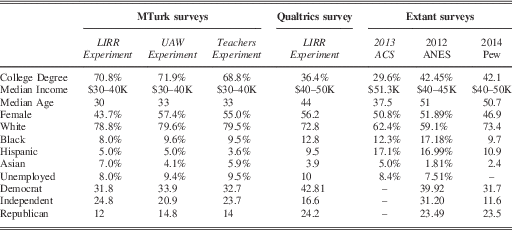
We conducted our three MTurk surveys consecutively between July and August 2014. Each of these experiments tested the effect of CAR on a distinct union target: our first study focused on the LIRR workers’ union and their potential strike during the summer of 2014 (LIRR Experiment, N=500), the second study focused on the UAW union and the government bailout of the auto industry following the 2008 financial crisis (UAW Experiment, N=460), and the third study focused on a (fabricated) teachers’ union and potential strike (Teachers Experiment, N=507).Footnote 78 In each experiment, participants first completed a pretreatment questionnaire containing basic demographic and political items. Table 1 provides the distribution of key demographic and political variables in these surveys, as well as their comparison to Census and other national survey data.
Sample Comparisons by Key Demographic and Political Variables

Sources: 2013 American Community Survey, 2012 American National Election Study, 2014 January Pew Political Survey (N=1,504).
After completing the pretreatment questionnaires, respondents moved onto the experiment itself, which involved reading one of three randomly assigned versions of a news story about the targeted union. For each experiment, we constructed a story about the targeted union that delivered our experimental manipulations, and each story and set of experimental stimuli drew on content from real news stories about the target union and related action. Each experiment concluded with a post-treatment questionnaire measuring participants’ attitudes toward the target union workers and preferences over various government policies, including laws concerning the legal protection of union formation and allowance of labor strikes.Footnote 79 In our initial LIRR experiment, we assess whether exposure to CAR diminished the perceived similarity of (otherized) railroad workers. In our follow-up UAW experiment, we determine whether exposure to CAR tarnished the perceived deservingness of union workers. Last, in the Teachers Experiment, we analyze the effect of CAR on both perceived similarity and deservingness. In addition to assessing the effect of our experimental treatments on these perceived qualities, we also analyzed the indirect effect of our treatments on support for government policies pertaining to unions.
Experimental Design
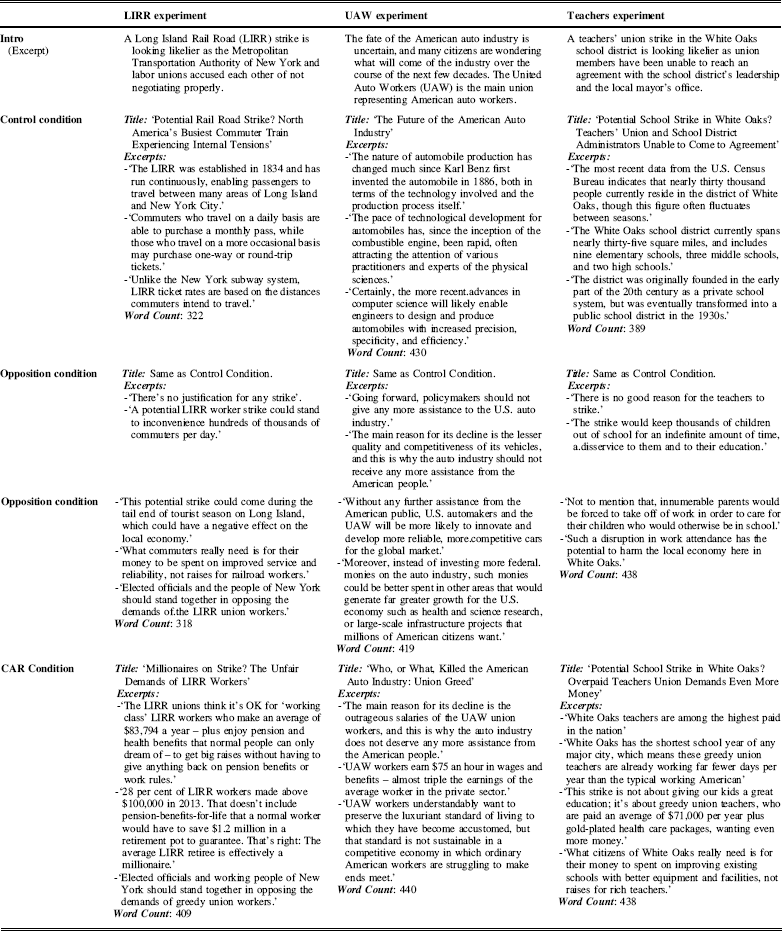
In each experiment, participants were randomly assigned to one of three experimental conditions, each of which involved reading a three-paragraph excerpt from an ostensibly real news story. Our experimental manipulations involved altering the title and content of the news stories. In the control condition for each experiment, respondents were introduced to the targeted union and related event in the first paragraph, and the remaining two paragraphs contained bland, affectively-neutral, non-judgmental information about the targeted union. In the CAR condition of each experiment, respondents were presented with the same introductory paragraph as appeared in the respective control condition, but were then exposed to two paragraphs containing arguments against the target union laden with CAR. The CAR treatment delivered in these paragraphs was drawn directly from real news stories, and involved either verbatim excerpts or the insertion of core phrases from such stories. Last, in the opposition condition of each experiment, respondents were exposed to arguments against the targeted labor union and related event that did not contain CAR. The arguments selected were designed to provide reasonable grounds for opposing a union strike (LIRR and Teachers Experiments) or government bailout (UAW Experiment) that did not involve highlighting the high incomes, lavish benefits packages, or greed and selfishness of targeted union workers. Opposition conditions were included in each experiment in order to assess the unique effects of exposure to CAR beyond those observed for exposure to an anti-union argument.Footnote 80
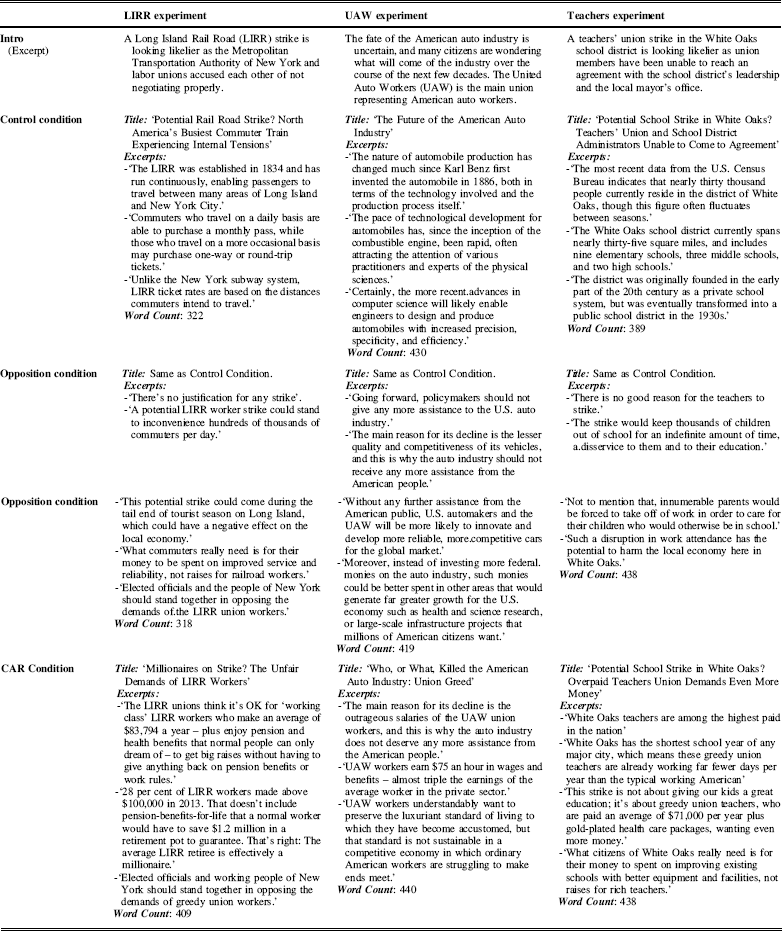
Table 2 presents the key content of each experimental condition from each of the three survey experiments. For full transcripts, see (online) Appendix A. As can be seen, for each experiment, the titles of the stories are identical for the control and opposition conditions, and change for the CAR conditions. For each CAR condition, the article titles were taken completely or nearly verbatim from real news stories and serve to initiate the treatment. The excerpts from the CAR conditions selected for Table 2 represent core statements delivering our CAR treatment, and in each instance involve completely or nearly verbatim excerpts from actual news stories. Table 2 also displays word counts for each condition; here, our goal was to keep the length of each condition as similar as possible. For more information about the primary news sources from which we drew our experimental material, including citation and web addresses, see Appendix B. To illustrate the essence of our design, we turn to the LIRR experiment as an example. In the control condition, respondents are introduced to the railroad workers’ union and the potential strike in the first paragraph. The following two paragraphs, however, offer bland descriptive information about the rail system and company; this condition serves to activate thought about ‘unions’ and ‘labor strike’ without offering any emotion or judgment concerning these concepts. In the opposition condition, the strike is explicitly opposed, and the arguments offered are reasonable but lack CAR (for example, the strike would ‘inconvenience commuters’ or ‘hurt the local economy’). In the CAR condition, each argument made against the LIRR strike in the opposition condition is retained; however, the article also includes recurrent forms of CAR taken from actual news sources that refer to the salaries and benefits of LIRR workers, their greed and selfishness, and contrasts wealthy union workers and ‘normal’ working people.
Sample Content From Different Experimental Conditions by Survey Experiment – MTurk Survey Experiments
Measures
In the pre-treatment questionnaire for each experiment, we included items soliciting standard demographic information (for example, age, education, income, gender, race/ethnicity), as well as union membership and self-reported partisan identification. In the post-treatment questionnaires for each experiment, we began with items tapping the perceived similarity and deservingness of union workers. We asked respondents: ‘How similar or dissimilar do you believe you are to the average [LIRR / UAW / Teachers’ union] worker?’ The response options for this item ranged from (1) – ‘very dissimilar’ to (4) – ‘very similar’. Respondents were then asked to what extent they agree with the statement: ‘Union workers deserve the support of other working Americans in their struggles for improved wages, benefits, and work conditions’. The response options for this item ranged from (1) – ‘strongly disagree’ to (4) – ‘strongly agree’. Following these items, we asked two questions to gauge support for pro-union government policies. The first asked: ‘Presently in the United States, several states have adopted laws that prohibit workers from going on strike, while other states allow workers to strike. In your opinion, do you think states laws should allow workers to strike or prohibit workers from striking?’ From this question, we constructed a dichotomous item coded 1 if respondents selected ‘state laws should allow workers to strike’, and 0 otherwise. The second item asked: ‘In your opinion, how important is it to have strong laws that give workers the right to form and join unions in their workplace?’ The response options for this item ranged from (1) – ‘not that important’ to (4) – ‘very important’. For more information about question wording and variable measurement, see Appendix C.
RESULTS
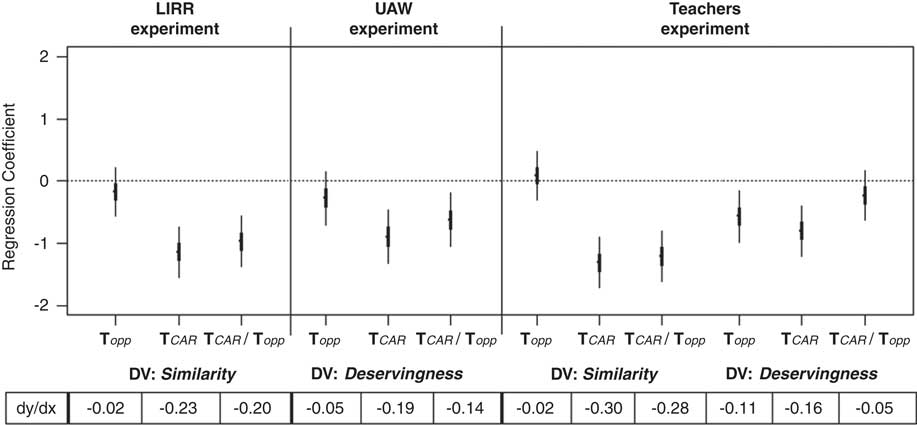
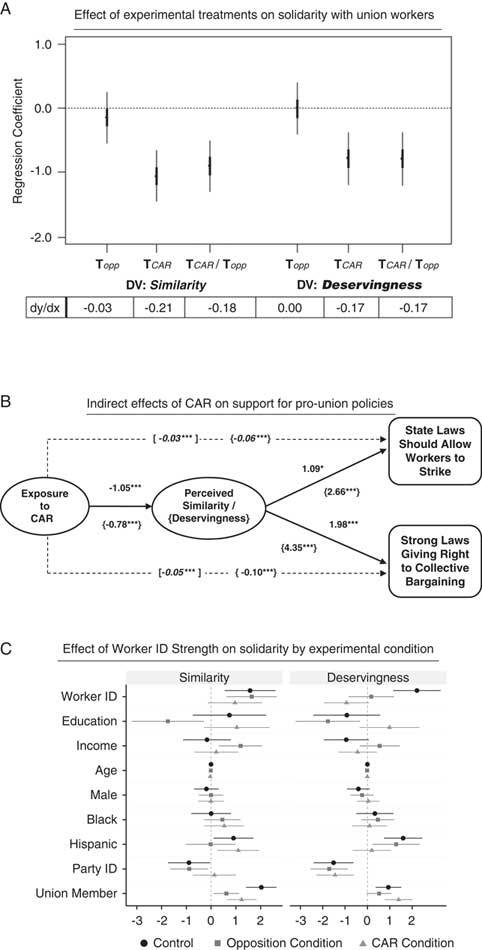
Figure 1 presents the effects of our experimental treatments on the perceived similarity of targeted union workers, and the deservingness of union workers in general, across our three survey experiments. Figure 1 plots the estimated effect of treatment dummy variables obtained from ordered logistic regression models that also included controls for education, income, age, gender, race, party identification and union membership (for the full results, see Appendix D). Three coefficients are displayed for each experiment: T opp and T CAR represent the estimated effects of movement from the control to the opposition condition, and from the control to the CAR condition, respectively, in each estimated model. T CAR / T opp represents the effect of movement from the opposition to the CAR condition obtained from estimating alternative models using the opposition condition as the excluded comparison group. Effect sizes are presented at the bottom of the figure, and are conveyed as first differences in the probability of perceiving the targeted workers as similar/deserving associated with each respective movement between experimental groups.
Plotted effects of experimental treatments on solidarity with union workers – MTurk survey experiments Notes: plotted values are unstandardized coefficient estimates from ordered logistic regression models. T opp is the estimated marginal effect of going from the control to the ‘opposition’ condition, T CAR is the estimated marginal effect of going from the control to the ‘class-based anti-union rhetoric’ (CAR) condition, and T CAR /T opp is the estimated marginal effect of going from the ‘opposition’ to the CAR condition. Vertical bars around point estimates represent 50 per cent (thick bars) and 95 per cent (thin bars) confidence intervals. N=496 (LIRR Experiment), N=455 (UAW Experiment), N=504 (Teachers Experiment). ‘dy/dx’ is the first difference in the predicted probability of perceiving the targeted workers as similar/deserving associated with each respective movement between experimental groups. All models control for education, income, age, gender, race, party ID and union membership.

Focusing first on the LIRR and UAW experiments, the results in Figure 1 reveal that receipt of the opposition treatment (relative to the control) led to a slight decrease in the perceived similarity and deservingness of targeted union workers, however such effects were negligible and insignificant. Turning to the contrast between the CAR and control conditions, we see that exposure to CAR led to significant and sizable decreases in the perceived similarity of targeted workers and the deservingness of union workers more generally. Most importantly, T CAR / T opp for the LIRR and UAW experiments indicate that exposure to CAR (compared to anti-union arguments devoid of CAR) led to significant decreases in the perceived similarity and deservingness of union workers. For the Teachers Experiment, Figure 1 reveals that the pattern of effects previously observed holds when analyzing perceptions of the similarity of the unionized teachers. When analyzing the perceived deservingness of unions, we see that receiving either the opposition or the CAR treatment reduced perceptions of deservingness relative to the control condition; however, there was no significant difference in perceived deservingness between the opposition and CAR conditions. This latter finding indicates that when it comes to the perceived deservingness of unionized workers, exposure to CAR had no added effect over that obtained from exposure to arguments against the teachers’ union strike.
Taken together, exposure to CAR relative to the control condition (that is, T CAR ) led to decreased solidarity with targeted unionized workers in all four tests. Additionally, exposure to CAR relative to the opposition condition (that is, T CAR / T opp ) led to decreased solidarity with unionized workers in three of the four tests. In sum, these results provide strong initial evidence of the causal effect of exposure to CAR on public solidarity with union workers. Across three separate experiments with distinct national adult samples, and with treatments focusing on unionized workers from distinct industries (railroad, auto, education) and employment sectors (public and private), we find that CAR significantly diminishes citizens’ perceptions that the targeted workers are like themselves, and that union workers deserve public support.
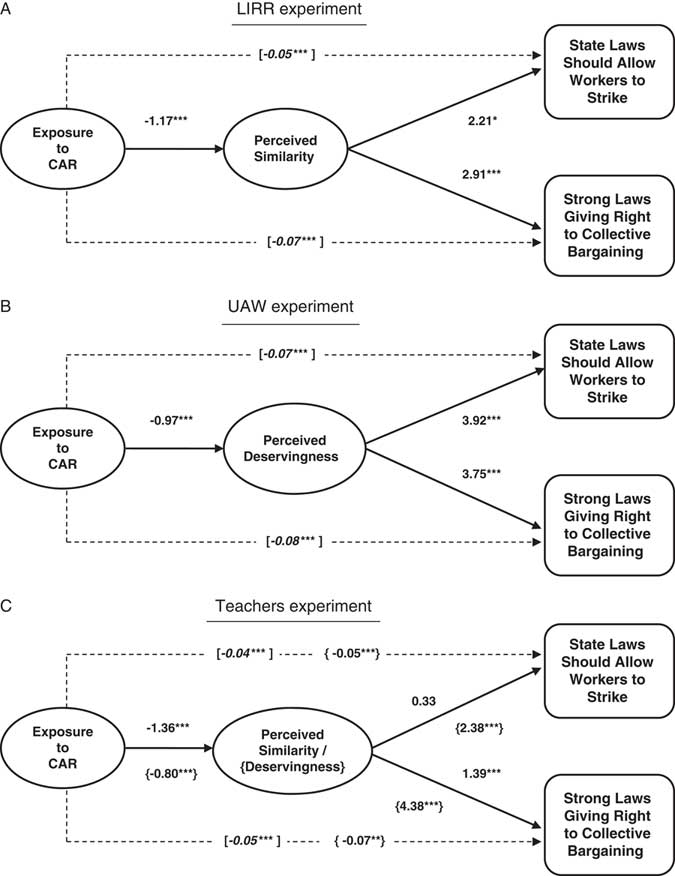
Having established strong support for Hypotheses 1 and 2, we now turn to tests of Hypothesis 3, which argues that exposure to CAR will indirectly reduce political support for unions by eroding solidarity (that is, perceived similarity and deservingness) with unionized workers. To assess the indirect effects of receiving the CAR treatment on support for pro-union government policies, we performed mediation analyses using the ‘mediation’ R package.Footnote 81 We present the results from these analyses in Figure 2. Panels A through C display the effects of the CAR treatments on perceived similarity or deservingness (that is, the mediating variables), the effects of perceived similarity and deservingness on the policy-dependent variables, and the average causal mediation effects (ACME) of the CAR treatments on the policy variables, for each of the three experiments. The ACME estimates are listed on dotted lines. The results displayed in Panels A through C reveal that an increase in the perceived similarity or deservingness of union workers is associated with significant increases in support for pro-union government policies. Notably, this confirms the default expectation established by previous research that solidarity with union workers is associated with political support for unions.Footnote 82 Turning to the estimated indirect or mediated effects, Panels A through C reveal that exposure to CAR, by directly eroding the perceived similarity or deservingness of union workers, indirectly reduced support for laws protecting union workers’ right to strike and engage in collective bargaining. These results provide strong evidence in support of Hypothesis 3, and suggest the efficacy of the putative goals motivating the usage of CAR against organized labor: exposure to CAR reduces solidarity with union workers, which in turn diminishes support for laws that strengthen unions.Footnote 83
Indirect effects of CAR on support for pro-union policies Notes: entries along solid line paths are logistic regression coefficients, while those along dotted line paths represent the average causal mediation effects (ACMEs) – that is, the indirect effects – of exposure to CAR on the probability of agreeing with each policy outcome via perceived similarity and deservingness. *p<0.05, **p<0.01, ***p<0.001 (two tailed tests).

ROBUSTNESS CHECK: MECHANISMS
One potential concern with our results is that the observed effects of what we describe as CAR are due to some difference between treatment conditions that is unrelated to class rhetoric or the activation of survey respondents’ class-based judgment processes. For example, while we designed our treatment conditions to be as similar as possible, our experimental conditions nonetheless varied in terms of content and length. One distinct concern is that rather than crafting treatments that differentially activate class-based thinking among respondents, the treatments simply presented arguments against unions that differed in argument strength. Indeed, in each experiment, our CAR condition was longer and presented more arguments against the unions. Thus, how do we know that the observed differences in outcomes between the opposition and CAR conditions are due to exposure to CAR versus exposure to more (and stronger) arguments? On this point, we should reiterate that to enable observation of the added effect of CAR over oppositional arguments alone, we had to (1) create a condition containing anti-union arguments lacking CAR and (2) construct CAR conditions containing all arguments contained in opposition conditions, but with the addition of arguments using CAR. Thus we run into the unavoidable problem of our CAR conditions necessarily containing at least n+1 arguments over the opposition condition. This feature of the design forces us to broach the ‘argument strength’ counter-hypothesis via some other means.
To do so, we conducted two separate sets of analyses. First, we fielded a follow-up study on MTurk that featured the opposition and CAR conditions of each of the three experiments. A total of 600 respondents were surveyed and, after reading the news article, were asked two manipulation checks and two placebo outcome questions (see Appendix Table E1 for details). We find consistent evidence across all three experiments that, relative to the opposition condition, the CAR condition (1) led respondents to think significantly more about their own salary and about class and (2) was not perceived as significantly more informative or detailed.
Secondly, we performed analyses of the role of worker identity strength in conditioning the effects of our CAR treatment. Theoretically, we argue that CAR activates class-based reasoning and, most importantly, that its effectiveness relies on a process of constructing two socio-economic groups. Namely, CAR constructs a deserving ingroup of ‘ordinary’ non-unionized working Americans and an outgroup of privileged, greedy, undeserving unionized workers. If our treatments are indeed delivering such manipulations, then we should be able to observe evidence of this among those most susceptible to such constructions – namely, those who identify most strongly as a ‘working person’. Prior research demonstrates that working-class consciousness is positively associated with support for, and participation in, labor unions.Footnote 84 This suggests that, in an information environment that lacks CAR, there should be a natural positive relationship between worker identity strength and solidarity with union workers. However, in a context where persuasive efforts are constructing ingroup/outgroup divisions where the ingroup comprises hardworking, earnest, non-unionized (that is, ‘normal’) working people, and where the outgroup members do not possess such qualities, we expect those who more strongly identify as a working person to be more responsive to such rhetoric. Indeed, prior research on identity priming indicates that efforts to evoke social and political identities in persuasive arguments have their greatest effect among those who hold the evoked identity most strongly.Footnote 85
One method for determining whether class rhetoric or argument strength is doing the ‘work’ of the CAR treatment is to assess whether the effect of the CAR treatment is conditional upon the extent to which respondents identity as a ‘working person’. If our theory is correct, those most susceptible to the putative ‘otherizing’ effects of CAR toward union workers will be respondents who identify strongly as a working person. However, if the argument strength counter-hypothesis is correct, we should not observe any interaction between the CAR treatment and worker identity strength, since the ‘work’ of the CAR condition rests upon argument strength, which should operate relatively equally among those both low and high in worker identity strength.
To test this expectation, we rely on two items appearing in the pre-treatment questionnaire of each survey tapping respondents’ strength of working-class identity. The first item asked: ‘Of the things that are important to who you are, how important is it to you to think of yourself as a working person?’ The response options for this item ranged from (1) – ‘not important at all’ to (3) – ‘very important’. This item is comparable to those used in leading research to measure the strength of partisan identification:Footnote 86 we simply inserted ‘working person’ in place of a party label. Our second item asked respondents: ‘How strongly do you identify as a working person?’ with response options ranging from (1) – ‘not at all’ to (4) – ‘very strongly’. Responses to these two items in each experiment were highly correlated,Footnote 87 and were thus combined into a scale labeled Worker ID Strength.
While these items depart from measures used in prior work,Footnote 88 they are consistent with the measurement of partisan identity in leading research,Footnote 89 and we see several benefits to our measure. First, these items avoid explicit reference to ‘class’, which many argue is increasingly an amorphous concept to Americans, who have a tendency to converge upon identification with the middle class regardless of significant objective differences in income and education. Secondly, the correlation between our combined measure of worker identity strength and indicators of socio-economic status (education and income) are in the expected direction, with more-educated and higher-income respondents identifying less strongly as working persons.
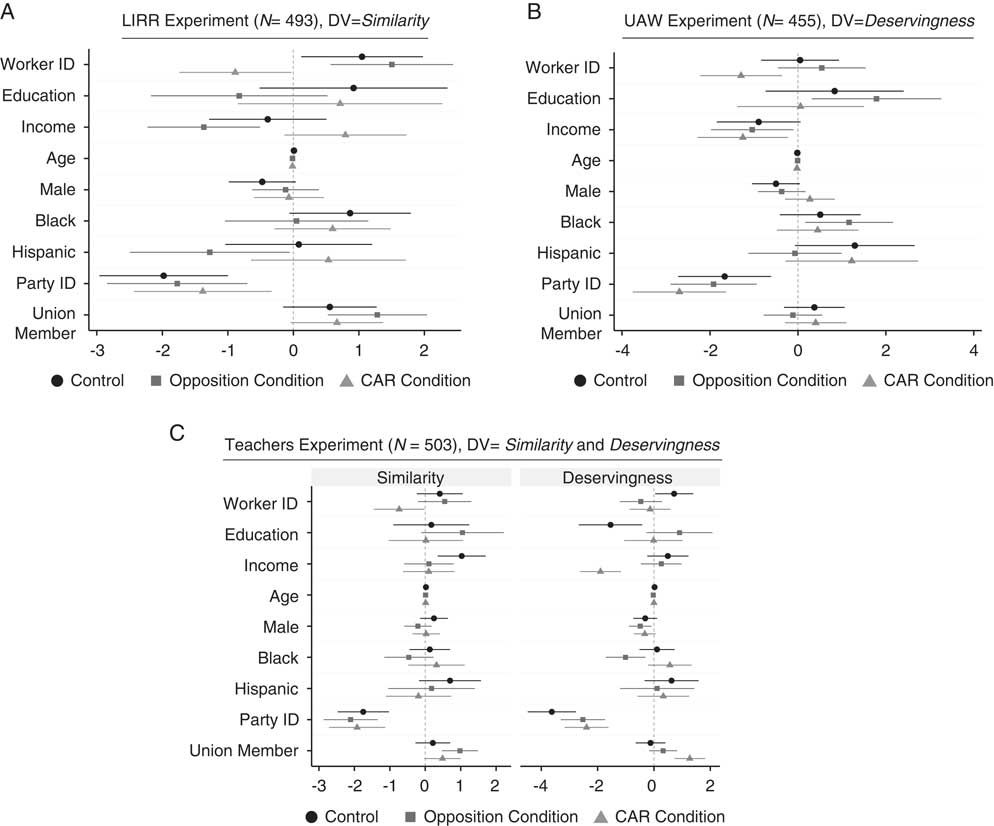
We present the results from regression analyses of the effect of Worker ID Strength on solidarity with union workers for each experiment, by treatment condition, in Figure 3, Panels A through C. To see these results in a single moderated regression model, where we find significant interactions between Worker ID Strength and receipt of the CAR treatment, see Appendix Table D3.Footnote 90 As can be seen, in three of the four CAR conditions (but none of the opposition conditions): increasing strength of identification as a working person is associated with significant decreases in the perceived similarity and/or deservingness of union workers. Moreover, in the control conditions of the LIRR and Teachers experiments, we see that an increase in Worker ID Strength is associated with significant (or near-significant) increases in perceived similarity and deservingness, which comports with standing wisdom. In other words, we find reversing marginal effects for worker identity depending on the experimental condition: in the control conditions of our experiments, we either find no significant differences between those low and high in worker identity, or we find that those high in worker identity are more likely than those low in worker identity to perceive union workers as similar and/or deserving of support.
The effect of worker identity strength on solidarity with union workers by experimental condition – MTurk survey experiments Note: figures plot coefficient estimates with 90 per cent confidence intervals from ordered logistic regression models estimated by treatment condition.

As expected, this relationship is reversed after exposure to CAR: those higher in worker identity strength are significantly less likely than those low in worker identity to perceive union workers as similar and/or deserving. These results suggest that, rather than being driven by argument strength, the effects of CAR are driven by the manipulation of class identity and reasoning. Further, these results uncover a striking aspect of the effect of CAR – its ability to fundamentally alter the relationship of worker identity strength to solidarity with unionized workers. Exposure to CAR thus holds the potential to convert those who are otherwise most sympathetic to union workers into those most antipathetic to union workers (Figure 3).
ROBUSTNESS CHECK: REPLICATION WITH REPRESENTATIVE DATA
The evidence presented thus far in support of our hypotheses has demonstrated robustness across different samples and targeted unions. One additional concern with this evidence, however, is that it is based on samples collected through MTurk. While extant scholarship demonstrates that samples collected in this way are more representative of the general population on key demographic variables than student samples,Footnote 91 and that treatment effects in framing experiments are similar in magnitude for MTurk vis-à-vis nationally representative samples,Footnote 92 our three MTurk samples do over-represent the young, well-educated and politically liberal. Further, and perhaps most important, one distinct concern with MTurk samples is the non-naiveté of the respondents.Footnote 93 In other words, given that MTurk’s respondent pool consists of individuals who take a large number of surveys on a regular basis, it is possible that this pool of ‘professional’ survey takers may differ in important and unknown ways from the general population. Indeed, in our three surveys, the overwhelming majority of respondents reported having taken more than ten surveys on MTurk within the previous month.Footnote 94
To mitigate concerns about this potential form of bias, we conducted a fourth and final internet survey experiment administered by the survey software company QualtricsFootnote 95 in September 2014. For the purposes of this follow-up, we selected the LIRR experiment for re-testing, and recruited 591 respondents. As can be seen from Table 1, our Qualtrics sample compares much better than our MTurk samples to the 2013 American Community Survey (ACS) and recent surveys conducted by well-known survey organizations on key demographic and political dimensions. For example, while our MTurk samples tended to be younger, better educated and more liberal than the public as a whole, our Qualtrics sample is far closer to ACS, American National Election Study (ANES) and Pew survey estimates of these quantities. Perhaps most important, in contrast to the high volume of surveys taken on a regular basis by the typical MTurk respondent (that is, N>10 surveys taken in the month preceding our surveys), the respondents in our Qualtrics sample were drawn from an online panel of respondents who on average completed 1.23 surveys per month. Thus, this sample is not only more representative on key demographic dimensions, but also more representative in that it does not comprise routine survey takers.
The experimental design and questionnaire in this study were identical to the LIRR experiment conducted with the MTurk sample, with the exception that we measure the perceived similarity and deservingness of union workers. Panels A through C of Figure 4 present the results from our Qualtrics LIRR experiment. Starting with Panel A, we see that the pattern of treatment effects entirely aligns with those observed with the MTurk sample; indeed, even the magnitude of effects is comparable. While the MTurk LIRR experiment only focused on perceived similarity, when we extend this original analysis to also explore perceived deservingness, we again find that the results align with our hypotheses. In sum, in line with Hypotheses 1 and 2, exposure to CAR decreased perceived similarity and deservingness, and did so in a manner beyond the decreases obtained from exposure to arguments against the union but lacking CAR.
Results from Replication of LIRR Experiment – Qualtrics Sample Note: entries in Panels A and C are coefficient estimates from ordered logistic regression models (estimated by treatment condition for Panel C) and the bars around the point estimates represent 95 per cent confidence intervals. For Panel A, ‘dy/dx’ is the first difference in the predicted probability of perceiving the targeted workers as similar/deserving associated with each respective movement between experimental groups. Panel B displays logistic regression coefficients along the solid line paths, while entries along the dotted line paths represent the average causal mediation effects (ACMEs) – i.e., indirect effects – of exposure to CAR on the probability of agreeing with each policy outcome via perceived similarity and deservingness. All models control for education, income, age, gender, race, party ID, and union membership.

Turning to Panel B, we find that the mediation analysis also replicates the results from the MTurk LIRR experiment, providing further evidence in support of Hypothesis 3. Last, the results in Panel C present some support for the additional hypothesis that CAR ‘works’ by tapping class-based sentiments rather than by merely being a stronger anti-union argument. As can be seen, exposure to CAR did not significantly alter the relationship between Worker ID Strength and perceived similarity, which remains positive and significant in the control and opposition conditions, and positive and nearly significant in the CAR condition. However, for perceived deservingness of unions in general, we again observe an undermining of the ‘default’ relationship between Worker ID Strength and solidarity, as an increase in Worker ID Strength is associated with a significant increase in perceived deservingness in the control condition, but a marginally significant (p=0.06) decrease in the CAR condition. Taken together, the results from our Qualtrics LIRR experiment demonstrate that the overwhelming majority of our key results hold when re-tested using a more nationally representative sample of non-professional survey takers. These findings, in conjunction with those from our three MTurk studies, offer strong evidence in support of our hypotheses.
ROBUSTNESS CHECK: PARTISANSHIP, INTEREST AND SELECTIVE ATTENTION
One final issue that is important to address is the relevance of the findings from our survey experiments in light of the role of selective attentionFootnote 96 in an increasingly choice-abundant and ideological media environment. Recent work by Arceneaux and JohnsonFootnote 97 highlights the importance of caution when using ‘forced exposure’ designs to study media effects, as many citizens in the real world either tune out of politics or selectively tune in to ideologically congruent news outlets. The net effect is the observation of more minimal media effects than those yielded from artificial experimental contexts with captive audiences. On this point, Arceneaux and Johnson contend that news seekers, because they ‘have stronger predispositions and a larger store of considerations regarding controversial political issues’, are ‘less likely to experience massive media effects, on average’.Footnote 98
As our experiments rely on forced exposure, it is important to consider how the treatment effects we observe may translate to the real world, especially where the exposure of politically interested citizens to CAR may be endogenous to their partisan or ideological orientations. In short, extrapolating from our findings to the real world requires some consideration of the unknown resilience of our treatment effects when accounting for factors that shape treatment exposure, such as political interest and standing political orientations. An important test, therefore, is to determine whether the treatment effects we observe are driven by subsamples of our data that are unlikely to receive our treatment in the real world (that is, individuals Arceneaux and Johnson refer to as the ‘inattentive public’).
To this effect, we re-estimate the effects of exposure to CAR reported in Figure 1 (as well as Appendix Table D1) among those low and high in political interest, as well as among Democrats and Republicans. While our experimental designs are limited in that they do not allow us to estimate the effects of CAR among subjects choosing to view the news or selecting specific outlets, this analysis does allow us to assess whether our treatment effects hold among those more or less likely to tune in to the news, as well as those more or less likely to find anti-union messages consistent with their existing political attitudes. As noted above, CAR can be found across a wide array of media outlets, with some notably right of center and others moderate or even left of center. Nonetheless, it is likely that systematic differences exist in the prevalence of CAR across the media environments selected into by liberal and conservative news-seeking citizens. Here, one critical test is whether we observe treatment effects for CAR separately among Democrats and Republicans (that is, excluding Independents), as there is reason to expect limited effects among each group of partisans. Democratic identifiers may be less likely to be exposed to CAR due to selecting into liberal media and may counter-argue CAR when encountering it. Republican identifiers may already oppose unions and thus select into media outlets that offer anti-union perspectives. Following this, a second critical test is whether we observe an effect of CAR among subjects reporting a strong interest in politics, as these respondents presumably correspond to news-seeking citizens who in the real world may be less susceptible to persuasion.
In Appendix Table D2, we present the results from our analyses of Democratic and Republican respondents, as well as of those low and high in political interest. As can be seen, our treatment effects are not driven by political Independents, as exposure to CAR erodes solidarity with union workers among Democratic and Republican identifiers alike. Further, our main results are not driven by low-interest respondents who, in the real world, would likely tune out of politics and thus fail to be exposed to CAR. In short, when restricting our analysis to subsamples of our data that correspond to segments of the public that are members of the ‘active audience’Footnote 99 and are presumably less persuadable, we continue to observe a negative effect of CAR on solidarity with union workers. In other words, our results are not driven by subsets of our samples unlikely to receive (low-interest individuals), or most likely to be affected by (non-partisans) the treatment in the real world.
CONCLUSION
In an era of declining unionization and rising economic inequality, we believe this article makes important contributions to the study of class and labor politics, and to the intersection of these fields with the study of public opinion, political rhetoric, intergroup attitudes and mass media effects. Despite declines in membership in more recent decades, labor unions continue to represent an influential and uniquely class-based interest group in American politics. And, as with other major interest groups, unions rely on public support to influence the political process and accomplish a variety of policy-oriented goals, as well as its ability to attract new membership and effectively engage in collective bargaining.Footnote 100 Public opinion also plays a key role in shaping the fate of union strikes, as expanding the scope of conflict with management to the court of public opinion (that is, ‘going public’) has proven to increase the success of labor strikes.Footnote 101 Moreover, the importance of public opinion toward unions has been especially great in recent years as numerous state legislatures have debated ‘Right-to-Work’ laws, and other union-related measures have been subject to direct vote by members of the public.Footnote 102 Thus developing a firmer understanding of how the public forms attitudes toward unions is critically important.
In this article, we identify an extremely timely phenomenon – CAR, which draws invidious economic comparisons between union and non-union workers – and test its potential effects on public opinion toward organized labor. Examples of CAR in media coverage of union-related events abound in recent years, and our findings offer an initial demonstration of the efficacy of CAR in eroding citizens’ solidarity with union workers, and through this, their support for pro-union government policies. Rather than representing yet another study demonstrating the effects of a negative media frame, we believe our findings are of substantial scholarly and political significance. Our analyses collectively demonstrate that the broad political alignment of socio-economic groups can potentially be undone when the members of one group are portrayed as socio-economically dissimilar to the members of the other group. In the case of union vs. non-union workers, CAR appears to accomplish precisely this function.Footnote 103
In this way, our findings go beyond prior studies’ documentation of the consequences of the anti-union frames prominent throughout the twentieth century (for example, ‘big labor’, ‘labor bosses’ and ‘consumer impacts’ frames), where the core findings are that exposure to negative information diminishes public approval of unions. In contrast to solely exerting the typical effects of a negative frame, our analysis documents a striking effect: exposure to CAR altered the standing relationship between class identity and solidarity with organized labor, as those highest in working-class identity strength evinced the strongest backlash against unions following exposure to CAR. CAR is therefore a potentially highly politically significant phenomenon insofar as it appears to effectively draw upon working-class sentiments to attack a historically pro-working class institution whose ostensible raison d’etre is to promote the interests of working-class citizens.
There are important limitations of our work, as well as promising future directions. In terms of limitations, it is important to reiterate that our findings represent the effects of CAR conditional upon exposure, or in other words, the potential effects of CAR in the real world. To be sure, our studies forced subjects’ exposure to CAR. Thus extrapolating from our findings to the real world, where citizens make choices about what news to watch or whether to watch the news at all, requires some consideration of the unknown resilience of our treatment effects when accounting for factors that shape treatment exposure, such as political interest and standing political orientations. As discussed above, across subjects low and high in political interest, as well as those identifying with the political left (that is, Democrats) and right (that is, Republicans), we observe consistent treatment effects. Thus whether exposure occurs for ‘entertainment seekers’, for whom persuasion is believed likely,Footnote 104 right-leaning ‘news seekers’, where minimal persuasion is expected due to pre-existing antipathy toward unions, or left-leaning news seekers, for whom persuasion is deemed unlikely due to motivated resistance,Footnote 105 our findings offer a reasonable basis to expect that CAR has meaningful real-world effects on public opinion.
Future studies should examine whether the effects of CAR vary depending on the economic context – for example, in more unequal (vis-à-vis equal) contexts, does CAR have stronger effects on public support for unions, particularly among economically insecure non-union workers? Relatedly, thorough content analyses of major media to construct a measure of the overall presence of CAR over time would enable scholars to potentially predict fluctuations in the supply of CAR, as well as whether variation in CAR is predictive of aggregate support for unions and union-related public policy.
Secondly, though our study has focused on the United States, examples of CAR are readily observed in many other Western, industrialized countries.Footnote 106 Indeed, given their socio-economic similarities to the USA (for example, declining unionization in the private sector, substantial unionization among public sector employees and long-term increases in income inequality), there is good reason to expect that the form and effects of CAR in other Western countries will closely resemble that of the USA. Moreover, given the nascent industrialization and distinctly high rates of inequality in much of the developing world, CAR might very well enable elites to foster public antipathy toward unions in emerging economies. Future research would do well to investigate such possibilities.
Finally, though CAR pertains to unions specifically, our theoretical argument implies that class-based rhetoric may affect intergroup attitudes among other types of societal groups. For example, racial minority groups in the USA typically have strong affinity for one another,Footnote 107 but how might this affinity be affected by rhetoric that makes the members of one group appear socio-economically dissimilar from members of another group?Footnote 108 Similarly, and as the politically motivated usage of the term ‘welfare queen’ in the United States might suggest,Footnote 109 would low-income citizens’ willingness to support social spending decrease in response to rhetoric that portrays welfare recipients as members of the upper class? In a broad sense, the potential for class-based rhetoric to construct socio-economic outgroups implies that extant affinities and political coalitions between various groups – for example, low-income workers and highly educated environmentalists, small business owners and corporate CEOs, undocumented immigrants and activist academics – can potentially be undermined, and perhaps reversed, when members of the lower-income group perceive members of the (relatively) higher-income group to belong to a more advantaged socio-economic class.