INTRODUCTION
It has been the goal of multiple authors (e.g., Suguio et al. Reference Suguio, Martin, Bittencourt, Dominguez, Flexor and Azevedo1985; Angulo and Lessa Reference Angulo and Lessa1997; Castro et al. Reference Castro, Suguio, Seoane, Cunha and Dias2014; Jesus et al. Reference Jesus, Dias, Muniz, Macário, Seoane, Quattrociocchi, Cassab, Aguilera, Souza, Alvez, Chanca, Carvalho and Araujo2017) to reconstruct Late Holocene paleo sea-level fluctuations along the Brazilian coast, in order to correlate it to current climate changes, and thus anticipate and aid in the mitigation of future impact.
According to Suguio et al. (Reference Suguio, Martin, Bittencourt, Dominguez, Flexor and Azevedo1985), evidence of relative sea-level variations can be grouped into three distinct sets: (1) prehistoric, which is evidenced by the constructions of ancient native peoples of the coastal zones—the shell midddens, called sambaqui in the native language; (2) geological, such as sandy terraces of marine origin and beach rocks; and (3) biological, defined by incrustations of vermetidae, oysters and hedgehog marks, located above the current life span of these animals.
Recent studies cover a strip of the Brazilian coast, which extends from the state of Rio Grande do Norte to Rio Grande do Sul, assessing the transformations of the last 7000 years. For the region of Southeast Brazil, several studies suggest a transgressive maximum at around 5600 cal BP followed by a regression with small oscillations to the current zero (Suguio et al. Reference Suguio, Martin, Bittencourt, Dominguez, Flexor and Azevedo1985; Martin et al. Reference Martin, Dominguez and Bittencourt2003; Castro et al. Reference Castro, Suguio, Seoane, Cunha and Dias2014; Jesus et al. Reference Jesus, Dias, Muniz, Macário, Seoane, Quattrociocchi, Cassab, Aguilera, Souza, Alvez, Chanca, Carvalho and Araujo2017). So far, sea-level fluctuation indicators are scarce in the Angra dos Reis region. Delibras and Laborel (Reference Delibrias and Laborel1969); Martin and Suguio (Reference Martin and Suguio1978); Martin et al. (Reference Martin, Suguio, Flexor, Bittencourt and Vilas-Boas1979, 1980), Martin and Suguio (Reference Martin and Suguio1989), and Suguio et al. (Reference Suguio, Martin, Bittencourt, Dominguez, Flexor and Azevedo1985) have only established a sea-level variation curve for the last 2500 years. Souza et al. (Reference Souza and Vilano2015a, Reference Souza and Sobrinho2015b) present an alternative to the lack of data on the north coast of the State of São Paulo, old records of sea urchin—holes in the rocks—that integrate the fauna of the infralittoral and beachrocks as indicators of sea-level fluctuations during the Holocene.
Fossil worm groups—tubular shell-shaped gastropod mollusks that live embedded in a substrate—are commonly used as indicators of sea-level variation because they dominate the mid-tidal portion of the rocky shores, indicating more accurately the relative sea-level in a given region (Delibrias and Laborel Reference Delibrias and Laborel1969; Laborel Reference Laborel and Van de Plassche1986; Angulo et al. Reference Angulo, Giannini, Suguio and Pessenda1999; Angulo et al. Reference Angulo, Lessa and Souza2006; Dias et al. Reference Dias, Breves-Ramos, Pimenta, Junqueira, Seoane, Castro and Ramos2011). Reconstructions of former relative sea-level positions are based on evidence defined in space and time. To define the position of this evidence in space it is necessary to know their current altitude in relation to the original, that is, to know their position in relation to sea-level at the time the evidence was formed. To define it in time, it is necessary to find out the period of its formation through dating methods, such as the 14C method.
By establishing many former relative sea-level positions, it is possible to construct a sea-level fluctuation curve for a specific region covering a given time interval (Suguio et al. Reference Suguio, Martin, Bittencourt, Dominguez, Flexor and Azevedo1985). Currently, for the Angra dos Reis region, a relative sea-level variation curve exists, covering the last 3500 years BP, with special emphasis on the final 2500 years (Suguio et al. Reference Suguio, Martin, Bittencourt, Dominguez, Flexor and Azevedo1985).
Most articles about sea-level variation curves in Brazil do not address the protocol used for carbonate sample treatment prior to dating. The first researchers to show concern over this were Angulo et al. (Reference Angulo, Giannini, Suguio and Pessenda1999, Reference Angulo, Pessenda and de Souza2002) and Ribeiro et al. (Reference Ribeiro, Giannini, Nascimento Junior and Sayeg2011). The former reported on the use of hydrochloric acid to remove calcite, and the latter, on the results of X-ray diffraction analyses to verify the presence of secondary minerals in the vermetid samples. In the present study, we use the methodology of Moreira et al. (Reference Moreira, Macario, Guimarães, Dias, Araújo, Jesus and Douka2020). Treatment with hydrochloric acid proved to be not enough to allow the elimination of calcite. In the present work, the separation of aragonite and calcite by density proved to be more efficient, avoiding the influence of recrystallization of the newly formed mineral.
The new data provide information that contributes to the period of 2500 to 6000 years BP, partially filling the gap of Suguio et al. (Reference Suguio, Martin, Bittencourt, Dominguez, Flexor and Azevedo1985) for the Ilha Grande Bay region. Samples of fossil vermetids were dated by 14C from the original aragonite, which guarantees greater precision of the results. This article seeks to emphasize the importance of a detailed description of the pretreatment methods for dating by 14C in carbonate incrustations due to their influence on the calculation of ages.
Thus, the development of this study sought to verify the relative sea-level variations in Angra dos Reis using biological samples (vermetidae) as indicators through literature reviews and analysis using new vermetid dating methodology.
STUDY AREA
Angra dos Reis is located on the southern coast of the state of Rio de Janeiro, Brazil, between latitudes 22º50ʼS, 44º00ʼW and 23º20ʼS, 44º45ʼW. Angra dos Reis is located in the Ilha Grande Bay (65,258 ha) and borders the municipalities of Paraty and Mangaratiba.
The Ilha Grande Bay has a tropical climate, hot and humid, with high temperatures and high rainfall. The continental portion of the Ilha Grande Bay has a very rugged, mountainous terrain, with undulating to steep terrain. In this configuration, the only flat areas are floodplains and mangroves. Sandy strands are restricted, with a predominance of rocky coastline. Thus, it is characterized by a submergent coastline with several islands (Neves and Muehe Reference Neves and Muehe2008).
Bathymetry is characterized by extensive shallow areas with depths of up to 40 m, except for interior channels where the bathymetric elevation can reach 55 m. In natural harbor and bight areas the average depth is less than 10 m. During the summer, the sea surface temperature varies from 24.4ºC to 28.4ºC. During the winter, they register temperatures between 24ºC and 26ºC (Inea 2015).
The region suffers direct action from the waves in the south quadrant. In winter, the region is exposed to swells in the southern quadrants (SW–S–SE), wind speeds above 18 m/s and waves 5–6 m high in the open sea. In summer, it presents smaller waves, between 0.3 and 0.4 m (Cavalcante Reference Cavalcante2010). The tidal regime is of the semidiurnal type with diurnal inequality, keeping with the pattern of the southeastern coast of Brazil.
METHODOLOGY
Suguio et al. (Reference Suguio, Martin, Bittencourt, Dominguez, Flexor and Azevedo1985) tried to outline the sea-level fluctuation curve for the sector located between Paraty and Angra dos Reis, making it possible to reconstruct 17 old positions of relative sea-level. These indicators only represent the last 2500 years and it is, therefore, not possible to draw a curve. Some researchers have shown concern about using fossil material for the purposes of dating. The presence of calcite occurring next to aragonite can change the apparent ages of the records. Ribeiro et al. (Reference Ribeiro, Giannini, Nascimento Junior and Sayeg2011) analyzed the samples by X-ray diffraction to check their mineralogy. In his sample dating treatment methodology, Angulo et al. (Reference Angulo, Pessenda and de Souza2002) added a step whereupon shells were washed in HCL to eliminate calcite, avoiding interference in the ages. Dias et al. (Reference Dias, Breves-Ramos, Pimenta, Junqueira, Seoane, Castro and Ramos2011), visiting islands in the Ilha Grande Bay, determined ages and heights at sea level of vermetidae fossil and calculated the altitudes of living gastropods.
The methodology consisted of developing safer techniques for obtaining space-time information on samples, their height on the rocky shore and dating by AMS 14C.The CarDS protocol uses a heavy liquid (in our case sodium polytungstate, SPT) of known density to separate original aragonitic structures from secondary calcite ones, prior to AMS dating (Moreira et al. Reference Moreira, Macario, Guimarães, Dias, Araújo, Jesus and Douka2020). In addition, we sought to analyze the influence of the polynomial degree on the configuration of the sea-level fluctuation curve and its effects on data interpretation.
Vermetidae Fossils and the Definition of Current and Paleo Sea Levels
Occurrences of fossilized vermetid fouling were investigated in the rocky shores located in the Ilha Grande Bay. Altitudes were defined using Zenith GPS trackers as static GPS, with post-processed differential correction, in relative mode.
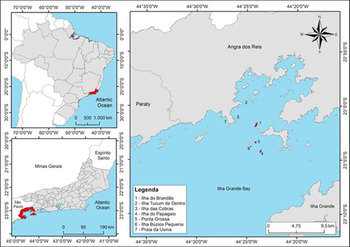
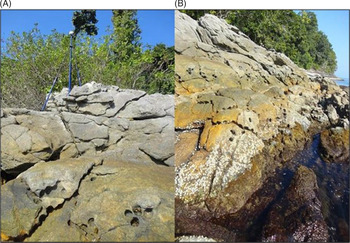
The search for fossils occurred on several islands (Figure 1), always in the more sheltered faces, especially in cracks parallel to the horizontal arrangement of the organisms that inhabit the rocky shores, such as barnacles, sea urchins, seaweed, and mussels, thus indicative of different positions of the water level. Preference was given to the vermetidae fossils that appear along lines formed by old barnacle and sea urchin holes. Urchin holes situated above the present-day tide level can no longer be occupied (Figure 2), becoming a type of iconofossil that could be used to infer below tide conditions and periods of sea-level stability (Angulo and Souza Reference Angulo and Souza2014).
Map of the study area, Ilha Grande Bay, Rio de Janeiro, Brazil. Localization of vermetidae scale samples.

(A) vermetid fossil location; (B) rocky shore ecology.

The base station was set up on Reference Level (RN) number 93520 - Angra dos Reis, which has data is made available by the Brazilian Institute of Geography and Statistics - IBGE in its geodetic database for post processing.
The altitude determined by a GNSS receiver is not related to mean sea-level (geoid), but rather to a reference ellipsoid with specific dimensions. Thus, it was necessary to establish the difference between the geoid and ellipsoid surfaces, that is, the geoidal height (or undulation), in order to determine the altitude above mean sea-level, orthometric height.
The conversion of the ellipsoidal altitude (h) resulting from the field survey with GNSS receivers to orthometric altitude (H) is performed using the geoidal height value (N) provided by a geoidal undulation model, as follows: H = h – N.
The ellipsoidal heights were processed in the EzSurver subprogram to obtain geographic coordinates. The geoidal ripple calculation was performed using the software MAPGEO 2015.
Vermetidae samples were collected on rocky shores (attached to metamorphic rocks) in the islands and continental shores of the Ilha Grande Bay: Brandão Island and Tucum de Dentro Island; Parrot Island (2 collection points), Cobras Island, Ponta Grossa, Buzios Pequena Island, and Usina Beach (Figure 1).
Radiocarbon Dating
Vermetidae fossils of the species Petaloconchus varians are sessile gastropods, belonging to the Vermetidae Rafinesque family, 1815 (Mollusca, Prosobranchia, Caenogastropoda). They consist of dense assemblages with a gregarious way of life (living in groups) that grow fixed in the substrate and may form a dense carbonate reef structure (Soares et al. Reference Soares, Meirelles and Lemos2010). They are formed by tubular shells characterized by extremely irregular growth and are strictly associated with the lower limit of the mid-coastal region (Vescogni et al. Reference Vescogni, Bosellini, Reuter and Brachert2008).
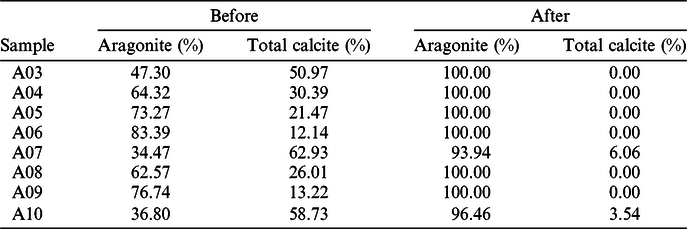
Ages were determined by radiocarbon method of accelerator mass spectrometry (14C-AMS) at the Radiocarbon Laboratory of the Fluminense Federal University (LAC-UFF). Samples of vermetidae, mostly composed of calcium carbonate (CaCO3) in the form of aragonite (2.93 g/cm3), are likely to recrystallize and become calcite (2.71 g/cm3), the most stable crystalline form of CaCO3 (Schmalz Reference Schmalz1967; Bathurst Reference Bathurst1972) and thus may or may not capture exogenous carbon, which is not original to the sample, influencing the measured age. To obtain more reliable dating, a new density separation protocol was applied following Moreira et al. (Reference Moreira, Macario, Guimarães, Dias, Araújo, Jesus and Douka2020), where the samples were grinded and subjected to a known density solution (2.84 g/cm3) prepared with sodium polytungstate (SPT). This solution separates the calcite fraction, so that only the original carbon of the sample (from the aragonite shell) is measured. To check if the separation was done correctly, we performed an X-ray diffraction (XRD) analysis, with results are presented below (Table 1).
Results of XRD analysis before and after the CarDS protocol (Moreira et al. Reference Moreira, Macario, Guimarães, Dias, Araújo, Jesus and Douka2020).

To ensure the correct interpretation of ages, the results were calibrated from the database produced by the radiocarbon scientific community. Calibration is necessary as it considers variations in 14C production and distribution over time and, in samples from the marine environment, correct for the marine reservoir effect (Macario and Alves Reference Macario and Alves2018).
Conventional ages were calibrated using Marine13 (Reimer et al. Reference Reimer, Bard, Bayliss, Beck, Blackwell, Bronk Ramsey, Buck, Cheng, Edwards, Friedrich, Grootes, Guilderson, Haflidason, Hajdas, Hatté, Heaton, Hoffmann, Hogg, Hughen, Kaiser, Kromer, Manning, Niu, Reimer, Richards, Scott, Southon, Staff, Turney and van der Plicht2013) and ΔR = 32 ± 44 (Alves et al. Reference Alves, Macario, Souza, Pimenta, Douka, Oliveira, Chanca and Suguio2015) calibration curve.
Relative Sea-Level Fluctuation Curve
Despite having few samples, two curves of relative sea-level variation to the south of the State of Rio de Janeiro were drawn using vertical altitude measurements (y) (altitude) and the age averages calibrated on the horizontal axis (x) to compare the effects of SPT treatment on the model. The fourth-degree polynomial was used to establish the best fit trendline based on the data set and the field evidence.
The first shows the calibrated ages of the samples which underwent HCl pretreatment only, while the second shows the variation in sea level in relation to the calibrated ages after pretreatment with SPT.
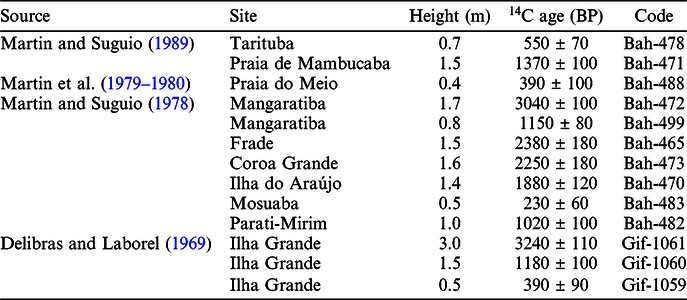
The ages obtained from vermetid samples after SPT treatment (Aragonite) were compared with samples from other Holocene sea-level fluctuations studies for the same region. Data from Delibras and Laborel (Reference Delibrias and Laborel1969); Martin and Suguio (Reference Martin and Suguio1978); Martin et al. (Reference Martin, Suguio, Flexor, Bittencourt and Vilas-Boas1979, 1980) and Martin and Suguio (Reference Martin and Suguio1989) are presented in Table 2.
Paleo sea levels inferred from vermetids (Angulo et al. Reference Angulo and Souza2014).

RESULTS
Bioindicator Heights and Radiocarbon Ages
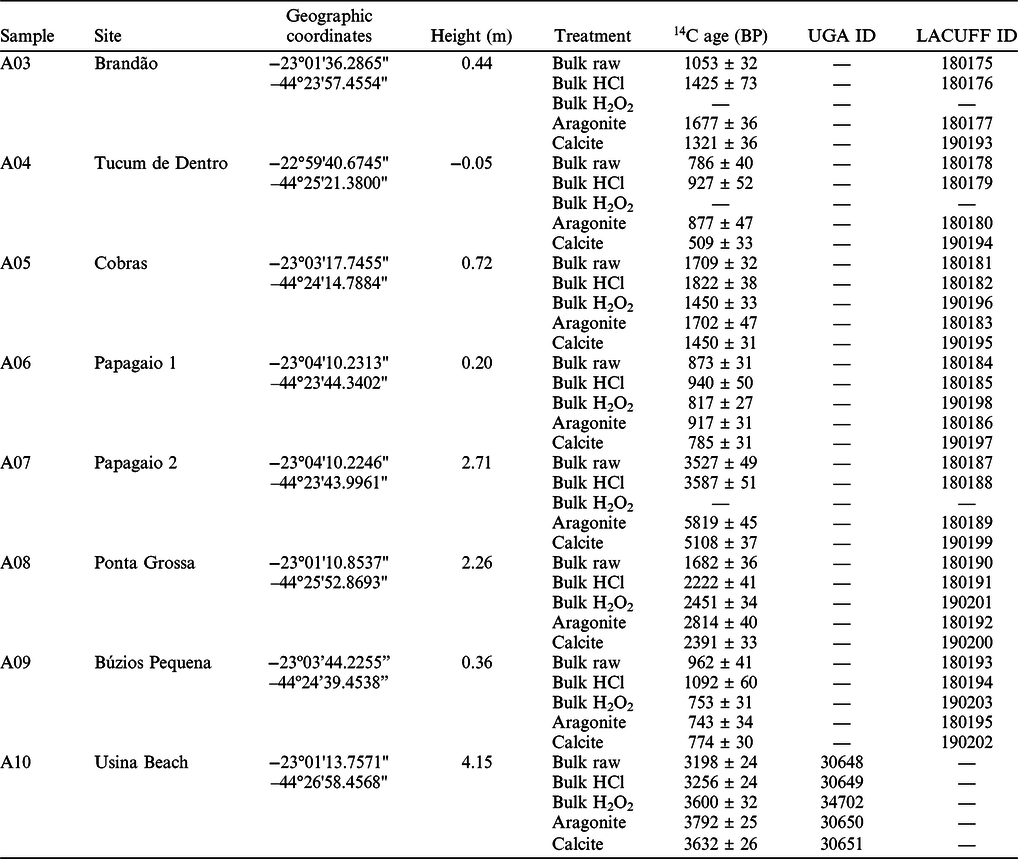
The resulting orthometric heights of the fossil vermetidae range from –0.05 to 4.15 m above MSL, with corresponding geographic coordinates (SIRGAS 2000 datum) and ellipsoidal heights. The results of orthometric heights and radiocarbon ages are presented in Table 3.
Altitude and chronology of the bioindicators.

There is observable difference in the age range after the CarDs treatment (dating of the original aragonite fraction, before the recrystallization process).
Preliminary Sea-Level Fluctuation Curve
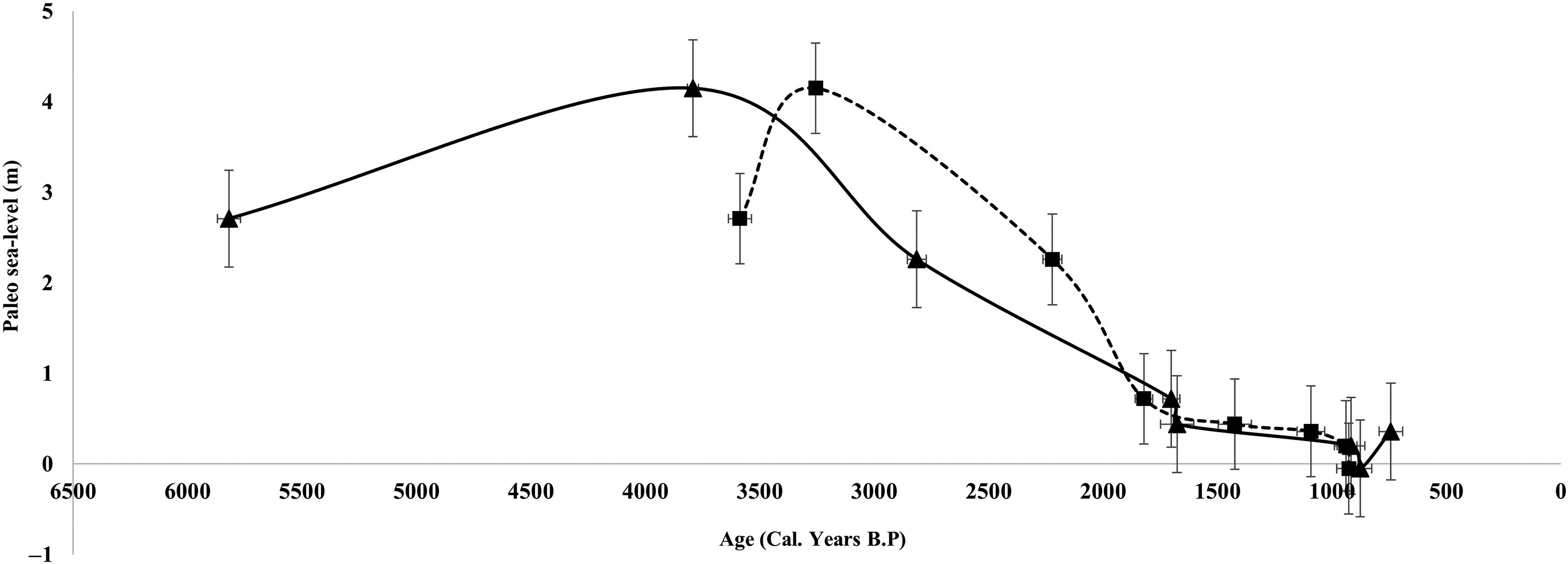
The different protocols for radiocarbon dating in fossil vermetids can considerably impact the interpretation of sea-level behavior during the Holocene, as shown in Figure 3. Ages obtained after sample treatment with HCl are more recent, with differences of up to 2000 years. Despite few samples, the preliminary curve corroborates with other studies carried out in the region, such as Delibras and Laborel (Reference Delibrias and Laborel1969), Martin and Suguio (Reference Martin and Suguio1978), Martin et al. (Reference Martin, Suguio, Flexor, Bittencourt and Vilas-Boas1979, 1980), Suguio et al. (Reference Suguio, Martin, Bittencourt, Dominguez, Flexor and Azevedo1985), Martin and Suguio (Reference Martin and Suguio1989), Dias (Reference Dias2009), Castro et al (Reference Castro, Suguio, Seoane, Cunha and Dias2014), and Jesus et al. (Reference Jesus, Dias, Muniz, Macário, Seoane, Quattrociocchi, Cassab, Aguilera, Souza, Alvez, Chanca, Carvalho and Araujo2017), showing a progressively increasing sea level up to the transgressive maximum of 4.15 ± 0.5 m to about 3792 ± 25 cal years BP, followed by regression with possible fluctuations to the current sea level.
Effect of age difference on the sea-level variation curve with SPT treatment. Squares correspond to the ages obtained after treatment with HCl, while ages for samples dated from the original aragonite content are represented by triangles.

The solid line shows a similar trend to the ones of the Brazilian coast and elsewhere in the Southern Hemisphere (Angulo and Lessa Reference Angulo and Lessa1997; Ramsay and Cooper Reference Ramsay and Cooper2002; Milne et al. Reference Milne, Long and Bassett2005; Sloss et al. Reference Sloss, Murray-Wallace and Jones2007; Martinez and Rojas Reference Martinez and Rojas2013). Sea-level behavior during the Holocene in the coast of Southeast Brazil is represented by a rise of the sea-level between 6000 and 4000 years BP, reaching a peak then (Suguio et al. Reference Suguio, Martin, Bittencourt, Dominguez, Flexor and Azevedo1985; Dias et al. Reference Dias, Breves-Ramos, Pimenta, Junqueira, Seoane, Castro and Ramos2011; Castro et al. Reference Castro, Suguio, Seoane, Cunha and Dias2014; Jesus et al. Reference Jesus, Dias, Muniz, Macário, Seoane, Quattrociocchi, Cassab, Aguilera, Souza, Alvez, Chanca, Carvalho and Araujo2017), followed by a regression to the current zero.
DISCUSSION
Vermetidae are organisms that during their lives build reefs (biological carbonate concretions) forming complex structures that occupy the middle portion of the region between tides of rocky shores (Breves-Ramos et al Reference Breves-Ramos, Junqueira, Lavrado, Silva and Ferreira-Silva2010). They are currently considered by several authors as one of the most reliable indicators of sea level variation (Suguio et al. Reference Suguio, Martin, Bittencourt, Dominguez, Flexor and Azevedo1985; Angulo and Lessa Reference Angulo and Lessa1997; Vescogni et al. Reference Vescogni, Bosellini, Reuter and Brachert2008; Dias Reference Dias2009; Spotorno-Oliveira et al. Reference Spotorno-Oliveira, Tâmega, De Oliveira, Castro, Coutinho, Iryu and Bassi2016; Jesus et al Reference Jesus, Dias, Muniz, Macário, Seoane, Quattrociocchi, Cassab, Aguilera, Souza, Alvez, Chanca, Carvalho and Araujo2017; Areias et al. Reference Areias, Spotorno-Oliveira, Bassi, Iryu, Nash, Castro and Tâmega2020). Their strict ecology on the coast means that the vermitids occupy the intertidal region and colonize rocky shores up to 1 m above the current sea level in regions of low tide and low wave exposure (Angulo et al. Reference Angulo, Lessa and Souza2006).
Vermetidae are considered excellent indicators of sea level due to their wide distribution, abundance and narrow vertical range of occurrence, ensuring accuracies of ± 10 cm (Laborel Reference Laborel and Van de Plassche1986; Baker and Haworth Reference Baker and Haworth1997; Baker et al. Reference Baker, Haworth and Flood2001; Angulo and Souza Reference Angulo and Souza2014). However, inaccuracies may be related to (1) fossil formation processes and (2) the degree of exposure to waves. Such factors can be minimized by considering the recrystallization process at the time of dating, that is, the replacement of aragonite by calcite (Silenzi et al. Reference Silenzi, Antonioli and Chemello2004) and ± 0.50 m in sheltered shores and ± 1.0 m in exposed shores (Jesus et al. Reference Jesus, Dias, Muniz, Macário, Seoane, Quattrociocchi, Cassab, Aguilera, Souza, Alvez, Chanca, Carvalho and Araujo2017).
Previously, sea-level data for the region covered only the last 3500 years BP, at a maximum sea level about 3 m above the current (Suguio et al. Reference Suguio, Martin, Bittencourt, Dominguez, Flexor and Azevedo1985). Dias et al Reference Dias, Breves-Ramos, Pimenta, Junqueira, Seoane, Castro and Ramos2011 reported the occurrence of fossil vermetids in the Bay of Ilha Grande at 2.5 m above sea level dated 2810 ± 95 years cal BP. Martin and Suguio (Reference Martin and Suguio1978) dated two samples of oysters (5200 ± 200 years AP and 4800 ± 200 years BP) at about 4.8 m above current sea level. Despite signaling an altitude higher than that recorded in the present study, Angulo et al. (Reference Angulo, Lessa and Souza2006) reinforces that oysters can live in a wide range of altitude, being limited of limited use as paleo-indicators of the level of the sea.
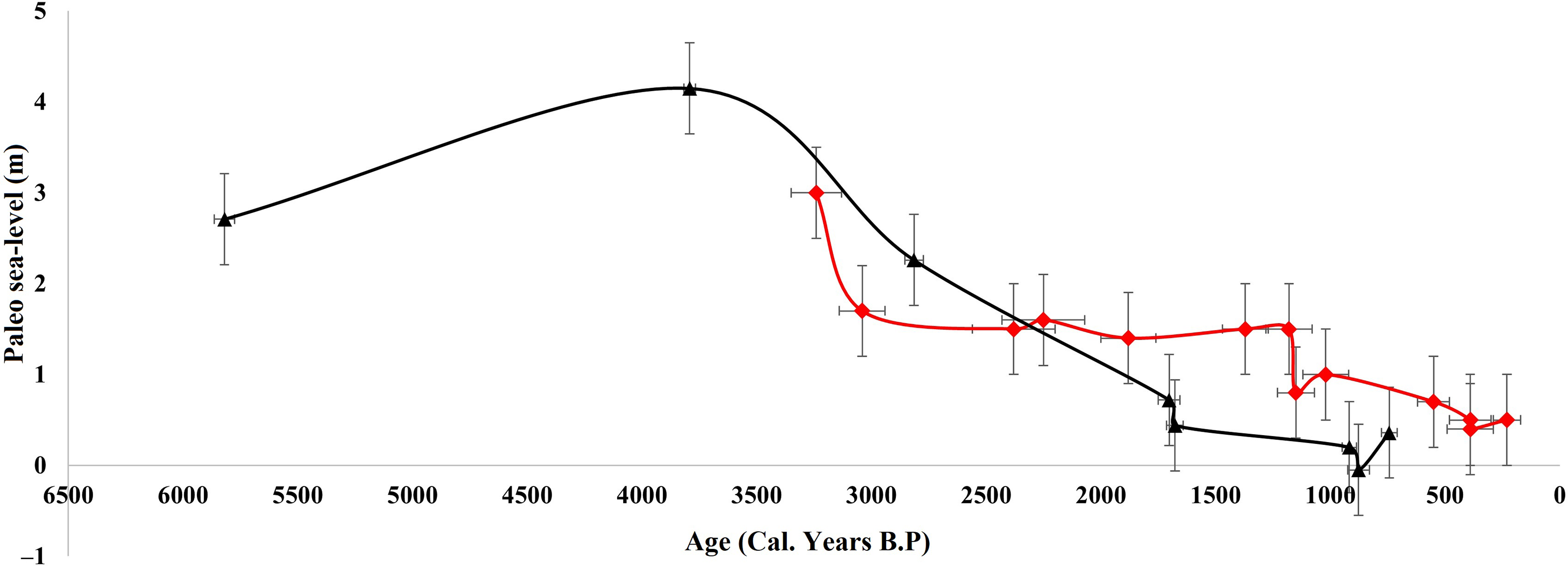
Figure 4 shows the proposed sea-level curve (black line) compared to a curve obtained from old data from by Delibras and Laborel (Reference Delibrias and Laborel1969), Martin and Suguio (Reference Martin and Suguio1978), Martin et al. (Reference Martin, Suguio, Flexor, Bittencourt and Vilas-Boas1979, 1980), Suguio et al. (Reference Suguio, Martin, Bittencourt, Dominguez, Flexor and Azevedo1985) and Martin and Suguio (Reference Martin and Suguio1989) for the same region (red line). The comparison of the two trend lines highlights the differences between the dating methods, as well as the compromises in the interpretation of the old data, and the need for and importance of collecting new data for the region.
Sea-level curve form age-dated vermetids from the SPT treatment (aragonite—black line). Curve composed from data compiled for the Ilha Grande Bay region (red line). Data compiled from Delibras and Laborel (Reference Delibrias and Laborel1969), Martin and Suguio (Reference Martin and Suguio1978), Martin et al. (Reference Martin, Suguio, Flexor, Bittencourt and Vilas-Boas1979, 1980), Suguio et al. (Reference Suguio, Martin, Bittencourt, Dominguez, Flexor and Azevedo1985), and Martin and Suguio (Reference Martin and Suguio1989). (Please see electronic version for color figures.)

The data obtained for sea-level fluctuation indicators for the Ilha Grande Bay, in Southeast Brazil, corroborates with the various curves already presented for the Brazilian east coast (Angulo and Lessa Reference Angulo and Lessa1997; Jesus et al. Reference Jesus, Dias, Muniz, Macário, Seoane, Quattrociocchi, Cassab, Aguilera, Souza, Alvez, Chanca, Carvalho and Araujo2017; Castro et al. Reference Castro, Seoane, Cunha, Malta, Oliveira, Vaz and Suguio2018). It shows a transgressive maximum between 5000 and 3500 years BP, following a regressive movement, not without significant oscillations, to the current zero. In Suguio et al. (Reference Suguio, Martin, Bittencourt, Dominguez, Flexor and Azevedo1985) several RSL curves are presented for the Brazilian coast, including the study for Angra dos Reis, which contemplates only the last 2500 years BP and presents some oscillations. However, the authors infer the existence of two transgressive maxima, the first just over 3 m between 3650 and 3450 years BP and the second of about 4.8 m at 5200 years BP. The present data can contribute to this discussion because it presents indicators with a height of 2.71 m in ca. 5819 cal years BP and 4.15 m at ca. 3792 cal years BP.
The new indicators cover the last 6000 years and only show subtle oscillations—within the margin of errors of the indicators, unlike the only other published curve for this region (Suguio et al. Reference Suguio, Martin, Bittencourt, Dominguez, Flexor and Azevedo1985), which has several sea-level oscillations for the last 2500 years BP. Such differences are explained by the use of different indicators, precision altitude reading and dating methodologies. However, oscillations can be masked by the construction of the curves, disguising subtler sea-level variations, often identified in the height range of the vermetid inlays. As more samples are used, these subtleties will tend to appear more.
Few studies related to sea-level variation in Brazil describe the pretreatment for radiocarbon dating of its biological indicators. The ages of fossil vermetids presented in previous curves did not consider the effect of aragonite recrystallization into calcite (Suguio et al. Reference Suguio, Martin, Bittencourt, Dominguez, Flexor and Azevedo1985; Dias Reference Dias2009; Dias et al. Reference Dias, Breves-Ramos, Pimenta, Junqueira, Seoane, Castro and Ramos2011; Castro et al. Reference Castro, Suguio, Seoane, Cunha and Dias2014), which can increase the margin of uncertainty with the rejuvenation of ages. Angulo et al. (Reference Angulo, Giannini, Suguio and Pessenda1999) point to the importance of pretreatment with rapid immersions in HCl (2%) to eliminate secondary carbonate in vermetid tubes. However, this is not enough to eliminate the secondary calcite fraction, as shown in the present study, for example, in the age difference before and after pretreatment with SPT, for sample A07 (Bulk HCl 3587 ± 51 yr; Aragonite 5819 ± 45). Ribeiro et al. Reference Ribeiro, Giannini, Nascimento Junior and Sayeg2011 recognize the considerable role of recrystallization in calculating ages by 14C in fossil vermetid samples from the coast of Espírito Santo (southeastern Brazil). The authors carried out mineralogical analysis of fossil vermetids by XRD (X-ray diffraction) which showed a tendency of calcite and aragonite mixed at the upper levels (related to the oldest samples), and of purely aragonitic composition, in the lower ones (newer samples). The authors also observed, through SEM (scanning electron microscope), layers of secondary calcite covering aragonite tubes in greater proportions in the samples with upper levels. This trend is also noted here, as shown in Tables 1 and 3.
Disregarding the effects of the recrystallization process may lead to errors and interfere with sample age results, as well as problems related to calibration, thus compromising data interpretation. Age calibration aims to correct variations in atmospheric isotopic concentrations caused by several factors (Hajdas 2009; Queiroz-Alves et al. Reference Queiroz-Alves, Macario, Ascough and Ramsey2018). In addition to this, it is important to consider the reservoir effect whenever the medium presents a different isotopic concentration than the current atmosphere (Macario and Alves Reference Macario and Alves2018), as in the case of vermetid shell samples. Previously published sea-level variation curves for sections of the Brazilian east coast were reconstructed after normalization and age calibration 14C (Suguio et al.Reference Suguio, Martin, Bittencourt, Dominguez, Flexor and Azevedo1985; Martin et al. Reference Martin, Dominguez and Bittencourt2003), thus emphasizing the need for age calibration to correct the interpretation of the data.
Other factors must be considered in relation to the precision of the fossil vermitid altitudes: (1) the amplitude of the occurrence of living vermitid in relation to fossil ones; (2) local hydrodynamics; (3) presence of shelter in the rocks (cracks and fractures) to protect against mechanical abrasion by waves and chemical weathering by meteoric water; (4) salinity and water temperature and luminosity; (5) neotectonic events (Angulo et al. Reference Angulo, Giannini, Suguio and Pessenda1999; Ribeiro et al. Reference Ribeiro, Giannini, Nascimento Junior and Sayeg2011; Angulo and Souza Reference Angulo and Souza2014). In the region of Angra dos Reis, living vermetids embedded in rocky shores occur at about –0.4 m (±0.05 m; Dias et al. Reference Dias, Breves-Ramos, Pimenta, Junqueira, Seoane, Castro and Ramos2011), typical amplitude of occurrence in bay regions.
It is possible that certain parts of the coast have been affected by a continental flexural mechanism, but this phenomenon seems to have an influence on a much larger scale of time than the Holocene (Martin and Suguio Reference Martin and Suguio1976). For some authors, the important role of neotectonics in the evolution of the Brazilian coast is almost unquestionable, with evidence of horizontal displacements of holocenic paleolines on the coast of the Brazilian coast as a consequence of vertical tectonic movements (Martin et al. Reference Martin, Bittecourt, Flexor and Vilas-Boas1984) and tectonic fractures appearing in the Barreiras Formation in the extreme north of Bahia (Lima Reference Lima2010) as excellent examples. Suguio and Martin (Reference Suguio and Martin1996), on the other hand, believe there is much speculation on the subject and a lack of scientific studies based on actual field and laboratory data, essential for getting a more reliable picture on the matter. Even in the marginal basins studied in the most detail, the majority of what is known about it is restricted to Cretaceous and Paleogene, and rarely have they been studied from a neotectonic point of view. It is therefore required and recommended that many more studies which encompass time and space scales are done for a better understanding of the true role played by neotectonics in the evolution of the Brazilian coast.
Thus, the importance of pretreatment of the samples by the CarDS method is observed in order to remove recent carbon contamination and avoid rejuvenation of measured ages (Douka et al. Reference Douka, Hedges and Higham2010; Moreira et al. Reference Moreira, Macario, Guimarães, Dias, Araújo, Jesus and Douka2020). In addition, for statistical analysis, it is necessary to consider the set of samples and the evidence from the field. Sea-level variation curves using multiproxy data may be the key to paleoenvironmental interpretations. For example, accumulations of shells in life may indicate transgressive highs and old beachrock shorelines lows (Ramsay Reference Ramsay1996; Ramsay and Cooper Reference Ramsay and Cooper2002; Lewis et al. Reference Lewis, Wust, Webster and Shields2008; Dias Reference Dias2009; Spotorno-Oliveira et al. Reference Spotorno-Oliveira, Tâmega, De Oliveira, Castro, Coutinho, Iryu and Bassi2016; Cunha et al. Reference Cunha, Castro and Carvalho2018; Ramsay and Cooper Reference Ramsay and Cooper2002; Malta and Castro Reference Malta and Castro2018). Thus, the use of several types of indicators can provide information for a more complete paleoenvironmental reconstruction.
CONCLUSION
The separation of the original fraction of aragonite from secondary calcite by density (SPT) proved to be efficient for dating by 14C. The new data presented contribute to the existing curves for the southeastern coast of Brazil and can fill the lack of data for the period of 6000 to 3500 years BP. According to the indicators, the sea level during the Holocene in the Angra dos Reis region behaved similarly to the rest of the Brazilian coast, although presenting a relatively higher transgressive maximum than most other published data for the State of Rio Janeiro. More surveys are needed to increase the accuracy of interpretation.
The new occurrences of fossil vermetidae and associated data expand the current knowledge of sea-level variations in southeastern Brazil. Through the process of recrystallization in vermetid fossils (transformation of aragonite to calcite in calcium carbonates) the ages of the samples can be rejuvenated, leading to misinterpretation. Over the years, research related to sea-level variations during the Holocene has warned us about changes in sample ages by recrystallization processes (Mendonça and Godoy Reference Mendonça and Godoy2004; Angulo et al. Reference Angulo, Lessa and Souza2006; Ribeiro et al. Reference Ribeiro, Giannini, Nascimento Junior and Sayeg2011; Angulo and Souza Reference Angulo and Souza2014; Jesus et al. Reference Jesus, Dias, Muniz, Macário, Seoane, Quattrociocchi, Cassab, Aguilera, Souza, Alvez, Chanca, Carvalho and Araujo2017). The CarDS protocol is used to overcome this problem.
Sea-level variation curve building needs to consider several factors regarding data collection: (1) types of marine paleo level indicators and their limitations, (2) precise methods for surveying the altitudes of the samples, and (3) pretreatment protocol for radiocarbon dating. Thus, we suggest continuing the surveying of indicators so that the behavior of sea level during the Holocene in the region becomes better understood, from samples dated after the SPT pretreatment. Improving the sea-level fluctuation curves contributes to more reliable paleoenvironmental reconstructions and to the determination of sea-level variation rates during the Holocene, which in turn subsidizes the simulations related to the sea-level rise foreseen for the current century. Such simulations identify areas most vulnerable to coastal flooding, coastal erosion, loss of habitats and many other impacts related to rising sea levels.
ACKNOWLEDGMENTS
The authors would like to thank Brazilian financial agencies CNPq (Conselho Nacional de Desenvolvimento Científico e Tecnológico, 307771/2017-2 and INCT-FNA, 464898/2014-5) and FAPERJ (Fundação Carlos Chagas Filho de Amparo à Pesquisa do Estado do Rio de Janeiro, E-26/110.138/2014 and E26/203.019/2016) for financial support. This study was financed in part by the Coordenação de Aperfeiçoamento de Pessoal de Nível Superior - Brasil (CAPES) - Finance Code 001 and CLIMATE-PRINT-UFF (88887.310301/2018-00). We thank the editors and reviewers for comments and suggestions, which helped to improve the quality of the manuscript. This article is a tribute to Prof. Dr. Kenitiro Suguio, who contributed so much to studies related to sea level fluctuations during the Holocene in Brazil.