Products from goat's milk have become significantly important in many parts of the world (da Silva Pdl et al., Reference da Silva Pdl, de Fátima Bezerra M, Dos Santos Kmo and Correia2015), promoted as healthy substitutes for cow milk, particularly for those with certain gastrointestinal disorders (da Silva Tms et al., Reference da Silva Tms, Piazentin, Mendonça, Converti, Bogsan, Mora and de Souza Oliveira Rp2019). Goat milk is claimed to have higher digestibility, alkalinity, buffering capacity, and mineral and vitamin contents and is often hypoallergenic compared to cow milk (Mituniewicz-Małek et al., Reference Mituniewicz-Małek, Pilarczyk, Tomza-Marciniak, Pilarczyk and Bakowska2017). Goat milk is claimed to have health-promoting benefits, including antihypertensive properties, antiallergenic attributes and lower cholesterol levels (Hafeez et al., Reference Hafeez, Muzammil, Ahmad, Alsulami, Waseem, Mehmood, Muhammad Aadil, Manzoor and Abdi2024). It also facilitates the long-term survival of probiotics due to its favourable properties (Ranadheera et al., Reference Ranadheera, Naumovski and Ajlouni2018). Different food matrices derived from goat milk, such as cheese (Pappa et al., Reference Pappa, Kondyli, Bosnea, Malamou and Vlacho2022), yoghurt (Costa et al., Reference Costa, Paula, Barão, Klososki, Bonafé, Visentainer, Cruz and Pimentel2019) and ice cream (da Silva Pdl et al., Reference da Silva Pdl, de Fátima Bezerra M, Dos Santos Kmo and Correia2015), have been studied as potential delivery vehicles for viable probiotics.
Ice cream is widely consumed by all age groups all over the world due to its taste characteristics and cooling effect, but can also have good nutritional properties (Durmaz et al., Reference Durmaz, Kilicli, Toker, Konar, Palabiyik and Tamtürk2020; Huang et al., Reference Huang, Wu, Xu, Cheng, Tao, Jing, Tang, Li, Liang, Zhang, Granato and Sun2024). Traditional ice cream ingredients (milk, sugar, emulsifier and stabilizers) determine the final quality of the ice cream. Additionally, the production process affects its final quality, and the aging process plays a key role in the formation of the desired flavour (Siriwardhana et al., Reference Siriwardhana, Rasika, Dinusha, Wadv and Priyashantha2024).
Functional foods are foods containing components that can positively affect the health conditions of consumers, and demand for functional foods is growing rapidly (Ckz et al., Reference Ckz, Leng, Lim and Du2024). Probiotic dairy products represent one of the most developed segments of the functional foods industry (Zhou et al., Reference Zhou, Sarwar, Xue, Hu, Wu, Aziz, Alasmari, Yang and Yang2024). Ice cream has a big potential to be developed as a functional food due to the consumer's high level of demand and functionalization with fruits rich in phenolics, probiotics and prebiotics (Oztürk et al., Reference Oztürk, Demirci and Akın2018). Another factor increasing the role of ice cream as a probiotic carrier food is the protective roles of milk proteins, lipids, lactose and other components for the survival of probiotics (Cruz et al., Reference Cruz, Antunes, Sousa, Faria and Saad2009). Although the ideal number of viable probiotic microorganisms has not been universally established, levels between 106 and 107 CFU/g are commonly recommended to be resistant to the gastrointestinal environment (Abadía-García et al., Reference Abadía-García, Cardador, Campo, Arvízu, Castaño-Tostado, Regalado- González, García-Almendarez and Amaya-Llano2013). The loss of probiotic bacteria in ice cream cannot be avoided during product formulation, processing, storage and melting (Hanafi et al., Reference Hanafi, Kamaruding and Shaharuddin2022). In addition to the necessary probiotic survival in the final product, sensory characteristics are identified as a major factor in influencing the acceptance of functional foods (Urala and Lahteenmaki, Reference Urala and Lahteenmaki2007).
Probiotic microorganisms should confer characteristics such as resistance to gastrointestinal tract conditions, auto-aggregation ability and adhesion to the intestinal mucosa (Gut et al., Reference Gut, Vasiljevic, Yeager and Donkor2018). The potential health-beneficial effects of probiotics include epithelial barrier enhancement and competitive exclusion to eliminate the pathogenic organism, antimicrobial substance production, prevention of diarrhoeal diseases, hypo-cholesterolemic effect, prevention of diabetes and anti-cancer activity (Das et al., Reference Das, Pradhan, Chakrabarti, Mondal and Ghosh2022). Lactobacillaceae are commonly utilized as probiotics in commercial dairy products (Hanafi et al., Reference Hanafi, Kamaruding and Shaharuddin2022). Limosilactobacillus fermentum is a probiotic strain that has attracted attention due to excellent adhesion to epithelial cell lines and resistance to gastrointestinal conditions in vitro (Mahmoudi et al., Reference Mahmoudi, Ben Moussa, Khaldi, Kebouchi, Soligot, Le Roux and Hassouna2016, Reference Mahmoudi, Ben Moussa, Boulares, Chouaibi and Hassouna2022). Our objective in this work was to compare the physicochemical characteristics, meltdown behaviour and sensory properties of goat milk ice cream produced with and without the probiotic bacteria L. fermentum CABA16. In addition, the potentially probiotic ice cream was evaluated with regard to the viability of the probiotic strain during storage. In order to assess the ability of the probiotic cells to survive under acid and bile stress, in vitro tests that simulate harsh gastrointestinal conditions were conducted in ice cream samples after 30 and 120 days of frozen storage.
Materials and methods
Probiotic strains conditions
The L. fermentum CABA16 is a recommended probiotic strain that has been isolated from camel milk (Mahmoudi et al., Reference Mahmoudi, Ben Moussa, Khaldi, Kebouchi, Soligot, Le Roux and Hassouna2016). For the cultivation of probiotic strains, L. fermentum was cultured in sterile de Man, Rogosa and Sharpe (MRS) broth and incubated overnight at 37 °C. The probiotic strain was grown in 5 l of MRS broth to obtain the desired levels before inoculation into the ice cream mixture. Following the incubation periods, probiotic cultures were centrifuged at 10,000 rpm for 10 min at 22 °C, and pellets were washed twice with PBS and inoculated into the pasteurized ice cream mix at 37 °C before and after aging steps.
Goat milk ice cream production process
Ice cream was produced from goat milk as described by da Silva Pdl et al. (Reference da Silva Pdl, de Fátima Bezerra M, Dos Santos Kmo and Correia2015) using dried goat milk (MERCI FIT, Tunisia), emulsifier (Base 50, GIAS, Tunisia), commercial sugar and sahlep (which was utilized as a stabilizer and thickening agent) and vanilla flavour (Aromatech, Tunis, Tunisia). Two distinct samples were prepared: ice cream without the addition of probiotics as Control (CIC) and ice cream inoculated with probiotics (PIC). Briefly, batches of 6.5 kg were prepared by mixing all the ingredients thoroughly followed by pasteurization at 70 °C for 30 min. The mixture was cooled and transferred to a refrigerated tank (Samsung, Korea) where the samples were aged at 4 °C for 20 h. After that, pasteurized goat milk (Farm of Mateur, Bizerte, Tunisia), previously incubated for 3 h at 37 °C with L. fermentum probiotic culture (109 CFU/ml), was added to PIC batches. The CIC samples had the same quantity of goat milk without probiotic added. The aged mixes (PIC and CIC) received the vanilla flavour, and the mixtures were frozen using an ice cream maker (Frigotechnique, Tunisia). The ice cream batches were drawn, conditioned into 500 ml polyethylene containers and stored in a horizontal freezer (Frigotechnique, Tunisia) at −18 °C for 24 h to harden. Three batches of each ice cream sample (PIC and CIC) were collected for triplicate analysis for each day of the frozen storage period.
Chemical parameters of ice cream products
Both PIC and RIC were analysed for their physicochemical characteristics. The pH, total solids, soluble solids, ash, fat and protein were determined according to AOAC Association of Official Analytical Chemists (1998). Total sugars were determined by a modified 3.5-dinitrosalicylic acid method of Miller (Reference Miller1959).
Viable probiotic counts
In order to assess the viability of L. fermentum probiotic strain during storage, samples of the ice cream were analysed after 7, 30, 60, 90 and 120 days of frozen storage. The L. fermentum count was conducted according to Mahmoudi et al. (Reference Mahmoudi, Ben Moussa, Boulares, Chouaibi and Hassouna2022). Probiotic culture numbers were determined by the pour plating technique using MRS-LP agar (Oxoid, UK) followed by anaerobic incubation at 37 °C for 48 h.
Overrun level
The overrun of the ice cream samples was calculated after 1 week of frozen storage according to Akin et al. (Reference Akin, Akin and Kirmaci2007) using the following equation:
 \begin{equation*}\% {\text{Overrun}} = \left[ {\left( {{W_1} - {W_2}} \right)/{W_2}} \right] \times 100\end{equation*}
where W 1 is the weight of the mix and W 2 is the weight of the same volume of ice cream.
Meltdown test
The meltdown test was conducted according to Hanafi et al. (Reference Hanafi, Kamaruding and Shaharuddin2022). After 1 week of frozen storage, 100 g of each ice cream sample was left to melt on a wire mesh screen (dimension size: 0.5 cm × 0.5 cm) at 25 ± 1 °C for 80 min. Then, the melted ice cream was weighed in order to calculate the melting rate as follows:
 \begin{equation*}\% {\text{Melting}}\,{\text{rate}} = \left[ {\left( {{W_1}} \right)/{W_2}} \right] \times 100\end{equation*}
where W 1 is the weight of the ice cream melt and W 2 is the weight of ice cream.
In vitro gastrointestinal tolerance assay
In order to study the effect of frozen storage on the cell viability under simulated gastrointestinal conditions, two experimental groups were investigated: probiotic ice cream samples after 30 and 120 days of frozen storage at −18 °C. The tolerance of L. fermentum to in vitro simulated gastric and enteric conditions was performed according to the method previously described by Buriti et al. (Reference Buriti, Castro and Saad2010), with modifications. Initially, 25 g of samples were homogenized in 225 ml of 0.5 g/100 ml NaCl solution. For the gastric phase simulation, the pH of aliquots (10 ml) was adjusted to 2.1–2.6 with 0.5 ml of HCl (0.5 mol/l) and 0.3 ml of pepsin solution (3 g/l, Sigma-Aldrich, France). Then, flasks were incubated at 37°C for 2 h with agitation. In order to simulate enteric conditions, the pH of samples was increased to 4.9–5.4 using an alkaline solution (150 mL of 1 mol//l NaOH solution, 14 g of PO4H2Na, 2H2O and distilled water up to 1 l). Bovine bile (Sigma-Aldrich, France) and pancreatin (Sigma-Aldrich, France) were added to reach a concentration of 10 and 1 g/l, respectively. After that, samples were reincubated at 37 °C for 2 h under agitation. After 4 h, the pH was increased to 7.5–7.7 using the same alkaline solution, bile and pancreatin concentrations were added (10 and 1 g/l, respectively) and samples were incubated again at 37 °C for 2 h under agitation, achieving 6 h of assay. The enumeration of L. fermentum was performed in aliquots collected after 2, 4 and 6 h.
Sensorial analysis
The hedonic sensory analyses were performed with 30 trained panelists (Professors and Students in the High School of Food Industry, ESIAT, Tunisia). The individuals were also regular consumers of ice cream and not allergic to milk. Ice cream samples CIC and PIC were evaluated for overall appearance, aroma, consistency and overall flavour using a structured 9-point hedonic scale ranging from 1 (dislike extremely) to 9 (like extremely) according to Meilgaard et al. (Reference Meilgaard, Civille and Carr1999). Each sample (20 g) was coded using three-digit-coded glass beakers. The ice cream samples were sensory evaluated after 1 week of frozen storage.
Statistical analysis
The quantitative data were analysed using SPSS Statistics 20.0 to perform a statistical analysis of the results with one-way analysis of variance. Tukey’s test (at the significance level of P < 0.05) was performed to determine significant differences between the means. Data are presented as mean ± standard deviation. The experiments were carried out in triplicate. The equations that describe the melting behaviour were obtained by regression analysis.
Results and discussion
Physicochemical characterization
The chemical characteristics of the ice cream products are given in Table 1. The addition of L. fermentum led to lower pH (P < 0.05), but it had no significant effect on the other physicochemical properties of goat ice cream samples. Our results are in agreement with prior records reported by Ranadheera et al. (Reference Ranadheera, Evans, Adams and Baines2013) and Sarwar et al. (Reference Sarwar, Aziz, Al-Dalali, Zhang, Ud Din, Chen, Cao, Fatima and Yang2021). The pH value of 6.25 is higher than 5.5, which can significantly reduce viable probiotic bacteria (Ziarno et al., Reference Ziarno, Cichonska, Kowalska and Zareba2024). For total solid content, Goktas et al. (Reference Goktas, Dikmen, Bekiroglu, Cebi, Dertli and Sagdic2022) reported that values range between 30.60 and 33.51 g/100 g of ice creams inoculated with Saccharomyces boulardii and Lactobacillus rhamnosus.
Physico-chemical characterization of samples goat milk ice cream without the addition of probiotics (CIC) and goat milk ice cream with added L. fermentum CABA16 (PIC)

Results are presented as mean ± standard deviation (n = 6).
a, b: means in the same row followed by different letters are significantly different (P < 0.05).
Overrun and meltdown tests
The overrun expresses the expansion of ice cream resulting from the air incorporation into the product. Our results for CIC and PIC samples (Table 1) are similar (46.0 ± 0.34 and 46.5 ± 0.49 g/100 g, respectively) but higher than those prepared with L. rhamnosus GG (Alamprese et al., Reference Alamprese, Foschino, Rossi, Pompei and Savani2005). Goktas et al. (Reference Goktas, Dikmen, Bekiroglu, Cebi, Dertli and Sagdic2022) revealed that overrun was affected by the inoculation of S. boulardii. In contrast, some reports have shown that the probiotic strain does not affect the overrun (Abghari et al., Reference Abghari, Sheikh-Zeinoddin and Soleimanian-Zad2011).
Besides the overrun, the melting characteristics are important for the storage stability and consumer perception of ice cream in terms of mouthfeel and flavour release (Durmaz et al., Reference Durmaz, Kilicli, Toker, Konar, Palabiyik and Tamtürk2020). The evolution of drained ice cream with time is shown in Fig. 1. The curve presents a sigmoidal shape, which was used to obtain the regression equations that correlate the drained volume y and time x: for CIC (y = 2.88x − 6.94, R 2 = 0.974) and for PIC (y = 2.76x − 11.91, R 2 = 0.968) ice cream products. Results show similar melting rates (P > 0.05) for PIC and CIC samples. Goktas et al. (Reference Goktas, Dikmen, Bekiroglu, Cebi, Dertli and Sagdic2022) reported that addition of probiotic S. boulardii and L. rhamnosus did not remarkably affect the melting properties of ice cream products. Several parameters influence the melting behaviour, including the overrun (Sofjan and Hartel, Reference Sofjan and Hartel2004), the fat content and use of fat replacers, as well as the type of milk (Karaca et al., Reference Karaca, Guven, Yasar, Kaya and Kahyaoglu2009). Both PIC and CIC samples were prepared using the same type of milk and they have similar chemical composition and overrun values.
Melting behaviour of regular goat milk ice cream without the addition of probiotics (CIC) and with added L. fermentum (PIC). The error bars represent the standard deviation (n = 6).

Viable probiotic counts during storage
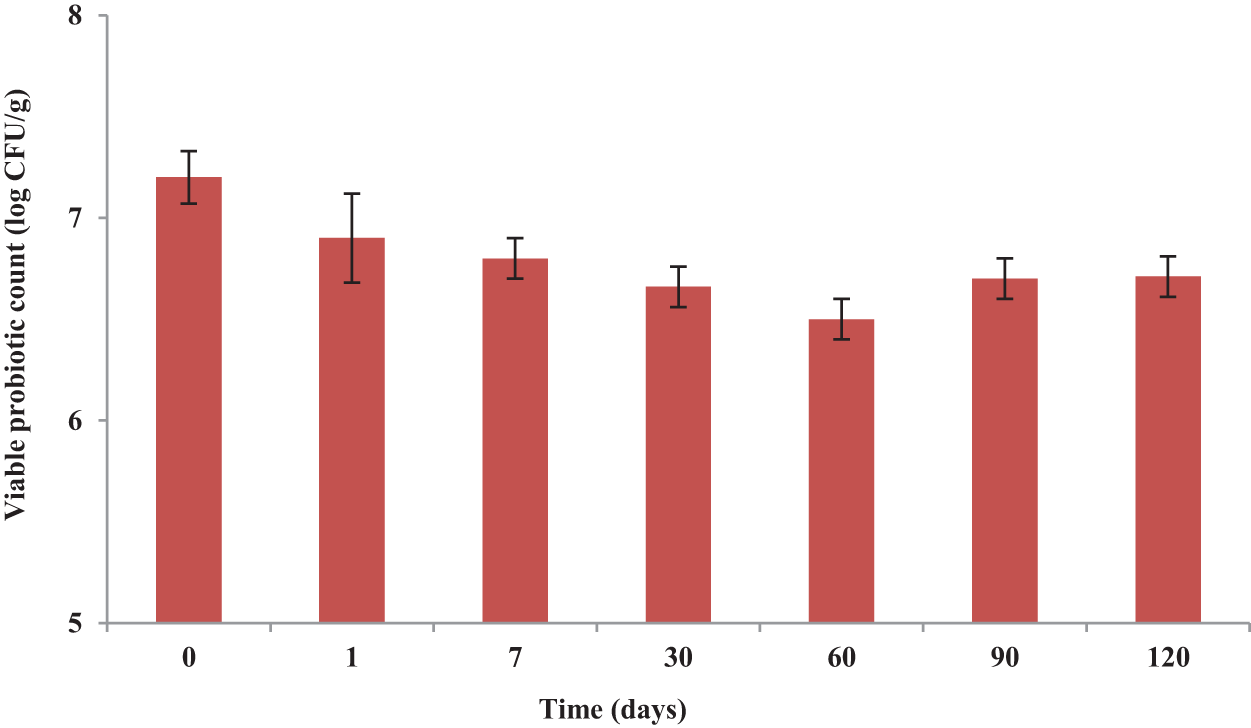
The count of L. fermentum decreased during the first day after processing (Fig. 2). After the first 2 h of frozen storage, a reduction of cell counts (1.08 log unit) was observed. According to Jay (Reference Jay2000), the microbial reduction is higher at the beginning of the freezing process and tends to decrease as the freezing progresses which agrees with our findings, which show a severe decline in probiotic population during the first 8 h and stabilization of the bacterial counts after that. Severe cell injuries caused by the physical stress involved in freezing and osmotic impacts were most probably part of such reduction (Tolve et al., Reference Tolve, Zanoni, Ferrentino, Gonzalez-Ortega, Sportiello, Scampicchio and Favati2024). Moreover, the decrease in probiotic viability during freezing may have resulted from mechanical stress of the mixing for incorporation of air into the mix leading to oxygen toxicity (Ranadheera et al., Reference Ranadheera, Evans, Adams and Baines2013). Despite the detected viability loss, the probiotic counts were kept near 7 log CFU/g, which means a high survival rate of 90%. This result is similar to those observed in ice cream produced with different cream levels (Turgut and Cakmakci, Reference Turgut and Cakmakci2009). In contrast, Ranadheera et al. (Reference Ranadheera, Evans, Adams and Baines2013) obtained higher probiotic bacteria survival in goat ice cream packaged with different packaging materials. The use of oxygen impermeable containers such as glass has been recommended in order to improve the viability of probiotics in dairy products (Shah, Reference Shah2000).
Viable counts of L. fermentum in goat milk ice cream during 120 days of frozen storage. The error bars represent the standard deviation (n = 6).

The viability of L. fermentum fluctuated along the 120 days of frozen storage (Fig. 2). Salem et al. (Reference Salem, Fathi and Awad R2005) found similar numbers after 12 weeks of storage, reporting a decrease of 1.68 log cycles in the Bifidobacterium bifidum population. The L. fermentum was able to maintain satisfactory viability (6.5 log CFU/g) throughout the frozen storage. Overall, the possible cryoprotector properties of the ice cream mixture, which contains casein, sucrose and lactose, might play a role in preserving the viability of probiotic cells during frozen storage (Zhou et al., Reference Zhou, Sarwar, Xue, Hu, Wu, Aziz, Alasmari, Yang and Yang2024). The observed survival rate and probiotic count are much higher than those of B. lactis in ice cream produced as reported by Akin et al. (Reference Akin, Akin and Kirmaci2007). With regard to probiotic viability, our results are similar to previous reports of ice cream manufactured from cow and buffalo milks (Costa et al., Reference Costa, Paula, Barão, Klososki, Bonafé, Visentainer, Cruz and Pimentel2019). Therefore, no clear influence of goat milk on probiotic viability was observed in this study. Recently, micro- and nanoencapsulation have been used to shield probiotic strains against detrimental factors such as pH, low temperature, oxygen and heat, thereby enhancing the survival rate and improving bioavailability, functionality and nutritional value (Arratia-Quijada et al., Reference Arratia-Quijada, Nuno˜, Ruíz-Santoyo and AndradeEspinoza2024).
In vitro gastrointestinal tolerance assay
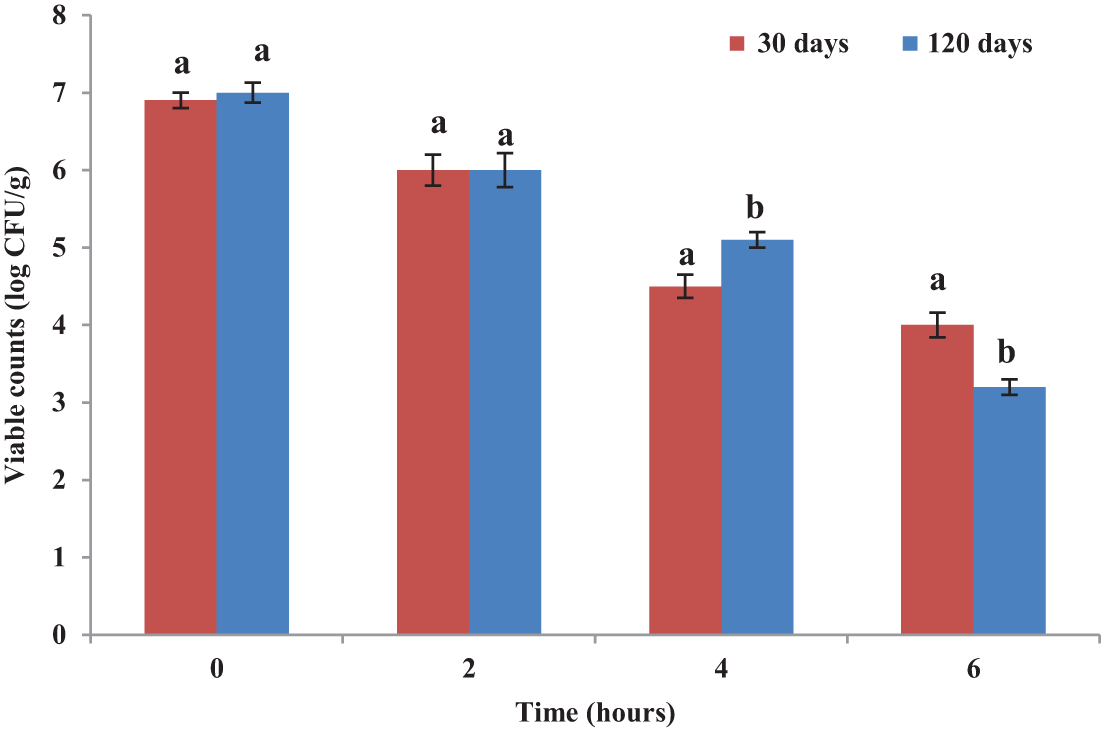
The simulation of gastrointestinal stress under the typical conditions of the human digestive system, such as pH, pepsin and bile, allows evaluation of the influence of these conditions on probiotic bacterial viability (Uriot et al., Reference Uriot, Denis, Junjua, Roussel, Dary-Mourot and Blanquet-Diot2017). The L. fermentum survival to in vitro simulated gastrointestinal conditions is shown in Fig. 3. The first 2 h of the assay mimics the gastric phase, when the ice cream samples were exposed to simulated gastric fluid consisting of HCl and pepsin in pH around 2. After this phase, the population of L. fermentum was reduced in 1.24 log cycles and 1.00 log cycles in samples stored at 30 and 120 days, respectively. No significant difference was observed between the two probiotic ice cream samples. Our results show higher probiotic survival than that observed for B. animalis subsp. lactis BB-12 inoculated in goat milk ice cream and submitted to similar gastric conditions (Ranadheera et al., Reference Ranadheera, Evans, Adams and Baines2012). The L. fermentum survival is also higher compared to the survival of L. acidophilus in refrigerated and frozen mousses, which experienced a reduction of more than 3 log cycles after 30 min of simulated gastric conditions (Buriti et al., Reference Buriti, Castro and Saad2010). This capacity seems to depend not only on the ability of the strain to produce extracellular polysaccharides but also on the type of carbon source available in the medium (da Silva Tms et al., Reference da Silva Tms, Piazentin, Mendonça, Converti, Bogsan, Mora and de Souza Oliveira Rp2019).
Viable counts of L. fermentum CABA16 in goat milk ice cream during exposure to simulated gastric (2 h) and enteric (4 and 6 h) conditions. Samples were analysed after 30 and 120 days of frozen storage at −18 °C. Values are mean ± SD (n = 6). a, b: letters show the differences between samples for the same sampling period of the in vitro gastrointestinal tolerance assay (P < 0.05).

Sensory profiles of goat milk ice cream samples without the addition of probiotics (CIC) and with added L. fermentum (PIC).

In order to simulate enteric conditions, bovine bile and pancreatin were added to ice cream samples with adjusted pH. It is known that bile acids are able to hamper the development and survival of probiotic bacteria (Bustos et al., Reference Bustos, Raya, Bru, Valdez and Taranto2011). The L. fermentum population suffered a remarkable decrease from 0 to 6 h of assay for the two frozen storage periods evaluated (30 and 120 days). Moreover, the reduction was more evident after 4 and 6 h of assay, which coincides with the enteric phase. For these two stages, it was also observed that the storage time influenced the probiotic viability and the PIC (120) sample reached lower bacterial counts when compared to PIC (30) (P < 0.05). The higher loss of viability was detected for the samples stored for 120 days after 6 h (decrease of 3.82 log cycles). Ding and Shah (Reference Ding and Shah2007) investigated the bile tolerance of several probiotic bacteria, including bifidobacteria strains, using two types of bile salts (oxgall and taurocholic acid). The probiotic strains were especially susceptible to the selected bile salts and a decrease of more than 3 log cycles was reported. One of the possible mechanisms by which bile affects probiotic cells would be through membrane-damaging effects and/or disrupting the cell stability, which may affect bacterial phospholipids and membrane proteins, making cell homeostasis difficult (Begley et al., Reference Begley, Gahan and Hill2005).
This considerable reduction is also close to what was observed for L. acidophilus La-5 submitted to similar assay conditions (Bedani et al., Reference Bedani, Rossi and Saad2013). On the other hand, the authors reported a remarkably higher resistance of probiotics, which maintained counts above 7 log CFU/g after 6 h of exposure to gastrointestinal conditions. Likewise, Ranadheera et al. (Reference Ranadheera, Evans, Adams and Baines2012) observed higher survival of L. acidophilus in ice cream and goat milk yogurt containing 10% fat submitted to in vitro gastrointestinal stress. Even though many other factors should be considered, in general, Gram-positive bacteria like bifidobacteria seem to be less resistant to the deleterious effects of bile.
Sensory evaluation
In general, the sensory scores for both ice cream samples were positive, ranging from “liked it regularly” to “liked it very much” (Fig. 4). With regard to overall appearance, aroma, consistency and overall flavour, the samples with or without probiotics had similar results (P > 0.05). No unpleasant or strange taste was reported for the ice cream with L .fermentum (PIC). The often reported unpleasant “goaty” flavour was not found to be particularly noticeable in the ice cream in this study, probably due to the incorporation of the vanilla flavour. Similar sensory impressions were reported by Goktas et al. (Reference Goktas, Dikmen, Bekiroglu, Cebi, Dertli and Sagdic2022) when investigating probiotic ice cream after inoculation of S. boulardii and L. rhamnosus. These findings suggest that probiotics could impact the sensory attributes of the ice cream product in a positive way. Functional foods offer additional health benefits beyond traditional nutrition, and incorporating probiotic L. fermentum into goat ice cream can provide consumers with a wide range of well-proven health benefits from a single product.
In conclusion, we have shown that L. fermentum can be utilized to obtain functional probiotic ice cream. The results showed that the addition of the probiotic L. fermentum influenced the pH, but it had no effect on physicochemical properties, including overrun and melting behaviour of ice cream made from goat milk. The ice cream with added probiotics received good sensory scores and no flavours associated to goat milk or the addition of probiotics was recorded. Results also show that most of the reduction of probiotic viability occurred during the first 24 h of frozen storage. Despite this reduction, satisfactory viability of L. fermentum (6–7 log CFU/g) was maintained throughout the 120 days of frozen storage, which is similar to those of S. boulardii and L. rhamnosus. For probiotic viability during gastrointestinal conditions, the higher loss of viability was detected during the enteric phase, when the exposure to bile and pancreatin resulted in a decline of approximately 3 log cycles in ice cream samples previously stored for 120 days at −18 °C. Overall, this research shows the technological potential and adequacy of using goat milk to produce potentially probiotic ice cream with satisfactory physicochemical, sensory and cell viability results. Future studies could focus on encapsulated probiotic or probiotic and fibre combinations in ice cream formulations for enhancing the stability, sensory quality and viability of probiotic enriched frozen products.
Funding statement
This study was sponsored by the Tunisian Ministry of Higher Education and Scientific Research for its financial support of the Research Laboratory: Technological Innovation and Food Security (LR22 AGR01-ESIAT) from Carthage University.