

INTRODUCTION
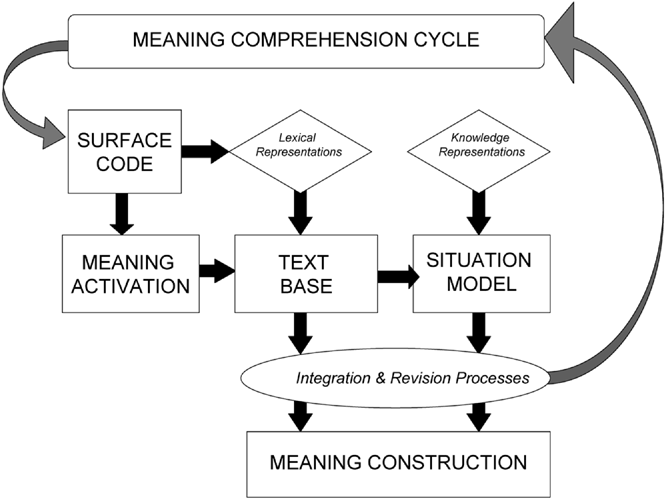
Comprehension involves the construction of meaning through the integration of old and new meanings. Old meanings may be remote, reflecting knowledge in long-term or semantic memory, or recent, reflecting information encountered during current processing. Both remote and recent meanings are retrieved from memory to facilitate ongoing comprehension. New meaning is continuously and actively constructed through a series of on-line comprehension processes that operate at the word, sentence, and text levels and that draw on cognitive resources such as working memory. We propose a model of meaning comprehension (Fig. 1) involving a surface code, a text base, and a situation model, the latter two supported by working memory and inhibitory control that allow for integration and revision of meaning. The gist of the model is that the surface code directly activates old meanings stored in memory, and on-line iterative cycles of integration and revision facilitate the construction of new meaning.

Meaning Comprehension Model.
We have explored the comprehension model in a series of studies with a single population, spina bifida meningomyelocele (SBM), a common, severely disabling birth defect arising from a failure of neural tube closure early in gestation and involving a complex pattern of gene/environment interactions (Kirkpatrick & Northrup, 2003). Individuals with SBM have some intact language skills, but difficulties in key processes in Fig. 1 that are important for constructing meaning.
Elements of Comprehension Cycle
Surface code
The surface code involves the passive activation of meaning from stored lexical representations (Clifton & Duffy, 2001). In ambiguity resolution experiments, normal adults show an interference effect whereby they are slow to reject the context-irrelevant meaning of a word immediately after reading it. For example, they are slower to say that ace does not fit the meaning of the sentence He dug with the spade than they are to say that ace does not fit the meaning of the sentence He dug with the shovel within 250 ms after having read the sentence (Seidenberg et al., 1982). More semantic information is activated than will enter the next processing cycle (Gernsbacher, 1990; Schmalhofer et al., 2002).
Children with hydrocephalus, most with SBM, have accurate and fluent access to surface codes. They understand the meanings of single words in discourse and text (Barnes & Dennis, 1992; 1998; Barnes et al., 2001; Dennis et al., 1994; Dennis et al., 1987; Horn et al., 1985; Parsons, 1969); access the meaning of some idioms (Barnes & Dennis, 1998); show intact semantic priming (Yeates & Enrile, 2005); and, like age peers, are slow to reject contextually irrelevant meanings of ambiguous words such as the card meaning of spade immediately after reading a sentence about digging with a spade (Barnes et al., 2004).
Text base
Text-based representations express the literal meaning of the text and are constructed through integration of information in the text and revision of information in relation to the unfolding context (Clifton & Duffy, 2001; Kintsch, 1988; Schmalhofer et al., 2002). Integration is effected through processes such as pronominal reference and bridging inferences, which integrate ideas or sentences explicitly stated within a text. For example, in order to correctly interpret the sentence, Jim picked up the spade, the reader may need to retrieve information from earlier in the text about Jim helping his mother in the garden. An accurate representation of the explicit meaning conveyed by the text also involves revising initial meanings activated by the surface code, so that the meaning sustained in the text based representation is relevant to the unfolding context (Gernsbacher, 1990). For example, in ambiguity resolution experiments like those discussed earlier, adults no longer show an interference effect about one second after an ambiguous word has been read; that is, they take the same amount to time to decide that ace does not fit the meaning of He dug with the spade and He dug with the shovel (Gernsbacher & Faust, 1991). The card meaning of spade is now suppressed by the digging context.
Children with hydrocephalus, most with SBM, have difficulty integrating propositions within texts (Barnes et al., 2004). When attempting to integrate information from a previous sentence to understand an ambiguous sentence such as, John laughed as he picked up the spade, they are more disadvantaged than same-age peers by textual distance involving separation of the sentences to be integrated. Because they are slow to make bridging inferences over longer chunks of text, they construct a less coherent and integrated representation of the text base. These children also have difficulty with rapid, on-line revision processes while constructing text-based representations. They show substantial interference effects in ambiguity resolution tasks past the point at which their typically developing peers have successfully used the context to suppress contextually irrelevant meanings (Barnes et al., 2004).
Integration and revision processes
Over time, meanings are integrated and revised as stored memory representations from old knowledge or more recently constructed meanings feed forward into the next processing cycle (Graesser et al., 1997; van den Broek et al., 1999). A proposition in a current processing cycle may resonate with information in long-term memory from a previous processing cycle or may activate general knowledge from long-term memory, thereby facilitating retrieval of that information to make inferences across text or inferences between general knowledge and text (Albrecht & Myers, 1998; van den Broek et al., 1999). These text integration and revision processes require working memory and/or inhibitory control.
Working memory involves the storage and processing of information in the service of a goal. Information is temporarily activated in working memory for rapid manipulation and retrieval. Inhibitory control is the ability to stop or modulate ongoing actions or to hold and switch between, or suppress competing representations. Working memory and inhibitory control are resource-limited (Gazzaley et al., 2005). Inhibitory control keeps irrelevant information out of working memory (Dempster, 1993; Engle et al., 1995; Harnishfeger & Bjorklund, 1994), and our model embeds it within working memory because the neural circuitry activated during inhibitory control tasks is a subset of that activated during working memory tasks (Bunge et al., 2001). Consistent with recent models of working memory, working memory in our model involves the calibration of integrative/storage and inhibitory functions (Miyake & Shah, 1999). Working memory facilitates revision from within a current processing cycle, as well as sustaining activation of information from previous processing cycles that is to be integrated with current information (Graesser et al., 1997).
Problems in working memory and/or inhibitory control and/or poor retrieval of information from long-term memory could contribute to difficulties in comprehension when meanings must be integrated and revised. Children and adults with SBM perform less well on tests of working memory and retrieval from long-term memory than do typically developing individuals (Dennis & Barnes, 2002; Purzner et al., 2004; Yeates et al., 1995) though few differences in verbal span have been reported (Parsons, 1969; Yeates et al., 1995).
Situation model
The situation model is the on-line working model of text meaning that includes real-world knowledge and goals, such as inferences about space, time, causality, and the goals of characters (Kintsch, 1988; Schmalhofer, et al., 2002; Zwann & Radvansky, 1998). In Fig. 1, the relation between text base and situation model is asymmetric in that the situation model does not typically influence construction of the text base. However, like text-based representations, situation models are constructed and revised through successive processing cycles.
Constructing situation models requires the integration of knowledge with text, or knowledge-based inference. Knowledge-based inferencing has been studied in typical and atypical development, using a paradigm in which children learn a new knowledge base about a make-believe world, and then integrate this knowledge with events in the text (Barnes & Dennis, 1996; 2001; Barnes et al., 1996; Cain et al., 2001). Less skilled comprehenders, including those with SBM, make fewer knowledge-based inferences than skilled comprehenders, although they have some success in making inferences when processing load is low (Barnes & Dennis, 2001; Cain et al., 2001).
In sum, individuals with SBM have difficulty constructing text-based representations because of deficient revision processes at the single sentence level and deficient integration processes at the text level. Greater textual distance magnifies inferencing difficulties, likely because of increased processing load associated with demands for either integration and/or revision. Difficulties in knowledge-based inferencing may also represent difficulties in integration, revision, or both. However, the processes that are intact and deficient in constructing text-based representations in SBM have received more investigation than those involved in the construction of situation models.
To better understand situation model construction in children with SBM, two studies of model construction at the single sentence- and text level were conducted. In Experiment 1 we investigated how children with SBM construct spatial and affective situation models from single sentences under conditions requiring minimal integration and revision. In Experiment 2, we tested how they construct situation models where spatial information must be iteratively integrated and updated, which draws more heavily on working memory resources.
Experiment 1: Situation Model Construction
The paradigm involved forming a mental model of a spatial layout (Bransford & Franks, 1972; Morrow et al., 1989). A two-sentence study phase was followed by a recognition test, the participant's task being to decide whether each test sentence was exactly the same in wording as one of the study phase sentences. For example, if a study sentence was Three turtles rested on a floating log and a fish swam beneath them, a test sentence might be Three turtles rested on a floating log and a fish swam beneath them (identical wording), or Three turtles rested on a floating log and a fish swam beneath it (different wording, but identical spatial mental model), or Three turtles rested on a floating log and a fish swam beside them (changed wording and changed spatial model). Adults accurately accept sentences that preserve both wording and meaning and accurately reject test sentences that change both wording and meaning. However, they often fail to reject test sentences that change the words but preserve the meaning, which is called the false recognition effect.
If children with SBM have primary difficulty in constructing situation models from single sentences, they will not show a normal false recognition effect. We studied two content domains, hypothesizing that models based on spatial location, an area of relative weakness in SBM, would be more difficult to construct than models based on affective information about character goals and feelings; that is, children with SBM may have difficulty constructing spatial situation models even when integration and revision processes are not required.
METHOD
Participants
Children were recruited from Ontario and Texas as part of a research program on SBM. All were in Grade 3 or higher. The 86 children with SBM came from service-providing medical clinics in Houston, Toronto, London, and Hamilton. They ranged in age from 8 years, 6 months to 18 years, 5 months with a mean age of 12.75 years (sd = 2.7 years). English was their primary language. Comparisons of these English-speaking cohorts of children with SBM have shown no differences across sites in socio-demographic characteristics, IQ, or achievement (Fletcher et al., 2004). To exclude children with intellectual deficiency, all children had a verbal and/or non-verbal IQ score of 70 or greater estimated from the Stanford-Binet Intelligence Test-IV using Vocabulary and Pattern Analysis subtests respectively (SB-IV, Thorndike et al., 1986). The reading requirements in Experiment 1 demanded word reading skill at a grade 3 level or higher (WJR-Letter Word Identification; Woodcock & Johnson, 1989).
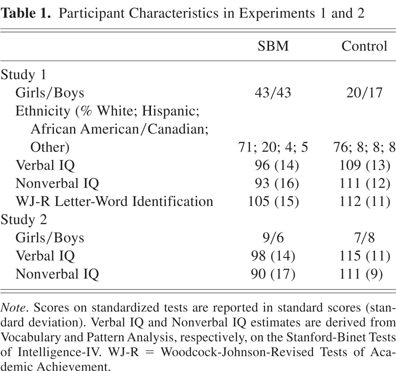
Because of the IQ, reading, and English-primary-language requirements of this study, the sample contained fewer children of Hispanic origins than in the larger population based sample described elsewhere (Table 1); otherwise, the study group is comparable (Fletcher et al., 2004; 2005). Twenty-eight percent of the sample had upper level lesions above L1. The majority (64%) had undergone 2 or fewer shunt revisions.
Participant Characteristics in Experiments 1 and 2

Thirty-seven typically achieving control participants from Texas and Ontario were volunteers who responded to announcements about the study and who had no learning or behavior disorders, or congenital or acquired CNS disorders. They ranged in age from 8 years, 0 months to 16 years, 9 months, with a mean age of 12.33 years (sd = 2.83 years). The same IQ and reading criteria discussed previously were applied to the control group. All participants and/or their parents gave informed consent and/or assent to participate in both experiments in compliance with research ethics boards in Toronto and Houston.
Participant characteristics are in Table 1. The groups did not differ in age. They did differ on the estimates of verbal IQ (t (121) = 25. 1, p < .05) and nonverbal IQ (t (121) = 37.5, p < .05) with the control group having higher scores than the group with SBM. Word reading scores of both groups were well within the average range on Letter-Word Identification of the WJ-R though the control group had significantly higher scores than the group with SBM (t (121) = 2.5, p < .05).
Materials and Procedures
The task was run on an IBM compatible computer using a program written in Micro Experimental Lab (MEL) that presented the stimuli on a screen and recorded response time and accuracy. Each trial consisted of two simultaneous study sentences followed by two recognition sentences, presented one after the other. Participants controlled study time by pressing a button on a button box after they felt they knew the two sentences. In the study phase, participants decided whether each of the two sentences was exactly the same in wording as one of the studied sentences. Spatial (N = 27) and affective (N = 21) items were presented in separate blocks, divided equally across three recognition conditions.
Spatial study sentences took the form: Three robins sat on the clothesline and Joe walked under them. An alligator glided under the water lilies when a man walked past it. Affective study sentences took the form: Carla cried when her cat ran away from home. Jim loved it when the Bears football team won.
Recognition sentences were either identical in wording to one of the study sentences (identical condition: Three robins sat on the clothesline and Joe walked under them; Carla cried when her cat ran away from home), identical in meaning, but different in wording (inference condition: Three robins sat on the clothesline and Joe walked under it; Carla was sad when her cat ran away from home); or different in wording and meaning (different condition: Three robins sat on the clothesline and Joe walked around them; Carla was surprised when her cat ran away from home). For both inference and different conditions, parallel one- or two-word changes were made. The type of recognition sentence was randomly distributed within and across trials.
RESULTS
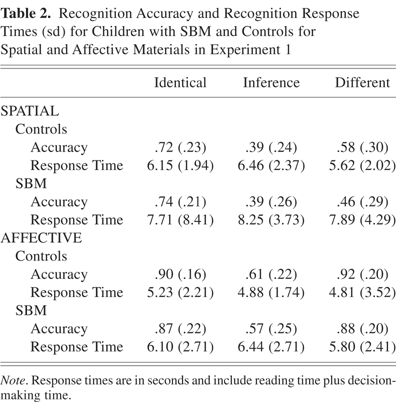
Accuracy data best demonstrate the false recognition effect (Table 2). A repeated measures ANOVA tested 2 groups (Control vs. SBM) by 2 material types (Spatial vs. Affective) by 3 types of recognition item (Identical, Inference, Different). There was no effect of group. There were main effects of material type (F(1,116) = 265.4, p < .001) and type of recognition item (F(2,116) = 76.7, p < .001) that were qualified by an interaction (F(2,116) = 16.31, p < .001). One-way analyses of variance using the Bonferroni correction (p = .008) revealed that inference items were judged less accurately than both other types of recognition items—the false recognition effect. The interaction reflects the fact that identical sentences were recognized more accurately than different sentences for spatial materials, but accuracy was similar for identical and different sentences for affective materials.
Recognition Accuracy and Recognition Response Times (sd) for Children with SBM and Controls for Spatial and Affective Materials in Experiment 1

For response times, there was a main effect of group (F(1,91) = 6.9, p < .01) such that the group with SBM took longer to make their decisions, and a main effect of type of material (F(1,91) = 19.6, p < .001) such that affective sentences were responded to more quickly than were spatial sentences. Response time data are based on fewer participants because of equipment malfunction at one site.
Supplementary Analysis: Age Effects
Although the mean ages of the groups did not differ and participants in both groups showed similar stratification across ages, the age distributions were slightly different. ANCOVA with age at test as the covariate comparing the groups on overall accuracy for affective and spatial materials showed no group differences. There was an effect of age for spatial, but not affective materials.
Effects of Age, Vocabulary and Visual-Spatial Skill
Because word meanings, activated by the surface code in the meaning comprehension model, are known to be important for comprehension in general, and because some of the materials contain spatial concepts (e.g., below, beside), it is of interest to investigate the relations of vocabulary knowledge and spatial skill on task performance. Vocabulary and Pattern Analysis were used to predict accuracy and response times for affective and spatial items. Age was added to the model in light of the findings from the ANCOVA. The model was significant for accuracy on spatial items (F(3,119) = 8.64, p < .001) accounting for 16% of the variance. Beta statistics revealed significant effects of age (t = 3.94, p < .001) and vocabulary skill (t = 2.69, p < .01). The model was significant for accuracy on affective items (F(3,119) = 4.51, p < .01) accounting for 10% of the variance. Beta statistics revealed significant effects of age only (t = 2.05, p < .05). The model was significant for response times on spatial items (F(3,119) = 2.89, p < .05) accounting for 4% of the variance. None of the predictors was significant. The model was significant for response times on affective items (F(3,119) = 10.13, p < .001) accounting for 18% of the variance. Beta statistics revealed significant effects of age (t = −4.51, p < .001) and vocabulary skill (t = −2.37, p < .05).
DISCUSSION
Children with SBM can construct sentence-level situation models from spatial or affective information when integration and revision of those models are not required. They showed similar false recognition effects to controls, incorrectly judging that they had previously read sentences with changed wording but preserved meaning. Content domain did not affect the false recognition effect. Even though some of their spatial skills are not well developed (Dennis et al., 2002), children with SBM constructed situation models of spatial relations. There is some evidence that forming situation models from spatial information was more difficult than constructing situation models from affective information for both groups of children: spatial judgments took longer to make than affective judgments and performance on spatial materials was strongly related to age. Although children with SBM were similar to their peers in recognition accuracy they were slower in their recognition judgments. They can construct situation models from single sentences, but they are slow to do so, suggesting less fluent generation of situation models than their peers. However, it is worth noting that the response times included reading time and time to make recognition judgments. Although children with hydrocephalus, many with SBM, do not have specific deficits in word reading speed (Barnes et al., 2001), reading fluency was not directly assessed in this study and so it cannot be ruled out as a source of difference in response times between the groups.
Experiment 2: Updating Situation Models: Integration
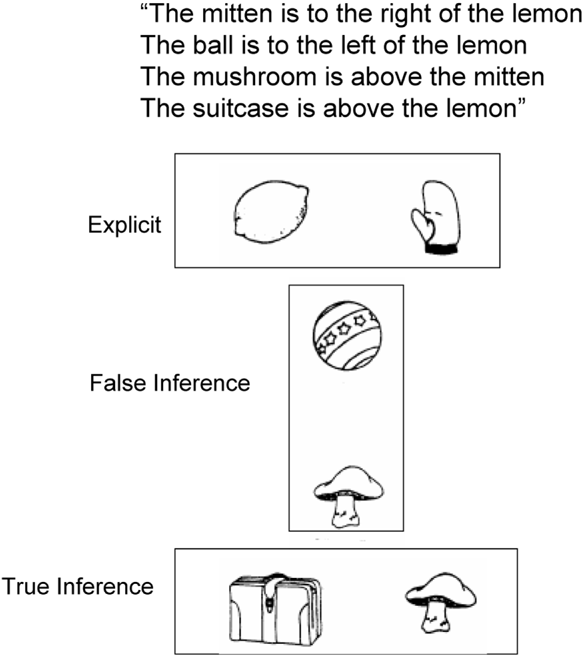
A paradigm devised by Mani & Johnson-Laird (1982) was used to test the construction of spatial situation models where information must be integrated across sentences, which, in accordance with the comprehension model, draws on working memory resources. A verbal description of relations between objects is provided and the situation model of the spatial relationships between objects is updated as new sentences are read out to the participant. An example of a 4-sentence oral description is in Fig. 2. The situation model that the participant constructs is then queried for its content by presenting pictures of pairs of objects depicting a spatial relation between those objects. On explicit trials, the picture matches a verbal description that was explicitly provided by a sentence (first picture in Fig. 2). In deciding whether this is true, the child could respond accurately by recalling the explicitly stated sentence The mitten is to the right of the lemon, or by “reading off” the relative positions of the mitten and lemon from an accurately updated situation model that integrated each succeeding sentence with the sentences before it. False inference trials test whether participants can say what spatial relations are not present in the situation model (second picture in Fig. 2). In deciding whether this is true, the child must search a constructed situation model for the spatial relation specified in the False Inference item, and respond “false” when that relation is not found in the model. The false items required an inference about the relation of two objects (e.g., the ball and the mushroom) by integrating across explicitly stated sentences and could not be solved through linguistic negation of an explicitly stated sentence because the child never heard, The ball is below the mushroom. True inference trials tap the situation model by presenting a picture of a relation that is never explicitly stated (third picture in Fig. 2) but which can be inferred from the verbal description. To respond correctly, the child must have accurately constructed a situation model from which the information may be “read off” without further updating or revision; that is, if the model was updated as each sentence was read, the spatial relation between the suitcase and the mushroom would be part of the constructed situation model even though it was never heard.

Spatial model layouts used in Experiment 2. Participant is read the sentences twice, and then responds to three pictures (presented in randomized sequence) by responding Yes if the picture represents a true spatial relation given the text and by responding No if the picture represents a false spatial relation. The top picture shows a true representation (the mitten right of the lemon), the middle picture shows a false representation (the ball above the mushroom), and the bottom picture shows the inference (the suitcase left of the mushroom).
If children with SBM have difficulty integrating information in the on-line construction of a spatial situation model, they should be less accurate than controls in the true inference and false inference conditions. Because explicit items can be answered directly from the text base (the relation was stated in a heard sentence), better performance in the explicit versus the inference conditions would imply a reliance on spatial information presented at the single sentence level because these items can be judged without updating the situation model by integrating across sentences. The ability to integrate information across sentences to update the situation model would facilitate accuracy on true inferences and false inferences.
METHODS
Participants
Participants were 15 children with SBM between 10 to 18 years of age and 15 typically developing controls between 10 and 16 years of age. Participants were part of the larger group of participants in Study 1 from the Toronto site (see Table 1). The groups were matched closely for age on a pair-wise basis with the greatest age differences occurring between the two oldest children in the control group (both 16 years old) and the two oldest children in the group with SBM (one 17 and one 18 years old). The groups did not differ in age. Controls had higher scores on estimates of verbal IQ (t (24) = 3.22, p < .01) and nonverbal IQ (t (24) = 3.88, p < .001). The participants were predominantly white.
Materials and Procedure
Eighty pictured objects were selected for high picture-name agreement and early age of acquisition (Snodgrass & Vanderwart, 1980). After pretesting for identification of the 80 objects, the children received 12 randomly ordered verbal descriptions. Each consisted of four sentences (see Fig. 2) that described the spatial relations between sets of five objects. The objects in the descriptions of each model were not natural associates (i.e., fork and bowl did not appear in the same model).
The children were tested on a laptop computer using MacStim programming software that also recorded accuracy and response time (Darby, 2000). After two practice trials, they heard each layout description twice, and then decided whether each of three sets of 2 pictured objects were in the correct relationship by pressing a yes or no button on the keyboard. The three sets of 2 pictured objects represented, in random presentation order, a true representation or explicit condition, a false representation or false inference condition, and the inference or true inference condition, in random order (see examples in Fig. 2).
RESULTS
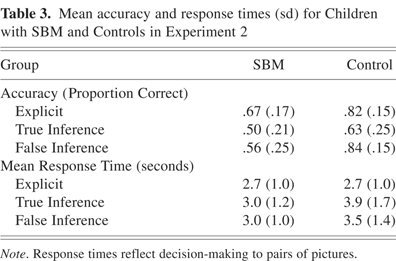
A repeated measures ANOVA with 2 groups (Control vs. SBM) and three types of picture test item (Explicit, True Inference, False Inference) revealed a main effect of group (F(1,28) = 12.84, p < .01), such that the control group was more accurate than the group with SBM, and a main effect of item type (F(2,28) = 9.07, p < .001), such that the explicit condition was more accurate than the true inference condition. For response times, there was a main effect of item type (F(2,28) = 9.50, p < .001), and a group by item type interaction (F(2,28) = 3.76, p < .05), with faster response times for the group with SBM on false and true inference items, consistent with speed-accuracy tradeoffs for the group with SBM (Table 3).
Mean accuracy and response times (sd) for Children with SBM and Controls in Experiment 2

Because chance performance on this task is 50% accuracy, one-sample t-tests were conducted to determine whether responding in each condition differed significantly from chance. For the control group, explicit and false inference items were correctly judged at levels significantly above chance (t (14) = 9.97, p < .0001 and t (14) = 8.67, p < .0001, respectively). True inference items failed to reach statistical significance (t (14) = 1.90, p < .08). For the group with SBM, accuracy on only explicit items was significantly above chance (t (14) = 3.87, p < .01).
Effects of Age, Vocabulary and Visual-Spatial Skills
A multiple regression was conducted with age, Vocabulary, and Pattern Analysis as predictors of overall accuracy. The model accounted for 40% of the variance in accuracy (F(3,22) = 6.61, p < .01). Beta statistics revealed significant effects of vocabulary (t = 3.08, p < .01), and a trend for age (p < .06).
DISCUSSION
Although children with SBM could make decisions at an above chance level about explicitly stated spatial relations, they had difficulty integrating information between sentences to construct situation models. The two conditions that tested integration (true and false inferences) were both at chance levels of accuracy for this group. Accurate performance on explicit trials reflects either recall of explicit text or retrieval of simple situation models that capture individual spatial relations at the single sentence level like those tested in Experiment 1. Thus, there was no evidence that children with SBM had integrated across sentences to form an updated spatial situation model. Children with SBM were as fast as controls in their responses to explicit items but faster than controls on true and false inferences suggesting that they traded accuracy for speed. In combination with the accuracy findings, these results suggest that the task was very difficult for these children; the adoption of a random response strategy often reflects a perceived lack of information on which to base decision-making.
The high accuracy of controls on false inference and explicit items suggests that they can construct a situation model to use in making decisions about spatial relations. It is unclear why the false inference items should have been responded to more accurately than the true inference items. Although accuracy on true inferences was not significantly above chance for controls there was a trend in this direction, which may reflect problems with power related to relatively small number of participants. Overall, the data suggest that typically developing children are engaging in model construction by integrating across sentences to a greater extent than are children with SBM.
General Discussion
Several new findings about comprehension in children with SBM emerge from the two experiments. Experiment 1 and the findings for the explicit condition in Experiment 2 provide evidence for the idea that children with SBM are accurate at constructing situation models when there are minimal requirements for integration or revision. This is true even in the visual-spatial domain, which is an area of relative cognitive weakness in SBM. In contrast, the findings from the two inference conditions in Experiment 2 demonstrate that children with SBM have difficulty updating spatial situation models by integrating information between sentences. Typically developing children showed better ability to integrate spatial information between sentences to make inferences based on an updated situation model. In terms of the meaning comprehension model, deficiencies in integration that draw on working memory resources may pose problems for constructing situation models beyond the single sentence level. Neither experiment tested the ability to revise situation models, which is hypothesized to require inhibitory control.
Whether children with SBM would experience a similar degree of difficulty in integrating information to construct situation models containing affective, temporal, and motivational information remains to be studied. Based on the difficulty they have in integrating information within a text to make bridging inferences when the materials are not spatial in nature (Barnes et al., 2004) we would predict that their integration difficulties in building situation models are not confined to visual-spatial materials. These findings and predictions stand in contrast to comprehension in special populations such as Williams-Beuren Syndrome where the severe deficit in spatial cognition specifically impedes understanding of spatial aspects of language even at the single sentence level (Phillips et al., 2004). It is worth remembering that children with SBM are not uniformly deficient in all aspects of visual-spatial processing (Dennis et al., 2006a).
A measure of visual-spatial skill was unrelated to accuracy or fluency in constructing spatial situation models. In keeping with our model, we suggest that visual-spatial skill per se may be less important for constructing spatial situation models than visual-spatial working memory. Vocabulary knowledge was related to skill in constructing affective and spatial situation models, with the full models accounting for between 4% to 40% of the variance in performance across experiments. It is not clear whether inefficient situation model building limits the acquisition of vocabulary, or vice versa. However it is related to comprehension, vocabulary knowledge is not sufficient for comprehension. Because the focus of our studies is to better understand the language and cognitive processes that lead to better or worse meaning activation and meaning construction, future studies might investigate how integrative and revision processes that draw on verbal and visual-spatial working memory affect the construction of spatial and affective situation models (Johnston & Barnes, 2007).
The data have implications for the nature of comprehension difficulties in SBM, particularly in relation to the meaning comprehension model, for how meaning comprehension might be situated within broader models of cognitive function in SBM, and more generally for models of language comprehension. These implications are discussed below.
A Model of Comprehension in SBM
Models of meaning comprehension that distinguish between automatic activation of surface codes and resource-intensive construction and revision of text-based representations and situation models are useful in capturing those aspects of comprehension that are intact and deficient in SBM. Broadly, SBM is associated with intact derivation of meanings associated with the surface code, and impaired derivation of meaning associated with the construction of meaning from a text base or situation model.
Our comprehension model associates meaning comprehension with two processes that are related to, but not synonymous with these different levels of text comprehension: meaning activation, which requires few cognitive resources, and meaning construction, which is resource-intensive. We suggest that success in deriving meaning depends more on whether comprehension draws on resource-intensive integration and revision processes than on whether meaning is being accessed from the surface code or constructed from the text-base and situation model.
Like their same-age peers, children with SBM understand and access literal meanings in on-line comprehension tasks that measure speeded access to word meaning, which taps surface code comprehension but not integration and revision processes (Barnes et al., 2004). Conversely, there is some evidence that surface code access can be impaired when suppression or revision is required. Highly literal idioms (e.g., a piece of cake) activate both literal and figurative meanings, with the literal meaning being suppressed as the relevant context unfolds. Comprehension of such idioms in on-line processing tasks is deficient for children with SBM, even when they are familiar with the figurative meaning, suggesting that surface code comprehension varies with demands for integration and revision (Huber-Okrainec et al., 2005).
Children with SBM can construct text-based representations and situation models when the resource demands for integration are minimal. For example, they are accurate, though less efficient than peers, in using context to keep a particular accessed meaning active in working memory, which is important for constructing the text-based representation (Barnes et al., 2004). And, they can construct spatial and affective situation models from single sentences similar to typically developing children (Experiment 1). In contrast, they have difficulty revising meaning by suppressing contextually irrelevant meanings, even at the level of single sentences, and they are less able than typically developing children to integrate across sentences to make inferences (Barnes et al., 2004) and to build a mental model of a spatial layout (Experiment 2). Difficulties in integration fluency may not be trivial; even though children with SBM may be able to integrate information within sentences and between adjacent sentences, slow integration processes may lead to bottlenecks in comprehending authentic texts from one comprehension cycle to the next (Long et al., 1997). Interestingly, children with SBM seem to have particular problems when suppression is required to revise representations of the text base, even at the single sentence level.
Meaning integration and revision are deemed to require working memory. Children with SBM have difficulty integrating across sentences to construct situation models (Experiment 2), and are impaired in making bridging inferences across increasing textual distances (Barnes et al., 2004). Simple fading of information from long-term memory in children with SBM seems an unlikely explanation for either of these findings. In the case of bridging inferences, children with SBM were very slow but accurate across increasing textual distances, so they were able to retrieve the information from memory. In Experiment 2, even after the reading of several sentences, the spatial relation described in a particular sentence was still retrievable (i.e., in the explicit condition). In contrast, the need for information to be integrated between sentences results in poor comprehension in children with SBM, possibly because integration involves retrieval of or reactivation of material from previous processing cycles and subsequent integration of that material with ongoing text in working memory. In reference to the meaning comprehension model, difficulties in constructing representations of the text-base and the situation model may be related to difficulties in accessing and integrating information from previous processing cycles with information currently in working memory.
In sum, access to the meaning of the surface code, and the construction of text-based representations and situation models is more or less proficient depending on the requirements for integration and revision, which includes the retrieval of information from previous comprehension cycles. In meaning comprehension, then, the distinction between the types of processing required to comprehend the text is more important than the distinction among levels of analysis (surface code, text base, or situation model).
The meaning comprehension profile in children with SBM converges with those described in other groups with poor comprehension. Neurologically intact individuals with poor comprehension have difficulties making knowledge-based inferences (Cain et al., 2001) and using context to derive new meanings for unknown words, particularly when the supporting context is not adjacent to the new word (Cain et al., 2003). Findings such as these have been used to suggest that less-skilled comprehenders have difficulty with integrative processes (Spooner et al., 2006 for another interpretation). Adults with poor comprehension skills can activate meanings, but cannot suppress contextually irrelevant meanings to revise meaning (Gernsbacher & Faust, 1991). Poor meaning suppression has been noted in adults with poor discourse comprehension and lesions of the right hemisphere (Tompkins et al., 2000). Children with traumatic brain injuries and children who are good decoders, but poor comprehenders can make inferences under conditions of low information-processing load, but have much more difficulty during on-line narrative comprehension requiring greater use of memorial resources (Barnes & Dennis, 2001; Cain et al., 2001).
Comprehension in the context of broader neurocognitive models of SBM
The distinction between meaning activation and meaning construction not only characterizes comprehension findings in SBM but also links comprehension to neurocognitive functions in other cognitive domains. Development across a number of domains for individuals with SBM has been modeled with reference to a small number of core deficits tied to the primary brain dysmorphologies of SBM that are evident from birth, persist throughout the lifespan, and result in a combination of spared and deficient processing within domains as diverse as motor function, perception, language, reading, and mathematics (Dennis et al., 2006b).
Stipulated processing, which involves performance that is automatically activated and established through associations and repetition is relatively intact in individuals with SBM, who show strengths in activation of stipulated representations including the ability to recognize faces, perceive objects from degraded visual cues (Dennis et al., 2002), retrieve small math facts (e.g., 2 + 3 = 5) from memory (Barnes et al., 2006), learn motor sequences (Edelstein et al., 2004) and motor adaptations (Colvin et al., 2003; Dennis et al., 2006b). Constructed processing, which relies on the integration of information from various sources and on-line performance adjustments, is consistently deficient in cognitive domains including on-line control of movement (Salman et al., 2005), shifting between perceptual representations (Dennis et al., 2002), and performance on larger sum computations whose answers are not reliably retrieved from semantic memory (e.g., 8 + 7) (Barnes et al., 2006). How deficits in meaning comprehension are related to dysfunction in other cognitive domains, and the neurobiology of comprehension disorders remain to be investigated, in SBM and in other neurodevelopmental disorders.
The meaning comprehension model and models of syntactic comprehension
Our model of meaning comprehension appears generally consistent with models of syntactic comprehension. Grammatical structures are rapidly activated from stored knowledge, as evidenced by data on garden-path sentences and temporary syntactic ambiguity (MacDonald et al., 1994). In speaking, the syntactic form of a prime sentence influences the syntactic form of a to-be-recalled sentence, and so the prime may need to be inhibited (Fox Tree & Meijer, 1999). The assembly of syntactic structures in human syntactic parsing involves competitive inhibition among candidates for inclusion in the final syntactic tree that is constructed for comprehension (Vosse & Kempen, 2000). More generally, Caplan and Waters (2006) have distinguished between syntactic comprehension failures that arise because of structural syntactic processes and those arising from limitations in processing resources that affect integration and revision. The fact that semantic and syntactic comprehension breakdown can be described by a similar and limited set of processes suggests that a relatively constrained set of comprehension and memorial processes may account for many individual differences in comprehension. To be sure, important questions remain unanswered. The parallel and interactive roles of semantic and syntactic information in the construction of meaning in our comprehension cycles model remains to be studied (Friederici, 2002).
Better comprehension of literal language and poorer comprehension of more abstract aspects of language such as figurative language and inference is sometimes said to characterize children with congenital and acquired neurodevelopmental disorders such as SBM or traumatic brain injury. Although children with neurodevelopmental disorders may have relatively more difficulty in dimensions of language such as inference and figurative language compared to literal language comprehension, our data suggest that the reason for this pattern has less to do with a literal/abstract dimension of language than it has to do with the specific comprehension and memorial processes that are often, but not always, implicated in understanding inferential and figurative language (Van Lancker-Sidtis, 2004). Such findings are of relevance to assessment and intervention because they attempt to identify those cognitive processes that may have greater explanatory value for explicating the situations under which comprehension is likely to succeed or fail. This type of knowledge may lead to more accurate assessment and better-targeted interventions.
ACKNOWLEDGMENTS
This research was supported by project grants from the Ontario Mental Health Foundation, the National Institute of Child Health and Human Development Grant P01 HD3596, and a University Research Chair from the College of Social and Human Applied Sciences at the University of Guelph. The information in this manuscript is new and original and has not been published previously in any form. Some of these data were presented at the annual meeting of the Canadian Psychological Association in 2006. No financial or other relationships exist that would represent a conflict of interest with respect to the information contained in the manuscript or the publication of the manuscript. The authors thank Margaret Wilkinson, Amy Walker, Stephanie Lane, Joanne Bosloy, and Jennifer Janes for research assistance as well as the Thames Valley Children's Centre in London, Ontario and McMaster Children's Hospital in Hamilton, Ontario for their participation.