Introduction
The lifetime risk of developing at least one episode of depression is estimated to be between 15% and 17% in the German population (Möller et al. Reference Möller, Laux and Deister2005). Because of the high co-morbidity of depression with other psychopathological disorders, such as eating and anxiety disorders, insomnia and substance abuse, depression creates a large welfare risk for the individual and causes high economic costs for society (Halfin, Reference Halfin2007; Hoffman et al. Reference Hoffman, Dukes and Wittchen2008). The pathogenesis of depression is far from being understood, but a complex interaction of factors including genetic vulnerability (Nes et al. Reference Nes, Røysamb, Reichborn-Kjennerud, Harris and Tambs2007; Boomsma et al. Reference Boomsma, Willemsen, Sullivan, Heutink, Meijer, Sondervan, Kluft, Smit, Nolen, Zitman, Smit, Hoogendijk, van Dyck, de Geus and Penninx2008), personality traits (Shifman et al. Reference Shifman, Bhomra, Smiley, Wray, James, Martin, Hettema, An, Neale, van den Oord, Kendler, Chen, Boomsma, Middeldorp, Hottenga, Slagboom and Flint2008) and adverse environmental influences such as critical lifetime events (Yang et al. Reference Yang, Chiu, Soong and Chen2008) seem to have their share in the genesis.
In depression research the hippocampal area represents one of the major neuroanatomical targets. Several studies show that environmental factors such as stress but also genetic variation play a crucial role in the proliferation and synaptic plasticity of neurons in the hippocampus. Smaller hippocampi have been associated with depression (Sheline et al. Reference Sheline, Wang, Gado, Csernansky and Vannier1996, Reference Sheline, Gado and Kraemer2003; Frodl et al. Reference Frodl, Meisenzahl, Zetzsche, Born, Groll, Jäger, Leinsinger, Bottlender, Hahn and Möller2002; Neumeister et al. Reference Neumeister, Wood, Bonne, Nugent, Luckenbaugh, Young, Bain, Charney and Drevets2005), which has been partly explained through the influence of glucocorticoid hypersecretion induced by stress (Axelson et al. Reference Axelson, Doraiswamy, McDonald, Boyko, Tupler, Patterson, Nemeroff, Ellinwood and Krishnan1993; Höschl & Hajek, Reference Höschl and Hajek2001; Sapolsky, Reference Sapolsky2001; Geuze et al. Reference Geuze, Vermetten and Bremner2005; Tessner et al. Reference Tessner, Walker, Dhruv, Hochman and Hamann2007). Based on several negative findings, this explanation is still a matter of debate (Vakili et al. 2000; Rusch et al. Reference Rusch, Abercrombie, Oakes, Schaefer and Davidson2001; Hajek et al. 2006).
A protein from the neurotrophin family, considered to be involved in atrophic (stress) effects on the hippocampus, is the brain-derived neurotrophic factor (BDNF). This neurotrophic factor has been related to depression and anxiety disorders for several reasons. On the one hand, plenty of evidence shows that signalling of BDNF at the tyrosine kinase receptor B (TrkB) is involved in the recovery from anxiety and depression (see reviews by Groves, Reference Groves2007; Martinowitch et al. Reference Martinowitch, Husseini and Bai2007); post-mortem analyses revealed that BDNF levels linked to neuronal sprouting increase after treatment with antidepressants (Dwivedi et al. Reference Dwivedi, Rizavi, Conley, Roberts, Tamminga and Pandey2003; Karege et al. Reference Karege, Perret, Bondolfi, Schwald, Bertschy and Aubry2002). On the other hand, a first study showed that glucocorticoids inhibit the effects of BDNF in the hippocampus leading to neuronal loss (Kumamaru et al. Reference Kumamaru, Numakawa, Adachi, Yagasaki, Izumi, Niyaz, Kudo and Kunugi2008). Therefore, BDNF seems to be important for understanding the biochemical mechanisms in affective disorders such as depression and anxiety (Jardine et al. Reference Jardine, Martin and Henderson1984; Kendler et al. Reference Kendler, Gardner, Gatz and Pedersen2007).
A single nucleotide polymorphism (SNP) on the BDNF gene (MIM 113505; located on human chromosome 11p14.1), the BDNF Val66Met polymorphism (rs6265), has received major attention in biologically oriented depression research. An exchange of amino acids from valine (Val) to methionine (Met) seems to have functional consequences for the neural plasticity in the medial temporal lobe (MTL). A seminal knock-in mice study by Chen et al. (Reference Chen, Jing, Bath, Ieraci, Khan, Siao, Herrera, Toth, Yang, McEwen, Hempstead and Lee2006) showed that, in particular, the very rare homozygote Met/Met variant (prevalence of 2–3% in the Caucasian population) is associated with a diminished BDNF secretion and more pronounced anxious behaviour. In this study mice carrying the 66Met allele showed lower hippocampal volumes, less dendritic arbors, and a 30% reduced activity-dependent secretion of BDNF from neurons. For ethical and technical reasons, differences in hippocampal volumes depending on the BDNF Val66Met genotype can only be investigated with the use of structural magnetic resonance imaging (MRI) in living human beings. Some studies have addressed this question before and found that carriers of the 66Met variant showed reduced hippocampal volumes, and this was observable not only in schizophrenic and depressive patients but also in healthy subjects (Frodl et al. Reference Frodl, Meisenzahl, Zetzsche, Born, Groll, Jäger, Leinsinger, Bottlender, Hahn and Möller2002; Pezawas et al. Reference Pezawas, Verchinski, Mattay, Callicott, Kolachana, Straub, Egan, Meyer-Lindenberg and Weinberger2004; Szeszko et al. Reference Szeszko, Lipsky, Mentschel, Robinson, Gunduz-Bruce, Sevy, Ashtari, Napolitano, Bilder, Kane, Goldman and Malhotra2005; Bueller et al. Reference Bueller, Aftab, Sen, Gomez-Hassan, Burmeister and Zubieta2006; Takahashi et al. Reference Takahashi, Suzuki, Tsunoda, Kawamura, Takahashi, Tsuneki, Kawasaki, Zhou, Kobayashi, Sasaoka, Seto, Kurachi and Ozaki2008). Of note, a recent study by Yamasue et al. (Reference Yamasue, Abe, Suga, Yamada, Inoue, Tochigi, Rogers, Aoki, Kato and Kasai2008) reported that higher scores on the self-report scale ‘harm avoidance’ (a personality trait highly correlated with anxiety) of the Temperament and Character Inventory (TCI; Cloninger et al. Reference Cloninger, Svrakic and Przybeck1993) are associated with a smaller regional grey-matter volume of the left hippocampus in both men and women. In sum, there is converging evidence from personality research, psychiatry and animal research stressing the importance of genetically determined differences in hippocampal volume in the context of anxiety and depression. Adding to this important area of interest, recent evidence from a meta-analysis also suggests that the amygdala is a target in depression research (Hamilton et al. Reference Hamilton, Siemer and Gotlib2008). On examining the results of several studies in the field, Hamilton and others show that smaller amygdala volumes have also been associated with depression. In treating depressive patients, the administration of antidepressant treatment could lead to an upregulation of BDNF secretion, which is followed by a growth of the amygdala structure. These mechanisms seem to be comparable to those of BDNF at the hippocampus level. As the amygdala and the hippocampus are strongly entwined and both structures may also play a crucial role in the genesis of the emotion anxiety (Gray & McNaughton, Reference Gray and McNaughton2000), we also searched for an impact of the BDNF Val66Met polymorphism on amygdala volumes. As anxiety and depression disorders may share common underlying biological mechanisms, it would be interesting to also detect smaller amygdala volumes in 66Met+ carriers. Although findings from personality research are heterogeneous, the results of Jiang et al. (Reference Jiang, Xu, Hoberman, Tian, Marko, Waheed, Harris, Marini, Enoch and Lipsky2005) and Montag et al. (Reference Montag, Fiebach, Basten, Stelzel and Reuterin press) show an association between the 66Met allele, or the homozygous 66Met variant, and higher scores on the temperament dimension ‘harm avoidance’ by Cloninger et al. (Reference Cloninger, Svrakic and Przybeck1993).
Previous imaging studies used several different techniques to investigate the influence of the BDNF Val66Met polymorphism on the structure of the brain. Among these techniques are manual volumetry (e.g. Bueller et al. Reference Bueller, Aftab, Sen, Gomez-Hassan, Burmeister and Zubieta2006), where analyses were restricted to the hippocampus. In line with Pezawas et al. (Reference Pezawas, Verchinski, Mattay, Callicott, Kolachana, Straub, Egan, Meyer-Lindenberg and Weinberger2004), we used whole-brain voxel-based morphometry (VBM) to investigate the effects of the BDNF Val66Met polymorphism on the brain architecture in healthy humans.
Method
Participants
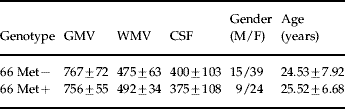
Eighty-seven Caucasian subjects of German origin were included in the study (mean age 23.86 years (s.d.=4.84); range 19–44 years; n=24 males, n=63 females; see Table 1). Most of the participants were recruited from psychology classes at the University of Bonn. None of the participants reported a neurological/psychopathological disorder (e.g. depression, attention deficit/hyperactivity disorder, schizophrenia) in a simple questionnaire enquiring about the lifetime history of such diseases. A shortcoming of the study is that we did not use a standardized structural interview for psychiatric diagnoses but relied on the self-report of participants. Substance abuse was not considered to be an exclusion criterion for the study. With respect to alcohol intake, a self-designed questionnaire revealed that women drank less than the critical 20 g/day and men less than the critical 30 g/day of pure alcohol. The mean alcohol consumption was 8.74 g/day (s.d.=7.50) of pure alcohol. Although we recently reported that smoking is not associated with the BDNF Val66Met polymorphism in a large sample of 614 Caucasian participants (Montag et al. Reference Montag, Basten, Stelzel, Fiebach and Reuter2008b), we also asked for the smoking status (64 non-smokers, including eight ex-smokers, and 23 smokers). This might help to better compare the results of future studies investigating the effect of the BDNF Val66Met polymorphism on the structure of the brain. The smokers smoked eight (s.d.=5.56) cigarettes a day and started 7.79 (s.d.=4.90) years ago. The questionnaire also asked if the participants used any kind of medication. The intake of medication and also any neurological/psychiatric disease were exclusion criteria for the study. As nearly all participants were students, no differences in education were observed. Because of the recruitment procedure used (psychology students, characterized by a higher percentage of female students), females were over-represented in the investigated sample.
Overall volume of grey matter, white matter, corticospinal fluid, gender and age of the two groups (mean±standard deviation)
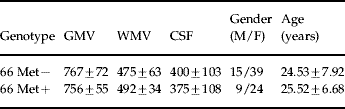
GMV, Grey-matter volume; WMV, white-matter volume; CSF, corticospinal fluid; M, male; F, female.
After undergoing a structural MRI scan, participants provided buccal cells for genotyping the BDNF Val66Met polymorphism. All participants were informed about the purpose of the study and gave written consent. The study was approved by the local medical ethics committee of the University of Bonn.
Genetic analyses
DNA was extracted from the buccal cells. Automated purification of genomic DNA was conducted by means of the MagNA Pure® LC system using a commercial extraction kit (MagNA Pure LC DNA isolation kit; Roche Diagnostics, Mannheim, Germany). Genotyping of the BDNF Val66Met polymorphism was performed by real-time polymerase chain reaction (PCR) using fluorescence melting curve detection analysis by means of the LightCycler System 1.5 (Roche Diagnostics). The primers and hybridization probes (TIB MOLBIOL, Berlin, Germany) and the PCR protocol for BDNF Val66Met are as follows: forward primer: 5′-ACTCTGGAGAGCGTGAATGG-3′; reverse primer: 5′-CCAAAGGCACTTGACTACTGA-3′; anchor hybridization probe: 5′-LC640-CGAACACATGATAGAAGAGCTGTT-phosphate-3′; sensor hybridization probe: 5′-AAGAGGCTTGACATCATTGGCTGACACT-fluorescein-3′.
The PCR run comprised 50 cycles of denaturation (95°C, 0 s, ramp rate 20°C/s), annealing (55°C, 10 s, ramp rate 20°C/s), acquisition of the fluorescence signal (55°C, 1 s, ramp rate 20°C/s) and extension (72°C, 12 s, ramp rate 20°C/s), which followed an incubation period of 10 min (95°C) to activate the FastStart Taq DNA Polymerase of the reaction mix (LightCycler FastStart DNA Master Hybridization Probes, Roche Diagnostics). After amplification, a melting curve was generated by keeping the reaction time at 40°C for 2 min and then heating slowly to 75°C with a ramp rate of 0.2°C/s. The fluorescence signal was plotted against temperature to yield the respective melting points (T m) of the two alleles. T m was 58.5°C for the Val allele and 63.8°C for the Met allele.
Because of the rare prevalence of the Met/Met genotype in Caucasians (about 2–3%), participants were grouped according to the occurrence of the Met allele, resulting in two independent groups: Met+ (Val/Met and Met/Met genotypes) and Met– (Val/Val genotype).
MRI acquisition and analyses
Three-dimensional high-resolution T1-weighted images were acquired from 87 subjects using a Magnetization Prepared RApid Gradient Echo (MP-RAGE) sequence with 160 sagittal slices on a 1.5 T MRI scanner (Avanto, Siemens, Erlangen; 1 mm slice thickness, field of view=256×256 mm, matrix size=256×256, yielding an isotropic resolution of 1 mm3 voxels). Differences of cerebral structure with respect to the BDNF Val66Met allele variants were analysed by VBM. Data analyses were performed using SPM5 software (available at www.fil.ion.ucl.ac.uk/spm/software/spm5/) on the Matlab 6.5 platform applying the VBM toolbox by Christian Gaser (version 5.1; http://dbm.neuro.uni-jena.de/vbm). The images were first segmented into grey matter, white matter and cerebrospinal fluid (CSF), and then normalized to the standard MNI template. During the segmentation process, Hidden Markov Random Fields (HMRF) theory was used to denoise the data (medium HMRF weighting of 0.3). The normalization procedure comprises a modulation step only for non-linear transformations, leading the resulting voxels to include information about volume. The images were smoothed by applying an 8-mm Gaussian kernel, and the smoothed images were then entered into a second-level ANOVA between the BDNF 66Met+ and 66Met– carriers with age and gender as covariates of non-interest. Only clusters at a significant threshold of p<0.001 with a cluster threshold of k>100 are presented. A non-parametric rank test (Mann–Whitney U test) was applied for the comparison of the three measures of total volume of grey matter, white matter and CSF between the two groups. Neither when normalizing for total brain volume nor when taking the raw measures can a significant difference between the two groups be observed (minimum p>0.496). The Mascoi toolbox for SPM5 was used for the anatomical localization (Reimold et al. Reference Reimold, Slifstein, Heinz, Müller-Schauenburg and Bares2006). The region of interest (ROI) mask was built by using the WFU Pickatlas toolbox of SPM consisting of bilateral hippocampus, parahippocampus and amygdala (Maldjian et al. Reference Maldjian, Laurienti, Kraft and Burdette2003; WFU Pickatlas, version 2.4). The results within the MTL ROI are false-discovery rate (FDR) corrected at a threshold of <0.05; for the whole brain an uncorrected threshold of <0.001 was applied.
Results
Genotyping
The genotype frequencies were in Hardy–Weinberg equilibrium (χ2=1.009, df=1, n.s.): Val/Val: n=54, Val/Met: n=27, Met/Met: n=6. Genotype distribution did not differ significantly between gender (χ2=0.35, df=2, n.s.). Furthermore, age was not significantly different in the three genotype groups [F(2, 84)=0.525, n.s.]. The same was true for both tests including allele instead of genotype groups (66Met+ v. 66Met– groups).
BDNF and global VBM
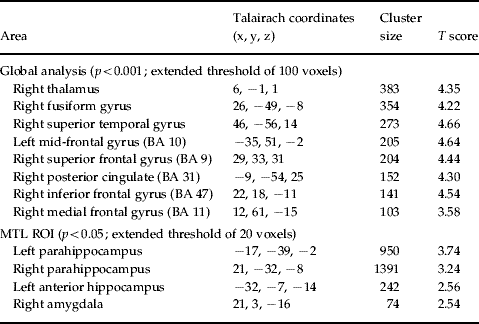
The total volume of grey matter, white matter and CSF did not differ significantly between the two groups (see Table 1). In the whole-brain analysis decreased grey-matter volumes in the BDNF 66Met+ in comparison to the 66Met– group were found, among other regions, in the thalamus, the right fusiform gyrus and several frontal regions (for a complete list see Table 2 and Fig. 1). The opposite contrast did not reveal any areas with decreased volumes in 66Met– allele carriers.
Sagittal (a), coronal (b) and axial (c) projection of larger grey-matter volumes in the 66Met− than in the 66Met+ carriers (p<0.001; extended threshold of 100 voxels).

Areas with higher grey-matter volume in 66Met− carriers than in 66Met+ carriers
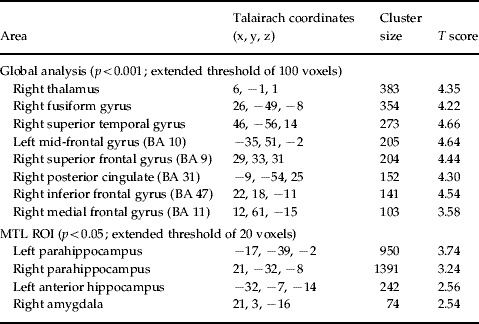
BA, Brodmann area; MTL, medial temporal lobe; ROI, region of interest.
BDNF and regional VBM
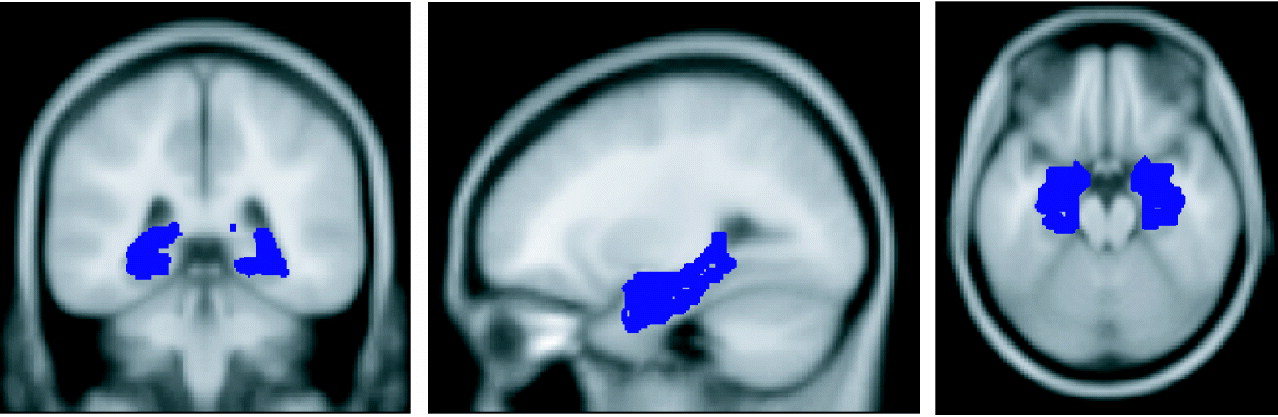
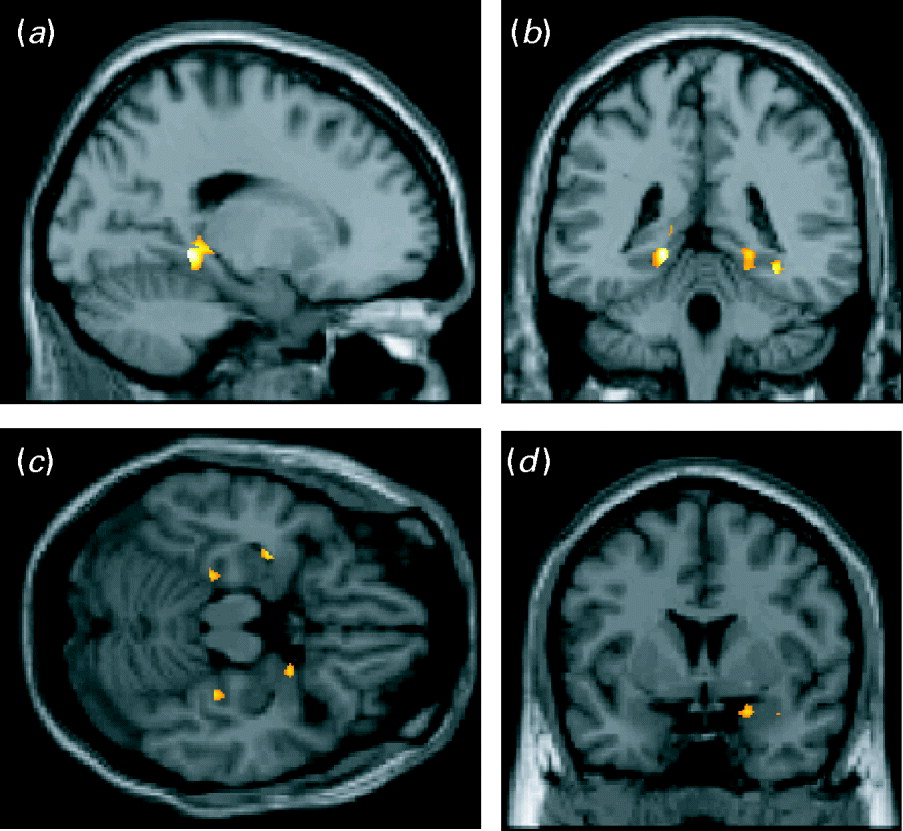
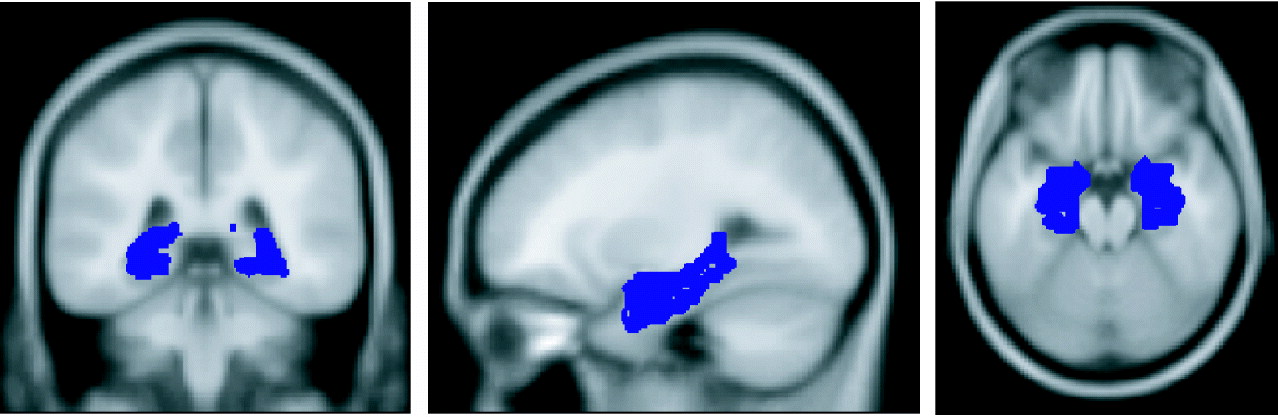
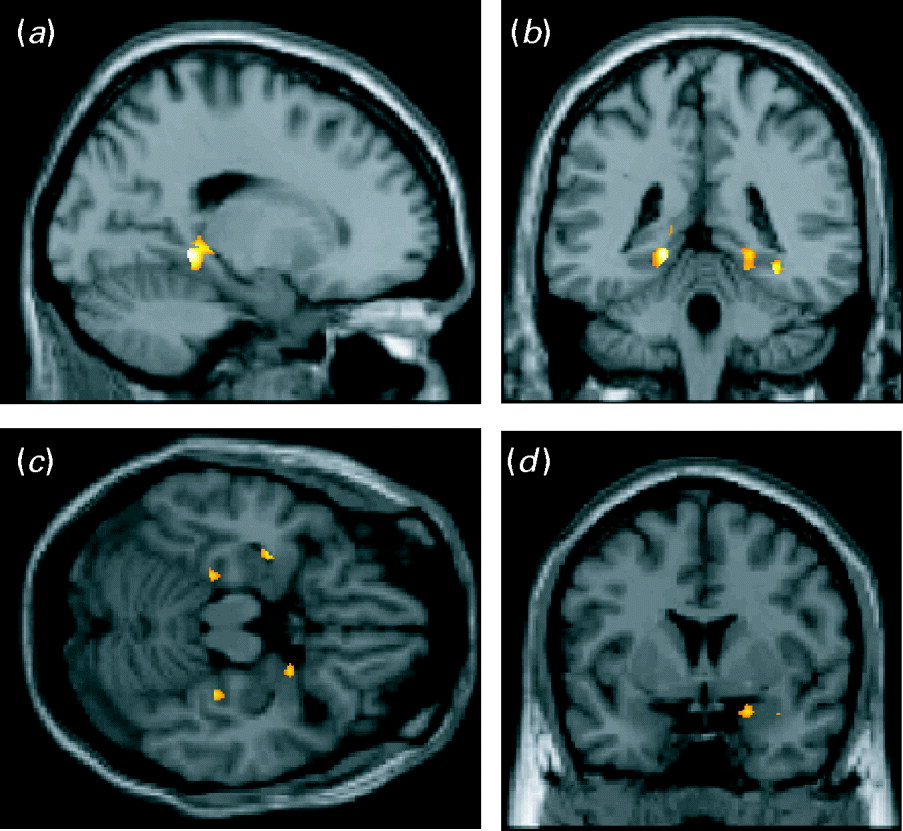
To increase the sensitivity and because of the a priori hypothesis, we performed a ROI analysis in the MTL using the mask illustrated in Fig. 2, and described in the method section. This ROI analysis revealed a significant decrease in grey-matter volume bilateral in the parahippocampal gyrus, the left anterior hippocampus and the right amygdala (see Fig. 3), as detailed in Table 2.
Projection of the medial temporal lobe mask used for the region of interest analysis.
Sagittal (a) and coronal (b) projection of larger posterior medial temporal lobe (MTL) volumes and (c)/(d) of the anterior parts of the MTLs in the 66Met− than in the 66Met+ carriers (p<0.05 false-discovery rate corrected; extended threshold of 20 voxels in the MTL region of interest as shown in Fig. 2).
Discussion
The aim of our study was to find evidence for the impact of the BDNF Val66Met polymorphism on the volume of the hippocampus and other brain structures. Several studies have shown previously that this functional BDNF SNP has an influence on the hippocampal volume (Frodl et al. Reference Frodl, Meisenzahl, Zetzsche, Born, Groll, Jäger, Leinsinger, Bottlender, Hahn and Möller2002; Pezawas et al. Reference Pezawas, Verchinski, Mattay, Callicott, Kolachana, Straub, Egan, Meyer-Lindenberg and Weinberger2004; Szeszko et al. Reference Szeszko, Lipsky, Mentschel, Robinson, Gunduz-Bruce, Sevy, Ashtari, Napolitano, Bilder, Kane, Goldman and Malhotra2005; Bueller et al. Reference Bueller, Aftab, Sen, Gomez-Hassan, Burmeister and Zubieta2006). By using VBM in a whole-brain analysis we were able to show an influence of the BDNF Val66Met polymorphism not only on the left anterior hippocampus but also on the wide parts of the parahippocampal gyrus in both hemispheres. Additionally, other brain structures (right thalamus, right gyrus fusiformis, and several parts of the frontal gyrus) show decreased grey-matter volumes. When focusing on the MTL our findings support the recent results by Takahashi et al. (Reference Takahashi, Suzuki, Tsunoda, Kawamura, Takahashi, Tsuneki, Kawasaki, Zhou, Kobayashi, Sasaoka, Seto, Kurachi and Ozaki2008), also reporting an impact of the BDNF Val66Met polymorphism on the parahippocampal gyrus. The parahippocampal gyrus and the fusiform gyrus are involved in the processing of visual spatial information on the location of an object through the entorhinal cortex to the hippocampus. Together with the hippocampus, both structures play a prominent role in spatial orienting and memory functions (Bird & Burgess, Reference Bird and Burgess2008). Therefore, adding to evidence from the above-mentioned studies, structures involved in processing information to the hippocampus are also influenced by the BDNF Val66Met polymorphism. Given that recent studies have implicated a role for smaller parahippocampal volumes specifically in late-onset depression (Andreescu et al. Reference Andreescu, Butters, Begley, Rajji, Wu, Meltzer and Reynolds2008), this finding could further stimulate research on the association between BDNF/stress interactions and anatomical changes in the MTL as a vulnerability factor for depression.
Following on from structural MRI data, experiments using functional MRI (fMRI) technology should now clarify the role of the BDNF Val66Met polymorphism in the processing of emotional stimuli. Emotional dysregulation represents a core characteristic of affective disorders. Studies in this field are scarce. fMRI data from our laboratory (Montag et al. Reference Montag, Reuter, Newport, Elger and Weber2008a) show that healthy female carriers of the 66Met allele react to diverse emotional stimuli with a stronger amygdala response in the right hemisphere in an affective startle paradigm. Evidence from the present study suggests that carriers of the Met66+ variant not only react more strongly to emotional stimuli but also have significantly diminished grey-matter volume in the right amygdala. The role of BDNF in the amygdala has been considered previously (Rattiner et al. Reference Rattiner, Davis, French and Ressler2004; Chhatwal et al. Reference Chhatwal, Stanek-Rattiner, Davis and Ressler2006), but to our knowledge a direct influence of the BDNF Val66Met polymorphism on amygdala volume has not been demonstrated before. A recent study by Sublette et al. (Reference Sublette, Baca-Garcia, Parsey, Oquendo, Rodrigues, Galfalvy, Huang, Arango and Mann2008) showed an inverse correlation between amygdala volume and age only in carriers of the 66Met+ allele. However, in the present study using a homogeneous sample with respect to age, we found a gene effect on the amygdala grey-matter volume independent of age. Individual differences in amygdala volume have been discussed in association with psychopathology. Thus, a study by Yoshikawa et al. (Reference Yoshikawa, Matsuoka, Yamasue, Inagaki, Nakano, Akechi, Kobayakawa, Fujimori, Nakaya, Akizuki, Imoto, Murakami, Kasai and Uchitomi2006) found that depressive patients showed smaller amygdala volumes in the left hemisphere. However, this finding stands in contrast to a study by Iidaka et al. (Reference Iidaka, Matsumoto, Ozaki, Suzuki, Iwata, Yamamoto, Okada and Sadato2006), showing that high harm avoidance scores (i.e. higher trait anxiety) were also associated with higher amygdala volumes in the left hemisphere, although this finding was only significant in females. The heterogeneity of these results could be clarified by the above-mentioned meta-analysis (Hamilton et al. Reference Hamilton, Siemer and Gotlib2008), revealing that unmedicated depressive patients had smaller amygdala volumes whereas medicated depressive patients were associated with higher amygdala volumes. Potentially, the antidepressant treatment leads to an increase in BDNF and neuronal proliferation. A study by Siegle et al. (Reference Siegle, Konecky, Thase and Carter2003) using both structural and functional MRI demonstrated that smaller amygdala volumes are associated with an increased reagibility in response to emotional stimuli. Another seminal study using both functional and structural imaging in the context of the BDNF Val66Met polymorphism and cognition (verbal and visuospatial memory performance) was conducted by Ho et al. (Reference Ho, Milev, O'Leary, Librant, Andreasen and Wassink2006) with a large group of schizophrenia patients and healthy controls. Ho et al. (Reference Ho, Milev, O'Leary, Librant, Andreasen and Wassink2006) found smaller grey-matter volumes in the temporal lobes in the 66Met carriers, in accordance with the data in the present study. They further showed that schizophrenic patient and healthy control 66Met carriers had poorer verbal memory performance in comparison to carriers of the Val/Val genotype.
The 66Met allele (or the homozygous 66Met variant) has also been associated with higher trait anxiety in humans and animals (Jiang et al. Reference Jiang, Xu, Hoberman, Tian, Marko, Waheed, Harris, Marini, Enoch and Lipsky2005; Chen et al. Reference Chen, Jing, Bath, Ieraci, Khan, Siao, Herrera, Toth, Yang, McEwen, Hempstead and Lee2006; Montag et al. Reference Montag, Reuter, Newport, Elger and Weber2008a, in press). Both the septo-hippocampal system and the amygdala represent the core structures of the neuronal anxiety circuit (Gray's Behavioural Inhibition System) according to the well-acknowledged revised Reinforcement Sensitivity Theory (RST) by Gray & McNaughton (Reference Gray and McNaughton2000). A study reporting an association between an anxiety-related functional gene variant and the grey-matter volume of both structures is therefore convincing support for the validity of the RST.
Although the findings from our study are comparable with most of the results in the field and seem to be robust, a recent report by Pezawas et al. (Reference Pezawas, Meyer-Lindenberg, Goldman, Verchinski, Chen, Kolachana, Egan, Mattay, Hariri and Weinberger2008) points out that referring to the 66Met allele as the ‘bad’ allele is too simplistic. Pezawas and others reported that the 66Met allele could even have a protective effect against the potential negative influence of the short allele of the serotonin transporter gene polymorphism (5-HTTLPR) with respect to the brain circuitry encompassing the subgenual portion of the anterior cingulate and the amygdala. They demonstrated that the anxiety/neuroticism-related s-allele (Canli & Lesch, Reference Canli and Lesch2007) of the 5-HTTLPR has no influence on the volume of the anterior cingulate when carrying at least one 66Met allele of the BDNF Val66Met polymorphism. Moreover, the BDNF 66Met allele, which is associated with impaired BDNF trafficking (Chen et al. Reference Chen, Jing, Bath, Ieraci, Khan, Siao, Herrera, Toth, Yang, McEwen, Hempstead and Lee2006), can have different effects in different areas of the mammalian brain depending on the pro or mature form of the BDNF molecule (Lu et al. Reference Lu, Pang and Woo2005). Therefore, a generalization of the effects of the BDNF Val66Met polymorphism on the brain is not possible. A future study should aim to replicate these new findings by Pezawas et al. (Reference Pezawas, Meyer-Lindenberg, Goldman, Verchinski, Chen, Kolachana, Egan, Mattay, Hariri and Weinberger2008).
Although the focus of our study was the investigation of the BDNF Val66Met polymorphism on structures of the MTL, we also want to discuss briefly the results of the whole-brain analysis. Pezawas et al. (Reference Pezawas, Verchinski, Mattay, Callicott, Kolachana, Straub, Egan, Meyer-Lindenberg and Weinberger2004) have shown an association between a decrease in grey-matter volume in the prefrontal cortex in carriers of the 66Met allele by means of VBM. Evidence from the present study showing an influence of the BDNF Val66Met polymorphism on several parts of the frontal gyrus underline the potential influence of this polymorphism on the circuitry of the prefrontal cortex and therefore also the importance of BDNF in learning and memory (Egan et al. Reference Egan, Kojima, Callicott, Goldberg, Kolachana, Bertolino, Zaitsev, Gold, Goldman, Dean, Lu and Weinberger2003; Ho et al. Reference Ho, Milev, O'Leary, Librant, Andreasen and Wassink2006). Nevertheless, we are aware that our current investigation of the effect of the BDNF Val66Met polymorphism has been on the structure and not the functionality of the brain. For this reason our interpretation of the present data concerning cognitive functions is not explored further here and remains preliminary.
Taking findings from fMRI and structural imaging into account, the 66Met allele is likely to represent a risk factor for developing an affective disorder such as depression under adverse environmental influences (stress). Given the complexity of the brain and the limited proportion of variance that could be explained by a single polymorphism, it is evident that multiple gene variants in concert influence those brain circuits associated with anxiety and depression, as exemplified by the reported interaction of BDNF Val66Met and 5-HTTLPR. Furthermore, BDNF is a factor that influences a wide variety of processes in the brain, being associated with psychopathological disorders ranging from anxiety (Groves, Reference Groves2007; Montag et al. Reference Montag, Reuter, Newport, Elger and Weber2008a, Reference Montag, Fiebach, Basten, Stelzel and Reuterin press), depression (Verhagen et al. Reference Verhagen, van der Meij, van Deurzen, Janzing, Arias-Vásquez, Buitelaar and Frankein press), potentially Alzheimer's disease (Tapia-Arancibia et al. Reference Tapia-Arancibia, Aliaga, Silhol and Arancibia2008) and schizophrenia (Ho et al. Reference Ho, Milev, O'Leary, Librant, Andreasen and Wassink2006) to addiction (Lang et al. Reference Lang, Sander, Lohoff, Hellweg, Bajbouj, Winterer and Gallinat2007; Montag et al. Reference Montag, Basten, Stelzel, Fiebach and Reuter2008b). Therefore, BDNF seems not to represent the biological basis of one distinct phenotype but instead may be relevant for the genesis of numerous psychopathological/neurological disorders.
Declaration of Interest
None.