Introduction
Ixodid ticks are the most important arthropod vectors in terms of the diversity of pathogens (i.e., bacteria, protozoa and viruses) transmitted to humans and domestic animals in North America (Jongejan and Uilenberg Reference Jongejan and Uilenberg2004). They are also hosts to a diverse range of non-pathogenic bacterial endosymbionts (Ahantarig et al. Reference Ahantarig, Trinachartvanit, Baimai and Grubhoffer2013). All tick-borne pathogens, and some symbionts, go through an enzootic transmission cycle (Sonenshine and Roe Reference Sonenshine and Roe2014). This often involves small mammals as hosts for the pathogen and at least one life cycle stage of the tick vector. Geographical variation in the species composition, density, and activity of these small mammals can result in spatial variation in the transmission rates of tick-borne microorganisms (Randolph Reference Randolph2008).
A variety of ixodid ticks have been recorded on small mammals in the prairie grasslands and aspen parklands of western Canada. These ticks include Ixodes angustus Newmann, Ixodes kingi Bishopp (Acari: Ixodidae), Ixodes sculptus Newmann (Acari: Ixodidae), Haemaphysalis leporispalustris (Packard) (Acari: Ixodidae), Dermacentor andersoni Stiles (Acari: Ixodidae), and Dermacentor variabilis (Say) (Acari: Ixodidae) (see Gregson Reference Gregson1956; Burachynsky and Galloway Reference Burachynsky and Galloway1985). Several of these tick species transmit pathogenic agents to humans and/or domestic and wild animals. For example, D. andersoni and D. variabilis are biological vectors for the bacteria, Anaplasma marginale Theiler (Anaplasmataceae), Francisella tularensis (McCoy and Chapin) (Francisellaceae), and Rickettsia rickettsii (Wolbach) (Rickettsiaceae) (Fournier and Raoult Reference Fournier and Raoult2009; Petersen et al. Reference Petersen, Mead and Schriefer2009; Kocan et al. Reference Kocan, de la Fuente, Blouin, Coetzee and Ewing2010). The other tick species are potential vectors of pathogenic agents because vector competence has been demonstrated in laboratory experiments (Peavey et al. Reference Peavey, Lane and Damrow2000), or the DNA of pathogens has been detected in ticks collected in the field (Steiert and Gilfoy Reference Steiert and Gilfoy2002). However, given that there is limited information as to which tick species parasitise small mammals in Saskatchewan, and which bacterial species occur within these ticks, we conducted a study to identify the tick species on small mammals at two localities in southern Saskatchewan. In addition, molecular analyses were conducted to determine if the ticks on these small mammals were infected with bacteria of the genus Rickettsia da Rocha-Lima.
Materials and methods
Collection of small mammals and identification of ticks
Sampling was conducted in areas of limited human activity at Saskatchewan Landing Provincial Park (SLPP) (50.6461°N, 107.9646°W) and near the shores of Blackstrap Lake (BL) (51.7954°N, 106.4127°W). These sites are located in the mixed grassland ecoregion and the moist mixed grassland ecoregion, respectively. Small mammals were collected using mouse snap-traps baited with peanut butter and oats. Traps were placed in tall grass or under shrubs, and set in the morning and checked at least every four hours until sunset. All traps were reset, left overnight and checked just after sunrise the next morning. Trapping was carried out for two to three consecutive days for each sampling effort in June and July of 2008 and April 2009 at SLPP and May to July 2009 at BL. All mammals, identified based on morphological examination (Banfield Reference Banfield1974; van Zyll de Jong Reference van Zyll de Jong1983), were placed into individual bags and then frozen at −20 °C within 18 hours of collection.
Ticks were removed from each thawed animal by combing the fur, followed by a detailed inspection of the entire body surface. Each tick was examined using a dissecting microscope and identified to the genus level based on morphological characters (Gregson Reference Gregson1956; Brinton et al. Reference Brinton, Beck and Allred1965). Contingency tests (χ2) with Yates’ continuity correction for small sample sizes were used to determine if there were differences among host species in the proportion of individuals infested by ticks, while Mann–Whitney U or Kruskal–Wallis tests (using a Bonferonni correction for sample sizes<7) were used to compare the mean ranking of intensity of ticks on different species of mammalian host.
Genomic DNA (gDNA) was isolated from whole individual ticks using the protocol described in Dergousoff and Chilton (Reference Dergousoff and Chilton2007). The species identity of all immature stages of Dermacentor Koch (i.e., larvae and nymphs) was determined using a polymerase chain reaction (PCR) assay targeting a portion of the second internal transcribed spacer (ITS-2) of the nuclear ribosomal DNA. This target region can be used to differentiate D. andersoni from D. variabilis and D. albipictus based on the amplicon size (Dergousoff and Chilton Reference Dergousoff and Chilton2007). Immatures of D. variabilis were then distinguished from those of D. albipictus by restriction fragment length polymorphism analysis of the ITS-2 amplicons using the restriction enzyme AluI (Fermentas, Burlington, Ontario, Canada) as per manufacturer’s instructions. The ITS-2 amplicons of D. variabilis lack an AluI restriction site, but the sequence of the ITS-2 amplicons from D. albipictus contains a single restriction site (Dergousoff and Chilton Reference Dergousoff and Chilton2007).
Detection and identification of rickettsial-specific genes in tick gDNA
The presence of rickettsiae in each tick was determined using a PCR assay designed to amplify part (381 base pairs) of the rickettsial citrate synthase gene (gltA). Polymerase chain reactions were performed in a 25 μL solution containing 200 μM of each dNTP, 2.5 mM MgCl2, 0.5 U of iTaqTM DNA polymerase (Bio-Rad, Hercules, California, United States of America), iTaq PCR buffer, 2 μL of template gDNA and 25 pmol (1 µM) of both primers; RpCS877F (5'-GGGGACCTGCTCACGGCGG-3') and RpCS1258R (5'-ATTGCAAAAAGTACAGTGAACA-3') (Regnery et al. Reference Regnery, Spruill and Plikaytis1991; Eremeeva et al. Reference Eremeeva, Dasch and Silverman2003). The amplification conditions used were: 95 °C for five minutes, followed by 30 cycles of 95 °C for 30 seconds, 60 °C for 30 seconds, and 72 °C for 30 seconds, and a final extension at 72 °C for five minutes. Also included in the PCR analyses were no gDNA (i.e., negative) controls and two positive control samples; the gDNA of Dermacentor adults demonstrated previously (Dergousoff et al. Reference Dergousoff, Gajadhar and Chilton2009) to contain the DNA of Rickettsia peacockii (Wolbach) or Rickettsia montanensis corrig. (ex Lackman et al.) Weiss and Moulder. Amplicons were subjected to electrophoresis on SYBR® Safe-stained 1.5% agarose-TBE (Thermo Fisher Scientific Inc., Waltham, Massachusetts, United States of America) (89 mM Tris, 89 mM boric acid, 2 mM EDTA, pH 8.3) gels and their banding patterns were visualised by ultraviolet transillumination. Amplicons were purified using shrimp alkaline phosphatase and exonuclease I (Werle et al. Reference Werle, Schneider, Renner, Völker and Fiehn1994) and subjected to automated DNA sequencing (ABI Prism DNA Sequencer; National Research Centre, Saskatoon, Saskatchewan, Canada) using primers RpCS877F and RpCS1258R in separate reactions.
To confirm the results of the gltA PCR assay, all tick gDNA samples were subjected to a nested PCR (nPCR) that amplifies part (434 base pairs) of the rickettsial 17 kDa surface antigen gene. Primers 17k-5 (5'-GCTTTACAAAATTCTAAAAACCATATA-3') and 17k-R3 (5'-TGTCTATCAATTCACAACTTGCC-3') (Stothard Reference Stothard1995) were used for the first phase of the nPCR, and primers 17kD1 (5'-GCTCTTGCAACTTCTATGTT-3') and 17kD2 (5'-CATTGTTCGTCAGGTTGGCG-3') (Webb et al. Reference Webb, Carl, Malloy, Dasch and Azad1990) for phase 2. The reaction volumes and reagents used in this PCR were the same as those used for the gltA PCR assay, except that 2 µL of tick gDNA was used as the template for phase 1, while 1 µL of purified PCR product (including those of the negative and positive control samples) was used as the template for phase 2. The cycling conditions used were: 95 °C for five minutes, followed by 35 cycles of 95 °C for 60 seconds, 58 °C for 60 seconds, and 72 °C for 60 seconds, with a final extension at 72 °C for five minutes (phase 1), and 95 °C for five minutes, 30 cycles of 95 °C for 30 seconds, 61 °C for 30 seconds, and 72 °C for 30 seconds, and then 72 °C for five minutes (phase 2). Amplicons of three representative samples from phase 1 of the nPCR were purified and subjected to automated sequencing using primers 17k-5 and 17k-R3 in separate reactions.
To further confirm the species identity of the Rickettsia, 532 base pairs of the outer membrane protein A gene (ompA) was amplified and sequenced using primers Rr190.70p (5'-ATGGCGAATATTTCTCCAAAA-3') and Rr190.602n (5'-AGTGCAGCATTCGCTCCCCCT-3') (Regnery et al. Reference Regnery, Spruill and Plikaytis1991) for ticks that were positive in the gltA assay. The PCR volumes and cycling conditions used to amplify ompA were the same as for the gltA PCR, except that 1.5 mM MgCl2 was used. The DNA sequences for all three genes of the rickettsiae detected in immature ticks were compared to those of Rickettsia within the GenBank database of the National Centre for Biotechnology Information (www.ncbi.nlm.nih.gov/genbank/).
Results
Ticks collected from small mammals
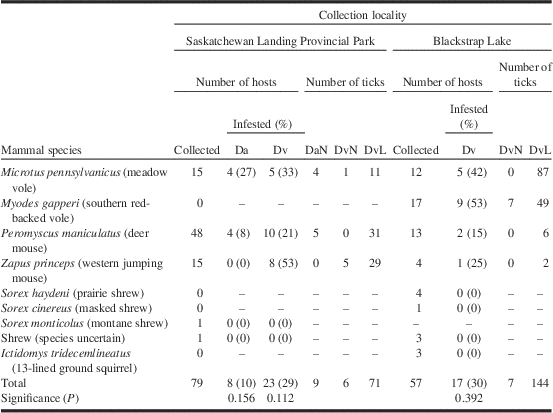
A total of 79 small mammals were trapped at SLPP (Table 1), 28 (35%) of which were infested with ticks. Nine D. andersoni nymphs were collected from four Peromyscus maniculatus (Wagner) (Rodentia: Cricetidae) and four Microtus pennsylvanicus (Ord) (Rodentia: Cricetidae). These animals were collected between 18 June and 10 July 2008, and between 21 April and 31 April 2009. No D. andersoni larvae were found on small mammals at SLPP. Seventy-one D. variabilis larvae were collected from 23 mammals at SLPP: 10 P. maniculatus, seven Zapus princeps Allen (Rodentia: Cricetidae) and four M. pennsylvanicus. These animals were collected between 27 May and 10 July 2008, and between 21 April and 1 May 2009. Six D. variabilis nymphs were collected from two Z. princeps and one M. pennsylvanicus trapped on 17 June and 8 July 2008. One of the Z. princeps was infested with both D. variabilis larvae and nymphs; while two M. pennsylvanicus and one P. maniculatus were infested with ticks of both species (i.e., D. andersoni nymphs and D. variabilis larvae). No adult ticks were found on any of the small mammals collected at SLPP.
The number of mammals collected at two localities in Saskatchewan (Canada) and the number of larvae and nymphs of Dermacentor andersoni and/or Dermacentor variabilis removed from these mammals.

Notes: DaN, D. andersoni nymphs; DvN, D. variabilis nymphs; DvL, D. variabilis larvae.
The prevalence of infestation was compared among all small mammal species using χ2 tests with Yates’ correction for continuity.
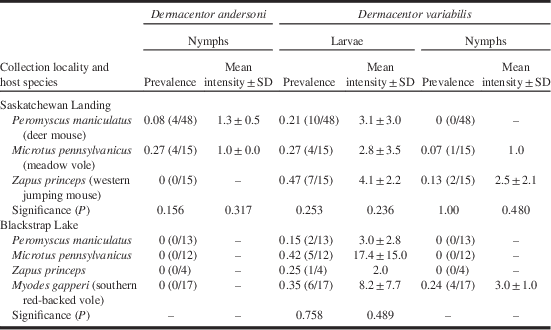
There was no significant difference (χ2 1=2.009; P=0.156) in the proportion of M. pennsylvanicus and P. maniculatus individuals at SLPP infested with D. andersoni nymphs (0.27 versus 0.08, respectively; see Table 2). The mean number of nymphs per infested mammal (i.e., mean intensity) was also similar for these two species of mammal (U=3.200; P=0.074). In contrast, the prevalence of D. variabilis larvae on Z. princeps was significantly greater than for P. maniculatus (χ2 1=4.430; P=0.035), but not for M. pennsylvanicus (χ2 1=0.543; P=0.461). Zapus princeps was also infested with more ticks, on average, than the other two species of animals (H=2.887; df=2; P=0.236). No meaningful comparisons for the infestation rates of D. variabilis nymphs could be made because only three individuals were infested.
Prevalence of infestation and mean intensity (±standard deviation) of immature ticks on small mammal species at Saskatchewan Landing Provincial Park and Blackstrap Lake, Saskatchewan.

Notes: The prevalence of infestation was compared among all small mammal species using χ2 tests with Yates’ continuity correction. The mean ranking of tick intensity was compared for all infested host species at each locality using the Kruskal–Wallis or Mann–Whitney non-parametric tests.
A total of 57 small mammals were trapped at BL, 17 (30%) of which were parasitised by at least one tick (Table 1); however, no adult ticks were collected. Dermacentor variabilis larvae (n=144) were collected from 29 May to 15 July 2009 from 14 small mammals representing four host species: M. gapperi (Vigors) (Rodentia: Cricetidae) (n=6), M. pennsylvanicus (n=5), P. maniculatus (n=2), and Z. princeps (n=1). A total of seven D. variabilis nymphs were collected on 29 May, 16 July, and 28 July 2009 from four M. gapperi, one of which was also infested by 14 larvae. None of the eight shrews (Sorex Linnaeus or Microsorex Coues (Soricomorpha: Soricidae)) or the three Ictidomys tridecemlineatus (Mitchill) (Rodentia: Sciuridae) were parasitised by ticks.
The greatest prevalence of D. variabilis larvae on hosts at BL occurred for M. pennsylvanicus, followed by M. gapperi, Z. princeps, and P. maniculatus (Table 2); however, statistical analyses revealed no significant difference in prevalence among host species (χ2 3=1.178; P=0.758). Similarly, M. pennsylvanicus had the greatest mean number of larvae per infested individual (i.e., mean intensity), but this was not statistically significant (H=2.242; df=3; P=0.489) because tick burden varied greatly among host species. A relatively large proportion of larvae were collected from three of the meadow voles (n=20, 25, and 37), while the other two only had a few larvae (n=1 and 4).
There were differences in the proportion of D. variabilis larvae parasitising different mammals between sites. For example, 60% (87/144) of larvae were found on M. pennsylvanicus at BL compared to only 15% (11/71) at SLPP (χ2 1=36.9; P<0.05), while 44% (31/71) of larvae at SLPP were collected from P. maniculatus, compared to only 4% (6/144) (χ2 1=52.0; P<0.05) at BL. Similarly, 41% (29/71) of D. variabilis larvae were collected from Z. princeps at SLPP, compared to only 1% (2/144) on this host species (χ2 1=56.8; P<0.05) at BL (Table 1). There were also differences in prevalence and intensity of D. variabilis larvae on different host species between sites (Table 2). Zapus princeps was the species with the greatest proportion of individuals infested at SLPP (χ2 2=2.747; P=0.253), but ranked third at BL (χ2 3=1.178; P=0.758). However, the ranking among host species was not statistically significant at both locations. This may be due to the small sample sizes. Although few D. variabilis nymphs were collected at BL and SLPP, there was no overlap in host species between the two sites (Table 2).
Detection and identification of rickettsiae in ticks
Molecular analyses were conducted on the gDNA of 236 ticks to determine if they were infected with rickettsiae. The results revealed that all nine D. andersoni nymphs, which were collected from eight different animals at SLPP, were PCR-positive for both the rickettsial GltA and 17 kDa genes. In contrast, none of the 214 D. variabilis larvae (n=71 from SLPP and n=143 from BL), the 13 D. variabilis nymphs (n=6 from SLPP and n=7 from BL), or the negative controls, were PCR-positive for either rickettsial gene. Amplicons of the expected sizes for both the rickettsial GltA and 17 kDa genes were obtained from the R. peacockii and R. montanensis-positive control samples (i.e., the gDNA of infected adult D. andersoni and D. variabilis, respectively).
The DNA sequences of the partial GltA gene (381 base pairs) of all PCR-positive D. andersoni nymphs (GenBank accession number HF912416) were identical in sequence to the gltA sequence of R. peacockii (accession number AY590152). The partial DNA sequences of the 17 kDa antigen gene (499 base pairs) from three D. andersoni nymphs (GenBank accession number HF912417) were also identical in sequence to the 17 kDa antigen gene of R. peacockii (accession number CP001227). Likewise, the partial ompA sequences (490 base pairs) of the rickettsiae in the infected D. andersoni nymphs (accession number HF912418) were identical to the ompA sequence of R. peacockii (accession number AY357766).
Discussion
Ticks removed from mice and voles at the two localities in southern Saskatchewan were identified as D. variabilis larvae and nymphs, and D. andersoni nymphs. This finding was not unexpected based on repeated collections of questing adults from each locality in recent years (Dergousoff et al. Reference Dergousoff, Galloway, Lindsay, Curry and Chilton2013). Saskatchewan Landing Provincial Park represents a locality where there are established populations of both D. andersoni and D. variabilis, while at BL, only D. variabilis have established (Dergousoff et al. Reference Dergousoff, Galloway, Lindsay, Curry and Chilton2013). However, in the present study, no D. andersoni larvae were collected from small mammals at SLPP. This suggests that D. andersoni larvae were host seeking sometime after early July at this locality, which would be consistent with previous reports of the timing of feeding for this species at other localities near the northern limits of its distributional range (Wilkinson Reference Wilkinson1967). Surprisingly, no Ixodes were detected on any of the small mammals at either locality. Previous studies have shown that M. gapperi was commonly parasitised by Ixodes angustus Neumann in British Columbia, Canada (Anstead et al. Reference Anstead, Hwang and Chilton2013), while Ixodes sculptus Neumann and I. kingi have been recorded on other rodents, such as Spermophilus richardsonii (Sabine) (Rodentia: Sciuridae) and/or Thomomys talpoides (Richardson) (Rodentia: Geomyidae) in southern Saskatchewan (Anstead and Chilton Reference Anstead and Chilton2011; Anstead et al. Reference Anstead, Wallace and Chilton2014).
There were differences in the preferred hosts of D. andersoni and D. variabilis immatures at SLPP. Two of the four species of small mammal (i.e., P. maniculatus and M. pennsylvanicus) trapped at SLPP were infested with D. andersoni nymphs. These two species have been recorded as hosts for D. andersoni nymphs in other regions of Canada (Gregson Reference Gregson1956). Although D. andersoni immatures were not collected from Z. princeps at SLPP, this species of small mammal has been recorded as a host for D. andersoni nymphs in other geographical areas of Saskatchewan (Gregson Reference Gregson1956). Thus, the absence of D. andersoni nymphs on Z. princeps may be a consequence of the low numbers of this tick species collected. This may also indicate that western jumping mice are parasitised less often than other species of small mammal at SLPP. In contrast, D. variabilis immatures at SLPP used Z. princeps, together with P. maniculatus and M. pennsylvanicus, as hosts.
There was overlap of the mammalian species used as hosts by D. variabilis immatures, yet the host range and proportion of ticks infesting each host species differed significantly between the two study sites. For example, the prevalence of D. variabilis larvae on M. pennsylvanicus was greater at BL than at SLPP. Similarly, the average number of larvae per parasitised M. pennsylvanicus was greater at BL than at SLPP. However, some of the observed differences in infestation rates for some of the other host species may be an artifact of the small sample sizes of the animals and/or of the ticks collected from them. The prevalence and mean intensity of D. variabilis larvae indicate clustering/non-random distribution among individuals. This is a common feature of ectoparasites, and reflects the large variation in tick burden among individuals within a population. At BL, D. variabilis parasitised Z. princeps, P. maniculatus, and M. pennsylvanicus, as well as M. gapperi, a species that was not trapped at SLPP. This tick is a generalist (Shaw and Dobson Reference Shaw and Dobson1995) and a greater diversity of mammalian species provides a wider range of potential hosts. However, shrews do not appear to be important hosts for D. variabilis at BL. The species used as hosts by D. variabilis immatures at BL are similar to those recorded by Burachynsky and Galloway (Reference Burachynsky and Galloway1985) at Birds Hill Park (Manitoba, Canada), a locality with a similar environment (i.e., aspen parkland) situated ~700 km east southeast of BL. Burachynsky and Galloway (Reference Burachynsky and Galloway1985) also collected a small number (n=7) of shrews (Sorex cinereus Kerr (Soricomorpha: Soricidae)), all of which were not parasitised by D. variabilis; however, larvae have occasionally been collected from short-tailed shrews (Blarina brevicauda (Say) (Soricomorpha: Soricidae)) in Tennessee and Missouri, United States of America (Kollars Reference Kollars1996, Kollars et al. Reference Kollars, Oliver, Masters, Kollars and Durden2000). Additional studies need to be conducted by sampling at regular intervals over the entire period of activity for each life stage at both sites to determine the relative importance of each species of small mammal as hosts to both species of tick. Nevertheless, the results of this study provide an indication as to the preferred hosts at each site.
Although D. andersoni and D. variabilis have largely allopatric ranges, their distributions overlap considerably in southern Saskatchewan (Gregson Reference Gregson1956; Merten and Durden Reference Merten and Durden2000; Dergousoff et al. Reference Dergousoff, Galloway, Lindsay, Curry and Chilton2013). Therefore, temporal overlap in the feeding activity of immature life cycle stages of both tick species, combined with an overlap in host usage, may have implications for pathogen transmission. For example, at localities where both tick species coexist, there is the potential for cross-species transmission of tick-borne microorganisms. It is possible that these microorganisms may be spread directly from one tick species to another as they feed adjacent to each other on a non-bacteremic host (i.e., co-feeding transmission) (Randolph et al. Reference Randolph, Gern and Nuttall1996), or indirectly through the transmission of the microbe to a host by an infected tick, followed by the feeding of another tick on the bacteremic host (Mather and Ginsberg Reference Mather and Ginsberg1994).
Both D. andersoni and D. variabilis are hosts and vectors for several species of Rickettsia, including the causative agent of Rocky Mountain spotted fever, R. rickettsii (Fournier and Raoult Reference Fournier and Raoult2009). In the present study, no larval or nymphal ticks at SLPP or BL were infected with R. rickettsii, which is consistent with the previous findings for questing adult D. andersoni and D. variabilis at these sites (Dergousoff et al. Reference Dergousoff, Gajadhar and Chilton2009). Furthermore, the endosymbiont, R. montanensis was not detected in D. variabilis larvae or nymphs at SLPP, which is also consistent with the results for adults in an earlier study (Dergousoff et al. Reference Dergousoff, Gajadhar and Chilton2009). In contrast, all nine D. andersoni nymphs, which were collected from four deer mice and four meadow voles, were infected with the endosymbiont, R. peacockii. This is similar to the 96% infection rates of questing D. andersoni adults at SLPP (Dergousoff et al. Reference Dergousoff, Gajadhar and Chilton2009). None of the D. variabilis larvae or nymphs from SLPP, some of which were on the same hosts as the D. andersoni nymphs, were infected with R. peacockii. These data provide additional support that R. peacockii is species-specific for D. andersoni and is not horizontally transmitted to D. variabilis immatures that feed on the same hosts as infected D. andersoni individuals. Rather, R. peacockii is maintained at a high frequency in tick populations exclusively by transovarial transmission (Burgdorfer et al Reference Burgdorfer, Hayes and Mavros1981; Niebylski et al. Reference Niebylski, Schrumpf, Burgdorfer, Fischer, Gage and Schwan1997).
One unexpected finding of the present study was the absence of R. montanensis in 150 D. variabilis larvae and nymphs collected from small mammals at BL because this bacterium was detected at a prevalence of 33% in questing D. variabilis adults collected from BL four years earlier. This apparent absence of R. montanensis in D. variabilis immatures is unlikely due to the infection intensity being below the detection limits of the nPCR, given that R. peacockii was readily detected in D. andersoni nymphs using the same PCR assays. One explanation for the difference in rickettsial infection rate between D. variabilis adults and immatures may be associated with the sites sampled at BL (Dergousoff et al. Reference Dergousoff, Gajadhar and Chilton2009). A majority (96%) of the immature ticks (i.e., seven nymphs and 144 larvae) were collected from the eastern side of Blackstrap Lake, where the prevalence of Rickettsia in adult ticks was significantly lower than on the western side of the lake (Dergousoff et al. Reference Dergousoff, Gajadhar and Chilton2009). Additional studies are needed to assess spatial and temporal patterns of R. montanensis infection in different populations of D. variabilis.
Host selection by D. andersoni and D. variabilis can have important implications for their population dynamics and for microbial transmission because vertebrate species differ in their relative abundance, suitability as hosts for ticks, and/or reservoir competence for tick-borne microorganisms (e.g., Kollars Reference Kollars1996; Kollars et al. Reference Kollars, Oliver, Masters, Kollars and Durden2000; LoGiudice et al. Reference LoGiudice, Ostfeld, Schmidt and Keesing2003; Madhav Reference Madhav, Brownstein, Tsao and Fish2004; Massung et al. Reference Massung, Mather and Levin2006). Comprehensive studies are needed to assess the geographic variation in the seasonal activity, host range and relative abundance of each tick life stage, along with the bacterial infection status of the ticks and their hosts. This information will further clarify the relationships among ticks, their vertebrate hosts, and associated microorganisms and will help identify potential transmission cycles of tick-borne microorganisms. Investigations into the possible effects of infection on tick survival, fitness, and behaviour would also address potential sources of variation in vectorial capacity.
Acknowledgements
The authors would like to thank Tyler Little, Clare Anstead, Kathrin Sim, and Veronica Duran for technical assistance, and the park superintendent and staff from Saskatchewan Landing Provincial Park for their permission and help in the collection of small mammals. We also acknowledge the assistance of Dr. Gary Wobeser and Dr. Ray Poulin for confirming the species identity of the small mammals trapped during this study. Permits to trap rodents were obtained from the Saskatchewan Ministry of Environment. All animal research was approved by the University of Saskatchewan’s Animal Research Ethics Board, and adhered to the Canadian Council on Animal Care guidelines for humane animal use. Funding for this work was provided to N.B.C. from the Natural Sciences and Engineering Research Council of Canada (NSERC) and the Canadian Foundation for Innovation. S.J.D. received funding through a NSERC Postgraduate Scholarship.