There are a number of native parasitoids that attack native Agrilus Curtis (Coleoptera: Buprestidae) in North America and have been observed to also attack the introduced emerald ash borer, Agrilus plannipennis Fairmaire (Coleoptera: Buprestidae), a major forest pest in Canada and the United States of America. Specifically, native larval parasitoids Phasgonophora sulcata Westwood (Hymenoptera: Chalcididae) and Atanycolus Förster (Hymenoptera: Braconidae) species are important mortality factors of emerald ash borers in Canada. Emerald ash borer parasitism has been observed as high as 40% by P. sulcata and 71% by Atanycolus cappaerti Marsh and Strazanac in some sites (Cappaert and McCullough Reference Cappaert and McCullough2009; Lyons Reference Lyons, Lyons and Scarr2010). It appears that these parasitoids have a strong, localised impact on emerald ash borer populations (Gaudon Reference Gaudon2019), which may be partially explained by weak dispersal (Gaudon et al. Reference Gaudon, Allison and Smith2018) and ecosystem characteristics such as tree species and tree condition (Gaudon Reference Gaudon2019).
Several emerald ash borer parasitoids, including species from Asia and North America, have been identified for biological control programmes to manage emerald ash borer populations (Bauer et al. Reference Bauer, Duan, Gould and Van Driesche2015; Roscoe Reference Roscoe2014; Gaudon Reference Gaudon2019), and recent research has incorporated native emerald ash borer parasitoids as part of a long-term management effort (Gaudon and Smith Reference Gaudon and Smith2019). To determine the success of such trials, sampling tools are needed to confirm the establishment of translocated parasitoids and monitor their populations over time. The ability to detect and monitor these natural enemies is critical if they are to be used successfully for biological control, especially in terms of their establishment and impact (Van Driesche and Bellow Reference Van Driesche and Bellows1996). Moreover, the variation in native emerald ash borer parasitoid abundance across eastern North America necessitates the development of an efficient trap for their sampling (i.e., one that, at minimum, could detect the presence or absence of native emerald ash borer parasitoids). In general, sampling for native emerald ash borer parasitoids is labour intensive and involves the cutting and sampling of large logs. This approach is destructive and time-consuming and requires considerable resources. Thus, there is a need for a less destructive and cost-effective sampling technique to survey and monitor the establishment of native emerald ash borer parasitoids before augmentative releases to facilitate the identification of high-priority release sites.
Adult parasitoids can be sampled using a wide variety of techniques (e.g., Malaise traps, yellow pan traps, sweep netting), and different sampling methods will collect different groups of parasitoids (Price Reference Price1971; Darling and Packer Reference Darling and Packer1988; Aguiar and Santos Reference Aguiar and Santos2010; McCravy Reference McCravy2018). While some of these recovery techniques allow for monitoring the establishment and impact of parasitoid populations in the emerald ash borer system (e.g., Duan et al. Reference Duan, Bauer, Abell, Lelito and Van Driesche2013; Hooie et al. Reference Hooie, Wiggins, Lambdin, Grant, Powell and Lelito2015; Jennings et al. Reference Jennings, Duan and Shrewsbury2018), they have only focussed on methods to survey introduced Asian emerald ash borer parasitoids (Parisio et al. Reference Parisio, Gould, Vandenberg, Bauer and Fierke2017) and not native parasitoids.
Traps designed to capture both host insects and their parasitoids would be extremely useful (e.g., Derocles et al. Reference Derocles, Plantegenest, Ait-Ighil, Chaubet, Dedryver and Le Ralec2014) and appear promising for emerald ash borer and its parasitoids (Roscoe Reference Roscoe2014). A recent meta-analysis of trap designs used in monitoring Buprestidae found that panel traps captured more than multiple-funnel traps, while traps treated with a slippery coating (e.g., Fluon or Teflon) increased captures compared to those left untreated (Allison and Redak Reference Allison and Redak2017). Allison and Redak (Reference Allison and Redak2017) also found that black traps were better at capturing insects compared to white or clear traps and that purple traps were equal or superior to green traps, especially for capturing Agrilus. It appears then that colour acts as an important visual stimulus for Agrilus beetles and this may also be true for shape as the tree-like appearance of prism traps may provide an attractive visual silhouette as seen with Lindgren-funnel traps for Scolytinae (Coleoptera: Curculionidae) (Lindgren Reference Lindgren1983; Chénier and Philogène Reference Chénier and Philogène1989). Currently, attractant-based traps are considered the most effective for detecting low-density populations of Buprestidae; however, we do not know whether any of the traps now used to sample emerald ash borers (e.g., baited purple or green prism traps) can also be used to monitor native emerald ash borer parasitoids.
Here, we evaluated the efficacy of trap type and bait to identify the optimal method for monitoring native North American emerald ash borer parasitoids and emerald ash borers following future releases in augmentative biological control. Specifically, our objective was to compare trap type and bait to assess what captured greater numbers of native emerald ash borer parasitoids. We predicted that dark-coloured, prism-shaped traps (purple prism) treated with a bait (host plant and/or host beetle chemical) would capture the greatest number of native emerald ash borer parasitoids on the basis that a parasitoid of Buprestidae would use similar visual signals to orient as their host.
Two experimental field trials were used to test different trap designs over three nonconsecutive years. In the first trial (McKeough Floodway in Wilkesport, Ontario, Canada), comparisons were made between trap type and bait using six purple prism traps, six green prism traps, and 30 sticky band traps; half of the purple prism traps (n = 3) were baited with manuka oil and half of the green prism traps (n = 3) were baited with a green leaf volatile, (Z)-3-hexenol. Both volatiles have been used for capturing emerald ash borers (e.g., Crook et al. Reference Crook, Khrimian, Cossé, Fraser and Mastro2012), and Roscoe (Reference Roscoe2014) found that P. sulcata were attracted to the green leaf volatile in behavioural assays and that it elicited a weak antennal response from P. sulcata in the laboratory. Prism traps were hung in the canopy of ash trees (Fraxinus Linnaeus; Oleaceae), while sticky band traps were deployed on the trunk at breast height, that is, approximately 1.3 m high. The traps were deployed between 2–4 June 2010, and P. sulcata, Atanycolus species, and emerald ash borers were collected from them approximately every two weeks until 9–12 September 2010; specimens were brought to the Great Lakes Forestry Centre (Sault Ste. Marie, Ontario, Canada) for identification.
Yellow pan traps are commonly used to sample introduced emerald ash borer parasitoids (United States Department of Agriculture 2015). Trial 2 compared P. sulcata and Atanycolus captures between 15 yellow pan traps, 15 sticky band traps, and 15 purple prism traps. Yellow pan traps were similar to those used by the United States Department of Agriculture (2015) and positioned on the southwest side of ash trees. Prism traps were purchased from Synergy Semiochemicals Corporation (Delta, British Columbia, Canada), and sticky band traps were made from approximately 51-cm-wide plastic wrap (item number 498385, Staples Canada: www.staples.ca) coated with Pestick insect glue (catalogue number 01-3522-2, Hummert International: www.hummert.com). Traps were deployed on ash trees on 25 May 2016 at a second study site in a naturalised area (Merchants Trail in Oakville, Ontario). Phasgonophora sulcata, Atanycolus, and emerald ash borers were collected from the yellow pan traps every week and from the sticky band and purple prism traps every two weeks until 18 August 2016. The following year (2017), the same number of yellow pan traps, sticky band traps, and purple prism traps were installed on ash trees and collected as in 2016 to examine variability between years. Parasitoids and emerald ash borers were also sampled at this site during 30 April 2017 by cutting three approximately 60-cm logs from 12 living ash trees (n = 36) in order to rear P. sulcata, Atanycolus, and emerald ash borers and compare the number of parasitoids to those caught in the pan, sticky, and prism traps. The expectation was that the logs would provide a baseline estimate of parasitoid and emerald ash borer density at that site. Ash trees typically showed signs and symptoms of emerald ash borer infestation, including canopy decline, bark splits, D-shaped exit holes, and woodpecker feeding, and were 11.7 ± 0.4 cm (mean ± standard error) diameter at breast height.
The total numbers of parasitoids and emerald ash borers caught per trap were summed over the total sampling period and used in the analysis. The Atanycolus species discussed herein includes A. cappaerti, A. hicoriae Shenefelt, A. disputabillis Cresson, A. tranquebaricae Shenefelt, and A. longicauda Kokujev, with A. cappaerti being the dominant species captured. Insects were identified using keys (Paiero et al. Reference Paiero, Jackson, Jewiss-Gaines, Kimoto, Gill and Marshall2012; Roscoe Reference Roscoe2014) and by specialists (D.B. Lyons, J.M. Gaudon, P. Marsh, and L. Roscoe). Voucher specimens were deposited at the Great Lakes Forestry Centre (Sault Ste. Marie, Ontario, Canada) and University of Toronto (Toronto, Ontario, Canada). Data from the two trials were analysed separately.
All data were analysed in R (R Development Core Team 2018). Generalised linear models with Poisson errors and log link functions were fit to test the effect of trap type on insect counts in Trial 1 and the effects of trap type and year on insect counts in Trial 2. Each model fit was examined by comparing the residual deviance and degrees of freedom to look for overdispersion or underdispersion. These models did not meet our assumption of overdispersion, so negative binomial models that accounted for the overdispersion in our data were used instead. We fit negative binomial models with functions in the package “MASS,” and post hoc tests were performed using functions in the package “agricolae.” All interaction terms were initially considered, but in cases where models would not converge if interactions were included, only main effects were explored. In all other cases, nonsignificant interaction terms were sequentially removed from the models to, at minimum, explore main effects (i.e., trap type and year). Tukey’s range test was used to explore significant differences between main effects at alpha = 0.05.
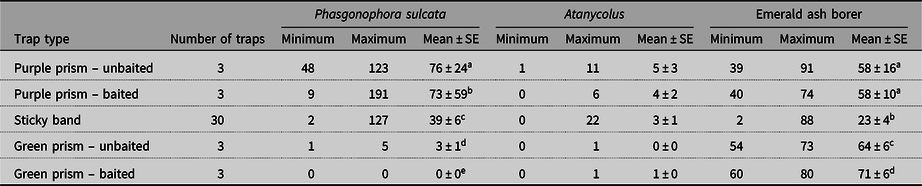
A total of 1618 P. sulcata, 129 Atanycolus, and 1434 emerald ash borers were captured in Trial 1. A maximum of 191 P. sulcata were captured on one baited purple prism trap, and no P. sulcata were collected on baited green prism traps in the same trial. Fewer emerald ash borers and Atanycolus were captured than P. sulcata at this site, with a maximum number of 91 emerald ash borers found on one unbaited purple prism trap and 22 Atanycolus found on one sticky band trap in 2010. Trap type significantly affected the number of P. sulcata captured (χ 2 = 47.60, df = 4, P < 0.001) in Trial 1. Unbaited purple prism traps captured significantly more P. sulcata than baited purple prism traps, baited purple prism traps captured significantly more P. sulcata than sticky band traps, sticky band traps captured significantly more P. sulcata than unbaited green prism traps, and unbaited green prism traps captured significantly more P. sulcata than baited green prism traps (Table 1). The number of emerald ash borers captured was also significantly influenced by trap type (χ 2 = 19.29, df = 4, P = 0.001), where more emerald ash borers were found on baited green prism traps than those left unbaited, and more emerald ash borers were found on unbaited green prism traps than both baited and unbaited purple prism traps. Fewer emerald ash borers were captured on sticky band traps than all other trap types (Table 1). The number of Atanycolus captured was not influenced by trap type (χ 2 = 7.50, df = 4, P = 0.112).
Minimum, maximum, and mean (± 1 standard error (SE)) number of Phasgonophora sulcata, Atanycolus, and emerald ash borer captured on unbaited purple prism, baited purple prism, sticky band, unbaited green prism, and baited green prism traps in the McKeough Floodway (Wilkesport, Ontario, Canada) in 2010 (Trial 1). Purple prism traps were baited with manuka oil, and green prism traps were baited with the green leaf volatile (Z)-3-hexenol.
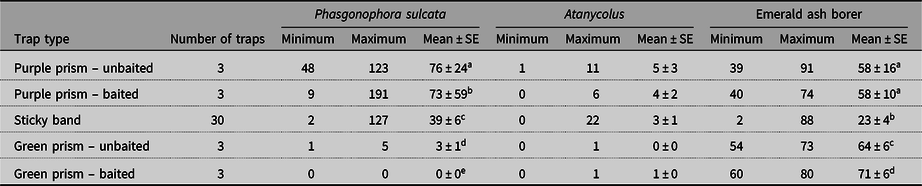
Note: Significant differences at P < 0.05 between trap type using Tukey’s range test are indicated by different lowercase letters.
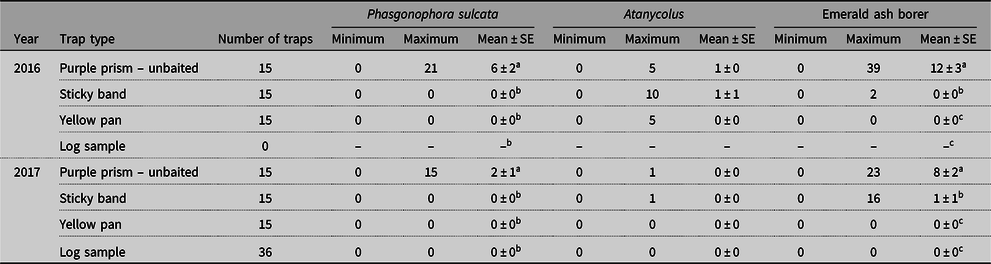
Fewer parasitoids and emerald ash borer overall were captured in Trial 2 than Trial 1. A total of 77 P. sulcata, 38 Atanycolus, and 152 emerald ash borers were captured in 2016 and 29 P. sulcata, three Atanycolus, and 143 emerald ash borers in 2017. A maximum number of 21 P. sulcata were collected on a purple prism trap in 2016 versus 10 Atanycolus on one sticky band trap in 2016. More emerald ash borers were captured than parasitoids, with a maximum of 39 emerald ash borers captured on one purple prism trap in 2016. The number of P. sulcata captured was significantly influenced by trap type (χ 2 = 90.02, df = 3, P < 0.001) and year (χ 2 = 4.18, df = 1, P = 0.041) in Trial 2. Significantly greater numbers of P. sulcata were captured using purple prism traps than all other trap types (sticky band traps and yellow pan traps) or by taking log samples (Table 2). Captures of P. sulcata were significantly higher in 2016 than 2017 (Table 2). In Trial 2, the number of Atanycolus captured was not influenced by trap type (χ 2 = 6.23, df = 3, P = 0.101); however, year did significantly affect the number of Atanycolus collected (χ 2 = 21.55, df = 1, P < 0.001). Similar to P. sulcata, more Atanycolus were captured in 2016 than 2017 (Table 2). The number of emerald ash borer captured was significantly influenced by trap type (χ 2 = 132.08, df = 3, P < 0.001), with greater numbers of emerald ash borer captured on purple prism traps than sticky band traps (Table 2). Not surprisingly, greater numbers of emerald ash borer were captured on sticky band traps than both yellow pan traps and logs (Table 2). Year did not significantly affect the number of emerald ash borer collected (χ 2 = 0.04, df = 1, P = 0.848).
Minimum, maximum, and mean (± 1 standard error (SE)) number of Phasgonophora sulcata, Atanycolus, and emerald ash borer captured on unbaited purple prism, sticky band, and yellow pan traps, and found emerging from logs in a naturalised area in Oakville, Ontario, Canada (Merchants Trail) in 2016 and 2017 (Trial 2).
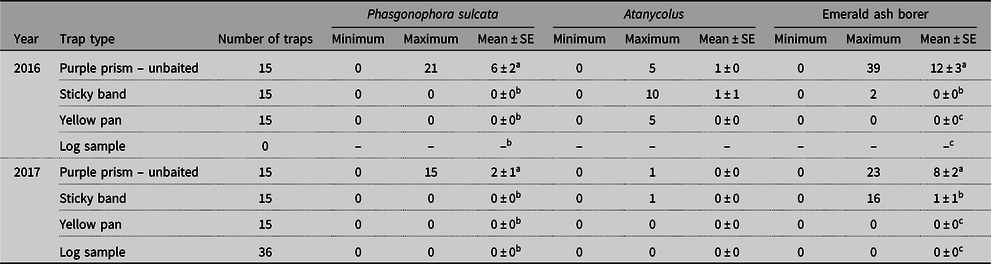
Note: Significant differences at P < 0.05 between trap type using Tukey’s range test are indicated by different lowercase letters.
Purple prism traps were better at capturing P. sulcata than green prism traps, sticky band traps, or yellow pan traps under similar conditions. In contrast, trap type did not influence the total number of Atanycolus collected. Prism traps captured more emerald ash borer than sticky bands or yellow pan traps, with baited and unbaited green prism traps capturing greater numbers than baited or unbaited purple prism traps. Studies that investigate traps that can be used to sample both a parasitoid and its host are rare (although see Derocles et al. Reference Derocles, Plantegenest, Ait-Ighil, Chaubet, Dedryver and Le Ralec2014), but our work shows that emerald ash borer and its native parasitoids can be sampled in the field using only one trap type (i.e., purple prism traps, although emerald ash borer captures on purple prism traps were lower than green prism traps) and that this may provide a particularly cost-effective tool for targeting future biological control programmes with native parasitoids against emerald ash borers.
It would be ideal if purple prism traps could also sample recently introduced emerald ash borer parasitoids such as Tetrastichus planipennisi Yang (Hymenoptera: Eulophidae), Oobius agrili Zhang and Huang (Hymenoptera: Encyrtidae), and Spathius agrili Yang (Hymenoptera: Braconidae). Parisio et al. (Reference Parisio, Gould, Vandenberg, Bauer and Fierke2017) found that yellow pan traps were comparable to sentinel logs and girdled trap trees in terms of their ability to detect the presence of introduced emerald ash borer parasitoids; however, we found that yellow pan traps took more time to install and service than other traps and did not recover native P. sulcata. Thus, it may be that multiple trap types are needed to sample for both introduced and native emerald ash borer parasitoids in North America.
Annual variation in the population sizes of both P. sulcata and Atanycolus will affect the total number of adults caught irrespective of trap type, and thus one must consider the age of the emerald ash borer infestation when sampling for these parasitoids. No parasitoids emerged from logs cut at the Oakville site in Trial 2 (Table 2), and this may be due to the age of the emerald ash borer infestation at that site and explain the differences observed between sampling years (2016 and 2017). Several mature ash trees at the site were dead, while the young ash trees showed fewer signs and symptoms of emerald ash borer suggesting that the infestation was older and had lower populations of emerald ash borer and parasitoids. Similarly, no emerald ash borer emerged from cut logs. Burr et al. (Reference Burr, McCullough and Poland2018) showed that sites with newer or older emerald ash borer infestations had lower emerald ash borer populations relative to “crest sites” with peak infestations, and thus we speculate that this may also be true for native parasitoids attacking emerald ash borer. Higher parasitism has been observed on stressed trees compared with relatively healthy trees for cerambycid beetles (Coleoptera: Cerambycidae) (Shibata Reference Shibata2000; Flaherty et al. Reference Flaherty, Sweeney, Pureswaran and Quiring2011), and it is possible that native emerald ash borer parasitoids follow a similar foraging pattern.
Trap placement and feeding guild are important considerations when monitoring insect populations. Ulyshen and Sheehan (Reference Ulyshen and Sheehan2019) found greater numbers of phloem and wood-boring beetles in traps high above the ground, while more ambrosia beetles were found in traps near the ground. Similarly, Allison et al. (Reference Allison, Strom, Sweeney and Mayo2019) reported significant effects on the capture of adult cerambycids for traps placed along transects perpendicular to forest edges. In our study, it appears that traps placed in tree canopies (prism traps) captured more emerald ash borer parasitoids than those placed on the main trunk (sticky bands and yellow pan traps). This is not surprising as prism traps also captured more emerald ash borers than sticky bands and yellow pan traps, which might suggest that the emerald ash borer infestation within our study sites occurred in the canopy. As such, survey programmes should consider placing traps near actively infested locations in order to effectively detect native emerald ash borer parasitoids and emerald ash borer.
We found that baiting prism traps with manuka oil or a green leaf volatile did not significantly increase parasitoid captures compared to unbaited prism traps. Moreover, our trap captures in the field of both P. sulcata and Atanycolus were either the same or less with the addition of a green leaf volatile – (Z)-3-hexenol – bait, despite P. sulcata showing a behavioural response to the same green leaf volatile in the laboratory (Roscoe Reference Roscoe2014). It is possible that these parasitoids use a combination of semiochemicals to locate emerald ash borer hosts, including compounds from the host itself (e.g., 3-(Z)-lactone, a pheromone released by emerald ash borer when it feeds on ash foliage (Bartelt et al. Reference Bartelt, Cossé, Zilkowski and Fraser2007)) under field conditions, and these were lacking in laboratory studies and the traps we had deployed.
Trap colour and placement appear to be more important than trap surface area for those parasitoid species studied here. Although the surface area of the purple prism traps used in our work was greater than that of the yellow pan traps, it was similar to that of the green prism traps and some sticky band traps, both of which captured significantly fewer P. sulcata than the purple prism traps. Furthermore, the number of Atanycolus collected was similar across all trap types regardless of their surface area. It is possible that multiple factors work synergistically in the field to determine the efficacy of traps for native emerald ash borer parasitoids. For example, more P. sulcata might be captured on purple prism traps in the canopy than on the lower bole of trees, especially in early infestations as emerald ash borer is thought to typically infest the upper canopy of large trees first (Cappaert et al. Reference Cappaert, McCullough, Poland and Siegert2005). Moving forward, future studies should investigate interactions between different trap colours and placement in the tree and stand, along with alternative baits (such as 3-(Z)-lactone, or a combination of baits such as 3-(Z)-lactone plus a green leaf volatile) to improve catches of native parasitoids in future biological control programmes against emerald ash borer.
Acknowledgements
Thanks to Dr. G. Grant, C. Marcoux, and C. Karandiuk (Town of Oakville) and S. White (St. Clair Region Conservation Authority) for permission to collect insects; M. Rains and M. Campbell for help with sampling; and P. Marsh and L. Roscoe for help with insect identification. Funding was provided by an Ontario Graduate Scholarship, Queen Elizabeth II Graduate Scholarship in Science and Technology, University of Toronto Fellowship, and the Ontario Ministry of Natural Resources and Invasive Species Centre.