
I. INTRODUCTION
With the development of astronautic and aeronautic industries, the applications of current high-temperature materials require that not only to satisfy the high temperature strength and good ductility but also ensure excellent thermal stability and oxidation resistance under high-temperature environments. Reference Lu, Zhu, Wang and Fan1–Reference Guo, Jia, Kong, Zhang, Sha and Zhang6 Therefore, how to improve the overall performance of high-temperature materials is a big challenge for their applications. Among all the high-temperature materials, Nb-based silicides are promising candidates due to the high melting point, high temperature strength, high elastic stiffness, low cost, low density, and excellent oxidation resistance etc. Reference Cheng, Yi and Park7–Reference Pan, Lin, Xue, Ren and Wang13 In particular, Nbss/Nb5Si3 silicides have drawn great attention because Nb solid solutions (Nbss) can provide excellent ductility and room-temperature toughness, while for Nb5Si3, it offers an enough high-temperature strength. Reference Xu, Han, Wang, Zhou, Wang, Kang, Wen, Liu and Liu14–Reference Papadinitriou, Utton and Tsakiropoulos17 However, the application of Nbss/Nb5Si3 silicides is hindered by the Nb3Si phase.
Earlier works have shown that the mechanical properties and thermal stability of Nbss/Nb5Si3 silicides mainly depend on the Nb5Si3 and Nb3Si.
Reference Su, Steffes, Zhang and Perepezko18,Reference Nnamchi19
That is to say, the mechanical properties of Nbss/Nb5Si3 silicides are markedly influenced by Nb3Si. However, the utility of Nb3Si is limited by some intrinsic shortcomings: low strength and the worse stability. Although Nb3Si transforms to the Nb5Si3 and Nb solid solution (Nbss) when temperature is up to 2038 K, it is again formed at 2193 K.
Reference Cheng, Qian, He and Ye15,Reference Liu, Shang, Wang, Liu, Zhang and Li20
Therefore, it is necessary to explore the solution strengthening mechanism to stabilize the Nb3Si phase. On the other hand, the high temperature strength of Nb3Si is much lower than that of Nb5Si3. The first-principles calculations have shown that the calculated bulk modulus and Young’s modulus of Nb3Si with cubic structures
 $\left( {Pm\bar 3n} \right)$
are 183 GPa and 190 GPa,
Reference Papadimitriou, Utton, Scott and Tsakiropoulos21
respectively, which are smaller than the corresponding elastic modulus of Nb5Si3.
Reference Pan, Lin, Wang and Zhang22
As a result, the low strength of Nb3Si weakens the mechanical properties of Nbss/Nb5Si3 silicides. Therefore, it is a big challenge to improve the mechanical properties of Nb3Si.
To the best of our knowledge, the mechanical properties of high-temperature materials mainly rely on the valence electron density of transition metals, chemical bonding, crystal structure, etc. Therefore, alloying can open up a possible clue to improve the overall properties of high-temperature materials because alloying elements change the electronic equilibrium of a system. To solve these problems, in the present paper, we use the first-principle with density functional theory (DFT) method to investigate the influence of heavy alloying elements (TM = Mo, Re, Ta, W, Pt, and Ir) on the structural, mechanical, and thermodynamic properties of Nb3Si. Two possible substitutional sites: Nb site (TM-Nb site) and Si site (TM-Si site) are considered. We explore the solution strengthening mechanism of Nb3Si and relevant properties. Our results predict that alloying elements of Re and Ir are benefited for improving the overall performance of Nb3Si.
II. MODEL AND METHODS
A. Model
To explore the solution strengthening mechanism and the influence of alloying elements on the mechanical and thermodynamic properties of Nb3Si, we firstly examine the structural features of Nb3Si. As we know, Nb3Si is a typical cubic (Space group:
 $Pm\bar 3n$
, No. 223) structure within lattice parameter of a = 5.155 Å.
Reference Wang, Iwasaki, Suryanarayana, Masumoto, Toyota, Fukase and Kogiku23
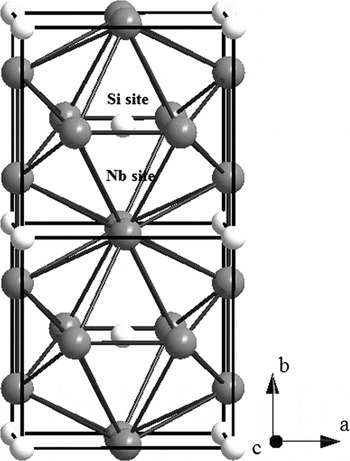
In this structure, the Si atom and Nb atom occupy the Wyckoff 2a (0, 0, 0) and 6c (0.250, 0, 0.500) sites, respectively. It is obvious that this structure is slightly different from the cubic L12 structure. We find that the Nb atom in the unit-cell migrates from 3c (0.500, 0, 0.500) site to 6c (0.250, 0, 0.500) site. As a result, each Si atom is surrounded by 8 Nb atoms. The symmetrically atomic arrangement forms one type of Nb–Si bond (2.855 Å). To estimate the alloying effect, we build a 2 × 1 × 1 supercell Nb3Si, as shown in Fig. 1. In particular, two possible doped sites, the Nb site and Si site are replaced by TM atoms, respectively. Considering the localized hybridization between atoms and the nearest atom, we select 4d- and 5d-transition metals (TM = Mo, Re, Ta, W, Pt, and Ir) to change the charge interaction and chemical bonding of a system.
Structural model of Nb3Si with doping of alloying elements. The arrow indicates the replaced site.

B. Computational methods
First-principles approach within DFT is an effective method to investigate the solution strengthening mechanism and mechanical properties of a solid at atomic or at electronic levels. Thus, all calculations in this paper were calculated by using the first-principles calculations, as implemented in the CASTEP code. Reference Segall, Lindan, Probert, Pickard, Hasnip, Clark and Payne24 The exchange correlation function was treated by using the generalized gradient approximation (GGA) with the Perdew-Burke-Ernzerhof (PBE). Reference Perdew and Wang25 The interactions between the electrons and ions was adopted by the ultrasoft pseudopentioals. Reference Vanderbilt26 The electronic configurations are 4p 64d 45s 1 and 3s 23p 2 for the Nb atom and Si atom, respectively. The electronic energy tolerance of the self-consistent field (SCF) was treated by the 1 × 10⁻⁶ eV. After converged tests, the cutoff energy of 360 eV and the Monkhorst Pack k meshes of 12 × 12 × 12 were selected. The Broyden Fletcher Golddarb Shanno scheme was introduced, and all atoms in a system were relaxed during the process of structural optimization. The convergence thresholds that were treated for structural optimizations are as follows: the total energy, maximum ionic Hellmann Feynman force, and maximum stress within 1 × 10⁻⁶ eV/atom, 0.01 eV/Å, and 0.02 GPa, respectively.
C. Theory
As we know, the stability of doped system is related to the dynamic stability, in addition to the thermodynamic stability. Generally speaking, the dynamical stability of a solid is determined by the phonon frequency, which is calculated by the Phonon package. Reference Pan27 The thermodynamical stability of doping elements is examined by the impurity formation energy (E f), which is given by:
 $$\Delta {E_{\rm{f}}} = E_{{\rm{N}}{{\rm{b}}_3}{\rm{Si}}}^{{\rm{M}} \to {\rm{TM}}} - {E_{{\rm{N}}{{\rm{b}}_3}{\rm{Si}}}} + {\mu _{\rm{M}}} - {\mu _{{\rm{TM}}}}\quad ,$$
where
 $E_{{\rm{N}}{{\rm{b}}_3}{\rm{Si}}}^{{\rm{M}} \to {\rm{TM}}}$
and
 ${E_{{\rm{N}}{{\rm{b}}_3}{\rm{Si}}}}$
are the total energies of Nb3Si with doping of TM atoms and perfect Nb3Si. µM and µTM are the chemical potentials of M (M = Nb and Si) and TM elements, respectively.
To predict the finite temperature thermodynamic properties of Nb3Si with alloying elements, we use the quasi-harmonic Debye model, as implemented in the Gibbs code. Reference Zhang, Shang, Wang, Saengdeejing, Chen and Liu28 For a system at a given volume (V) and temperature (T), the Gibbs free energy (G) can be represented by Reference Xu, Han, Wang, Wang, Liu and Liu29 :
 $$G\left( {V{\rm{,}}T} \right) = {E_{{\rm{stat}}}}\left( V \right) + {F_{{\rm{vib}}}}\left( {V{\rm{,}}T} \right) + {F_{{\rm{el}}}}\left( {V{\rm{,}}T} \right) + PV\quad ,$$
here, P is the applied external pressure, E stat(V) is the static energy at 0 K, which can be calculated by the first-principles methods. F vib(V,T) and F el(V,T) are the lattice vibrational contributions to the free energy and the thermal electronic contribution, which can be well described by the quasi-harmonic approximation and the phonon approach, as follows:
 $${F_{{\rm{vib}}}}\left( {V{\rm{,}}T} \right) = {k_{\rm{B}}}T\int_0^\infty {\ln \left[ {2\sinh {{\hbar \omega } \over {2{k_{\rm{B}}}T}}} \right]g\left( {\omega {\rm{,}}V} \right){\rm{d}}\omega } \quad ,$$
where k B is Boltzmann’s constant, g(ω,V) is the phonon density of states (PDOS) at phonon frequency ω and volume V. ħ is the reduced Planck’s constants. While F el(V,T) is given by:
 $${F_{{\rm{el}}}}\left( {V{\rm{,}}T} \right) = {E_{{\rm{el}}}}\left( {V{\rm{,}}T} \right) - T{S_{{\rm{el}}}}\left( {V{\rm{,}}T} \right)\quad ,$$
where thermal electronic energy E el(V,T) is obtained by:
 $${E_{{\rm{el}}}}\left( {V{\rm{,}}T} \right) = \int {g\left( {\omega {\rm{,}}V} \right)f\left( {\varepsilon {\rm{,}}V{\rm{,}}T} \right)\varepsilon {\rm{d}}\varepsilon - \int {g\left( {\varepsilon {\rm{,}}V} \right)\varepsilon {\rm{d}}\varepsilon } } \quad ,$$
where f is a Fermi distribution. Therefore, S el(V,T) can be expressed as:
 $${S_{{\rm{el}}}}\left( {V{\rm{,}}T} \right) = - {k_{\rm{B}}}\int {n\left( {\varepsilon {\rm{,}}V} \right)f\ln f + \left( {1 - f} \right)\ln \left( {1 - f} \right){\rm{d}}\varepsilon } \quad .$$
Thus, the isochoric heat capacity (C v) can be obtained as follows:
 $${C_{\rm{v}}} = {\sum {{k_{\rm{B}}}\left( {{{\hbar \omega } \over {{k_{\rm{B}}}T}}} \right)} ^2}{{{{\rm{e}}^{{\textstyle{{\hbar \omega } \over {{k_{\rm{B}}}T}}}}}} \over {{{\left[ {{{\rm{e}}^{{\textstyle{{\hbar \omega } \over {{k_{\rm{B}}}T}}}}} - 1} \right]}^2}}}\quad .$$
To our knowledge, the mechanical properties play a key role for high-temperature materials. Reference Curle, Cornish and Govender30,Reference Pan and Zhou31 Generally, the mechanical properties of high temperature-materials are estimated by three factors: bulk modulus (B), shear modulus (G), and Young’s modulus (E). Reference Zhou, Zhou and Zhang32 Elastic modulus at the equilibrium volumes is evaluated by elastic constants (C ij ), which are calculated by the stress versus strain method. Reference Zhou, Zhou and Zhang33 For a solid, a set of strains, ε = (ε1, ε2, ε3, ε4, ε5, ε6), both stress and strain have three normal strains (ε1, ε2, and ε3) and three shear strains (ε4, ε5, and ε6). The corresponding stress is represented as σ i = C ij ε i . Therefore, the linear elastic constants form a 6 × 6 symmetric matrix. According to the Hooke’s law, the elastic constants of a solid are calculated by:
 $$C = {\varepsilon ^{ - 1}}\sigma = \left\{ {\matrix{ {{C_{11}}}{{C_{12}}}{{C_{13}}}000 \cr {{C_{21}}}{{C_{22}}}{{C_{23}}}000 \cr {{C_{31}}}{{C_{32}}}{{C_{33}}}000 \cr 000{{C_{44}}}00 \cr 0000{{C_{55}}}0 \cr 00000{{C_{66}}} \cr} } \right\}\quad .$$
According to Eq. (8), the elastic constants of a solid are obtained by first-principles calculations for the deformed crystal. Therefore, the elastic constants of a solid are calculated by using the variations of the equilibrium energy with respect to the applied strain, which is defined as Reference Aydin and Simsek34 :
 $${C_{ijkl}} = {{{\partial ^2}E} \over {\partial {\delta _{ij}}\partial {\delta _{kl}}}}\quad ,$$
where the total energy of the deformed crystal E(V) under a strain can be expanded as the Taylor expansion for a system with respect to a small strain δ and unit-cell volume V. The energy of a strained system is given by:
 $$E\left( V \right) = E\left( {{V_0},0} \right) + {V_0}\sum\limits_{ij} {{\delta _{ij}}} {\delta _{ij}} + {{{V_0}} \over 2}\sum\limits_{i,j,k,l} {{V_{ijkl}}} {\delta _{ij}}{\delta _{kl}} + \cdots \quad ,$$
where V 0 is the volume of unstrained crystals, and E(V 0,0) is the corresponding ground state energy. The strain tensor subscripts (ij, kl) represent the Voigt notation scheme.
For cubic structures, there are three independent elastic constants: C 11, C 12, and C 44. The mechanical stability of a cubic structure satisfies the following equations Reference Zhou, Zhou and Zhang33 :
 $${C_{11}} > 0,\;{C_{44}} > 0,\;{C_{11}} - {C_{12}} > 0,\;{C_{11}} + 2{C_{12}} > 0\quad .$$
As mentioned above, the elastic properties include bulk modulus (B), shear modulus (G), and Young’s modulus (E) which are calculated by elastic constants. In this paper, the bulk modulus and shear modulus were calculated by the Voigt–Reuss–Hill approximation method. Reference Hill35 Thus, the Young’s modulus of Nb3Si is given by:
 $$E = {{9BG} \over {3B + G}}\quad .$$
III. RESULTS AND DISCUSSIONS
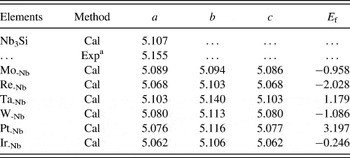
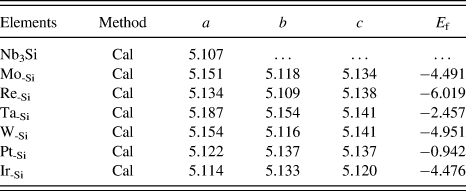
The stability of doped system is examined by the formation enthalpy and phonon dispersion, respectively. To examine the thermodynamical stability at the ground state, Tables I and II list the calculated lattice parameters and the impurity formation energy of the TM-Nb site and TM-Si site, respectively, together with the perfect Nb3Si. We can conclude that the TM-Si site is more thermodynamically stable than that of the TM-Nb site because the calculated impurity formation energy of the TM-Si site is smaller than that of the TM-Nb site. Importantly, we predict that alloying elements of Re can effectively improve the solution strengthening of Nb3Si because the calculated impurity formation energy of the Re-Nb site (−2.028 eV/atom) and Re-Si site (−6.019 eV/atom) is smaller than that of other alloying elements. We suggest that this discrepancy mainly depends on the valence electron density of alloying elements, which is demonstrated by the electronic structure. It is worth noticing that the alloying element of Re prefers to occupy the Si site in comparison to the Nb site.
Calculated lattice parameters a-axis, b-axis and c-axis (Å) and impurity formation energy E f (eV) of alloying elements at Nb site.

a Ref. Reference Galasso and Pyle36.
Calculated lattice parameters a-axis, b-axis and c-axis (Å) and impurity formation energy E f (eV) of alloying elements at Si site.
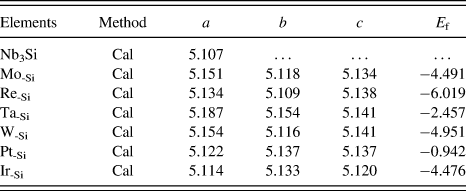
To further reveal the thermodynamical stability, the structural information of Nb3Si with alloying elements is analyzed and discussed as follows. As listed in Tables I and II, the calculated lattice parameter of Nb3Si is in good agreement with the experimental data. Reference Galasso and Pyle36 For the TM-Nb site, the calculated lattice parameters of the TM-Nb site along the a-axis and c-axis are smaller than the corresponding axis of Nb3Si. This variation is due to the fact that the heavy alloying elements can effectively improve the charge interaction between the TM atom and the Si atom. As a result, the strong TM–Nb bond is formed in the TM-Nb site. For example, the calculated bond length of the Nb–Re metallic bond of Re-Nb site is about 2.515 Å, which is smaller than that of the Nb–Nb metallic bond (2.553 Å) of Nb3Si. On the contrary, the lattice parameter of Ta-Nb site, W-Nb site, and Pt-Nb site along the b-axis is larger than that of Nb3Si.
For TM-Si site, however, alloying elements result in lattice expansion along the a-axis and lattice shrinkage along the b-axis and c-axis, respectively. We can see that the calculated lattice parameters of the Ta-Si site along the a-axis, b-axis, and c-axis are larger than that of other alloying elements. This discrepancy is attributed to the valence electron density of various alloying elements. The increasing of a-axis is attributed to the atomic radius of alloying elements. There is no doubt that the atomic radius of alloying elements is much larger than that of the atomic radius of Si atoms.
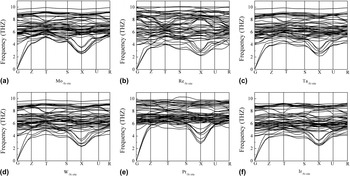
Figures 2 and 3 show the calculated phonon dispersion curves of the TM-Nb site and TM-Si site, respectively. It can be seen that no imaginary phonon frequencies are observed at the TM-Si site, indicating that the substitutional alloying elements at the Si site are dynamically stable at the ground state. Although no imaginary phonon frequencies are found in substitutional alloying elements (TM = Mo, Ta, W, Pt, and Ir) at the Nb site, some imaginary phonon frequencies are found in substitutional alloying elements of the Re-Nb site. That is to say, alloying elements are dynamically stable in Nb3Si (except for the Re-Nb site). As mentioned above, we can conclude that alloying elements improve the stability of Nb3Si.
The calculated phonon dispersion of Nb site occupied by alloying elements, (a) Mo-Nb site, (b) Re-Nb site, (c) Ta-Nb site, (d) W-Nb site, (e) Pt-Nb site, and (f) Ir-Nb site, respectively.

The calculated phonon dispersion of Si site occupied by alloying elements, (a) Mo-Si site, (b) Re-Si site, (c) Ta-Si site, (d) W-Si site, (e) Pt-Si site, and (f) Ir-Si site, respectively.

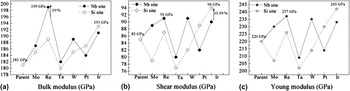
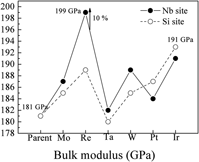
Figure 4 shows the calculated bulk modulus, shear modulus, and Young’s modulus of the TM-Nb site and TM-Si site, respectively, together with the perfect Nb3Si. It can be seen that the calculated bulk modulus, shear modulus, and Young’s modulus of Nb3Si are 181 GPa, 85 GPa, and 220 GPa, respectively, which are in good agreement with the other theoretical results. Reference Papadimitriou, Utton, Scott and Tsakiropoulos21 It must be mentioned that the calculated bulk modulus, shear modulus, and Young’s modulus of Nb3Si are smaller than the corresponding elastic modulus of Nb5Si3. This is well explained why the Nb3Si phase weakens the deformation resistance of Nbss/Nb5Si3 silicides. Reference Todai, Hagihara, Kishida, Inui and Nakano37,Reference Zhu, Wang, Lu, Wu and Feng38 According to the first-principles calculations, we suggest that the low elastic modulus of Nb3Si is attributed to the weak Nb–Nb metallic bond and Nb–Si bond. The calculated bond length of the Nb–Nb metallic bond and Nb–Si bond is 2.553 Å and 2.855 Å, respectively.
Calculated elastic modulus of six alloying elements at Nb site and Si site, respectively. (a) Bulk modulus, (b) shear modulus, and (c) Young’s modulus, respectively.

We further find that these alloying elements (except for Ta) can improve the volume deformation resistance of Nb3Si because the calculated bulk modulus of alloying elements is larger than that of the perfect Nb3Si. On the other hand, the bulk modulus of the TM-Nb site is different from the TM-Si site. As shown in Fig. 4(a), we observe that the calculated bulk modulus of the Mo-Nb site, Re-Nb site, Ta-Nb site, and W-Nb site is larger than that of the Si site. On the contrary, the calculated bulk modulus of the Pt-Si site and Ir-Si site is larger than that of the Nb site. This discrepancy is attributed to the valence electronic density and chemical bonding. Importantly, the calculated bulk modulus of the Re-Nb site is about 199 GPa, which is 10% larger than that of the perfect Nb3Si. The calculated bulk modulus of the Ir-Si site is about 191 GPa. In addition, we find that the volume deformation resistance of alloying elements of Re is stronger than that of alloying elements of Ir.
The trends of shear modulus and Young’s modulus are similar to the bulk modulus. The shear deformation resistance and elastic stiffness of alloying elements of Mo-Nb site, Re-Nb site, Ta-Nb site, and W-Nb site are stronger than that of Mo-Si site, Re-Si site, Ta-Si site, and W-Si site. However, the shear deformation resistance and elastic stiffness of the Pt-Si site and Ir-Si site are stronger than that of the Nb site. It is worth noticing that the shear modulus and Young’s modulus of alloyed Ir are larger than that of alloyed Re. The calculated shear modulus of the Ir-Si site is 94 GPa, which is 10.59% bigger than that of the perfect Nb3Si. The calculated shear modulus of the Re-Nb site is about 91 GPa. On the other hand, the calculated Young’s modulus of the Ir-Si site and Re-Nb site is 243 GPa and 237 GPa, respectively, which are larger than that of Nb3Si. Therefore, we can conclude that although the alloying element Ta is harmful to the strength of Nb3Si, alloying elements of Re and Ir can improve the mechanical properties and solution strengthening of Nb3Si.
To gain insight into the nature of solution strengthening mechanism and mechanical properties, we calculate the electronic structure of Nb3Si with these alloying elements. As mentioned above, we find that Re and Ir are beneficial for improving the overall performances of Nb3Si. Therefore, we further investigate the electronic structure of Re and Ir. Figure 5 displays the calculated total and partial density of states (DOS) of Nb3Si with Re and Ir, together with the perfect Nb3Si. The black vertical dashed of DOS profile implies the Fermi level (E F). To examine the influence of alloying elements on the solution strengthening and mechanical properties, we firstly discuss the electronic structure of Nb3Si.
Calculated total and (DOS) of Nb3Si with alloying elements of Re and Ir. (a) Nb3Si, (b) Re element at Nb site, (c) Re element at Si site, (d) Ir element at Nb site, (e) Ir element at Si site, respectively.

As shown in Fig. 5(a), it is clear that the DOS profile of Nb3Si near the Fermi level is contributed by the Si-3p state and Nb-4d state. The localized hybridization between the Nb atom and the Si atom forms the Nb–Si bond. The calculated bond length of the Nb–Si bond is about 2.855 Å, which is in excellent agreement with other theoretical results. Reference Pan, Lin, Xue, Ren and Wang13,Reference Shang, Guan and Wang39 In addition, the Nb-4p state insets into the Nb-4d state, which forms the Nb–Nb metallic bond. The calculated bond length of the Nb–Nb metallic bond is 2.553 Å. Thus, the structural stability and mechanical properties of Nb3Si with cubic structures are attributed to the symmetric Nb–Si bond and Nb–Nb metallic bond.
However, alloying addition changes the electronic equilibrium between the Nb atom and the Si atom. From Fig. 5, we observe that the DOS profiles of alloyed Re and Ir are markedly different from the DOS profile of Nb3Si. For Re-Nb site, Re element results in Si-3p state and Nb-4d state shifts from the Fermi level to the low-energy region. The localized hybridization between Re–Si and the Re–Nb atoms forms the Si–Re bond and Nb–Re metallic bond. The calculated bond lengths of Si–Re and Nb–Re bonds are 2.841 Å and 2.515 Å, respectively. In particular, alloyed Re can improve the charge interaction between the Nb atom and the Si atom. The calculated bond length of the Nb–Si bond is 2.816 Å, which is smaller than the corresponding Nb–Si bond for perfect Nb3Si. This is why the volume deformation resistance of the Re-Nb site is stronger than that of Nb3Si.
However, the DOS profile of the Re-Si site [see Fig. 5(c)] is different from the Re-Nb site [see Fig. 5(b)]. For the Re-Nb site, although Re also changes the electronic equilibrium between the Nb atom and the Si atom, Re element weakens the localize hybridization between the Nb atom and Si atom because the valence electron density of the Nb atom is bigger than that of Si. This is why the mechanical properties and solution strengthening of the Re-Si site is different from the Re-Nb site. From Fig. 5, the DOS profile of alloyed Ir is similar to the Re. Compared with the Re, the Ir-Si site can improve the localized hybridization between the Nb atom and the Si atom due to the electronic shifts from the Fermi level to valance band.
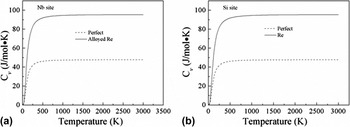
High-temperature thermal stability plays an important role for high temperature-materials. Thus, we explore the influence of alloying elements on thermodynamic properties of Nb3Si. According to the first-principles calculations, the calculated heat capacity of Nb3Si with these alloy elements is close. Therefore, we only consider the heat capacity of the alloying element of Re. Figure 6 represents the isochoric heat capacity (C v) of the Re-Nb site and Re-Si site, together with the perfect Nb3Si. We find that the heat capacity of Nb3Si, the Re-Nb site, and Re-Si site rapidly increases when temperature is up to 350 K. With further increasing temperature, the heat capacity is close to a constant. The calculated value of heat capacity of Nb3Si is 47.6 J/(mol K) under high temperatures. Importantly, we predict that alloyed Re improves the heat capacity of Nb3Si. Firstly, the calculated heat capacity of Nb3Si with alloying elements is two times larger than that of perfect Nb3Si. Secondly, the calculated heat capacity of the TM-Nb site is close to the Si site. In particular, the calculated heat capacity of the alloying element of Re is 95.3 J/(mol K). According to the calculated PDOS, the high heat capacity of the TM-Nb site and TM-Si site mainly derives from the vibration of TM atoms.
Calculated heat capacity (C v) of Nb3Si with various alloying elements as a function of temperature from 0 to 3000 K. (a) Nb site and (b) Si site, respectively.

IV. CONCLUSIONS
In summary, we investigate the solution strengthening mechanism of Nb3Si and the effect of alloying elements (TM = Mo, Re, Ta, W, Pt, and Ir) on the bulk modulus, shear modulus, Young’s modulus, and heat capacity of Nb3Si by using the first-principles calculations. To find the stable substitutional site, we consider two possible sites: the Nb site and Si site, respectively. In particular, we calculate the impurity formation energy and phonon dispersion of Nb3Si with alloying elements to examine the structural stability.
The calculated results show that alloying elements prefer to occupy the Si site in comparison to the Nb site. Nb3Si with the alloying element of Re is more thermodynamically stable than other alloying elements. The calculated phonon dispersion indicates that these alloying elements are dynamically stable at the ground state. Furthermore, these alloying elements can improve the elastic properties of Nb3Si. The calculated bulk modulus of the Re-Nb site is about 199 GPa. However, the shear modulus and Young’s modulus of the Ir-Si site are 94 GPa and 243 GPa, respectively. Finally, we find that these alloying elements can markedly improve the heat capacity of Nb3Si. The calculated heat capacity of Nb3Si is 47.6 J/(mol K). But the heat capacity of the alloying element of Re is 95.3 J/(mol K). The high elastic modulus of Nb3Si with alloying elements mainly derives from the strong TM–Si bond because the valence electron density of TM is bigger than that of Nb. Therefore, our results open up a new clue to improve the overall performance of Nb3Si.
ACKNOWLEDGMENTS
This work is supported by grants from the National Natural Science Foundation of China (No. 51274170). We acknowledge the discussion from Lady Yun Zheng.