Dairy cow cleanliness is possibly an indicator of cow welfare (Bowell et al. Reference Bowell, Rennie, Tierney, Lawrence and Haskell2003), with dirtier cows positively correlated to mastitis incidence (Valde et al. Reference Valde, Hird, Thurmond and Osteras1997; Ward et al. Reference Ward, Hughes, Faull, Cripps, Sutherland and Sutherst2002) and individual cow somatic cell count (Reneau et al. Reference Reneau, Seykora, Heins, Emdres, Farnsworth and Bey2005). Cow cleanliness scoring has been used to study effects of tail docking (Tucker et al. Reference Tucker, Fraser and Weary2001; Schreiner & Ruegg, Reference Schreiner and Ruegg2002), to determine relationships between cow hygiene and subclinical intramammary infection rates (Schreiner & Ruegg, Reference Schreiner and Ruegg2003) and to determine the risk of bacterial contamination of milk (Sanaa et al. Reference Sanaa, Poutrel, Menard and Serieys1993). A number of broadly similar cleanliness scoring systems for dairy cows have been developed to record the degree of contamination of different anatomical areas with dirt and faecal matter, thus giving an overall assessment of the cleanliness of the whole animal (Hughes, Reference Hughes2001; Tucker et al. Reference Tucker, Fraser and Weary2001; Schreiner & Ruegg, Reference Schreiner and Ruegg2002; Bowell et al. Reference Bowell, Rennie, Tierney, Lawrence and Haskell2003; De Rosa et al. Reference De Rosa, Tripaldi, Napolitano, Saltalamacchia, Grasso, Bisegna and Bordi2003; Cook, Reference Cook2004; Reneau et al. Reference Reneau, Seykora, Heins, Emdres, Farnsworth and Bey2005). A number of factors can potentially affect cow cleanliness including housing design, with smaller cubicles associated with dirtier cows (Bowell et al. Reference Bowell, Rennie, Tierney, Lawrence and Haskell2003) and faecal consistency, where increasing fluid faecal consistency is positively correlated with dirtier cows (Ward et al. Reference Ward, Hughes, Faull, Cripps, Sutherland and Sutherst2002). Faecal consistency in turn reflects cow nutrition and digestion (Grove-White, Reference Grove-White2004).
Animal-based health and welfare assessment is increasingly being used as a tool to investigate direct effects of different management systems on cows, as opposed to just evaluating the provision of resources on a farm (Main et al. Reference Main, Whay, Green and Webster2003; Whay et al. Reference Whay, Main, Green and Webster2003; Regula et al. Reference Regula, Danuser, Spycher and Wechsler2004). In the UK, organic farming standards include the feeding of a minimum of 60% of the dry matter intake as forage and aim to provide a basis for optimal dairy cow comfort and health (Anon, 2005). There is increasing interest in, and demand for, animal-based assessment of livestock from organic and conventionally managed farms. This allows comparison of the effects of different management systems (Pye-Smith, Reference Pye-Smith2003; von Borell & Sørensen, Reference von Borell and Sørensen2004) and the benchmarking between farms to help producers improve their systems (Huxley et al. Reference Huxley, Burke, Roderick, Main and Whay2004). Thus, attempts can be made to address the claims of sustainability and improved animal welfare made by some sectors of the organic movement. However, to date, a direct comparison of organic and conventional dairy cow health and welfare using animal-based assessments has not been reported in the UK. The present study aimed to address three questions: (1) whether there were differences in cleanliness between dairy cows managed in organic or conventional farming systems; (2) what, if any, effects on cow cleanliness were seen due to the transition from summer grazing to winter housing and other farm management factors; (3) did cow cleanliness score affect the hygiene parameters of the milk produced and the clinical mastitis incidence.
Materials and Methods
Study design
Using a validated cow cleanliness scoring system, dairy cows from organic (n=7) and conventional (n=7) farms were assessed for cleanliness during a transitional period through from summer grazing to winter housing in a longitudinal study; farms were visited in August and October 2003 and January 2004. Additionally, a larger, cross-sectional study assessed cows from a greater total number of farms (n=14 organic and n=14 conventional) during the winter housing period (January 2004).
Cow hygiene assessment and faecal pat scoring
Cow cleanliness score was assessed using a modified scoring method (Hughes, Reference Hughes2001). Four anatomical areas were observed on each cow: the flanks (above hocks including lateral thigh and abdominal wall caudal to ribs on both sides of cow), the hind legs (hocks distally to include foot), the whole tail and the udder, with an overall whole-cow score ascribed, based on summation of scores from these sites. Area scores were assigned on a 1–5 scale (score 1=very clean, no dirt; score 5=heavily soiled with dirt and/or faeces) thus giving the whole-cow score from 4 to 20. One observer determined scores throughout the study. Within-observer repeatability was assessed by duplicate scoring (on the same visit) of 43 lactating dairy cows (from a separate farm to the study herds), without access to the first set of scores. On all study herds, a proportion of cows in each management group (i.e. dry, high yielders, low yielders or all lactating cows) were randomly selected for scoring, based on an estimated expected prevalence of 10% of cows being classed as excessively dirty (Ward et al. Reference Ward, Hughes, Faull, Cripps, Sutherland and Sutherst2002). Faecal pat consistency from cows in each management group was also scored on a five-point scale: 1=very dry, firm and lumpy to 5=extremely loose/diarrhoeic, based on Hughes (Reference Hughes2001).
Milk sample collection and production data
Milk samples were obtained aseptically from the bulk tank following stirring for a minimum of 2 min after milk had cooled to <4°C. All milk samples were frozen at −20°C and submitted to a laboratory for standard bacteriological culture. Milk quality information came from the monthly mean values of the milk purchasing dairy's weekly analysis and comprised bulk tank somatic cell count (BTSCC), Bactoscan count (BS), and butterfat (BF), protein (P) and urea percentages. Milk quality details were obtained for the 3-month periods before and after the cow cleanliness scoring visit. Farm management and production data were collected by interview questionnaire with the herdsman and/or herd owner and the number of mastitis cases reported by each farm was also recorded.
Data analysis
Data were analysed using Microsoft Excel and MINITAB (Minitab Inc., 2003).
Validation of cow cleanliness scoring
Weighted kappa (Κ(W)) (Ersbøll et al. Reference Ersbøll, Bruun, Toft, Houe, Ersbøll and Toft2004) was used to measure the level of the observer agreement in the duplicate scored cows. For Κ(W), agreement (on the leading diagonal of a table) was weighted as zero, using a weights matrix that increased uniformly for each score disagreement.
Statistical analysis
Cow cleanliness scores from herds in the longitudinal study were compared over time using a generalized linear mixed model (GLMM, Model 1), where μ is the mean whole-cow cleanliness score, Fi is the individual farm effect, Tj is the farm type, Mk is the month effect and εijk is the residual error term;

Factors affecting cow cleanliness score each month for both longitudinal and cross sectional herds were analysed using proportional odds logistic regression (POLR, Model 2), where logit (p(Y⩽y j)) is the log odds of a response in category y j or below, αj is the unknown intercept, β=(β1−βk) is the effect (slope) of the predictor X=(X1−Xk);

For POLR analyses, the reference outcome is the lower (cleaner) cleanliness score; so that odds ratios (OR) relate to the odds of a cow being in a cleaner score group. Variables included in POLR analysis were: farm identity, farm system type (organic or conventional), housing system (cubicles or straw yards, for January only), housed or at grass (October only), yield group of cows when housed (dry, high, mid and low yielders, or ‘all lactating cows’ if herds housed all lactating cows together), herd average yield and herd size (both by quartiles) and faecal pat consistency. Cows were classed as lactating or dry when some or all were at grass (August and October). Variables affecting cow cleanliness score that were significant (P<0·2) at the univariable level were included in the multivariable model. Multivariable models were constructed by stepwise backwards elimination. Variables were retained if the change in deviance, calculated using the change in the log-likelihood, was significant (P<0·05). Biologically plausible interactions were included when significant. Individual farm identity was nested within farm type (organic or conventional) for multivariable analyses.
For cross-sectional herds, the 3-month (January–March) geometric mean BTSCC and two-month (January–February) mean BS counts were calculated. The mean monthly clinical mastitis case rate was determined for January and February. Herds were ranked by BTSCC, BS and mastitis incidence, with the median cleanliness score of the top quartile of herds compared with the median cleanliness score of the bottom using a Mann-Whitney test. Herds were also ranked by weighted mean cow cleanliness score, and the top quartile of herds (cleanest cows), were compared with the bottom quartile of herds (dirtiest cows), with respect to milk bacteriology results. Linear regression analysis compared BTSCC and BS with median herd cleanliness score on organic and conventional farms.
Results
Repeatability of within-observer assessment
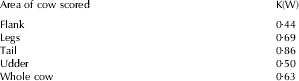
Data from duplicate scored cows showed that observer disagreement only occurred by one point for the individual sites of flank, legs, tail and udder. The cumulative total for whole cow score showed maximal disagreement by two points in less than ten percent of cows scored. The results of calculation of Κ(W) on data from each anatomical site and whole-cow score are shown in Table 1.
Weighted kappa Κ(W) results for each anatomical area scored in repeat scored cows

Longitudinal study
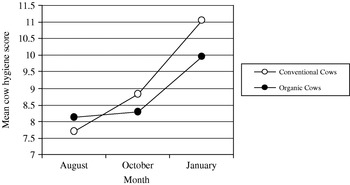
Herd-level mean cow cleanliness scores for each month are shown for the two management systems in Fig. 1. There was an increase in cow cleanliness score (cows became dirtier) between each month of assessment (overall effect for month, P<0·001), with an interaction (P<0·001) between farm system type and month, where organic cows were on average dirtier in August and cleaner in January.
Change in cleanliness score due to farm type and month interaction for conventional (○) and organic (●) farms.

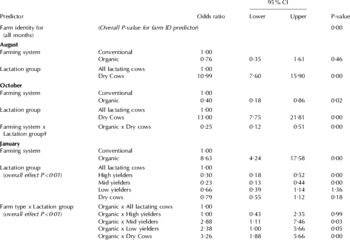
Herd yield and herd size were not included as factors affecting cow cleanliness in any of the final models as they were co-linear with herd identity and faecal pat consistency dropped out of all final models. In all models, individual herd identity had a highly significant effect on cow cleanliness score (P<0·001). Results of multivariable models are summarized in Table 2. In August, farming system had no effect on cow cleanliness, though dry cows from both farm systems were more likely to be in a cleaner score category than milking cows (OR of 11, P<0·001). In October, organic cows were more likely to be dirtier (OR 0·40, P=0·02) and again, dry cows (from both farm systems) were more likely to be cleaner than lactating cows (OR 13, P<0·001). However, an interaction between farm type and cow type indicated that organic dry cows were more likely to be dirtier than conventional dry cows (OR 0·25, P<0·001). In January, all organic cows were more likely to be in a cleaner cleanliness score category compared with conventional (OR 8·63, P<0·001). Across both organic and conventional herds, high yielders and mid yielders were less likely to be cleaner than ‘all lactating cows’ with OR of 0·30 (P<0·001) and 0·23 (P<0·001) respectively. Again, there was a significant interaction between farm system (organic or conventional) and lactation group, but this time organic dry cows were more likely to be cleaner than conventional dry cows (OR 3·26, P<0·01).
Results of final multivariable POLR models for factors affecting cow cleanliness score on longitudinal study organic and conventional farms in August, October and January

† where x=interaction term
Cross-sectional study
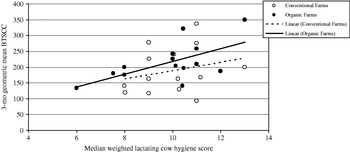
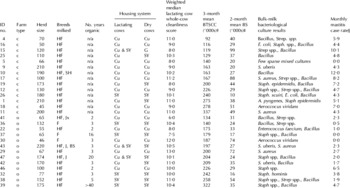
Details of the study herds are summarized in Table 3 ranked by BTSCC within farming system type. Of the organic farms studied, more than half the farms (57%) were using straw yards to house some or all of their lactating cows compared with only 2 of 14 (14%) of conventional farms. A higher proportion of dry cows were housed in straw yards in both farming systems, with just over a quarter (29%) of conventional farms and 64% of organic farms housing their dry cows in straw yards. There was no difference in the average 3-month geometric mean BTSCC or BS count between organic and conventional herds during this study period. However, there was a lower (P<0·05) mean monthly reported lactating cow clinical mastitis incidence on organic farms compared with conventional farms of 3·5 v. 5·6 cases/100 cows in milk/month. The quartile of all herds (organic and conventional) with the lowest BTSCC (124 000 cells/ml) tended to have a lower (cleaner) median cow cleanliness score (score of 9) than herds in highest BTSCC quartile (294 000 cells/ml; median score of 11; P=0·06). Linear regression showed a difference in relationship between cleanliness score and BTSCC association between organic and conventional farms (Fig. 2). There was a significant positive relationship between cleanliness score and BTSCC on organic farms R 2=0·38 (P=0·02) but not on conventional farms R 2=0·06 (P=0·38). There was no significant association between cleanliness score and BS count or mastitis incidence. No major mastitis pathogens were cultured from the cleanest quartile of herds, but major pathogens (Streptococcus uberis and Staphylococcus aureus) were cultured from three herds in the dirtiest quartile.
Association between cow cleanliness score and BTSCC for conventional (○) r 2=0·38, P=0·02 and organic (●) farms r 2=0·06, P=0·38.

Farm details (see footnote for key to abbreviations) for 28 cross sectional study herds ranked by farm system (conventional or organic) and BTSCC showing median herd level lactating cow cleanliness score, BS data, bacteriological culture results and reported monthly mastitis case rate

Key: O=organic, C=conventional, HF=Holstein/Friesian, SH=Dairy Shorthorn, F=Friesian, Jx=Jersey cross, J=Jersey, BS=Brown Swiss, Cu=cubicles, SY=Straw yards, G=At grass, n/a=not appropriate, † geometric mean (Jan–March), ‡ geometric mean (Jan–Feb), § cases/100 cows in milk/month for Jan–Feb
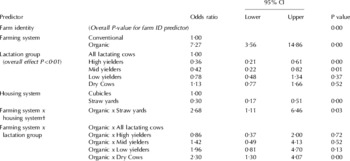
Results of the final multivariable POLR model of factors affecting cow cleanliness are shown in Table 4. Overall, organically managed cows were more likely to be in a cleaner score category than conventionally managed cows (OR 7·27, P<0·001). Both high-yielding and mid-yielding cows were less likely to be in a cleaner score category compared with ‘All lactating cows’ (OR 0·36, P<0·001 and OR 0·42, P<0·001 respectively). Housing type remained significant in this larger study group of herds, with cows in straw yards less likely to be clean (OR 0·30, P<0·001). However, significant interaction terms suggested that organically managed cows in straw yards were more likely to be cleaner than conventionally managed cows in straw yards (OR 2·68, P=0·03), and organically managed dry cows were more likely to be cleaner than conventionally managed dry cows (OR 2·30, P<0·01).
Results of final multivariable POLR model for cow cleanliness score in 28 cross-sectional farms in January

† where x=interaction term
Discussion
The herds selected for this study were approximately matched for herd size and represented a broad cross section of different UK dairy farm sizes in both the organic and conventional sector. The mean conventional study farm herd size was 132 cows; larger than the mean English and Welsh herd size of 92 cows (MDC, 2006) although the range from 45 to 210 cows, with most herds being between 100 and 200 cows, is similar to UK data for 2003–2004 (MDC, 2006). For organic farms, detailed UK-wide herd demographic data are not easily accessed. The organic study herd mean size of 118 cows was smaller than the mean herd size of 165, reported for 60 organic members of a specialist dairy support service (MDC, 2006), although that only represents a small number of producers.
Validity of cow cleanliness assessment
The subjective assessment of cleanliness score was successfully validated for repeatability. Interpretation of the value of the kappa statistic varies between authors; however, the values obtained in this study would range from fair/poor for the flanks to excellent for the tail (Ersbøll et al. Reference Ersbøll, Bruun, Toft, Houe, Ersbøll and Toft2004). The area with most variability in scores was the flanks as found by Reneau et al. (Reference Reneau, Seykora, Heins, Emdres, Farnsworth and Bey2005) with abdominal scores and this most likely reflects variability in the overall definition of this area as compared with, for example, the tail. Lower agreement for udder scores in the current study most likely reflects the relatively poor visibility of all areas of the udder in standing cows, highlighting that this area should be carefully looked at from several views. Reneau et al. (Reference Reneau, Seykora, Heins, Emdres, Farnsworth and Bey2005) reported good correlation between repeated cow cleanliness scores overall, although this does not measure score agreement per se. Using Kappa does assess agreement and weighted Kappa is used to take account of ordinal data by penalizing disagreements by an amount that reflects the degree of disagreement. For whole-cow scores, the K(W) of 0·61 indicates good agreement. The intra-observer repeatability in the current study is similar to that reported in a previous study (De Rosa et al. Reference De Rosa, Tripaldi, Napolitano, Saltalamacchia, Grasso, Bisegna and Bordi2003) which also studied similar numbers of repeat scored cows. An added complexity in the current study was the fact that the whole cow score was a compound score from the four areas, with the same score achievable by summation of a number of different scores. It can be argued whether this level of detail is of major importance, when what is being obtained is a ranking of cow cleanliness by a subjective approach.
Factors affecting cow cleanliness
Using POLR, the OR calculated is not an indication of ‘clean’ v. ‘dirty’, rather it gives the odds of a cow being at or below a certain cut-point in the ordinal scale. This can be thought of as the odds ratio of a cow, taken at random from one group being in a cleaner score category than a cow selected at random from the comparison group. It was outside the scope of this project to calculate cow stocking density when housed, or to attempt to assess or measure ‘stockmanship’; it was intended to assess the animal-based outcomes of the two management systems (conventional and organic). Further follow-up studies would be indicated to try to assess husbandry variables in both organic and conventional systems, although these are complex areas with many potential areas of confounding to account for and any such study should go beyond an inventory of the presence or absence of management and housing factors. However, despite the current study's limits it did highlight a number of interesting associations of management factors with cow cleanliness. Cows become dirtier in the transition from summer grazing to winter housing, which would be expected, as the cows have greater restriction in space and in their choice of lying areas in housed systems. During the grazing season when this study was conducted, the weather had been good with little rain. Dry cows tended to be cleaner than lactating cows in August and October, although this effect was reduced when cows were housed. During the grazing period, walking lactating cows to milking and putting them through a collecting yard is likely to increase their exposure to mud and faecal contamination; thus they may be dirtier than dry cows. In the longitudinal study, although farming system had no significant effect on cow cleanliness score when all cows were at grass in August, when housed in winter, organic cows were significantly more likely to be cleaner. However, during the transition month of October, organic cows were less likely to be in a cleaner cleanliness score category and this may have been because more organic cows were still at grass, which was wetter at this time of year. Although the variable ‘housed’ or ‘at-grass’ dropped out of the multivariable model in October, this may have been due to being closely associated with farming system and should be considered in future studies. The effect of farming system was also seen in the cross-sectional study of a greater number of herds, where again, organic cows were more likely to be in a cleaner cleanliness score. Additionally, in both the longitudinal and cross-sectional studies an effect of yield group on cleanliness was observed. High yielders and mid yielders were less likely to be clean than low yield or ‘all lactation’ groups, which most likely reflects higher feed intakes and faecal output by higher-yielding groups. This concurs with Reneau et al. (Reference Reneau, Seykora, Heins, Emdres, Farnsworth and Bey2005), where cow cleanliness score was found to improve as time from parturition increased. In the cross-sectional study, straw yards were more likely to be used on organic than conventional farms. Cows in straw yards were more likely to be dirty than those in cubicles; however, owing to an interaction with farming system, organic cows were more likely to be cleaner than conventional cows in straw yards. This may suggest that straw yards on organic farms were better managed, possibly by better bedding management or by reduced stocking density on average. In summary, cubicles appear to be better for cow cleanliness, but straw yards on organic farms have less of a negative effect on cleanliness than straw yards on conventional farms.
Cow cleanliness and milk quality
This study identified a positive relationship between cow cleanliness score and herd BTSCC in cows under both management systems, possibly indicative of increased subclinical mastitis. This concurs with the findings of Schreiner & Ruegg (Reference Schreiner and Ruegg2003) where udder cleanliness score was related to isolation of pathogens from the milk in individual cows and Reneau et al. (Reference Reneau, Seykora, Heins, Emdres, Farnsworth and Bey2005) where increasing (dirtier) udder and hind leg cleanliness scores were positively associated with increased individual cow somatic cell count. Valde et al. (Reference Valde, Hird, Thurmond and Osteras1997) reported that in Norwegian dairy herds, those scoring ‘very good’ on cow cleanliness had significantly lower mean BTSCC compared with those herds scoring ‘average’ or ‘good’ for cow cleanliness. This would suggest that cleanliness score is not merely a cosmetic issue and is associated with BTSCC and therefore, subclinical and/or clinical mastitis. The current study found a stronger association between cow cleanliness score and increasing herd BTSCC on organic farms compared with conventional. This would suggest that organic farms, which use fewer antimicrobials and no blanket dry cow therapy, should emphasize clean cow management as part of subclinical mastitis prevention, especially in recently calved (higher yielding) cows which are at greater risk of being dirtier and are most susceptible to mastitis.
Interestingly, in this study, major contagious mastitis pathogens were isolated in bulk milk from the dirtiest quartile of herds. It would be expected that dirtier cows would be at greater risk of mastitis caused by environmental pathogens. Bacteriological examination results may not be completely representative of milk hygiene status as these were only single time-point samples. Additionally, freezing the milk samples prior to culture (because immediate culture of refrigerated samples was not practical in this study) may affect the culture results. Some authors report a reduction in the number of viable Gram-negative bacteria in some studies (Schukken et al. Reference Schukken, Smit, Grommers, Vandegeer and Brand1989; Sanchez et al. Reference Sanchez, Contreras, Jimenez, Luengo, Corrales and Fernandez2003) although other work has shown no significant effect on pathogen culture after freezing (Dinsmore et al. Reference Dinsmore, English, Gonzalez and Sears1992; McDougall, Reference McDougall2000). It may be more appropriate in future studies only to culture fresh samples and additionally to perform colony counts, particularly coliform counts to supplement Bactoscan data. Culture of serial samples, if financially possible, would be more representative, especially if performed in parallel with bacteriological examination of clinical mastitis cases in order to assess the relationship between mastitis due to environmental pathogens and poor cow cleanliness. Other factors to consider in future studies are, for example, the level of intramammary drug use, the culling policy of high cell count cows and the milking routine.
The lack of association between cleanliness score and BS count or clinical mastitis incidence again reflects the multifactorial aetiological nature of mastitis and milk hygiene. Studies of clinical mastitis may reflect difficulties in case definition and reporting when using farm record data, where mastitis incidence may only reflect those cases receiving antibiotics. In the study period reported here, there was a significantly lower lactating cow mastitis incidence on organic farms. This may reflect a lack of reporting of clinical cases on organic farms if cases do not receive antimicrobial therapy and are treated either symptomatically (such as udder massage) or using alternative medicines (Hovi & Roderick, Reference Hovi and Roderick2000; Ellis, Reference Ellis2005). However, the lower incidence may reflect in part the cleaner dry cow status on organic herds, as it has been found that >50% of new intramammary infections in lactation can be traced to infection in the dry period (Green et al. Reference Green, Green, Medley, Schukken and Bradley2002). The BS count, although potentially recording bacteria originating from the cows, is often dissociated from cow factors and is influenced by poor bulk tank hygiene or poor parlour and milking machine washing techniques (Blowey et al. Reference Blowey, Davis and Edmondson1997; Edmondson, Reference Edmondson2003).
This study validated a cow cleanliness scoring system over a wide range of UK dairy farms, and found that it was both repeatable and a practical technique to use on farm. Cow cleanliness score was seen to be associated with farming system (organic or conventional), season, lactation status and housing type and may be a potential indicator of milk hygiene quality; dirtier cows are positively correlated with increased BTSCC. All farmers, especially organic farmers, should attempt to keep their cows as clean as possible, particularly higher yielding cows in early lactation as part of an overall approach to mastitis control and production of high quality milk.
The authors thank all the farmers who participated in this study; the staff of the University of Liverpool Veterinary School Farm Animal Practice; and Professor David Taylor at the University of Glasgow Faculty of Veterinary Medicine for his help with bacteriological examination of milk samples and the preparation of this manuscript. This work was supported by the Organic Milk Suppliers Cooperative (OMSCo). Giles Innocent was supported by the Wellcome Trust funded International Partnership Research Award in Veterinary Epidemiology (IPRAVE) project and is presently a DEFRA VTRI fellow.