Developing countries are frequently faced with the transition from a highly state-dominated nonmarket economy with nondemocratic political institutions to a more market-oriented economy with democratic political institutions. Since the late 1980s, a large number of countries, including the postcommunist regimes of East and Central Europe as well as many African countries, fall into this category. The current conventional policy prognoses for these developing countries is the adoption of policy and institutional reforms designed to promote efficiency—for example, “micro-lending” initiatives designed to promote indigenous business formation or more secure property rights aimed at expanding the base of investment capital (de Soto 2000). Increasingly, development economists recognize that economic development policies will only work if they incorporate incentives that promote efficient economic choices, such as investing in the future rather than increasing consumption (Easterly 2002).
Many of these initiatives build upon straightforward conclusions from classical micro-economic theory. To the extent that the basic assumptions of classical micro-economic theory hold in developing countries, many of these policy prognoses make eminent sense. Some have argued, though, that the behavioral assumptions of these classical models do not hold in developing countries with sociopolitical contexts that differ widely from those in advanced industrial countries.1
Palmer (1989, 320), for example, argues that “… a major reason for the growing disparities between the First and Third World is to be found in the persistence of traditional attitudes and behavior patterns in many regions of the Third World.” Bourgin (1984) suggests that the religious and cultural values in many regions of the Third World stress passivity rather than achievement. Other examples include Greif (1994), Harrison (1992), and Schejtman (1984).
We focus on two of these challenges to the classical assumptions in the literature. First, a large body of experimental evidence demonstrates that deviations from micro-economic behavioral assumptions vary considerably across cultural contexts. Second, an extensive literature suggests that citizens in these transition countries retain considerable cultural and ideological “baggage” that inhibits their ability to respond appropriately (i.e., in the classical micro-economic sense) to institutional and economic cues.
Are there universal regularities to economic reasoning and behavior? Or are the reasoning and behavioral assumptions of micro-economic theory subject to significant cross-cultural variations? We propose a conceptualization of economic reasoning that highlights its multidimensionality and suggests that certain aspects of economic reasoning are invariant across contexts while others vary across contexts. First, we distinguish between norms associated with the basic rules that govern market interactions and those that are associated with economic choices. We dismiss the notion that socioeconomic context or individual cognitive capabilities affect normative commitment to the basic rules governing market interactions. We contend that there is no systematic variation in commitment to these basic norms. With respect to economic choices, though, we expect variation across contexts in the extent to which choices reflect the utility maximization assumptions of micro-economic theory. First, we posit that basic economic reasoning associated with market choices is not predicated on sophisticated cognitive abilities, nor is it predicated on demanding informational and psychological prerequisites. We do expect, though, that the nature of “social capital” varies across cultural and political contexts and hence the costs associated with more or less cooperative behavior can vary significantly generating, for example, cross-contextual variation in utility maximization behavior.
The unique contribution of our article to this debate is that we test these propositions using a mix of traditional survey research methods augmented with experiments that are imbedded within surveys administered to representative samples of national populations. Second, our analysis focuses on survey experiments conducted in a country, Benin, where the behavioral assumptions of classical micro-economic theory are least likely to hold, at least according to critics of such models.2
For two excellent analyses of the Benin democratic transition, see Banégas (1998) and Magnusson (1996).
Benin is a particularly impoverished nation that adopted a democratic system of government during the past decade (per capita income in Benin hovered around $1000 during the late 1980s and early 1990s when the democratic transition occurred). Moreover, Benin's transition to democracy supplanted a nondemocratic regime that implemented highly collectivist and antimarket institutions. By selecting this particular case, we believe our analysis is strongly biased toward producing results consistent with the (null) hypothesis that nascent market economies exhibit underdeveloped market reasoning.
Does Any of This Matter?
Our larger concern in this article is improving our understanding of the micro-foundations of implementing market reforms in contexts with underdeveloped market mechanisms. The literature on these transitions is replete with rather broad assertions about the appropriateness and feasibility of implementing market reforms in contexts that lack a well-established tradition of classic market institutions. Some scholars, for example, argue that classic notions of property rights can easily be implemented in widely varying national contexts (e.g., de Soto 2000), while others question the cultural “receptivity” to such initiatives in many developing nations (Harrison and Huntington 2000). Similarly, some scholars suggest that the transition to market economics from a nonmarket system of the Soviet variety is extremely problematic because individuals adapt slowly to classic market reasoning, which is fundamentally at odds with their traditional communitarian norms (Moore 1966). These are important issues because they are the basis for extremely expensive international policy initiatives designed to promote economic development.
Yet surprisingly there is little effort to leverage empirical work on the microfoundations of economic behavior in order to better understand these broader theoretical and policy issues. The hypotheses and empirical tests reported below explicitly address this lacuna. At the very broadest level, these hypotheses test whether in fact there is any systematic deviation from the fundamental assumptions of classic macro-economic theory. Moreover, this test is conducted in a context in which such deviations are most likely to occur, i.e., a poor developing country with a nascent market economy.
This article's principal theoretical contention is that economic reasoning is multidimensional, some dimensions are more or less subject to deviations from classic economic assumptions, and the pattern of deviations across dimensions has important policy implications. Our theory helps explain why economic behavior deviates from classic micro-economic assumptions. The empirical results have important policy implications because they indicate whether personal capital is the principal factor in explaining out-of-equilibrium behavior. To the extent that this is the case, nothing short of dramatically improving cognitive and information capabilities in transitional societies will promote economic choices consistent with micro-economic theory. Alternatively, if social capital is primarily responsible for out-of-equilibrium decisions, policymakers should design policies that anticipate existing contextual incentives or modify contextual circumstances to better reflect classic micro-economic theory.
THEORY
Our primary focus in this article is exploring whether cross-cultural or cross-contextual differences in economic reasoning help us understand the success or failure of countries in economic transitions. A variety of factors is hypothesized to determine the success of economic transitions including institutional attributes (McKinnon 1993), geography (Diamond 1997), investment in human capital (Romer 1990), and a country's endowment in productive factors such as technological innovation (Solow 1957) natural resources and population. Recent advances in our understanding of the rational choice assumptions underpinning economic theory suggest that systematic variations in economic reasoning might be an appropriate candidate for addition to this list of explanatory factors. First, many scholars concede that the domains in which economic choices are made vary and that in some contexts rational choice assumptions, such as utility maximization, are more or less approximated (e.g., Chrystal and Peel 1986 and Kahneman, Knetsch, and Thaler 1986). It certainly seems plausible that contexts exist where, for a variety of socioeconomic and historical reasons, classic economic reasoning might be “underdeveloped” (or “overdeveloped”). Second, a number of recent empirical findings suggest that there are systematic contextual or cultural differences in economic reasoning (e.g., Heinrich 2000, Henrich et al. 2001, and Prasnikar and Roth 1992). Again, it would not seem unreasonable to link these systematic differences in economic reasoning with the success or failure of economic transitions.
Unfortunately, much of the literature focuses on demonstrating the existence of systematic differences in economic reasoning. Yet, we believe the more interesting and relevant issue is explaining these systematic differences in economic reasoning and drawing inferences as to whether they help account for why some societies have experienced more successful transitions to a market economy.3
Note that traditional economic models of market transition generally assume that the basic assumptions of classical micro-economic theory hold for citizens in developing countries just as they do for citizens in advanced industrial countries. Hence, research on the process of economic liberalization does not include the development of market reasoning as an initial step in the transition process (e.g., McKinnon 1993).
In this section, we briefly review a number of existing theoretical arguments along with our theoretical perspective on the factors that might explain cross-national differences in cognitive reasoning as it relates to economic decision making.
Economic Reasoning?
The notion that cultural values play an important role in the successful transition to a successful market economy is widely accepted by social scientists (e.g., Harrison and Huntington 2000, Inglehart 1997, and Weber 1958). An example is North's (1981) argument that norms governing economic interactions can inhibit the development of efficient market economies. Typically, these claims have been rather broad and imprecise, which we believe undermines their credibility and impedes empirical testing. Our approach provides more precise insights into these linkages by conceptualizing economic reasoning as multidimensional with some dimensions having little cross-national or cross-cultural variation, while others are more sensitive to different socioeconomic contexts.
What is it about economic reasoning that might be more or less consistent with efficient economic decision making? Individuals have a repertoire of expectations and norms related to the market economy that make up the various behavioral assumptions of micro-economic theory. Within this broad repertoire we distinguish amongst two different types of reasoning: rules and choices. The obvious political analogy is the distinction between the legitimacy individuals accord regime institutions and their preferences over politicians contending for political power (Easton 1963).
Basic Economic Norms
We begin with the fundamental rules governing economic exchange. Market economies are unlikely to function without wide acceptance of certain basic norms or rules that govern individual transactions—guarantees of individual liberties, of property rights, and of personal security. Olson (1993), for example, argues that the protection of individual rights to property and contract enforcement is a sufficient condition for the emergence of democracy as well as for economic development and growth. We contend that these basic economic norms are widely shared by individuals across different cultures and levels of socio-economic status (see Milgrom, North, and Weingast 1990 and Putnam 1993). The notion of the right to, and the preservation of, private property is not cognitively demanding, nor do we expect that it requires extensive socialization (e.g., Ellickson 1991 and Ostrom 1990). It is, we would argue, virtually a primal instinct for the human species. In fact, there is an impressive body of evidence from the fields of ethnology and sociobiology suggesting that acquisitiveness is universal across the human species.4
For an extensive review of the evidence supporting the notion that “acquisitiveness is universal among humans as well as animals,” see Pipes 1999.
Evidence of this includes the historical evolution of property rights in widely different cultural contexts and the failure of efforts by various regimes to eliminate property rights (Pipes
1999; Putnam
1993). And as de Soto (
2000) argues, cultural factors have not prevented the evolution of more effective property rights in developing countries. Hence, we expect that respect for basic rights, such as property rights, will be uniformly high across all groups in society, regardless of education, information levels, socioeconomic status, and cultural context.
Economic Choices
Micro-economic theory also posits a set of assumptions regarding the choices individuals make in market contexts. One critical assumption is that individuals will maximize utility when faced with choices among different alternatives. We treat these assumptions differently than the fundamental rules described above. These are behaviors that we expect will vary by socio-economic context. Moreover, experimental findings indicate considerable variation in the extent to which individuals approximate the utility maximization assumptions of micro-economic theory. Examples include experiments designed to investigate bargaining in ultimatum games (e.g., Heinrich 2000 and Prasnikar and Roth 1992). Similarly, experimental evidence points to significant individual-level variations in the extent to which subjects engage in cooperative behavior (Eckel and Wilson 2003; E. Glaeser et al. 2000). And there is increasing evidence that the experimental results are conditioned by cultural and institutional contexts (e.g., Roth et al. 1991).
How might variations in utility maximization impact transition economies? Evidence that individuals in transition contexts adopt very different strategic behavior than individuals in more established market economies suggests that the public's acquisition of market reasoning might represent a barrier to successful transition. Strong aversions to particular equilibrium strategies (such as the zero offer in the ultimatum game) may reflect cognitive reasoning that undermines certain liberal market reforms.
Our primary goal in this article is to establish, through the application of survey research techniques combined with experimental methods, whether in fact there exists systematic individual-level variation in utility maximization. Having established this, the second goal is to account for the sources of systematic individual-level variation in economic reasoning. There are two fundamentally different explanations for this variation in utility maximization: one involving personal abilities (or capital) and the other focusing on social capital. 5
We use the distinction between personal and social capital proposed by Becker (1996).
Which of these explanations proves correct has important implications for our understanding of the process of market transition.
Personal Capital
On the one hand, variations in utility maximization behavior might be linked to personal capital, specifically cognitive abilities and levels of information. Countries with poorly educated and uninformed populations (and there are many; see Duch and Whitten 2003) would be unfertile soil for market reforms that build on classical micro-economic assumptions. If variation in economic choice is uniquely explained by education, then educating the population would be the most effective strategy for promoting a successful transition to a market economy. We seriously doubt, however, that greed or self-interest requires any sophisticated reasoning capabilities. And some of the limited efforts to empirically model deviations from utility maximization behavior lend support to our position (Henrich et al. 2001). We propose three measures of personal capital: cognitive abilities, modernization, and information.
Cognitive Abilities
Many argue that investment in human capital, or personal capital, to use our nomenclature, positively impacts economic development (e.g., Barro 1991, Romer 1990, and Duch and Whitten 2003).6
But see Easterly (2002) for a skeptical assessment of the evidence.
A reasonable expectation is that education contributes to economic development because of its impact on economic reasoning. Lower levels of education might undermine classic economic reasoning and hence constitute, in the aggregate, a barrier to economic transition or development. Yet we see no inherent cognitive challenges associated with utility maximization. Hence, we do not expect education to explain individual-level variation in utility maximization behavior.
Modernization
There are characteristics of modern, as opposed to traditional, society that may contribute to the sophistication of individual-level economic reasoning. Individuals in “modern” societies have greater access to more diverse information sources. Urbanization, another feature of modernization, is frequently identified as one of the catalysts for the development of successful market economies, primarily because it accelerates the diffusion of knowledge and improvements in human capital (Becker, Glaeser, and Murphy 1999; Glaeser 1999; Lucas 1988). One might conclude that urbanization increases the exposure of average citizens to market mechanisms and thereby increases their level of sophistication in economic reasoning. We question whether exposure to urban or modern influences will have any bearing on economic reasoning per se. Lending support to this perspective is experimental research that questions whether economic reasoning is underdeveloped in nonmodern settings. Heinrich (2000), for example, compares the ultimatum game results for the Machiguenga tribe with those of a Los Angeles control group and finds that the Machiguenga much more closely approximate the predicted equilibrium outcome.
Information
To the extent that engaging in maximizing behavior incurs information-gathering costs, one might expect high levels of media usage (information consumption) to reduce these information-gathering costs and hence produce behavior more consistent with the classical model. We contend that these information gathering costs are not particularly high and hence media exposure should have little bearing on economic reasoning.
We believe that the above three factors (as components of personal capital) have only marginal impacts on market reasoning and strategic economic decision-making. Education, exposure to “modern” information sources, and the acquisition cost of information about the economy are not expected to be significantly correlated with the sophistication of individuals' economic reasoning. Rather, individuals have inherent economic instincts that evolve relatively quickly into cognitive market skills without extensive training or socialization (i.e., education, exposure to “modernity,” or frequent media usage). In short, we reject the notion that personal capital has any significant bearing on utility maximization behavior.
Social Capital
On the other hand, we expect that there are contexts in which rational choice behavioral assumptions, such as utility maximization, are likely to be at odds with theoretical expectations. Based on Becker (1996), we adopt the concept of social capital to account for contextual incentives to deviate from utility maximization behavior. Social capital shapes the extent to which the economic choices of average citizens reflect norms governing equity and reciprocity. Individuals through interactions and socialization develop different expectations as to how equitable gestures are likely to be reciprocated (Fehr and Gachter 2000). To use Becker's (1996, 13) formulation, individuals incorporate the costs associated with utility maximization behavior into their social capital. Efforts to formalize these contextual influences have demonstrated that the economic environment, which consists of varying degrees of heterogeneity of preferences for equitable versus inequitable outcomes, can significantly affect equilibrium outcomes in a number of cooperation games (Fehr and Schmidt 1999). We expect to be able to identify individual-level traits (attributable to contextual features such as culture, politics, and the socioeconomic environment) that distinguish more aggressive from less aggressive utility maximization.
Our expectation is that individuals adjust their economic behavior in response to contextual factors that make some choices more or less costly than others. So, for example, many years of interacting in a community that punishes aggressive utility maximization is likely to have some long-term impact on this facet of economic behavior. Three factors related to social capital are likely to condition economic behavior: socialization to market, government and authority, and personal economic circumstances.
Socialization to Market
There is a variety of historical and contemporary examples of social contexts that reward equitable and fair choices and are antagonistic toward individual choices that maximize utility. The postcommunist nations are examples of contexts in which at least official norms were antagonistic to individual maximization behavior. And many of the developing African nations, of which Benin is an example, have been governed by a similar set of official norms. As North (1981) points out these informal norms governing economic interaction change slowly in response to societal change. Individuals in countries that only recently adopted a market economy might be slow to discard command-economy reasoning that emphasizes social goals, in favor of market reasoning that focuses on personal welfare. If contextual factors influence the “cost” of utility maximization, we should see considerable out-of-equilibrium individual choices in these nascent market economies.
We speculate that the effects on market reasoning of the cultural and ideological “baggage” of non-market-oriented regimes are reinforced by two primary factors. First, sociological theories (e.g., Smelser and Swedberg 1994) assert that individuals with more extensive social networks are more likely to engage in cooperative behavior and hence are less likely to behave in a strict utility maximization fashion. Summarizing this literature, Frye (2000) notes that dense social networks are hypothesized to increase the cost of having a reputation for excessively self-interested behavior and, also, to increase the opportunities to punish selfish behavior.
Second, game theoretic approaches suggest that heterogeneity of group membership results in higher levels of noncooperative behavior (Ostrom 1990; Snidal 1994). More heterogeneous groups have more diverse interests, which hinders cooperative agreements. Because the expectations and norms of heterogeneous members can be very different and conflicting, transactions are much more likely to reflect utility maximization rather than fairness and cooperation. Hence, individuals in larger and more heterogeneous communities are more likely to behave according to the utility maximization assumptions of classic models of economic behavior.
Benin offers a particularly interesting venue for assessing the extent to which market behavior varies according to the heterogeneity of ethnic communities. There are diverse tribal groups in Benin, and for our purposes, the fact that they vary in size and heterogeneity allows us to test the heterogeneity and cooperation argument developed above. The Fon tribe is by far the largest and most heterogeneous tribal group, accounting for roughly one-third of the respondents in the survey. All of the other tribal communities in Benin are considerably smaller in comparison with no other group commanding more than 10% of the sample. The Fon tribe has historically been the dominant tribe in Benin and exhibits a very heterogeneous membership in terms of socioeconomic characteristics and geographic dispersion. We expect that cooperative impulses will be more instinctive in the smaller, minority, and homogeneous tribal communities in Benin. Members of these homogeneous tribes, because of their commonality of interests, are much more likely to have well-developed cooperative norms. By contrast, members of the larger and more heterogeneous Fon tribe will have much less developed cooperative norms. Because of the greater diversity of group interests, utility maximization will guide common transactions and economic decisions for members of the Fon tribe much more than for members of other minority tribes.
Finally, socialization also covers the personal experiences that individuals have with market mechanisms. To what extent are individuals familiar with market processes and have actually engaged in market activities, such as saving, borrowing, investing, and property ownership? Henrich et al. (2001) conduct ultimatum games in 15 different tribal societies and find significant group differences in terms of the modal offers. The principal explanation for these tribal differences is the degree to which people in these different groups relied on market exchange in their daily life.
Government and Authority
Political institutions and government actions can provide the negative or positive incentives that lead individuals to deviate from utility maximization. Trust represents a critical precondition for individuals to make choices that promote cooperative goals as opposed to maximizing personal utility (Glaeser et al. 2000). Trust in government is likely to ensure individuals that cooperative behavior will be enforced and shirking will be punished. Paradoxically, rising levels of trust in government should lead to out-of-equilibrium economic choices. Similarly highly deferential attitudes toward governmental authority are also likely to result in out-of-equilibrium responses. High levels of trust in government have important positive implications for the success of democratic polities (Rabushka 1974; Weingast 1997). In the context of the transition from authoritarian and nonmarket regimes, residual attitudes of deference and trust in government may have different implications. As Olson (1993) and others have pointed out, the successful transition to democratic market economies builds on self-interested behavior that checks the possible exercise of centralized authority, making power sharing a more preferred outcome.7
In the context of Olson's (1993) argument, trust in government in a nascent democracy undermines the necessary condition for the transition from authoritarian to democratic rule: the existence of a political stalemate that forces leaders to consider power-sharing as a more viable option than trying to consolidate power.
Transition environments that reinforce attitudes of trust and deference in government may generate levels of out-of-equilibrium behavior that are inconsistent with aggressive protection of, for example, private property, individual liberties, and contracts.
Economic Circumstances
The economy is a context that can reassure individuals that the consequences of cooperative actions, even if not reciprocated, will have a marginal impact on their well-being. So, for example, we see levels of charity rise when the economy is doing well and individuals are less price-conscious in their consuming behavior. By contrast, the economy can also reinforce utility maximization behavior. When the economy is performing poorly individuals are much more attentive to making within-equilibrium economic choices. The consequences of failing to maximize one's economic opportunities are quite different if one lives on the edge of economic survival as opposed to being relatively wealthy. The costs of cooperation are higher when individuals are facing difficult economic conditions. We believe that affluence tends to moderate utility maximization, while poverty should enhance this economic calculus.
A Synopsis of Our Hypotheses
Our empirical efforts focus on testing four hypotheses that follow from the above discussion:
- Support for basic economic norms is pervasive across sociopolitical contexts—there is no systematic variation in individual-level support for these basic norms.
- Individual economic choices deviate in a systematic fashion from micro-economic assumptions regarding utility maximization.
- Deviations from utility maximization are not systematically linked to individual-level differences in personal capital.
- Deviations from utility maximization are systematically related to individual-level differences in social capital.
DATA AND METHOD
The survey results reported in this article are based on a survey conducted in the West African nation of Benin in May 2000. The sample consisted of a stratified national random sample of the Benin population. The Appendix contains a detailed discussion of the survey design and the coding of the variables included in our statistical analysis.
Dependent Variables
The focus of our statistical analysis is explaining individual-level variation in market reasoning. We distinguish between market reasoning associated with rules versus choices. Rather than using attitudinal questions to indirectly measure market reasoning, we employ two quasi-experiments imbedded in the survey that are designed to measure these two different dimensions of market reasoning. The first survey experiment characterizes economic choices by simulating the conditions of a dictatorship game. In this experiment, the interviewer tells the respondent that after the survey is completed, two of the persons interviewed will be chosen randomly to share a 15,000 CFA prize (two months' average salary in Benin). How that prize is divided will be determined by the first person chosen. The interviewer then asks the respondent to choose how he or she wants to divide the prize in the event of being chosen first to share the prize. Responses that are more consistent with the equilibrium response of keeping all of the prize (except a trivial amount) represent more sophisticated market reasoning. See the Appendix for the specific wording of the dictatorship game experiment.
The second survey experiment characterizes support for basic rules of the market economy. It employs a vignette about the expropriation of a person's farmland by the regional government (see the Appendix for specific wording). The circumstances of the vignette are manipulated in three ways to create eight unique scenarios: (1) the occupant's legal (de jure) claim to the land, i.e., whether or not the occupant has legal title to the land; (2) the merits of the occupant's (de facto) claim to the land, i.e., whether or not the occupant improved the productivity of the land; and (3) the perceived motives of the regional government, i.e., whether the land would be used to build a new headquarters for the region's ruling party or a water tower that would provide the village with drinking water. Respondents were randomly assigned to the different scenarios or treatments. Negative reactions to the government's decision to expropriate the farmland represent greater support for property rights and more sophisticated market reasoning.
Explanatory Variables
The statistical analysis presented below includes two sets of explanatory variables that correspond to the personal and social capital concepts introduced in the previous section. As pointed out earlier, our measure of personal capital incorporates three dimensions: (1) cognitive capabilities, which are measured by formal education (Education); (2) modernization, which is measured by urban residency (Urban Resident); and (3) information consumption, which is measured by attention to the media (Media Usage).
Social capital has three dimensions: socialization to the market, government and authority, and personal economic circumstances. These three dimensions capture environmental factors that raise or lower the costs of engaging in utility maximization behavior. Socialization to the market is measured by three variables: the density of Social Group Membership, the subjective Importance of Ethnic Identity, and Experience with Market Mechanisms. 8
Experience with Market Mechanisms is only a proxy for actual experience with market mechanisms. For this reason, some readers might doubt the validity of this measure. The survey data, however, indicate that the proxy is valid. Respondents with the highest values for Experience with Market Mechanisms (>2) were more likely to have experience with borrowing (14.6% versus 10.0% for those with values <2) and to own more than one household item (34.8% versus 29.2%). Similarly, they also displayed greater willingness to use their savings to start a business (71.2% versus 67.4% responded “very likely” or “somewhat likely” to do so) and to borrow money to start a business (58.1% versus 45.2%).
Density of group membership is hypothesized to increase the social costs of engaging in aggressive utility maximization. Similarly, traditional ethnic or tribal norms are likely to either raise or lower the social costs associated with utility maximization behavior. We expect ties to the dominant heterogeneous Fon ethnic group to exaggerate utility maximization, while ties to the smaller more homogeneous ethnic groups will moderate utility maximization. And finally, experience or familiarity with market mechanisms should raise the likelihood of utility maximization.
A second dimension of social capital concerns government and authority. Out-of-equilibrium results in the dictatorship game are predicted for individuals who are more likely to be assured that cooperative behavior will be effectively enforced. These are individuals who have a high Trust in Government and a high Deference to Authority.
The third dimension of social capital is the economic environment. We expect that the economic situation confronting individuals “motivate” the application of market reasoning in the survey experiments. For individuals facing less secure financial situations—lower incomes (Income), greater concern about employment status (Unemployment Concern), less personal property (Personal Property Ownership)—the costs of out-of-equilibrium choices are likely higher than for those facing more secure economic prospects.
Finally, the analysis controls for contextual factors associated with region. We speculate that regional differences exist in local financial and social institutions (both formal and informal) that influence market reasoning. While a full investigation of these regional differences is beyond the scope of this article, controlling for these potential effects seems warranted.9
Specifically, we expect the southern, coastal regions of Oueme, Mono, and Atlantique (baseline category) to be more market oriented than the central and northern regions of Zou, Atacora, and Borgou. This division of the regions reflects differences in their economies, where the former group has a greater concentration in service and light industry, while the latter has a greater concentration in agriculture.
Additionally, we control for gender differences. Studies of advanced industrial democracies indicate that gender differences exist in social and political capital (e.g., Burns, Schlozman, and Verba
1997), so it is natural to expect to find gender differences in market reasoning among citizens of a developing country with a nascent democracy. See
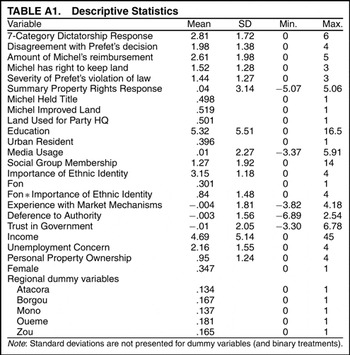
Table A1 in the Appendix for descriptive statistics for all variables used in our analysis.
RESULTS
Economic Choices: The Dictatorship Game
Table 1 reports the distribution of responses to the dictatorship survey experiment. Table 1 indicates that there is considerable variation in how respondents chose to divide the 15,000 CFA prize. Furthermore, only 7.8% chose to divide the prize in a way consistent with the equilibrium strategy in a dictatorship game, while 45.6% chose an even, near-even, or disadvantageous split of the prize. The typical experimental result for dictatorship games is that the modal offer is the equilibrium outcome, i.e., 0 to the other player (e.g., see Forsythe et al. 1994). The individual-level variation in Table 1 highlights the possibility of underdeveloped economic reasoning in developing countries.
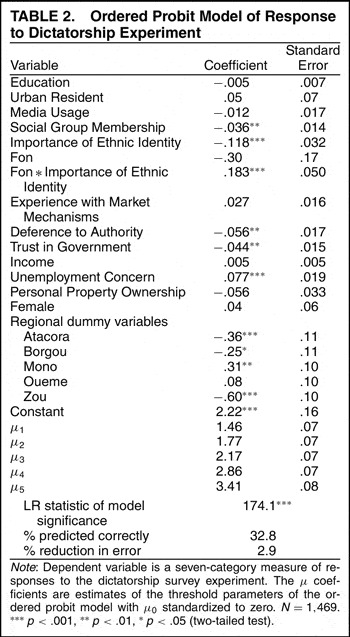
Yet the crucial question of what explains this individual-level variation remains unanswered. The ordered probit analysis reported in Table 2 attempts to address this very question (for a description of ordered probit models, see Greene 2000, 875–77). It models responses to the dictatorship survey experiment as a function of personal and social capital.10
In an auxiliary analysis (available from the authors upon request), we estimated the model in Table 2 with control variables for age, religiosity, societal ethics, support for government ownership and regulation, and support for social welfare policies. All of these control variables were insignificant at the 0.10 level except societal ethics. The only notable change in the parameter estimates for the measures of personal and social capital was that the coefficient for Personal Property Ownership was about 20% larger in magnitude and significant at the 0.05 level.
In order to simplify the presentation of the ordered probit model, we collapsed the 11 categories in
Table 1 into seven categories. This was done by combining adjacent categories with theoretically similar divisions of the prize money (see the Appendix for the specific coding of the collapsed measure).
11 In an auxiliary analysis (available from the authors upon request), we estimated the model in Table 2 using the full set of categories in Table 1. The results of this analysis were essentially the same as those presented in Table 2.
As discussed above, some critics of micro-economic theories of market transition question whether mass publics in developing countries have the requisite personal capital for market reasoning. This theoretical perspective implies that citizens in transition economies who engage in market reasoning must be unusual in terms of their cognitive abilities and knowledge of market processes. Consistent with our expectations, Table 2 casts doubt on the validity of this theoretical perspective by demonstrating the statistical insignificance of all of the personal capital measures: Education, Urban Resident, and Media Usage. 12
In an auxiliary analysis (available from the authors upon request), we replaced Media Usage with a measure of the respondent's level of economic information (based on interviewer evaluation). This variable also proved to be statistically insignificant in the ordered probit model of response to the dictatorship experiment.
Considered together, these three variables prove to be jointly insignificant, at even the 0.10 level, with a likelihood-ratio (LR) test statistic of 1.60.
On the other hand, we expect social capital to be significant in explaining individual-level variation in economic behavior, specifically utility maximization. Variables measuring the first dimension of social capital—socialization to the market—are mostly statistically significant.13
The five variables capturing socialization to the market are jointly significant at the 0.0001 level, with a LR test statistic of 35.67.
Respondents who had more dense social networks were less likely to apply market reasoning in the dictatorship game. Similarly, the subjective importance of ethnic identity strongly distinguished among respondents in terms of their market reasoning. For those respondents who belonged to ethnic groups other than
Fon, their likelihood of placing personal gain above social justice decreased with the importance of their ethnic identity. In contrast, among Fon respondents, stronger ethnic identity increased the likelihood of engaging in market reasoning. This difference confirms the argument that larger heterogeneous communities, such as the Fon, are more likely to engage in myopic utility maximization while members of smaller, more homogeneous tribal communities are more likely to have cooperative norms.
The final component of the “socialization to market” dimension of social capital—experience with market mechanisms—influenced market reasoning in the expected direction but did not prove statistically significant at the 0.05 level. In light of the variable's statistical insignificance, our suspicion is that exposure to the sophisticated market mechanisms measured by this variable does not significantly enhance market reasoning—partially because it is relatively rare in this context. It is likely the case that less demanding forms of market exposure, such as weekly barter marchés, are pervasive in Benin. Hence, our results suggest that these less demanding experiences provide enough familiarity with the market to allow citizens to develop market reasoning. In sum, the dictatorship game provides evidence supporting the argument that there are aspects of socialization to the market (or nonmarket) economy that reduce or lower the social costs associated with engaging in utility maximization behavior.
The empirical results for the second dimension of social capital concerning government and authority also confirm our hypotheses. Individuals with greater trust in government and those with higher deference to authority are significantly more likely, as theorized, to have out-of-equilibrium responses to the dictatorship game. These estimated effects proved to be individually significant at the 0.01 level and jointly significant at the 0.001 level (with a LR test statistic of 18.40).
Finally, Table 2 provides some evidence that personal economic circumstances, as the third dimension of social capital, influence market reasoning in a manner consistent with our theoretical perspective.14
The ordered probit model controls for gender differences based on the speculation that gender differences in social capital might exist independent of the measures of social capital included in our analysis. Gender differences, though, do not prove significant in our analysis. Even though gender does not have a direct impact on market reasoning, we did find some evidence of gender differences in social capital, with women having less dense social networks and being less deferent to authority. The t-statistics for the difference of means tests are 4.61 for density of social network and 2.09 and 2.79 for the two items used to construct the deference to authority measure (see the Appendix). These statistics are significant at the 0.0001, 0.05, and 0.01 levels, respectively.
As expected, respondents with less personal property and more serious unemployment concerns were more likely to engage in market reasoning in the dictatorship game. While the effect of
Unemployment Concern is strongly significant at the 0.001 level,
Personal Property Ownership is only marginally significant at the 0.10 level.
15 The three variables representing personal economic circumstances are jointly significant at the 0.001 level, with a LR test statistic of 18.43.
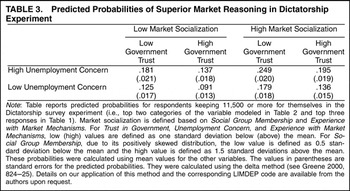
Because ordered probit estimates nonlinear relationships between the explanatory variables and the choice probabilities, we calculated the predicted probabilities in Table 3 to illustrate the estimated effects of the three dimensions of social capital on the probability of “superior” market reasoning (i.e., choosing to keep at least 11,500 CFA or 76.7% of the prize money).16
Since we hypothesized, and the empirical results confirm, that personal capital has no impact on utility maximization behavior, we have not illustrated this factor's impact in Table 3.
reports the predicted probabilities of superior market reasoning for high and low values of
Trust in Government (as a measure of the government and authority dimension),
Unemployment Concern (as a measure of the economic circumstances dimension), and
Social Group Membership and
Experience with Market Mechanisms (as measures of the market socialization dimension). As shown in
Table 3, respondents with low trust in government, high unemployment concern, and high market socialization were 15.8 percentage points more likely to display superior market reasoning than were their counterparts with high trust in government, low unemployment concern, and low market socialization. The largest effects in
Table 3 are for economic circumstances where a two-standard deviation increase in
Unemployment Concern produces 4.6 to 7.0 percentage point increases in the predicted probability of superior market reasoning. Yet even the relatively small effects of a two-standard deviation decrease in government trust are notable, producing 3.4 to 5.4 percentage point increases in the likelihood of superior market reasoning.
Basic Economic Rules: The Property Rights Vignette
An experimental vignette was included in the survey in order to assess the manner in which respondents in a very deprived transition context respond to formal and informal norms regarding property rights.17
Our implementation of this experimental vignette is modeled on Gibson and Gouws 1999.
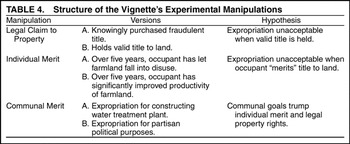
Our expectation is that norms, both formal and informal, regarding property rights are relatively robust regardless of the nature of one's personal or social capital. Hence, we predict that respondents will recognize the collective gains associated with respecting property rights and respond to the experimental stimuli accordingly. In addition, we do not expect any systematic variation in these “appropriate” responses attributable to the personal and social capital characteristics of the respondents. The experiment consists of three treatments that are summarized in
Table 4.
Survey respondents were randomly assigned to one of the eight treatments resulting from the scenario manipulation. The major actor in the vignette is Michel, a purported property owner. All respondents were told that the Prefet of the department (region) had expropriated Michel's property. Each respondent was offered a version of the property rights story that had three components reflecting the different treatments. Each version described Michel as occupying a piece of property—in some cases he had valid title to the property in others he did not. A sentence described the extent to which Michel had improved the land during the period he occupied it. A concluding sentence described how the state (regional/department government) planned to use the land—to construct either a water tower that would serve the interests of the community or a new headquarters for the Prefet's political party.18
The questionnaire included a number of checks on whether the experimental manipulations had the intended effects on the respondents. First, interviewers were asked to assess the extent to which respondents understood the vignette. Interviewers reported that 98% of the respondents had at least a good cursory (“passablement”) understanding of the vignette, while 70% were reported as having a very good understanding of the vignette. Second, several checks were included to assess consistency of interpretation of the scenario. Respondents were asked whether they agreed with the Prefet's decision to expropriate Michel's property and then whether they agreed with the Prefet's proposed use of the land. We would expect a strong, although not perfect, correlation between these two responses, which is the case with a correlation of 0.60. The survey also checked the experimental manipulation related to Michel's use of his land by asking respondents to evaluate the degree to which Michel could be characterized as hardworking versus lazy. The mean evaluation of Michel's work ethic was significantly more positive at the 0.0001 level for the “value added to land” scenario (t-statistic for difference of means test, 47.50), indicating that respondents were in fact appropriately influenced by this experimental manipulation. Finally, respondents were also asked to what extent they believed the Prefet was motivated by concerns for his political career (as opposed to civic considerations). The mean evaluation of the Prefet's motivation was significantly more negative at the 0.0001 level for the “party headquarters” version of the vignette (t-statistic, 36.14), which again indicates that the experimental manipulation had the intended effect on respondents.
The statements in the Hypothesis column in Table 4 indicate the impact we expect the treatments to produce. The first hypothesized effect indicates the extent to which respondents respond positively to formally recognized property rights. We expect respondents to be more critical of the expropriation in those cases in which Michel has legal title to the property. Secondly, reflecting informal notions of property rights based on evidence of personal contributions to property value, we expect that opposition to expropriation will be higher for the treatment in which Michel improves the value of the land. Finally, we predict that the legitimacy of the state's expropriation authority should vary with the extent to which the use of the land is designated for the public good.
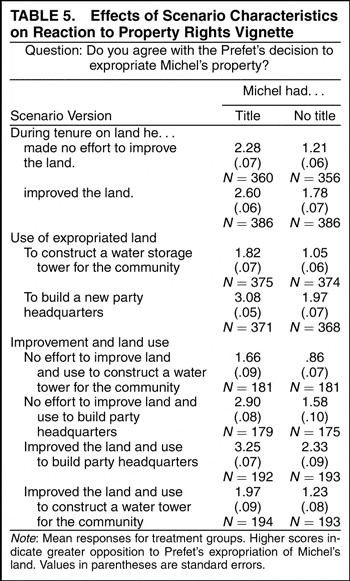
Table 5 illustrates the results of the vignette experiment. These results indicate that the experimental treatments produced exactly the effects expected. Note that a high score indicates opposition to the state expropriation. Respondents exposed to the legitimate title vignette had uniformly higher mean scores. In addition, respondents who were told that Michel improved the value of the land had higher mean scores. Finally, opposition to the Prefet's expropriation of the land was greater in the cases in which the land was used for a new headquarters for the Prefet's political party.
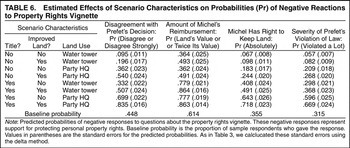
Extending the analysis in Table 5, we estimated ordered probit models of responses to four questions asked after the vignette that delve into the extent and nature of the respondent's opposition to the Prefet's expropriation of Michel's land (see the Appendix for details on question wording and variable coding). These ordered probit models included dummy variables for the three treatments in the vignette. In addition to the “disagreement with Prefet's decision” question (analyzed in Table 5), we modeled responses to questions about the amount of Michel's reimbursement, whether Michel has the right to keep the land, and the severity of the Prefet's violation of the law. Rather than presenting the ordered probit coefficients, Table 6 presents predicted probabilities derived with those coefficients to illustrate the estimated effects of the vignette treatments.19
The ordered probit coefficients are available from the authors upon request. All of the treatment coefficients except two were statistically significant at the 0.001 level. The two exceptions were the Michel Improved Land coefficient in the Severity of Prefet's violation of law model, which was only significant at the 0.01 level, and the Land Used for Party HQ coefficient in the Amount of Michel's reimbursement model, which was insignificant at even the 0.10 level. Overall, the treatment effects had considerable predictive power reducing the prediction error by 14.1% for Disagreement with Prefet's decision, by 17.7% for Amount of Michel's reimbursement, by 30.4% for Michel has right to keep land, and by 23.8% for Severity of Prefet's violation of law.
For instance, the fourth column in
Table 6 presents the predicted probabilities of disagreeing with the Prefet's action—considered here as a response supporting property rights—for the eight possible combinations of the three treatments. The baseline probability at the bottom of this column (44.8%) represents a naïve estimate of opposition to the Prefet's decision and is simply the proportion of the sample giving a “disagree” or “disagree strongly” response. Respondents who were read the most pro-property rights scenario (Michel has title, he has improved the land, and the land will be used for a party headquarters) had an 83.5% probability of opposing the Prefet's decision—almost twice the naïve probability prediction.
Table 6 demonstrates that each of the treatments had significant effects in the hypothesized direction. The legality of Michel's claim produced the strongest effects followed by the communal merit of (or Prefet's motivations for) expropriating the land. This pattern is telling since it indicates that individuals in a transition society responded more strongly to the treatment about formal property rights than to the treatments about informal (“squatter”) property rights and about societal interests. There is no indication here that citizens of an impoverished society with a recent authoritarian past have conceptions of property rights that differ from those we would expect to find in developed market economies. While this lack of cultural differences is consistent with our theoretical argument, it conflicts with the perspective that respect for property rights is not a basic, instinctual norm and must develop over time.
Another interesting finding is that communal merit played no role in explaining attitudes toward the amount that Michel should be reimbursed. This finding indicates that respondents' attitudes toward reimbursement were not conditioned on communal interests (i.e., whether the state intended to use the land for the public good). While use of the land for the public good increased the likelihood that respondents would perceive the Prefet's action as justified, it had no bearing on their attitudes about what constituted fair compensation for the loss of Michel's land. In other words, this finding suggests that Benin citizens believe that communal interests can justify infringement on property rights by the state but does not invalidate those rights and thereby reduce the state's obligation to compensate Michel for the loss of his property.20
In an auxiliary analysis (available from the authors upon request), we further investigated this issue by including an interaction between Social Group Membership and exposure to the Land Used for Party HQ scenario. This interaction only proved significant in the Amount of Michel's reimbursement model, in which it had a negative effect. In other words, this auxiliary analysis revealed that support for reimbursing Michel for infringement on his property rights to build a party headquarters was conditioned on the density of the respondent's social network. Respondents with denser social networks, and presumably stronger communitarian values, were less likely to support a greater reimbursement for Michel when his land was expropriated for a political purpose.
Again, this response to the treatment is consistent with our theoretical argument but conflicts with the perspective that citizens' conception of property rights should vary across cultural contexts.
The results in Table 6 represent extremely compelling support for our contention that regardless of the sociopolitical context individuals respond favorably to both formal institutional guarantees for property rights and to more informal norms regarding property rights. Support for property rights resonates in a very strong fashion for the average citizen even in one of the most economically deprived regions of the world and a country with a long historical tradition of antimarket politics and policies. We now move to exploring whether these positive attitudes toward property rights are confined to particular segments of this transition society. Of particular interest is testing our argument that support for basic economic rules, in this case property rights, is not conditioned by personal or social capital. Hence, if our theoretical perspective is correct, only the experimental treatments should generate differences in opposition to the government's expropriation of Michel's land. In other words, our theoretical expectation is that the addition of variables measuring personal and social capital will have no statistically significant impact on respondents' reaction to the stimuli.
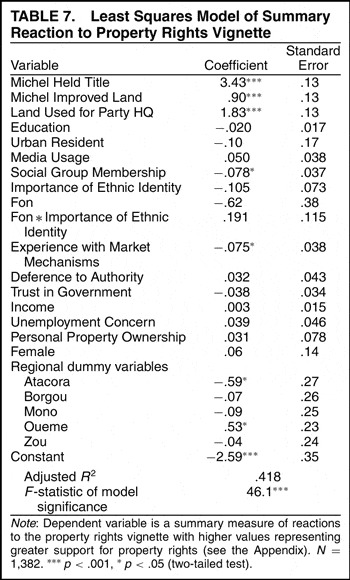
Table 7 takes this additional step in analyzing responses to the vignette by modeling a summary measure of support for property rights (see Appendix for definition of this variable). In addition to the treatment variables, this analysis includes the personal and social capital explanatory variables employed in the analysis of the dictatorship survey experiment. Consistent with the dictatorship results, and with our theoretical argument, there is no evidence that individual characteristics associated with personal capital play any role in shaping utility maximization behavior. Also consistent with our argument is the poor performance of the social capital variables—only Social Group Membership proves significant at the 5% level.21
We also investigated the effects of personal and social capital variables by adding them to the ordered probit models used to derive the predicted probabilities presented in Table 6. This auxiliary analysis (available from the authors upon request) was largely consistent with the results in Table 7. The only exception was the effect of Trust in Government, which proved to have significant negative effects on the likelihood of questioning the legitimacy of the Prefet's decision to expropriate Michel's land but a significant positive effect on the likelihood of supporting a larger reimbursement for Michel. This pattern of effects suggests that respondents in Benin with high levels of government trust are more deferent to the government when judging the infringement on Michel's property rights but temper that deference with stronger support for Michel being fairly compensated for the loss of his property.
To the extent that respect for property rights is a basic norm, opposition to the state infringing on those rights should not vary with personal and social capital.
22 The marginally significant negative effect of Experience with Market Mechanisms on the summary measure of support for property rights in Table 7 is counterintuitive since one would expect market experience to stimulate support for property rights. Yet a developing economy like Benin's is more likely to have observed the influence of patronage, especially in the regulation of business. This interpretation is borne out by our auxiliary analysis of the four items that compose the summary measure of support for property rights. Market experience might increase support for property rights but that experience also exposes the respondent to cases where the abuse of property rights was greater than the Prefet's expropriation of land for public use.
CONCLUSION
This article explores whether there are systematic differences in economic reasoning and what might account for them. By identifying explanations for systematic variation in economic reasoning, our analysis provides some insights into the dynamics of successful (or unsuccessful) transition to a market economy. It is, after all, reasonable to question the applicability of classic models of economic reasoning in contexts with cultural and historical settings that widely diverge from those of advanced industrial countries. The literature on market transitions is replete with rather broad assertions about the appropriateness and the feasibility of implementing market reforms in contexts with an underdeveloped tradition of classic market institutions. But what precise aspects of economic reasoning are likely to be relevant in these transition contexts? Following the lead of Bates (1981), we attempt to integrate rigorous theoretical perspectives from microeconomics and rational choice with area studies perspectives on the norms and cultural values of traditional societies. We argue for a multidimensional conceptualization of economic reasoning and propose an important distinction between economic rules (or norms) and economic choices. Economic rules constitute basic, instinctual values that govern market exchange, such as property rights, individual freedom, and individual security. A second critical facet of economic reasoning relates to the nature of economic choices—such as utility maximization—in market contexts. Both, we would argue, are critical elements of properly functioning markets.
Why might economic reasoning systematically differ in one context versus another? Building on Becker (1996) and others, we argue that systematic variations in economic reasoning can be a function of either personal or social capital. Personal capital represents individual characteristics such as cognitive capabilities and information levels. Social capital represents social contextual factors that can either increase or decrease the costs associated with classic economic reasoning. The evidence presented here, based on experiments embedded in a public opinion survey in Benin, clearly indicates that commitments to the basic foundations of economic interaction—in this case property rights—are widely shared by citizens, even those in a very nascent market economy such as Benin's. Moreover, personal capital—such as education or information levels—is not a precondition for commitment to these basic rules. Similarly, the nature of one's social capital has no significant bearing on commitment to these rules. This finding suggests that commitment to private property—one of the critical foundations on which market economics are built—is in some sense a universal trait.
The results of the experimental dictatorship game embedded in our survey suggest, on the other hand, that there is systematic variation in the nature of economic choices that individuals make. As we expected, utility maximization behavior is not systematically related to personal capital. Greed and self-interest do not require particularly sophisticated cognitive reasoning or high levels of information. On the other hand, also consistent with our theoretical argument, social capital does affect the extent to which individuals utility maximize. Social pressures and expectations can either increase or decrease the likelihood that individuals maximize personal utility. Hence, to the extent that we can observe variation in utility maximization—or, we would speculate, other economic behavior consistent with rational choice assumptions underlying economic reasoning—it is likely the result of variation in contextual incentives or social pressures.
We believe that a more precise understanding of systematic variation in economic reasoning is an important foundation for developing policies aimed at promoting transitions to successful market economies. Economists recognize that successful efforts to promote economic development are those that get the individual-level incentives right. Policies need to be designed to reward growth-compatible behavior on the part of citizens. Developmental economists are guided in crafting these policies by the rich theoretical assumptions of classical micro-economic theory. Our results suggest that for the most part the norms and choices that individuals make in widely varying socio-economic contexts are likely to conform to classical assumptions. In particular, the basic economic norms underlying market behavior seem to be widely embraced with little evidence of any meaningful systematic variation across individuals. Hence, policy makers can assume that adopting the institutional infrastructure of market economies—property rights, individual freedoms, enforcement of contracts, etc.—will be widely endorsed by citizens and will likely elicit behaviors consistent with micro-economic theory. Additionally, development policies often assume citizens are likely to make choices that reflect the utility maximization maxims of micro-economic theory. Here, policymakers need to recognize that there are no inherent informational or educational barriers to behaving in such a fashion—the potential for self-interested behavior is pervasive within the population. Yet our results certainly indicate that utility maximizing behavior can be tempered by social rewards and costs. Hence, in order to get incentives right, policymakers need to understand the impact of social capital and how the balance of social rewards and costs in any particular society is likely to affect the incentives to engage in utility maximizing behavior.
APPENDIX
This appendix discusses the sampling procedures for the Benin survey and variable coding and presents the wording of the two survey experiments—Dictatorship Game and Property Rights Vignette. First, we discuss the coding of the dependent variables analyzed in Tables 2, 6, and 7. Second, we report the coding of the explanatory variables used in these analyses. Finally, we present the wording of the two survey experiments.
Sampling Procedures for Benin Survey
The Benin survey, conducted in May 2000, is based on a stratified random sample of the entire country. The eight sampling strata consist of the six departments, which are the regional administrative districts that divide up the country, and the two major urban areas (Cotonou and Porto-Novo). The sampling frame included all geographic areas within a 50-km range of towns with more than 10,000 inhabitants. The interviews consisted of a questionnaire approximately one hour in length that was administered face-to-face in French and in four of the major tribal languages. A total of 1,513 interviews were completed—this represented a response rate of 98% (there was a total of 22 refusals). A detailed sampling document and copies of the English and French versions of the questionnaire are available at www.uh.edu/democracy.
Coding of Dependent Variables
Market Reasoning—Responses to Dictatorship Game
This seven-category variable measures closeness to the equilibrium decision of keeping the entire prize except a trivial amount. It is coded as follows (first amount is for respondent): 0—7,000 CFA for me and 8,000 CFA for other person or 5,000/10,000 split (volunteered); 1—7,500/7,500 split (volunteered); 2—7,600/7,400 split; 3—7,800/7,200 split, 8,000/7,000 split (volunteered), 8,500/6,500 split, or 9,000/6,000 split (volunteered); 4—9,500/5,500 split, 10,000/5,000 split (volunteered), or 10,500/4,500 split; 5—11,500/3,500 split, 12,000/3,000 split (volunteered), or 13,000/2,000 split; 6—14,950/50 split or 15,000/0 split (volunteered).
Market Reasoning—Responses to Property Rights Vignette
Reactions to the vignette were analyzed separately and as part of a summary measure of support for personal property rights. Respondents were asked four questions designed to capture the extent to which they support property rights:
“Do you agree with the decision of the Prefet to expropriate Michel's property?” Responses were coded from 0 for “agree strongly” to 4 for “disagree strongly.”
“Do you think that the Prefet should compensate Michel?” Respondents who answered “yes” were then asked: “To what extent should the Prefet reimburse Michel?” Responses to these questions were coded as follows: 0–Prefet should not compensate Michel; 1—one- quarter of the land's value; 2—one-half of the land's value; 3—three-quarters of the land's value; 4—full value of the land; 5—twice the land's value.
“Do you think that Michel has the right to keep his farmland?” Responses were coded from 0 for “absolutely not” to 3 for “absolutely.”
“To what extent do you think that the Prefet has violated Benin law regarding the protection of private property?” Responses were coded from 0 for “did not violate at all” to 3 for “violated a lot.”
To the extent that these items tap a latent “support for private property” attitude, it would be reasonable to model them as a single construct. Principal component factor analysis of the four items identifies a single significant component (eigenvalue of 2.50 and 62.4% variance explained). Accordingly, we constructed a summary measure of support for property rights by standardizing (i.e., subtracting the mean and dividing by the standard deviation) the four variables and then adding them together. The Cronbach α coefficient for this measure is 0.793. Respondents who did not answer all four questions were excluded from the analysis of the summary measure presented in
Table 7.
Coding of Explanatory Variables23 In an auxiliary analysis (available from the authors upon request), we reestimated the model in Table 7 with an augmented sample that included respondents who failed to answer all four questions about the vignette. For these respondents, we coded missing values to the sample means before creating the summary measure. This auxiliary analysis produced results very similar to those presented in Table 7, which did not alter any of our theoretical inferences.
Michel Held Title—Dummy variable denoting scenarios stating that Michel has legal title to farmland and that title is properly registered with the authorities.
Michel Improved Land—Dummy variable denoting scenarios stating that Michel worked to improve the productivity of the farmland.
Land Used for Party HQ—Dummy variable denoting scenarios stating that the Prefet ordered the expropriation of Michel's land in order to build a new headquarters for the ruling political party in the region.
Education—Respondent's education level measured in years.
Urban Resident—Dummy variable denoting residence in city.
Media Usage—Constructed from responses to questions about how frequently the respondent watches news programs on television, listens to news on the radio, and reads the news in the daily paper. These responses were coded from 0 for “never” to 4 for “every day.” The resulting three variables were standardized and then added together to construct Media Usage. The Cronbach α coefficient for this measure is 0.626.
Social Group Membership—Constructed from responses to questions about membership in 14 types of organizations. Constructed a variable for each organization coded from 0 for nonmember to 2 for active member. Social Group Membership is the sum of these separate organization variables, such that higher values represent a more extensive social network. The Cronbach α coefficient for this measure is 0.436.
Importance of Ethnic Identity—Coded response to question on importance of ethnic group identity ranging from 0 for “not very important” to 4 for “very important.”
Fon—Dummy variable denoting identification with Fon ethnic group.
Deference to Authority—Constructed from responses to questions on how strongly the respondent agrees or disagrees (coded on a five-point scale) with the following two statements: “People shouldn't accept everything the authorities say without questioning it” and “It is very good that people today have greater freedom to protest against things they do not like.” These variables were standardized and then added together, with higher values denoting greater deference to authority (i.e., more agreement with the first statement and less agreement with the second statement). The γ coefficient for these two variables has an asymptotic t-statistic of 6.83.
Government Trust—Constructed from coded responses to the following three questions:
“Generally speaking, would you say that this country is run by a few big interests looking out for themselves or that it is run for the benefit of all the people?” (Responses coded from 0 to 2)
“What do you think about how the people working for the government use the money of taxpayers? Do they waste a lot of the money, some of the money, little of the money, or none of the money?” (Responses coded from 0 to 3)
“In your opinion, does the government include a lot of dishonest people, some dishonest people, or no dishonest people at all?” (Responses coded from 0 to 2)
These variables were standardized and then added together, with higher values denoting greater trust of government. The Cronbach α coefficient for this measure is 0.426.
Experience with Market Mechanisms—Constructed from coded responses to the following two questions:
“How difficult would you say it is for someone like yourself to start a successful small business?” (Responses coded from 0 for “very difficult” to 4 for “very easy”)
“How difficult would it be for you to start a small business and have it grow into a very large business?” (Responses coded from 0 for “very difficult” to 4 for “very easy”)
These variables were standardized and then added together, with higher values denoting greater experience with market mechanisms. The γ coefficient for these two variables has an asymptotic
t-statistic of 32.45.
Income—Monthly household income measured in 10,000 CFA.
Unemployment Concern—Constructed from questions on employment status and concern about becoming unemployed during the next 12 months. Variable ranges from 0 for “not at all worried” to 4 for currently unemployed.
Personal Property Ownership—Five-category measure of personal property ownership constructed from questions about 13 household items (e.g., iron, television, stove). Variable is coded 0 for respondents who do not own any of the 13 items, 1 for those who own one item, 2 for those who own two or three items, 3 for those who own four to six items, and 4 for those who own seven or more items.
Regional Dummy Variables—Dummy variables denoting region of residence. Dummy variables were constructed for each of the regions except Atlantique, which serves as the baseline for comparison.
Female—Dummy variable denoting female respondents.
Wording of Dictatorship Game Survey Experiment
As you know people across the country are being interviewed for this survey. After all of the interviews are completed, two of the people interviewed will share a prize of 15,000 CFA. Here is how the winners of the money will be decided. Each person interviewed has been given an envelope just like the one I handed to you. The envelope contains your name and address. After we have finished all of our interviewing, we will put all of the envelopes in a large urn. One envelope will be selected. If your envelope is selected, you will be paid whatever amount of the 15,000 CFA you decided to give to yourself. Then another person's name will be selected from the urn. This second person will receive whatever amount remains of the 15,000 CFA prize. Your decision will determine how much money you might receive so please take the decision seriously.
In the event that your name is chosen first, we want you to decide right now how much of the 15,000 CFA prize you want to give to yourself. Here is a list of amounts. Circle the amount of the 15,000 CFA you want to give to yourself. The rest of the money will be given to the other person selected from the urn. After you have circled the amount place the paper in the envelope and seal it. If your name is selected first then we will open your envelope and you will receive the amount circled: 1) 14,950 for me, 50 for other person; 2) 13,000 for me, 2,000 for other person; 3) 11,500 for me, 3,500 for other person; 4) 10,500 for me, 4,500 for other person; 5) 9,500 for me, 5,500 for other person; 6) 8,500 for me, 6,500 for other person; 7) 7,800 for me, 7,200 for other person; 8) 7,600 for me, 7,400 for other person; 9) 7,000 for me, 8,000 for other person.
Wording of Different Scenarios for the Property Rights Vignette
Three parts of the vignette were manipulated to produce eight different scenarios. These parts dealt with whether Michel had legal title to the land (title), whether Michel had added value to the land (merit), and the intended use of the land by the prefet government (land use). There are two versions of each part of the vignette. Each version for each part is presented below.
Title
Positive version is: Michel has legal title to the farmland he occupies and the title is properly registered with the authorities. Negative version is: Michel is not the legal heir of the farmland he occupies although he did purchase the land along with purchasing false titles to the property.
Merit
Positive version is: For a number of years Michel worked to improve the productivity of the farmland. Negative version is: For a number of years Michel has done nothing to improve the productivity of the farmland.
Land Use
Positive version is: The Prefet administration ordered the expropriation of Michel's land in order to build a large water tower that would provide the village with drinking water. Negative version is: The Prefet administration ordered the expropriation of Michel's land in order to build a new headquarters for the ruling political party in the department.
Previous versions of this article were presented at the 2001 American Political Science Association Meetings, San Francisco, CA, the 2001 Meeting of the Public Choice Society, San Antonio, TX, and the 2001 Midwest Political Science Association Meeting, Chicago, IL. The version presented at the 2001 Midwest Political Science Association Meeting won the Robert H. Durr Award for the best paper applying quantitative methods to a substantive problem. This research was supported by Duch's NSF Grant SBR-9730464. The authors thank Andrew Barnes, James Gibson, Henry Hale, Daniel Nelson, Tim Nordstrom, Francis Oke, Jennifer Seely, and Rick Wilson for constructive comments and assistance. Any errors are the fault of the authors alone.






Comments
No Comments have been published for this article.