There is considerable evidence to support the importance of passive immunity, present in breastmilk, in protecting the neonate during the early stages of life (Butler, Reference Butler1979; Goldman et al. Reference Goldman, Thorpe, Goldblum and Hanson1986). As it requires some time for the new-born baby's immune system to be fully developed, mother's milk plays a crucial role in delivering protection and development. These innate immune components elicit a potent response against a large array of invading microorganisms. Important factors include antibodies, TNF-α receptors, interleukin (IL)-1RA, partially digested lactoferrin, anti-inflammatory cytokines IL-10 and transforming growth factor. In addition, human breast milk also contains some antioxidants, protease inhibitors and prostaglandins. Beneficial lactobacilli and bioactive bifidus factors have also been isolated and measured in higher quantities in breast-fed infants compared to their formula-fed counterparts. Thus, the absence or limited presence of these beneficial factors in infant formula is likely to lead to a higher incidence of health disorders of an enteric nature, including inflammatory bowel diseases (Newburg & Allan Reference Newburg and Allan2007; Tasnim, Reference Tasnim2014).
Complement is a major component of the innate immune response and is known to provide protection in human breast milk against invading microorganisms (Ogundele, Reference Ogundele2001). Its role is believed to be bactericidal – an effect that can be tested by a bactericidal sequestration assay (Rainard & Caffin, Reference Rainard and Caffin1984; Ogundele, Reference Ogundele2002). Originating in the blood and tissues of the lactating mammal, precursor zymogens of the Complement system at the sites of infection are activated locally and trigger a series of potent inflammatory events. It is known that a number of the Complement proteins are classified as zymogens which are proteases activated by proteolytic cleavage. These zymogens act at specific sites of infection to trigger a series of potent inflammatory events and also contribute to the activation of some components of the Complement system (Janeway et al. Reference Janeway, Travers, Walport and Schlomchik2001). Following initiation, a cascading mechanism made up of 30 serum and non-serum proteins stimulate auxiliary components of the innate immune as well as working alongside and promoting the adaptive immune system. Complement activity in bovine milk was recently shown to have an approx. eighty per cent bactericidal efficacy compared to human milk against the assay target bacterium (E. coli O111: Maye et al. Reference Maye, Stanton, Fitzgerald and Kelly2015). This finding raised questions as to the origin of Complement in milk, particularly with respect to mammalian immunity and transmissibility of innate immune components to milk. The inflammatory response is a process in the body which activates the required components to eliminate invading organisms and also to initiate tissue repair. Some of these antibacterial activities include increased levels of lactoferrin and specific blood proteins such as immunoglobulins and complement components (Pyörälä & Mattila, Reference Pyörälä and Mattila1987).
Mastitis is as an inflammation of the mammary gland that affects lactating mammalian species (Sordillo & Streicher, Reference Sordillo and Streicher2002) and is ranked highest (16·5% in 2007) in terms of morbidity (±0·5 sd mean) expressed as a percentage of all cows in the USA (Sordillo, Reference Sordillo2009).
Mastitis is categorised as either clinical or subclinical according to the degree of severity, both forms result in a reduction in milk yield. Sub-clinical by definition means that it has no visible symptoms and can only be detected by laboratory methods. However, clinical cases of mastitis are accompanied by swelling of the udder and/or milk alterations such as a watery appearance, flakes, clots, or pus and in severe cases also fever. Clinical mastitis is accompanied by one or several of these symptoms. In more serious cases (often associated with Escherichia coli), the clinical symptoms additionally may include lack of appetite, sunken eyes and signs of diarrhoea and dehydration. Most bovine mastitis cases are caused by microorganisms, the most pertinent causative agents being bacteria. Staphylococcus aureus, Streptococcus agalactiae, Str. dysgalactiae, Str. uberis and Escherichia coli are the common causes of bacteria-associated bovine mastitis. From a consumer perspective, it is valuable to know that innate immune components could provide some biological value and anti-pathogenic effects of milk (Jakaitis & Denning, Reference Jakaitis and Denning2014). Hence, it was opportune to explore mastitis infection as a health disorder with which to monitor changes in Complement activity in milks drawn from both healthy as well as udder quarters showing the first clinical signs of mastitis in the secreted milk. During this study it was intended to quantify the bactericidal effect of milk during a passive immune response activated by inoculating Streptococcus dysgalactiae spp. dysgalactiae into individual udder quarters of mammary glands. It was also opportune to make a general assessment of the extent of the relationship between elevated SCCs and the bacteriostatic potential of milks produced during the trials.
Materials and methods
The experimental procedures carried out in the following sections were performed under licence from the Irish Department of Agriculture and Food, Agriculture House, Kildare St. Dublin 2, Ireland.
Study design
Study one
For this study quarter milk was collected from 3 individual animals on 3 consecutive days at the morning milking time. This fresh whole milk was collected from the Moorepark Dairy Production Centre (MDPC) farm on the day of testing. Each milk sample was screened for presence of pathogenic microbes and levels of bacteria present were measured using ISO 16917/IDF 161 method (ISO, 2013). The SCC was also assessed using ISO methods ISO, 2006 using Bentley Somacount 300® (Bentley Instruments Inc., Chaska MN, USA). Milks were classified according to high SCC, i.e., >200 000 cells per ml, while low SCC milks were <100 000 cells per ml. Cows were selected with quarters exhibiting both high and low SCCs for the preliminary study. Milk was collected from the individual quarters of each cow containing high and low SCC and assessed using the bactericidal sequestration assay.
Before completing the sequestration assay the milks were screened using violet red and aesculin blood agar to monitor background bacteria (results not shown). Violet red agar is used to detect the levels of coliforms in food or dairy products. Blood aesculin agar selects for the growth of Staphylococci, Streptococci as well as S. uberis by means of the aesculin cleaving. The growth of coliform bacteria, pseudomonads and yeasts is also possible on non-selective agar. For the purpose of this study these agars were used to monitor any significant changes in the milk other than the Streptococcus dysgalactiae.
Study two
For these subsequent inoculation experiments, different cows were selected from the dairy production centre in Moorepark Fermoy, Co. Cork. Cows were chosen based on their low SCC as well as long term and up-to-date infection information. Seven days pre intra-mammary challenge, all animals and individual quarters were inspected by trained staff. To be selected, each animal required a healthy appearance. SCC was monitored from all cow milk samples to ensure no increase in levels due to infection. The milks were also screened using violet red and aesculin blood agar to monitor background bacteria (results not shown). SCCs were monitored 7 d pre- and up to 12 d post inoculation (PI). Bulk milk samples were closely monitored up to 2 months following inoculation.
Control preparation
Milk was freshly collected from the MDPC following the morning milking on the day of each test. This raw bulk milk was heat-treated at 56 °C for 30 min to ensure complete inactivation of the complement protein (Geiger, Reference Geiger1952). All samples were screened for pathogens and SCC levels using the ISO methods (ISO, 2004, 2013). Milks were subject to bacteriological examination by culturing on Nutrient and Luria Bertani agar.
Intra-mammary challenge
As part of this study a strain of Str. dysgalactiae spp. dysgalactiae previously isolated and identified from an animal in the Dairy Production centre in Teagasc Food Research Centre, Moorepark, was used for the intra-mammary challenge.
S. dysgalactiae spp. dysgalactiae DPC 5435 was grown at 37 °C in tryptic soy broth (Difco Laboratories, Detroit, USA). Following this the overnight cultures were serially diluted and plated to determine CFU count. 200 µl of this culture was diluted with 1·8 ml of maximum recovery diluent (MRD, Oxoid) and this 2 ml suspension (containing 2500 CFU S. dysgalactiae spp. dysgalactiae) was used for the challenge. Subsequently, milk was aseptically collected periodically at designated milking intervals (7, 12, 24, 48, 72 h and 7, 14 and 21 d PI) from both an unchallenged control quarter and a challenged quarter. Infusions as well as milk sampling were performed under licence from the Irish Department of Agriculture and Food, and the cows’ health was subsequently monitored by trained farm staff and veterinary personnel. For animal welfare purposes, where clinical signs of infection were observed, intra-mammary challenged cows received antibiotic treatment.
Bactericidal sequestration assay
Escherichia coli O111 (E. coli NCTC 8007, serotype O111 K58(B4)) a pathogenic Complement sensitive strain was purchased from Health Protection Agency Culture Collections (Health Protection Agency Culture Collections Porton Down Salisbury Wiltshire, SP4 0JG UK). This strain was routinely grown in Luria-Bertani (LB) medium at 37 °C with shaking. Standard LB broth and agar was prepared as described by Sambrook & Russell (Reference Sambrook and Russell2001).
E. coli O111 was prepared for overnight growth at 37 °C on LB agar. An isolated colony from replicate plates was inoculated into 3 tubes of LB broth (Merck KGaA, Darmstadt, Germany) and grown over night at 37 °C. This assay was performed essentially as described by Rainard & Caffin (Reference Rainard and Caffin1984), the overnight cultures were centrifuged at 5000 rpm, a pellet was formed, the supernatant was removed and the pellet was re-suspended in phosphate buffer saline solution (PBS solution) this step was repeated twice. On the final step, the pellet was suspended in LB broth and adjusted to 3 × 10⁸ colony forming units (CFU) per ml using the McFarland Method (McFarland, Reference McFarland1907). Using 96-well plates 3 × 20 µl of each of the three replicate cultures was added to each round bottomed well (SARSTEDT Ltd. Wexford, Ireland) and 80 µl of the sample to be tested was then added. The plate was incubated at 37 °C for 2 h shaking at 200 rpm (Model Mini 4450 SHKA4450-1CE, Fischer Scientific, Ballycoolin, Dublin). A 20 µl sample was taken from each well after the incubation time and total viable counts enumerated on LB agar using the pour plate method.
C5a ELISA assay
A C5a ELISA kit (BlueGene, Shanghai, China) assay was purchased and used in parallel to the bactericidal sequestration assay. The samples collected at each time point were repeated on three separate days. The results presented below were an average of these results. This assay was used to detect the levels of convergent C5a Complement protein in the milks.
Reproducibility and statistical analysis
Throughout the study all work was carried out in triplicate using three separate cultures (i.e., three biological repeats) and repeated on three other separate days. Examination of the results received was done using the SPSS program (SPSS Inc. Released 2009. PASW Statistics for Windows, Version 18.0. Chicago: SPSS Inc.).
Results
Complement activity in milks with high and low somatic cell counts
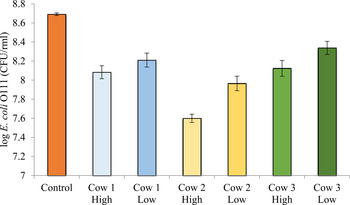
In Study 1 preliminary screening was carried out to investigate the extent of the association between SCC and Complement activity in the milk samples. Milks from those quarters of individual animals with spontaneously high SCC inhibited most (P < 0·05) of the growth of the Complement-sensitive strain, E. coli O111, compared to the control (heat-inactivated milk). Low SCC milk also had significantly reduced E.coli O111 growth rates in comparison to the control (P < 0·05) i.e. a milk in which complement has been heat-inactivated (56 °C for 30 min) as described by Reiter & Brock (Reference Reiter and Brock1975). However, when the high SCC milks from affected quarters of Cows 1, 2, and 3 were compared to milks from their healthy quarter (low SCC < 100 000), the difference was not significant (P > 0·05), based on respective E. coli O111 growth values of 8·08, 7·60 and 8·12 log CFU/ml for high SCC and 8·21, 7·97 and 8·34 log CFU/ml (low SCC milks).
Intra-mammary challenge of individual quarters with Streptococcus dysgalactiae
In a follow-up study (Study 2), the bovine immune system response was deliberately challenged by inoculating an infectious strain Str. dysgalactiae into one (healthy) quarter of 4 cows selected from the MDPC herd. In the days after the inoculation viable Str. dysgalactiae was recovered at 7 and 24 h from the infused quarters of all four treated cows. Importantly, there were no other pathogenic strains isolated from the milk drawn from the affected quarters throughout the trial. Equally, all of the uninfected control quarters remained free of pathogenic microorganisms throughout this period.
Clinical response and milk characteristics
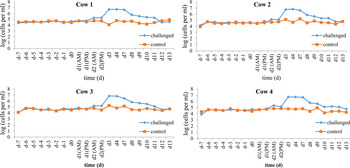
Twenty-four hours post-inoculation all 4 cows presented with signs of udder inflammation in the test quarters. The cows were monitored individually for the anticipated signs of mastitis, e.g., inflammation and swelling of challenged quarters, increased levels of SCC and expressed milk with abnormal signs such a watery appearance, flakes, clots or pus. The SCC of cows 1, 3 and 4 peaked after 72 h while cow 2 peaked after 96 h PI. At this time, clots were visible in the milk collected from the infused quarters, and the SCCs for the challenged quarter increased to 6·73, 6·76, 6·84 and 6·71 log SCC per ml for cows numbered 1 to 4, respectively (Fig. 2). Hence, it was concluded that the Str. dysgalactiae infection was now established, so that the immune response in the inoculated quarters could be monitored. The control (uninfected, healthy) quarters did not show any significant change in SCC (P < 0·05). Close monitoring of udder conditions and milking from the four cows continued during the period following establishment of inflammation. The reaction was self-limiting in the case of three of affected animals, and their SCCs returned to normal levels within 14d PI, while the fourth cow required brief antibiotic intervention. The SCC was followed until it had returned to normal values.
Results of the bacterial sequestration assay of the milk samples from individual cows in the MDPC herd. Each cow had one quarter producing high SCC milk and one producing low. The samples include; (i) heat treated raw bovine milk (control, 56 °C 30 min), (ii) Cow 1 qtr with high SCC, (iii) Cow 1 qtr with low SCC, (iv) Cow 2 qtr with high SCC, (v) Cow 2 qtr with low SCC, (vi) Cow 3 qtr with high SCC, (vii) Cow 3 qtr with low SCC.

The individual SCCs (log cells per ml) for both the challenged quarter and the control. The SCC was measured from 7 d prior to intra-mammary challenge until d 18 PI.

Viable bacteria enumerated from collected milk pre and post -inoculation
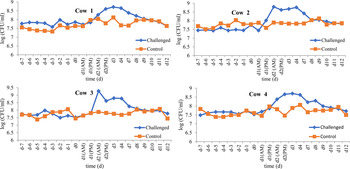
The number of viable bacteria in the challenged quarter increased in the days PI (Fig. 3) while, at the same time, there was no significant effect on the number of viable bacteria in the control (uninfected) quarters throughout the study (P < 0·05). The bacteria shed in the milks from the infused quarters had the appearance and growth characteristics of Str. dysgalactiae. The bacterial counts peaked between days 2 and 4 PI, cow 1 peaked on day 3 at 8·72 log CFU per ml, cows 2 and 3 peaked on day 2 at 8·797 and 9·28 respectively, cow 4 reached its peak on day 3 with 8·7 log CFU per ml. For animal welfare reasons, the cows were monitored with bacteriological examination of the milk during the following 30 d PI (results not shown) to check that all animals were restored to regular udder health and normalised in terms of low bacterial levels in milk. The levels of bacteria in the milk returned to normal after 21 d PI.
The individual colony forming units (log CFU/ml) of the Str. dysgalactiae for both the challenged quarter and the control. The CFU was measured from 7 d preceding to intra-mammary challenge until d 18 PI.

Bacterial sequestration assay
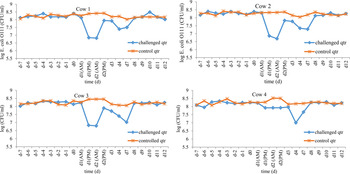
From the moment that infection had taken hold, as reflected in the higher milk SCCs, the bactericidal sequestration assay was undertaken on the milks from both the inoculated and control quarters. It was found that the milks from the challenged quarters of all cows were more effective at restricting E. coli O111 growth PI according to the reduced log CFU per ml for cows numbered 1 to 4 by 6·81, 6·69, 6·8, and 7·93 respectively (Fig 4). This effect was most notable between Day 1 and Day 7 PI. The corresponding control quarters in all four cows were significantly less effective at reducing growth of the assay strain (P < 0·05). These healthy (control) quarters of all animals remained stable in terms of Complement efficacy throughout the trial (Fig. 4).
Complement activity in milk was assessed using the bactericidal sequestration assay from both challenged and control quarters. Measurement as reflected by the total viable counts from (log CFU/ml) during performance of the bactericidal sequestration assay.

C5a ELISA assay
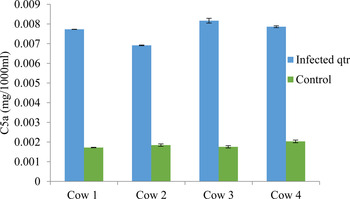
An Enzyme Linked Immunosorbent Assay (ELISA) was performed to quantify C5a in order to establish if elevated levels of this component coincided with greater inactivation of the bactericidal sequestration assay target microorganism (E. coli O111), and provide further evidence of increased Complement activity. The C5a ELISA assay indicated that there was significantly greater (P < 0·05) levels of C5a in the infected quarters compared to the control quarters (Fig. 5).
Levels of complement component C5a as determined by an ELISA assay completed on the milks from both the control and challenged quarters of the individual cows.

Discussion
During the preliminary investigation milk samples with spontaneously increased somatic cell counts were investigated for Complement activity. The objective of this work was to assess the increased antimicrobial activity of these milks due to the elevated innate immune components present. Of particular interest was the effect of Complement on the growth of E.coli O111, a Complement susceptible bacteria. It was found that the high and normal SCC milks significantly reduced the growth of E. coli O111 in comparison to the control (P < 0·05), i.e., a milk in which Complement has been heat-inactivated at 56 °C for 30 min (Geiger, Reference Geiger1952; Lepow et al. Reference Lepow, Wurz, Ratnoff and Pillemer1954). These results confirmed that the presence of Complement at normal and higher levels in individual cow milk samples had a significant antimicrobial effect against E. coli O111 (P < 0·05).
In the second study, the immune response of four dairy cows was challenged by stimulating a controlled inflammatory response, using a known strain of Str. dysgalactiae. The mastitis-inducing strain, Str. dysgalactiae, inoculated into the mammary gland of the four cows studied was based on a strain isolated previously from an incidence of mastitis in the MDPC herd. This Gram-positive strain is credited with a significant number of both clinical and subclinical infections (Hogan et al. Reference Hogan, Todhunter, Smith and Schoenberger1989; Todhunter et al. Reference Todhunter, Smith and Hogan1990). As expected, SCC increased from base levels in the inoculated quarter in the hours and days following inoculation, thus confirming that the infecting Str. dysgalactiae pathogenic strain had triggered tissue inflammation in the affected mammary quarter. Importantly the results of the bacterial sequestration assay identified that there was a significant increase in Complement activity against E. coli O111 in the inoculated mammary quarters as compared to the controlled quarters (P < 0·05). Although some cow to cow variation was found for onset of increased SCC and antimicrobial activity all milks produced had increased anti E.coli O111 activity due to the increased Complement activity. Moreover, bactericidal sequestration assay counts in the non-infected (control) quarter were largely unaffected throughout the trial period, thus confirming that the innate immune response was mainly elevated in the infected quarter. No other pathogenic bacteria were tested from the milk samples, which confirmed that the increase in SCC was as a direct response to Str. dysgalactiae inoculation.
The ELISA test based on its specific determination of Component C5a, a chemotactic protein known for its recruitment of inflammatory cells, in the freshly collected milk samples provided additional confirmation that Complement was the key innate immune factor at work in combating the induced-mammary infection.
Overall, the study provides key insights into the innate immune response, and specifically the Complement response, of the mammary gland... in the mammary gland when triggered by S. dysgalactiae spp. Dysgalactiae inoculation. Hyperimmunisation of lactating dairy cows with specific antigens is frequently employed to induce increased antibody activity in the milks collected from these animals. A commercial bovine colostral whey preparation containing enriched levels of immunoglobulins was found to enhance the immune and bacteriolytic responses of calves (Hammarström and Weiner, 2008). Oral administration of milks collected from hyper-immunised cows has reportedly improved the incidence of acute colitis and maintained intestinal homoeostasis in mice models (Wang et al. Reference Wang, Lin, Yin, Othtani, Aoyama, Lu, Sun and Yoshikai2014). Unfortunately, there is little published information on how Complement activity in milk is affected following hyper-immunisation of selected dairy cows. The current induced-mastitis study found that the Complement response was of a local nature i.e., confined to the affected milking quarter. However, it is reasonable to expect that a systemically-triggered response following hyper-immunisation is most likely to be manifested also by increased Complement activity in addition to the release of specific antibodies. Further research which monitors for changes in Complement as a result of hyper-immunisation of dairy cows is recommended. In exploring the potential for generating therapeutic preparations based on generated antibodies, there is considerable interest also in the release of cationic host defense peptides (HDP) which are known to be transcriptionally regulated and dependant on stimulus and cell type. Furthermore, HDP are regulated and/or coordinated in conjunction with the expression of other entities of innate immunity and acute inflammation.