Introduction
Bilingual children often display linguistic behaviours that are different from those of their monolingual peers, especially in the domains involving the integration of multiple sources of information such as the syntax-discourse interface. The attested differences between bilinguals and monolinguals have commonly been ascribed to crosslinguistic influence (e.g., Argyri & Sorace, Reference Argyri and Sorace2007; Döpke, Reference Döpke1998, Reference Döpke2000; Hulk & Müller, Reference Hulk and Müller2000; Müller & Hulk, Reference Müller and Hulk2001; Serratrice, Reference Serratrice2007; Serratrice, Sorace & Paoli, Reference Serratrice, Sorace and Paoli2004). One influential hypothesis (Hulk & Müller, Reference Hulk and Müller2000) posits that two conditions make a structure vulnerable to crosslinguistic influence. First, the structure should be located at the syntax-discourse interface, which means that its interpretation requires syntactic and discourse pragmatic knowledge (cf. Avrutin, Reference Avrutin1999). Second, the counterparts of the structure in the two languages should overlap at the surface level (cf. Döpke, Reference Döpke1998). A prototypical situation for crosslinguistic influence is when language A uses construction x in context X and construction y in context Y (xX, yY), whereas language B uses construction x in both contexts X and Y (xX, xY). In such cases crosslinguistic influence is expected from B to A, i.e., the under-specified construction x from language B is over-used in context Y in language A, resulting in the infelicitous or even ungrammatical form-function pairing xY in language A.
In line with the interface hypothesis, numerous studies demonstrate that simultaneous bilingual children tend to over-use overt subjects in languages that have both null and overt subjects, under the influence of English where only overt subjects are possible (see Paradis & Navarro, Reference Paradis and Navarro2003 for Spanish; Serratrice et al., Reference Serratrice, Sorace and Paoli2004 and Serratrice, Reference Serratrice2007 for Italian; Hacohen & Schaeffer, Reference Hacohen and Schaeffer2004 for Hebrew; Haznedar, Reference Haznedar2007 for Turkish). More specifically, bilingual children over-use overt subjects in contexts of topic maintenance, which is infelicitous in languages such as Italian, Spanish and Greek. Similar kinds of crosslinguistic influence have been reported for other interface phenomena, such as object drop (Müller & Hulk, Reference Müller and Hulk2001) and subject placement in wide-focus contexts (Argyri & Sorace, Reference Argyri and Sorace2007).
A central assumption of the interface hypothesis, as formulated by Hulk & Müller (Reference Hulk and Müller2000), is that crosslinguistic influence is determined exclusively by language-internal factors (interface and overlap), and not by language-external factors such as amount of input in each language and children's processing capacities. However, more recent studies suggest that external factors may play a larger role than has been previously assumed and that crosslinguistic influence is not the only factor that can explain the attested differences between bilinguals and monolinguals (Argyri & Sorace, Reference Argyri and Sorace2007; Sorace & Seratrice, Reference Sorace and Serratrice2009).
Contrary to Hulk and Müller's (Reference Hulk and Müller2000) hypothesis, Argyri and Sorace (Reference Argyri and Sorace2007) show that crosslinguistic influence is sensitive to language dominance, as demonstrated by differences between English–Greek bilinguals and English/Greek monolinguals in subject placement in Greek. In Greek preverbal subjects are used in narrow-focus contexts and postverbal subjects are used in wide-focus contexts (language A), whereas English allows only preverbal subjects, which are used in both wide- and narrow-focus contexts (language B). In this case, the interface hypothesis would predict influence from English (language with one option) to Greek (language with two options), regardless of language dominance. Importantly, however, this direction of crosslinguistic influence was found only in English-dominant bilinguals (Argyri & Sorace, Reference Argyri and Sorace2007). In contrast, Greek-dominant bilinguals did not over-use preverbal subjects in wide-focus contexts in Greek. This result is incompatible with the claim that crosslinguistic influence is exclusively determined by language-internal factors (Hulk & Müller, Reference Hulk and Müller2000; Müller & Hulk, Reference Müller and Hulk2001) and shows that the amount of input in each of the child's languages or frequency of language use (resulting in varying degrees of activation) may over-ride predictions based on linguistic factors.
Another language-external factor that may explain non-target-like behaviour of bilinguals is related to processing demands in a bilingual context. The two languages of a bilingual are always active to a certain extent and the language that is not currently used needs to be suppressed (MacWhinney, Reference MacWhinney, Kroll and De Groot2005). This additional cognitive task may lead to a processing overload when bilinguals have to deal with relatively complex phenomena requiring integration of multiple cues, such as constructions at the interface of syntax and pragmatics. It has been shown in the literature that even monolingual children (and to some extent monolingual adults) have some difficulty with phenomena such as anaphor choice in Italian (Sorace, Serratrice, Filiaci & Baldo, Reference Sorace, Serratrice, Filiaci and Baldo2009). It is then not surprising that bilinguals constantly dealing with competing cues from their two languages have more trouble selecting the appropriate anaphor.
Perhaps the best illustration that crosslinguistic influence cannot explain all differences between monolinguals and bilinguals is that both Italian–English and Italian–Spanish bilinguals were shown to accept overt pronouns in topic-maintenance contexts more often than Italian monolinguals, even though Spanish and Italian have a similar distribution of null and overt subjects (Sorace et al., Reference Sorace, Serratrice, Filiaci and Baldo2009). At least for the latter group of bilinguals, crosslinguistic influence cannot be the reason for non-target-like performance. Sorace and Serratrice (Reference Sorace and Serratrice2009) argue that processing limitations may offer a more plausible explanation of these data. Alternatively, one may argue that Italian–Spanish bilinguals were not target-like in their use/interpretation of Italian pronouns because they had received less input in each of their languages and were still in the process of acquiring the relevant distinctions between null and overt subjects (cf. Paradis, Nicoladis, Crago & Genesee, Reference Paradis, Nicoladis, Crago and Genesee2010). In this respect, bilinguals may display performance similar to that of monolingual children with (specific) language impairment (SLI).
Monolinguals with SLI grow up with only one language and therefore receive more input compared to bilinguals. However, language-impaired individuals were shown to have difficulty with analysing the available input due to processing deficits (Ellis Weismer & Evans, Reference Ellis Weismer and Evans2002; Leonard, Reference Leonard1998; Pizzioli & Schelstraete, Reference Pizzioli and Schelstraete2013). In other words, in the case of language-impaired children the problem is not the actual amount of input received (as in the case of bilinguals), but rather reduced intake, i.e., the amount of input that can effectively be used for acquisition (Orgassa & Weerman, Reference Orgassa and Weerman2008). Processing limitations of children with SLI lead to significant delays in language acquisition and less developed grammars and lexicons compared to unimpaired peers.
If non-target-like performance of bilingual children is not due to crosslinguistic influence but rather due to either less input or processing disadvantages (resulting from the cognitive load of switching between the languages), we may expect them to have similar language profiles with those of language-impaired monolinguals. Monolinguals with SLI receive more input than bilinguals, but cannot use that input efficiently for deriving the language rules, which commonly leads to higher error rates and delayed acquisition compared to typically-developing (TD) monolinguals. Indeed there is growing evidence that it is sometimes difficult to distinguish between child L2 learners and monolingual children with SLI based on error rates (Armon-Lotem, Reference Armon-Lotem2014; Blom, De Jong, Orgassa, Baker & Weerman, Reference Blom, De Jong, Orgassa, Baker and Weerman2013; Chondrogianni & Marinis, Reference Chondrogianni and Marinis2012; Crago & Paradis, Reference Crago, Paradis, Levy and Schaeffer2003; Paradis, Reference Paradis1999, Reference Paradis2010b; Paradis & Crago, Reference Paradis and Crago2000, inter alia). Much less is known about similarities between simultaneous bilinguals (growing up with two languages from birth) and language-impaired monolinguals. As explained above, there are reasons to assume that complex language domains that are problematic for language-impaired individuals (due to processing deficits) are also problematic for simultaneous bilinguals (because their time/input and cognitive resources are divided between two languages). Hence, both groups may need more time to acquire complex language phenomena, like the ones at the interface of syntax and discourse. Whereas most previous research comparing (sequential) bilinguals with language-impaired monolinguals has focussed on the acquisition of morphosyntax, relatively little is known about possible similarities between the two groups in the acquisition of interface phenomena. However, it might be particularly rewarding to compare the performance of language-impaired monolinguals to that of simultaneous bilinguals (in their nondominant language) in one of the interface domains where the integration of multiple cues is required. The present paper aims to fill this niche by comparing production of discourse connectives by simultaneous (Dutch–Russian) bilinguals and monolinguals with and without SLI.
Although discourse connectives are prototypical phenomena at the interface between syntax and discourse, connective use by bilinguals has barely been investigated. Tribushinina, Valcheva and Gagarina (forthcoming) report that the production of additive connectives (‘and’, ‘but’) by child L2 learners of German with Russian as L1 is different from that of monolinguals. These differences were attributed to crosslinguistic influence from German (L2) to Russian (L1) in the L2-dominant environment. Notice, however, that crosslinguistic influence might not be the (only) factor explaining differences between bilinguals and monolinguals. For one, another study (Tribushinina, Dubinkina & Sanders, Reference Tribushinina, Dubinkina and Sanders2015) showed that monolingual Russian-speaking children with SLI also have difficulty using appropriate discourse connectives. Hence, it might be the case that the problems in connective use reported for early sequential bilinguals are not (only) due to crosslinguistic influence, but rather due to reduced input in both languages and/or due to processing cost in bilingualism.
To address these issues, the present study will compare connective use by Dutch–Russian simultaneous bilinguals (dominant in Dutch) to that of monolinguals in both languages (Study 1) and also compare connective production in the bilinguals’ nondominant language (Russian) to connective use by Russian-speaking monolinguals with SLI (Study 2). In this manner, we hope to shed more light on the complex interplay between various factors affecting language use in a bilingual context. By comparing language production of bilinguals and monolinguals in both languages, this paper will provide useful insights into the role of language dominance in possible crosslinguistic influence. Furthermore if connective production by bilinguals (in their nondominant language) proves similar to that of monolinguals with SLI, that would provide evidence that crosslinguistic influence is not the only factor accounting for deviant language use by bilinguals.
Before reporting the two studies, we first explain the relevant differences between the Dutch and Russian additive connectives that will be investigated in the experiments reported below.
Additive connectives in Dutch and Russian
Two additive connectives are commonly used for coordination in Dutch – the positive en “and” and the negative maar “but”. Their semantic-pragmatic profiles are very similar to those of the English counterparts and and but and to the German counterparts und and aber. In Russian the same meanings are divided over three connectives – the positive i “and”, the negative no “but” and the semi-negative a “but/and” (Jasinskaja & Zeevat, Reference Jasinskaja and Zeevat2009).
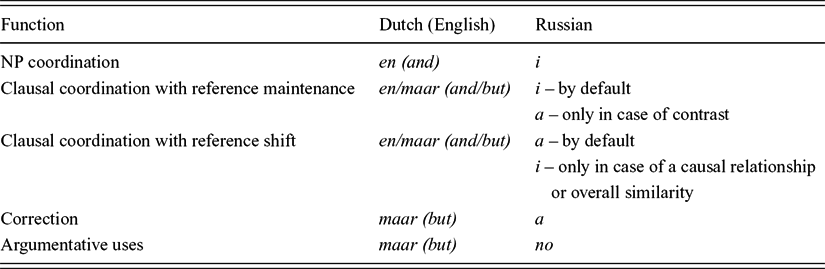
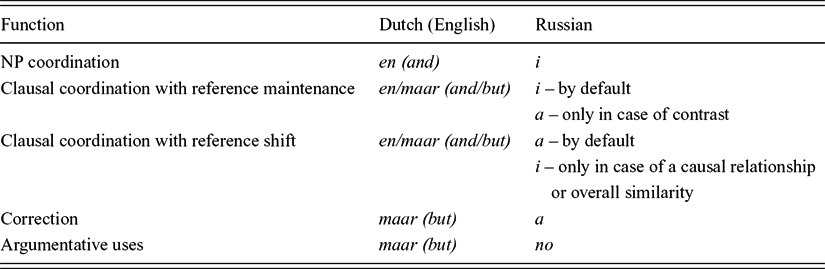
As shown in Table 1, the Russian no “but” has a narrow semantics, largely confined to argumentative uses such as denial of expectation and concession (e.g., The ring is beautiful, but too expensive); such uses will not be considered in this paper. Corrective uses (e.g., not in Amsterdam, but in Moscow) and cases of NP coordination (e.g., cat and fox) are also beyond the scope of this research. As is evident from Table 1, the most intriguing differences between Russian and Dutch additive connectives are in the domain of clausal coordination. The Dutch connective en “and” is equally acceptable in the contexts of reference maintenance and reference shift, as in examples (1a) and (2a) respectively. In contrast, the Russian counterpart i “and” is only felicitous in cases of reference maintenance, as in (1b), but not in cases of reference shift, as in (2b).
Functions of additive connectives in Dutch (en “and”, maar “but”) and Russian (i “and”, a “but/and”, no “but”).
-
(1)
-
a. Nina is aan het fietsen, en (zij) kijkt heel blij.
-
b. Nina katajetsja na velosipede, i (ona) vygljadit očen’ dovol’noj.
“Nina is riding a bike, and (she) looks very happy.”
-
-
(2)
-
a. Nina is aan het fietsen, en Mark is aan het vissen.
-
b. Nina katajetsja na velosipede, #i Mark lovit rybu.
“Nina is riding a bike, and Mark is fishing.”
-
However, i “and” can sometimes be used for reference shift, but only if there is an obligatory causal relation between the clauses, since a causal relation warrants topic continuity that is crucial for the use of i. For example, the only possible interpretation of (3b) is that Mark was angry because of Nina's late arrival. In Dutch this causal reading is also possible (see 3a), but not obligatory. In (2b), i is not impossible, but it would force the reader to interpret the clauses as causally related, which in this case is infelicitous. Hence, the use of i in the context of topic shift without an apparent causal link leads to discourse violation.
-
(3)
-
a. Nina kwam te laat, en Mark was boos.
-
b. Nina opozdala, i Mark rasserdilsja.
“Nina came too late, and Mark was angry.”
-
The Russian connective a “but/and” is a marker of double topics (Jasinskaja & Zeevat, Reference Jasinskaja and Zeevat2008, Reference Jasinskaja and Zeevat2009; Kreidlin & Paducheva, Reference Kreidlin and Paducheva1974) and is therefore prototypically used for reference shift, as in (4b). In Dutch, both en and maar are possible in this case; see (2a) and (4a) respectively.
-
(4)
-
a. Nina is aan het fietsen, maar Mark is aan het vissen.
-
b. Nina katajetsja na velosipede, a Mark lovit rybu.
“Nina is riding a bike, but Mark is fishing.”
-
A “but/and” can only be used for reference maintenance in case there is a contrast relation involved (often realized as temporal contrast), as in (5b). The Dutch maar “but” can also be used in such cases, as evidenced by (5a).
-
(5)
-
a. Op warme dagen drinkt Nina sap, maar op koude dagen drinkt zij thee.
-
b. V žarkije dni Nina p’ët sok, a v xolodnye dni ona p’ët čaj.
“On warm days Nina drinks juice, but on cold days she drinks tea.”
-
Hence, there is a crucial difference between Dutch and Russian. The Dutch additive connectives are not specified for reference maintenance/shift in their semantics, whereas their Russian counterparts are. By default, i must be used for reference maintenance and a for shift. The uses of i for shift and a for maintenance are only possible under specific discourse constraints, as explained above. An eye-tracking experiment reported in Mak, Tribushinina and Andreiushina (Reference Mak, Tribushinina and Andreiushina2013) demonstrated that Russian-speaking adults are sensitive to these semantic properties of the two connectives and use them to predict discourse continuation. In contrast, speakers of Dutch do not use the additive connectives to predict referential development in discourse.
Hence, the Russian additive connectives have intricate discourse-organizational profiles based on an interaction between referential and relational coherence. They are prototypical phenomena at the interface of syntax and discourse. On the one hand, they are used for syntactic coordination; on the other hand, connective choice is determined by discourse principles (reference maintenance vs. shift). It then does not come as a surprise that i and a present a challenge to a language learner. Despite their high frequencies in the input and early emergence in child speech (Knjazev, Reference Knjazev and Cejtlin2007), the acquisition of their semantic profiles is not yet completed by age 7 (Tribushinina et al., Reference Tribushinina, Dubinkina and Sanders2015). As explained above, both Russian–German early sequential bilinguals (Tribushinina et al., forthcoming) and Russian monolinguals with SLI (Tribushinina et al., Reference Tribushinina, Dubinkina and Sanders2015) were shown to have particular difficulty with the production of these discourse connectives. Tribushinina et al. (forthcoming) explain the differences between bilinguals and monolinguals by appealing to crosslinguistic influence from German. In their study Russian L1 German L2 children overused the Russian connective i “and” in contexts of reference shift, presumably under the influence of the German counterpart und “and” that is equally acceptable in contexts of reference maintenance and reference shift. However, the results reported by Tribushinina et al. (Reference Tribushinina, Dubinkina and Sanders2015) suggest that Russian monolinguals with SLI also overuse i for reference shift in cases where there is no plausible causal relation between the events (as in 2b), and they also inappropriately use a where the causal use of i would be required. These errors were not due to misunderstanding the causal links in the story, as children with a language impairment performed like unimpaired controls on the task testing the understanding of story grammar. In the case of children with SLI problems with i and a cannot be explained by crosslinguistic influence because all subjects in Tribushinina et al. (Reference Tribushinina, Dubinkina and Sanders2015) were raised monolingual. In view of these earlier findings, it is not clear whether the differences attested between bilinguals and TD monolinguals are due to crosslinguistic influence (as argued by Tribushinina et al., forthcoming) or due to insufficient exposure to Russian. These two possibilities will be explored in the two studies reported below. Study 1 compares the use of additive connectives by Dutch–Russian bilinguals to that of monolinguals in both languages and tests the predictions of the interface hypothesis for crosslinguistic influence. Study 2 compares production of the same discourse connectives in the nondominant language of bilinguals with connective use by monolinguals with a language impairment.
Study 1
Predictions
In this study, we investigate how bilingual Dutch–Russian children living in the Netherlands use the additive connectives in a narrative production task, compared to monolinguals in both languages. The following three scenarios appear possible based on prior research on crosslinguistic influence:
-
(a) Russian > Dutch (bilinguals will use Dutch en “and” more often for reference maintenance and maar “but” more often for reference shift compared to Dutch monolinguals);
-
(b) No influence (option (a) counterbalanced by language dominance);
-
(c) Dutch > Russian (bilinguals will use Russian i “and” more often for reference shift and a “but/and” more often for reference maintenance compared to Russian monolinguals).
Scenario (a) is compatible with the interface hypothesis (Hulk & Müller, Reference Hulk and Müller2000; Müller & Hulk, Reference Müller and Hulk2001). The investigated phenomenon lies at the interface of syntax and discourse. There is a surface overlap between connective use in the two languages. Dutch allows reference maintenance and shift after both en “and” and maar “but” without any constraints, whereas in Russian i “and” must be used in contexts of topic maintenance (commonly realized as reference maintenance) and a “but/and” must be used in contexts of reference shift (unless there is a temporal/spatial contrast involved). The interface hypothesis would predict that bilinguals over-use Dutch en for maintenance and maar for shift, because this analysis is reinforced by both languages. By this view, language-external factors, such as dominance, should not play a role.
However, as demonstrated by Argyri and Sorace (Reference Argyri and Sorace2007), language dominance does affect manifestations of crosslinguistic influence. This study found influence from a language with one option (English) to a language with two options (Greek) in the domain of subject placement, but only for bilinguals living in Great Britain. Based on these findings, scenario (b) can be predicted. Influence from Russian to Dutch would be expected based on the structural properties of the two languages in the domain of clausal coordination. However, given that the bilingual subjects in this study are all dominant in Dutch, it can also be predicted that there is no influence either way.
Finally, in view of the earlier finding that connective use in L1 Russian can be affected in the L2 dominant environment (Tribushinina et al., forthcoming), it is likely that the same will happen in simultaneous Dutch–Russian bilinguals for whom Dutch is the dominant language (scenario c). Since the Dutch connectives are not specified for reference maintenance/shift, it is plausible to assume that simultaneous bilingual children will over-use i for reference shift and a for reference maintenance. This scenario is counter to the predictions of the interface hypothesis, but is compatible with the view positing the importance of language dominance in crosslinguistic influence.
Method
Subjects
Ninety children participated in this study: 30 Dutch–Russian bilinguals (15 females, mean age: 7;2, age range: 6;8−7;10), 30 monolingual Dutch-speaking children (11 females, mean age: 7;3, age range: 6;8−7;10) and 30 monolingual Russian-speaking children (18 females, mean age: 7;2, age range: 6;8−7;10). A chi-square test revealed no significant difference in the distribution of male and female participants across groups, χ2(2) = 3.3, p = .19.
The monolingual Dutch group was recruited from a primary school in Utrecht (The Netherlands) and the monolingual Russian group from a primary school in Kemerovo (Russia). The bilingual participants were recruited from the Russian Saturday schools in Amsterdam and Hilversum (The Netherlands). They were all dominant in Dutch. Dominance is defined in this study as the amount of exposure to each of the languages (Argyri & Sorace, Reference Argyri and Sorace2007; Döpke, Reference Döpke1992). All bilinguals in this study had above 60% exposure to Dutch (range 60–82%), as established by a parental questionnaire. These children were born in the Netherlands and raised bilingual from birth (in most cases by a Russian mother and a Dutch father). They all attended a regular Dutch primary school and a Russian language school on Saturday morning. The subjects had normal sensory-motor, social-emotional and cognitive development, and age-appropriate language skills (as reported by teachers and parents). Informed consent was obtained from the parents of all participants.
Materials and procedure
Two picture stories were used to elicit children's narratives – the Fox Story (Gülzow & Gagarina, Reference Gülzow, Gagarina, Bittner and Gagarina2007) and the Cat Story (Hickmann, Reference Hickmann2003). The stories contained six pictures each and were matched for the number of characters and grammatical gender of the nouns referring to the protagonists (fox, bird/crow and fish in the Fox Story; bird, cat and dog in the Cat Story). Both sets of pictures were simple black-and-white drawings, 12×12 cm (Fox Story) and 10×13 cm (Cat Story) in size.
The bilingual subjects told both stories, one in each language (either Cat or Fox). The monolingual participants were randomly assigned to one of the narratives (Cat or Fox) so that their corpus size would be comparable to that of the bilingual participants. The narratives were elicited by native speakers of Russian and Dutch, with a two-week interval between the sessions. Half of the children first produced a Russian narrative, and half started in Dutch.
The children were interviewed individually in a quiet room in their school. After a short warming-up talk about the child's favourite stories, the investigator asked the child to tell the story in pictures. All pictures of the story were then placed on the table in front of the child. After the child looked through all the pictures and acknowledged to have understood the plot, the experimenter put all the pictures away and afterwards placed only the first picture in front of the child and said, “Please, start telling the story”. When the child finished describing picture 1, the investigator placed picture 2 next to picture 1 so that the child could see two pictures at the same time. When the child was finished with picture 2, the investigator placed it on top of picture 1 and put picture 3 next to picture 2 on the table, etc. We chose to present the pictures one by one, because there is evidence that children often fail to tell the story consecutively and leap back and forth when presented with all pictures at the same time (e.g., Miranda, McCabe & Bliss, Reference Miranda, McCabe and Bliss1998).
The narratives were audio-recorded and later transcribed in a CHAT format (MacWhinney, Reference MacWhinney2000). The Russian transcriptions were morphologically tagged by means of MORCOMM tools (Gagarina, Voeikova & Gruzincev, Reference Gagarina, Voeikova and Gruzincev2003) and disambiguated by a trained research assistant. The Dutch transcriptions were tagged using the CHILDES’ MOR software tool producing lemmatization, morphological decomposition and part-of-speech tagging (Gillis, Reference Gillis and MacWhinney1991).
Coding
First, we identified all relevant instances of the additive connectives en and maar in Dutch, and i and a in Russian following a set of criteria. An instance was identified as relevant if it met the following two criteria: a. both discourse segments coordinated by the connective contained a finite verb, thus excluding cases of NP coordination (e.g., knife and fork); b. a referent (protagonist) could be clearly identified in both discourse segments, thus excluding all ambiguous cases. Repetitions, self-corrections and fixed expressions (i vsë “and that's it”) were excluded from analysis. Similarly, cases where additive connectives were used as part of more complex sequential connectives (e.g., Russian a potom “and then”, Dutch en dan “and then”) were also excluded because the use of such sequential connectives (in Russian) is not guided by the same discourse constraints (with regard to maintenance and shift), as the use of simple additive connectives. The selection resulted in a corpus of 450 relevant instances in Russian and 290 in Dutch.
The selected sentences were coded as cases of either
-
- reference maintenance: the same referent was used in the discourse segment following the connective, as in example (6) from Dutch and (7) from Russian, or
-
- reference shift: a new referent was (re-)introduced in the second discourse segment, as in Dutch example (8) and Russian example (9).
-
(6) De kraai ziet de vis en hij wilde hem oppakken. (BD-004-fox)
“The crow sees the fish and he wanted to pick it up.”
-
(7) Potom kot prišël. I on xotel ptički dostat’. (BR-185-cat)
“Then a cat came. And he wanted to get the little birds.”
-
(8) En daar zien ze een kat, maar de moeder die vliegt weg. (MD-010-cat)
“And there they see a cat but the mother is flying away.”
-
(9) Mama-ptica uletela, a ptenčiki ostalis’ odni v gnezde. (MR-085-cat)
“Mother-bird flew away, but/and the baby-birds stayed alone in the nest.”
The coding was performed by a trained student under the supervision of the first author. Ten percent of the occurrences was also coded by the first author. Inter-coder agreement was 98%.
Results
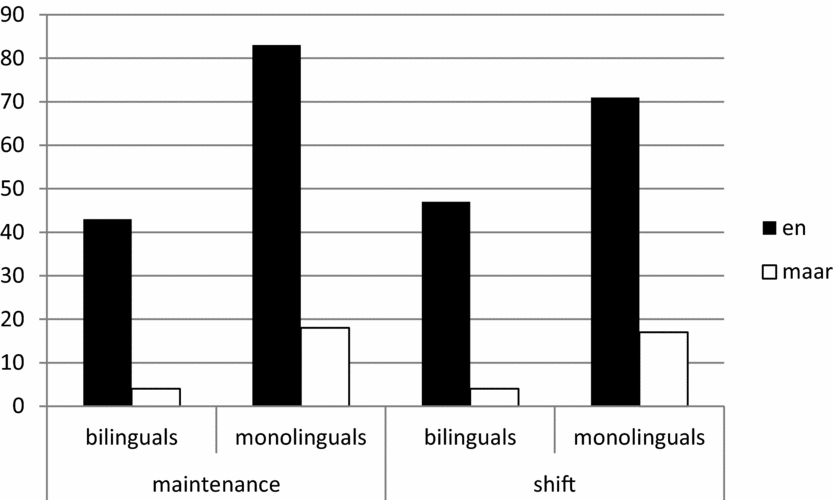
We first analyzed the results of the data in the dominant language of the bilinguals, Dutch. We compared the results in the bilingual group with those in the monolingual Dutch group. The token frequencies of the Dutch connectives en “and” and maar “but” are presented in Figure 1.
Frequency of the Dutch connectives by referential development and group.

The data were analyzed using a logistic regression, using the lme4 package in R (Bates, Maechler, & Bolker, Reference Bates, Maechler and Bolker2013). We created a model that predicted the probability that a child would use the connective en on the basis of Referential Development (maintenance versus shift) and Group (monolinguals versus bilinguals). We first created a model in which both factors were included as main effects. Participant was added as a random factor. Since the children all produced one unique story, we did not use Story as a random factor. We then created a model that also included the interaction between those factors. Goodness of fit was computed to establish whether adding the interaction increased the fit of the model with the data. This appeared not to be the case (χ2(1) = 0.008, p = .93). The first model showed a main effect of Referential Development (β = -1.10, SE = 0.46, z = -2.37, p = .017). Shift relations led to a lower proportion of the use of en.
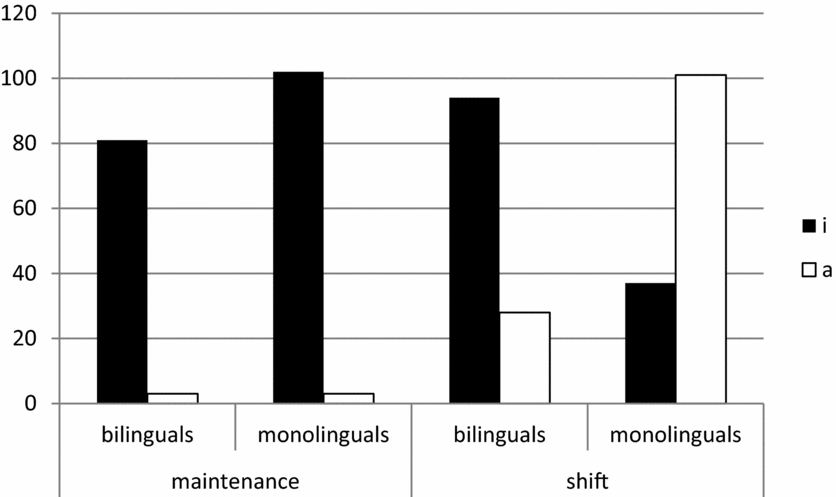
We then analyzed the results of the data in the nondominant language of the bilinguals, Russian. We compared the results of the bilingual children with those of the monolingual Russian children. We built similar models, but this time we tested the probability of using i on the basis of Referential Development and Group. The token frequencies of the Russian connectives i “and” and a “but/and” are presented in Figure 2.
Frequency of the Russian connectives by referential development and group.

In this analysis, the model including the interaction did show an increase in fit compared to the model including only the main effects (χ2(1) = 10.04, p = .002). In the model there was a main effect of Referential Development (β = -2.45, SE = 0.73, z = -3.38, p < .001). Overall the probability that a child used i was higher when there was a maintenance continuation than when there was a shift continuation. However, there was also an interaction of Referential Development and Group (β = -3.42, SE = 1.11, z = -3.09, p = .002). As Figure 2 shows, the tendency to use i for maintenance and a for shift was stronger for the monolingual children than for the bilingual children.
Discussion
The results of the narrative production task reveal that Dutch–Russian bilinguals use additive connectives in Dutch in the same way as their monolingual peers. The only effect in the analysis of the Dutch data (monolingual and bilingual) was a slightly higher preference for the use of maar “but” in shift relations. In contrast, the connective use of the bilingual children in Russian deviates from that of monolinguals. More specifically, bilinguals over-use i “and” and under-use a “but/and” for reference shift. This finding is perfectly explicable in view of the structural properties of Dutch. The Dutch connective en “and” has a broader semantics than its Russian counterpart i, being equally felicitous in contexts of reference maintenance and shift (without any further constraints). In contrast, the Russian positive connective i can only be used for reference shift under specific constraints of topic continuity.
This result is compatible with the view positing the importance of language dominance, since we find influence from the children's dominant language (Dutch) to their nondominant language (Russian). Therefore, the present findings are against the interface hypothesis that would predict influence from Russian to Dutch. Along the lines of the interface hypothesis, we would expect that bilingual children would over-use Dutch en “and” for reference maintenance and maar “but” for reference shift, since these options are reinforced by both Dutch and Russian. The present results are consonant with earlier findings from research on language attrition demonstrating that sometimes the application range of a construction in L1 may be extended under the influence of a second language in a dominant L2 environment (Keijzer, Reference Keijzer, Pütz and Sicola2010; Seliger, Reference Seliger, Ritchie and Tej1996; Seliger & Vago, Reference Seliger, Vago, Seliger and Vago1991; Silva-Corvalán, Reference Silva-Corvalán, Seliger and Vago1991). Hence, influence from the language with one option to the language with two options is not the only possible direction of crosslinguistic influence. External factors such as language dominance leading to easier activation of structures from the most frequently used language (Paradis, Reference Paradis2004) appear to be more important than purely language-internal structural factors.
Interestingly, bilinguals in this study did not use a “but/and” for maintenance more than their monolingual peers do, even though the Dutch connective maar “but” does not have semantic restrictions for maintenance or shift. This result replicates earlier findings by Tribushinina et al. (forthcoming) demonstrating that only i “and”, but not a “but/and” is vulnerable to crosslinguistic influence. I “and” is a positive connective and is apparently very close in meaning to the Dutch positive connective en “and”. In contrast, the semi-negative connective a “but/and” has no direct counterpart in Dutch: it partly corresponds to maar “but” and partly to en “and”. It appears that such elements for which there is no good counterpart in the other language, are not affected by crosslinguistic influence (see Seliger, Reference Seliger, Ritchie and Tej1996 and Gürel, Reference Gürel2004 for similar findings on L1 attrition). However, it is not the case that the use of a “but”/and” by bilinguals is identical to that of monolinguals. Dutch–Russian bilinguals use a “but/and” for shift less often than monolingual children do; this is a consequence of over-using i “and” in these contexts. In a similar vein, Tribushinina et al. (forthcoming) report that Russian–German early sequential bilinguals come to use a “but/and” less frequently, as they grow more proficient in their environment language (German). At the same time, non-target-like uses of i “and” for shift increase, presumably under the influence of German.
In view of the typological properties of Russian and Dutch connectives, it is plausible that the observed differences between bilinguals and Russian monolinguals are due to crosslinguistic influence from Dutch. However, Tribushinina et al. (Reference Tribushinina, Dubinkina and Sanders2015) showed that Russian monolinguals with SLI also over-use i in contexts of reference shift. In this case, over-use of the connective i in the shift contexts cannot be attributed to crosslinguistic influence. Rather, inappropriate connective use by monolinguals with a language impairment is presumably due to a considerable delay in the acquisition of discourse connectives. Thus, we cannot exclude the possibility that the over-use of i attested in Study 1 is due to a delayed acquisition of connectives by Dutch-dominant bilinguals with relatively little exposure to Russian (rather than due to crosslinguistic influence). If reduced input in the nondominant language results in a delayed acquisition of connective semantics, then we would expect connective use by bilinguals to be similar to connective production by monolinguals with SLI. This possibility will be further explored in Study 2. Since no differences between bilinguals and monolinguals were found in Dutch, only the use of Russian connectives will be addressed.
Study 2
Predictions
This experiment compares the use of the Russian additive connectives i “and” and a “but/and” by Dutch–Russian bilinguals (dominant in Dutch) and Russian monolingual peers with and without SLI. Based on the results of Study 1, we expect that bilinguals will use i in contexts of reference shift more often than TD monolinguals, and that they will use a for reference shift less often than monolinguals.
As for monolinguals with SLI, the findings reported in Tribushinina et al. (Reference Tribushinina, Dubinkina and Sanders2015) suggest that it might be problematic to differentiate between TD children and children with SLI based on frequencies of connective use, but error analysis reveals that children with a language impairment use connectives inappropriately significantly more often than their TD peers. Hence, in this study we will not only look at overall frequencies, but also zoom in on the quality of connective use in context.
Method
Subjects
Sixty children participated in this study: 20 Dutch–Russian bilinguals (5 female, mean age: 8;5, age range: 8;0−8;10), 20 TD Russian monolinguals (5 female, mean age: 8;5, age range: 8;0−8;11) and 20 Russian monolinguals with SLI (5 female, mean age: 8;5, age range: 8;0−8;11). The number of female subjects in each group was relatively low. This was necessary in order to match the two TD groups to the SLI group, since there are more boys than girls in special schools for children with language disorders. It was decided to match the groups for age rather than language proficiency, since a similar level of cognitive development is crucial to ensure comparable understanding of causal links in the stories across the groups (Boudreau & Chapman, Reference Boudreau and Chapman2000; Tribushinina et al., Reference Tribushinina, Dubinkina and Sanders2015).
The bilingual participants were recruited from the Russian Saturday schools in Amsterdam, Amersfoort, Hilversum and The Hague (The Netherlands). These children were selected on the basis of the same criteria as in Study 1. None of them had participated in the first experiment.
The subjects with SLI were recruited through special schools for language disorders located in the Kemerovo region (Russia). The children were monolingual speakers of Russian and had been independently diagnosed for SLI (in Russian – obščee nedorazvitie reči II-III urovnja) by a multidisciplinary committee consisting of a speech pathologist, a psychiatrist, a neurologist, a paediatrician and a clinical psychologist. The subjects had been followed by the fourth author of this paper, a certified speech therapist, for two years prior to the beginning of the study. The children were selected for participation in the study if they met the following selection criteria: normal IQ (within one standard deviation from the mean on IQ tests conducted for school enrolment), absence of any other known disorder such as autism, no evidence of neurological impairment, no severe visual or auditory problems (based on the yearly medical checks at school), average academic performance, normal motor, social-emotional and cognitive development, a composite language score of 156 or below on the Fotekova-Akhutina test, including a receptive subtest (comprehension of phonologically similar nouns, receptive vocabulary, comprehension of grammatical constructions) and an expressive subtest (expressive vocabulary, narrative production and retelling, sentence production, sentence repetition, sentence completion, preposition use, inflection and derivation production) (Fotekova & Akhutina, Reference Fotekova and Akhutina2002).
TD monolinguals were recruited from a regular primary school in Kemerovo. The teachers were asked to select the subjects following a set of criteria: normal IQ (within one standard deviation of the mean on IQ tests conducted for school enrolment), average academic performance, normal motor, social-emotional and cognitive development, as well as age-appropriate language skills (as reported by teachers and parents). Informed consent was obtained from the parents of all participants.
Materials and procedure
Materials and procedure were identical to those used in Study 1. However, in this study only Russian narratives were elicited from the bilingual group. Half of the children told the Fox Story, and half the Cat Story.
Coding
We first identified the relevant uses, where i “and” and a “but/and” were used for clausal coordination, using the same set of criteria as in Study 1. This procedure gave us a corpus of 435 relevant instances. Each relevant instance was coded as either a case of reference maintenance or a case of reference shift. Additionally, we coded each relevant instance as either correct or incorrect based on adult intuitions. As shown by Tribushinina et al. (Reference Tribushinina, Dubinkina and Sanders2015), 8-year-old children (with and without SLI) have adult-like understanding of the causal links in the stories. Coding was performed by the third author. Ten percent of the data were also coded by the first author of this paper. Inter-coder agreement was 94%.
Results
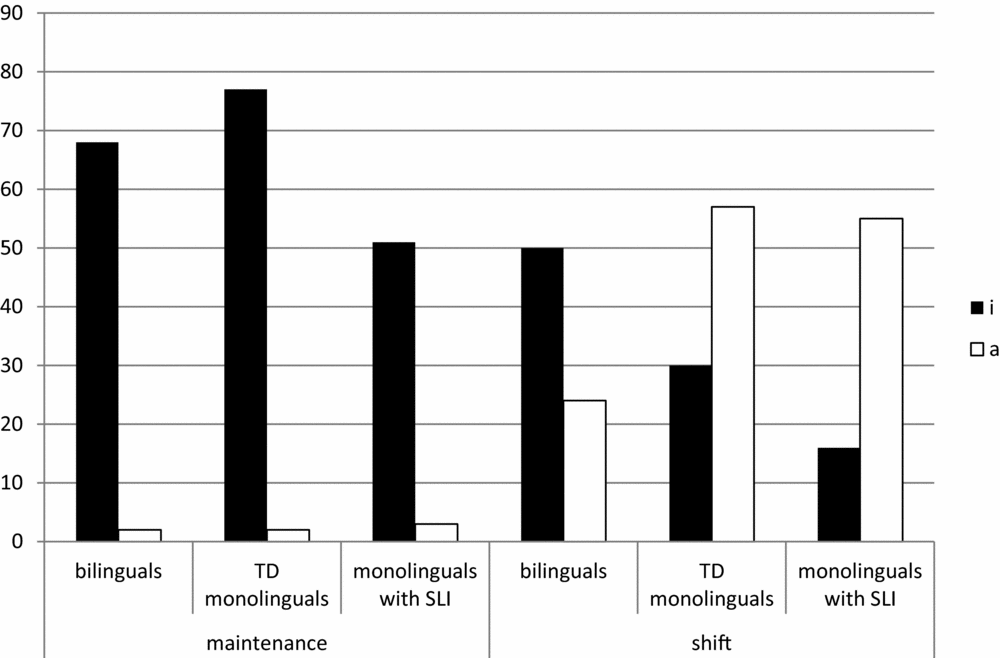
As in Experiment 1, the data were analyzed using a logistic regression. We created a model that predicted the probability that a child would use the connective i “and” on the basis of Referential Development (maintenance versus shift) and Group (TD monolinguals versus bilinguals versus monolinguals with SLI). We first created a model in which both factors were included as main effects. Participant was added as a random factor. We then created a model that also included the interaction between those factors. Goodness of fit was computed to establish whether adding the interaction increased the fit of the model with the data. The token frequencies of the two connectives are presented in Figure 3.
Connective frequencies by referential development and group.

Including the interaction did not increase the fit of the model (χ2(2) = 3.47, p = .17). The model without the interaction showed a main effect of Referential Development (β = -4.33, SE = 0.48, z = -8.98, p < .001). Across all three groups, reference-shift continuations led to a lower proportion of the use of i. In addition, the bilinguals showed a higher probability of using i than the monolinguals (β = 1.61, SE = 0.49, z = 3.25, p = .001). The latter effect is visible in the shift condition. Whereas the monolinguals with and without SLI predominantly used a for shift relations, the bilinguals tended to use i for shift relations.
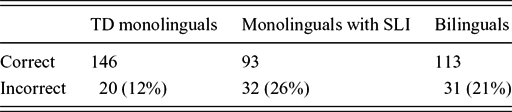
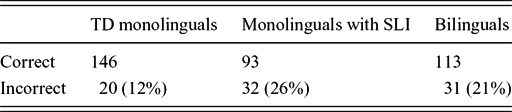
We also performed an analysis on the errors. The frequencies of correct and incorrect uses of i and a are listed in Table 2. There was a difference between the groups in the frequency of incorrect uses (χ2(2) = 9.32, p = .009). The TD monolinguals made fewer errors than the bilinguals and the monolinguals with SLI.
Correct and incorrect uses of the additive connectives by group (only cases of clausal coordination).
There were three categories of inappropriate uses. In about a third of the errors, the participants incorrectly used i in cases of topic shift, forcing the listener to adopt an (infelicitous) causal reading of the sentences. For example, in (10) the use of i in the context of reference shift imposes a causal interpretation, namely that the dog started chasing the cat because the mother-bird came back into the nest, whereas in the story these two events were unrelated. In such cases, a should be used.
-
(10) Tam ptica prizemlilas’, i sobaka za koškoj pobežala. (BR-006-cat)
“There the bird landed, and the dog started chasing the cat.”
The bilinguals made this error in 40% of contexts where i was used for reference shift (meaning that in the remaining 60% of such contexts there was a plausible causal relation licensing the use of i for reference shift). Monolinguals with SLI made this error in 31% and monolinguals without SLI in 10% of the cases of i in shift-contexts.
Alternatively, the participants used a for topic shift, when there was a clear causal relation between the sentences, i.e., in contexts where i should have been used instead (60% of errors). For instance, in (11) there is a cause-consequence relation between the two events – the bird dropped the fish because of being chased by the fox. However, by choosing a (rather than i) the child construes the two events as incidentally following each other. This error was made in 38% of shift-contexts in the bilingual group, 44% in the SLI group and 12% in the TD monolingual group.
-
(11) Lisa pticu gnala, a rybu ptica uronila. (SLI-070-fox)
“The fox chased the bird, but/and the bird dropped the fish.”
Finally, in a small number of errors (6%), the participants used a for reference maintenance, without a contrastive context, as in (12).
-
(12) Ona poletela, ona červjačkov…A ona ostavil&ERR ix odnix. (SLI-071-cat)
“She (mother-bird) flew away, she worms… But/and she left them (baby-birds) alone.”
The errors of the latter type were only attested in the narratives of the bilinguals and the monolinguals with SLI.
Discussion
When we only look at frequencies of occurrence, the monolingual groups (TD and SLI) seem to perform very similarly. Both monolingual groups use more i “and” than a “but/and” for maintenance, and more a “but/and” than i “and” for shift. In contrast, bilingual children have a tendency to use i “and” for both maintenance and shift. Hence, like in Study 1, Dutch–Russian bilinguals extend the use of i to contexts of reference shift. Given that this pattern has only been found in the speech of bilingual children, and not in the narratives of the two monolingual groups, it is plausible that the use of i in the nondominant language of the bilinguals (Russian) is extended under the influence of their dominant language (Dutch), where the counterpart connective en is equally acceptable for reference maintenance and shift. As in Study 1, bilinguals under-use a “but/and” for shift, because this function is partly taken over by the semantically extended i “and”. And as in Study 1, bilinguals do not use a more often for maintenance compared to monolinguals, probably because it has no semi-negative counterpart in Dutch.
Even though the frequency distributions seem to be similar for TD monolinguals and their peers with SLI, children with a language impairment make more errors in the use of the additive connectives: They often use i “and” instead of a “but/and”, and vice versa. In this respect, monolinguals with SLI are similar to Dutch-dominant bilinguals. Based on error rates and error types, we cannot distinguish between bilinguals and monolinguals with SLI. Both groups have difficulty distinguishing between the two additive connectives in narrative production. Thus, even though unimpaired monolinguals use i “and” for shift as often as their peers with SLI do, the unimpaired group does so overwhelmingly in contexts with a plausible causal relationship between the two events (which renders i fully acceptable), whereas the SLI group often uses i for shifting reference in the absence of any plausible causal link (which leads to infelicitous use). This result replicates an earlier finding by Tribushinina et al. (Reference Tribushinina, Dubinkina and Sanders2015) that children with SLI are not different from their TD peers in overall frequencies of connective use, but significantly differ from unimpaired peers when it comes to error rates. As we have seen, a closer look at the contexts in which these children use connectives reveals that their connective use is often inappropriate.
It is important to mention that making errors in connective use may be due to either a linguistic problem (choosing the wrong connective) or a conceptual problem (not understanding the (causal) relationship in the story). For example, in (10) it is possible that the child thought there was a causal relation between the bird returning to the nest and the dog chasing the cat. Similarly, in (11) we do not know whether the child simply used the wrong connective, or did not grasp the causal relation between the fox chasing the bird and the bird dropping the fish. We did not control for story comprehension in this study. However, based on the experimental results reported by Tribushinina et al. (Reference Tribushinina, Dubinkina and Sanders2015), we assume that it is a linguistic rather than a conceptual problem. Although children with SLI in that study made more errors with i and a compared to TD peers, their understanding of causal links in the story was not significantly different; both groups performed at ceiling in a follow-up interview testing the understanding of story grammar (Tribushinina et al., Reference Tribushinina, Dubinkina and Sanders2015). Since the groups in the present study were matched for chronological age and given earlier findings from Tribushinina et al. (Reference Tribushinina, Dubinkina and Sanders2015), it is unlikely TD monolinguals in this study made fewer errors in connective used because they were better able to understand causal links in the picture stories.
General discussion
This study set out to explore the complex interplay between language-internal and language-external factors that might explain the frequently observed non-target-like performance of bilinguals with language structures involving integration of syntactic and pragmatic cues. Although prior work, particularly along the lines of the interface hypothesis, suggests that differences between monolinguals and bilinguals can be explained by crosslinguistic influence under specific linguistic constraints, there is a growing body of evidence that external factors such as amount of input in each of the bilingual's languages and allocation of processing resources also play an important role in shaping linguistic behaviours of children growing up with two languages. In order to disentangle language-internal and language-external factors, this study compared production of additive connectives by Dutch–Russian bilinguals, Dutch and Russian TD monolinguals and Russian-speaking children with SLI. The results suggest that both language interaction in the bilingual mind and the fact that bilinguals receive less input and use their languages less frequently than monolinguals can explain their use of discourse connectives. These two aspects will be discussed in order.
Crosslinguistic influence
The interface hypothesis predicts that phenomena at the syntax-discourse interface having two possible (pragmatic) contexts of use in language A and one possible context in language B are vulnerable to crosslinguistic influence from B to A. Crosslinguistic influence is taken to be a language-internal mechanism, whereby language-external factors such as dominance do not play a role (Hulk & Müller, Reference Hulk and Müller2000; Müller & Hulk, Reference Müller and Hulk2001). The use of discourse connectives by Dutch–Russian bilinguals provides a good testing ground for this hypothesis. The Dutch additive connectives en “and” and maar “but” are equally felicitous in cases of reference maintenance and reference shift. In contrast, the Russian additive connectives have strong semantic preferences – i “and” is used for reference maintenance (unless there is a causal link between the two discourse segments) and a “but/and” is used for reference shift (unless there is a contrast relation involved). Thus, along the lines of the interface hypothesis, we would predict that bilinguals would over-use the Dutch connective en “and” for reference maintenance and maar “but” for reference shift, because these analyses are reinforced by their both languages.
The obtained results are contrary to the interface hypothesis. We did not find any influence from Russian to Dutch. However, we did find influence from the children's dominant language (Dutch) to their nondominant language (Russian). Bilingual children over-extended the range of applications of the positive connective i “and” to cases of reference shift (without a causal link), which led to the under-use of a “but/and” in this function. This result is consistent with earlier findings on connective use in Russian–German early sequential bilinguals (living in a German-dominant environment). These children were also shown to over-use i “and” for reference shift and to under-use a “but/and” in this function. Importantly, this pattern is not likely to be caused by the reduced amount of input (and hence delayed acquisition), because the distribution of the two connectives across the maintenance and shift contexts in the narratives of bilingual children was different from both unimpaired and impaired monolinguals. Both monolingual groups used more i than a for reference maintenance, and more a than i for reference shift. In contrast, the bilingual group used i more often than a for both maintenance and shift. In view of these results, the most likely interpretation of the differences between bilinguals and monolinguals is crosslinguistic influence from Dutch, where en “and” is equally acceptable in contexts of reference maintenance and reference shift.
All in all, these results suggest that influence from a language with one option to a language with two options, as demonstrated for example in the domain of null/overt subjects (Hacohen & Schaeffer, Reference Hacohen and Schaeffer2004; Haznedar, Reference Haznedar2007; Paradis & Navarro, Reference Paradis and Navarro2003; Serratrice, Reference Serratrice2007; Serratrice et al., Reference Serratrice, Sorace and Paoli2004), is not the only possible direction of crosslinguistic influence. It is also possible that an additional analysis is added to a language with one option, under the influence of a language with two options. In the present study, the range of applications of the Russian connective i “and” was extended under the influence of the children's dominant language (Dutch). Therefore, counter to the interface hypothesis, the present results suggest that not only structural overlap, but also language dominance plays a role in crosslinguistic influence (cf. Argyri & Sorace, Reference Argyri and Sorace2007). We found influence from the children's dominant language (Dutch) to their nondominant language (Russian). It would be theoretically interesting to study a group of Dutch–Russian bilinguals dominant in Russian, but it appears very difficult to find such subjects in Russia.
As in L2 acquisition and L1 attrition (Keijzer, Reference Keijzer, Pütz and Sicola2010; Seliger, Reference Seliger, Ritchie and Tej1996; Seliger & Vago, Reference Seliger, Vago, Seliger and Vago1991; Silva-Corvalán, Reference Silva-Corvalán, Seliger and Vago1991), we observed crosslinguistic influence for the item with a seemingly close counterpart in the other language (i), but not for the item that has no direct counterpart in the dominant language (a). This pattern can be explained by the Activation Threshold Hypothesis (Paradis, Reference Paradis2004), according to which a more frequent use of language leads to a lower activation threshold. For the bilingual participants in the present research, Dutch has a lower activation threshold, since all the children live in the Netherlands, attend a regular Dutch school and only speak Russian with one of their parents and at a Saturday school. If two languages of a bilingual have an overlapping structure (like i/en in our case), there will be a competition between the two counterpart structures and the activation threshold of the structure in the less frequently used language (in this case Russian) will be raised. The lower activation threshold for the Dutch connective en compared to its Russian counterpart i may lead to what Meisel (Reference Meisel2007) calls “covert code-switching”, i.e., activating structural properties of the other/stronger language, without inserting lexical material from that language. In contrast, the semi-negative connective a “but/and” has no direct counterpart in Dutch (Dutch only has the positive en and the negative maar). The activation threshold for an item without a competitor in the dominant language is not raised, because no competition occurs.
Earlier research on crosslinguistic influence focussed by and large on younger children. An important finding of this study is that crosslinguistic influence was attested in older bilingual children, aged 7−8 (cf. Argyri & Sorace, Reference Argyri and Sorace2007). Future research might look at young bilingual adults to establish whether they eventually attain the target-like use in each of their languages, or whether their weaker language remains different from that of monolinguals (Meisel, Reference Meisel2007; Schlyter, Reference Schlyter, Hyltemstam and Viberg1993; Schlyter & Håkansson, Reference Schlyter and Håkansson1994).
Amount of input received and processed: bilinguals vs. monolinguals with SLI
At the outset of this research, we hypothesized that difficulty in connective use by bilinguals can be not only due to crosslinguistic influence, but also due to reduced exposure to the two languages (and the nondominant language in particular) and/or to less efficient processing as a result of cognitive coordination of two languages. In this respect, comparison with monolinguals with SLI appears especially rewarding, because these children have a reduced language learning ability due to processing deficits. Similarities between bilinguals and monolinguals with SLI would then point at factors other than crosslinguistic influence.
As explained above, bilinguals were clearly different from both TD monolinguals and monolinguals with SLI in the distribution of the two Russian connectives across maintenance and shift contexts. Bilinguals were likely to use i “and” for both reference maintenance and reference shift. In contrast, Russian monolinguals with and without language impairment strongly associated i “and” with reference maintenance and a “but/and” with reference shift, which is appropriate in Russian. Therefore, this aspect of the bilinguals’ deviant connective production is more likely to be related to crosslinguistic influence from the dominant language than to delayed acquisition or less efficient processing.
However, a closer scrutiny of the contexts in which connectives are used by the three groups revealed that both Dutch–Russian bilinguals and monolinguals with SLI make more errors in connective use than unimpaired monolinguals. Children with a language impairment and bilingual children over-use i “and” in contexts of reference shift without a plausible causal link between the events (thus making an exception where it is not allowed), and under-use a “but/and” in contexts with an obvious causal relationship between the propositions (thereby not making a required exception). Based on error rates and error types, we cannot distinguish between bilinguals and monolinguals with SLI. This said, do these errors necessarily have the same cause in bilingualism and SLI?
Notice that the errors made by both groups of subjects are in principle compatible with several explanations. First, confusion of the two additive connectives may point at incomplete acquisition. Eight-year-old bilingual children may still be acquiring the relevant semantic distinctions between i and a because they receive much less input in Russian compared to their monolingual peers. Children with SLI do receive sufficient input in Russian, but have difficulty analysing that input, which results in a slow acquisition pace (Leonard, Reference Leonard1998).
Second, both groups may have acquired the relevant semantic-pragmatic distinctions between the two connectives, but may make errors in production due to processing breakdowns. Monolinguals with a language impairment have processing deficits (Ellis Weismer & Evans, Reference Ellis Weismer and Evans2002), and bilinguals have reduced processing capacity because they constantly need to suppress the language that is not currently in use, which requires more cognitive resources if the language to be inhibited is the dominant language with a low activation threshold (Paradis, Reference Paradis2010a; Sorace & Serratrice, Reference Sorace and Serratrice2009). Processing breakdowns may lead to the selection of the wrong connective when cognitive resources are limited, which might often happen when dealing with interface phenomena that involve integration of multiple cues.
Alternatively, it is possible that the seemingly similar errors have different underlying causes. Notice that over-use of i in reference-shift contexts is an error that is in principle compatible with the pattern that might be predicted based on crosslinguistic influence from Dutch. It is then possible that bilingual children incidentally make these errors because they sometimes have trouble suppressing the structural properties of their dominant language. At the same time, monolingual children with SLI may confuse i and a because they have not yet acquired the relevant semantic distinctions between the two connectives. This explanation is compatible with the observation that Turkish L1 English L2 children make quite a few errors in English tense morphology, but are sensitive to ungrammaticality in a receptive task (Chondrogianni & Marinis, Reference Chondrogianni and Marinis2012). In contrast, children with SLI perform poorly on both productive and receptive tasks (Montgomery & Leonard, Reference Montgomery and Leonard2006). If the latter scenario is on the right track, we would predict that bilingual children understand the semantics of i “and” and a “but/and” and are more likely to expect a new referent on hearing the latter connective, despite their non-target-like production. In contrast, if children with SLI make errors due to poor knowledge of connective semantics, it would be expected that they will not be able to use the information in the connective to predict discourse continuation. We are currently exploring these possibilities in our lab by means of processing experiments in the Visual World Paradigm (cf. Mak et al., Reference Mak, Tribushinina and Andreiushina2013).
An important implication of the present findings is that based on error rates (and types of errors), it might be difficult to distinguish between TD bilinguals (in their nondominant language) and monolinguals with SLI, which might lead to over-diagnosis of bilingual children for SLI. This has already been repeatedly shown for L2 learners (e.g., Armon-Lotem, Reference Armon-Lotem2014; Blom et al., Reference Blom, De Jong, Orgassa, Baker and Weerman2013; Chondrogianni & Marinis, Reference Chondrogianni and Marinis2012; Crago & Paradis, Reference Crago, Paradis, Levy and Schaeffer2003; Paradis, Reference Paradis1999, Reference Paradis2010b; Paradis & Crago, Reference Paradis and Crago2000; Paradis, Schneider & Sorenson Duncan, Reference Paradis, Schneider and Sorenson Duncan2014); the present study extends this finding to simultaneous bilinguals (see Meisel, Reference Meisel2007 and Schlyter, Reference Schlyter, Hyltemstam and Viberg1993 for similarities between the weaker language of simultaneous bilinguals and L2). Processing experiments might be particularly helpful in distinguishing between bilinguals with typical language development and monolinguals with SLI.
Conclusion
The interface hypothesis posits that crosslinguistic influence is determined by language-internal factors (interfaces, partial structural overlap) rather than language-external factors such as amount of input and language processing. Crosslinguistic influence is expected from a language with a narrower range of application of the target structure to a language where the target structure can be used in more than one (pragmatic) context. This study demonstrated that crosslinguistic influence is indeed an important factor explaining differences between bilinguals and monolinguals in the use of discourse connectives. This said, factors such as language dominance and allocation of processing resources may also play a role in shaping language use of bilinguals. Contrary to the predictions of the interface hypothesis, no differences between monolinguals and bilinguals were found in the dominant language of our bilingual subjects (Dutch), even though discourse connectives have fewer distributional restrictions in Dutch than in Russian. Hence purely linguistic factors can be over-ridden by language-external factors, such as frequency of language use. In contrast, the nondominant language of the bilingual participants (Russian) featured connective use that was different from that of the monolingual group. A comparison between bilinguals (in their nondominant language) and monolinguals with and without language impairment reveals that the bilinguals’ deviant distributions of discourse connectives (reference maintenance vs. reference shift) is at least partly related to crosslinguistic influence, because the observed patterns were perfectly compatible with the structural properties of Dutch and because neither of the monolingual groups showed a similar pattern. At the same time the errors made by the bilingual subjects were very similar to the errors made by their monolingual peers with SLI, in both frequencies and types of errors. Processing experiments are needed to establish whether these apparently similar errors have the same or different causes in bilingualism and SLI.