1. Introduction
Over the past 155 years, Geological Magazine has published myriad articles on trilobites, an extinct group of marine arthropods that inhabited Palaeozoic oceans for c. 270 Ma (during c. 521–252 Ma). In fact, the first original article to appear in Volume 1, Number 1 was by Salter (Reference Salter1864), who reported on Palaeozoic fossils (including trilobites) from the Budleigh Salterton Pebble Bed in Devonshire, United Kingdom. Since that time, many important trilobite studies have been published in this journal, particularly those focused on systematics. These include seminal classification schemes (e.g. Reed, Reference Reed1898, Reference Reed1905, Reference Reed1927, Reference Reed1928; Swinnerton, Reference Swinnerton1915, Reference Swinnerton1919), extensive taxonomic works (e.g. Woodward, Reference Woodward1883, Reference Woodward1884 b; Thomas & Narbonne, Reference Thomas and Narbonne1979; McNamara, Reference McNamara1980; Rushton & Hughes, Reference Rushton and Hughes1981; Fortey & Owens, Reference Fortey and Owens1991; Edgecombe et al. Reference Edgecombe, Vaccari and Waisfeld1994; Adrain & Westrop, Reference Adrain and Westrop2005; Feist & McNamara, Reference Feist and McNamara2007; Żylińska & Masiak, Reference Żylińska and Masiak2007; Feist et al. Reference Feist, McNamara, Crônier and Lerosey-Aubril2009; Lerosey-Aubril, Reference Lerosey-Aubril2012; Crônier et al. Reference Crônier, Abbache, Khaldi, Oudot, Maillet and Ouali Mehadji2018), and key papers that have attempted to reveal, support or dispute the relationships between groups (e.g. Temple, Reference Temple1956; Lane & Thomas, Reference Lane and Thomas1978; Ludvigsen & Chatterton, Reference Ludvigsen and Chatterton1980; Fortey, Reference Fortey1981; Tripp & Evitt, Reference Tripp and Evitt1981; Whittington, Reference Whittington1981; Park & Choi, Reference Park and Choi2011 a; Park, Reference Park2018), as well as the affinities of trilobites with other arthropods (e.g. Woodward, Reference Woodward1871, Reference Woodward1884a ; Mickleborough, Reference Mickleborough1884; Walcott, Reference Walcott1894; Zeng et al. Reference Zeng, Zhao, Yin and Zhu2017). The aim of this review is to focus on some of these studies and how they have influenced our understanding of trilobite evolution, as well as to highlight some of the perpetual problems that plague the systematics of this iconic invertebrate group.
2. An abridged history of trilobite classification
Since the naming of Trilobita by Walch in 1771 (Walch, Reference Walch1771; see Kihm & St John, Reference Kihm, St. John, Mikulic, Landing and Kluessendorf2007 for a translation of this pioneering work), the classification of the group has had a complicated history. This not only relates to the disparate schemes (e.g. Harrington et al. Reference Harrington, Henningsmoen, Howell, Jaanusson, Lochman-Balk, Moore, Poulsen, Rasetti, Richter, Richter, Schmidt, Sdzuy, Struve, Størmer, Stubblefield, Tripp, Weller and Whittington1959; Bergström, Reference Bergström1973; Fortey, Reference Fortey1990, Reference Fortey and Kaesler1997, Reference Fortey2001; Adrain, Reference Adrain and Zhang2011) and disputes (e.g. Fortey & Owens, Reference Fortey and Owens1975, Reference Fortey and Owens1979; Bergström, Reference Bergström1977; Lamsdell & Selden, Reference Lamsdell and Selden2015) relating to higher-level groupings such as orders, suborders and superfamilies, but also debate over the monophyly of Class Trilobita (see Lauterbach, Reference Lauterbach1980, Reference Lauterbach1983, Reference Lauterbach1989; Fortey & Whittington, Reference Fortey and Whittington1989; Hahn, Reference Hahn1989; Ramsköld & Edgecombe, Reference Ramsköld and Edgecombe1991; Edgecombe & Ramsköld, Reference Edgecombe and Ramsköld1999; Paterson & Edgecombe, Reference Paterson and Edgecombe2006).
In what could be considered one of the first comprehensive and authoritative tomes on trilobite systematics – the 1959 trilobite Treatise (Harrington et al. Reference Harrington, Henningsmoen, Howell, Jaanusson, Lochman-Balk, Moore, Poulsen, Rasetti, Richter, Richter, Schmidt, Sdzuy, Struve, Størmer, Stubblefield, Tripp, Weller and Whittington1959) – Harrington provided a history of the various major classification schemes that had been erected since the early 1800s. Among these schemes was Pierre Hupé’s extensive works (Hupé, Reference Hupé1953 a, b, Reference Hupé1955), as well as Swinnerton’s (Reference Swinnerton1915) pivotal study published in Geological Magazine.
Swinnerton’s (Reference Swinnerton1915) classification was largely focused on using cephalic (facial) suture patterns to diagnose orders and their subdivisions, building on the seminal work of Beecher (Reference Beecher1897). Although Swinnerton rejected Beecher’s (Reference Beecher1897) concept of the order Hypoparia – trilobites that allegedly have ventral librigenae, and lack dorsal sutures and dorsal compound eyes (e.g. Fig. 1a) – he adopted the orders Opisthoparia and Proparia (discussed below). Swinnerton (Reference Swinnerton1915, p. 493) also erected a new order, the Protoparia, for “trilobites and trilobite-like organisms in which the absence of facial sutures is primary”. At the time, membership of the Protoparia was limited to supposedly non-biomineralized euarthropods from the mid-Cambrian Burgess Shale of Canada, namely Marrella splendens (Fig. 1b) and Nathorstia transitans. However, as correctly pointed out by Stubblefield (Reference Stubblefield1936) and Harrington (in Harrington et al. Reference Harrington, Henningsmoen, Howell, Jaanusson, Lochman-Balk, Moore, Poulsen, Rasetti, Richter, Richter, Schmidt, Sdzuy, Struve, Størmer, Stubblefield, Tripp, Weller and Whittington1959), Marrella is no longer considered a trilobite (see García-Bellido & Collins, Reference García-Bellido and Collins2006; Legg et al. Reference Legg, Sutton and Edgecombe2013; Aria & Caron, Reference Aria and Caron2017; Vannier et al. Reference Vannier, Aria, Taylor and Caron2018) and Nathorstia is a soft-shelled moult stage of the (opisthoparian) trilobite Olenoides serratus (see Whittington, Reference Whittington1980). This polyphyletic grouping of disparate arthropods is therefore redundant.
Exemplar species that represent some of the higher-level groups established by Beecher (Reference Beecher1897) and Swinnerton (Reference Swinnerton1915) in their trilobite classification schemes. (a) Serrodiscus gravestocki (order Eodiscida) from the lower Cambrian (Series 2, Stage 4) Mernmerna Formation, Elder Range, South Australia; such taxa were classified in Beecher’s (Reference Beecher1897) ‘Hypoparia’; South Australian Museum, SAM P40229; photograph, J. Paterson. (b) Marrella splendens from the middle Cambrian (Miaolingian, Wuliuan) Burgess Shale, British Columbia, Canada; although no longer considered a trilobite, this species formed a part of Swinnerton’s (Reference Swinnerton1915) ‘Protoparia’; Smithsonian Institution, USNM 57674; photograph, D. García-Bellido. (c) Flexicalymene retrorsa from the Upper Ordovician (Katian) Dillsboro Formation, Cincinnati Arch region, USA; a classic example of Swinnerton’s (Reference Swinnerton1915) suborder Calymenina (order Phacopida); photograph, E. Bonino. Scale bars: (a) 2 mm; (b) 5 mm; and (c) 10 mm.

Swinnerton’s (Reference Swinnerton1915) main contribution to trilobite classification was the subdivision of the Opisthoparia, taxa with cephalic sutures that cut the posterior margin of the cephalon adaxial to the genal angle. His concept of the Opisthoparia included groupings of families into suborders and sections (Table 1). Importantly, Swinnerton erected some groups that have endured subsequent classification schemes and held up to phylogenetic scrutiny (Harrington et al. Reference Harrington, Henningsmoen, Howell, Jaanusson, Lochman-Balk, Moore, Poulsen, Rasetti, Richter, Richter, Schmidt, Sdzuy, Struve, Størmer, Stubblefield, Tripp, Weller and Whittington1959; Fortey, 1997, Reference Fortey2001; Lieberman & Karim, Reference Lieberman and Karim2010), none more so than Calymenina (Fig. 1c; Henry, Reference Henry1980; Chatterton et al. Reference Chatterton, Siveter, Edgecombe and Hunt1990; Fortey, Reference Fortey1990; Edgecombe, Reference Edgecombe, Novacek and Wheeler1992; Adrain, Reference Adrain and Zhang2011, Reference Adrain, Harper and Servais2013). However, in a modern context, Calymenina is now a suborder within the order Phacopida (Fortey, Reference Fortey and Kaesler1997; Adrain, Reference Adrain and Zhang2011), other members of which (e.g. Phacopidae, Encrinuridae and Cheiruridae) were placed in Proparia by Swinnerton (Reference Swinnerton1915) (Table 1).
Trilobite classification schemes of Swinnerton (Reference Swinnerton1915), Harrington et al. (Reference Harrington, Henningsmoen, Howell, Jaanusson, Lochman-Balk, Moore, Poulsen, Rasetti, Richter, Richter, Schmidt, Sdzuy, Struve, Størmer, Stubblefield, Tripp, Weller and Whittington1959), Fortey (Reference Fortey and Kaesler1997), and Adrain (Reference Adrain and Zhang2011)

The first trilobite Treatise (Harrington et al. Reference Harrington, Henningsmoen, Howell, Jaanusson, Lochman-Balk, Moore, Poulsen, Rasetti, Richter, Richter, Schmidt, Sdzuy, Struve, Størmer, Stubblefield, Tripp, Weller and Whittington1959) remained the primary classification scheme for almost 40 years, until the revised edition appeared in the late 1990s (Whittington et al. Reference Whittington, Chatterton, Speyer, Fortey, Owens, Chang, Dean, Fortey, Jell, Laurie, Palmer, Repina, Rushton, Shergold, Clarkson, Wilmot and Kelly1997). Unlike its predecessor, the 1997 Treatise did not include all known trilobite genera and their suprageneric ranks, but it did provide comprehensive treatment of the orders Agnostida and Redlichiida (as Volume 1); additional volumes on the remaining orders are still in preparation (Adrain, Reference Adrain, Rábano, Gozalo and García-Bellido2008, Reference Adrain, Harper and Servais2013). Fortey (Reference Fortey and Kaesler1997), in a similar vein to Harrington (in Harrington et al. Reference Harrington, Henningsmoen, Howell, Jaanusson, Lochman-Balk, Moore, Poulsen, Rasetti, Richter, Richter, Schmidt, Sdzuy, Struve, Størmer, Stubblefield, Tripp, Weller and Whittington1959), masterfully summarized the current state of trilobite classification, and presented a revised scheme that did not differ substantially from the 1959 Treatise (Table 1). His main changes included: an expanded Corynexochida, including the suborders Illaenina and Leiostegiina; raising Asaphida to ordinal level (based on the study by Fortey & Chatterton, Reference Fortey and Chatterton1988); demoting the Odontopleurida to a superfamily within the Lichida; a reshuffling of the Ptychopariida; and relegating the Bathynotidae to an Order Uncertain category, thereby disbanding the suborder Bathynotina (sensu Harrington et al. Reference Harrington, Henningsmoen, Howell, Jaanusson, Lochman-Balk, Moore, Poulsen, Rasetti, Richter, Richter, Schmidt, Sdzuy, Struve, Størmer, Stubblefield, Tripp, Weller and Whittington1959). Notably, this scheme did not formally adopt the subclass Libristoma (sensu Fortey, Reference Fortey1990) – trilobites having a natant hypostomal condition (i.e. the hypostome is detached from the cephalic doublure; Fig. 2a) or secondarily derived conterminant condition (i.e. the hypostome is attached to the cephalic doublure; Fig. 2b) – because a broad-scale phylogenetic analysis necessary to determine all constituent clades had not yet been conducted. Nonetheless, Fortey (Reference Fortey and Kaesler1997) still recognized the Libristoma as being composed of the orders Asaphida, Proetida and Ptychopariida.
Key morphological features of the Libristoma (sensu Fortey, Reference Fortey1990), including the order Asaphida (sensu Fortey & Chatterton, Reference Fortey and Chatterton1988; Fortey, Reference Fortey1990). (a) Ventral view of the cephalon of Ptychoparia (Ptychopariida) showing the natant hypostomal (Hn) condition; drawing by Sam Gon III. (b) Ventral view of the cephalon of Lachnostoma (Asaphida) showing the conterminant hypostomal (Hc) condition and the ventral median suture (arrowed); drawing by Sam Gon III. (c, d) Ventral and lateral views of a bulbous ‘commutavi’ (or ‘asaphoid-type’) protaspis (Isotelus sp. (Asaphida: Asaphidae), Middle Ordovician, Virginia, USA); modified from Evitt (Reference Evitt1961, text-fig. 3); 0.5 mm scale bar applies to (c) and (d) only.

In the intervening years since the 1997 Treatise, other key publications have provided updates, overviews or new ideas on broad-scale trilobite systematics (e.g. Fortey, Reference Fortey2001; Jell & Adrain, Reference Jell and Adrain2003; Whittington, Reference Whittington, Mikulic, Landing and Kluessendorf2007; Lieberman & Karim, Reference Lieberman and Karim2010; Adrain, Reference Adrain and Zhang2011, Reference Adrain, Harper and Servais2013). Fortey (Reference Fortey2001), Whittington (Reference Whittington, Mikulic, Landing and Kluessendorf2007) and Lieberman & Karim (Reference Lieberman and Karim2010) have provided excellent reviews on trilobite classification and phylogenetics. One of the repeated and perhaps concerning messages throughout these papers is that we still know very little about the relationships between, and indeed the validity of, the major groups (especially orders and suborders), which also compounds the issue of finding the as-yet unknown ‘roots’ of several post-Cambrian trilobite clades, known as the cryptogenesis problem (see Section 3). This critical knowledge gap is perhaps best illustrated in Fortey’s (Reference Fortey2001, fig. 1) hypothetical phylogenetic tree, which is riddled with broken branches and question marks.
The most recent efforts in dealing with trilobite classification on a grand scale are those of Jonathan Adrain and Peter Jell (Jell & Adrain, Reference Jell and Adrain2003; Adrain, Reference Adrain and Zhang2011). In a monumental piece of work, Jell & Adrain (Reference Jell and Adrain2003) compiled lists of all known genera (including their synonyms) and families into what has been nicknamed ‘the trilobite phonebook’. This publication has become invaluable for taxonomists wanting to know the authorship, validity or availability of generic names, plus details about type species or familial classifications. It has also provided the raw data for quantitative studies (e.g. Tarver et al. Reference Tarver, Braddy and Benton2007; Álvaro et al. Reference Álvaro, Ahlberg, Babcock, Bordonaro, Choi, Cooper, Ergaliev, Gapp, Ghobadi Pour, Hughes, Jago, Korovnikov, Laurie, Lieberman, Paterson, Pegel, Popov, Rushton, Sukhov, Tortello, Zhou, Żylińska, Harper and Servais2013).
In the latest trilobite classification scheme to be published, Adrain (Reference Adrain and Zhang2011) made considerable modifications to Fortey’s (Reference Fortey and Kaesler1997) scheme, particularly with regard to the number of orders recognized (Table 1), as well as their constituent superfamilies and families. Notable changes include: the abandonment of Ptychopariida in favour of reassigning the majority of its families to either an Order Uncertain list, or the new orders Aulacopleurida and Olenida; the resurrection of the Odontopleurida; and the exclusion of Agnostina from Trilobita altogether, thus elevating the suborder Eodiscina to ordinal rank and considering it to be monophyletic. Although Adrain (Reference Adrain and Zhang2011) did not explicitly state why he rejected the Agnostina, there is a substantial body of evidence that supports this view (see Müller & Walossek, Reference Müller and Walossek1987; Walossek & Müller, Reference Walossek and Müller1990; Ramsköld & Edgecombe, Reference Ramsköld and Edgecombe1991; Shergold, Reference Shergold1991; Bergström & Hou, Reference Bergström, Hou, Koenemann and Jenner2005; Haug et al. Reference Haug, Maas and Waloszek2010; Ortega-Hernández & Brena, Reference Ortega-Hernández and Brena2012; Legg et al. Reference Legg, Sutton and Edgecombe2013); see Section 4 for further discussion. Moreover, in a recent large-scale phylogenetic analysis of Cambrian trilobites, Paterson et al. (Reference Paterson, Edgecombe and Lee2019) have shown that the Eodiscida is indeed monophyletic, but their position is highly labile across different tree topologies produced by Bayesian and parsimony analyses.
In a major review of Ordovician trilobite diversity and distribution, Adrain (Reference Adrain, Harper and Servais2013) took the opportunity to provide a more detailed commentary on his 2011 classification scheme. While much of the discussion was focused on families, Adrain (Reference Adrain, Harper and Servais2013) also presented his views on various orders, particularly for Asaphida, Harpida, Lichida, Odontopleurida, Olenida, and Proetida. Importantly, Adrain (Reference Adrain, Harper and Servais2013) provided critical information on the stratigraphic ranges of many families, several of which extend down into Cambrian strata, thus having important implications for the cryptogenesis problem (see Section 3 below).
3. The cryptogenesis problem: trilobite evolution across the Cambro-Ordovician boundary
In 1981, Geological Magazine published a special issue dedicated to one of the doyens of trilobite research, Sir James Stubblefield (Calver, Reference Calver1981). In this issue, an article by Whittington (Reference Whittington1981) highlighted two of Stubblefield’s key papers on trilobite classification and evolution (Stubblefield, Reference Stubblefield1936, Reference Stubblefield1959). The latter is of particular relevance here, as it focused on what is now referred to as cryptogenesis: our poor understanding of the phylogenetic relationships between major post-Cambrian trilobite groups and their Cambrian sister taxa (Stubblefield, Reference Stubblefield1959; Whittington, Reference Whittington1981; Edgecombe, Reference Edgecombe, Novacek and Wheeler1992; Lieberman & Karim, Reference Lieberman and Karim2010). In short, Stubblefield (Reference Stubblefield1959) considered the majority of post-Cambrian superfamilies – and by extension, many orders and suborders – to be cryptogenetic (i.e. of unknown Cambrian origin or appearing de novo in the Ordovician), based on the higher-level classification of trilobites at that time (Harrington et al. Reference Harrington, Henningsmoen, Howell, Jaanusson, Lochman-Balk, Moore, Poulsen, Rasetti, Richter, Richter, Schmidt, Sdzuy, Struve, Størmer, Stubblefield, Tripp, Weller and Whittington1959).
Whittington (Reference Whittington1981) provided an update on the cryptogenesis problem, with particular reference to the orders Phacopida, Odontopleurida and Lichida. He also hypothesized that trilobites were undergoing elevated rates of extinction and origination throughout late Cambrian – Early Ordovician time, with origination rates taking over in the latter part of this interval. However, despite over 20 years of trilobite research since Stubblefield’s (Reference Stubblefield1959) seminal essay, Whittington (Reference Whittington1981, p. 594) concluded with: “How the major taxa of post-Cambrian trilobites arose, and their relationship to each other or to older groups, is still unknown.”
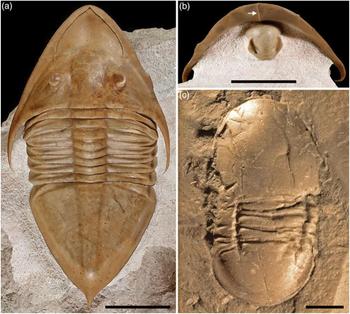
In what is now considered one of the classic papers on trilobite systematics, Fortey & Chatterton (Reference Fortey and Chatterton1988) conducted a large-scale study on the order Asaphida (Fig. 3), which included cladistic (parsimony) analyses. While their main aim was to present a new phylogenetic classification of a major trilobite group, they had essentially tackled a part of the cryptogenesis problem. They demonstrated that, with the exception of the superfamily Cyclopygoidea (Fig. 3c), the evolutionary history of most ingroup clades is reasonably complete from the middle–late Cambrian Period and extending well into the Ordovician Period, as supported by their stratigraphic records. The two key synapomorphies that Fortey & Chatterton (Reference Fortey and Chatterton1988) considered to unite members of the Asaphida have been subsequently criticized, with both the ventral median cephalic suture (Figs 2b, 3b; Whittington, Reference Whittington2003; Zhu et al. Reference Zhu, Hughes and Peng2007, Reference Zhu, Hughes and Peng2010; Park & Choi, Reference Park and Choi2009, Reference Park and Choi2010, Reference Park and Choi2011 a; Park et al. Reference Park, Kihm, Kang and Choi2014) and the bulbous ‘commutavi’ (or ‘asaphoid-type’) protaspis (Fig. 2c, d; Park & Kihm, Reference Park and Kihm2015; Park et al. Reference Park, Kihm, Woo, Kim and Lee2016; Park, Reference Park2018) thought to have evolved independently across disparate groups. Even so, this does not render these characters as inoperative for diagnosing Asaphida. Fortey & Chatterton’s (Reference Fortey and Chatterton1988) paper therefore remains an important study on the evolutionary relationships between Cambrian and post-Cambrian trilobites, and their concept of the Asaphida is still partly followed in the latest classification scheme of Adrain (Reference Adrain and Zhang2011, Reference Adrain, Harper and Servais2013).
Examples of the order Asaphida. (a, b) Megistaspidella triangularis (Asaphoidea: Asaphidae) from Middle Ordovician strata of the St Petersburg region, Russia; (a) entire exoskeleton in dorsal view and (b) oblique ventral view of anterior of cephalon showing the ventral median suture (arrowed) and in situ conterminant hypostome; photographs, A. Evdokimov. (c) Microparia speciosa (Cyclopygoidea: Cyclopygidae) from the Upper Ordovician (Katian) Králův Dvůr Formation, Prague Basin, Czech Republic; Museum of Comparative Zoology, Harvard University, MCZ 3354; photograph, R. Bicknell. Scale bars: (a, b) 20 mm; (c) 5 mm.

Edgecombe (Reference Edgecombe, Novacek and Wheeler1992) took a novel cladistic approach to investigate the cryptogenesis problem. He slightly modified and reanalysed the dataset of Fortey & Chatterton (Reference Fortey and Chatterton1988) and calibrated the cladogram with stratigraphic first appearances for each lineage. Importantly, Edgecombe (Reference Edgecombe, Novacek and Wheeler1992) applied the ‘ghost lineage’ concept – range extensions inferred from the earlier appearance of a sister group – to show that clades can be older than the fossil record suggests (see his fig. 5.5). While Edgecombe’s results were essentially the same as those of Fortey & Chatterton (Reference Fortey and Chatterton1988), the consideration of ghost lineages had filled any perceived stratigraphic gaps across clades, for example, allowing the long range extension of the Cyclopygoidea to the middle–late Cambrian Period; with the exception of some latest Cambrian species of Nileidae, all other cyclopygoids are Ordovician in age (Adrain, Reference Adrain, Harper and Servais2013).
Edgecombe (Reference Edgecombe, Novacek and Wheeler1992) applied the same methodology to the order Phacopida, a classic example of a supposedly cryptogenetic clade (Stubblefield, Reference Stubblefield1959; Whittington, Reference Whittington1981). Interestingly, the results of one of his parsimony analyses using holaspid characters permit considerable disparity of the order already within the Cambrian Period, provided the Pilekiinae (Cheirurina: Cheiruridae) are of late Cambrian age (Edgecombe, Reference Edgecombe, Novacek and Wheeler1992, fig. 5.12A); recent stratigraphic data for this subfamily would support this view (see Adrain, Reference Adrain, Harper and Servais2013). However, some derived subclades, such as the suborder Phacopina (Fig. 4; Edgecombe, Reference Edgecombe, Novacek and Wheeler1992, fig. 5.11), are consistent with traditional notions of cryptogenesis during the Ordovician Period, again supported by current stratigraphic data (Adrain, Reference Adrain, Harper and Servais2013).
Examples of the suborder Phacopina, a classic ‘cryptogenetic’ clade. (a) Acernaspis copperi (Phacopoidea: Phacopidae) associated with a small exoskeleton of Rielaspis elegantula (Cheirurina: Encrinuridae) from the lower Silurian (Llandovery) Jupiter Formation, Anticosti Island, Québec, Canada (previously illustrated by Chatterton & Ludvigsen, Reference Chatterton and Ludvigsen2004, pl. 37, figs 2–6); photograph, B. Chatterton. (b) Huntoniatonia oklahomae (Dalmanitoidea: Dalmanitidae) from the Lower Devonian Haragan Formation, Oklahoma, USA; Smithsonian Institution, USNM 376737; photograph, R. Bicknell. (c) Hollardops mesocristata (Acastoidea: Acastidae) from the Lower Devonian (Emsian) Timrhanrhart Formation, south of Foum Zguid, Morocco; Smithsonian Institution, RMH2002-256; photograph, R. Bicknell. Scale bars: (a) 5 mm; (b, c) 10 mm.

Other aspects of the cryptogenesis problem have apparently been solved by reclassifying some of the major groups. For example, Fortey (1990, Reference Fortey and Kaesler1997) expanded the scope of the order Corynexochida to also include the suborders Illaenina and Leiostegiina. The Illaenina (Fig. 5a) was considered to be exclusively post-Cambrian in age in the 1959 Treatise (where it was classified under Ptychopariida; Harrington et al. Reference Harrington, Henningsmoen, Howell, Jaanusson, Lochman-Balk, Moore, Poulsen, Rasetti, Richter, Richter, Schmidt, Sdzuy, Struve, Størmer, Stubblefield, Tripp, Weller and Whittington1959), and was one of Stubblefield’s (Reference Stubblefield1959) cryptogenetic groups. Fortey’s reclassification implied that the sister group of Illaenina must lie with Cambrian members of the Corynexochina or Leiostegiina; it is also important to note that Fortey (Reference Fortey and Kaesler1997) included the Cambrian family Tsinaniidae in the Illaenina, and the family Styginidae is now known to extend down into Cambrian strata (Adrain, Reference Adrain, Harper and Servais2013). An affinity between all three suborders of the Corynexochida is supported by several ontogenetic (Chatterton & Speyer, Reference Chatterton, Speyer and Kaesler1997; Lee & Chatterton, Reference Lee and Chatterton2003) and holaspid characters (Fortey, Reference Fortey1990), but how these suborders are related to one another, and to other orders, remains an open question (Fortey, Reference Fortey2001; Adrain, Reference Adrain and Zhang2011).
Examples of other trilobite orders, including the ‘cryptogenetic’ Odontopleurida and Proetida. (a) Illaenus tauricornis (Corynexochida: Illaenina) and (b) Boedaspis ensifer (Odontopleurida) from Middle Ordovician strata of the St Petersburg region, Russia; photographs, A. Evdokimov. (c) Gerastos cultrijugati (Proetida) from the Middle Devonian (Eifelian) Lauch Formation, Eifel, Germany; photograph, H. Prescher. (d) Metopolichas huebneri (Lichida) from the Middle Ordovician of the St Petersburg region, Russia; photograph, A. Evdokimov. Scale bars: (a, d) 20 mm; (b) 10 mm; (c) 5 mm.

While many studies published since Stubblefield’s (Reference Stubblefield1959) paper have partially alleviated the cryptogenesis problem, there are certain major post-Cambrian clades that remain cryptogenetic in a modern context. For example, the oldest unequivocal representatives of the distinctive orders Odontopleurida (Fig. 5b) and Proetida (Fig. 5c) (sensu Adrain, Reference Adrain and Zhang2011) are Early Ordovician (Floian) in age (see Adrain, Reference Adrain, Harper and Servais2013). It has been previously suggested that the Odontopleurida and Lichida (Fig. 5d) are sister taxa (e.g. Thomas & Holloway, Reference Thomas and Holloway1988; Fortey, Reference Fortey and Kaesler1997, Reference Fortey2001), the latter extending back to the middle Cambrian Period (Guzhangian) (see Adrain, Reference Adrain, Harper and Servais2013). However, Adrain (Reference Adrain, Harper and Servais2013) presented a compelling argument that refutes a close relationship between these two orders; the Cambrian roots of Odontopleurida therefore remain unclear. The Cambrian sister group of Proetida also remains obscure (Edgecombe, Reference Edgecombe, Novacek and Wheeler1992; Fortey, Reference Fortey2001; Lamsdell & Selden, Reference Lamsdell and Selden2015). Although Adrain (Reference Adrain, Harper and Servais2013) stated that the Proetida and Aulacopleurida may prove to be related – the latter having an extensive Cambrian record – he also noted that there is currently little evidence to support this relationship. Future work on older Ordovician (Tremadocian) and Cambrian (especially Furongian) trilobite assemblages may push back the first appearance of these groups, and broad-scale phylogenetic analyses may help to reveal their Cambrian sister taxa.
The cryptogenesis problem has largely existed because trilobite workers have struggled to detect distinctive morphological traits that link Cambrian and post-Cambrian taxa. Given that trilobites are indeed monophyletic, all major post-Cambrian clades must have Cambrian roots, but unique synapomorphies have been (and in many cases remain) elusive. Also, lack of a robust phylogenetic framework across the entire Trilobita has been a long-term issue, with previous attempts to show relationships between major groups being largely hypothetical and often ambiguous (e.g. Swinnerton, Reference Swinnerton1915, p. 542; Henningsmoen, Reference Henningsmoen1951, fig. 2; Bergström, Reference Bergström1973, fig. 12; Hahn & Hahn, Reference Hahn and Hahn1975, fig. 1; Eldredge, Reference Eldredge and Hallam1977, fig. 8; Fortey, Reference Fortey1990, text-fig. 19; Fortey, Reference Fortey2001, fig. 1; Jell, Reference Jell2003, fig. 1). Edgecombe (Reference Edgecombe, Novacek and Wheeler1992) and Fortey (Reference Fortey2001) outlined many reasons why there have been such contrasting approaches to trilobite classification and phylogeny, which can amplify or dampen the cryptogenesis effect around the Cambro-Ordovician boundary depending on the view followed. One purported reason is that trilobite workers typically specialize in either Cambrian or post-Cambrian taxa but rarely both, and therefore do not often recognize the phylogenetic links. This also has implications regarding pseudoextinctions of paraphyletic groups around the Cambro-Ordovician boundary (see Fortey, Reference Fortey1989).
Fortey’s (Reference Fortey1983, p. 181) statement that “the Cambrian-Ordovician boundary marks a watershed in trilobite evolution” is still correct, given the substantial evidence for the origination and proliferation of families, genera and species during the Great Ordovician Biodiversification Event (Adrain et al. 1998, Reference Adrain, Edgecombe, Fortey, Hammer, Laurie, McCormick, Owen, Waisfeld, Webby, Westrop, Zhou, Webby, Droser and Paris2004; Servais et al. Reference Servais, Owen, Harper, Kröger and Munnecke2010; Adrain, Reference Adrain, Harper and Servais2013; Servais & Harper, Reference Servais and Harper2018). However, resolving the ongoing issues related to the cryptogenesis problem, such as identifying the Cambrian sister taxa of Proetida and Odontopleurida, will require more comprehensive and detailed morphological studies across a range of groups in an attempt to reveal key synapomorphies.
4. The future of trilobite systematics
A recurring theme in reviews on trilobite systematics is to announce that it is still in an unsatisfactory state, at least concerning higher-level classification and phylogeny (Fortey, Reference Fortey2001). In the first trilobite Treatise, Harrington (in Harrington et al. Reference Harrington, Henningsmoen, Howell, Jaanusson, Lochman-Balk, Moore, Poulsen, Rasetti, Richter, Richter, Schmidt, Sdzuy, Struve, Størmer, Stubblefield, Tripp, Weller and Whittington1959, p. O145) stated “A wholly satisfactory, natural classification of trilobites is beyond possibility at the present moment.” Over 50 years later, it seems little progress had been made in this regard with Adrain (Reference Adrain and Zhang2011, p. 104) asserting that “Higher trilobite phylogeny remains essentially unresolved.”
Fortey (Reference Fortey and Kaesler1997) noted that the perennial instability of trilobite classification is not only the result of changing taxonomic methods and ongoing discoveries, but also relates to the issue of dealing with such a large, diverse group. Indeed, 6 years ago, Jonathan Adrain’s trilobite database contained 21 161 valid species (Adrain, Reference Adrain, Harper and Servais2013), with a multitude of new species published since that time; this number is now over 22 000 (J. Adrain, pers. comm., Feb. 2019). This huge diversity is one of the reasons why trilobite taxonomists tend to specialize in particular groups and/or time periods (as mentioned above), and is perhaps also a disincentive to tackle higher-level classification and phylogenetic analyses.
From a Linnean perspective, future research on trilobite systematics could benefit from a combined bottom-up and top-down approach. The former starts with rigorous, high-quality taxonomic work at the species level. Where possible, trilobite workers should be collecting large numbers of specimens and extensively illustrating them to get a better sense of overall morphology and inter- and intraspecific (including ontogenetic) variability, which can be supplemented with the application of morphometric techniques if preservational quality allows; see Webster’s (Reference Webster2015) study on Olenellus gilberti as a great example. Obtaining large collections is not always practical, however, as some species can be very rare and others are available only as crack-out specimens that are time-consuming to collect and prepare. Conversely, secondarily silicified specimens can be easily recovered in vast numbers by careful acid digestion of limestones. The work by Jonathan Adrain and colleagues on Cambrian and Ordovician silicified faunas from the USA (especially Utah) provide excellent case studies (e.g. Adrain & Westrop, Reference Adrain and Westrop2004, Reference Adrain and Westrop2005, Reference Adrain and Westrop2007; McAdams & Adrain, Reference McAdams and Adrain2009, Reference McAdams and Adrain2010, Reference McAdams and Adrain2011 a, Reference McAdams and Adrain b , Reference McAdams and Adrain c ; Adrain et al. Reference Adrain, McAdams and Westrop2011 a, Reference Adrain, McAdams, Westrop and Karim b , Reference Adrain, McAdams and Karim2012, Reference Adrain, Karim and Westrop2014; Adrain & McAdams, Reference Adrain and McAdams2012), showing that comprehensive documentation can lead to a much better understanding of morphological variation and species diversity. In turn, such vigilant taxonomic work underpins all other aspects of trilobite research, such as studies on biostratigraphy, palaeoecology, biogeography and phylogeny (see Adrain & Westrop, Reference Adrain and Westrop2005, p. 379–380; Westrop & Adrain, Reference Westrop and Adrain2016, p. 397).
Ideally, the bottom-up approach – beginning with a detailed knowledge of species, followed by comprehensive systematic studies (including phylogenetic analyses) of genera, families and so on – would be the best way of constructing a robust natural classification of trilobites, or indeed any organismal group. The reality, however, is that this is not necessarily practical for a clade with over 22 000 species. A compromise might entail an associated top-down approach of conducting broad-scale phylogenetic analyses at higher taxonomic levels (e.g. Edgecombe, Reference Edgecombe, Novacek and Wheeler1992; Fortey & Chatterton, Reference Fortey and Chatterton1988; Paterson & Edgecombe, Reference Paterson and Edgecombe2006; see Lieberman & Karim, Reference Lieberman and Karim2010 for other examples), at least to provide testable hypotheses regarding trilobite relationships, with the possibility of using monophyletic groupings for classification purposes. Also, the clades produced by such analyses can assist in the pursuit of new synapomorphies by providing distinct search areas in tree space. Trilobite workers should attempt more ambitious phylogenetic analyses of large datasets using both parsimony and Bayesian methods (e.g. Pollitt et al. Reference Pollitt, Fortey and Wills2005; Paterson et al. Reference Paterson, Edgecombe and Lee2019). Considered character formulations are also important, not only with discrete traits that comprise most of the characters in existing phylogenetic matrices, but also concerning the use of meristic and continuous traits (see Paterson et al. Reference Paterson, Edgecombe and Lee2019). Of course, ontogenetic characters have long been considered important for revealing trilobite relationships (see Chatterton & Speyer, Reference Chatterton, Speyer and Kaesler1997; Fortey, Reference Fortey2001; Park & Choi, Reference Park and Choi2011 b), and will no doubt continue to be a critical component of phylogenetic datasets and used in the diagnoses of higher-level clades.
Other ongoing issues in trilobite systematics include: identifying the sister group of Trilobita; continued use of antiquated groupings; and whether certain groups, such as the suborder Agnostina (sensu Fortey, Reference Fortey and Kaesler1997) and Cambrian family Burlingiidae (Fig. 6), represent trilobites. The phylogenetic relationship between trilobites and their artiopodan relatives has received considerable attention over the past 20 years (e.g. Edgecombe & Ramsköld, Reference Edgecombe and Ramsköld1999; Caron et al. Reference Caron, Rudkin and Milliken2004; Cotton & Braddy, Reference Cotton and Braddy2004; Hendricks & Lieberman, Reference Hendricks and Lieberman2008; Paterson et al. Reference Paterson, Edgecombe, García-Bellido, Jago and Gehling2010, Reference Paterson, García-Bellido and Edgecombe2012; Budd, Reference Budd2011; Stein & Selden, Reference Stein and Selden2012; Ortega-Hernández et al. Reference Ortega-Hernández, Legg and Braddy2013; Stein et al. Reference Stein, Budd, Peel and Harper2013; Edgecombe et al. Reference Edgecombe, Paterson and García-Bellido2017; Hou et al. Reference Hou, Williams, Gabbott, Siveter, Siveter, Cong, Ma and Sansom2017, Reference Hou, Williams, Sansom, Siveter, Siveter, Gabbott, Harvey, Cong and Liu2018; Lerosey-Aubril et al. Reference Lerosey-Aubril, Zhu and Ortega-Hernández2017b; Zeng et al. Reference Zeng, Zhao, Yin and Zhu2017; Du et al. Reference Du, Ortega-Hernández, Yang and Zhang2018; Mayers et al. Reference Mayers, Aria and Caron2019). Unfortunately, the results of these analyses are ambiguous, in that trilobites are resolved either in a polytomy with other artiopodan clades, or their position jumps around depending on taxon sampling, character selection and coding, and the analytical methods used.
Type species of the Cambrian family Burlingiidae. (a) Lectotype of Burlingia hectori from the middle Cambrian (Miaolingian, Wuliuan) Stephen Formation, British Columbia, Canada (previously illustrated by Walcott, Reference Walcott1908, pl. 1, fig. 8 and Whittington, Reference Whittington1994, pl. 1, fig. 1); photograph, R. Bicknell. (b) Reconstruction of Schmalenseeia amphionura by Whittington (Reference Whittington1981, fig. 1). Both scale bars are 1 mm.

Many suprafamilial names and concepts have come and gone over the decades (see Harrington et al. Reference Harrington, Henningsmoen, Howell, Jaanusson, Lochman-Balk, Moore, Poulsen, Rasetti, Richter, Richter, Schmidt, Sdzuy, Struve, Størmer, Stubblefield, Tripp, Weller and Whittington1959; Fortey, Reference Fortey and Kaesler1997), but one of the most enduring is the order Ptychopariida. While Fortey (1997, Reference Fortey2001) recognized this group as being problematic, it has undergone so many different iterations (e.g. Table 1) that the Ptychopariida has essentially become a ‘wastebasket taxon’ (Lieberman & Karim, Reference Lieberman and Karim2010), mainly for a plethora of Cambrian families. As noted in Section 2, Adrain (Reference Adrain and Zhang2011, p. 107) abandoned the idea of the group altogether, stating that “it serves no scientific purpose”. Previous claims for the Ptychopariida representing a plesiomorphic grade and being ancestral to typical post-Cambrian groups, such as the Asaphida, Phacopida and Proetida (Swinnerton, Reference Swinnerton1915; Henningsmoen, Reference Henningsmoen1951; Hahn & Hahn, Reference Hahn and Hahn1975; Fortey, Reference Fortey2001; Cotton, Reference Cotton2001), are therefore now meaningless.
The phylogenetic affinity of the suborder Agnostina (sensu Fortey, Reference Fortey and Kaesler1997) remains a challenge. Ever since the discovery of appendages in small (larval) specimens of Agnostus pisiformis (Müller & Walossek, Reference Müller and Walossek1987), many have questioned the systematic placement of Agnostina in the Trilobita (see Bergström & Hou, Reference Bergström, Hou, Koenemann and Jenner2005), and therefore the monophyly of order Agnostida (Agnostina + Eodiscina) (see Adrain, Reference Adrain and Zhang2011). Previous phylogenetic studies have argued that the Agnostina are trilobites, representing a monophyletic group nested within a paraphyletic Eodiscina (Fortey & Theron, Reference Fortey and Theron1994; Jell, Reference Jell and Kaesler1997, Reference Jell2003; Cotton & Fortey, Reference Cotton, Fortey, Koenemann and Jenner2005). However, results from more recent phylogenetic analyses with broader taxonomic and character sampling across many arthropod groups show that the Agnostina (using A. pisiformis as the exemplar taxon) falls outside the Trilobita (Legg et al. Reference Legg, Sutton and Edgecombe2013, fig. 4; Aria & Caron, Reference Aria and Caron2017, extended data fig. 10; Vannier et al. Reference Vannier, Aria, Taylor and Caron2018, supplementary material S22).
Fortey (Reference Fortey2001) predicted that the discovery of appendages in Eodiscina, the larvae of other trilobites, or indeed adult Agnostina, should cast further light on the agnostid problem. Moysiuk & Caron (Reference Moysiuk and Caron2019) recently documented soft tissues (including appendages) in adult specimens of the agnostines Peronopsis cf. columbiensis and Ptychagnostus praecurrens from the Burgess Shale. Interestingly, the appendicular morphology of these taxa differ considerably from what is known in ‘polymerid’ trilobites (see Zeng et al. Reference Zeng, Zhao, Yin and Zhu2017). Notably, they seem to possess a cephalon with six appendage pairs (antennae + five post-antennal), which contrasts with the four (antennae + three post-antennal) observed in trilobites (Scholtz & Edgecombe, Reference Scholtz, Edgecombe, Koenemann and Jenner2005, Reference Scholtz and Edgecombe2006; Park & Kihm, Reference Park and Kihm2017; Zeng et al. Reference Zeng, Zhao, Yin and Zhu2017). Also, while the finer details of the post-antennal cephalic appendages in the Burgess Shale agnostines are somewhat obscure, they do not seem to show the typical homonomous biramous morphology, including the lamellipedian exopods, seen in polymerid trilobites (Zeng et al. Reference Zeng, Zhao, Yin and Zhu2017). Further differences can be found in the cephalic digestive structures, which in the Burgess Shale agnostines are more like those seen in naraoiids (cf. Zhang et al. Reference Zhang, Shu and Erwin2007; Mayers et al. Reference Mayers, Aria and Caron2019) as opposed to trilobites (cf. Lerosey-Aubril et al. Reference Lerosey-Aubril, Hegna, Kier, Bonino, Habersetzer and Carré2012, Reference Lerosey-Aubril, Paterson, Gibb and Chatterton2017 a; Gutiérrez-Marco et al. Reference Gutiérrez-Marco, García-Bellido, Rábano and Sá2017; Hopkins et al. Reference Hopkins, Chen, Hu and Zhang2017; Wang et al. Reference Wang, Fatka, Sun, Budil and Gao2018). The results of the phylogenetic analysis conducted by Moysiuk & Caron (Reference Moysiuk and Caron2019) show that Agnostina (Agnostus + Peronopsis) is sister to the polymerid trilobites, which is mainly supported by shared features such as the calcified tergites, style of tergal articulation, and a dorsally segmented cephalon (including the occipital lobe). In summary, although the combined soft-tissue and biomineralized morphology of agnostines may now suggest an affinity closer to artiopodans (even as sister to polymerid trilobites; Moysiuk & Caron, Reference Moysiuk and Caron2019) than to pancrustaceans (Walossek & Müller, Reference Walossek and Müller1990; Bergström & Hou, Reference Bergström, Hou, Koenemann and Jenner2005), further analyses are needed to test whether they are trilobites sensu stricto. This will require a new, more holistic dataset that contains an expanded sampling of trilobite taxa, especially members of the Eodiscina, plus many more tergal characters, given their importance in this debate (see Shergold, Reference Shergold1991 versus Cotton & Fortey, Reference Cotton, Fortey, Koenemann and Jenner2005, for example). Fortey’s (Reference Fortey2001) hope that the discovery of eodiscine or larval polymerid appendages will resolve this issue, of course, still stands.
The Burlingiidae (Fig. 6) is an unusual Cambrian family that were assigned to the Proparia by Swinnerton (Reference Swinnerton1915) (Table 1) and later elevated to their own monotypic superfamily (within the Ptychopariida) in the 1959 Treatise (Harrington et al. Reference Harrington, Henningsmoen, Howell, Jaanusson, Lochman-Balk, Moore, Poulsen, Rasetti, Richter, Richter, Schmidt, Sdzuy, Struve, Størmer, Stubblefield, Tripp, Weller and Whittington1959). Their unique combination of features – including a small (< 15 mm long), thin-cuticle exoskeleton, proparian facial sutures, plus a strange non-fulcrate trunk that lacks well-developed tergite articulations (see Whittington, Reference Whittington1994; Hughes et al. Reference Hughes, Minelli and Fusco2006; Hughes, Reference Hughes2007; Ebbestad & Weidner, Reference Ebbestad and Weidner2017) – is perhaps why Fortey (Reference Fortey and Kaesler1997) relegated them to Order Uncertain (but still considered them trilobites), and Adrain (Reference Adrain and Zhang2011) excluded them from the Trilobita. Several studies on the family have been published over the past 50 years, including two in Geological Magazine (Whittington, Reference Whittington1981; Yuan & Esteve, Reference Yuan and Esteve2015), but none have attempted a large-scale phylogenetic analysis to place them among trilobites or non-trilobite arthropods (Jago, Reference Jago1972; Rushton, Reference Rushton1978; Ahlberg, Reference Ahlberg1989; Whittington, Reference Whittington1994; Jell & Hughes, Reference Jell and Hughes1997; Yuan et al. Reference Yuan, Zhao, Li and Huang2002; Ebbestad & Budd, Reference Ebbestad and Budd2003; Peng et al. Reference Peng, Babcock and Lin2004; Robison & Babcock, Reference Robison and Babcock2011; Geyer & Corbacho, Reference Geyer and Corbacho2015; Ebbestad & Weidner, Reference Ebbestad and Weidner2017). It is indeed possible that burlingiids have a closer affinity to other artiopodans than to trilobites – for example, Kleptothule rasmusseni (see Budd, Reference Budd1995; Ebbestad & Budd, Reference Ebbestad and Budd2003) or even the ‘Protosutura’ (sensu Du et al. Reference Du, Ortega-Hernández, Yang and Zhang2018) – but the suggestion that they are a trilobite lineage that arose via paedomorphosis (Stubblefield, Reference Stubblefield1936; Whittington, Reference Whittington1981) cannot be ruled out either. Future discovery of burlingiid appendages may answer this question of relationship, but a phylogenetic analysis including the better-known burlingiid taxa (including those with ontogenetic data), various non-trilobite artiopodans and a range of relevant trilobite groups (see Whittington, Reference Whittington1994; Ebbestad & Budd, Reference Ebbestad and Budd2003; Ebbestad & Weidner, Reference Ebbestad and Weidner2017) should be conducted in the interim.
Until the suggested bottom-up and top-down approaches are adopted by trilobite workers en masse, and many of the above-mentioned issues are resolved, trilobite systematics will continue to be riddled with problems, particularly at the suprafamilial level. With the high-resolution digital imaging capabilities, computing power, analytical methods and software now available, trilobite systematics has the potential to enter a revolutionary new age of research.
Author ORCID
John R. Paterson, 0000-0003-2947-3912
Acknowledgements
Thanks to Greg Edgecombe for reading and commenting on an early draft of the manuscript, and to Russell Bicknell, Enrico Bonino, Brian Chatterton, Diego García-Bellido, Sam Gon III and Arkadiy Evdokimov for providing images. Jonathan Adrain and an anonymous referee provided helpful reviews. This work was supported by an Australian Research Council Future Fellowship (FT120100770).