In summer 2014, the Swedish collective Ful premiered an ‘anti-nationalist cabaret’ called Europa Europa, written and directed by Nasim Aghili, with music created in collaboration with the show's ‘house band’, Gothenburg-based electronic music duo the Knife (1999–2014).Footnote 1 The performance played to approximately twenty thousand audience members over six free outdoor shows in Visby, Gothenburg, Malmö and Stockholm in the run-up to an election in which the nationalist, far-right Sweden Democrats party ultimately won 12.9 per cent of the seats in the parliament, more than twice their previous win of 5.7 per cent. In 2015, as the influx of migrants to Europe was being labelled a ‘crisis’ by the media, Europa Europa toured to festivals and theatres in Sweden, the Netherlands, Germany and Belgium. By the time it was reworked in 2016 for a Mexican tour that also included San Diego in the United States, the United Kingdom's Brexit referendum had already taken place, and Donald Trump had just been elected on a platform of ‘America First’.
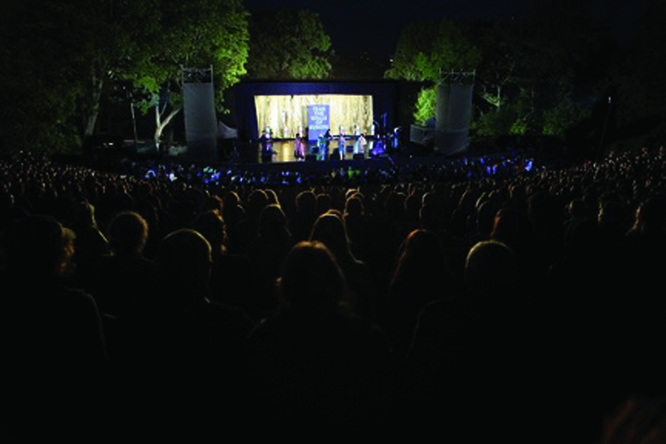
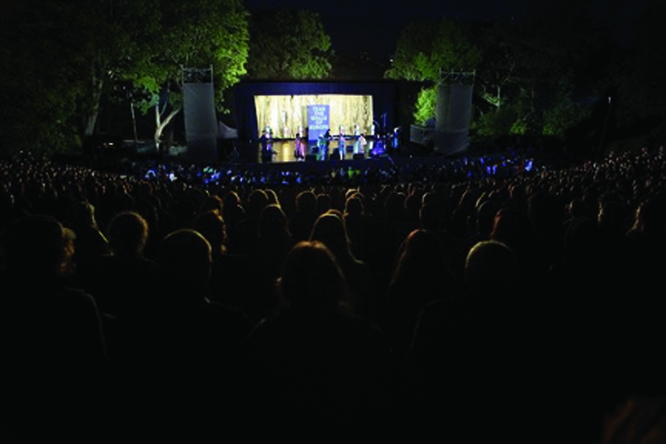
In an initial letter to the performers, which later became the foreword to a booklet distributed to audiences, Aghili proposes countering the racism not just of the Sweden Democrats’ anti-immigrant propaganda but also of the migration policies of the European Union more generally ‘with a queer-feminist attack on its closest ally’ by refusing nationalism. She continues with a list of the things that an ‘antinationalistic resistance embodied as performing arts has to be’, such as ‘without walls (outdoors)’, ‘free of charge’, ‘borderless (in relation to stage and audience)’, ‘expressed through different languages’, ‘embodied by different bodies’, and ‘welcoming (but not limiting by recognition)’.Footnote 2 Onstage the resulting cabaret is part rally and part concert, layering the didactic and the experimental in a performance that Aghili insists must be ‘maximalist and without compromise’, including camp, glitter and courage.Footnote 3 The five performers and two musicians act as hosts and divas, dressed in spangled jumpsuits in jewel and metal tones that are tailored yet loose-fitting. In front of a gold backdrop, they talk, dance and sing through a series of vignettes, oscillating between catchy electronic songs, sincere spoken texts and high-energy direct addresses to the audience, whether satirical, enthusiastic or a combination thereof (see Fig. 1).
Europa Europa’s outdoor stage at Vitabergsparken in Stockholm. Photograph by Patriez van der Wens.
Slogans projected in neon colours at various moments – such as ‘Tear the walls of Europe!’, ‘Anigu marnaba ma noqon karo sharcidarro’ (in Somali, ‘I cannot be illegal’), and ‘No borders no nations’ – reinforce the anti-national ethos of Europa Europa, which belongs to a rising strand of contemporary anti-nationalism called ‘no-borders’ politics. Gaining momentum since the mid-1990s among artists and activist groups, the political project of no-borders is grounded in the idea that the capacity to deal with the human rights injustices produced by borders will be limited until national belonging itself is unsettled. Or, as the guest editors of a 2009 special journal issue on No Borders as Practical Politics explained, ‘the border-control practices of national states not only reflect people's unequal rights . . . but also produce this inequality’.Footnote 4 Instead, working to understand the world from the perspective of no-borders will ultimately ‘activate new subjectivities, ones that correspond with the global level at which human society is actually organized’.Footnote 5 To do so in a reality in which borders proliferate, activist and writer Natasha King advocates a critical form of resistance to borders that is ‘about doing and imagining, practice and theory’.Footnote 6
Many performance scholars understand the temporary event of the theatrical performance to be a site at which to test social possibilities and alternative, perhaps even utopian, ways of being in the world.Footnote 7 In this article, I argue that the Europa Europa cabaret functions to explore the kind of alternative anti-national subjectivities to which the editors of the special issue refer, through the combination of ‘doing and imagining’ that King suggests. The language of performance has been specifically important to understandings of how narratives of nation are constructed. Performance scholars have built on these premises from postcolonial studies, among other fields, to argue for the distinct role that cultural products and the affects that support them play in actively creating, as Erin Hurley puts it, ‘the conditions of possibility from which national reference might emerge’.Footnote 8 Arguments linking performance and nation in this vein tend to rely on the slipperiness of performativity, namely that attending to nation in terms of doing holds space for the possibility of doing differently. A performance model that recognizes the iterative reworking of national performance opens out ideas of the nation, leading to better understandings of transnationalism, post-nationalism and globalization.Footnote 9 However, despite the myriad scholarly languages for the performance of nationalisms, there is little precedent for a discussion of anti-nationalism, in particular one that is grounded neither in resistance to a particular nation state, nor in a more international or universalizing, ahistorical impulse. Expanding the repertoire of anti-nationalisms and performance thus follows Rustom Bharucha's call for new understandings of nationalism that are positioned both against ‘nativist community’ and ‘the glib advocacy of postnationalism’.Footnote 10
Revisiting no-borders politics by means of Europa Europa offers the opportunity to extend performance's contributions to anti-nationalism in a moment of rising nationalisms, focusing particular attention on the various ways in which solidarity might be constituted as communitarian alternatives to the imagined community of the nation. I begin by locating such solidarity in relation to historical cabaret forms – in particular agitprop – that return in the present in new ways to show how Europa Europa aims to build a coalition between various audiences, which supports a temporary community among the like-minded, rather than an advocacy that would aim to change minds. From there, I turn to the staging of solidarity through the theatrical positioning of migration stories and how the ambiguity between inside and outside on which such performances depend has the potential to challenge conventional imaginaries of heroes and criminals. Finally, I look to how the performance provides a training ground for engagement with wider publics, through the multiple contexts in which the cabaret takes form and circulates, including the music video created prior to the premiere, as well as the transition of this anti-nationalist project initially created for a Swedish context beyond broader European to North American audiences. The no-borders politics elaborated in each section depend on mobility, but do not presume that movement across borders is itself unbridled. In the conclusion, I complicate the ‘performance’ model of (trans)nationalisms by elaborating the anti-national friction that develops from these various engagements with solidarity.
Building solidarity through contemporary cabaret
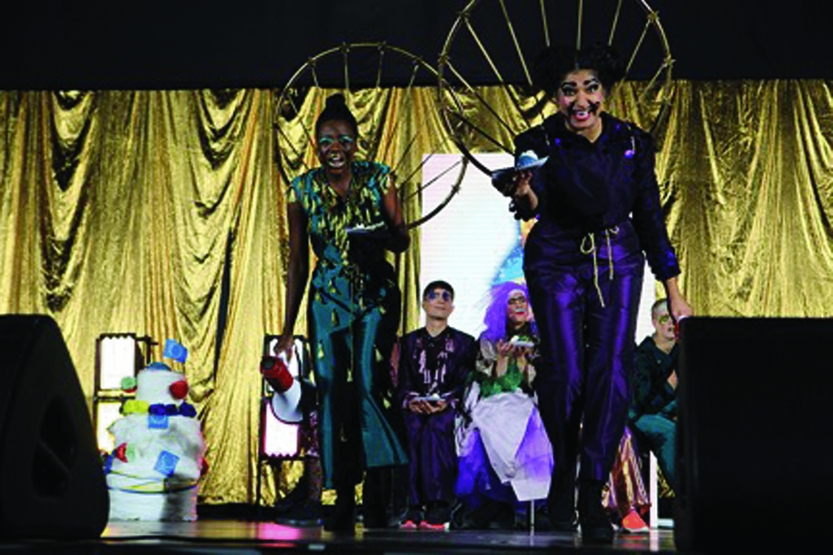
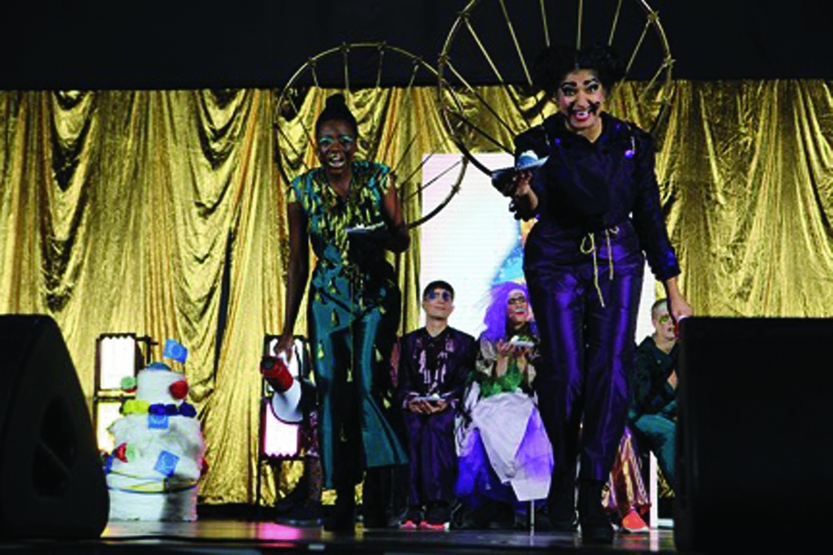
A series of cake scenes forms a leitmotif of Europa Europa. The show begins with the performers sneaking onstage, pulling a large cake on a rope, while singing a birthday song in multiple languages that celebrates the ‘naughty . . . ten-year-old birthday child called FRONTEX’ (the EC's border agency). This is picked up in a later cake scene, in which two performers wearing gold wings and haloes debate who will receive the single piece of cake from their ‘generous’ cake party, while the rest of the cast sit behind them eating. In an extended allegory for the twisted priorities and authentication processes of immigration applications, they ask questions through bullhorns to deliberate on who has the legal right to express their desire to join the cake party (see Fig. 2). The front row may deserve cake for coming early. But perhaps it should go to someone who has never had cake, for which they need verification; two performers interrogate an audience member: ‘Do you have pictures of people eating cake without sharing a single piece with you?’
Performers debate which audience members should receive the one slice of cake. Photograph by Patriez van der Wens.
These cake scenes highlight something important about Europa Europa and the audience it addresses. While cake functions allegorically in each of these scenes as something given away, it does so by playing with a particularly symbolic object, which is explained in a third cake scene. In 2005, news reports surfaced that some members of the Swedish Migration Board had celebrated the deportation of a single mother and her three children with cake, which was taken together with other similar events to be emblematic of the Migration Board's oppositional stance and lack of professionalism toward asylum seekers.Footnote 11 As a result, cake came to be used as a referent in Scandinavian arts activism for power differences with regard to those perceived as being from elsewhere, the most notorious of which was presented by artist Makode Aj Linde in 2012 at Stockholm's Moderna Museet.Footnote 12 However, unlike Linde's piece, Europa Europa’s cakes aim not to entrap, but to facilitate the reparative possibility of communal feeling, in the sense of Eve Kosofsky Sedgwick's differentiation between ‘paranoid’ and ‘reparative’ critical practices as punitively critiquing in contrast to seeking to make better.Footnote 13 The happy-birthday song may call out how long FRONTEX has been operating while infantilizing its aspirations, but, seen another way, it also offers the performers and audience an opportunity to share how many languages they can recognize or sing. Likewise, the cake giveaway operates through a substitution that highlights the challenges of migration; however, the humour of that moment calls together audience members around a collective sense of disgust at the absurdity of demands placed on asylum seekers. In addition, cake was shared toward the end of the Mexico shows among as many audience members as possible.
Looking more closely at the cake scenes reveals how the anti-nationalism of Europa Europa rests on a goal of solidarity, rather than advocacy or even persuasion. If historical nationalisms have built on appeals to an imagined community bound by hard geographical borders or a single ethnic ‘people’, then historical anti-nationalisms have strategically needed to construct solidarity in other ways; socialist internationalism, for example, was about strengthening the ties of a proletariat that cut across geographic borders. Contemporary no-borders politics likewise suggest membership in a global society, in place of national citizenship; however, this membership is not based on work (in terms of the migration-based right to do so), but rather on publics and hospitality. As King puts it, such ideas are not really about migration at all, but rather ‘a certain way of being that's other to the system; that creates or has the potential to create supportive, collaborative, and non-dominating communities of people from different backgrounds’.Footnote 14 Considering the kinds of alternative publics or counterpublics that are constituted by Europa Europa’s particular form of contemporary anti-nationalism requires accounting for the use of performance to build solidarity among a temporary community as an aim distinct from changing minds. To do so, I trace the balance of critical and reparative impulses through Europa Europa’s historical antecedents in cabaret and particularly Weimar-era agitprop traditions of political solidarity, before addressing Europa Europa’s performances at the Swedish political week at Almedalen to show how such practices are altered in contemporary form through feminist, decolonial solidarity that resists complete identification in favour of a coalition that acknowledges unequal power relations.
Over the past decade, increasing recognition of post-migrant theatrical practices across Europe has led to discussions of the salient aesthetic features of such forms, including the tendency to at once appropriate and resist European aesthetic discourses.Footnote 15 The self-designation of Europa Europa by its creators as ‘cabaret’ likewise functions as a placeholder for multiple ideas that mix together various times and places. First, the alignment of Europa Europa with cabaret advertises to prospective audiences that this is a kind of singing and dancing performance in which the performers may be seen as heightened versions of themselves, rather than a form of naturalist theatre in which there is a tacit agreement that the performers will successfully embody specific characters. In addition, referencing Weimar cabaret's canonical historical forms through the sharp, politically aware satire of vignettes like the cake scenes recalls with them the Weimar Republic, a historical moment that serves as a warning of how National Socialism's racism and autocracy grew up from within as one of many radical political experiments of the time.Footnote 16 Finally, while the artists reference the Weimar era, they also draw on more recent forms from the second half of the twentieth century through which political satire was passed down, using a longer history of cabaret to suggest that this show is made by, represents and speaks to minority or marginalized voices. These include specific traditions that have directed European cabaret forms toward concerns regarding identity and belonging, as in the traditions of Ethno Kabarett, including Turkish-German work.Footnote 17 However, Aghili points out other associations with modern cabaret as well, on the one hand in a European context as a queer practice, and on the other in Iran, where one of the better-known manifestations is as a quasi-erotic show.Footnote 18 It is through these alternate lineages that Europa Europa recognizes and plays with the limitations for social critique in Weimar cabaret's most-known form, best exemplified by historian Peter Jelavich's explanation that such satire risked empty criticism with no allegiances. Rather, it functioned as a kind of safety valve that allowed Weimar audiences to let off the steam of their pent-up anger against social ills, instead of forcing them into action that might have united the communists and socialists and stemmed the tide of National Socialism.Footnote 19
The historical agitprop tradition is never explicitly called out by Europa Europa’s makers in discussing their reanimation of cabaret forms, and yet this is where the opportunity for critical performance to reparatively constitute solidarity becomes most clear. One strand of agitprop performances in particular in the late 1920s and early 1930s took place outdoors as a kind of happening that aimed to catalyse audience response. Tactics such as these are represented by the scene in the movie Kuhle Wampe oder: Wem gehört die Welt? (1932) by Slatan Dudow, Bertolt Brecht and Hanns Eisler, in which a debate is staged about coffee production among performers scattered throughout the crowded train car, to draw fellow passengers into considered discussion.Footnote 20 Another example is the 1930 performance by the communist group Die Ketzer in which passers-by were lured into conversations about social disparity by the juxtaposition of a young man seemingly collapsed of starvation outside a bakery with its windows full of goods.Footnote 21 These examples combine strategies from experimental theatre with a strong political compass that ultimately put art to work as an instrument of social change. To do so, they presented material in a dialectical form, from which unwitting audience members were meant to develop their own arguments. The goal, however, was to advocate for the international solidarity of workers, which ultimately fit into the period's understanding of solidarity as connected to the political demand both to question the existing order of things and to look forward to a different future.Footnote 22
Europa Europa premiered as part of Almedalen Week, a week-long Swedish political forum that began in the 1960s, but picked up momentum at the turn of the century, today attracting approximately 35,000 participants annually. At Almedalen, Europa Europa was listed as an ‘Anti-nationalist critique of European migration policy in the form of cabaret’ – a description that clearly positioned the performance as a means through which to practise politics in agitprop style. Although the performance itself was not a surprise, there was something covert in the use of cabaret performance as a rally form, in place of more conventional political spectacle. This was further amplified by Europa Europa’s playful categorization on the online schedule, in which the event category was listed as a ‘seminar’ on the topic of ‘human rights’.Footnote 23 After Almedalen, the initial Swedish performances were all scheduled prior to the election, and that quality of ‘informative/intimate’ direct address continued even as the cabaret was adapted to new, theatrical venues.Footnote 24
However, if Europa Europa draws on aspects of agitprop tradition, the type of solidarity that is ultimately the goal of its politics by means of performance and the tactics by which it achieves that solidarity vary in several ways, and this has much to do with the intended audience. Rather than using the performance to establish the international solidarity of a single group (workers), multiple audiences are drawn together through the cabaret into a kind of solidarity that continues to recognize the differing and unequal power relations among them: what theorist Chandra Mohanty would call ‘strategic coalitions’.Footnote 25 Mohanty's ‘solidarity’ – itself evolved in part from a history of socialist feminism – is defined ‘in terms of mutuality, accountability, and the recognition of common interests as the basis for relationships among diverse communities’.Footnote 26 Looking to Europa Europa, one audience is the migrants and asylum seekers both in Sweden and on tour, whom the production team made a serious effort to reach. For example, under their contract with Kampnagel, in Hamburg, the festival provided buses and dinner for inhabitants of local refugee camps, which were on the outskirts of the city; at Centro Cultural Tijuana, Ful paid for the buses; and in Ghent, they donated the full fifteen-thousand-euro box office from the Vooruit theatre to Hand in Hand, a local non-government organization working with asylum seekers. Another purpose of the performance is to provide what the performers themselves need – a safe space for those witnessing and experiencing prejudice in European cultures. A third audience may not directly experience such structural racism, but is nonetheless in a position to recognize it.
With these three overlapping constituencies, Europa Europa sets itself apart from a European performance trend that Azadeh Sharifi and Steven Wilmer identify as attempting to ‘“educate” the audience’ on the topic of refugees but ultimately addressing ‘white audiences but not the racialized groups, or an audience that lives in a diverse society’.Footnote 27 It is telling that, at its first performance during the political week at Almedalen, Europa Europa played near a Sweden Democrats event that was going on simultaneously also under the auspices of the political festival, while setting new lyrics to Parvati Khan's 1982 ‘Jimmy Jimmy Ajaa’ (from the Bollywood hit Disco Dancer) that satirized Jimmie Åkesson, the SD leader. Europa Europa was never meant to build bridges to those who did not agree, but to provide support for those who do.
In this form, a coalition based in anti-nationalist solidarity is about using the reparative potential of performance to temporarily bind the already converted, who nevertheless need support, strength and reassurance in the face of the kind of anti-immigration, right-wing, populist nationalism that the rise of the Sweden Democrats represents. Writing about the experience of being in the audience at that first performance, journalist Sara Abdollahi extends Europa Europa’s performative strategy of representing such solidarity onstage through the sharing of voices and stories for the newspaper Arbetaren (The Worker), by beginning with her own family's border crossing and the conditional circumstances under which they were able to enter Sweden while others could not.Footnote 28 Abdollahi anchors that within seeing Europa Europa at Almedalen in particular. In place of what she calls the ‘empty language of campaigning’, the anti-nationalist cabaret had created the possibility for her body, side by side with those of the performers, to challenge the ‘white supremacy’ that she reported observing both at the political week and in society at large. If Europa Europa echoes suggestions that the only way to stop the violence being perpetrated at Europe's external borders is to refuse nationalism – thereby taking down the internal borders of Europe and thus the external ones as well – then Abdollahi's account suggests how this might be possible through an approach that not only critiques nationalism's implications for human rights, but also takes responsibility for building new alliances.
In conversation, Aghili and others involved in the performance have described their concerns in developing the project; some could not imagine making something so radical while attracting a large audience. Yet they have also described the way in which that seeming contradiction played out in their experience of the early performances, including a kind of awe about the ability to share quiet moments and silences with up to six thousand people at a time.Footnote 29 Europa Europa recognizes this as a two-way street, and the performers thank the audience in the penultimate scene:

The need for thanks reiterates that Europa Europa’s solidarity is neither premised on unity, nor does it produce something solid; rather, it is hard to hold onto because it is continually being re-formed. While the makers sometimes cite a generic Weimar-esque cabaret, which would ordinarily suggest political satire, the reparative politics by means of performance in fact are descended from other cabaret practices, including a lineage of agitprop. Looking more closely at agitprop history, however, reveals the importance of audience for anti-nationalism, and particularly Europa Europa’s very contemporary approach to building solidarity among the multiple constituencies.
Being heroes: performing between inside and outside
The idea that ends the thank-yous – of the performers not playing but being heroes – is important to staging solidarity. Whereas early agitprop was driven by performers assuming archetypes or propaganda stereotypes, later forms such as the train conversation and the bakery window collapse emphasized an ‘enactment closer to real life – deceptively closer . . . than to art’.Footnote 30 Although the Europa Europa performance itself is relatively demarcated, what is more ambiguous is the relationship of its performers with the larger body of migrants whom they advocate should be seen as heroes. Many of the performers, as Europeans of colour, participate in a form of partial non-matrixed representation, by which their appearances as themselves onstage may already signify the idea of migration, even without directly performing as migrants as such. On the one hand, Aghili notes that ‘you are already an activist by walking around in the body you have, if you look like me’, but on the other hand, she pushes (via Sara Ahmed) for performance strategies that work to ‘make performers of colour not feel othered’, among other things by oscillating between roles to stand for both themselves and others.Footnote 31 Here I consider how putting the performers’ own bodies on the line extends their performance strategies of coalitional solidarity to refigure more conventional imaginaries of the migrant in a European context, and what this more porous staging contributes to defining an aesthetics of anti-nationalism.
One of the first lines of Europa Europa welcomes audiences to Europe, a construct that complicates discussions of national identification. The cabaret follows popular arguments that the premise of open borders within the EU and Schengen countries and ‘unlimited’ (internal) mobility have solidified an ‘unfree’ external border – a concept sometimes pejoratively referenced under the repurposed phrase from the Second World War: ‘Fortress Europe’. As Marilena Zaroulia and Philip Hager point out in Performances of Capitalism, Crises, and Resistance, the idea of being inside versus outside reframes Europe as ‘at once exclusive and privileged’.Footnote 32 In addition, being physically inside is not always the same as being understood to belong. As Fatima El Tayeb explains in European Others, once EU unification diffuses many of the formal state border infrastructures within Europe, ‘the border is now everywhere’ because dividing lines between European and non-European are reinforced along perceptions of cultural difference.Footnote 33 However, performance has the potential to unsettle binaries like inside and outside, by producing, as Zaroulia and Hager put it, ‘new subjectivities and webs of solidarity beyond monolithic definitions of Europeanness’, thus making visible the dense heterogeneity that is often lost in the European imaginary.Footnote 34 El Tayeb describes artistic practices developed by second- and third-generation visible minorities that are characterized by an ‘emerging postethnic, translocal European identity’ that tactically leverages the marked status of Europeans of colour to ultimately perform a kind of disidentification. This ‘queering of ethnicity’ depends on creatively transforming the tension of living with many seemingly exclusive identities into ‘a community based on the shared experience of multiple, contradictory positionalities’.Footnote 35 One of El Tayeb's key points is that such work being done by artists precedes academic theorizations of European identity vis-à-vis migration in the way their minority activism navigates a ‘“postethnic” understanding of identity that is not built around racial identification but nevertheless challenges the European dogma of colorblindness by deconstructing racialization and the ways in which these processes are made invisible’.Footnote 36
Instead of clearly defining the intersecting race and gender experiences embodied by the director and the performers, Europa Europa plays with theatricality and polyvocality, suggesting in various scenes that the performers oscillate between multiple positions and roles to tell migration stories that may or may not be their own. Even when one person is speaking, they are always supported by multiple bodies and voices. One scene called ‘Tack Mamma’ is structured through a series of thank-yous that form a testimonial about a border crossing, addressed to an absent mother. The scene begins with all five Ful performers speaking, before dropping to two who take turns with thanks that cover various details, out of order, of choosing to leave family, physical travel, police detention and acclimation to a new place. The text of the scene itself is based on a story that is partly that of Aghili, but, as performer Rani Nair explains, ‘It's some Nasim, but someone is crossing the border right now or trying to, and so this could be their story as well’.Footnote 37 The rigid structure of repeated thank-yous to an absent figure, together with the multiple speakers, resists completely binding the narrated events to any individual onstage. In addition, the visual location of the absent mother in the audience not only prefigures the thanks to the audience at the end, but also suggests that they too might have taken part in such a journey.
Explaining the use of such strategies in relation to the ways in which Europa Europa reworks historical practices, dramaturg Malin Axelsson points out the production's desire to depart from the Weimar cabaret as ‘a venue where the stranger is portrayed as a fetishized object’.Footnote 38 Rather than a single emcee who stands apart, for example, the performers share the role, not only distributing the outsiderness among the collective, but also enabling them to speak for those who are not there. It is a dangerous game – on the one hand it could lend credibility to the already pervasive perception that all bodies of colour are from elsewhere. But on the other hand, by risking this marginal position, the performers also claim space to be inside differently in a way that simultaneously unsettles boundary lines. As Aghili puts it, via Shahram Khosravi on the experience of ‘homelessness’ and exclusion as part of being perceived as a person of colour, ‘it is only by not claiming a home that everyone can be welcomed, that everyone can be included’.Footnote 39
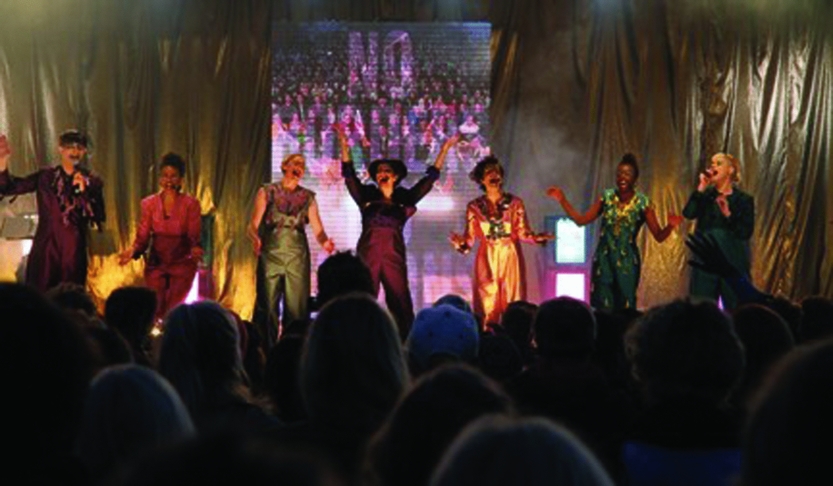
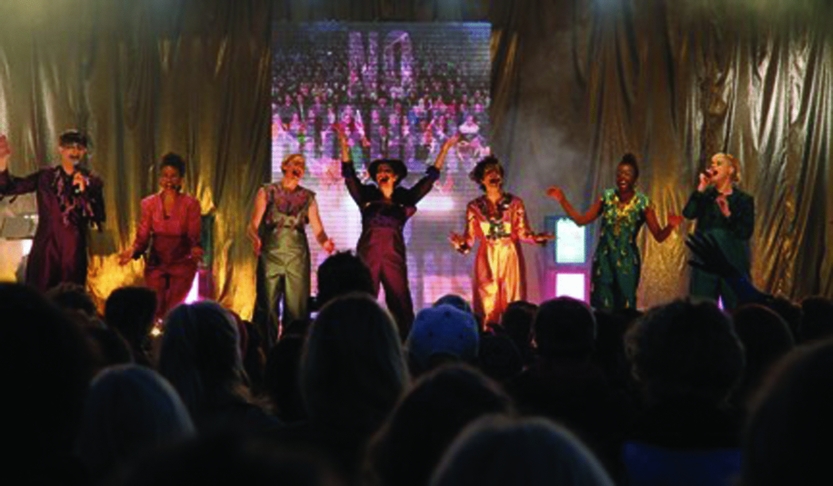
In another scene, one voice speaks as a chorus of four performers echoes lines about an immigration journey so intense that ‘[t]hat's why it felt so strange when I got here. I was completely sure I'd be greeted as a hero’. This move, by which the performers use ambiguous representation to align themselves with migrants, and then reposition migrants as heroes, is repeated throughout Europa Europa, and both reinforced and extended by the song that ends the show (see Fig. 3). The lyrics of ‘För Alla Namn Vi Inte Får Använda’ begin, ‘you call me [this]’, ‘we are called [that]’, including ‘parasite’, ‘burden’, ‘criminal’, ‘illegal’ and so on. However, as the title lyric – ‘For All the Names We Are Not Allowed to Use’ – suggests, the group represent both themselves and others because they have the ability to do so. Once the verses establish this, the song flips in the chorus. There is a request to ‘call us by our real names’, but the name that should be used for those for whom these surrogates stand is ‘hero’: ‘Call me hero! Call us heroes!’
Singing ‘För Alla Namn Vi Inte Får Använda’ onstage. Photograph by Patriez van der Wens.
Migration scholar Bridget Anderson highlights the potential for new imagery as a first step in contesting the slippage from migrants to criminals. Anderson argues that the popular imagination of borders as controlled by guards and immigration mandates needs to be replaced by a different image of borders: those between ‘citizen’ and ‘migrant’ that mutually define one another and ultimately the normative construct that constitutes the modern state. Looking this way at borders, categories such as ‘non-citizen’ do not depend on legal immigration or citizenship status so much as on a community of values.Footnote 40 This is why certain people tend to be designated migrants even after achieving citizenship, and their progeny become second- or third-generation migrants. It is under that same set of tacit agreements that it is easy for one designated a non-citizen to be ‘to be imagined as the “illegal” and thereby associated with the Criminal’.Footnote 41
However, Anderson points to the ways in which those at risk of failure – those in racial and/or ethnic categories of the ‘tolerated citizen’ or perhaps even the ‘non-citizen’ – often disassociate themselves from failed citizens, and this is where Europa Europa differs.Footnote 42 In contrast to such ‘divide-and-rule’ tactics, the performers in Europa Europa take on positions that oscillate between inside and outside in moments such as the final song. The staging of solidarity onstage among the performers in turn enables them to speak for those who are not there, without turning them into strangers. From the perspective advocated by Anderson, this would seem to be precarious – solidarity is the opposite of disassociation. In addition, the risks of staging one's own body in solidarity are not just social but physical; part of the budget for the initial tour went to hiring substantial security for the initial outdoor productions, because there had recently been threats and attacks against artists and also demonstrators in public spaces in multiple Swedish cities. However, it is precisely because of such a context that the identification as illegal matters to Europa Europa’s aesthetic of anti-nationalism. Aghili suggests that her manifesto for Europa Europa should be seen as ‘a love letter rather than an artistic concept’, because that is what will get the performers through the experience.Footnote 43 There is a hopeful kind of Europeanness to the performers’ non-matrixed representations, which remind those present that a substantive reimagining of the migrant figure would require replacing society's foregrounding of legality with an alternative community of values, even if just for a few moments.
Doing the political Macarena
The types of counterpublics drawn together by the coalitions described above are most often also located within (bourgeois) public spheres. As much as they may serve as temporary spaces of withdrawal, their end goal is not to be separate; rather they function as training grounds for activities directed at wider publics.Footnote 44 In order to reconcile the desire for its performance of anti-national politics to reach a wide swath of audiences and the commitment to challenging traditional theatrical infrastructures of circulation in a world with borders, Europa Europa relies on various alliances beyond those described above. For example, on the one hand, some of the main initial funders were the two Swedish national arts funding bodies, Konstnärsnämnden and Kulturrådet, together with the Knife themselves, who donated time and resources. On the other hand, the production operates to some degree under the principles of the Ful collective, including accepting support from local activist organizations when they tour, while turning down offers of collaboration with certain larger organizations in order to maintain more artistic control over the project. Placing the material conditions of production around Europa Europa alongside aspects of the work itself, this section brings to the surface the tensions inherent in such practices of alliance building. These examples reflect on the relationships between publics and counterpublics in the enactment of anti-national solidarity through Europa Europa’s final song and its music video, and finally the cabaret's North American tour.
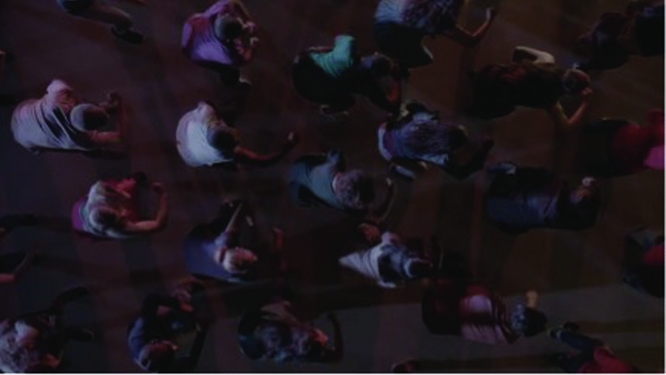
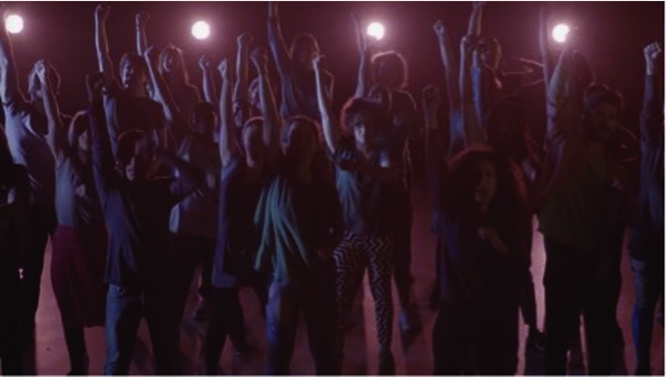
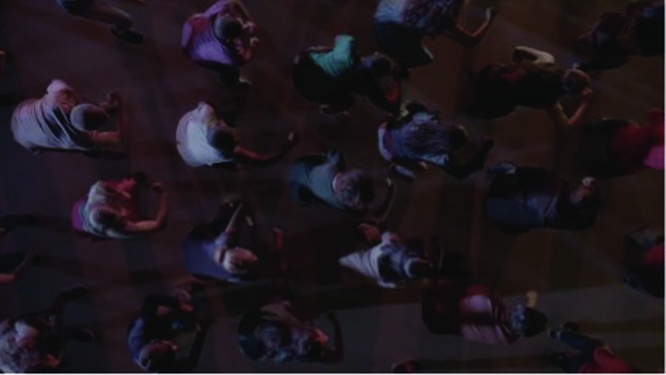
The music video of ‘För Alla Namn Vi Inte Får Använda’ was released several weeks before Almedalen, on Swedish national day.Footnote 45 The lyrics analysed in the previous section were written by Aghili and set to music by the Knife, as with all the songs within the show. Appearing as the final scene of Europa Europa, the song reiterates the ideas and language that have been previously established to reimagine border discourse, including the rejecting the association of migration with illegality and flipping the roles of heroes and criminals. But whereas the show was controlled by Ful, the video was developed by the team of Roxy Farhat, a visual artist who worked with Europa Europa as stage designer, but also works in music video production. Comparing the two media in which the song appeared, both the critical and the reparative edges of the cabaret are softened in the music video. While the live cabaret places five Ful members onstage plus the band, in the video they are joined by dozens of other performers, all of whom have backgrounds connected to migration; some are known activists and a few are refugees with no papers. A form of melancholy replaces sharp anger and wit, while faded street clothing replaces sparkly jumpsuits, in a manner that is not quite offset by the smoke and lasers (see Figs. 4 and 5).
Screen grab from the ‘political Macarena’ in the music video of ‘För Alla Namn Vi Inte Får Använda’.
Screen grab from the ‘political Macarena’ in the music video of ‘För Alla Namn Vi Inte Får Använda’.
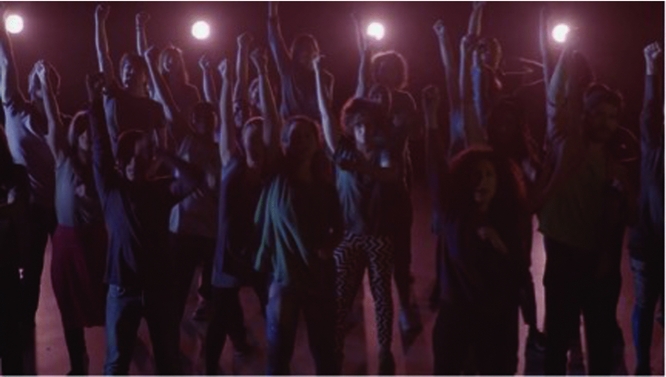
The most striking visual part of the song's music video is the choreography by the group Dom Dugliga, in particular what they call a ‘political Macarena’, to which the description on the Knife's YouTube channel suggests viewers should learn the steps and dance along. The movement of the political Macarena is created from three main dance vocabularies that are used onstage throughout Europa Europa: voguing from American ball culture, the butch Persian dance style of baba karam and Bollywood. The Macarena model itself has a long history, but it was the movement pattern together with a semi-English-language remix that reached anglophone listeners in 1996 in a ‘strange transnational strain of Latinadad’.Footnote 46 That form of the Macarena was a group dance that maximized participation by repeating a very simple sequence of movements in what musicologist Melinda Russell describes as an ‘atmosphere of inclusion’, exemplified by the movement pedagogy built into it, the focus on arm movements that are relatively unthreatening to the self-conscious, and the short cycle that maximized opportunities to get back in.Footnote 47
The ‘political Macarena’ in the Europa Europa music video employs a similar pattern also made of twelve or so moves that alternate sides and change orientation by ninety degrees in the room, but the differences between the two simple choreographies are striking. The sexual content of the 1990s song was partly hidden in the bilingual lyrics that were, as Russell points out, all about touching multiple other people while doing a communal dance in which one touches oneself.Footnote 48 By contrast, the body operates differently in ‘För Alla Namn . . .’.Footnote 49 The beginning hits with the fists are much sharper than the unfurling flat-handed reach of the Macarena, and even when the fists are pulled down into a quasi-mudra that is evocative of Bollywood dance styles, the arms stay powerfully away from the body, as the knees are eventually brought high for the quarter turn that precedes the looping of the choreography.
Importantly, the bodies do not keep the rhythm like they do in the 1990s dance. The Macarena's 1996 music video suggests the dance as a kind of bait and switch between the writhing bodies of the individual dancers and those suckers who are invited to ‘move with me, dance with me, and if you're good I'll take you home with me’, which then translated in the amateur group form to a kind of pleasure of bouncing together in the synchronized mass.Footnote 50 In Europa Europa’s political Macarena, however, there is a stillness to the core of the body from which the controlled movements emanate. This is not about the pleasure of dancing in a group, but about the visibility of it. What the music video proposes is a form of not only ‘dancing for’ someone (the unnamed migrants), but also ‘dancing for’ something other than oneself (human rights). At the same time, that very serious form of resistance is grounded in a melancholy world of what-is, which does not allow for the live performance's more optimistic slippages into glitter-fuelled what-might-be.
This music video was picked up as a teaser for the cabaret performances, but also as a single by Europa Europa’s ‘house band’, the Knife. The release of the video received articles on Billboard, MTV, Pitchfork, Spin, and other online music news websites, all featuring the band as protagonist, even as it brought attention to Ful and the project as a whole. The band lent celebrity and connections that enabled the collective to operate on a large scale and reach wider publics, at the same time as the experimental collective also lent a particular set of activist bodies to the band's existing investments in political work. For example, the Knife's famously reticent Dreijer duo agreed to an interview in Dagens Nyheter, one of the two main Swedish newspapers, only to turn the answering of the actual interview questions over to Aghili behind the scenes, thereby amplifying her voice as theirs.
An instructive comparison can help to articulate the potential but also the ambivalent politics of such alliances. Writing about the Glow ‘flash mob’ that was created for the interval act of the 2010 Eurovision Song Contest in Oslo, Zaroulia proposes that this ‘aspired to present Eurovision audiences with a possibility of participation in the contest and, metaphorically, Europe’.Footnote 51 The Eurovision segment begins and ends by cutting to various public locations in which large groups of people carry out simple mass movements accompanied by an uptempo song by Madcon; in the middle, however, the group numbers get smaller, the spaces become on the whole more interior, and the movement changes from the unison choreography of a song to individual people dancing to that song. Pointing out how such a moment works outside conventional EU institutions that have failed to convene spaces for shared public feeling, Zaroulia comes to the conclusion that ‘the flash mob was an appropriate strategy to briefly articulate Europeanness as an impossible principle while indicating how multiple communities can shape public spheres through embodied experiences of participation’.Footnote 52 On the one hand, the Glow performance was constructed in a manner that was meant to ‘ripple out’, a phrase Zaroulia borrows from Jill Dolan's discussion of utopian performatives, and thereby offer a temporary means for European subjects to come together. On the other hand, however, Zaroulia argues that this potentiality was undercut by the ultimate form in which it took place: ‘the synchronized dance number produced a naïve understanding of shared identity and celebrated what can otherwise be perceived as a rather dystopian uniformity’.Footnote 53 Nonetheless, this ultimate failure proves for Zaroulia the potential for alternative strategies of staging Europe, and particularly the need to work beyond EU politics to pursue affective approaches to feeling European.
A comparison with Glow invites us to see the music video of ‘För Alla Namn . . .’ not as an endpoint to demonstrate a synchronized community, but rather as an invitation to practise joining a coalition. Here, it is important to note the choices made by Europa Europa’s cast members in live performance. Whereas the music video is widely used in advertising the show, the performers do not necessarily represent its choreography onstage during the final number. After the thank-you scene, they motion for the audience to rise, if they are not doing so already when the music begins, and they start to sing, keeping time and music with their bodies. The audience clap with them, and the performers wait to see whether audience members seem to be interested in dancing a political Macarena, only joining in if they see enough audience members beginning to carry out the movements. In other words, the performers mirror the audience, rather than the other way around. Thus the political Macarena happened at the first Almedalen show, but not, for example, at Södra Theater in Stockholm. There is no assumption about the temporary public sphere that is held together by this shared movement, or even the nature of the movement that would be required to create that space; it is reconstituted by choice rather than coercion. That choice to participate depends not only on the temporary community within the space of the performance, but also on how audience members choose to connect it to their experiences of having seen the video in the outside world.
The flexibility required to connect public and counterpublic spheres for this anti-nationalist cabaret is reinforced by Europa Europa’s travels to Mexico and the US for its first non-European performance engagements in November 2016, just after the US presidential election. Rather than focusing only on the EU's FRONTEX, the existing show was translated into Spanish and English, with parts adapted to the situation of migrants along the Mexico–US border, thus expanding the investment in solidarity by focusing on the ways in which migration policies in many places are grounded in similar ideologies. Although the Knife had continued to perform for the prior European tour after their own brother–sister partnership had broken up, they decided with Ful to hand off the next tour to local Mexican musicians Paulina Lasa and Moisés Horta to adapt and perform their interpretation of the Knife's music.
Horta had already seen Europa Europa in Sweden while on tour with his own band, Los Macuanos, whose work is key in the development of the ruidosón genre in the past decade: a kind of politically motivated electronica that makes use of regional Mexican musical patterns. In an interview, Horta describes the many geographical places and borders that influenced their project of bringing Europa Europa – already itself connected to many contexts – to a Mexican audience: ‘There's a lot of Middle Eastern vibes, taking into account that the play is about immigrants from that area. We're linking it to the immigration issues particular to Latin America, which requires more Pre-Hispanic aesthetics and guapachoso rhythms’.Footnote 54 Horta suggests that this process of adapting this anti-nationalist cabaret to new borders and new audiences built from existing ideas and concerns within the performance project itself. From the start, the cabaret format had been chosen as a flexible way to communicate with the audience, one that could be updated by ongoing research to reference the contemporary of the performance, and this was something that had gone on throughout both the Swedish and the Central European tours as well. However, the adaptations of Europa Europa for the North American tour bring sharply into focus what is already implicit in the example of the final song and its music video: that to create temporary theatrical training grounds for a wider public, and ultimately build anti-nationalist alliances within a transnational context by inviting different audiences to opt in, requires operating an eclectic aesthetic, responsive to local specificities, yet capable of circulating by recognizing how practices are already in circulation.
Conclusion: on friction
In her manifesto letter inviting artists to participate in Europa Europa and imagining what it might be, Aghili describes the event conspicuously not in terms of performance at all, but rather as ‘an antinationalistic resistance embodied as performing arts’.Footnote 55 In addition, when speaking to the press about Europa Europa, the artists tend to redirect their answers immediately to a series of talking points about migration. While writing about Europa Europa as performance risks describing the work in a way other than its activist intent, to articulate the work only in terms of its border discourse misses what enacting a no-borders politics by means of performance may offer to considering anti-nationalism as a time- and event-based practice of connection. I conclude by building on Europa Europa’s formulations of solidarity to acknowledge the critical work that the performance is doing, specifically how Europa Europa might offer the opportunity to practise a theory and a way of theorizing the frictions of strategic anti-nationalism.
Europa Europa’s politics of anti-nationalism in the shape of performance depend on various forms of solidarity that still allow for difference. The reparative performance builds a coalition between audiences that focuses on support, not advocacy, while developing an aesthetic that challenges the imaginary of migration as locked into the opposition of inside and outside, and does so with enough flexibility to offer a training ground for new publics. Each of these forms of solidarity contributes to a politics and aesthetics of performing anti-nationalism that recognize the inevitability and importance of movement at the same time as it does not presume that to be easy. Mohanty explains, ‘Feminism without borders is not the same as “border-less” feminism’.Footnote 56 Likewise, no-borders politics must acknowledge ‘the fault lines, conflicts, differences, fears, and containment that borders represent’.Footnote 57
On the one hand, Europa Europa underscores the inevitability of migration. The performance aligns with recent political projects that reimagine migration in a manner that does not presume stasis as a norm.Footnote 58 No-borders theorists argue that, as long as migration is an aberration, then ‘people's mobility is seen as only ever caused by crisis and as crisis producing’.Footnote 59 The normalizing of such mobility is seen not only in the bodies onstage and offstage in Europa Europa, but also in the global repertoire of referents on which the performance draws. However, while no-borders politics are sometimes described as ‘politics of movement’, the practicalities of performance practice reveal how and in what ways people can be brought together, as well as the sticking points that persist. From a sociological perspective, John Urry talks about the need to attend to such stickiness in terms of mobility capital: the uneven distribution of capacities and competences for mobility, based on the social, political and physical affordances for movement.Footnote 60 In the framework of an anti-nationalist cabaret, whose aesthetic is so deeply suffused by a utopian celebration of this inevitability, it feels important that so many of the stories shared onstage, and even the bringing together of audiences themselves, recognize difficulty. Europa Europa foregrounds mobility as pervasive and yet illusory, by calling attention to what are in fact differentials of mobility capital inherent in national and supranational positionings.
This is where the idea of anti-nationalism as friction is important. Post-national, for example, would suggest the possibility of being beyond inside and out; however, as El Tayeb and others have argued, any claim to post-nationalism within Europe still relies on implicit nationalism that does a disservice not only to those from elsewhere, but also to those perceived to be from elsewhere. By contrast, the no-borders anti-nationalism of Europa Europa recognizes multiple, polysemic border sites while marking resistances to them that leverage and complicate both inside and out. It took me a while to notice that the English phrase that appears in the music video and on the staged projections is ‘Tear the walls of Europe’. In my mind, I kept inserting the word ‘down’, which is conspicuously missing. However, the aim of Europa Europa’s strategic anti-nationalism is not to tear walls down, but rather to offer tactics to render them more visible and more permeable at the same time.
Friction is most commonly understood as the force that resists the sliding of one object over another. But as an oppositional force that needs to be overcome for motion to begin or continue, friction is also the basis of all movement – without traction there could be no push. Through this necessary force of opposition that both slows and enables mobility, friction causes wear and tear. Europa Europa encourages temporary practices of coalition between multiple constituencies and across multiple types of borders in a manner that tears at walls by refusing both inclusion and exclusion. By repeatedly practising such strategic anti-nationalism, these borders might wear over time, to ultimately become more porous.